Amir Khusrau and His Contribution

Amir Khusrau (c. 1252–1325) stands as one of the most extraordinary figures of medieval Indian cultural history — a Sufi poet, musician, and literary genius who adorned the courts of seven successive Delhi Sultans, from Balban to Ghiyasuddin Tughluq, earning the popular title Tuti-e-Hind (“the Parrot of India”). Far more than a court poet, Khusrau was a pioneering figure who fused Persian and Indian literary traditions, chronicled the political history of his age through a remarkable body of historical masnavis, contributed decisively to the evolution of Hindavi and North Indian classical music, and left behind a body of work whose historical value continues to be debated by historians to this day. This article traces Khusrau’s life and career across the courts of the Delhi Sultanate, surveys his major literary works and their historical significance, examines his contributions to regional language and music, and finally considers the historiographical debate over whether Khusrau should be regarded as a genuine historian or merely a poet writing about history.
Life and Career
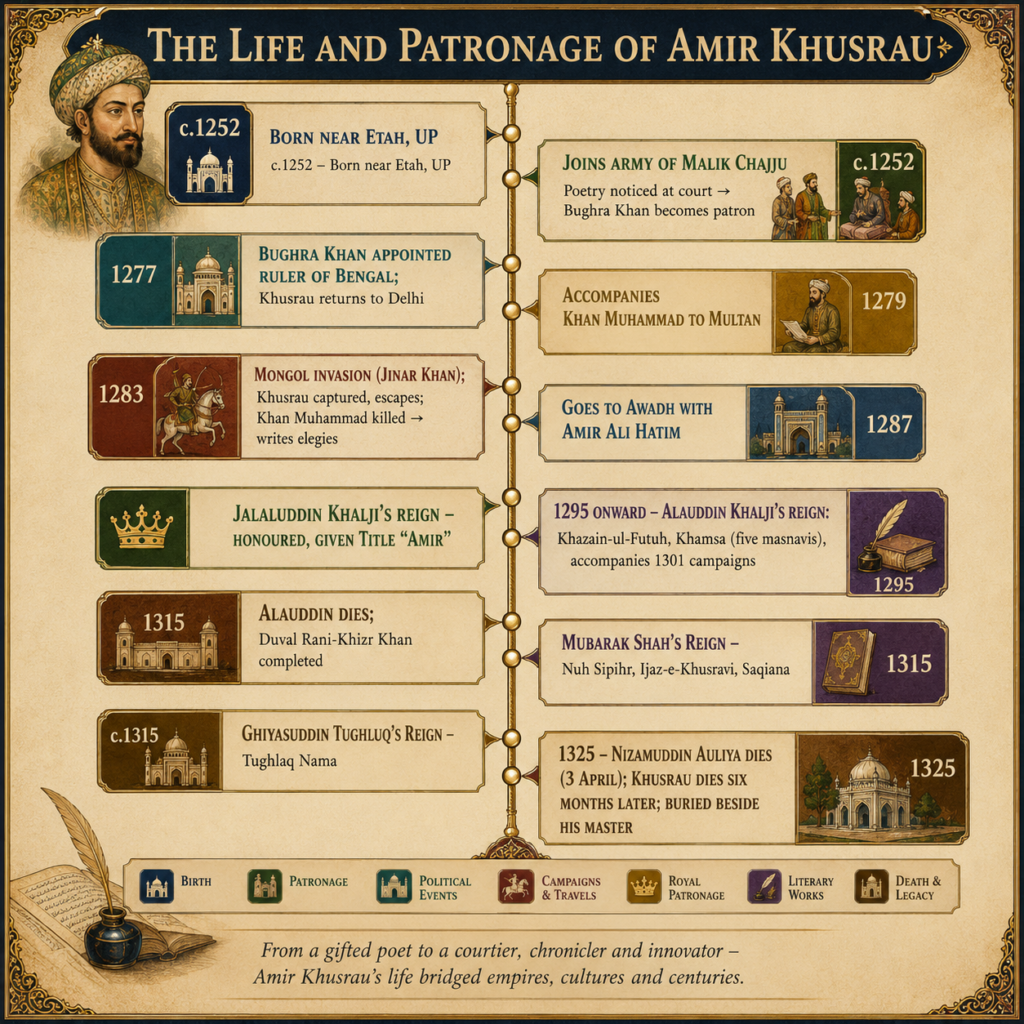
- Amir Khusrau (c. 1252–1325) was a Sufi poet, musician, and genius as a writer. He adorned the courts of all the Sultans from Balban to Ghiyasuddin Tughluq as poet laureate, and was popularly known as Tuti-e-Hind — “the Parrot of India.”
- Amir Khusrau was born near Etah, Uttar Pradesh.
- His father, Amir Saifuddin, came from Balkh. He was a mystic, and a spiritual disciple of Nizamuddin Auliya of Delhi.
- After his grandfather’s demise, Khusrau joined as a soldier in the army of Malik Chajju, a nephew of Sultan Balban.
- This brought his poetry to the attention of the Assembly of the Royal Court, where he was honoured.
- Bughra Khan, son of Balban, was invited to listen to Amir Khusrau. He was impressed, and became Khusrau’s patron.
- In 1277 A.D., Bughra Khan was appointed ruler of Bengal, but Amir Khusrau decided to return to Delhi.
- The eldest son of Balban, Khan Muhammad (who was in Multan), came to Delhi. On hearing about Amir Khusrau, he invited him to his court.
- Khusrau finally accompanied him to Multan in 1279 A.D.
- Multan at that time was the gateway to India, and a centre of knowledge and learning — caravans of scholars, tradesmen, and emissaries transiting from Baghdad, Arabia, and Iran to Delhi passed through Multan.
- In 1283 A.D., Jinar Khan, a Mongol, invaded India.
- Khusrau participated as a soldier in the war against the invading Mongols. He was taken prisoner, but escaped.
- Khan Muhammad was killed in battle; Khusrau wrote two elegies in grief of his death.
- In 1287, Khusrau went to Awadh with Amir Ali Hatim (another patron).
- After the death of Kaikubad (son of Balban), the Turk soldier Jalaluddin Firuz Khalji took power and became king.
- He appreciated poetry, and invited many poets to his court. Khusrau was honoured and respected, and was given the title “Amir.”
- He was given a court appointment; court life made Amir Khusrau focus more on his literary works. Khusrau’s ghazals, composed in quick succession, were set to music, and sung by singing girls every night before the king.
Under Alauddin Khalji and His Successors
- After Jalaluddin, Alauddin Khalji ascended the throne of Delhi in 1295 A.D.
- Amir Khusrau wrote the “Khazain-ul-Futuh” (“The Treasures of Victory”), recording Alauddin’s construction works, wars, and administrative services.
- He then composed a quintet (khamsa) with five masnavis.
- Alauddin Khalji was highly pleased by his works, and rewarded him handsomely.
- In 1301, Khalji attacked Ranthambhor, Chittor, Malwa, and other places, and Khusrau remained with the king in order to write chronicles.
- In 1310, Khusrau became close to Nizamuddin Auliya, and completed the Khazain-ul-Futuh.
- In 1315, Alauddin Khalji died. Khusrau completed the romantic masnavi “Duval Rani-Khizr Khan.”
- After Alauddin Khalji’s death, his son Qutubuddin Mubarak Shah became king.
- Amir Khusrau wrote a masnavi on Mubarak Shah, titled “Nuh Sipihr” (“Nine Skies”), relating events of Mubarak Shah’s reign.
- He classified his poetry into nine chapters, each part considered as a “sky.”
- In the third chapter, he wrote a vivid account of India — its environment, seasons, flora and fauna, cultures, scholars, etc.
- He wrote another work during the period of Qutubuddin Mubarak Shah, titled “Ijaz-e-Khusravi,” consisting of five volumes.
- When Qutubuddin Mubarak Shah’s son was born, Khusrau prepared the horoscope of the child, making certain predictions — this horoscope is included in the masnavi “Saqiana.”
- Amir Khusrau wrote a masnavi on Mubarak Shah, titled “Nuh Sipihr” (“Nine Skies”), relating events of Mubarak Shah’s reign.
- After Mubarak Shah, Ghiyasuddin Tughluq came to the throne.
- Amir Khusrau wrote a historic masnavi, “Tughlaq Nama,” about his reign and that of other Tughluq rulers.
- On 3 April 1325, Hazrat Nizamuddin Auliya died, and after six months, Khusrau himself passed away.
- Khusrau’s tomb is located next to that of his spiritual master, in the Nizamuddin Dargah of Delhi.
Amir Khusrau’s Contribution to Poetry, Literature, and History
- Khusrau was a prolific classical poet, associated with the royal courts of more than seven rulers of the Delhi Sultanate.
- He wrote primarily in Persian and Hindavi.
- Khusrau was an expert in many styles of Persian poetry, developed in medieval Persia — from Khaqani’s qasidas to Nizami’s khamsa.
- Khusrau created a new style of Persian, called Sabaq-i-Hind (“style of India”) — a mix of Indian and Persian elements.
- His work represents the beginning of Persian literature with Indian influence.
- He is considered the first Muslim poet who made liberal use of Hindi words, and adopted Indian poetic imagery and themes. He wrote many poems, couplets, and riddles in Hindi.
- He wrote in many verse forms, including ghazal, masnavi, qata, rubai, do-baiti, and tarkib-band. His contribution to the development of the ghazal is particularly significant.
- Amir Khusrau was the author of a Khamsa, which emulated that of the earlier Persian epic poet Nizami Ganjavi. His work was considered one of the great classics of Persian poetry in later centuries.
- He also wrote a war ballad in Punjabi.
- A vocabulary in verse, the Khaliq Bari — containing Arabic, Persian, and Hindavi terms — is often attributed to him.
- He is said to have composed four lakh couplets in Persian and Hindavi (or Delhvi, later Urdu), and wrote several works on literature, including Qiran-us-Sa’adain, Miftah-ul-Futuh, Khazain-ul-Futuh, Tughluq Nama, and five divans (collections of poetic compositions), novels, four collections of Shaikh Nizamuddin’s Sufi philosophy and sayings, besides numerous treatises on theology, philosophy, art, literary criticism, and various cultural themes.
Major Historical Works
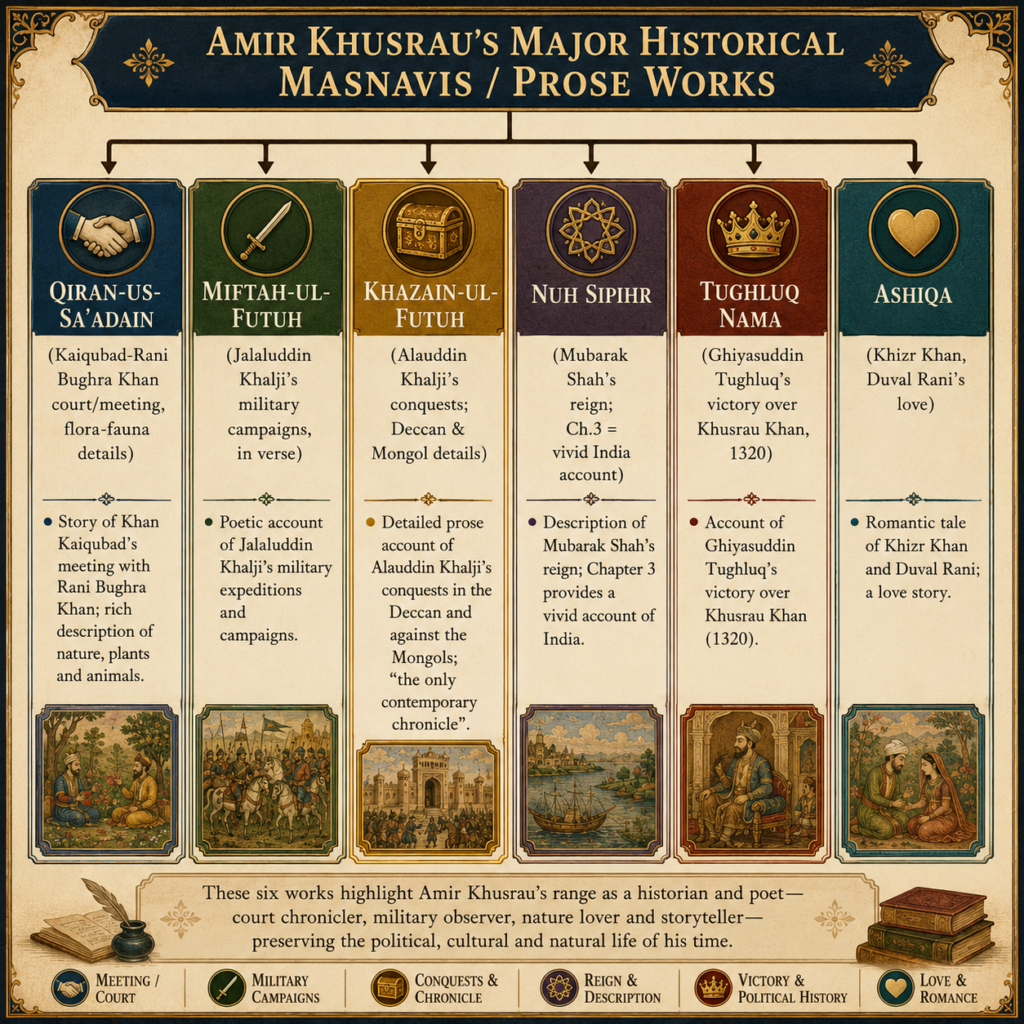
Qiran-us-Sa’adain (Meeting of the Two Auspicious Stars)
- An historical masnavi giving an eyewitness account of the meeting that took place in Oudh between Sultan Kaiqubad and his father Bughra Khan, the governor of Bengal.
- It throws light on the political condition, the court atmosphere, and the socio-cultural life of the period.
Miftah-ul-Futuh (Key to the Victories)
- Contains an account, in poetry, of the military campaigns of Jalaluddin Khalji.
Khazain-ul-Futuh (The Treasures of Victory), or Tarikh-i-Ilahi
- A historiographical composition in prose, describing the conquests and other achievements of Alauddin Khalji.
- His military campaigns in the Deccan are given in detail.
- The description of Alauddin Khalji’s conquests, the Mongol invasions of India, and the counter-strategy adopted by Alauddin to combat them — being based on first-hand knowledge — is of great historical value.
- Khazain-ul-Futuh also records Alauddin’s construction works, administrative measures, market control, and the destruction of Somnath.
- This is the only contemporary chronicle of the period, providing details with reasonable accuracy.
Nuh Sipihr (Nine Skies)
- A masnavi on Mubarak Shah (son of Alauddin Khalji, and his “unworthy and incompetent successor”), relating the events of his reign.
- Classified into nine chapters, each considered a “sky.”
- The third chapter gives a vivid account of India, its environment, seasons, flora and fauna, cultures, and scholars, etc.
Tughluq Nama (Book of the Tughluqs)
- An historical masnavi, composed to commemorate the victory of Ghiyasuddin Tughluq over Khusrau Khan (1320 A.D.), leading to the establishment of the new ruling dynasty.
- A valuable primary source of history for the reign of Ghiyasuddin Tughluq.
Ashiqa
- An account of the love story between Khizr Khan (son of Alauddin Khalji) and Duval Rani, daughter of Raja Karan — but also containing extensive details of his court, and the flora, fauna, and languages of India.
The Five Masnavis (Khamsa)
- Khusrau composed a quintet (khamsa) with five masnavis:
- Matla-ul-Anwar (“Rising Place of Lights”) — with ethical and Sufi themes.
- Khusrau and Shirin — the second masnavi.
- Laila Majnun — the third, a romance.
- Aina-e-Sikandari — the fourth, a voluminous work narrating the heroic deeds of Alexander the Great.
- Hasht Bihisht — the fifth, relating to the events of King Bahram Gur.
- All these works made Amir Khusrau a leading luminary in the world of poetry.
Ijaz-i-Khusravi
- One of Khusrau’s compilations, Ijaz-i-Khusravi, is a massive collection of diverse types of documents — personal letters and treatises, written to friends, masters, or simply to satisfy his literary and intellectual hunger.
- Some of these are official documents, like the Fathunama of Lakhnauti, drafted by him on the orders of the Sultans — of immense historical importance.
- The contents of Ijaz-i-Khusravi constitute an invaluable source for the socio-cultural history of the times.
Amir Khusrau’s Contribution to Regional Language
- He contributed to the development of Hindavi.
- His view was that the Hindavi language was not inferior to the Persian language.
- He also compared the grammar and syntax of Arabic to that of Hindavi.
- Writing at the beginning of the 14th century, Amir Khusrau had noted the existence of regional languages, remarking:
- “There is at this time in every province a language peculiar to itself, and not borrowed from any other—Sindhi, Lahori, Kashmiri, Kubari (Dogri of the Jammu region), Dhur Samundari (Kannada of Karnataka), Tilangi (Telugu), Gujar (Gujarati), Mabari (Tamil), Gauri (North Bengal), Bengali, Awadh, and Delhi and its environs (Hindavi).”
- He adds: “These languages have from ancient times applied in every way to the common purposes of life.”
- Some modern regional languages, such as Assamese, Oriya, and Malayalam, have not been noted by him.
- However, Khusrau points to a significant development — the emergence of the modern regional languages of India.
Contributions to Music
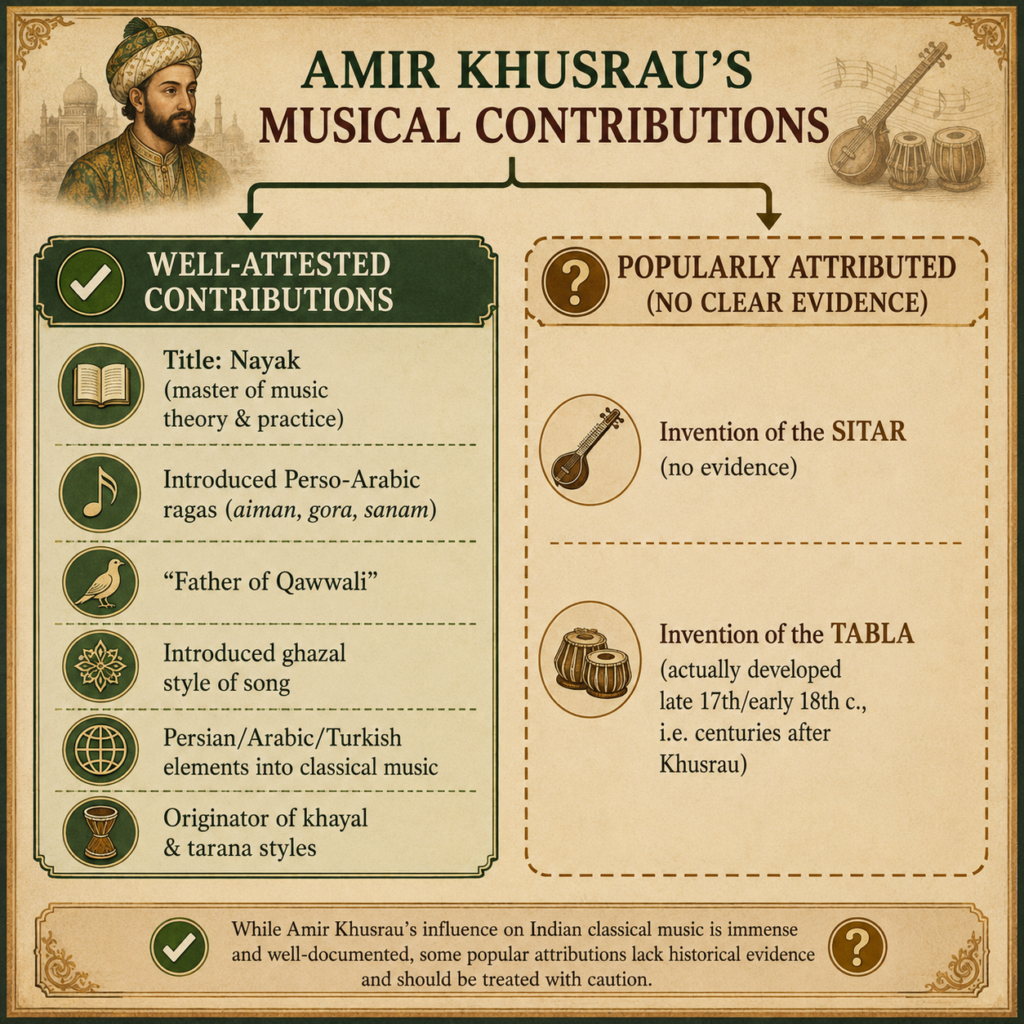
- Amir Khusrau, who was given the title of Nayak — “master” of both the theory and practice of music — introduced many Perso-Arabic airs (ragas), such as aiman, gora, sanam, etc.
- He is credited with having invented the sitar, though we have no evidence of this.
- The tabla, also often attributed to him, seems, however, to have developed during the late 17th or early 18th century.
- He is regarded as the “father of Qawwali” — a devotional music form of the Sufis in the Indian subcontinent — and introduced the ghazal style of song into India.
- He is also credited with introducing Persian, Arabic, and Turkish elements into Indian classical music, and is credited as the originator of the khayal and tarana styles of music.
Was Amir Khusrau a Historian? An Assessment
- On first sight, it seems that Khusrau’s works are of much historical value — he wrote prolific records of what he saw, and what happened during the reign of the various Sultans he served in Delhi.
- He widened the scope of Indo-Persian historiography, inventing new genres by writing history both in prose and verse.
- Khusrau’s writing also focuses on social and cultural aspects — festivals, food, dresses — an example of “embedded” history.
The Positive Assessment
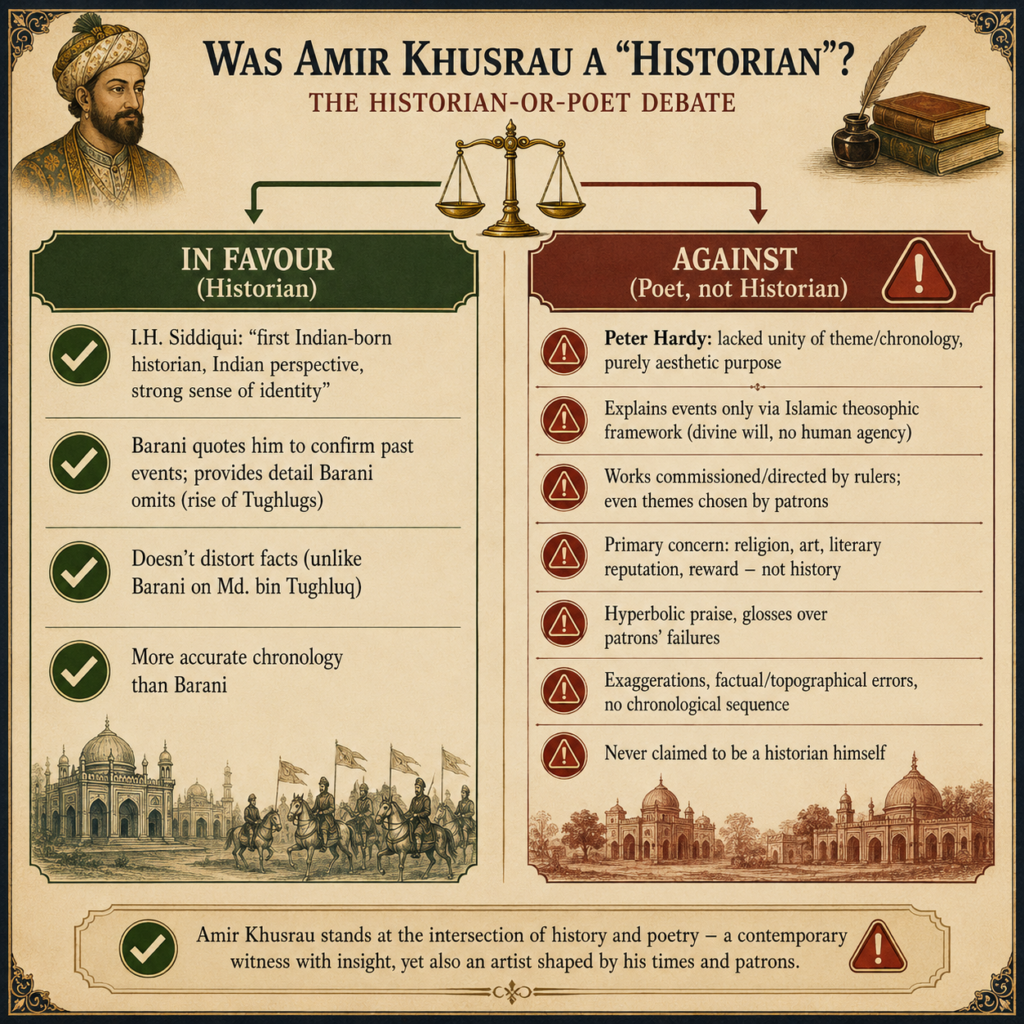
- I.H. Siddiqui says: Amir Khusrau was the first Indian-born historian, who wrote from an Indian perspective, his work reflecting a strong sense of identity with the country and the Sultanate.
- Barani, the later historian, quotes Khusrau on many occasions, to confirm major points of view on past events.
- Barani has not given any account regarding the rise of the Tughluq dynasty, while Khusrau has provided detailed information in this regard.
- Khusrau does not distort the facts, as Barani was accused of doing in the case of Muhammad bin Tughluq.
- Khusrau’s chronology is considered more accurate than that of Barani.
The Critical Assessment: Peter Hardy’s View
- Peter Hardy argues that Khusrau was a poet, and not a historian.
- Khusrau’s treatment of the past lacked unity of theme and chronology, and he wrote about the past only to fulfil an aesthetic purpose.
- Hardy further states that Khusrau, in his writings, never cared to look for an explanation for events beyond those within the Islamic theosophic framework — all events are seen as reflections of the will of God, devoid of any human agency.
- Works prepared by Khusrau were either under the direction of the reigning monarchs, or written for presentation to them — sometimes, even the themes of his writings were selected by rulers.
- His primary concern was not writing history, but religion, love of art and literature, demonstrating his literary ability, praising the ruler, and gaining a lasting reputation — as well as earning rewards for his literary performances.
- The writer applauds the achievements of his patrons in hyperbolic terms, and glosses over their shortcomings and failures — he skipped details that could have put his patrons in a difficult position.
- Khusrau himself never claimed to be a historian.
- His works generally suffer from exaggerations, factual and topographical errors, and show a lack of chronological sequence.
- The author gives fanciful accounts of some very insignificant happenings, employing a verbose style, poetic imagery, and literary art forms — while at the same time missing important socio-political events and the economic conditions of the time.
- Amir Khusrau cannot be called a deliberate liar, although he omitted what he did not want to express.
- Thus, the basic requirements to be considered a historian — such as objectivity, unbiasedness, and giving accounts of events full of historical value — are, in this view, lacking in Amir Khusrau’s account.
Conclusion
Amir Khusrau occupies a singular place in the cultural history of the Delhi Sultanate — as a poet of extraordinary range, moving fluidly between Persian, Hindavi, and even Punjabi; as a pioneer of a genuinely Indo-Persian literary style (Sabaq-i-Hind); as a foundational figure in the development of North Indian classical music, from the ghazal and qawwali to the khayal and tarana; and as the author of a body of historical masnavis and prose chronicles — from the Khazain-ul-Futuh to the Tughluq Nama — that remain indispensable, if imperfect, sources for reconstructing the political and cultural life of his age. Yet, as Peter Hardy’s critique makes clear, Khusrau’s historical writings were fundamentally shaped by his role as a court poet dependent on royal patronage, his overriding aesthetic and religious purposes, and an explanatory framework rooted in divine will rather than human agency — qualities that set his work apart from the more analytically rigorous, if not always more reliable, historiography of a chronicler like Barani. Whether read as history or as literature, Amir Khusrau’s vast corpus remains an unparalleled window into the political, social, and cultural world of the 13th- and 14th-century Delhi Sultanate — a legacy fittingly commemorated by his tomb beside that of his beloved spiritual master, Nizamuddin Auliya, in Delhi.