Mughal Painting

- The Mughal school of painting has steadily gained recognition as a distinctive artistic style, one that drew upon a rich pre-existing tradition and reached full maturity during the 17th century.
- It went on to create a genuinely living painting tradition, one that continued in different forms across various parts of the country long after the political glory of the Mughals had itself faded.
- Painting is referred to in certain Sanskrit literary works, while the murals of Ajanta stand as eloquent testimony to the richness of India’s ancient pictorial tradition. Although this tradition declined from around the 8th century onward, its survival is evidenced by certain illustrated Jain palm-leaf manuscripts.
- A genuinely new phase began with the introduction of paper in the 13th century, granting painters far greater freedom in their choice of colours and considerably more working space. Miniature painting, accordingly, began to show “signs of improvement in colouring, composition, delineation and decoration detail” — though this change proved slow and hesitant, with Gujarat and Malwa appearing to be the two regions where such improvements first took hold.
- No illustrated manuscripts survive from the Sultanate period proper — though Amir Khusrau tells us that painting was indeed practised among the ruling classes of the time, and Firuz (Shah Tughlaq) is recorded as having had wall paintings erased from his own palace.
- Meanwhile, a rich and independent painting tradition was developing at Shiraz in Persia, itself influenced by the Chinese style of painting.
- During the 15th century, as the provincial kingdoms of Gujarat, Malwa, and Jaunpur emerged as significant patrons of the fine arts and literature, painters and littérateurs began migrating from Shiraz to these Indian courts — marking the earliest genuine contact between the Persian and West Indian painting styles during this century.
- The best example of this early fusion is the Ni’mat Nama (“Cookery Book”), illustrated at Mandu, in which rounded Indian body contours are set against a background of formalised Persian leaves and vegetation.
Painting in the Fifteenth Century
- Until relatively recently, it was believed that painting had not flourished under the Delhi Sultans, and that the illuminated manuscripts of the Mughals represented, in effect, a revival of painting after a lapse of several centuries dating back to the end of the 10th.
- Sufficient evidence has since come to light, however, suggesting the existence of:
- A lively tradition of murals and painted cloth during the 13th and 14th centuries.
- A simultaneous tradition of Quranic calligraphy, persisting through to the end of the 14th century.
- A tradition of illustrated Persian and Awadhi manuscripts, likely originating at the beginning of the 15th century.
- Of this last tradition, a notable number of illustrated manuscripts from the period between the 15th and 16th centuries have since become known — some of these works were commissioned by independent patrons within the Sultanate, located outside the royal court itself.
- From the court-associated category: the Bostan of Sa’di, illustrated by the artist Hajji Mahmud; the Ni’mat Nama (a cookery book); and the Miftah al-Fuzala by Muhammad Shadiabadi — these manuscripts were all illustrated at Mandu (Malwa) during the second half of the 15th century.
- A fine example of the second, independently patronised category is the illustrated manuscript of Laur Chanda (in Awadhi), executed for a patron apparently unconnected to the royal court.
- It is thus evident that, at the time of the Mughals’ arrival in India, a genuinely living painting tradition already existed — focused mainly on illuminating manuscripts, and made possible above all by the availability of paper as a new working material.
The Mughal School of Painting
A distinct style of painting, known as the Mughal school, subsequently emerged — generally confined to miniatures, either as book illustrations (narrative painting) or as single works intended for albums (album painting). This school developed as a genuinely happy blending of Persian and Indian painting traditions.
Babur
- Babur, founder of Mughal rule in India (1526), ruled for only four years, and was consequently unable to contribute meaningfully to the growth of painting during his reign.
Humayun
- Humayun remained largely occupied with containing his political rivals until he was ultimately driven out of India by Sher Shah in 1540. It was, however, during his subsequent exile at the court of Shah Tahmasp of Persia that Humayun personally acquired a deep love for the art of painting.
- So strongly influenced was he by the art practised there that he commissioned two Persian masters, Mir Sayyid Ali and Khwaja Abdus Samad, to illustrate manuscripts on his behalf. Having first joined him in Afghanistan, these two painters accompanied Humayun’s entourage on his eventual triumphant return to India.
- Humayun’s own contribution to the evolution of Mughal painting proved genuinely significant — several important features of the later Mughal school appear to have first originated in paintings produced during his own period.
- An important surviving painting from Humayun’s reign, titled Princes of the House of Timur and dated c. 1550, was executed on cloth in an unusually large format — a scale unusual even for Persian painting of the time, leading some scholars to suggest it may relate to the older Mongol tradition of displaying paintings within tents.
- The Persian master artists Abdus Samad and Mir Sayyid Ali, having accompanied Humayun to India, oversaw the imperial atelier during the early, formative stages of Mughal painting — though large numbers of additional artists, the majority apparently Hindu, also worked on major commissions.
- Mughal painting flourished during the late 16th and early 17th centuries, with spectacular works produced by master artists such as Basawan, Lal, Miskin, Kesu Das, and Daswanth.
Akbar
- The emergence of a distinct Mughal School of painting, clearly differentiated from all other contemporary styles, owed itself largely to the deep personal interest Akbar took in promoting this art form.
- During this period, painting remained largely focused on manuscript illustration, though other forms — such as frescoes on the palace walls at Fatehpur Sikri — were also produced. Most surviving paintings from Akbar’s reign are, in fact, narrative paintings, illustrating works such as the Hamzanama, Tutinama, Baburnama, Tarikh-i-Alfi, and Razmnama, among many others.
- The fusion of Persian and Indian traditions during this period gave rise to a genuinely distinct Mughal painting style.
The Hamzanama Project
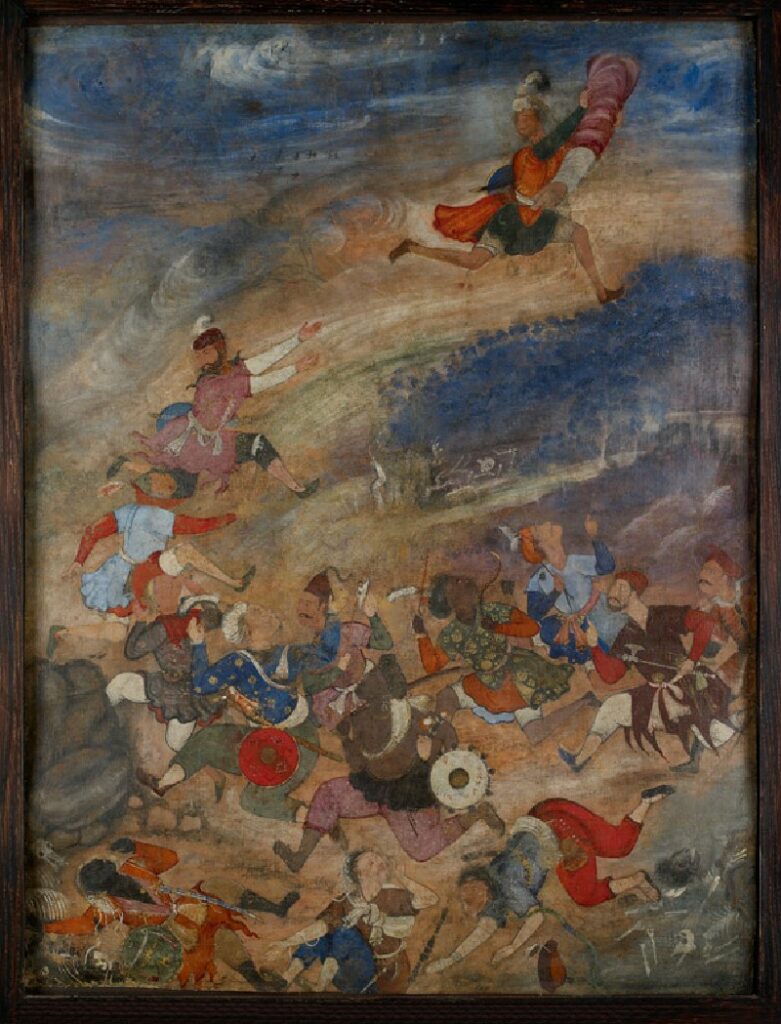
- The first major artistic project undertaken during Akbar’s reign was the illustration of the Hamzanama.
- Around 1567, Akbar ordered the preparation of a lavishly illustrated manuscript of the Persian translation of the Hamzanama — a celebrated Arab epic concerning the legendary hero Hamza.
- Under Sayyid Ali and Abdus Samad, a group of roughly one hundred painters, drawn from Gwalior, Gujarat, Lahore, Kashmir, Malwa, and elsewhere, were assembled for the project.
- The work took fifteen years to complete, ultimately producing some 1,400 pages of illustrations — and, in the process, served as an invaluable training ground for a whole generation of Indian painters.
Other Narrative Paintings Under Akbar
- A large number of works of Persian literature, along with literature translated from Sanskrit into Persian, were illustrated during this period. Notable narrative paintings of Akbar’s reign include the Anwar-i-Suhaili, Tutinama, Tarikh-i-Khandan-i-Timuriya, Baburnama, Chingiznama, Tarikh-i-Alfi, and the Razmnama (the Persian translation of the Mahabharata).
- Various artists similarly illustrated Abul Fazl’s most celebrated historical work, the Akbarnama.
- The illuminated manuscript Khamsa of Nizami — a lavishly illustrated rendition of the “five poems” of the 12th-century Persian poet Nizami Ganjavi — was created for Akbar in the early 1590s by a team of artists working alongside a single scribe at the Mughal court.
- Some orthodox thinkers of the period objected to the art of painting as fundamentally un-Islamic. Abul Fazl answered this objection by arguing that painting, in fact, brought painters and viewers alike closer to a recognition of God — since, in sketching any living thing, the artist came to realise that only God could truly bestow individuality upon His creations.
Establishment of the Royal Atelier
- Akbar was deeply fond of painting, and during his reign, the art was formally organised as an imperial establishment or karkhana known as the Tasvir Khana (initially placed under Abdus Samad), where painters carried out their work.
- Abul Fazl records: “His Majesty from his earliest youth, has shown a great predilection for this art, and gives it every encouragement.”
- Although Abul Fazl himself names only seventeen artists (thirteen of them Hindu), it is now known that the actual number employed was considerably larger — S.P. Verma has compiled a list of some 225 artists who worked at Akbar’s atelier, drawn from many different regions, though the majority remained Hindu.
- Notably, several individuals from low-caste backgrounds were elevated to the status of royal artist purely on the strength of their artistic skill — the case of Daswanth, son of a kahar (palanquin-bearer), is especially cited in this regard.
- Painters were assisted by teams of gilders, line-drawers, and paper-preparers. Govardhan was a noted painter across the successive reigns of Akbar, Jahangir, and Shah Jahan. Farrukh Beg (1545–1615), a Persian-born Mughal painter, served first at the court of Mirza Muhammad Hakim before working for both Akbar and Jahangir — his most celebrated work, produced under Jahangir, was the so-called Gulshan Album.
- Painters received monthly salaries, with the Emperor granting further rewards based on works regularly presented before him; the raw materials artists required were similarly provided by the state.
- S.P. Verma notes that even the lowest-paid worker in the atelier received between 600 and 1,200 dams (40 dams equalling one rupaya).
- Many surviving paintings bear the names of two artists, and sometimes even three worked on a single painting — on one painting from the Akbarnama, as many as four artists contributed. Painting, in this sense, was often a genuinely collaborative team effort.
- Typically, the sketching of figures and the application of colour were handled by two separate artists; where three artists collaborated, one would handle the outlining, a second would colour the faces, and a third would colour the remaining figures — suggesting sketching and colouring were, in general, treated as genuinely distinct specialised tasks.
- The atelier itself was supervised by daroghas, assisted by clerks, who were responsible for ensuring artists had ready access to necessary materials, for overseeing the progress of their work, and for arranging the periodic presentation of finished works before the Emperor.
Style and Technique
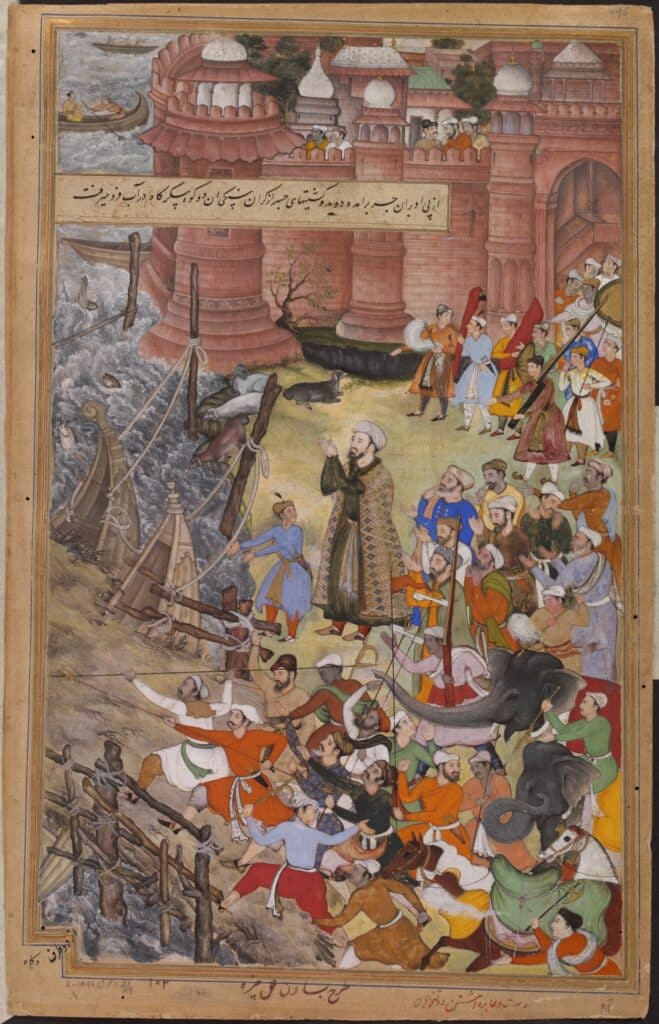
- The illustrations of this early phase were clearly influenced by the established Persian tradition, identifiable through several distinctive features:
- Symmetrical compositions.
- Restricted movement of figures.
- Fine, delicate line-work in drawing.
- Flat depiction of architectural columns.
- Profuse, jewel-like embellishment of buildings.
- Over time, Mughal paintings acquired an increasingly distinctive character of their own, becoming more genuinely eclectic — combining Persian and Indian traditions with growing touches of European influence.
Distinctive Features of the Mature Akbari Style
- The Mughal style became clearly recognisable within roughly fifteen years of the royal atelier’s establishment under Akbar. Within the following decade or so — by around 1590 — it had acquired a fully distinctive form, marked by:
- Naturalism and rhythm.
- Everyday objects of daily use assuming distinctly Indian forms.
- Picture space incorporating subsidiary scenes set within the background.
- Extraordinary vigour of action and dynamic, even violent, movement.
- Luxuriant depiction of foliage and brilliant floral blossoms.
- It should be emphasised that the identity of Mughal painting under Akbar was as much an original style in its own right as it was a simple fusion of Persian and Indian traditions.
- The depiction of dynamic action and movement, in particular, finds no real precedent in either pre-Mughal Indian art or the art of Persia.
- Akbari-period painting further distinguishes itself, both from Persian painting and from earlier Indian styles, through its distinctive emphasis on historical subject matter — the two most common themes being:
- The daily events of court life.
- Portraits of leading contemporary personalities.
- While portrait painting as such was already known in Persia, painting as a genuine chronicle of actual historical events represented a wholly new emphasis under Akbar.
- Painters covered an impressively vast thematic range, including war, hunting scenes, mythical beings, and building activity.
- Portrait painting was another particularly favoured theme — Akbar ordered that likenesses be taken of all the great nobles of the realm, and sat for his own portrait as well. According to Abul Fazl, Basawan excelled particularly in the drawing of facial features, portrait painting, and several other branches of the art.
- Despite this thematic range, there remained relatively little scope for strict artistic specialisation: two or even three painters could jointly complete a single picture, one drawing the outline, another filling in colours, and a third completing the face — with the same painter sometimes asked to switch roles between successive commissions.
- Jahangir, later, famously claimed he could distinguish precisely which painter had drawn a given outline, and which had filled in colours or completed the face. Despite this genuinely composite, collaborative nature of many pictures, distinct individual styles did nonetheless clearly emerge.
- Overall, the Akbari period not only firmly established painting as a major Mughal art form, but also freed it from earlier Persian rigidity of form, introducing the plastic roundness characteristic of Indian painting to create a genuine three-dimensional effect, in place of the earlier flat, two-dimensional style.
- Distinctly Indian trees and flowers, and Indian buildings, were similarly introduced into the pictorial repertoire, alongside characteristically Indian colours such as peacock blue and Indian red — with continuing efforts made to refine and improve colour mixing techniques.
- Under Akbar, European painting was first introduced at court, via Portuguese priests; Abul Fazl himself praised the evident skill of this European style.
- Under its influence, the principle of foreshortening — whereby near and distant figures and objects could be rendered in proper perspective — was gradually adopted, though Indian painters never fully mastered true perspective technique: distant objects continued to be depicted in a somewhat vertical manner, rather than being properly foreshortened.
- The earlier “bird’s-eye-view” perspective, whereby action occurring at different levels could be depicted within a single picture, was gradually replaced by a more circular compositional effect.
Jahangir
- Jahangir took a deep personal interest in the art of painting, and it was under his patronage that Mughal painting reached its true zenith.
- During his reign, the Persian and Indian styles of painting became fully and genuinely synthesised, with Indian painting growing increasingly free of purely foreign influence.
- Jahangir had cultivated a deep interest in painting even as a prince, maintaining his own personal studio quite apart from Akbar’s much larger imperial atelier.
- During his reign, narrative painting grew somewhat less prominent than individual pictures and formal albums.
- A man of genuinely refined aesthetic taste, Jahangir loved a wide variety of painting styles, but as a keen naturalist, showed particular preference for hunting scenes, birds, and flowers.
- Whenever he encountered an unfamiliar animal or bird, his court artists would immediately produce a painting of it — resulting in a remarkable body of birds and animals rendered in a strikingly realistic fashion.
- He also continued the established tradition of portraiture, possessing a famously discriminating eye, and claimed he could identify individual painters’ work purely by sight.
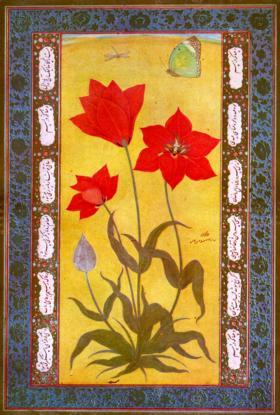
- Beyond hunting, battle, and court scenes, particular progress was made under Jahangir in portrait painting and in paintings of animals and flowers. Ustad Mansur was especially celebrated for his floral paintings, his best-known work being The Red Blossoms.
Introduction of New Styles Under Jahangir
- During Jahangir’s reign (1605–27), manuscripts grew steadily less important relative to individual pictures.
- Given his own deep personal involvement, Jahangir may effectively have functioned as head of the royal studio himself — artistic decisions were, accordingly, often made directly by the Emperor, introducing his own distinct stylistic preferences into the paintings produced.
- Brushwork grew notably finer, and colours correspondingly lighter, during this period.
- Jahangir was also deeply influenced by European painting. During his reign, he came into direct contact with the English Crown, receiving gifts of oil paintings that included portraits of the English King and Queen.
- He actively encouraged his royal atelier to adopt the single-point perspective favoured by European artists, in place of the flattened, multi-layered style traditionally used in Indian miniature painting.
- He particularly encouraged paintings depicting events from his own life, individual portraits, and detailed studies of birds, flowers, and animals.
- The Jahangirnama, his own autobiographical account of his reign, contains numerous accompanying paintings.
- Two important new stylistic elements emerged in Mughal painting during the first half of the 17th century:
- A formalist, realistic style — this period’s painting shows a preference for precision, and a genuine effort to record contemporary reality accurately.
- Broad decorative margins, gorgeously embellished with depictions of flora, human faces, and other plant-motif designs.
- Despite genuinely lively studies of animals and birds, Mughal painters showed relatively little independent interest in the study of nature purely for its own sake — trees, birds, streams, and hillocks nonetheless frequently formed the backdrop for many hunting and battle scenes, with a particular emphasis on achieving a tonal, rounded effect in the rendering of tree trunks.
Shah Jahan
- Painting continued to receive patronage under Shah Jahan, though he himself lacked Jahangir’s own refined aesthetic sensibility in this particular field.
- As a result, his period’s paintings show a marked profusion of court scenes, alongside a distinctly lavish use of gold — colours grew more overtly decorative overall, with gold employed with increasing frequency for embellishment.
- Though Shah Jahan remained a great patron of architecture above all, he did not entirely neglect painting — Mughal painting continued to develop under his reign, though it gradually took on a somewhat colder, more rigid quality.
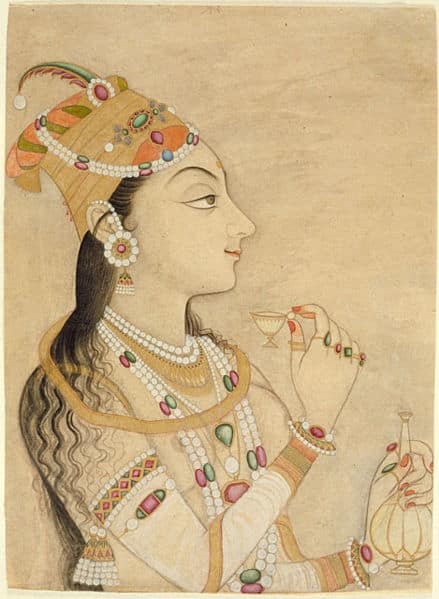
- The earlier traditions of portraiture, album preparation, and manuscript illustration all continued under his patronage. Additionally, this period saw the emergence of charming paintings depicting romantic love scenes, and portraits of female members of the court.
- Notable themes of Shah Jahan’s period include:
- Musical gatherings and parties.
- Lovers, sometimes depicted in intimate poses, set on terraces and within gardens.
- Ascetics gathered around a fire.
- Superimposed depictions of animals, and scenes of performing acrobats.
Aurangzeb
- Aurangzeb, who succeeded Shah Jahan, began his reign on a notably bitter note — executing his brothers and imprisoning his own father. The arts, more broadly, were largely neglected throughout his reign.
- Painting did not cease entirely, though it lost the direct patronage of the Emperor, becoming instead largely confined to the private studios of individual nobles. Some commissioned portraits of nobles and their relatives survive from the courts of the various Rajput principalities of the period.
- A large number of karkhana records relating to painting survive today in the Rajasthan State Archives, Bikaner.
- A handful of interesting paintings of Aurangzeb himself, during his military campaigns, also survive — the underlying skill of the painters remains evident, though the works appear notably more formal, having lost much of the earlier tradition’s liveliness.
- Aurangzeb’s own lack of interest in painting ultimately led to a broader dispersal of artists across different parts of the country — a development that, in turn, helped stimulate the growth of painting traditions in the states of Rajasthan and the Punjab Hills.
- During the first half of the 18th century, many artists trained within the imperial workshop left to work instead at various Rajput courts — including figures such as Bhawanidas and his son Dalchand.
- Migrating painters similarly contributed to the development of the distinct Patna Kalam style of painting.
Later Mughal Emperors
- Among the later Mughals, the reign of Muhammad Shah “Rangeela” (1719–48) saw a genuine renewal of interest in depicting pleasure-loving court scenes — though by this stage, many artists of the imperial studio had already begun migrating toward the various provincial courts.
- By the time of Shah Alam II (1759–1806), the art of Mughal painting had, in effect, lost its earlier glory altogether.
- By this later period, other distinct schools of Indian painting had firmly established themselves — including Rajput painting, flourishing in the royal courts of the Rajput kingdoms of Rajputana, and the Company style, developing under Western influence in cities administered by the British East India Company.
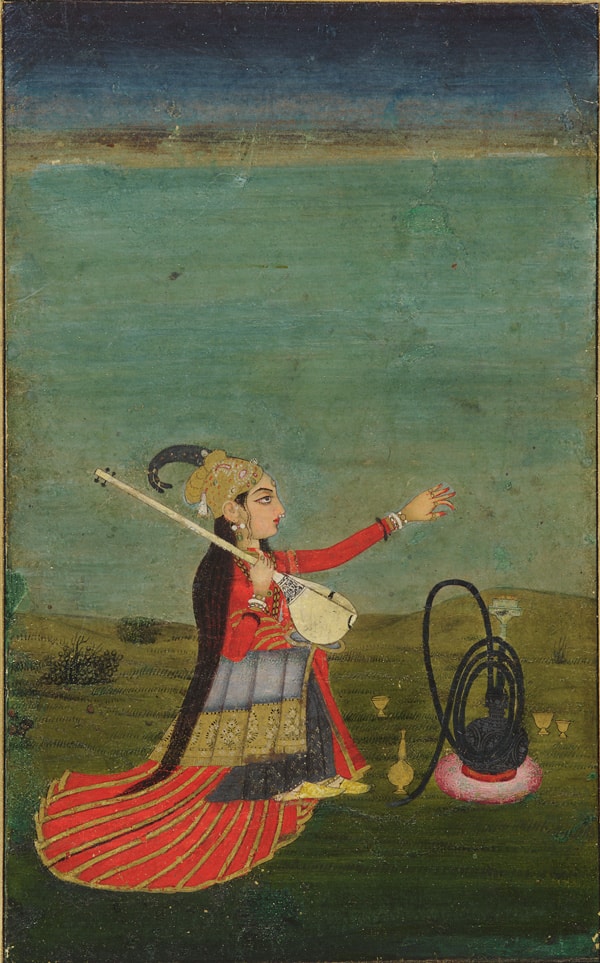 A Mughal woman holding a Veena
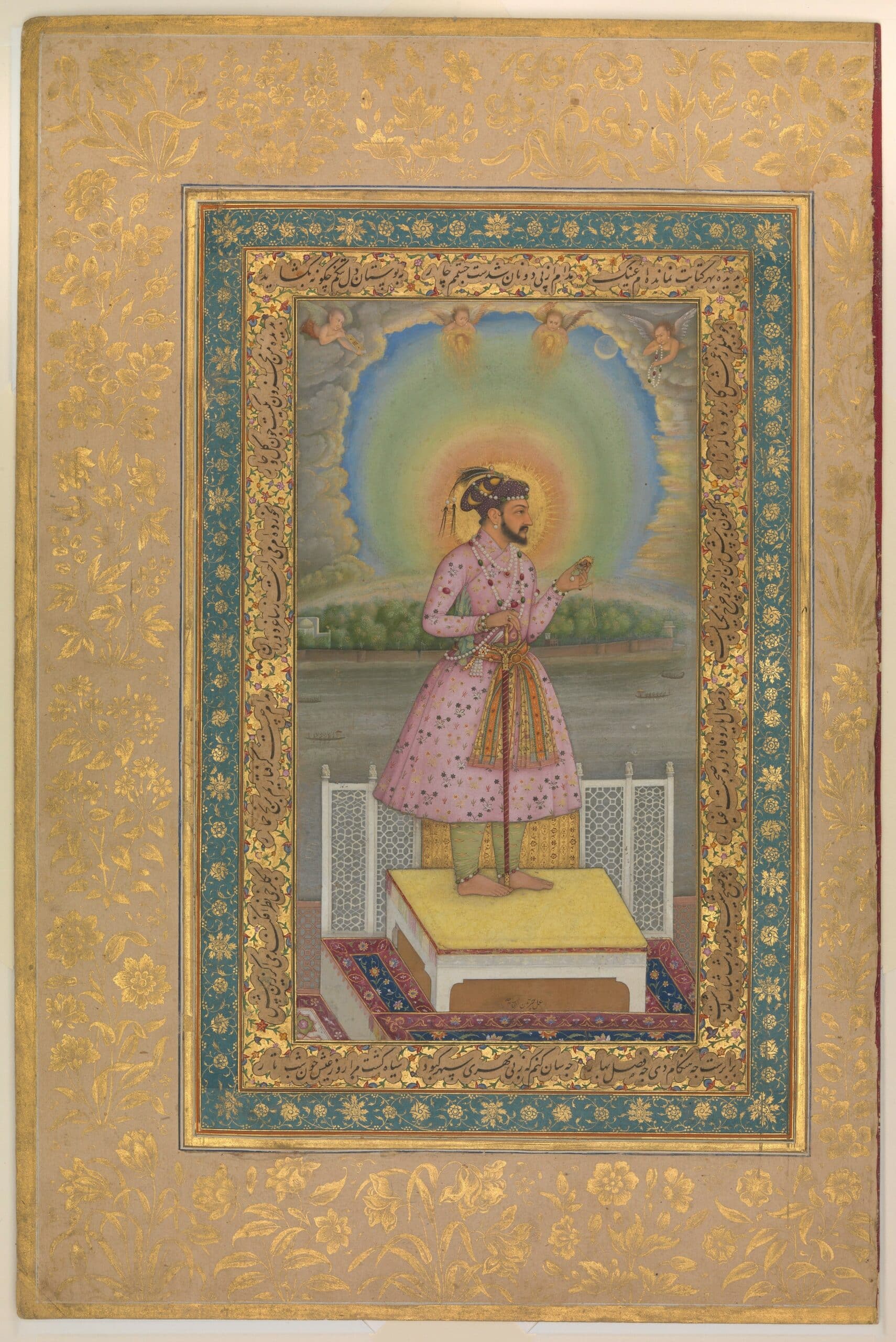 Shah Jahan on a Terrace Holding a Pendant Set with His Portrait
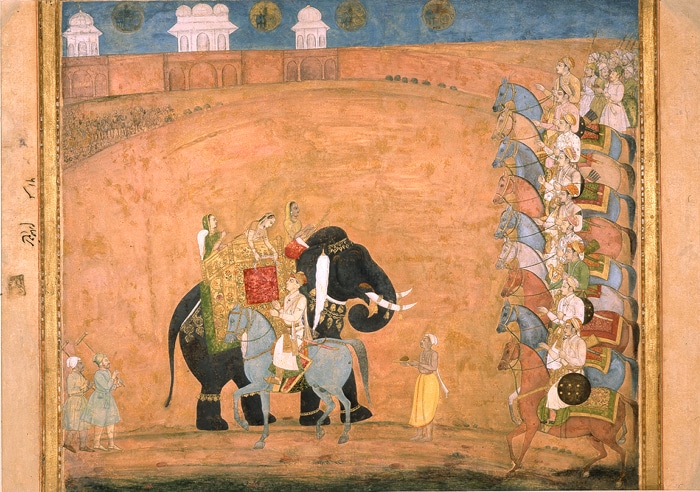 Payag Princess on elephant:
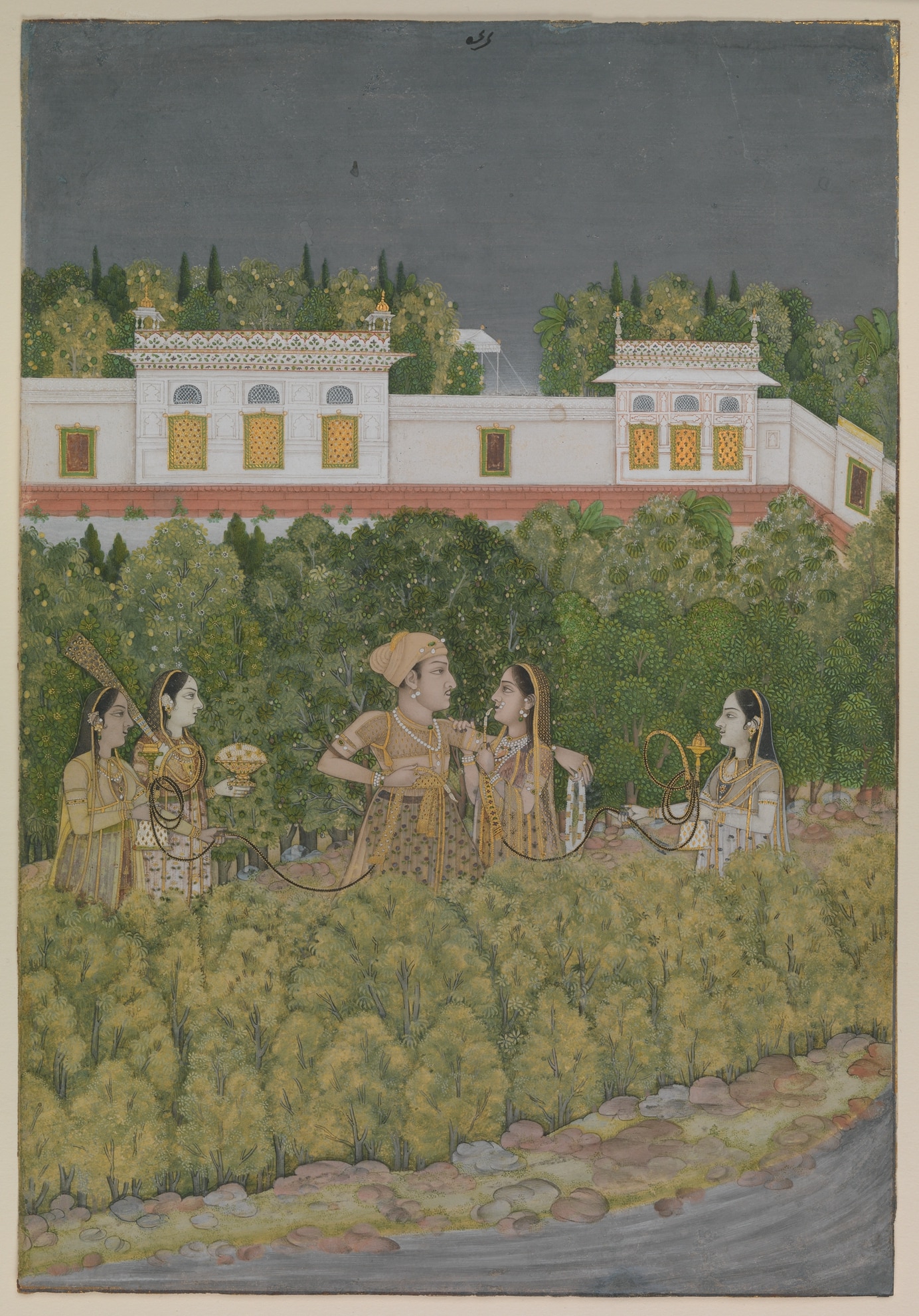 A Mughal Prince and Ladies in a Garden
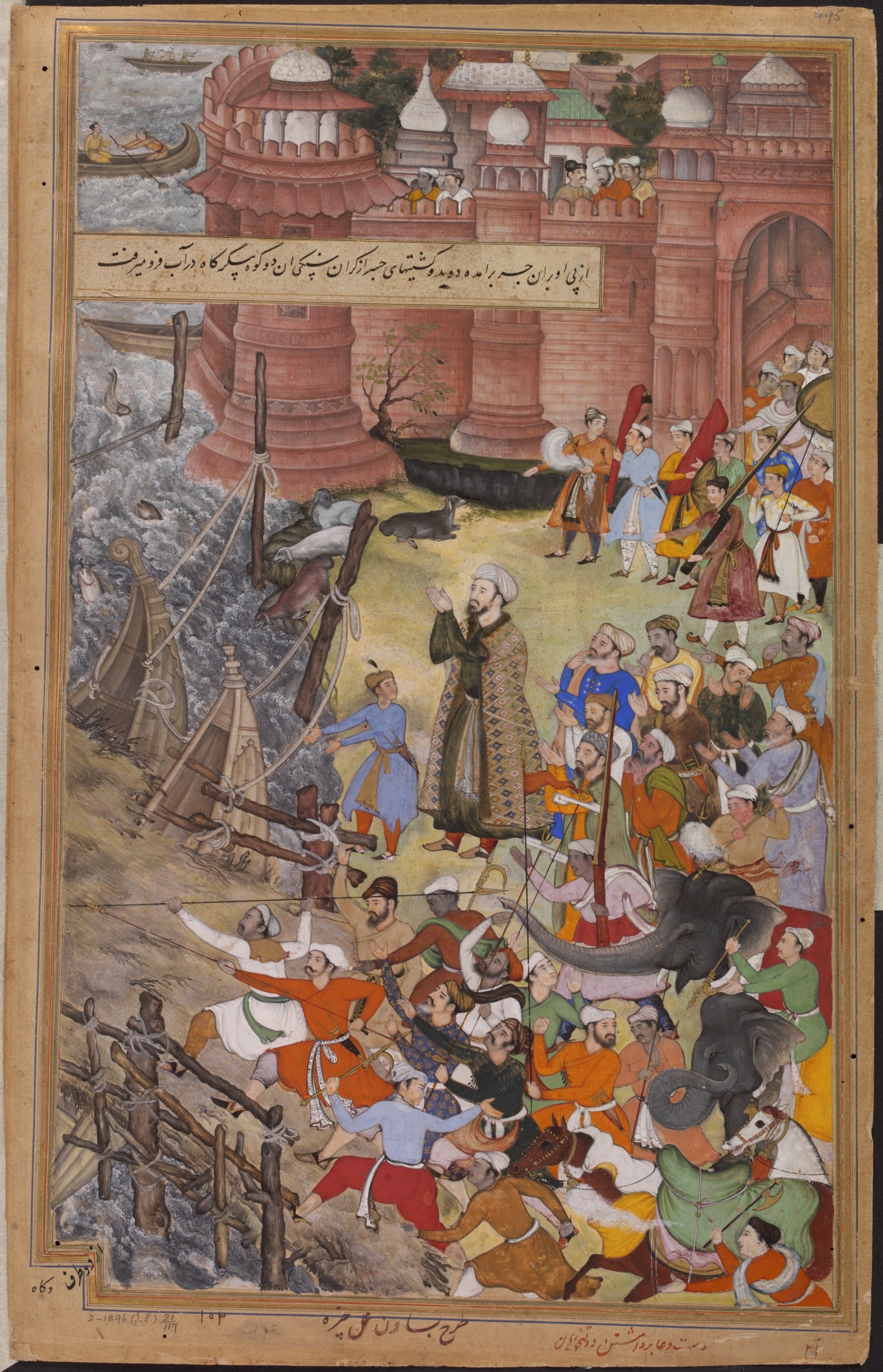 1561-Akbar riding the elephant Hawa’I pursuing another elephant across a collapsing bridge of boats
European Impact on Mughal Painting
- In its later phases, particularly during the 17th century, Mughal painting came under increasing European artistic influence.
- Certain European artistic themes were directly incorporated by Mughal painters, who similarly adopted a number of European technical conventions.
- According to A.J. Qaisar, a considerable number of European paintings were either copied, adapted, or even creatively reinterpreted by Mughal painters — while numerous original European prints were simultaneously collected and preserved within the albums of Jahangir, Dara Shikoh, and several Mughal nobles.
- Initial contact with European paintings prompted Mughal court painters first to produce exact copies in their own hand — imitations that, as noted by contemporary European travellers, were executed with genuinely impeccable skill.
- Mughal painters subsequently went further, experimenting with entirely new compositions built around subjects drawn from European painting.
- One particularly notable feature emerging in certain Mughal paintings of this period is a deliberate attempt at achieving genuine three-dimensionality — a clear reflection of European technical influence.
- Another European convention Mughal painters readily adopted was the deliberate use of light and shade, most commonly employed in battle scenes.
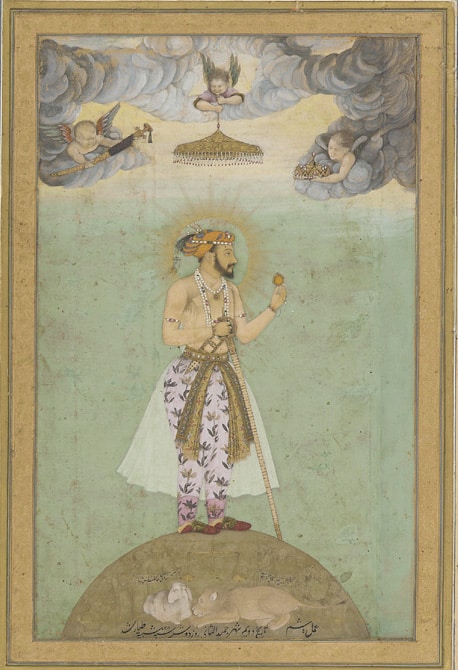
- The depiction of motifs such as haloes, winged angels, and dramatically roaring clouds in Mughal painting likewise reflects clear European influence.
- As already noted, Jahangir actively encouraged his atelier to adopt the single-point perspective favoured by European artists, over the traditional flattened, multi-layered style of Indian miniature painting.
- One significant European technique, however — that of oil painting — never genuinely attracted the Mughals; no surviving work from this period was actually executed in oil.
Outside Influences on Mughal Painting
Throughout its development, Mughal painting was shaped by three principal external influences: Persian (Iranian), European, and continuing Indian influence.
Iranian Influence
- A flat, essentially two-dimensional pictorial effect.
- Facial features often depicted in a distinctly “Mongolian” manner, reflecting the influence of Chinese style transmitted to Persian painters via the Mongols — though this particular feature gradually diminished over time.
- A dominant emphasis on scenes of nature — hills, gardens, fountains, trees, and broader landscape.
- The depiction of distinctly Iranian costumes.
European Influence
- A genuine three-dimensional effect, achieved through shading (from Akbar’s reign onward).
- The deliberate use of light and shade, most commonly in battle and fighting scenes.
- The depiction of dramatically roaring clouds.
- The principle of foreshortening (nearer objects rendered larger, more distant objects rendered smaller).
- European symbolic motifs, such as the cross and depictions of angels.
- More genuinely naturalistic overall colour schemes.
- Other painting conventions introduced via European contact included: the broader idea of artistic idealism; oil painting technique (though never fully adopted, as noted above); the picturesque aesthetic sensibility; landscape painting as an independent genre (as seen, for instance, in Thomas Daniell’s later paintings of the Yamuna); the European style of portraiture; and the broader tradition of painting as a form of historical record.
Indian Influences
- A distinctive colour palette favouring deep, saturated tones — deep red, deep blue, and similar hues.
- Distinctly Indian colours, such as peacock blue and Indian red, came into growing use, alongside continuing efforts to refine and improve overall colour-mixing technique.
- Themes drawn from Indian tradition, such as illustrations of the Mahabharata, alongside depictions of everyday contemporary social and religious life.
- The plastic roundness characteristic of Indian painting, introduced during Akbar’s reign, which gave paintings a genuine three-dimensional quality in place of the earlier flat, two-dimensional style.
- The introduction of distinctly Indian trees and flowers, and characteristically Indian architectural forms, into the broader pictorial repertoire.
- Notably, Indian painters never fully mastered the European art of true linear perspective — a limitation that left a lasting, visible imprint on the wider Mughal painting tradition.