

Shankaracharya’s Advaita Vedanta and Ramanuja’s Vishishtadvaita

- Vedanta is the most prominent of the six schools of Hindu philosophy. Literally meaning “end of the Vedas,” Vedanta draws on the ideas developed in the Upanishads (the concluding portion of the Vedas), focusing specifically on knowledge and liberation.
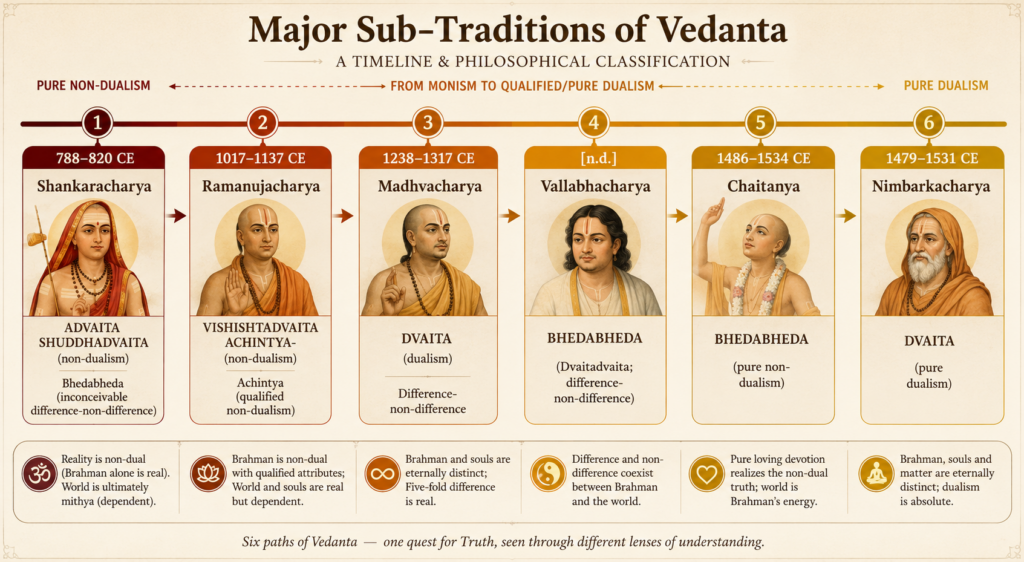
- Vedanta encompasses many sub-traditions — ranging from dualism to non-dualism — all grounded in a shared textual foundation known as the Prasthanatrayi: the Upanishads, the Brahma Sutras, and the Bhagavad Gita.
- All Vedanta schools engage with the same core concerns, but differ significantly in their positions on ontology (the nature of reality), soteriology (the path to liberation), and epistemology (the nature of knowledge).
- This article examines Shankaracharya’s Advaita Vedanta and Ramanuja’s Vishishtadvaita — two of the most influential philosophical systems to emerge from this broader Vedantic tradition — tracing their core doctrines, their respective paths to liberation, and their distinct social and historical significance.
Major Sub-Traditions of Vedanta
- Advaita Darshan — established by Shankaracharya (788–820 CE).
- Vishishtadvaita Darshan — established by Ramanujacharya (1017–1137 CE).
- Dvaita Darshan — established by Madhvacharya (1238–1317 CE).
- Bhedabheda (or Dvaitadvaita) Darshan — established by Nimbarkacharya.
- Shuddhadvaita Darshan — established by Vallabhacharya (1479–1531 CE).
- Achintyabhedabheda Darshan — established by Chaitanya Mahaprabhu (1486–1534 CE).
Shankaracharya and Advaita Vedanta
- Adi Shankaracharya was an early eighth-century Indian philosopher and social reformer, born in Kerala into a devout Brahmin family. He is credited with formulating the doctrine of Advaita Vedanta — advaita meaning “not two,” i.e., a strictly monistic system.
Core Philosophy
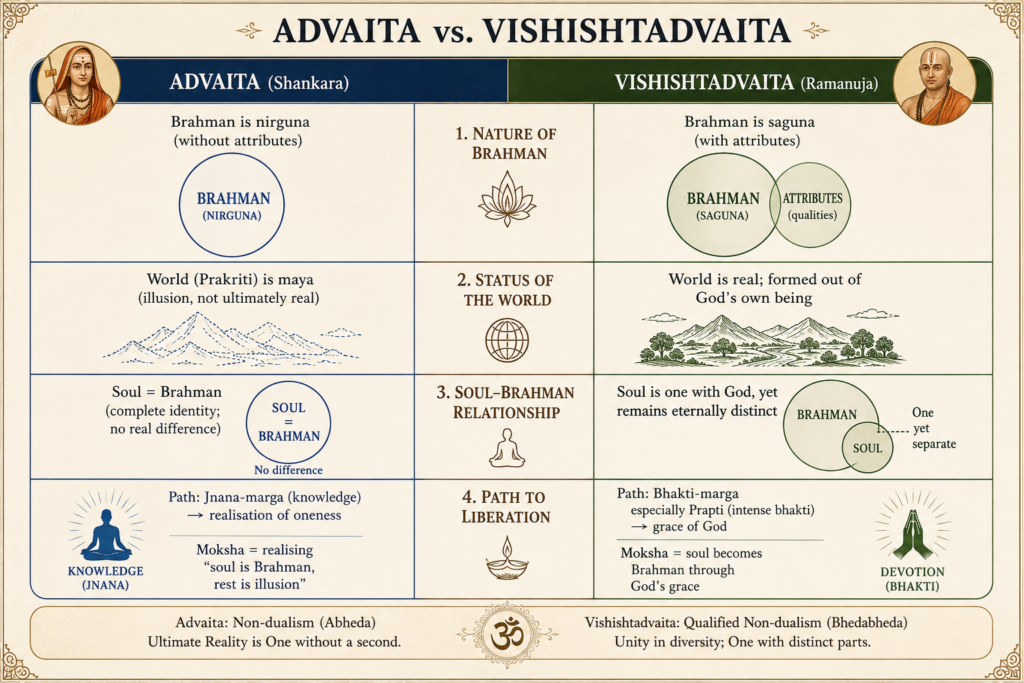
- Shankara’s teaching rests on the unity of the individual soul (atman) and Brahman, where Brahman is understood as nirguna — entirely without qualities or attributes, and the sole, ultimate reality.
- The soul is Brahman, while creation (Prakriti, or matter) is not truly real — it is maya, an illusion.
- As Shankara himself put it: the apparent difference between the individual self and the supreme Self arises only from limiting adjuncts — such as the body — which are constructed through names and forms and produced by avidya (ignorance); in reality, no such difference exists.
- Shankara identified two levels of reality (while holding that, ultimately, only one level is真实, i.e. genuinely real):
- Conventional reality — the individual soul.
- Absolute reality — Brahman.
- Avidya (ignorance) is precisely what causes conventional reality to be mistaken for absolute reality.
- Moksha (liberation), for Shankara, is the direct realisation that the “soul is Brahman, and everything else is maya” — accordingly, his path to liberation centres on the path of knowledge (jnana marga).
- The ultimate goal of Advaita Vedanta is liberation from the cycle of rebirth, achieved through the realisation of the oneness of atman and Brahman — a realisation possible only once ignorance (avidya) is dispelled.
Shankara as Political Sage: Engaging with His Historical Context
(“Adi Shankara was not an ivory-tower philosopher; he was a political sage, engaging with and responding to the historical context of his time.” — Elucidate.)
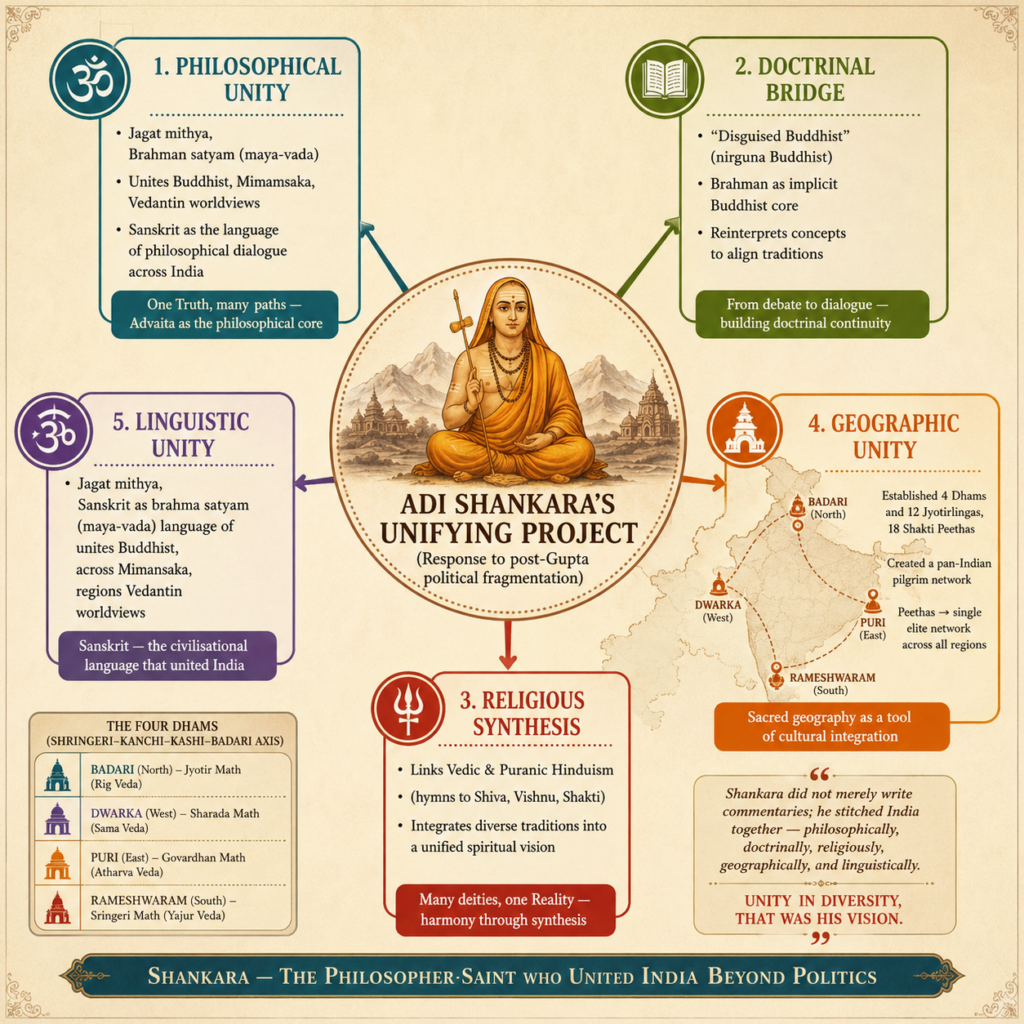
- Adi Shankara, a South Indian philosopher, propagated the doctrine of Advaita (monism) and preached the Upanishadic doctrine of salvation through knowledge. He is widely credited with unifying and consolidating the main currents of diverse religious thought across India.
- Several distinct contributions illustrate this unifying, socially-engaged dimension of his work:
Doctrine of Jagat Mithya, Brahma Satyam
- This doctrine forms the essential core of Shankara’s non-dualist maxim — holding that the world as we experience it is essentially illusory, or more precisely, a set of mind-dependent epistemological truths. The only mind-independent, ontological truth is Brahman — variously translated as God, soul, consciousness, language, or the infinitely expanded, eternal, unconditioned mind.
- This doctrine of reducing the phenomenal world to illusion — popularly known as maya-vada — allowed Shankara to unite diverse religious cults and worldviews: the Buddhists, the Mimansakas (orthodox Vedic householders), and the Vedantins (later Vedic hermits), as well as the Shaivas, Vaishnavas, and Shaktas — a synthesis clearly evident across his own writings.
- Shankara’s philosophy remained avowedly Vedic throughout: unlike the Buddhists and Jains, he traced his own knowledge back to the Vedas and submitted to their impersonal authority, making him firmly a believer (astika).
A “Disguised Buddhist”
- Across his commentaries (bhashya) and monographs (prakarana), Shankara repeatedly argued for a formless divine (nirguna Brahman) as the sole reality — a position clearly visible in his Brahma-sutra-bhashya, his Sanskrit poems Vivekachudamani and Nirvana-shatakam, and his treatise Atma-bodha.
- Many scholars consider this an implicit acceptance of the Buddhist worldview, reframed with a distinctly Vedic twist — which is precisely why Shankara has sometimes been described as a “disguised Buddhist” (prachanna bauddha).
Linking Vedic and Puranic Hinduism
- At the same time, Shankara’s devotional poetry (stotra) also celebrates several tangible, qualified forms of the divine (saguna Brahman) as they appear in the Puranas — he composed grand hymns of praise to Shiva (Dakshinamurti Stotra), Vishnu (Govinda-ashtaka), and Shakti (Saundarya-lahari).
- This body of work makes Shankara the first Vedic scholar after Vyasa to overtly link Vedic Hinduism with Puranic Hinduism — he is even known to have written on tantra.
Unifying India Geographically
- Shankara connected India’s holiest sites — the twelve jyotirlingas, the eighteen shakti peethas, and the four Vishnu-dhaams — into coherent pilgrim routes that, in effect, defined India as a single, unified land.
- According to tradition, he travelled from Kerala to Kashmir, from Puri to Dwarka (Gujarat), from Shringeri (present-day Karnataka) to Badari (Uttarakhand), and from Kanchi (present-day Tamil Nadu) to Kashi (Uttar Pradesh) — moving along the Himalayan slopes, the banks of the Narmada and Ganga, and both the eastern and western coastlines of the subcontinent.
Communicating in a Common Language
- Shankara, who travelled the length and breadth of the land, communicated throughout in Sanskrit — the single language that connected the intellectual elite across all these diverse regions.
Responding to Political Fragmentation
- Following the collapse of the Gupta Empire, India had become deeply politically fragmented, with numerous kingdoms locked in constant conflict.
- In his commentary on the Brahma-sutra, Shankara himself remarked: “One can say that there never was a universal ruler, as there is none now” — a direct acknowledgement of the fragmented political condition of his own time.
- Set against this fractured political order, Shankara sought to bind the Indian subcontinent together through philosophy, poetry, and pilgrimage — a genuinely political project pursued through cultural and religious means.
Limitations of Shankaracharya’s Legacy
- Shankara taught in Sanskrit — a language not accessible to the masses, limiting the direct reach of his teaching.
- His philosophy was genuinely complex: Vivekananda observed that Shankara’s real insight was in showing that Buddhism and Vedanta were not, at their core, very different — but his own disciples reportedly failed to grasp this nuance, degrading his teaching into a denial of the very existence of soul and God, effectively lapsing into atheism.
- Some scholars have questioned the extent of Shankara’s early influence in India.
- The Buddhist scholar Richard E. King notes: “Although it is common to find Western scholars and Hindus arguing that Sankaracarya was the most influential and important figure in the history of Hindu intellectual thought, this does not seem to be justified by the historical evidence.”
- Several scholars argue that Shankara’s historical fame and cultural influence actually grew centuries later — particularly during the era of Muslim invasions and the consequent upheaval in India. Many of his biographies were composed and published only from the 14th century onward, including the widely-cited Vidyaranya’s Shankara-vijaya.
- Later traditions went on to attach numerous embellished or legendary stories to his life — for example, the belief that Shankara himself was an incarnation of Shiva.
- Shankara is traditionally held to have lived a remarkably short life, dying at the age of 32.
Ramanuja and Vishishtadvaita
- Ramanuja, or Ramanujacharya (1077–1157 CE), was an Indian theologian and philosopher, and one of the most important exponents of the Sri Vaishnavism tradition within Hinduism.
- His philosophical foundations for devotionalism proved highly influential to the later Bhakti movement.
- Ramanuja’s own guru was Yadava Prakasa, a scholar associated with the older Advaita Vedanta monastic tradition.
- According to Sri Vaishnava tradition, Ramanuja came to disagree with both his guru and the non-dualistic Advaita Vedanta more broadly, instead following the path laid out by the Tamil Alvars tradition and the scholars Nathamuni and Yamunacharya.
Vishishtadvaita: Qualified Non-Dualism
- Ramanuja’s Vishishtadvaita (“qualified non-dualism”) philosophy stood alongside the Dvaita (theistic dualism) of Madhvacharya and the Advaita (non-dualism) of Adi Shankara as one of the three most influential Vedantic philosophies of the second millennium.
- Vishishtadvaita can be understood literally as “Advaita with qualification” — i.e., a form of qualified monism.
- In this framework, soul and matter are understood as two qualities or attributes of Brahman.
- The world is not separate from God, but is instead formed out of God’s own being.
- Even so, as a monist, Ramanuja did not accept that God could be entirely exempt from form and qualities — his Brahman is, accordingly, a Sagun Brahman (Brahman with attributes).
- The individual soul, created by God out of His own essence, ultimately returns to its maker and lives with Him eternally — yet remains, throughout, distinct from God: it was one with God, and yet separate.
- Vishishtadvaita is thus best understood as a modified form of Advaita, rather than a wholesale rejection of it.
Path to Liberation: Bhakti and Prapti
- Ramanuja advocated bhakti-marga (the path of devotion) as the means to salvation (moksha).
- Prapti — a particularly intense form of bhakti — is central to this path: moksha becomes possible through prapti, which in turn results in the grace of God.
- Moksha, for Ramanuja, is the soul’s becoming one with Brahman — achievable only through God’s grace, itself obtained through prapti.
- In this way, Ramanuja effectively redefined Vedantic philosophy, placing decisive stress on devotional worship of a personal God.
Key Texts and Social Legacy
- The Sri Vaishnava tradition attributes nine Sanskrit texts to Ramanuja, of which two are especially significant:
- The Sri Bhashya — a review and commentary on the Brahma Sutras.
- The Bhagavad Gita Bhashya — a review and commentary on the Bhagavad Gita.
- Ramanuja struck a careful balance between orthodox Brahmanism and a form of popular bhakti open to all — though this balance had clear limits: he did not support the idea of “lower” castes gaining direct access to the Vedas.
- He did, however, advocate bhakti itself as a mode of worship accessible to everyone, including Shudras and even outcastes.
- In propagating bhakti, Ramanuja notably did not observe caste distinctions, and made real efforts to eradicate untouchability within the devotional sphere.
Conclusion
- Shankaracharya’s Advaita Vedanta and Ramanuja’s Vishishtadvaita represent two of the most consequential responses to the Upanishadic inquiry into the nature of Brahman, the soul, and liberation — one grounded in strict non-dualism and the path of knowledge, the other in qualified monism and the path of devotion.
- Beyond their philosophical content, both thinkers left a lasting social and civilisational imprint: Shankara worked, through philosophy, poetry, and pilgrimage, to bind a politically fragmented subcontinent into a shared cultural whole, while Ramanuja’s emphasis on bhakti accessible to all castes — including Shudras and outcastes — helped lay crucial philosophical groundwork for the later Bhakti movement.
- Together, their legacies illustrate a recurring theme in early medieval Indian intellectual history: that even the most abstract metaphysical debates were often deeply entangled with the social and political realities of their time.




