

Literature in the Newly Developing Languages

The Early Medieval Period of Indian history was marked by an unprecedented growth of regional identity, visible across the domains of polity, society, and culture — and nowhere was this regionalisation more evident than in the sphere of language and literature. As Sanskrit’s pan-Indian dominance began to loosen, a network of new regional languages, evolving from Sanskrit’s own linguistic descendants, gradually crystallised into distinct literary traditions across the subcontinent. In the North, languages such as Bengali, Oriya, Assamese, and Marathi took their first tentative literary steps, while in the South, the Dravidian languages — Kannada, Telugu, and Malayalam — built on a longer and more assured tradition of vernacular literary production, alongside Tamil. This article traces the linguistic evolution from Vedic Sanskrit through Prakrit and Apabhramsha to the newly developing regional languages, and surveys the distinctive literary trajectories of Bengali, Oriya, Assamese, Marathi, Kannada, Telugu, and Malayalam during the early medieval period.
Regionalisation and the Growth of Vernacular Languages
- The Early Medieval Period of Indian history was marked by an unprecedented growth of regional identity, noticeable in domains such as polity, society, and culture.
- Art activities, too, became recognisable only in terms of regional schools — such as Eastern, Orissan, Central Indian, West Indian, and Central Deccanese — or through labels such as Pallava and Chola, in which the regional context is again implicit.
- In various media of social communication — such as script, language, and literature — there emerged a crystallisation of regional character.
- This period saw the evolution (rise and growth) of several regional languages in both North and South India, though these remained comparatively in their incipient forms in the North.
- Literary works composed in these vernaculars were marked by a distinct regional spirit.
- It was primarily local demand and the need for a colloquial language — an easy medium for expressing the thought of the commoners — that paved the way for such developments.
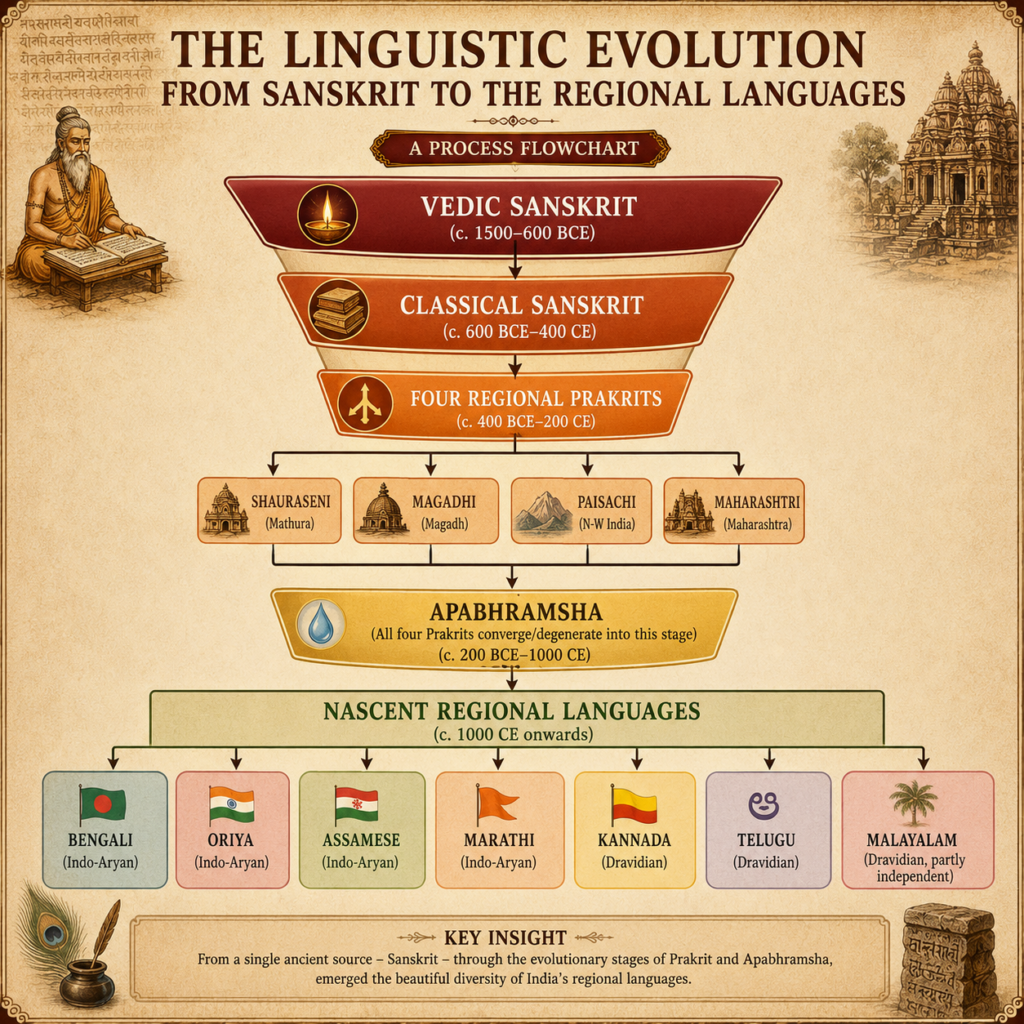
Linguistic Evolution: From Sanskrit to the Regional Languages
- From Vedic Sanskrit evolved Classical Sanskrit, which in turn led to the emergence of four types of Prakrit, believed to have been spoken in four different parts of the country:
- Shauraseni in the Mathura region.
- Magadhi in Magadh.
- Paisachi in the North-Western parts of India.
- Maharashtri in Maharashtra.
- These regional Prakrits, in turn, degenerated into the Apabhramsha.
- In the course of time, the regional languages evolved from these Apabhramshas, though still in a nascent form during the period under review.
- The two broad divisions of Indian languages are as follows:
- Those descending from Sanskrit, known as the Indo-Aryan group — languages such as Bengali, Marathi, Gujarati, Oriya, Assamese, and several others.
- The other group, known as the Dravidian languages — such as Tamil, Telugu, Kannada, and Malayalam — the last of which, however, traced its evolution to a much earlier date.
Bengali
- Religion played a vital role in shaping the life and thought of Bengal, a region that served as the cradle of popular religious movements.
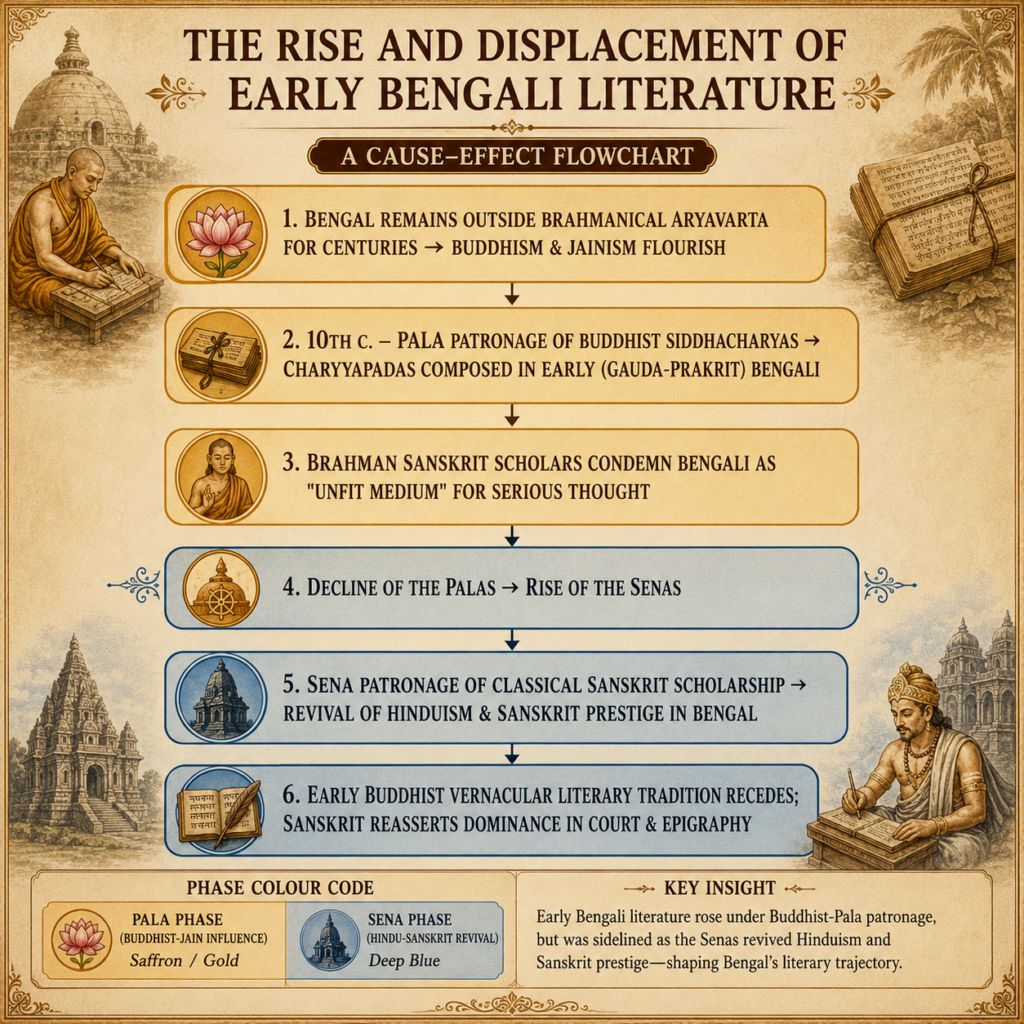
- Bengal was the last of the regions to be included in the Aryan-dominated Aryavarta (Land of the Aryans).
- Hence, Brahmanic influence remained at a very low ebb here for centuries.
- This explains the popularity of the comparatively more liberal creeds of Buddhism and Jainism in the region.
- In the later part of the 10th century A.D., the Buddhist monks (the Siddhacharyas of the Mahayana sect) — at the behest of the Pala rulers of Bengal, who professed the same religion — began to write books in Prakrit.
- The Charyyapadas were the most notable literary production of this period, though still in a rudimentary form.
- The language of these padas or songs — the Charyyageets — represented old Bengali and are regarded as the precursors of the later Bengali Sahajiya songs, the Vaishnava padas, the Shakta hymns, the Baul songs, and even the marfati songs of Sufi inspiration.
- Their appeal and intention were primarily religious, dealing with the philosophy of several Buddhist schools such as the Vajrayana, Sahajiya, and others.
- Lacking in literary beauty, their importance was primarily linguistic — as an old form of Bengali, the Gauda-Prakrit — and doctrinal.
- The literary production of the period, in fact, owed its origin chiefly to the earnestness of the Tantric Buddhists in popularising their creed.
- These initial efforts by the Buddhists to use Bengali as a literary medium were condemned by Brahman scholars well-versed in Sanskrit.
- They regarded Bengali as an unfit medium for conveying serious thought.
- They wished to preserve their monopoly over the interpretation of the shastras.
- With the decline of the Palas and the rise of the Senas, Buddhism rapidly waned from the land of its origin.
- The establishment of Sena rule brought about a revival of Hinduism in Bengal.
- The Brahman pandits were imbued with a taste for the hard and fast rules of classical grammar, denouncing the literary status of the vernacular.
- The Senas took pride in keeping a number of Sanskrit scholars attached to their courts.
- These pandits revelled in the high-flown style and niceties of rhetoric characteristic of 7th-century Sanskrit works.
- The establishment of Sena rule brought about a revival of Hinduism in Bengal.
- The inscriptions of the Pala and Sena kings of Bengal further testify to the coexistence of Sanskrit and vernacular usage. A few examples of this genre include:
- Pala king Dharmapala’s Khalimpur Copper Plate.
- Devapala’s Nalanda Copper Plate.
- Sena King Vijayasena’s Deopara Prasasti.
- The Naihati Copper Plate of Lakshmanasena.
- These epigraphic evidences throw sufficient light on the polity, socio-economy, religion, and administrative life of the period under review.
Oriya
- Lying between North and South India, across a natural highway along the eastern coast, Orissa displays through her indigenous individuality an interesting synthesis of Dravidian and Aryan cultures.
- Though the Oriyas speak a language of the Indo-Aryan group, much of their social life remains Dravidian.
- Many of the commonest words of daily use in an Oriya household are of Dravidian origin.
- Like Bengali and Assamese, Oriya too is a member of the eastern (Magadhi) group of the Indo-Aryan family of languages in India.
- In her script, however, Orissa presents an interesting synthesis of North and South India.
- Originating from the Brahmi script in the 3rd century B.C., it gradually developed towards its present form.
- This script combines the characteristics of the southern Kalinga script with those of the so-called Gupta and Proto-Bengali scripts.
- In her script, however, Orissa presents an interesting synthesis of North and South India.
- With the conquest of Kalinga by Ashoka in the 3rd century B.C., we find utterances made in Kalinga in the language of Magadhi Prakrit.
- Scholars hold that it is from this Magadhi Prakrit, and its later Apabhramsha form, that the entire group of Eastern Indian languages — Assamese, Bengali, and Oriya — evolved.
- In the 1st century B.C., Kalinga’s ruler Kharavela’sHathigumpha inscription was written in Pali, associated with the twin faiths of Jainism and Buddhism.
- Along with successive ruling dynasties, Pali-Prakrit remained the cultural language of Orissa (with local variations), until the Brahmanic revival, begun by the Imperial Guptas in North India in the 4th century A.D., firmly established itself in Orissa.
- Despite the rulers’ leanings towards Sanskrit, the people at large and the Buddhist intellectuals close to them still expressed themselves in a common language of their own — by then an Apabhramsha — that had come much closer to modern Oriya than either Ashoka’s edicts or Kharavela’s inscription.
- The common religion of the time was Mahayana, corrupted by Tantric elements called Vajrayana, believed to have originated in this part of India.
- The Buddhist monks wrote songs and psalms under the patronage of the Bhauma kings, who — like the Palas of Bengal and Bihar — were great patrons of art, literature, and religion.
- The spirit and content of these Buddhist poems depict the eternal undercurrent of the Natha-Mahayanic philosophy of life in Oriya culture.
- Buddhist poems in the Eastern Indian Apabhramsha of the 7th–9th centuries are found.
- Between this Apabhramsha Buddhist poetry (7th–9th centuries) and the Sisu Veda — the composition of an anonymous poet — and the Rudrasudhanidhi of Avadhuta Narayana Swami in the 13th century, no literary work in the vernacular has yet been traced.
- During this period of four to five centuries, Sanskrit-based Brahmanism held an almost totalitarian sway over the land.
- There were systematic persecutions of the Buddhists during the reigns of the Imperial Gangas and the Solars, who followed the Bhaumas.
- This was also the period of the great Hindu revivalists — Sankara, Ramanuja, Madhva, and Nimbarka — who visited Orissa and established zonal headquarters at Puri for the propagation of their faith in the eastern region of India.
- The vehicle of all these revived Hindu faiths was Sanskrit, to which the common people had no access; Buddhism, and its accompanying popular culture, had by now disappeared.
- However, amid the innumerable gift-records and panegyrics to kings composed in Sanskrit, we come across, in the 11th century, the inscription of Ananta Varma Vajrahasta Deva, King of Kalinga, written in the earliest form of the vernacular.
Assamese
- The period between the 6th and the end of the 10th century A.D. saw Kamarupa (formerly known as Pragjyotisa) ruled by Bhutivarman of the Pusyavarman line.
- He is described as an asvamedhayajin — a performer of the asvamedha sacrifice — in his Barganga Rock Inscription.
- From the 6th to the 10th century A.D., the Kamarupi Prakrit developed into the Kamarupi Apabhramsha.
- From the beginning of the 11th century A.D., the Kamarupi Apabhramsha turned into Kamarupi, or early Assamese.
- The aphorisms and sayings of Dak Mahapurusa constitute the earliest collection of popular literature in Assamese.
- These wise maxims are mostly in verse form.
- They were similarly popular in Bengal, Bihar, and Nepal.
- These compositions are significant for the account they give of customs, beliefs, and rules of conduct prevailing in the region from earliest times.
- They reflect the spirit of the age — the principles of Buddhistic ethics and morality.
- The beginning of distinctive Assamese literature appears to be marked by the composition of folk songs, commonly known as Bihugeets, along with pastoral ballads, marriage songs, and nursery rhymes.
- Bihu songs are connected with the Bihu festivals.
- However, recorded literature in Assamese began only from c. A.D. 1200 onwards.
Marathi
- The Marathi language draws the major part of its vocabulary from Sanskrit, Prakrit, Pali, and Apabhramsha, and came to be used as a medium of literary expression by about the 11th century.
- Very little evidence is available for tracing the evolution of Marathi from Maharashtri Prakrit; the Apabhramsha influence is traceable more clearly.
- It is also held by some scholars that Marathi represents a re-Sanskritised stage.
- In the 9th century, there followed the revival of Hinduism and its reinstatement as the most powerful religion — the development of Marathi synchronised with this revival.
- In the 9th century, the Rashtrakutas ruled over Maharashtra; powerful kings of this dynasty — Dantidurga, Krishna, Dhruva, and Govinda — ruled over the Deccan for more than two hundred years and were patrons of art and learning, though the language of learning in those days remained Sanskrit.
- Marathi had been in use as a spoken language since about c. A.D. 600, spreading into far-flung areas up to Mysore in the south.
- It was, however, not yet used as a language of literature; its traces are, therefore, found only in inscriptions meant to be seen by all the people.
- The earliest Marathi inscription (c. A.D. 983) is found at the foot of the huge monolithic statue of Gomateshwara at Shravanbelgola in Mysore.
- About twenty-eight inscriptions and copper plates in Marathi, dating from the 10th to the 12th centuries, have been discovered so far — marking different stages in the development of the language and its growing position in the life of the people.
- Because the language was so widely spoken, deeds of charitable gifts — such as the one at Patan (c. A.D. 1203), celebrating the gift of a math by King Soidev to his guru, and the imperial mandates of King Aparnaditya (c. A.D. 1183) — were drawn up in Marathi.
- Marathi had acquired a respectable place in court life by the time of the Yadava kings.
- Treatises in Marathi were written and read out in the court of kings.
- In the 12th century, during the reign of the last three Yadava kings, a great variety of literature in verse and prose was created — including folk-tales, folk songs, and Pauranic stories, as well as treatises on astrology, medicine, and other subjects of popular need.
- Another kind of literature, meant to please patrons and kings, also gradually came into existence — consisting mostly of long, rhetorical poems based on Pauranic stories or religious and philosophical discourses.
- The oldest available work of this type is the Viveksindhu by Mukundaraj.
- During the 12th century, a number of popular religious cults arose in India that broke away from orthodox Hinduism and the domination of Sanskrit.
- They aimed at a religious awakening of the masses, offering them simple forms of worship through their own languages.
- Such was the Nath cult, which had spread almost all over India.
- In Maharashtra, it resorted to the use of Marathi.
- Many Marathi songs and bhajans were in vogue during the days of Macchindranath, Gorakhnath, and others.
- Mukundaraj, author of the Viveksindhu — the earliest available work in Marathi — himself belonged to the Nath Panthi sect.
- The main current in Marathi literature was one of religious and philosophical exposition; like the literature in all the other regional languages, it was composed in verse.
- The Viveksindhu was such a work, in which Mukundaraj based his exposition on the basic tenets of Hindu philosophy and the Yogamarga.
- Mukundaraj also wrote other books, including Paramamrit, Paramvijaya, and Mulastambha.
- His work may be described as a confluence of various currents of contemporary life — he used the language of the people and aimed at presenting texts of ancient Hinduism from the point of view of his cult.
Kannada
- Sanskrit was the literary medium for the high and sophisticated culture of the region south of the Vindhyas.
- Alongside the classical language, however, the regional kingdoms of the Rashtrakutas, Cholas, and others nurtured vernacular languages such as Tamil, Kannada, Telugu, and Malayalam — all of which owed a great deal to the language of the Aryans in attaining literary status.
- The earliest extant work on rhetoric in Kannada is Nripatunga’sKavirajamarga(c. A.D. 850).
- The Kavirajamarga is based in part on Dandin’s Kavyadarsa, and must have received the patronage of the Rashtrakuta ruler Nripatunga Amoghavarsha I.
- Another writer of the early period (c. A.D. 650) was Syamakundacarya, a Jain.
- The first extant work on literature is Sivakoti’s Vaddaradhane (c. A.D. 900), a prose work on the lives of the older Jain saints, written mostly in the oldest Kannada style called Purvahal-Kannada.
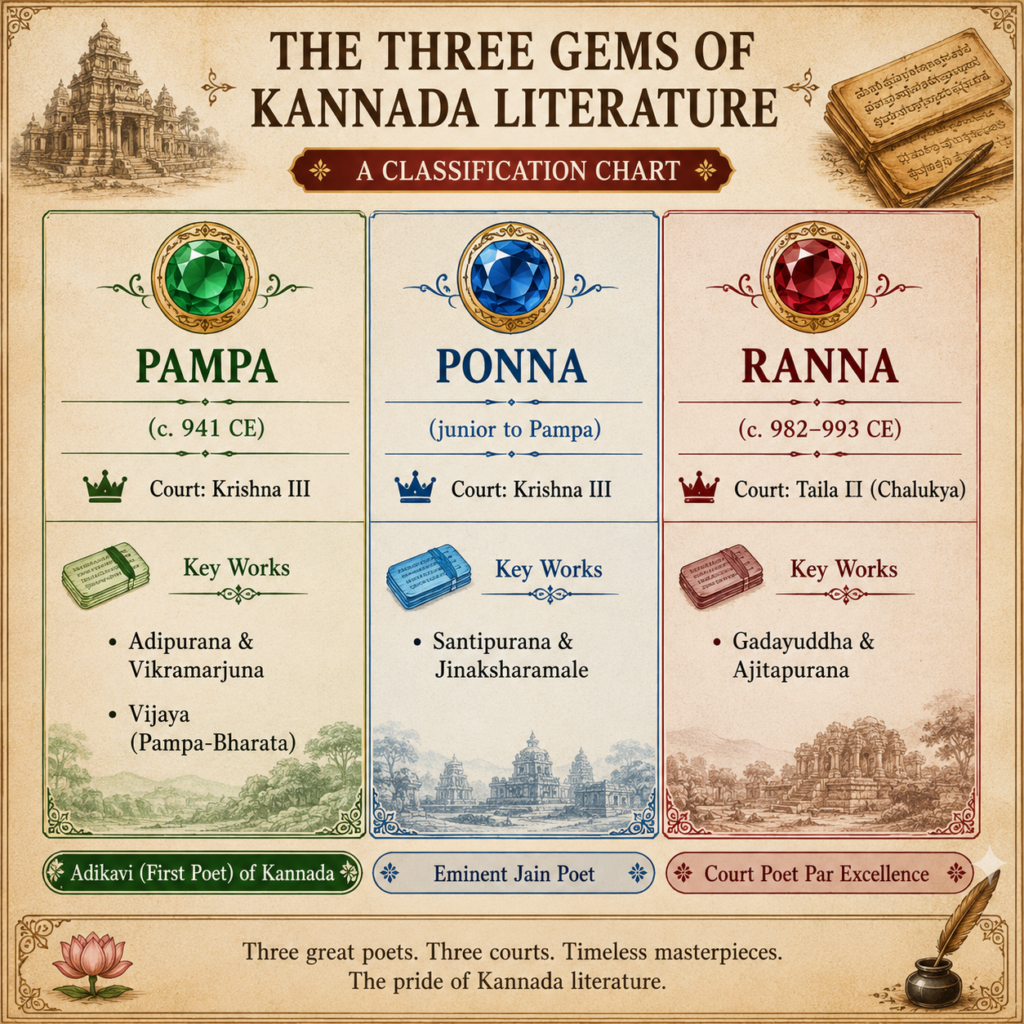
The Three Gems of Kannada Literature: Pampa, Ponna, and Ranna
- Pampa:
- He came of a family from Vengi, flourishing in the court of a feudatory of Rashtrakuta king Krishna III — Arikesari II of Vemulavada.
- Pampa is said to have composed two great poems at the relatively early age of thirty-nine (c. A.D. 941).
- His Adipurana narrates the life-story of the first Jain Tirthankara.
- His other work, Vikramarjuna Vijaya (also called Pampa-Bharata), contains his own version of the Mahabharata story.
- Pampa is considered the most eminent among Kannada poets.
- Ponna:
- He was Pampa’s junior contemporary; his family also had its origin in Vengi.
- His principal work is the Santipurana, the legendary history of the sixteenth Tirthankara; he also wrote the Bhuvanai-Karamabhyudaya and the Jinaksharamale, a poem in praise of the Jainas.
- He received the title “Ubhayakavicakravarti” (supreme poet in two languages — Sanskrit and Kannada) from Rashtrakuta king Krishna III.
- Ranna:
- He, along with Pampa and Ponna, completes the “Three Gems” of Kannada literature.
- He adorned the court of the Chalukya king Taila II and his successor, rising to the rank of Kavicakravarti.
- His Ajitapurana (c. A.D. 993) is a work on the life of the second Tirthankara.
- His Gadayuddha (c. A.D. 982) reviews the story of the Mahabharata, with particular reference to the last fight with clubs (gada) between Bhima and Duryodhana.
Later Kannada Writers
- Chavundaraya, one of Ranna’s early patrons and a feudatory of Ganga Racamalla II, composed the Cavundaraya Purana in c. A.D. 978 — one of the earliest extant prose works in Kannada treating the legends of the twenty-four Tirthankaras.
- Nagavarma I, a protégé of Chavundaraya from a Brahman family, wrote the Chandombudhi (“ocean of prosody”), addressed by the author to his wife — the earliest work on the subject in Kannada.
- Durgasimha, a Brahman Saiva minister under Jayasimha II Jagadekamalla, wrote the Pancatantra, a Champu based on Gunadhya’s Brihatkatha.
- Chavundaraya, a Brahman Advaita Saiva protégé of Jayasimha, authored the Lokopakara (c. A.D. 1025) — a cyclopaedic miscellany in verse on subjects such as astronomy, astrology, sculpture, construction of buildings, omens, divination of water, medicinal herbs, scents, cookery, and toxicology.
- Sridharacarya, a Jain Brahman, wrote the Jataka-tilaka (c. A.D. 1049), the earliest work on astrology in Kannada.
- Advaiti Nagavarmacarya, patronised by Ganga Udayaditya (c. A.D. 1070), a feudatory of Somesvara II at Banavase, authored the Candracudamanisataka, on the ethics of renunciation.
- Nagachandra:
- A Jain (c. A.D. 1105) who built the Mallinatha Jinalaya, dedicated to the nineteenth Tirthankara, at Bijapur.
- He wrote the Mallinathapurana, a Champu, and is best known for his Ramachandra Charitapurana, which gives the Jain version of the Rama legend — a necessary complement to Pampa’s Bharata, earning its author the title Abhinava (new) Pampa.
- The Govaidya of Kirttivama was a 12th-century work on veterinary science, half medicine and half magic.
- In c. A.D. 1145, Karnaparya wrote the life of the 22nd Tirthankara in his Neminathapurana, a Champu in which the story of Krishna and the Mahabharata were also skilfully worked in.
- Nagavarma II:
- He wrote the Kavyavalokana, an important work on Kannada grammar and rhetoric.
- His Karnataka Bhashabhushana deals with grammar — the sutras and short explanations are in Sanskrit, while the illustrations come from Kannada literature.
- His Vastukosa is a relatively short lexicon of Kannada equivalents of Sanskrit terms.
- The Udayadityalankara (c. A.D. 1150), a short work on the art of poetry based on Dandin’s Kavyadarsa, was written by a Chola prince.
- Pujyapada’s Kalyanakaraka, a work on medicine, was translated from Sanskrit into Kannada by the Jain author Jagaddala Somanatha.
- Most of the writers mentioned so far were Jains, followed by the Vira-Saivas and Vaishnavas, who began influencing Kannada literature from the 12th and 15th centuries respectively.
- Jain writers continued to flourish under the later Hoysalas, with the lives of the Tirthankaras forming the theme of many puranas in the form of Champus.
- Nemichandra:
- A court-poet under Vira Ballala, who wrote the Lilavati, a plain romance.
- He undertook to write the Neminathapurana at the instance of Ballala’s minister but died before completing it — the work came to be known as Ardha Nemi (unfinished life of Nemi).
Telugu
- In ancient times, the Telugu country was often called Trilinga, the country bounded by the three lingas of Kalahasti, Srisailam, and Daksharama, and Telinga.
- “Telugu” as the name of the country and language may well be traced to this word; it has also been suggested that “Tel(n)ugu” derives from “tene” (honey) or “tennu” (way).
- The beginnings of the language can be traced from stone inscriptions of the 5th and 6th centuries A.D., and its basic elements show affinities with Tamil and Kannada.
- From the beginning, however, the literary idiom depended very largely upon Sanskrit — the inscriptions of the ruling dynasties of the 6th–7th centuries are in Sanskrit with an admixture of Prakrit and Telugu words.
- In its beginnings, Telugu had much in common with Kannada, an affinity that persisted to a relatively late stage in the development of the two languages.
- Pampa and Ponna, two of the greatest Kannada poets, came from the Telugu country, and the great Telugu poet Srinatha styled himself a poet in Karnatabhasha.
- Early Telugu prose and verse can now be traced only in inscriptions, such as those of the Telugu-Chodas and the Eastern Chalukyas — a well-developed verse adorns the grant of General Panduranga (c. A.D. 845–6).
- There must have existed much unwritten literature of a popular character enlivening the daily life of the common folk. Such desi compositions may have included:
- Lalipatalu (song of the cradle).
- Melukolupulu (songs of the dawn).
- Mangala haratulu (songs of festivity).
- Kirtanalu (devotional songs).
- Udupu patalu (songs of the harvest).
- Of higher literature strongly influenced by Sanskrit, no work earlier than the 11th century has survived.
- Telugu literature, as we know it, begins with Nannaya’s translation of the Mahabharata, undertaken during the reign of Rajaraja Narendra (c. A.D. 1019–61).
- Nannaya was perhaps also the author of the Andhra-sabda-cintamani, the first Telugu grammar, which systematised the language by standardising words and their usage, earning for its author the title “Vaganusasana” (“law-giver of the language”).
- An eminent younger contemporary of Nannaya was Vemulavada Bhima Kavi.
- He was associated with the Eastern Ganga King Anantavarman Chodaganga (c. A.D. 1078–1148).
- He was the author of the Kavijanasraya, a Telugu grammar.
- From the 12th century, Vira-Saivism became an important factor in the religious life of the Telugus, and a sectarian outlook became more and more common.
- The poets of the period were generally supporters of this faith.
- Famous among them was Mallikarjuna Pandita, guru of Nanne Choda, whose Siva-tattva-Saram is an exposition of Virasaivism in about five hundred verses.
- Nanne Choda, a Telugu-Choda prince, son of Chodaballi of Pakanadu, was the author of Kumarasambhava, a Mahakavya.
- It is based on the Sanskrit works on the same theme by Kalidasa and Udbhata, and also draws upon the Saiva literature known to the author.
Malayalam
- Malayalam was the last of the South Indian languages to develop a separate existence and a literature of its own.
- The literary idiom of Malayalam, like that of Kannada and Telugu, borrowed freely from Sanskrit — and, in order to express Sanskrit sounds adequately, it had to discard the old Vatteluttu script and evolve a new script based on Tamilgrantha. This happened perhaps about the 10th century.
- The early inscriptions of the country used the grantha script for Sanskrit words, amid the Tamil-Malayalam written in Vatteluttu.
- The date of the earliest extant literary composition falls beyond 1200 A.D.
- Literary activities in this vernacular began only from the 13th–14th centuries onwards.
Conclusion
While the North Indian vernaculars — Bengali, Oriya, Assamese, and Marathi — remained in their incipient stage so far as literary production was concerned during the early medieval period, the southern Dravidian group of languages manifested a steady and comparatively earlier growth, producing a substantial corpus of literature across different branches of knowledge — from kavya and purana to grammar, lexicography, astrology, and medicine. This regional divergence reflects the deeper historical asymmetry between the North, where Brahmanical Sanskrit hegemony and shifting dynastic patronage (as seen vividly in Bengal and Orissa) delayed vernacular literary confidence, and the South, where languages like Kannada, with its “Three Gems,” and Telugu, benefiting from sustained royal and religious patronage, achieved earlier literary maturity. Taken together, the story of these newly developing languages illustrates how the political and religious regionalisation of early medieval India laid the linguistic foundations for the rich vernacular literary traditions that would flourish across the subcontinent in the centuries to follow.




