

Growth of Tamil Literature: Introduction

- The growth of Tamil literature unfolded across several distinct historical phases, each shaped by evolving religious, political, and cultural currents in South India.
- The oldest body of works now known in the Tamil language belongs to the literature of the Sangam Age. The next major epoch in the history of Tamil literature spans a period of roughly three and a half centuries (c. AD 500–850), followed by the golden age ushered in under the imperial Cholas (c. AD 850–1200).
- This article traces the growth of Tamil literature across these two formative periods — examining the deepening Sanskritic influence, the rise of Jain, Saiva, and Vaishnava devotional writing, and the flowering of Chola-era court poetry, grammar, and lexicography that together defined the golden age of Tamil culture.
Tamil Literature over the Period c. AD 500–850
- This phase saw Sanskritic influence become even more pronounced than before:
- Numerous words and concepts from the domains of ethics, religion, and philosophy were freely borrowed and absorbed into Tamil.
- Sanskrit codes and law books were adopted as the foundation for a considerable body of didactic literature, a striking feature of the age.
- On occasion, entire works in Sanskrit or allied dialects were directly translated or adapted into Tamil.
- There was, at the outset, a clear preponderance of Jain writers, since — as elsewhere in India during this period — Jainism and Buddhism exercised a strong cultural influence.
- The rising tide of Hindu reaction, however, soon produced a substantial body of popular devotional literature in verse, composed to be set to music, which came to captivate the hearts of the common people.
- This widespread Hindu religious revival — in which numerous Saiva nayanars and Vaishnava alvars worked in tandem — furnished a powerful stimulus to the growth of popular devotional literature.
- This devotional literature was significant both for its sheer volume and for its influence on everyday life.
- Groups of devotees, led by prominent religious figures, travelled from place to place and shrine to shrine, singing the hymns composed during these very pilgrimages — a practice that encouraged the use of simple diction and catchy tunes.
Major Literary Works of the Period
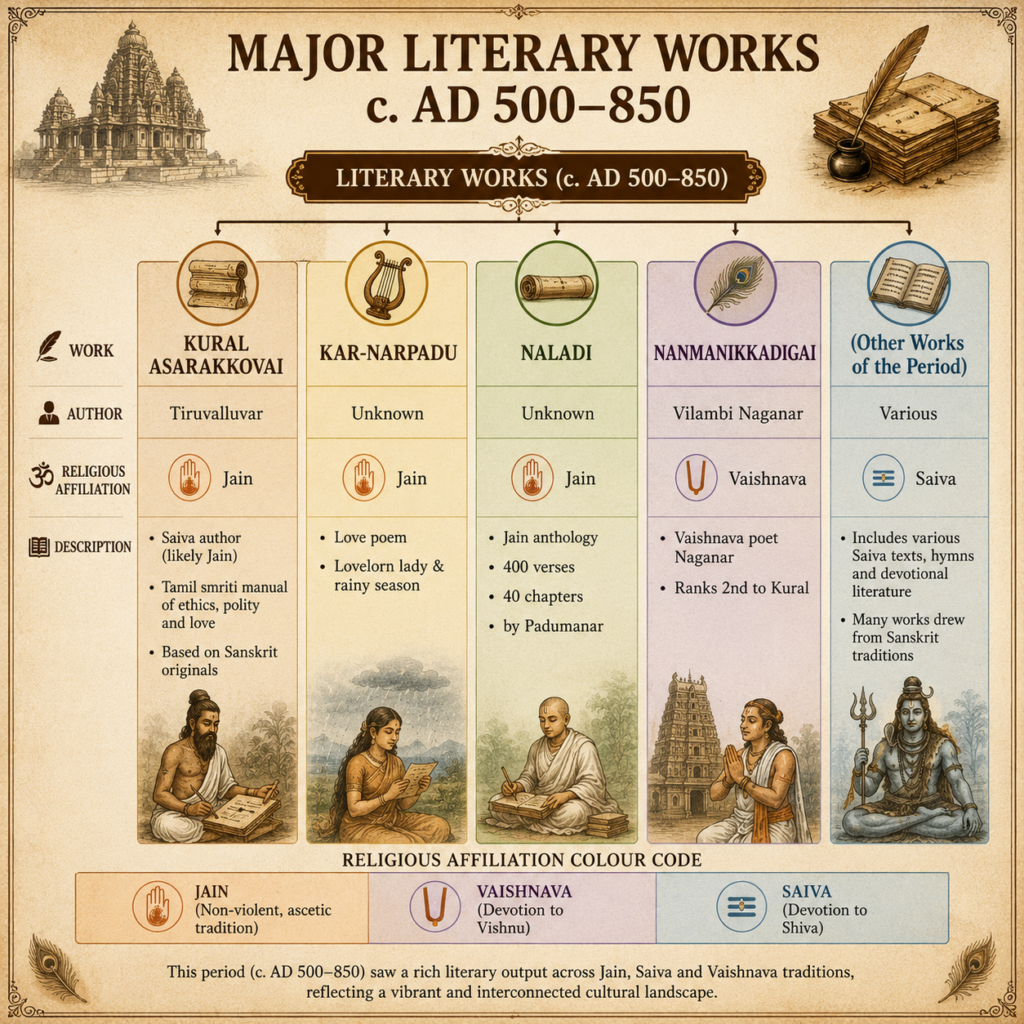
- Kural of Tiruvalluvar:
- A comprehensive manual on ethics, polity, and love.
- Its author was most likely a learned Jain divine — a close familiarity with the works of Manu, Kautilya, and Vatsayana is unmistakably evident throughout the text.
- Kar-narpadu: a love poem in which a lovelorn lady describes the dreadful approach of the rainy season in her beloved’s absence.
- Naladi: a Jain anthology of 400 verses, compiled by Padumanar and arranged across forty chapters.
- Nanmanikkadigai (100 stanzas): composed by the Vaishnava poet Vilambi Naganar, and considered a work of high literary merit, ranking second only to the Kural.
- Asarakkovai: effectively a Tamil smriti composed by a Saiva author, avowedly based on Sanskrit originals.
Canonisation of Devotional Hymns
- In this golden age of Tamil Hinduism, a substantial volume of literature has survived through the canonical editions of hymns compiled in the tenth century — by Nambi Andar Nambi for the Saiva group, and by Nathamuni for the Vaishnava tradition.
- One of the earliest poets whose work entered the Saiva canon was Karaikkal Ammai, who sang the praises of the deity of Tiruvalangadu; the two other poems she composed mark the very beginning of Prabandha literature in Tamil.
- The devotional songs of the Vaishnava alvars were compiled into the Natayira Divyaprabandham, or the “Four Thousand Sacred Hymns.”
The Age of the Imperial Cholas (c. AD 850–1200)
- This period represents the golden age of Tamil culture, naturally marked by the widespread practice and patronage of literature. The impulse to produce devotional religious literature, already active in the preceding period (c. AD 500–850), continued with considerable force well into this era.
- The Prabandha form became the dominant literary mode, and the systematic treatment of Saiva-siddhanta in philosophical treatises began in earnest during this period.
- Great Siva temples were newly built, and the hagiology of Saivism was formally standardised in a great purana composed by Sekkilar.
- A substantial quantum of Vaishnava devotional literature and commentary on the canon also emerged during this period.
Jain and Buddhist Authors under the Cholas
- Jaina and Buddhist authors continued to flourish during this period, though in noticeably smaller numbers than in the earlier age.
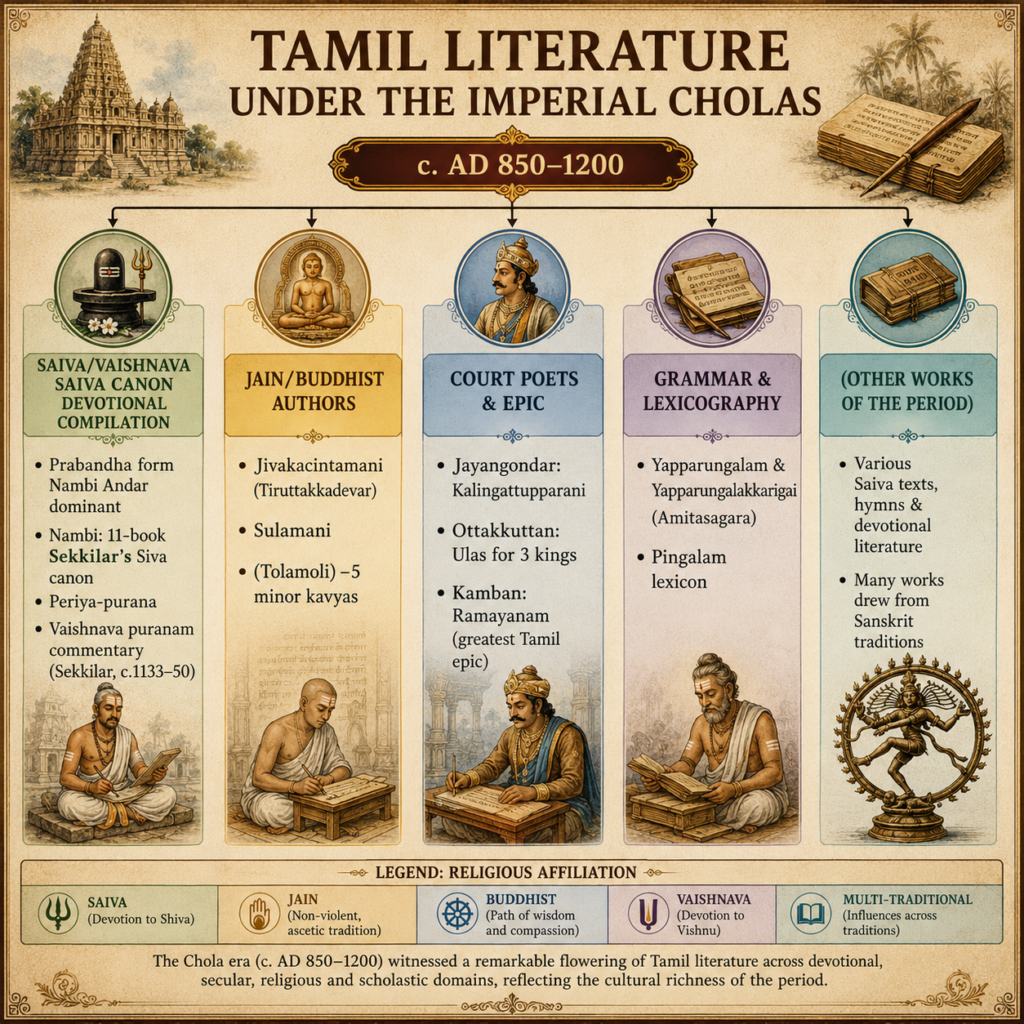
- In general literature, the Jivakacintamani of the Jain ascetic and poet Tiruttakkadevar was composed early in the tenth century.
- Another Jain writer of the time, Tolamoli, authored the Sulamani, which treats a Jain puranic theme in verse form and is counted among the five minor kavyas of Tamil literature.
Chola Court Poets and the Tamil Epic
- The Kalingattupparani, composed by Jayangondar, poet-laureate of the Chola court, is a war poem par excellence, describing the Kalinga war of Kulottunga.
- Another poet-laureate of the Chola court was Kuttan (Ottakkuttan), a contemporary of Vikrama Chola, Kulottunga II, and Rajaraja II, who composed eloquent Ulas in honour of each of these three rulers.
- Kamban was the celebrated author of the Tamil Ramayanam (or Ramavataram), composed during the reign of Kulottunga III — widely regarded as the greatest epic in Tamil literature.
The Saiva Canon and the Periya-puranam
- The extant arrangement of the Saiva canon into eleven books was the work of Nambi Andar Nambi, who lived at the close of the tenth century.
- His own compositions include six Prabandhas on Nanasambandar and one on Appar, in addition to the Tiruttondar-tiruvandadi, which provides a brief account of the lives of the sixty-three (Nayanar) saints.
- These works, along with poems he composed in praise of Vinayaka and Chidambaram, together occupy the eleventh book of the Saiva canon.
- The Periya-puranam of Sekkilar, composed during the reign of Kulottunga II (c. AD 1133–50), stands as a genuine landmark in the history of Tamil Saivism.
- Vaishnava religious literature produced during this period was, by contrast, composed predominantly in Sanskrit.
Tamil Grammar and Lexicography
- In the field of Tamil grammar, the Yapparungalam and Yapparungalakkarigai — two authoritative works on prosody — were composed by Amitasagara, a Jain ascetic of the late tenth century, who received patronage from contemporary Chola monarchs, including liberal grants of territory.
- In lexicography, the concise nigandu (lexicon) known as the Pingalam — named after its author — also belongs to this period.
Conclusion
- The growth of Tamil literature between c. AD 500 and 1200 traces a remarkable arc — from the deepening Sanskritic and Jain influence of the earlier period, through a powerful Hindu devotional revival driven by the Saiva nayanars and Vaishnava alvars, to the full flowering of Chola-era court poetry, epic literature (Kamban’s Ramayanam), religious canon-building, and grammatical and lexicographical scholarship.
- Taken together, these two periods represent the consolidation of Tamil as a major literary and devotional language in its own right — one whose canon, court poetry, and religious literature continued to shape South Indian culture well beyond the Chola period itself.




