The Chalukya dynasty ruled large parts of southern and central India between the 6th and 12th centuries CE, over this period branching into three related yet individual dynasties. This article focuses on the earliest and founding branch — the Chalukyas of Badami — tracing their disputed origins, political history, administration, and their far-reaching contributions to religion, architecture, painting, and literature, an essential topic for UPSC History Optional aspirants.
The Three Chalukya Dynasties

- The Chalukyas of Badami: The earliest of the three, ruling from Vatapi (modern Badami) from the middle of the 6th century.
- They began asserting independence at the decline of the Kadamba kingdom of Banavasi, rising rapidly to prominence during the reign of Pulakeshin II.
- This dynasty ruled for nearly two hundred years (6th–8th century), until the rise of the Rashtrakutas in the mid-8th century eclipsed them.
- The Chalukyas of Vengi (also called the Eastern Chalukyas): This branch split off from the Chalukyas of Badami.
- The Badami ruler Pulakeshin II (608–644 CE) conquered the Vengi region in the eastern Deccan after defeating the remnants of the Vishnukundina dynasty, appointing his brother Kubja Vishnuvardhana as governor of this newly acquired territory in 624 CE.
- After Pulakeshin II’s death, Vishnuvardhana’s viceroyalty became an independent kingdom in the eastern Deccan, giving rise to the Eastern Chalukya kingdom.
- They ruled the Vengi region of present-day Andhra Pradesh until around 1130 CE, continuing thereafter as feudatories of the Cholas until 1189 CE.
- The Chalukyas of Kalyani (also known as the Western Chalukyas): The Rashtrakuta Empire of Manyakheta controlled most of the Deccan and Central India for over two centuries after eclipsing the Chalukyas of Badami.
- In the late 10th century, seeing confusion in the Rashtrakuta empire, descendants of the Chalukyas of Badami rose quickly to power, growing into an empire under Someshvara I, who moved the capital to Kalyani.
- These Western Chalukyas ruled from Kalyani (modern Basavakalyan) until the end of the 12th century, distinguished from the contemporaneous Eastern Chalukyas of Vengi by name.
Chalukyas of Badami
The Origin
- There is considerable controversy surrounding the origin of the Chalukyas, with several competing views:
- Dr. V.A. Smith held that the Chalukyas were connected with the Chapas, and hence with the foreign Gurjara tribe of which the Chapas were a branch.
- Dr. D.C. Sircar, whose view is considered more probable (though without sufficient evidence either), held that the Chalukyas represented an indigenous Kanarese family that claimed the status of Kshatriyas.
- The Chalukyas of Badami themselves claimed Brahmana origin, styling themselves Haritiputras of the Manavya Gotra in their inscriptions — the same lineage claimed by their early overlords, the Kadambas of Banavasi, making them, by this account, descendants of the Kadambas; the Chalukyas indeed took control of territory formerly ruled by the Kadambas.
- Some records of the Eastern Chalukyas mention a northern origin theory, claiming that one ruler came south from Ayodhya.
- The legendary history in the records of the later Chalukyas of Kalyani traces the dynasty’s origin to Manu or the Moon, associating it with Ayodhya, capital of Uttara Kosala — stating that 59 kings of the Chalukya lineage ruled at Ayodhya and 16 kings ruled in the Dakshinapatha.
- However, it was a popular practice in the 11th century to link South Indian royal lineages to a northern kingdom, and the Badami Chalukya records themselves remain silent on any Ayodhya origin.
- Another inscription states that the progenitor of the dynasty was the god Brahma, while other records claim the Chalukyas descended from Soma (the Moon), said to have been created from the eye of Atri, son of Brahma — among several other similar origin legends.
- The 12th-century Kashmiri poet Bilhana suggests the Chalukya family belonged to the Shudra caste, while other sources claim they were Kshatriyas.
- The historian S.C. Nandimath proposed that the word “Chalukya” derives from Salki or Chalki, a Kannada word for an agricultural implement.
Historical Sources
- Inscriptions in Sanskrit and Kannada are the main source of information on Badami Chalukya history, including:
- the Badami cave inscriptions of Mangalesha;
- the record of Kappe Arabhatta (a Chalukyan warrior), dated around 700 CE;
- the Peddavaduguru inscription of Pulakeshin II; and
- the Kanchi Kailasanatha Temple inscription and Pattadakal Virupaksha Temple inscription of Vikramaditya II.
- The Mahakuta Pillar inscription of Mangalesha and the Aihole inscription of Pulakeshin II are important Sanskrit inscriptions written in old Kannada script.
- Several coins of the Badami Chalukyas bearing Kannada legends have also been found, all indicating that the Kannada language flourished during this period.
- Travelogues of contemporary foreign travellers also provide useful information: the Chinese traveller Xuanzang visited the court of Pulakeshin II.
- As recorded in the Aihole inscription, at the time of this visit, Pulakeshin II had divided his empire into three Maharashtrakas, or great provinces, each comprising 99,000 villages — an empire likely covering present-day Karnataka, Maharashtra, and the coastal Konkan.
- Xuanzang, impressed by the empire’s governance, observed that the benefits of the king’s efficient administration were felt far and wide.
- Later, the Persian emperor Khosrau II exchanged ambassadors with Pulakeshin II.
Political History of the Chalukyas of Badami
- The Chalukyas became a sovereign power with Pulakeshin I (533–566 CE), who laid the foundations of his kingdom by fortifying the hill near Badami, in the Bijapur district of Karnataka, in 543–44 CE, and performing a horse sacrifice.
- He established his capital at the hill-fort of Vatapi (Badami), a choice dictated by strategic considerations, as the site was fortified by hills and rivers.
- He adopted the title Vallabheshvara and performed the ashvamedha.
- He was succeeded by Kirtivarman I (566–597 CE), who further extended the kingdom by defeating the Mauryas of North-Konkana, the Nalas of Nalavadi (Bellari), and the Kadambas of Banavasi.
- Kirtivarman I was succeeded by his brother Mangalesha, who began ruling as regent, since Pulakeshin II, son of Kirtivarman I, was a minor.
- Mangalesha established Chalukya power over the entire region between the two seas and defeated the Kalachuris of Chedi.
- Pulakeshin II (609–642 CE) had to wage a civil war against his uncle Mangalesha, who refused to hand over power; he adopted the title Satyashraya.
- With the expeditions of Pulakeshin II, the Chalukyas became the paramount power in the Deccan.
- He defeated the Western Gangas and the Alupas in the south, while the Latas, Malavas, and Gurjaras in the north offered their submission to him.
- The army of Pulakeshin II checked the forces of Harshavardhana on the banks of the Narmada.
- Pulakeshin II also defeated the Vishnukundins of the Andhra delta and annexed Vengi, lying between the mouths of the Krishna and Godavari rivers.
- In 621 CE, he sent his younger brother Vishnuvardhana to consolidate this conquest and take over the area; by 631 CE, Vishnuvardhana was allowed to form his own kingdom.
- Thus began the line of the Chalukyas of Vengi, or Eastern Chalukyas, who remained in control of the area for more than five hundred years.
- His first expedition against the Pallava kingdom, then ruled by Mahendravarman I, was a complete success, occupying the northern part of the Pallava kingdom.
- However, Pulakeshin’s second invasion of Pallava territory ended in failure — he was badly defeated in several battles by Narasimhavarman I, who had succeeded Mahendravarman.
- Narasimhavarman I then attacked the Chalukyas, captured Badami, and probably killed Pulakeshin II.
- One of the paintings at Ajanta represents Pulakeshin II receiving an ambassador from Iran; owing to Pulakeshin’s growing power and trade relations with India, the Iranian king Khusrau II sent an ambassador to Badami in return for one sent earlier by Pulakeshin to Iran in 625 CE.
- Hiuen Tsang, the Chinese pilgrim, visited Pulakeshin’s kingdom around 641 CE.
- Pulakeshin II encouraged art and architecture and promoted religion and learning; his court poet Ravikirti composed his eulogy in the Aihole inscription.
- Vikramaditya I (644–681 CE), son of Pulakeshin II, succeeded in restoring a semblance of unity, gradually regaining territory lost to the Pallavas.
- He drove out the Pallavas, formed an alliance with the Pandyas, and repeatedly raided Pallava territory, eventually plundering the Pallava capital, Kanchi, thus avenging his father’s defeat and death at Pallava hands.
- Vinayaditya’s (681–693 CE) reign was generally peaceful and prosperous.
- Vijayaditya (693–733 CE), the next ruler, had the longest and also the most prosperous and peaceful reign, marked by a great increase in temple building.
- The Chalukyan king Vikramaditya II (733–745 CE) is said to have overrun Kanchi three times; in 740 CE, he completely routed the Pallavas, his victory ending Pallava supremacy in the far south — his reign is also notable for his repulsion of an Arab invasion of south Gujarat.
- The last Chalukyan ruler, Kirtivarman II (744–745 CE), was defeated by one of his own feudatories, Dantidurga, founder of the Rashtrakuta dynasty — bringing an end to the Chalukya dynasty of Badami.
Contribution of the Chalukyas of Badami
- The Chalukyas established an extensive empire in the Deccan, bringing glory to their family — first under the Chalukyas of Badami for nearly two hundred years, and then for a comparable period under the Chalukyas of Kalyani — ruling over an extensive area of South India for a long span of time.
- The dynasty produced many capable rulers, both as military commanders and good administrators; many of them fought against powerful rulers of both South and North India, often succeeding, and assumed high titles such as Parameshvara and Paramabhattaraka, governing their empire well.
- The Chalukyas also participated actively in the progress of South Indian culture. Their kingdom was economically prosperous, with several large cities and ports serving as centres of both internal and external trade, even with countries outside India.
- The Chalukyas used this prosperity for the development of architecture, literature, and the fine arts.
- The Chalukya era may be seen as the beginning of the fusion of northern and southern Indian cultures, enabling the transmission of ideas between the two regions — most clearly visible in architecture, where the Chalukyas developed the Vesara style, combining elements of the northern Nagara and southern Dravida styles.
- During this period, the expanding Sanskritic culture mingled with already-popular local Dravidian vernaculars.
- In present times, a celebration called Chalukya Utsava — a three-day festival of music and dance organised by the Government of Karnataka — is held every year at Pattadakal, Badami, and Aihole, celebrating Chalukya achievements in art, craft, music, and dance; the programme begins at Pattadakal and ends at Aihole.
The Contribution to Religion
- The Chalukyas were followers of the Brahmanical religion, performing many yajnas according to Vedic rites, with many religious texts written and compiled during their rule.
- Sacrifices were given great importance, the king himself performing a number of them, including the Ashvamedha and Vajapeya.
- Despite this emphasis on the orthodox form of Hindu religion, the Puranic version of Hinduism grew popular, and this popularity gave momentum to the building of temples in honour of Vishnu, Shiva, and other gods.
- Superb structures were built at Vatapi and Pattadakal in honour of Brahma, Vishnu, and Shiva.
- The Chalukyas followed a policy of religious tolerance.
- Jainism prospered in the Deccan during their reign; the famous Jaina scholar Ravikirti was honoured at the court of Pulakeshin II, and Vijayaditya and Vikramaditya also donated many villages to Jaina scholars.
- Buddhism was certainly in decline, but the Chalukyas treated it with tolerance — the Chinese traveller Hiuen Tsang found many well-established viharas and monasteries during his visit to the kingdom.
- Even the Parsees were allowed to settle and practise their faith without interference, in the Thana district of Bombay.
The Contribution to Architecture
- The Chalukyas were great patrons of art and architecture, developing the Vesara style in the building of structural temples — though this style reached its culmination only under the Rashtrakutas and Hoysalas.
- Examples of early medieval rock-cut shrines and structural shrines survive; the structural temples of the Chalukyas are found at Aihole, Badami, and Pattadakal.
- Cave temple architecture was also famous under the Chalukyas, with their cave temples found at Aihole, Badami, Ajanta, Ellora, and Nasik.
Cave Architecture
- Chalukya cave temples generally represent Brahmanical/Hindu themes, with varied patterns and designs — there is no single element of uniformity.
- Some cave temples have a sanctum (garbhagriha) and assembly hall (mandapa); the caves are characterised by pillars with bases and capitals, normally square in shape.
- Caves generally feature engravings, some representing beautiful art forms, such as depictions of Nataraja.
Aihole Caves
- There are two notable cave shrines at Aihole, one Shaiva and the other Jaina, both with heavily ornamented interiors.
- Ravanaphadi cave: a Shaiva cave, consisting of a central hall, two side shrine sections, and a garbhagriha with a linga at the back.
- It bears sculptures on the walls and part of the ceiling, including representations of Shiva as Nataraja and of the Sapta-Matrikas.
- Compared to the figures at Ellora and Badami, these figures are more slender and have tall crowns; outside the cave’s entrance are carvings of dwarfs and doorkeepers wearing Scythian-type attire.
Badami Caves
- These caves are carved into the red sandstone hillside. Of the three major caves, the largest is Vaishnava, while the others are Shaiva and Jaina in affiliation.
- The caves follow a simple plan — a verandah and a pillared hall leading into a small square sanctum in the back wall — with walls and ceilings decorated in carvings.
- Cave 3 is the largest, most ornate, and most impressive of the early Chalukya caves.
- It bears impressive relief sculptures of various Vishnu incarnations, including Varaha (boar), Narasimha (lion), and Vamana (dwarf) — the boar also served as the symbol of the Western Chalukyas.
- It also features mithuna figures (amorous couples), exceptional in their variety and finesse.
Temple Architecture
- The structural temples of this period were, for the most part, built from large blocks of stone without mortar.
- Inner walls and ceilings bear sculptural ornamentation, and the temples of Aihole, Pattadakal, and Badami even record the names of guilds of architects and sculptors, along with individual craftspeople who worked at these sites.
- Chalukya temples may be divided into two stages:
- The first stage was the early architectural phase (6th–early 8th centuries), represented by temples at Aihole and Badami.
- The second stage was the later and grander 8th-century temples at Pattadakal.
- A unique feature of Chalukya temple-building was that the same site could follow both northern and southern styles, though in different temples.
- This led to the foundation of the new Vesara style, an amalgam of northern and southern architectural features that nonetheless attained a distinctive identity of its own during these centuries, though it reached its true culmination only under the Rashtrakutas and Hoysalas.
Temples in Aihole
- At Aihole alone, there are about 70 temples — earning it the names “city of temples” and “the cradle of Indian temple architecture.”
- Most Aihole temples are Hindu shrines, showing considerable variation in plan. Among the seventy temples, four are especially important:
- The Ladh Khan temple is a low, flat-roofed structure consisting of a pillared hall, neither purely northern nor southern in style, resembling a village assembly structure — it has a pillared porch and a large square hall with pillars arranged in two concentric squares, ending in a small shrine area.
- The Durga temple resembles a Buddhist chaitya, following the northern style, characterised by a garbhagriha and mandapa.
- The Huchimalligudi temple.
- The Jain temple at Meguti, built in southern style, houses the famous Aihole inscription of Pulakeshin II.
Temples in Badami
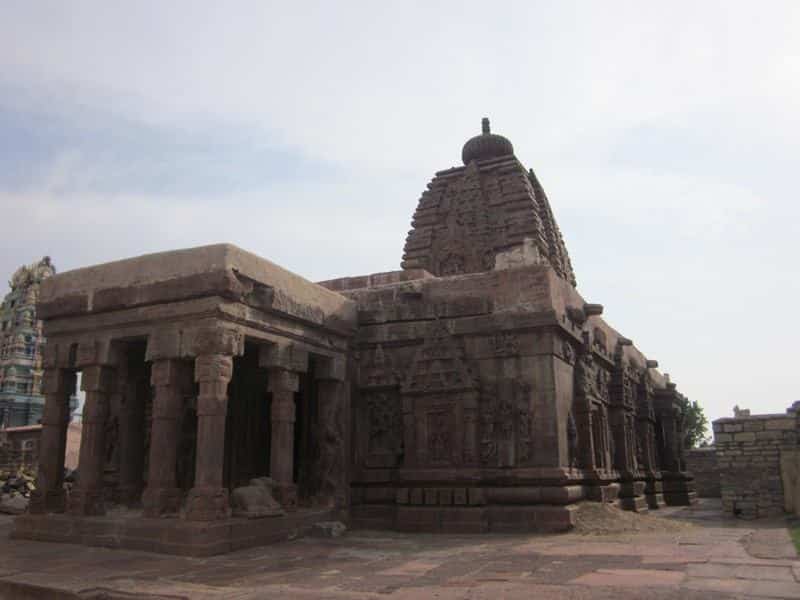
- Here, the Muktheeswara temple and the Melagutti Sivalaya are notable for their architectural beauty.
Temples in Pattadakal
- There are ten temples here — four in the northern style, and the remaining six in the Dravidian style.
- The Sangamesvara temple and the Virupaksha temple are famous examples of the Dravidian style.
- The Virupaksha temple is the most important of the group.
- It was built on the model of the Kailasanatha temple at Kanchipuram, and by one of the queens of Vikramaditya II — sculptors brought from Kanchi were employed in its construction.
- It is the largest and most profusely sculpted shrine at Pattadakal, dedicated to Shiva, built at the instance of Lokamahadevi, chief queen of Vikramaditya II, and represents the climax of early Chalukya temple architecture.
- It is the only temple of this time to feature a gopuram, the first such structure in the Deccan.
- Similar to temples in the Dravida style, it consists of a complex of shrines, including a Nandi shrine, within a rectangular walled enclosure.
- The main temple consists of a pillared hall, with the sanctum having an enclosed passage for circumambulation (known as the sandhara style).
- The shikhara follows the Dravida style; niches in the outer walls bear fine, deep carvings, mostly of Shiva, and the temple’s interior is likewise ornamented with sculptures.
- An exceptional carving of Durga appears in one of the niche shrines, and the doorway leading into the sanctum, which enshrines a linga, is elaborately carved with dvarapalas and other figures.
- The Papanath temple at Pattadakal follows the northern style.
Temples in Mahakuta
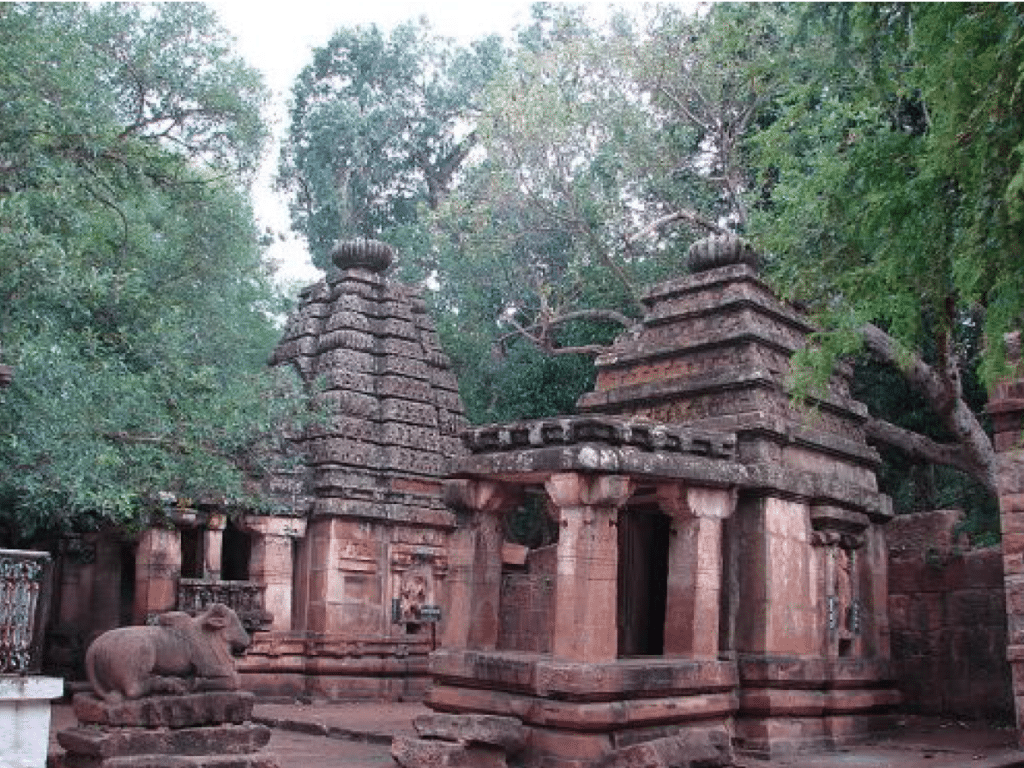
Vishnu temple
- At Mahakuta, near Badami, there are about 20 temples belonging to the early Western Chalukya period, almost all featuring northern-style curvilinear shikharas.
- Notable examples include the Vishnu temple, and the Swarg Brahma temple at Alampur, which is very rich in ornamentation.
Painting
- Among the fine arts, painting was primarily what flourished under Chalukya patronage.
- Some of the frescoes at Ajanta were created during the reign of the Chalukyas.
- One such painting depicts the scene of welcoming the ambassador of Persia at the court of Pulakeshin II.
Literature
- The Aihole inscription of Pulakeshin II, a prashasti (eulogy) composed by his court poet Ravikirti in Sanskrit language and Kannada script, is considered a classical piece of poetry.
- A few verses of a poet named Vijayanaka, who describes herself as the “dark Sarasvati,” have been preserved; it is possible she was a queen of prince Chandraditya, a son of Pulakeshin II.
- Famous Sanskrit writers of the Western Chalukya period include Vijnaneshwara, who achieved fame by writing the Mitakshara, a treatise on Hindu law, and King Someshvara III, a noted scholar who compiled an encyclopedia of all arts and sciences called the Manasollasa.
- From the period of the Badami Chalukyas, references exist to the existence of Kannada literature, though little has survived; inscriptions, however, refer to Kannada as the “natural language.”
- The Karnateshwara Katha, later quoted by Jayakirti, is believed to be a eulogy of Pulakeshin II and to belong to this period.
- The reign of the Chalukyas saw the rise of Kannada as the predominant language of inscriptions, alongside Sanskrit; several coins of the Badami Chalukyas bearing Kannada legends have also been found — all indicating that Kannada flourished during this period.
Conclusion
The Chalukyas of Badami stand as one of the most significant early medieval Deccan powers, forging an extensive empire through the military successes of rulers like Pulakeshin II and Vikramaditya II, while fostering a genuine synthesis of northern and southern Indian traditions in religion, language, and above all, architecture. Their pioneering Vesara style, distinctive rock-cut and structural temples at Aihole, Badami, and Pattadakal, and patronage of Kannada and Sanskrit literature together make the Chalukyas of Badami a pivotal dynasty for understanding the political and cultural landscape of early medieval South India, and an essential topic for UPSC History Optional preparation.