Ajanta art refers to all the art forms found at Ajanta — cave architecture, sculpture, and painting — located in present-day Maharashtra. It was created mainly in two phases: first under the Satavahanas (100 BCE–225 CE), and later under the Vakatakas during the 4th–6th century CE, coinciding with the Gupta period. The first Buddhist cave monuments at Ajanta date from the 2nd and 1st centuries BCE, and during the Gupta/Vakataka period, many more richly decorated caves were added to this original group. This article examines the cave architecture, sculptural ornamentation, and mural paintings of Ajanta in detail, an essential topic for UPSC History Optional aspirants studying Gupta-period art.
Ajanta Cave Architecture and Sculptural Ornamentation

- The Buddhist site of Ajanta consists of several caves nestled in a curving section of the Sahyadri hills, overlooking the Waghora river; the caves were carved out of basalt, an igneous rock.
- There are 30 caves at Ajanta in total.
- Workers carved pillars, roofs, and idols out of the rock, alongside extensive painting work.
- There were two phases of activity at the site: 5 caves were excavated during the Satavahana period, while the rest belong to the Vakataka period.
- Of the Satavahana-period caves, two (Caves 9 and 10) were chaityas (prayer halls), and the rest were viharas (monasteries).
- Caves 9 and 10 are the two chaitya, or worship halls, from the 2nd to 1st century BCE, with a distinct apsidal shape.
- Above the pillars, and also behind the stupa, are colourful paintings of the Buddha.
- Of the Vakataka-period caves, three (Caves 19, 26, and 29), belonging to the late 5th and early 6th century, were chaityas, with the rest being viharas.
- Caves of the later period generally show richer sculptural ornamentation, both inside and outside, along with a profusion of figures from the Mahayana pantheon.
- Of the Satavahana-period caves, two (Caves 9 and 10) were chaityas (prayer halls), and the rest were viharas (monasteries).
- Caves are generally of one storey, though a few — such as Cave 6 and Cave 27 — are of two storeys.
Viharas (Monasteries)
- The majority of the caves are vihara halls with symmetrical square plans.
- Most of these caves were built during the second phase and were shifted from the Hinayana sect to the Mahayana sect.
- They consist of a colonnaded porch and three entrance doors leading into a hall.
- The centre of the viharas takes the form of a square with rectangular aisles on each side, surrounded by a number of small monastic cells or square dormitories that can be entered through doors around the central hall.
- Cave 12 illustrates an early vihara plan without an internal shrine, its layout showing the surrounding monk cells.
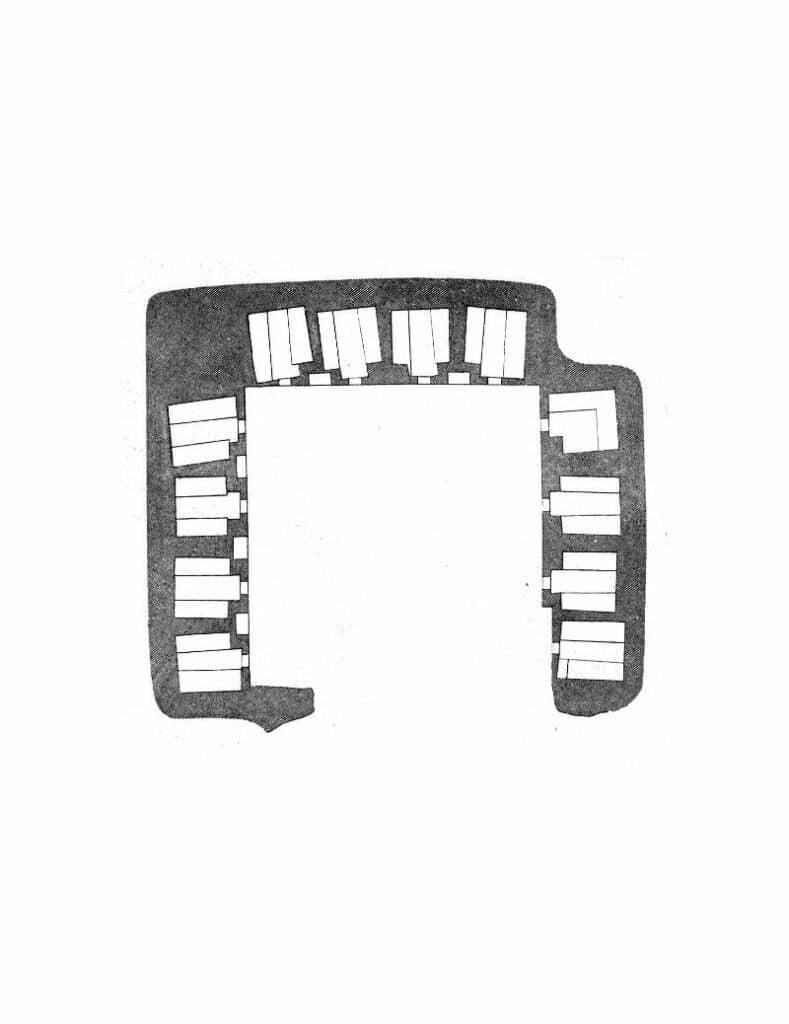
Cave 12 plan (early Vihara without internal shrine):
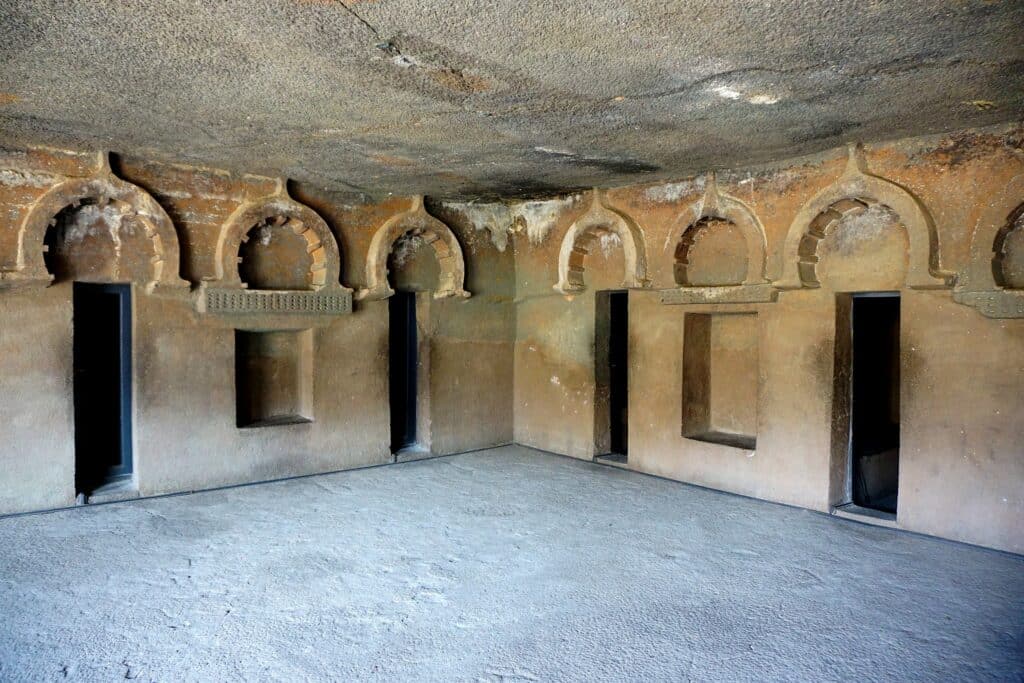
Cave 12 with monk cells:
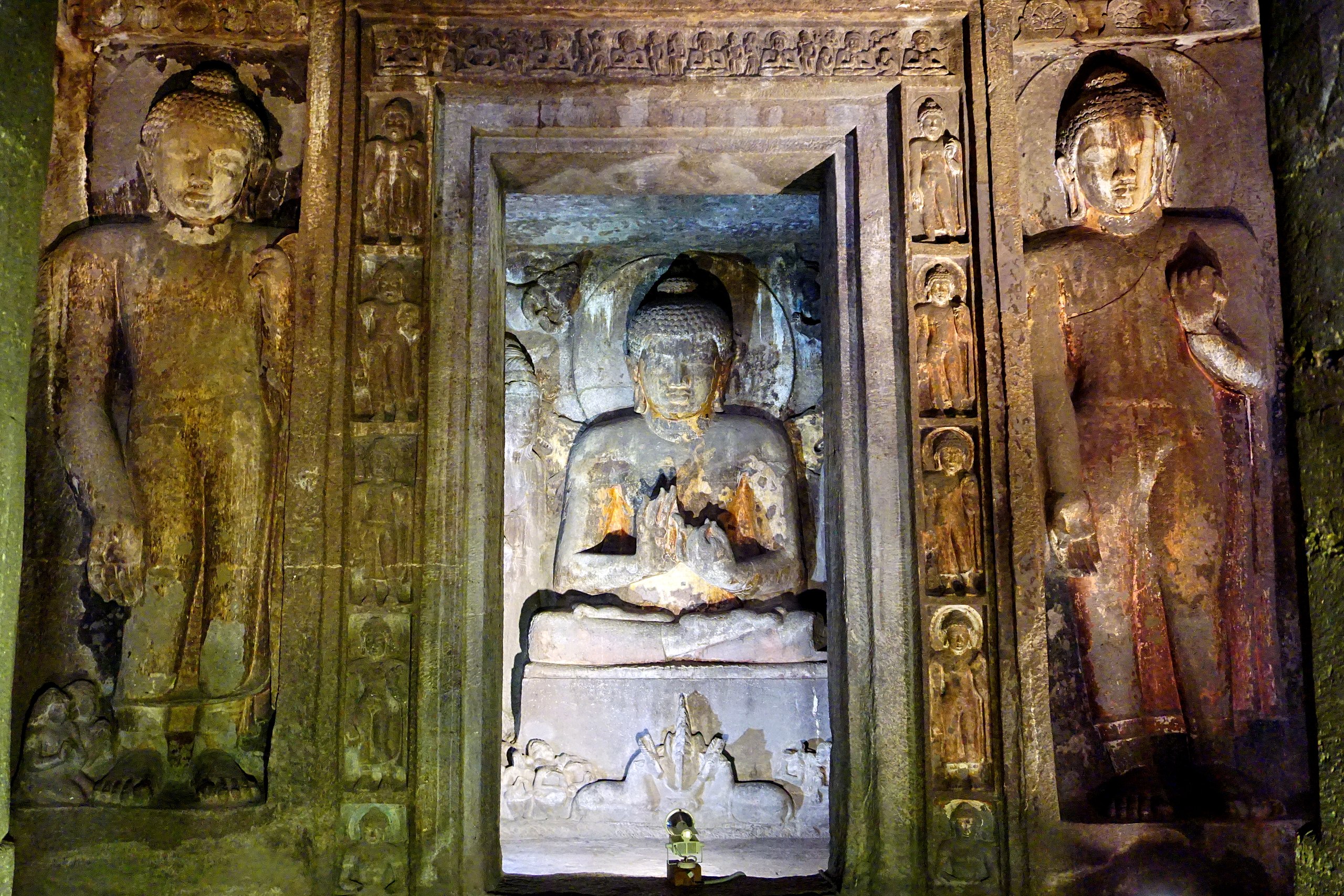
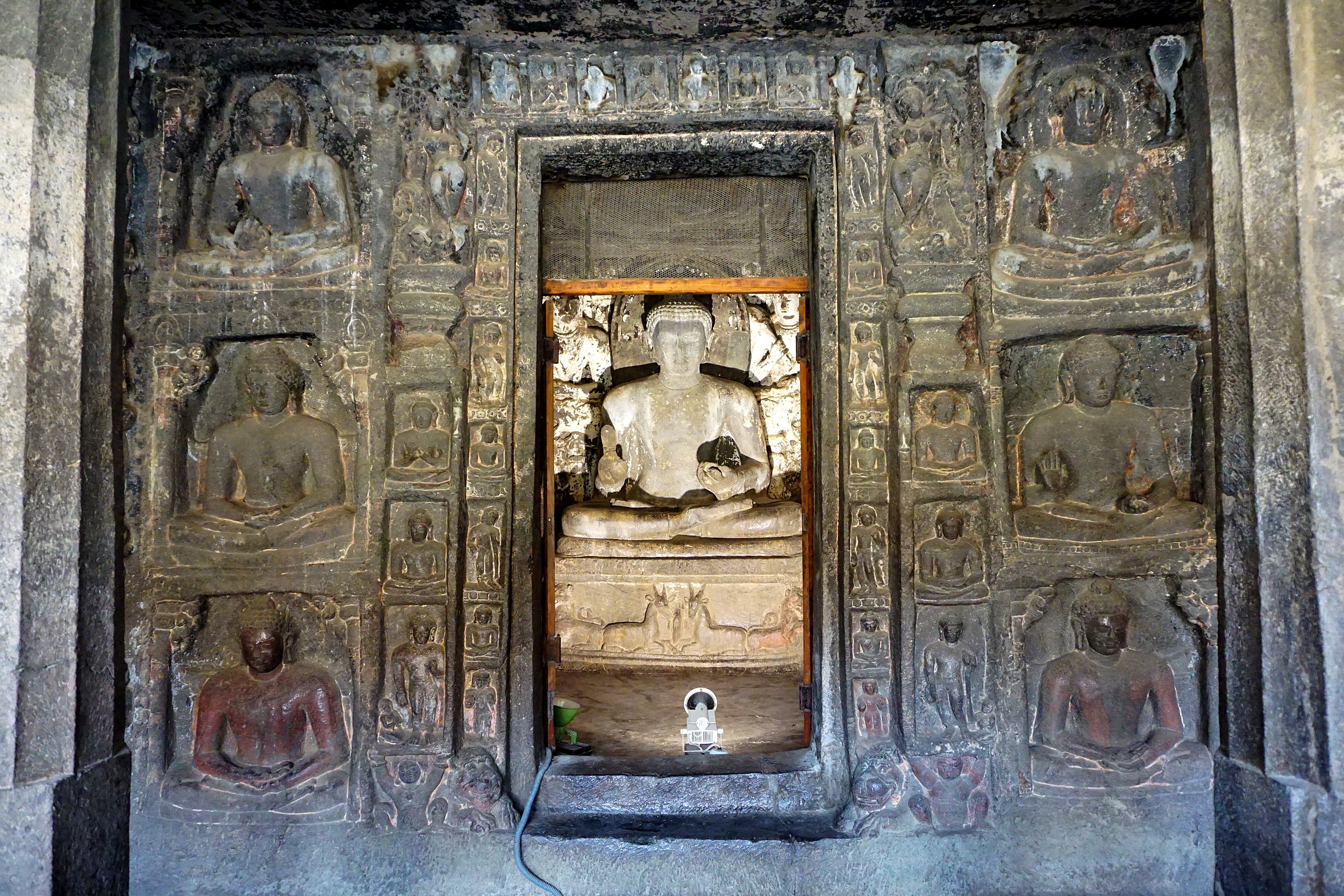
- At the rear of the caves, a sanctuary was built, each with a statue of the Buddha at its centre — the introduction of a shrine room into the vihara was an innovation of this period.
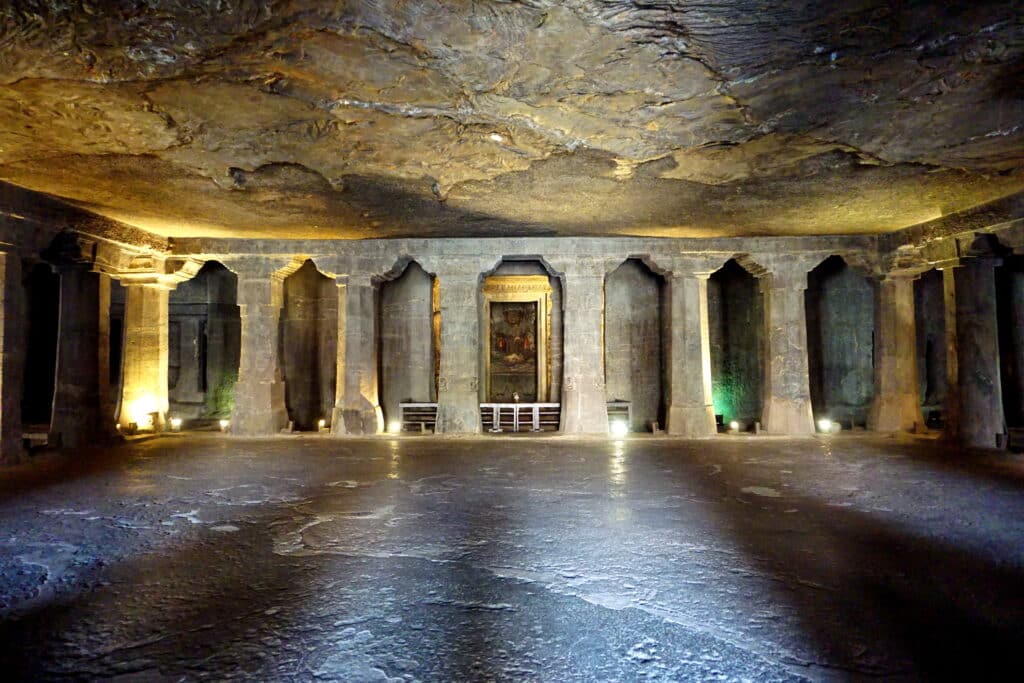
Cave 4 internal shrine:
- Cave 4 shows an example of such an internal shrine, and many other deities are also carved on the pillars and near the large statue of the Buddha.
- Cave 1:
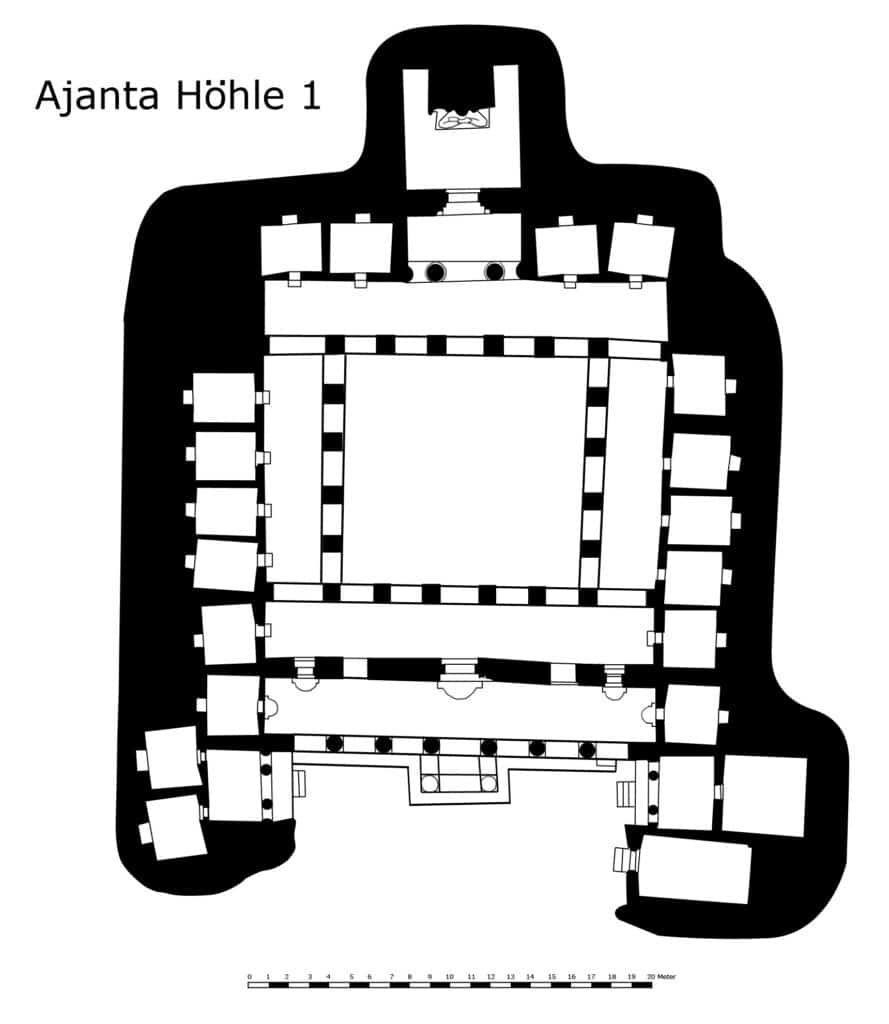
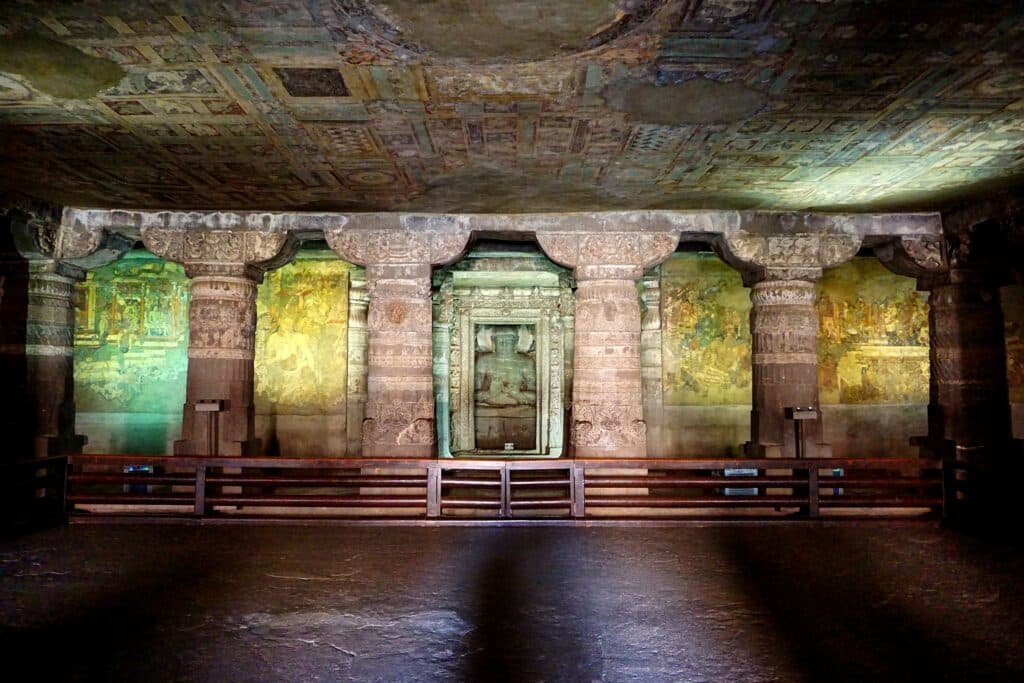
- The plan of Cave 1 shows one of the largest viharas, and its patronage is attributed to Harishena.
- Its main hall is square in plan, with aisles along all four sides; adjacent to these aisles are doorways leading to fourteen small chambers.
- Cave 1 contains twenty painted and carved pillars, above which are reliefs depicting tales from the life of the Buddha (Jataka tales).
- Located at the rear of the hall is a large shrine of the Buddha, and the most famous painting on its walls is the Bodhisattva Padmapani.
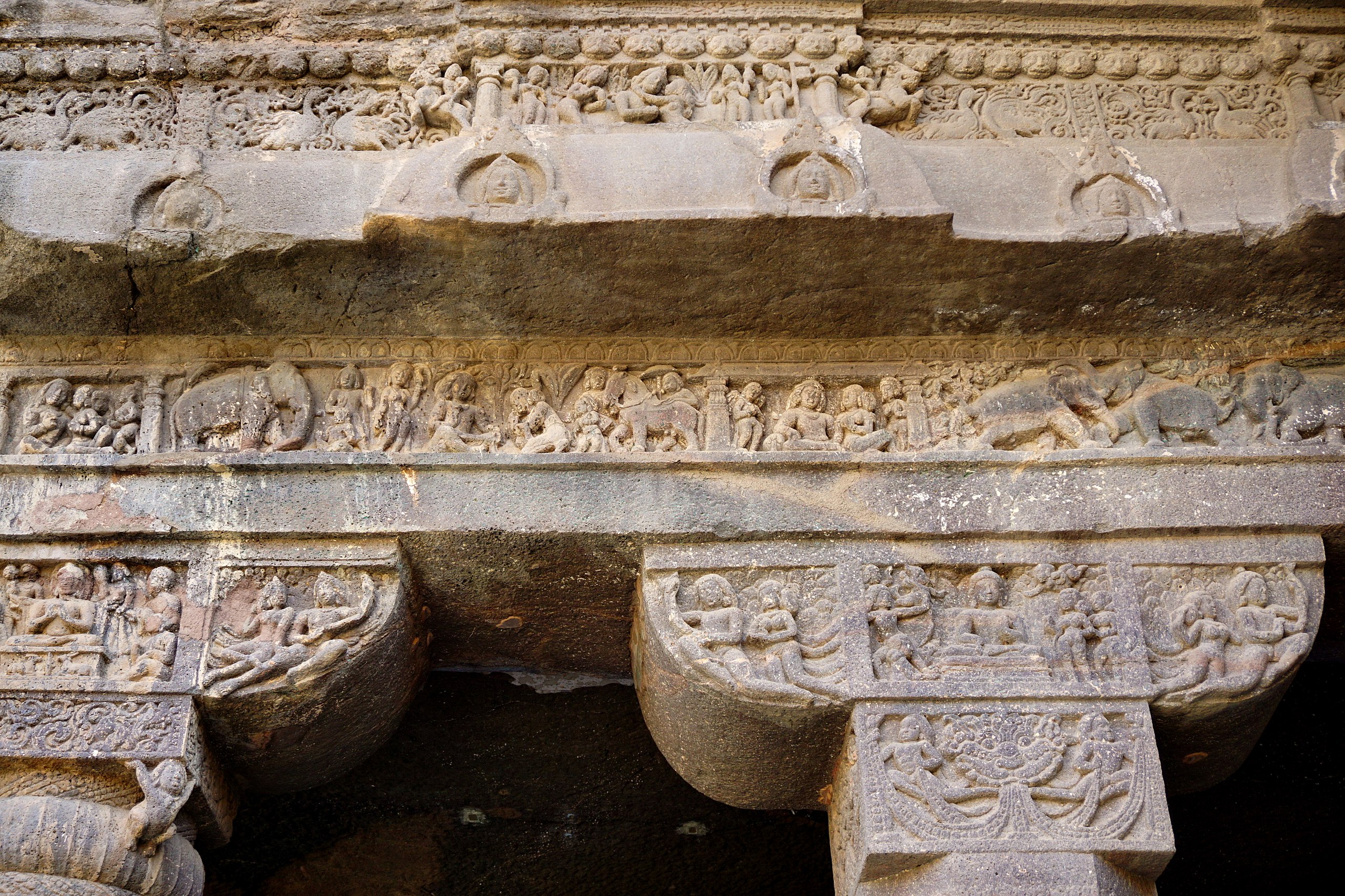
- Viharas, like chaityas, display a profusion of sculptural ornamentation.
- The sculpture artists likely worked at both excavating the rock and carving the intricate details of pillars, roofs, and idols.
- The columns and doorways of the viharas show great variety — some are rather plain, others richly decorated with sculptures.
- Carvings on door frames and pillars include elephants, horses, bulls, lions, apsaras, naga (snake) figures, meditating monks, and flowers, among other motifs.
From Hinayana to Mahayana
- The viharas of the earlier period are much simpler and lack shrines.
- A vast majority of the caves were carved in the second period, in which a shrine or sanctuary is appended at the rear of the cave, centred on a large statue of the Buddha, along with exuberantly detailed reliefs and deities near him, as well as on the pillars and walls — all carved out of the natural rock.
- This change reflects the shift from Hinayana to Mahayana Buddhism; such caves are often called monasteries.
Chaitya Griha (Worship Halls)
- A chaitya griha has a narrower rectangular plan with a high, arched ceiling.
- The hall is longitudinally divided into a nave and two narrower side aisles, separated by a symmetrical row of pillars, with a stupa placed in the apse.
- The stupa is surrounded by pillars and a concentric walking space for circumambulation.
- Some caves have elaborately carved entrances, some with large windows over the door to admit light; there is often a colonnaded porch or verandah, with another space inside the doors running the width of the cave.
- The oldest worship halls at Ajanta were built in the 2nd to 1st century BCE, and the newest ones in the late 5th century CE.
Caves 9 and 10
- Caves 9 and 10 are the two chaitya, or worship halls, from the 2nd to 1st century BCE, with a distinct apsidal shape.
- Above the pillars and also behind the stupa are colourful paintings of the Buddha.
- On the walls are friezes of Jataka tales, likely dating from the Hinayana phase of early construction.
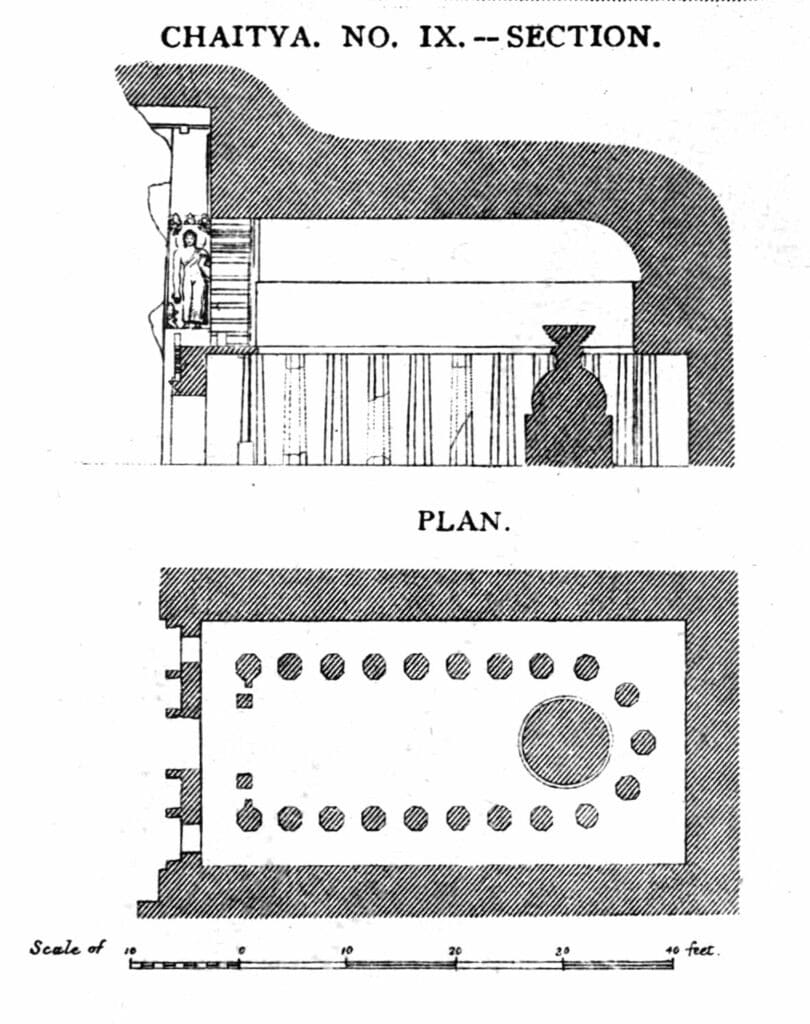
Cave IX plan
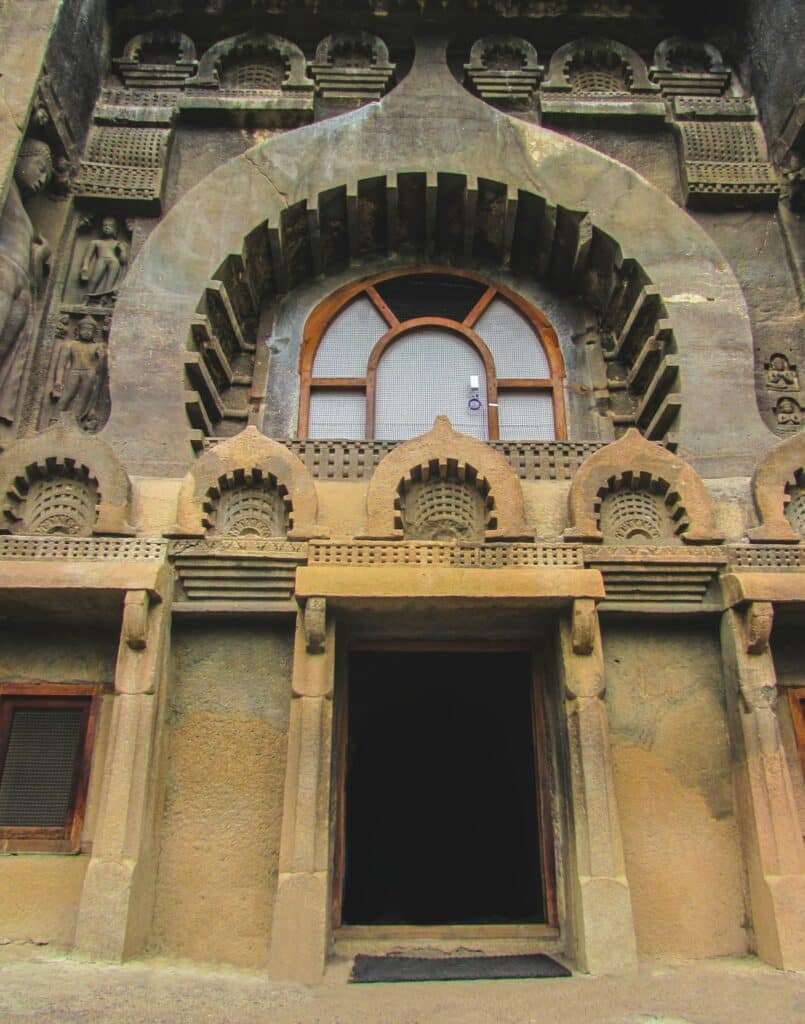
Cave IX entrance
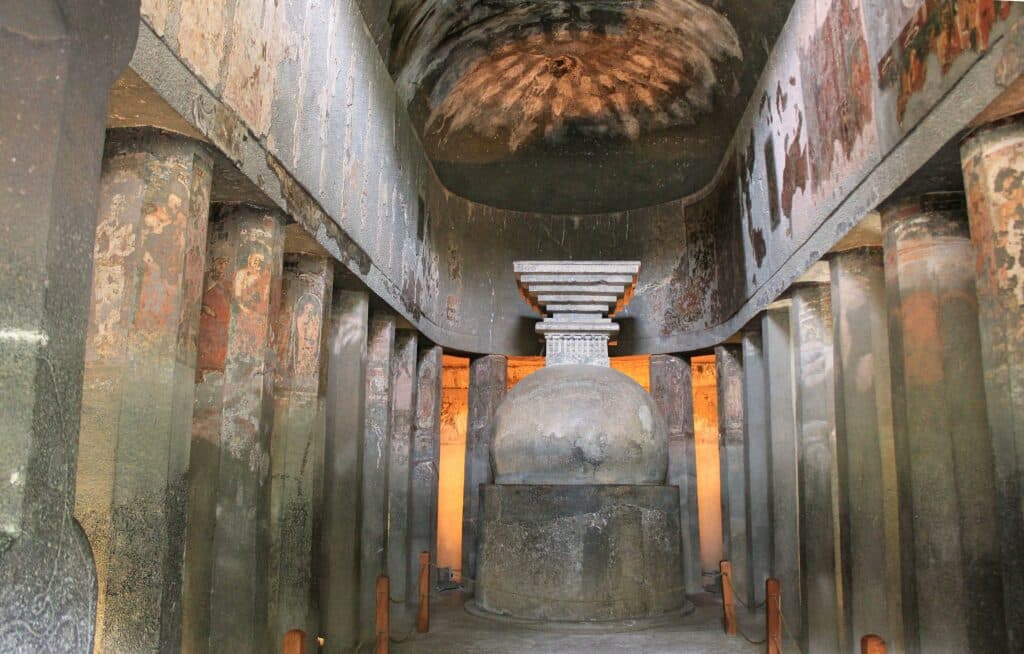
Cave IX interior
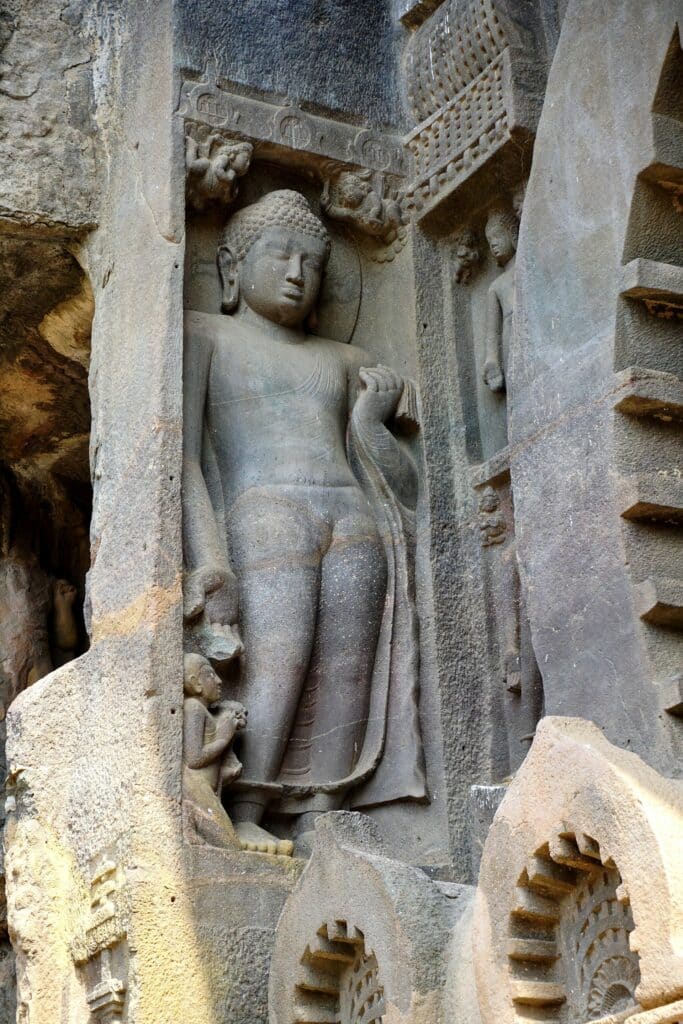
Buddha statue on the porch of Cave 9
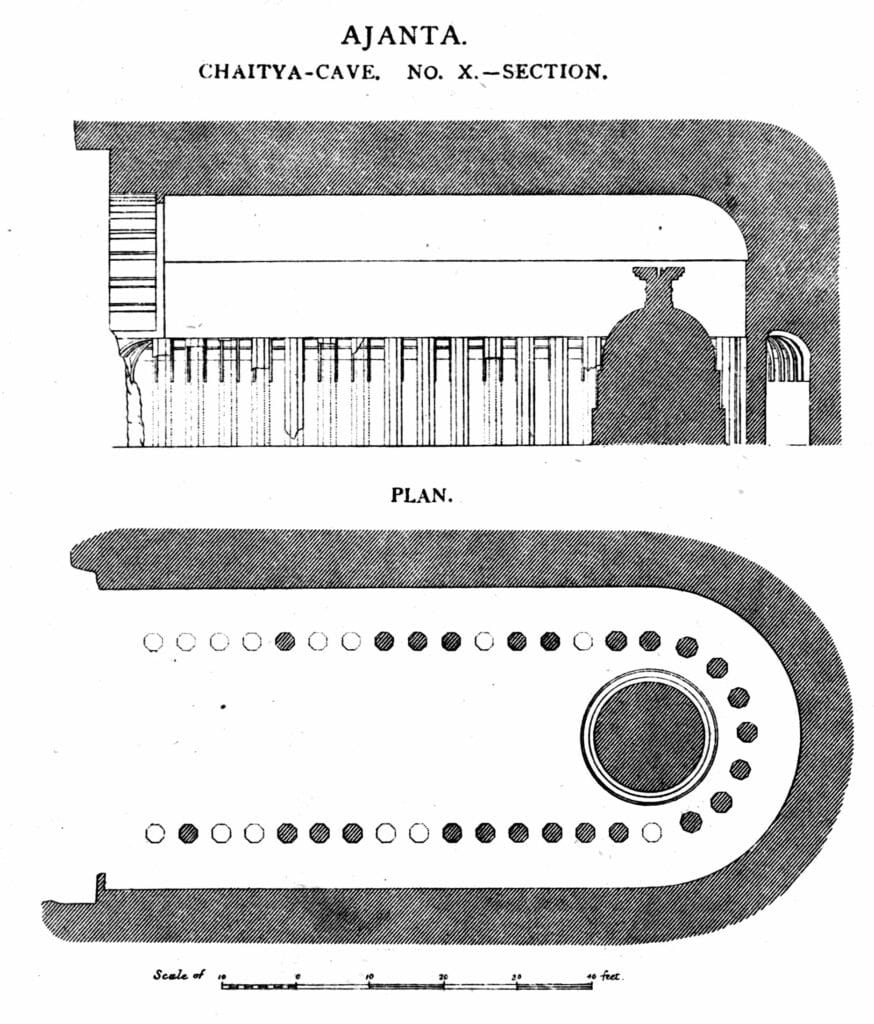
Cave X plan
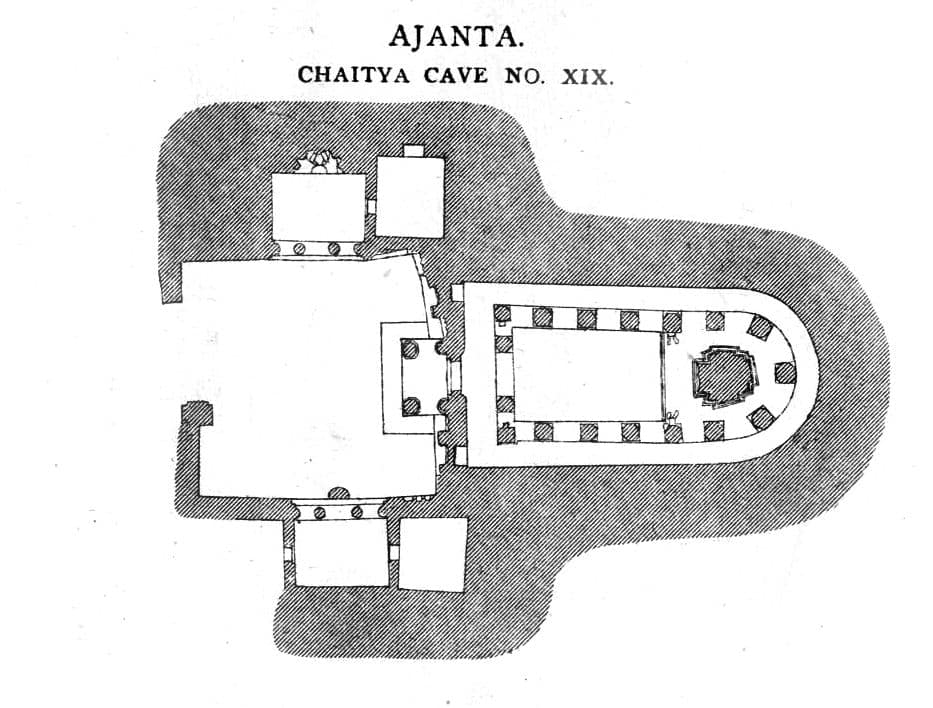
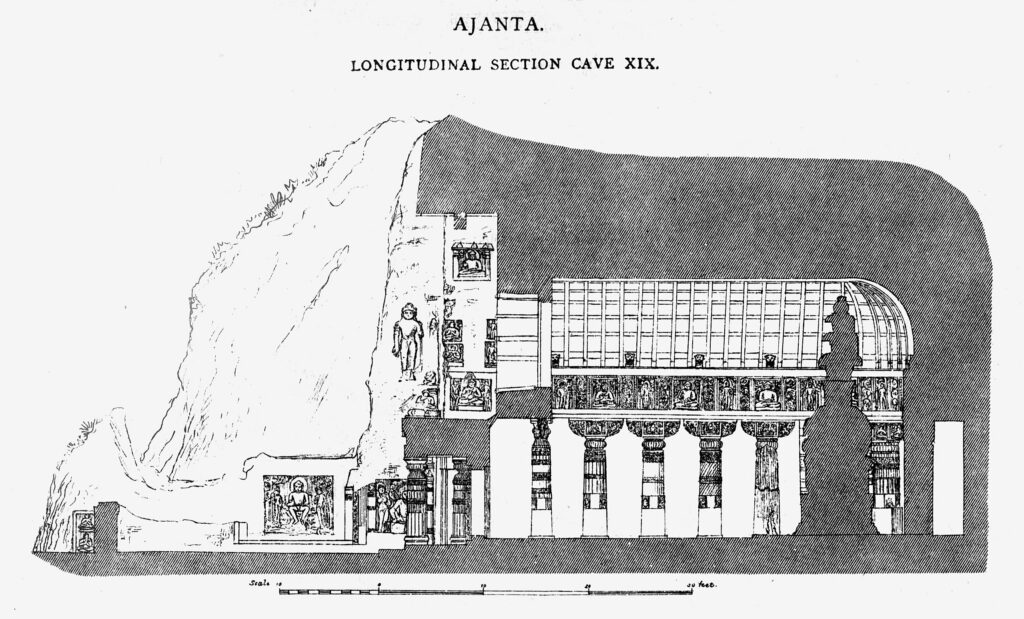
Cave 19
- Cave 19 consists of a rectangular hall rounded into an apse at the rear.
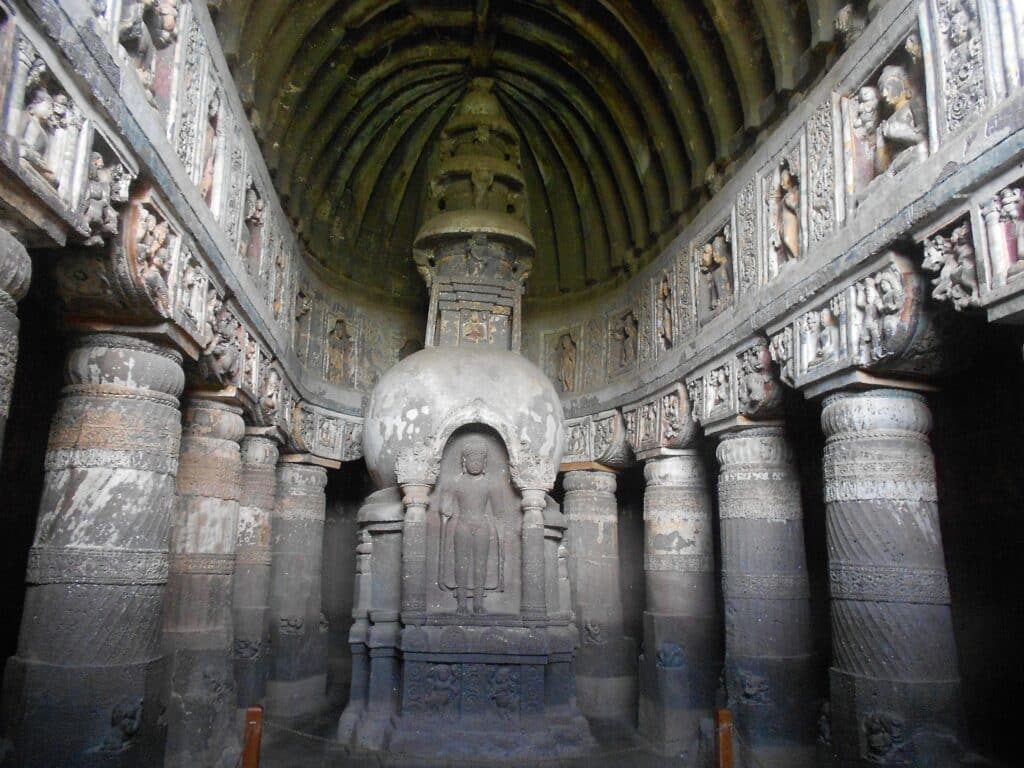
- The hall is divided into a central section and two side aisles by richly carved pillars running the entire length of the hall, around the central image of worship — a stupa with a high, almost spherical dome, within which a standing Buddha is carved in high relief.
- A stupa is a hemispherical structure containing the remains of Buddhist monks and nuns; the apse, at the rear, is a semi-circular structure with a vault or semi-dome.
- The roof is vaulted and ribbed.
- The hall is divided into a central section and two side aisles by richly carved pillars running the entire length of the hall, around the central image of worship — a stupa with a high, almost spherical dome, within which a standing Buddha is carved in high relief.
- The cave has an elaborately carved façade with Buddha figures, attendants, and various ornamental devices.
- Its unique facade feature is the Chandrasala — a large semicircular window.
- The upper part of the interior has sculpted panels representing Buddhas.
- Other sculpture at Cave 19 includes Naga figures with a serpent canopy protecting the Buddha, Yaksha dvarapala images on the sides of its arches, flying couples, and sitting and standing Buddha figures.
Cave 26
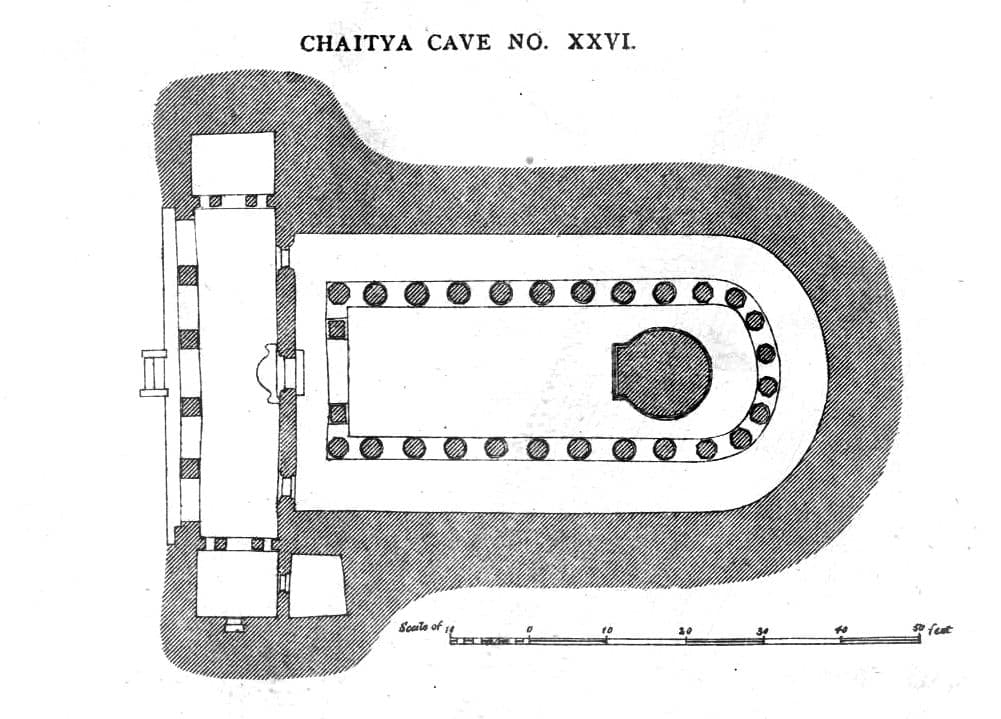
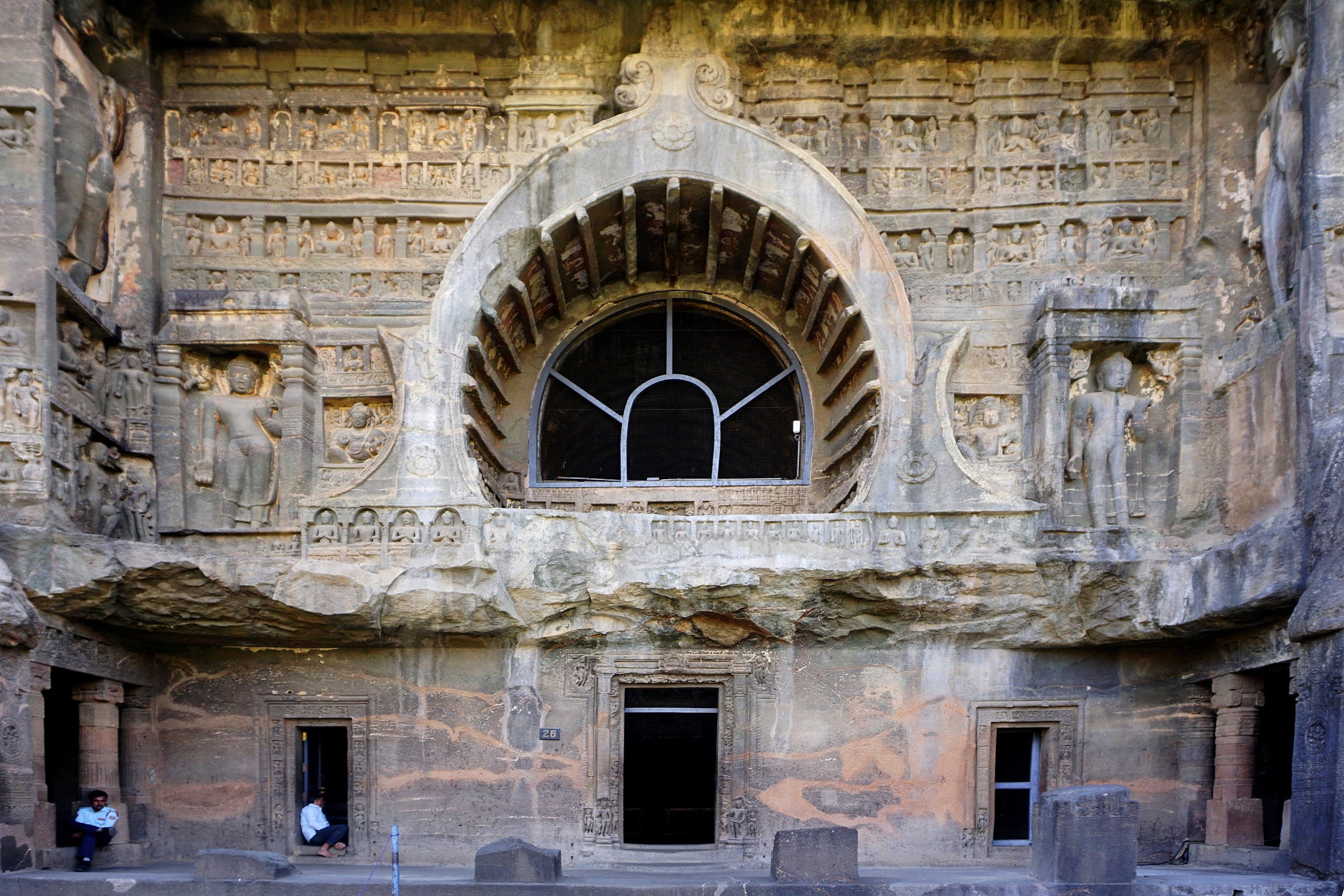
- Cave 26 has more elaborate and detailed sculptural decoration, its builders having focused on sculpture rather than painting.
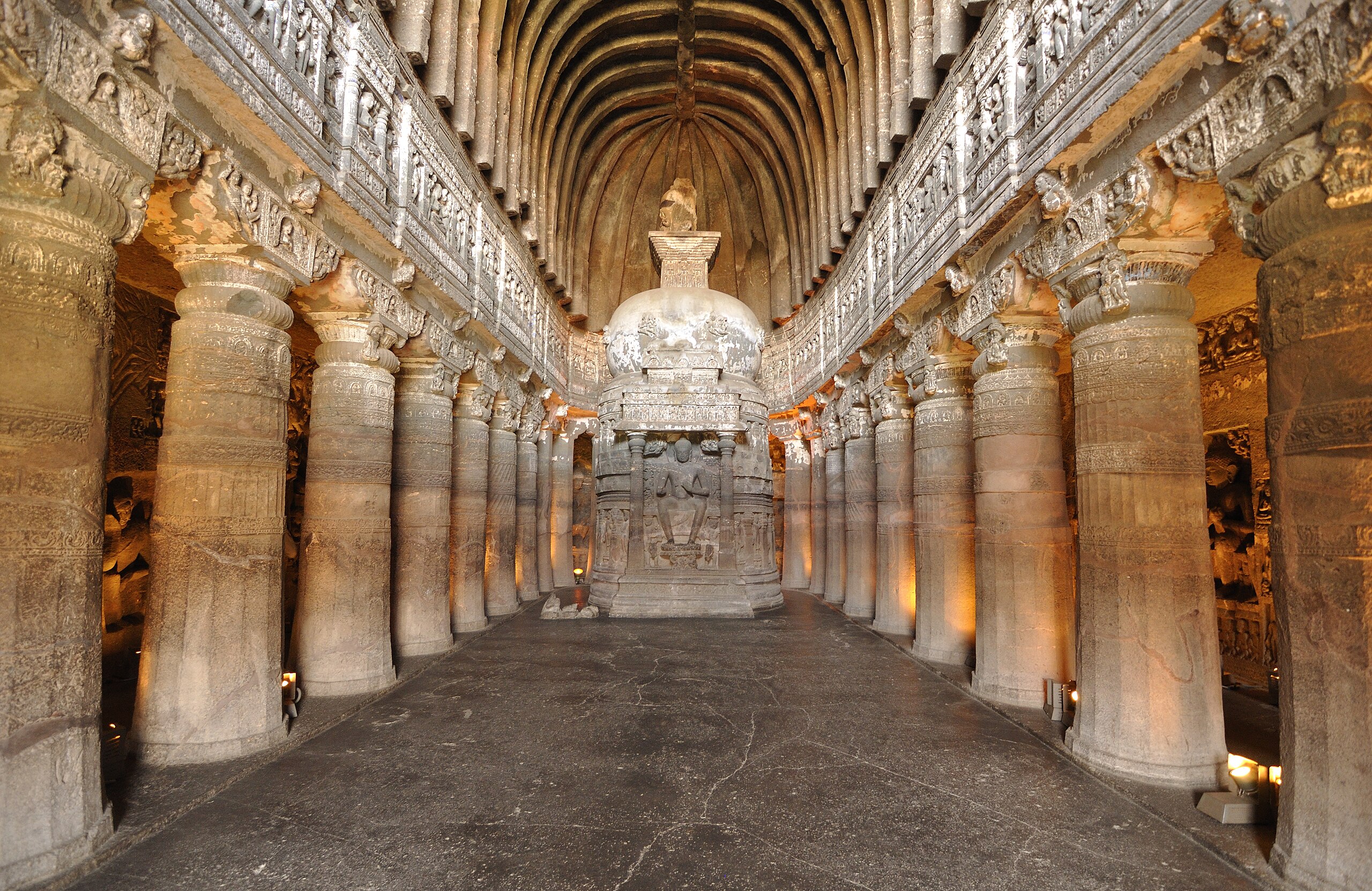
- The cave consists of an apsidal hall with side aisles for circumambulation (pradakshina), a path filled with carved Buddhist legends and seated Buddhas in various mudras.
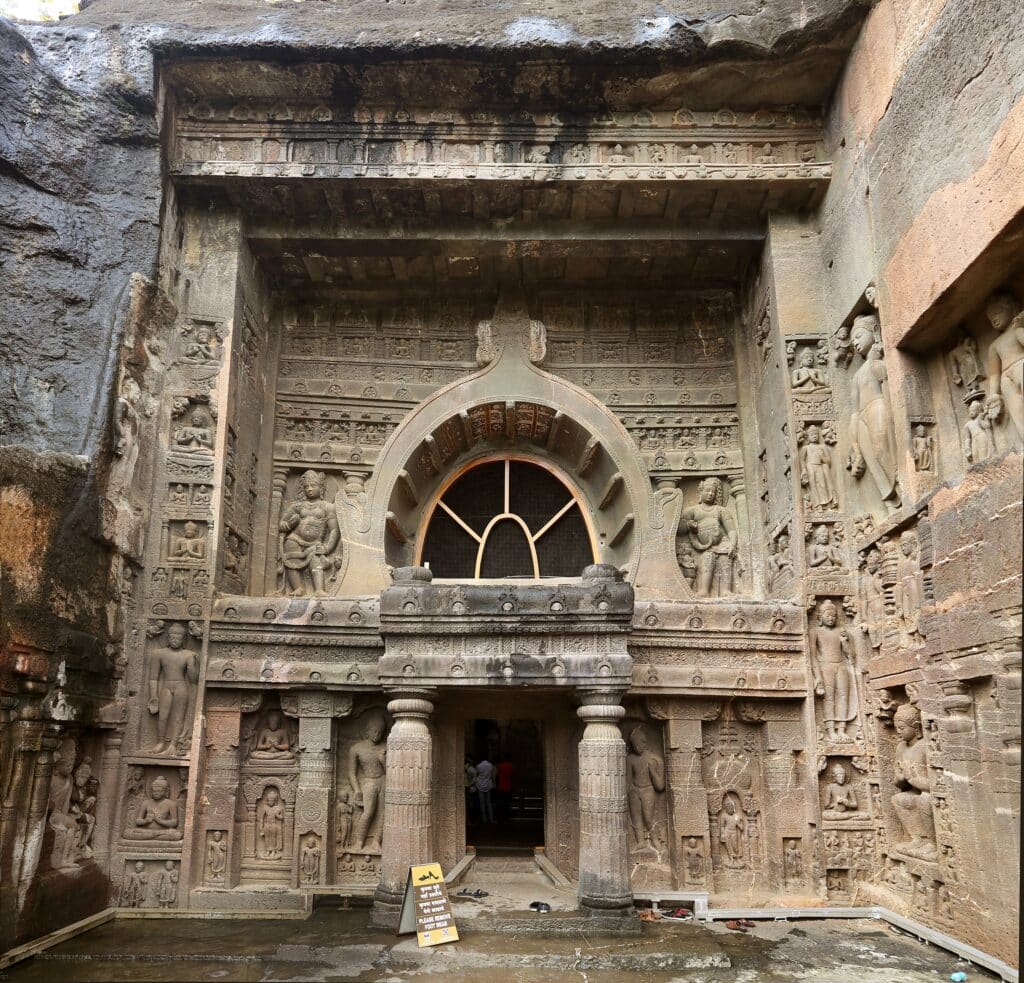
Cave 19 entrance
- It enshrines a huge stupa with a seated Buddha carved in high relief, adorned with rich ornamentation.
- The walls, pillars, brackets, and the triforium are extensively carved with Buddhist themes.
- The inner walls carry many carvings, including a 7-metre-long reclining Buddha on the left wall, representing the Parinibbana (Mahaparinirvana), surrounded by mourning figures.
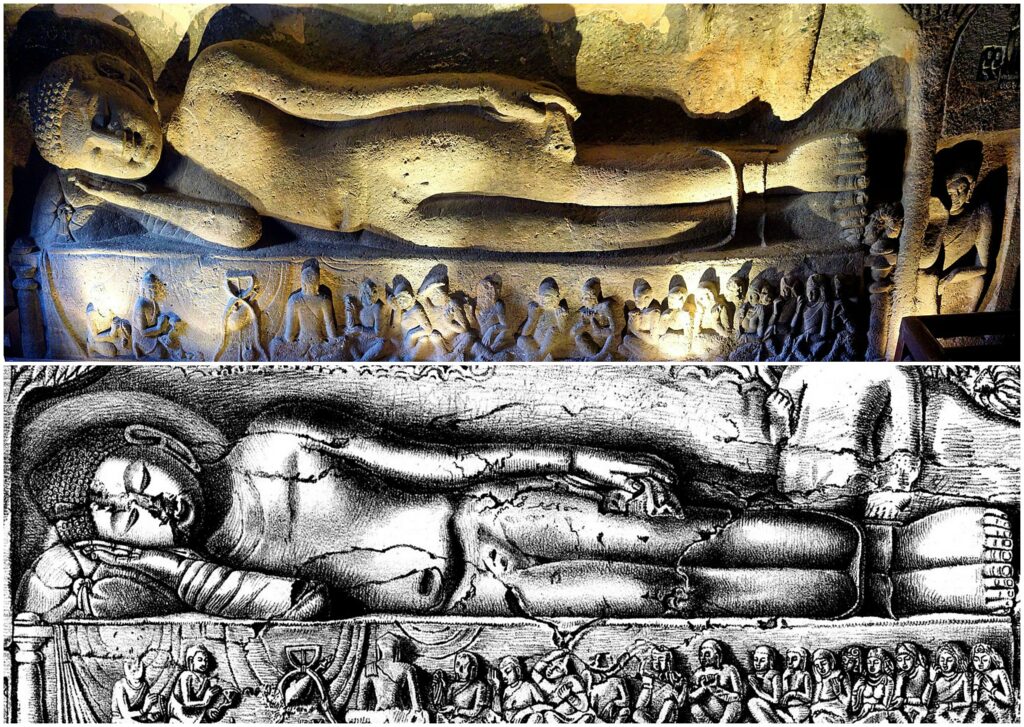
Cave 26 Mahaparinirvana of Buddha:
Ajanta Mural Paintings
- The exquisite sculptures at Ajanta are complemented by beautiful murals on the walls, ceilings, door-frames, and pillars.
- Originally, most of the caves had paintings; today, paintings survive in only six caves — 1, 2, 9, 10, 16, and 17.
- Of these, Caves 9 and 10 appear to belong to the 2nd/1st century BCE, while the second phase of painting corresponds to the Vakataka period.
Technique and Materials
- The technique of painting is known as fresco secco.
- A thick layer of mud, mixed with vegetable material, was applied to the rock surface, followed by a thin coat of plaster on top.
- Paintings were then made on this prepared surface using pigments mixed in a glue or gum medium, with brushes likely made of animal hair.
- The artists used and blended six colours:
- white, made from lime, kaolin, and gypsum;
- red and yellow, from ochre;
- black, from soot;
- green, from glauconite (a mineral); and
- blue, from lapis lazuli.
- All these materials, except for lapis lazuli, were available in the vicinity of Ajanta.
Scenes Depicted
- Apart from narrative scenes connected with the Buddhas, bodhisattvas, and Jatakas — fine scenes related to the birth, life, and death of the Buddha, along with several scenes from Jataka stories — the Ajanta frescoes also depict yakshas, gandharvas, and apsaras.
- In addition to these religious scenes, there are many scenes of everyday life in cities and villages.
- The artists’ deep and sympathetic understanding of nature is evident in their representation of trees, flowers, and animals such as elephants, monkeys, deer, and hares, along with a great variety of decorative patterns.
- In the narrative paintings, episodes flow from and into each other in different directions, without any clear demarcation between scenes.
- Ajanta paintings are not conceived in terms of depth; rather, the figures seem to come forward towards the viewer.
- The artists knew the technique of foreshortening, and their paintings are marked by a “multiple perspective” — objects are painted as if seen simultaneously at eye level, from above, and from below.
- The paintings are marked by a fine balance between the material and the spiritual.
- The artists used shading and highlighting to great effect, giving parts of their compositions a luminous glow.
- The paintings also display some stylistic differences, reflecting the different hands that created them.
Human Figures
- The human figures are slender, well-proportioned, and elegant.
- Women have narrow waists and full breasts, their faces marked by highly arched eyebrows and elongated, lotiform eyes.
- There is an intricate range of sophisticated costumes, jewellery, and hairstyles.
- The beautiful Ajanta murals themselves point to a long tradition of mural painting in India.
Conclusion
The cave architecture, sculpture, and paintings of Ajanta together represent one of the finest surviving expressions of ancient Indian art, evolving over centuries from simple Hinayana viharas to elaborately carved Mahayana shrines and monasteries. Considered masterpieces of Buddhist religious art, Ajanta’s caves have had a considerable artistic influence in later periods, and remain central to any comprehensive understanding of Gupta-period art and architecture for UPSC History Optional preparation.