The Sunga Dynasty

The Sunga dynasty (187–78 BCE) rose from the ashes of the Mauryan Empire, its founder, Pushyamitra Sunga, seizing the throne of Magadha through a military coup against the last Mauryan king. Ruling over a considerably reduced territory centred on the Gangetic valley, the Sungas defended north India against Bactrian Greek incursions, revived Brahmanical religious practice, and patronised a flourishing artistic tradition at sites such as Sanchi, Bharhut, and Vidisha. For UPSC History Optional aspirants, the Sunga period marks an important transitional phase between the Mauryan and Gupta empires, raising key debates over religious policy, particularly Pushyamitra’s contested relationship with Buddhism.
Background: The Decline of the Mauryas and the Rise of the Sungas
- After the death of Ashoka, his successors were unable to keep the vast Mauryan Empire intact. The provinces began declaring their independence — north-western India slipped out of Mauryan control and was affected by a series of foreign invasions, Kalinga declared its own independence, and further south, the Satavahanas established independent rule.
- As a result, Mauryan authority was reduced to the Gangetic valley alone, and it was soon replaced by the Sunga dynasty.
Sunga Empire (187–78 BCE)
Pushyamitra Sunga (187–151 BCE)
- The founder of the Sunga dynasty was Pushyamitra Sunga, who had served as commander-in-chief under the Mauryas. According to the Harshacharita, Pushyamitra killed the Maurya king Brihadratha while the latter was inspecting his troops — a coup that ended Mauryan rule in 187 BCE, with Pushyamitra usurping the throne for himself.
- The Sunga capital was Pataliputra, though later emperors, such as Bhagabhadra, also held court at Besnagar, modern Vidisha.
Origin of the Sungas
- The Puranas describe Pushyamitra as belonging to the Shunga family. There are several references to Shunga teachers in Vedic texts, and the Brihadaranyaka Upanishad mentions a teacher named Shaungiputra; Panini connects the Shungas with the Brahmana Bharadvaja gotra.
- Kalidasa’s Malavikagnimitra describes Agnimitra, son of Pushyamitra, as belonging to the Baimbika kula (family/lineage) and the Kashyapa gotra. While these sources differ in detail, all indicate that the Shungas were Brahmanas.
- The name “Sunga” means “fig tree” in Sanskrit, so the Sungas took their dynastic name from this tree — as other Indian dynasties took theirs from trees, such as the Kadamba (a tree name) of Banavasi, or the Pallava (Sanskrit for “branch and twig”) of Kanchi.
Challenges and Military Campaigns
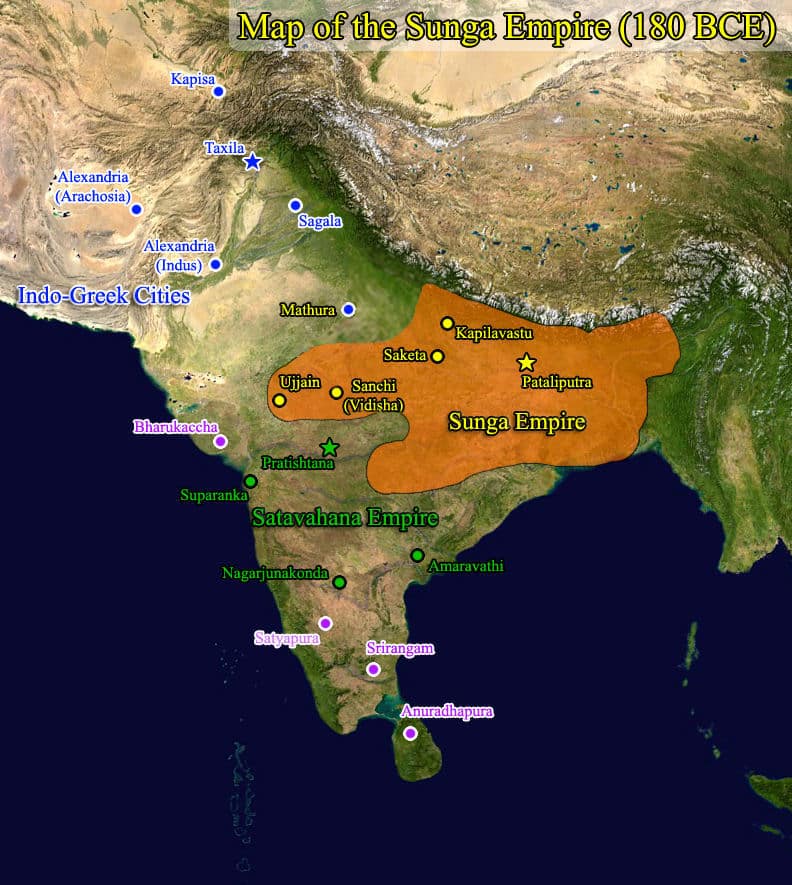
- The most important challenge facing Sunga rule was protecting north India against the invasions of the Bactrian Greeks from the north-west; the Greeks advanced as far as Pataliputra and occupied it for some time, though Pushyamitra succeeded in regaining the lost territory.
- He also fought a campaign against Kharavela of Kalinga, who had invaded north India.
Extent of the Empire
- Pushyamitra’s empire extended over only part of the erstwhile Mauryan territory, including Pataliputra (still the capital), Ayodhya, and Vidisha; according to the Divyavadana and Taranatha’s account, it also included Jalandhara and Shakala in Punjab.
- Pushyamitra placed viceroys in at least some parts of his empire — in Kalidasa’s drama Malavikagnimitra, Agnimitra appears as the viceroy at Vidisha.
Conflicts and Sacrifices
- The Malavikagnimitra refers to a conflict between Pushyamitra and Yajnasena, king of Vidarbha (the eastern Maharashtra region), resulting in a Shunga victory. The Shungas also clashed with the Bactrian Greeks.
- Citing an event from the recent past, the second-century BCE grammarian Patanjali refers to the yavanas advancing as far as Saketa (in or around Ayodhya) and Madhyamika (near Chittor, Rajasthan) — yavana being, at this time, a general term used in Indian texts for foreigners from the West, including the Greeks; here, it refers specifically to the Bactrian Greeks. Patanjali also mentions sacrifices performed on Pushyamitra’s behalf.
- The Malavikagnimitra further narrates a military encounter between prince Vasumitra (son of Agnimitra) and a Yavana army on the banks of the Sindhu.
- The conflict apparently arose in the course of Pushyamitra’s ashvamedha sacrifice, when the Yavanas challenged the sacrificial horse, which was accompanied by the young prince and his soldiers; the Yavanas were defeated, and the horse was brought safely home.
- The Ayodhya stone inscription of king Dhana refers to Pushyamitra as having performed two ashvamedha sacrifices, while the Divyavadana offers stories of Pushyamitra’s cruelty and his animosity towards Buddhism.
Religious Policy
- Pushyamitra was a staunch follower of Brahmanism, performing two ashvamedha sacrifices; Buddhist sources describe him as a persecutor of Buddhism. There is, however, ample evidence that Pushyamitra also patronised Buddhist art — during his reign, the Buddhist monuments at Bharhut and Sanchi were renovated and further improved.
Did Pushyamitra Persecute Buddhists?
- Some historians believe Pushyamitra persecuted the Buddhists, contributing to a resurgence of Brahmanism that forced Buddhism outward to Kashmir, Gandhara, and Bactria.
- The earliest reference to Pushyamitra’s persecution of Buddhists comes from the Sarvastivadin Buddhist text of the second century CE, the Divyavadana, and its constituent part, the Ashokavadana; the Tibetan Buddhist historian Taranatha likewise mentions such persecution.
- Pushyamitra may have withdrawn royal patronage from Buddhist institutions; with patronage shifting from Buddhism to Brahmanism, the Buddhists are thought to have sided with the Sungas’ enemies, the Indo-Greeks.
- According to some historians, several pieces of evidence support the persecution thesis:
- There is evidence of damage to Buddhist establishments at Takshashila around the time of the Sungas.
- The Sanchi stupa was destroyed by Pushyamitra, though it was later restored by his successor, Agnimitra.
- The Bharhut Stupa gateway was not constructed during Pushyamitra’s own reign, but rather by his successors, who displayed a more tolerant attitude towards Buddhism than Pushyamitra himself.
- The destruction of the Ghositarama monastery at Kaushambi, in the second century CE, is likewise attributed to Pushyamitra.
- The Deokothar Stupas (located between Sanchi and Bharhut) suffered destruction during the same period, further suggesting some involvement of Sunga rule.
- Other historians, however, express scepticism about the claim that Pushyamitra persecuted Buddhists:
- The account of the Tibetan Buddhist historian Taranatha is considered by some to be absurd, and archaeological evidence more broadly casts doubt on the claims of persecution.
- The Ashokavadana legend is likely a Buddhist retelling of Pushyamitra’s attack on the Mauryas, reflecting the declining influence of Buddhism at the Sunga imperial court — the very same Ashokavadana attributes similarly cruel behaviour to Ashoka himself, against the Ajivikas.
- Support for Buddhism by the Sungas at some point is suggested by an epigraph on the gateway at Bharhut, which mentions its erection “during the supremacy of the Sungas” (though this may refer to the reign of Pushyamitra’s successors rather than Pushyamitra himself).
- The existence of Buddhism in Bengal during the Sunga period can also be inferred from a terracotta tablet found at Tamralipti.
- Once the Sunga dynasty ended, Buddhism flourished under the Kushanas and the Shakas — suggesting that Buddhism, on the whole, did not suffer any real, lasting setback as a result of Sunga rule.
Agnimitra (149–141 BCE)
- After the death of Pushyamitra, his son Agnimitra became ruler, and was the hero of Kalidasa’s play Malavikagnimitra. According to Kalidasa, Agnimitra belonged to the Baimbika family (Baimbika-kula), while the Puranas describe him simply as a Sunga.
- The Malavikagnimitra records that a war broke out between the Sungas and the neighbouring kingdom of Vidarbha during Agnimitra’s reign.
- Before the rise of the Sungas, Vidarbha (under Yajnasena) had become independent of the Mauryan Empire; Yajnasena was now defeated and recognised the suzerainty of the Sunga rulers.
Vasumitra
- In the Malavikagnimitram, Kalidasa tells us that Vasumitra guarded the sacrificial horse released by his grandfather, Pushyamitra, and defeated the armies of the “Yavana” (Indo-Greeks) on the banks of the Sindhu River.
Devabhuti (83–73 BCE)
- Ten Sunga kings are supposed to have ruled for a combined total of 112 years; according to the Puranas, the last ruler of this line was Devabhuti.
- The Harshacharita narrates that Devabhuti fell victim to a conspiracy masterminded by his Brahmana minister, Vasudeva, who went on to found the Kanva dynasty.
- The remnants of Sunga rule probably survived in central India for some time thereafter, until the rise of the Satavahanas.
Significance of Sunga Rule
- The rule of the Sungas was significant because they defended the Gangetic valley against foreign invasions. In the cultural sphere, the Sungas revived Brahmanism and the practice of horse sacrifice, and also promoted the growth of Vaishnavism and the Sanskrit language.
- In short, Sunga rule represented a brilliant anticipation of the golden age of the Guptas that was to follow.
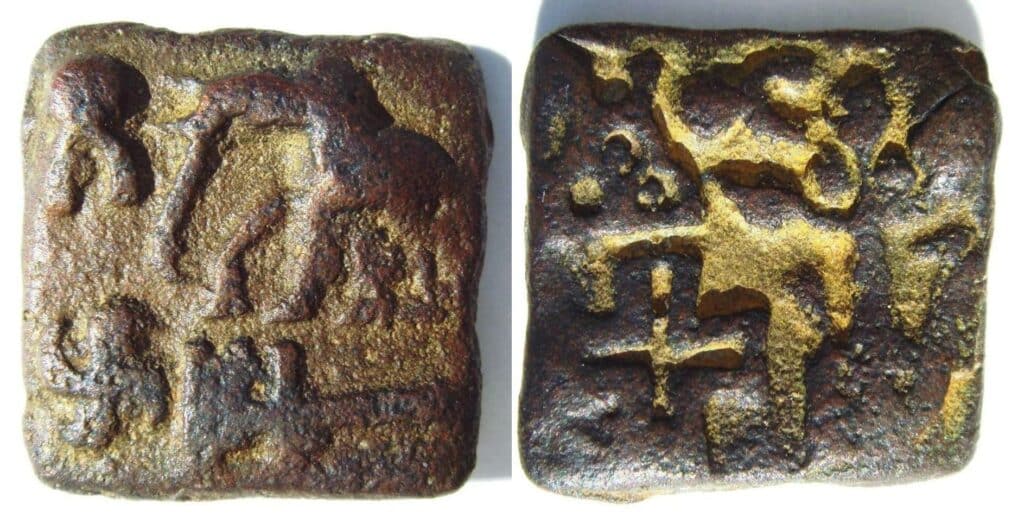
A bronze coin of the Sunga period, from eastern India, dates to the second–first century BCE.
Cultural Contributions of the Sungas
- Art, education, philosophy, and other forms of learning flourished during the Sunga period. Most notably, Patanjali’sYoga Sutras and Mahabhashya were composed during this time.
- The period is also remembered through its subsequent depiction in the Malavikagnimitra — composed by Kalidasa in the later Gupta period — which romanticised the love of Malavika and King Agnimitra against a backdrop of court intrigue.
- Artistry across the subcontinent also progressed with the rise of the Mathura school of art, considered the indigenous counterpart to the more Hellenistic Gandhara school of art.
Sunga Art
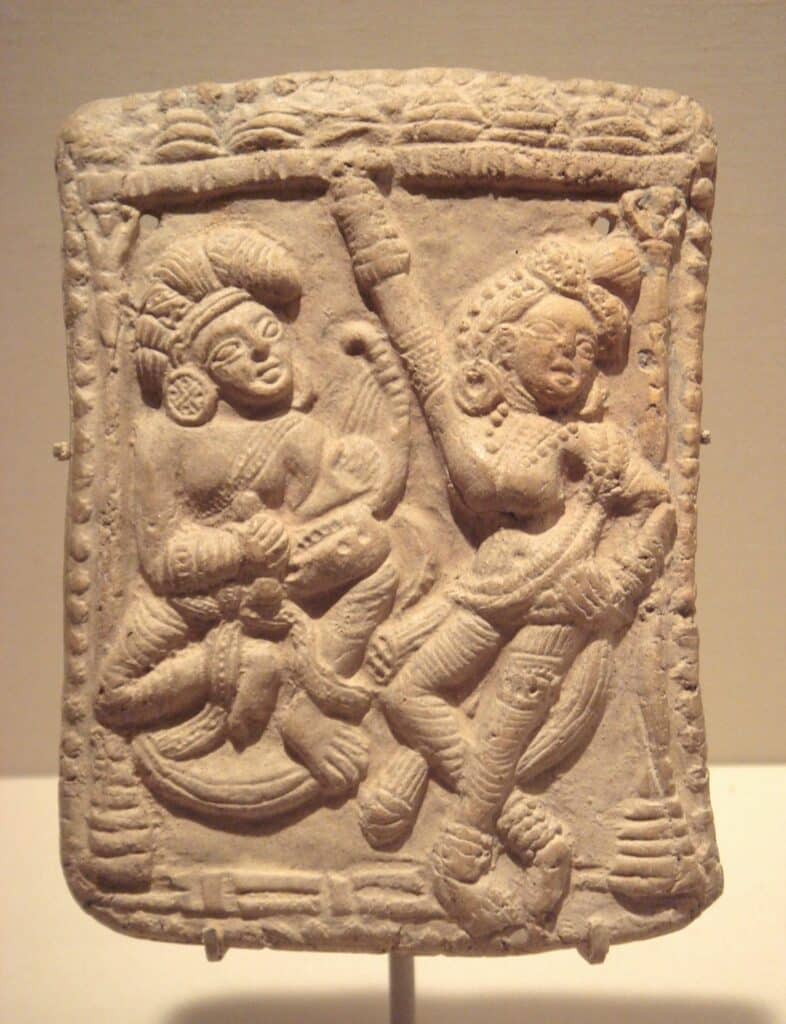
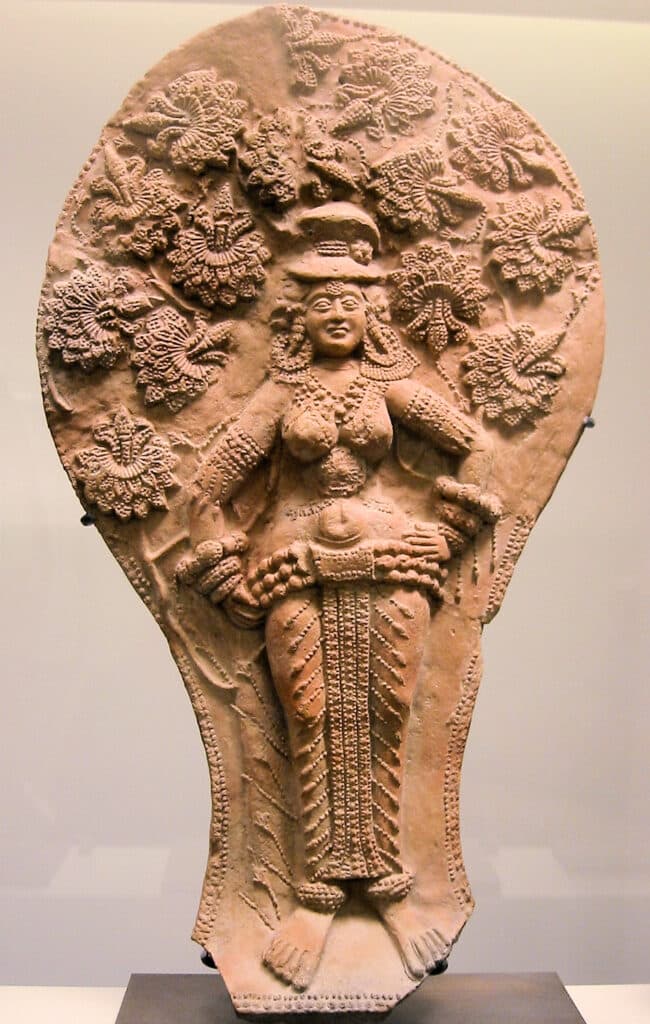
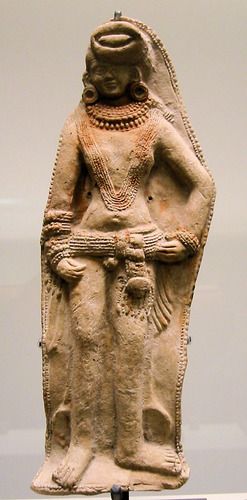
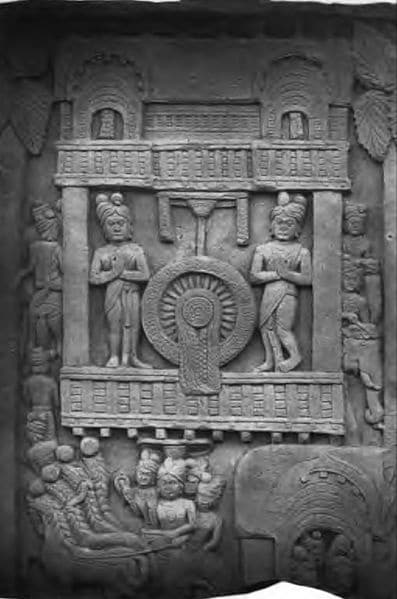
- Sunga art is represented by standing sculptures of Yakshas and Yakshis, discovered at Gwalior and Mathura. During this period, Buddhist activity also managed to survive to some extent in central India (Madhya Pradesh), as suggested by architectural expansions carried out at the stupas of Sanchi and Bharhut, originally begun under Emperor Ashoka.
- The Sungas contributed to the expansion of both the Bharhut and Sanchi stupas. During Sunga times, several structures were raised at Sanchi and its surrounding hills — the original Ashokan stupa was enlarged and faced with locally available dark purple-grey sandstone, and decorated with balustrades, staircases, and a harmika on top.
- Later Sunga emperors are seen as having been more amenable to Buddhism, and as having contributed to the building of the stupa at Bharhut.
The Besnagar Pillar Inscription of Heliodorus
- An especially interesting inscription of the Sunga period is found on a pillar at Besnagar, the site of ancient Vidisha — written in Prakrit, in the Brahmi script. It records that this is the Garuda pillar of Vasudeva, the Garuda being the bird that serves as the vehicle of Vishnu.
- The Besnagar pillar inscription indicates that the Sungas continued the Mauryan tradition of hosting ambassadors from Greek courts. Heliodorus, the Greek ambassador, describes himself as a Bhagavata — a worshipper of the god Vasudeva Krishna — and states that he erected this pillar in the god’s honour.
- Heliodorus calls himself a Parambhagavata, a native of Taxila and son of Divya, who had been sent as ambassador by the Greek king Antialcidas to the Indian king Kasiputra (a Sunga king).
- The foundations of a structure near the pillar represent the remains of an ancient temple, in front of which the Greek ambassador left this inscribed record of his personal devotion.
The Art of Vidisha
- Vidisha was an important centre of trade, art, and religion, and served as a Sunga capital; Vidisha art flourished between roughly 200 and 100 BCE, mainly during Sunga rule, and can be divided into three parts: the free-standing stone pillar, the stone capital without shaft, and sculptural art.
- The free-standing stone pillar at Besnagar was erected by the Greek ambassador Heliodorus, and is known as the “Garuda Dhwaj”; it stands roughly 20 feet tall, and was left unpolished.
- Both the shaft and capital survive; the shaft is divided into four equal sections, not all of the same shape — the topmost section is circular, while the three sections below have 8, 16, and 32 sides respectively, with garland ornamentation between the second and third sections.
- The capital itself has two parts: a lower, inverted lotus-shaped capital (also known as the bell capital), and an upper capital which today consists only of leaves, though the inscription suggests it must originally have been crowned by a Garuda emblem.
Conclusion
Emerging from Pushyamitra’s coup against the last of the Mauryas, the Sunga dynasty held the Gangetic heartland together against Bactrian Greek incursions for over a century, while presiding over a genuine cultural flowering — from Patanjali’s grammatical and yogic treatises to the expanded stupas of Sanchi and Bharhut, and the striking testimony of Greek devotion to Vishnu recorded on the Besnagar pillar. Whatever the truth of Pushyamitra’s contested reputation as a persecutor of Buddhism, Sunga patronage of art, sculpture, and Sanskrit learning marks the dynasty as a genuine bridge between the Mauryan and Gupta ages — a theme UPSC History Optional aspirants should study alongside both the decline of the Mauryas and the classical efflorescence of the Guptas that followed.