Mesolithic Art: Rock Paintings

- In the distant past, when there was no paper, no written language, and hence no books or written documents, the way people lived in those times can be reconstructed from old tools, pottery, habitats, the bones of ancient human beings and animals, and drawings on cave walls.
- Remnants of rock paintings have been found on the walls of caves situated in several districts of Madhya Pradesh, Uttar Pradesh, Andhra Pradesh, Karnataka, and Bihar. Some paintings have also been reported from the Kumaon hills in Uttarakhand, as at Lakhudiyar.
- Prehistoric rock cave paintings help us understand early human beings — their lifestyle, food habits, and daily activities — and, above all, they help us understand their minds: the way they thought.
- When the basic needs of food, water, clothing, and shelter were fulfilled, people felt the need to express their creative urges.
- They may have drawn and painted to decorate their homes, to tell a story in pictures, or to keep a visual record of their day-to-day life.
- Some scenes may have been picture-stories of memorable events in their lives — the primitive artists seem to have possessed an intrinsic passion for storytelling.
- Others may have been connected with rituals related to hunting or fertility.
- Apart from scenes of animals and people, there are a few more enigmatic paintings. A very interesting, rather abstract painting has been found in a rock shelter at Jaora (MP), which perhaps reflects a view of the world as consisting of air, earth, and fire.
- The richest paintings are reported from the Vindhya ranges of Madhya Pradesh. These hill ranges are full of Palaeolithic and Mesolithic remains, and among them, the largest and most spectacular rock shelter complex is located in the Vindhya hills at Bhimbetka, Madhya Pradesh.
- Though rock painting seems to have started in the Upper Palaeolithic period, the largest number of paintings belong to the Mesolithic period, during which the themes multiply considerably.
- Bhimbetka has about eight hundred rock shelters, of which five hundred bear paintings.
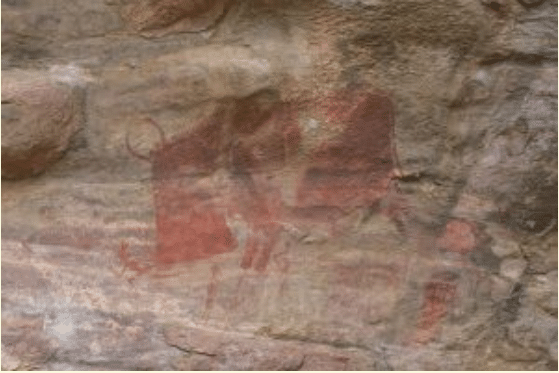
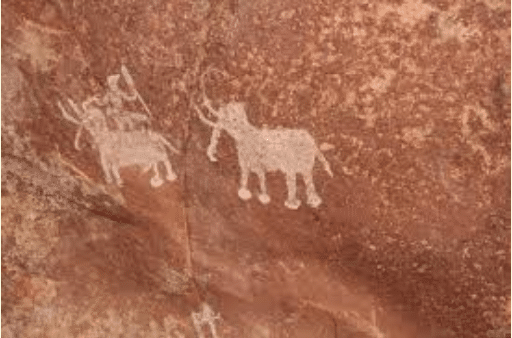
- The themes of the paintings found here are of great variety, ranging from mundane events of daily life to sacred and royal imagery. These include hunting, dancing, music, horse and elephant riders, animal fighting, honey collection, decoration of bodies, and other household scenes.
- Colours
- The artists of Bhimbetka used many colours, including various shades of white, yellow, orange, red ochre, purple, brown, green, and black. Sixteen colours or shades can be identified at Bhimbetka.
- White and red were their favourite colours.
- Some paintings are monochrome (in one colour), while others are polychrome (in more than one colour).
- The paints were made by grinding various rocks and minerals.
- Red was obtained from haematite.
- Green came from a green variety of a stone called chalcedony.
- White might have been made from limestone.
- The rock or mineral was first ground into a powder, which may then have been mixed with water and with some thick or sticky substance.
- The handles of brushes must have been made from twigs, and the brush itself from squirrel tail, animal fur, semal (silk cotton), or plant fibre.
- These colours have survived thousands of years of adverse weather conditions — probably remaining intact because of a chemical reaction of the oxide present on the surface of the rocks.
- Hunting Scenes
- Hunting scenes predominate in Mesolithic rock art.
- Hunters hunt singly or in groups, sometimes wearing masks and headdresses crowned with antlers and horns. They are adorned with ornaments such as necklaces, bangles, wristbands, elbow bands, and knee bands with tassels.
- Some are unarmed; others carry sticks, spears, bows and arrows, or slings. Hunters are sometimes accompanied by dogs.
- There are scenes showing traps and snares, probably used to catch animals.
- In some pictures, animals are shown chasing men; in others, they are being chased and hunted by men.
- The hunters are shown wearing simple clothes and ornaments; sometimes men are adorned with elaborate headdresses, and sometimes painted with masks as well.
- Animal Painting
- Animal painting predominates — the Mesolithic artists clearly loved to paint animals.
- In Mesolithic art at Bhimbetka and elsewhere, animals are represented both on their own and as part of hunting scenes.
- While some animal figures are rather abstract, many are very realistic.
- Twenty-nine species of animals are depicted, including the chital (which occurs most often), leopard, tiger, panther, elephant, rhinoceros, antelope, deer, and squirrel.
- Different kinds of birds, fish, lizards, frogs, crabs, scorpions, and small centipedes also make an appearance.
- No snakes are depicted in Indian Mesolithic paintings, here or elsewhere.
- There are also fantastic, composite animals — the famous Bhimbetka “boar” has the body of a boar.
- Some animal paintings, especially in hunting scenes, show a fear of animals, while many others show a feeling of tenderness and love for them.
- In one scene, a group of people is shown hunting a bison; in the process, some injured men are depicted lying scattered on the ground. In another scene, an animal is shown in the agony of death, while men are depicted dancing. These kinds of paintings might have given people a sense of power over the animals they would meet in the open.
- These pictures depict both men and animals engaged in the struggle for survival.
- Animals are sometimes shown in outline, and in other instances their bodies are decorated with designs.
- A few paintings are in the “x-ray style,” showing the inner organs, including foetuses in the womb of female animals.
- Apart from hunting scenes, animals also appear in more peaceful, sympathetic scenes — such as those depicting pregnant animals, a panther or tiger with cubs, a stag or chital running after a fawn, grazing buffaloes, rabbits hopping, and monkeys leaping about. There is a great deal of movement in these scenes.
- There are also a few engravings, representing mainly animals.
- Human Figures and Activities
- Mesolithic paintings at Bhimbetka and other sites also depict men and women, young and old.
- Though animals were painted in a naturalistic style, humans were depicted only in a stylistic manner.
- Male figures often look like matchsticks, while women are sometimes given fuller forms.
- Women are painted both in the nude and clothed.
- Some men wear loincloths, probably made of leaves, animal skin, or pieces of tree bark. Men are shown wearing their hair loose, and women braided.
- Some figures are broad and decorated with geometric designs, and, from their attitude, seem to represent men of authority.
- Children are painted running, jumping, and playing.
- There are paintings of people gathering fruit or honey from trees, and of women grinding and preparing food.
- Some of the pictures of men, women, and children seem to depict a sort of family life, and some scenes depict sexual activity.
- Division of Labour
- The Bhimbetka paintings reflect a division of labour on the basis of gender.
- Men are shown hunting, while women are shown gathering and preparing food — for instance, grinding food on querns.
- Basket-like containers must have been used to store food, though no pottery is depicted.
- Dry gourds and leather bags may have been used to hold water.
- Dancing
- Some scenes show people dancing; community dances provide a common theme.
- The dancers convey a sense of rhythmic movement, occasionally losing their balance and falling.
- Masked dancers (referred to by prehistorians as “dancing sorcerers”) may represent ritual specialists.
- Some hand-linked figures in dancing mode are shown — in fact, this is a recurrent theme.
- Hand, fist, and finger prints are also found, similar to those that people make on their houses today on auspicious occasions.
- Place of Painting
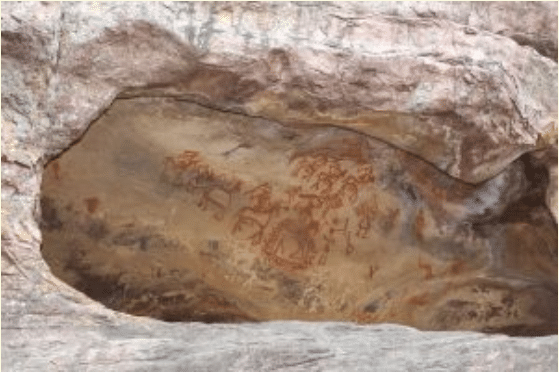
- The artists made their paintings on the walls and ceilings of rock shelters.
- Some paintings are found in shelters where people actually lived, but some others were made in places that do not seem to have been living spaces at all — perhaps these places had some religious importance.
- Some paintings are located very high up on rock shelters, or close to the ceilings of rock shelters. Paintings made in these places were perhaps intended to be noticeable from a distance.
- Some of the large paintings on high surfaces would have required scaffolding and the cooperation of many people. Such paintings, and those made in layers, suggest some kind of ritualistic significance.
- Layers of Painting
- At many rock-art sites, a new painting was made on top of an older one. At Bhimbetka, in some places, there are as many as 20 layers of paintings, one on top of another.
- This may have been because the artist did not like his earlier creation and painted a new one over it, or because some paintings and places were considered sacred or special, or because the area may have been used by different generations of people at different times.
- Pictorial Quality
- The paintings, though from the remote past, do not lack pictorial quality.
- Despite various limitations — such as acute working conditions and inadequate tools and materials — there is a charm to the simple rendering of scenes from the environment in which the artists lived.
- The men shown in them appear adventurous and full of the joy of living; the animals are shown more youthful and majestic than they perhaps actually were.
- Mesolithic Rock Art of Orissa
- Mesolithic shelters with rock art have been identified in the western districts of Orissa, especially in the Sundargarh and Sambalpur districts. The richest area for rock paintings is the group of 12 rock shelters of Lekhamoda.
- An interesting feature of the rock art of Orissa is the co-existence of paintings and engravings within the same shelter.
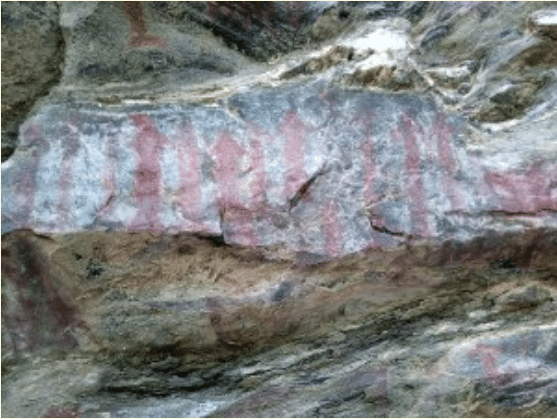
- The art here is mostly non-figurative, with an emphasis on abstract patterns and decorative designs, both geometric and non-geometric.
- Animals occur infrequently, and humans are even rarer.
- Conclusion
- The rock paintings of Bhimbetka and other Mesolithic sites across India offer far more than decorative imagery — they are a rare, direct window into the minds, beliefs, and daily lives of India’s earliest artists. Through their hunting scenes, animal studies, dances, and depictions of family life, these paintings reveal a society already marked by a clear division of labour, a rich ritual and religious sensibility, and an unmistakable, universal human impulse to tell stories in pictures. As with the rock art of Orissa’s Lekhamoda group, regional variations in style and subject matter remind us that Mesolithic art was not a single, uniform tradition, but a varied and evolving one — making these rock shelters, layered with thousands of years of superimposed paintings, one of the richest and most evocative sources for reconstructing the social and cultural life of Mesolithic India.