

- Insolation (incoming solar radiation) is the energy received by the Earth from the sun in the form of short waves. It is the main source of heat for the Earth’s surface and atmosphere.
- The Earth receives only a tiny fraction of the sun’s output. At the top of the atmosphere, about 1,361 W/m² falls on a surface facing the sun (the solar constant), averaging about 340 W/m² over the whole globe.
- The Earth neither keeps getting hotter nor colder, because the heat it receives as insolation is returned to space as long-wave terrestrial radiation. This balance is the heat budget of the Earth.
Insolation
Variability of Insolation
- The amount and intensity of insolation vary during the day, across seasons and over a year. The controls are:
- Rotation of the earth on its axis, which creates day and night.
- Inclination of the earth’s axis: the axis makes an angle of 66½° with the plane of its orbit, so the overhead sun migrates between the tropics and seasons arise.
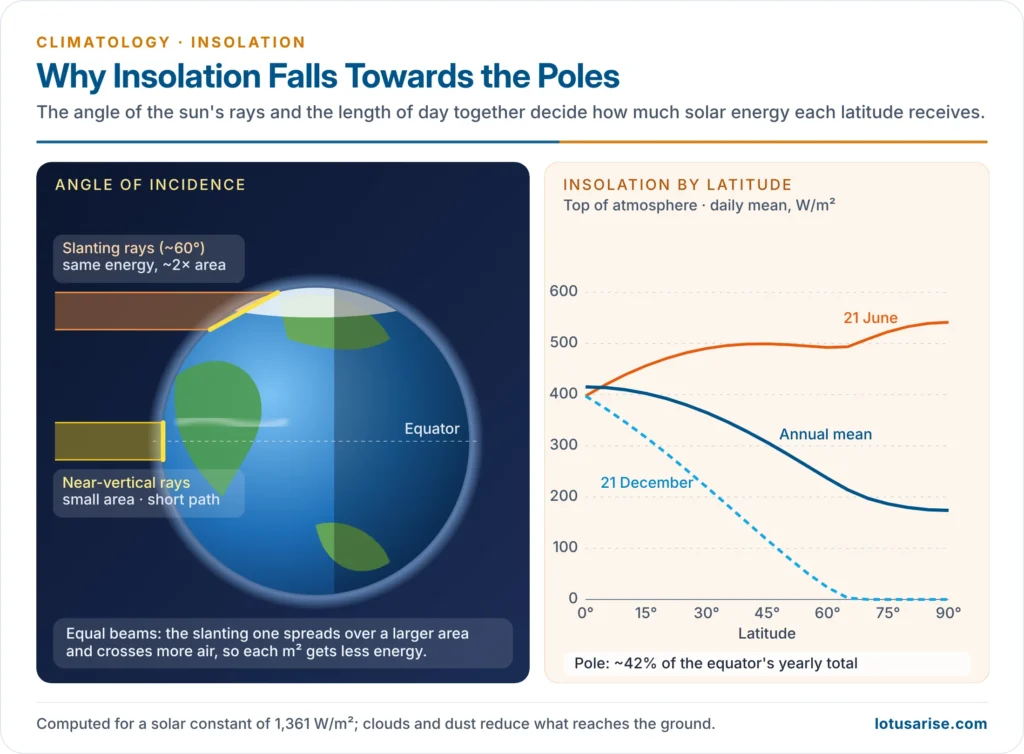
- Angle of the sun’s rays:
- Vertical rays heat a small area.
- Slanting rays spread the same energy over a larger area and pass through a thicker layer of atmosphere, losing more energy on the way.
- Insolation therefore falls from the equator towards the poles.
- Length of the day: longer days mean more insolation. Day length is 12 hours at the equator, but up to 24 hours at the polar circles at the summer solstice.
- Transparency of the atmosphere: clouds, water vapour and dust reflect, scatter and absorb part of the radiation.
- Configuration of land (aspect): sun-facing slopes receive more than shaded slopes.
- The first three factors (rotation, axial tilt and the angle of the rays) matter most.
- Earth–sun distance matters little. At perihelion (3 January) the Earth receives slightly more insolation than at aphelion (4 July), yet it is winter in the northern hemisphere in January.
Passage of Solar Radiation through the Atmosphere
- The atmosphere is largely transparent to short-wave solar radiation:
- Ozone absorbs ultraviolet rays in the stratosphere.
- Water vapour, carbon dioxide and other gases absorb part of the near-infrared radiation.
- Suspended particles scatter visible light. The blue colour of the sky and the red colour of the rising and setting sun both result from scattering.
Spatial Distribution of Insolation
- Insolation at the surface varies from about 320 W/m² in the tropics to about 70 W/m² near the poles.
- The maximum is in the subtropical deserts, not at the equator: cloudiness is least there and the air is clear. The cloudy equatorial belt receives somewhat less.
- At the same latitude, continents receive more insolation than oceans.
- Winter insolation is lower everywhere outside the tropics, because the rays are slanting and the days short.
- India: western Rajasthan, Gujarat and Ladakh receive the highest insolation, thanks to clear skies and, in Ladakh, high altitude. This is why India’s largest solar parks are located there.
Heating and Cooling of the Atmosphere
- The atmosphere is heated mainly from below: the ground absorbs insolation and then heats the air above it.
- Terrestrial radiation:
- The heated earth radiates energy as long waves.
- Gases such as carbon dioxide and water vapour absorb these long waves readily, so the atmosphere is heated indirectly by the earth.
- The atmosphere in turn radiates heat to space.
- Conduction:
- The air in contact with the warm land gets heated, and heat flows from warmer to cooler until both reach the same temperature.
- It affects only the lowest layers of air.
- Convection:
- Heated air rises vertically and carries heat upward.
- It is confined to the troposphere.
- Advection:
- Heat is carried horizontally by winds.
- It is more important than convection in middle latitudes, where most day-to-day temperature changes come from advection.
- In northern India, the hot dry loo of summer is an example of advection.
Heat Budget of the Earth
- Assume that 100 units of insolation reach the top of the atmosphere:
- 35 units are reflected back to space before heating anything. This reflected part is the albedo of the Earth:
- 27 units from the top of clouds
- 6 units from scattering by air and dust
- 2 units from snow and ice-covered areas
- 14 units are absorbed by the atmosphere.
- 51 units are absorbed by the earth’s surface: 34 units as direct radiation and 17 units as scattered (diffuse) radiation.
- 35 units are reflected back to space before heating anything. This reflected part is the albedo of the Earth:
- The earth’s surface returns these 51 units as terrestrial radiation:
- 17 units go directly to space.
- 34 units are absorbed by the atmosphere:
- 6 units directly
- 9 units through convection and turbulence
- 19 units through the latent heat of condensation
- The atmosphere thus holds 48 units (14 from insolation + 34 from the earth), and it radiates all of them back to space.
- Total radiation returned to space = 17 + 48 = 65 units, which balances the 65 units absorbed from the sun. This balance is the heat budget or heat balance of the Earth.
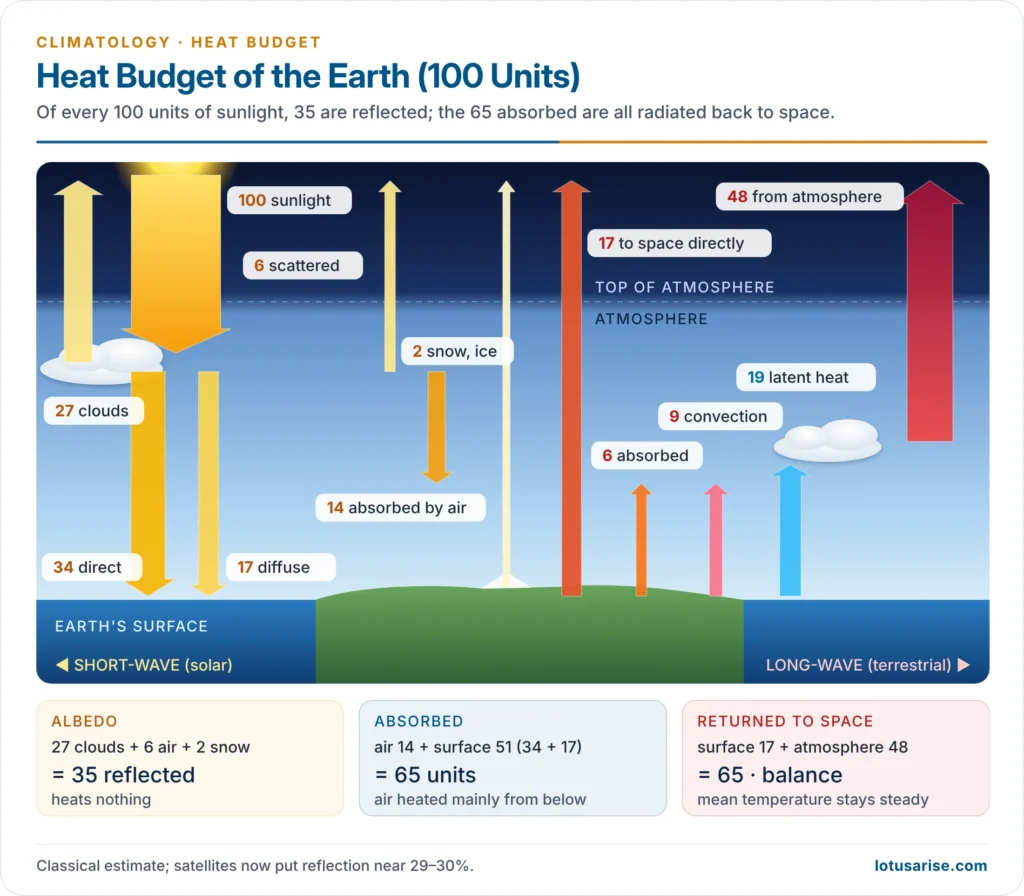
- Recent satellite measurements put the reflected share nearer 29–30% than 35%.
- They also show that the Earth now absorbs slightly more energy than it emits, about 1 W/m² by the late 2010s.
- This surplus is the energy behind global warming, and most of it is stored in the oceans.
Variation in the Net Heat Budget
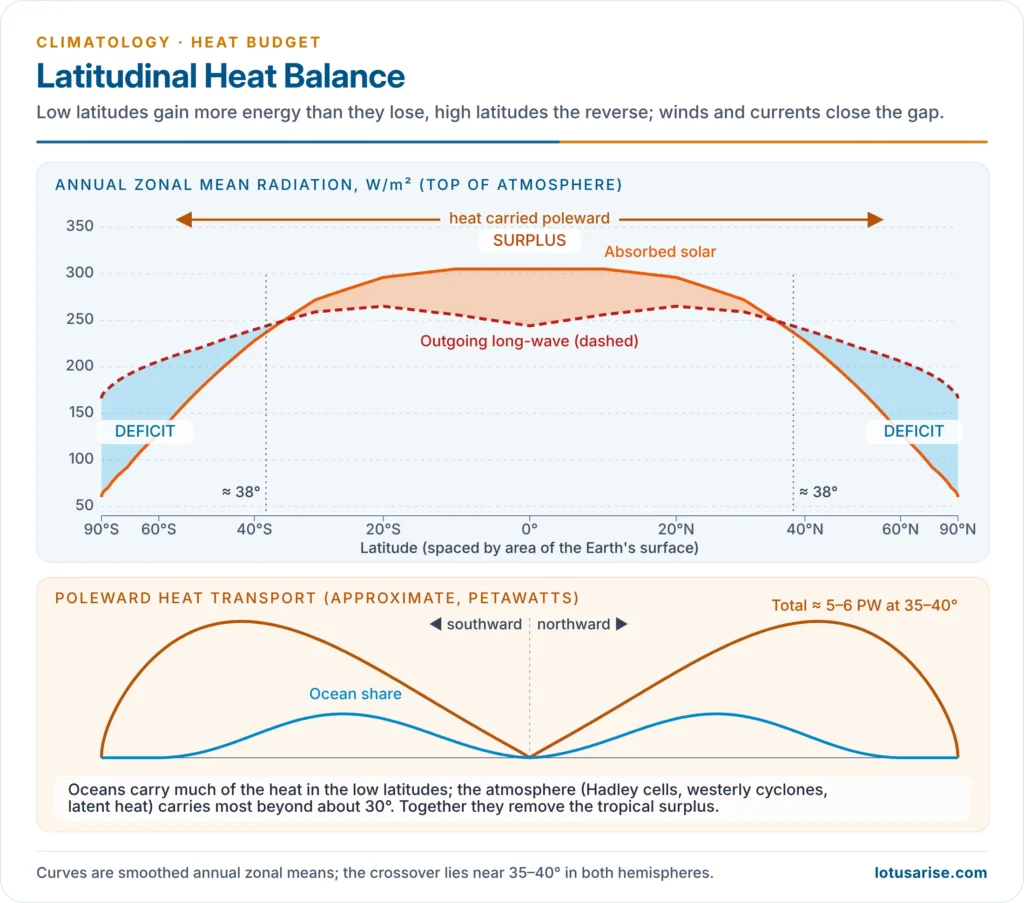
- Insolation is unevenly received, so some parts of the Earth have a surplus and others a deficit:
- The surplus lies between about 40° N and 40° S.
- The regions near the poles have a deficit.
- Winds and ocean currents carry the surplus heat from the tropics towards the poles.
- As a result, the tropics do not keep getting hotter, and the high latitudes do not freeze permanently.
- This poleward transfer of heat is the basic driver of the planetary winds and ocean currents.
Factors Controlling Temperature Distribution
- Latitude:
- Insolation falls from the equator to the poles as the sun’s rays become more slanting.
- Temperature therefore decreases poleward.
- Altitude:
- The atmosphere is heated from below, so temperature falls with height.
- The average fall is 6.5 °C per km, called the normal lapse rate.
- Shimla and Darjeeling are much cooler than the plains at the same latitude.
- Distance from the sea:
- Land heats and cools faster than water, so coastal places have a moderate (maritime) climate, while interiors have extremes (continentality).
- Mumbai’s annual temperature range is small compared with Delhi’s.
- Land and sea breezes further moderate coastal temperatures.
- Air masses and ocean currents:
- Places under warm air masses or along coasts washed by warm currents are warmer.
- Those under cold air masses or beside cold currents are cooler.
- The North Atlantic Drift keeps the ports of Norway ice-free, while the Labrador Current chills the coast of north-east Canada.
- Local aspects: slope, aspect, vegetation and urbanisation modify temperature locally. Cities form urban heat islands.


Dear Lotusarise ,
your notes helped not only me but thousand of students all around to have a clear and crisp knowledge of almost all the subjects but why you left Economy if possible plz cover that too cuz your notes are really helpful .
Yeah Sure!
lotus arise ji please cover economy also.
Exactly
Thanx
Sir is it sufficient for mains. Please reply sir