

- Disinvestment is the sale or liquidation of an asset or subsidiary by an organisation or government. It is also called divestment or divestiture.
- In most Indian contexts, it means the government’s sale of part or all of its stake in a government-owned enterprise.
- A company or government usually disinvests as a strategic move, or to raise resources for general or specific needs.
- Current policy has two limbs, in the words of the Department of Investment and Public Asset Management (DIPAM):
- Strategic disinvestment: sale of the entire or a substantial government holding, with transfer of management control. Sale to a private buyer is privatisation, a sub-set of this.
- Minority stake sale: sale of shares without transfer of control, through public offers, offer for sale, buybacks and similar routes.
Why Disinvest
Objectives of Disinvestment
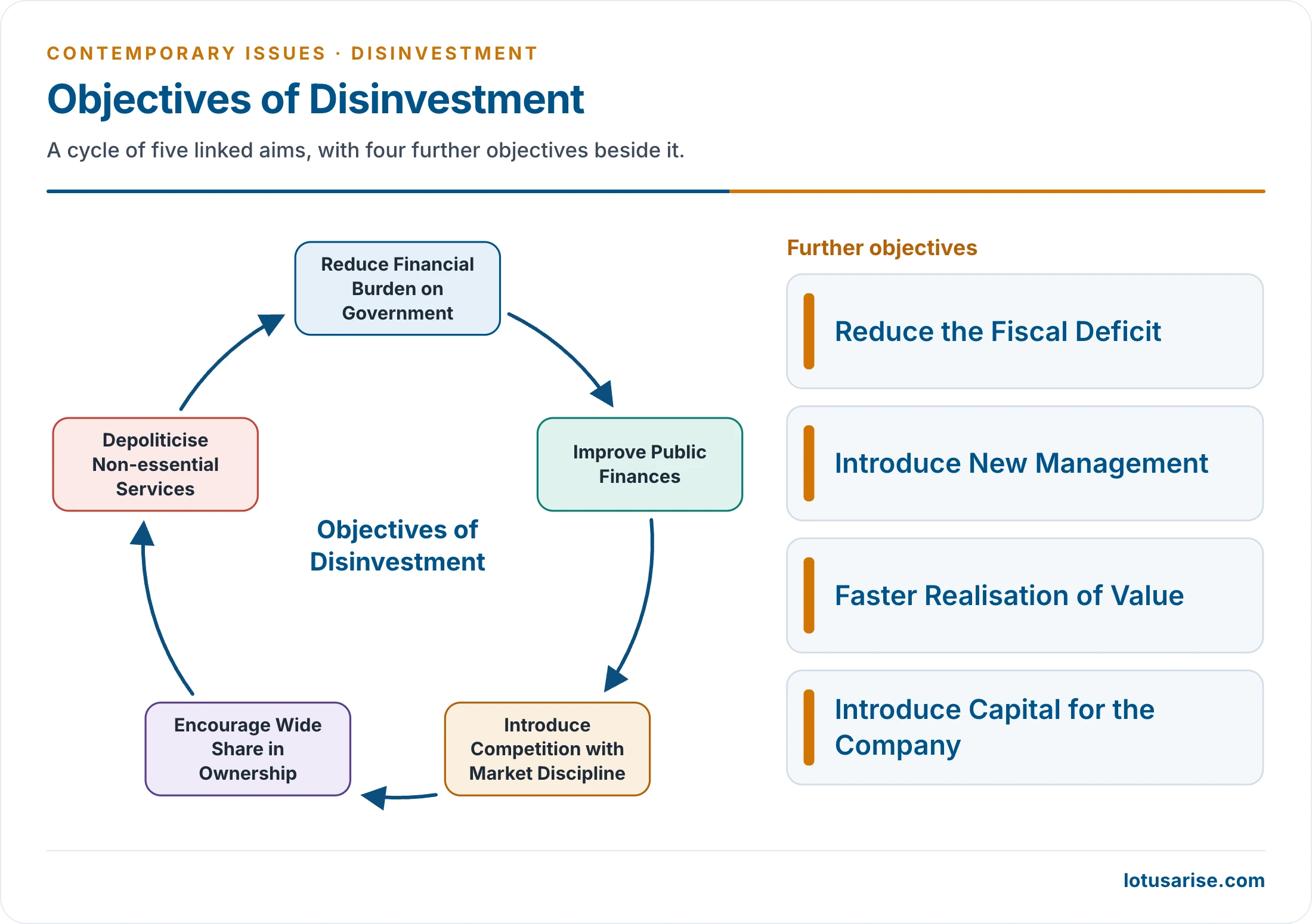
- To reduce the financial burden on the government.
- To improve public finances.
- To introduce competition and market discipline.
- To depoliticise non-essential services.
- To encourage a wider share of ownership.
- To fund growth.
Benefits of Disinvestment
- Improves corporate governance: privatised firms gain freedom from government control, more room for innovation, and independent directors.
- Develops and deepens the capital market through a spread of equity culture. Small investors and employees share in the wealth through public offerings.
- Funds long-term goals:
- Financing large-scale infrastructure.
- Investing in the economy to encourage spending.
- Expansion and diversification of the firm.
- Repayment of government debt. Older accounts put about 40–45% of the Centre’s revenue receipts as going to public debt and interest. The 2026-27 Budget puts interest alone at ₹14.04 lakh crore, or 39.7% of revenue receipts.
- Social programmes such as health and education.
- Creates fiscal space by freeing resources locked in central public sector enterprises (CPSEs).
- A more competitive setting makes it hard for many enterprises to earn well, so the case made is that their value erodes unless sold early.
- Redirects resources: money locked in sectors developed enough to raise funds from the market can move to areas less able to do so.
- Supporters add that the yield on such holdings is low, so selling serves taxpayers in the long term.
- Unlocks shareholder value through an Initial Public Offering (IPO).
- An IPO is the process by which a privately held company becomes publicly traded, by offering shares to the public for the first time.
- The money goes to expansion, better business and infrastructure, or repaying loans.
- Employees gain, on this view, through:
- Pay rises, as in some past disinvestments.
- Greater opportunities for career growth and new jobs through capacity expansion.
Disinvestment Types
- Minority disinvestment: the government keeps a majority, typically above 51%, and so keeps management control.
- Early examples were auctions to institutions in the early and mid-1990s, such as Andrew Yule & Co. and CMC.
- Later examples were offers in Power Grid Corporation, Rural Electrification Corporation, NTPC and NHPC.
- Majority disinvestment: the government sells off a majority stake and keeps a minority one.
- Historically, these went to strategic partners.
- The partner may be another CPSE, as with Bongaigaon Refinery (BRPL) to IOC and Kochi Refineries (KRL) to BPCL.
- It may be a private firm, as with Modern Foods to Hindustan Lever and CMC to Tata Consultancy Services (TCS).
- Complete privatisation: a form of majority disinvestment in which 100% control passes to a buyer.
- Examples are 17 hotel properties of ITDC and 3 of Hotel Corporation of India, sold in 1999–2004.
- A policy statement for FY 2018-19 spoke of minority disinvestment through public offerings. Strategic sales were cleared alongside it: 34 firms had in-principle approval by 2020, and eight went to other CPSEs.
- In a majority sale too, shares may be offloaded by an Offer for Sale, on its own or with a sale to a strategic partner.
- Disinvestment and privatisation are often used interchangeably, but disinvestment may or may not result in privatisation.
- If the government keeps 26% of voting shares and sells the rest to a strategic buyer, it has disinvested but not fully privatised. A holding above one-quarter can block a special resolution, which needs a three-fourths majority.
Privatisation and Disinvestment
- Privatisation means a change in ownership and in management. It occurs when government sells more than 51% of its ownership to private entrepreneurs.
- Disinvestment is wider. It may dilute the stake to the point of transferring management, or stop at a level that leaves government in control.
- Disinvestment beyond 50% transfers management. Below 50%, the government keeps a major say.
Criteria for Disinvestment
- Whether the company’s objectives have been achieved.
- Whether the number of beneficiaries has decreased.
- Whether national interest would be affected.
- Whether the private sector can operate and manage the undertaking efficiently.
- Whether the original target rate of return can still be achieved.
How It Is Done
Modalities of Disinvestment
- Public offer: shares offered at a fixed price to the general public through a prospectus and market intermediaries.
- Cross holding: government sells part of its share in one enterprise to one or more other enterprises.
- Before March 1999, ONGC bought 9.82% of GAIL and 12.11% of IOC, and IOC bought 10% of ONGC.
- Golden share: government keeps 26% in the enterprise. This is short of a majority, but it carries a veto over special resolutions.
- Warehousing: government-owned financial institutions buy the government’s shares in selected enterprises and hold them until a third buyer emerges.
- Strategic sale: government sells a major portion, 51% and above, to a strategic buyer and hands over management control.
- Follow-on Public Offer (FPO): shares issued by a company already listed. Retail participation is mostly high.
- Offer for Sale (OFS): a stock exchange window, under a framework first set by the Securities and Exchange Board of India (SEBI) and revised on 10 January 2023.
- Size of at least 1% of paid-up capital, subject to a minimum of ₹25 crore.
- A floor price may be declared. It must now be announced by 5 pm on the day before the offer.
- The older rule held the offer to one trading day. Today non-retail investors bid on the first day and retail investors on the next, as in the LIC offer of 4–5 August 2026.
- A separate window is created by the stock exchanges.
- The exchange collects 100% of the order value in cash at order level for buy bids.
- At least 10% is reserved for retail investors.
- Institutional placement programme (2012): fresh shares or an offer for sale in a listed firm, placed with institutions to reach minimum public shareholding.
- There must be at least ten allottees.
- No partly paid-up securities may be offered.
- The issue stays open for a minimum of one day and a maximum of two days.
- It must not raise public shareholding by more than ten percent.
- An allottee cannot sell the allotment for one year.
- Newer routes: buybacks, and exchange traded funds: the CPSE ETF, with ₹3,000 crore in its first tranche in 2013-14, and Bharat 22, launched in 2017.
The Debate
Merits of Disinvestment
- Lighter burden: disinvesting loss-making enterprises frees government to invest in profit-making ones.
- Faster decisions: private firms decide quickly and respond to competitive market changes.
- Better governance: better corporate practice, exposure to competitive corporate responsibility, and an improved work environment.
- Price discovery: market participation in enterprise capital through stock exchanges reveals their latent worth.
- Revival of sick units: a strategic partner can infuse fresh capital and exercise strong management control.
Demerits of Disinvestment
- Lost income: selling profit-making, dividend-paying enterprises removes a regular source of income.
- Asset stripping: a strategic partner might exploit valuable plant, machinery, land and buildings.
- Sale of viable firms: policy covers both profit-making and potentially viable enterprises.
- Strategic and national security concerns: some experts see strategic sale of oil enterprises as a threat, since oil is a strategic resource and foreign ownership may not fit strategic goals.
- Selling the family silver: critics call raising funds this way to bridge the fiscal deficit an unhealthy, short-term practice.
Arguments Against Disinvestment
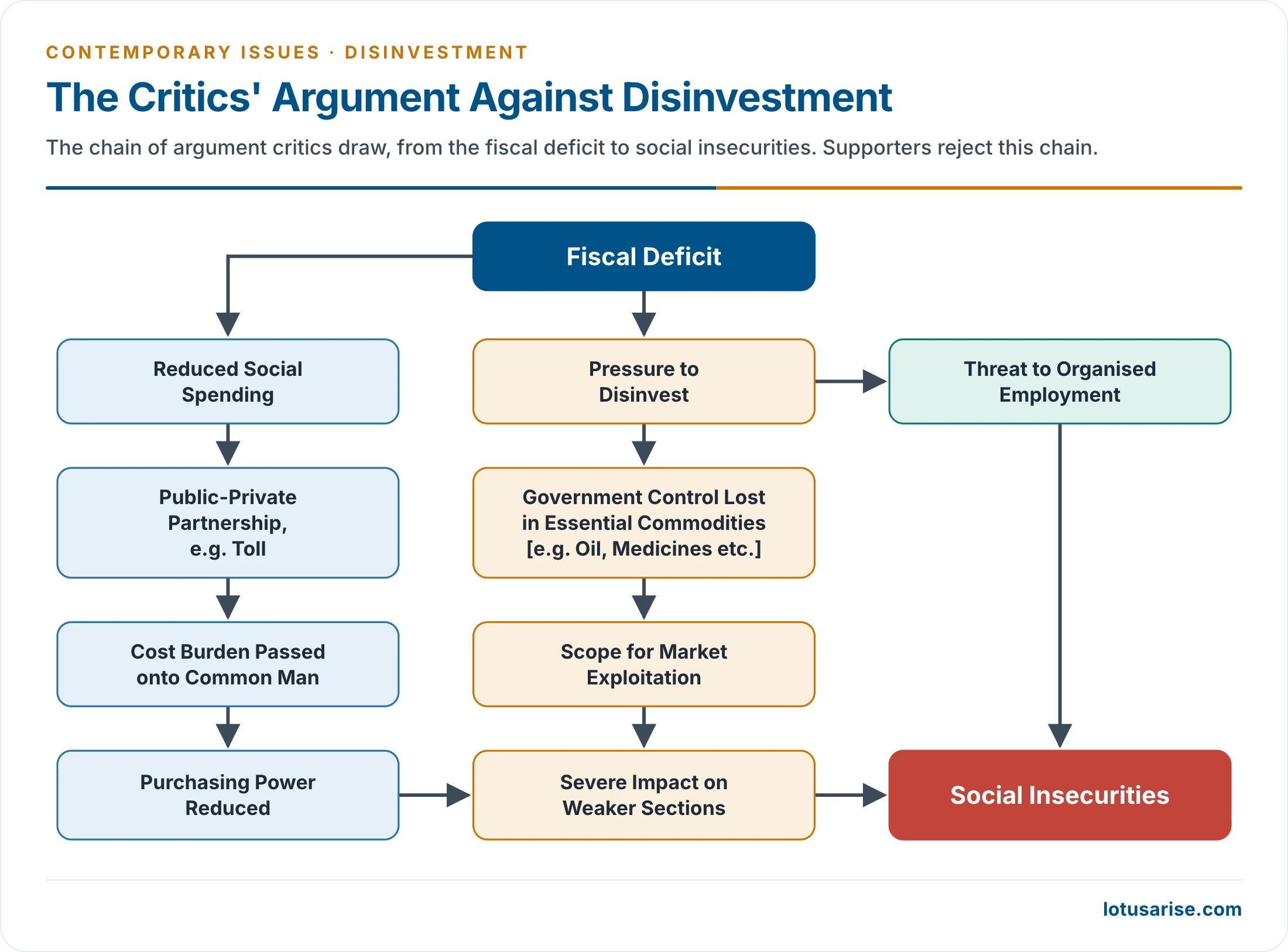
- Sale of government stakes shrinks an important revenue source, and critics hold that the real beneficiaries are institutional investors, not the ordinary retail investor.
- Future dividend income is forgone against a one-time receipt.
- Employees may lose jobs or government benefits, as unions argue. One study of the strategic sales of 1999–2004 found no retrenchment took place, though strikes did occur.
Positions Held
| Group | Stated position |
|---|---|
| Government, New Public Sector Enterprise Policy (2021) | Minimise government’s presence in enterprises across sectors; keep a bare minimum in strategic sectors |
| Trade unions and employees’ bodies | Oppose sale over jobs, benefits and public control |
| Comptroller and Auditor General | Audit objections on valuation and on the sale of hotels in the 1999–2004 phase |
| Thirteenth and Fourteenth Finance Commissions | Questioned the National Investment Fund; the Fourteenth called for its closure, as States gain no share of the money |
Use of the Proceeds
National Investment Fund
- The government decided on 27 January 2005 to constitute a National Investment Fund (NIF), into which money from selling minority shares in profitable CPSEs would flow. It was set up in late 2005.
- Until 2008-09: 75% of the fund’s income was for selected central social welfare schemes in health, education and employment, and 25% for the capital needs of profitable enterprises.
- From April 2009 to March 2013: in view of the difficulties of the global recession, the government used 100% for social welfare schemes.
- Since 17 January 2013 (restructuring), proceeds from 2013-14 go to a Public Account head, outside the Consolidated Fund of India, where they remain until withdrawn or invested for approved purposes.
- Approved uses include share purchases to keep 51% government ownership in CPSEs, and recapitalisation of public sector banks and insurers.
- They also include investment in regional rural banks, IIFCL, NABARD and Exim Bank, and equity in Metro projects.
- Salient features at the start:
- Proceeds were channelled into the fund, outside the Consolidated Fund.
- The corpus was permanent.
- It was to be managed professionally, without depleting the corpus.
- The 75:25 division of annual income applied.
- Fund managers: UTI Asset Management, SBI Funds Management and LIC Mutual Fund Asset Management.
Use of Disinvestment Proceeds
- 75% went to finance selected social sector schemes promoting education, health and employment.
- 25% met the capital needs of profitable and revivable CPSEs that yield adequate returns, to enlarge their capital base for expansion and diversification.
- From April 2009, the proceeds flowed through the fund in full to capital spending on social programmes:
- Mahatma Gandhi National Rural Employment Guarantee Scheme
- Indira Awas Yojana
- Rajiv Gandhi Gramin Vidyutikaran Yojana
- Jawaharlal Nehru National Urban Renewal Mission
- Accelerated Irrigation Benefits Programme
- Accelerated Power Development and Reform Programme
Policy on Disinvestment, 2004–14
- Citizens’ stake: citizens have every right to own shares of CPSEs, through IPOs and FPOs.
- People’s wealth: CPSEs are the wealth of the nation, and this wealth should rest in the hands of the people.
- Control kept: government was to retain at least 51% and management control.
- The National Common Minimum Programme (NCMP) of 2004 kept existing Navratna companies in the public sector.
- Profit-making companies would generally not be privatised.
- Loss-making companies would be sold or closed, after workers received their legitimate dues and compensation.
- Government approved listing of unlisted profitable enterprises with net worth above ₹200 crore, through an IPO.
Disinvestment in Practice
Evolution
- The process began in 1991-92 with the sale of a minority stake in some enterprises, as part of the public sector reforms framed by the 1991 New Industrial Policy.
- Government said it remained committed to a strong public sector whose social objectives are met through commercial functioning.
- It also promised full managerial and commercial autonomy to successful, profit-making companies in competitive settings.
- Bodies: the C. Rangarajan Committee (1993), the Disinvestment Commission (1996) under G. V. Ramakrishna, and a separate Department of Disinvestment (December 1999), which became a ministry in 2001 and was renamed DIPAM on 14 April 2016.
- Scope widened after 2014: new avenues included enemy shares, asset monetisation and holdings in SUUTI, the body that took over part of the old Unit Trust of India. NITI Aayog gained an advisory role on strategic sales.
- Listing rules also pushed sales: government companies had to meet minimum public shareholding of 10%, and this helped drive offers for sale and exchange traded funds. LIC’s deadline for this was reported as May 2027.
- Controversies of the 1999–2004 sales: methods of valuation, legal disputes, adverse audit remarks and labour unrest.
- Some enterprises with disinvestment: BHEL, BPCL, CONCOR, GAIL, Hindustan Copper (HCL), SAIL, NTPC, NMDC, VSNL, MTNL.
| Phase | Target (₹ crore) | Realised (₹ crore) | Character |
|---|---|---|---|
| 1991–99 | 34,300 | 16,809 | Minority sales in 39 CPSEs, averaging 8.87%; no transfer of control |
| 1999–2004 | 58,500 | 24,619 | First strategic sales: Modern Foods (2000), then BALCO, VSNL and others; 20 hotels |
| 2004–14 | 1,93,000 | 1,14,045 | No strategic sale; public offers, OFS and ETFs |
| 2014–20 | 4,26,925 | 3,05,357 | 78% from minority sales; CPSE-to-CPSE deals |
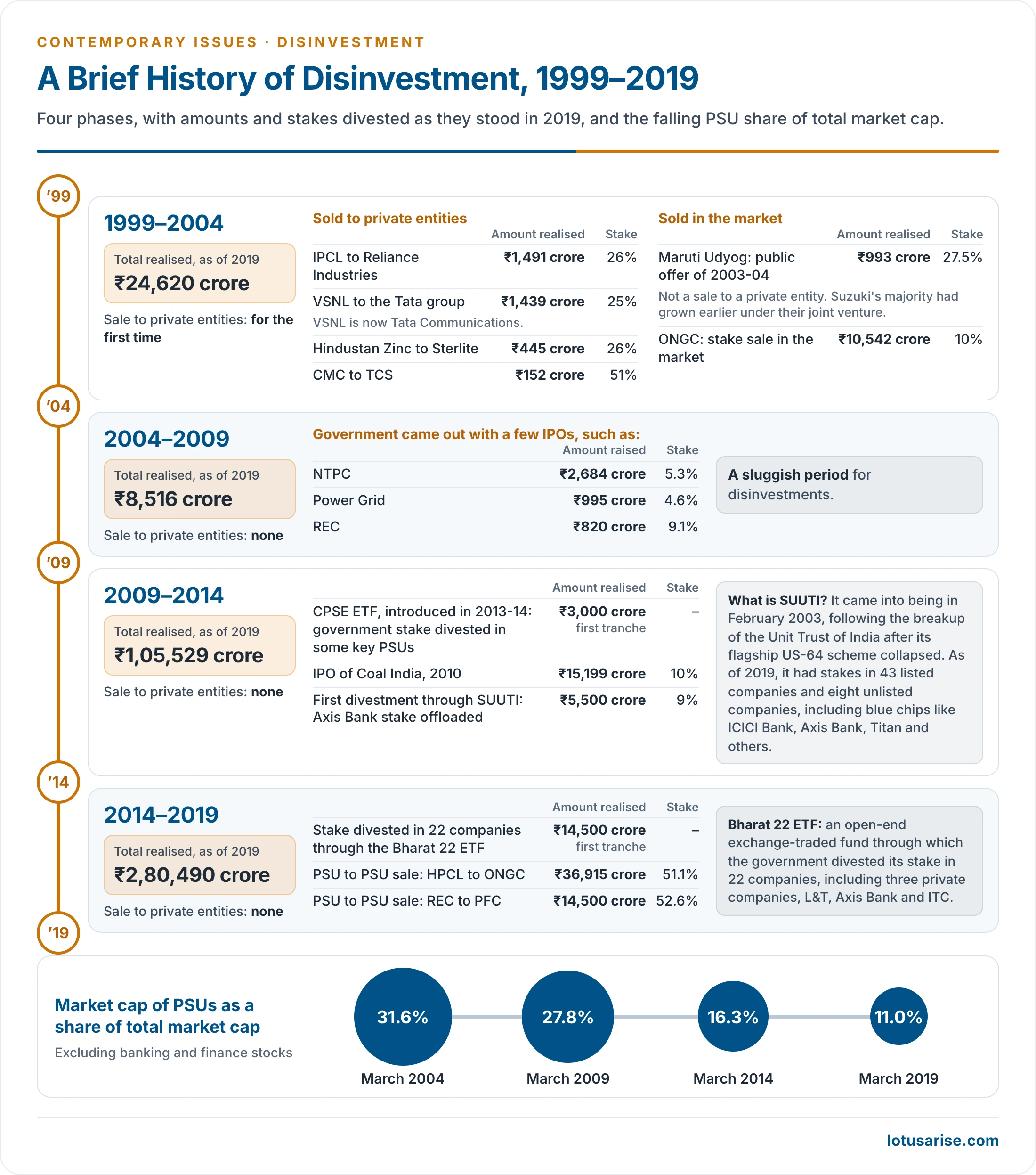
- This figure ends at March 2019. Later strategic sales to private buyers include Air India, below.
- Later strategic sales to private buyers include Air India, below.
Latest Receipts
| Year | Disinvestment receipts (₹ crore) |
|---|---|
| 2017-18 | 1,00,037 |
| 2018-19 | 84,972 |
| 2019-20 | 50,300 |
| 2020-21 | 32,886 |
| 2021-22 | 13,534 |
| 2022-23 | 35,294 |
| 2023-24 | 16,507 |
| 2024-25 | 10,163 |
| 2025-26 | 16,886, plus 28,420 from asset monetisation |
| 2026-27 (to 10 September 2026) | 55,757, plus 6,367 from asset monetisation |
- Budget 2026-27 has ₹80,000 crore for disinvestment and asset monetisation together. The revised figure for 2025-26 was ₹33,837 crore, against ₹47,000 crore budgeted.
Current Policy and Major Cases
- New Public Sector Enterprise Policy (notified 4 February 2021): four strategic sectors keep a bare minimum of enterprises under government control, and others are to be privatised, merged or closed. All enterprises in non-strategic sectors are to be privatised where feasible.
- Air India: sold to Talace, a Tata Sons subsidiary, at ₹18,000 crore (₹2,700 crore in cash and ₹15,300 crore of debt taken over). The transfer was completed on 27 January 2022.
- Neelachal Ispat Nigam: 93.71% to Tata Steel Long Products, at an enterprise value of ₹12,100 crore.
- Ferro Scrap Nigam: to Konoike Transport, at an equity value of ₹320 crore.
- BPCL: the sale was called off in 2022 for lack of offers.
- LIC:
- An IPO in May 2022 raised about ₹21,000 crore.
- An OFS of 6.5% in August 2026 raised ₹31,514.89 crore, taking the government’s stake to 90%.
- IDBI Bank:
- May 2021: the Cabinet Committee on Economic Affairs approved a strategic sale.
- October 2022: bids were invited for 60.72% (government 30.48%, LIC 30.24%).
- March 2026: the process paused when bids fell short of the reserve price.
- 14 October 2026: the Committee approved sale to a Fairfax Financial Holdings company for about ₹52,878 crore. Government and LIC together keep 34%. The deal still needs Reserve Bank clearance.
- In the pipeline, as DIPAM lists it (September 2026): Shipping Corporation of India, BEML, Projects and Development India, HLL Lifecare and NMDC Steel at the second stage, and Rashtriya Ispat Nigam and CONCOR among those to come.
- Asset monetisation: related, but distinct from selling equity. The National Monetisation Pipeline (2021) aimed at ₹6 lakh crore over four years, and its second phase, launched on 23 February 2026, puts potential at ₹16.72 lakh crore over FY 2026–30.
Factors Responsible for Low Disinvestment
- Unfavourable market conditions.
- Offers unattractive to private investors.
- Opposition on the valuation process.
- No clear-cut policy in earlier years.
- Strong opposition from employees and trade unions.
- Lack of transparency, as critics allege.
- Lack of political will.
- Legal limits: in 2003 the Supreme Court stalled the sale of HPCL and BPCL without Parliament’s approval, while it had upheld the BALCO sale policy.
- Targets repeatedly missed: only 10 privatisations took place in the three decades to 2020, against 249 operating CPSEs in 2019.
Previous Year Questions
- No direct PYQ has been asked on this sub-topic yet.





Super
like it