

- Sericulture, or silk farming, means rearing silkworms for raw silk.
- It is an agro-based industry with a long chain of work:
- Raising food plants for the worms.
- Rearing them to get cocoons.
- Reeling and spinning the cocoons into yarn.
- Processing and weaving, which add value.
- Among silkworm species, Bombyx mori is the most widely used.
- Silk is called the queen of textiles, and “biosteel” for its strength.
- India produces all five commercial silks: Mulberry, Tropical Tasar, Oak Tasar, Eri and Muga. The older count of four treats Tasar as one.
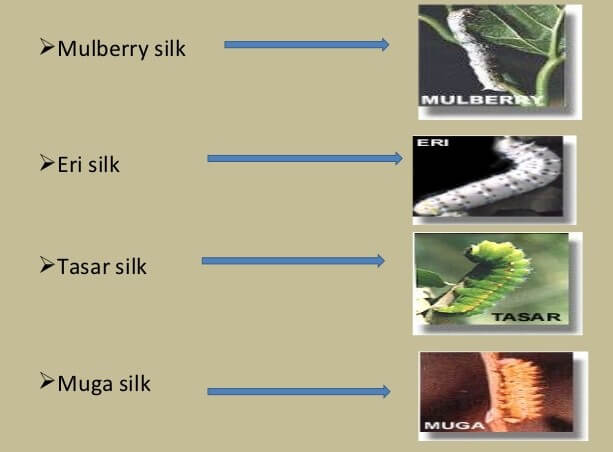
Silk and Its Geography
Types of Silk
- Silk falls into two groups, by what the worm eats:
- Mulberry silk comes from worms fed on mulberry leaves.
- Non-mulberry or Vanya silk comes from worms fed on other plants. Vanya means wild, because these silks are mostly forest products.
| Silk | Worm | Food plants | Main areas |
|---|---|---|---|
| Mulberry | Bombyx mori | Mulberry; about 150 kg of leaves for 1 kg of silk | Karnataka, Andhra Pradesh, Telangana, West Bengal, Tamil Nadu, Jammu and Kashmir |
| Tropical Tasar | Antheraea mylitta | Sal, asan, arjuna | Chhattisgarh, Jharkhand, Madhya Pradesh, Bihar, Odisha, West Bengal |
| Oak Tasar | Antheraea proylei | Oak | Sub-Himalayan belt: Manipur, Himachal Pradesh, Uttarakhand, Assam, Meghalaya, Jammu and Kashmir |
| Eri | Samia ricini | Castor | Assam, Meghalaya, Nagaland, Manipur, parts of Bihar, West Bengal, Odisha |
| Muga | Antheraea assama | Som and soalu | Assam, mainly the Brahmaputra valley; Meghalaya |
- Muga has a golden yellow glitter and is unique to India.
- Eri cannot be reeled, so it is only spun.
- By-products of reeling are also used:
- Spun silk yarn is made by dressing and spinning waste filament.
- Noil yarn comes from the short residue left in spinning, and gives coarse counts.
- All the Vanya worms belong to the Saturniidae family. Tasar in particular supports tribal livelihoods, and has drawn rural women and unemployed youth into the work.
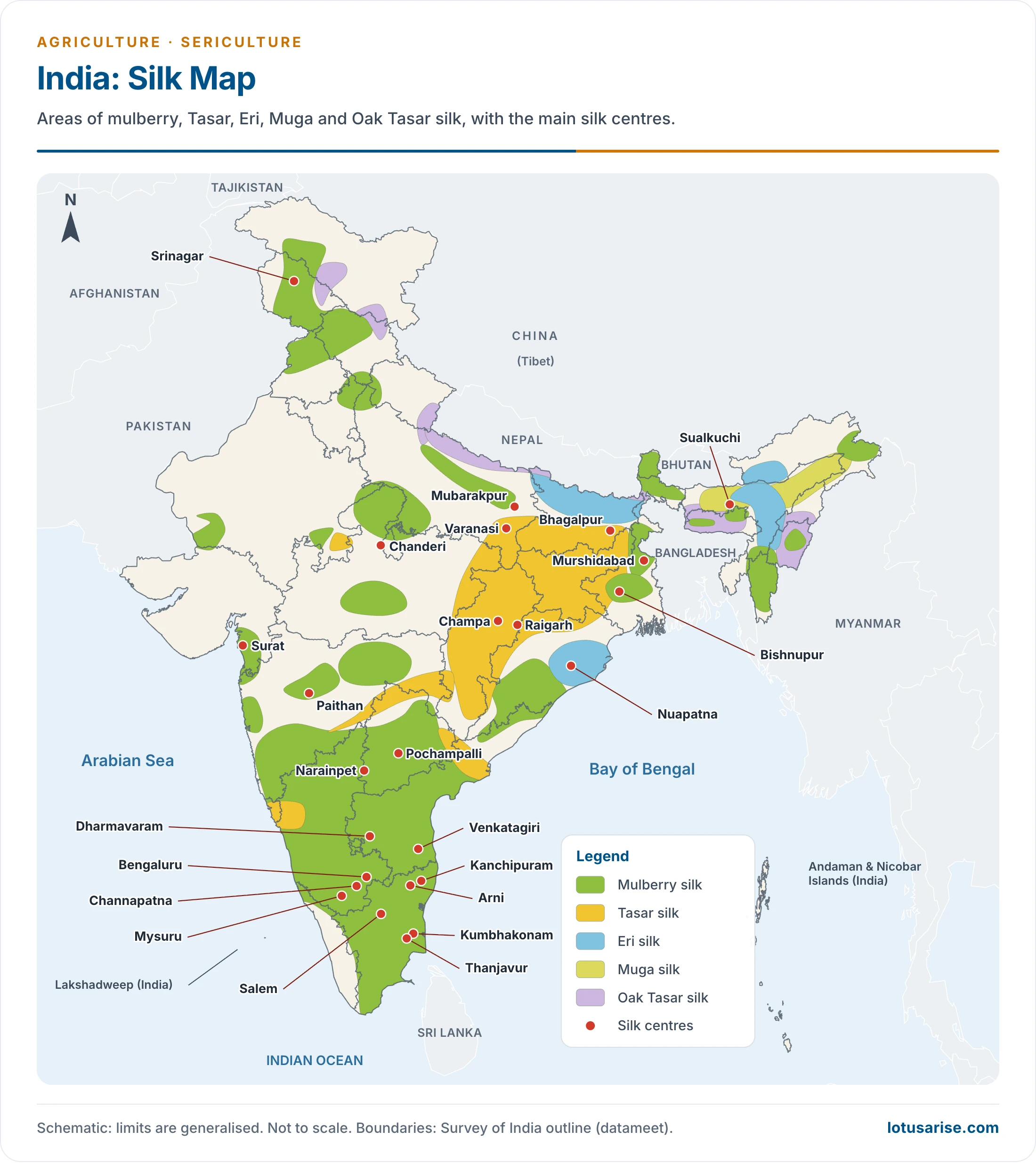
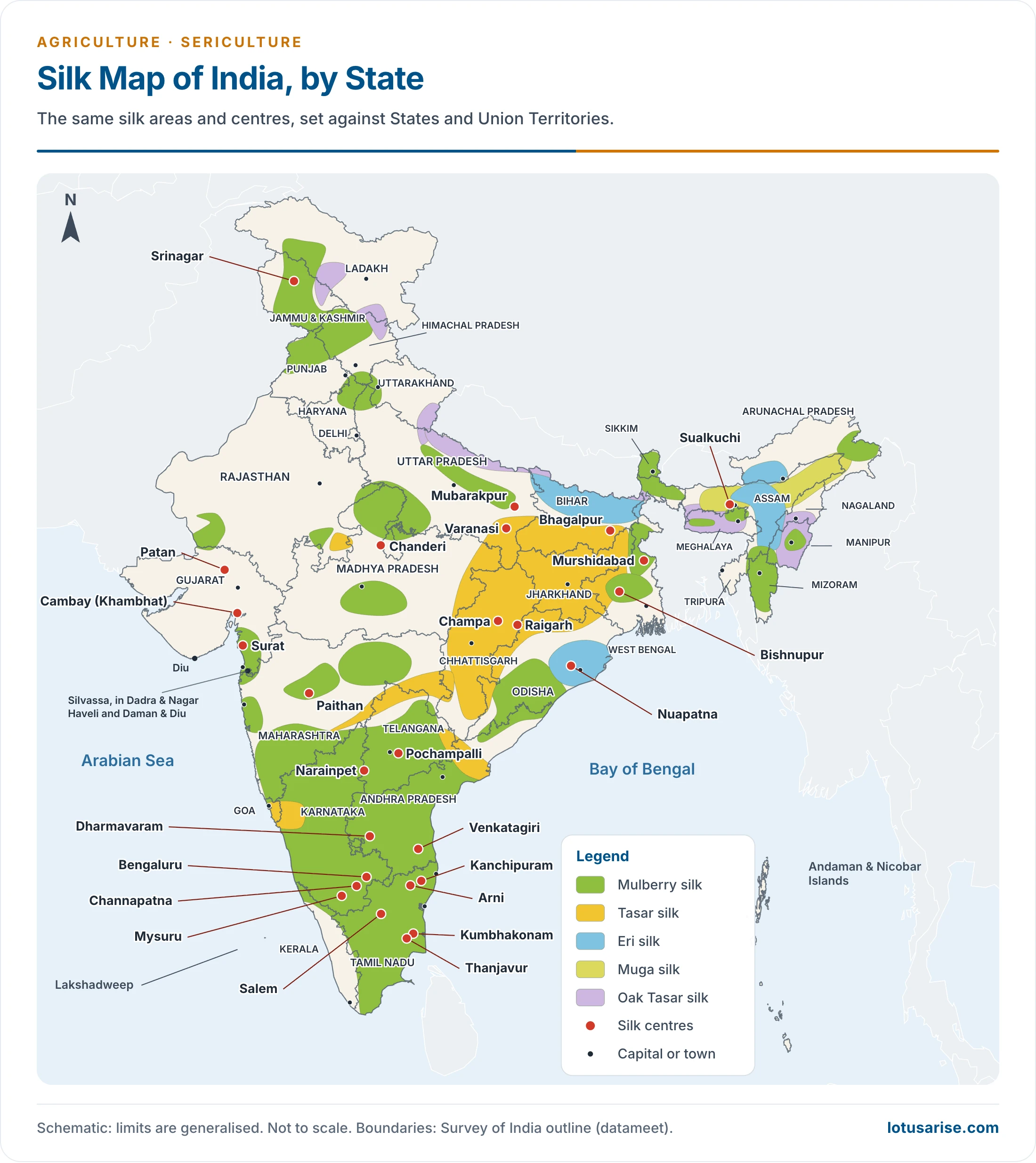
Distribution
- South India leads, and is known for weaving enclaves such as Kanchipuram, Dharmavaram and Arni.
- The major silk-producing States are Karnataka, Andhra Pradesh, Assam (with Bodoland), West Bengal, Jharkhand and Tamil Nadu.
- Mulberry has six traditional States (Karnataka, Andhra Pradesh, Telangana, Tamil Nadu, West Bengal, Jammu and Kashmir), long reckoned at 97% of mulberry area and 95% of raw silk.
- It has since spread to non-traditional areas, and limited mulberry silk now comes from about a dozen other States.
- The North East is the only region producing four varieties: Mulberry, Oak Tasar, Muga and Eri. It gives 18% of India’s silk.
| State share of production | Older | Later |
|---|---|---|
| Raw silk, all varieties | Karnataka 65%, Andhra Pradesh 17%, West Bengal 8%, Tamil Nadu 5%, Assam 2.5%, Jammu and Kashmir 1.2% | Karnataka about 32% (2023-24) |
| Mulberry silk | 2004-05: Karnataka 50%, Andhra Pradesh 34.8%, West Bengal 10.4%, Tamil Nadu 3%, Jammu and Kashmir 0.62% | About 2021: Karnataka 47%, Andhra Pradesh 35%, Tamil Nadu 8%, West Bengal 4%, Maharashtra 2% |
| Tasar | 2004-05: Chhattisgarh 37.24%, Jharkhand 28.24%, Odisha 10.2%, West Bengal 8.1% | |
| Eri | 2004-05: Assam 38.3%, Manipur 29.8%, Meghalaya 22.6%, Nagaland 6.8% | About 2021: Assam 75%, Meghalaya 16%, Nagaland 4% |
| Muga | 2004-05: Assam 94.6% | About 2021: Assam 83%, Meghalaya 16% |
- Silk centres:
| State | Centres |
|---|---|
| Andhra Pradesh | Dharmavaram, Venkatagiri, Hindupur |
| Telangana | Pochampalli, Narainpet, Warangal |
| Assam | Sualkuchi |
| Bihar | Katihar, Bhagalpur |
| Gujarat | Surat, Cambay (Khambhat) |
| Jammu and Kashmir | Srinagar |
| Karnataka | Bengaluru, Mysuru, Molakalmuru, Ilkal, Kollegal |
| Chhattisgarh | Champa, Raigarh |
| Madhya Pradesh | Chanderi |
| Tamil Nadu | Kanchipuram, Arni, Salem, Kumbhakonam, Thanjavur |
| Uttar Pradesh | Varanasi |
| West Bengal | Bishnupur, Murshidabad, Malda |
History
- China is taken as the home of sericulture, where silk production from B. mori is traditionally dated to about 2700 BC, though archaeological records point to still earlier silk use.
- In India, cultivation is traditionally dated to 140 AD.
- Silk fibres from Harappa and Chanhu-daro, dated to about 2450–2000 BC, came from wild moths native to South Asia. Irene Good, Jonathan Mark Kenoyer and Richard Meadow reported them in 2009 as the earliest silk known outside China. The later date therefore holds for rearing, and wild silk was in use long before.
- The craft later reached other Asian countries, the Mediterranean and Europe, and became a major cottage industry in China, Japan, India, Korea, Brazil, Russia, Italy and France.
Stages of Production
- The silk moth lays eggs, and the caterpillars that hatch are fed mulberry leaves.
- At about 25 days, a silkworm is 10,000 times heavier than at hatching and is ready to spin.
- Silk is secreted as a liquid by a pair of silk glands (modified salivary glands) and leaves through the spinneret on the head, hardening in air.
- In about two or three days, the worm spins approximately 1 mile of filament and encloses itself in a cocoon.
- Little of it is of usable quality, so about 5,500 silkworms are needed for 1 kg of silk.
- Cocoons meant for reeling are stifled, the pupa being killed by heat before the moth can break out, and cooked in hot water to soften the gum, sericin.
- Undamaged cocoons are brushed to find the outer end of the filament, and the filaments are wound on a reel. One cocoon gives approximately 1,000 yards of reelable filament, and the product at this stage is raw silk.
- One thread may hold up to 48 filaments.
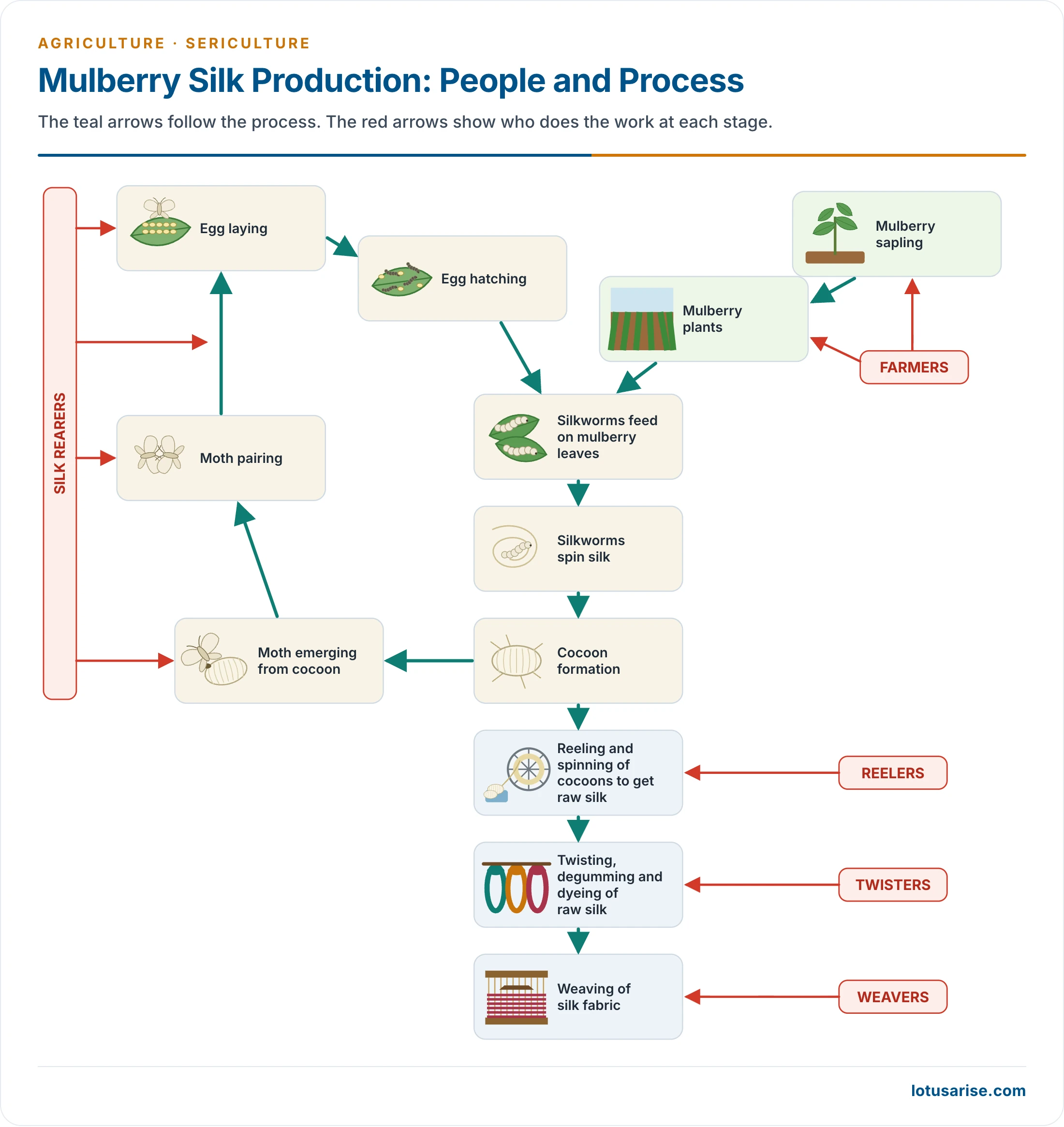
- People in the chain: farmers, silk rearers, seed producers, reelers, twisters, spinners of silk waste, weavers and traders.
Production and Policy
Production
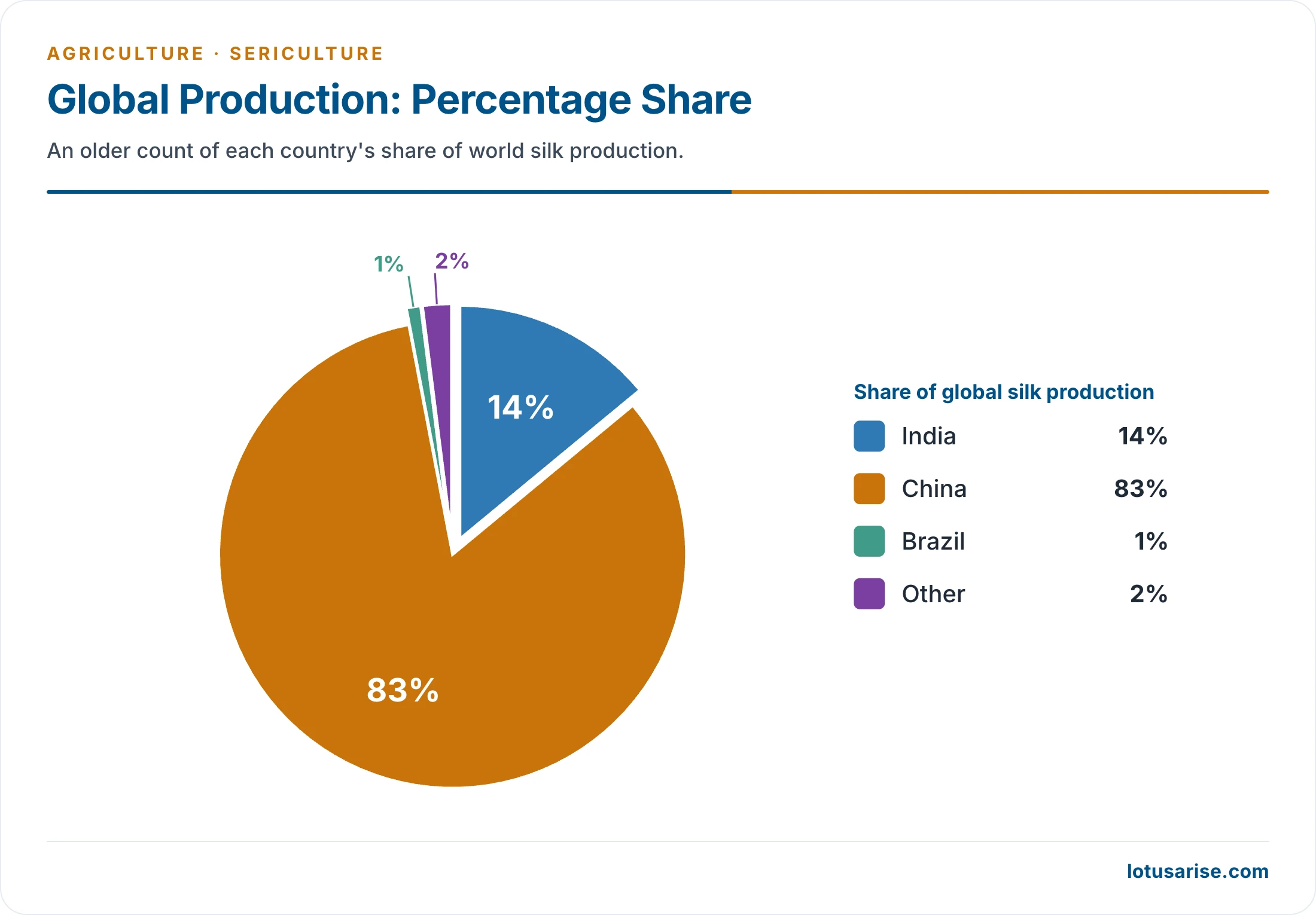
- India is the second largest producer of silk, after China. Its share of world output rose from about 13% (2004-05) and 17% (about 2012-13) to about 41% of some 94,000 tonnes in 2023, when China held about 53%.
- Output has grown from 1,214 tonnes in 1950 to 16,500 tonnes in 2004-05 and 38,913 tonnes in 2023-24.
- 2024-25 set a record of 41,121 tonnes, with mulberry at 31,119 tonnes and Eri at 7,886 tonnes.
| Variety | Older share | 2023-24 (tonnes) | Share |
|---|---|---|---|
| Mulberry | 91.7% | 29,892 | 76.8% |
| Eri | 6.4% | 7,183 | 18.5% |
| Tasar | 1.4% | 1,586 | 4.1% |
| Muga | 0.5% | 252 | 0.6% |
| Total | 38,913 |
- Mulberry dominates, and Eri leads the Vanya silks.
- Area: mulberry covered 2,23,926 hectares in 2017-18 and 2,63,352 hectares in 2023-24.
- Employment:
- About 55 lakh people were reckoned to work in the industry, and later counts ran to about 72.5 to 75.6 lakh.
- One hectare of mulberry generates about 12 man-years of work, in leaf cultivation, rearing, egg production, reeling and weaving.
- Many workers are from Scheduled Castes, Scheduled Tribes and weaker sections, and women take a large part.
- Exports of silk goods rose from Rs 1,649.48 crore in 2017-18 to Rs 2,027.56 crore in 2023-24. The USA, UK, Russia, Saudi Arabia, Kuwait and Singapore have been major buyers.
- Bivoltine silk of superior quality is in growing demand at home and for value-added exports.
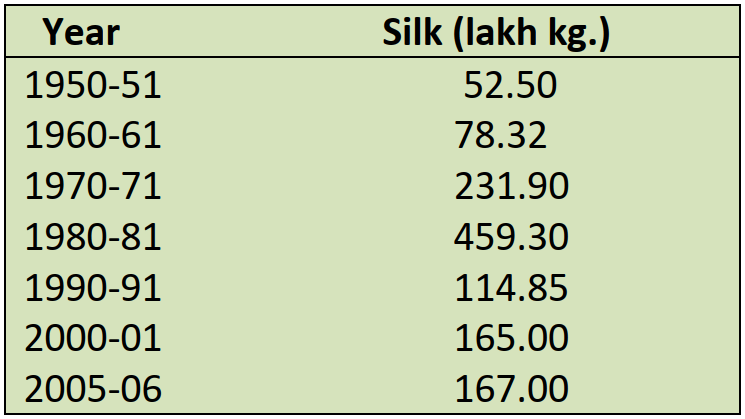
- The lakh-kg figures in this table do not form one series. Official counts give 1,214 tonnes (12.14 lakh kg) in 1950 and 12,560 tonnes in 1990-91, of which 11,486 tonnes was mulberry.
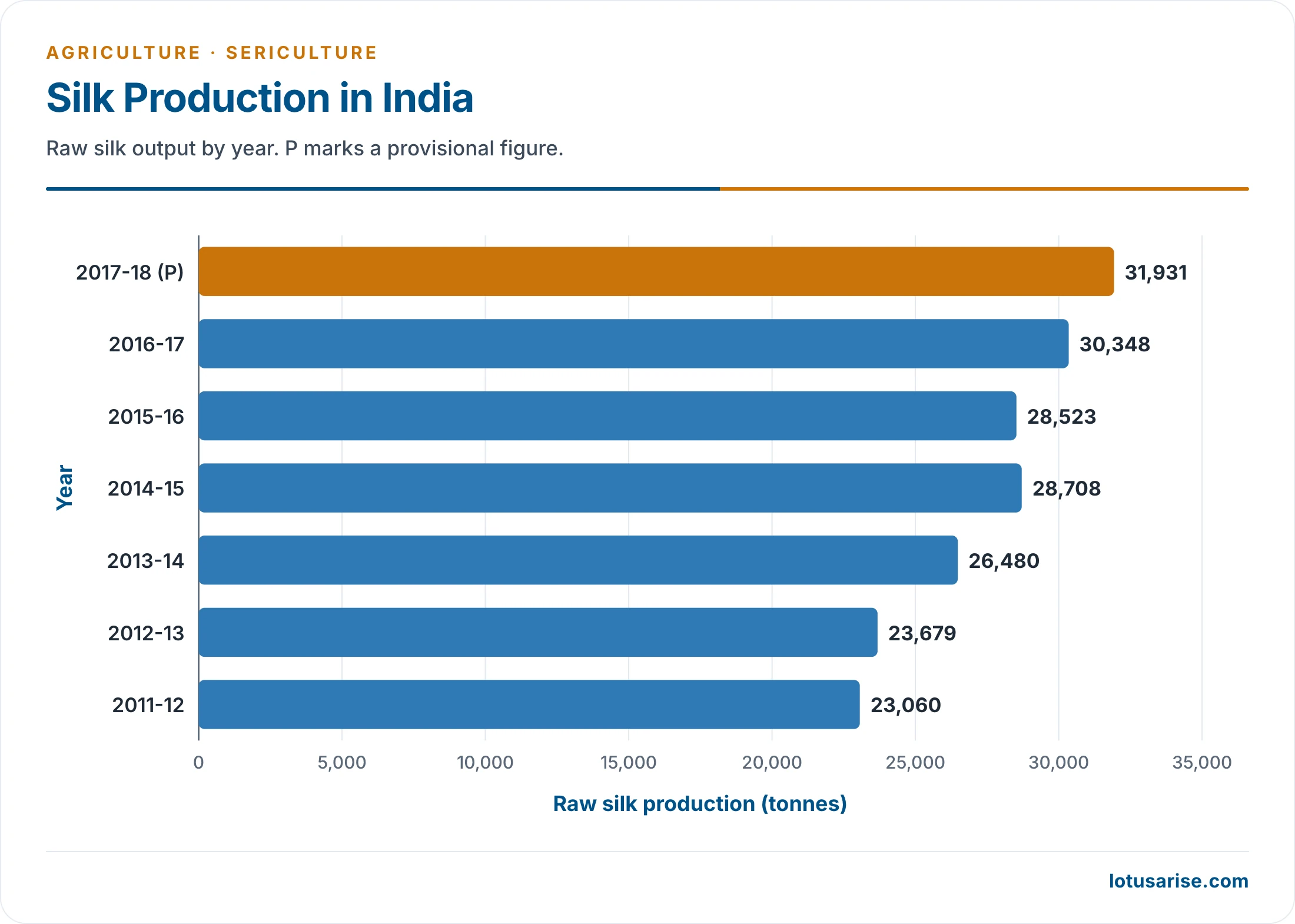
- The chart’s 2017-18 bar is provisional; the final figure is 31,906 tonnes.
Central Silk Board
- The Central Silk Board (CSB) is a statutory body set up under the Central Silk Board Act, 1948, working under the Union Ministry of Textiles.
- It is the national organisation for overall development of the silk sector, from food plants through cocoons to yarn, and also shapes policy on silk imports and exports.
- It is chiefly an R&D organisation, which undertakes, assists and encourages scientific, technological and economic research on silk.
Opportunities
- Employment and poverty alleviation: a cottage industry and one of the most profitable rural activities, with low-cost indigenous technology and regular, quick returns.
- Demand: hand-woven silks sell well in the West, silk is worn on festive occasions at home, and a large production gap remains in domestic supply.
- Scope for large production units, the organised sector and better use of by-products.
- Limits: competition from Italy and Japan, and cheaper, easy-care synthetic fibres, have set the industry back in some markets.
Government Steps
- Integrated Scheme for the Development of Silk Industry, known as Silk Samagra:
- Covers feed, seed, breed, post-cocoon technology and capacity building across the States.
- Components:
- Research and development, training, transfer of technology and IT initiatives.
- Seed organisation.
- Coordination and market development.
- Quality certification, brand promotion and technology upgradation.
- Silk Samagra-2 runs from 2021-22 to 2025-26, with an outlay of about Rs 4,679.85 crore.
- Cold storage and bivoltine grainages have been strengthened to give quality seed.
- Seed law: the Central Silk Board (Amendment) Act, 2006 brought silkworm seed under regulation, to raise standards, productivity and quality.
- Technology: the Board has developed technology packages, improved farm machinery, indigenous automatic reeling units, and Vanya reeling and spinning units that cut drudgery.
- Forests: a measure under the Forest (Conservation) Act, 1980 treats non-mulberry sericulture as a forest-based activity, so farmers can rear Vanya worms on natural host trees.
- Training: the Board’s central sericultural training institute supports the cocoon sector and weavers.




awesome content
THANKU SOO MUCH,, AMAZING CONTENT