

- India has been placed 5th in the world for installed hydroelectric power capacity since about 2020.
| Date | Large hydro (MW) | Share of national capacity | Small hydro (MW) | Share |
|---|---|---|---|---|
| 31 March 2020 | 46,000 | 12.3% | 4,683 | 1.3% |
| 30 September 2026 | 52,064.66 | About 9.3% | 5,181.76 | About 0.9% |
- The share falls because solar and coal capacity have grown faster; hydro capacity itself keeps rising.
Plants: History and Size
Early Power and Plant Facts
- Power development in India dates from the end of the 19th century.
- 1897: electricity reached Darjeeling, from the Sidrapong station, India’s first.
- 1902: the Sivasamudram (Shivanasamudra) station in Karnataka was commissioned, the first on a large scale.
- Later, plants were set up in the Western Ghats to meet the growing demand of Mumbai, and in the 1930s stations were commissioned in Himachal Pradesh, Uttar Pradesh, Tamil Nadu and Karnataka.
- Koyna (1,960 MW) has long been called India’s largest completed plant.
- The Tehri complex now totals 2,400 MW, since its 1,000 MW pumped storage plant was fully commissioned on 12 April 2026.
- Tehri is India’s highest hydroelectric project: its dam, at 260.5 m, is the country’s tallest.
- Srisailam (1,670 MW), on the Krishna, ranks second or third among working plants, depending on how they are counted.
- Nathpa Jhakri (1,500 MW), on the Satluj, is among the largest underground plants.
- Sardar Sarovar is often called the world’s second-largest concrete dam by volume.
- Subansiri Lower, on the Arunachal Pradesh–Assam border, is planned at 2,000 MW. Its fifth 250 MW unit entered commercial operation on 23 October 2026, making 1,250 MW, and the rest are due by December 2026.
- Growth of capacity: 508 MW at independence in 1947, about 600 MW in 1950–51, about 40,500 MW in 2013–14, and over 52,000 MW in 2026.
- Several multipurpose projects were undertaken during the Five Year Plans, and the National Hydroelectric Power Corporation (NHPC) dates from 1975.
Size Classes and Small Hydro
- Hydro projects are divided by size into large and small; countries set the upper limit for “small” anywhere from 10 MW to 50 MW.
- In India, plants of 25 MW or below count as small hydro:
| Class | Capacity |
|---|---|
| Micro | 100 kW or below |
| Mini | 101 kW to 2 MW |
| Small | 2 MW to 25 MW |
- Administration: the Ministry of Power, through the State Electricity Boards, until 1989, when plants of up to 3 MW moved to what is now the Ministry of New and Renewable Energy (MNRE). The limit rose to 25 MW in November 1999.
- Promotion: MNRE’s Small Hydro Power Development Scheme of 2026 has ₹2,584.60 crore for 2026–27 to 2030–31, aimed at about 1,500 MW.
- Potential: 21,135.37 MW from 7,135 sites, as assessed by IIT Roorkee’s Alternate Hydro Energy Centre in its small hydro database of July 2016.
- Arunachal Pradesh, Himachal Pradesh, Jammu and Kashmir and Uttarakhand hold about half.
- Maharashtra, Chhattisgarh, Karnataka and Keralam (Kerala) follow.
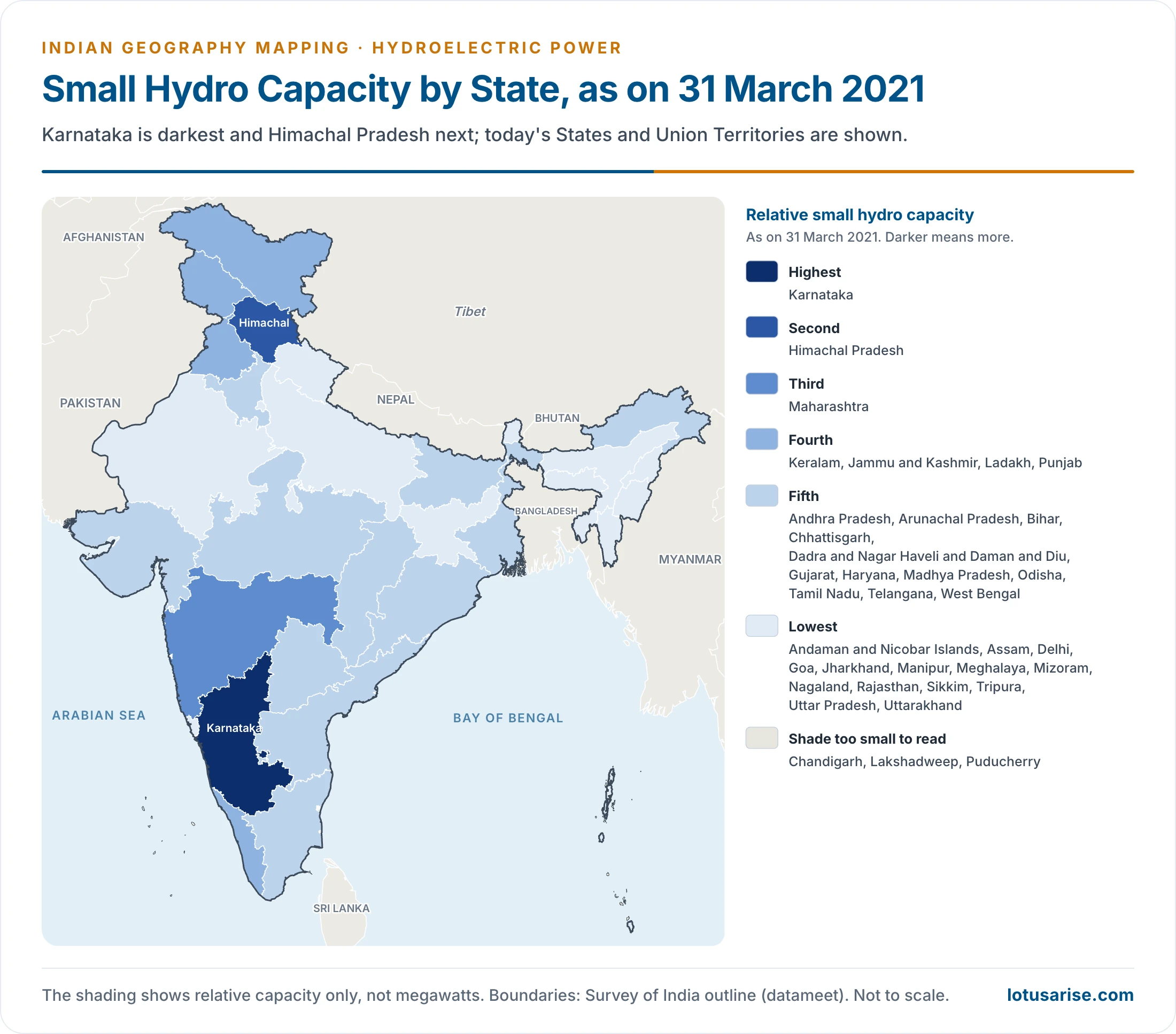
- As on 31 March 2021, Karnataka had the most installed small hydro (about 1,281 MW), followed by Himachal Pradesh (about 936 MW) and Maharashtra (about 380 MW).
List of Hydroelectric Power Plants in India
- Location factors: the Himalayan rivers are snow-fed and steep, and they hold about four-fifths of the potential.
- Peninsular rivers depend on rain alone, so they need storage, but the Western Ghats and Nilgiris offer high drops far from the coalfields.
Himalaya and the North-West
| State or UT | River | Plant | MW |
|---|---|---|---|
| Himachal Pradesh | Baira | Baira-Siul | 180 |
| Himachal Pradesh | Satluj (Sutlej) | Bhakra Nangal | 1,379 at Bhakra |
| Himachal Pradesh | Beas | Dehar | 990 |
| Himachal Pradesh | Satluj | Nathpa Jhakri | 1,500 |
| Himachal Pradesh | Baspa | Baspa-II | 300 |
| Himachal Pradesh | Beas | Pandoh Dam | Feeds Dehar |
| Himachal Pradesh | Ravi | Chamera-I, Chamera-II | 1,071 with Chamera-III |
| Himachal Pradesh | Beas | Pong | 396 |
| Jammu and Kashmir | Chenab | Salal | 690 |
| Jammu and Kashmir | Jhelum | Uri | 480 |
| Jammu and Kashmir | Chenab | Dulhasti | 390 |
| Uttarakhand | Bhagirathi | Tehri | 1,000, plus 1,000 pumped storage |
Central and Eastern India
| State or UT | River | Plant | MW |
|---|---|---|---|
| Uttar Pradesh, with the reservoir reaching Madhya Pradesh | Rihand | Rihand | 300 |
| Uttar Pradesh | Rihand (Renuka) | Obra | 99 |
| Madhya Pradesh | Son (Sone) | Bansagar | 425 |
| Madhya Pradesh | Narmada | Indira Sagar | 1,000 |
| Madhya Pradesh | Sindh | Madikheda Dam | 60 |
| Madhya Pradesh | Narmada | Bargi Dam | 105 |
| Jharkhand | Subarnarekha | Subarnarekha | Not listed |
| Jharkhand, on the West Bengal border | Barakar | Maithon | 63.2 |
| Odisha | Sileru | Balimela | 510 |
| Odisha | Mahanadi | Hirakud | 347.5 |
| Odisha | Indravati | Indravati Dam | 600 |
| Odisha and Andhra Pradesh | Machkund | Machkund | 120 |
Western India and the Peninsula
| State or UT | River | Plant | MW |
|---|---|---|---|
| Gujarat | Narmada | Sardar Sarovar | 1,450 |
| Gujarat | Tapi | Ukai Dam | 300 |
| Maharashtra | Koyna | Koyna | 1,960 |
| Maharashtra | Bhima | Ujjani Dam (Bhima Dam) | 12 |
| Maharashtra | Godavari | Jayakwadi Dam | 12 |
| Maharashtra | Mula | Mulshi Dam, feeding Bhira | 300 |
| Andhra Pradesh–Telangana | Krishna | Nagarjunasagar | About 816 |
| Andhra Pradesh–Telangana | Krishna | Srisailam | 1,670 |
| Karnataka | Kalinadi | Kalinadi | 1,240 |
| Karnataka | Sharavathi | Sharavathi | 1,608 |
| Karnataka | Kaveri (Cauvery) | Shivanasamudra | Not listed |
| Keralam | Periyar | Idukki | 780 |
North-East and Sikkim
| State or UT | River | Plant | MW |
|---|---|---|---|
| Manipur | Loktak Lake | Loktak (power house at Leimatak) | 105 |
| Sikkim | Rangit | Rangit | 60 |
| Sikkim | Teesta | Teesta | 510 at Teesta-V |
| Arunachal Pradesh, on the Assam border | Subansiri | Lower Subansiri | 2,000 planned; 1,250 working |
| Meghalaya | Umiam | Umiam-Umtru | 185 |
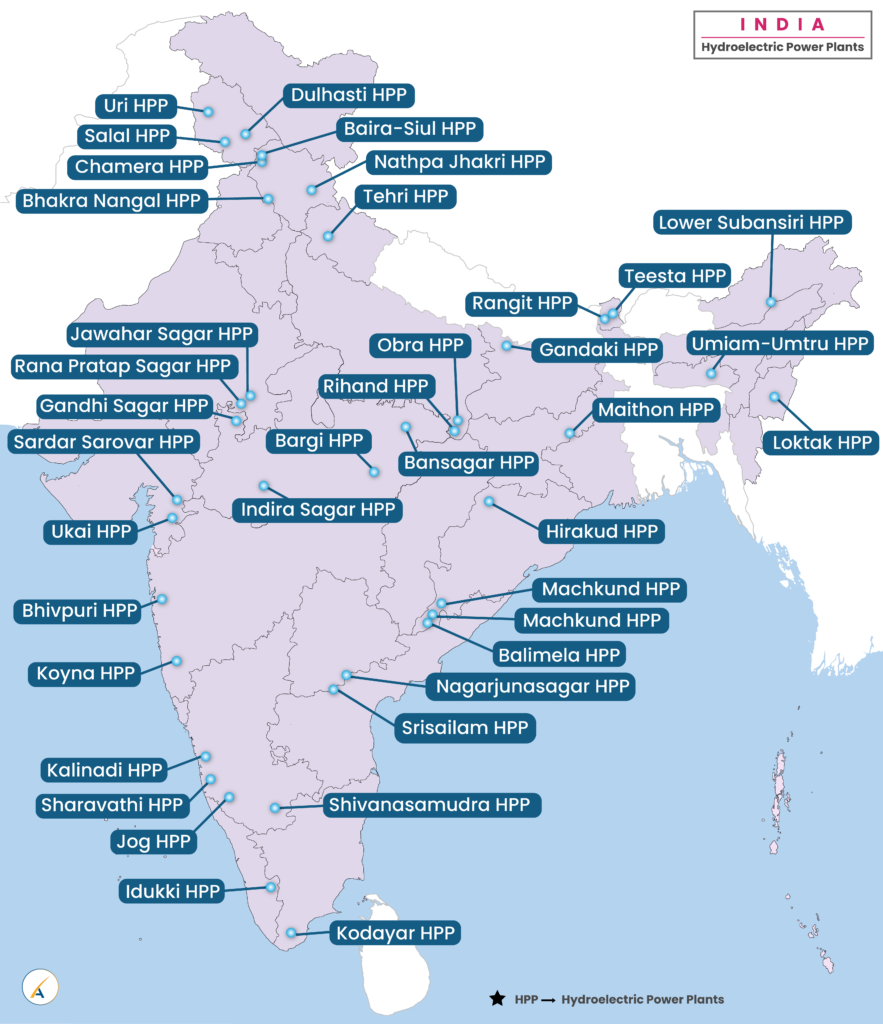
More Stations by State
- Andhra Pradesh and Telangana: Nizam Sagar, Lower Sileru and Upper Sileru.
- Karnataka: Mahatma Gandhi station at Jog Falls, Shimsha on a Kaveri tributary and Krishnaraja Sagar.
- Keralam: short, swift streams off the Western Ghats feed Sabarigiri, Sholayar, Kuttiady and Pallivasal.
- Tamil Nadu: Pykara, Mettur, Papanasam, Kodayar and Kundah, in the hill districts and joined by a grid.
- Maharashtra: the Tata hydroelectric grid near Lonavala has Khopoli, Bhivpuri and Bhira, which send power to Mumbai.
- Mulshi Lake, behind the Mulshi Dam built by the Tatas in the 1920s on the Mula in Pune district, stores monsoon water that drops west down the Ghats to the Bhira station in Raigad district.
- Punjab and Himachal Pradesh: Ganguwal and Kotla on the Bhakra system; Joginder Nagar in the Mandi project.
- Uttar Pradesh and Uttarakhand: the Upper Ganga Canal has 12 falls between Haridwar and Meerut, with stations such as Bahadurabad and Mohammadpur. Matatila on the Betwa adds to these.
- Jammu and Kashmir: Chenani, Sind and Lower Jhelum.
- Odisha: Rengali, beside Hirakud and Balimela.
- West Bengal and Jharkhand: Panchet and Tilaiya, under the Damodar Valley Corporation.
- North-east: Dikhu and Doyang in Nagaland, Kopili in Assam, and Ranganadi in Arunachal Pradesh.
- Dependence: hill States such as Sikkim, Meghalaya, Himachal Pradesh, Nagaland and Uttarakhand draw most of their power from hydro, since their terrain suits it and coal must be hauled in from far away.
Selected Plants
Baira Siul Power Station
- In Chamba district, Himachal Pradesh, and NHPC’s first power station (1981).
- It works on a run-of-the-river basis, using the combined flow of three Ravi tributaries: Baira, Siul and Bhaledh.
- Installed capacity: 180 MW (3 × 60 MW); project headquarters at Surangani.
Machkund Hydro Electric Power Plant
- At Machkund Dam in Koraput district, Odisha.
- First unit commissioned in 1959; 120 MW in all, shared with Andhra Pradesh.
- Its storage is the Jalaput Dam on the Machkund, a tributary of the Godavari.
Balimela Hydro Electric Power Plant
- On the Sileru, a tributary of the Godavari, at Balimela town in Malkangiri district of Odisha.
- The dam lies 35 km east of Malkangiri.
- It is a joint project of Odisha and Andhra Pradesh, and inflow to the reservoir is shared 50:50.
Rangit Hydroelectric Power Plant
- A run-of-the-river project of 60 MW (3 × 20 MW) in Sikkim, on the Rangit, a tributary of the Teesta.
Obra Hydroelectric Power Plant
- At Obra village in Sonbhadra district, Uttar Pradesh, using water of the Rihand (Renuka).
- Obra Dam stands upstream of the point where the Rihand joins the Son.
- Owned by the State and run by Uttar Pradesh Jal Vidyut Nigam Limited.
Previous Year Questions
2018Map item: Mulshi Lake





Obra dam mapping is wrong. It’s in sonebhadra, uttar pradesh.
Yes
Kirru hydroelectric power is not available which is in chenab river