Relations with Bhutan
- At the beginning of the Company’s rule, the relationship between India and Bhutan was hostile. There were frequent attacks by the Bhutanese in the Duars plains of British territory.
- Warren Hastings signed an Anglo-Bhutanese Treaty on April 25, 1774, to end the hostilities and establish friendly relations with Bhutan. This treaty permitted EIC to trade with Tibet through Bhutan’s territory.
- The Treaty of Yandabo (1826) handed over Assam to the British, bringing them into close contact with Bhutan.
- The Bhutanese took advantage of political instability in Northeast India after the Anglo-Burmese War (1824-26). They committed various acts of aggression, leading to encroachments and adding to their possessions of the Dooars. This led to an estranged relationship between the British India and Bhutan.
- The intermittent raids by the Bhutiyas on the Bengal side of the border further strained relations between India and Bhutan.
The EIC’s engagement with Bhutan started in 1772 after the Bhutanese invaded Cooch Behar (a city in West Bengal), which was a dependency of the EIC.
Duar War and Treaty of Sinchula (Ten Article Treaty of Rawa Pani) (1865)
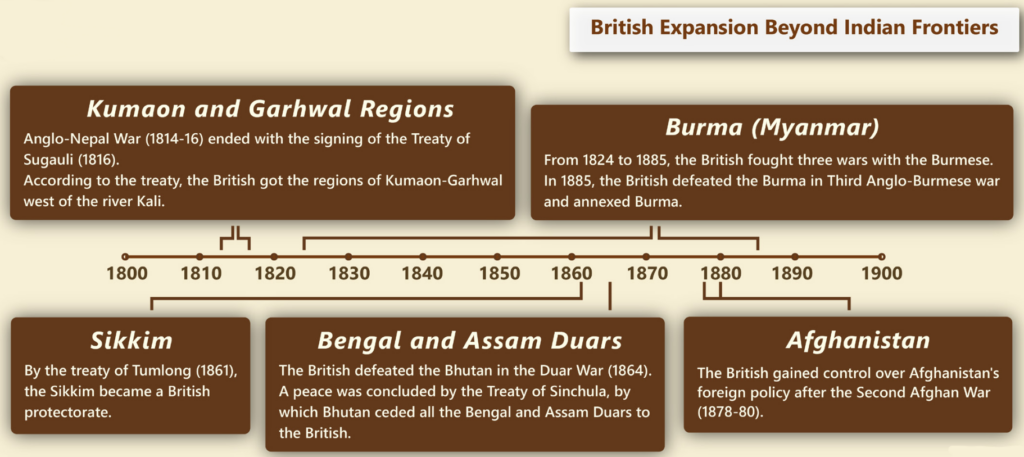
- In 1863, a brief war broke out between the British and Bhutan. In 1864, the British launched the Duar War. Bhutan was defeated, and peace was concluded by the Treaty of Sinchula, signed in 1865, by which:
- Bhutan ceded all the Bengal and Assam Duars
- The British agreed to pay Bhutan an annual payment of Rs.50,000.
The relations of the Bhutan with Great Britain started growing to the extent that the Bhutanese king accompanied Col. Younghusband to visit Lhasa (Tibet) to sign a convention in 1904 through which Tibet agreed to end its special ties with Bhutan in favour of the Britishers.
Treaty of Punakha (Treaty of Friendship) (1910)
- A fresh treaty, the Treaty of Punakha, was concluded in 1910, by which:
- Bhutan surrendered her foreign relations to British India and accepted the latter as arbiter in her disputes with Cooch Behar and Sikkim.
- Britain increased the annual subsidy to Bhutan to Rs.100,000 and assured that they would not interfere in Bhutan’s internal affairs.
- After India’s independence, a new treaty was signed in 1949, and the government of India further increased the allotted payment to Bhutan to Rs 500,000 a year.
Relations with Sikkim
- By the end of the 18th century, the Gorkhas took control of Sikkim. However, after the Anglo-Nepal War (1814-16), the British restored Sikkim’s independence.
- The Treaty of Sugauli (1816) (between the British and Nepal): The British annexed the territories of the Sikkim captured by Nepal.
- The Treaty of Titalia (1817) (between the British and Sikkim): The British restored the territory of Sikkim to the Kingdom of Sikkim, ruled by Chogyal monarchs.
- The Treaty of Titalia was signed between the Chogyal (monarch) of the Kingdom of Sikkim and the British EIC.
- It returned Sikkimese land annexed by the Nepalese over the centuries and guaranteed the security of Sikkim by the British.
- The British had their vested interests in befriending Sikkim, including:
- To open a direct trade route through Sikkim to Tibet as an alternative to the route through Nepal.
- To counter increasing Russian intrusion into Tibet.
- The Anglo-Sikkimese ties began to deteriorate in 1835 when Sikkim had to give Darjeeling to the
British in return for an annual subsidy of Rs.3000. - Relations between Sikkim and the British soured further in 1849 when a minor quarrel led Dalhousie to send troops into Sikkim. This resulted in the British annexation of Darjeeling and a major portion of the Sikkimese Morang (terai) territory. Another clash occurred in 1860.
- In 1861, the Treaty of Tumlong reduced Sikkim to the status of a virtual protectorate.
- 1886, fresh trouble arose when the Tibetans tried to bring Sikkim under their control. The Government of India carried out military operations against the Tibetans in Sikkim in 1888. The final settlement came in 1890 with the signing of an Anglo-Chinese agreement.
Anglo-Chinese Agreement or Convention of Calcutta (1890)
- Anglo-Chinese Agreement was a treaty between Britain and China relating to Tibet and the Kingdom of Sikkim. The Viceroy of India, Lord Lansdowne, and the Chinese Amban in Tibet, Sheng Tai, signed the treaty on 17 March 1890 in Calcutta, India.
- The treaty recognised that Sikkim was a British protectorate over whose internal administration and foreign relations the Government of India had the right to exorcise exclusive control. It also demarcated the Sikkim–Tibet border.
- British protected states represented a more loose form of British suzerainty, where the local rulers retained control over the states’ internal affairs, and the British exercised control over defence and foreign affairs.
- China is said to have negotiated the treaty without consulting Tibet, and the Tibetans refused to recognise it.
Sikkim’s merger
- In 1950, Sikkim became a protectorate of India through a treaty signed between the then-Sikkim monarch, Tashi Namgyal, and the Indian government. This meant that while Sikkim was not part of India, it was also not a fully sovereign country.
- The Indian government managed Sikkim’s defence and foreign relations, while the Chogyal, as the monarchy, controlled the internal administration.
- From the 1950s to the 1970s, the discontent against the monarchy in Sikkim grew because of growing inequality and feudal control.
- Thousands of protesters surrounded the royal palace during the 1973 anti-monarchy protests. Finally, in the same year, a tripartite agreement was signed between the Chogyal, the Indian government, and three major political parties to introduce major political reforms.
- In 1974, elections were held, and the Sikkim State Congress, which advocated greater integration with India, won.
- The assembly first sought the status of ‘associate state’ and then, in April 1975, passed a resolution asking for full integration with India. This was followed by a referendum that put a stamp of popular approval on the assembly’s request.
- The Indian Parliament immediately accepted this request, and Sikkim became the 22nd State of the Indian Union in 1975.
Relations with Tibet
Nominal Suzerainty of the Chinese Empire
- Tibet is located to the north of India and is separated from India by the Himalayan mountain range.
- Tibet was ruled by a Buddhist religious aristocracy (the lamas). The chief political authority was exercised by the Dalai Lama, who claimed to be the living incarnation of the power of the Buddha.
- The lamas wanted to isolate Tibet from the rest of the world. They acknowledged the nominal suzerainty of the Chinese Empire to repel foreign threats.
- With no threat from Tibet and China being militarily weak, the British interest in Tibet was purely commercial in the beginning.
- Warren Hastings showed keen commercial interest in the region and sent two missions, one in 1774 and another in 1783. However, the isolationist and suspicious Dalai Lama (the ruler) declined the offer to establish trade relations with the British EIC.
British interest in Tibet
- Both Britain and Russia were keen to promote relations with Tibet. British policy towards Tibet was governed by economic and political considerations.
- Economically, the British wanted to develop the Indo-Tibetan trade and exploit its rich mineral resources.
- Politically, they wanted to safeguard the northern frontier of India.
- However, until the end of the 19th century, the Tibetan authorities blocked all British efforts to penetrate it.
- At the beginning of the 20th century, Russian influence in Tibet increased. The British government perceived this as threatening India’s security from the northern side.
- Under Lord Curzon, the British government decided to take immediate action to counter Russian moves and bring Tibet under its system of protected border states.
- According to some historians, the Russian danger was not real and was merely used as an excuse by Curzon to intervene in Tibet.
Expedition to Lhasa
- In March 1904, Curzon sent a military expedition to Lhasa, the Capital of Tibet, under Francis Young-husbdnd. Younghusbdnd started his march into Tibet through Sikkim. During this expedition, 700 Tibetans were killed.
- Younghusbdnd reached Lhasa in August 1904, and after prolonged negotiations, a Treaty of Lhasa was signed, by which:
- Tibet was reduced to the status of a protectorate of the British.
- Tibet was to pay Rs. 25 lakhs as indemnity
- The Chumbi Valley was to be occupied by the British for three years.
- A British trade mission was to be stationed at Gyantse (a town in Tibet).
- The British agreed not to interfere in Tibet’s internal affairs. On their part, the Tibetans agreed not to admit the representatives of any foreign power into Tibet.
- The British accomplished little during the Tibetan expedition. Although it led to Russia’s withdrawal from Tibet, it confirmed China’s suzerainty in 1906.
Anglo-Chinese Convention (1906)
- Anglo-Chinese Convention was a treaty signed between the Qing Dynasty of China and the British Empire in 1906.
- This treaty, which was signed in the absence of Tibet, reaffirmed the Chinese suzerainty over Tibet. By the terms of the treaty:
- The British agreed not to annex or interfere in Tibet in return for indemnity from the Chinese
government. - China agreed not to permit any other foreign state to interfere with Tibet’s territory or internal administration.
- The British agreed not to annex or interfere in Tibet in return for indemnity from the Chinese
Shimla Conference 1913
- After the Chinese Revolution of 1911, the. Dalai Lama announced his independence.
- Instead of recognising Tibet as an independent state, the British invited representatives of China and Tibet to a tripartite conference in Shimla in May 1913. At the conference:
- The Tibetans sought to acknowledge their independence, repudiate the Anglo-Chinese Convention of 1906, and the revision of the trade regulations.
- The Chinese Government wanted that their sovereignty over Tibet should be recognised and their right to control foreign and military affairs of the country should be accepted.
- The British were more interested in the Indo-Tibetan border than Tibet’s internal problems.
- On 27 April 1914, two agreements were concluded.
- Tibet was divided into two zones, ‘Outer Tibet’ and ‘Inner Tibet’. Chinese suzerainty over the whole of Tibet was recognised.
- Outer Tibet would remain in the hands of the Tibetan Government at Lhasa under Chinese suzerainty, but China would not interfere in its administration.
- Inner Tibet would be under the jurisdiction of the Chinese government.
- It was decided to draw a boundary between Tibet and British India (McMahon line).
- Tibet was divided into two zones, ‘Outer Tibet’ and ‘Inner Tibet’. Chinese suzerainty over the whole of Tibet was recognised.
- However, China refused to ratify the conference’s agreement (including the demarcated border) and did not accept Tibet as an independent nation.