

Map Entries for History Optional – History Optional Mapping Book
- For many UPSC aspirants, Map Entries in History Optional Paper I can be a high-scoring area if prepared smartly.
- The challenge is that it demands accuracy, precision, and wide coverage — something not possible without a curated, reliable source. That’s why having a good map entry compilation or book is a game-changer.
Why Map Entries Matter in History Optional
- 20% Weightage in Paper I – The first question in History Optional Paper I is the Map Question (50 marks).
- Predictable Yet Vast – The list of sites changes, but patterns repeat from Ancient and Medieval history.
- Factual Scoring Opportunity – No subjective interpretation — either you know it or you don’t.
What Are “Map Entries” in UPSC for History Optional
- In UPSC History Optional Paper I, map entries are the very first question, worth 50 marks, where you’re given a blank outline map of India.
- Your task is to:
- Locate & mark historical sites – These are usually archaeological sites, ancient cities, religious monuments, ports, battlefields, inscriptions, caves, temples, etc., from Ancient and Medieval Indian History.
- Write two short notes for each site – Generally 30–40 words each, mentioning:
- Location (state/region)
- Time period or dynasty (e.g., Mauryan, Gupta, Mughal)
- Historical significance (e.g., Buddhist stupa, inscription site, capital city)
- Example: Harappan site – Rakhigarhi
Harappan site: Rakhigarhi
- Location
- Hisar District, Haryana
- Situated on the banks of the now-dry Sarasvati–Drishadvati river system
- Cultural Chronology
- Largest Indus Valley Civilization (IVC) site, spanning around 550 hectares
- Occupied from 5000 BCE to 1900 BCE
- Contains cultural layers from Early to Mature Harappan phases
- 9th phase of excavation currently ongoing
- Urban Planning and Architecture
- Well-planned township following grid layout
- Mud-brick and burnt-brick houses
- Proper drainage system and sanitation
- Houses with courtyards, bathing areas, and wells
- Material Culture and Artifacts
- Pottery: Red ware including dish-on-stand, vase, jar, bowl, beaker, perforated jars
- Seals: Inscribed steatite seals, including a cylindrical seal with five Harappan characters
- Ritual Objects: Animal sacrificial pits, circular fire altars suggesting ritualistic practices
- Other artifacts:
- Terracotta and shell bangles
- Beads of semiprecious stones (carnelian, lapis lazuli)
- Copper tools and objects
- Blades, bone points
- Terracotta toy carts, wheels, and animal figurines
- Craft and Industry
- Specialized craft areas including a jewelry-making unit
- Evidence of production of bronze, copper, and gold jewelry
- Semi-finished beads and figurines, indicating local manufacture and trade
- Agriculture and Economy
- Cultivation of wheat, barley, peas
- Domestication of cattle and buffalo
- Indications of surplus agricultural production
- Burial and Ritual Practices
- Animal sacrifices and structured fire altars
- Burials under residential floors and in open spaces
- Genetic and Anthropological Evidence
- DNA recovered from Harappan skeletal remains
- Suggests genetic continuity from 10,000 BCE, indicating no major external migration
- Challenges the Aryan migration theory
- Significance
- One of the most crucial sites for understanding Harappan urbanism, ritual life, and genetics
- Offers insights into continuity of South Asian populations and early urbanization
History Optional Mapping Book: Best Sources for Map Entry Preparation
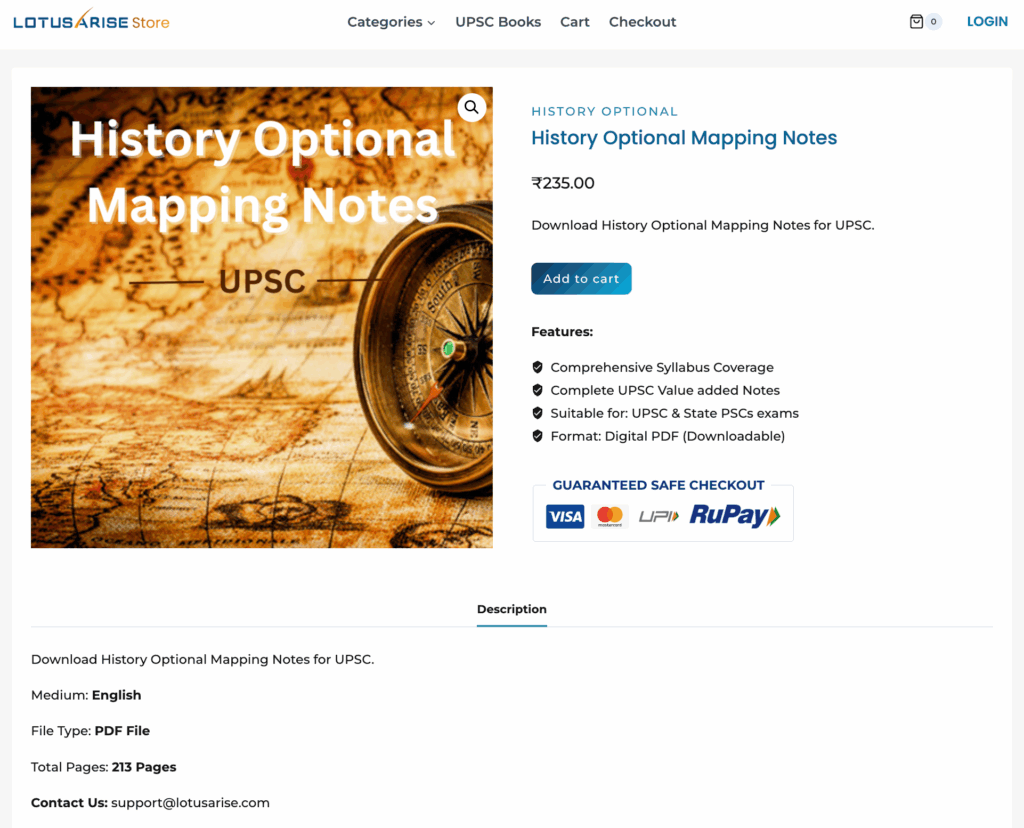
- LotusArise Map Entries for History Optional
- What you get: Updated, concise, exam-oriented notes with clear maps, chronological classification, and easy recall tricks.
- Why buy: Exhaustive list of sites, Affordable, covers all PYQ trends, easy to revise in 2–3 days.
- Availability: Instant download from LotusArise store.
- Vision IAS Map Entries PDF for History Optional
- What you get: Updated yearly with PYQs, detailed notes, and precise coordinates.
- Availability: Buy the printed version from Vision IAS bookshop or download PDF if subscribed.
- Self-Study History Map Entries
- What you get: Exhaustive list of sites categorized into Ancient, Medieval, and Post-Medieval.
- Where to get: Available in printed format from reputed coaching institutes and online sellers.
- Online Marketplaces
- Amazon & Flipkart often list Map Entry Compilations from UPSC coaching centers. Search for: “History Optional Map Entries UPSC“.
How to Use the Purchased History Optional Mapping Book
- Divide by Era – Ancient, Medieval, Modern sites separately.
- Practice with Blank Maps – Download outline maps of India and test yourself daily.
- Add PYQ Sites – Every year, UPSC repeats 40–50% of sites.
- Revision Plan – Cover maps 3–4 times before Mains.
💡 Pro Tips to Score in Map Question
- Always spell site names correctly – UPSC deducts marks for spelling errors.
- Mention location, dynasty/period, and historical significance in 2–3 lines.
- Use a blue pen for map marking — neatness counts.
- Practice from bought map compilations instead of random lists for accuracy.
Where to Buy Map Entries for History Optional
- LotusArise Store – Digital bundles available.
- Coaching Institute Book Counters – Shubhra Ranjan, Vajiram, Vision IAS.
- Amazon & Flipkart – Search “UPSC History Optional Map Entries”.
- Second-hand Market – Telegram groups, and Facebook UPSC material exchanges.
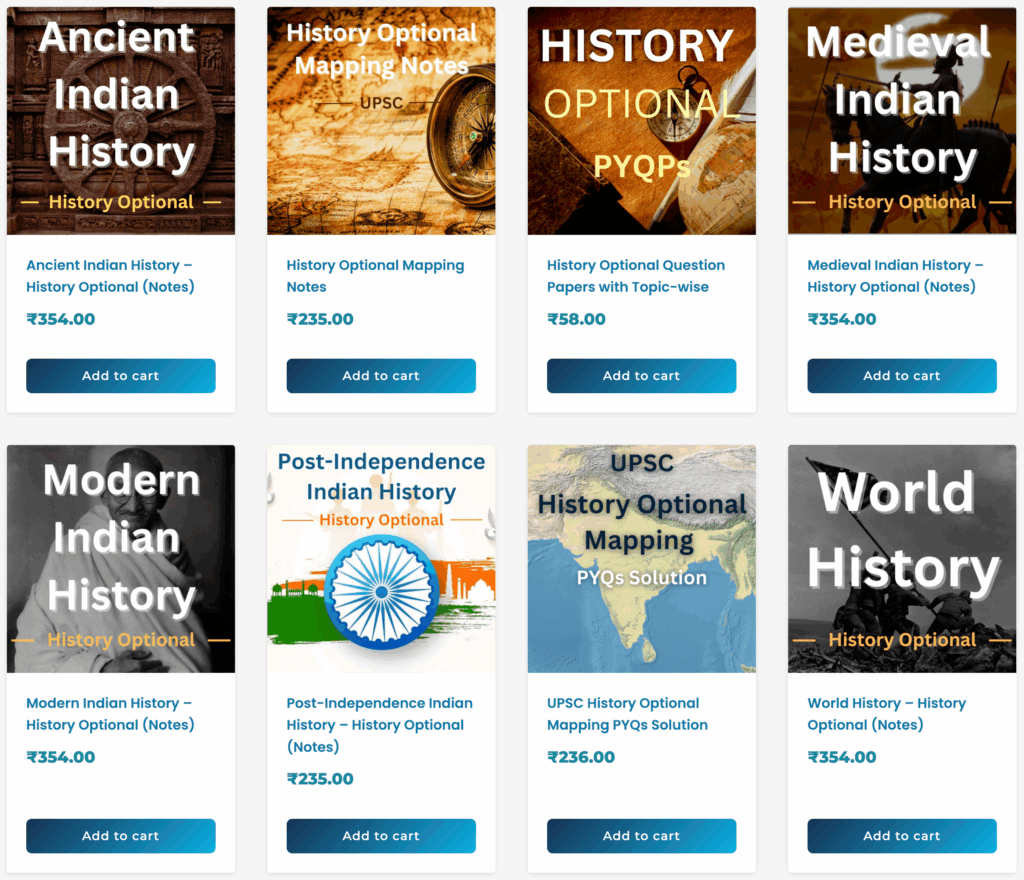
Sample: History Optional Mapping Book
✅ Bottom Line: If you want to secure at least 40+ marks in the History Optional map question, investing in a good map entry compilation is non-negotiable. It saves time, ensures coverage, and boosts your accuracy in the exam hall.