

Constitutional position; Structure, recruitment, training and capacity building; Good governance initiatives; Code of conduct and discipline; Staff associations; Political rights; Grievance redressal mechanism; Civil service neutrality; Civil service activism.
This article: Training and capacity building of civil servants: meaning, need and objectives; training versus capacity building (individual, institutional, systemic); types and methods of training; evolution from Haileybury and the British universities to the Mussoorie academy; the institutional network (LBSNAA, SVPNPA, IGNFA, SSIFS, NADT, NACIN, NAAA, AJNIFM, ISTM, State ATIs); the Common Foundation Course and Aarambh (2019); induction training of the IAS and other services, the sandwich pattern and district training; mid-career training (MCTP Phases III–V, Common MCTP); training of State services and frontline staff; the National Training Policies of 1996 and 2012; committees (Krishnamachari, First ARC, Gore, Kothari, Alagh, Yugandhar, Surinder Nath, Hota, 2nd ARC 10th Report); competency frameworks; Mission Karmayogi (CBC, Karmayogi Bharat, iGOT, FRAC, Karmayogi Competency Model, capacity building plans, APAR link, learning weeks, State-level roll-out) and its assessment; issues and critique; evaluation of training (Kirkpatrick); international comparisons (UK, France, Singapore); the theory lens.
Official Syllabus: Paper II · Unit 2-08 Civil Services
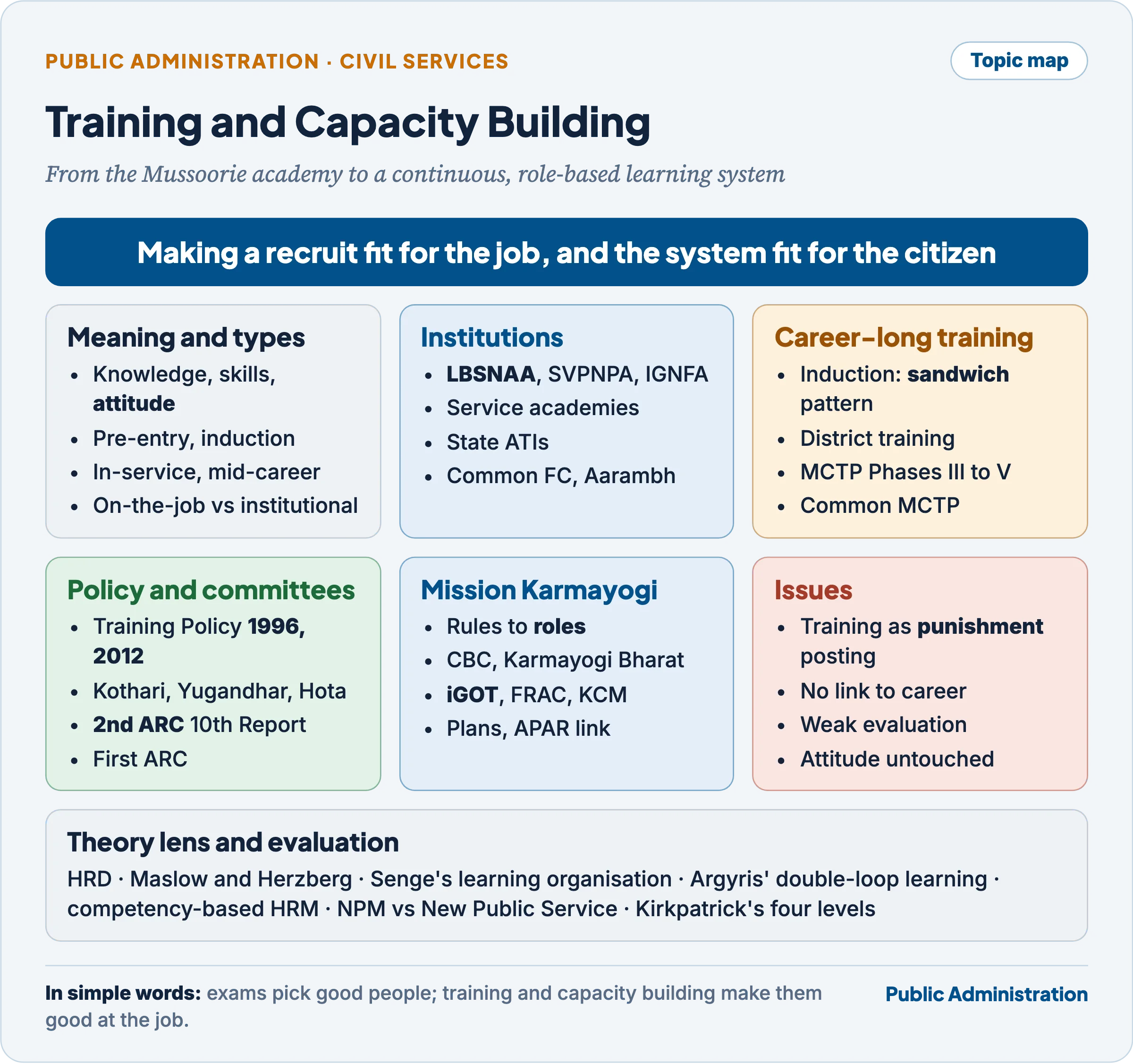
A competitive examination can find bright young graduates, but it cannot teach them how to run a district, draft a Cabinet note, handle a riot, audit a scheme or listen to an angry citizen. Training fills that gap for the individual officer; capacity building goes further and asks whether the office, the rules and the incentives around that officer let the training work.
India has one of the oldest formal training systems for higher civil servants in the developing world, built around the academy at Mussoorie and a ring of service academies. Since 2020 it has been recast by Mission Karmayogi, which aims to move the whole government workforce, from the peon’s successor to the Secretary, from rule-based to role-based learning. The central question of this topic is whether training in India has become a genuine engine of performance, or remains a ritual that officers attend and forget.
In simple words
A cricket team does not stop at picking good players. It runs net sessions, coaches each player for his position, studies video of past games and changes its tactics as the game changes. Recruitment is the selection; training is the net practice; capacity building is the whole system of coaches, the ground, the equipment and the selectors who reward improvement.
1. Training of Civil Servants: Meaning, Need and Objectives
In simple words
Even the best recruit arrives with gaps. Training is the planned way of closing those gaps quickly, instead of leaving the officer to learn by trial and error at the citizen’s cost.
1.1 Meaning of training
- Training is a planned, deliberate process of giving employees the knowledge, skills and attitudes they need to perform their present job well and to prepare for future jobs.
- It is the act of making a person fit to perform defined tasks.
- In the public service it covers not only skills but values: impartiality, integrity, empathy and respect for the citizen.
- Training, education and development are related but distinct.
- Education builds general understanding and the capacity to think (a degree in economics).
- Training is job-related and short-term (a course on public procurement rules).
- Development is career-long growth of the person for higher responsibility (a mid-career programme on policy design).
- Human resource development (HRD) joins all three into a continuing process. Leonard Nadler, the American adult-education scholar who popularised the term around 1969–70, described HRD as organised learning experiences within a given time to improve job performance and growth. See the article on Personnel Administration: HRD, Recruitment, Training, Career, Classification, Promotion and Pay.
1.2 Why civil servants need training
- No recruit is complete. However well an officer is selected, she still has inadequacies that only practice and instruction remove; the examination tests aptitude and general knowledge, not the ability to run a tehsil.
- On-the-job learning is too slow and too costly. The old method of apprenticeship, learning by watching seniors and by trial and error, is slow, and errors in administration fall on citizens. A planned programme speeds up learning and brings recruits to a working standard in a short time. This economy is one reason formal training became central to development administration.
- Expanding and changing functions. The State moved from revenue and order to development, welfare, regulation and digital service delivery; each shift needed new knowledge (planning, project appraisal, financial management, data analytics, artificial intelligence).
- Herbert Simon’s reasons. Herbert Simon, the American Nobel-winning theorist of decision-making, argued that training is especially urgent in developing countries because of the need for administrative innovation, the rapid multiplication of government tasks and the acute shortage of skilled personnel.
- Attitudinal change. A colonial-era culture of hierarchy, secrecy and distance from the citizen has to be replaced by responsiveness; only sustained training, together with incentives, can attempt this.
- Integration of a diverse service. Officers come from every region, language, class and caste; common training builds a shared national outlook and an esprit de corps across services.
1.3 Objectives and concerns of civil service training
- Objectives:
- keep professional knowledge and skills up to date, for better performance of both the individual and the organisation;
- build understanding of and sensitivity to the professional, socio-economic and political environment in which officers work;
- bring about the right attitudinal orientation: service, impartiality, integrity;
- prepare a second line of officers for higher posts;
- broaden vision and correct the narrow outlook that comes from working in one department.
- Core concerns that training must address:
- Responsiveness to the changing democratic needs of citizens and to organisational and technological change;
- Awareness of technological, social, political and economic developments;
- Scientific temper in place of rule-of-thumb and superstition;
- Accountability: high performance in every professional field and cost-effective delivery.
1.4 Training versus capacity building
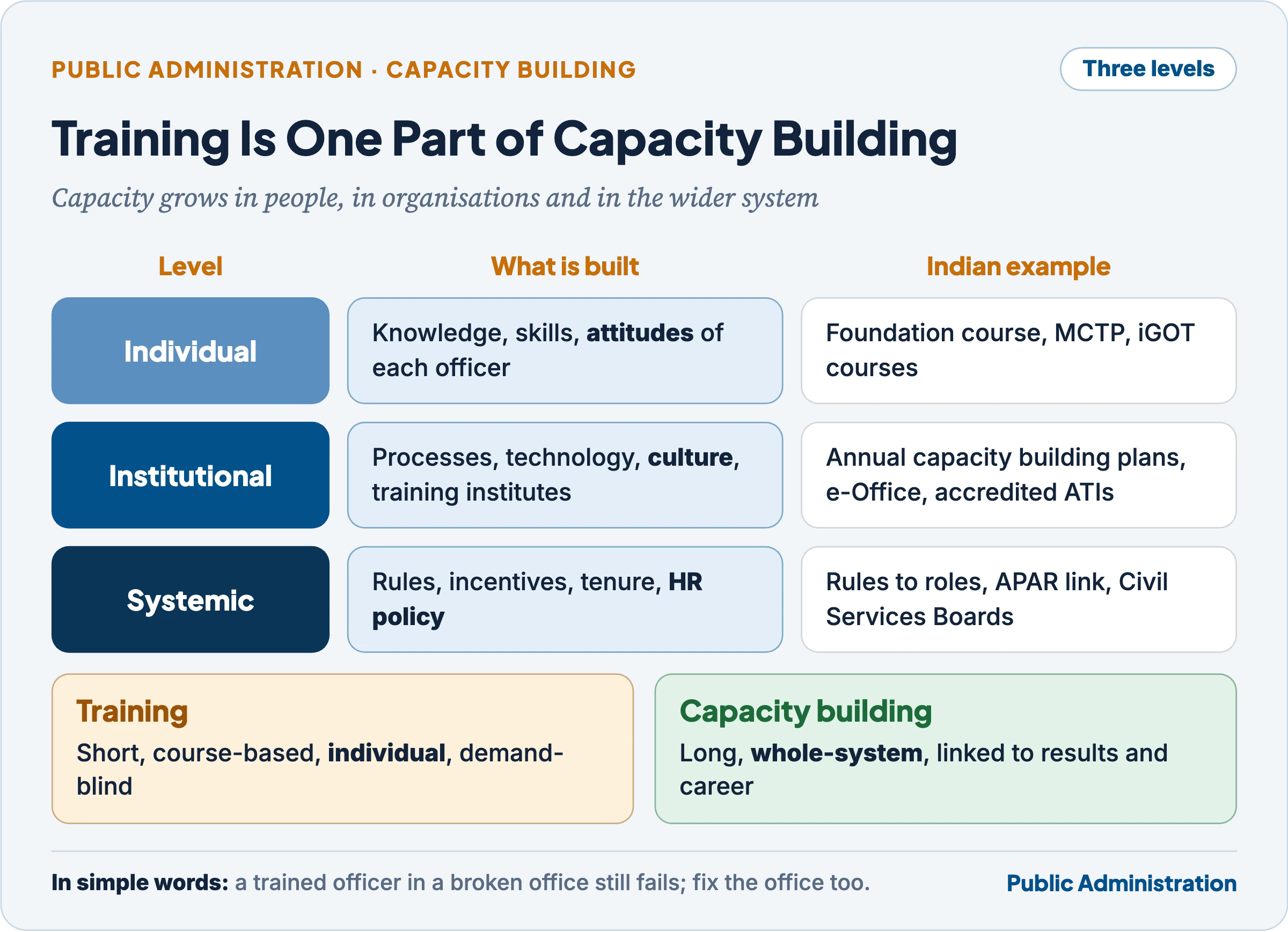
Training and capacity building are often used as synonyms, but they differ in scope, level, time horizon and objective. Capacity building (the international literature now prefers capacity development) asks not “has the officer attended a course?” but “can the organisation and the system deliver results?“
- Three levels of capacity. The UNDP’s capacity-development framework distinguishes the individual, the organisational and the enabling-environment levels; in Indian usage these are the individual, institutional and systemic levels.
- Individual: knowledge, skills, attitudes and competencies of each officer.
- Institutional: processes, technology, structures, culture, leadership and training institutes of an organisation.
- Systemic: the rules, incentives, tenure, accountability and HR policies within which organisations work.
- Mission Karmayogi’s design reflects this: the Cabinet described it as reform of the capacity building apparatus at the individual, institutional and process levels.
| Basis | Training | Capacity building |
|---|---|---|
| Scope | Individual skills and knowledge | Individuals, institutions and the system |
| Time horizon | Short, course-based, episodic | Long-term, continuous |
| Driver | Often supply-driven (what institutes offer) | Demand-driven (what roles and results need) |
| Objective | Better performance of a task | Better organisational and service outcomes |
| Tools | Courses, lectures, field visits | Training plus process redesign, technology, HR reform, culture change |
| Measure of success | Attendance, test scores | Changed behaviour and results for citizens |
| Indian example | Foundation Course, MCTP | Mission Karmayogi, capacity building plans, APAR linkage |
The contrast explains a common experience: a well-trained officer sent to an office with outdated rules, no data, frequent transfers and no reward for initiative soon stops using what she learned. Training is necessary but not sufficient; capacity building adds the conditions that let training show up as performance.
Common confusion
Is capacity building just more training? No. Training is one tool of capacity building. Capacity building also changes processes (e-Office, simplified rules), structures (role clarity through frameworks of roles and competencies), incentives (linking learning to appraisal and promotion) and institutions (accredited training institutes). A government can run thousands of courses and still have low capacity if postings, tenure and accountability work against their use.
1.5 Where training sits among the civil service topics
- Constitutional position, structure and recruitment. Part XIV (Articles 308–323), the All India Services under Article 312, the UPSC and the Civil Services Examination decide who enters; training decides what they become. See the article on Civil Services: Constitutional Position, Structure and Recruitment.
- Good governance initiatives. Citizen’s charters, e-governance and performance management depend on trained staff. See the article on Good Governance Initiatives and Civil Service Reforms.
- Conduct and discipline. Ethics training and the conduct rules work together. See the article on Code of Conduct, Discipline, Staff Associations, Political Rights and Grievance Redressal.
- Neutrality and activism. Training shapes the officer’s understanding of constitutional values and the limits of advocacy. See the article on Civil Service Neutrality and Activism.
2. Types and Methods of Training
In simple words
Training comes in many shapes: before joining, on joining, at intervals during a career, in an institute or on the job. Each suits a different need, and the method should match the skill being taught.
2.1 Types of training
The types below are classified by timing, place and purpose; a single programme often combines several.
| Type | Meaning | Indian example |
|---|---|---|
| Pre-entry | Education that prepares for public service before recruitment | University courses in public policy; the 2nd ARC’s proposal for National Institutes of Public Administration offering degrees |
| Foundation (orientation) | Common introduction to the constitutional, social and economic setting | Common Foundation Course at LBSNAA |
| Induction (professional) | Service-specific training after the foundation | IAS Phase I, IPS basic course at SVPNPA |
| On-the-job / field | Learning by seeing and doing under supervision | District training of IAS officer trainees |
| In-service | Training at intervals after confirmation | Short courses at ATIs, iGOT courses |
| Mid-career | Structured programmes at career transitions | MCTP Phases III, IV and V; Common MCTP |
| Refresher | Updating knowledge on new laws or tools | Courses on the BNSS, GeM procurement, data protection |
| Specialised / domain | Deep skills for a sector | Public financial management at AJNIFM; cyber-crime courses |
| Formal vs informal | Planned institutional programme vs learning from seniors | Academy course vs a Collector mentoring a trainee |
| Centralised vs decentralised | National institute vs department or State institute | LBSNAA vs State ATIs |
| Sandwich | Institutional spells with field training in between | IAS induction since 1969 |
- Institutional (off-the-job) training gives theory, reflection and peer learning away from daily pressure, but risks being abstract.
- On-the-job training is realistic and cheap, but its quality depends wholly on the senior’s interest and ability; it can transmit bad habits as easily as good ones.
- The sandwich pattern tries to get the best of both: theory, then field, then structured reflection on the field.
2.2 Methods of training
- Conventional methods:
- lecture, the oldest and still the commonest, but passive;
- the Socratic question-and-answer method;
- discussion, conference and seminar, which draw out participation;
- case method, in which trainees analyse a real administrative situation;
- syndicate method, in which small groups study a problem and report to the full group;
- programmed learning and correspondence or distance courses.
- Modern and simulation methods:
- simulation exercises, in which the trainee acts as if in a real situation: management games, role play, in-basket exercises (handling a pile of files against time);
- T-group or sensitivity training, unstructured group sessions in which members give and receive feedback on behaviour, developed from Kurt Lewin’s group-dynamics work in the late 1940s;
- field immersion: village stays, attachments with NGOs, armed forces and companies, the Bharat Darshan winter study tour.
- Digital and blended methods:
- e-learning and MOOCs, now delivered at scale on iGOT Karmayogi;
- blended learning, combining online modules with on-site workshops;
- AI tutors and personalised course recommendations (iGOT AI Tutor, AI Sarthi).
- A caution on simulations. Simulation exercises help most in decision-making and problem-solving, but only if their content fits the trainee’s real job and environment; exercises imported wholesale from highly developed countries, built on irrelevant material, do little for officers in a developing country.
| Method | How it works | What it mainly develops |
|---|---|---|
| Syndicate | Small groups study a problem under a guide and present solutions | Analysis, teamwork, policy thinking |
| Role play | Trainees act out a situation (a grievance hearing, a negotiation) | Empathy, communication |
| T-group | Unstructured feedback on one another’s behaviour | Self-awareness, attitude change |
The syndicate works on the problem, role play on the situation and the T-group on the self. Changing attitudes, the hardest aim of public service training, is attempted mainly through the last two and through field immersion.
2.3 The systems approach to training
- Training is a cycle, not an event: training needs analysis → design → delivery → transfer to the job → evaluation → redesign.
- Needs analysis works at three levels: the organisation (what results are needed), the job (what the role demands) and the person (what this officer lacks).
- Training cannot stand alone. It is wasted if it is not harmonised with career development and other personnel functions (placement, appraisal, promotion), or not tied to administrative improvement. It is effective only if what is learned can be and is used on the job.
- This systems view is the logic of the National Training Policy, 2012 and of Mission Karmayogi’s frameworks of roles and competencies (sections 6 and 9).
3. Evolution of Civil Service Training in India
In simple words
Training of India’s senior officers began in England, moved to Delhi and Shimla after 1947, and settled in Mussoorie in 1959. Since then it has grown from a single induction course into a career-long system that now runs largely online.
3.1 The colonial period
- Haileybury. The East India Company trained its young civil servants (“writers”) at the East India College, Haileybury (founded 1806), in law, oriental languages and political economy; it closed in 1858 after the move to open competition.
- British universities. After open competition was introduced, selected ICS probationers spent one to two years at Oxford, Cambridge, London or Dublin, studying law, Indian languages, history and riding.
- Apprenticeship in the district. Real training happened informally in the district under the Collector: the young officer learned revenue, magistracy and the vernacular by doing.
- Wartime improvisation. When the Second World War made study in Britain impossible, a temporary training camp at Dehra Dun trained recruits.
- Character. Colonial training stressed the generalist with a liberal education, a paternal “Mai-Baap” ethos, horsemanship and law, and loyalty to the Crown; it prepared rulers, not development managers.
3.2 After Independence: building the Mussoorie academy
- 1947: the IAS Training School opened at Metcalfe House, Delhi, giving one year of multi-purpose training to IAS probationers.
- 1948: the Central Police Training College opened at Mount Abu (15 September 1948), a body Sardar Patel conceived for the new IPS; the Secretariat Training School (later ISTM) began in May 1948.
- 1957: the IAS Staff College, Shimla was set up for refresher training of officers with six to ten years of service.
- 1958–59: Home Minister Govind Ballabh Pant announced in the Lok Sabha on 15 April 1958 a National Academy of Administration for all recruits to the higher civil services; the Delhi school and the Shimla college were merged, and the Academy began at Mussoorie on 1 September 1959.
- 1960: a common Foundation Course for the IAS, the IFS and other Central Services was introduced.
- 1969: the sandwich pattern for IAS probationers: Phase I at the Academy, district training in the cadre State, then Phase II. Before this, the foundation course was followed by about eight months of continuous professional training.
- 1972–73: renamed the Lal Bahadur Shastri Academy of Administration (October 1972), and “National” was added in July 1973: hence LBSNAA.
- Administrative control: under the Ministry of Home Affairs, then the Cabinet Secretariat (1970–77), the Home Ministry again (1977–85), and from 1985 the Ministry of Personnel, Public Grievances and Pensions.
- 1970s: the Department of Personnel (created in 1970) set up a Training Division, which the First ARC had recommended; it is still DoPT’s nodal unit for training.
3.3 From the 1990s to Mission Karmayogi
| Year | Development |
|---|---|
| 1996 | First National Training Policy |
| 2001 | Domestic Funding of Foreign Training becomes the main route for foreign training of officers |
| 2003 | Yugandhar Committee on in-service training of IAS officers |
| 2007 | Mandatory Mid-Career Training Programme for the IAS, linked to career progression |
| 2012 | National Training Policy, 2012 |
| 2014 | National Centre for Good Governance set up, as the 2nd ARC had proposed |
| 2015 | Assistant Secretary attachment in Union ministries added to IAS induction |
| 2019 | Aarambh: the first common foundation course gathering at Kevadia |
| 2020 | Mission Karmayogi approved (2 September) |
| 2021 | Capacity Building Commission constituted (1 April); first Common MCTP (October) |
| 2022 | National Standards for Civil Service Training Institutions; Karmayogi Prarambh module |
| 2024 | Karmayogi Competency Model and the first Karmayogi Saptah |
| 2025–26 | Mandatory iGOT courses recorded in the APAR; Sadhana Saptah (April 2026) |
The arc is clear: from elite, induction-centred, institution-based training for a few thousand officers to mass, career-long, digital and competency-based learning for about two crore government employees across the Centre and the States.
4. The Institutional Framework of Training
In simple words
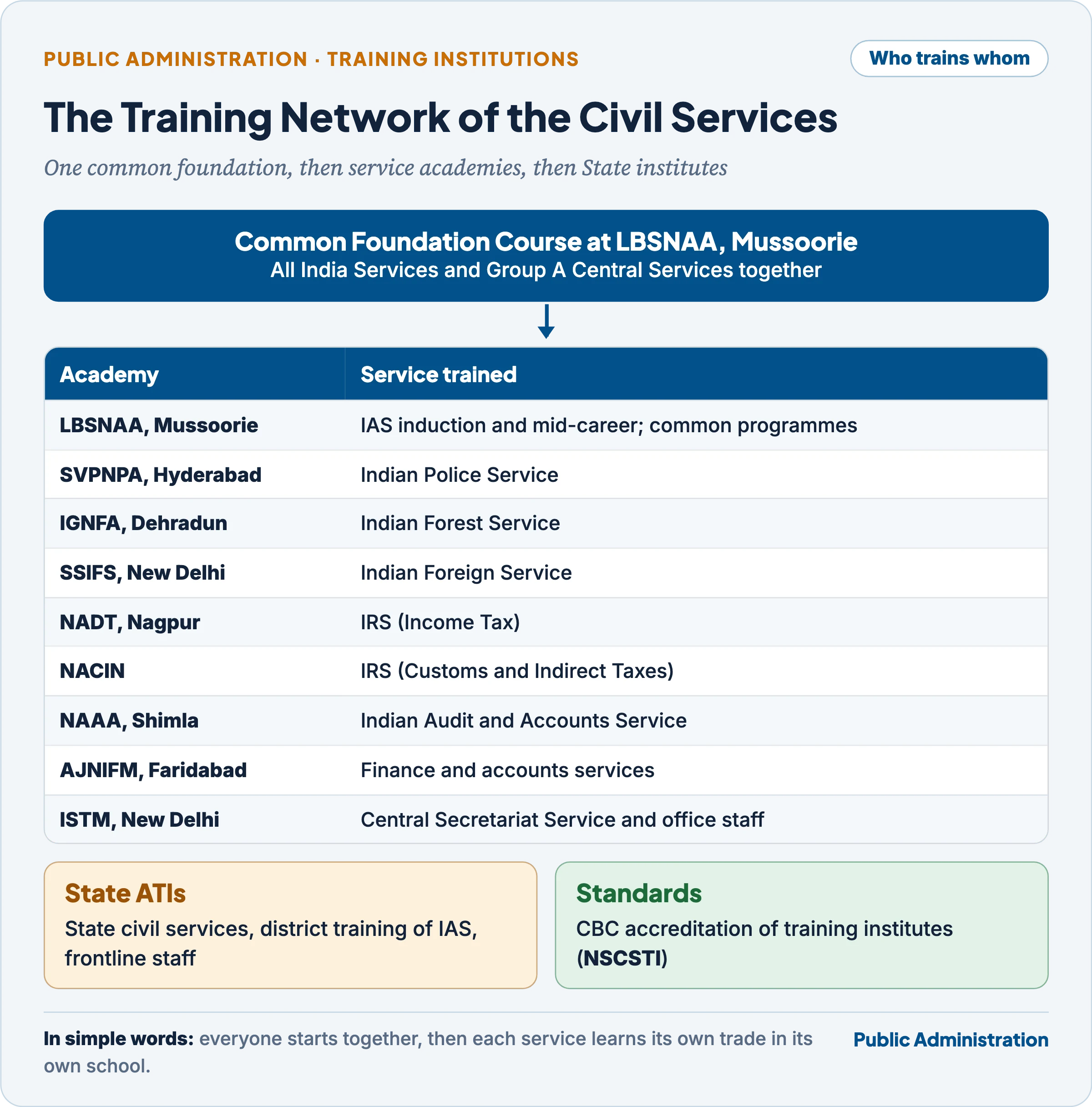
India trains its civil servants through a network: one national academy for the common start, a separate academy for each service’s trade, and an administrative training institute in every State. A small set of bodies at the top sets the policy and the standards.
4.1 Policy and standard-setting bodies
- Department of Personnel and Training (DoPT), Training Division: nodal agency for training policy, the “Training for All” approach, support to State training, foreign training schemes and the iGOT roll-out.
- Capacity Building Commission (CBC): since 2021, sets standards, supervises central training institutions, prepares capacity building plans with ministries and accredits institutes (section 9).
- Karmayogi Bharat: the non-profit company that runs the iGOT Karmayogi platform.
- Cadre-controlling ministries: each runs its service’s academy (Home for the IPS, Environment for the IFoS, External Affairs for the IFS, Finance for the revenue and accounts services).
4.2 LBSNAA, Mussoorie
- Mandate: the Common Foundation Course for All India and Group A Central Services; induction training of the IAS; mid-career training (MCTP Phases III to V and the Common MCTP); induction of officers promoted to the IAS from State services; and short courses such as the Joint Civil–Military Programme.
- Research and outreach centres include the Centre for Rural Studies (1989, first a land reform unit) and the National Gender Centre (1995), which anchors gender sensitisation.
- Academic credentialing: IAS officer trainees completing the two-year induction earn a Master’s in Public Management, recognised by Jawaharlal Nehru University.
- Status: an attached office of DoPT, headed by a Director of Secretary or Additional Secretary rank.
4.3 Service academies
| Academy | Year and origin | Service trained |
|---|---|---|
| SVPNPA, Hyderabad | 1948 at Mount Abu; National Police Academy 1967; named after Sardar Patel 1974; Hyderabad 1975 | IPS |
| IGNFA, Dehradun | 1987, renaming the Indian Forest College (1938) | Indian Forest Service |
| SSIFS, New Delhi | Foreign Service Institute (1986); renamed after Sushma Swaraj (2020) | Indian Foreign Service |
| NADT, Nagpur | IRS training at Nagpur from 1957 | IRS (Income Tax) |
| NACIN | National Academy of Customs, Indirect Taxes and Narcotics | IRS (Customs and Indirect Taxes) |
| NAAA, Shimla | National Academy of Audit and Accounts | Indian Audit and Accounts Service |
| AJNIFM, Faridabad | 1993 as NIFM; renamed after Arun Jaitley (2020) | Finance and accounts services |
| ISTM, New Delhi | May 1948 as the Secretariat Training School | Central Secretariat Service, office staff, RTI training |
| NAIR, Vadodara | Formerly the Railway Staff College | Railway services (now the Indian Railway Management Service) |
The academies give professional depth in each service’s trade, but they also reproduce service silos: an officer’s identity is formed first by her own academy. This is why common programmes (the Foundation Course, Aarambh, the Common MCTP) matter.
4.4 State Administrative Training Institutes (ATIs)
- Origin: the V.T. Krishnamachari report on the Indian and State Administrative Services and district administration (1962) urged structured training for State civil service officers, similar to that of the IAS, and State training institutes set up with the National Academy’s help.
- Roles: induction and in-service training of State civil services; the institutional component of IAS district training (3 to 12 weeks, varying by State); training of frontline staff, panchayat functionaries and municipal staff; State-level capacity building under Mission Karmayogi.
- Examples: YASHADA (Pune), the Dr MCR HRD Institute (Hyderabad), HCM RIPA (Jaipur), ATI Mysuru, the Anna Institute of Management (Chennai).
- Problems: thin and deputed faculty, limited budgets, uneven quality, a lecture-heavy style and weak links with State HR decisions. CBC accreditation under the national standards is now the main lever for raising quality.
4.5 Other institutions
- Indian Institute of Public Administration (New Delhi, 1954): research, the Advanced Professional Programme in Public Administration and short courses.
- National Centre for Good Governance (2014): documents good practices and trains Indian and foreign civil servants.
- Universities, IIMs and foreign institutions: the first MCTP rounds (2007–2010) were designed with partners such as Duke University, the Maxwell School of Syracuse University, IIM Bangalore and TERI, before LBSNAA took them over in 2010.
5. Training Across the Career
In simple words
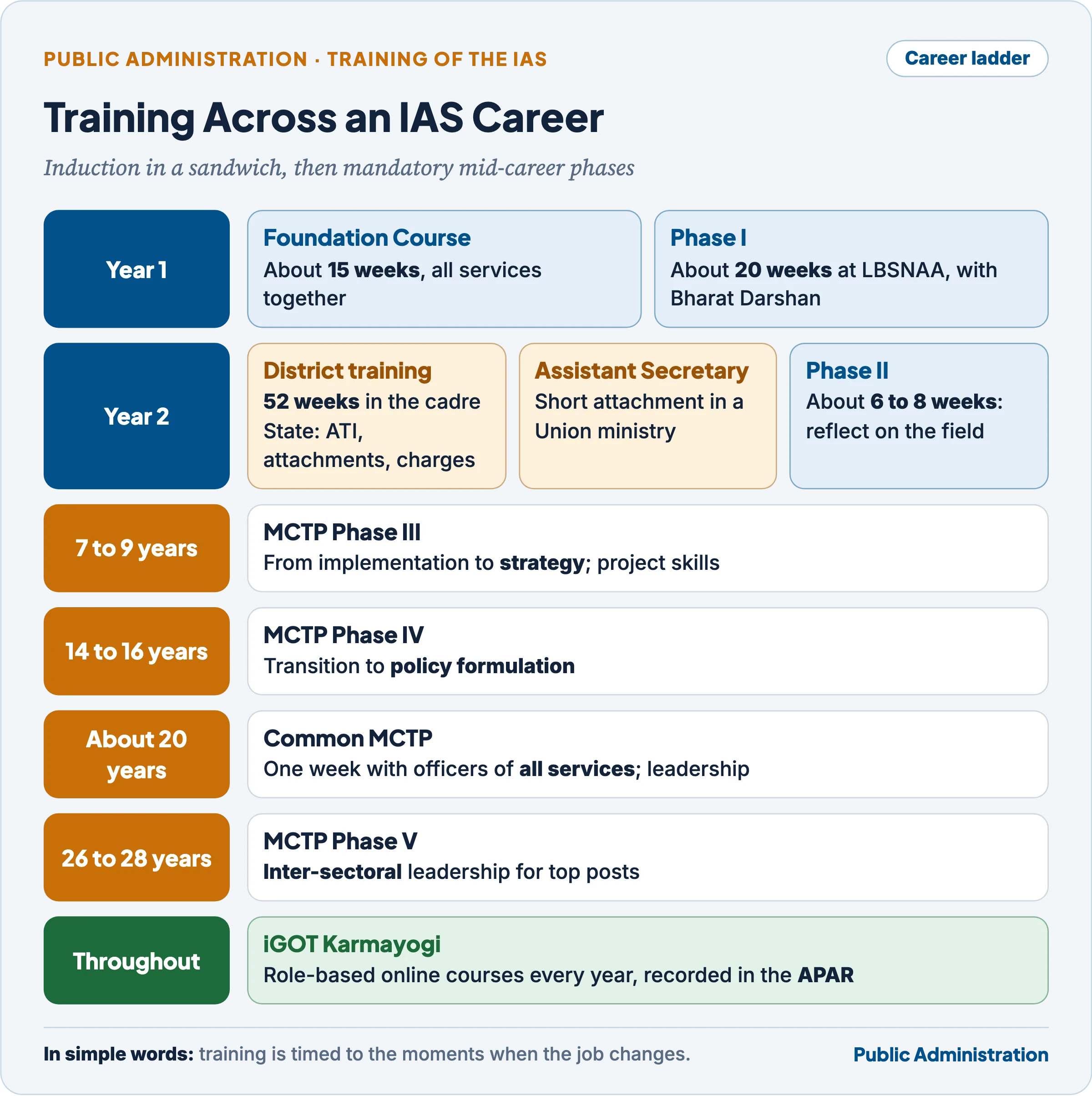
An IAS officer’s training is timed to the moments when her job changes: on joining, before her first district posting, and again when she moves from running programmes to shaping policy and then to leading whole sectors.
5.1 The Common Foundation Course
- Who: officer trainees of the All India Services and Group A Central Services recruited through the Civil Services Examination; LBSNAA runs it (some batches have been split across academies when numbers were large). The 100th Foundation Course was held in 2025.
- Duration: about 15 weeks (14 weeks in the 2025 calendar).
- Objectives:
- an understanding of the constitutional, economic, social, political, legal, historical and cultural context of administration;
- a feeling of belonging and a broad common outlook among members of different services (esprit de corps);
- professional, administrative and human values.
- Content: public administration and management, law and the Constitution, economics, Indian history and culture, behavioural sciences, ICT, plus trek, village visit, athletics and cultural activity.
- Design for integration. Hostel rooms were traditionally allotted so that no two trainees of the same service share a room, to build cross-service friendships that later ease coordination and curb departmentalism.
- The limit of that integration. The fraternity may be ephemeral: in the Academy all trainees are equals, but outside they meet as superior and subordinate, with lifelong differences in pay, postings and status.
- Assessment: the course carries 400 marks; with the later phases, it decides seniority within the IAS batch, not service allocation.
- The 2018 proposal. In May 2018 DoPT, at the PMO’s instance, asked cadre-controlling ministries whether service and cadre allocation could be made after the foundation course on the combined score of the examination and the course. Supporters said it would make trainees take the course seriously; critics said it would dilute the UPSC’s role under Part XIV and expose academy faculty to pressure to favour “loyal” trainees. It was not adopted. The idea echoed the Kothari Committee’s (1976) suggestion of a post-training test, which had also been set aside.
Indian Connect — Aarambh: the first common foundation course gathering (2019)
- In October 2019, the 94th Foundation Course became Aarambh (“beginning”): about 430 officer trainees of the civil services gathered for a week at Kevadia, Gujarat, near the Statue of Unity, organised by DoPT and LBSNAA.
- They worked on themes such as agriculture and rural empowerment, health care reform, sustainable rural management, inclusive urbanisation and the future of education, with sessions by global experts including the World Bank President.
- On 31 October 2019 (Sardar Patel’s birth anniversary, Rashtriya Ekta Diwas) the Prime Minister described it as a reform to end working in silos, and urged officers to treat no posting as a “punishment posting”.
- The format was repeated in later years. Its significance lies in symbolically integrating the services from day one, the problem the 1960 common course had addressed only partly.
5.2 Induction training of the IAS
- Phase I (about 20–22 weeks): at LBSNAA, preparing officers for the jobs of their first ten years: law (now the BNS, BNSS and BSA, which replaced the IPC, CrPC and Evidence Act from 1 July 2024), land revenue and land records, district administration, public finance, project management, ICT and e-governance, economics and planning. It includes a Winter Study Tour (Bharat Darshan) of six to seven weeks, with attachments to the armed forces, public sector, private sector, municipal bodies and NGOs.
- District training (about 52 weeks): in the allotted State (see 5.3).
- Assistant Secretary attachment: since 2015 (beginning with the 2013 batch), young IAS officers spend a short spell as Assistant Secretaries in Union ministries, to see policy-making at the Centre early.
- Phase II (about 6–8 weeks): back at the Academy for structured reflection on district experience, sharing good practices and strengthening managerial, ICT and legal skills.
- Old and new patterns. The older induction ran to about 24 months: foundation (4 months), Phase I (5 months), district training (12 months) and Phase II (3 months), followed by a UPSC-conducted examination. The structure is the same; the content has shifted from law and revenue towards management, technology, development and citizen services.
5.3 District training and why it needs revisiting
District training is the “learning by seeing and learning by doing” core of induction. Its quality varies more than any other component, because it depends on the State, the district and the Collector.
- Components:
- institutional training at the State ATI (3 to 12 weeks, positioned differently across States);
- attachments (about 25–30 weeks) with the Collectorate, Zila Parishad, SDM and tehsil offices, police, district judiciary, forest, health and engineering offices, municipal bodies and block offices;
- independent charges of BDO, Tehsildar, sometimes Executive Officer of a municipality or SDM;
- a short State Secretariat attachment;
- assignments: monthly analytical notes to the Academy, a village study report, law cases heard and decided, language tests.
- Problems:
- Collector-dependent quality. A busy Collector may have no time to mentor; trainees become extra hands for VIP duty, elections or surveys.
- Uneven design across States: the ATI spell, the order of attachments and the charges held vary widely.
- Old-fashioned content. Exposure to data systems, digital public infrastructure, disaster management, climate risk, public finance and grievance systems is patchy.
- Weak feedback loops between the district, the ATI and the Academy; assessment of district training is often a formality.
- Language and isolation: officers from outside the State may struggle with the language and with local institutions.
- Reforms suggested:
- trained, selected mentor-Collectors with time set aside, and a standard district training schedule (the Academy has proposed one);
- assignment-based learning with defined outcomes (a service-delivery improvement, a data project);
- real independent charge of a sub-division with accountability;
- digital logs and dashboards for monitoring and feedback;
- alignment with Karmayogi competencies and the Trust-Based Peer Assessment Framework (2026) to test whether skills are used.
- For the Collector’s office itself, see the article on The District Collector: Changing Role, Development Management and Law and Order.
5.4 Induction of the IPS and other services
- IPS: after the foundation course, IPS probationers go to the SVPNPA, Hyderabad for the basic course in law, investigation, forensic science, public order, internal security, police leadership, drill, weapons and field craft. Since 1986 the IPS has followed a sandwich pattern too: two spells at the Academy with district practical training in between. The Gore Committee on Police Training, set up in 1971 under the sociologist M.S. Gore, reviewed police training as a whole and pressed for a people-oriented, behavioural approach as well as a permanent home for the Academy.
- Is police training still colonial? Constabulary and sub-inspector training in State police training colleges often remains dominated by drill, physical training and law by rote, with little on communication, human rights, gender, community policing, mental health, cyber-crime and forensic science; trainers are frequently officers on punishment postings. The result is a force trained to control rather than to serve. Modernisation (scientific investigation, soft skills, community policing modules, cyber and forensic courses) has been uneven. Police reform as a whole belongs to the articles on law and order administration.
- Indian Foreign Service: a long induction (about three years in the older pattern) at the Foreign Service Institute (now SSIFS), with attachments to the armed forces, a Bharat Darshan tour, a spell in the Ministry of External Affairs and foreign-language training at a mission abroad. Before the Foreign Service Institute, probationers studied at the Indian School of International Studies.
- Indian Forest Service: foundation course, then long professional training at IGNFA, then on-the-job training in the cadre State.
- Central services: professional training at their academies (NADT, NACIN, NAAA, AJNIFM, NAIR); the Central Secretariat Service trains at ISTM.
- State civil service officers promoted to the IAS: a separate Induction Training Programme (about six weeks) at LBSNAA.
5.5 Mid-career training
- Why mid-career? Officers who were the brightest at entry often stop reading and learning as they rise; meanwhile their work shifts from implementation to strategy, policy and leadership. The Hota Committee (2004) observed exactly this loss of motivation and recommended periodic management development for every higher civil servant.
- Yugandhar Committee (2003). The committee under B.N. Yugandhar to review in-service training of IAS officers recommended three mid-career programmes in the 12th, 20th and 28th years, because these are points of major shift in an officer’s work; the 12th-year programme was to last at least eight weeks (five weeks academic, three weeks of study visits to best practices in India and abroad), the 20th-year programme twelve weeks.
- MCTP (2007). In March 2007 the government made mid-career training mandatory for the IAS:
- Phase III for officers of 7–9 years: from implementation to strategy; project formulation and appraisal, process re-engineering, IT for service delivery, team-building;
- Phase IV for 14–16 years: transition to policy formulation; political economy, policy analysis and evaluation, domain knowledge, leadership and negotiation;
- Phase V for 26–28 years: inter-sectoral strategy and leadership for the top posts.
- The IAS (Pay) Rules were amended on 20 March 2007 so that career benefits at each stage depend on completing the relevant phase; Phase V became a minimum requirement for empanelment as Additional Secretary or Secretary and for further increments. It is a necessary but not sufficient condition for promotion.
- The programmes were first outsourced to Indian and foreign institutions; since 2010 LBSNAA designs and runs them. Durations have shrunk (Phases III and IV now about four weeks, Phase V about three).
- Common MCTP (from 2021). Under Mission Karmayogi, a one-week programme brings together All India Services and Central Group A officers of about 20 years’ seniority at LBSNAA, focused on behavioural competencies, leadership and collaboration rather than domain content. The first round was held in October 2021; the sixth was scheduled for 21–25 September 2026.
- Other services run their own MCTPs (the IPS at SVPNPA, the IFoS at IGNFA); the CBC’s mandate includes setting norms for common mid-career training across all services.
Indian Connect — Is in-service training the most conspicuous development?
- Before 2007, in-service training of IAS officers was voluntary, irregular and unlinked to promotion; many officers never attended a serious course after their district years.
- The MCTP’s link to pay and empanelment made it the first systematic, career-staged in-service programme for the IAS. The Common MCTP, iGOT’s annual mandatory courses and the APAR link (from 2025-26) extend the idea to all services and all levels.
- The limits are equally clear: a few weeks every seven or eight years cannot build deep domain expertise, and attendance is not proof of changed behaviour.
5.6 Training of State services, Group B and C staff and frontline workers
- The neglected majority. Systematic training long remained confined to the higher civil services, while the large mass of Group B and C employees, who meet citizens daily, received sporadic training if any. The NTP 2012 named this its first drawback to correct.
- State services suffer in comparison with the All India and Central Services: shorter and weaker induction, under-resourced ATIs, slower promotions, less exposure to national programmes, and subordination to IAS officers in the same districts. Measures include structured induction modelled on the IAS, mid-career programmes for State officers, inter-State and Central deputation for exposure, and induction into the IAS through open, merit-based selection.
- Recent mass programmes:
- Karmayogi Prarambh (launched 22 November 2022 at a Rozgar Mela): an online orientation course for all new Central government appointees, covering the code of conduct, workplace ethics and integrity, HR policies and benefits;
- Karmayogi Kshamata Connect (2026): foundational training for frontline functionaries in regional languages;
- Karmayogi Kartavya Karyakram (2026): a national behavioural training programme anchored in seva bhav, meant to reach about 1.3 crore officials.
- Local bodies: employees of urban and rural local bodies have been onboarded on iGOT; capacity of elected representatives of panchayats and municipalities is a separate challenge, handled under rural and urban local government.
6. National Training Policy: 1996 and 2012
In simple words
A training policy is the government’s rulebook for learning: who will be trained, how often, by whom, with what money and to what end. India has had two, in 1996 and 2012.
6.1 Background
- The First Administrative Reforms Commission (1966–70) held that training should prepare officers not only for the present job but for higher responsibilities and new challenges. It recommended a national policy on civil services training, a Central Training Division in the Department of Personnel, and changes in the foundation course.
6.2 National Training Policy, 1996
- Issued in April 1996 as the first comprehensive statement of the government’s approach to developing its human resources.
- Its spirit was “training for all”: training for every level, at entry and at intervals, to make the services responsive to citizens and aware of a changing environment.
- Shortcomings (as the 2012 policy noted):
- its focus stayed on rules and procedures of recruitment, retention and career development;
- in practice training concentrated on the higher civil services;
- Group B and C employees were neglected;
- there was no focus on the competency of the person doing a particular job.
- The 2nd ARC (2008) recommended a monitoring mechanism to oversee its implementation, an admission that it had stayed largely on paper.
6.3 National Training Policy, 2012
The 2012 policy, issued by DoPT after liberalisation and decentralisation had changed the State’s tasks, shifted the emphasis to competencies, the frontline and the citizen.
- Objectives: a professional, impartial and efficient civil service responsive to citizens’ needs; adequate attention to all levels; the knowledge, skills and attitudes for effective performance; actual improvement in performance.
- Training target:
- training at entry and at appropriate intervals throughout the career;
- all civil servants, from the lowest functionary to the highest;
- flexible options, not only at mandated career points;
- priority to frontline staff, including soft skills, customer orientation and the quality of service delivery.
- Duties of every ministry and department:
- appoint a Training Manager as the nodal officer, supported by a Training Cell of HR and capacity building professionals;
- classify all posts with clear job descriptions and competencies;
- prepare Cadre Training Plans based on competencies and training needs;
- link training and competency development to career progression;
- take up the non-training interventions (process, equipment, staffing) needed to make training work.
- Duties of training institutions: adequate staff, infrastructure and finance; become models of excellence and learning organisations through self-assessment and benchmarking; help ministries prepare annual training plans and move to a competency framework.
- Funding: each ministry and department to set aside at least 2.5 per cent of its salary budget for training; adequate funds for Domestic Funding of Foreign Training.
- Wider content: training for flagship programmes; field attachments in gram panchayats and municipalities; ethics and values in governance; distance and e-learning; empathy for senior citizens, persons with disabilities, SCs, STs and minorities; networking with international institutions.
- Implementation: a National Training Council chaired by the Minister in charge of personnel, a monitoring committee, and DoPT’s Training Division as the nodal agency.
6.4 Why capacity problems persisted after 2012
Several government programmes were hampered by weak staff capacity even after the 2012 policy. The reasons lie in the gap between the policy’s text and the system around it.
- Competency frameworks stayed on paper. Few departments actually mapped posts to competencies; without that, training needs could not be identified.
- Budgets were not ring-fenced. The 2.5 per cent norm was rarely met; training budgets were the first to be cut.
- No link to placement and promotion. Except for the IAS MCTP, training seldom affected postings, appraisal or promotion, so officers had no incentive to learn.
- Frontline neglect continued. Group B and C staff, contract staff and scheme functionaries (the real implementers of flagship schemes) remained largely untrained.
- Vacancies and overload. Large vacancies and heavy workloads meant departments could not spare staff for training.
- Weak institutions. Many ATIs and departmental institutes lacked faculty, research and standards; there was no accreditation.
- Transfers and tenure. Frequent transfers wasted training investments: an officer trained in one sector was moved to another.
- No evaluation of impact. Training was measured by numbers trained, not by changes in behaviour or results.
Mission Karmayogi was designed precisely to address these gaps: frameworks of roles and competencies, mandatory plans, a common digital platform, accreditation of institutes and linkage to appraisal.
7. Committees and Commissions on Training
In simple words
Almost every major review of the civil services since Independence has said something about training. Their advice has moved from “train the new entrant well” to “train everyone, all the time, for the role they actually hold”.
- V.T. Krishnamachari (1962): structured training for State civil service officers comparable to the IAS; State training institutes with the National Academy’s support; carefully supervised district training.
- First ARC Study Team on Recruitment, Selection, UPSC/State PSCs and Training (Lt Gen S.P.P. Thorat, 1967): a year of district training under an experienced, carefully chosen Collector.
- First ARC, Report on Personnel Administration (1969): a national training policy; a Central Training Division; training for higher responsibilities, not only the present job; revision of the foundation course.
- Gore Committee on Police Training (M.S. Gore, 1971): a comprehensive review of police training at all levels; stress on behavioural and attitudinal training; a permanent home for the National Police Academy (it moved to Hyderabad in 1975).
- Kothari Committee on Recruitment Policy and Selection Methods (D.S. Kothari, 1976): the three-stage Civil Services Examination, and a foundation course followed by a post-training test, with service allocation based on both the examination and that test. The government did not accept the post-training test, partly because it would have required reorganising the Academy.
- Alagh Committee on the Civil Services Examination (Y.K. Alagh, 2001): reviewed recruitment and favoured testing candidates on common subjects relevant to governance rather than optional subjects, so that entry and training would build on a shared base.
- Yugandhar Committee (B.N. Yugandhar, 2003): three mid-career programmes at the 12th, 20th and 28th years (section 5.5).
- Surinder Nath Committee (2003): on appraisal, promotion, empanelment and placement; urged officers, as leaders of multi-disciplinary teams, to acquire more domain knowledge as they rise.
- Hota Committee on Civil Service Reforms (P.C. Hota, 2004):
- adequate importance to foundational and professional courses;
- every higher civil servant to spend a few months under training at periodic intervals in management development or other skills;
- compulsory visits to inaccessible rural areas and reports on their problems as part of training;
- only officers with aptitude and genuine interest in training to be posted to training institutes;
- career planning in which officers spend their first six or seven years in rural areas.
- 2nd ARC, 10th Report, Refurbishing of Personnel Administration: Scaling New Heights (2008), on capacity building:
- mandatory training at induction and periodically through the career for every government servant; successful completion to be a minimum condition for confirmation and promotion;
- a monitoring mechanism for the National Training Policy;
- mid-career training aimed at domain knowledge and competence;
- encouragement to obtain higher academic qualifications and to publish in reputed journals;
- broader governing bodies of LBSNAA, SVPNPA, IGNFA and State ATIs, with eminent experts;
- a National Institute of Good Governance, by upgrading an existing institute, to document and disseminate best practices and run training;
- on the recruitment side, National Institutes of Public Administration offering degrees as a pre-entry route, and domain assignment of officers after their early years (see the article on Civil Services: Constitutional Position, Structure and Recruitment).
Indian Connect — From recommendation to practice
- Mandatory, career-linked training (2nd ARC, Yugandhar) → the MCTP (2007) and the APAR link for iGOT courses (2025-26).
- National Institute of Good Governance (2nd ARC) → the National Centre for Good Governance (2014).
- Training for all levels (NTP 1996 and 2012) → iGOT Karmayogi, Karmayogi Prarambh and frontline programmes.
- Quality of training institutions (2nd ARC, NTP 2012) → National Standards for Civil Service Training Institutions (2022) and CBC accreditation.
- Faculty quality (Hota) → still unresolved: training postings remain unattractive.
8. Capacity Building through Competencies
In simple words
A competency is what a person must actually be able to do in a job, not just know. If every post has a clear list of competencies, the government can train for exactly those and pick the right person for each post.
8.1 What is a competency?
- A competency is an underlying characteristic (knowledge, skill, attitude, motive or trait) that leads to effective or superior performance in a role.
- David McClelland, the Harvard psychologist, argued in “Testing for Competence Rather than for ‘Intelligence'” (1973) that job success is better predicted by competencies than by aptitude tests; Richard Boyatzis built the first managerial competency model in The Competent Manager (1982).
- Types used in the Indian civil service:
- behavioural: leadership, empathy, integrity, collaboration, decision-making;
- functional: generic administrative skills such as procurement, budgeting, noting and drafting, project management;
- domain: sector-specific knowledge such as health economics, tax law or forestry.
8.2 Competency mapping and the generalist
- Competency mapping lists the competencies each post requires and assesses those each officer holds, so that the two can be matched in postings and gaps can be filled by training.
- Effective allocation of responsibilities. Without mapping, postings follow seniority and discretion; with it, a post in the power ministry goes to someone with energy-sector competence.
- Generalist versus specialist. Mapping does not abolish the generalist: senior posts need behavioural and coordination competencies that generalists develop. But it shows where a generalist cannot handle an issue as well as a specialist (complex regulation, technology, finance), and justifies domain specialisation after the early years, lateral entry of experts, and mid-career domain training. The debate itself belongs to the article on Civil Services: Constitutional Position, Structure and Recruitment.
- Linked to career development, competency mapping can motivate officers: if learning and demonstrated competence lead to better postings and promotion, officers have reason to invest in them. Without that link, mapping becomes a paper exercise.
8.3 FRAC and the Karmayogi Competency Model
- FRAC (Framework of Roles, Activities and Competencies): under Mission Karmayogi, every post is to be described by its roles, the activities they involve and the competencies they need. FRAC is the bridge from rule-based to role-based HR.
- Karmayogi Competency Model (KCM): launched by the Prime Minister on 19 October 2024, it was described as India’s first public HR competency model, drawing on Indian knowledge systems.
- It sets out 13 behavioural competencies (5 leadership and 8 core), along with functional and domain competencies.
- It frames the ideal civil servant through sankalpas (resolves) and gunas (virtues) every Karmayogi should practise.
- It now feeds the national training standards and course design.
9. Mission Karmayogi: National Programme for Civil Services Capacity Building
In simple words
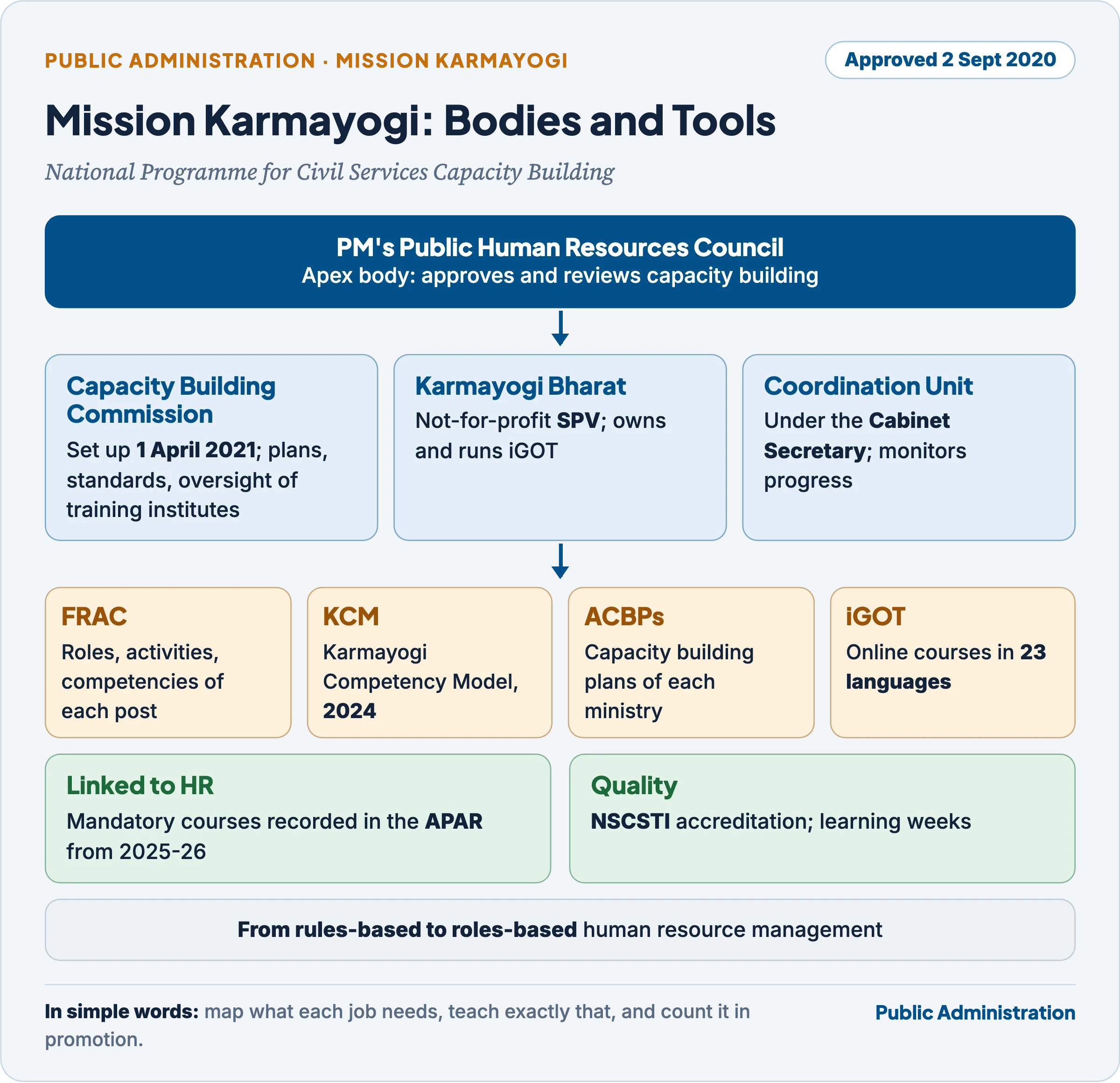
Mission Karmayogi treats the whole government as one learning organisation. It defines what each job needs, offers courses for it on one online platform, sets standards for training institutes, and counts learning in an officer’s appraisal.
9.1 Approval and rationale
- Approved by the Union Cabinet on 2 September 2020 as the National Programme for Civil Services Capacity Building (NPCSCB), a comprehensive reform of the capacity building apparatus at the individual, institutional and process levels.
- Rationale:
- training had been fragmented across hundreds of institutes, episodic and unlinked to roles and careers;
- the frontline workforce was largely untrained;
- the State needed officers with a global outlook yet rooted in Indian ethos, able to deliver in a technology-driven economy;
- the HR system was rule-based (governed by entitlements and seniority) rather than role-based (governed by what each post requires).
- Coverage and money: about 46 lakh Central employees initially; ₹510.86 crore over five years (2020-21 to 2024-25), partly funded by USD 50 million of multilateral assistance. The platform was meant ultimately to serve over two crore officials across governments.
9.2 Guiding principles
- Rules-based to roles-based HR: allocate work by matching competencies to the requirements of the post.
- On-site learning to complement off-site training.
- A shared ecosystem of training infrastructure, learning material, institutions and faculty.
- Calibrate every position to FRAC and create learning content for it.
- Give every civil servant the chance to build behavioural, functional and domain competencies through self-driven and mandated learning paths.
- Ministries to invest in a common ecosystem through an annual subscription per employee.
- Partner with the best content creators: public institutes, universities, start-ups and individual experts.
- Use data analytics from the platform to identify areas for policy reform.
9.3 Institutional framework
- Prime Minister’s Public Human Resources Council: the apex body, chaired by the Prime Minister with select Union Ministers, Chief Ministers and eminent HR practitioners; approves and reviews capacity building plans.
- Capacity Building Commission (CBC): constituted on 1 April 2021, with a Chairperson and two Members (Adil Zainulbhai was the first Chairperson; S. Radha Chauhan, a former DoPT Secretary, took charge on 6 August 2025). Its functions:
- assist the HR Council in approving Annual Capacity Building Plans;
- exercise functional supervision over all Central Training Institutions;
- create shared learning resources, including faculty and resource centres;
- coordinate and supervise implementation of plans with departments;
- recommend standardisation of training, pedagogy and methodology;
- set norms for common mid-career programmes across services;
- suggest policy interventions in HR management and capacity building.
- Karmayogi Bharat: a wholly owned, not-for-profit company under Section 8 of the Companies Act, 2013 (the special purpose vehicle), which owns and runs iGOT Karmayogi, manages the content marketplace, content validation, proctored assessments and data, and holds the intellectual property on behalf of the government.
- Coordination Unit headed by the Cabinet Secretary: monitors implementation across ministries.
9.4 Tools of the mission
- iGOT Karmayogi (Integrated Government Online Training): the digital backbone.
- As of August 2026, more than 1.7 crore registered users, over 5,600 courses (about 6,950 hours of learning) in 23 languages, and more than 14.4 crore course completions.
- 218 courses on artificial intelligence and emerging technologies, with 3.35 crore completions; AI features such as the iGOT AI Tutor, AI Sarthi and an AI-based capacity building plan tool.
- All Union ministries and all States and UTs have been onboarded, along with urban and rural local bodies.
- Learning is gamified through Karma Points, badges and leaderboards.
- Annual Capacity Building Plans (ACBPs): each ministry, department and organisation prepares a plan from its priorities and roles; more than 130 plans had been developed by 2026.
- National Standards for Civil Service Training Institutions (NSCSTI): launched 18 July 2022 as an accreditation framework for training institutes; NSCSTI 2.0 (18 July 2025) cut the metrics from 59 to 43 and added the KCM, the Amrit Gyaan Kosh case repository and Indian knowledge systems; about 200 institutes were accredited by January 2026.
- Amrit Gyaan Kosh: a repository of Indian governance case studies for training; AI-based case tools were added in 2026.
- Karmayogi Quality Framework (2026): a six-stage quality cycle for iGOT learning: discover, design, develop, deliver, evaluate, improve.
- Trust-Based Peer Assessment Framework (2026): workplace validation in which colleagues confirm whether learning is applied on the job.
- Monitoring and Evaluation framework: key performance indicators for every stakeholder, with dashboards.
- Link to appraisal: from the reporting year 2025-26, all Central government employees and All India Services officers must complete prescribed iGOT courses annually, and completion is captured in their Annual Performance Appraisal Reports (APAR).
9.5 Learning weeks
- Karmayogi Saptah (National Learning Week), 19–27 October 2024: launched by the Prime Minister, who also unveiled the KCM; every civil servant was asked to complete at least four hours of competency-based learning. More than 7.45 lakh officials took part, with about 45 lakh enrolments and 32.5 lakh completions, over 200 webinars and Ministry-led sessions (samuhik charcha).
- Sadhana Saptah, 2–8 April 2026: Strengthening Adaptive Development and Humane Aptitude for National Advancement, marking the CBC’s foundation day and five years of the Mission, with the tagline “Ham Bane Karmayogi”. It was organised on three themes, Technology, Tradition and Tangible Outcomes, across 100+ Central ministries, 30+ States and UTs and 250+ training institutions, and launched Kshamata Connect, Kartavya Karyakram, the peer assessment framework and the AI case-study suite.
9.6 Mission Karmayogi in the States
- Tripartite MoUs between the State, Karmayogi Bharat and the CBC have been signed with 30 States and UTs for systematic implementation; States prepare their own capacity building plans and bring their ATIs under the accreditation standards.
- Example: Odisha had onboarded about 4.32 lakh officials and recorded about 31.7 lakh course completions by mid-2026.
- At the 2026 Sadhana Saptah, the Cabinet Secretary urged States to extend the Mission to the district and sub-district levels, where most citizen contact happens.
- Challenges in States: language and content relevance, connectivity, ATI capacity, and the absence of a State-level APAR link in many cases.
9.7 Assessing the Capacity Building Commission and the Mission
The table sets the CBC’s aims against what it has done and what is still missing.
| Aim at creation | Progress | Gaps |
|---|---|---|
| Annual capacity building plans for every ministry | 130+ plans; AI-assisted planning tool | Plans often generic; FRAC mapping of posts incomplete |
| Standards and oversight of training institutes | NSCSTI and NSCSTI 2.0; about 200 institutes accredited | Accreditation measures inputs more than learning results |
| Shared learning resources | iGOT marketplace, Amrit Gyaan Kosh, Karmayogi Talks | Quality of online content uneven; little deep domain content |
| Common mid-career norms | Common MCTP since 2021 | One week; little domain depth |
| Policy advice on HR | KCM, APAR linkage, peer assessment | Postings, tenure and promotion still largely rule-based |
| Culture of lifelong learning | 1.7 crore users, 14 crore+ completions, learning weeks | Completions are not evidence of changed behaviour |
- Strengths of the Mission:
- scale and inclusion: frontline staff, States and local bodies are in the same system for the first time;
- a shift from entitlement to role, at least in design;
- data on who learns what, enabling targeted interventions;
- standards for institutes, which India never had;
- linkage to appraisal, which gives learning some career weight.
- Limits:
- Capacity is more than training. Vacancies, short tenures, political transfers, outdated rules, weak data systems and low autonomy constrain performance whatever officers learn. Mission Karmayogi can supplement but not solve the capacity problem; that needs civil service reform in postings, tenure, appraisal and accountability, and adequate staffing.
- Click-through learning. Mandatory courses tied to appraisal risk box-ticking: officers complete short videos to meet targets.
- Kirkpatrick levels 3 and 4 (behaviour and results) remain largely unmeasured; the 2026 peer assessment framework is only a start.
- Rules-to-roles is incomplete as long as postings and promotions follow seniority and discretion rather than mapped competencies.
- Centralisation and content concerns: a single national platform and an Indic competency model raise questions about pluralism of content, State ownership and the political neutrality of what is taught.
- Off-site depth: online learning cannot replace long, reflective, residential programmes for senior officers or deep domain education.
Common confusion
Did Mission Karmayogi abolish the old training academies? No. LBSNAA, SVPNPA and the other academies still run induction and mid-career programmes. The Mission adds a common digital platform, standards and oversight by the CBC, role-based planning and an appraisal link on top of them, and brings the academies under functional supervision and accreditation.
10. Issues and Challenges in Civil Service Training
In simple words
India spends a great deal of time and money on training, yet many officers say it changed little in how they work. The reasons lie partly in how training is designed and partly in the system it sits inside.
10.1 Problems of design and delivery
- Too pedagogic, too casual, too generalist. An old charge: higher civil service training is lecture-heavy rather than result-oriented, not linked to promotion, and too generalist to be professionally relevant.
- Mismatch with personnel policy and manpower planning. Training objectives and methods rarely matched placement, promotion or workforce planning; officers were trained for one sector and posted to another.
- Efficiency over attitude. Programmes teach rules and techniques but seldom transform attitudes and behaviour; training alone has limited capacity to change deep-seated values formed by family, class and organisational culture.
- Rule-bound training breeding “bureaucrazy”. Induction stresses rules, procedures and precedent; combined with fear of audit and vigilance, this produces officers who follow procedure even when it defeats the purpose. Training on purpose, discretion, problem-solving and citizen outcomes is the corrective.
- Weak training needs analysis. Courses are designed around what institutes can offer, not what roles require.
- Lack of evaluation. Evaluation usually stops at feedback forms; impact on work and outcomes is rarely measured (section 11).
- Generalist orientation and specialised roles. Officers handling regulation, infrastructure finance, health systems, cyber-security or AI policy need deep domain training that short courses cannot give; foreign degree programmes and study leave are used unevenly.
- Digital skills gap. Data analytics, digital public infrastructure, cyber hygiene and AI are now core skills; iGOT’s AI courses are a response, but senior officers’ digital fluency varies widely.
- Ethics training. Ethics is taught as lectures and codes; case-based moral reasoning, dilemmas and integrity systems get less attention. See the article on Administrative Ethics.
- Gender sensitisation. The National Gender Centre at LBSNAA and gender modules exist, but training on gender budgeting, workplace harassment law and gender-sensitive service delivery is uneven across institutes and levels.
10.2 Problems of institutions and faculty
- Training as a “punishment posting”. Postings to training institutes are often seen as sidelining; good officers avoid them, and those posted may lack aptitude. The Hota Committee recommended that only officers with aptitude and genuine interest be posted to training institutes; incentives (higher allowances, credit in empanelment) remain weak.
- Faculty quality. Many institutes depend on deputed generalist officers and guest speakers; permanent academic faculty and research are thin, particularly in ATIs.
- Silos. Separate academies for each service reinforce service identity over a common civil service ethos.
- Funding. Training budgets are small and unstable; the 2.5 per cent norm of the 2012 policy is rarely met.
10.3 Problems of motivation and the system
- “Paid holiday”. Many officials treat training as a break from work, a sign of a crisis of motivation on both sides: trainers deliver routine courses, trainees attend because they are nominated. Nominations sometimes go to those the department can spare, not those who need training.
- No link with career progression (outside the MCTP and now the APAR link): officers gain nothing in postings for having learned.
- Transfers waste training. An officer trained for a role is often moved within months.
- Organisational climate. Returning trainees meet superiors and rules that do not allow them to apply new ideas, so learning decays: a transfer-of-training problem.
Common confusion
Is the “paid holiday” view a problem of training or of motivation? Mostly of motivation and system design. When training is not tied to roles, appraisal or postings, and when the workplace does not use new skills, rational officers treat it as leave. The remedy is to make training relevant (needs-based, role-based), consequential (linked to postings and promotion), engaging (case and field methods) and followed up (application on the job and evaluation of results).
10.4 Measures for reform
- Needs-based, role-based design through FRAC and the KCM, with every course mapped to a competency gap.
- Link to the career: training completion and demonstrated competence to count in postings, empanelment and promotion, as the 2nd ARC recommended.
- Attitudinal methods: field immersion, village stays, citizen interaction, role play, case-based ethics, feedback from citizens and subordinates.
- Domain tracks for mid-career officers, including university degrees and study leave, linked to domain assignment.
- Better faculty: attractive training postings, permanent academic faculty, research centres in academies, and exchanges with universities.
- Stronger ATIs with funding, accreditation and State ownership; frontline training in local languages.
- Evaluation at Kirkpatrick levels 3 and 4, with follow-up assessment after three to six months and outcome tracking.
- Stable tenure, so that training and posting stay aligned (see the article on Good Governance Initiatives and Civil Service Reforms for Civil Services Boards and tenure).
11. Evaluation of Training: The Kirkpatrick Model
In simple words
Asking trainees whether they enjoyed a course tells you little. Real evaluation asks whether they learned, whether they now work differently, and whether citizens are better served as a result.
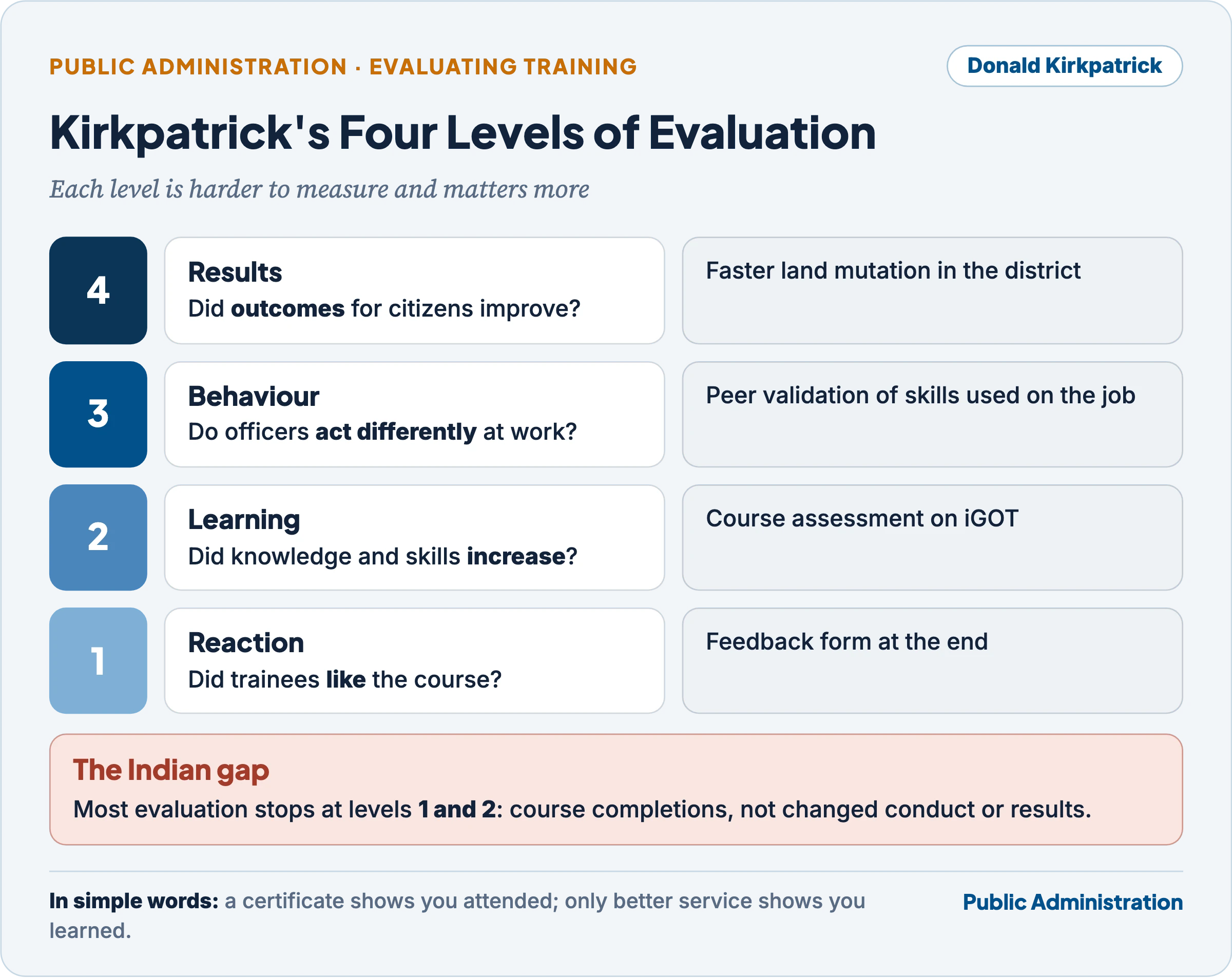
- Donald Kirkpatrick, an American professor of management, set out a four-level model in a series of articles in 1959, later developed in Evaluating Training Programs: The Four Levels (1994).
- Level 1, Reaction: did trainees find the programme useful and engaging? (feedback forms)
- Level 2, Learning: did knowledge, skills or attitudes change? (pre- and post-tests, iGOT assessments)
- Level 3, Behaviour: do trainees apply what they learned on the job? (observation, supervisor and peer feedback, the 2026 peer assessment framework)
- Level 4, Results: did organisational and citizen outcomes improve? (faster land mutation, fewer grievances, better scheme coverage)
- Each level is harder to measure but more meaningful. Positive reactions do not guarantee learning; learning does not guarantee use; use does not guarantee results, because other factors intervene.
- Return on investment. Jack Phillips later added a fifth level, comparing the monetary benefit of training with its cost.
- Indian practice. Most civil service evaluation stops at levels 1 and 2: end-of-course feedback, examinations, course completions and certificates. Mission Karmayogi’s dashboards count enrolments and completions; the Trust-Based Peer Assessment Framework and the Karmayogi Quality Framework (both 2026) are the first steps toward levels 3 and 4.
- Why it is hard in government: outcomes have many causes; there is no single profit measure; officers move often; and evaluation units lack independence and data.
- What good evaluation needs: baseline data, follow-up months after the course, supervisor and citizen feedback, links to performance data, and use of the findings to redesign courses.
12. International Comparisons
In simple words
Other countries train their senior officers differently: some in one elite school, some in a central college, some mostly online and on the job. Comparing them shows what India could borrow.
| Country | Institution | Main features |
|---|---|---|
| United Kingdom | Civil Service College (1970, after the Fulton Report, 1968) → National School of Government → closed 31 March 2012; Civil Service Learning (2011); Government Skills (the Government Skills and Curriculum Unit, created September 2020); Government Campus and Leadership College for Government (2022) | Moved from residential courses to work-based and e-learning; one curriculum and skills taxonomy for all civil servants; professions and functions; Fast Stream for graduates |
| France | École nationale d’administration (ENA, 1945) → Institut national du service public (INSP), from 1 January 2022, based in Strasbourg | Elite school for senior State cadres; the reform sought diversity, practical skills and a common core across public service schools, and ended automatic entry to elite corps on graduation |
| Singapore | Civil Service College, a statutory board under the Public Service Division (Act of 1 October 2001) | Leadership and policy development, public administration and management; tight link between learning, talent management and promotion on merit |
- Lessons for India:
- the UK shows the value of a single curriculum and skills taxonomy (India’s FRAC and KCM), but also the risk of losing depth when residential training is cut for savings;
- France shows that an elite school can entrench a caste of officials, and that reform aims at diversity and a common culture, which India’s common foundation and Aarambh also seek;
- Singapore shows that training works best when tied to merit-based promotion and talent management, the link India has been slowest to build.
13. Assessment and the Theory Lens
In simple words
Is Indian civil service training a real engine of better government, or a ritual? The honest answer is that it is both, and that its success depends on the system around it as much as on the courses themselves.
Criticism — Criticism: training as ritual
- Little lasting effect on attitudes. Officers leave the Academy idealistic and are reshaped within years by hierarchy, rules, fear of vigilance and political pressure.
- Unlinked to careers. Outside the MCTP and the new APAR link, learning does not change postings or promotions, so it is treated as a paid holiday.
- Box-ticking at scale. Crores of online completions measure clicks, not competence or conduct.
- Generalist and shallow. Short courses cannot build the domain expertise that regulation, technology and finance now demand.
- Weak institutions. Training postings are seen as punishment; ATIs are under-funded; evaluation stops at feedback forms.
- Capacity lies elsewhere. Vacancies, transfers, outdated rules and political interference limit performance whatever the training.
Defence — Defence: building a learning civil service
- Integration and ethos. The common foundation, Aarambh and the Common MCTP build a shared national outlook across a diverse service; district training gives every IAS officer grassroots exposure unmatched in many countries.
- Career-staged learning. The MCTP links learning to promotion and empanelment, and the APAR link now extends this to all Central and AIS officers.
- Scale and inclusion. Mission Karmayogi has brought frontline staff, States and local bodies into continuous learning for the first time.
- Role-based design. FRAC, the KCM and capacity building plans move training from what institutes offer to what roles need.
- Standards and data. Accreditation of institutes and learning analytics give the system tools to improve itself.
- Reform, not rejection. The answer to weak training is better training tied to HR reform, not less training.
Theory lens: training through Paper I ideas
- Human resource development theory. Leonard Nadler (HRD, around 1969–70) and later strategic HRM treat people as assets to be developed, not costs to be controlled. India’s shift from induction-only training to career-long, role-based development under the NTP 2012 and Mission Karmayogi is the move from personnel administration to HRD. See the article on Personnel Administration: HRD, Recruitment, Training, Career, Classification, Promotion and Pay.
- Maslow and Herzberg on motivation. Abraham Maslow (“A Theory of Human Motivation”, 1943) placed esteem and self-actualisation at the top of human needs; Frederick Herzberg (The Motivation to Work, 1959) showed that growth, achievement and recognition are motivators, while working conditions are only hygiene factors. Training that offers growth and recognition (badges, certification, better postings) taps motivators; training seen as a perk or a break is a hygiene factor, which explains the “paid holiday” attitude. See the article on Motivation Theories: Content, Process and Contemporary.
- Argyris on organisational learning. Chris Argyris (Personality and Organization, 1957) argued that rigid hierarchies keep adults immature and dependent; with Donald Schön (Organizational Learning, 1978) he distinguished single-loop learning (correcting errors within existing rules) from double-loop learning (questioning the rules and goals themselves). Indian training is largely single-loop: it teaches officers to apply rules better. The idealistic recruit pushed by hierarchy and vigilance fears into passivity illustrates his immaturity–maturity argument. See the article on Participative Management: Likert, Argyris and McGregor.
- Senge’s learning organisation. Peter Senge (The Fifth Discipline, 1990) described organisations that continually expand their capacity through personal mastery, mental models, shared vision, team learning and systems thinking. Mission Karmayogi’s aim of making the government a learning organisation, the NTP 2012’s call for training institutes to become learning organisations, and the “rules to roles” shift echo Senge; the stress on individual courses over team learning and systems thinking shows how far there is to go.
- Competency-based HRM. David McClelland (1973) and Richard Boyatzis (1982) grounded HR in competencies that predict performance. FRAC and the Karmayogi Competency Model apply this to the Indian State; their success depends on using competencies in selection, posting and promotion, not only in training.
- Weber, Merton and trained incapacity. Max Weber (Economy and Society, 1922) made specialised training a defining feature of legal-rational bureaucracy: officials are appointed for expert qualification and trained in the rules. Robert Merton (“Bureaucratic Structure and Personality”, 1940), borrowing Thorstein Veblen’s phrase “trained incapacity”, showed how training in rules produces goal displacement: rules become ends in themselves. Officers “trained to follow rules” until administration becomes “bureaucrazy” are Merton’s bureaucratic personality. See the article on Weber’s Bureaucratic Model, its Critique and Post-Weberian Developments.
- NPM versus New Public Service. New Public Management (Christopher Hood, 1991) views the civil servant as a manager to be trained in efficiency, performance measurement and customer orientation: hence courses on project management, outcome budgets and service standards. The New Public Service of Janet and Robert Denhardt (2000) sees the civil servant as a steward of citizenship who serves rather than steers: hence training in empathy, ethics, deliberation and citizen engagement, echoed in the KCM’s sankalpas, the motto Nagrik Devo Bhava and frontline behavioural programmes. India’s training mixes both. See the article on New Public Management and After.
- Riggs and formalism. Fred Riggs (Administration in Developing Countries, 1964) described formalism: a gap between prescribed norms and actual practice. Training policies that remain on paper, competency frameworks never applied to postings, and certificates without changed conduct are training formalism in the prismatic setting. See the article on Riggsian Models and their Critique.
- Development administration. U.L. Goswami (1955) and Edward Weidner treated administration as an instrument of planned change; training of officers as change agents (rural studies, project appraisal, development modules) was central to India’s development administration, while Simon’s urgency argument explains why formal training expanded fastest in developing States. See the article on Development Administration.
Key Terms
| Term | Meaning in simple words |
|---|---|
| Training | Planned process of giving employees the knowledge, skills and attitudes for their job |
| Capacity building | Strengthening individuals, institutions and the system so that results improve |
| Competency | A knowledge, skill or attitude that leads to effective performance in a role |
| Behavioural, functional, domain competencies | People skills; general administrative skills; sector-specific knowledge |
| Foundation Course | Common opening course for All India and Group A Central Services at LBSNAA |
| Aarambh | The 2019 common foundation course gathering at Kevadia |
| Sandwich pattern | Institutional training, then field training, then institutional training again |
| District training | Year-long field training of IAS officer trainees in the cadre State |
| Bharat Darshan | Winter study tour of IAS trainees across India with attachments |
| MCTP | Mandatory Mid-Career Training Programme for the IAS (Phases III, IV, V) |
| Common MCTP | One-week programme for officers of all services with about 20 years’ service |
| ATI | Administrative Training Institute of a State |
| National Training Policy | Government policy on training (1996, revised 2012) |
| Training Manager | Nodal officer for training in every ministry under the 2012 policy |
| Cadre Training Plan | A ministry’s plan of training for each cadre based on competencies |
| Mission Karmayogi | National Programme for Civil Services Capacity Building, approved in 2020 |
| Rules-based to roles-based | Shift from HR governed by rules and seniority to HR governed by what each post requires |
| CBC | Capacity Building Commission, which sets standards and plans for capacity building |
| Karmayogi Bharat | Not-for-profit company that runs the iGOT platform |
| iGOT Karmayogi | The government’s online learning platform |
| FRAC | Framework of Roles, Activities and Competencies for each post |
| KCM | Karmayogi Competency Model (2024), India’s first public HR competency model |
| ACBP | Annual Capacity Building Plan of a ministry, department or organisation |
| NSCSTI | National Standards for Civil Service Training Institutions, an accreditation framework |
| APAR | Annual Performance Appraisal Report, which now records mandatory iGOT courses |
| Kirkpatrick model | Four levels of training evaluation: reaction, learning, behaviour, results |
| Single- and double-loop learning | Correcting errors within the rules versus questioning the rules themselves |
| Trained incapacity | Training that makes officials unable to respond when rules no longer fit |
Commissions, Committees and Judgments
The bodies, policies and decisions below shaped civil service training in India, listed by year.
| Body / case | Year | Key point |
|---|---|---|
| East India College, Haileybury | 1806 | Pre-entry training of Company civil servants; closed 1858 |
| IAS Training School, Metcalfe House, Delhi | 1947 | First post-Independence training school for the IAS |
| Central Police Training College, Mount Abu | 1948 | Training of the new IPS; later SVPNPA (1974), Hyderabad (1975) |
| IAS Staff College, Shimla | 1957 | Refresher training for officers of 6–10 years |
| National Academy of Administration, Mussoorie | 1959 | Merged Delhi school and Shimla college; LBSNAA from 1972–73 |
| V.T. Krishnamachari report | 1962 | Structured training for State services; State training institutes |
| First ARC Study Team on Recruitment, Selection, UPSC/State PSCs and Training (S.P.P. Thorat) | 1967 | One-year district training under an experienced Collector |
| First ARC, Report on Personnel Administration (K. Hanumanthaiya) | 1969 | National training policy; Central Training Division; training for higher responsibility |
| Sandwich pattern for IAS induction | 1969 | Phase I, district training, Phase II |
| Gore Committee on Police Training (M.S. Gore) | 1971 | Review of police training; behavioural approach; permanent academy |
| Kothari Committee on Recruitment Policy and Selection Methods (D.S. Kothari) | 1976 | Three-stage examination; post-training test proposed, not accepted |
| National Training Policy | 1996 | “Training for all”; first policy statement |
| Alagh Committee on the Civil Services Examination (Y.K. Alagh) | 2001 | Common governance-related subjects for all candidates |
| Yugandhar Committee on In-Service Training (B.N. Yugandhar) | 2003 | Mid-career training in the 12th, 20th and 28th years |
| Surinder Nath Committee | 2003 | Appraisal and placement; more domain knowledge for senior officers |
| Hota Committee on Civil Service Reforms (P.C. Hota) | 2004 | Periodic management training; rural visits; aptitude-based faculty postings |
| IAS (Pay) Rules amendment | 2007 | Mandatory MCTP linked to career benefits and empanelment |
| 2nd ARC, 10th Report (M. Veerappa Moily) | 2008 | Mandatory training for confirmation and promotion; NTP monitoring; National Institute of Good Governance |
| National Training Policy | 2012 | Competencies, frontline priority, Training Managers, 2.5% of salary budget |
| Mission Karmayogi (NPCSCB) | 2020 | Rules to roles; HR Council, CBC, SPV, Coordination Unit; iGOT |
| Capacity Building Commission | 2021 | Constituted 1 April; standards, plans and oversight |
| National Standards for Civil Service Training Institutions | 2022 | Accreditation of training institutes; version 2.0 in 2025 |
| Karmayogi Competency Model | 2024 | 13 behavioural competencies; Indic sankalpas and gunas |
Contemporary Developments
- Karmayogi Saptah (19–27 October 2024). The first National Learning Week, launched by the Prime Minister along with the Karmayogi Competency Model, drew 7.45 lakh+ participants, about 45 lakh enrolments and 32.5 lakh completions against a four-hour learning goal.
- NSCSTI 2.0 (18 July 2025). The revised accreditation framework cut evaluation metrics from 59 to 43 and added the KCM and the Amrit Gyaan Kosh; about 200 training institutes were accredited by January 2026.
- New CBC Chairperson (6 August 2025). S. Radha Chauhan, a former DoPT Secretary, took charge from Adil Zainulbhai, who had led the Commission since April 2021.
- APAR linkage (reporting year 2025-26). All Central government employees and All India Services officers must complete prescribed iGOT courses annually, recorded in their APARs, linking capacity building to HR management.
- Sadhana Saptah (2–8 April 2026). The second learning week marked five years of Mission Karmayogi and the CBC’s foundation day; it launched Karmayogi Kshamata Connect for frontline staff, the Karmayogi Kartavya Karyakram behavioural programme for about 1.3 crore officials, a Trust-Based Peer Assessment Framework and the Karmayogi Quality Framework.
- Scale of iGOT (Lok Sabha reply, 12 August 2026). More than 1.7 crore registered users, 5,600+ courses covering about 6,950 hours in 23 languages, and over 14.4 crore course completions; 218 AI and emerging-technology courses recorded 3.35 crore completions.
- State roll-out (2026). Tripartite MoUs with 30 States and UTs; all States and UTs and local bodies onboarded; the Cabinet Secretary urged extension to district and sub-district levels.
- Common MCTP continues (September 2026). The 6th round for officers of all services was scheduled at LBSNAA for 21–25 September 2026.
Revision Grid
| Thinker / body | Work or report (year) | Key idea |
|---|---|---|
| Herbert Simon | On training in developing countries | Innovation, multiplying tasks and skill shortage make training urgent |
| Leonard Nadler | HRD (about 1969–70) | Organised learning to improve performance and growth |
| Kurt Lewin | Group dynamics (late 1940s) | T-group and sensitivity training |
| Abraham Maslow | “A Theory of Human Motivation” (1943) | Growth and self-actualisation needs |
| Frederick Herzberg | The Motivation to Work (1959) | Growth and recognition as motivators |
| Donald Kirkpatrick | Four levels (1959; book 1994) | Reaction, learning, behaviour, results |
| Jack Phillips | ROI model | Fifth level: return on investment |
| Chris Argyris and Donald Schön | Organizational Learning (1978) | Single-loop and double-loop learning |
| Peter Senge | The Fifth Discipline (1990) | The learning organisation |
| David McClelland; Richard Boyatzis | 1973; The Competent Manager (1982) | Competencies predict performance |
| Robert Merton | “Bureaucratic Structure and Personality” (1940) | Trained incapacity and goal displacement |
| Christopher Hood; Janet and Robert Denhardt | NPM (1991); New Public Service (2000) | Manager versus steward of citizenship |
| V.T. Krishnamachari | Report (1962) | State service training; State institutes |
| Kothari Committee | Report (1976) | Foundation course and post-training test |
| Yugandhar Committee | Report (2003) | Mid-career training at the 12th, 20th and 28th years |
| Hota Committee | Report (2004) | Periodic management training; motivated faculty |
| 2nd ARC | 10th Report (2008) | Mandatory training for confirmation and promotion |
| DoPT | National Training Policy (1996, 2012) | Training for all; competencies; frontline priority |
| Union Cabinet | Mission Karmayogi (2020) | Rules-based to roles-based HR; iGOT; CBC |
| Capacity Building Commission | KCM (2024); NSCSTI (2022, 2025) | Competency model; accreditation of institutes |
Previous Year Questions
- 2026Civil services is grappling with severe capacity issues and which is a major bottleneck in implementing ambitious programmes across sectors. Mission Karmayogi can only supplement but not solve the entire capacity constraint. Give your opinion.
- 2025Training and capacity building represent different scope and objectives. Explain the key differences.
- 2024What aims and objectives was the Capacity Building Commission established for? Evaluate how far it has come in realising the goals.
- 2023The district training component of Induction Training of IAS officers requires to be revisited. Examine.
- 2022“The objective of Mission Karmyogi is to enhance capacity building of Indian Civil Servants and improve governance.” Discuss.
- 2021Well planned and goal oriented training programmes are the backbone of the civil service system in India. Examine the statement.
- 2020Civil servants are trained to follow rules and procedures so much that they become bureaucrazy. Do you agree? Justify.
- 2019Capacity issues relating to employees have hampered the implementation of several government programmes. Trace the reasons in the context of the provisions of the National Training Policy, 2012.
- 2018“Competency mapping is important for effective allocation of responsibilities to administrators.” Do you think that a generalist administrator can handle all issues as effectively as a specialist Discuss.
- 2016Is training of police in India still a reflection of the colonial mindset? Give reasons for your answer.
- 2009Do State Services suffer in comparison with the All-India and Central Services? Suggest measures for enhancing the role, competence and impact of State Services.
- 2008‘Training of civil servants for capacity building should de in consonance with the needs of the socio-economic and technological development of the country.’ Explain.
- 2007“A well-designed module-based training for Civil Servants is the best way to achieve the goals of good government.” Analyse.
- 2003“In-service training of officers belonging to higher civil services has been perhaps the most conspicuous development in Indian administration.” Discuss with reference to training designed for the Indian Administrative Service officers.
- 1998It is argued that the recruitment and training of All India and Central Services have not kept pace with the changing needs and time. Give suggestions for improving these processes in order to make administrators more effective, committed and honest.
- 1994“Although training in development administration, on the surface, appears to be a straight, simple matter a close hard look reveals its manifold complexities and interrelated problems.” Elucidate the statement.
- 1993“Professionalisation Civil Services demand that their training programmes should be tagged with the Personnel policies of promotion, placement and career planning at each level.” Comment.
- 1991‘Systematic training of higher Civil Servants has been conducive to promote ability, skills and integrity of the Civil Services, but the objectives of training have not been realised to the desired extent.’ Comment.
- 1990‘Training is viewed as a paid holiday by a large number of public officials in India. It essentially betrays a crisis of motivation: in the process of administration, and on the part of both the trainers and trainees.’ Comment.
- 1988“Higher Civil Service Training in India is too pedagogic to be result-oriented, too Casual to be promotion-linked and too generalistic to be professionally relevant.” Discuss.
- 1987‘The objective and methods of higher Civil service training hardly match with the personnel policies and man-power planning by government of India.’ Discuss.
- 2025Can competency mapping linked to career development incentivise civil servants commitment to effective service delivery? Elaborate.
- 2023“Training is not a short affair, rather it is a step-by-step process of developing skills, habits, knowledge and aptitude.” Elucidate.
- 2022Performance problems are rarely caused simply by lack of training and rarely can performance be improved by training alone. Critically analyse the statement.
- 2018Currently, administrative training focuses more on improving efficiency than on transforming the attitudes and behaviour of civil servants. What type of training will you suggest to fill this gap? Elaborate.
- 2016“Training is considered as paid holidays.” Comment.
- 2010Distinguish fully between the syndicate method, role playing method, and T-Group training method in personnel management.
- 2008“Training has proved its incapacity to change the attitudes, behaviour and values of civil servants.” Do you agree with this statement?
- 2007“Training is essential not only for efficiency and effectiveness but also for broadening the vision of the employees.” Substantiate.
- 2003“Training is practical education in any profession, not only to improve skills but also to develop attitudes and scheme of values necessary for effective performance.” Elaborate.