

Changing role of the Collector; Union-State-local relations; Imperatives of development management and law and order administration; District administration and democratic decentralization.
This article: The district as the basic unit of administration and the structure below it; reorganisation of districts; origin and evolution of the Collector (Mughal antecedents, Hastings 1772, Cornwallis and Munro, the 1859 union of Collector and Magistrate, the colonial “Mai-Baap”); the Collector’s roles after Independence (Collector, District Magistrate under the BNSS, development administrator, disaster manager, election and census officer, coordinator, grievance and protocol officer); the police commissionerate and its effect on the DM; the four phases of the changing role; development management versus law-and-order administration; issues (overload, tenure and transfers, politicisation, generalist versus specialist, district training); committees and reports (Krishnamachari, First ARC study team, Hota, 2nd ARC 5th, 6th and 15th Reports, T.S.R. Subramanian); modernisation, best practices and awards; climate change and the Collector; a brief note on democratic decentralisation.
Official Syllabus: Paper II · Unit 2-07 District Administration since Independence
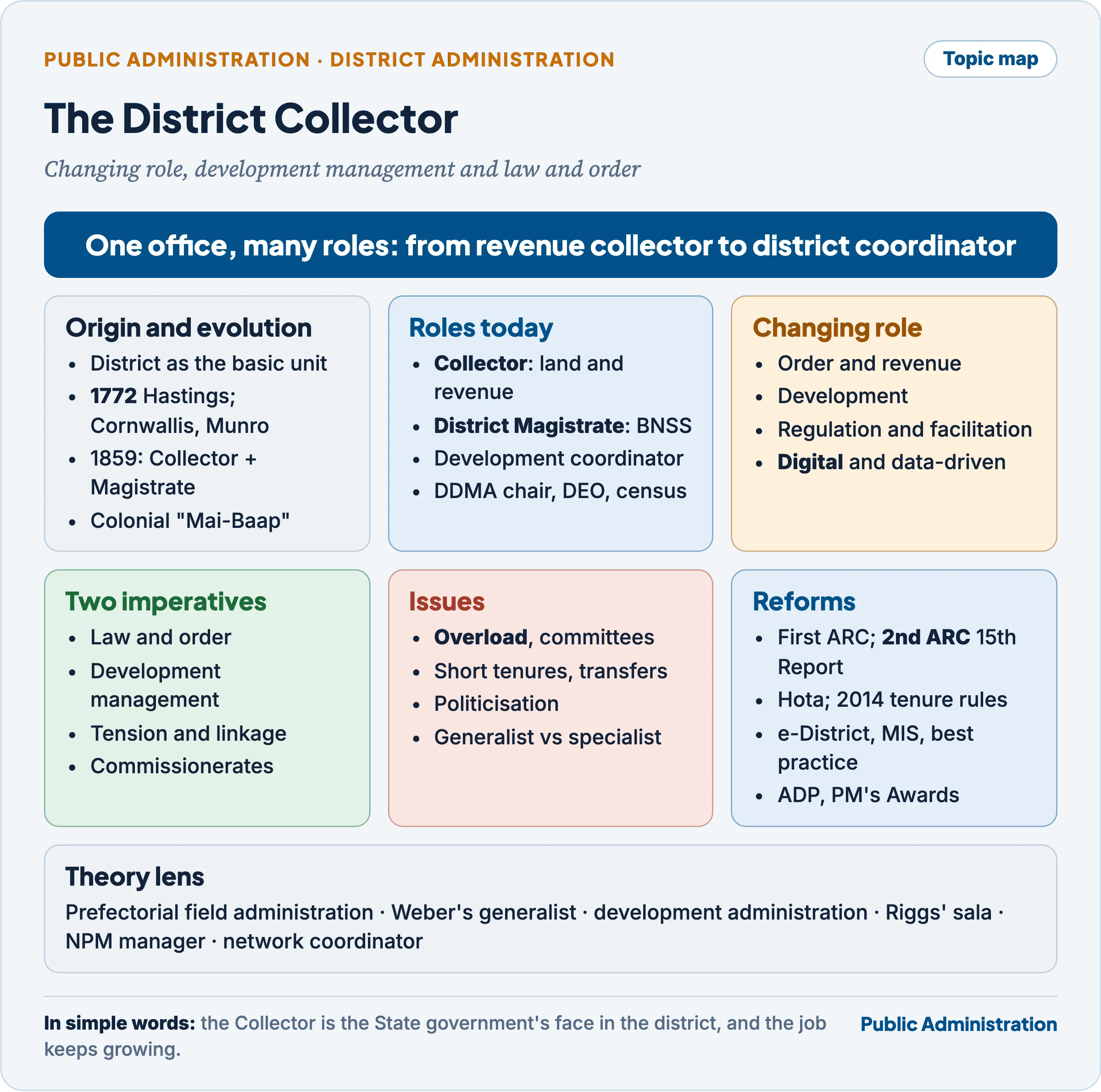
India has more than 770 districts, and in almost every one of them a single officer, called the Collector, District Magistrate (DM) or Deputy Commissioner (DC), stands at the head of the State government’s field administration. The office was created by the East India Company in 1772 to collect land revenue; it survived the end of empire, absorbed the tasks of planning and welfare, and today also carries disaster management, elections, the census, flagship schemes and a growing list of crisis duties.
How this one office balances order and development, regulation and facilitation, and State control and local democracy is the central question of district administration in India. The answer decides how well national policies actually reach the citizen.
In simple words
Think of the captain of a cricket team who is also the groundsman, the umpire on some days and the team manager on others. He keeps order on the field, plans how to win, looks after the pitch and deals with every visitor. The Collector is that captain for the district: the government’s single most visible face, expected to keep peace, deliver schemes and solve whatever problem walks through the door.
1. The District as the Basic Unit of Administration
In simple words
A State is too big to be run from its capital alone, so it is divided into districts. The district is the level where the government’s departments meet the people, and where one officer can see the whole picture at once.
1.1 Meaning of district and district administration
- District. The Oxford Dictionary defines it as “a territory marked off for special administrative purposes”. In India it is the basic territorial unit of general administration, revenue, criminal justice and development.
- District administration. S.S. Khera, a former Cabinet Secretary, in District Administration in India (1964), called it the total management of public affairs within the territorial unit of the district: that portion of public administration which functions within a district’s limits.
- The convenient unit. The First Administrative Reforms Commission’s Study Team on District Administration (1967) described the district as the most convenient geographical unit where the total apparatus of public administration can be concentrated and where it comes into direct contact with the people.
- Size and scale. A district is often as populous as a small country: the median district held about 1.5 million people in 2001, and many now exceed four or five million. Hence the remark, made by Prime Minister Manmohan Singh to District Magistrates in May 2005, that if India lives in its States, it also lives in its districts.
1.2 The district in the Constitution and law
- Original Constitution. The word appeared only in Article 233, which deals with the appointment of district judges.
- After 1992. The 73rd and 74th Amendments placed the district at the centre of local government: the district panchayat (Part IX), municipalities (Part IXA) and the District Planning Committee (Article 243ZD), which consolidates the plans of panchayats and municipalities.
- Creation of districts. Districts are created, merged and abolished by State governments by executive notification under their Land Revenue Codes; no parliamentary law is needed. This flexibility explains frequent and sometimes politically driven reorganisation (section 1.4).
- Designations. The same office is called Collector (revenue role; Tamil Nadu, Maharashtra, Gujarat, Andhra Pradesh), District Magistrate (magisterial role; Uttar Pradesh, Bihar, West Bengal) and Deputy Commissioner (Karnataka, Assam, Punjab, Haryana, Jammu and Kashmir). The office of the Collector is the Collectorate.
1.3 Administration in and below the district
The Collector sits in the middle of a vertical chain that runs from the State capital to the village, while several other chains run beside it.
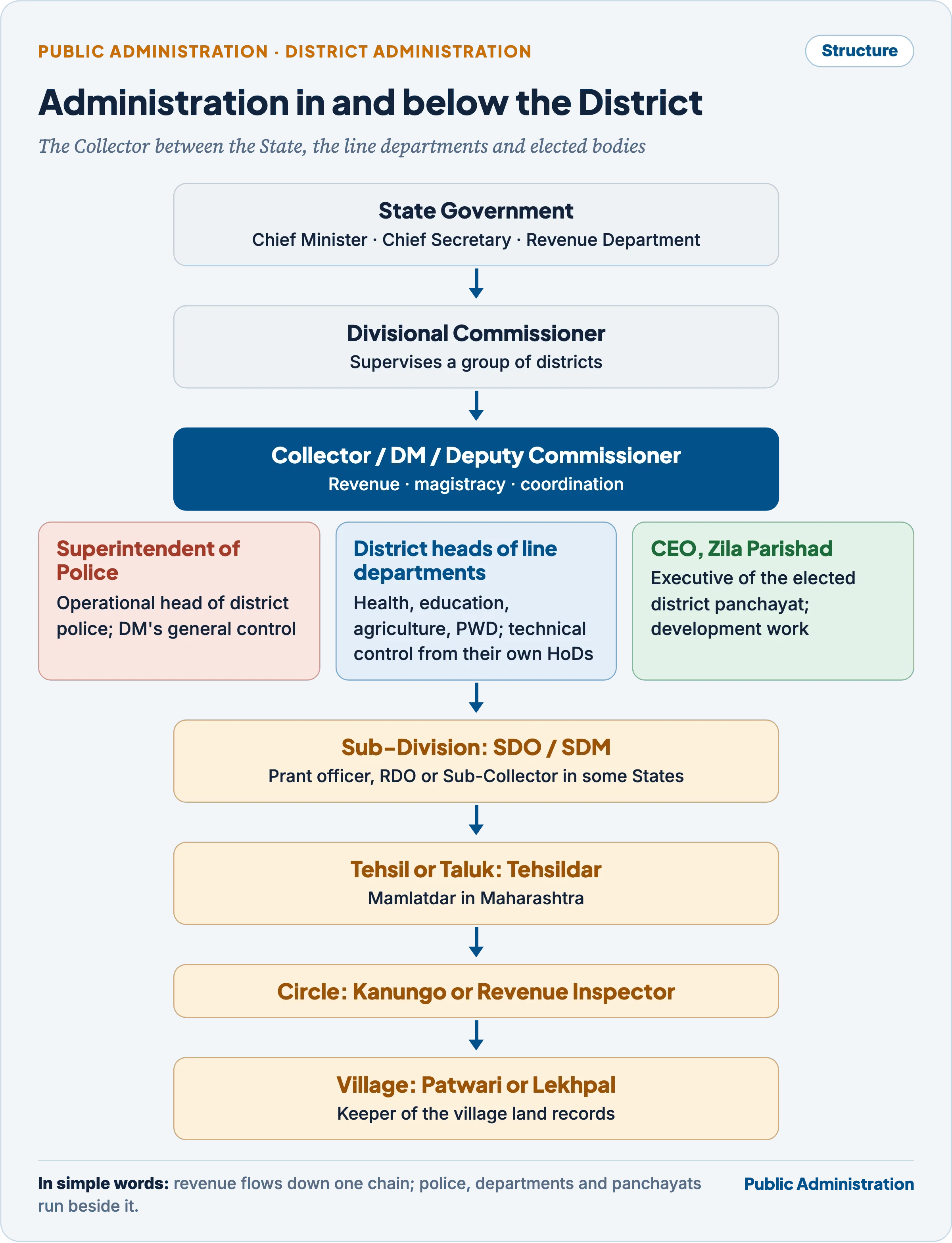
- Above the district. The Collector belongs to the General Administration / Revenue Department, works under the Chief Secretary and the Revenue Department, and in most States is supervised by a Divisional Commissioner (created in Bengal from 1829), who oversees a group of districts.
- Beside the Collector. The Superintendent of Police (police), the District and Sessions Judge (judiciary, under the High Court), the district heads of line departments (health, education, agriculture, public works, forests), and the CEO of the Zila Parishad, the executive of the elected district panchayat.
- Below the district. The chain of revenue and magisterial administration, summarised in the table.
The units below the district carry different names in different States, but their logic is the same everywhere.
| Level | Usual name | Officer in charge | Variants |
|---|---|---|---|
| Sub-division | Sub-division | Sub-Divisional Officer / Magistrate (SDO/SDM) | Revenue division and Sub-Collector or RDO (Tamil Nadu); prant and Prant Officer (Maharashtra) |
| Tehsil | Tehsil or taluk | Tehsildar (with Naib-Tehsildar) | Taluka and Mamlatdar (Maharashtra, Gujarat) |
| Circle | Circle, pargana or firka | Kanungo / Revenue Inspector | Circle Inspector (Maharashtra) |
| Village | Revenue village | Patwari | Lekhpal (Uttar Pradesh), karnam (Tamil Nadu), talathi (Maharashtra) |
- The SDO is a young IAS officer or a State Civil Service officer: a link between the Collector and the Tehsildar in revenue matters, and between the DM and the station house officer in law and order. Sub-divisions are of an office type (the SDO has an office within the sub-division, the common pattern) or a touring type.
- The tehsil is often called a “miniature district“, because the field offices of many departments sit at its headquarters; the Tehsildar is a gazetted State officer with revenue, magisterial and executive powers.
- The patwari keeps the village land records and revenue accounts, and is often called the kingpin of revenue administration.
- A recurring weakness. SDOs and other sub-divisional officers often live at district headquarters rather than in their sub-divisions, which defeats the purpose of the tier and makes citizens travel for small tasks.
1.4 Size and reorganisation of districts
The number of districts has risen from about 300 around Independence to more than 770 today. Whether smaller districts bring better administration is a live question.
- The case for smaller districts. A smaller area reduces the Collector’s span of control, brings the office closer to citizens, allows closer supervision of schemes and police stations, and gives remote or tribal areas their own headquarters. Smaller districts have helped some new States (Telangana, Chhattisgarh) bring administration nearer to people.
- The case against. Each new district needs a Collectorate, police headquarters, courts and staff; new districts often start with vacant posts and no buildings; boundaries can split communities, PRIs and planning units; and an overloaded Collector’s problem lies in the number of functions, not only in area.
- Politico-populist reorganisation: the Rajasthan case. The State notified 17 new districts and 3 divisions on 5 August 2023, shortly before the Assembly election. A review committee of the next government, chaired by retired IAS officer Lalit K. Panwar, found several of them unviable, some with fewer than six tehsils; on 28 December 2024 the Cabinet abolished nine districts and the three divisions, leaving 41 districts and 7 divisions. The episode shows how district creation can follow electoral convenience rather than administrative criteria such as population, area, revenue base and connectivity.
Indian Connect — Criteria for creating districts
No national law fixes criteria for new districts. Sound practice, as reflected in State review committees, looks at population and area, distance from headquarters, number of tehsils and police stations, financial capacity to build offices, social and geographical coherence, and the effect on panchayat and municipal boundaries. A district created without these becomes a signboard rather than an administration.
2. Origin and Evolution of the Collector
In simple words
The British needed one trusted officer in each district to collect taxes and keep order. Over time this officer became the government itself in the eyes of villagers. Independent India kept him but asked him to serve a democracy and to develop the district, not just to rule it.
2.1 Before the British
- Ancient and medieval antecedents. Territorial units existed from the Mauryan period. Under the Mughals the sarkar (district) had a faujdar for law and order and an amalguzar (or karori) for revenue, with the pargana, qanungo and patwari below. The British inherited this revenue structure and placed their own officer over it.
2.2 The colonial Collector, 1772 to 1947
This is a brief summary; the full story is in the article on Legacy of British Rule.
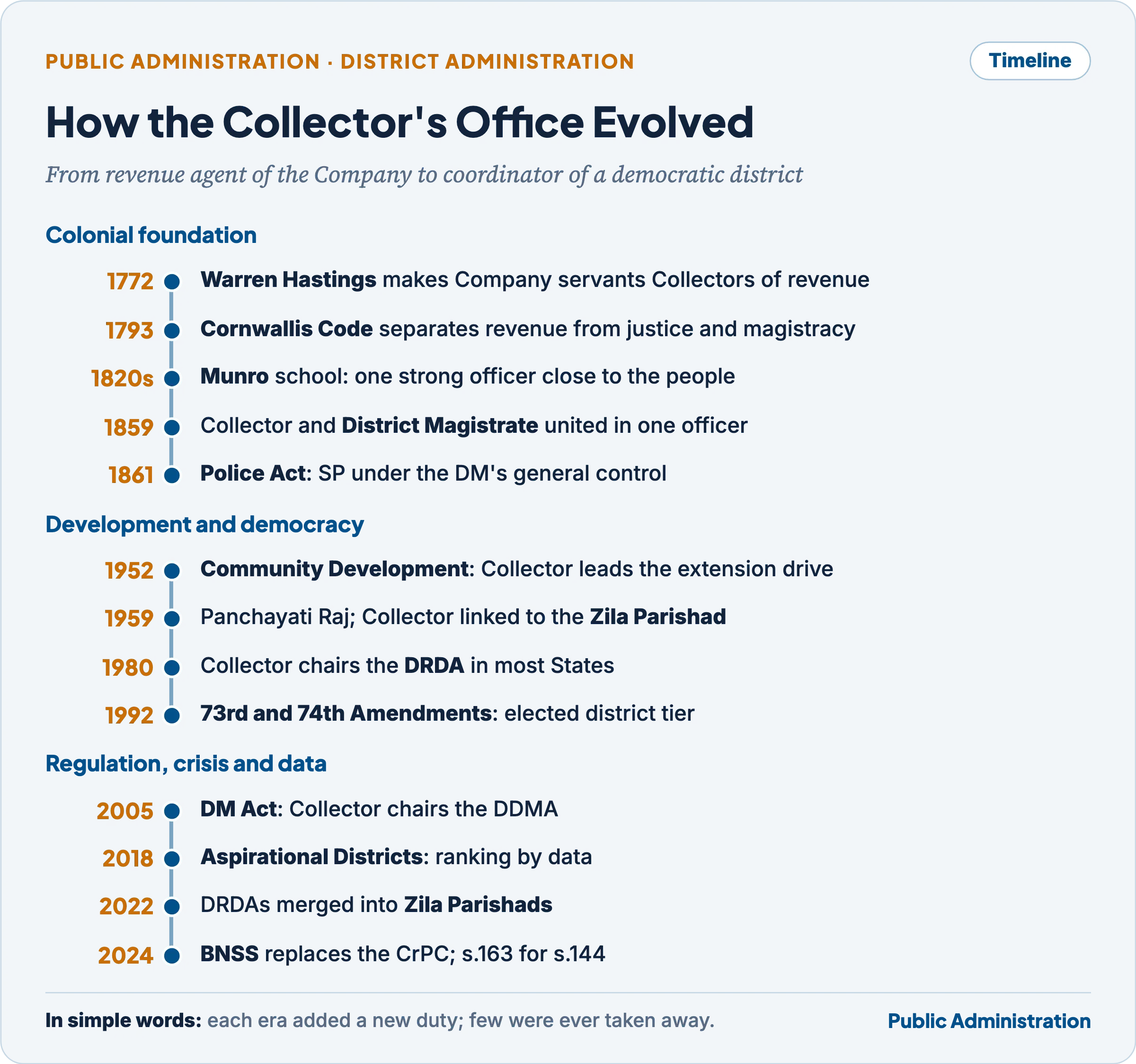
- 1772, Warren Hastings. When the Company decided to “stand forth as Diwan” in Bengal, Warren Hastings made Company servants Collectors of revenue in the districts. The title still records the office’s first purpose.
- 1787. The Collector was given civil justice and magistracy in addition to revenue.
- 1793, the Cornwallis Code. Lord Cornwallis, believing in the rule of law and separation of powers, confined the Collector to revenue and gave civil justice, magistracy and police to a separate Judge-Magistrate. This was the Cornwallis school, tied to the Permanent Settlement with zamindars in Bengal.
- The Munro school. Thomas Munro in Madras, with Elphinstone, Malcolm and Metcalfe, argued for one strong, paternal officer combining revenue, magistracy and police and dealing directly with cultivators under the ryotwari system. Its logic of concentrated authority prevailed in the non-regulation provinces and gradually everywhere.
- 1829 to 1859. Divisional Commissioners were placed over Collectors (1829); magisterial powers returned to the Collector; and in 1859 the Collector and District Magistrate were finally united in one officer.
- 1861, the Police Act. Under section 4 of the Police Act, 1861, the district police, headed by the Superintendent of Police, worked under the general control and direction of the District Magistrate. This created the dual control of district policing that still exists.
- The “little Napoleon”. By the late nineteenth century the Collector-cum-DM was revenue collector, treasurer, magistrate, controller of police and jails, head of local boards and the government’s eyes and ears. The Simon Commission (1930) observed that to most inhabitants the district officer was the government. Ramsay MacDonald compared him to the tortoise on whose back stood the elephant of the Government of India.
- “Mai-Baap”. People came to see the Collector as mother and father (mai-baap), a paternal guardian who could solve land disputes, scarcity, family quarrels and caste conflicts. This image gave the office legitimacy, but it also bred dependence, distance and arbitrariness, which democracy later had to unlearn.
Indian Connect — The Bengal and ryotwari patterns of district administration
The Bengal pattern grew from the Permanent Settlement (1793): revenue was fixed and collected through zamindars, so the Collector had little direct contact with cultivators, village records decayed and the district was large and thinly administered. The Madras and Bombay (ryotwari) pattern settled revenue directly with the ryot, so the Collector’s revenue staff (tehsildar, patwari) reached every village and plot, building a dense, record-based administration. Much of today’s variation in land records and sub-district structure across States still reflects this divide.
2.3 Why the colonial office was “prefectorial”
- Prefectorial system. In a prefectorial system, named after the French prefect, a general representative of the government in each territory supervises and coordinates the field officers of all departments. In a functional system each department runs its own field line from headquarters.
- The British choice. The British superimposed a prefect-like officer on the inherited Mughal district at a time when there were no elected rural local governments at the district level. With nothing to share or check power, all authority converged on the Collector. The French prefect is still regarded as the nearest analogue of the Indian Collector.
- After 1947. India kept this integrated prefectorial core for revenue, law and order and crises, while development sectors developed functional lines and, after 1992, elected district bodies. The result is a mixed system, discussed in the theory lens.
2.4 What changed after Independence
The Collector “admirably survived the historic role of change from an alien regime to a national one”, in a phrase long used to describe the office, but its setting changed in at least ten ways.
- Ends of government. A welfare state replaced a revenue-and-order “police state“; development became the main business of the district.
- Form of government. Parliamentary democracy at the Centre and States made the Collector answerable to elected ministers, and MLAs and MPs became powerful local actors.
- Separation of the judiciary. Article 50 (a Directive Principle) and the Code of Criminal Procedure, 1973 moved criminal trials to judicial magistrates under the High Court, ending the Collector’s role as a trial magistrate.
- Panchayati Raj. From 1959, and constitutionally from 1992, elected Zila Parishads and municipalities became separate centres of power.
- Departmental growth. A large number of technical departments (agriculture, health, cooperation, industries) set up district offices headed by specialists answerable to their own heads of department.
- ICS to IAS. The Indian Administrative Service replaced the ICS, with a broader social base after the spread of education and reservation, and a stated ethos of service rather than rule.
- Political consciousness. Rising awareness, political parties, pressure groups, the media and later RTI and social media made the district officer far more visible and contestable.
- Commissionerates. In large cities, police commissionerates took law and order away from the DM.
Common confusion
Is the District Collector a Union (central) government officer? No. The Collector is usually a member of the Indian Administrative Service, an All India Service recruited by the Union through the UPSC and governed by Union rules (the All India Services Act, 1951). But the Collector is appointed by the State government, holds powers under State laws such as the Land Revenue Code, and works under the State’s control and discipline while posted in the district. The office is a State post; the Union’s influence comes through the cadre rules, centrally sponsored schemes and bodies such as the Election Commission, not through direct command.
3. The Collector’s Roles Today
In simple words
The Collector wears many hats. Some come from laws (revenue codes, the BNSS, the Disaster Management Act, election laws), some from government orders (chairing committees, running schemes) and some from tradition (being the person everyone turns to in trouble).
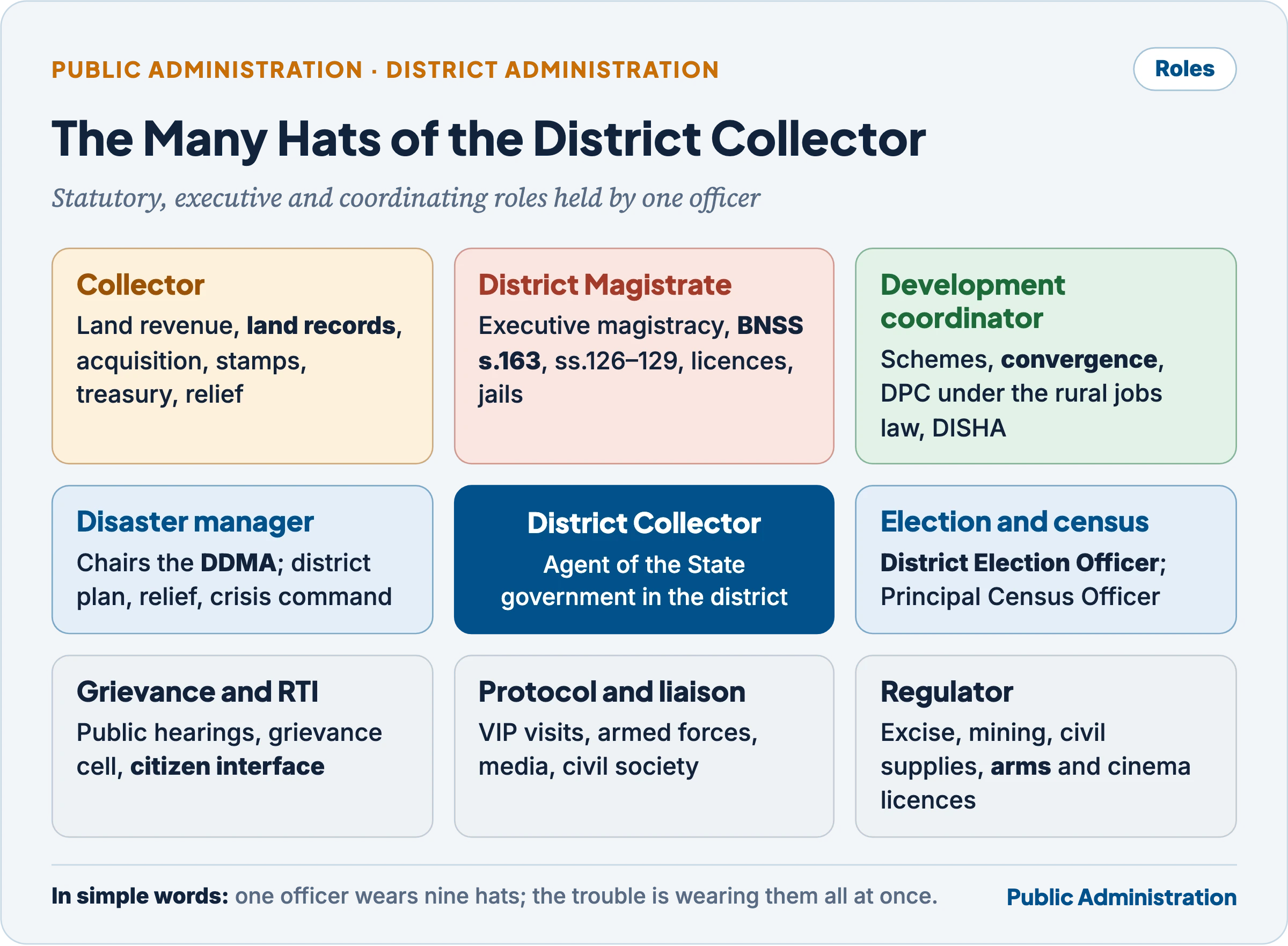
The 2nd ARC’s 15th Report, State and District Administration (2009), listed the portfolio broadly as: head of land and revenue administration and district finance; executive magistracy and overall supervision of law and order; licensing and regulatory authority under special laws; elections; disaster management; guardian of public lands; public service delivery; facilitating civil society–government interaction; local cadre management; and chief information and grievance redressal officer.
3.1 As Collector: land, revenue and relief
Revenue is the oldest function, and although land revenue now yields little money, land administration remains central to every dispute, project and welfare scheme.
- Revenue collection. Land revenue and other government dues recovered as arrears of land revenue (irrigation dues, loans, cesses); stamp duty and registration (in many States); excise (through the District Excise Officer); transport revenue. S.S. Khera stressed two principles: revenue assessed must be collected in full, and in time, or collection soon becomes impossible.
- Land records. Maintenance and revision of records of rights, village maps, mutation registers and crop registers through the patwari–kanungo–tehsildar chain; survey and settlement. Digitisation under the Digital India Land Records Modernisation Programme and the SVAMITVA scheme (2020) for drone mapping of village habitations now runs under the Collector’s supervision.
- Land management. Land acquisition under the Right to Fair Compensation and Transparency in Land Acquisition, Rehabilitation and Resettlement Act, 2013; custody of government land and removal of encroachments; implementation of land reforms and ceiling laws; nazul and government estates.
- Relief. Assessing crop losses, granting gratuitous relief, suspending or remitting revenue, distributing agricultural loans (taccavi) and running relief works in drought, flood and fire.
- Treasury. General supervision of the district treasury and sub-treasuries, periodic verification of balances and reporting to the Accountant General.
- Revenue courts. Hearing revenue appeals against orders of subordinate revenue officers.
Indian Connect — Land records and transparency
Digitised records reduce visits to the patwari and the scope for rent-seeking, but they do not by themselves make the system transparent. Old errors get digitised, mutation may still lag behind sale, the spatial map and the textual record often do not match, and the Collector’s revenue courts remain slow. Real transparency needs survey and resurvey, linked registration and mutation, time-bound services under State Right to Service laws, and ultimately conclusive titles, which the 2nd ARC (11th Report on e-Governance) and the 15th Report both urged.
3.2 As District Magistrate: executive magistracy and law and order
Since the separation of the judiciary, the Collector is an executive magistrate, not a trial magistrate. His law-and-order powers now come from the Bharatiya Nagarik Suraksha Sanhita, 2023 (BNSS), which replaced the CrPC from 1 July 2024.
- Appointment. Under BNSS section 14 (formerly CrPC section 20), the State government appoints Executive Magistrates in every district and designates one of them as the District Magistrate; it may also appoint Additional District Magistrates and place executive magistrates (SDMs) in charge of sub-divisions.
- Preventive and order-maintenance powers. The main sections that the DM and the executive magistracy use are set out below, with their old CrPC numbers.
The BNSS kept almost all the executive magistrate’s preventive powers, but renumbered them; older literature cites the CrPC sections.
| Power | BNSS 2023 | Old CrPC 1973 |
|---|---|---|
| Executive Magistrates and the District Magistrate | s. 14 | s. 20 |
| Security for keeping the peace | s. 126 | s. 107 |
| Good behaviour from persons disseminating certain matters | s. 127 | s. 108 |
| Good behaviour from suspected persons | s. 128 | s. 109 |
| Good behaviour from habitual offenders | s. 129 | s. 110 |
| Dispersal of an unlawful assembly by civil force | s. 148 | s. 129 |
| Conditional order for removal of a public nuisance | s. 152 | s. 133 |
| Urgent orders in cases of nuisance or apprehended danger (prohibitory orders) | s. 163 | s. 144 |
| Dispute concerning land or water likely to cause breach of peace | s. 164 | s. 145 |
- Section 163 orders. The DM, an SDM or a specially empowered executive magistrate may issue written prohibitory orders to prevent obstruction, danger to life or a riot; such an order lasts at most two months, extendable by the State to six months. This is the most visible of the DM’s powers in tense situations.
- Control of the police. Under section 4 of the Police Act, 1861 (and corresponding State Police Acts), the district police is under the SP, subject to the DM’s general control and direction. The SP manages internal organisation, postings, discipline and investigation under the DGP; the DM decides when and where force is needed, receives intelligence, can inspect police stations, and the SP’s annual report passes through him. Some new State Police Acts have dropped the explicit “general control” clause, though people still see the DM as overall in charge.
- Other magisterial functions. Licensing under the Arms Act, 1959, explosives, petroleum and cinematograph laws; preventive detention orders under the National Security Act, 1980 and State laws when empowered; requisitioning the armed forces in aid of civil power; supervision of jails and juvenile homes (parole, classification of prisoners, inspection); enforcement of Essential Commodities orders against hoarding; the annual criminal administration report.
- What was lost. Trial of criminal cases, inspection of trial registers and control of judicial magistrates passed to the High Court and Sessions Judge. A DM’s orders under preventive sections are open to revision by the courts.
3.3 The DM and the SP: dual control
The relationship between the DM and the SP has been debated for over a century, and the debate still turns on one question: how to reconcile the DM’s general supervision with the SP’s operational freedom.
- Colonial roots. Police manuals once treated the SP as the DM’s assistant. The Indian Police Commission (1902–03) under Andrew Fraser kept the DM’s supremacy but asked him not to interfere in departmental management and discipline; the Royal Commission on Decentralisation (1909) favoured stronger district officers. Philip Woodruff, in The Men Who Ruled India, noted that local factions always tried to play the Superintendent off against the Magistrate.
- After Independence. A State police commission in Bihar (1961) concluded that friction, where it existed, came more from clashes of personality than from the system. With rising communal, caste and extremist violence, the DM’s civilian, neutral check on police force was valued, while police reformers argued that dual command causes delay and blame-shifting.
- Current balance. The Prakash Singh v Union of India (2006) directions on police autonomy (State Security Commissions, Police Establishment Boards, minimum two-year tenure for SPs and SHOs) and the separation of investigation from law and order strengthen police professionalism. The DM remains the coordinator of the district’s response to unrest, elections, VIP security and disasters.
3.4 The police commissionerate and its effect on the DM
In a commissionerate, a Commissioner of Police (an IPS officer of DIG rank or above) heads a unified police command for a city and is himself vested with executive magistrate powers (prohibitory orders, licensing, preventive sections), which in districts belong to the DM and SDMs.
The table contrasts the two systems that coexist in India today.
| Dimension | Dual control (districts) | Commissionerate (large cities) |
|---|---|---|
| Command | SP heads police; DM has general control | Commissioner heads a unified command |
| Magisterial powers | With DM and SDMs | With Commissioner and his deputies |
| Speed | Consultation can delay preventive action | Quick decisions in fast-moving urban crises |
| Check on police | Civilian IAS officer as an external check | Concentrated police power; needs strong complaints bodies |
| Accountability | Through DM and SP to State government | Directly to State Home Department |
- Recommendations. The National Police Commission (1977–81) favoured commissionerates for large and rapidly urbanising cities; the Model Police Act, 2006 (drafted by the Soli Sorabjee committee) and the 2nd ARC’s 5th Report, Public Order (2007) recommended them for cities with a population of ten lakh or more.
- Spread. Kolkata, Mumbai and Chennai have had commissioners since colonial times; Delhi adopted the system in 1978; Uttar Pradesh introduced it in Lucknow and Gautam Buddh Nagar (Noida) in January 2020, and later in more cities. More than 60 cities across some 15 States had commissionerates by 2020.
- Effect on the DM. In commissionerate areas the DM loses magisterial and law-and-order powers (in UP, powers under about 15 Acts passed to the police), keeping revenue, elections, disasters, development and protocol. Supporters see clear accountability and faster response; critics fear “police raj“, the loss of a non-uniformed authority citizens can approach, and weaker civilian oversight of force.
3.5 As development administrator
After Independence, the single largest addition to the Collector’s work came from planning and rural development. As Prime Minister Lal Bahadur Shastri put it in 1965, the district officer was to be a commander organising the development drive with clear targets.
- Community Development (1952). The Collector became the district leader of the extension movement; Block Development Officers worked under him. Khera argued that administrative leadership was even more necessary in economic development than in the routine tasks of order and revenue.
- Panchayati Raj after the Balwantray Mehta Committee (1957). The committee proposed that the Collector chair the Zila Parishad. States diverged into three broad patterns (a fuller account is in the article on District Administration, Democratic Decentralisation and Union–State–Local Relations).
- Maharashtra–Gujarat pattern (from the early 1960s): development transferred to the Zila Parishad with a separate senior officer (CEO / District Development Officer, usually IAS) under it; the Collector is confined largely to regulatory administration.
- Tamil Nadu–Rajasthan pattern: the Collector, often designated District Development Officer or Inspector of Panchayats, combines regulatory and development roles; in Rajasthan the Collector sat in the Zila Parishad without a vote and chaired committees.
- West Bengal pattern: the DM has served as Executive Officer of the Zila Parishad, though in practice law and order and protocol left him little time for it.
- The Bihar swing. Bihar shows how the role ebbed and flowed: a 1955 circular made the Collector responsible for all development; a 1973 scheme gave planning and development to a Deputy Development Commissioner of equal rank as CEO of the Zila Parishad; the Emergency (1975–77) brought the Collector back to the centre, including the 20-Point Programme; the Janata years revived PRIs; and after 1980 the Collector again led most programme points. Whatever the design, governments returned to the Collector when they wanted results.
- District Rural Development Agency (DRDA, 1980). A registered society for IRDP, TRYSEM, DWCRA, the Drought Prone Areas and Desert Development Programmes, chaired by the Collector in most States. It combined government authority with a society’s flexibility, but it also became a parallel channel to PRIs. The Union discontinued the DRDA Administration scheme from 1 April 2022 and asked States to merge DRDAs into Zila Parishads, a step that formally moved the district development machinery towards elected bodies.
- Flagship schemes and convergence. The Collector chairs or reviews district bodies for health (the District Health Society under the National Health Mission; the Rogi Kalyan Samiti of the district hospital in many States), education, nutrition, water, housing and sanitation, the District Level Bankers’ Committee reviews and District Industries Centre in some States, and the governing council of the District Mineral Foundation in mining districts. Under the Viksit Bharat–Guarantee for Rozgar and Ajeevika Mission (Gramin) Act, 2025, which replaced MGNREGA from 1 July 2026, section 17 makes the District Collector (or an officer of equal rank) the District Programme Coordinator, responsible for consolidating the district plan, convergence, monitoring and grievance redressal, as the Collector or CEO was under MGNREGA.
- DISHA (2016). The District Development Coordination and Monitoring Committee, set up in June 2016, is chaired by the senior-most Lok Sabha MP of the district, with MLAs, ZP chairperson and others as members, and the Collector as Member Secretary. It monitors about 28 Union programmes and places the Collector in a structured relationship with elected representatives.
- Aspirational Districts Programme (ADP, January 2018). NITI Aayog’s programme for 112 of the least developed districts rests on Convergence (of Union and State schemes), Collaboration (of central and State nodal officers and District Collectors) and Competition (monthly delta ranking on 49 indicators under five themes: health and nutrition, education, agriculture and water resources, financial inclusion and skill development, and basic infrastructure). The Champions of Change dashboard makes the Collector a data-driven manager. The Aspirational Blocks Programme (7 January 2023, 500 blocks) extends the model to block officers under district guidance.
Indian Connect — Field organisations and national missions
Programmes such as MGNREGA (now its 2025 successor) and the Swachh Bharat Mission are designed in Delhi but succeed or fail in the district. The district administration mobilises Gram Sabhas, sanctions works, geo-tags assets, trains frontline workers, settles land and convergence issues and ensures social audit. Where Collectors used campaign methods, community ownership and peer pressure (as in many open-defecation-free drives), outcomes improved quickly; where the field relied on target-chasing and paperwork, assets were poor and toilets went unused. The field organisation turns a scheme into a local programme.
3.6 As disaster manager and crisis administrator
It is in a crisis that the district system is most severely tested, and that the Collector’s authority is least questioned.
- Statutory basis. Under section 25 of the Disaster Management Act, 2005, every district has a District Disaster Management Authority (DDMA) with the Collector / DM / Deputy Commissioner as Chairperson, the elected head of the local authority (usually the Zila Parishad chairperson) as co-chairperson, and an ADM as CEO. The DDMA prepares the District Disaster Management Plan (s. 31), coordinates response, and may requisition resources and premises (s. 34).
- The 2025 amendment. The Disaster Management (Amendment) Act, 2025 (assent 29 March 2025, in force 9 April 2025) requires district plans to be reviewed at least once every two years, provides for a disaster database, and allows Urban Disaster Management Authorities for State capitals and municipal-corporation cities, chaired by the Municipal Commissioner with the Collector as vice-chairperson. It also clarifies that “man-made causes” of disaster exclude law-and-order situations.
- Functions in a disaster. Early warning and evacuation, rescue and relief camps, food and drinking water, health response, requisitioning the armed forces, damage assessment, gratuitous relief under SDRF norms, and rehabilitation. Earlier, the Famine Codes and the Defence of India Rules gave similar crisis powers.
- Leadership. Older administrators described crisis administration as a vibrant response to the unforeseen, not a rigid application of rules; L.S.S. O’Malley observed that crises cannot be met by rule-of-thumb routine and bring out the higher qualities of leadership.
- COVID-19. The pandemic showed the Collector as incident commander. Using the DM Act, the Epidemic Diseases Act, 1897 and prohibitory orders, Collectors declared containment zones, ran district war rooms, organised testing, oxygen and hospital beds, managed migrant movement and later vaccination. Rajasthan’s Bhilwara district became an early model (March–April 2020) of strict curfew, door-to-door screening and contact tracing. The experience also exposed centralised micromanagement, dependence on the Collector’s personal ability, and weak public health capacity below the district.
3.7 As District Election Officer and census officer
- Elections. Under section 13AA of the Representation of the People Act, 1950, the Collector is usually the District Election Officer (DEO), coordinating electoral rolls and the conduct of elections; he is also commonly the Returning Officer for the Lok Sabha seat (s. 21, RP Act, 1951). During elections he works under the Election Commission’s superintendence. In the Special Intensive Revision (SIR) of rolls ordered on 24 June 2025 (Bihar first, then 12 States and UTs from October 2025 with 321 DEOs), the DM hears the first appeal against an Electoral Registration Officer’s decision. Collectors usually also conduct panchayat and municipal elections for the State Election Commission.
- Census. Under section 4 of the Census Act, 1948, States appoint the Collector as Principal Census Officer for the district (the Divisional Commissioner, SDO and Tehsildar get census designations below and above). For Census 2027, India’s first digital census, the house-listing phase began on 1 April 2026 with self-enumeration, and population enumeration is due in February 2027.
3.8 As coordinator, grievance officer and protocol officer
- Coordinator of departments. District heads of specialist departments are technically and administratively answerable to their own directorates, so the Collector coordinates through review meetings, committees and persuasion rather than command. Most State governments value his view, and departments look to him when inter-departmental bottlenecks arise.
- Committees. The Collector chairs a very large number of district committees: a study for DARPG cited by the 2nd ARC found a Deputy Commissioner in Assam chairing 43 committees, and the Commission noted that some Collectors did not know how many committees they chaired or all the laws under which they held powers. He may also head the Red Cross, trusts, colleges and sports bodies.
- Grievance and public interface. Public hearing days (Jan Sunwai, Praja Vani, “Collector’s Grievance Day”), grievance portals and the citizen’s charter of the Collectorate make the office the last local resort for citizens. The 2nd ARC proposed an RTI cell and a computerised grievance cell in every Collectorate.
- Protocol and liaison. Protocol for VIP and VVIP visits, the government’s representative at ceremonial functions, liaison with the armed forces and ex-servicemen, civil defence, and the district’s public relations with the media.
- Other regulatory work. Civil supplies and the PDS (through the District Supply Officer), mining leases for minor minerals, excise, transport, labour laws such as the Bonded Labour System (Abolition) Act, 1976, and supervision of municipalities in some States.
3.9 Articles and Acts governing the Collector’s work
The Collector’s powers are scattered across dozens of laws; the most important are listed here.
| Article / Act | Provision | What it gives the Collector |
|---|---|---|
| Article 50 | Separation of judiciary from executive | Ended trial functions; DM is an executive magistrate |
| Article 233 | District judges | The judicial head of the district is separate from the Collector |
| Articles 243G, 243W, 243ZD | Powers of panchayats and municipalities; District Planning Committee | Define the elected district tier the Collector must work with |
| Police Act, 1861, s. 4 | District police under DM’s general control | Basis of dual control |
| BNSS, 2023, ss. 14, 126–129, 148, 152, 163, 164 | Executive magistracy and preventive powers | Prohibitory orders, bonds, dispersal of assemblies, land disputes |
| State Land Revenue Codes | Revenue administration | Appointment as Collector; revenue courts; land records |
| RFCTLARR Act, 2013 | Land acquisition | Collector as acquiring and award-making authority |
| Arms Act, 1959; Explosives laws | Licensing | Licensing authority |
| Disaster Management Act, 2005, ss. 25, 30, 31, 34 (amended 2025) | DDMA | Chairperson; district plan; emergency powers |
| RP Act, 1950, s. 13AA; RP Act, 1951, s. 21 | Elections | District Election Officer; Returning Officer |
| Census Act, 1948, s. 4 | Census officers | Principal Census Officer |
| VB–G RAM G Act, 2025, s. 17 | Rural employment guarantee | District Programme Coordinator |
| Essential Commodities Act, 1955 | Supply and price control | Action against hoarding; PDS oversight |
| National Security Act, 1980 | Preventive detention | Detention orders when empowered by the State |
4. The Changing Role of the Collector
In simple words
The Collector’s job has changed four times: from ruler and tax-collector, to development leader, to regulator and facilitator in a market economy with elected local bodies, and now to a data-driven crisis manager. Each phase added work without removing much of the old.
4.1 Four phases
The role has moved through four overlapping phases, each with a dominant image of the office.
| Phase | Period | Dominant role | Key drivers |
|---|---|---|---|
| Law and order and revenue | 1772–1947 | Ruler-magistrate, “Mai-Baap” | Colonial extraction and control |
| Development administrator | 1950s–1980s | Leader of planned development, chair of DRDA, often of ZP | Five-Year Plans, Community Development, poverty programmes |
| Regulator and facilitator | 1990s–2000s | Coordinator alongside elected PRIs and markets | 73rd/74th Amendments, liberalisation, PPPs |
| Digital, data and crisis manager | 2005 onwards | Outcome manager, DDMA chief, platform-based service deliverer | DM Act, e-governance, ADP dashboards, COVID-19 |
- Phase one. Revenue and order were the purpose; the welfare of subjects was incidental. The Collector was distant, powerful and paternal.
- Phase two. The Five-Year Plans made the district the operational unit of development. Area programmes (DPAP, DDP, Command Area Development) and beneficiary programmes (IRDP, TRYSEM) put the Collector at the centre. Revenue became the least important of his tasks, as Prime Minister Manmohan Singh later told DMs.
- Phase three. After 1991, the State moved from provider to regulator and facilitator, and after 1992 PRIs became a constitutional third tier. The Collector’s expected role became enabler: attracting investment, ensuring ease of doing business (land, permissions, utilities), building public–private partnerships, protecting the weaker sections from the uneven effects of globalisation, and forging consensus among competing groups. In this view the district administration must be partisan in favour of the poor to be truly neutral in an unequal society.
- Phase four. Since the DM Act (2005), the Collector has become crisis manager-in-chief; since the National e-Governance Plan (2006) and the ADP (2018), a manager of indicators, dashboards and platforms; since COVID-19, an incident commander. New skills are expected: human resource management, strategic planning, financial management, data analysis and communication.
4.2 Changed but not diminished?
- Diminished in some respects. Judicial functions went to the judiciary; development in several States went to ZPs and line departments; law and order in big cities went to commissionerates; the SP and specialists gained autonomy; elected representatives and the media constrain discretion. Some observers predicted that the CEO of the Zila Parishad would become the most influential official and the Collector would “sink into oblivion“.
- Not diminished in others. Every new national priority (elections, disasters, flagship schemes, the census, COVID-19, voter roll revision) has been routed through the Collector. As the only official with horizontal authority across departments, legal powers, and public recognition, the office remains the linchpin of district administration outside the metropolises.
- Additional function: guiding democratic bodies. The Collector must now carry conviction with elected Zila Parishads, MLAs and MPs, rather than command. In Richard Park’s observation, people in many districts saw a strong Collectorate as protection against capture of local funds by local politicians, which is why the office kept its legitimacy even as democracy deepened.
- Why the office survived the transition. It was adaptable (it absorbed each new task), neutral (an All India Service officer from outside local factions), legally anchored (dozens of statutes), trusted by citizens and useful to politicians who wanted visible delivery. The “steel frame” bent rather than broke.
Common confusion
Has the Collector become merely a “post office” for government schemes and an “officer in attendance” on VIPs? Partly. Studies and the 2nd ARC itself found Collectors overwhelmed by review meetings, data reporting, protocol and committee work, leaving little time for independent judgement or field inspection, and the “bureau for funnelling schemes” description captures this. But the description is incomplete: the Collector still exercises real statutory power (land, prohibitory orders, licences, disaster powers, elections), resolves inter-departmental deadlocks, and in programmes like the ADP and crisis response shows initiative that changes outcomes. The 2nd ARC’s answer was not to abolish the office but to realign it around core functions and coordination, and to shed what PRIs and departments can do.
4.3 From hierarchy to teamwork
- Old style. The Collector as commander at the top of a hierarchy of revenue and magisterial officials, issuing orders.
- New demands. Development and service delivery depend on specialists (doctors, engineers, agronomists), elected representatives, SHGs, NGOs, CSR foundations and community volunteers who are not the Collector’s subordinates. Results come from teams that cut across hierarchies: ADP’s district “champions of change” teams, mission-mode cells for sanitation or nutrition, disaster task forces, district war rooms.
- Meaning for the Collector. Leading by persuasion, shared data and trust, giving each agency breathing space, removing bottlenecks and building a unity of purpose. Mary Parker Follett’s “power with” rather than “power over” and Chester Barnard’s acceptance theory of authority describe this shift; see the articles on Mary Parker Follett and Chester Barnard.
- Limits. Teamwork does not remove the need for hierarchical authority in emergencies, law and order and statutory decisions; the art is to switch between the two modes.
5. Development Management and Law-and-Order Administration
In simple words
The district administration has two big jobs: keeping the peace and making life better. The first needs firmness and quick orders; the second needs patience, money and people’s cooperation. The same officer has to do both, and the two jobs sometimes get in each other’s way.
5.1 Key concepts
- Law-and-order administration. Maintenance of public order and security: prevention of breaches of peace, riot control, regulation of assemblies, licensing, and coordination with police and courts. It is regulatory and coercive, works on short time horizons and is judged by incidents prevented.
- Development administration. The term is credited to U.L. Goswami (1955) and popularised by Edward Weidner (Development Administration: A New Focus for Research, 1962) and Fred Riggs: administration oriented to goals of socio-economic change and nation-building, as against the maintenance-oriented administration of the colonial state. See the article on Development Administration.
- Development management. A later, more managerial idea associated with writers such as Derick Brinkerhoff and Jennifer Coston (1999): achieving development objectives with optimum use of limited resources, through results-based management, stakeholder participation and capacity building, and building self-sustaining, client- or customer-friendly local institutions (SHGs, water user associations, school management committees, panchayats) that continue after a scheme ends. At the district level it means outcome dashboards, convergence, participatory planning and accountability to users.
Indian Connect — Self-sustaining institutions in the district
Development management in an Indian district looks less like a Collector running schemes and more like the Kudumbashree network of women’s groups in Kerala, village water and sanitation committees that own and maintain piped supply under the Jal Jeevan Mission, or Rogi Kalyan Samitis that let district hospitals raise and spend user fees. The Collector’s role is to create, train and protect such institutions, then step back; institutions that depend on one officer’s enthusiasm fade when he is transferred.
5.2 The two imperatives compared
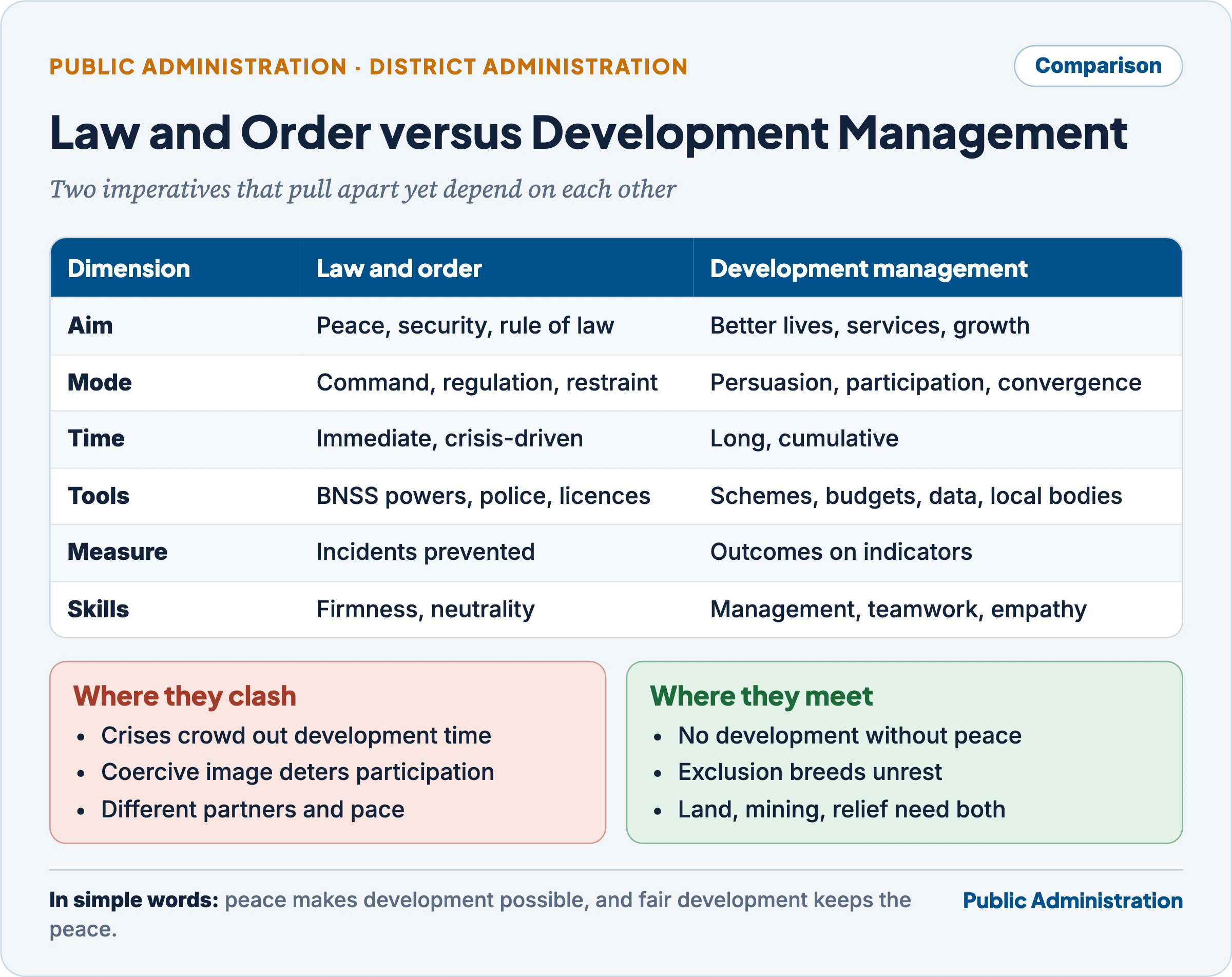
- Aim and mode. Order is about restraint and command; development about persuasion, participation and convergence.
- Time and attention. Law and order is urgent; development is important but deferrable. In practice, the urgent crowds out the important.
- Partners. Order is pursued with the police and magistracy; development with departments, PRIs, banks, NGOs and communities.
- Image. A coercive image may deter the trust that participatory development needs; a welfare image may weaken the authority needed in a riot.
5.3 The dichotomy and the interdependence
District administration in India has long been organised as if the two functions were separate, while in reality they depend on each other.
- Sources of the dichotomy.
- Colonial legacy: the district was built for revenue and order; development was added on top through separate agencies (CD blocks, DRDAs, missions).
- Structural separation: in Maharashtra–Gujarat-type States, regulatory functions stay with the Collector and development goes to the ZP; police commissionerates separate order from the rest of urban administration.
- Separate career and reporting lines: the SP reports to the DGP, line officers to their directorates, the CEO to the ZP and Panchayati Raj department, the Collector to the Revenue department.
- Different performance metrics: incidents and crime figures versus scheme indicators.
- Time pressure: recurring law-and-order and protocol demands leave the Collector little time for development, a point the 2nd ARC made explicitly.
- Why the two are interdependent.
- No development without peace: investment, schools, health camps and road works stop in districts affected by riots, insurgency or Left-Wing Extremism.
- No lasting peace without fair development: land alienation, displacement, unemployment and exclusion of tribals and Dalits generate unrest; the approach to LWE-affected districts treats roads, mobile towers, banking and schools as security measures as much as development ones.
- Shared instruments: land acquisition, mining, encroachment removal, relief and rehabilitation all need both regulatory force and developmental sensitivity in the same decision.
- Crisis as both: a flood, epidemic or communal flare-up is simultaneously an order problem and a welfare problem.
- Reconciling them. Keep one coordinating authority for both in the district; give the Collector adequate deputies (ADMs for law and order, CEO/ADM for development); use integrated district plans linking security and development in sensitive areas; and adopt community policing and participatory development so that each supports the other.
5.4 Separating regulatory and development functions: the debate
Several States removed development from the Collector to protect PRIs and lighten his load; others kept them together. The question is whether the separation helped or harmed.
- Case for separation.
- It frees the Collector for regulation, order and crisis, where his statutory role is unique.
- It gives elected PRIs real control over development (the Maharashtra–Gujarat and Kerala experiences) and avoids a powerful official dominating elected leaders.
- Development needs continuity and specialisation, which a separate CEO or DDO can supply.
- The Ashok Mehta (1978) and G.V.K. Rao (1985) committees favoured giving district development to the ZP and a separate officer (the G.V.K. Rao Committee proposed a District Development Commissioner).
- Case against (or for a relook).
- Development depends on regulatory inputs (land, encroachment, law and order, licences), so separation causes delay and buck-passing.
- The CEO lacks the Collector’s horizontal clout, so line departments do not cooperate; PRIs lack funds, functionaries and capacity, so devolved development stagnates.
- In practice the separation is incomplete: Collectors still chair DISHA, run flagship schemes, head ADP efforts and receive MPLADS/MLALADS funds, producing ambiguity rather than clarity.
- Experience (Bihar’s swings, the Emergency, ADP) shows governments return to the Collector when they want results, suggesting that separation weakened both the Collector and development administration.
- The middle path. The 2nd ARC (6th and 15th Reports) sought a “golden mean“: empower the elected District Council while fully using the institutional strength of the Collector, by making the Collector its Chief Officer in the interim, accountable to the Council on local matters and to the State on regulatory matters.
6. Issues and Challenges in the Collector’s Office
In simple words
The Collector’s office is overloaded, moved around too often, pulled by politics, staffed by officers who may be too young for hard districts, and asked to be an expert at everything. These problems, more than any law, decide how well a district is run.
6.1 Overload and role diffusion
- Too many functions without clear definition. The 2nd ARC found that the Collector’s widespread functions without well-defined roles cause lack of clarity and diffusion of responsibility; Collectors were sometimes unaware of all the statutes under which they held powers.
- The tortoise and the elephant. The old image of a small tortoise carrying the elephant of government still fits: one office carrying revenue, magistracy, elections, census, disasters, dozens of committees, scores of schemes and endless reviews by State and Union departments.
- Officers in attendance. Protocol, VIP visits, video conferences and data reporting consume time; tours and inspections, once the core of district administration (the “tent is mightier than the pen” tradition and the detailed inspection notes that fed the old District Gazetteers), have declined.
- Consequences. Firefighting instead of planning, superficial reviews, dependence on subordinates, and inter-role conflict between order, development and protocol.
6.2 Short tenures and frequent transfers
- Evidence. Lakshmi Iyer and Anandi Mani (“Traveling Agents”, Review of Economics and Statistics, 2012), studying IAS career data from 1980 to 2004, found an average tenure of about 16 months in a post, a 53 per cent annual probability of transfer, and that only 56 per cent of District Officers stayed more than a year. Transfers rose with changes of Chief Minister or ruling party. David Potter found that even in 1936 two-thirds of district officers had held their posts for under a year.
- Effects. Officers cannot learn the district, projects and innovations lapse when they leave (a point the 2nd ARC made about best practices), subordinates wait out unpopular officers, and transfers become a tool of political control.
- Responses. The Hota Committee (2004) recommended assured tenure and statutory Civil Services Boards; the Supreme Court in T.S.R. Subramanian v Union of India (31 October 2013) directed minimum fixed tenure and Civil Services Boards; the IAS (Cadre) Amendment Rules, 2014 (notified 28 January 2014) require a cadre officer to hold a post for at least two years, with premature transfers only on the Civil Services Board’s recommendation, which the competent authority may override with recorded reasons. Compliance remains uneven because the override clause is often used.
6.3 Politicisation
- Pressures. MLAs and ministers seek favourable postings, transfers of subordinates, land and licence decisions, and control over scheme beneficiaries. Caste affinity with the ruling party, Iyer and Mani found, can influence who gets important posts.
- Risks. Erosion of neutrality, selective enforcement of law (encroachments, prohibitory orders), and a “committed bureaucracy” in the negative sense.
- Counterweights. Fixed tenure, Civil Services Boards, RTI, judicial review, the Election Commission’s control during polls, and a professional ethic of the All India Services.
6.4 Generalist versus specialist
- The generalist rationale. The IAS is a multipurpose service: the same officer moves from district to secretariat to corporation. The Collector’s value lies in breadth, judgement and coordination, in line with Max Weber’s picture of the trained, impersonal official and the British tradition of the “intelligent amateur“.
- The critique. District problems now involve public health, climate risk, data systems, finance and engineering. A young generalist may be insulated from contemporary professionalism, dependent on specialists, and slow to adopt modern management. The Fulton Committee (UK, 1968) made the same criticism of the British administrative class.
- Towards a balance. Domain competencies through Mission Karmayogi (2020) and role-based training, lateral expertise in district teams (data analysts, fellows such as ADP fellows), and the Collector as integrator of specialist inputs rather than a specialist himself. See the article on Bureaucracy and Democracy, Bureaucracy and Development.
6.5 Young Collectors and district training
- Early postings. In many States IAS officers become Collectors after about four years of service, having held only an SDM post. The 2nd ARC felt that complex, populous or problem-prone districts need officers with 10–12 years of service.
- Induction training. The two-year induction of IAS officers includes Phase I at the LBSNAA, district training of about a year in the allotted State, an Assistant Secretary attachment in Union ministries (started in 2015 with the 2013 batch; now an eight-week integral component) and Phase II. The Thorat study team (1967) of the First ARC and the V.T. Krishnamachari Committee (1962) had already stressed training under carefully selected Collectors, a spell as additional BDO, and casework in law and order.
- Why it needs revisiting. District training quality depends on the Collector’s time and interest; trainees are sometimes used as extra hands; exposure to modern tools (data, digital platforms, disaster management, financial management) is uneven; and feedback loops between field training and the academy are weak. Suggestions include structured mentoring, assignment-based learning with outcomes, sub-district charge with real responsibility, and alignment with Karmayogi competencies.
6.6 Relations with elected bodies and representatives
- With PRIs. After the 73rd Amendment, ambiguity persists: PRIs say Collectors control panchayat staff, funds and approvals (as Inspectors of Panchayats or through the District Panchayat Officer) and treat them as subordinate; Collectors say PRIs lack capacity and are prone to elite capture. The Constitution did not define the Collector’s role in the new set-up, so each State drew its own line. This is treated in full in the article on District Administration, Democratic Decentralisation and Union–State–Local Relations.
- With MLAs and MPs. Legislators increasingly drive local development through MPLADS/MLALADS, DISHA and their influence on postings, creating a parallel political channel that can bypass PRIs.
- Union–State–local layering. The Collector is a State officer implementing Union-designed schemes through local bodies, making him the meeting point of three levels of government; overlapping funds and reporting lines complicate accountability. Again, detail belongs to the companion article.
6.7 Challenges facing district administration as a whole
Because almost every Union and State programme lands in the district, the district administration faces challenges beyond the Collector’s own office.
- Scheme proliferation with separate guidelines, portals and reporting formats; fragmented funding (centrally sponsored schemes, State schemes, MPLADS, DMF, CSR).
- Capacity gaps: vacancies at block and village level, weak technical staff, poor data quality.
- Coordination failures among line departments, PRIs, ULBs and parastatals (the 2nd ARC warned that parastatals should not undermine PRIs).
- Accountability deficits: weak social audit, grievance backlogs, corruption at the cutting edge (the 2nd ARC found vigilance a neglected component in districts employing more than ten thousand State employees on average).
- New risks: climate extremes, cybercrime, misinformation, urbanisation of rural districts, and migration.
7. Committees, Reforms and Modernisation
In simple words
Since Independence, many commissions have asked what the Collector should do. Their common answer: keep the office, define its core clearly, give it modern tools and stable tenure, and let elected local bodies grow alongside it.
7.1 Major committees and their views on the Collector
- Balwantray Mehta Committee (1957). Recommended democratic decentralisation and proposed that the Collector chair the Zila Parishad to lead development.
- V.T. Krishnamachari Committee (1962), on Indian and State Administrative Services and Problems of District Administration. Urged expansion of the IAS cadre for development needs, coordination of elective and administrative elements and of administrative and technical services in the district, and better district training of IAS probationers (training under carefully selected Collectors, 18 months in the State, a spell as additional BDO).
- First ARC (1966–70), chaired by Morarji Desai and then K. Hanumanthaiya. Its Study Team on District Administration (1967) examined the district machinery; its Report on State Administration (1969) carried its conclusions, and the Thorat study team (1967) on recruitment and training recommended a one-year district attachment under an experienced Collector.
- Ashok Mehta Committee (1978) and G.V.K. Rao Committee (1985). Moved district development towards the Zila Parishad and proposed a District Development Commissioner as its chief executive; the Collector’s development role would shrink.
- Hota Committee on Civil Services Reforms (2004), chaired by P.C. Hota. Recommended assured tenure, statutory Civil Services Boards, an ombudsman for premature transfers, and career planning in which officers spend early years in rural areas and are posted to small districts on first promotion.
- 2nd ARC, 6th Report, Local Governance (2007). Proposed a single elected District Council for rural and urban areas as the District Government, with the Collector as its Chief Officer in the interim.
- 2nd ARC, 15th Report, State and District Administration (2009). The fullest recent review of the Collector’s office (below).
7.2 The 2nd ARC’s 15th Report on the Collector
- Realign functions so that the Collector concentrates on core functions: land and revenue administration, law and order, disaster management, public distribution and civil supplies, excise, elections, transport, census, protocol, general administration, treasury management and coordination with agencies and departments.
- Job profile in three parts: (a) a well-defined set of exclusive statutory and non-statutory functions for the State; (b) the general work of coordination with State and Union agencies at the district level; (c) in the interim, the Chief Officer of the proposed District Council, fully accountable to it on local matters and to the State on regulatory matters not delegated.
- Experience before posting: officers may be posted as DMs early, but in complex and problem-prone districts only after 10–12 years of service.
- Modernise the Collectorate through an MIS for monitoring programmes under the Collector’s direct charge; a computerised District Grievance and Public Feedback Cell linked to field offices and kiosks; a Vigilance Cell liaising with the State Vigilance Commission; revival of tour inspection notes and institutional memory; a civil society and media cell; and a special RTI cell.
- Process re-engineering and IT: an e-District framework, codified rules and procedures, standard forms, delegation to avoid file movement, a central district database, computerised land records, front-end service centres, online grievance tracking and networking of the Collectorate with sub-district offices.
- Land titles: move to a land title management system, as recommended in the 11th Report on e-Governance.
- Document and institutionalise best practices, so that innovations do not die with the officer’s transfer.
Indian Connect — Best practices from the districts
- SCORE, Muzaffarpur (Bihar). The busiest registration office in Bihar, handling 150–200 documents a day, introduced digitised registration in December 2005, so that deeds could be registered and returned the same day, with transparent procedures.
- Total Sanitation Campaign, Surguja (Chhattisgarh). In a large, poor, tribal district with high infant mortality, the district administration used a model of convergence in which health, education, panchayats and rural development worked together with communities: more than 85,000 household toilets and 2,703 school sanitation complexes in 256 panchayats, with communities monitoring construction and fining defaulters; teacher attendance and hygiene improved.
- Service centres. Early one-stop citizen centres such as Jan Seva Kendras (Ahmedabad), Mahiti Shakti Kendras (Panchmahal), Saukaryam (Visakhapatnam) and Lok Mitra (Hamirpur) showed what the e-District model later generalised. The 2nd ARC observed that such initiatives were mostly individual-driven and poorly replicated, and asked States to provide a holistic framework.
7.3 Modernisation since the 2nd ARC
- e-District. A Mission Mode Project under the National e-Governance Plan (2006) for high-volume district services (certificates, pensions, revenue court cases, ration cards, grievances), now largely delivered through Common Service Centres and State portals, often under Right to Service laws with fixed timelines.
- e-Office and dashboards. Paperless files, CM dashboards, PRAGATI-style reviews, and the ADP’s Champions of Change dashboard turn the Collectorate into a data-driven office.
- Land records and courts. DILRMP, SVAMITVA property cards, online revenue court case management, and integration of registration and mutation.
- Recognition. The Prime Minister’s Awards for Excellence in Public Administration (instituted 2006) now reward districts for holistic development under priority programmes, Aspirational Blocks and innovation; for the 2024 cycle, 710 districts (92 per cent) registered, and 16 awards were conferred on Civil Services Day, 21 April 2025 with an incentive of Rs 20 lakh each.
- Capacity building. Mission Karmayogi (2020) and the iGOT platform for role-based competencies of district officials.
8. Emerging Frontiers: Climate Change and the Collector
In simple words
Floods, heatwaves, droughts and cyclones are becoming more frequent. The district is where these hit people first, so the Collector must prepare before disaster, not only respond after it.
8.1 Why climate change is a district problem
- Local impact. Heatwaves, erratic monsoons, floods, cyclones, landslides and droughts strike specific districts and specific groups (farmers, outdoor workers, coastal fishers, urban poor), and their effects (crop loss, water scarcity, disease, migration) land on district institutions.
- From relief to risk reduction. The DM Act (amended 2025) defines disaster management to include disaster risk reduction, and requires district plans to be reviewed at least every two years, pushing DDMAs from relief towards preparedness and mitigation.
8.2 What a proactive district administration does
- District Heat Action Plans. Many DDMAs now issue annual heatwave action plans (shifting working hours, cooling centres, drinking water points, hospital preparedness, alerts); the NDMA, which had about 250 city heat action plans by 2025, has sought to extend them to districts with financing mechanisms.
- Health adaptation. Under the National Programme on Climate Change and Human Health (2019), districts have a District Nodal Officer for climate change, a District Multisectoral Task Force and a District Action Plan on Climate Change and Human Health, with heat-illness and respiratory-illness surveillance.
- Water and land. Convergence of rural employment works, watershed and Amrit Sarovar-type water bodies, crop diversification, contingency crop plans and climate-resilient infrastructure in district plans.
- Early warning and communication. Using IMD alerts, common alerting protocols and community networks to reach the last village; hazard-specific nodal departments, which the 2025 amendment asks States to notify.
- Mainstreaming. Climate screening of district projects, protection of wetlands, forests and floodplains from encroachment (a regulatory function), and air-quality action in polluted districts.
8.3 Constraints
- Short tenures and crisis-driven attention favour response over prevention.
- Scattered funds and departments: climate action falls between agriculture, water, health, forests, disaster management and urban bodies.
- Data and skills gaps in risk assessment; weak ULB and PRI capacity.
- The Collector’s coordinating role is therefore central: climate adaptation is a classic whole-of-government, place-based task.
Criticism — Criticism: the Collector as an imperial anachronism
- Colonial origin and ethos. An office built for revenue extraction and control, with a “Mai-Baap” paternalism ill-suited to citizens who are rights-holders.
- Contradicts democratic decentralisation. A powerful, unelected officer overshadows elected Zila Parishads and municipalities (Articles 243G and 243W), retains control over their staff and approvals, and channels scheme funds around them.
- Overloaded and diffuse. Too many functions, too many committees and too little time make supervision superficial and reduce the office to an officer in attendance.
- Generalist and transient. Young generalists with 16-month average tenures cannot master complex districts or sustain reform.
- Politicised. Transfers and postings used as rewards and punishments undermine neutrality.
- Centralising. The office makes the district dependent on one person’s ability, blocking the growth of other local institutions; the Commission itself noted the view that the institution should gradually recede into a land revenue functionary responsible to local bodies.
Defence — Defence: the Collector as an indispensable linchpin
- Neutral arbiter. In districts divided by caste, community and party, an All India Service officer from outside local factions offers impartiality and protects weaker sections against elite capture.
- Horizontal coordination. Line departments work in vertical silos; only the Collector has the legal standing and recognition to make them work together, as convergence programmes and the ADP show.
- Crisis authority. Disasters, epidemics, riots and elections need single-point command; the DM Act, the BNSS and election law all rely on it, and COVID-19 proved its value.
- Statutory anchor. Dozens of Union and State laws vest powers in the Collector; replacing them would be costly and disruptive.
- Adaptability. The office has absorbed every new national priority and moved from ruler to facilitator, manager and coordinator.
- Reform, not abolition. The 2nd ARC chose a golden mean: realign core functions, modernise the Collectorate and use the Collector to empower the District Council rather than oppose it.
Theory lens: the Collector through Paper I ideas
- Prefectorial versus functional field administration. James Fesler (Area and Administration, 1949) contrasted area-based (prefectorial) and function-based field systems; Robert Fried (The Italian Prefects, 1963) distinguished integrated prefectorial systems (France, British India), where the prefect commands departmental field officers, from unintegrated ones (Italy), where he only coordinates. The Indian Collector began as an integrated prefect and has become a partly unintegrated one: commanding revenue and magistracy but only coordinating specialist departments and PRIs. See the article on Structure and Forms of Public Organisations.
- Weber’s generalist bureaucrat. Max Weber (Economy and Society, 1922) described legal-rational authority exercised by trained, impersonal officials appointed on merit with career tenure. The Collector’s statutory powers, hierarchy and neutrality fit this ideal; the “Mai-Baap” image and personal charisma of district officers show traditional and charismatic elements alongside it. The generalist–specialist debate questions whether Weber’s trained official must also be a domain expert. See the article on Weber and Bureaucracy.
- Development administration. U.L. Goswami (1955) and Edward Weidner (1962) defined administration as an instrument of planned change; the Collector as change agent in Community Development, IRDP and ADP is the Indian embodiment, while Riggs warned that a bureaucracy pursuing development without political checks may become self-serving. See the article on Development Administration.
- Riggs’ sala, formalism and overlapping. Fred Riggs (Administration in Developing Countries, 1964) described the prismatic sala: modern structures coexisting with family, caste and patronage. The Collectorate shows formalism (laws and charters on paper, uneven practice), overlapping (land and posting decisions shaped by caste, kin and party), and poly-normativism (citizens and officials switching between legal and personal norms). See the article on Riggsian Models.
- NPM and the managerial Collector. Christopher Hood’s (1991) New Public Management, with its stress on results, competition and performance measurement, explains the ADP’s delta ranking, outcome dashboards, service-level guarantees and award competitions; critics warn of indicator-chasing and neglect of what is not measured. See the article on New Public Management and After.
- Network governance and the Collector as coordinator. R.A.W. Rhodes (Understanding Governance, 1997) and Stephen Osborne’s New Public Governance describe governing through networks of public, private and voluntary actors. The modern Collector steers networks (SHGs, NGOs, CSR foundations, banks, PRIs) more than he commands a hierarchy, which is why teamwork and trust matter; Barnard’s acceptance theory explains why such authority rests on consent.
- Principal–agent and public choice. Iyer and Mani’s finding that politicians use transfers to control bureaucrats is a principal–agent problem: elected principals with short horizons, bureaucratic agents with career concerns. Fixed tenure and Civil Services Boards are devices to realign incentives. See the article on New Public Administration and Public Choice.
- Democratic decentralisation theory. The subsidiarity principle (functions at the lowest competent level) underlies the 2nd ARC’s District Council and the transfer of development to PRIs; the Collector’s future is as an enabler of local self-government, not its rival. See the article on District Administration, Democratic Decentralisation and Union–State–Local Relations.
Key Terms
| Term | Meaning in simple words |
|---|---|
| Collector | Head of district administration; named after the original task of collecting land revenue |
| District Magistrate (DM) | The Collector as chief executive magistrate, responsible for law and order |
| Deputy Commissioner (DC) | Name for the same office in Karnataka, Assam, Punjab, Haryana and some other States |
| Collectorate | The Collector’s office, divided into sections (revenue, land records, elections, relief, etc.) |
| Divisional Commissioner | Officer supervising a group of districts on behalf of the State |
| SDO / SDM | Sub-Divisional Officer or Magistrate, in charge of a sub-division |
| Tehsildar | Revenue and executive officer of a tehsil or taluk |
| Patwari | Village accountant who keeps land records |
| Executive magistrate | Non-judicial magistrate with preventive and order-maintenance powers under the BNSS |
| Section 163 order | BNSS prohibitory order in urgent cases of nuisance or apprehended danger (old s.144) |
| Dual control | District police headed by the SP but under the DM’s general control |
| Police commissionerate | City policing in which the Commissioner of Police also holds magisterial powers |
| Prefectorial system | Field administration led by one general representative of government in each area |
| Functional system | Field administration in which each department runs its own field offices |
| Mai-Baap | Paternal “mother-and-father” image of the colonial district officer |
| DRDA | District Rural Development Agency, a society that ran poverty programmes (merged into ZPs from 2022) |
| DDMA | District Disaster Management Authority, chaired by the Collector |
| District Election Officer | The Collector’s role in coordinating electoral rolls and elections in the district |
| DISHA | District Development Coordination and Monitoring Committee chaired by an MP |
| Aspirational Districts Programme | NITI Aayog’s 2018 programme for 112 districts based on convergence, collaboration and competition |
| Delta ranking | Ranking districts by improvement rather than absolute level |
| Development administration | Administration as an instrument of planned socio-economic change |
| Development management | Results-oriented, participatory management of development with lasting local institutions |
| Convergence | Pooling schemes, funds and departments on one place or outcome |
| e-District | Mission Mode Project for electronic delivery of district services |
| Civil Services Board | Board of senior officers that recommends postings and screens premature transfers |
Commissions, Committees and Judgments
The bodies, laws and cases below shaped the Collector’s office, listed by year.
| Body / case | Year | Key point |
|---|---|---|
| Warren Hastings’ revenue arrangements | 1772 | Company servants made Collectors in Bengal districts |
| Cornwallis Code | 1793 | Collector confined to revenue; justice and magistracy separated |
| Union of Collector and Magistrate | 1859 | One officer for revenue and magistracy |
| Police Act, s. 4 | 1861 | District police under the DM’s general control and direction |
| Indian Police Commission (Andrew Fraser) | 1902–03 | DM supremacy kept; no interference in police management and discipline |
| Royal Commission on Decentralisation (C.E.H. Hobhouse) | 1907–09 | Strengthened the district officer’s position |
| Indian Statutory (Simon) Commission (John Simon) | 1930 | District officer seen by most inhabitants as “the government” |
| Balwantray Mehta Committee | 1957 | Democratic decentralisation; Collector to chair the Zila Parishad |
| V.T. Krishnamachari Committee | 1962 | IAS expansion; coordination of elective and administrative elements; district training |
| First ARC (Morarji Desai, then K. Hanumanthaiya): Study Team on District Administration; Report on State Administration | 1967–69 | Reviewed the district machinery and its coordination |
| First ARC Study Team on Recruitment and Training (S.P.P. Thorat) | 1967 | One-year district training under an experienced Collector |
| Ashok Mehta Committee | 1978 | Zila Parishad as the executive body for district development |
| National Police Commission (Dharma Vira) | 1977–81 | Commissionerates for large, fast-growing cities |
| G.V.K. Rao Committee | 1985 | District Development Commissioner as CEO of the Zila Parishad |
| Hota Committee on Civil Services Reforms (P.C. Hota) | 2004 | Assured tenure; statutory Civil Services Boards |
| Prakash Singh v Union of India | 2006 | Police reform directions, including minimum tenure for SPs |
| Model Police Act (Soli Sorabjee committee) | 2006 | Commissionerates for cities of ten lakh and above |
| 2nd ARC, 5th Report, Public Order | 2007 | Commissionerates for cities above ten lakh; separate investigation |
| 2nd ARC, 6th Report, Local Governance | 2007 | District Council as District Government; Collector as interim Chief Officer |
| 2nd ARC, 15th Report, State and District Administration | 2009 | Realign core functions; modernise Collectorate; 10–12 years for complex districts |
| T.S.R. Subramanian v Union of India | 2013 | Minimum fixed tenure; Civil Services Boards; written instructions |
| IAS (Cadre) Amendment Rules | 2014 | Minimum two-year tenure; transfers through Civil Services Board |
| Disaster Management (Amendment) Act | 2025 | District plan review every two years; Urban DMAs with Collector as vice-chair |
| Viksit Bharat–G RAM G Act, s. 17 | 2025 | Collector as District Programme Coordinator of rural employment guarantee |
Contemporary Developments
- BNSS in force (1 July 2024). The Bharatiya Nagarik Suraksha Sanhita replaced the CrPC; the DM’s prohibitory power moved from s.144 to s.163, and preventive bonds from ss.107–110 to ss.126–129, with the substance largely unchanged.
- Sampoornata Abhiyan (4 July–30 September 2024). NITI Aayog’s three-month campaign sought saturation of key indicators in all 112 Aspirational Districts and 500 Aspirational Blocks, run by district and block administrations with elected representatives.
- Rajasthan reverses new districts (28 December 2024). The State Cabinet abolished nine of the 17 districts and three divisions created in August 2023, after a review committee chaired by Lalit K. Panwar, leaving 41 districts and 7 divisions.
- Disaster Management (Amendment) Act, 2025 (in force 9 April 2025). Added disaster databases, two-yearly review of district plans, Urban Disaster Management Authorities with the Collector as vice-chairperson, and statutory status for national crisis committees.
- PM’s Awards for districts (21 April 2025). On Civil Services Day, 16 awards were conferred under Holistic Development of Districts, Aspirational Blocks and Innovation; 710 districts (92 per cent) had registered.
- Special Intensive Revision of rolls (2025–26). Ordered on 24 June 2025 and extended to 12 States and UTs on 27 October 2025, the SIR placed Collectors as District Election Officers and first appellate authorities at the centre of a nationwide verification of about 51 crore electors.
- Census 2027 field work (from 1 April 2026). The first digital census began with self-enumeration and house-listing; Collectors were notified as Principal Census Officers (for example, in Rajasthan on 2 December 2025).
- Rural employment guarantee recast (1 July 2026). The VB–G RAM G Act, 2025, replacing MGNREGA, makes the District Collector the District Programme Coordinator (s.17), with Zila Parishads overseeing implementation and Gram Panchayats preparing Viksit Gram Panchayat Plans.
Revision Grid
| Thinker / body | Work or report (year) | Key idea |
|---|---|---|
| Warren Hastings | Revenue arrangements (1772) | Creation of the Collector |
| Lord Cornwallis | Cornwallis Code (1793) | Separation of revenue and justice; rule of law |
| Thomas Munro | Ryotwari system (1820s) | One strong paternal officer close to the cultivator |
| Simon Commission | Report (1930) | District officer is “the government” to the people |
| Ramsay MacDonald | On the Collector | Tortoise carrying the elephant of government |
| Philip Woodruff | The Men Who Ruled India (1953–54) | Rivalry of Magistrate and Superintendent |
| S.S. Khera | District Administration in India (1964) | Total management of public affairs in the district |
| David Potter | India’s Political Administrators (1986) | Continuity and short tenures of district officers |
| U.L. Goswami; Edward Weidner | 1955; 1962 | Development administration as goal-oriented change |
| Fred Riggs | Administration in Developing Countries (1964) | Prismatic sala, formalism, overlapping |
| James Fesler | Area and Administration (1949) | Area versus function in field administration |
| Robert Fried | The Italian Prefects (1963) | Integrated and unintegrated prefectorial systems |
| Max Weber | Economy and Society (1922) | Legal-rational, trained generalist official |
| Derick Brinkerhoff and Jennifer Coston | Development management (1999) | Results, participation, sustainable local institutions |
| Christopher Hood | NPM (1991) | Performance measurement and managerialism |
| R.A.W. Rhodes | Understanding Governance (1997) | Governing through networks |
| Lakshmi Iyer and Anandi Mani | “Traveling Agents” (2012) | 16-month average tenure; transfers as political control |
| Hota Committee | Report (2004) | Assured tenure; Civil Services Boards |
| 2nd ARC | 15th Report (2009) | Realigned core functions; modernised Collectorate; District Council |
Previous Year Questions
- 2026District administration in India is characterised by the dichotomy between law and order maintenance and development management, even though both functions are interdependent and mutually reinforcing. Explain.
- 2025In contemporary times, the District Collector should prioritize teamwork over hierarchical structures. Comment.
- 2025Experience of various States suggests that reorganization of districts was prompted more by politico-populist convenience rather than ease of administration. Discuss.
- 2025Examine the significance of field organizations in enhancing policy implementation of projects like MGNREGA and Swachh Bharat Mission.
- 2023“There is a need to redefine and realign the functions of the Deputy Commissioner/ District Collector. Elaborate.
- 2023The district training component of Induction Training of IAS officers requires to be revisited. Examine.
- 2022“The office of the District Collector admirably survived the changing times from colonialism to the present times”. Comment.
- 2021District Collector is the most important functionary in district administration in India. In light of the above statement, discuss the multidimensional responsibilities of District Collector in effecting coordinated developmental administration in India.
- 2020District administration is the most important unit in governance. Most of the Central and State Government schemes and programmes are directed towards the district administration. In this context, discuss the challenges and problems posed to the district administration.
- 2020At the district level, police functions under the overall supervision and control of the District Magistrate. Comment.
- 2019The office of the District Collector has merely become a bureau for funneling government schemes, collecting statistics and an officer on attendance for unending VIP duties. Critically examine its role in the light of the recommendations of the Second Administrative Reforms Commission.
- 2018Climate change issues pose new challenges for district administration to be proactive.” Elaborate
- 2018“Development management advocates self-sustaining customer-friendly institutions at the district level.” Comment.
- 2017”Digitalization of land records is a necessary but not sufficient precondition for ensuring transparent district administration.” Explain.
- 2017“Disaster preparedness and management has become an important component of district administration in India.” Discuss with suitable illustrations.
- 2016“The separation between regulatory and development functions in many States has not only weakened the District Collector but also development administration.” Critically examine the need to relook at this policy.
- 2015“District Collector’s role in the development process has been overemphasised.” Comment on the statement.
- 2014“District collector is a legacy of the British Raj and has largely remained insulated from the demands of contemporary professionalism.” Discuss.
- 2013“Reducing the size (geographical area) of the district will provide relief to the overburdened and overworked collector.” Comment.
- 2013Explain the important recommendations of V.T. Krishnamachary Committee on Indian and State Administrative Services and problems of District Administration.
- 2012Explain the emerging ambiguity in respect of the developmental role of the District Collector in the wake of the 73 rd Constitutional Amendment Act.
- 2011“Administrative reforms get diluted because of constant tinkering on the margin rather than a holistic transformation.” Discuss the statement in the context of reforming district administration in India.
- 2008“District Administration is like a small tortoise carrying the load of an elephant.’ Discuss.
- 2006“The District Collector, the Additional Deputy Commissioner and Sub-Divisional Officer, have virtually become ‘officers- in-attendance’ and have lost initiative and independent of judgement.” Comment.
- 2005“One of the most distinctive characteristics of Indian Administrative Service is its multipurpose character.” Comment.
- 2005“The primary emphasis in District Administration has to be on implementation of development programmes in cooperation with active support of people.” Elucidate.
- 2005“The District Collector is an overburdened officer due to the expansion and increasing developmental activities.” Comment.
- 2004“The district officer as a chief agent and representative of state serves as a channel of communication between the Government and the residents of the district.” Explain.
- 2003“District Collector Has increasingly become multi-dimensional.” Comment.
- 2002“Collector is the representative of the State government in the district and also represents public interest.” Comment.
- 2001“The District Collector admirably survived the historical change of role from an alien regime to a national one.” Comment.
- 1995Critically review the evolving relationship between the district magistrate and the superintendent of police in the fiend of law-and-order management in a district.”
- 1994“The Bengal pattern of district administration was based on the Zamindari system of land tenure.” Explain.
- 1993“The British colonial administration superimposed the prefectorial system on the historically inherited district administration in India, in the absence of rural local governments at the district level.” Comment.
- 1992‘The office of collector created by the British forms the basis of district administration in India, but today it needs a new look to metamorphise itself into a Key office of District Government.’ Comment.
- 1990‘The designation “District Collector” is a misnomer at the present juncture, the correct designation would be “Chief District Administrator”. He is the pivot, in district administration, of the stability and progress of the district, but his performance in both these respects depends on the co-operation of and co-ordination with the officials in various departments in the district.’ Elucidate the statement in the light of the experience, particularly during the eighties and nineties.
- 1989‘As the Panchayati Democracy descends down to the hustings, the Office of the ‘Collector’, like that of the ‘Governor’ tends to become anachronistic in the Federal Political System of India.’ Examine the Statement.
- 1988“The formative stage of administration, preceding the Indian mutiny of 1857 witnessed a struggle between the ‘Cornwallis’ and ‘Munro’ schools of district administration.” Comment.
- 1987‘The role of District Collector has changed but not diminished for now he has an additional function of guiding democratic bodies and has to carry conviction with members of these democratic institutions.’ Comment.
- 1998“Headquarter and Field relationships determine the tendor of implementation of programmes.” Comment.