

Executive, Parliament, Judiciary – structure, functions, work processes; Recent trends; Intra-governmental relations; Cabinet Secretariat; Prime Minister’s Office; Central Secretariat; Ministries and Departments; Boards; Commissions; Attached offices; Field organizations.
This article: Parliament (structure of the two Houses and presiding officers; legislative, financial, control, deliberative, electoral and constituent functions; law-making, money and finance bills, sessions, Question Hour, Zero Hour, motions and the Rules of Procedure; departmentally related standing committees, PAC, Estimates Committee, COPU, select and joint committees; parliamentary control over administration and its limits; recent trends: fewer sittings, bills without committee scrutiny, ordinances, disruptions, the money-bill route, anti-defection and the Speaker, the new Parliament building, Sansad TV, digital Parliament); the Judiciary (Supreme Court, High Courts, subordinate courts and tribunals; jurisdiction and writs; judicial review, PIL, activism and overreach; independence and appointments from the Three Judges cases to NJAC and the collegium; case management, e-Courts, NJDG, pendency and vacancies; judicial accountability and removal; the All India Judicial Service; Lok Adalats, mediation, commercial courts and Gram Nyayalayas); intra-governmental relations among the three organs (separation of powers, checks and balances); the theory lens.
Official Syllabus: Paper II · Unit 2-04 Union Government and Administration
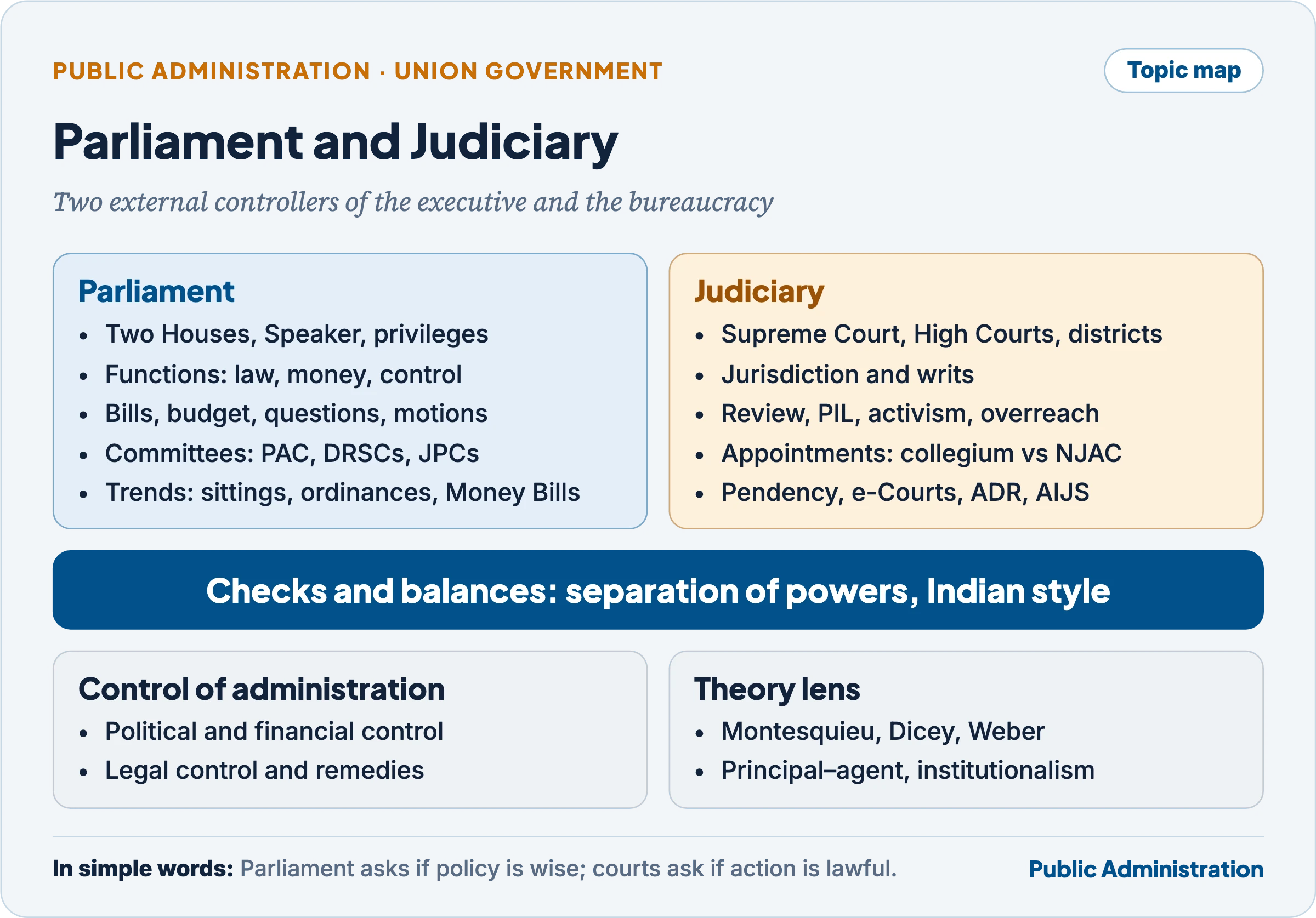
The Constitution creates three organs of the Union: an executive that governs, a Parliament that makes laws and holds the executive to account, and a judiciary that interprets the law and keeps every organ within its constitutional limits. For public administration, the last two are the main external controllers of the bureaucracy: Parliament controls administration politically and financially (questions, budgets, committees, the CAG), while the courts control it legally (writs, judicial review, PIL). How well these two bodies work, and how they relate to each other and to the executive, decides how accountable Indian administration really is.
In simple words
Think of a large school. The principal and staff run it day to day (the executive). The managing committee approves the fee structure and the budget and calls the principal to explain any problem (Parliament). An independent ombudsman hears complaints from students and parents and can cancel any unfair rule (the courts). If the committee never meets or the ombudsman takes ten years to decide, the principal faces no real check.
What this article leaves to the others in the unit. The President, Prime Minister, Council of Ministers, Cabinet and cabinet committees, including the President’s legislative role and ordinance power in full, are taught in the article on the Union Executive. The Prime Minister’s Office, Cabinet Secretariat and Central Secretariat are in the article on PMO, Cabinet Secretariat and Central Secretariat, and ministries, departments, boards, commissions, attached and subordinate offices in the article on Ministries, Departments, Boards, Commissions, Attached Offices and Field Organisations. This article touches the executive only where Parliament or the courts act on it.
1. The Constitutional Setting: Parliamentary Democracy and Three Organs
In simple words
India chose a system in which the government sits inside Parliament and must keep its support every day, and a written Constitution that the courts protect. So no organ is supreme: Parliament can amend most of the Constitution, but the courts can strike down a law, and the courts’ judgments can be overcome by a new law that removes the defect.
1.1 Why India chose the parliamentary form
- Accountability over stability. In the Constituent Assembly, B.R. Ambedkar (chairman of the Drafting Committee) argued that a presidential system offers more stability but less responsibility, while a parliamentary system offers more responsibility but less stability; India preferred daily and periodic assessment of the government by the legislature to a fixed-term executive.
- Familiarity: Indians had worked legislative councils since the Indian Councils Acts and the Government of India Act, 1935; Nehru explained that the system was chosen deliberately because it suited Indian conditions.
- Main features. A titular head (the President) and a real executive (Prime Minister and Council of Ministers); ministers drawn from Parliament; collective responsibility to the Lok Sabha (Article 75(3)); a government that survives only while it keeps the confidence of the lower House.
- Representative government. John Stuart Mill, the British liberal philosopher, in Considerations on Representative Government (1861), described it as rule by the people through periodically elected deputies who hold the ultimate controlling power. Parliament is India’s main institution of this kind.
- Review in 2002. The National Commission to Review the Working of the Constitution (NCRWC), chaired by Justice M.N. Venkatachaliah, reconsidered the presidential alternative and concluded that the parliamentary form suits India; it recommended reforms to make Parliament work better rather than a change of system.
1.2 Neither parliamentary sovereignty nor judicial supremacy
- Britain: Parliament is sovereign in law; there is no written constitution and courts cannot strike down an Act of Parliament (A.V. Dicey‘s doctrine).
- United States: the Supreme Court, since Marbury v. Madison (1803), can declare any law unconstitutional, and its word is close to final.
- India: a middle path. The Constitution is supreme; Parliament is limited by the division of powers (Seventh Schedule), Fundamental Rights and the basic structure; the courts can strike down laws, but Parliament can re-enact a law after curing its defect or amend the Constitution within the basic structure. Both are “supreme in their own spheres”.
- Granville Austin, the American historian of the Constitution, called the document a “seamless web” in which the three organs are interdependent rather than sealed off from each other.
1.3 Key Articles and Acts
The table below collects the provisions this article relies on, so that the rest of the text can refer to them briefly.
| Subject | Article / Act |
|---|---|
| Parliament: composition, Houses, duration | Arts 79–83 |
| Sessions, prorogation, dissolution; President’s address | Arts 85–87 |
| Presiding officers; removal of Speaker | Arts 89–96 |
| Secretariats of Parliament | Art 98 |
| Voting, quorum | Art 100 |
| Disqualification of members; anti-defection | Arts 101–103; Tenth Schedule (52nd Amendment, 1985; 91st Amendment, 2003) |
| Privileges of Parliament | Art 105 |
| Legislative procedure; joint sitting | Arts 107–108 |
| Money Bills; financial bills | Arts 109–110; Art 117 |
| Budget and appropriation | Arts 112–116 |
| Rules of procedure; courts not to inquire into proceedings | Arts 118, 122 |
| Ordinances | Art 123 |
| Supreme Court: establishment, appointment, removal | Arts 124–147 |
| High Courts | Arts 214–231 |
| Subordinate courts | Arts 233–237 |
| Separation of judiciary from executive (Directive Principle) | Art 50 |
| Tribunals | Arts 323A, 323B |
| Amendment of the Constitution | Art 368 |
| All India Services including a judicial service | Art 312 |
| Free legal aid | Art 39A; Legal Services Authorities Act, 1987 |
| Removal of judges | Judges (Inquiry) Act, 1968 |
| Contempt | Arts 129, 215; Contempt of Courts Act, 1971 |
The pattern in the table is worth noticing: the Constitution itself fixes Parliament’s structure and the courts’ jurisdiction in detail, but leaves much of their working to rules made by each House (Art 118) and by the Supreme Court (Art 145). That is why so many recent controversies (committee referral, the Deputy Speaker’s post, case listing) concern practice and convention rather than constitutional text.
2. Parliament: Structure
In simple words
Parliament has three parts: the President, the Rajya Sabha (which represents the States) and the Lok Sabha (which represents the people directly). The Lok Sabha is the stronger House because the government depends on its support and only it can vote money.
2.1 Composition and the two Houses
- Article 79: Parliament consists of the President and two Houses. The President is part of Parliament though not a member: he summons and prorogues the Houses, dissolves the Lok Sabha, addresses them (Art 87), assents to Bills (Art 111) and issues ordinances (Art 123); these roles are taught in the article on the Union Executive.
- Bicameralism gives the States a voice through the Rajya Sabha (which grew out of the Council of States of the Government of India Act, 1919) and lets a second chamber revise hasty legislation.
The table compares the two Houses on the points that matter for administration.
| Point | Rajya Sabha (Council of States) | Lok Sabha (House of the People) |
|---|---|---|
| Strength | Max 250 (238 elected + 12 nominated for literature, science, art, social service); now 245 (Art 80) | Max 550 (530 States + 20 UTs); now 543; Anglo-Indian nomination ended in 2020 (104th Amendment) (Art 81) |
| Election | By elected State MLAs by single transferable vote; seats roughly by population (Fourth Schedule) | Direct, adult franchise, first-past-the-post, single-member constituencies |
| Term | Permanent; one-third retire every two years; member’s term six years | Five years unless dissolved; extendable by one year at a time in a national emergency (Art 83) |
| Presiding officer | Vice-President as ex officio Chairman (C.P. Radhakrishnan since September 2025); elected Deputy Chairman | Elected Speaker and Deputy Speaker |
| Special powers | Art 249 (Parliament to legislate on a State subject) and Art 312 (new All India Services) by two-thirds resolution; initiates removal of the Vice-President | Council of Ministers responsible only to it; Money Bills start only here; alone votes grants; prevails in a joint sitting by numbers |
| Money matters | Cannot amend or reject a Money Bill; must return it in 14 days (Art 109) | Final say on Money Bills and the budget |
- Representation reforms: the 84th Amendment (2001) froze the allocation of Lok Sabha seats among States until the first census after 2026; the 106th Amendment (2023) (Nari Shakti Vandan Adhiniyam) reserves one-third of Lok Sabha and Assembly seats for women after the next delimitation; SC/ST reservation (Arts 330, 334) runs to 2030.
- Membership: a member must be a citizen aged at least 30 (Rajya Sabha) or 25 (Lok Sabha) (Art 84). Disqualifications (Art 102) include an office of profit, insolvency, unsound mind, foreign allegiance and conviction under the Representation of the People Act, 1951; since Lily Thomas v. Union of India (2013) a convicted legislator is disqualified immediately.
- Anti-defection (Tenth Schedule): added by the 52nd Amendment (1985); a member who voluntarily gives up party membership or defies the whip loses the seat. The 91st Amendment (2003) removed the “one-third split” exception (keeping only merger by two-thirds) and capped the Council of Ministers at 15 per cent of the Lok Sabha. The Speaker or Chairman decides (section 7.7).
2.2 Presiding officers and the officers of Parliament
The Speaker is the centre of the Lok Sabha’s working. The Indian office was modelled on the Speaker of the House of Commons, but with one major difference: the Indian Speaker usually remains a party member and is often re-nominated by the ruling party.
- Election and removal (Arts 93–96): elected by the House from among its members; removable by a resolution passed by a majority of all the then members after 14 days’ notice; while such a resolution is under consideration, the Speaker does not preside but may speak and vote (Art 96).
- Powers and functions: presides and keeps order (can name and suspend members, adjourn for want of quorum, which is one-tenth of membership); interprets the Rules and decides admissibility of questions, motions and amendments; certifies Money Bills (Art 110(3)); presides over joint sittings (Art 108); has only a casting vote (Art 100); chairs the Business Advisory, Rules and General Purposes Committees and refers Bills to DRSCs; decides defection petitions; guards the House’s privileges; heads the Lok Sabha Secretariat (Art 98). His salary is charged on the Consolidated Fund and his conduct can be discussed only on a substantive motion.
- The neutrality question. The Speaker’s authority rests on being seen as neutral. Britain secures this by convention: the Speaker leaves the party, is usually not opposed at elections, and is re-elected by the House regardless of which party wins. India has not adopted this convention. Critics point to Speakers’ delays on defection petitions, certification of contested Bills as Money Bills, and mass suspensions of opposition members as signs of partisanship; defenders note that rulings on admissibility and order are routinely made against the government too, and that the House, not a party, elects the Speaker.
- Deputy Speaker (Arts 93, 95): presides in the Speaker’s absence and acts as Speaker if the office is vacant. By convention the post went to the opposition. It has been vacant since June 2019, through the whole 17th Lok Sabha and so far in the 18th, the first such gap since 1952; critics read Art 93 (“as soon as may be“) as mandatory.
- A Panel of Chairpersons presides when both are absent; non-partisan Secretaries-General head the secretariats (Art 98).
- Leader of the House and Leader of the Opposition. The Leader of the Opposition received statutory recognition under the Salary and Allowances of Leaders of Opposition in Parliament Act, 1977; by practice, recognition needs one-tenth of the House. The post was vacant in the Lok Sabha from 2014 to 2024 because no opposition party reached that figure; it was filled again in June 2024. The LoP sits on selection panels for the CBI Director, Lokpal, CVC, CIC and NHRC.
Common confusion
Must the Indian Speaker resign from his party, as in Britain? No. Nothing in the Constitution or the Rules requires it, and Indian Speakers have usually remained party members. The British practice is a convention, backed by the custom of not contesting the Speaker’s seat. Several scholars and former presiding officers have urged a similar convention in India, but it has not been adopted. Neutrality in India therefore depends on the conduct of the person and on judicial review of specific decisions (such as defection rulings), not on the structure of the office.
2.3 Parliamentary privileges
- Meaning: special rights and immunities that allow each House, its committees and members to work without obstruction; they belong to the House as an institution.
- Article 105: freedom of speech in Parliament (subject to the Constitution and Rules); immunity from court proceedings for anything said or any vote given in Parliament or a committee, and for publications by its authority. Other privileges are those defined by law; Parliament has never codified them, so they still follow precedent.
- Other privileges include freedom from arrest in civil cases during and 40 days before and after a session, the right to exclude strangers, and the power to punish for contempt or breach of privilege (a House can reprimand, suspend or even expel a member, as in the cash-for-query expulsions of 2005, upheld in Raja Ram Pal v. Speaker (2007)).
- Sita Soren v. Union of India (2024): a seven-judge Bench overruled P.V. Narasimha Rao (1998) and held that a legislator who takes a bribe to speak or vote in a particular way has no immunity under Art 105(2) or 194(2); the offence is complete when the bribe is accepted, whatever the vote.
3. Functions of Parliament
In simple words
Parliament does more than pass laws. It decides how the government may raise and spend money, questions ministers every day, debates national problems, elects the President and Vice-President, can amend the Constitution and can remove the highest officials.
The British journalist Walter Bagehot, in The English Constitution (1867), listed the functions of the House of Commons as elective (choosing the government), expressive (voicing the people’s mind), teaching, informing and only then legislative and financial. The list still describes India’s Parliament well, as the table shows.
| Function | What it involves | Main provisions |
|---|---|---|
| Legislative | Laws on the Union List, Concurrent List and residuary subjects; State subjects in special cases | Arts 245–254; 248, 249, 250, 252, 253 |
| Financial | No tax without law; no spending without appropriation; voting grants; scrutiny through committees and the CAG | Arts 112–117, 265, 266, 148–151 |
| Control over the executive | Collective responsibility; questions, motions, debates; no-confidence | Art 75(3); Rules of Procedure |
| Deliberative and informative | Debate on policy, national issues, the President’s address | Art 87 |
| Electoral | Electing the President (with State MLAs) and the Vice-President; Speaker, Deputy Speaker, Deputy Chairman; members of committees | Arts 54, 66, 89, 93 |
| Constituent | Amending the Constitution: simple majority, special majority, or special majority with State ratification | Art 368 |
| Judicial / quasi-judicial | Impeachment of the President; removal of judges, CAG, CEC; punishing breach of privilege | Arts 61, 124(4), 148, 324 |
| Other | Approving emergencies; creating or altering States; creating All India Services | Arts 352, 356; 3, 4; 312 |
- The financial function rests on the old rule of “no taxation without representation”: Art 265 (no tax except by authority of law) and Art 114 (no withdrawal from the Consolidated Fund except under an Appropriation Act). This is the strongest formal control Parliament holds, and it is examined in section 4.3.
- Control over the executive is political, continuous and day-to-day: the Lok Sabha can withdraw confidence by a no-confidence motion, by defeating the government on a major policy or a financial measure, or (less decisively) by passing an adjournment or censure motion.
- The deliberative role. The word “parliament” comes from the French parler, “to talk”. Debate allows the government to explain and the opposition to criticise in public. Harold Macmillan, the British Prime Minister, described Parliament as the “great inquest of the nation“. Deliberation also legitimises decisions: losing groups accept outcomes more readily when their views have been heard.
- The constituent function has been used more than a hundred times; the courts have checked it through the basic structure doctrine (section 10.1).
4. Work Processes: How Parliament Transacts Business
In simple words
Parliament works by a detailed rulebook. A Bill passes through several readings and often a committee; the budget is voted ministry by ministry; and every sitting begins with an hour of questions to ministers. Each device gives members a different way to make the government explain itself.
4.1 Sessions, sittings and the Rules of Procedure
- Summoning (Art 85): the President summons each House so that no more than six months pass between its last sitting in one session and the first sitting of the next. In practice there are three sessions a year: Budget (late January or February to April or May), Monsoon (July to August) and Winter (November to December). There is no fixed calendar; the Cabinet Committee on Parliamentary Affairs recommends dates, so the government effectively decides how long Parliament sits.
- Adjournment ends a sitting; prorogation ends a session; dissolution ends the Lok Sabha, and Bills pending in it lapse.
- Joint sitting (Art 108): if the Houses disagree on an ordinary Bill (not a Money Bill or a Constitution Amendment Bill), the President may summon a joint sitting, presided over by the Speaker; the Bill passes by a majority of members present and voting. It has happened only three times: the Dowry Prohibition Bill (1961), the Banking Service Commission (Repeal) Bill (1978) and the Prevention of Terrorism Bill (2002).
- Rules of Procedure (Art 118): each House frames its own Rules of Procedure and Conduct of Business (the Lok Sabha’s are supplemented by the Directions by the Speaker). The Business Advisory Committee allots time; the Rules Committee amends the Rules.
- Art 122: courts cannot question the validity of proceedings on the ground of irregularity of procedure. But the Supreme Court has held that this protects only procedural irregularity, not illegality or unconstitutionality (Raja Ram Pal, 2007), and that the Speaker deciding defection or certifying a Money Bill is open to review (sections 7.6, 7.7).
4.2 How a Bill becomes law
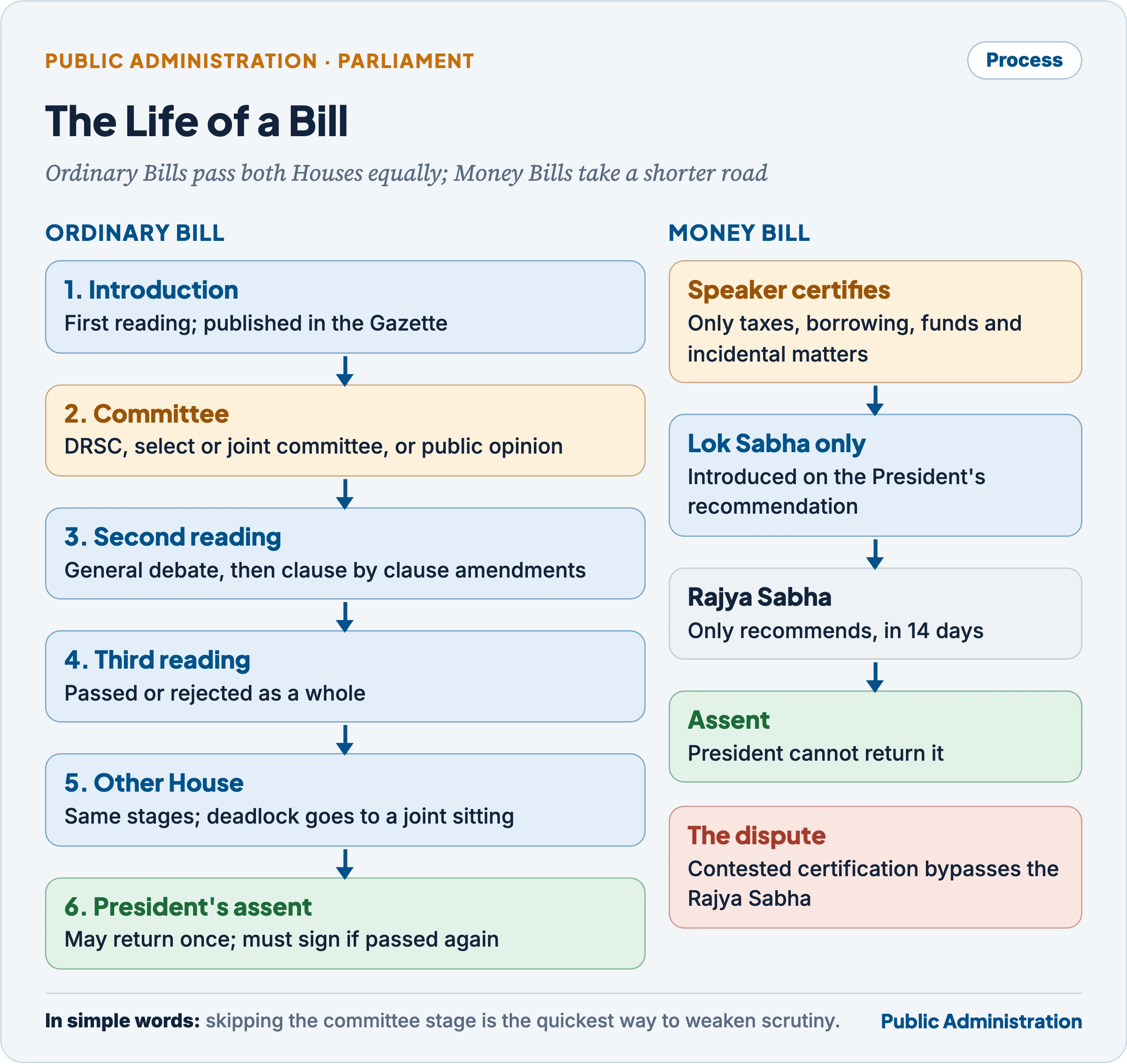
- Types of Bills: Government Bills (moved by a minister) and Private Members’ Bills (moved by any other member; only 14 have become law, the last in 1970); ordinary Bills, Money Bills (Art 110), Financial Bills (Art 117) and Constitution Amendment Bills (Art 368).
- Pre-legislative stage. The Pre-Legislative Consultation Policy (2014) asks ministries to publish draft Bills for at least 30 days of public comment. It is an executive policy, not a law, and is often not followed.
- First reading: leave to introduce; the Bill is introduced and published in the Gazette; usually no debate.
- Second reading has two stages:
- General discussion on the principles, after which the House may take the Bill into consideration at once, refer it to a Select Committee (of one House) or Joint Committee (of both), or circulate it to elicit public opinion. Separately, the Speaker or Chairman may refer it to the relevant Department-related Standing Committee, which reports within a set time.
- Clause-by-clause consideration, in which amendments are moved and voted; this is the stage where a Bill can change most.
- Third reading: only verbal or formal amendments; the Bill is passed or rejected as a whole.
- In the other House the Bill goes through the same stages. Disagreement can be settled by negotiation, by the first House accepting amendments, or by a joint sitting.
- Assent (Art 111): the President may assent, withhold assent or (for a non-Money Bill) return it once for reconsideration; if it is passed again, he must assent.
- Constitution Amendment Bills need a special majority in each House separately (majority of total membership and two-thirds of those present and voting); there is no joint sitting; some need ratification by half the States; and the President must assent (24th Amendment, 1971).
4.3 Money Bills, Financial Bills and the budget
- Money Bill (Art 110): a Bill containing only provisions on matters listed in Art 110(1)(a)–(f): taxes, borrowing, the Consolidated and Contingency Funds, appropriation, expenditure charged on the Consolidated Fund, and receipt or audit of money, plus “any matter incidental” to them (Art 110(1)(g)). The Speaker’s certificate is declared “final” (Art 110(3)).
- Special procedure: introduced only in the Lok Sabha on the President’s recommendation; the Rajya Sabha can only make recommendations within 14 days; the President cannot return it.
- Financial Bills (Art 117): Bills that include Money-Bill matters along with others (Category A, starting only in the Lok Sabha) or that involve expenditure from the Consolidated Fund (Category B); both Houses have full power over them.
The budget process shows Parliament’s financial control in operation. Its full treatment is in the article on financial management; the points relevant here are:
- Stages: presentation of the Annual Financial Statement (Art 112) on 1 February (since 2017; the Railway Budget was merged into the general budget the same year); general discussion; examination of demands for grants by DRSCs; discussion and voting of demands in the Lok Sabha (Art 113); the Appropriation Bill (Art 114); the Finance Bill (taxation).
- Charged expenditure (President’s emoluments, judges’ salaries, CAG, debt charges and others, Art 112(3)) is discussed but not voted.
- Cut motions allow members to oppose a demand: a policy cut (reduce to ₹1, disapproving the policy), an economy cut (reduce by a stated sum) and a token cut (reduce by ₹100, to air a grievance). Their passage would mean a defeat of the government, so they are almost never adopted; their value lies in forcing a debate on a ministry.
- Guillotine: on the last day allotted for demands, the Speaker puts all remaining demands to vote together without discussion. It keeps the budget on time (it must pass before 1 April or a vote on account, Art 116, is needed), but most demands now pass this way; in 2023, amid disruption, the Lok Sabha passed all demands and the Finance Bill without discussion.
- Vote on account (Art 116): an advance grant for part of the year, usually two months, or longer in an election year.
- Supplementary, additional and excess grants (Art 115) cover spending beyond the original estimate; excess grants come only after the PAC has examined them.
4.4 Devices of the floor: questions, Zero Hour and motions
The procedural devices are the tools by which ordinary members, especially the opposition, hold ministers to account. Each has a different purpose, as the table shows.
| Device | How it works | Purpose |
|---|---|---|
| Calling attention | Member calls a minister’s attention to an urgent matter; minister makes a statement; brief questions (Lok Sabha Rule 197, an Indian innovation of 1954) | Quick government response |
| Censure motion | Must state the charges against a minister or the government | Disapproval; does not by itself force resignation |
| Motion of Thanks | Debate on the President’s address | Its defeat would be a defeat of the government |
| Short-duration discussion | Rule 193; on an urgent matter, no vote | Debate without a formal motion |
| Half-an-hour discussion | On a matter arising from an answer that needs clarification | Follow-up of Question Hour |
| Privilege motion | Alleges breach of privilege, for example a minister misleading the House | Protects the House’s information |
| Cut motions | On demands for grants (section 4.3) | Debate on a ministry’s policy and spending |
- Why Question Hour matters. Answers are drafted by the ministry’s officials, so a question reaches deep into administration. Answers also create assurances, which the Committee on Government Assurances follows up. Question Hour was suspended in the 2020 Monsoon Session (only written answers were given) during COVID-19, which critics saw as weakening accountability.
- Questions as financial control. Questions on scheme spending, delays, cost overruns and unspent funds force ministries to put expenditure data on record between budgets; they often feed later PAC and DRSC scrutiny. Their limit is that answers can be evasive, and supplementaries are few when Question Hour is disrupted.
- Zero Hour is popular because it needs no notice and reaches local and constituency issues, but ministers are not obliged to reply.
5. Parliamentary Committees
In simple words
A House of 543 members cannot study every Bill line by line or check every ministry’s accounts. So it sends the detailed work to small groups of members from all parties, who meet in private, call officials and experts, and report back. These committees are often called “Parliament in miniature”.
5.1 Why committees are needed
- Volume and complexity. Modern government produces more legislation, spending and rules than a full House can examine; committees allow division of labour and specialisation.
- Calmer, cross-party work. Committees meet in camera, away from television and party theatre, so members can question officials frankly and reach consensus reports; party whips do not usually operate.
- Evidence and expertise. Committees can summon officials, ask for files and documents, hear experts and stakeholders, and make study visits.
- Continuity. Standing committees work between sessions, keeping up scrutiny when the House is not sitting.
- Limits by design. Committees are subordinate to the House: they recommend, they do not decide; ministers are not usually summoned before them; and they do not examine matters of day-to-day administration or anything sub judice.
5.2 Classification
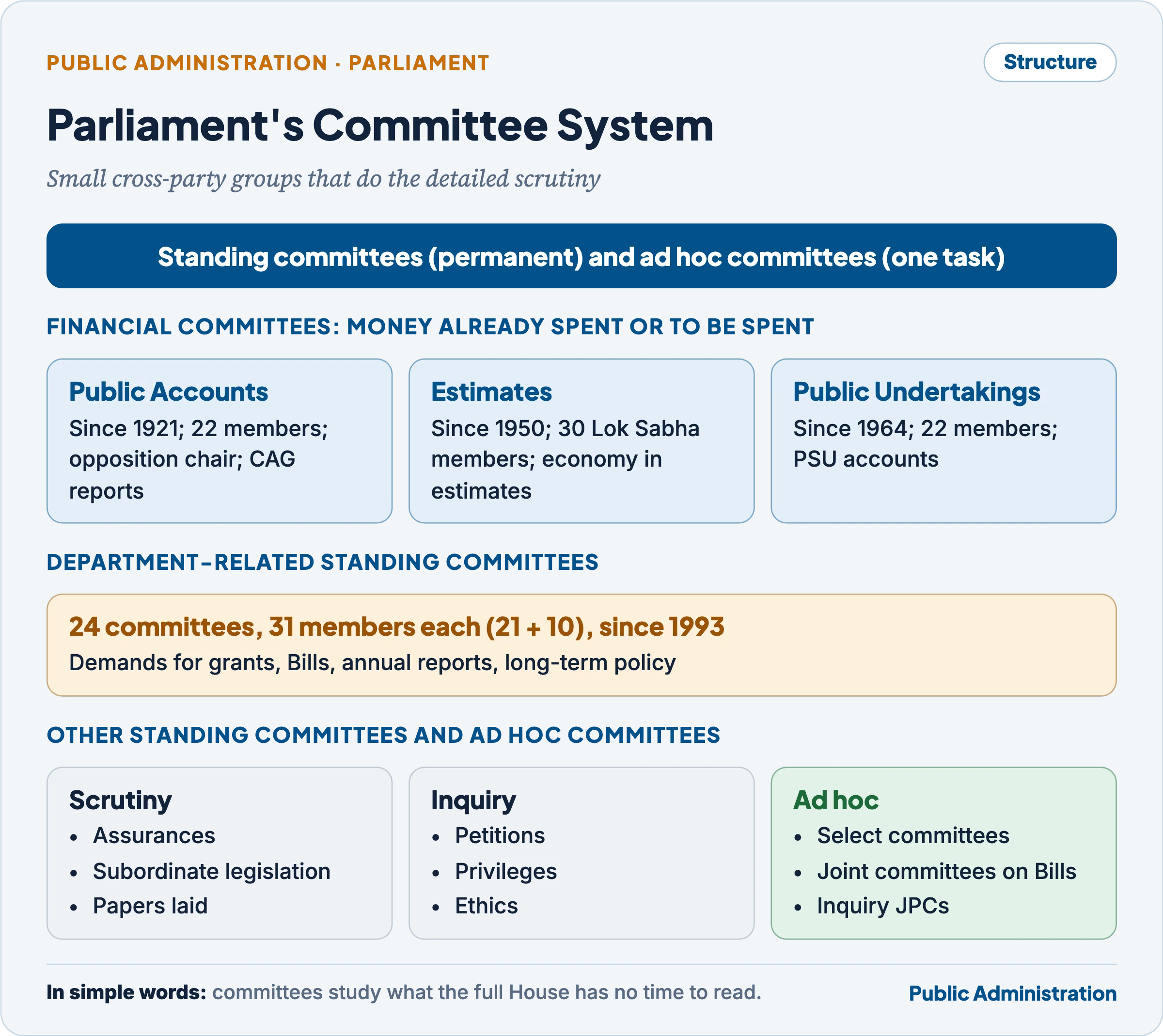
- Standing committees are permanent, elected or nominated every year or from time to time, and work continuously. Ad hoc committees are set up for a specific task and end when they report.
- Standing committees include the financial committees, the DRSCs, committees to inquire (Petitions, Privileges, Ethics), to scrutinise (Government Assurances, Subordinate Legislation, Papers Laid, Welfare of SCs and STs), on the business of the House (Business Advisory, Rules) and house-keeping committees.
- Ad hoc committees are inquiry committees (such as Joint Parliamentary Committees on scams) and advisory committees (select or joint committees on Bills).
5.3 The financial committees
The three financial committees are the oldest and best known; together they carry Parliament’s financial control beyond the budget vote.
| Committee | Origin | Members | Main role |
|---|---|---|---|
| Public Accounts Committee (PAC) | 1921 (Montagu–Chelmsford reforms) | 22: 15 Lok Sabha + 7 Rajya Sabha; chair from the opposition since 1967 | Examines appropriation and finance accounts and CAG audit reports; checks that money was spent as Parliament granted; looks at excess grants |
| Estimates Committee | 1950 (on the suggestion of Finance Minister John Mathai) | 30, all Lok Sabha | Suggests economies, efficiency and alternative policies within the estimates; called a “continuous economy committee“ |
| Committee on Public Undertakings (COPU) | 1964 (on the recommendation of the Krishna Menon Committee) | 22: 15 + 7 | Examines reports and accounts of public undertakings and CAG reports on them; checks autonomy and efficiency |
- The PAC and the CAG. The PAC’s work rests on the CAG’s reports (Arts 148–151); the CAG is often called the PAC’s “friend, philosopher and guide“. The PAC’s best-known reports include those on the 2G spectrum allocation (2011) and on defence procurement. Its weakness is that it is a post-mortem: it examines spending one or two years after it has happened.
- The Estimates Committee cannot question policy approved by Parliament and examines only a few ministries each year, so most estimates are never studied by it. After the DRSCs began examining demands for grants (1993), its role has shrunk.
- Ministers cannot be members of the financial committees, so that they remain independent of the executive.
5.4 Department-related Standing Committees (DRSCs)
- Origin. Set up in 1993 (17 committees) on the recommendation of the Rules Committee, after repeated demands that the budget and Bills receive sector-wise scrutiny; the number was raised to 24 in 2004.
- Composition. Each has 31 members: 21 from the Lok Sabha and 10 from the Rajya Sabha; 16 are serviced by the Lok Sabha Secretariat and 8 by the Rajya Sabha Secretariat. A minister cannot be a member. The term is one year.
- Functions:
- Consider the demands for grants of their ministries before the House votes on them (the House adjourns for a few weeks after the general discussion for this).
- Examine Bills referred by the Speaker or Chairman.
- Consider annual reports of ministries.
- Consider national basic long-term policy documents referred to them.
- They do not consider matters of day-to-day administration; reports are advisory; the government responds through Action Taken Reports.
- Value. They broadened scrutiny from three financial committees to every ministry, gave MPs specialisation, and made cross-party consensus possible. Their reports on Bills have produced real changes (the Lokpal Bill, the Land Acquisition Bill 2011, and several financial-sector laws were substantially amended after committee reports).
- Weaknesses in examining demands for grants:
- Time: a few weeks to examine thousands of crores; the committee usually studies only some heads.
- No independent research staff comparable to the US Congressional Budget Office; reliance on ministry data.
- No follow-through on the floor: most demands are then guillotined, so committee reports are rarely debated.
- Low attendance and frequent change of membership; reports are not binding.
5.5 Other standing committees
- Committee on Subordinate Legislation: checks whether rules, regulations and bye-laws made by the executive under delegated powers stay within the parent Act (see the article on Delegated Legislation).
- Committee on Government Assurances: follows up promises made by ministers on the floor until they are implemented.
- Committee on Petitions: examines petitions from the public on Bills and matters of general interest.
- Committee of Privileges: examines alleged breaches of privilege.
- Ethics Committees: Rajya Sabha (1997) and Lok Sabha (2000, made permanent in 2015); examine unethical conduct of members. The Lok Sabha Ethics Committee’s report led to the expulsion of a member in the “cash-for-query” case of December 2023.
- Committee on Papers Laid on the Table, Committee on Absence of Members, Committee on Welfare of SCs and STs, Committee on Empowerment of Women.
5.6 Select committees, joint committees and JPCs
- Select Committee (members of one House) and Joint Committee (both Houses) examine a specific Bill clause by clause and can propose redrafting. The Income-tax Bill, 2025 was examined by a Lok Sabha Select Committee before a revised Bill was passed.
- Joint Parliamentary Committees (JPCs) are ad hoc committees formed by a motion in one House agreed to by the other. Inquiry JPCs have examined the Bofors contract (1987), the securities scam (1992), the stock market scam (2001), pesticide residues in soft drinks (2003) and 2G spectrum (2011). Legislative JPCs in the 18th Lok Sabha examined the Waqf (Amendment) Bill, 2024, the One Nation One Election Bills (the Constitution (129th Amendment) Bill, 2024), the Constitution (130th Amendment) Bill, 2025 (removal of ministers held in custody for 30 days) and the FCRA Amendment Bill, 2026.
- Limits of JPCs. Inquiry JPCs are often divided on party lines, their reports carry dissent notes, and setting one up is itself a political battle (the winter session of 2010 was lost over the demand for a 2G JPC).
5.7 How strong is the committee system?
- Strengths: detailed, evidence-based, cross-party scrutiny; continuity between sessions; access to officials and experts; reports put information in the public domain.
- Weaknesses:
- Reference is discretionary. No rule requires a Bill to go to a committee; the share referred fell from 60 per cent (14th Lok Sabha) and 71 per cent (15th) to 28 per cent (16th) and 16 per cent (17th), according to PRS Legislative Research. The 18th Lok Sabha had referred 21 per cent up to the Monsoon Session of 2026.
- Advisory status: recommendations are not binding; Action Taken Reports often reject them.
- Thin support: little independent research staff, short terms, frequent reshuffles.
- Confidentiality protects frankness but also hides the reasoning from the public until the report appears.
- Reform proposals:
- Mandatory referral of all Bills (except Money Bills and urgent measures) to a committee, a reform urged by PRS Legislative Research and many former MPs.
- Longer terms (two years) and research staff; a Parliamentary Budget Office.
- Debate on committee reports in the House, and public hearings on major Bills.
- Opposition chairs for more committees, as with the PAC.
Committees are where Parliament does its homework; when Bills skip them, scrutiny shrinks to speeches on the floor.
6. Parliamentary Control over Administration and its Limits
In simple words
On paper, Parliament controls every rupee and every policy. In practice, a government with a majority wins every vote, officials know far more than MPs, and most checks happen after the money is spent. So Parliament’s control works mainly by making ministers explain in public, not by changing what they do.
6.1 Basis and forms of control
- Basis: the principle of ministerial responsibility: ministers answer to Parliament for everything done in their departments, and civil servants stay anonymous behind them.
- Forms of control:
- Through law-making: Parliament creates departments, agencies and their powers; it sets limits on delegated legislation and scrutinises rules through the Committee on Subordinate Legislation.
- Through finance: budget votes, cut motions, the financial committees and the CAG as Parliament’s agent.
- Through questions, motions and debates (section 4.4).
- Through committees (section 5).
- Through the ultimate sanction: the no-confidence motion.
- Timing: some control is before action (passing laws and budgets), some during action (questions, debates) and most after action (PAC, CAG, assurances).
The American scholars Mathew McCubbins and Thomas Schwartz, in “Congressional Oversight Overlooked: Police Patrols versus Fire Alarms” (1984), distinguished two styles of oversight. Police-patrol oversight is centralised, active and continuous (the legislature itself inspects agencies, like committees examining demands). Fire-alarm oversight is decentralised and reactive: the legislature sets up rules that let citizens and interest groups raise the alarm when an agency goes wrong (petitions, RTI, media, courts), and responds when the alarm sounds. Indian practice combines both: committees and audit are police patrols; Zero Hour, petitions and constituency complaints are fire alarms.
6.2 Why parliamentary control is weaker than it ought to be
- Executive dominance through the majority. The government controls the agenda, the calendar and the majority; the anti-defection law makes every vote a party vote, so the House rarely defeats the government.
- Technical complexity. Members are generalists; Bills, budgets and rules are prepared by specialist officials. Nehru had warned that unless members could match the expertise of the bureaucracy, Parliament would lose relevance in decision-making.
- Shortage of time. Fewer sitting days, disruptions and the guillotine leave most demands and many Bills undiscussed.
- Information asymmetry. Ministries control information; questions get evasive or delayed answers; assurances pile up.
- Post-mortem character. PAC and CAG reports come after the money is spent, often years later.
- Growth of delegated legislation and of autonomous bodies, PSUs and regulators outside the line of ministerial responsibility.
- Large and diverse administration. No assembly can watch thousands of schemes and offices.
- Weak follow-up. Committee reports are advisory; Action Taken Reports may reject them without consequence.
- Behaviour of members. Low attendance, constituency and party work, and disruption reduce the time and interest given to scrutiny.
6.3 The “guillotine blade” view of control
- A classic view holds that parliamentary control is potential rather than actual: like the blade of a guillotine, it works because it can fall, not because it falls often. Ministers and officials act carefully because they know they may have to explain in the House.
- On this view, control is a matter of anticipated reaction: the deterrent effect of questions, CAG audit and committee scrutiny on officials is more important than the number of votes the government loses (almost none).
- The same view suggests that as administration becomes better and more open, the need for members to intervene directly falls.
6.4 Parliamentary control and judicial control compared
The two controls are often compared; they are complementary, not substitutes, because they ask different questions of administration.
| Point | Parliamentary control | Judicial control |
|---|---|---|
| Nature | Political, general, continuous | Legal, specific, case-based |
| Question asked | Is the policy wise, efficient, responsive? | Is the action lawful, fair, within power? |
| Initiated by | Members, committees, CAG | An aggrieved person or a public-spirited petitioner |
| Coverage | All of government, including policy | Only matters brought before a court; policy usually left alone |
| Remedy | Debate, censure, budget cuts, removal of the government | Quashing orders, writs, compensation, directions |
| Timing | Before, during and after action | After action (sometimes before, through stay orders) |
| Weakness | Majority rule, generalism, little time | Cost, delay, limited expertise, cannot initiate |
- Why parliamentary control cannot replace judicial control: a majority-backed government will not be censured by its own House for an illegal act against an individual; only a court can give the individual a binding remedy. Parliament also cannot rule on whether a law itself is constitutional.
- Why judicial control cannot replace parliamentary control: courts act only on petitions, avoid policy merits, cannot examine the budget, and lack expertise and democratic legitimacy to decide priorities. Courts check legality; Parliament checks policy, efficiency and value for money.
7. Recent Trends in the Working of Parliament
In simple words
Many observers say Parliament has grown weaker: it meets less often, sends fewer Bills to committees, passes laws in minutes during uproar, and leaves key posts empty. Others reply that it still passes the budget, hosts sharp debates and runs active committees. The facts below show both sides.
7.1 The “decline of Parliament” thesis
- James Bryce, the British jurist, in Modern Democracies (1921), wrote of the “decline of legislatures” across democracies as executives, parties and the press grew stronger. K.C. Wheare in Legislatures (1963) agreed that legislatures had declined in law-making but not necessarily in criticism and control.
- The question has three parts:
- Decline in power? Formally, no: Parliament keeps every constitutional power and passes more laws than before.
- Decline in esteem? Largely yes: disruption, criminalisation (a large share of members declare pending criminal cases), defections and walkouts have lowered the institution’s public image.
- Decline relative to the executive? Yes: the executive initiates almost all legislation, drafts it in skeleton form for delegated legislation, controls the calendar and uses ordinances and the Money-Bill route.
- W.H. Morris-Jones, the British political scientist, in Parliament in India (1957), praised the early Parliament’s debating quality; the first Lok Sabha met for 677 sittings.
- Scholars class the Indian Parliament as a reactive legislature: it reacts to, amends and legitimises executive proposals rather than making policy itself.
7.2 Fewer sittings and less time for business
- Before 1990, a Lok Sabha typically met for over 550 days in five years; since then the average has been about 345. The 17th Lok Sabha (2019–24) held only 274 sittings, the fewest of any full-term Lok Sabha; 11 of its 15 sessions ended early (PRS).
- The NCRWC (2002) recommended a minimum of 120 sitting days for the Lok Sabha and 100 for the Rajya Sabha a year; this has never been met in recent decades.
- Monsoon Session 2026: the Lok Sabha worked for only 15 per cent of its scheduled time and the Rajya Sabha for 33 per cent; Question Hour ran for 1 per cent of scheduled time in the Lok Sabha (PRS).
7.3 Bills passed without scrutiny
- In the 17th Lok Sabha, 35 per cent of Bills passed with less than an hour of discussion in the Lok Sabha, and 58 per cent within two weeks of introduction; only 16 per cent went to committees (PRS).
- In the Monsoon Session 2026, the Lok Sabha passed 11 Bills, nine of them without any member other than the minister speaking; the Supreme Court (Number of Judges) Amendment Bill, 2026 passed in four minutes and the Tribunals Reforms Bill, 2026 in twelve.
- Major laws passed quickly include the J&K Reorganisation Bill (2019) and the farm laws (2020), which were later repealed (2021) after protests; critics argue that committee scrutiny would have exposed their problems earlier.
7.4 Ordinances as a substitute for legislation
- Art 123 lets the President promulgate an ordinance when Parliament is not in session and immediate action is needed; it lapses six weeks after Parliament reassembles unless replaced by an Act.
- Concerns: ordinances are issued just before or after sessions, re-promulgated repeatedly, and used for major policy (land acquisition in 2014–15 was re-promulgated three times before it lapsed).
- Judicial checks:
- D.C. Wadhwa v. State of Bihar (1987): Bihar’s practice of re-promulgating ordinances (one ordinance for 14 years) was a “fraud on the Constitution“.
- Krishna Kumar Singh v. State of Bihar (2017), a seven-judge Bench: re-promulgation without placing the ordinance before the legislature is a fraud on the Constitution; the President’s or Governor’s satisfaction is open to judicial review; and failure to lay an ordinance before the House is a serious constitutional breach.
- See the article on the Union Executive for the ordinance power in full.
7.5 Disruptions, suspensions and the opposition
- Disruption has become a routine tactic of opposition parties (of all parties when in opposition). The government in turn uses mass suspensions: in the Winter Session of 2023, 146 members (100 in the Lok Sabha, 46 in the Rajya Sabha) were suspended, and several Bills, including the three criminal-law Bills, were passed in their absence.
- The opposition’s role in procedure has also become contested: the Deputy Speaker‘s post has stayed vacant since 2019; on 11 March 2026 the Lok Sabha defeated by voice vote a resolution to remove Speaker Om Birla, only the fourth such motion in its history (after 1954, 1966 and 1987).
- Remedies suggested: an agreed parliamentary calendar, opposition days (as in the UK, where the opposition sets the agenda on 20 days a year), a fixed time share for the opposition, a code of conduct, and a Deputy Speaker from the opposition.
7.6 The Money-Bill route
- The issue: if a Bill is certified as a Money Bill, the Rajya Sabha cannot amend or reject it. Governments without a Rajya Sabha majority have used the wide words “incidental to” (Art 110(1)(g)) to send non-financial laws through this route.
- Examples: the Aadhaar Act, 2016; the Finance Act, 2017 (which changed the appointment rules of 19 tribunals); amendments to the Prevention of Money Laundering Act from 2015; and in August 2026, the Supreme Court (Number of Judges) Amendment Bill, 2026, raising the Court’s strength from 34 to 38, was again passed as a Money Bill (the 2019 increase had followed the same route).
- K.S. Puttaswamy (Aadhaar) (2018): the majority upheld the Aadhaar Act as a Money Bill, reasoning that its core was subsidies from the Consolidated Fund. Justice D.Y. Chandrachud, dissenting, called the certification a “fraud on the Constitution” and held that the Speaker’s certificate is not immune from review.
- Rojer Mathew v. South Indian Bank (2019): a five-judge Bench struck down the Tribunal Rules made under the Finance Act, 2017, doubted the correctness of the Aadhaar majority on the Money-Bill point, and referred the question (what is a Money Bill, and how far the Speaker’s certificate is reviewable) to a seven-judge Bench. A review of the Aadhaar judgment was dismissed by majority in 2021, with Justice Chandrachud again dissenting.
- Status (October 2026): the seven-judge reference is still pending; it was last listed for directions in October 2023, and in July 2024 the then Chief Justice said it would be listed. Meanwhile the route continues to be used.
- Why it matters: the Rajya Sabha is the federal chamber; bypassing it weakens both bicameralism and federalism, and turns a procedural certificate into a political weapon.
7.7 Anti-defection, the Speaker and the courts
The Tenth Schedule made the Speaker a judge of defection disputes, which drew the courts into the House’s affairs.
- Kihoto Hollohan v. Zachillhu (1992): upheld the Tenth Schedule; held that the Speaker, deciding disqualification, acts as a tribunal, so the decision is subject to judicial review on limited grounds (mala fides, perversity, violation of natural justice, jurisdictional error), though not before the decision (except interim orders in exceptional cases). The minority (Justice J.S. Verma) would have struck down the Speaker’s role as violating the basic structure because the Speaker’s tenure depends on the majority.
- Keisham Meghachandra Singh v. Speaker, Manipur (2020): a Speaker should decide disqualification petitions within three months ordinarily; the Court suggested that Parliament replace the Speaker with an independent tribunal (a retired judge or similar body).
- Subhash Desai v. Principal Secretary, Governor of Maharashtra (2023): a five-judge Bench held that the Speaker must decide disqualification first; that the political party (not the legislature party) appoints the whip; and that the Governor erred in calling a floor test without objective material. It referred to a seven-judge Bench the question in Nabam Rebia (2016): whether a notice to remove the Speaker bars him from deciding disqualification petitions. That reference is pending.
- Padi Kaushik Reddy v. State of Telangana (31 July 2025): where the Telangana Speaker did not even issue notices for seven months on petitions against 10 MLAs, the Court directed him to decide within three months, warned against “operation successful, patient died” delays, and asked Parliament to consider whether leaving defection cases to the Speaker serves the purpose of the law.
- Assessment: the courts have pushed the Speaker toward speed and reasons while refusing to decide disqualification themselves. Reform proposals include giving the decision to the President or Governor on the advice of the Election Commission (the Dinesh Goswami Committee on electoral reforms, 1990) or to an independent tribunal.
7.8 A new building, Sansad TV and a digital Parliament
- New Parliament building: inaugurated on 28 May 2023 under the Central Vista project; the Houses moved there for the Special Session of September 2023, whose first Bill was the Women’s Reservation Bill. The old building is now called Samvidhan Sadan. The new chambers seat 888 (Lok Sabha) and 384 (Rajya Sabha) members, preparing for a larger House after delimitation.
- Sansad TV: launched on 15 September 2021 by merging Lok Sabha TV and Rajya Sabha TV; live telecast of proceedings (begun in the 1990s) has made disruption more visible but has also made Parliament more transparent.
- Digital Parliament: the Digital Sansad portal and app carry questions, debates, Bills and committee reports; members submit notices online; the Houses have moved toward paperless working with tablets in the new chambers. For State legislatures, the National e-Vidhan Application (NeVA) (under the One Nation, One Application idea) aims to make all legislatures paperless.
- Research support: the Parliament Library’s research service (LARRDIS) and independent bodies such as PRS Legislative Research now publish data on sittings, Bills and committees, which is the main evidence for the “decline” debate.
7.9 Counter-trends: what still works
- Parliament still passes the budget and major reforms (GST in 2017, the Bharatiya Nyaya Sanhita, Bharatiya Nagarik Suraksha Sanhita and Bharatiya Sakshya Adhiniyam in 2023, the Women’s Reservation Act in 2023).
- Committees held about 1,700 meetings in the 17th Lok Sabha (PRS) and continue to produce detailed reports, including on demands for grants.
- Questions keep producing large volumes of official data (much of the pendency and vacancy data in this article comes from answers in Parliament).
- The 18th Lok Sabha has a stronger opposition, a recognised Leader of the Opposition, and more Bills sent to JPCs than its predecessor.
Parliament as an institution, not an extension of government. In a parliamentary system the government comes from the majority, so Parliament is easily seen as the government’s instrument. Its independence as an institution rests on features that belong to the whole House, not to the majority:
- a presiding officer who protects every member’s rights and decides admissibility, privileges and defection impartially;
- opposition rights: questions, adjournment and no-confidence motions, time in debate, the Leader of the Opposition, and the opposition-chaired PAC;
- cross-party committees that examine the government’s Bills and spending on evidence;
- a separate secretariat (Art 98) and privileges (Art 105) that do not depend on the executive;
- the Rajya Sabha, which the government of the day often does not control.
When the calendar, agenda, committee referral and even the Deputy Speaker’s post are decided by the government alone, Parliament drifts toward being an extension of the executive; reforms such as a fixed calendar and opposition days aim to restore its institutional identity.
8. The Judiciary: Structure
In simple words
India has one ladder of courts for all laws, Union and State alike. At the bottom are the district and magistrates’ courts, above them the High Court of each State, and at the top the Supreme Court, whose decisions bind every court in the country. Specialised tribunals sit beside this ladder for particular subjects.
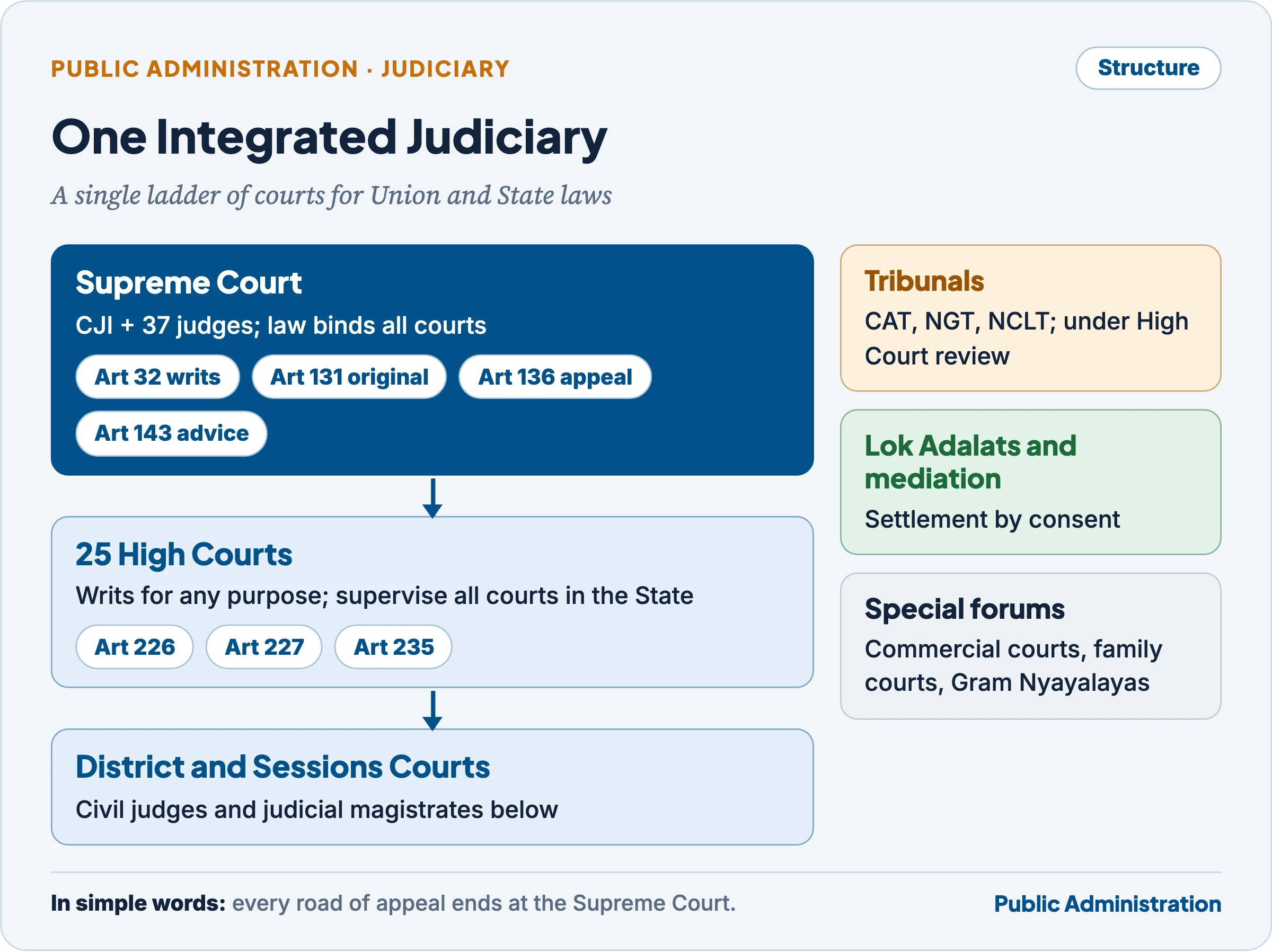
- A single integrated judiciary. Unlike the United States, which has separate federal and State court systems, India has one hierarchy that administers Union and State laws, civil, criminal and constitutional. This is a legacy of the Government of India Act, 1935 and the Federal Court (1937), which the Supreme Court replaced on 28 January 1950.
- Unitary features inside a federal polity: the Supreme Court’s law binds all courts (Art 141); High Court judges are appointed and transferred through a national process; and All India Services can include a judicial service (Art 312).
8.1 The three tiers
The table sets out the three tiers of the regular judiciary.
| Point | Supreme Court | High Courts | Subordinate courts |
|---|---|---|---|
| Provisions | Arts 124–147 | Arts 214–231 | Arts 233–237 |
| Strength | 38 including the CJI (raised from 34 in August 2026; it was 8 in 1950) | 25 High Courts; 1,122 sanctioned judges (906 in 2014) | District and sessions courts, civil judges, judicial magistrates in every district |
| Appointment | President, after consulting the CJI and judges (collegium) | President, after consulting the CJI, Governor and HC Chief Justice (collegium) | District judges by the Governor with the High Court (Art 233); others under rules with the PSC and High Court (Art 234) |
| Qualifications | 5 years as HC judge, 10 years as HC advocate, or a distinguished jurist | 10 years in judicial office or as HC advocate | 7 years at the Bar for direct district judges |
| Tenure | Till 65 | Till 62 | Under State service rules |
| Key powers | Arts 32, 131, 136, 141, 142, 143 | Art 226 writs “for any other purpose”; superintendence (Art 227); control of lower courts (Art 235) | Civil suits and criminal trials under the CPC and the BNSS, 2023 |
- Supreme Court working: it sits in Delhi (Art 130); most cases go to Benches of two or three judges; a Constitution Bench of at least five hears substantial questions of constitutional interpretation and presidential references (Art 145(3)). The CJI is by convention the senior-most judge (the supersessions of 1973 and 1977 were condemned as attacks on independence); Justice Surya Kant became the 53rd CJI on 24 November 2025.
- High Courts: Parliament may set up a common High Court for two or more States (Art 231); judges may be transferred by the President after consulting the CJI (Art 222); additional judges (Art 224) and retired judges (Art 224A) help with arrears.
- District level: on the civil side, District Judge down to Civil Judge (Junior Division); on the criminal side, under the Bharatiya Nagarik Suraksha Sanhita, 2023 (which replaced the CrPC from 1 July 2024), the Sessions Judge, Chief Judicial Magistrate and Judicial Magistrates; plus family courts, fast-track special courts and special courts. The High Court’s control over postings and promotions (Art 235) and Art 50 keep this tier separate from the State executive.
- The district judiciary carries almost 90 per cent of pending cases (section 13); for most citizens it is the justice system.
8.2 Tribunals in brief
- Arts 323A and 323B (inserted by the 42nd Amendment, 1976) allow administrative tribunals for service matters and other tribunals for taxation, industrial disputes, land reforms, elections and so on. Examples: the Central Administrative Tribunal (1985), the National Green Tribunal (2010), NCLT and NCLAT, the Armed Forces Tribunal, the Income Tax Appellate Tribunal.
- The constitutional limits: in L. Chandra Kumar v. Union of India (1997) a seven-judge Bench held that the High Courts’ power of judicial review (Arts 226, 227) and the Supreme Court’s (Art 32) are part of the basic structure; tribunals can act only as courts of first instance, subject to High Court review.
- Does judicial review defeat the purpose of tribunals? Tribunals such as the CAT were meant to give speedy, specialised and cheap justice in service matters. Since 1997, almost every CAT order can be challenged in a High Court and then the Supreme Court, adding two tiers and delay. But review is the price of independence and legality: tribunal members are appointed largely by the executive, and without review, the government would judge its own disputes. The balance lies in limited review (on law and jurisdiction, not facts) and stronger tribunals, not in removing review.
- Independence of tribunals has been litigated repeatedly in the Madras Bar Association cases (2010, 2014, 2020, 2021 and 19 November 2025). In 2025 the Court struck down key provisions of the Tribunals Reforms Act, 2021 (minimum age of 50, four-year terms, the two-name panel) as violating separation of powers and judicial independence, and directed an independent National Tribunals Commission.
- Tribunals Reforms Act, 2026 (assent 13 August 2026) repeals the 2021 Act and creates a five-member National Tribunals Commission (a Chairperson, two judicial and two technical members) to select tribunal members, review performance, inquire into complaints and maintain a National Tribunals Data Grid for 16 tribunals. See the article on Administrative Tribunals for the theory of tribunals and natural justice.
The National Green Tribunal: brake on development or guardian of the environment?
- Structure: set up under the National Green Tribunal Act, 2010; principal bench in New Delhi with zonal benches; judicial and expert members; aims to dispose of cases within six months; applies the principles of sustainable development, the precautionary principle and polluter pays (s. 20).
- The critics’ case: orders that stall infrastructure and industry (halting projects, mining and construction; the ban on diesel vehicles over ten years old in Delhi-NCR, 2015); heavy compensation and sweeping, policy-like directions, sometimes on suo motu cases; uncertainty when ministry clearances are overturned years later.
- The defenders’ case: the NGT enforces laws Parliament made, so the fault often lies in poor clearance processes; it gives citizens a specialised, faster and cheaper forum; and environmental damage (air, rivers, groundwater) is itself an economic cost, so sustainable development is a condition of development, not its enemy.
- Assessment: the tension is a version of the general debate on judicial activism: the NGT is most legitimate when it enforces existing law with reasons and expertise, and least when it frames policy through blanket bans.
9. Jurisdiction and Powers of the Courts
In simple words
The Supreme Court can hear some cases first (disputes between governments and rights violations), hear appeals from every court, give advice to the President, and re-examine its own judgments. High Courts can issue orders to any authority in their State to protect rights or correct illegal action.
9.1 The Supreme Court’s jurisdiction
| Jurisdiction | Provision | Content |
|---|---|---|
| Original (exclusive) | Art 131 | Disputes between the Union and States, or among States, involving a legal right |
| Writ | Art 32 | Enforcement of Fundamental Rights; itself a Fundamental Right (Ambedkar called Art 32 the “heart and soul” of the Constitution) |
| Appellate | Arts 132–134 | Appeals on constitutional questions, civil cases (substantial question of law) and criminal cases (death sentence, certificate) |
| Special leave | Art 136 | Discretionary leave to appeal from any court or tribunal (except military tribunals); now the bulk of its docket |
| Advisory | Art 143 | Opinion on any question of law or fact referred by the President; not binding; the Court may decline (as in the Ayodhya reference, 1994) |
| Review and curative | Art 137; Rupa Ashok Hurra (2002) | Review of its own judgments; curative petition to prevent gross miscarriage of justice |
| Transfer | Art 139A | Transfer of cases between High Courts or to itself |
| Binding law | Art 141 | Its law binds all courts |
| Complete justice | Art 142 | Any order needed for “complete justice” in a case |
| Aid of the Court | Art 144 | All authorities must act in aid of the Supreme Court |
| Contempt | Arts 129, 142 | Power to punish for contempt of itself |
- Advisory references have shaped the Constitution: In re Delhi Laws Act (1951) on delegated legislation; In re Kerala Education Bill (1958); In re Berubari (1960); the Third Judges case (1998); the natural resources reference (2012); and the Presidential Reference of 2025 on Governors’ and the President’s assent to Bills (section 16.3).
- Article 142 has been used creatively: to approve the Bhopal gas settlement (1991), to dissolve marriages that have irretrievably broken down (Shilpa Sailesh, 2023), and in 2025 to deem ten Tamil Nadu Bills to have received assent. Its limits are contested: Supreme Court Bar Association v. Union of India (1998) held that Art 142 cannot be used to supplant substantive law, only to supplement it.
9.2 Writs and the High Courts’ wider power
| Writ | Meaning | Against whom |
|---|---|---|
| Habeas corpus | “Produce the body”: release from unlawful detention | State and private persons |
| Mandamus | “We command”: perform a public duty | Public authorities, not private persons or the President or Governor personally |
| Prohibition | Stop a lower court or tribunal from exceeding jurisdiction | Judicial and quasi-judicial bodies, before decision |
| Certiorari | Quash an order made without or in excess of jurisdiction or in breach of natural justice | Judicial, quasi-judicial and (now) administrative bodies, after decision |
| Quo warranto | “By what authority”: challenge to a person holding a public office unlawfully | Holder of a substantive public office |
Common confusion
Is the High Courts’ writ power narrower than the Supreme Court’s? No, it is wider. The Supreme Court under Art 32 can issue writs only to enforce Fundamental Rights, while a High Court under Art 226 can issue them for Fundamental Rights “and for any other purpose“, that is, for any legal right or any illegal action. But Art 32 is itself a Fundamental Right, so the Supreme Court cannot refuse relief merely because a High Court remedy exists (though in practice it often sends petitioners to the High Court first), while the High Court’s power under Art 226 is discretionary.
10. Judicial Review, PIL and Judicial Activism
In simple words
Judicial review lets courts strike down laws and actions that break the Constitution. In the late 1970s the Supreme Court also opened its doors to anyone who wrote in on behalf of the poor, and began giving orders on prisons, bonded labour, pollution and corruption. Supporters call this activism the conscience of the state; critics say judges have started to govern.
10.1 Judicial review and the basic structure
- Meaning: the power of the courts to examine whether a law or executive action conforms to the Constitution and to declare it void if it does not.
- Constitutional basis: Art 13 (laws inconsistent with Fundamental Rights are void), Arts 32 and 226 (writs), Arts 245–246 (legislative competence), Arts 131–136, and Art 143. Judicial review is itself part of the basic structure (Minerva Mills, L. Chandra Kumar).
- Grounds of review of legislation: lack of competence (outside the Seventh Schedule entry), violation of Fundamental Rights, violation of other constitutional limits, and, for amendments, violation of the basic structure.
- From “procedure established by law” to fairness. Art 21 uses the narrower phrase “procedure established by law” (from the Japanese Constitution) rather than the American “due process of law“. In A.K. Gopalan (1950) the Court read it literally; in Maneka Gandhi v. Union of India (1978) it held that the procedure must be “just, fair and reasonable“, bringing in substantive due process in effect.
- Amendments and the basic structure:
- Shankari Prasad (1951) and Sajjan Singh (1965): Parliament can amend any part, including Fundamental Rights.
- Golaknath v. State of Punjab (1967), eleven judges, 6:5: an amendment is “law” under Art 13, so Fundamental Rights cannot be abridged. Parliament replied with the 24th Amendment (1971).
- Kesavananda Bharati v. State of Kerala (1973), thirteen judges, 7:6: Parliament can amend any part, but not the basic structure of the Constitution.
- Indira Gandhi v. Raj Narain (1975): struck down the clause of the 39th Amendment that placed the Prime Minister’s election beyond review; free and fair elections and the rule of law are basic features.
- Minerva Mills v. Union of India (1980): struck down clauses of the 42nd Amendment that made amendments immune from review; limited amending power and the balance between Fundamental Rights and Directive Principles are basic features.
- I.R. Coelho v. State of Tamil Nadu (2007), nine judges: laws placed in the Ninth Schedule after 24 April 1973 are open to review on basic-structure grounds.
- Self-imposed limits: courts do not ordinarily review economic policy (BALCO Employees’ Union v. Union of India, 2002), political questions without judicially manageable standards, or the wisdom of a law; they presume a law is constitutional.
Indian Connect — The basic structure as India’s answer to the sovereignty question
The basic structure doctrine is how India settled the contest between parliamentary sovereignty and judicial supremacy. Parliament keeps a wide power to amend (more than a hundred amendments have been made), but the Court keeps the last word on whether an amendment destroys the Constitution’s identity. Critics call the doctrine vague and say it gives unelected judges a veto the framers never intended (the framers wanted a flexible Constitution; Nehru warned against making anything “rigid and permanent”). Defenders reply that the doctrine has been used sparingly, and that it protected elections and judicial review during the Emergency.
10.2 Public Interest Litigation
- Meaning: litigation in which a person or group with no personal injury approaches the court on behalf of those who cannot, or on a matter of public concern. Upendra Baxi, the Indian legal scholar, preferred the term “social action litigation“.
- How it was made possible:
- Relaxed locus standi: in S.P. Gupta v. Union of India (1981) (the First Judges case), Justice P.N. Bhagwati held that any member of the public with “sufficient interest” can move the court for persons unable to do so because of poverty, helplessness or disability.
- Epistolary jurisdiction: a letter or postcard can be treated as a writ petition.
- Non-adversarial procedure: courts appoint commissioners, amici curiae and expert committees to collect facts; they issue continuing mandamus (keeping a case open to monitor compliance).
- Phases of PIL:
- First phase (late 1970s–1980s): rights of the poor. Hussainara Khatoon v. State of Bihar (1979) (undertrials held longer than their possible sentence; speedy trial part of Art 21); Bandhua Mukti Morcha v. Union of India (1984) (bonded labour in Faridabad quarries, started by a letter); Olga Tellis (1985) (pavement dwellers, right to livelihood); Lakshmi Kant Pandey (1984) (inter-country adoption).
- Second phase (1990s): environment and governance. M.C. Mehta cases (Oleum gas leak 1987 and absolute liability; Taj Trapezium; CNG for Delhi buses, 1998); T.N. Godavarman (1996) (forests); Vineet Narain v. Union of India (1997) (CBI’s independence; statutory status for the CVC); Vishaka v. State of Rajasthan (1997) (guidelines on sexual harassment at work, which became the POSH Act, 2013).
- Third phase (2000s onward): institutions, accountability and policy. PUCL v. Union of India (right to food; mid-day meals ordered in 2001); Prakash Singh v. Union of India (2006) (police reforms); the 2G spectrum (2012) and coal block (2014) cancellations; electoral disclosure (Union of India v. ADR, 2002) and the electoral bonds judgment (2024).
- Misuse and correction. PIL has also been used for publicity, political rivalry and private interest (“paisa income litigation” or “publicity interest litigation”). In State of Uttaranchal v. Balwant Singh Chaufal (2010) the Court laid down guidelines: verify the petitioner’s credentials and bona fides, check that a substantial public interest is involved, and impose costs on frivolous petitions.
10.3 Judicial activism, overreach and restraint
- Judicial activism: an active use of judicial power to protect rights and enforce the rule of law where other organs fail, going beyond narrow dispute settlement. Justice J.S. Verma described it as the court’s duty to ensure that every agency involved in implementing the rule of law works effectively.
- Judicial overreach: activism that crosses into the domain of the legislature or executive, framing policy, administering programmes or making law without a clear legal basis.
- Judicial restraint: deference to the elected organs on policy and expertise, intervening only where law or rights are clearly violated.
Why activism grew. Activism grew where other organs left a vacuum:
- the legislature failed to legislate or was paralysed by weak or coalition governments unwilling to take hard decisions;
- the executive failed to implement laws or protect basic rights (custodial deaths, bonded labour, pollution);
- politicians passed hard choices to the courts to avoid blame;
- the Emergency (1975–77) showed how rights could be suspended, and the Court sought to restore its legitimacy afterwards;
- and courts themselves, at times, were drawn by public acclaim and media attention.
Examples often cited as overreach:
- The ban on liquor sales within 500 metres of highways (State of Tamil Nadu v. K. Balu, December 2016), later diluted.
- Mandatory playing of the national anthem in cinemas (2016), made optional in 2018.
- Directions on interlinking of rivers (2012), on administrative matters such as cricket administration (the Lodha Committee, 2016) and on firecrackers and air quality.
- Use of Art 142 to grant “deemed assent” to Tamil Nadu Bills and to set timelines for Governors (State of Tamil Nadu v. Governor of Tamil Nadu, 8 April 2025), which the Court itself narrowed in the Presidential Reference opinion of 20 November 2025.
The case for restraint was stated in Divisional Manager, Aravali Golf Club v. Chander Hass (2007): judges must “know their limits“, must not run the government, and must leave policy to the elected organs, as Montesquieu warned that combining judicial and legislative power produces tyranny.
Criticism — Judicial activism as overreach
- Democratic deficit: unelected judges, not accountable to voters, make policy (Alexander Hamilton’s “least dangerous branch” becomes the most powerful).
- Separation of powers is eroded; the executive and legislature are made to look incompetent, and they in turn pass the buck to courts.
- Institutional limits: courts lack expertise, data and the means to implement their orders; orders such as highway liquor bans had large unintended effects on jobs.
- Inconsistency and uncertainty: different Benches take different views; continuing mandamus keeps cases open for decades.
- Docket burden: time spent on governance matters adds to the backlog of ordinary litigants.
- Pratap Bhanu Mehta, the Indian political scientist, warned of a drift toward “judicial sovereignty” in which the Court’s legitimacy rests on popularity rather than law.
Defence — Judicial activism as a corrective
- It began as a response to failure: the Court acted where prisons, quarries, rivers and police were neglected; it did not seek the power.
- It has expanded rights for the poorest, who have no other access to the state (undertrials, bonded labourers, pavement dwellers, children).
- It has strengthened accountability: CBI and CVC independence, electoral disclosure, police reform, transparency in natural resource allocation.
- Many “policy” directions enforce existing law (environmental statutes, Art 21) rather than create new law.
- Parliament has often adopted the Court’s work (POSH Act after Vishaka, the National Food Security Act after the right-to-food orders).
- The Court has corrected itself when it went too far (anthem order relaxed; PIL guidelines; the 2025 Presidential Reference opinion).
Assessment. Activism is legitimate when it is rooted in rights and statutes, reasoned, time-bound and respectful of the other organs’ choices; it becomes overreach when courts design policy or manage administration. Overreach is to a large extent a symptom of executive and legislative failure, but the remedy lies in better executive performance, not only in judicial restraint.
10.4 The judiciary as a policy actor
- Limiting policy: striking down laws and actions (the classic role).
- Mandating policy: ordering the state to act: the right to food (mid-day meals, 2001), police reforms (2006), Lalita Kumari (2013: mandatory registration of FIRs), and timelines for decisions.
- Making interim law: guidelines that operate until Parliament legislates (Vishaka, 1997; D.K. Basu on arrest, 1997; Common Cause on advance directives, 2018).
- Monitoring implementation: continuing mandamus, court-appointed committees (forests, the Central Empowered Committee), and periodic compliance reports.
- In Paper I terms, courts have become policy entrepreneurs and veto players in the policy process; see the article on Accountability and Control for judicial control as a mode of accountability.
11. Independence of the Judiciary and Appointments
In simple words
Judges must be free to rule against the government without fear for their jobs, salaries or promotions. The hardest question is who chooses the judges. Since 1993, senior judges themselves (the “collegium”) have had the decisive voice, and every attempt to change this has been controversial.
11.1 Constitutional safeguards
- Security of tenure: removal only by Parliament, by special majority, for proved misbehaviour or incapacity (Art 124(4), 217(1)(b)).
- Salaries charged on the Consolidated Fund (Art 112(3)(d)) and not varied to their disadvantage after appointment, except during a financial emergency (Art 125(2), 360(4)).
- Conduct not discussed in Parliament or State legislatures except on a removal motion (Arts 121, 211).
- Contempt power (Arts 129, 215) to protect the authority of courts.
- Bar on practice after retirement: Supreme Court judges cannot plead in any court (Art 124(7)); High Court judges may plead only in the Supreme Court and other High Courts (Art 220).
- Control over staff and procedure: appointment of officers and staff by the Chief Justice (Arts 146, 229); power to make rules (Art 145).
- Jurisdiction of the Supreme Court can be enlarged but not curtailed by Parliament (Arts 138, 139).
- Separation of judiciary from executive (Art 50) and High Court control over subordinate courts (Art 235).
- Threats to independence in practice: supersessions of 1973 and 1977, mass transfers during the Emergency, post-retirement appointments (to tribunals, commissions, Governorships and the Rajya Sabha) that may tempt judges to please the government, and delays by the government in notifying appointments.
11.2 From consultation to collegium: the Three Judges cases
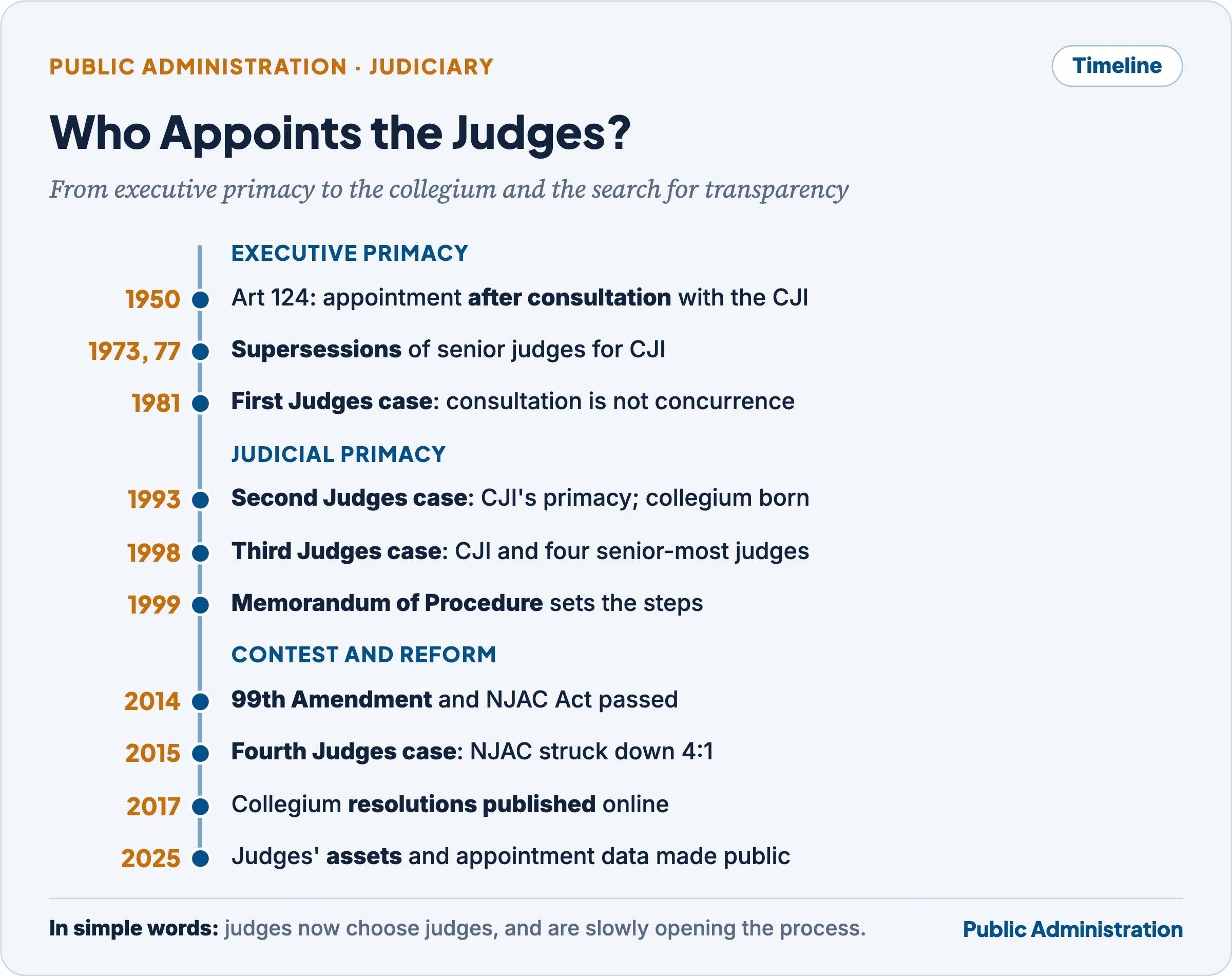
- The text: Art 124(2): Supreme Court judges are appointed by the President “after consultation” with such judges as he deems necessary, and the CJI shall always be consulted for judges other than the CJI. Art 217: High Court judges after consultation with the CJI, Governor and High Court Chief Justice. Until 1993, the executive had the effective final say. The Constituent Assembly had rejected both a CJI veto and a pure executive choice; Ambedkar called giving the CJI a veto “a dangerous proposition”.
- S.P. Gupta v. Union of India (1981), the First Judges case (seven judges): “consultation” does not mean concurrence; the executive has primacy and can disagree with the CJI for cogent reasons.
- Supreme Court Advocates-on-Record Association v. Union of India (1993), the Second Judges case (nine judges): overruled S.P. Gupta; the opinion of the CJI, formed with his two senior-most colleagues, has primacy; the executive may return a name once, but must appoint if it is reiterated. This created the collegium.
- In re Special Reference No. 1 of 1998 (the Third Judges case): on a presidential reference, the Court widened the collegium to the CJI and four senior-most judges for Supreme Court appointments (CJI and two senior-most for High Courts) and required written opinions. The Memorandum of Procedure (MoP) of 1999 codified the process, which continues today.
- Constitution (99th Amendment) Act, 2014 and the National Judicial Appointments Commission Act, 2014 replaced the collegium with a six-member NJAC: the CJI (chair), two senior-most Supreme Court judges, the Union Law Minister and two eminent persons chosen by the PM, CJI and Leader of the Opposition (one from SC, ST, OBC, minorities or women). Any two members could veto a name.
- Supreme Court Advocates-on-Record Association v. Union of India (16 October 2015), the Fourth Judges case (NJAC case), 4:1: struck down the amendment and the Act, because primacy of the judiciary in appointments is part of judicial independence, a basic feature; the presence of the Law Minister and the veto of two lay members could defeat judicial choices. Justice J. Chelameswar dissented, criticising the collegium’s opacity. The Court then asked the government to revise the MoP; a revised MoP has not been finalised since.
11.3 The collegium debate
| Arguments for the collegium | Arguments against the collegium |
|---|---|
| Insulates appointments from executive and political pressure, as the 1970s supersessions showed was needed | Opaque: no written criteria, no public reasons, no record of consideration (until recent reforms) |
| Judges know the competence and integrity of candidates best | Judges appointing judges is unknown in other major democracies; no accountability |
| Upheld as part of the basic structure (2015) | Charges of nepotism (“uncle judges”; the Law Commission’s 230th Report, 2009) and lack of diversity (women, SC/ST/OBC, minorities) |
| The government still has a role: intelligence inputs, objections, and returning names | Delays and friction: the government sits on or segregates names; vacancies remain high |
| Recent transparency steps show it can reform itself | It is a judicial creation contrary to the text of Art 124 (which says “consultation”) |
Arguments in the NJAC debate (2014–15).
- For NJAC: a broad-based body with executive and civil-society voices, as in the UK’s Judicial Appointments Commission (2006) and in South Africa; it would bring transparency, accountability and diversity; Parliament passed it almost unanimously and more than half the State legislatures ratified it.
- Against NJAC: the Law Minister represents the government, the biggest litigant; two lay members could veto the three judges; the selection criteria were left to regulations; and it would expose appointments to political bargaining.
Transparency steps since 2015:
- October 2017: the collegium began publishing its resolutions with brief reasons on the Supreme Court website.
- Recent practice: the collegium has begun interacting with candidates in person before recommending them.
- 1 April 2025: the Full Court resolved that judges’ asset declarations be published; on 5 May 2025 the Court put on its website the complete appointment process and data on High Court appointments approved from November 2022 to May 2025, including the candidate’s category (SC/ST/OBC/minority/woman) and whether the candidate is related to a sitting or retired judge.
- Persistent friction: the government’s delays in notifying names (some pending over a year) and its practice of segregating names from a collegium list have been criticised by the Court; the MoP remains unrevised.
- Proposed middle paths: a revised MoP with written criteria, a permanent secretariat for the collegium, a search-and-evaluation committee, fixed timelines for both sides, and, in the 2nd ARC‘s Ethics report (2007), a National Judicial Council to handle appointments and judicial conduct.
Common confusion
Is the “collegium” mentioned in the Constitution? No. The word appears nowhere in the Constitution. Articles 124 and 217 speak only of “consultation” with the Chief Justice and other judges. The collegium is a judge-made institution created by the Second Judges case (1993) and refined by the Third Judges case (1998), and its working is set out in the Memorandum of Procedure, an agreed executive–judicial document, not a statute. When the 99th Amendment tried to write a different body (the NJAC) into the Constitution, the Court struck it down in 2015, so the collegium returned as the operative system.
11.4 Inside the court: roster, transfers and retirement
- Master of the roster: the CJI alone allocates cases to Benches (Asok Pande and Shanti Bhushan, 2018). In January 2018 four senior judges held an unprecedented press conference alleging selective allocation of sensitive cases, which led to the publication of a subject-wise roster.
- Transfers of High Court judges, though meant to be “in public interest”, are sometimes seen as punitive.
- Post-retirement jobs: many statutes reserve tribunal and commission posts for retired judges; critics suggest a cooling-off period to protect independence.
12. Judicial Accountability
In simple words
Independence does not mean judges answer to no one. A judge can be removed by Parliament, can be asked to resign by the Chief Justice after an internal inquiry, and must now disclose assets. But the removal process is so hard that no judge has ever actually been removed.
12.1 Removal by Parliament
- Procedure (Art 124(4), (5) and the Judges (Inquiry) Act, 1968):
- A notice of motion signed by 100 Lok Sabha or 50 Rajya Sabha members.
- The Speaker or Chairman may admit or refuse it.
- If admitted, a three-member Inquiry Committee (a Supreme Court judge, a High Court Chief Justice and a distinguished jurist) frames charges and investigates.
- If the committee finds the judge guilty, each House must pass the motion by a majority of its total membership and two-thirds of members present and voting in the same session.
- The President then orders removal.
- Removal is not impeachment. The Constitution uses “impeachment” only for the President (Art 61, for “violation of the Constitution”); judges are removed for “proved misbehaviour or incapacity“. The popular phrase “impeachment of judges” is loose usage.
- Cases: Justice V. Ramaswami (1993): found guilty by the committee, but the motion failed in the Lok Sabha when the ruling party abstained; Justice Soumitra Sen (2011): the Rajya Sabha passed the motion and he resigned before the Lok Sabha voted; Justice P.D. Dinakaran (2011): resigned during the inquiry; a 2018 notice against CJI Dipak Misra was refused at the admission stage.
- The Justice Yashwant Varma case (2025–26).
- A fire at the Delhi High Court judge’s official residence on the night of 14 March 2025 led to the discovery of burnt currency in a storeroom.
- CJI Sanjiv Khanna set up a three-member in-house inquiry and forwarded its report to the President and Prime Minister; the judge was repatriated to the Allahabad High Court and kept away from judicial work.
- On 12 August 2025 Speaker Om Birla admitted a removal motion signed by 146 Lok Sabha members and constituted an Inquiry Committee under the 1968 Act (Justice Aravind Kumar of the Supreme Court as presiding officer, a High Court Chief Justice and senior advocate B.V. Acharya).
- The judge resigned on 9 April 2026, after withdrawing from the inquiry. The committee’s report, tabled on 12 August 2026, found all three charges proved: unexplained cash, interference with evidence, and evasive explanations.
- What it shows: the in-house process acted quickly; the statutory route took over a year; and resignation can pre-empt removal, leaving no formal sanction beyond the findings.
12.2 In-house procedure and ethics codes
- C. Ravichandran Iyer v. Justice A.M. Bhattacharjee (1995): the Court noted the gap between bad conduct and the very high bar of removal, and suggested an in-house procedure.
- Restatement of Values of Judicial Life (May 1997): a code of conduct adopted by the Full Court (no lobbying, no relatives practising before the judge, no public debates on pending cases, no gifts).
- In-house procedure (1999): a complaint goes to the CJI (or High Court Chief Justice); after a preliminary view, a three-member committee inquires; if the misconduct is serious, the judge is advised to resign or retire; if he refuses, the CJI informs the President and Prime Minister, and judicial work may be withdrawn.
- Limits: the process is confidential and has no statutory force; the complainant has no rights; outcomes depend on the CJI.
- The Judicial Standards and Accountability Bill, 2010 (a statutory code, asset declarations and a complaints body) passed the Lok Sabha in 2012 but lapsed in 2014.
12.3 Other channels of accountability
- Transparency and RTI: CPIO, Supreme Court v. Subhash Chandra Agarwal (2019) held that the office of the CJI is a public authority under the RTI Act, subject to privacy and independence; asset declarations are now published (2025).
- Open courts, reasoned judgments, appeals and review are the basic accountability of judging.
- Live streaming: after Swapnil Tripathi v. Supreme Court (2018), Constitution Bench hearings have been live-streamed since September 2022, and several High Courts stream proceedings.
- Contempt power cuts the other way: it protects courts, but its use against critics has been questioned. The Contempt of Courts (Amendment) Act, 2006 allowed truth as a defence when in the public interest and bona fide.
- Criminal prosecution: K. Veeraswami v. Union of India (1991) held that judges are “public servants” under the anti-corruption law, but no prosecution can begin without consulting the CJI.
13. Work Processes of Courts and the Pendency Problem
In simple words
Courts are also organisations that must schedule cases, manage files and staff, and decide disputes on time. In India, more than five crore cases are waiting. Computerisation, video hearings and data dashboards help, but without enough judges, fewer adjournments and less government litigation, the queue keeps growing.
13.1 Case management and listing
- Listing and the cause list: the Registry lists cases before Benches according to the roster set by the Chief Justice; unpredictable listing leads to repeated oral mentioning and adjournments. Chief Justice Surya Kant began a pilot listing reform and quarterly reports on administrative reforms (2025–26), and has prioritised Constitution Bench cases and mediation.
- Adjournments: the Code of Civil Procedure was amended in 2002 to allow no more than three adjournments to a party; the rule is widely ignored. Salem Advocate Bar Association v. Union of India (2005) upheld these amendments and asked High Courts to frame case-flow management rules.
- Commercial courts use case management hearings and strict timelines (Order XV-A CPC, as applied to commercial disputes).
- Criminal procedure under the BNSS (2023): timelines for charge-sheets, framing of charges and delivery of judgment (within 30 days of the end of arguments, extendable to 45), trial in absentia of proclaimed offenders, and electronic summons.
- Court management: the National Court Management Systems committee (2012) and court managers in each district aim to bring professional management to courts, which judges traditionally ran themselves.
13.2 e-Courts, NJDG and virtual hearings
- e-Courts Mission Mode Project (under the Supreme Court’s e-Committee):
- Phase I (2007–2015): computerisation of district courts.
- Phase II (2015–2023): case information systems, NJDG, e-filing, virtual courts for traffic challans.
- Phase III (2023–2027): approved in September 2023 with ₹7,210 crore; aims at digital and paperless courts, cloud storage of digitised records, video conferencing in all courts, jails and hospitals, universal e-Sewa Kendras, and AI and OCR tools.
- Progress (Lok Sabha reply, August 2026): over 753 crore pages digitised, 2,584 e-Sewa Kendras, about 4.18 crore hearings by video conferencing and about 1.25 crore cases e-filed. Sikkim became the first State with a fully paperless judiciary.
- National Judicial Data Grid (NJDG): an online dashboard of filed, pending and disposed cases for every court, by type and age; the Supreme Court joined it in September 2023. It is the basis of all official pendency figures and helps identify bottleneck courts and case types.
- Virtual hearings: made routine during COVID-19 (2020–21); hybrid hearings continue. SUVAS (translation of judgments into Indian languages) and SUPACE (AI research assistance) are Supreme Court tools.
- Concerns: the digital divide for litigants and lawyers in rural areas, data protection, uneven infrastructure across districts.
13.3 Pendency and vacancies: the numbers
The figures below come from answers given in Parliament in 2026 (based on the NJDG and the Department of Justice).
| Level | Pending cases | Notes |
|---|---|---|
| Supreme Court | 95,954 (30 July 2026) | About 9,400 pending over ten years |
| High Courts | about 64.7 lakh | About 16 lakh pending over ten years; 80,660 over 30 years |
| District and subordinate courts | about 4.99 crore | About 54.5 lakh pending over ten years |
| Total | about 5.64 crore | Mostly criminal cases |
- Vacancies (1 October 2026): the Supreme Court had 34 judges against 38 sanctioned; the High Courts had 834 against 1,122 sanctioned, so 288 posts (26 per cent) were vacant, with some High Courts above 40 per cent.
- Judge strength: the Law Commission’s 120th Report (1987) recommended 50 judges per million people; India remains far below that level.
- Undertrials: about three-quarters of prisoners are undertrials, the human cost of delay first exposed in Hussainara Khatoon (1979).
13.4 Why justice is delayed
- Too few judges and slow appointments at every level; poor infrastructure and staff.
- Government as the largest litigant: departments appeal routinely, even on settled issues; the National Litigation Policy (2010) to make government an “efficient and responsible litigant” was never fully implemented.
- Adjournments and procedural complexity; lawyers’ strikes; vacations.
- Investigation delays, absent witnesses and slow forensic reports in criminal cases.
- Docket explosion at the top: special leave petitions and PILs crowd the Supreme Court.
- Colonial inheritance: an adversarial, paper-heavy, English-language process designed for a small colonial elite; long vacations; formal dress and ritual; distance from the litigant.
13.5 Measures
- Fill vacancies on time, with fixed timelines in the MoP; raise strength toward the Law Commission norm; retired judges under Art 224A.
- Infrastructure: the proposal (2021) for a National Judicial Infrastructure Authority to fund and plan court infrastructure; more court halls and staff.
- Reduce government litigation: a binding litigation policy, empowered committees to screen appeals, alternative redressal for service matters.
- Process reform: strict adjournment rules, case-flow management, clustering of identical cases, time standards (the Law Commission’s 245th Report, 2014 recommended a rate-of-disposal method to calculate the judges needed).
- Technology: e-Courts Phase III, NJDG analytics, AI-assisted listing and translation.
- ADR and specialised forums (section 15), plea bargaining, compounding of minor offences.
- Targeted action: in October 2026 the Law Ministry began a mission focused on the 100 districts with the highest pendency, which account for over half of district-court arrears.
- Indian languages in courts, less ritual and simpler procedure to bring justice closer to citizens.
- Former CJI Dipak Misra‘s remark that an efficient judiciary is the hallmark of a great nation reflects the link between timely justice and economic and social development: contract enforcement, investment, rule of law and public trust all depend on it.
14. The All India Judicial Service
In simple words
The idea is to recruit district judges through a national examination, like the IAS, so that the best young lawyers join the judiciary from all over the country. Many States and High Courts oppose it because it would take away their control over local courts.
- Constitutional basis: Art 312, as amended by the 42nd Amendment (1976), allows Parliament to create an All India Judicial Service if the Rajya Sabha passes a resolution by two-thirds; Art 312(3) limits it to posts not inferior to district judge.
- History: recommended by the Law Commission’s 14th Report (1958) (chaired by M.C. Setalvad), and again in its 77th (1978) and 116th (1986) Reports; the Supreme Court in All India Judges’ Association v. Union of India (1992) asked the government to consider it. A proposal was discussed in Chief Justices’ conferences and with the States, but there is no consensus: most High Courts and many States have opposed it.
| Arguments for AIJS | Arguments against AIJS |
|---|---|
| Attracts talented young lawyers through a transparent national exam | Federalism: Arts 233–235 give High Courts and Governors control of subordinate courts |
| Fills vacancies faster and builds a pool for High Court elevation | Language: district courts work in regional languages; local laws and customs differ |
| Uniform training and standards; improves quality and reduces delay | Blocks promotion prospects of State judicial officers |
| Diversity through national reservation; national integration | Does not address delays at High Courts or the collegium |
| A step toward an independent, merit-based judicial career | States can improve existing exams instead; some already hold good ones |
- Assessment: an AIJS addresses recruitment quality but not the main causes of delay (vacancies at all levels, adjournments, government litigation). A middle path suggested is a national-level exam whose results States and High Courts use, keeping State cadres and High Court control.
15. Lok Adalats, Mediation, Commercial Courts and Gram Nyayalayas
In simple words
Not every dispute needs a full trial. People can settle before a Lok Adalat in a day, sit down with a trained mediator, or take a business dispute to a special commercial court. For villages, the law provides mobile courts close to home. These routes take pressure off the regular courts.
- Constitutional basis: Art 39A (added by the 42nd Amendment) directs the State to provide equal justice and free legal aid.
- Lok Adalats under the Legal Services Authorities Act, 1987 (in force 1995), run by NALSA and State and district legal services authorities:
- settle pending or pre-litigation cases by compromise; the award is deemed a civil court decree and is final, with no appeal; court fees are refunded.
- National Lok Adalats are held on fixed days across the country and dispose of very large numbers of cases (mostly traffic, cheque-bounce, motor accident, bank recovery, family and petty cases).
- Permanent Lok Adalats (2002 amendment) for public utility services can decide a dispute on merits if conciliation fails.
- Limit: they work only where parties agree; critics note pressure on weaker parties to accept low settlements.
- Arbitration and Conciliation Act, 1996 (amended 2015 and 2019 for time limits and an Arbitration Council of India) governs commercial arbitration.
- Mediation Act, 2023: India’s first standalone mediation law. Key features:
- Pre-litigation mediation (voluntary) and court-referred mediation.
- A time limit of 120 days, extendable by 60.
- Mediated settlement agreements enforceable like a court decree.
- Online mediation and community mediation for local disputes.
- A Mediation Council of India to register mediators and institutions.
- Commercial Courts Act, 2015 (amended 2018): commercial courts at district level and commercial divisions in High Courts for disputes of a specified value (now ₹3 lakh), with strict timelines; s. 12A requires pre-institution mediation unless urgent relief is sought, held mandatory in Patil Automation v. Rakheja Engineers (2022).
- Gram Nyayalayas Act, 2008 (in force 2 October 2009):
- mobile courts at the intermediate panchayat level, presided over by a Nyayadhikari (a first-class judicial magistrate), with summary procedure, power to hold sittings in villages, and a duty to try conciliation first.
- Poor implementation: about 490 have been notified and only around 330–340 are operational (Department of Justice data, 2026), concentrated in a few States; reasons include lack of funds, existing regular courts at taluka level, reluctance of lawyers and police, and limited jurisdiction.
- Samadhan Samaroh (2026): the Supreme Court’s drive (from 21 April 2026) to identify pending matters for mediated settlement, ending in a Special Lok Adalat in August 2026.
- Assessment: ADR reduces arrears and cost and suits India’s tradition of community dispute settlement (the old nyaya panchayats), but it needs trained mediators, public trust and safeguards so that it does not become second-class justice for the poor.
16. Intra-governmental Relations: Separation of Powers and Checks and Balances
In simple words
The three organs are separate but not sealed off. Ministers sit in Parliament; Parliament can remove judges; courts can cancel laws and orders. Each watches the others so that no one becomes all-powerful, but this also produces regular clashes over who has the last word.
16.1 Separation of powers in the Indian version
- Montesquieu, the French political philosopher, in The Spirit of the Laws (1748), argued that liberty is lost when legislative, executive and judicial powers are held by the same person or body; each must check the others (“power should be a check to power“).
- The US model separates the organs strictly and adds checks and balances (presidential veto, Senate confirmation, judicial review).
- India has no rigid separation. The Constitution does not use the phrase. The executive is drawn from the legislature; the President legislates through ordinances; Parliament judges privilege and removal; courts make rules and issue guidelines. In Ram Jawaya Kapur v. State of Punjab (1955) the Supreme Court held that India has not adopted separation of powers in its absolute rigidity, but the functions of the organs are sufficiently differentiated and one organ cannot assume the essential functions of another. Separation of powers was later recognised as a basic feature (Indira Gandhi v. Raj Narain, 1975).
- Art 50 (separation of judiciary from executive) and Art 121/211 (no discussion of judges’ conduct) are the only explicit separations.
16.2 The web of checks
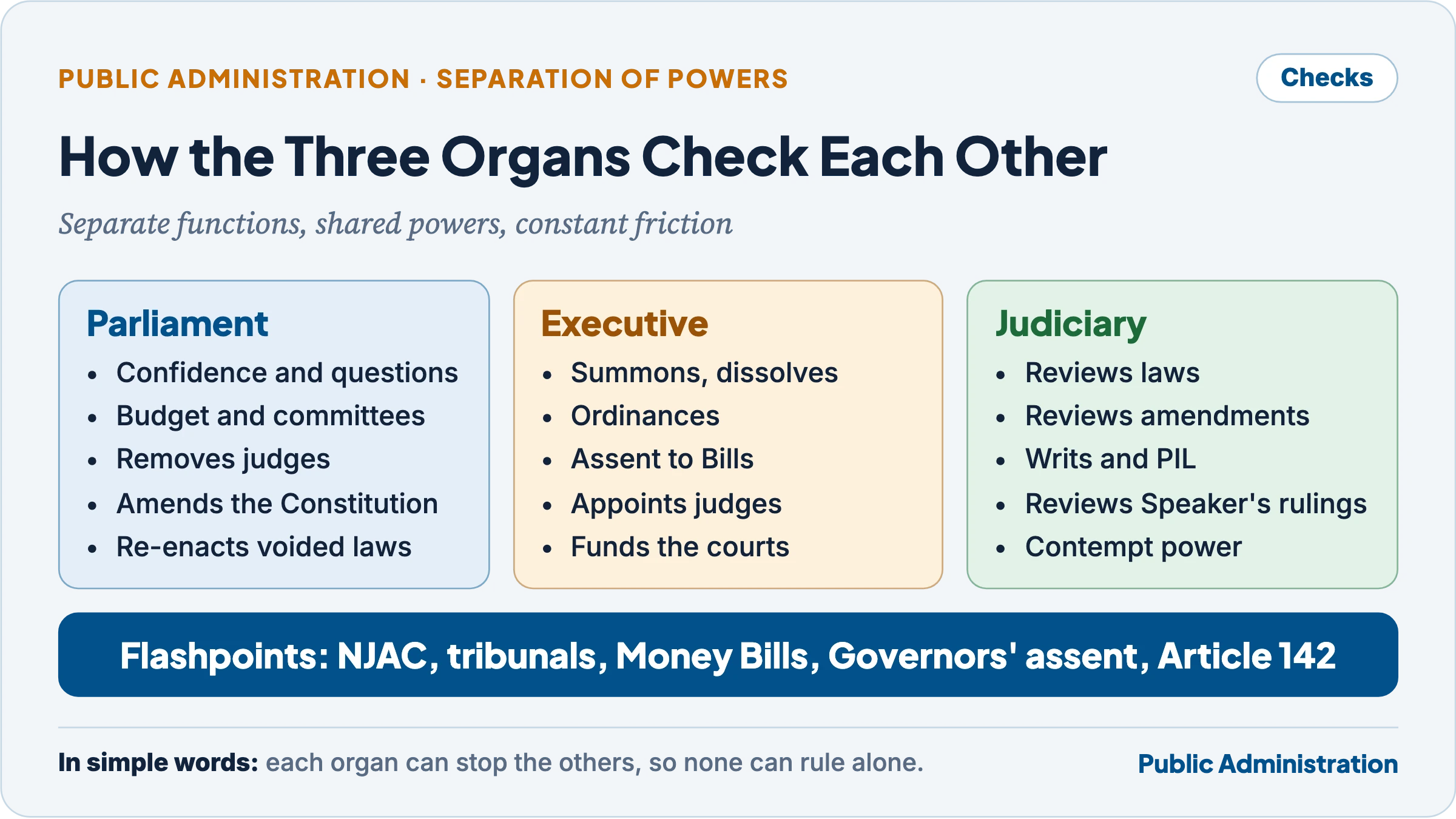
| Who checks | Over the legislature | Over the executive | Over the judiciary |
|---|---|---|---|
| Legislature | (Each House over its members: privileges, ethics, discipline) | Collective responsibility, questions, motions, budget, committees, CAG, approval of emergencies | Removal of judges; fixing number, salaries and jurisdiction by law; amending the Constitution; re-enacting laws struck down |
| Executive | Summons and prorogues; dissolves the Lok Sabha; ordinances; President’s assent and return of Bills; controls the agenda through its majority | (Internal hierarchy) | Appointment of judges (with the collegium); budget and infrastructure for courts; notifying names |
| Judiciary | Judicial review of laws and amendments; review of Money-Bill certification and Speaker’s defection rulings | Writs, judicial review of action, PIL, contempt | (Appeals, review, curative petitions within the judiciary) |
16.3 Flashpoints in the relationship
- Property and land reform (1950s–70s): the First Amendment, Ninth Schedule and Golaknath led to the basic structure settlement (1973).
- The Emergency (1975–77): the 39th and 42nd Amendments, the ADM Jabalpur judgment (1976, later overruled in Puttaswamy, 2017), and the 44th Amendment restoring safeguards.
- Judicial appointments: from the supersessions of the 1970s to the NJAC case (2015) and continuing disputes over the MoP and delays in notifying names.
- Tribunals: repeated laws and repeated strikings down (Madras Bar Association series), ending (for now) in the Tribunals Reforms Act, 2026, which adopts the Court’s model of a National Tribunals Commission.
- Money Bills and the Rajya Sabha (section 7.6).
- Governors, assent and federalism: in State of Tamil Nadu v. Governor of Tamil Nadu (8 April 2025), a two-judge Bench fixed timelines for Governors and the President and used Art 142 to treat ten Bills as having received assent. On a Presidential Reference under Art 143, a Constitution Bench opined on 20 November 2025 that courts cannot impose fixed timelines on Governors or the President, that “deemed assent” is not permissible and Art 142 cannot be used to substitute their functions, while allowing limited judicial intervention in cases of prolonged, unexplained inaction. The episode shows the Court drawing back from overreach while preserving review.
- Public criticism across organs: senior constitutional functionaries have openly criticised the use of Art 142 and judicial “overreach”, while the Court has criticised vacant posts, delayed appointments and legislation without debate.
16.4 Managing intra-governmental relations
- Why it matters: friction among organs delays appointments, legislation and policy, multiplies litigation, and lowers public trust; smooth relations improve governance outcomes as much as smooth Centre–State relations do.
- Mechanisms that help:
- Conventions: the senior-most judge as CJI; opposition Deputy Speaker; consultation on appointments; the Attorney-General’s role as a bridge (Art 76, 88).
- Institutional forums: the Chief Justices’ and Chief Ministers’ Conference, the Law Commission, the e-Committee and the Department of Justice working with the judiciary; the Business Advisory Committee in Parliament.
- Self-restraint by each organ: courts avoiding policy design; the executive avoiding ordinance and Money-Bill shortcuts; Parliament respecting judgments.
- Intra-governmental relations inside the executive (between ministries, departments and coordination bodies) are covered in the article on Ministries, Departments, Boards, Commissions, Attached Offices and Field Organisations.
17. Reading Parliament and the Judiciary through Paper I
In simple words
Ideas from administrative theory help explain why Parliament struggles to control a large bureaucracy, why courts became so active, and why Indian institutions often work differently from what the Constitution’s text says.
Theory lens: legislative and judicial control in theory and Indian practice
- Separation of powers (Montesquieu). The Spirit of the Laws (1748) gives the logic of three organs that check one another. India’s design is “separation with fusion”: the executive is fused with the legislature (as Walter Bagehot described for Britain, where the Cabinet is the “buckle” joining the two), while the judiciary stands apart. Recent friction (tribunals, governors, Art 142) is about where the boundaries lie. See the article on Accountability and Control.
- Rule of law and parliamentary sovereignty (Dicey). A.V. Dicey, in Introduction to the Study of the Law of the Constitution (1885), joined two principles that sit uneasily together: parliamentary sovereignty and the rule of law enforced by ordinary courts. India resolves the tension through constitutional supremacy: Parliament is limited, and courts enforce the rule of law even against statutes. Dicey’s suspicion of separate administrative courts also echoes in Indian tribunal law (L. Chandra Kumar). See the article on Administrative Law: Meaning, Scope, Significance and Dicey.
- Accountability theory (Finer and Friedrich). Herman Finer (1941) argued for external, formal control of officials by elected representatives; Carl Friedrich (1940) relied on professional responsibility and inner checks. Parliament’s weakness in technical scrutiny supports Friedrich’s realism; the decline of committee referral and debate supports Finer’s fear that, without strong external control, bureaucracy and the executive escape accountability. See the article on Accountability and Control.
- Principal–agent theory; police patrols and fire alarms. Voters (principals) delegate to Parliament, which delegates to ministers and officials (agents) who have more information. McCubbins and Schwartz (1984) showed that legislatures often prefer cheap fire-alarm oversight (relying on citizens, interest groups and courts to raise complaints) to costly police-patrol oversight (continuous inspection). India’s falling committee scrutiny and rising reliance on RTI, PIL, media and courts fit this shift; the courts have in effect become a fire-alarm channel for citizens.
- Weber and the bureaucratisation of politics. Max Weber warned that parliaments of amateurs would be dominated by expert bureaucracies unless they built strong committees with powers of inquiry. Indian MPs’ generalism, dependence on ministry-drafted answers and Bills, and skeleton laws filled by delegated legislation illustrate the “bureaucratic triumph” Weber feared. See the article on Weber’s Bureaucratic Model, its Critique and Post-Weberian Developments.
- Riggs and formalism. Fred Riggs‘s idea of formalism (a gap between formal rules and actual practice) describes parts of Indian practice: Art 93 says “as soon as may be” yet the Deputy Speaker’s post is vacant for years; the CPC limits adjournments to three, yet adjournments are routine; Gram Nyayalayas exist on paper in many places. See the article on Riggsian Models.
- Judicial activism and policy making. Public policy theory treats courts as veto players and, in India, as policy entrepreneurs that place issues on the agenda (food, police, environment) and even design implementation through continuing mandamus. Upendra Baxi‘s “social action litigation” and Pratap Bhanu Mehta‘s warning of “judicial sovereignty” frame the two sides. See the article on Models of Policy-Making.
- Institutionalism. James March and Johan Olsen (Rediscovering Institutions, 1989) argued that institutions shape behaviour through rules and norms of appropriateness, and historical institutionalism stresses path dependence. The collegium (born of the 1970s distrust of the executive), the Speaker’s partisan role, and the colonial form of courts show how past choices lock in present practice; reforms succeed when they change norms, not only rules.
Key Terms
The terms below recur through the article; each is explained in the section indicated or in plain words here.
| Term | Meaning in simple words |
|---|---|
| Money Bill | A Bill only on taxes, borrowing and government funds (Art 110); the Rajya Sabha cannot amend or reject it |
| Guillotine | Putting all remaining demands for grants to vote together without discussion on the last allotted day |
| Cut motion | A motion to reduce a demand for grants (policy, economy or token cut) to debate a ministry |
| Question Hour | The first hour of a sitting, when ministers answer members’ questions |
| Zero Hour | The period after Question Hour when members raise urgent matters without notice; an Indian practice |
| Adjournment motion | A motion to set aside normal business to discuss an urgent matter; implies censure |
| No-confidence motion | A motion in the Lok Sabha that, if passed, forces the Council of Ministers to resign |
| DRSC | Department-related Standing Committee: 24 committees, 31 members each, that examine ministries’ grants and Bills |
| Public Accounts Committee | The committee that examines government accounts and CAG reports after money is spent |
| Joint Parliamentary Committee | An ad hoc committee of both Houses to examine a Bill or inquire into a matter |
| Anti-defection law | The Tenth Schedule, under which members who leave their party or defy the whip lose their seats |
| Basic structure | Core features of the Constitution that even an amendment cannot destroy (Kesavananda, 1973) |
| Public Interest Litigation | A case brought for the public or for those who cannot approach the court themselves |
| Continuing mandamus | A court keeping a case open to monitor whether its orders are carried out |
| Judicial activism | Active use of judicial power to protect rights where other organs fail |
| Judicial overreach | Courts entering the legislature’s or executive’s domain, such as framing policy |
| Collegium | The Chief Justice and senior-most judges who recommend appointments and transfers of judges |
| Memorandum of Procedure | The agreed document that sets out the steps for appointing and transferring judges |
| In-house procedure | The judiciary’s internal process for inquiring into complaints against judges |
| NJDG | National Judicial Data Grid: the online dashboard of cases in all courts |
| Gram Nyayalaya | A mobile village-level court under the 2008 Act |
Commissions, Committees and Judgments
The table lists, in order, the bodies and judgments that shaped Parliament, the judiciary and their relations.
| Body / case | Year | Key point |
|---|---|---|
| Ram Jawaya Kapur v. State of Punjab | 1955 | No rigid separation of powers, but no organ may assume another’s essential functions |
| Law Commission, 14th Report (chair M.C. Setalvad) | 1958 | Reform of judicial administration; recommended an All India Judicial Service |
| Kesavananda Bharati v. State of Kerala | 1973 | 7:6; Parliament cannot amend the basic structure |
| Hussainara Khatoon v. State of Bihar | 1979 | Speedy trial part of Art 21; start of PIL for undertrials |
| S.P. Gupta v. Union of India (First Judges case) | 1981 | Consultation is not concurrence; executive primacy; relaxed locus standi for PIL |
| D.C. Wadhwa v. State of Bihar | 1987 | Repeated re-promulgation of ordinances is a fraud on the Constitution |
| Law Commission, 120th Report | 1987 | 50 judges per million population |
| Dinesh Goswami Committee on electoral reforms | 1990 | Defection disputes to be decided by President or Governor on Election Commission’s advice |
| Kihoto Hollohan v. Zachillhu | 1992 | Tenth Schedule valid; Speaker’s defection ruling subject to judicial review |
| S.C. Advocates-on-Record Assn. v. Union of India (Second Judges case) | 1993 | Primacy of the CJI; creation of the collegium |
| Department-related Standing Committees set up | 1993 | Sector-wise scrutiny of grants and Bills; 24 committees from 2004 |
| C. Ravichandran Iyer v. Justice A.M. Bhattacharjee | 1995 | Need for an in-house procedure for judicial misconduct |
| L. Chandra Kumar v. Union of India | 1997 | High Courts’ review over tribunals is basic structure |
| Vishaka v. State of Rajasthan | 1997 | Guidelines on sexual harassment at work until Parliament legislates |
| In re Special Reference No. 1 of 1998 (Third Judges case) | 1998 | Collegium of CJI and four senior-most judges; written opinions |
| NCRWC (chair Justice M.N. Venkatachaliah) | 2002 | Parliamentary form suits India; minimum 120/100 sitting days a year; review of anti-defection and contempt law |
| 2nd ARC, 4th Report: Ethics in Governance (chair M. Veerappa Moily) | 2007 | National Judicial Council for appointments and judicial conduct; ethics codes for legislators |
| Aravali Golf Club v. Chander Hass | 2007 | Judges must exercise restraint and not run the government |
| State of Uttaranchal v. Balwant Singh Chaufal | 2010 | Guidelines to check frivolous PIL |
| Law Commission, 245th Report (chair Justice A.P. Shah) | 2014 | Rate-of-disposal method to estimate judge strength |
| S.C. Advocates-on-Record Assn. v. Union of India (NJAC case) | 2015 | 4:1; 99th Amendment and NJAC Act struck down; judicial primacy is basic structure |
| Krishna Kumar Singh v. State of Bihar | 2017 | Re-promulgation is fraud; ordinance satisfaction is reviewable |
| K.S. Puttaswamy (Aadhaar) | 2018 | Aadhaar Act upheld as a Money Bill; Justice Chandrachud’s dissent |
| Rojer Mathew v. South Indian Bank | 2019 | Money-Bill question referred to a seven-judge Bench (pending) |
| CPIO, Supreme Court v. Subhash Chandra Agarwal | 2019 | Office of the CJI is a public authority under RTI |
| Keisham Meghachandra Singh v. Speaker, Manipur | 2020 | Speakers should decide defection petitions in about three months; suggested an independent tribunal |
| Subhash Desai v. Principal Secretary, Governor of Maharashtra | 2023 | Speaker decides first; party appoints whip; Nabam Rebia question referred to seven judges |
| Sita Soren v. Union of India | 2024 | No legislative immunity for bribery; P.V. Narasimha Rao overruled |
| Padi Kaushik Reddy v. State of Telangana | 2025 | Speaker directed to decide defection petitions in three months |
| Madras Bar Association v. Union of India | 2025 | Tribunals Reforms Act 2021 provisions struck down; National Tribunals Commission directed |
| Presidential Reference No. 1 of 2025 | 2025 | No judicial timelines or “deemed assent” for Governors and President; limited review of prolonged inaction |
| Judges Inquiry Committee on Justice Yashwant Varma (presiding officer Justice Aravind Kumar) | 2026 | All three charges proved; report tabled after the judge resigned |
Contemporary Developments
- Tribunals Reforms Act, 2026 (assent 13 August 2026): repealed the 2021 Act after the Supreme Court’s November 2025 judgment and set up a National Tribunals Commission to select and oversee members of 16 tribunals, with a National Tribunals Data Grid.
- Supreme Court (Number of Judges) Amendment Act, 2026 (August 2026): raised the Court’s sanctioned strength from 34 to 38; it was passed as a Money Bill, reviving the Money-Bill debate while the 2019 seven-judge reference remains pending.
- Justice Yashwant Varma inquiry (report tabled 12 August 2026): the statutory committee found all three charges proved; the judge had resigned on 9 April 2026, so removal did not take place, exposing the gap between inquiry and sanction.
- Monsoon Session 2026 (20 July to 13 August): the Lok Sabha worked 15 per cent of scheduled time; nine of eleven Bills passed without any member other than the minister speaking; the 18th Lok Sabha’s committee-referral rate stood at 21 per cent (PRS).
- Removal resolution against the Speaker defeated (11 March 2026): the first such motion in nearly four decades; the debate highlighted the Deputy Speaker’s post, vacant since 2019.
- Presidential Reference opinion (20 November 2025): a Constitution Bench held that courts cannot fix timelines for Governors and the President or grant “deemed assent”, narrowing the April 2025 Tamil Nadu ruling.
- Pendency and the hotspot mission (2026): about 5.64 crore cases pending (July 2026), with 26 per cent of High Court posts vacant (October 2026); in October 2026 the Law Ministry launched a focused mission on the 100 districts with the highest pendency.
- Judicial transparency (April–May 2025): the Supreme Court published judges’ asset declarations and full details of the appointment process, including whether candidates are related to judges.
Revision Grid
| Thinker / body | Work or report (year) | Key idea |
|---|---|---|
| Montesquieu | The Spirit of the Laws (1748) | Separation of powers; power must check power |
| John Stuart Mill | Considerations on Representative Government (1861) | Rule through periodically elected deputies |
| Walter Bagehot | The English Constitution (1867) | Functions of the Commons; Cabinet as the “buckle” fusing executive and legislature |
| A.V. Dicey | Introduction to the Study of the Law of the Constitution (1885) | Parliamentary sovereignty and rule of law |
| James Bryce | Modern Democracies (1921) | Decline of legislatures |
| W.H. Morris-Jones | Parliament in India (1957) | Early Indian Parliament’s working |
| K.C. Wheare | Legislatures (1963) | Decline in law-making, not necessarily in control |
| Granville Austin | The Indian Constitution: Cornerstone of a Nation (1966) | Constitution as a “seamless web” |
| McCubbins and Schwartz | “Congressional Oversight Overlooked” (1984) | Police-patrol versus fire-alarm oversight |
| March and Olsen | Rediscovering Institutions (1989) | Institutions shape behaviour; path dependence |
| Upendra Baxi | Writings on social action litigation (1980s) | PIL as a tool of the poor |
| Pratap Bhanu Mehta | “The Rise of Judicial Sovereignty” (2007) | Risk of courts governing on popularity |
| NCRWC | Report (2002) | Minimum sittings; parliamentary reform |
| 2nd ARC | Ethics in Governance (2007) | National Judicial Council; ethics codes |
| Law Commission | 14th (1958), 120th (1987), 245th (2014) Reports | AIJS; judge strength; disposal-rate method |
Previous Year Questions
- 2026Though seldom enacted, Cut Motions remain vital instruments of parliamentary accountability. Comment.
- 2025The ‘guillotine’ hastens the budgetary process to meet the timeline. Evaluate the procedure.
- 2024“The collegium system of appointments to higher judiciary has been the cornerstone of independence of judiciary. It has remained as the subject of debates in the recent past.” Discuss.
- 2024“Parliamentary control over public expenditure is declining.” Comment.
- 2023Former Chief Justice of India, Dipak Misra observed: “An efficient judiciary is the hallmark of a great nation.” Comment.
- 2022“The Indian judicial system has failed to deliver justice expeditiously”. Examine the challenges faced by the judiciary and suggest measures to overcome them.
- 2022Parliamentary control over administration is no substitute for judicial control. Comment.
- 2021The role and status of the Speaker in parliamentary system have their foundation in the Speaker’s stance on neutrality. Comment.
- 2020Parliamentary committees are at the deliberative core of parliamentary work which is crucial for refining legislations. Elucidate.
- 2020The spirit of democratic values requires that the independence of judiciary remains absolute. It is high time that the All India Judicial Service (AIJS) was created. Elaborate.
- 2019There has been an opinion that the ethos of Indian Judicial System continue to be colonial. Suggest measures for raising the level of judicial excellence for achieving speedy justice.
- 2018“Judicial overreach to a large extent is a consequence of ineffective executive.” Examine.
- 2017Do you think that “All India Judicial Service (AIJS) would contribute to timely delivery of justice to the citizens? Argue your case.
- 2016“The absence of congruence of views on appointments to judiciary between the Supreme Court and the Union Government has had an adverse impact on the judicial system.” In the light of the above statement, examine the proposal to constitute an All India Judicial Service (AIJS).
- 2016“National Green Tribunal is viewed by many critics as a hindrance to economic development” Evaluate the statement and give arguments in support of your answer.
- 2015Discuss the arguments for and against the National Judicial Appointments Commission Act, 2014.
- 2014Parliamentary committees bring about accountability and public expenditure. Discuss.
- 2014“Management of intragovernmental relations is as important as that of intergovernmental relations.” Examine its impact upon the performance of the government.
- 2013“Judicial review of administrative tribunal’s decisions defeats the very objective of establishing tribunals.” Comment with reference to Central Administrative Tribunal.
- 2012‘Parliamentary Departmental Committees have played their role effectively in analysing the demands for grants.’ Evaluate.
- 2012‘Parliament is an independent institution, not to be seen as an extension of government or of a party.’ Elaborate.
- 2012‘Judges should not govern the country. They can lay down a law, not interfere with governance.’ Discuss.
- 2012‘Questions represent a powerful technique of parliamentary control over expenditure.’ Explain.
- 2010“……… Judges and Courts have creatively reinterpreted their statutory authority and expanded their own power and enhanced their standing vis-a vis the legislature and executive.” Critically examine this assessment.
- 2010“Public Interest Litigation (OIL) has undergone several changes since its inception in 1980.” Comment.
- 2007“Parliamentary Departmental Committees have played their role effectively in analysing the demands for grants.” Evaluate.
- 1999It is said that the image and influence of Indian Parliament have suffered a serious decline in recent years. How far do you agree with this view-point?
- 1992‘Public Accounts Committee of Parliament is the real watch dog of financer of Union Govt.’ Comment.
- 1989‘The Parliamentary Control over administration is a misnomer……… It is like the blade at the top of the Guillotine, which need not fall to be Parliament gets improved, the desire to control by its members will abate.’ Comment.
- 1988“The judicial control over administration is no substitute for parliamentary control. Infact, they are supplementary but serve two different kinds of purposes.” Discuss.
- 1987What have you to suggest to make legislative control over public administration healthy and purposeful?
- 2026The fine demarcation between judicial control and judicial overreach disappears when judicial prudence is replaced by activism. Critically examine.
- 2024Ineffectiveness of legislative control over administration can stem from various factors, hence in ensuring effectiveness, a comprehensive approach is the need of the hour. Discuss.
- 2023“The judiciary is playing a more positive role in policy formulation, not just in limiting government actions, but also in mandating them.” Comment.
- 2016“The legislative control over administration is not as effective as it ought to be.” Comment.
- 2005What is judicial activism? How far has it been successful in exercising a check over administration?
- 2000Write short note on Judicial control over administration in India and concept of judicial activism.
- 1999“Public Interest Litigation is an effective innovation in realizing social justice.” Comment.
- 1997“The controls exercised over administration by legislature are, in sum, of greater theoretical than practical efficiency. Comment.
- 1996At one extreme, the vigour of judicial control may paralyse effective administration, at the other the result may be offensive bureaucratic tyranny, exactly where the balance may be best struck is a major problem of judicial administration relationship. Comment.
- 1987‘The Judicial Control over administration operates through a system of writs.’ Comment.