

Executive, Parliament, Judiciary – structure, functions, work processes; Recent trends; Intra-governmental relations; Cabinet Secretariat; Prime Minister’s Office; Central Secretariat; Ministries and Departments; Boards; Commissions; Attached offices; Field organizations.
This article: The apex staff system of the Union Government: the Cabinet Secretariat (origin, legal basis under the Allocation and Transaction of Business Rules, functions, organisations under it, Committees of Secretaries, servicing of Cabinet Committees, recent trends); the Cabinet Secretary (role, tenure, recent incumbents, comparison with the Chief Secretary); the Prime Minister’s Office (evolution from the Prime Minister’s Secretariat, present organisation, functions, Prime Minister by Prime Minister, PRAGATI and the Prime Minister’s councils, criticism and defence, Seva Teerth); PMO versus Cabinet Secretariat; the Central Secretariat (meaning, evolution, structure of a ministry, grades of officers, functions, split system, secretariat and executive agencies, line and staff); staffing (tenure system, Central Secretariat Service, Central Staffing Scheme, lateral entry, Mission Karmayogi); work procedure (noting, file movement, desk officer system, level-jumping, CSMOP 2022, e-Office); First and Second ARC views and recent reforms.
Official Syllabus: Paper II · Unit 2-04 Union Government and Administration
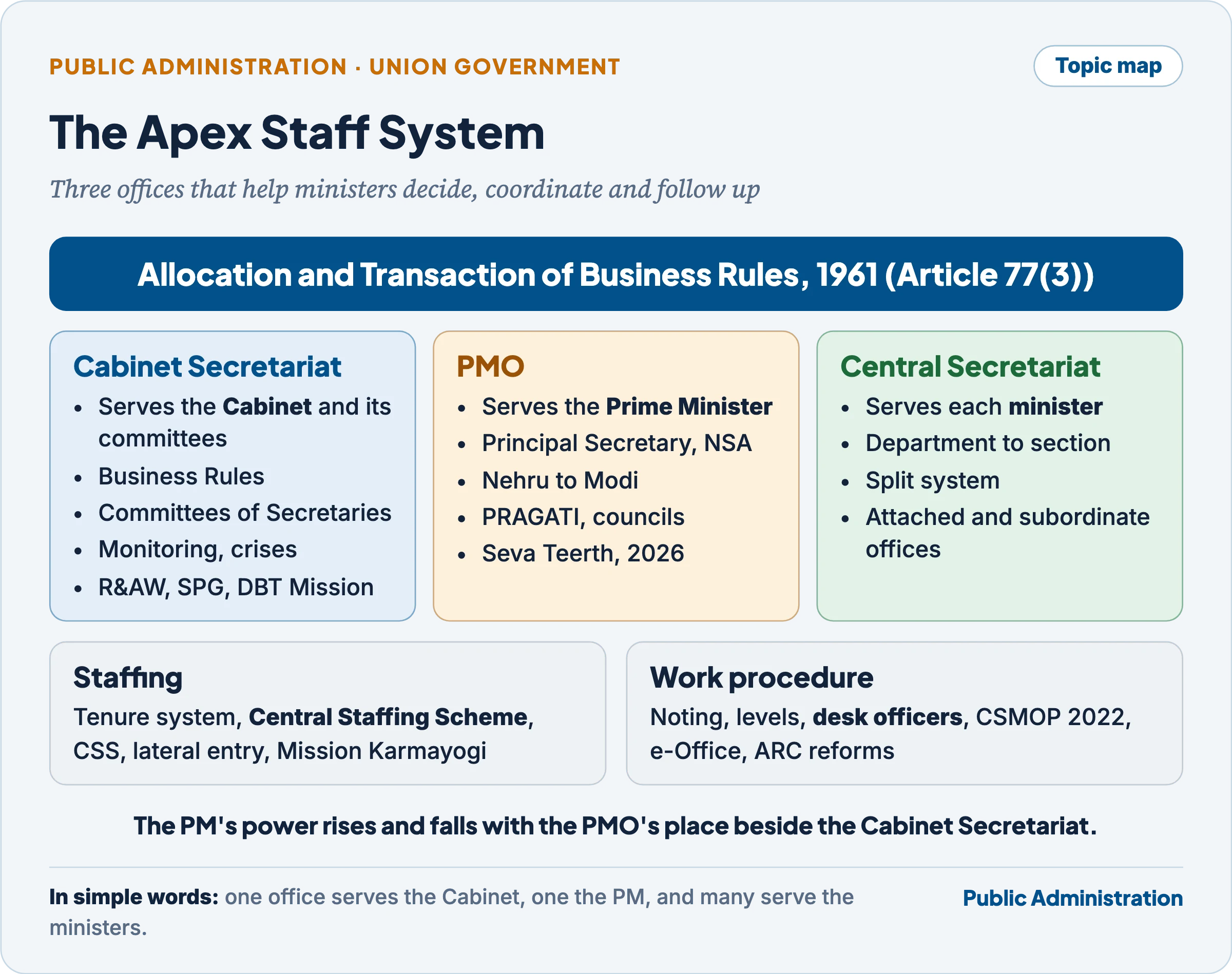
At the top of the Union Government sit a few hundred ministers and senior officials who decide what the State will do. They cannot decide well without staff: people who collect facts, draft papers, check legality, consult other offices, record decisions and follow them up. India has built three such staff systems at the apex. The Cabinet Secretariat serves the Cabinet as a collective body; the Prime Minister’s Office (PMO) serves the Prime Minister as a person and as head of government; and the Central Secretariat, the complex of ministries and departments, serves individual ministers in their own subjects.
The way these three bodies are organised, staffed and related to one another decides how fast the government thinks, how well its parts work together, and who really holds power at the top. That is why their story is also the story of the Indian executive: cabinet government in the Nehru years, the rise of the Prime Minister’s Secretariat under Indira Gandhi, the coalition decades, and the PMO-centred governance of the last decade.
In simple words
Think of a large hospital. The board of trustees (the Cabinet) meets once a week and needs a board secretary’s office to prepare the agenda, record decisions and chase follow-up: that is the Cabinet Secretariat. The Medical Director (the Prime Minister) has a personal office that reads everything coming to her desk, advises her and pushes her priorities: that is the PMO. Each department of the hospital (surgery, pharmacy, accounts) has its own head office that writes rules and supervises the wards: that is the Central Secretariat. The wards and clinics that treat patients are the field offices.
1. The Apex Staff System: Setting and Legal Basis
In simple words
A Prime Minister and fifty-odd ministers cannot read every file, check every law or attend every meeting. They depend on offices of officials who prepare, coordinate and follow up. The Constitution says almost nothing about these offices; they rest on two sets of rules made by the President.
1.1 Three staff systems at the apex
- Cabinet Secretariat. The secretariat of the Cabinet and its committees and the coordinating office of the whole government, headed by the Cabinet Secretary, the senior-most civil servant. It works directly under the Prime Minister.
- Prime Minister’s Office (PMO). The personal staff agency of the Prime Minister, headed politically by the PM and administratively by the Principal Secretary to the PM. It helps the PM discharge every responsibility of the office.
- Central Secretariat. The totality of ministries and departments of the Union Government listed in the First Schedule to the Allocation of Business Rules, each headed politically by a minister and administratively by a Secretary to the Government of India.
- Executive agencies below them. Attached offices, subordinate offices, boards, commissions, public sector undertakings and field formations carry out the policies framed above (see the article on Ministries, Boards, Commissions and Field Organisations).
The short version is that the Cabinet Secretariat coordinates the government collectively, the PMO coordinates it on the PM’s behalf, and the Central Secretariat frames and supervises policy subject by subject. The overlap between the first two is the source of the most debated question in this part of the syllabus.
1.2 Constitutional and legal basis
All three bodies are extra-constitutional in the sense that the Constitution does not name them. Their basis lies in the President’s rule-making power under Article 77(3) and in the parliamentary logic of Articles 74 and 75.
| Provision | What it says | Relevance here |
|---|---|---|
| Article 53 | Executive power of the Union vests in the President, exercised directly or through subordinate officers | Secretariat officers act “in the name of the President” |
| Article 74(1) | Council of Ministers with the PM at the head to aid and advise the President | Basis of the PM’s primacy that the PMO serves |
| Article 75(3) | Council of Ministers collectively responsible to the Lok Sabha | The Cabinet Secretariat serves collective decision-making; a dominant PMO is said to strain this |
| Article 77(1)–(2) | Executive action expressed in the President’s name; orders authenticated as the rules specify | Secretaries and other officers sign “by order and in the name of the President” |
| Article 77(3) | President makes rules for the more convenient transaction of business and its allocation among ministers | Source of both sets of Business Rules |
| Article 78 | PM’s duty to keep the President informed | PMO and Cabinet Secretariat prepare the information; Cabinet Secretariat circulates monthly summaries |
| Government of India (Allocation of Business) Rules, 1961 | First Schedule lists ministries, departments, secretariats and offices (Cabinet Secretariat and PMO included); Second Schedule distributes subjects | Defines the Central Secretariat; Rule 4(1): business allotted to the Cabinet Secretariat is deemed allotted to the Prime Minister |
| Government of India (Transaction of Business) Rules, 1961 | How business is disposed of; cases for the Cabinet (Second Schedule), Cabinet Committees (First Schedule), PM and President (Third Schedule); Rule 12: PM may permit or condone departures | Administered by the Cabinet Secretariat |
| All India Services Act, 1951 and AIS (Death-cum-Retirement Benefits) Rules, 1958, Rule 16(1A) | Extension in service for the Cabinet Secretary and some other posts; Cabinet Secretary’s total term capped at four years (a further three months allowed since 2019) | Tenure of the Cabinet Secretary |
| IAS (Cadre) Rules, 1954, Rule 6(1) | Deputation of cadre officers to the Centre with the concurrence of the State | Basis of the tenure system and Central Staffing Scheme |
| Special Protection Group Act, 1988; Chemical Weapons Convention Act, 2000 | Statutory bodies serviced through the Cabinet Secretariat | SPG and the National Authority, CWC |
| Part XIV (Articles 308–323), especially Articles 309, 320 and 16(4) | Recruitment and conditions of service; UPSC consultation; reservation | Debate on lateral entry |
The table shows a pattern: the Constitution creates the political executive, but the President’s rules create the administrative executive. This gives the Prime Minister great flexibility. A ministry can be created, merged or split (the Ministry of Cooperation in 2021, the split of the Ministry of Housing and Urban Affairs into two departments in July 2026) by amending the Allocation of Business Rules, without Parliament legislating. The same flexibility lets the PMO grow or shrink with each Prime Minister.
1.3 Where this article sits
- The Union executive (President, Prime Minister, Council of Ministers, Cabinet, Cabinet Committees, the Cabinet note and Rule 12) is treated in the article on the Union Executive. In short: India has a parliamentary executive in which real power lies with the Prime Minister and the Cabinet; much Cabinet business is done through eight standing Cabinet Committees (reconstituted in July 2024), Groups of Ministers and Committees of Secretaries.
- Parliament and the judiciary are treated in the article on Parliament and the Judiciary.
- Ministries, departments, boards, commissions, attached and subordinate offices and field organisations are treated in the article on Ministries, Boards, Commissions and Field Organisations. This article covers them only where the Central Secretariat’s relation with its executive agencies needs explaining.
2. Evolution of the Secretariat System
In simple words
The offices that serve India’s ministers today were built by the British over two centuries and then adapted. Each reform committee changed a piece: who staffs the secretariat, how many levels a file passes through, and how the secretariat relates to the offices that do the actual work.
2.1 The British period
- A small secretariat of a few departments. By the end of the eighteenth century the central government consisted of the Governor-General and three councillors, served by a secretariat of a few departments, each under a Secretary, with a Chief Secretary at the head. The secretariat was essentially the office of the Governor-General in Council: it supervised and controlled the provincial governments, which did most of the actual administration.
- Portfolio system (1859–1861). Lord Canning began distributing departments among individual members of the Executive Council, and the Indian Councils Act, 1861 legalised this portfolio system. Each member now headed a department and issued orders on behalf of the Council. This is the ancestor of the minister-in-charge of a ministry and of the later Allocation of Business Rules.
- Tenure system (1905). Lord Curzon made it a rule that superior secretariat posts be filled by officers drawn from the provinces for a fixed term, who then returned to the field. He held that India might be governed from Simla or Calcutta but was administered in the plains, so policy-makers needed field experience. Curzon is called the father of the tenure system.
- Committees on the secretariat.
- Llewellyn Smith Committee (1919), on Government of India Secretariat procedure, endorsed the separation of policy work from execution and the tenure principle.
- Montagu–Chelmsford reforms (Government of India Act, 1919) divided functions between the Centre and provinces; the central secretariat began to take on executive work as well as policy, and grew.
- Wheeler Committee (1936) and Maxwell Committee (1937) reviewed organisation and procedure; the Maxwell Committee led to the abolition of the Assistant Secretary grade below the Under Secretary.
- Rowlands Committee (Bengal Administration Enquiry Committee, 1944–45) wanted secretariat posts held only by officers with long district experience (it suggested twelve years).
- Tottenham Committee (Report on the Reorganisation of the Central Government, 1945–46) favoured a lean secretariat and gave the classic image of the system: the minister is the will, the Secretary the brain, and the executive head the hands. It also warned that Additional and Joint Secretaries should not become either cheap Secretaries or expensive Deputy Secretaries.
- Growth with war and provincial autonomy. Provincial autonomy (1937) and the Second World War multiplied central work; the number of secretariat departments rose from about nine in 1919 to about eighteen in 1947.
- Cabinet Secretariat’s roots. The secretariat of the Executive Council was headed by the Private Secretary to the Viceroy. Lord Willingdon began having him in Council meetings; in November 1935 he was also designated Secretary to the Executive Council. With the Interim Government, the Executive Council’s secretariat was renamed the Cabinet Secretariat on 5 September 1946 (section 4).
2.2 After Independence
- Expansion. Partition, refugee rehabilitation, integration of the princely States, planning and the public sector (Industrial Policy Resolution, 1948) multiplied ministries and staff. In 2025 the government counted 51 ministries, many split into two or more departments.
- N. Gopalaswami Ayyangar Report on the Reorganisation of the Machinery of Government (1949). It proposed:
- grouping ministries into four bureaus (natural resources and agriculture; industry and commerce; transport and communications; labour and social services) for coordination; the government rejected the bureaus;
- treating a department as a Secretary’s charge and a ministry as a minister’s charge;
- standing Cabinet Committees with secretarial support (four were set up in 1950);
- an Organisation and Methods (O&M) unit for continuous improvement of procedure;
- a special position for the Cabinet Secretary as the adviser and conscience-keeper of the civil service, which the government accepted.
- Paul H. Appleby’s reports (1953, 1956) led to the O&M Division in the Cabinet Secretariat (1954) and the Indian Institute of Public Administration.
- Central Secretariat Service (CSS). A permanent secretariat cadre was formed after Independence for the middle and lower posts (section 9).
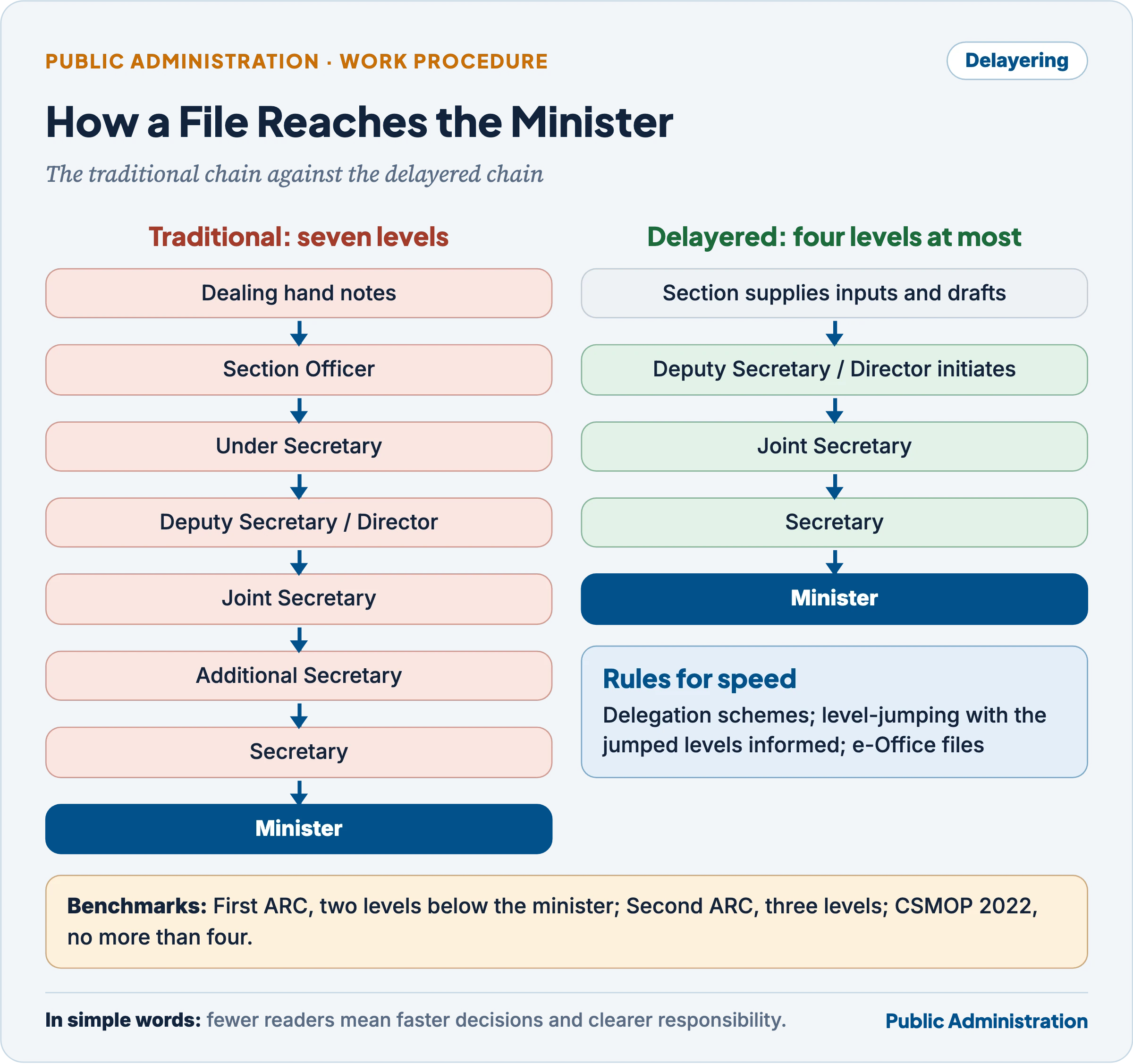
- First Administrative Reforms Commission (1966–70). Its report on the Machinery of the Government of India and its Procedures of Work (1968) recommended: the Cabinet Secretary as principal staff adviser to the PM, Cabinet and Cabinet Committees, with a tenure of three to four years; only two levels of consideration below the minister (Under/Deputy Secretary and Joint/Additional Secretary/Secretary) on a desk officer basis; standing Cabinet Committees supported by Committees of Secretaries; and a Department of Personnel (created in the Cabinet Secretariat in 1970).
- Desk officer system (from 1973). Introduced in several ministries on the ARC’s advice (section 10).
- Second ARC, 13th Report: Organisational Structure of the Government of India (2009). It recommended reducing ministries to 20–25 by grouping related departments under a First or Coordinating Minister; a file passing through no more than three levels; ministries concentrating on policy while executive agencies with autonomy implement; recasting the Allocation of Business Rules around missions and outcomes; and effective, time-bound use of Groups of Ministers and Committees of Secretaries (section 10.5).
- Recent decade. Delayering, delegation and e-Office under the Central Secretariat Manual of Office Procedure (CSMOP) 2022; Mission Karmayogi (2020); lateral entry (2018–2023, stalled since 2024); and the move of the PMO, Cabinet Secretariat and ministries into Seva Teerth and the Kartavya Bhavans (2025–26).
Common confusion
Did the Tottenham Committee create India’s split system? No. The separation of the secretariat (policy) from executive departments (execution) was an old feature of British Indian administration and was endorsed by several committees, notably the Llewellyn Smith Committee (1919). The Tottenham Committee (1945–46) described and refined the arrangement (its “will, brain and hands” image is the best-known statement of it), but did not invent it. Similarly, the Cabinet Secretariat was not created in 1947: the Executive Council’s secretariat was renamed the Cabinet Secretariat on 5 September 1946, when the Interim Government was formed; Independence changed its role from circulating papers to coordinating ministries.
3. The Cabinet Secretariat: Legal Position and Functions
In simple words
When fifty ministers run fifty ministries, someone must make sure they do not work at cross-purposes, that the Cabinet gets proper papers before it decides, and that its decisions are actually carried out. That someone is the Cabinet Secretariat, a small office of senior officials working directly under the Prime Minister.
3.1 Nature and legal position
- A staff agency. The Cabinet Secretariat neither makes policy nor runs programmes. It assists decision-making by the Cabinet and coordinates ministries. In Gulick’s terms it performs the coordinating and reporting parts of POSDCORB for the government as a whole.
- Under the Prime Minister. It functions directly under the PM. Rule 4(1) of the Allocation of Business Rules says the business allotted to the Cabinet Secretariat is and shall always be deemed to have been allotted to the Prime Minister.
- Business allotted to it (Allocation of Business Rules): (i) secretarial assistance to the Cabinet and Cabinet Committees; and (ii) Rules of Business.
- Head. The Cabinet Secretary is its administrative head and the ex-officio Chairman of the Civil Services Board.
- Custodian of Cabinet papers. It keeps the papers and records of all Cabinet meetings.
3.2 Functions
The functions officially listed for the Cabinet Secretariat, with what each involves, are below.
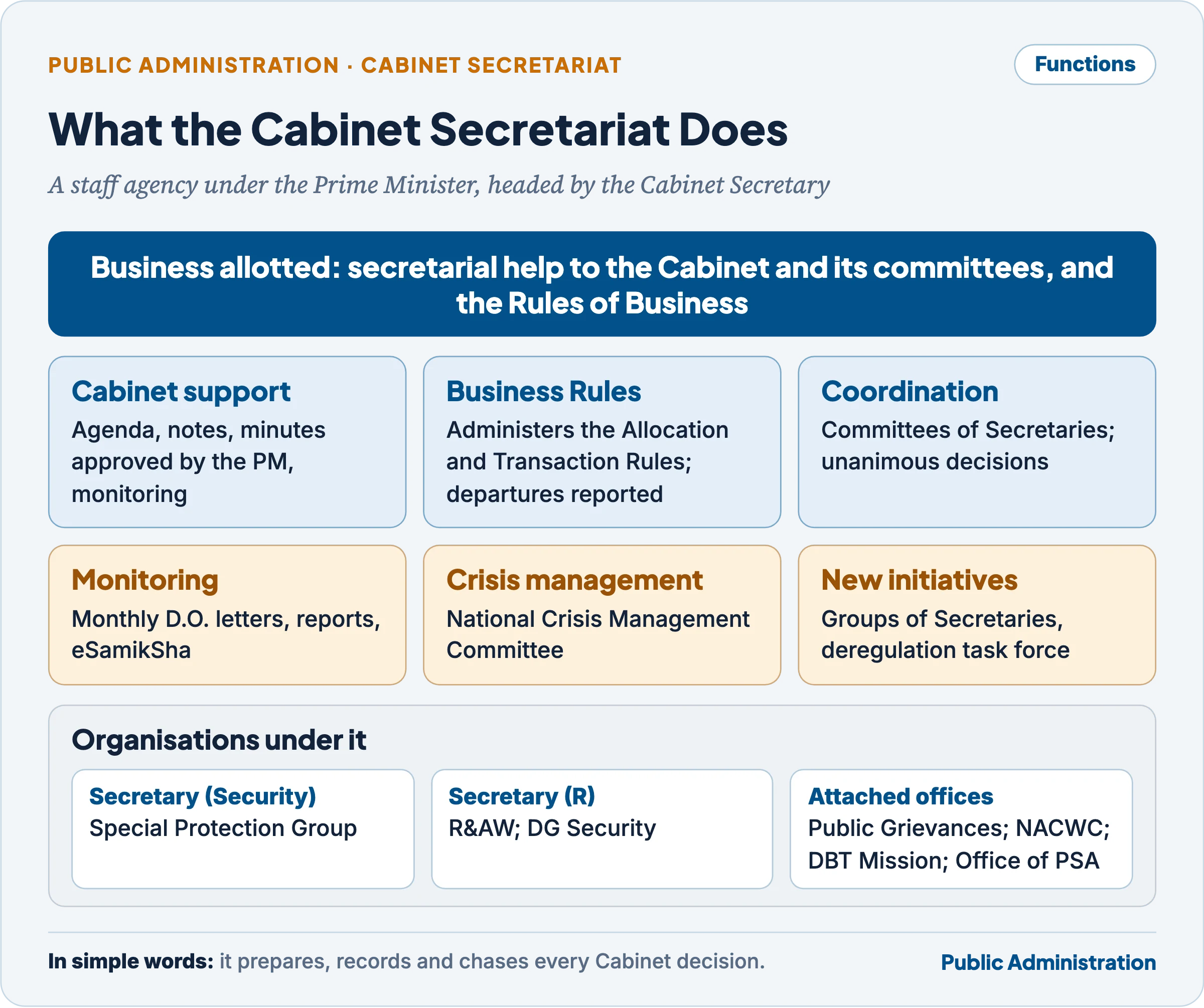
- Secretarial assistance to the Cabinet and its Committees.
- Convening meetings on the orders of the Prime Minister.
- Preparing and circulating the agenda and the papers (Cabinet notes) on each item.
- Preparing the record of discussions (minutes) and circulating it after the PM approves it.
- Monitoring implementation of decisions of the Cabinet and its Committees.
- Administration of the Business Rules. It administers the Transaction of Business Rules and the Allocation of Business Rules, 1961, interprets them, processes amendments (for example, when a ministry is created), and checks that ministries follow the prescribed consultations and approvals. Ministries must report departures from the Rules; ex-post approval of action taken under Rule 12 is sought through it.
- Inter-ministerial coordination. Coordination is needed for removing difficulties, removing differences, overcoming delays, coordinating administrative action and coordinating policies. Inter-ministerial problems go to Committees of Secretaries (CoS) chaired by the Cabinet Secretary.
- The CoS discusses a paper from the principal department, with a supplementary note from any department that differs.
- Its decisions or recommendations are unanimous; proceedings are circulated and followed up.
- It breaks bottlenecks and secures mutually supporting action before a dispute reaches ministers.
- Monitoring and information. Ministries send monthly D.O. letters to the Cabinet Secretary on important developments, and a monthly report on policy matters, compliance with CoS decisions, sanctions for prosecution pending for over three months, departures from the Business Rules and e-governance. The Cabinet Secretariat keeps the President, Vice-President and ministers informed through monthly summaries of the activities of all ministries.
- Crisis management. It coordinates ministries in major crises; the National Crisis Management Committee (NCMC), chaired by the Cabinet Secretary, directs the national response to disasters, terrorist incidents, epidemics and evacuations.
- Promoting new policy initiatives. Standing and ad hoc Committees of Secretaries and Sectoral Groups of Secretaries are used to develop cross-cutting initiatives; the Secretariat also coordinates programmes such as the Aspirational Districts Programme, the National Conference of Chief Secretaries (held since 2022) and the task force on compliance reduction and deregulation (2025).
- Senior appointments. It services the Appointments Committee of the Cabinet (ACC) in coordination with the Department of Personnel and Training; the Cabinet Secretary chairs the Civil Services Board that recommends postings at Joint Secretary level and below.
The list shows that the Cabinet Secretariat’s power is procedural and informational: it controls the agenda pipeline, the record and the follow-up, and it knows what every ministry is doing. That is why the 2005 question calls it the eyes and ears of the Prime Minister. Its weakness is the same: it has no line authority and works through persuasion, consensus in the CoS and the authority of the PM.
Indian Connect — Indian Connect: speeding up Cabinet decisions (2025)
In an office memorandum of 14 May 2025, the Cabinet Secretariat reported that its analysis of the time-cycle of Cabinet notes showed delays at every stage. Acting on a Committee of Secretaries’ recommendations (meetings of November 2024 and May 2025), it told ministries to consult only ministries whose business is affected (as the Transaction of Business Rules require), to flag the points on which comments are sought, and to hold an early inter-ministerial meeting for complex proposals. It set fresh time limits for comments (for instance, 21 days for legislative and policy proposals, 14 days for most others) and added an inter-ministerial consultation module to the eSamikSha portal to track pendency. This is the Cabinet Secretariat acting as the process owner of government decision-making.
3.3 Servicing Cabinet Committees and Committees of Secretaries
- Cabinet Committees. India has eight standing Cabinet Committees (Appointments; Security; Economic Affairs; Political Affairs; Investment and Growth; Skill, Employment and Livelihood; Parliamentary Affairs; Accommodation), set up under Rule 6 and the First Schedule of the Transaction of Business Rules. The Cabinet Secretariat convenes them, circulates notes, records decisions and monitors follow-up exactly as for the Cabinet. Their origin, list and politics are discussed in the article on the Union Executive.
- Variables in their composition and functioning. How much Cabinet Committees matter depends on:
- the PM’s style: under dominant PMs (Nehru, Indira and Rajiv Gandhi) committees lost weight to the PM and his circle; under coalition and collegial PMs (Janata, United Front, UPA) they and Groups of Ministers did real work;
- the party system: coalition partners must be represented, so committees grow and become bargaining forums (allied ministers joined several committees in 2024);
- reference and coverage: a committee can act only on matters referred to it, and its charter may leave gaps;
- regularity of meetings and secretariat support: committees that meet rarely cannot keep policy under review;
- membership size: the First ARC wanted membership capped at about six; the ACC has had only the PM and the Home Minister since 2014.
- Committees of Secretaries (CoS). The officials’ counterpart of Cabinet Committees, chaired by the Cabinet Secretary. They examine inter-ministerial issues before they reach ministers, and the First ARC wanted every standing Cabinet Committee to be backed by a CoS that would consider its matters in advance. The 2nd ARC (2009) asked that unresolved Centre–State issues needing inter-ministerial coordination go first to the CoS and then to the Cabinet.
3.4 Development: units that came and went
The Cabinet Secretariat has often served as an incubator: new functions were placed in it under the PM’s authority and later moved to a ministry once they had grown.
| Year | Unit placed in the Cabinet Secretariat | Later history |
|---|---|---|
| 1950–55 | Economic Wing (from the Economic Committee’s secretariat in Finance) | Merged with the Secretariat in 1955 |
| 1954 | Organisation and Methods Division | To the Ministry of Home Affairs, 1964 |
| 1957 | Military Wing (Defence Committee of the Cabinet) | To the Ministry of Defence, 1991 |
| 1961 | Department of Statistics | To the Ministry of Planning, 1973 |
| 1965 | Intelligence Wing (Joint Intelligence Committee) | The JIC later merged into the National Security Council Secretariat |
| 1968 | Research and Analysis Wing (R&AW) | Still under the Cabinet Secretariat |
| 1970 | Department of Personnel; Departments of Electronics and Scientific and Industrial Research | Became independent; Personnel moved to Home in 1977, later the Ministry of Personnel (1985) |
| 1981 | Department of Ocean Development | Independent in 1982 |
| 1988 | Directorate of Public Grievances | Still under it |
| 1997 | National Authority, Chemical Weapons Convention | Still under it |
| 2015 | Direct Benefit Transfer Mission (from the Department of Expenditure) | Still under it |
| 2018 | Office of the Principal Scientific Adviser (administratively) | Still under it |
The movement of units shows two things. First, the Cabinet Secretariat is where the PM places priorities that need cross-ministry authority (personnel reform in 1970, DBT in 2015). Second, its coordinating role is diluted when it carries line work for too long, which is why most units were later transferred.
3.5 Organisation today
- Cabinet Secretary, assisted by a Secretary (Coordination), a Special Secretary and Additional and Joint Secretaries, each handling a group of ministries (governance, security and foreign affairs, infrastructure, resources, technology, finance and economy, commerce and industry, rural and agriculture, social, welfare).
- Secretary (Security): security of the PM and VIPs, including the Special Protection Group.
- Secretary (R), who heads the Research and Analysis Wing (external intelligence, created in 1968) and the Directorate General of Security (the Aviation Research Centre and the Special Frontier Force).
- Attached offices and statutory bodies: the Directorate of Public Grievances, the National Authority, Chemical Weapons Convention, the Office of the Principal Scientific Adviser and the Direct Benefit Transfer Mission.
- Cells: Vigilance and Complaints Cell, a Deregulation Cell (2025) and others.
Indian Connect — Indian Connect: attached offices and the Cabinet Secretariat
The Cabinet Secretariat is mainly a coordinating body, but its attached offices give it operational reach. The Directorate of Public Grievances takes up unresolved grievances against organisations with heavy public interface (railways, posts, public sector banks, insurance). The DBT Mission coordinates direct benefit transfers across ministries using Aadhaar-linked payments. The National Authority, CWC implements the Chemical Weapons Convention Act, 2000 and liaises with the OPCW. These offices give the Secretariat data, citizen feedback and cross-ministry levers that a pure coordinating office would lack; at the same time they show the tension between coordination and execution discussed above.
3.6 Recent trends: decline and revival as coordinator
- Decline relative to the PMO. From the late 1960s the Prime Minister’s Secretariat took over policy initiative; under Indira Gandhi the PM’s Secretariat was described as the national policy formulation body and the Cabinet Secretariat as its enforcement arm. During coalition years the Cabinet Secretariat regained some weight because Cabinet Committees and GoMs mattered more.
- Revival as the government’s “process owner” (since 2014). With GoMs and Empowered GoMs abolished in 2014, decisions moved back to ministries, the Cabinet and the PMO. The Cabinet Secretariat’s role shifted to monitoring and delivery:
- eSamikSha (online follow-up of Cabinet decisions, PM’s directions and inter-ministerial consultations);
- monthly D.O. letters and reports from every Secretary;
- Sectoral Groups of Secretaries preparing cross-cutting agendas;
- coordination of the Aspirational Districts Programme and the National Conference of Chief Secretaries with the States;
- the Task Force on Compliance Reduction and Deregulation under the Cabinet Secretary (constituted on 24 January 2025), with a Deregulation Cell and a portal to track State-level reforms.
- Physical consolidation. Since 13 February 2026 the Cabinet Secretariat works from Seva Teerth with the PMO and the National Security Council Secretariat, ending eight decades in Rashtrapati Bhavan. Proximity may ease coordination, but it also underlines how closely the two offices now work together.
4. The Cabinet Secretary
In simple words
The Cabinet Secretary is the most senior civil servant in the country. He sits in every Cabinet meeting, writes its minutes, chairs the meetings of all Secretaries, and is the person every ministry calls when it is stuck with another ministry. He is also the leader of the civil service.
4.1 Position
- Senior-most civil servant, ranked 11th in the Table of Precedence; head of the Cabinet Secretariat; Secretary to the Cabinet; ex-officio Chairman of the Civil Services Board; chairs the Committees of Secretaries and the National Crisis Management Committee.
- Head of the civil services. Not a formal command over Secretaries, who answer to their ministers, but moral and professional leadership. The Ayyangar report (1949) wanted the civil service to see him as its adviser and conscience-keeper; the First ARC (1968) wanted his role to go beyond coordination to that of principal staff adviser to the PM, Cabinet and Cabinet Committees.
- Appointment and tenure. Appointed by the ACC. By convention a two-year term is given and then extended. Rule 16(1A) of the AIS (DCRB) Rules, 1958 allows extensions but caps the total term at four years, with a further three months allowed by a 2019 amendment. Rajiv Gauba served five years (2019–2024) through successive extensions. The current Cabinet Secretary, Dr T.V. Somanathan (IAS, 1987, Tamil Nadu), took over on 30 August 2024; on 5 August 2026 the ACC extended his service by a year to 30 August 2027.
The list of recent Cabinet Secretaries shows the trend towards longer tenures, which the First ARC had recommended.
| Cabinet Secretary | Term | Note |
|---|---|---|
| N.R. Pillai | 1950–1953 | First Cabinet Secretary of the Republic |
| B.D. Pande | 1972–1977 | Served through the Emergency |
| T.N. Seshan | 1989 | Later Chief Election Commissioner |
| B.K. Chaturvedi | 2004–2007 | Coalition era (UPA-I) |
| K.M. Chandrasekhar | 2007–2011 | Four years |
| Ajit Kumar Seth | 2011–2015 | Four years; spanned a change of government |
| P.K. Sinha | 2015–2019 | Over four years |
| Rajiv Gauba | 2019–2024 | Five years, the longest tenure |
| T.V. Somanathan | 2024– | Extended to August 2027 |
4.2 Roles
- Secretary to the Cabinet. Prepares the agenda in consultation with ministries and gets it approved by the PM, decides which items go to which committee, ensures notes are self-contained, attends all meetings, prepares the minutes and communicates decisions.
- Coordinator of the administration. Chairs CoS meetings, resolves inter-ministerial disputes, keeps track of bottlenecks in major programmes, and is the channel for Centre–State administrative issues (through Chief Secretaries).
- Principal adviser to the PM on administration. Briefs the PM on what is happening across government, matters needing urgent decision and problems in implementation.
- Crisis manager. As NCMC chair, he directs the national response to disasters (cyclones, floods), terror attacks, pandemics (COVID-19) and evacuations of Indians abroad.
- Leader of the civil service. Chairs the Civil Services Board, influences senior postings and empanelment, and sets the tone for neutrality and integrity.
- Guardian of procedure. Ensures the Business Rules are followed; departures must be reported to him.
His influence depends on personal qualities and the PM’s confidence more than on formal powers: interpersonal skill, discretion, a reputation for neutrality, and the trust of both ministers and Secretaries. That is why the post is called the ultimate test of a civil servant’s leadership (2000 question): he leads peers who outrank no one but him, serves a political master while defending the neutrality of the service, and must keep fifty departments moving without commanding any of them.
4.3 Cabinet Secretary and Chief Secretary compared
The State-level counterpart of the Cabinet Secretary is the Chief Secretary (see the article on the Chief Secretary, State Secretariat and Directorates). The two offices are similar in some respects and different in others.
| Aspect | Cabinet Secretary (Union) | Chief Secretary (State) |
|---|---|---|
| Position | Senior-most civil servant of the Union | Senior-most civil servant of the State |
| Secretariat role | Secretary to the Cabinet | Secretary to the State Cabinet |
| Coordination | Chairs CoS; coordinates ministries | Chairs meetings of Secretaries; coordinates departments |
| Line charge | No department of his own besides the Cabinet Secretariat | Usually holds direct charge of key departments (General Administration, Personnel, often Planning) |
| Head of services | Moral head; chairs Civil Services Board | Head of the State civil service, with direct control over postings and discipline |
| Law and order | Limited; crisis coordination | Central role in law and order and district administration |
| Relations with field | Remote; works through Secretaries and Chief Secretaries | Direct; Collectors and Divisional Commissioners report to the government through him |
| Political interface | Works with a PM who has a large PMO | Works closely with the Chief Minister; the CM’s Office competes in many States |
| Tenure | Two years plus extensions (cap four years) | Varies; frequent changes in many States |
The table shows that the Chief Secretary is more of a line administrator and the Cabinet Secretary more of a pure coordinator. Both rely on the confidence of the political head, and both face a rival power centre (the PMO at the Centre, the CM’s Office in many States).
5. The Prime Minister’s Office: Nature, Organisation and Functions
In simple words
The Prime Minister receives hundreds of files, letters and requests every day and must make decisions on all of them. The PMO is the team that sorts this flow, adds advice, follows up and makes sure the PM’s priorities reach every ministry. Under strong Prime Ministers, this team becomes very powerful.
5.1 Nature and legal status
- Staff agency of the PM. Its job is to give secretarial help and advice to the PM. It is extra-constitutional (no mention in the Constitution) but has the status of a department under the Allocation of Business Rules, 1961, appearing in the First Schedule.
- Origin and name. It came into being on 15 August 1947 as the Prime Minister’s Secretariat, taking over the work of the Secretary to the Governor-General (Personal). It was renamed the Prime Minister’s Office in June 1977, under Morarji Desai.
- Headship. Headed politically by the PM and administratively by the Principal Secretary. A Minister of State in the PMO (currently Dr Jitendra Singh) answers questions in Parliament on its behalf.
- Location. From South Block, the PMO moved on 13 February 2026 to Seva Teerth, a new complex in the Executive Enclave that also houses the Cabinet Secretariat and the National Security Council Secretariat.
5.2 Present organisation
- Principal Secretary to the PM: administrative head. Dr P.K. Mishra has held the post since 11 September 2019 (succeeding Nripendra Misra, 2014–2019). Since 2019 the post carries Cabinet rank.
- Principal Secretary-2 to the PM: a second Principal Secretary, Shaktikanta Das (former RBI Governor), appointed on 22 February 2025, for a term coterminous with the PM.
- National Security Adviser (NSA): Ajit Doval, NSA since 2014, with Cabinet rank since 2019. The NSA heads the National Security Council Secretariat (NSCS), which is a separate organisation but works closely with the PMO and now shares Seva Teerth with it. The link began in 1998, when the National Security Council was set up and Vajpayee’s Principal Secretary Brajesh Mishra was also made the first NSA.
- Adviser(s) of Secretary rank, Additional Secretaries and Joint Secretaries, each handling a group of ministries and subjects.
- Directors, Deputy Secretaries, Under Secretaries for administration, Parliament, public grievances, funds (the PM’s National Relief Fund), RTI and so on.
- Officers on Special Duty (communications, research and strategy, appointments and tours, media research) and Private Secretaries to the PM.
- Flexibility. Below the Principal Secretary the structure is not fixed; its size and composition change with each PM’s needs and style. Officers come mainly from the IAS and IFS, and also from other services and outside experts.
5.3 Functions
- Dealing with all references that come to the PM under the Business Rules, and assisting the PM in examining cases submitted for orders.
- Helping the PM as head of government: guidance in framing policies, monitoring them, and coordinating ministries on the PM’s priorities.
- Looking after departments under the PM: the Ministry of Personnel, Public Grievances and Pensions, the Departments of Atomic Energy and Space, and all subjects not allotted to any minister.
- Supporting the PM’s other roles: chair of NITI Aayog and its Governing Council (earlier the Planning Commission and the National Development Council), the Inter-State Council, the ACC and most Cabinet Committees.
- Liaison: with the President, Governors, Chief Ministers, ministers, foreign governments and representatives in India.
- Parliament: preparing answers to questions addressed to the PM and briefing him for debates.
- Public interface: public grievances and letters addressed to the PM, press and media relations, speeches and the PM’s programmes.
- Think tank: assembling ideas, collecting inputs from diverse sources, formulating issues and working out alternatives on matters coming to the PM. The economist P.N. Dhar, who headed the PMO in the 1970s, described its ideal role as a transmission belt for ideas rather than a decision-maker in its own right.
- Monitoring: the PM’s announcements, flagship schemes and major projects (PRAGATI, section 6.3).
5.4 Councils and advisory bodies around the PM
Successive PMs have built advisory bodies around themselves, serviced by the PMO or the Cabinet Secretariat. They extend the PM’s expert power (knowledge attributed to the office) and are criticised as parallel channels outside the ministries.
| Body | Period | Role |
|---|---|---|
| Economic Advisory Council to the PM (EAC-PM) | Reconstituted in 2017 under Bibek Debroy; chaired since June 2025 by S. Mahendra Dev | Independent economic advice on issues referred by the PM or taken up on its own |
| PM’s Council on Climate Change | UPA period | Coordinated the national response; the National Action Plan on Climate Change (2008) |
| PM’s National Council on Skill Development | 2008 | Policy direction for skilling |
| Delivery Monitoring Unit in the PMO | 2009 | Tracked flagship programmes (MGNREGA, NRHM, SSA and others) |
| National Advisory Council (NAC) | 2004–06, 2010–14 | Chaired by Sonia Gandhi; drafted social legislation (RTI, rural employment, food security inputs); called a parallel power centre |
| PM’s Science, Technology and Innovation Advisory Council (PM-STIAC) | 2018– | Serviced by the Office of the Principal Scientific Adviser |
| Project Monitoring Group | 2013 in the Cabinet Secretariat, moved to the PMO side in 2014 | Fast-tracking stalled large investment projects |
The table shows a recurring pattern: each PM creates instruments that bypass slower ministerial channels, and each is attacked as extra-constitutional by opponents, whether the NAC under the UPA or the PMO-led monitoring of the present period.
6. Evolution of the PMO and Its Relation with the Cabinet Secretariat
In simple words
The PMO is like a room that expands and contracts with whoever lives in it. Under some Prime Ministers it was a small office handling letters; under others it became the most powerful office in the country. Its power has always reflected the power of the Prime Minister and the strength of the ruling party.
6.1 Prime Minister by Prime Minister
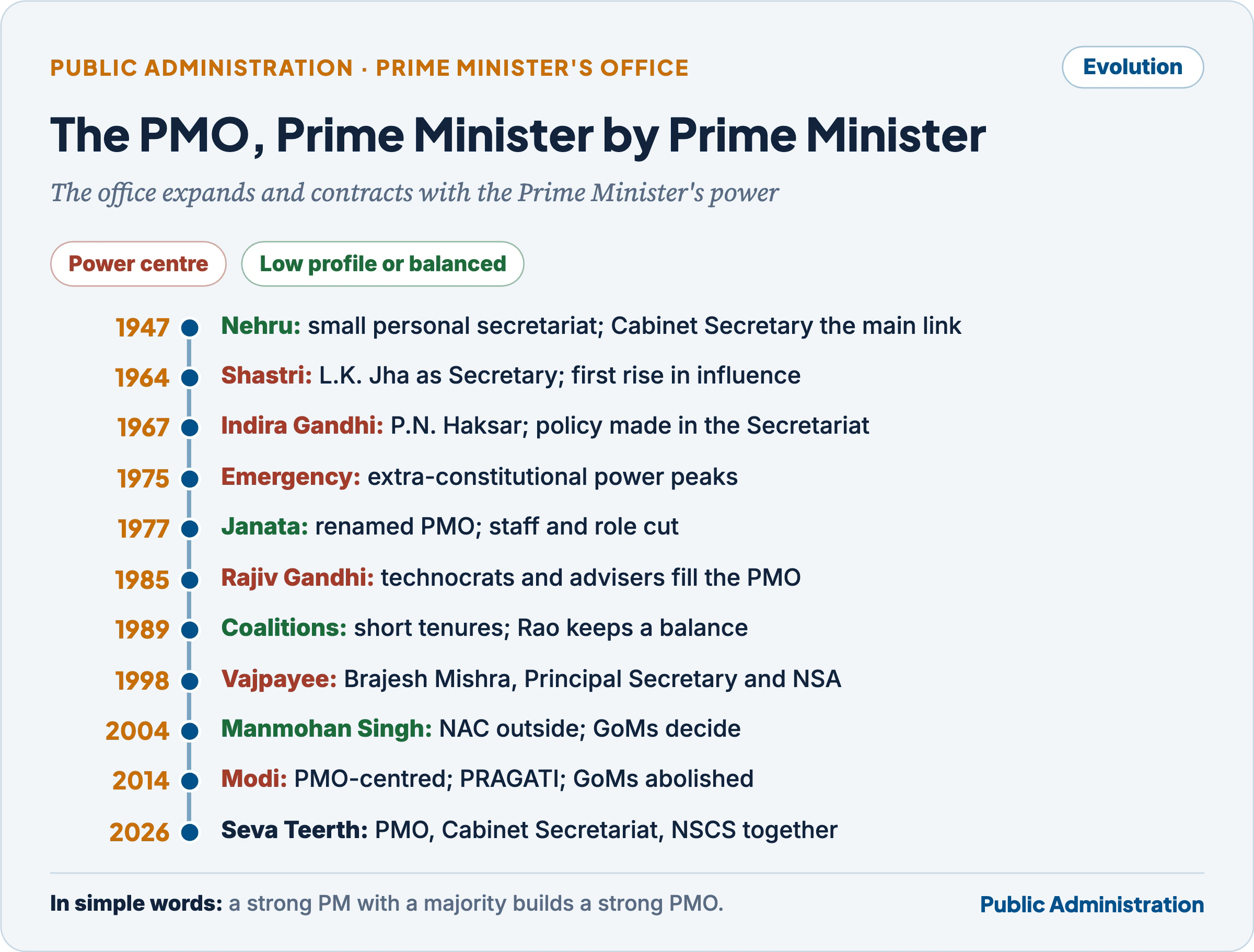
- Jawaharlal Nehru (1947–64): a modest personal office. The PM’s Secretariat was small and largely faceless; Nehru’s Private Secretary M.O. Mathai was the visible figure. Nehru relied on ministries, the Cabinet and the Cabinet Secretary, who was the primary link with the administration. The Secretariat stayed below the Cabinet Secretariat in status. This reflected Nehru’s commitment to cabinet government and his own stature, which needed no borrowed authority.
- Lal Bahadur Shastri (1964–66): the first boost. Shastri appointed L.K. Jha as Secretary to the PM. The Secretariat became a regular department under a full Secretary and began shaping policy. The scholar Michael Brecher observed that, through Jha’s forceful personality, it had become a major power centre in Indian politics.
- Indira Gandhi (1966–77): the Secretariat as power centre. Inexperienced in administration at first and battling the party’s old guard (the “Syndicate”), Mrs Gandhi leaned on her Secretariat. P.N. Haksar (Secretary from 1967, Principal Secretary 1971–73) made it the nerve centre of economic, foreign and political strategy: bank nationalisation, the 1971 war and the Indo-Soviet treaty were shaped there. The Cabinet Secretary’s standing declined. In the Emergency (1975–77) real power shifted further, to the PM’s House and extra-constitutional figures, and the Secretariat’s image suffered from bureaucratic excesses.
- Janata government (1977–79): cut to size. Morarji Desai reduced its staff and policy cells and renamed it the Prime Minister’s Office (June 1977), with V. Shankar as Principal Secretary. The Cabinet and the Cabinet Secretariat regained primacy, although political instability later pushed the PM to use the PMO for political work as well.
- Indira Gandhi (1980–84): an institution to aid and advise. P.C. Alexander as Principal Secretary handled parliamentary questions, briefings and foreign visits; the Cabinet Secretary regained confidence and the PMO acted more as an advisory institution.
- Rajiv Gandhi (1984–89): the technocratic PMO. With Sarla Grewal and later B.G. Deshmukh as Principal Secretaries, the PMO filled with specialists and advisers (on technology missions, economy, foreign policy and media) and grew in space and influence; the Planning Commission was sidelined in some fields. The Cabinet Secretariat kept its identity, and the two offices coordinated.
- Coalition and minority years (1989–98). Under V.P. Singh, Chandra Shekhar, Deve Gowda and Gujral, short tenures limited the PMO’s impact; Cabinet Committees and consultation mattered more. P.V. Narasimha Rao (1991–96), with A.N. Verma as Principal Secretary, ran the economic reforms with his Finance Minister and kept a strong PMO, but observers saw a balance with the Cabinet Secretariat. Gujral set up an anti-corruption cell in the PMO.
- A.B. Vajpayee (1998–2004): the Brajesh Mishra model. Brajesh Mishra was both Principal Secretary and the first NSA (from 1998). The PMO steered nuclear tests, foreign policy, disinvestment and infrastructure monitoring; Groups of Ministers multiplied. Critics said Mishra combined too much power in one unelected official; in a coalition of many parties, however, a strong PMO was how the PM held the government together.
- Manmohan Singh (2004–14): the dual power centre. T.K.A. Nair and then Pulok Chatterji headed the PMO. Policy initiative was shared with the National Advisory Council chaired by the Congress president, and decisions often went to GoMs and Empowered GoMs. Critics, including the PM’s former media adviser Sanjaya Baru (The Accidental Prime Minister, 2014), argued that the PMO was weak because real political authority lay outside it.
- Narendra Modi (2014– ): PMO-centred governance. Nripendra Misra (2014–19; his appointment needed an ordinance amending the TRAI Act) and P.K. Mishra (2019– ) as Principal Secretaries; GoMs and EGoMs abolished (May 2014); direct monitoring through PRAGATI; a two-member ACC; Secretaries meeting the PM directly; the NSA and Principal Secretaries given Cabinet rank (2019); a second Principal Secretary (2025). After 2024 the BJP governs with allies, but the PMO’s central role has continued. On 10 June 2024 the PM told PMO staff that the PMO should be a “People’s PMO”, not “Modi’s PMO”, and a catalytic agent rather than a power centre.
The sequence shows that the PMO’s power is a function of three variables: the PM’s personality and style, the strength of the PM’s party in Parliament, and the complexity of the issues facing the government. Strong PMs with majorities (Indira Gandhi, Rajiv Gandhi, Modi) built strong PMOs; coalition and caretaker PMs worked through the Cabinet and its committees.
6.2 Why the PMO has grown
- Personality and style of PMs: the PMO mirrors the PM’s priorities, fears and working habits.
- Party system: single-party majorities concentrate authority in the leader; even in coalitions, a large, heterogeneous Cabinet with inexperienced ministers pushes the PM to rely on a trusted staff.
- Complexity of governance: economic management, security, technology and international negotiations need cross-ministry direction that no single ministry can supply.
- Electoral and media personalisation: campaigns built around the leader make the PM personally answerable for delivery, so the PM wants a delivery machine.
- Summit diplomacy: G20, BRICS, Quad and bilateral summits put foreign economic policy in the PM’s hands.
- Technology: dashboards, video conferencing and data platforms allow the PMO to monitor ministries and States directly.
- Control over appointments: the ACC and the PMO’s role in senior postings give it leverage over every ministry.
- Global trend: chief executives everywhere have built up their own offices (the US Executive Office of the President, created in 1939 after the Brownlow Committee declared that “the President needs help”; the UK’s Number 10 Policy Unit, 1974).
6.3 PRAGATI: the PMO as delivery unit
Indian Connect — Indian Connect: PRAGATI
PRAGATI (Pro-Active Governance And Timely Implementation), launched in March 2015, is an ICT-based, multi-modal platform through which the Prime Minister personally reviews stalled projects, schemes and public grievances with Union Secretaries and State Chief Secretaries by video conference, usually once a month. At its 50th meeting (31 December 2025), the government reported that 377 projects had been reviewed since 2014, that 2,958 of 3,162 identified issues (about 94 per cent) had been resolved, and that projects worth over Rs 85 lakh crore had been accelerated, including the Bogibeel bridge, the Jammu–Udhampur–Srinagar–Baramulla rail link and Navi Mumbai airport. The 51st meeting (27 May 2026), the first held at Seva Teerth, reviewed seven projects worth about Rs 30,000 crore, the Ken–Betwa link and Swachh Bharat Mission-Urban 2.0, and States were asked to set up monthly reviews of social sector schemes at Chief Secretary level.
- What it shows. PRAGATI is the clearest case of the PMO acting as a line authority: it fixes deadlines, assigns responsibility to Secretaries and Chief Secretaries, and tracks compliance. It also illustrates cooperative federalism in practice (States are participants) and Gulick’s coordination by authority from the top.
- Criticism. It bypasses the minister-in-charge and the Cabinet, concentrates attention on a few visible projects, and makes officials answerable to the PMO rather than to their ministers. Defenders reply that it has unblocked projects stuck for decades because only the PM’s authority could make Centre, States and agencies act together.
6.4 PMO and Cabinet Secretariat compared
Both offices work under the PM and both coordinate, but they differ in nature, loyalty and method.
| Dimension | Prime Minister’s Office | Cabinet Secretariat |
|---|---|---|
| Serves | The Prime Minister personally and as head of government | The Cabinet and its Committees collectively; the PM as its head |
| Nature | Personal-political staff agency | Institutional staff agency of the government |
| Head | Principal Secretary (often a retired officer, Cabinet rank) | Cabinet Secretary (serving senior-most civil servant) |
| Staffing | Flexible, chosen by the PM; includes outsiders and advisers | Regular officers on tenure; continuity across governments |
| Coordination | Of the PM’s team and priorities; political and policy coordination | Of the Council of Ministers and ministries; procedural and inter-ministerial coordination |
| Main tools | Access to the PM, monitoring (PRAGATI), appointments, advisory councils | Agenda, minutes, Business Rules, CoS, monthly reports, eSamikSha |
| Changes with government? | Yes, completely | Little; institutional memory |
| Accountability | Through the PM to Parliament; officials not answerable directly | Through the PM and Cabinet; bound by Business Rules |
The comparison explains the two old questions that call the PMO the youngest secretariat organisation that has grown taller than the Cabinet Secretariat (1991) and the two bodies as having common but dissimilar staff functions (1988). Both are staff; the PMO’s staff work is personal and political, the Cabinet Secretariat’s collective and procedural. When the PM is dominant, the personal office overshadows the collective one; when the PM is first among equals, the Cabinet Secretariat comes back to the centre.
Common confusion
Is the PMO a constitutional body, and is it the same as the Cabinet Secretariat? Neither. The PMO is not mentioned in the Constitution; it is a department under the Allocation of Business Rules, created and shaped by each PM. The Cabinet Secretariat is also extra-constitutional, but it serves the Cabinet collectively and administers the Business Rules; the PMO serves the PM. Both are under the PM’s charge, and the two heads (Principal Secretary and Cabinet Secretary) work side by side, now in the same Seva Teerth complex, but the institutions are distinct.
6.5 Strong PMO: the central debate
The question underlying many PYQs is whether a strong PMO is a necessity of modern government or a threat to cabinet government and democratic accountability.
Criticism — Criticism: a super-cabinet without accountability
- Erodes collective responsibility (Article 75(3)). Decisions taken in the PMO are presented to the Cabinet for ratification; the Cabinet becomes collectively responsible for choices it did not make.
- Super-cabinet and parallel government. The PMO has been called a super-ministry, a micro-cabinet and the government of the Government of India; ministries wait for PMO directions and stop applying their own minds.
- Unelected power. Principal Secretaries, the NSA and advisers wield great influence but do not answer to Parliament; only the PM does, and the PM rarely answers for them.
- Staff turning into line. A staff agency issuing orders breaks the secretariat principle that advice and command be separate (1993 question); it confuses accountability between the minister and the PMO.
- Politicisation of the bureaucracy. Control over postings through the PMO and ACC can reward loyalty over competence.
- Bottleneck and overload. Centralising decisions in one office slows the system and makes the government dependent on one person’s attention.
- Weak institutional memory. A PMO rebuilt by each PM loses the continuity that the Cabinet Secretariat provides.
Defence — Defence: why a strong PMO is needed
- Coordination of a large government. Over fifty ministries, many with overlapping mandates, need a centre that can settle priorities quickly; the Cabinet Secretariat’s consensus-based CoS cannot always do this.
- The PM is accountable for delivery. Voters judge the PM, not individual ministers; the PM needs a staff that tracks delivery (PRAGATI).
- Coalitions and weak ministers. In large, diverse cabinets, a trusted PMO keeps policy coherent (Vajpayee’s experience).
- Complex cross-cutting issues. Security, climate, technology and economic diplomacy cut across ministries and need direction from the top.
- Global practice. Chief executives in every democracy have strengthened their offices; India’s PMO is comparable to the US Executive Office of the President.
- Formal decisions still go through the Cabinet and its Committees, and the PM remains answerable to the Lok Sabha.
The balance most observers accept is that a strong PMO is necessary but must work through the system rather than around it: it should set priorities and monitor, while ministers decide within their charge and the Cabinet remains the forum for collective decisions. The PM’s own description of a “people’s PMO” acting as a catalytic agent (2024) states the ideal; whether practice matches it depends on institutional restraint, not on rules, because the rules say almost nothing about the PMO.
6.6 What the reform commissions said
- First ARC (1968). The PM should have institutional support (it proposed a Deputy PM recognised in the Business Rules); the PM should not ordinarily hold a ministry so that his time is free for guidance and coordination; he should meet Secretaries of key departments periodically; the Cabinet Secretary should be the PM’s principal staff adviser. It did not favour a large personal secretariat.
- Second ARC (2005–09). It made no separate recommendation on the PMO. Its views bearing on the apex are: strengthen collective coordination (CoS, time-bound GoMs), reorganise ministries into 20–25 clusters under coordinating ministers, focus ministries on policy and give executive agencies autonomy (13th Report, 2009). By implication, it preferred institutional coordination to personal coordination from the PM’s office.
7. The Central Secretariat: Meaning and Structure
In simple words
Each minister has a head office that turns political goals into rules, budgets and instructions, answers Parliament and supervises the offices in the field. Together, these head offices of all ministries are called the Central Secretariat. Inside each one, work is divided like a tree, from the Secretary at the top down to small sections.
7.1 Meaning
- Definition. The Central Secretariat is the complex of ministries and departments of the Union Government, listed in the First Schedule of the Allocation of Business Rules, each politically headed by a minister and administratively headed by a Secretary. It is the policy-making organ immediately below the political executive; executive agencies sit below it.
- Ministry and department.
- A ministry is the minister’s charge; a department is the Secretary’s charge. A ministry is a political, flexible unit; a department is an administrative, more stable unit.
- A ministry may have one department or several (Finance has six departments); some ministries have none formally (External Affairs), and some departments stand alone (Atomic Energy, Space).
- Where a ministry has several Secretaries, one is often designated to represent the ministry as a whole (the Finance Secretary, for instance).
- Secretary to the Government of India, not to the minister. Officers serve the government as a whole. Under the Business Rules a department must consult other concerned departments before disposing of a case, so the Secretariat works as a single unit, just as ministers are bound by collective responsibility.
- Size. In 2025 the government spoke of 51 ministries to be housed in ten Common Central Secretariat buildings; the number changes with each reorganisation.
7.2 Structure of a department
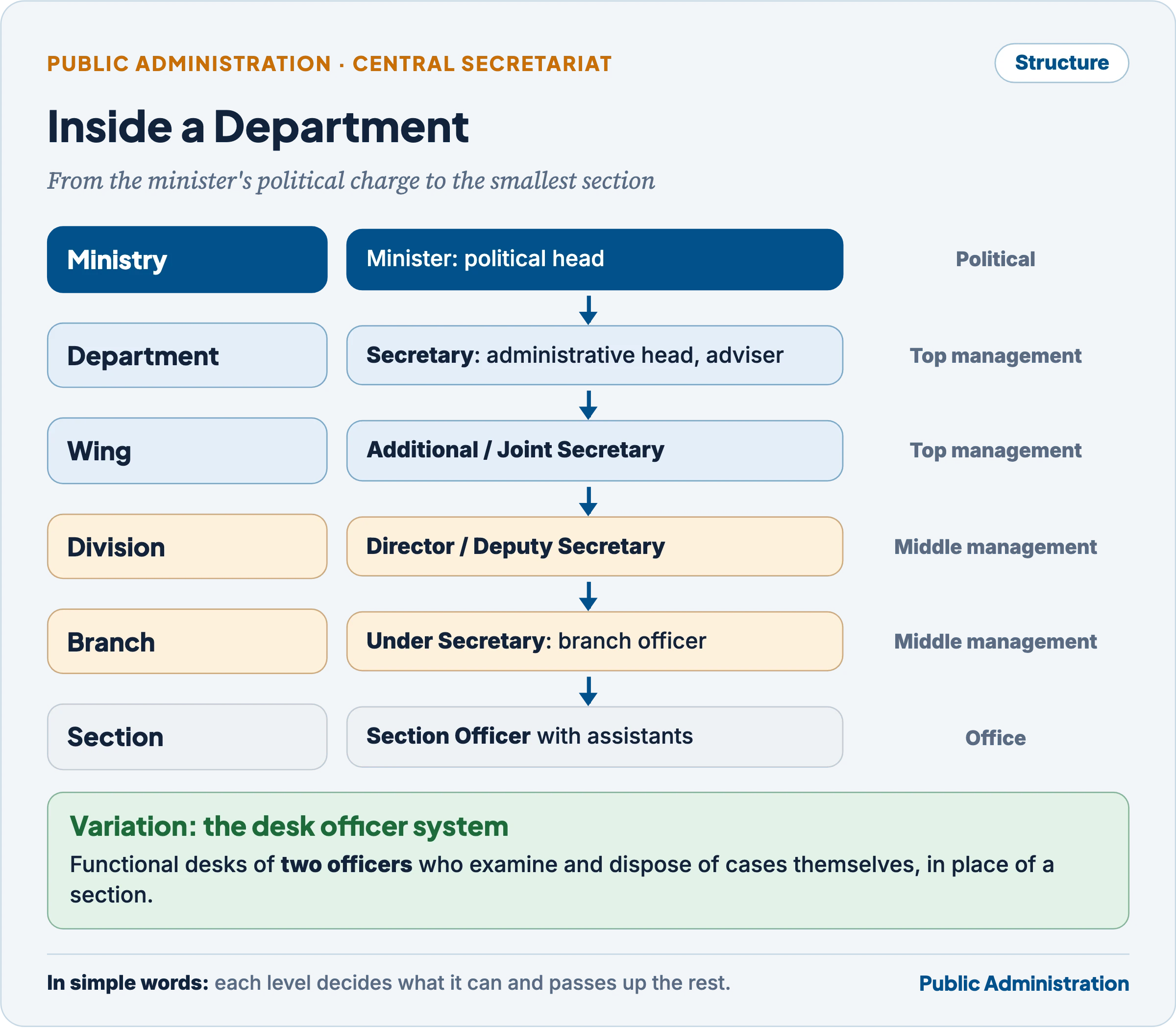
The work of a department is divided as follows (the CSMOP describes this as the commonly adopted pattern).
| Unit | Officer in charge | What it does |
|---|---|---|
| Department | Secretary (sometimes Special or Additional Secretary) | Whole subject area; administrative head; principal adviser to the minister |
| Wing | Additional Secretary / Joint Secretary | A block of work with the maximum independent responsibility |
| Division | Director / Deputy Secretary | A group of related subjects |
| Branch | Under Secretary (branch officer) | Usually two sections |
| Section | Section Officer | Lowest unit: receipts, noting, drafting, records; staffed by Assistant Section Officers and clerks (the “dealing hands”) |
- Top management: Secretary, Additional Secretary, Joint Secretary. Middle management: Director, Deputy Secretary, Under Secretary. Office: Section Officer, Assistant Section Officers, clerks, stenographers, multi-tasking staff.
- Variations.
- Desk officer system: functional desks manned by two officers (Under Secretary and Section Officer, or Section Officer and Assistant Section Officer) who dispose of cases themselves with stenographic support (section 10.4).
- Integrated Headquarters of the Ministry of Defence, where Vice Chiefs and Principal Staff Officers exercise powers delegated by the Defence Minister.
- Boards that are themselves the secretariat: the Railway Board in the Ministry of Railways, the CBDT and CBIC in the Department of Revenue.
7.3 Grades of officers and their roles
- Secretary.
- Administrative head of the department; his responsibility for it is complete and undivided.
- Chief adviser to the minister on all aspects of policy and administration.
- Represents the ministry before Parliamentary committees, especially the Public Accounts Committee, as its Principal Accounting Officer responsible for its expenditure.
- The Ayyangar report (1949) warned that a Secretary should not be immersed in files and routine: he needs time to see the whole picture, size up problems, think and plan. The First ARC (1968) wanted him to be a coordinator, policy guide, reviewer and evaluator.
- Additional Secretary / Joint Secretary. In charge of a wing, with near-independent responsibility; may deal directly with the minister on the subjects allotted, keeping the Secretary informed. The Joint Secretary is the key policy level of the Government of India.
- Director / Deputy Secretary. In charge of a division; acts on behalf of the Secretary, disposes of as many cases as possible and seeks instructions only on important ones. The Director grade was added later; there is little functional difference between a Director and a Deputy Secretary, though the Director is senior.
- Under Secretary. In charge of a branch (branch officer); disposes of minor cases and submits important ones in a form that allows quick decisions.
- Section Officer. First-line supervisor and link between the Under Secretary and the section’s staff.
- Officer on Special Duty (OSD). A temporary post for urgent, specialised work; its rank varies.
- The filter principle. Each level disposes of what it can and passes up only what needs a higher decision. This is the theory; the practice, as section 10 shows, often reverses it.
7.4 Functions of the Central Secretariat
The official functions of the Secretariat, as listed in the Manual of Office Procedure and the standard literature, are:
- Assisting the minister in policy-making and in modifying policy from time to time.
- Framing legislation, rules and regulations, and drafting replies for Parliament.
- Sectoral planning and programme formulation.
- Budgeting and control of expenditure, and according administrative and financial approval to operational programmes.
- Supervision and control over the execution of policies by executive departments and field agencies, and evaluation of results.
- Coordination and interpretation of policies, assisting other branches of government, and maintaining contact with State administrations.
- Developing personnel and organisational competence in the ministry and its agencies.
- Assisting the minister in parliamentary responsibilities: questions, committees, debates.
These functions explain the classic description of the Secretariat by the First ARC (1968): the Secretariat system has lent balance, consistency and continuity to administration and served as the nucleus of the total machinery of a ministry, facilitating inter-ministry coordination and accountability to Parliament. The Secretariat is also the institutional memory of government: precedents, files and the record of past decisions let it test new proposals against experience.
- Nodal role (2013 question): for every Union subject, a department of the Central Secretariat is the nodal agency that frames policy, handles legislation, controls funds and coordinates with other ministries and the States; inter-ministerial coordination is built into the Business Rules through mandatory consultation.
- Executive work as well (2002 question): in theory the Secretariat should not execute, but in practice it does a great deal of executive work, from sanctioning individual grants to managing schemes directly, because executive agencies are weak or absent, or because ministries prefer to keep control.
8. The Split System and the Secretariat’s Executive Agencies
In simple words
The idea behind India’s secretariat is simple: people who plan should be free from the daily rush of running things, and people who run things should be free to do their job without the planners interfering. So the head office plans, and separate offices in the field carry out the plans. Whether this separation works is one of the oldest debates in Indian administration.
8.1 The split system
- Meaning. The split system separates policy-making (the Secretariat) from policy execution (executive agencies outside the Secretariat, headed by Directors-General, Commissioners, Inspectors-General, Chief Controllers and the like). The Secretariat is the staff; the executive agencies are the line.
- Rationale. The Bombay Administrative Enquiry Committee (1948) said a secretariat exists because policy must be separated from current administration, with execution handed to an agency that enjoys some freedom. The British statesman L.S. Amery argued that routine business is always more urgent and needs less intellectual effort than thinking about the future, so only a separate policy staff, freed from administration, can ensure forethought and planning.
- Advantages.
- Policy-makers can plan with national interests in view, freed from day-to-day pressures.
- The Secretary can examine proposals from executive agencies objectively, from the viewpoint of the government as a whole.
- Executive agencies get operational freedom; delegation and specialisation are encouraged.
- The Secretariat stays small and manageable.
- Field performance can be evaluated by an independent headquarters.
- Comparison. In Britain a ministry (Whitehall) integrates policy and execution; Indian scholars (A. Avasthi) called the Indian Secretariat sui generis: modelled on Whitehall but never its counterpart, since India has two parallel hierarchies, one in the Secretariat and one under the heads of executive departments. S.R. Maheshwari likened India to Sweden, which has separate organisations for policy and for implementation.
- Criticisms.
- Duplication and delay: a proposal is examined twice, first in the executive agency and again in the Secretariat.
- Generalist–specialist friction: generalist Secretariat officers sit in judgement over technical heads of department; specialists resent the “layman’s” scrutiny, while generalists defend it as a wider view.
- Secretariat interference in execution and its habit of retaining executive work, so the separation exists only on paper.
- Policy without field knowledge: if policy-makers have no field experience, policies may be unworkable (the original reason for the tenure system).
- Lower status for executors: those who actually deliver services enjoy less status and pay than desk officers at headquarters.
- Second ARC’s answer (2009). Keep ministries focused on policy analysis, budgeting, monitoring, appointments, coordination and evaluation, and turn attached and subordinate offices into autonomous or semi-autonomous executive agencies, professionally managed under a mandate and bound by performance agreements. This is the Indian version of the British Next Steps agencies of the late 1980s.
8.2 Executive agencies and patterns of relationship
- Forms of executive agencies. Attached offices (e.g. the Central Public Works Department, the Directorate General of Health Services), subordinate offices (field establishments), departmental undertakings, companies, statutory corporations and boards, and registered societies. Attached offices give technical advice to the ministry and executive direction to the field; subordinate offices carry out detailed execution. They are discussed fully in the article on Ministries, Boards, Commissions and Field Organisations.
- Six patterns of Secretariat–agency relationship.
- Complete separation: separate offices and files; correspondence by self-contained letters (the standard pattern, e.g. All India Radio and the I&B Ministry earlier).
- Complete merger: the executive head is part of the ministry (the Railway Board).
- Link officer: a senior Secretariat officer concurrently heads the executive agency.
- Ex-officio Secretariat status: the agency head is given Secretariat rank (the Textile Commissioner as ex-officio Joint Secretary in the past).
- Common office: one office serves both.
- Common files: separate officers, common files and file bureau.
- Choosing a pattern. No pattern suits every case; neither total separation nor total merger is normally desirable. The First ARC (1968) recommended merging only development-oriented executive agencies with their Secretariats and keeping the distinction elsewhere.
8.3 Line, staff and auxiliary agencies
- Line agencies carry out the primary objectives of an organisation and command; staff agencies advise, plan and coordinate; auxiliary (housekeeping) agencies provide common services such as personnel, finance and supplies. Classical writers such as W.F. Willoughby and L.D. White used this classification (see the article on Structure and Forms of Organisation).
- Indian mapping.
- Staff: the PMO, the Cabinet Secretariat, the Secretariat departments in their policy role, NITI Aayog.
- Line: the minister and Secretary in their command over attached and subordinate offices, the field formations.
- Auxiliary: the Department of Personnel and Training, the Department of Expenditure, the Central Public Works Department and procurement agencies serving all ministries.
- Relativity. The distinction is relative: the PMO is a staff agency that often acts as line; the Secretariat is staff in theory but does executive work; a Secretary is staff to his minister but line to the attached offices below. The classification describes functions, not fixed bodies.
9. Staffing the Central Secretariat
In simple words
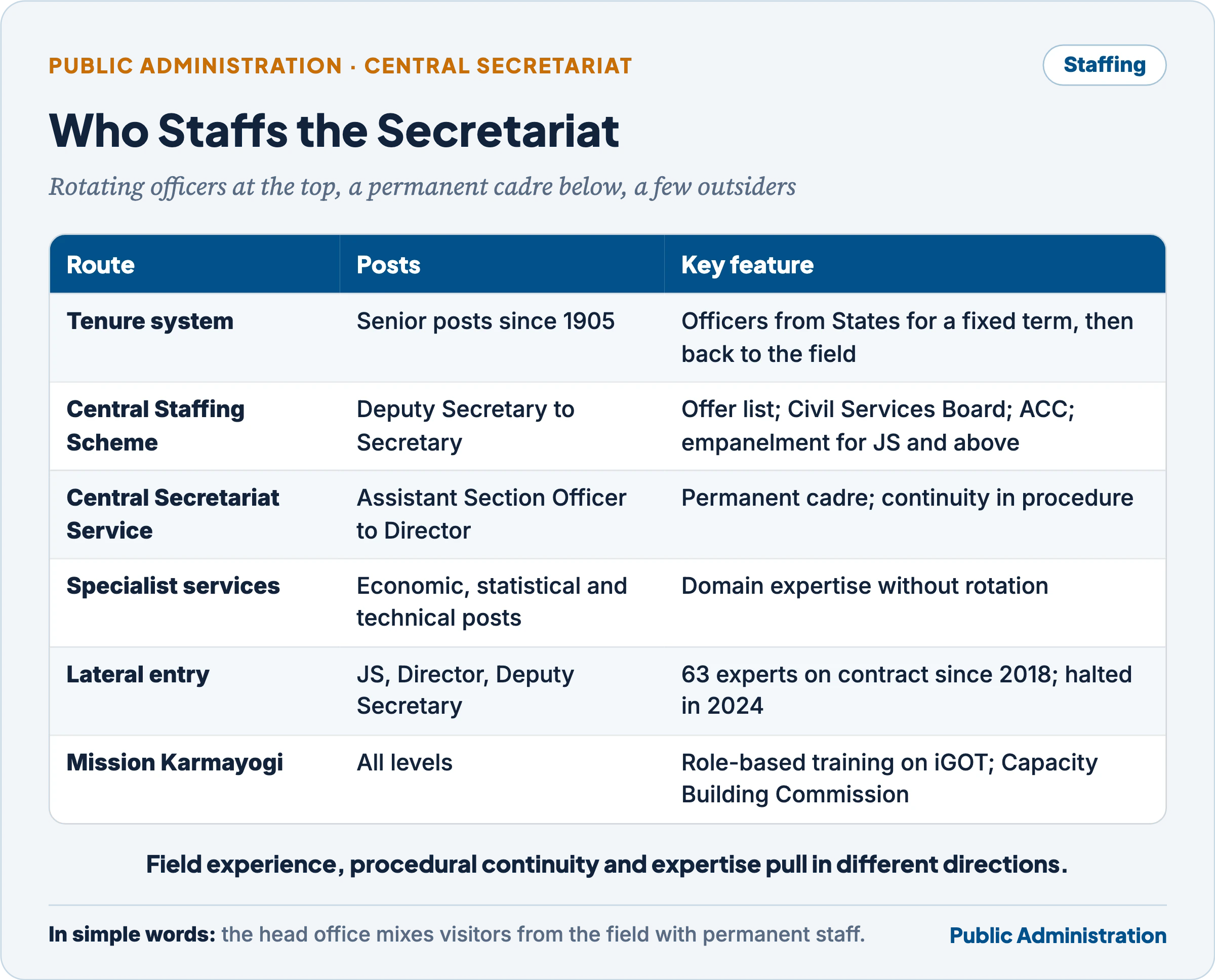
Who should work in the head office: officers who come from the field for a few years and then go back, or permanent headquarters staff who know the files inside out? India uses both. The top posts go to officers on deputation, the middle and lower posts to a permanent secretariat cadre, and a few posts have recently gone to outside experts.
9.1 The tenure system
- Meaning. Superior Secretariat posts are filled by officers from the States and from Central services for a fixed period, after which they revert to their cadre. In S.R. Maheshwari’s description, officers come for a specified period and, after serving their tenure, would (or should) return to their States or services.
- Origin. Lord Curzon (1905). Supported by the Llewellyn Smith Committee (1919), the Simon Commission (1930), the Wheeler (1936) and Maxwell (1937) Committees, the Rowlands Committee (1944–45) and, after Independence, the First ARC’s study team on personnel administration (1967).
- Arguments for.
- Brings field experience into policy-making, so policies are realistic.
- Gives States officers with a national perspective.
- Promotes administrative unity of the federation and Centre–State coordination.
- Prevents officers from becoming stale at headquarters; gives fresh outlook.
- Gives equal opportunity to all officers to serve at the Centre.
- Keeps the Secretariat flexible: inefficient officers can be returned to their cadres.
- Supports the independence of the civil service (officers have a home cadre and are not wholly dependent on central patronage).
- Arguments against.
- Secretariat work is now specialised; the system rests on the myth of the all-round generalist.
- District experience is not relevant to much Secretariat work (trade negotiations, telecom, finance).
- Birds of passage: officers on short tenure depend on permanent office staff to get things done, producing an office-dominated administration.
- In a federal polity with autonomous States, ministers need permanent advisers, not rotating ones (Avasthi).
- States are reluctant to spare their best officers, and officers prefer Delhi’s comforts and proximity to power and resist going back.
- Erosion. The tenure system never covered all departments (Audit and Accounts, Customs and Income Tax, Foreign and Political, Posts and Telegraphs were exempt even in British days). Its weakening came from:
- the Central Secretariat Service for posts below Deputy Secretary (section 9.2);
- specialist services (Indian Economic Service and Indian Statistical Service, 1961) posted in the Secretariat without rotation;
- officer pools for senior posts: the Finance and Commerce Pool (1938–46) and the Central Administrative Pool (1957);
- officers who simply never go back.
9.2 The Central Secretariat Service and allied services
- Central Secretariat Service (CSS). A permanent cadre for the Secretariat’s middle and lower posts, controlled by the Department of Personnel and Training. Its grades rise from Assistant Section Officer and Section Officer through Under Secretary (Grade I), Deputy Secretary (Selection Grade) to Director (Senior Selection Grade).
- Central Secretariat Stenographers’ Service and Central Secretariat Clerical Service for the office component. The Staff Selection Commission recruits clerks and assistants by competitive examination; Section Officers come partly by direct recruitment and partly by promotion.
- Effect. The CSS gives continuity and expertise in procedure, which rotating officers lack. It also created a permanent secretariat culture of noting and precedent, and recurring friction over promotions, stagnation and the share of senior posts between the CSS and the All India and Central Group A services.
9.3 The Central Staffing Scheme
- What it is. The modern form of the tenure system. It fills posts of Deputy Secretary, Director and Joint Secretary and above in ministries (and in the UPSC, Election Commission, CVC and some other bodies) with officers drawn from the All India Services and participating Group A Central services.
- Procedure.
- Each year the Establishment Officer (DoPT) asks States and cadre-controlling ministries for willing officers; an offer list is prepared.
- The Civil Services Board, chaired by the Cabinet Secretary, recommends officers for posts up to Joint Secretary; the ACC approves Joint Secretary and above (powers for DS and Director postings are delegated to the Establishment Officer with the minister’s approval).
- Posts of Joint Secretary, Additional Secretary and Secretary require empanelment, assessed by expert panels and the Civil Services Board.
- Tenure (Consolidated Deputation Guidelines, 18 June 2024): Under Secretary three years; Deputy Secretary four; Director five; Joint Secretary five; JS and AS together up to seven; Additional Secretary four; Secretary without ceiling. A cooling-off period (three years for JS and below; one year for AS) applies between deputations.
- Problems.
- Shortfall of IAS officers on central deputation: States are reluctant to spare officers, and officers prefer State postings at the middle levels. A 2022 draft amendment to Rule 6 of the IAS (Cadre) Rules, to let the Centre call officers without State consent, met strong opposition from several States.
- Empanelment is criticised as opaque and as concentrating patronage at the Centre; supporters say it rewards a record of performance across the career.
- The share of posts held by IAS and by other services is contested; the Joint Secretary level has become more mixed.
9.4 Lateral entry
- What it is. Appointment of domain experts from outside government (private sector, academia, PSUs, State governments) to Secretariat posts at Joint Secretary, Director and Deputy Secretary levels, on contract or deputation (three to five years), selected through the UPSC.
- Origin and record. Earlier governments brought in individual experts (Manmohan Singh, Montek Singh Ahluwalia, Vijay Kelkar, Nandan Nilekani), but without a scheme. The First ARC had suggested lateral entry to senior technical posts. The 2nd ARC’s 10th Report (2008) wanted posts of Joint Secretary and above opened to officers of all services and lateral entry institutionalised at Additional Secretary level and above, through an independent Central Civil Services Authority; NITI Aayog’s Three-Year Action Agenda (2017) also favoured lateral entry. The first advertisement came in 2018. In three cycles (2018, 2021 and 2023), 63 lateral entrants were appointed; about 43 were in position in 2025.
- The 2024 halt. On 17 August 2024 the UPSC advertised 45 posts; after protests from opposition parties and an ally over the absence of reservation, the Minister of State for Personnel asked the UPSC to cancel the advertisement, which it did on 20 August 2024. The government’s position is that each lateral post is a single-post cadre, to which reservation cannot apply (citing the Supreme Court’s judgment in PGIMER, Chandigarh v. Faculty Association). In February 2026 the government told Parliament that 63 appointments had been made; in June 2026 the Minister said no feasible model for reservation in standalone posts had been suggested, leaving the scheme in limbo though not formally suspended.
- Constitutional angle (Part XIV). Recruitment and conditions of service are regulated under Article 309; routing selection through the UPSC follows the spirit of Article 320; the reservation debate turns on Article 16(4) and the rule that a single post cannot be reserved. Critics argue that contract appointments at policy levels bypass the merit system and constitutional safeguards for permanent services; supporters reply that UPSC selection preserves merit and that Article 309 allows such schemes.
- Arguments for. Brings domain expertise (finance, energy, aviation, health); infuses fresh ideas and competition; fills the shortfall of IAS officers at JS level; matches global practice (the US Senior Executive Service, UK open competition); answers the 2nd ARC’s concern with the “cult of the generalist”.
- Arguments against. Risk of politicisation and conflict of interest (revolving door with industry); accountability of contract officers is weaker; short tenure limits impact; lateral entrants struggle with Secretariat procedure and need career officers’ cooperation; resentment and morale issues among career services; reservation and social justice concerns.
- Why it has not moved as intended. Small numbers (63 in eight years against thousands of Secretariat posts); no clear career path or extension for entrants; departure of some entrants before completing terms; the reservation dispute and the 2024 cancellation; lack of a statutory framework and of systematic evaluation of what entrants achieved.
9.5 Capacity building: Mission Karmayogi
- The National Programme for Civil Services Capacity Building (Mission Karmayogi), approved in September 2020, aims to move training from rule-based to role-based learning, using the iGOT Karmayogi online platform, competency frameworks for each post, and a Capacity Building Commission that prepares annual capacity-building plans for ministries. For the Central Secretariat it means training CSS and other staff in e-Office, policy analysis and domain skills. The programme is discussed in the article on Civil Services.
10. Work Procedure: Files, Levels and Reforms
In simple words
In a Secretariat, almost every decision travels on a file. A clerk writes a note, a Section Officer adds a comment, an Under Secretary another, and so on up the ladder until someone with enough authority decides. This makes decisions careful and traceable, but it can also make them painfully slow.
10.1 How a case moves
- Receipt. A letter is received and registered in the Central Registry Unit, now digitised, and sent to the section.
- Noting. The dealing hand (Assistant Section Officer) examines it: checks facts, cites rules and precedents, states the points for decision and suggests options. This written examination is the note; the reply is the draft.
- Submission upwards. The Section Officer scrutinises the note, disposes of routine cases and submits others to the Under Secretary, and so on through the Deputy Secretary/Director, Joint Secretary, Additional Secretary and Secretary to the minister, according to the level of disposal fixed for that class of case.
- Consultation. If another department’s business is affected, the file or a self-contained note goes to it (mandatory under the Business Rules: Finance, Law and Personnel are the most common).
- Decision and record. The competent authority decides; the file preserves the reasoning, so the decision can be reviewed, audited and defended before Parliament, the CAG, courts and RTI applicants.
- Level-jumping. A senior officer may skip levels for speed; under the CSMOP each case, on its return, passes through the levels jumped over, who may resubmit it for reconsideration. In urgent cases the decision may go straight down for action, and those jumped over are informed afterwards.
10.2 Merits of the Secretariat system
- Deliberation and consistency: decisions are examined from several angles and tested against precedent and rules.
- Accountability and record: every step is written, signed and traceable.
- Institutional memory: files and guard files preserve experience across changes of officers and governments.
- Equal treatment: rule-bound examination limits arbitrary decisions.
- Coordination: consultation is built into the procedure.
- Continuity: the system kept government running through changes of party, coalition crises and emergencies.
10.3 Criticisms
- Too many levels. The 2nd ARC counted at least seven levels, from the dealing hand through Section Officer, Under Secretary, Deputy Secretary/Director, Joint Secretary, Additional Secretary to Secretary, before a case reaches the minister. Sequential examination delays decisions and dilutes responsibility: each level assumes the next will catch mistakes.
- Noting culture. Long notes recapitulating the case, written by the most junior and least informed level, set the frame for every decision above; senior officers spend time reading rather than thinking.
- Reverse delegation. Vague delegation makes officers push even routine matters upwards for safety; senior officers drown in minor cases.
- Fear of audit and investigation. The record that ensures accountability also breeds caution: officers prefer to refer, consult and delay rather than decide.
- Non-essential work and over-staffing (1999 question): the Secretariat keeps executive and routine work that could be delegated; staff multiplies at the lower levels; work expands to fill the staff available (Parkinson’s law). The Staff Inspection Unit (Department of Expenditure, 1964) was set up to fix work norms and cut surplus posts.
- Desk-bound distance from citizens and the field; status gap between headquarters and field staff.
- Duplication between Secretariat and attached offices (section 8).
10.4 The desk officer system
- What it is. Introduced from 1973 on the First ARC’s recommendation and adapted from Whitehall practice. The lowest level of work is organised into functional desks, each handled by two officers (Under Secretary and Section Officer, or Section Officer and Assistant Section Officer), who examine and dispose of cases themselves, with stenographic and clerical help, instead of relying on dealing hands’ notes.
- Merits. Speedier disposal; no examination at the clerical level; better quality since the first examination is by an officer; lower cost; fewer levels; clearer responsibility.
- Conditions for success (First ARC): a functional file index, guard files or card indices of precedents, adequate leave reserve, and adequate stenographic and clerical aids.
- Why it spread slowly. Ministries kept the section system alongside; officers lacked support staff; the CSS cadre structure was built around sections; and senior officers continued to expect full notes. The CSMOP 2022 made operationalising the desk officer system one of its four reform prongs, and proposals to replace sections with desks have been debated repeatedly.
10.5 Reforms: from ARC to e-Office
- First ARC (1968). Only two levels of consideration below the minister (Under/Deputy Secretary and Joint/Additional Secretary/Secretary), on a desk officer basis; clear job definitions at each level; a policy advisory committee in each ministry; separate staff offices for planning, finance and personnel.
- Second ARC, 13th Report (2009).
- Each department to lay down a detailed scheme of delegation, updated, audited and placed in the public domain.
- A file should pass through no more than three levels: cases for the minister initiated by a Deputy Secretary/Director and moved through the Joint Secretary and Secretary; cases for the Secretary through two levels; cases for a JS/Director/DS through one level.
- Recast the Manual of Office Procedure; build an electronic database of precedents; allow Secretaries to form inter-disciplinary teams for cross-cutting issues.
- Reduce ministries to 20–25 under coordinating ministers; executive agencies for implementation.
- CSMOP 2022 (16th edition, launched on 5 August 2022). The manual, first published in 1955, was revised to build a digital Central Secretariat on a four-pronged approach:
- Delayering: a file should pass through no more than four levels; levels of disposal reviewed periodically; files for the minister may be initiated at Deputy Secretary/Director level;
- Delegation: financial and administrative powers delegated to Joint Secretaries (heads of department) and Under Secretaries (heads of office);
- Desk officer system operationalised;
- Digitisation: Central Registry Units scanning all receipts, e-Office version 7.0, e-files and digital signatures.
- Results claimed (DARPG impact evaluation, 2022). Delayering reviews in 95 per cent of ministries, delegation of financial powers in 90 per cent, e-Office in all ministries, and a large rise in digital receipts.
- Special Campaigns (since 2021) for disposal of pending matters, record weeding and cleanliness have been institutionalised.
- Common Central Secretariat. Under the Central Vista plan, 51 ministries are to be brought into ten Common Central Secretariat buildings. Kartavya Bhavan-03 (Home, External Affairs, DoPT and others) opened on 6 August 2025; Kartavya Bhavan-1 and 2 (Finance, Defence, Health, Education and others) and Seva Teerth opened on 13 February 2026, when the North and South Blocks were vacated for a national museum. Co-location is meant to ease inter-ministerial coordination, cut maintenance costs and support a paperless workflow.
Indian Connect — Indian Connect: what delayering means for one file
Take a proposal to revise a scheme’s guidelines. In the traditional chain it might pass from the dealing hand to the Section Officer, Under Secretary, Deputy Secretary, Director, Joint Secretary, Additional Secretary and Secretary before the minister sees it, with a note at each step. Under the delayered pattern, a Deputy Secretary or Director initiates the note directly (the section supplying inputs and drafts), and the file moves through the Joint Secretary and Secretary to the minister. Fewer readers mean faster decisions and clearer responsibility; the risk is that fewer people check for errors, which is why the reforms pair delayering with clear delegation schemes and digital records of precedents.
10.6 Assessment
- Procedural reform (delayering, delegation, e-Office) has advanced steadily since 2019; structural reform (fewer ministries, autonomous executive agencies) has not, because ministries are created for political as well as administrative reasons and agencies remain under close ministry control.
- Open questions remain: the future of the section and the Section Officer level, the balance between permanent CSS staff and rotating officers, the place of lateral entrants, and whether digital monitoring from the PMO and Cabinet Secretariat strengthens ministries or reduces them to implementers of decisions taken above.
11. Theory Lens and Intra-governmental Relations
In simple words
Ideas from administrative theory help explain why these offices look and behave as they do: why there are so many levels, why the PM’s office grows, and why coordination is so hard in a large government.
Theory lens: the apex staff system through Paper I ideas
- Gulick’s POSDCORB and coordination. Luther Gulick, in Notes on the Theory of Organization (1937), listed the executive’s functions as planning, organising, staffing, directing, coordinating, reporting and budgeting, and argued that a chief executive needs staff to perform them. The Cabinet Secretariat performs coordinating and reporting for the Cabinet, the PMO for the PM. Gulick distinguished coordination by organisation (structure, hierarchy, rules: the Cabinet Secretariat and Business Rules) from coordination by the dominance of an idea (shared purpose: the PM’s priorities pushed by the PMO). See the article on Classical Theory.
- Line, staff and auxiliary agencies. The classical distinction (Willoughby, White) explains why the 1993 question objects to a staff agency exercising line functions. The Indian experience confirms that the distinction is relative: staff closest to the chief executive acquire authority by proximity. See the article on Structure and Forms of Organisation.
- Weber’s hierarchy and file-based administration. Max Weber, in Economy and Society (1922), identified written files, hierarchy, rules and full-time officials as features of legal-rational bureaucracy. The Secretariat’s noting, precedents and levels are a textbook case; so are its pathologies, which Robert Merton called the displacement of goals: following procedure becomes an end in itself. The 2nd ARC itself said that India’s structures, built on the Weberian model, suit command and control better than development and facilitation. See the article on Weber and Bureaucracy.
- Simon’s decision-making and the limits of hierarchy. Herbert Simon, in Administrative Behavior (1947), showed that decisions are made with bounded rationality and that organisations divide decisions into premises supplied by different units. Multi-level files are an attempt to pool premises, but Simon’s critique of the proverbs of administration (1946) warns that narrow spans of control produce many levels and delay. Delayering and delegation schemes apply Simon’s insight that decisions should be located where the relevant information lies. See the article on Herbert Simon.
- Core executive model. Patrick Dunleavy and R.A.W. Rhodes (1990) replaced the debate “prime ministerial versus cabinet government” with the idea of a core executive: the network of the PM, Cabinet, committees, central offices and senior officials that pulls together government policy. Power in the core is resource-dependent: the PM has authority and patronage, ministers have departments and expertise, officials have information. Indian history fits this: the PMO, Cabinet Secretariat, Cabinet Committees, NSA and Finance Ministry form the core, and the balance shifts with resources (majorities, coalitions, personalities).
- Presidentialisation of prime ministers. Thomas Poguntke and Paul Webb, in The Presidentialization of Politics (2005), argued that prime ministers in parliamentary systems increasingly gain leadership power resources and autonomy within the executive, the party and elections, without any constitutional change. The growth of the PMO, PRAGATI, a two-member ACC and leader-centred campaigns are Indian signs; the 2024 return of coalition politics tests how far the trend can be reversed. Richard Crossman’s earlier thesis (1963) of prime ministerial government in Britain made a similar argument.
- New Public Management and agencification. The 2nd ARC’s executive agencies, performance agreements and delegation follow the NPM model of separating steering (policy) from rowing (delivery), as in Britain’s Next Steps agencies (1988). See the article on New Public Management and After.
- Riggs’ formalism. Fred Riggs described formalism, the gap between prescribed rules and actual behaviour, as a feature of prismatic societies. The split system on paper but Secretariat interference in practice, desk officers on paper but sections in practice, tenure system on paper but permanent officers in practice, are examples. See the article on Riggsian Models.
11.1 Intra-governmental relations at the apex
- PMO and Cabinet Secretariat are complementary when the PMO sets priorities and the Cabinet Secretariat runs the process; they become rivals when the PMO bypasses procedure.
- Secretariat and executive agencies remain in tension between headquarters control and field autonomy, sharpened by the generalist–specialist divide.
- Union and States are now linked directly at the apex: PRAGATI, the Chief Secretaries’ conferences and the deregulation task force bring Chief Secretaries into regular contact with the PMO and Cabinet Secretariat, while the tenure system and the Central Staffing Scheme share officers between the two levels (see the article on the Union Executive for relations between the PM, Cabinet and ministers).
Key Terms
| Term | Meaning in simple words |
|---|---|
| Allocation of Business Rules, 1961 | Rules under Article 77(3) listing ministries and departments and distributing subjects among them |
| Transaction of Business Rules, 1961 | Rules on how government business is decided, which cases go to the Cabinet, its Committees, the PM or the President |
| Rule 12 | Power of the PM to permit or condone a departure from the Transaction of Business Rules |
| Cabinet Secretariat | Secretariat of the Cabinet and its committees; coordinates ministries; under the PM |
| Cabinet Secretary | Senior-most civil servant; head of the Cabinet Secretariat; chairs Committees of Secretaries and the Civil Services Board |
| Committee of Secretaries (CoS) | Meeting of Secretaries under the Cabinet Secretary to resolve inter-ministerial issues |
| Prime Minister’s Office (PMO) | Personal staff agency of the PM; a department under the Allocation of Business Rules |
| Principal Secretary to the PM | Administrative head of the PMO |
| PRAGATI | PM-led video-conference platform reviewing projects, schemes and grievances with Secretaries and Chief Secretaries |
| Central Secretariat | All ministries and departments of the Union Government taken together |
| Ministry and department | A ministry is a minister’s charge; a department is a Secretary’s charge |
| Wing, division, branch, section | Units of a department under a JS/AS, Director/DS, Under Secretary and Section Officer respectively |
| Split system | Separation of policy-making in the Secretariat from execution by agencies outside it |
| Attached office | Executive agency giving technical advice to a ministry and direction to field offices |
| Subordinate office | Field establishment carrying out detailed execution |
| Tenure system | Filling senior Secretariat posts with officers from States and services for fixed terms |
| Central Staffing Scheme | Scheme for posting AIS and Group A officers to DS, Director, JS and higher posts at the Centre |
| Empanelment | Clearance of an officer as fit to hold JS, AS or Secretary posts at the Centre |
| Central Secretariat Service (CSS) | Permanent cadre for the Secretariat’s middle and lower posts |
| Lateral entry | Appointment of outside experts to JS, Director and DS posts on contract through UPSC |
| Noting and drafting | Written examination of a case on file, and the draft reply |
| Level-jumping | Skipping levels in file submission for speed |
| Desk officer system | Organising work into functional desks of two officers who dispose of cases themselves |
| Delayering | Reducing the number of levels a file passes through |
| e-Office | Digital file and receipt system used across the Central Secretariat |
| Seva Teerth | The complex housing the PMO, Cabinet Secretariat and NSCS since 13 February 2026 |
Commissions, Committees and Judgments
The bodies and reports that shaped the apex staff system, with their key points, are listed below.
| Body / case | Year | Key point |
|---|---|---|
| Indian Councils Act (Lord Canning) | 1861 | Legalised the portfolio system; ancestor of ministries and Business Rules |
| Lord Curzon’s tenure rule | 1905 | Senior Secretariat posts filled by officers from the provinces for fixed terms |
| Llewellyn Smith Committee (Government of India Secretariat Procedure) | 1919 | Endorsed separation of policy from execution and the tenure system |
| Wheeler Committee | 1936 | Reviewed Secretariat organisation and procedure |
| Maxwell Committee | 1937 | Organisation and procedure; abolition of the Assistant Secretary grade |
| Rowlands Committee (Bengal Administration Enquiry) | 1944–45 | Secretariat posts only for officers with long district experience |
| Tottenham Report (Reorganisation of the Central Government) | 1945–46 | Lean secretariat; minister as will, Secretary as brain, executive head as hands |
| Cabinet Secretariat designated | 5 Sept 1946 | Executive Council’s secretariat renamed with the Interim Government |
| Bombay Administrative Enquiry Committee | 1948 | Rationale of a secretariat: separating policy from current administration |
| N. Gopalaswami Ayyangar Report (Reorganisation of the Machinery of Government) | 1949 | Four bureaus (rejected); department as Secretary’s charge; standing Cabinet Committees; O&M; Cabinet Secretary as conscience-keeper |
| Paul H. Appleby reports | 1953, 1956 | O&M Division in the Cabinet Secretariat (1954); IIPA |
| First ARC (Morarji Desai, then K. Hanumanthaiya), Report on the Machinery of the GoI and its Procedures of Work | 1968 | Cabinet Secretary as principal staff adviser, tenure three to four years; two levels below the minister; desk officers; CoS behind Cabinet Committees; Department of Personnel |
| Prime Minister’s Secretariat renamed PMO | June 1977 | Janata government cut its size and role |
| Second ARC, 10th Report (Refurbishing of Personnel Administration; chair M. Veerappa Moily) | 2008 | JS and above open to all services; lateral entry at AS level and above through an independent authority; domain competence |
| Second ARC, 13th Report (Organisational Structure of GoI) | 2009 | 20–25 ministries under coordinating ministers; no more than three levels; executive agencies; time-bound GoMs and CoS |
| CSMOP, 16th edition (DARPG) | 2022 | Delayering (four levels), delegation, desk officers, digitisation, e-Office 7.0 |
| PGIMER, Chandigarh v. Faculty Association (Supreme Court) | 1998 | No reservation in a single-post cadre; cited to justify unreserved lateral entry posts |
| Consolidated Deputation Guidelines (DoPT) | 2024 | Tenures under the Central Staffing Scheme; cooling-off periods |
The sequence shows that the questions have hardly changed in a century: how many levels, who staffs the Secretariat, how policy relates to execution, and who coordinates at the top. What has changed is the tool: from committees and manuals to digital platforms and co-located buildings.
Contemporary Developments
- Seva Teerth (13 February 2026). The PM inaugurated Seva Teerth, the new complex housing the PMO, Cabinet Secretariat and National Security Council Secretariat, and Kartavya Bhavan-1 and 2; the Cabinet resolved that North and South Blocks become part of the Yuge Yugeen Bharat National Museum.
- Cabinet Secretary’s extension (5 August 2026). The ACC extended T.V. Somanathan’s service as Cabinet Secretary by one year beyond 30 August 2026, to 30 August 2027.
- PRAGATI milestones (31 December 2025; 27 May 2026). At the 50th meeting the government reported 377 projects reviewed and about 94 per cent of identified issues resolved; the 51st meeting, the first at Seva Teerth, reviewed projects worth about Rs 30,000 crore and the Ken–Betwa link.
- Revised timelines for Cabinet notes (14 May 2025). The Cabinet Secretariat fixed new time limits for inter-ministerial comments and added an inter-ministerial consultation module to eSamikSha.
- Deregulation task force (24 January 2025). A Task Force on Compliance Reduction and Deregulation, chaired by the Cabinet Secretary, and a Deregulation Cell in the Cabinet Secretariat were set up after the fourth National Conference of Chief Secretaries (December 2024).
- Second Principal Secretary in the PMO (22 February 2025). Former RBI Governor Shaktikanta Das was appointed Principal Secretary-2 to the PM; S. Mahendra Dev became chair of the EAC-PM in June 2025.
- Kartavya Bhavan-03 (6 August 2025). The first of ten Common Central Secretariat buildings opened, meant eventually to house all 51 ministries.
- Lateral entry in limbo (2024–2026). After the cancellation of the 45-post advertisement (20 August 2024), the government told Parliament in February 2026 that 63 lateral entrants had been appointed since 2018; in June 2026 the Minister said no workable reservation model for standalone posts had emerged.
Revision Grid
| Thinker / body | Work or report (year) | Key idea |
|---|---|---|
| Lord Curzon | Tenure rule (1905) | Governed from Simla, administered in the plains: field officers in the Secretariat |
| Tottenham | Reorganisation of the Central Government (1945–46) | Minister the will, Secretary the brain, executive head the hands |
| N. Gopalaswami Ayyangar | Reorganisation of the Machinery of Government (1949) | Bureaus, Cabinet Committees, O&M, Cabinet Secretary as conscience-keeper |
| L.S. Amery | Thoughts on the Constitution | Policy staff must be freed from routine to plan |
| A. Avasthi | Writings on central administration | Indian Secretariat sui generis; two parallel hierarchies |
| S.R. Maheshwari | Indian Administration | Tenure system defined; India like Sweden in separating policy and implementation |
| Michael Brecher | Study of Nehru’s succession | L.K. Jha made the PM’s Secretariat a power centre |
| P.N. Dhar | Head of PMO (1973–77) | PMO as a transmission belt for ideas, not a decision-maker |
| First ARC | Machinery of the GoI (1968) | Two levels; desk officers; Cabinet Secretary as principal staff adviser |
| Second ARC | 13th Report (2009) | Three levels; 20–25 ministries; executive agencies |
| Luther Gulick | Notes on the Theory of Organization (1937) | POSDCORB; coordination by organisation and by idea |
| Max Weber | Economy and Society (1922) | Hierarchy, files, rules: the Secretariat’s model |
| Herbert Simon | Administrative Behavior (1947) | Bounded rationality; limits of hierarchy and proverbs |
| Dunleavy and Rhodes | Core executive studies (1990) | Power in a network of resource-dependent actors |
| Poguntke and Webb | The Presidentialization of Politics (2005) | PMs gain power resources without constitutional change |
| Richard Crossman | Introduction to Bagehot (1963) | Prime ministerial government |
Previous Year Questions
- 2026Lateral Entry in Government of India has not moved in the intended direction. Explain the reasons.
- 2024“It should be people’s Prime Minister Office (PMO), it can’t be Prime Minister’s PMO.” Comment.
- 2022“The smooth transaction of business in Ministries and Departments depends on the role played by Cabinet Secretariat”. Discuss.
- 2022Examine the lateral entry recruitment in government in the context of Part XIV of the Indian Constitution.
- 2021The Prime Minister’s Office has become a powerful institution in itself by virtue of its role in decision-making on strategic issues of utmost importance. Examine the statement.
- 2019“Strong PMO is anti-thesis to the feature of collective responsibility of Council of Ministers”. Examine the issues in relation to the position of PMO vis-a-vis Council of Ministers in the light of this statement.
- 2018“The attached offices and subordinate offices are integral to the functioning of the Cabinet Secretariat.” Discuss.
- 2018It is apprehended that lateral entry will lead to politicisation of bureaucracy. Do you agree? Justify
- 2017“The status and functioning of the Cabinet Secretariat face a stiff challenge from the Prime Minister’s Office (PMO).” Argue both in favour and against the contention.
- 2017“The idea of lateral entry into the Civil Services would energise Indian administration.” What are its possible advantages and limitations?
- 2016“Dominant centralized administration is correlated with decisive and authoritative leadership provided by the Prime Minister’s Office.” Explain with suitable examples since independence.
- 2014The functional role of Prime Minister’s office (PMO) depends on the Prime Minister’s policy orientation, personality and style of administration. Comment on the statement with suitable examples.
- 2013“Central Secretariat is the nodal agency for administering the Union subjects and establishing coordination among the various activities of the government.” Discuss.
- 2012Critically examine the variables in the composition and functioning of Cabinet Committees.
- 2011Discuss the evolution of the role of the Prime Minister’s Office (PMO) since independence.
- 2009“The respective roles of the Cabinet Secretary of the Government of India and of the Chief Secretary of a State are similar in certain respects, and dissimilar in other.” Explain.
- 2007“The dispute between Secretariat and Directorate is the result of Generalist vs Specialist controversy.” Analyse.
- 2005“A strong PMO is a salvation for any Indian Prime Minister, but concentration of power is a danger to democracy.” Comment.
- 2005“The Cabinet Secretariat provides the eyes & ears for the Prime Minister to keep in touch with the process of official business in Central Government.” Comment.
- 2002“The central secretariat is a policy formulating, co-ordinating and supervisory agency besides being the principal executive agency of the government.” Explain.
- 2000“The leadership qualities of a civil servant are test most during his tenure as the Cabinet Secretary – a dream-post for every bureaucrat.” Elucidate.
- 1999“The rise of the Prime Minister’s Secretariat and the Cabinet Secretariat in India during the past three decades is an indication of the growing centralisation of policy and decisional authority in the positions of the Prime Minister.” Examine.
- 1999“The Central Secretariat is thus today encumbered with non-essential work and has, for a large part, become an unwisely and over-staffed organization.” Elucidate.
- 1997“The efficiency of the Cabinet depends to a large extent on the Cabinet Secretariat “Elucidate.
- 1995“The Secretariat system of work has lent balance, consistency and continuity to the administration and server as a nucleus for the total machinery of a ministry.” Explain.
- 1994“One weakness of the Gopalaswami plan was to identify a ministry with a minister’s charge.” Discuss, in this context, Gopalaswami Ayyangar’s recommendations regarding Secretariat organization.
- 1993“The Prime Minister’s Office is a staff agency. Its line functions are inconsistent with the Secretariat Systems of administration.” Comment.
- 1992Examine the comparative roles of the Cabinet Secretariat and the Prime Minister’s Secretariat in the functioning of the Union and the Governments in India. Illustrate your answer.
- 1991‘The Prime Minister’s Secretaria-the youngest of the Central Secretariat Organizations-has grown taller than the Cabinet Secretariat.’ Discuss this, analysing the role and influence of the Prime Minister’s Office on the Adminis-tration of the country.
- 1990‘The cabinet secretariat in India as an innovation in the central administration has been emulated from the British experience. Its fortunes have changed with the vicissitudes of the Prime Minister.’ Review the working of the Cabinet Secretariat since its inception in the light of the above statement.
- 1988“Cabinet Secretarial the Prime Minister’s Secretarial in India have Common but dissimilar staff, functions.” Elucidate.
- 1988Trace the evolution of Secretariat system in India during the British period of administrative history with special reference to the structure of central administration and its field organisations.
- 1987‘The role of the Chief Secretary as Principal Co-ordinator in State administration is comparable with that of the Cabinet Secretary in Union Government.’ Do you agree or not? Give reasons.
- 2018“Lateral entry is an antidote to the complacency in civil service.” Discuss.
- 2017Lateral entry of competent experts into the government will promote freshness and innovation, but it can create problems of accountability.”
- 2007“The distinction between line and staff is relative rather than absolute.” Discuss.