

Concept of development; Changing profile of development administration; ‘Anti-development thesis’; Bureaucracy and development; Strong state versus the market debate; Impact of liberalisation on administration in developing countries; Women and development – the self-help group movement.
This article: Concept of development (growth, modernisation, basic needs, human development, development as freedom, sustainable development), underdevelopment and dependency, development administration and administrative development, the changing profile of development administration, and the anti-development thesis
Official Syllabus: Paper I · Unit 1-08 Development Dynamics
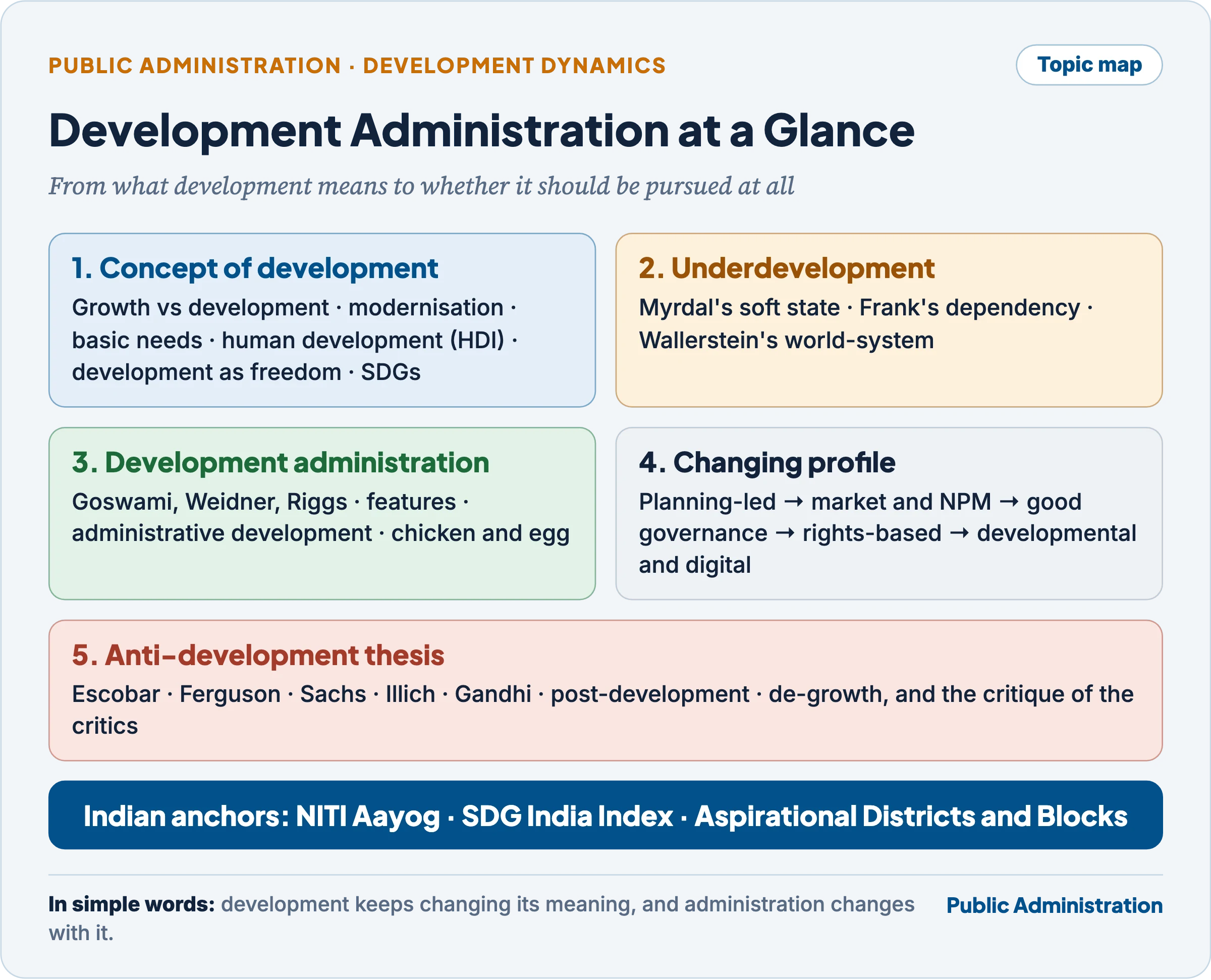
Development administration is the part of public administration that sets out to change society on purpose: to raise incomes, spread schooling and health, build roads and dams, and turn subjects into citizens. It grew up in the 1950s and 1960s, when dozens of newly independent states in Asia, Africa and Latin America made the state the chief engine of national progress. To study it, one must first ask what “development” means, because every answer to that question (growth, modernisation, basic needs, human capability, freedom, sustainability) demands a different kind of administration. The topic ends with the sharpest challenge of all: the anti-development thesis, which asks whether the whole project of planned development was a mistake.
In simple words
Think of a district in 1955 and the same district today. In 1955 “development” meant a new canal and a fertiliser depot run by government officers. Today it also means girls finishing school, a woman’s self-help group running a canteen, a forest community saying no to a mine, and an app that sends a pension straight to a bank account. The word has stayed the same; what it asks of administration has changed completely.
1. The Concept of Development
In simple words
Growth is getting bigger; development is getting better. A country can double its income while most of its people stay hungry, sick and voiceless. Development asks whether people’s lives have actually improved.
1.1 Growth and development: the basic distinction
- Economic growth is a quantitative rise in output: Gross Domestic Product (GDP, the money value of all final goods and services produced in a year) or per capita income goes up.
- Charles Kindleberger, the American economic historian, put it simply: growth means more output; development means more output plus changes in the technical and institutional arrangements by which it is produced.
- Gerhard Colm and Theodore Geiger summed up the same idea as development = growth + change.
- Development is a qualitative, multi-dimensional transformation: the economy, social structure, political system, culture and administration all change together.
- Michael Todaro, the development economist, defined it as a multi-dimensional process involving changes in structures, attitudes and institutions, together with faster growth, lower inequality and the end of absolute poverty.
- Dudley Seers, in The Meaning of Development (1969), asked three questions: what has happened to poverty, to unemployment and to inequality? If all three have grown worse, he argued, it would be strange to call the result development even if per capita income doubled. He later added self-reliance and cultural independence.
- Denis Goulet, in The Cruel Choice (1971), named three core values of development: life-sustenance (food, health, shelter), self-esteem (being treated as a person of worth) and freedom from servitude (a wider range of choice).
- Development is relative and contested. The Brandt Commission (1980) observed that development can never be defined to everyone’s satisfaction. Edward Weidner warned that what looks like growth from one point of view may look like decline from another (a dam is growth for the irrigated plain and loss for the submerged village).
| Basis | Economic growth | Development |
|---|---|---|
| Nature | Quantitative | Qualitative and quantitative |
| Measure | GDP, per capita income | HDI, poverty, inequality, freedoms, sustainability |
| Scope | Economy only | Economy, society, polity, culture, administration |
| Time | Can be short-run | A long, cumulative process |
| Distribution | Silent on who gains | Asks who gains and who loses |
The table shows why development administration cannot simply be “growth administration”. Once development includes distribution, dignity and freedom, administration is judged not only by how much was built but by who benefited, who decided and who was left out.
Weidner’s distinction: change in output versus change in the system
- Edward W. Weidner, the American political scientist who led the comparative study of development administration in the early 1960s, defined development as growth in the direction of modernity, nation-building and socio-economic progress.
- He separated two kinds of change.
- Change in output: more grain, more roads, more schools. This is measurable growth.
- Change in the system itself: new values, new institutions, new relations between state and citizen. This is the deeper transformation that makes growth last.
- His warning: growth is value-laden. A rise in factory output may be decline in clean air, in a forest community’s livelihood, or in social equality. So the administrator must state whose goals and which direction count as development; the word is never neutral.
- This is why Weidner called development administration “action-oriented, goal-oriented”: the goals have to be chosen and stated, not assumed.
1.2 The dimensions of development
Development touches every sphere of social life. The main dimensions identified by scholars are listed below.
- Economic development. Higher real national income over a long period (Gerald Meier stressed three words: process, real national income, long period), lower poverty and fairer distribution. For Meier, economic growth is a means; better nutrition, health, education and opportunity are the ends.
- Political development. The capacity of a political system to deal with its problems and respond to new demands.
- Gabriel Almond saw it as the acquisition of new capabilities through specialised roles.
- Lucian Pye identified a development syndrome of equality, capacity and differentiation.
- Social development. Health, education, housing, the status of women, protection of children and workers, and a shift from ascription (status by birth) to achievement (status by merit).
- Cultural and moral development. Scholars such as S.L. Sharma complained that Western thought lets economic rationality crowd out human morality; development needs a moral framework.
- Liberty. Political rights and civil liberties (free press, association, religion). Cross-country studies by Partha Dasgupta found political and civil rights positively correlated with income and welfare gains such as health and literacy.
- Administrative development. The creation and improvement of the administrative capability to reach development goals (taken up in section 3).
- Environmental sustainability. Development that does not exhaust the resources future generations will need (section 1.4).
1.3 Four lenses on development: modernisation, basic needs, human development, freedom
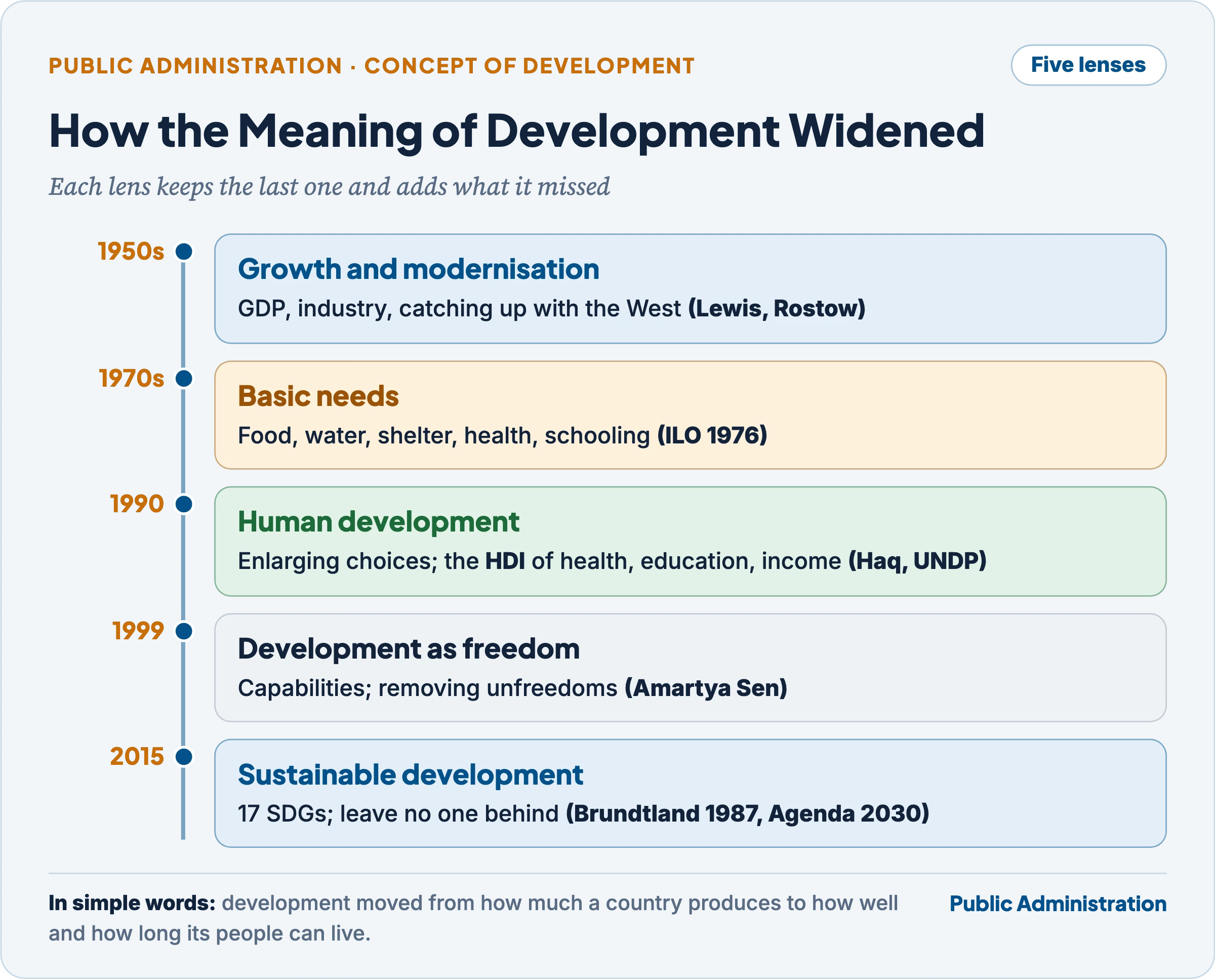
The meaning of development has widened decade by decade. Each new lens kept the earlier one but added something it had missed.
(a) Development as growth and modernisation (1950s–1960s)
- Core idea. Poor countries are “traditional”; they become developed by copying the path of the industrial West: capital investment, industrialisation, urbanisation and Western-style institutions.
- Thinkers.
- W. Arthur Lewis (1954): a dual economy in which surplus rural labour moves into a modern industrial sector.
- W.W. Rostow, The Stages of Economic Growth: A Non-Communist Manifesto (1960): five stages, from traditional society, through preconditions for take-off, take-off, the drive to maturity, to high mass consumption.
- Daniel Lerner (The Passing of Traditional Society, 1958): modernisation as linked changes in literacy, urbanisation, media and political participation.
- Psychological school. Max Weber‘s Protestant Ethic (1905) inspired later work; David McClelland (The Achieving Society, 1961) traced growth to the need for achievement; Everett Hagen traced stagnation to authoritarian personalities; Alex Inkeles and David Smith (Becoming Modern, 1974) described the “modern man” produced by school, factory and mass media.
- Diffusion approach (Everett Rogers): innovations, capital and technology spread from the advanced West to the rest.
- Administrative meaning. A strong, Western-trained bureaucracy, technical assistance and foreign aid, and a planning commission at the top.
- Critique.
- Ethnocentric: it equates development with Westernisation and treats local culture as an obstacle.
- Blames the victim: it explains poverty by internal defects and ignores the external history of colonialism and unequal trade (the point dependency theory makes).
- Trickle-down failed: by the late 1960s many countries had grown fast while poverty and unemployment persisted.
(b) Development as basic needs (1970s)
- Core idea. Instead of waiting for growth to trickle down, attack poverty directly by meeting basic needs: food, water, shelter, clothing, primary health, basic education and employment.
- Origin. The ILO World Employment Conference (1976) endorsed a basic needs strategy; the World Bank under Robert McNamara (president 1968–1981) shifted towards “redistribution with growth” and anti-poverty lending; Paul Streeten and Mahbub ul Haq developed the approach.
- Administrative meaning. Target-group programmes, area plans and delivery systems reaching the poor at the village.
- Indian anchor. The Minimum Needs Programme of the Fifth Five-Year Plan (1974–79) and the “Garibi Hatao” turn; the Integrated Rural Development Programme (1978–80) and the Integrated Child Development Services (1975).
- Critique. It treated people as passive recipients of goods, said little about rights, participation or freedom, and fed large, top-down delivery bureaucracies.
(c) Human development (1990)
- Core idea. People are the real wealth of nations. Development is the process of enlarging people’s choices, above all to lead a long and healthy life, to be educated and to enjoy a decent standard of living.
- Origin. The UNDP Human Development Report (1990), conceived by the Pakistani economist Mahbub ul Haq, with Amartya Sen as a key collaborator.
- The Human Development Index (HDI) combines three dimensions.
- Health: life expectancy at birth.
- Education: mean years of schooling (adults) and expected years of schooling (children).
- Standard of living: Gross National Income (GNI) per capita at purchasing power parity.
- Since 2010 the three are combined by a geometric mean, so poor performance on one cannot be fully offset by another.
- Companion indices. The Inequality-adjusted HDI, the Gender Development Index, the Gender Inequality Index and the Multidimensional Poverty Index (MPI), developed with the Oxford Poverty and Human Development Initiative (2010).
- Critique. The HDI is a narrow summary of a broad idea; it leaves out freedom, environment and dignity; its weights are arbitrary. Its value lies in shifting attention from income to lives.
Indian Connect — India on the human development ladder
- HDR 2025 (UNDP, released 6 May 2025) ranked India 130th of 193 countries, with an HDI value of 0.685 for 2023 (up from 0.676 and rank 133 a year earlier). India remains in the medium human development group, close to the 0.700 threshold for “high”.
- Life expectancy reached 72 years, the highest since the index began; mean years of schooling rose to about 6.9.
- Multidimensional poverty. A NITI Aayog discussion paper (January 2024) estimated that about 24.82 crore people moved out of multidimensional poverty between 2013-14 and 2022-23, the headcount falling from 29.17% to 11.28%.
- India’s own National MPI (NITI Aayog, first edition 2021) adapts the global index and adds maternal health and bank account indicators.
(d) Development as freedom: Amartya Sen (1999)
- Who. Amartya Sen, the Indian economist and Nobel laureate (1998), in Development as Freedom (1999).
- Core idea. Development is the expansion of the real freedoms people enjoy. Income, industry and technology are means; freedom is both the primary end and the principal means of development.
- Key terms.
- Functionings: the things a person manages to be or do (being nourished, literate, taking part in community life).
- Capabilities: the real opportunities to achieve functionings. A fasting monk and a starving labourer may eat equally little; only the monk had the capability to eat.
- Unfreedoms: famine, preventable disease, illiteracy, lack of jobs, gender oppression, political repression. Development is the removal of unfreedoms.
- Five instrumental freedoms that reinforce each other.
- Political freedoms: elections, free speech, opposition.
- Economic facilities: access to markets, credit and resources.
- Social opportunities: schooling and health care.
- Transparency guarantees: openness and trust, which curb corruption.
- Protective security: safety nets, unemployment relief, famine relief.
- Famines and democracy. Sen’s well-known finding: no substantial famine has occurred in a functioning democracy with a free press, because rulers face elections and criticism.
- Administrative meaning. Administration must widen capabilities: public schooling, public health, nutrition, gender equality, and an open, accountable state. It links development to rights-based administration (section 4).
- Critique. Critics say the capability list is vague (Sen refused to fix one; the philosopher Martha Nussbaum offered a list of ten central capabilities); it is individualist and can underplay power, class and community; and it is hard to measure.
1.4 Sustainable development and the SDGs
In simple words
Sustainable development means not eating the seed grain. A family that sells its land to buy a car looks richer this year and is poorer for ever. A country can do the same with its forests, water and air.
- Background. The Club of Rome report The Limits to Growth (1972) and the UN Conference on the Human Environment, Stockholm (1972) raised the alarm that unlimited growth would collide with a finite planet.
- Definition. The World Commission on Environment and Development, chaired by Gro Harlem Brundtland, in Our Common Future (1987): development that meets the needs of the present without compromising the ability of future generations to meet their own needs.
- Three pillars: economic growth, social inclusion and environmental protection, to be pursued together. Later versions add governance as a fourth.
- Milestones. Rio Earth Summit (1992) and Agenda 21 · Millennium Development Goals (2000–2015, eight goals) · Rio+20 (2012) · Agenda 2030, adopted by the UN General Assembly on 25 September 2015, with 17 Sustainable Development Goals and 169 targets · the Paris Agreement (2015) on climate.
- What the SDGs changed.
- Universal: they apply to rich and poor countries alike, unlike the MDGs.
- “Leave no one behind”: progress is judged by the worst-off groups, not averages.
- Integrated: poverty, health, gender, cities, climate, oceans, peace and institutions (Goal 16: peace, justice and strong institutions) in one framework.
- Administrative meaning. Localisation (district and panchayat SDG plans), convergence across departments, data and indicators, environmental and social impact assessment, and green procurement.
- Critique. Too many goals to steer by; weak enforcement (they are voluntary); “green growth” may still mean growth first; financing gaps for poor countries.
Indian Connect — NITI Aayog and the SDG India Index
- NITI Aayog, which replaced the Planning Commission on 1 January 2015, is the nodal body for the SDGs in India; MoSPI keeps the National Indicator Framework.
- The SDG India Index, first released in 2018, scores States and UTs from 0 to 100 on each goal. The fourth edition (2023-24), released on 12 July 2024, used 113 indicators.
- India’s composite score rose from 57 (2018) to 66 (2020-21) to 71 (2023-24).
- Kerala and Uttarakhand topped with 79; Bihar was lowest with 57; 32 States and UTs were “front-runners”.
- The Index is an example of competitive and cooperative federalism: ranking creates peer pressure, while NITI supports laggards.
- Many States now publish district SDG indices and tag budget lines to SDGs (localisation).
2. Underdevelopment, Dependency and the World-System
In simple words
Modernisation theory says a poor country is poor because it has not yet caught up. Dependency theory says it is poor because of the way it was tied to rich countries: it was made to supply cheap raw materials and buy expensive manufactures. One theory looks inside the country; the other looks at its chains.
2.1 Underdevelopment as a process
- Underdevelopment was once treated as a simple absence of development, a starting point. Later scholars saw it as a dynamic process with causes.
- Gunnar Myrdal, the Swedish economist, in Asian Drama: An Inquiry into the Poverty of Nations (1968).
- Cumulative circular causation: low income, low productivity and poor living standards reinforce each other in a vicious circle; political and administrative structures can deepen the inequality.
- The soft state: a state marked by social indiscipline: weak laws, poor enforcement, officials who disobey rules and collude with the powerful they should regulate, and corruption at all levels. A soft state cannot carry out its own development plans.
- Common features of developing countries (as summed up by sociologist Andrew Webster and others): a large agricultural workforce, dependence on a few primary exports, high illiteracy and poor nutrition, rapid population growth, a colonial past, external debt and adverse terms of trade.
2.2 Dependency theory: André Gunder Frank and others
- Roots. The UN Economic Commission for Latin America (ECLA) under Raúl Prebisch, and the Prebisch–Singer thesis (1950): the terms of trade of primary-goods exporters tend to decline against manufactures.
- André Gunder Frank, the German-American economist, in “The Development of Underdevelopment” (1966) and Capitalism and Underdevelopment in Latin America (1967).
- Underdevelopment is not original backwardness; it was produced by the same capitalist process that developed the West.
- A chain of metropolis–satellite relations runs from the world centre to national capitals, to regional towns, to the rural merchant; at each link the surplus is drained upwards.
- Satellites developed most when their ties to the metropolis were weakest (for example, during world wars and depressions).
- Other dependency scholars.
- Fernando Henrique Cardoso and Enzo Faletto, Dependency and Development in Latin America (Spanish 1969): “dependent development” is possible, but on terms set by foreign capital and local elites.
- Samir Amin (unequal exchange, delinking); Walter Rodney, How Europe Underdeveloped Africa (1972).
- Prescriptions. Break or loosen links with the capitalist core, import-substituting industrialisation, collective self-reliance among Southern countries (the New International Economic Order demand of 1974), and removal of the “comprador” elite that serves foreign capital.
- Administrative meaning. A strong planning state, public sector “commanding heights” and controls on foreign capital; aid and technical assistance viewed with suspicion as neo-colonialism.
2.3 World-system theory: Immanuel Wallerstein
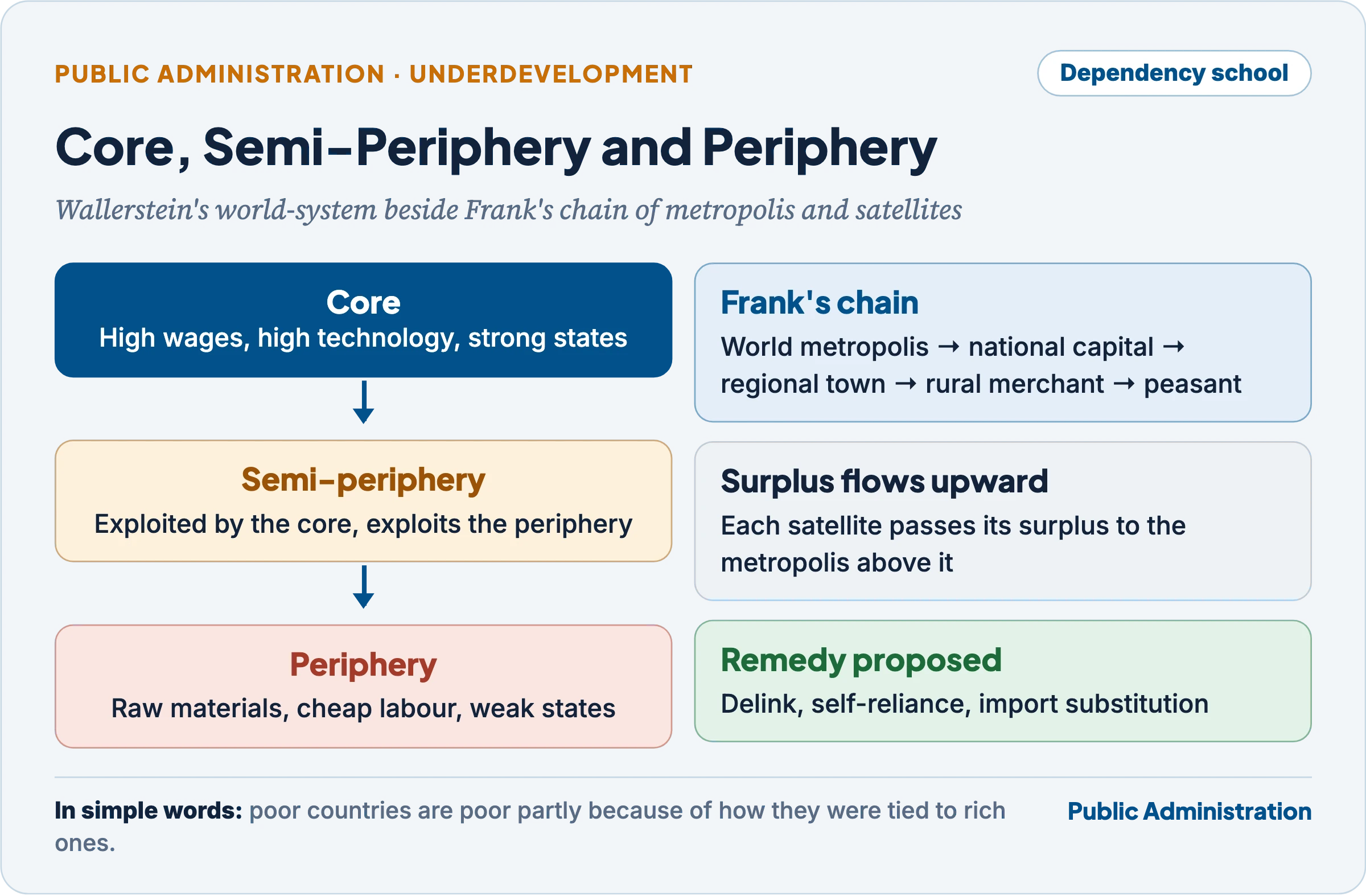
- Who. Immanuel Wallerstein, the American sociologist, in The Modern World-System (vol. I, 1974).
- Core idea. The unit of analysis is not the nation-state but the capitalist world-economy that emerged in the “long sixteenth century”. It has a single division of labour with three zones.
- Core: high-wage, high-technology, capital-intensive production; strong states (Western Europe, North America, Japan).
- Periphery: low-wage, raw-material and labour-intensive production; weak states.
- Semi-periphery: in between, exploited by the core and exploiting the periphery; it gives the system stability (for example, Brazil, India, China at various points).
- Mobility. Unlike Frank, Wallerstein allows countries to move between zones (the rise of East Asia), but not to escape the system.
- Difference from dependency. Dependency theory looks at a pair (metropolis and satellite); world-system theory looks at the whole system and its three-tier structure.
2.4 Critique of dependency and world-system approaches
- East Asian evidence. South Korea, Taiwan, Singapore and later China grew by integrating with world markets under a disciplined state, contradicting “delink to develop”.
- Too external. They play down internal causes: corruption, poor governance, caste and class structures, weak administration (Myrdal’s soft state).
- Economic determinism. Culture, politics and agency of local actors get little room.
- Vague alternatives. Import substitution often produced inefficient, protected industry and the “licence-permit raj”.
- Lasting value. They exposed the international structure of poverty, debt and unequal trade, and they fed directly into the anti-development thesis (section 5).
3. Development Administration
In simple words
Ordinary administration keeps the peace and collects taxes; development administration tries to change how people live. One is a traffic policeman keeping cars moving; the other is a town planner deciding where new roads, schools and hospitals should go, and then getting them built.
3.1 Origin of the term and the field
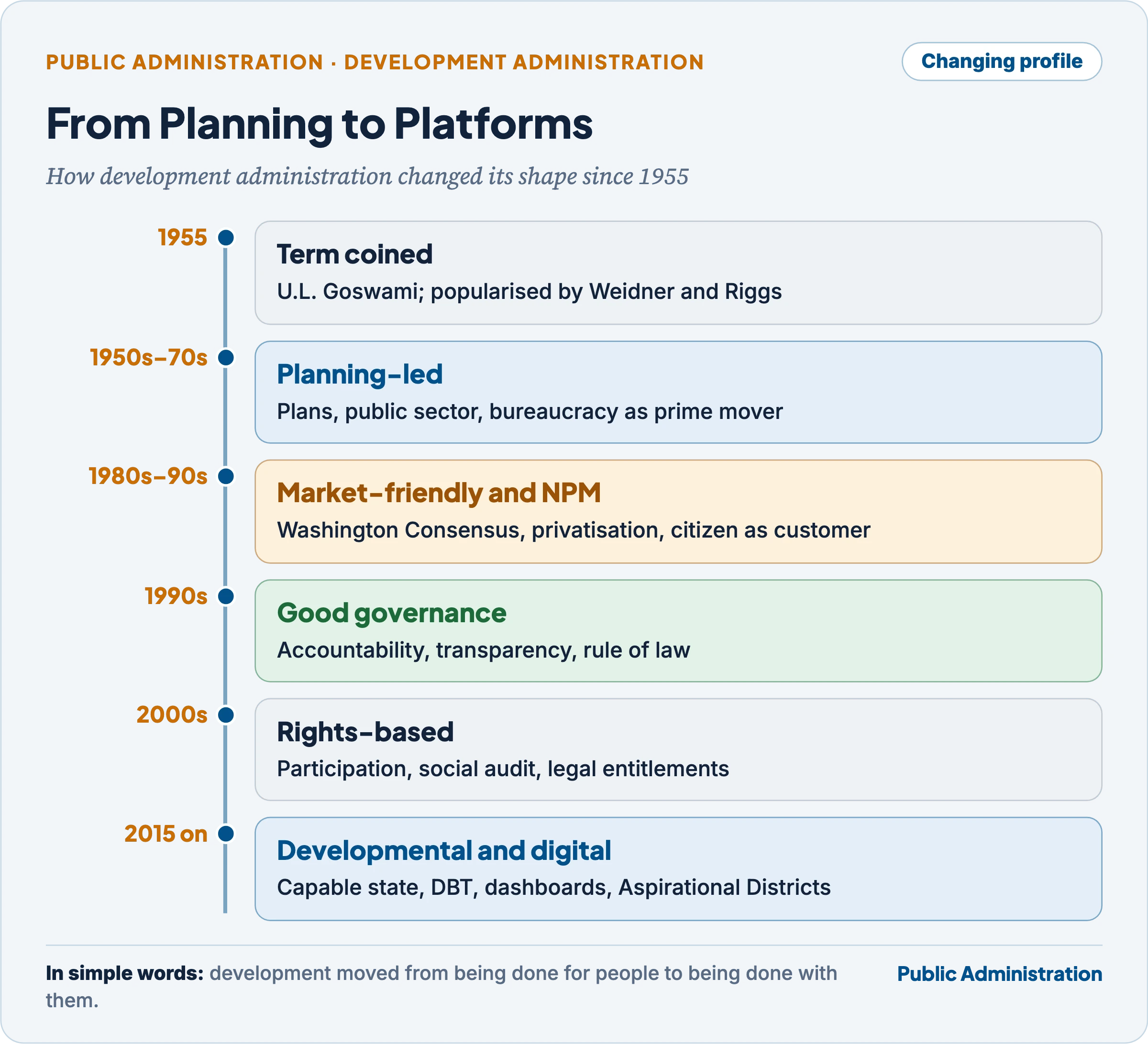
- The coinage. The term “development administration” was first used by the Indian scholar-administrator U.L. Goswami in an article on the structure of development administration in India in 1955. Many notes wrongly credit Weidner or Riggs with coining it; they popularised it.
- Why it emerged.
- Decolonisation after 1945 created dozens of new states whose first task was nation-building and socio-economic development.
- The Keynesian revolution after the Great Depression had already legitimised an active, interventionist state.
- The success of the Marshall Plan (1948) in rebuilding Western Europe led the United States to offer technical assistance to the new states (President Truman’s “Point Four” programme, 1949), and with it American models of administration.
- The Cold War gave the West a motive to show that development was possible without communism (Rostow’s subtitle A Non-Communist Manifesto says so openly).
- The ecological approach in comparative public administration showed that administration must be studied in its social setting.
- Institutional home. The Comparative Administration Group (CAG) of the American Society for Public Administration, set up in 1960 with Fred Riggs as its first chairman and funded mainly by the Ford Foundation, made development administration its main concern. It faded after Ford funding ended in the early 1970s.
- Key scholars.
- Edward W. Weidner: “Development administration: a new focus for research” (1962) and Development Administration in Asia (ed., 1970).
- Fred W. Riggs: Administration in Developing Countries: The Theory of Prismatic Society (1964) and Frontiers of Development Administration (ed., 1970).
- George F. Gant: Development Administration: Concepts, Goals, Methods (1979).
- Milton Esman, Joseph La Palombara (Bureaucracy and Political Development, 1963), Irving Swerdlow, John Montgomery, Ferrel Heady.
3.2 Definitions
- Edward Weidner: development administration is an action-oriented, goal-oriented administrative system; it is concerned with maximising innovation for development, where innovation means planned or intended change in the direction of modernity, nation-building and socio-economic progress.
- Fred Riggs: “organised efforts to carry out programmes or projects thought by those involved to serve developmental objectives”. Riggs defined development itself, in ecological terms, as a process of increasing autonomy (discretion) of a social system, made possible by rising levels of diffraction (functional specialisation plus integration).
- George Gant: that aspect of public administration in which the focus is on organising and administering public agencies so as to stimulate and facilitate defined programmes of social and economic progress; its purpose is to make change attractive and possible.
- John Montgomery: carrying out planned change in the economy (agriculture, industry or the infrastructure supporting them) and, to a lesser extent, in the social services of the state (especially education and public health).
- Irving Swerdlow: administration in poor countries where government plays an unusually large and positive role in development.
- Merle Fainsod: development administration is a carrier of innovating values: it embraces the array of new functions assumed by developing countries embarking on modernisation and industrialisation.
- Indian voices. T.N. Chaturvedi saw development as the “transformation of society”; Tarlok Singh, a member of India’s first Planning Commission, stressed that its objective is the attainment of development goals, and that the line between it and general administration should not be drawn too sharply.
Common confusion
Is development administration a separate kind of administration, found only in poor countries? No. Most scholars, including Gant and Hsueh, treat it as an aspect or orientation of public administration, not a separate machine. The same Collector both keeps order and runs development schemes. Developed countries too run development programmes (regional regeneration, welfare reform, green transition). What marks development administration is its orientation to planned change, not its location.
3.3 The “new functions” of the developing state
The developing state took on many tasks that the old colonial or regulatory state never had. Two scholars listed them.
- Merle Fainsod stressed the array of new functions (planning, industrial promotion, extension, social welfare) that developing countries assumed.
- Milton Esman listed the tasks of a modernising regime:
- security and internal order; consensus and legitimacy of the regime
- integrating diverse ethnic, religious and regional groups into one political community
- distributing powers among central, regional and local governments and between public and private sectors
- displacing vested traditional interests (zamindari abolition, land reform)
- developing modernising skills and institutions; mobilising savings; rational investment programming
- efficient management of facilities and services; activating participation; and a secure position in the international community
- Indian example. In the 1950s the Indian state added the Planning Commission (1950), the Community Development Programme (2 October 1952), the National Extension Service (1953), public sector steel plants and river valley corporations: none of these existed under the colonial “law and order” state.
3.4 Features of development administration
- Change-oriented. Its central concern is socio-economic change, not maintaining the status quo.
- Goal-oriented and result-oriented. It is judged by outcomes (literacy, immunisation, incomes), not only by compliance with rules.
- Innovative. It favours new structures, methods and technologies (Weidner’s innovation).
- Client-oriented and people-centred. It serves specific target groups (small farmers, tribal communities, women), who are treated as participants rather than subjects.
- Participative. It needs people’s participation for local knowledge, legitimacy and sustainability.
- Commitment. Administrators are expected to be committed to development goals and time-bound targets, not merely neutral rule-followers.
- Temporal dimension. Development is urgent; programmes run in mission mode with deadlines.
- Ecological. It is shaped by and must adapt to its social, economic, political and cultural setting.
- Integrated and coordinated. Development needs many departments to work together (convergence), and planning ties them to common goals.
- Flexible structure. It prefers decentralisation, project teams and matrix structures to rigid hierarchy.
- Close to politics. It is openly linked with political goals; the politics–administration dichotomy does not hold.
Development administration versus traditional administration
| Basis | Traditional (regulatory) administration | Development administration |
|---|---|---|
| Purpose | Law and order, revenue, stability | Planned socio-economic change |
| Orientation | Rules and procedures (means) | Goals and results (ends) |
| Structure | Hierarchical, centralised | Flexible, decentralised, team-based |
| Citizen | Subject to be regulated | Participant and client |
| Time | Routine, continuous | Urgent, time-bound |
| Politics | Dichotomy with administration | Closely tied to politics |
| Values | Neutrality, economy, efficiency | Commitment, innovation, equity |
| Setting | Mostly mature states | Mostly developing states |
The contrast should not be overdrawn. Development needs order, revenue and rule-following too; a corrupt or lawless administration cannot develop anything. So the two are complementary, and the real issue is the balance between them in a given office.
3.5 Development administration and administrative development
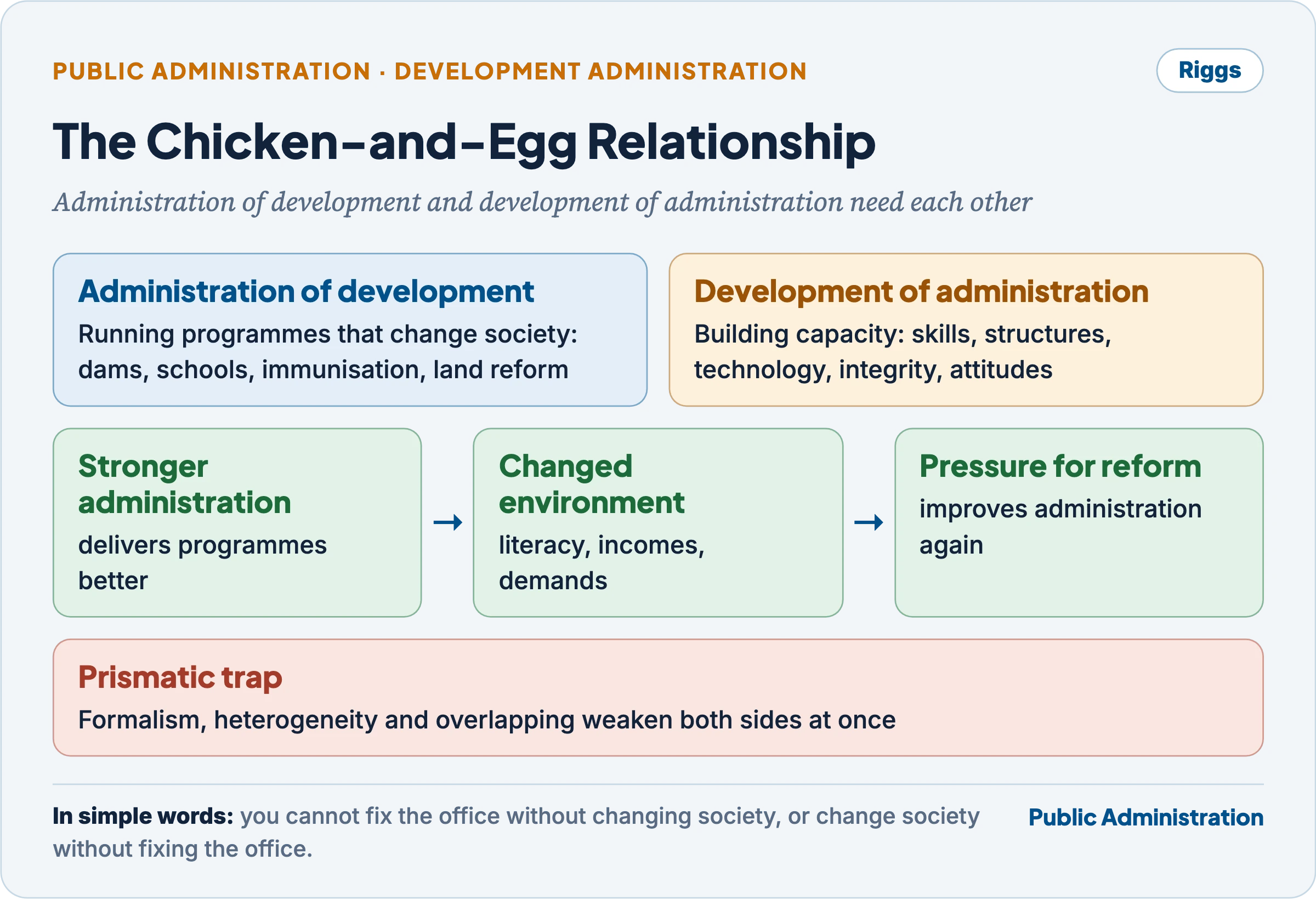
- Two facets (Riggs, Weidner and others).
- Administration of development: using administration to carry out development programmes, projects and policies (building dams, running immunisation drives, land reform).
- Development of administration (administrative development): building the capacity of the administration itself: better structures, skills, procedures, technology, integrity and motivation.
- Administrative development means the creation, improvement and enhancement of administrative capabilities to achieve prescribed goals. It involves:
- modernising structures and processes (delegation, decentralisation, O&M, e-office)
- human resource development (training, merit, career management)
- attitudinal and behavioural change (from “ruler” to “servant”, from procedure to results)
- increasing differentiation with effective integration (Riggs’s diffraction)
- an innovative, motivating climate and accountability systems
| Basis | Development administration | Administrative development |
|---|---|---|
| Focus | Society and economy | The administrative system itself |
| Purpose | Achieve development goals | Build capacity to achieve them |
| Examples | MGNREGA, rural electrification, ICDS | Training reform, e-office, lateral recruitment, citizen charters |
| Measure | Outcomes in society | Capability, efficiency, integrity |
| Relation | The “end” | The “means” |
The chicken-and-egg debate
- Riggs described the relation between the two as a “chicken and egg” type of causation.
- Administration cannot be improved very much without changes in its environment (education, economy, political culture) that limit its effectiveness.
- But the environment cannot be changed unless the administration of development programmes is first strengthened.
- Implication. Neither can wait for the other; both must be pursued together, each reinforcing the other. A literate, prosperous population demands better administration; a better administration spreads literacy and prosperity.
- The prismatic trap. In Riggs’s prismatic society, formalism (the gap between rules and practice), heterogeneity and overlapping weaken administrative development, and so weaken development administration. This is why development schemes in such societies often look good on paper and fail in practice. (The Riggsian models are taught in full in the article on Riggsian models.)
- Why administrative development is slower. Socio-economic change can be speeded by investment, technology and markets; administrative change depends on attitudes, habits, vested interests and political will, which change slowly. Remedies include:
- political commitment and stable tenure for reformers
- capacity building at the cutting edge (for example, Mission Karmayogi, launched in 2020, and the Capacity Building Commission, 2021)
- technology to cut discretion (e-office, DBT, digital land records)
- decentralisation and social audit to bring citizen pressure
- outcome measurement and ranking to make performance visible (the Aspirational Districts dashboard)
- lateral entry and specialist cadres for new skills
Common confusion
Are “development administration” and “administrative development” the same thing? No. Development administration is the use of administration to change society; administrative development is the change in administration itself. The first is the end, the second the means. Riggs’s point is that each depends on the other, which is why a reform that improves only one side usually stalls.
3.6 Objectives and demands on structure
- Objectives. Rapid and sustained economic growth; social justice and reduced inequality; nation-building and political integration; modernisation of attitudes and institutions; people’s participation and empowerment; sustainable use of resources; and reform of the bureaucracy itself.
- Demands on structure and practice.
- De-emphasise hierarchy; decentralise authority to field and local levels.
- Free flow of information and lateral coordination across departments.
- Merit in recruitment, promotion and appraisal; continuous manpower planning.
- Flexible, adaptable organisation: project teams, boards, corporations, mission-mode agencies.
- Specialist and technical skills beside generalists.
- Recognition of the supremacy of the political executive in setting goals.
- Mobilisation of resources through taxation and savings.
- Citizen cooperation and participation built into programmes.
- Attitudinal change: the 1991 UPSC question put it as “revolutionary changes in the attitudes, behaviour, orientation and outlook” of public servants.
3.7 Areas of development administration
- Extension and community services: seeds, fertiliser, credit and advice delivered through extension officers and village-level workers.
- Programme management: plans for rural and urban areas, backward regions, Scheduled Castes and Scheduled Tribes.
- Project management: power plants, irrigation, highways, industrial projects.
- Area development: drought-prone, desert, hill and tribal area programmes.
- Urban and rural development: once mainly rural, now including cities (Smart Cities, AMRUT).
- Personnel development: training administrators for new tasks.
3.8 Why development administration under-performed: problems and critique
Problems in practice
- Colonial legacy: a bureaucracy built for control and revenue, with a ruler mentality.
- Centralisation and lengthy procedures; red tape.
- Shortage of skilled and technical staff, especially at the cutting edge.
- Corruption and elite capture of benefits.
- Poor coordination: departmental silos.
- Weak political support for administrative reform; political interference in postings.
- Limited popular participation; people treated as beneficiaries.
- Lack of motivation and of accountability for results.
- Insufficient finances and multiplicity of agencies.
- Social constraints: traditions, caste, language and beliefs (Riggs’s ecology).
Theoretical critique: the weaknesses of Weidner and Riggs
- Ethnocentrism. Both took the Western (mainly American) experience as the model of “modernity”. Development came to mean becoming like the West, which ignored local values and led to transplanted structures that did not fit. Riggs himself later admitted the danger.
- Too abstract. Riggs’s models (fused, prismatic, diffracted) describe societies at a high level but give little practical guidance on how to administer a programme.
- Static and descriptive. They describe a condition rather than explain how and why change happens.
- Neglect of politics and power. They treat development as a technical problem of capacity, and say little about class, power, land and conflict (the point Ferguson later pressed).
- Bureaucratic bias. They gave the bureaucracy a leading role, assuming that a strong civil service would modernise society; in practice bureaucracies often became self-serving power centres. Joseph La Palombara and Fred Riggs both warned that bureaucratic power can outrun political institutions.
- Normative and value-laden. “Goal-oriented” begs the question whose goals.
- No general theory. As a 2005 UPSC question put it, development administration remained “starved for theories” that could organise evidence and guide policy.
- The “deadlock”. The British scholar Bernard Schaffer wrote of “the deadlock in development administration” (1969): the bureaucratic model cannot deliver the participative, flexible change that development needs, yet development administration relied on it.
- Loss of impetus. When Ford funding ended and the CAG faded in the early 1970s, and when the oil shocks and debt crisis discredited state-led planning, the field lost momentum without a decisive intellectual breakthrough. It revived in new forms (good governance, participatory and rights-based development) rather than in its 1960s shape.
- Ethnocentrism and the SDGs. Ethnocentric “one size fits all” models still damage sustainability goals: high-input Green Revolution farming harmed soils and water in Punjab; large dams displaced tribal communities; uniform schemes ignore local ecology. The SDGs’ stress on localisation and leave no one behind is partly a correction of this.
Criticism — The case against classical development administration
- Ethnocentric: equated development with Westernisation and transplanted foreign structures.
- Top-down and bureaucratic: treated citizens as passive beneficiaries; development became “bureaucracy-led”, not “people-centred”.
- Depoliticised: turned questions of land, caste and power into technical problems.
- Exclusionary in practice: big projects displaced the poor, and benefits were captured by local elites.
- Theoretically thin: abstract models, no general theory, and a loss of momentum after the 1970s.
Defence — Its lasting contribution
- It worked in many places: India’s food self-sufficiency, rising literacy and life expectancy, and rural electrification were delivered largely by development administration.
- It gave the state a positive role: it rejected the idea that government should only keep order.
- It brought ecology into public administration: Riggs showed that structures must fit their society.
- It evolved: participation, decentralisation, rights and outcome monitoring grew out of its own critique.
- Its core question remains: how a state builds capacity and uses it to change lives is still the central question of governance.
4. The Changing Profile of Development Administration
In simple words
In 1960 development was something the government did for people. In 1990 it was something markets were supposed to do. Today it is meant to be done with people, as a matter of their rights, by a state that is smaller in some places, stronger in others, and increasingly digital.
The profile of development administration has changed in roughly five overlapping phases. Each phase reacted to the failures of the one before.
4.1 Phase I: planning-led, state-centric development (1950s–1970s)
- Model. The state as the prime mover: national plans, public sector “commanding heights”, import substitution, controls and licences, community development and extension.
- Intellectual support. Keynesian economics, Rostow’s stages, Lewis’s dual economy, the Soviet example of rapid planned industrialisation, and (for the Left) dependency theory.
- Administrative form. Bureaucracy-led development; generalist civil servants as development managers; the Collector as the head of district development; new agencies such as the Damodar Valley Corporation (1948).
- Indian anchor: the Nehruvian model.
- Planning Commission (15 March 1950); the Second Five-Year Plan (1956–61) built on the Mahalanobis model of heavy industry.
- Industrial Policy Resolution, 1956: a large reserved role for the public sector.
- Community Development Programme (1952), then democratic decentralisation after the Balwantrai Mehta Committee (1957).
- Green Revolution (late 1960s) and bank nationalisation (1969).
- What went wrong. Slow growth (the so-called “Hindu rate of growth” of about 3.5%), the licence-permit raj, loss-making public enterprises, persistent poverty, and a growing gap between plans and implementation.
4.2 Phase II: market-friendly development, structural adjustment and NPM (1980s–1990s)
- Trigger. The oil shocks, the debt crisis (1982), stagflation in the West and the collapse of the Soviet bloc (1989–91) discredited the planning state.
- Ideas. Public choice theory, neo-liberalism (Hayek, Friedman), and the diagnosis of “government failure” alongside “market failure”.
- The Washington Consensus. John Williamson (1989) summarised the ten policies favoured by the IMF, World Bank and US Treasury: fiscal discipline, tax reform, liberalised interest and exchange rates, trade liberalisation, openness to foreign investment, privatisation, deregulation and secure property rights, among others.
- The World Bank’s “market-friendly” approach (World Development Report 1991): governments should do less where markets work and more where they do not (education, health, infrastructure, a stable framework).
- Administrative form: New Public Management (NPM). Downsizing, privatisation, contracting out, agencies, performance targets, customer orientation, “steering not rowing”.
- The market becomes the “new icon of developmentalism” (UPSC 2010): development is redefined as integration into the global economy.
- Indian anchor. The 1991 reforms (New Industrial Policy, de-licensing, disinvestment, opening to FDI). (The administrative impact of liberalisation and the state–market debate are treated in full in the companion article on bureaucracy, the state–market debate and liberalisation.)
- What went wrong. Social costs of adjustment in Latin America and Africa (cuts in health and education), rising inequality, and the realisation that markets need strong institutions to work.
4.3 Phase III: good governance (1990s onward)
- Trigger. The World Bank’s 1989 report on Sub-Saharan Africa blamed a “crisis of governance”; its Governance and Development (1992) defined governance as the manner in which power is exercised in managing a country’s economic and social resources for development.
- Elements. Accountability, transparency, rule of law, participation, predictability, control of corruption, and an effective public sector.
- The state’s role revisited. The World Development Report 1997: The State in a Changing World said an effective state is vital to development; it named five fundamental tasks: a foundation of law; a non-distortionary policy environment with macroeconomic stability; investment in basic social services and infrastructure; protection of the vulnerable; and protection of the environment. The state should match its role to its capability, then raise that capability.
- The Comprehensive Development Framework (World Bank, 1999) under James Wolfensohn: a holistic, country-owned approach covering structural, human, physical and sectoral aspects, with governments, civil society and private sector as partners.
- Indian anchor. The Conference of Chief Secretaries (1997) Action Plan for Effective and Responsive Government; Citizen’s Charters (1997); the Right to Information Act, 2005; the Second Administrative Reforms Commission (2005–2009), chaired first by Veerappa Moily. (Good governance is treated in full in the article on LPG and good governance.)
4.4 Phase IV: participatory and rights-based development (1990s–2010s)
- Participatory development. Robert Chambers, the British development scholar, in Rural Development: Putting the Last First (1983) and Whose Reality Counts? (1997), argued for “reversals”: from top-down to bottom-up, from experts to local knowledge, from blueprint to learning process. Tools such as Participatory Rural Appraisal spread widely.
- Decentralisation. Local governments were given constitutional status or new powers in many countries.
- Rights-based approach. Development needs are recast as legal entitlements that citizens can claim and courts can enforce (UN Declaration on the Right to Development, 1986). This draws on Sen’s freedoms and on human rights law.
- Social accountability. Social audit, community scorecards, participatory budgeting (Porto Alegre, Brazil, from 1989).
- NGOs and civil society as partners in delivery and as watchdogs; self-help groups as vehicles of women’s and community empowerment (treated in the companion article on women, development and SHGs).
- The essence of development administration becomes “people’s empowerment” (UPSC 2004) through decentralisation, transparency, legal entitlements, social audit and SHGs.
Indian Connect — The rights-based turn in India
- 73rd and 74th Constitutional Amendments (1992): constitutional status to panchayats and municipalities, with an Eleventh Schedule of 29 subjects for panchayats.
- PESA Act, 1996: gram sabhas in Fifth Schedule areas get powers over minor forest produce, land acquisition consultation and local resources.
- Right to Information Act, 2005; Mahatma Gandhi NREGA, 2005 (a legal right to 100 days of wage work, with mandatory social audit); Forest Rights Act, 2006; Right to Education Act, 2009; National Food Security Act, 2013; Right to Fair Compensation and Transparency in Land Acquisition, Rehabilitation and Resettlement Act, 2013 (with Social Impact Assessment).
- Niyamgiri case. In Orissa Mining Corporation v. Ministry of Environment and Forests (18 April 2013), the Supreme Court held that the gram sabhas of the Dongria Kondh villages must decide whether bauxite mining would affect their religious and cultural rights under the Forest Rights Act; the gram sabhas rejected the project.
4.5 Phase V: the developmental state, outcomes and digital delivery (2000s–present)
- The developmental state. The East Asian experience showed that a strong, capable, autonomous state working with markets can drive rapid development.
- Chalmers Johnson, MITI and the Japanese Miracle (1982), coined the term “developmental state”.
- Peter Evans, Embedded Autonomy (1995): the best states combine a Weberian, meritocratic bureaucracy (autonomy) with dense ties to business and society (embeddedness).
- Post-Washington Consensus (Joseph Stiglitz, late 1990s): state and market are complements, not substitutes.
- Outcome orientation. Results-based management, outcome budgets, real-time dashboards, ranking of districts and States.
- Digital delivery. Digital-era governance (Patrick Dunleavy): direct, technology-mediated links between state and citizen that reduce intermediaries.
- New public governance and networks. Delivery through partnerships with private firms, NGOs and communities.
- Sustainability and climate. Development administration now includes climate adaptation, disaster resilience and green transition.
- Indian anchor.
- NITI Aayog (1 January 2015) replaced the Planning Commission: from five-year plans to cooperative and competitive federalism, indices and outcome monitoring.
- Direct Benefit Transfer (from 1 January 2013) and the JAM trinity (Jan Dhan accounts, Aadhaar, mobile) to cut leakages.
- Aspirational Districts and Blocks (below), PRAGATI review meetings (2015), Gati Shakti (2021) for infrastructure coordination.
Indian Connect — Aspirational Districts and Aspirational Blocks: development administration by data
- Aspirational Districts Programme (ADP), launched in January 2018, covers 112 of the most under-developed districts. It rests on three Cs: Convergence (of Central and State schemes), Collaboration (Centre, State, district officers, development partners) and Competition among districts.
- Districts are ranked every month on 49 indicators under five themes: health and nutrition, education, agriculture and water resources, financial inclusion and skill development, and basic infrastructure. The ranking is by improvement (delta ranking) on the public Champions of Change dashboard, so a poor district that improves fast can top the list.
- Aspirational Blocks Programme (ABP), launched on 7 January 2023, takes the model to 500 blocks in 27 States and 4 UTs (NITI Aayog now lists 513 blocks), tracking about 40 key indicators.
- Theory lens. ADP is close to Weidner’s goal-oriented development administration (measurable goals, time-bound targets), to NPM (performance ranking) and to the SDGs’ “leave no one behind” (focus on laggard districts). Critics note the risk of target-chasing and “teaching to the indicator”, and the limited role of elected local bodies.
4.6 The five phases compared
| Phase | Period | Main driver | View of the state | Citizen as |
|---|---|---|---|---|
| Planning-led | 1950s–70s | Plans, public sector | Prime mover | Beneficiary |
| Market-friendly / NPM | 1980s–90s | Markets, privatisation | Minimal, “steering” | Customer |
| Good governance | 1990s– | Institutions, accountability | Effective, capable | Stakeholder |
| Participatory / rights-based | 1990s–2010s | Communities, law | Duty-bearer | Rights-holder |
| Developmental / digital | 2000s– | Capable state with markets, data | Strategic, enabling | Co-producer, user |
The table shows a movement from administration “for” people to development “with” and “by” people, and from the state as doer to the state as enabler, regulator and guarantor. The phases overlap: India today runs plan-era public enterprises, NPM-style agencies, rights-based Acts and digital platforms side by side.
5. The Anti-Development Thesis
In simple words
Imagine an outside expert who arrives in a village, decides its people are “backward”, and builds a dam that floods their fields so that a distant city can have electricity. The villagers did not ask to be “developed”. The anti-development thesis says that this story, repeated across the world, is what development has often meant.
5.1 What the thesis says
- Meaning. The anti-development thesis (also called post-development) rejects not just bad development but the very idea of development as it has been practised since 1945. It sees development as a Western discourse that defined two-thirds of humanity as “underdeveloped” and then justified intervening in their lives.
- When. It took shape in the late 1980s and 1990s, drawing on earlier critics (Gandhi, Illich, Schumacher) and on post-structuralist thought (Michel Foucault‘s analysis of knowledge and power).
- Its starting point. In his inaugural address of 20 January 1949, President Harry Truman called the poorer regions “underdeveloped areas” (Point Four). Post-development writers treat this as the moment when much of the world was re-labelled as deficient.
5.2 Named critics and their arguments
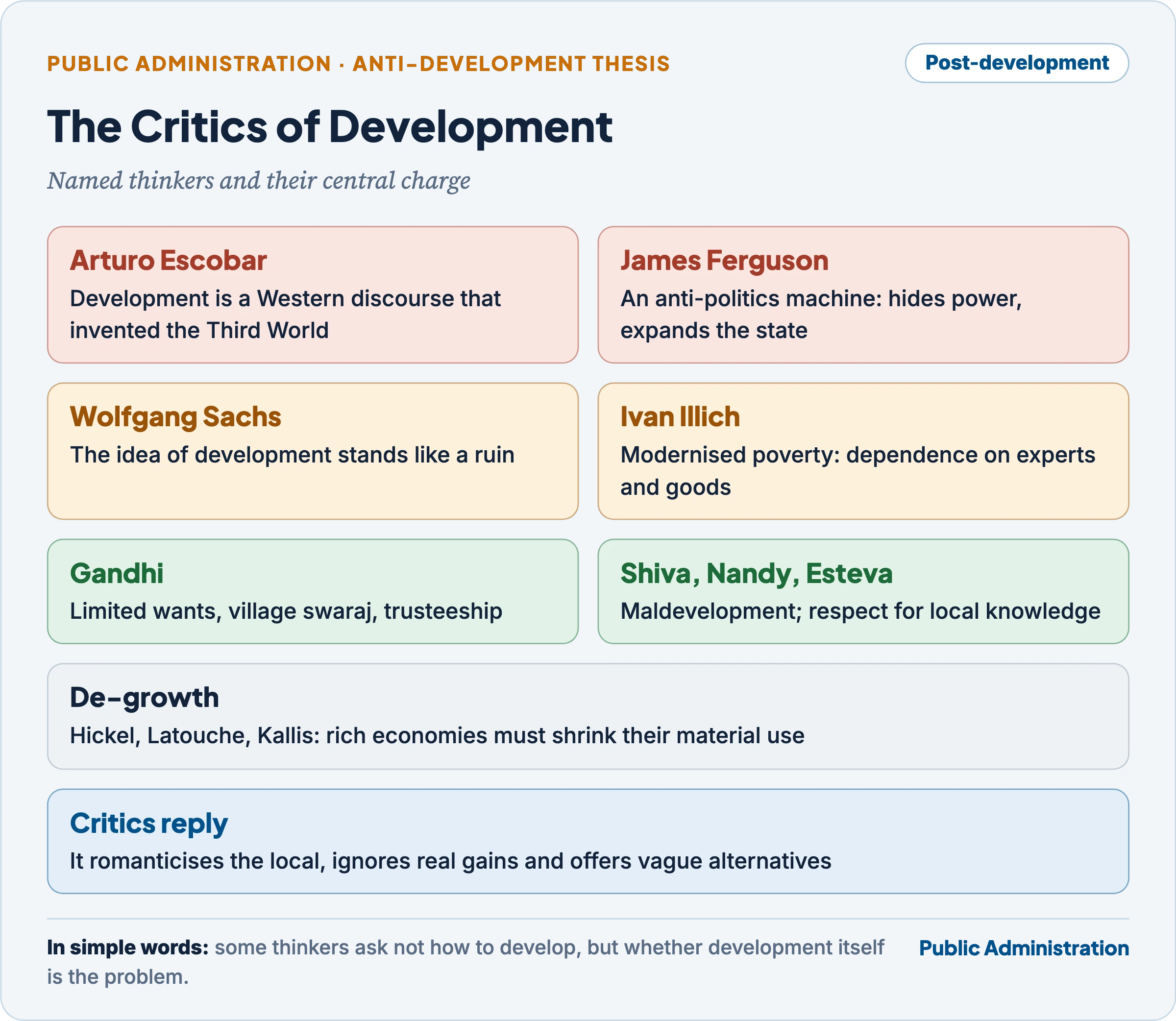
Arturo Escobar: development as a discourse
- Who. Arturo Escobar, the Colombian-American anthropologist, in Encountering Development: The Making and Unmaking of the Third World (1995).
- Argument.
- “Development” and “the Third World” were invented after 1945 as a discourse: a system of knowledge and power that produced “problems” (poverty, illiteracy, overpopulation) and the experts and institutions to solve them.
- This discourse colonised reality: it made Western-style progress the only imaginable future and turned local people into objects of planning.
- The result was not prosperity but dependency, debt, environmental damage and the erosion of local cultures.
- The way forward lies in social movements and local, hybrid alternatives, not in better development.
James Ferguson: the anti-politics machine
- Who. James Ferguson, the American anthropologist, in The Anti-Politics Machine: “Development”, Depoliticization, and Bureaucratic State Power in Lesotho (1990).
- Case. The Thaba-Tseka rural development project in Lesotho (1975–84), funded by the World Bank and Canadian aid.
- Argument.
- Development agencies described Lesotho as an isolated, traditional farm economy, when in fact it was a labour reserve for South African mines. The wrong diagnosis came from the needs of the development apparatus, which must present problems that technical projects can solve.
- The project failed in its stated aims (livestock and crop improvement).
- But it had powerful side-effects: it extended bureaucratic state power into remote areas (roads, offices, police posts) under a neutral, technical label.
- Development thus works as an “anti-politics machine”: it turns political questions of land, wages and power into technical problems, and in doing so depoliticises poverty while quietly strengthening the state.
- Lesson for administration. A project should be judged not only by its stated goals but by its real effects on power.
Wolfgang Sachs: development as a ruin
- Who. Wolfgang Sachs, the German scholar, editor of The Development Dictionary: A Guide to Knowledge as Power (1992).
- Argument.
- Sachs wrote that the idea of development stands like a ruin in the intellectual landscape and that it is time to dismantle this mental structure.
- Development rested on four assumptions that have collapsed: Western superiority (now questioned), the promise of catching up (the gap has widened), the planet’s capacity (ecological limits), and the US-led order that sponsored it (ended with the Cold War).
- The Dictionary‘s essays take apart key words (needs, poverty, planning, participation, standard of living) to show how each carries Western assumptions.
Ivan Illich: development as planned poverty
- Who. Ivan Illich, the Austrian-born radical thinker, in Deschooling Society (1971), Tools for Conviviality (1973) and Medical Nemesis (1975).
- Argument.
- Development creates “modernised poverty”: it makes people dependent on professional services and commodities (schools, hospitals, cars) and destroys their ability to provide for themselves.
- Beyond a point, institutions become counter-productive: schooling produces dependence rather than learning; medicine produces illness (iatrogenesis); fast transport consumes more time than it saves.
- He called for “convivial” tools that people control, rather than tools that control people.
The Gandhian critique
- Who. Mahatma Gandhi, in Hind Swaraj (1909) and later writings.
- Argument.
- Modern industrial civilisation is driven by endless wants, which breed exploitation, violence and moral decay. Gandhi’s well-known saying, that the earth provides enough for every person’s need but not for every person’s greed, sums up the point.
- Development should rest on self-sufficient village republics (gram swaraj), swadeshi, bread labour, decentralised small production, and trusteeship of wealth.
- Antyodaya and Sarvodaya: judge every step by its effect on the poorest (the “talisman”) and seek the welfare of all.
- He distrusted the centralised state as a “soulless machine” and favoured its gradual withering away.
- Influence. J.C. Kumarappa (Economy of Permanence, 1945), E.F. Schumacher‘s Small is Beautiful (1973) with its intermediate technology, Khadi and Village Industries, and today’s Mission LiFE (Lifestyle for Environment, launched by India in October 2022).
Other post-development voices
- Gustavo Esteva and Majid Rahnema: The Post-Development Reader (1997); grassroots post-modernism, radical pluralism and the revival of the commons.
- Vandana Shiva, Staying Alive (1988): Western development as “maldevelopment” that destroys nature and marginalises women; she links ecology and feminism.
- Ashis Nandy: development and modern science as forms of internal colonialism that devalue traditional knowledge.
- Indian movements: the Chipko movement (1973), the Narmada Bachao Andolan (from the mid-1980s, led by Medha Patkar) against displacement by the Sardar Sarovar dam, and the Niyamgiri struggle.
De-growth
- Who. Serge Latouche (France), Giorgos Kallis, Jason Hickel (Less is More, 2020).
- Argument.
- Endless GDP growth in rich countries is ecologically impossible on a finite planet; “green growth” cannot decouple growth from resource use fast enough.
- Rich countries should plan a democratic down-scaling of material and energy use, while poor countries meet basic needs; well-being should be measured by health, time, community and equality, not output.
- Difference from post-development. De-growth is mainly a critique of growth in the North; post-development is mainly a critique of development imposed on the South. They meet in their rejection of growth as the goal.
5.3 The main charges, summarised
- Ethnocentrism: development equals Westernisation; local cultures become “obstacles”.
- Technocracy and depoliticisation: experts and bureaucrats decide; politics is hidden.
- Top-down, bureaucracy-led: no space for people; “development” becomes “bureaucracy”.
- Dependency and debt: aid with conditions, transplanted structures, debt traps.
- Ecological destruction and displacement: big dams, mines and monocultures.
- Exclusion in practice: a participatory rhetoric with exclusionary results (the dilemma posed in the UPSC 2019 question).
- The East Asian point (raised in some critiques): countries that followed their own path while keeping their cultural identity did better than those that copied Western blueprints.
5.4 Critique of the anti-development thesis
- It romanticises the local. It treats local cultures as harmonious and ignores their own hierarchies: caste, patriarchy, landlord power. Defending “tradition” can mean defending oppression.
- It treats the South as passive. Saying development was simply “imposed” denies the agency of Southern governments and peoples, who chose and adapted development (India’s planners were not puppets).
- It is vague about alternatives. It says what it rejects more clearly than what it proposes.
- It ignores real gains. For all its faults, development can be empowering: longer lives, mass literacy, vaccines, electricity, clean water and the vote. Critics such as Jan Nederveen Pieterse and Ray Kiely argued that post-development reduces development to a single idea without history, ignoring how it has changed in response to criticism (basic needs, human development, participation, sustainability).
- It is itself a form of cultural imperialism, some argue, when outsiders tell the poor that they should not want what the rich already have.
- It stays inside dualisms (modern versus traditional, dominant versus dominated) instead of moving beyond them.
5.5 What the thesis changed in development administration
The thesis did not end development, but it changed how it is administered.
- Participation and consent: gram sabha consent under PESA and the Forest Rights Act; free, prior and informed consent in international practice.
- Social and environmental impact assessment before projects (the 2013 Land Acquisition Act; environmental clearance).
- Rehabilitation and resettlement as a legal duty.
- Local knowledge and community management (joint forest management, community forest rights).
- Bottom-up planning: Gram Panchayat Development Plans and People’s Plan Campaigns (Kerala, 1996).
- Plural measures of progress beyond GDP: HDI, MPI, SDG indices, happiness and well-being measures (Bhutan’s Gross National Happiness).
- Sustainable lifestyles and circular economy, echoing Gandhi and de-growth (Mission LiFE).
Common confusion
Is the anti-development thesis the same as dependency theory? No. Dependency theory accepts the goal of development (industrialisation, higher incomes) and blames the world capitalist structure for blocking it; its answer is a different path to the same goal. The anti-development thesis rejects the goal itself as a Western construct, and looks for alternatives to development, not alternative paths of development.
5.6 Bridges to the companion articles
- Bureaucracy, the strong state versus market debate, and the impact of liberalisation on administration in developing countries are taught in the companion article Bureaucracy, State–Market Debate and Liberalisation. In brief: the planning state relied on bureaucracy; neo-liberalism attacked it; the developmental-state school argues that a capable, embedded bureaucracy is still needed to make markets work.
- Women and development (WID, WAD, GAD) and the self-help group movement are taught in the companion article Women, Development and the SHG Movement. In brief: the participatory and rights-based phase of development administration made women’s collectives, such as Kudumbashree and the DAY-NRLM self-help groups, key agents of local development.
Key Terms
| Term | Meaning in simple words |
|---|---|
| Economic growth | A rise in total output or income, measured by GDP |
| Development | A broad improvement in people’s lives: income, health, education, freedom, dignity |
| Modernisation | Change from “traditional” to “modern” society, usually modelled on the West |
| Basic needs approach | Directly meeting food, water, shelter, health and schooling needs of the poor |
| Human development | Enlarging people’s choices to live long, healthy, educated and decent lives |
| HDI | UNDP index combining health, education and income (since 1990) |
| Capability | A person’s real opportunity to be or do something they value (Sen) |
| Unfreedom | Any deprivation that limits choice: hunger, illness, illiteracy, oppression |
| Sustainable development | Meeting present needs without harming future generations’ ability to meet theirs |
| SDGs | 17 UN goals with 169 targets for 2030, adopted in 2015 |
| Underdevelopment | A condition produced by historical processes, not just a lack of development |
| Soft state | A state that cannot enforce its own laws and plans (Myrdal) |
| Dependency | Poverty caused by unequal ties between metropolis and satellite (Frank) |
| World-system | A single capitalist economy with core, semi-periphery and periphery (Wallerstein) |
| Development administration | Administration geared to planned socio-economic change |
| Administrative development | Building the capacity of administration itself |
| Administration of development | Using administration to run development programmes |
| Chicken-and-egg relation | Each of two things is both cause and effect of the other (Riggs) |
| Formalism | A gap between official rules and actual practice (Riggs) |
| Washington Consensus | 1989 package of market-oriented policies favoured by the IMF and World Bank |
| Developmental state | A capable state that steers markets to rapid development (East Asia) |
| Embedded autonomy | A meritocratic bureaucracy closely linked with society and business (Evans) |
| Rights-based approach | Treating development needs as legal entitlements |
| Delta ranking | Ranking by improvement rather than by level |
| Anti-development thesis | The view that development itself is a harmful Western discourse |
| Anti-politics machine | Development turning political issues into technical ones (Ferguson) |
| De-growth | Planned reduction of material and energy use in rich economies |
Commissions, Committees and Judgments
| Body / case | Year | Key point |
|---|---|---|
| Planning Commission | 1950 | Planning-led development; replaced by NITI Aayog |
| Balwantrai Mehta Committee | 1957 | Democratic decentralisation; three-tier panchayats |
| Brundtland Commission (WCED) | 1987 | Defined sustainable development in Our Common Future |
| Brandt Commission | 1980 | North–South report; development hard to define universally |
| UNDP Human Development Report | 1990 | HDI; development as enlarging choices |
| World Bank, Governance and Development | 1992 | Good governance as a condition of development |
| World Development Report: The State in a Changing World | 1997 | Five fundamental tasks of an effective state |
| Second Administrative Reforms Commission | 2005–09 | Citizen-centric, accountable administration |
| NITI Aayog | 2015 | Cooperative federalism, SDG monitoring, ADP and ABP |
| Orissa Mining Corporation v. MoEF (Niyamgiri) | 2013 | Gram sabhas decide on effects of mining on forest rights |
Contemporary Developments
- HDR 2025 (6 May 2025). UNDP’s report A Matter of Choice: People and Possibilities in the Age of AI ranked India 130th of 193 with an HDI of 0.685, up from 133rd; life expectancy reached 72 years.
- SDG India Index 2023-24 (12 July 2024). NITI Aayog’s fourth edition put India’s composite score at 71 (from 57 in 2018); Kerala and Uttarakhand led with 79, Bihar trailed with 57.
- Sustainable Development Report 2025 (24 June 2025). The UN Sustainable Development Solutions Network ranked India 99th of 167 countries, its first time in the top 100 (109th in 2024).
- Multidimensional poverty (January 2024). A NITI Aayog discussion paper estimated that about 24.82 crore people escaped multidimensional poverty between 2013-14 and 2022-23.
- Aspirational Blocks Programme. Launched on 7 January 2023 for 500 blocks; NITI Aayog has since expanded the list to 513 blocks and publishes quarterly delta rankings from a March 2023 baseline.
- Mission LiFE (October 2022 onward). India’s global campaign for sustainable lifestyles, an official echo of the Gandhian and de-growth critiques of consumption.
- Mission Karmayogi. The national capacity-building programme for civil servants (2020) and the Capacity Building Commission (2021) are India’s main current instruments of administrative development.
Revision Grid
| Thinker / body | Work or report (year) | Key idea |
|---|---|---|
| U.L. Goswami | Article on development administration in India (1955) | Coined “development administration” |
| Edward Weidner | “Development administration: a new focus for research” (1962) | Action- and goal-oriented; maximising innovation |
| Fred Riggs | Administration in Developing Countries (1964); Frontiers of Development Administration (1970) | Prismatic society; chicken-and-egg relation |
| George Gant | Development Administration (1979) | Making change attractive and possible |
| Bernard Schaffer | “The deadlock in development administration” (1969) | Bureaucracy cannot deliver participative change |
| W.W. Rostow | The Stages of Economic Growth (1960) | Five stages to mass consumption |
| Dudley Seers | The Meaning of Development (1969) | Poverty, unemployment, inequality |
| Denis Goulet | The Cruel Choice (1971) | Sustenance, self-esteem, freedom |
| Gunnar Myrdal | Asian Drama (1968) | Soft state; cumulative causation |
| A.G. Frank | “The Development of Underdevelopment” (1966) | Metropolis–satellite chain |
| Immanuel Wallerstein | The Modern World-System (1974) | Core, semi-periphery, periphery |
| Mahbub ul Haq / UNDP | Human Development Report (1990) | HDI; enlarging choices |
| Amartya Sen | Development as Freedom (1999) | Capabilities; five instrumental freedoms |
| Brundtland Commission | Our Common Future (1987) | Sustainable development |
| Chalmers Johnson; Peter Evans | MITI and the Japanese Miracle (1982); Embedded Autonomy (1995) | Developmental state |
| Robert Chambers | Putting the Last First (1983) | Participation; reversals |
| Arturo Escobar | Encountering Development (1995) | Development as discourse |
| James Ferguson | The Anti-Politics Machine (1990) | Depoliticisation; state expansion |
| Wolfgang Sachs | The Development Dictionary (1992) | Development “like a ruin” |
| Ivan Illich | Tools for Conviviality (1973) | Modernised poverty; convivial tools |
| Gandhi | Hind Swaraj (1909) | Limited wants, village swaraj, trusteeship |
| E.F. Schumacher | Small is Beautiful (1973) | Intermediate technology |
| Jason Hickel | Less is More (2020) | De-growth |
Previous Year Questions
- 2024The Anti-Development Thesis is a critical perspective on the traditional development models. Comment.
- 2023“In explaining the ‘development’, Weidner made a distinction between change in the output and change in the system itself; and warned that what is growth from one point of view may decline from another.” Comment.
- 2022Development Administration ’embraces the array of new functions assumed by the developing countries’. Explain.
- 2019“Development dynamics is marked by a dilemma: the concept of development has a built-in participatory orientation but the practice of development has been inherently exclusionary.” Discuss.
- 2018How does ethnocentrism impact development administration in achieving sustainable goals? Argue with examples.
- 2018“The process of administrative development is generally slower than the process of socio-economic development.” How can the speed of administrative development be made faster?
- 2017“Development Administration and Administrative Development have a chicken and egg kind of relationship”. -(Riggs). Elaborate
- 2016“The idea of development stands like a ruin in the intellectual landscape” and “it is time to dismantle this mental structure”. (Wolfgang Sachs) In the light of the statement, critically examine the anti-development thesis.
- 2014“The term Development Administration can be used only in a broad sense to mark the variety of approaches and point of view.” Discuss.
- 2012‘The anti-development thesis … reduces development to an idea without history, impervious to change’, but for all its faults, development can be empowering.’ Discuss.
- 2011Neither Edward Weidner nor Fred Riggs was able to describe the process of development administration adequately. Explain the drawbacks and weaknesses in their theoretical analyses.
- 2011Indicate the milestones in the story of development from the Nehruvian Model to the Liberalisation Model.
- 2010“The concept of development is multi-dimensional and ever-expanding.” Explain.
- 2010“The market has become the new icon of developmentalism.” Comment.
- 2007“People’s participation is crucial to development administration.” Comment.
- 2006Do you agree with the view that development administration has in recent years lost its impetus without making any significant intellectual breakthrough? Discuss.
- 2005“Development Administration is starved for theories which will guide the pooling of empirical knowledge, orient new research, and recommend administrative policy.” Explain.
- 2004Describe the changing profile of Development Administration and identify its efforts towards people’s empowerment.
- 2003“Development Administration has two important aspects viz. ‘the administration of development’ and ‘the development of administration’.” Explain.
- 2002“Development administration is concerned with maximising innovation for development.” – Discuss.
- 1998What are the objectives of Development Administration? Also examine the demands D.A. places on the structure and practices of administration.
- 1997Development administration is basically an action-oriented, goal-oriented administrative system.” Comment.
- 1996An attack has been made on the “top down” character of the an alternative ‘bottom up’ ‘approach has been developed.’ Comment.
- 1995Outline the features of development administration and explain the reasons for its marginal performance.
- 1991‘Development administration calls for some revolutionary changes in the attitudes, behaviour, orientation and out-look of public services at all levels of administration.’ Comment.
- 1989Development administration is “an action-oriented goal oriented administrative system.” (Edward Weidner). Comment.
- 1988Examine the positive and negative roles of ideology and culture in administrative development.
- 1988“The nature of Prismatic Society adversely tells upon the phenomenon of administrative development which in-turn hinders the working of development administration.” Comment.
- 1987Distinguish between administrative development and administration of development. In what way is the former supplementary to the latter in a Prismatic Society?
- 2015Do you agree that there has been a serious governance-deficit in development administration in India? Give reasons for your answer and add your suggestions.
- 2010Comment on the following statements: – “The more developed an administrative system became the greater the likelihood that it would have developmental effects.” “The thrust of development administration failed to energise the Indian bureaucracy.”
- 1995“Development administration ultimately boils down to effective project implementation, and it is implementation that has been badly negated in Indian planning. Critically examine the statement.”
- 1991‘Welfare and development administration calls for qualities different from law and order administration.’ Examine, in the light of this statement, the crucial issues in tribal welfare and development administration, highlighting the role of the Government agencies involved in it.