

Concept of development; Changing profile of development administration; ‘Anti-development thesis’; Bureaucracy and development; Strong state versus the market debate; Impact of liberalisation on administration in developing countries; Women and development – the self-help group movement.
This article: Why women became a development question; approaches to women and development (welfare, WID, WAD, GAD, WED, post-modern feminism) and Boserup’s critique; Moser’s practical and strategic gender needs and her five policy approaches; Kabeer’s resources–agency–achievements model of empowerment; capabilities (Sen, Nussbaum); gender mainstreaming after Beijing 1995; gender in organisations; the Indian shift from welfare to empowerment; gender budgeting in India since 2005–06; women in administration (civil services, 73rd and 74th Amendments, Nari Shakti Vandan Adhiniyam 2023); the self-help group movement (Grameen Bank, MYRADA, SHG–Bank Linkage Programme, SGSY, DAY-NRLM, Kudumbashree, Lakhpati Didi, Namo Drone Didi); impact and critiques (Andhra Pradesh microfinance crisis 2010, Malegam Committee, instrumentalism, elite capture).
Official Syllabus: Paper I · Unit 1-08 Development Dynamics
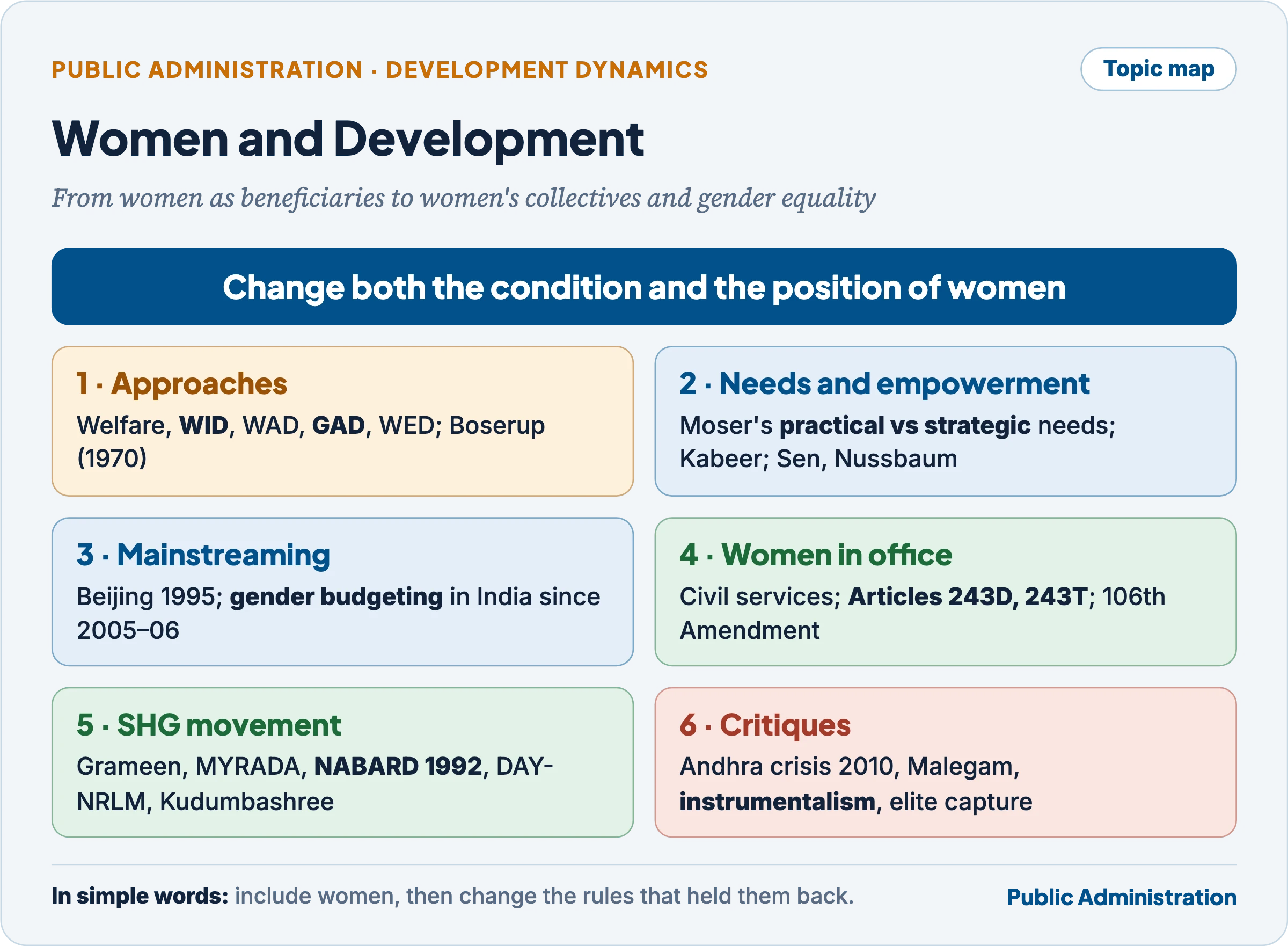
Women and development asks a simple question that development theory ignored for two decades after 1945: who actually gains from growth, and who does the unpaid work that makes it possible? Early development plans treated the household as one unit headed by a man and assumed benefits would reach women through him. When they did not, a body of thought grew that first tried to add women to development, then to rethink development itself from the standpoint of gender relations.
- For administration the question is practical. Every scheme, budget line and district office either reaches women or bypasses them, and the design of the delivery machine decides which.
- India’s answer has been two-pronged: reservation and representation (in panchayats, municipalities, now legislatures) and collective organisation of poor women into self-help groups (SHGs), which have become the largest women’s institutional network in the world.
- This article closes the unit. The companion articles cover the concept of development and the changing profile of development administration, and bureaucracy, the state–market debate and liberalisation; brief bridges to them appear where needed.
In simple words
Imagine a village gets a new tractor scheme. On paper it is “for farmers”. But the land is in the husband’s name, the loan needs a land title, and the training is held in the town at an hour when the women are collecting water. Women do most of the weeding and harvesting, yet the scheme never reaches them. Women and development is the study of why this happens and how administration can change it.
1. Why Women Became a Development Question
In simple words
For a long time planners thought “help the family and the woman will benefit”. Research showed the opposite: new technology and cash crops often made women’s lives harder. So development had to look at women directly.
1.1 The blind spot of modernisation
The modernisation school of the 1950s and 1960s (discussed in the article on the concept of development) equated development with economic growth, industrialisation and the spread of “modern” values. It had three gender blind spots:
- The male breadwinner assumption: the household was treated as a unit led by a man; extension services, credit and land reform were addressed to him.
- Invisible work: unpaid care work, subsistence farming, fuel and water collection were not counted in national income, so women’s contribution simply did not appear in plans.
- Trickle-down to women: it was assumed that rising household income would automatically improve women’s welfare. Evidence showed intra-household inequality in food, health and education persisted even as incomes rose.
1.2 Ester Boserup and the turning point (1970)
Ester Boserup, the Danish economist, published Woman’s Role in Economic Development (1970), the founding text of the field.
- Female and male farming systems: she showed that in much of sub-Saharan Africa women were the main cultivators (shifting, hoe-based “female farming”), while plough agriculture in Asia created “male farming” with women pushed into secondary roles.
- Colonial and modern bias: colonial administrators and later development agencies gave land titles, training and new technology to men, eroding women’s earlier status and productivity.
- Marginalisation by modernisation: as agriculture and industry modernised, women were confined to the low-productivity, traditional sector. Development widened the gender gap instead of closing it.
- Policy conclusion: women must be integrated into development through education, training, credit and employment.
Critique of Boserup. Later feminists (especially Lourdes Benería and Gita Sen, 1981) argued that she accepted the modernisation model and only asked for women’s inclusion in it; she ignored class, reproductive work and the way capitalist development itself depends on women’s cheap labour.
1.3 The international milestones
Boserup’s book coincided with the rise of the women’s movement and pushed the United Nations to act. The sequence below frames everything that follows.
| Year | Event | Significance |
|---|---|---|
| 1973 | Percy Amendment to the US Foreign Assistance Act | USAID required to integrate women into its programmes; origin of the label “WID” |
| 1975 | First World Conference on Women, Mexico City; International Women’s Year | Launched the UN Decade for Women (1976–85) |
| 1979 | CEDAW adopted by the UN General Assembly | The “international bill of rights” for women; India ratified it in 1993 |
| 1985 | Third World Conference, Nairobi | Forward-Looking Strategies; DAWN network’s critique of growth models |
| 1995 | Fourth World Conference, Beijing | Beijing Declaration and Platform for Action; gender mainstreaming adopted |
| 2000 / 2015 | MDG 3 and SDG 5 (gender equality) | Gender equality as a stand-alone global goal |
2. Approaches to Women and Development
In simple words
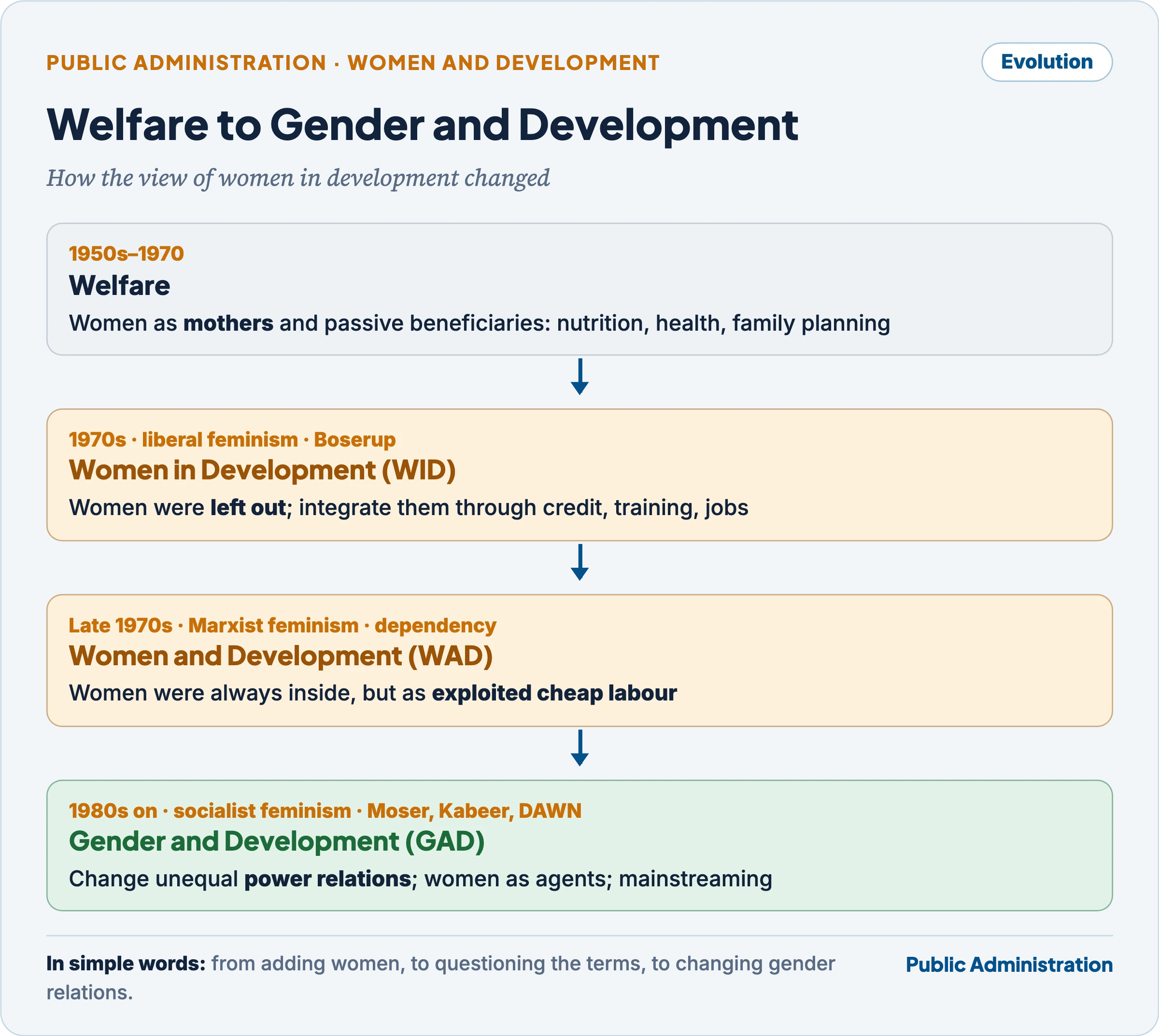
The approaches are like three stages of thinking. First: “women are left out, let us include them” (WID). Second: “women were never left out, they were exploited” (WAD). Third: “the real problem is the unequal relation between men and women, so change that” (GAD).
2.1 The welfare approach (1950s–1970)
- Women seen only as mothers and wives, passive beneficiaries of development.
- Programmes: maternal and child health, nutrition, family planning, food aid, home science.
- Women’s productive role is ignored. In India this phase is visible in the Central Social Welfare Board (1953) and the welfare chapters of the early Five-Year Plans.
2.2 Women in Development (WID), 1970s
- Origin: Boserup’s findings and liberal feminism; the term came from the Washington-based Women’s Committee of the Society for International Development and the Percy Amendment.
- Core claim: women have been left out of development; the solution is to integrate them through education, credit, training, technology and employment.
- Rooted in modernisation theory: it accepts the growth model and asks only for women’s share in it.
- Efficiency logic: including women makes development projects more productive.
- Administrative form: separate women’s projects, women’s desks and “women’s components” in larger programmes.
Critique of WID
- Add women and stir: it adds women to existing structures without asking why they were excluded.
- Focus on women alone: it ignores men, power and household relations.
- Overloads women: income projects add to the triple burden (productive, reproductive, community work).
- Ignores class and race: it treats women as one homogeneous group.
- Marginal projects: small women’s projects with tiny budgets sit outside the mainstream.
2.3 Women and Development (WAD), late 1970s
- Origin: Marxist and dependency thought (see the article on the concept of development for the dependency school).
- Core claim: women were always part of development; the problem is the terms on which they were included. The global capitalist system uses women as cheap labour, for example in export-processing zones and multinational assembly lines.
- Focus: the relationship between women and development processes, and the exploitation of both poor men and poor women by international structures.
Critique of WAD
- Class over gender: it assumes women’s position will improve once international structures become equitable, giving little attention to patriarchy within the household and community.
- Unpaid work still neglected: it focuses on productive work and largely misses domestic and care work.
- Little practical guidance: it offered a powerful critique but few operational tools for planners.
2.4 Gender and Development (GAD), 1980s onwards
- Origin: socialist feminism; scholars such as Kate Young, Caroline Moser and Naila Kabeer, and the DAWN network (Development Alternatives with Women for a New Era, 1984) of Southern feminists including Gita Sen and Caren Grown (Development, Crises and Alternative Visions, 1987).
- Core claim: the problem is not “women” but gender: the socially constructed roles and power relations between women and men, shaped also by class, caste and race.
- Holistic: it looks at productive and reproductive work, the household, the market and the state together.
- Women as agents: women are active agents of change, not passive recipients.
- The state’s role: the state must actively promote women’s emancipation, including legal and property reform.
- Transformative aim: it seeks to change unequal structures, not merely to improve women’s condition inside them.
- Tools: gender analysis frameworks, sex-disaggregated data, gender budgeting, gender mainstreaming.
Critique of GAD
- Hard to operationalise: bureaucracies find “transforming gender relations” far harder to plan for than a women’s project.
- Dilution in practice: “gender” is often reduced back to counting women beneficiaries (a slide called “evaporation” of gender policy).
- Resistance: it challenges power directly, so it meets resistance from men, families and institutions.
2.5 Two further strands: WED and post-modern feminism
- Women, Environment and Development (WED): links women’s subordination with ecological destruction. Vandana Shiva, in Staying Alive (1988), argued that reductionist “maldevelopment” harms both nature and women; the Chipko movement is its Indian symbol. Bina Agarwal criticised this ecofeminist view as essentialist and proposed feminist environmentalism, which explains women’s closeness to nature through their material roles (fuel, fodder, water), not their biology.
- Post-modernism and development (PAD): post-modern feminists such as Chandra Talpade Mohanty (“Under Western Eyes”, 1984) criticised the image of a single “Third World woman” constructed by Western feminism. They stress difference and dialogue, so that women articulate their own needs and agendas.
2.6 WID, WAD and GAD compared
The three main approaches differ on what the problem is, what the goal is and how administration should respond.
| Basis | WID | WAD | GAD |
|---|---|---|---|
| Period and root | 1970s; liberal feminism, modernisation | Late 1970s; Marxist feminism, dependency | 1980s on; socialist feminism |
| Focus | Women | Women and development processes | Gender relations (women and men) |
| Problem | Women’s exclusion | Exploitative global structures | Unequal power between genders |
| Goal | Efficient, productive inclusion | More equitable international system | Transformation; empowerment |
| Women seen as | Untapped resource | Exploited labour | Agents of change |
| Typical tool | Women’s income projects | Structural critique | Gender analysis, mainstreaming, budgeting |
- The movement is from women as beneficiaries to women as participants to gender as a relation of power.
- The 2018 PYQ’s phrase, “development of women” versus “women in development”, captures exactly this contrast: GAD holds that women’s development cannot be secured merely by putting women into existing development.
Common confusion
Is WAD just another name for WID? No. WID (liberal) said women were left out and must be integrated. WAD (Marxist and dependency-inspired) said women were already inside development but on exploitative terms, so integration into an unequal system would not help. GAD then moved the focus from “women” to “gender relations” between women and men.
3. Needs, Empowerment and Capabilities
In simple words
Giving a woman a water tap near her home meets her daily need. Giving her the right to own land or sit on the panchayat changes her position for good. Good policy does the first in a way that leads to the second.
3.1 Molyneux and Moser: practical and strategic gender needs
Maxine Molyneux (1985) first distinguished women’s practical and strategic gender interests. Caroline Moser, the British social planner, turned this into a planning tool in “Gender Planning in the Third World” (World Development, 1989) and Gender Planning and Development (1993).
| Basis | Practical gender needs (PGNs) | Strategic gender needs (SGNs) |
|---|---|---|
| Meaning | Needs arising from women’s existing roles | Needs arising from women’s subordinate position |
| Time frame | Immediate, short-term | Long-term |
| Challenge to power | Do not challenge the gender division of labour | Challenge it directly |
| Examples | Water, fuel, health care, crèches, ration cards | Land and property rights, freedom from violence, equal wages, political voice, control over fertility |
| Indian example | Ujjwala LPG, Jal Jeevan Mission, Anganwadis | Hindu Succession (Amendment) Act 2005, reservation in panchayats, Protection of Women from Domestic Violence Act 2005 |
- The two are linked: an SHG that starts by meeting a practical need (credit for a goat) can, through collective action, take up strategic issues (liquor bans, violence, land titles). This is the core of the claim that SHGs empower.
- Moser also identified women’s triple role: productive (paid and subsistence work), reproductive (care and household work) and community managing (water committees, festivals), mostly unpaid.
3.2 Moser’s five policy approaches
Moser classified Third World policies towards women into five approaches, which map onto the WID–GAD evolution.
| Approach | Period | Aim | Need met |
|---|---|---|---|
| Welfare | 1950–70 | Women as better mothers | Practical |
| Equity | 1976–85 (UN Decade) | Equality with men, top-down | Strategic, but politically resisted |
| Anti-poverty | 1970s on | Raise poor women’s productivity and income | Practical |
| Efficiency | Post-1980s debt crisis | Women’s labour for efficient development and structural adjustment | Practical, often adds burden |
| Empowerment | Mid-1980s on, from Southern feminism | Self-reliance; women organise to change their position | Strategic, built from below |
- The efficiency approach coincides with structural adjustment: cuts in public services shifted care costs back on to women, a link to the article on liberalisation.
- Many SHG programmes are a mix of anti-poverty and efficiency approaches that claim the language of empowerment, which is the root of the instrumentalism critique (Section 8).
3.3 Naila Kabeer: empowerment as resources, agency and achievements
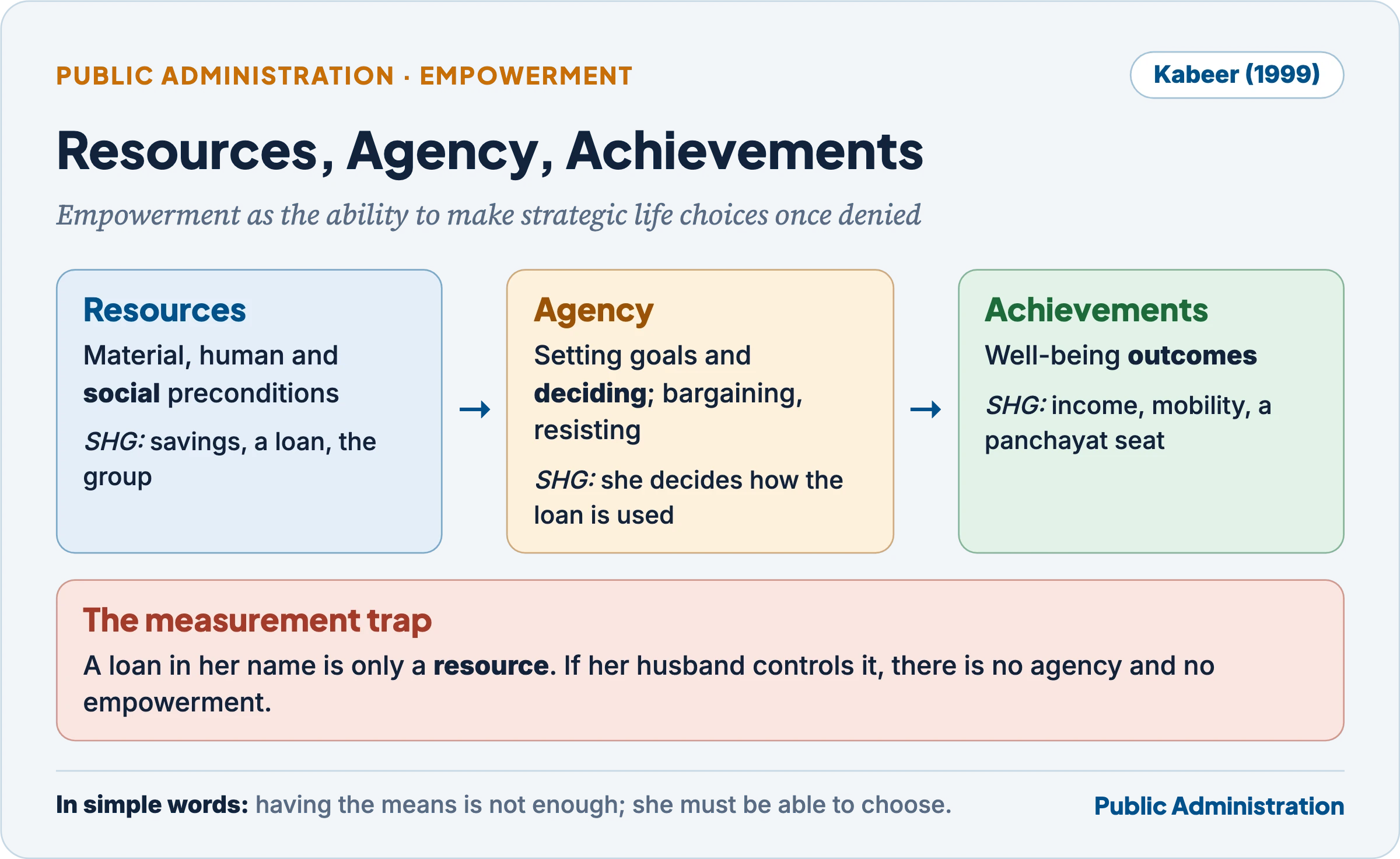
Naila Kabeer, the British-Bangladeshi social economist, gave the most cited definition in “Resources, Agency, Achievements: Reflections on the Measurement of Women’s Empowerment” (Development and Change, 1999). Empowerment is the expansion in people’s ability to make strategic life choices in a context where this ability was previously denied to them.
- Resources: the preconditions for choice: material (land, income, credit), human (education, skills) and social (networks, groups).
- Agency: the ability to define one’s goals and act on them; decision-making, bargaining, negotiation and also resistance. Kabeer calls it the “power within”.
- Achievements: the outcomes, i.e. well-being results such as health, mobility, freedom from violence.
- Process, not a product: empowerment means a change from a state of disempowerment; a woman who always had choices is not “empowered” by having them.
- Measurement trap: a loan in a woman’s name (resource) does not prove empowerment if her husband decides how it is spent (no agency). This is the precise point on which SHG impact studies divide.
Srilatha Batliwala (1994) similarly defined empowerment as a process of challenging existing power relations and gaining greater control over the sources of power, both material and ideological. The Mahila Samakhya programme (1989) in India was built on this idea of collective empowerment through education.
3.4 Capabilities: Sen and Nussbaum
- Amartya Sen, in Development as Freedom (1999), defines development as the expansion of capabilities, the real freedoms people have to be and do what they value. His work on “missing women” (1990) showed that excess female mortality in Asia meant around 100 million women were “missing” from the population, a stark index of gender bias. His idea of the household as a site of “cooperative conflict” explains why household income does not reach women equally.
- Martha Nussbaum, in Women and Human Development: The Capabilities Approach (2000), argued that the combination of poverty and gender inequality demands attention to what women are actually able to do and to be, not to their satisfaction or resources. She proposed a list of ten central capabilities, including life, bodily health (including reproductive health), bodily integrity, practical reason, affiliation and control over one’s environment (political and material).
- The UNDP built gender into its Human Development Reports: the Gender Development Index and Gender Empowerment Measure (1995), replaced in 2010 by the Gender Inequality Index (GII).
3.5 Gender mainstreaming (Beijing 1995)
Gender mainstreaming was endorsed by the Beijing Platform for Action (1995), which asked governments to put a gender perspective at the centre of all policies and programmes. The UN ECOSOC agreed conclusions (1997) gave the standard definition: the process of assessing the implications for women and men of any planned action, including legislation, policies or programmes, in all areas and at all levels, so that women’s and men’s concerns are an integral part of design, implementation, monitoring and evaluation and inequality is not perpetuated. The ultimate goal is gender equality.
- Shift from add-on to core: instead of a separate women’s project, every ministry examines how its own roads, budgets or health programmes affect women and men.
- Tools: sex-disaggregated data, gender impact assessment, gender budgeting, gender audits, gender focal points.
- Critique: in many bureaucracies mainstreaming became a technocratic checklist; when gender is “everyone’s job”, it can become no one’s job, and dedicated women’s machinery loses funds.
- Beijing’s twelve critical areas include poverty, education, health, violence, armed conflict, the economy, power and decision-making, and institutional mechanisms. Beijing+30 (2025) reviewed progress and found none of the areas fully achieved.
3.6 Gender in organisations
Public administration theory long treated organisations as gender-neutral. Feminist organisation theory disagrees.
- Joan Acker, “Hierarchies, Jobs, Bodies: A Theory of Gendered Organizations” (1990), argued that the “abstract worker” of bureaucratic job descriptions is implicitly a man without care duties, so long hours, transfers and unbroken careers disadvantage women.
- Kathy Ferguson, The Feminist Case Against Bureaucracy (1984), saw bureaucratic hierarchy as reproducing domination and called for more participatory, relational forms.
- Camilla Stivers, Gender Images in Public Administration (1993), showed how images of the expert, the leader and the hero in public administration are masculine.
- The 2013 PYQ’s line that “in organizational analysis, there is always gender around” makes the same point: transfer policies, meeting hours, sexual harassment and promotion norms are gendered even when rules look neutral. In India the Vishaka v. State of Rajasthan (1997) guidelines and the Sexual Harassment of Women at Workplace (Prevention, Prohibition and Redressal) Act, 2013 (Internal Committees) are the main legal responses.
4. Indian Policy: From Welfare to Women-Led Development
In simple words
India’s own policy moved in the same direction as world thinking: first welfare for mothers, then development schemes for women, then empowerment, and now the slogan of women leading development.
| Phase | Period | Landmarks |
|---|---|---|
| Welfare | 1950s–1970s | Central Social Welfare Board (1953); Mahila Mandals under Community Development |
| Development | 1974–1990 | Towards Equality (1974), report of the Committee on the Status of Women in India; Sixth Plan (1980–85) first chapter on women and development; DWCRA (1982–83) |
| Empowerment | 1990–2014 | National Commission for Women Act 1990; 73rd and 74th Amendments (1992); Ninth Plan’s women’s component plan; National Policy for the Empowerment of Women (2001); gender budgeting (2005–06); NRLM (2011) |
| Women-led development | 2014 on | Beti Bachao Beti Padhao (2015); Ujjwala (2016); G20 New Delhi Leaders’ Declaration (2023) on women-led development; Nari Shakti Vandan Adhiniyam (2023); Mission Shakti (2022) |
- Towards Equality (1974) showed that women’s status had declined on several indicators since Independence (falling sex ratio, low work participation), puncturing the assumption that planned development was helping women.
- DWCRA (Development of Women and Children in Rural Areas), started in 1982–83 under IRDP, organised poor rural women into groups of 10–15 for income activities. It is the state-led precursor of the SHG approach.
- The Paper II PYQs of 1995 and 2002 ask precisely about this shift from welfare and consumption to recognising women as contributors to the economy and to empowerment.
Indian Connect — Constitutional base for gender equality
- Article 14 (equality before law), Article 15(3) (special provisions for women and children), Article 16 (equal opportunity in public employment), Article 39(a) and (d) (equal livelihood and equal pay), Article 42 (maternity relief), Article 51A(e) (renounce practices derogatory to women’s dignity), Articles 243D and 243T (reservation in panchayats and municipalities), Article 330A and 332(3A) / 334A (inserted by the 106th Amendment).
- Judicial interventions: Vishaka (1997) on workplace harassment; C.B. Muthamma v. Union of India (1979) struck down service rules requiring women foreign service officers to seek permission to marry and allowing their removal on marriage; Secretary, Ministry of Defence v. Babita Puniya (2020) granted permanent commission to women army officers; Vineeta Sharma v. Rakesh Sharma (2020) held daughters coparceners by birth.
5. Gender Budgeting in India
In simple words
A gender budget does not mean a separate budget for women. It means reading the whole budget with one question: how much of this money actually reaches women and girls, and does it reduce the gap between them and men?
5.1 Concept
- Gender-responsive budgeting (GRB) applies gender analysis to every stage of the budget cycle: planning, allocation, spending, audit and impact assessment.
- Origin: Australia’s Women’s Budget Statement (1984); the Commonwealth Secretariat‘s initiative (1995) and South Africa’s Women’s Budget Initiative (1995) spread it; the Beijing Platform endorsed it.
- It is a tool of gender mainstreaming: it moves gender from a ministry of women into the Finance Ministry and every spending department.
5.2 The Indian machinery
- 2004–05: the Ministry of Finance accepted gender budgeting; the Department of Women and Child Development prepared the first framework, and in 2005 the Ministry of Finance asked every ministry to set up a Gender Budgeting Cell (charter issued 2007).
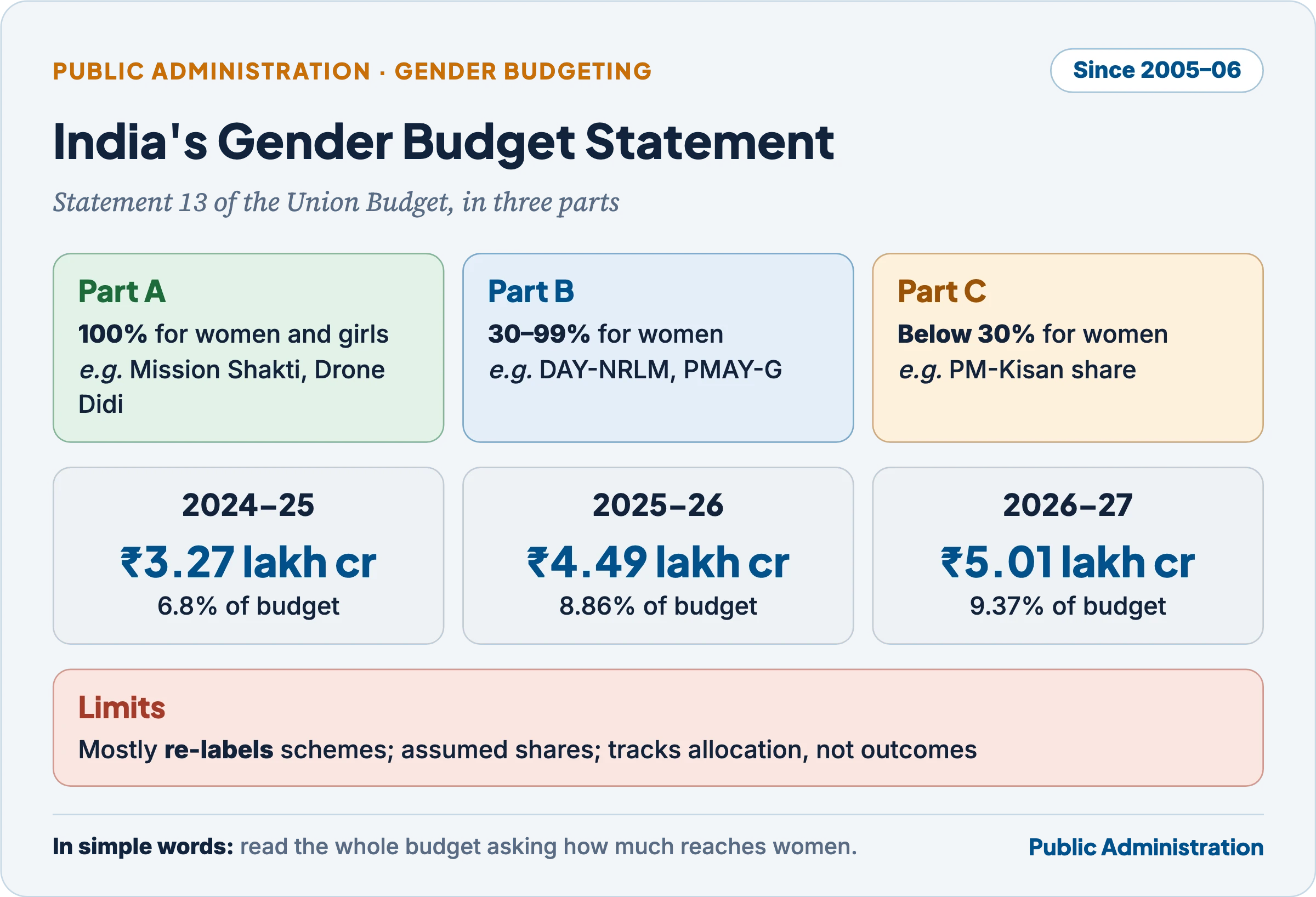
- 2005–06: the first Gender Budget Statement (GBS) was published with the Union Budget. It is now Statement 13 of the Expenditure Profile.
- Three parts: Part A schemes with 100% allocation for women and girls; Part B schemes with 30–99% for women; Part C (added from 2024–25) schemes with less than 30% for women.
- Nodal agency: the Ministry of Women and Child Development (MWCD), with a gender budgeting handbook (2015) and training of States; most States now publish their own gender budgets.
5.3 Current figures (verified)
| Year | GBS allocation | Share of total Union Budget | Ministries/Departments reporting |
|---|---|---|---|
| 2024–25 | ₹3.27 lakh crore | 6.8% | 38 and 5 UTs |
| 2025–26 | ₹4.49 lakh crore | 8.86% | 49 and 5 UTs |
| 2026–27 | ₹5.01 lakh crore | 9.37% | 53 and 5 UTs |
- In 2026–27, Part A (100% women) was about ₹1.08 lakh crore (21.5%), Part B about ₹3.63 lakh crore (72.5%) and Part C about ₹0.30 lakh crore (6%).
- The Department of Rural Development reports almost 70% of its allocation as gender-relevant, mainly because of DAY-NRLM and PMAY-G (houses registered in the woman’s name or jointly).
5.4 Critique of gender budgeting in India
- Reporting, not budgeting: the GBS largely re-labels existing schemes rather than designing allocations around gender gaps; the large jump in 2025–26 came mostly from more ministries reporting and from Part B and C.
- Assumed shares: Part B and C use rough assumptions (for example, that 30% or 40% of a scheme benefits women) without beneficiary data.
- Allocation, not outcome: it tracks inputs; there is little link to outcomes such as female labour force participation, which remains low.
- Small Part A: genuinely women-specific schemes remain a fifth of the total.
- Hence the 2018 PYQ’s point: gender budgeting must move “beyond allocations” to gender audits, sex-disaggregated outcome budgets and gender impact assessment to become a true tool of mainstreaming. The 2014 PYQ’s claim of greater accountability of planning departments holds where States (Kerala, Odisha, Karnataka) have linked gender budgets to plan formulation and audit.
6. Women in Administration and Public Office
In simple words
Policies for women are better when women help make and run them. So a key test of gender equality is simple: how many women sit in the civil service, the panchayat and Parliament, and do they have real power once they get there?
6.1 Women in the civil services
- Anna Rajam Malhotra became the first woman IAS officer (1951). Early service rules discriminated: women in the foreign service had to resign on marriage until Muthamma (1979).
- Rising entry: women’s share among candidates recommended through the Civil Services Examination rose from 24% (2019) to 35% (2023) (220 of 922 to 397 of 1,132), according to the Government’s reply in the Lok Sabha (December 2025); 38% of the officers in the 99th Foundation Course at LBSNAA (2024) were women.
- Stock still low: women made up only about 13% of all IAS officers recruited between 1951 and 2020, with wide variation across State cadres, and remain rare as Chief Secretaries and Secretaries to the Government of India.
- Barriers: fewer women applicants, family responsibilities, transfer and posting norms, the “glass ceiling” in senior positions and gendered postings (women officers steered to social sectors).
- Measures: UPSC fee exemption for women candidates, Child Care Leave of 730 days for women employees (Central Civil Services (Leave) Rules), posting of spouses at the same station where possible, and the Internal Committees under the POSH Act 2013.
6.2 Reservation in local government: 73rd and 74th Amendments
- Article 243D (panchayats) and Article 243T (municipalities) reserve not less than one-third of directly elected seats and of chairperson offices for women, including within SC/ST seats, by rotation.
- 21 States and 2 UTs have raised women’s reservation in panchayats to 50% (Bihar was the first, in 2006).
- Scale: women hold about 14.5 lakh of roughly 31 lakh panchayat seats, about 46% (Ministry of Panchayati Raj, 2025); a February 2026 Lok Sabha reply put the figure at 49.75% of the 24.4 lakh representatives then in office.
- Proxy leadership: “Sarpanch Pati” or “Pradhan Pati” (husbands exercising power for elected women) remains common. On the Supreme Court’s direction, the Ministry of Panchayati Raj constituted an Advisory Committee (September 2023, chaired by former Secretary Sushil Kumar), whose report (February 2025) recommended legal safeguards, penalties, capacity building and social audits; a Task Force was set up in April 2025.
- Capacity building: under the Revamped Rashtriya Gram Swaraj Abhiyan, about 28.6 lakh women representatives were trained between 2022–23 and December 2025, and a special Sashakt Panchayat-Netri Abhiyan module addresses women’s leadership.
Indian Connect — What women in panchayats change
- Chattopadhyay and Duflo (Econometrica, 2004), studying randomly reserved seats in West Bengal and Rajasthan, found that women pradhans invested more in drinking water and other goods that women had demanded.
- Later studies found that exposure to women leaders reduced voters’ bias and raised parents’ aspirations for daughters in reserved villages.
- Limits: women from marginalised backgrounds face caste hostility, low literacy, no-confidence motions and male gatekeeping, which is why the 2025 and 2026 Paper II PYQs ask whether they “struggle to govern effectively” and whether they “challenge patriarchal norms”.
6.3 The Nari Shakti Vandan Adhiniyam, 2023 (106th Amendment)
- Passed by Parliament in September 2023 and assented to on 28 September 2023 as the Constitution (One Hundred and Sixth Amendment) Act, 2023.
- Content: reserves one-third of seats in the Lok Sabha (new Article 330A), State Legislative Assemblies (Article 332A) and the Delhi Assembly (Article 239AA), including one-third of SC and ST reserved seats; by rotation; for 15 years, extendable by Parliament. It does not cover the Rajya Sabha or Legislative Councils, and has no OBC sub-quota.
- Condition (Article 334A): reservation takes effect only after a delimitation exercise based on the first Census after the Act’s commencement.
- Status (2026): the Government brought the Act into force on 16 April 2026. The same day it introduced the Constitution (131st Amendment) Bill, 2026, with a Delimitation Bill, to delink reservation from the new Census, delimit on the 2011 Census and raise the Lok Sabha’s maximum strength to 850 so that reservation could apply in 2029. On 17 April 2026 the Bill failed in the Lok Sabha (298 for, 230 against; short of the two-thirds required), and the linked Bills were withdrawn. The 2023 Act stands, so reservation awaits the Census (2027) and a subsequent delimitation.
- Representation now: women are about 14% of the 18th Lok Sabha (75 members) and about 17% of the Rajya Sabha.
Common confusion
Is women’s reservation in the Lok Sabha already in operation? No. The 106th Amendment is law and was brought into force in April 2026, but under Article 334A the seats are reserved only after a delimitation based on a fresh Census. The 2026 attempt to advance it to the 2029 election failed in the Lok Sabha. Reservation in panchayats and municipalities (Articles 243D and 243T), by contrast, has operated since 1993–94.
7. The Self-Help Group Movement
In simple words
Ten to twenty poor women from the same village each save ₹100 a month. Soon they have a common fund and lend to each other for a buffalo, school fees or a hospital bill, at fair interest. The bank, seeing them repay regularly, lends them more, without asking for land as security because the whole group stands guarantee. That small circle is a self-help group.
7.1 What an SHG is and how it works
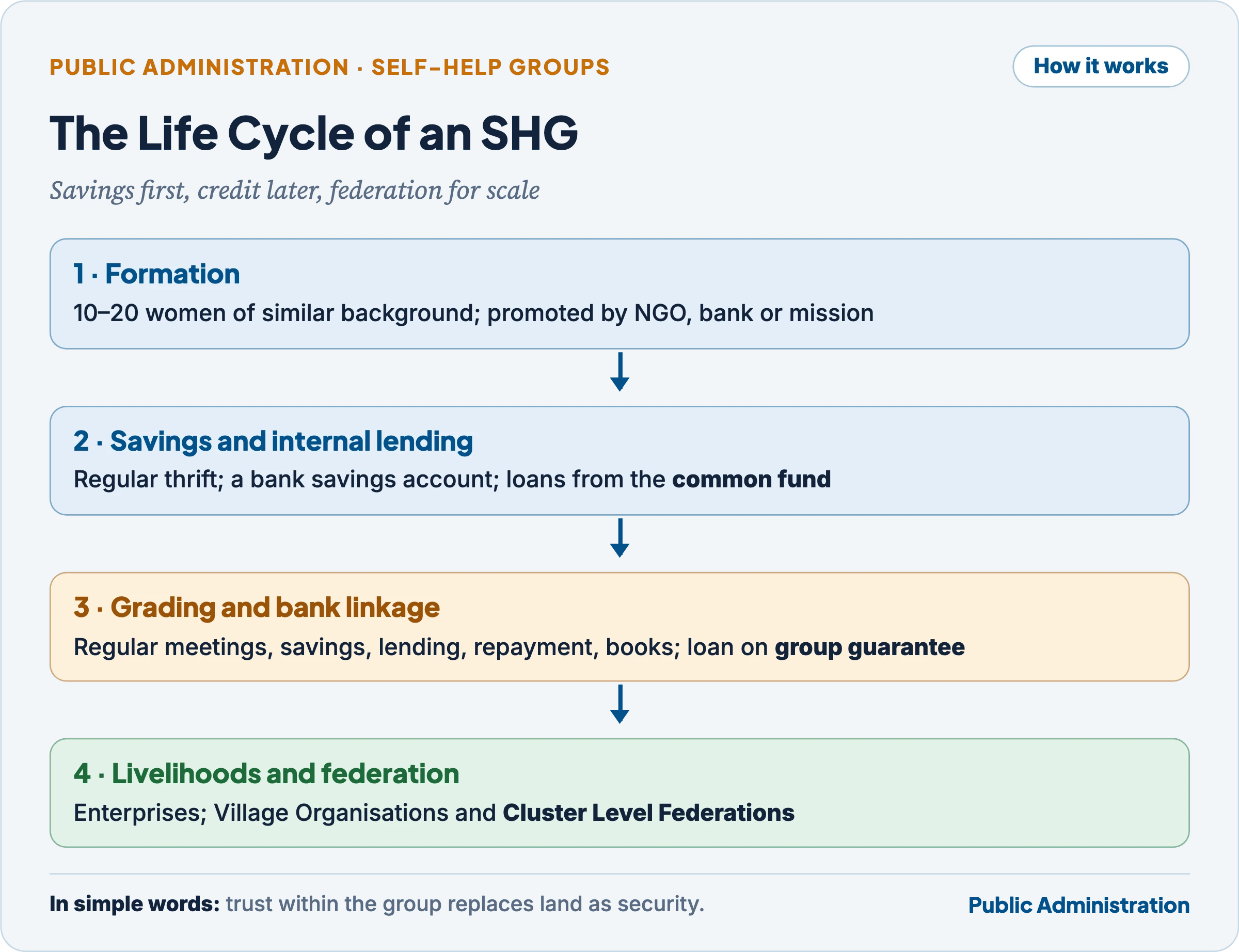
A self-help group is a small, informal, homogeneous group (usually 10–20 members, of similar socio-economic background) that saves regularly, lends from its pooled fund and then borrows from banks on group guarantee.
- Size: a group above 20 persons carrying on business for gain would have to register as a company or association under company law, so SHGs are kept to 20 or fewer; this keeps them informal and free of registration costs and red tape.
- Savings first: members save a fixed amount, typically for about six months, and open a savings bank account.
- Internal lending: the group lends from its own fund, learning to set priorities, keep books and enforce repayment.
- Grading and credit linkage: after a period of stable functioning the bank grades the group (the Panchasutra norms of regular meetings, regular savings, internal lending, timely repayment and up-to-date books) and sanctions a loan, initially a multiple of savings.
- Joint liability and peer monitoring: the group is collectively responsible, so it screens and monitors members, doing work the bank would otherwise have to do. This lowers transaction costs and replaces physical collateral with social collateral.
- Federations: SHGs federate into Village Organisations (VOs) and Cluster Level Federations (CLFs), which give scale, bargaining power and access to markets.
- Assisted self-help: the poor seldom organise unaided. Groups are promoted by Self-Help Promoting Institutions (NGOs, banks, government missions), so the movement is an assisted process involving the State, banks and NGOs.
7.2 Roots of self-help
- Old traditions: rotating savings and credit associations exist across the world: harambee (Kenya’s “pulling together” self-help tradition), tontines (West Africa), hui (China and Vietnam), and the chit funds and bhishis of India.
- Alternative development: thinkers of “another development” (John Friedmann, Empowerment: The Politics of Alternative Development, 1992) stressed participation, self-reliance and people’s organisations as the basis of development.
- Neo-liberal adoption: the same idea was also taken up by neo-liberal policy as a way to build entrepreneurship and draw the poor into financial markets without state subsidy, a dual origin that explains the later debate.
7.3 Grameen Bank and Muhammad Yunus
- Muhammad Yunus, a Bangladeshi economics professor, began lending small sums to poor women in Jobra village in 1976; the Grameen Bank became a formal bank by ordinance in 1983.
- Model: groups of five borrowers, mostly women; loans to individuals, with group-based peer pressure and weekly repayment meetings; no collateral.
- Recognition: Yunus and the Grameen Bank jointly received the Nobel Peace Prize (2006).
- Difference from Indian SHGs: Grameen is a lender-led microcredit model (the bank lends to individuals in small groups); the Indian SHG is a savings-led, member-owned group that borrows as a unit from mainstream banks.
7.4 MYRADA and the birth of Indian SHGs
- MYRADA, a Karnataka-based NGO (originally Mysore Resettlement and Development Agency), found in the early 1980s that its large cooperatives were captured by dominant members. In 1984–85 it began working with small affinity groups, first called Credit Management Groups, which pooled savings and managed credit themselves.
- 1986–87: NABARD supported MYRADA’s action research on affinity groups with a grant, providing the evidence base for formal bank linkage.
- Other pioneers: SEWA (Self Employed Women’s Association, Ahmedabad, 1972, founded by Ela Bhatt) and its SEWA Bank (1974); PRADAN and Working Women’s Forum (Chennai, 1978).
7.5 The NABARD SHG–Bank Linkage Programme (1992)
- February 1992: NABARD launched a pilot to link 500 SHGs with banks, after the RBI allowed banks to lend to unregistered SHGs (1991 circular).
- 1996: RBI made SHG financing a mainstream activity of banks under their priority sector lending.
- Three models: (i) banks form and finance SHGs; (ii) NGOs or government agencies form groups and banks lend directly (the dominant model); (iii) banks lend through NGOs as financial intermediaries.
- Scale (NABARD data, 2024–25): about 143 lakh SHGs covering about 17.1 crore households were savings-linked, with savings of about ₹71,433 crore; about 85 lakh SHGs had loans outstanding of about ₹3.04 lakh crore; gross NPA was about 1.7%. It is the largest microfinance programme in the world.
- Interest subvention: under DAY-NRLM, women SHGs get loans at a subsidised 7% (lower in some districts for prompt repayment), and collateral-free loans up to ₹20 lakh (RBI master circular).
7.6 From IRDP to SGSY to NRLM
- IRDP (1978–80) gave individual subsidised loans to the rural poor; studies found leakages, poor asset quality and over-reliance on subsidy.
- SGSY (Swarnjayanti Gram Swarozgar Yojana, April 1999) merged IRDP, DWCRA, TRYSEM and others and adopted the group (SHG) approach to self-employment, with subsidy and bank credit. It struggled with weak social mobilisation, uneven bank linkage and subsidy-driven group formation.
- The Radhakrishna Committee on Credit Related Issues under SGSY (2009) recommended converting SGSY into a National Rural Livelihoods Mission with dedicated professional societies.
7.7 DAY-NRLM (Aajeevika), 2011
- Launch: NRLM-Aajeevika was launched by the Ministry of Rural Development in June 2011; it was renamed Deendayal Antyodaya Yojana-National Rural Livelihoods Mission (DAY-NRLM) in 2015–16. It is a Centrally Sponsored Scheme with a 60:40 Centre–State share (90:10 for the North-East and Himalayan States).
- Design principles: universal social mobilisation (at least one woman from every poor household into an SHG), dedicated State Rural Livelihood Missions (autonomous societies staffed by professionals), community institutions as the main channel, and a demand-driven approach.
- Funding to groups: Revolving Fund (₹20,000–30,000 per SHG) and Community Investment Fund through federations; total capitalisation support exceeded ₹51,000 crore by early 2025.
- Community cadres: Krishi Sakhis and Pashu Sakhis (agriculture and livestock extension), Bank Sakhis and BC Sakhis (banking correspondents; about 48,000 deployed in branches by 2025), and Gender Sakhis at the community level.
- Scale (verified): by early 2025, 10.05 crore rural women households in more than 90.9 lakh SHGs, across 745 districts; by December 2025 over 10.29 crore households had been mobilised. Women SHGs had accessed about ₹11 lakh crore of bank credit since 2013–14.
- Gender component: a gender operational strategy and Social Action Committees in VOs address violence, entitlements and gender resource centres.
- Allocation: about ₹19,000 crore in the 2025–26 and 2026–27 Budget Estimates.
Indian Connect — Kudumbashree, Kerala
- Launched on 17 May 1998 by the Government of Kerala as the State Poverty Eradication Mission, as part of the People’s Plan Campaign of decentralised planning.
- Three-tier structure: Neighbourhood Groups (NHGs) of 10–20 women at the base, Area Development Societies (ADS) at ward level and Community Development Societies (CDS) at the panchayat or municipal level; over 45 lakh members.
- Linked to local government: unlike most SHG systems, Kudumbashree is formally tied to panchayats and municipalities, so its plans feed into local planning (anti-poverty sub-plans).
- Enterprises and services: micro-enterprises, collective farming (Joint Liability Groups), catering, Janakeeya Hotels (community kitchens selling low-cost meals during the Covid-19 lockdown), and disaster response during the 2018 floods.
- Model status: it is the National Resource Organisation for NRLM and has helped other States set up their missions.
7.8 Other State models
- Mission Shakti, Odisha (2001), later a full Department of Mission Shakti (2021), channels government work (procurement, take-home rations, uniform stitching) to SHGs, with interest-free loans.
- Jeevika, Bihar (2007), the World Bank-supported Bihar Rural Livelihoods Project, whose women’s groups campaigned for the 2016 prohibition law.
- SERP and Velugu, Andhra Pradesh (2000), one of the earliest large State-led SHG federations; Andhra Pradesh and Telangana still have the densest SHG networks.
7.9 Lakhpati Didi and Namo Drone Didi
- Lakhpati Didi: an SHG woman whose household earns at least ₹1 lakh a year on a sustainable basis (an average of ₹10,000 a month for at least four agricultural seasons or business cycles). It is not a separate scheme; it is funded through DAY-NRLM and bank linkage.
- The target of 3 crore Lakhpati Didis (announced in August 2023, for March 2027) was crossed ahead of time; the Rural Development Minister reported 3.01 crore in February 2026.
- In February 2026 the target was raised to 6 crore by March 2029.
- Critics note that the figure is self-reported, measures household rather than the woman’s own income, and does not show control over that income.
- Namo Drone Didi: a Central Sector Scheme (approved November 2023) with an outlay of ₹1,261 crore for 2023–24 to 2025–26, to provide 15,000 drones to women SHGs for renting out spraying services to farmers.
- Central assistance of 80% of the drone cost, up to ₹8 lakh; the balance can be borrowed by the Cluster Level Federation under the Agriculture Infrastructure Fund with 3% interest subvention; 15 days’ pilot training.
- Progress has been slow: Lead Fertiliser Companies distributed 1,094 drones in 2023–24, of which 500 were under the scheme, and an official study found transport and battery problems; ₹677 crore is provided in the 2026–27 Budget Estimates.
7.10 Impact: what SHGs have achieved
Economic
- Financial inclusion: crores of poor women have bank accounts, savings and credit histories for the first time.
- Freedom from moneylenders: lower dependence on informal credit at 36–60% interest.
- Livelihood diversification: dairy, goatery, micro-enterprises, value chains and farm producer groups (1.95 lakh producer groups by 2025).
- Repayment culture: SHG NPAs below 2% undercut the old banking view that the poor are not creditworthy.
Social
- Mobility and voice: women travel to banks and block offices and speak in public meetings.
- Collective action: campaigns against liquor, dowry and violence (Bihar’s Jeevika women and prohibition; Andhra Pradesh’s anti-arrack movement of 1992–93 grew out of literacy groups).
- Convergence with schemes: SHG women run take-home rations, school uniforms, PDS shops, Swachh Bharat campaigns and Covid-era mask and meal production.
Political
- Nursery of leadership: many SHG members contest and win panchayat elections; federations pressure Gram Sabhas on water, schools and roads.
- Participatory governance: in Kerala, NHGs are formally part of local planning; the 2009 PYQ’s point about political mobilisation draws on such experience.
The 2014 PYQ’s claim of attitudinal change among stakeholders is visible in banks (from seeing poor women as a risk to a priority segment), in families (women’s earnings recognised) and in administration (the State treating women’s collectives as delivery partners).
8. Critiques of the SHG and Microfinance Model
In simple words
Small loans can help a poor woman, but they can also trap her if several lenders push loans she cannot repay, if her husband takes the money, or if the group is run by the richest women of the village. The critiques ask whether SHGs change women’s power or only their workload.
8.1 The Andhra Pradesh microfinance crisis (2010)
- Background: after 2005, for-profit microfinance institutions (MFIs), many converted into NBFCs, grew rapidly using the Grameen-style Joint Liability Group (JLG) model. In 2010 SKS Microfinance raised money through a public share issue, symbolising commercialisation.
- Over-lending: in Andhra Pradesh many households held several loans from several MFIs at high interest (often 24–36% or more), with coercive recovery.
- Suicides and the Ordinance: reports of borrower suicides led the State to issue the Andhra Pradesh Micro Finance Institutions (Regulation of Money Lending) Ordinance, October 2010 (later an Act), requiring registration, monthly instead of weekly repayment and banning coercion. MFI recoveries collapsed and the sector contracted sharply.
- Lesson: commercial microcredit is not the same as the savings-led SHG model; over-indebtedness is a structural risk when credit is pushed as a growth product.
8.2 The Malegam Committee (2010–11) and regulation
- The RBI set up a sub-committee of its Central Board under Y.H. Malegam in October 2010; it reported in January 2011.
- Key recommendations: a separate category of NBFC-MFIs; a margin cap (10% for large MFIs, 12% for smaller ones) and an interest ceiling (24%) on loans; limits on loan size and on lending to a borrower by more than two MFIs; household income limits; credit bureau reporting; no coercive recovery; a code of conduct.
- RBI acted by creating the NBFC-MFI category (December 2011, with a 12% margin cap and a 26% interest ceiling) and later laid down an activity-based, harmonised framework for microfinance loans (March 2022): a household income ceiling of ₹3 lakh and a cap of 50% of household income on loan repayments for all regulated lenders, removing interest caps in favour of board-approved pricing.
- 2024–25 stress: over-leveraging returned; the microfinance sector contracted by about 14% in 2024–25, and industry self-regulatory guardrails (July 2024, April 2025) limited lenders per borrower. The SHG–bank linkage segment, however, kept growing, which shows the difference between the two models.
8.3 Instrumentalism
- Women as instruments: policy often values women for efficiency (good repayment, cheap delivery of schemes) rather than for their own rights. This matches Moser’s efficiency approach.
- Credit is not empowerment: Anne Marie Goetz and Rina Sen Gupta, “Who Takes the Credit?” (World Development, 1996), found that in Bangladesh a large share of women’s loans were controlled by male relatives. In Kabeer’s terms, a resource without agency.
- Debt and discipline: Lamia Karim, Microfinance and Its Discontents (2011), described how NGOs used women’s sense of honour and shame to enforce repayment.
- Burden shifting: SHGs are loaded with unpaid or low-paid state work (survey, mobilisation, ration delivery) so that the State offloads its responsibilities on to women’s voluntary labour. This links to the neo-liberal “roll-back” of the state discussed in the article on liberalisation.
- Practical, not strategic, needs: most activity remains within traditional low-return work (pickles, papad, tailoring) without challenging the gendered division of labour, land ownership or wages.
8.4 Elite capture and exclusion
- Elite capture: Ghazala Mansuri and Vijayendra Rao, Localizing Development: Does Participation Work? (World Bank, 2013), found that participatory programmes are often dominated by the better-off and better-connected; within SHGs, leaders from dominant castes or richer households control funds and benefits.
- Exclusion of the poorest: the very poor, migrants, disabled, single women and Dalit women may find the savings discipline impossible and are left out or drop out.
- Regional concentration: the movement grew fastest in the southern States; for years Andhra Pradesh alone accounted for over 40% of linked SHGs, and the North and the North-East lagged. DAY-NRLM has reduced but not removed this gap.
- Proxy and patronage: political parties use federations as vote banks; officials push targets (number of groups formed) leading to “paper SHGs” that exist only to receive the revolving fund.
- Quality of groups: weak bookkeeping, irregular meetings and dependence on promoters affect sustainability.
8.5 Can SHGs empower in an unequal society?
The 2019 PYQ asks whether SHGs are “bound to play a marginal role” in a society marked by social and gender inequality, and the 2012 PYQ whether they address the absence of women from the mainstream development agenda. The evidence supports a qualified answer.
- Where SHGs stay marginal: when they are only credit channels, when groups are formed for targets, when caste and patriarchy go unchallenged, and when there is no market, skills or asset base for the loans to build on.
- Where they transform: when they are federated, linked to local government (Kudumbashree), backed by gender components (Gender Resource Centres, Social Action Committees), and combined with strategic reforms such as land rights and political reservation.
- Complement, not substitute: SHGs do not replace public provision, labour rights or legal change; they work best as one pillar with reservation, gender budgeting and laws.
Criticism — The case against the SHG movement as women’s empowerment
- Instrumentalism: women are valued as reliable borrowers and cheap delivery agents, not as rights-holders (Moser’s efficiency approach).
- Credit without control: loans are often used and controlled by men (Goetz and Sen Gupta, 1996), so resources do not become agency.
- Debt traps: the Andhra Pradesh crisis of 2010 and the 2024–25 stress showed how credit-led models create over-indebtedness and coercion.
- Elite capture: dominant-caste and better-off women lead groups and take most benefits (Mansuri and Rao, 2013); the poorest are excluded.
- State offloading: SHGs carry unpaid state work, masking the withdrawal of public services.
- Practical, not strategic: most enterprises are low-return and reproduce the gendered division of labour.
Defence — The case for the SHG movement as women’s empowerment
- Scale of inclusion: over 10 crore women organised and more than ₹11 lakh crore of bank credit accessed with NPAs below 2%.
- Agency through collectives: groups give women mobility, confidence and a platform for collective action against liquor and violence.
- Pathway from practical to strategic needs: credit and livelihoods lead on to leadership in panchayats and Gram Sabhas.
- Savings-led and member-owned: the Indian SHG–bank model is distinct from commercial microcredit and remained stable in the 2010 and 2024–25 crises.
- Institutional depth: federations, Kudumbashree’s link with local government and community cadres (Bank Sakhis, Krishi Sakhis) create durable people’s institutions.
- Measured income gains: over 3 crore women reported as Lakhpati Didis by 2026, even if the measure needs refinement.
Key Terms
These terms recur throughout the topic; each is glossed in plain words.
| Term | Meaning in simple words |
|---|---|
| WID | Women in Development: include women in existing development through education, credit and jobs |
| WAD | Women and Development: women were always in development, but on exploitative terms |
| GAD | Gender and Development: change unequal power relations between women and men |
| WED | Women, Environment and Development: links women’s subordination with ecological damage |
| Gender | Socially constructed roles and relations of women and men, as distinct from biological sex |
| Practical gender needs | Immediate needs arising from women’s current roles (water, fuel, health) |
| Strategic gender needs | Long-term needs that challenge women’s subordination (land rights, voice, freedom from violence) |
| Triple role | Women’s productive, reproductive and community-managing work (Moser) |
| Empowerment | Expansion in the ability to make strategic life choices where it was denied (Kabeer) |
| Agency | The ability to set goals and act on them |
| Gender mainstreaming | Assessing the effect on women and men of every policy, at every stage (ECOSOC 1997) |
| Gender budgeting | Analysing the budget for its effect on gender equality; India’s GBS since 2005–06 |
| Missing women | Sen’s estimate of women absent from the population because of gender bias in survival |
| Cooperative conflict | Sen’s view of the household as a site of both cooperation and unequal bargaining |
| Self-help group (SHG) | A small, informal group of 10–20 members that saves, lends internally and borrows from banks |
| Joint liability | The whole group is responsible for each member’s loan, replacing collateral |
| Social collateral | Peer pressure and trust used in place of physical security |
| SHG–Bank Linkage Programme | NABARD’s 1992 programme linking SHGs to mainstream banks |
| JLG | Joint Liability Group of 4–10 borrowers, used by MFIs for individual loans |
| NBFC-MFI | RBI’s category of non-banking microfinance companies created after the Malegam Committee |
| Village Organisation / CLF | Federations of SHGs at village and cluster level under DAY-NRLM |
| Lakhpati Didi | An SHG woman whose household earns at least ₹1 lakh a year sustainably |
| Elite capture | Domination of a participatory programme’s benefits by the better-off |
| Instrumentalism | Valuing women for what they deliver to development rather than for their own rights |
| Proxy representation | Male relatives exercising the power of elected women (“Sarpanch Pati”) |
Commissions, Committees and Judgments
| Body / case | Year | Key point |
|---|---|---|
| Committee on the Status of Women in India (Towards Equality) | 1974 | Women’s status had declined on key indicators since Independence |
| C.B. Muthamma v. Union of India | 1979 | Struck down discriminatory marriage rules for women foreign service officers |
| Vishaka v. State of Rajasthan | 1997 | Guidelines on sexual harassment at the workplace; basis of the POSH Act 2013 |
| National Policy for the Empowerment of Women | 2001 | Empowerment as policy goal; gender mainstreaming |
| Radhakrishna Committee on credit under SGSY | 2009 | Recommended restructuring SGSY into the National Rural Livelihoods Mission |
| Malegam Committee (RBI) | 2010–11 | NBFC-MFI category, margin and interest caps, borrower protection after the Andhra crisis |
| Secretary, Ministry of Defence v. Babita Puniya | 2020 | Permanent commission for women officers in the Army |
| Vineeta Sharma v. Rakesh Sharma | 2020 | Daughters are coparceners by birth under the amended Hindu Succession Act |
| RBI harmonised microfinance framework | 2022 | ₹3 lakh household income cap; repayment within 50% of income |
| Advisory Committee on proxy representation of women in PRIs | 2023–25 | Legal safeguards, penalties and training to end “Pradhan Pati” practice |
Contemporary Developments
- February 2026: the Gender Budget Statement for 2026–27 reported ₹5.01 lakh crore (9.37% of the Union Budget), up from ₹4.49 lakh crore (8.86%) in 2025–26, with a record 53 Ministries/Departments reporting.
- February 2026: the Government announced that 3 crore Lakhpati Didis had been reached ahead of the March 2027 deadline and doubled the target to 6 crore by March 2029.
- April 2026: the 106th Amendment was brought into force on 16 April; the Constitution (131st Amendment) Bill, 2026, to apply women’s reservation from the 2029 election through a 2011-Census delimitation, failed in the Lok Sabha on 17 April (298–230).
- December 2025: DAY-NRLM had mobilised over 10.29 crore rural households into SHGs; in Parliament the Government reported women’s share among successful civil services candidates had risen from 24% (2019) to 35% (2023).
- 2024–25: NABARD and Sa-Dhan data showed SHG–bank loans outstanding of about ₹3.04 lakh crore with NPAs of 1.74%, even as the MFI-led microfinance sector shrank by about 14% amid over-indebtedness.
- February 2025 and April 2025: the Advisory Committee on proxy representation of women in panchayats submitted its report, and a Task Force was formed to implement it.
- 2025: the Beijing+30 review marked thirty years of the Platform for Action, finding persistent gaps in women’s political participation, unpaid care work and violence.
- 2023–26: Namo Drone Didi (₹1,261 crore, 15,000 drones) moved slowly, with 1,094 drones distributed by early 2026, illustrating the gap between technology schemes and ground capacity.
Revision Grid
| Thinker / body | Work or report (year) | Key idea |
|---|---|---|
| Ester Boserup | Woman’s Role in Economic Development (1970) | Modernisation marginalised women; founding text of WID |
| Maxine Molyneux | “Mobilization without Emancipation?” (1985) | Practical vs strategic gender interests |
| Caroline Moser | “Gender Planning in the Third World” (1989); Gender Planning and Development (1993) | Practical vs strategic gender needs; triple role; five policy approaches |
| Gita Sen and Caren Grown (DAWN) | Development, Crises and Alternative Visions (1987) | Southern feminist critique; empowerment approach |
| Naila Kabeer | Reversed Realities (1994); “Resources, Agency, Achievements” (1999) | Empowerment as ability to make strategic choices |
| Srilatha Batliwala | Empowerment of women (1994) | Empowerment as challenging power relations |
| Amartya Sen | “More than 100 million women are missing” (1990); Development as Freedom (1999) | Missing women; cooperative conflict; capabilities |
| Martha Nussbaum | Women and Human Development (2000) | Ten central capabilities |
| Vandana Shiva | Staying Alive (1988) | Ecofeminism; maldevelopment |
| Bina Agarwal | “The Gender and Environment Debate” (1992) | Feminist environmentalism |
| Chandra Talpade Mohanty | “Under Western Eyes” (1984) | Critique of the homogeneous “Third World woman” |
| Joan Acker | “Hierarchies, Jobs, Bodies” (1990) | Organisations are gendered |
| Muhammad Yunus | Grameen Bank (1976 project; bank 1983) | Microcredit to poor women; Nobel Peace Prize 2006 |
| Goetz and Sen Gupta | “Who Takes the Credit?” (1996) | Male control of women’s loans |
| Mansuri and Rao | Localizing Development (2013) | Elite capture in participatory programmes |
| Beijing Conference | Platform for Action (1995) | Gender mainstreaming; 12 critical areas |
| NABARD | SHG–Bank Linkage pilot (1992) | 500 SHGs linked to banks; now the world’s largest microfinance programme |
| Ministry of Rural Development | NRLM-Aajeevika (2011); DAY-NRLM | Universal mobilisation of poor women into SHGs |
| Government of Kerala | Kudumbashree (1998) | Three-tier women’s network linked to local government |
| Y.H. Malegam | RBI sub-committee report (2011) | Regulation of microfinance institutions |
Previous Year Questions
- 2025Economic development alone is not a sufficient component for women development and empowerment. Discuss.
- 2023“Women empowerment is essential for sustainable development; hence it should not be reflected only in programmes but promoting concrete actions to ensure the participation across institutions and communities.” Critically examine.
- 2021Gender equality and women’s rights have laid down a strong foundation of development. Elaborate.
- 2020Affirmative action in socio-economic development has not altogether eliminated discrimination. Discuss it in the context of women empowerment.
- 2019In a society marked by social inequity and gender inequality women self-help groups are bound to play a marginal role. Do you agree? Give reasons for your answer.
- 2018“The issue of development of women is closely related to the issue of women in development.” How can women become equal partners in the process of socio-economic development?
- 2016“Self-Help Groups are considered as one of the most significant tools to adopt participatory approach for economic empowerment of women.” Comment.
- 2015Show in what way the Gender and Development approach differs from the Woman and Development approach.
- 2014“Self-help groups have not only empowered women, but have also brought about attitudinal change among all stakeholders towards women development.” Discuss.
- 2013“In organizational analysis, there is always gender around.” (Gouldner). Argue.
- 2012Given the importance of the issue of sex equality in development do you think the self-help group movement adequately addresses absence of women in the former mainstream development agenda?
- 2009Consider the statements below: Self-Help Groups (SHGs) enable women to realise their full potential in some spheres of life. Self-Help Groups (SHGs) are providing avenues of political mobilisation. Examine the implications of these two statements and assess the potential of SHGs for development.
- 2026Women in panchayats challenge the established patriarchal norms and contest structural inequalities in society. Explain.
- 2025Highlight the constitutional provisions and judicial interventions to promote gender equality in India.
- 2025Many elected women representatives in local governments in India, especially from marginalized backgrounds, often struggle to govern effectively. Examine.
- 2018“Gender budgeting requires rethinking beyond allocations to become a powerful tool of gender mainstreaming.” Discuss.
- 2014“Gender responsive budgeting has infused greater accountability of planning departments towards women empowerment programs.” Examine the statement.
- 2013“Self-Help Groups (SHGs) have contributed to a change in the role of rural women in development – from symbolic participation to empowerment.” Discuss.
- 2002“Women’s development programmes of recent have shifted from welfarist approach to empowerment of women.” – Elaborate.
- 1995“The emphasis in women’s development programmes has in recent years shifted from a purely welfare and consumption oriented one to a realistic one which recognizes women as contributors to the country’s economy.” Elaborate.
- 1993Attempt an evaluation of various welfare programmes, sponsored by the Central and State governments and district level agencies, for the development of women and children, accounting for their success or failure.
- 1990How would you respond to the view that the welfare programmes for Women have touched the fringe of their problems. Account for the Existing state of apathy of the administration. Examine the working of a government agency involved in the implementation of a women’s welfare programme.
- 1989Evaluate the administrative experience of Rural Development Schemes or Programmes in the area of Social Justice during last two decades. What role should the voluntary agencies play in the administration of Social welfare to ameliorate the conditions of women in the villages?