

Comparative Public Administration: Historical and sociological factors affecting administrative systems; Administration and politics in different countries; Current status of Comparative Public Administration; Ecology and administration; Riggsian models and their critique.
This article: Meaning, nature, scope and significance of Comparative Public Administration (CPA); why compare (Dahl’s three problems); evolution from traditional comparative government to the Comparative Administration Group; Riggs’s three trends; approaches (Heady’s four foci, Henderson’s three, bureaucratic, structural-functional, ecological, behavioural, development and decision-making approaches); historical and sociological factors shaping administrative systems (colonial legacy, state formation, culture and Hofstede’s dimensions, religion, stratification, political culture, economy, legal traditions); administration and politics in the UK, USA, France, Japan, China and developing countries, with Heady’s six regime categories and common features; ecology and administration (Gaus, Riggs’s The Ecology of Public Administration, Agraria and Industria); decline, critique, revival and current status of CPA; relevance for India.
Official Syllabus: Paper I · Unit 1-07 Comparative Public Administration
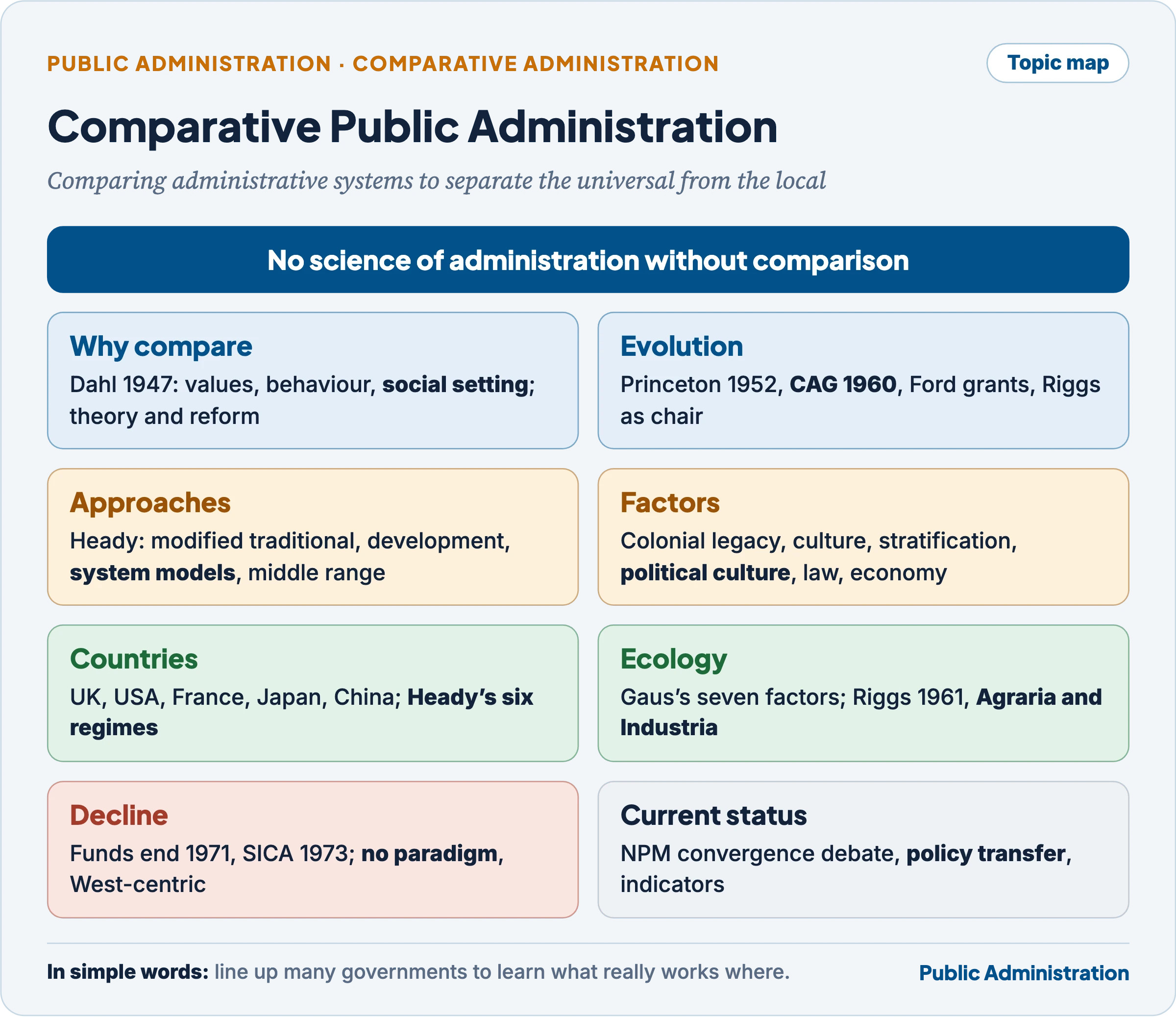
Comparative Public Administration (CPA) is the study of public administration across countries, cultures and periods, using comparison as its main method. It asks why a civil service that works well in one country fails when copied in another, why the same law produces different results in two states, and whether any principle of administration holds everywhere.
- The field rose after the Second World War, when dozens of new states in Asia, Africa and Latin America adopted Western administrative models, and American advisers discovered that those models did not travel well.
- It gave public administration its cross-cultural vocabulary: ecology, formalism, prismatic society, development administration, bureaucratic politics.
- Today it survives less as grand theory and more as comparative public management: comparing reforms, performance, governance indicators and policy transfer.
In simple words
A doctor who has examined only one patient cannot tell what is normal and what is a disease. A student of administration who has seen only one country is in the same position. Comparison is how we learn what is general and what is local.
1. Meaning, Nature and Scope of Comparative Public Administration
In simple words
CPA is public administration with the map widened. Instead of studying only “our” government, it lines up several governments side by side and asks what is common, what is different, and why.
1.1 Definitions
Several definitions are in circulation; each stresses a different element.
| Scholar or body | Definition (paraphrased) | What it stresses |
|---|---|---|
| Nimrod Raphaeli | The study of public administration on a comparative basis | Comparison as method (but vague on content) |
| Comparative Administration Group | The theory of public administration applied to diverse cultures and national settings, and the body of factual data by which it can be examined and tested | Theory testing across cultures |
| Robert H. Jackson | Rigorous cross-cultural comparison of the structures and processes involved in administering public affairs | Rigour and public organisations |
| Fred Riggs | Truly comparative studies are empirical, nomothetic and ecological | Method: facts, generalisation, environment |
| Ferrel Heady, Public Administration: A Comparative Perspective (1966) | Comparative study of national administrative systems, especially their bureaucracies and the political systems around them | Bureaucracy-polity relationship |
- The common core: CPA compares administrative systems or their parts in different environments in order to explain similarities and differences and, if possible, to generalise.
- Lynton Caldwell contrasted the older comparative administration, which blended into administrative history of Western states, with the post-war field, which drew methods from sociology, anthropology and organisation theory and studied mainly the new nations.
1.2 Why compare: Dahl’s 1947 challenge
Robert Dahl, the American political scientist later famous for theories of democracy, wrote “The Science of Public Administration: Three Problems” in Public Administration Review (1947). It is the usual starting point of CPA.
- Problem of values (normative values): administration cannot be value-free; ends and means are entangled, so a “science” must state its values openly.
- Problem of human behaviour: organisations are made of people whose behaviour is not mechanical, so principles based on a rational “administrative man” are incomplete.
- Problem of social setting: administration is shaped by national psychology, history and the political, social and cultural environment. Generalisations drawn from one nation-state cannot be applied everywhere.
- Hence his conclusion: as long as the study of public administration is not comparative, claims for a science of public administration sound rather hollow. A science needs principles that transcend national boundaries and peculiar historical experiences, and only comparison can find them.
“…as long as the study of public administration is not comparative, claims for ‘a science of public administration’ sound rather hollow.” — Robert Dahl (1947)
- Dahl was not alone. Herbert Simon (Administrative Behavior, 1947) attacked the “principles” as proverbs; Dwight Waldo (The Administrative State, 1948) exposed their hidden political values; Edwin Stene called for scientific propositions. All three weakened the claim that American principles were universal, which opened the door to comparison.
- Earlier writers had assumed universality. Leonard White wrote that a principle, applied in its proper frame of reference, was as useful in Russia as in Britain, in Iraq as in the USA. W.F. Willoughby treated administration as a science with fundamental principles of general application. CPA was a reaction to exactly this confidence.
- Riggs later put the point sharply: not to be comparative is to be naively parochial. A scholar who knows one system tends to mistake its local habits for laws of administration.
1.3 Purposes of comparison
Ramesh K. Arora, the Indian scholar of comparative administration, listed four purposes:
- To learn the distinctive features of a particular system or cluster of systems.
- To explain the factors responsible for cross-national and cross-cultural differences in bureaucratic behaviour.
- To examine the causes of success or failure of particular administrative features in particular ecological settings.
- To understand strategies of administrative reform.
Ferrel Heady, the American scholar whose textbook defined the field for four decades, saw five motivating concerns behind CPA:
- the search for theory;
- the urge for practical application (technical assistance);
- the incidental contribution of the broader field of comparative politics;
- the interest of researchers trained in the administrative law tradition (mostly European);
- the comparative analysis of ongoing problems of public administration.
The purposes therefore fall into two families: academic (theory-building, a genuine science of administration) and utilitarian (better reforms, better technical assistance, lesson-drawing). Mohit Bhattacharya summed up the twin foci as theory-building and improving the administrative capability of developing countries.
1.4 What is compared, and at what level
CPA can compare almost anything administrative. The unit of analysis is an administrative system or one of its parts:
- the environment of the system;
- the whole system (for example, India and Britain);
- its formal structure (hierarchy, specialisation, delegation, control);
- informal patterns (groups, morale, leadership, informal communication);
- roles, and the interaction of personality and organisation;
- policy and decision systems, communication and feedback;
- performance.
Comparisons are also made at three levels:
| Level | What is compared | Example |
|---|---|---|
| Macro | Whole administrative systems in their ecology | Indian and British administration |
| Middle-range | Large parts of systems | Higher civil services of India, France and Japan |
| Micro | A single organisation or process | Recruitment in two state public service commissions |
And by range:
- Inter-institutional: two bodies in one government (Home and Defence Ministries).
- Intra-national: district administration in Bihar and Punjab.
- Cross-national: higher civil service recruitment in China, Thailand and Tanzania.
- Cross-cultural: countries with different political-economic cultures (the former USSR and the USA; France and Algeria).
- Cross-temporal: Ashokan and Mughal administration; British India and independent India.
The scope of CPA is therefore as wide as public administration itself: comparative health, education, urban, rural, financial and personnel administration all exist as sub-fields.
1.5 Nature and features of CPA
- Young sub-field: systematic CPA is a post-1945 development; the 1952 Princeton conference is usually taken as its institutional start.
- Pre-paradigmatic: many approaches, none dominant.
- Close to comparative politics: it shared stimuli, scholars and concepts with the comparative politics movement.
- Ecological outlook: administration is studied in interaction with its environment.
- Empirical and explanatory, not merely descriptive or prescriptive.
- Closely tied to development administration, which was often treated as its main sub-field.
- Interdisciplinary: concepts come from sociology (Weber, Parsons), anthropology, economics and systems theory.
CPA differs from mainstream public administration on three counts: mainstream PA is largely culture-bound (grounded in American or British reality), practitioner-oriented and normative-descriptive; CPA is cross-cultural, more theory-seeking, and empirical-explanatory.
Indian Connect — Comparison as a reform tool in India
- The First Administrative Reforms Commission (1966–70) and the Second Administrative Reforms Commission (2005–09, chaired first by M. Veerappa Moily) drew openly on foreign practice: the ombudsman idea behind Lokpal came from Scandinavia via Britain and New Zealand; the Citizen’s Charter (1991, UK) was adopted in India in 1997; the 2nd ARC’s reports on ethics, personnel and citizen-centric administration compare British, Australian, Canadian and New Zealand reforms.
- Comparison also warns against blind copying: the ombudsman took decades to arrive (Lokpal and Lokayuktas Act, 2013; first Lokpal appointed 2019) and works very differently from its Nordic model, an example of transfer shaped by local ecology.
2. Evolution: From Comparative Government to the Comparative Administration Group
In simple words
Before the 1950s, “comparative” books simply put chapters on Britain, France and America side by side. After the war, scholars went abroad, saw Western methods fail, and began asking why. That question created modern CPA.
2.1 The early comparative elements
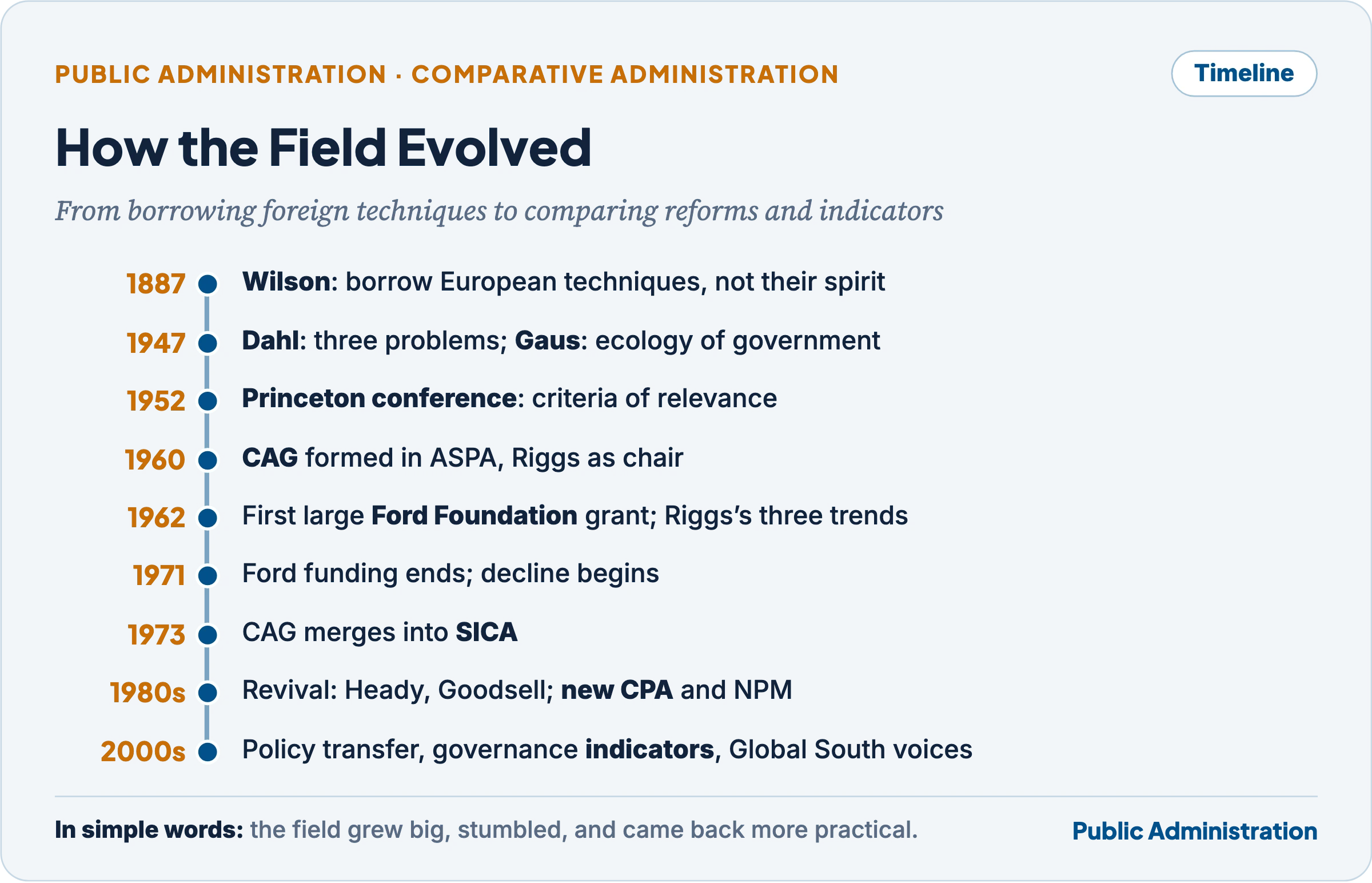
- Woodrow Wilson, “The Study of Administration” (1887), already argued that America could borrow European, especially Prussian and French, administrative techniques without borrowing their autocratic spirit: one could learn from a murderer how to sharpen a knife without learning his intent. Wilson’s comparison was instrumental, aimed at transfer.
- Civil service reformers such as Dorman B. Eaton studied the British civil service to fight the American spoils system; the Pendleton Act (1883) borrowed the idea of a merit system through competitive examination.
- German cameralism (eighteenth century) and later Max Weber (writing roughly 1895–1920) were comparative at heart. Weber’s typology of traditional, charismatic and legal-rational authority, each with its own type of administrative staff, is the most important single piece of comparative research before 1945; bureaucracy, the field’s core concept, comes from it.
- European-trained scholars in America such as Herman Finer and Carl Friedrich compared Western governments in the inter-war years. Scientific management even became international: Lenin’s planners admired Taylorism.
2.2 Traditional comparative government and its critics
Pre-war “comparative government and administration” studied central administrative machinery, decentralisation, civil service structure, public finance and control of the executive, almost always in Britain, France, Germany, Italy, the Soviet Union and the USA. Post-war critics found it:
- culture-bound: limited to Western nations;
- normative and parochial: it assumed one-directional development towards Western liberal democracy;
- legalistic and formalistic: it described constitutions and rules, not real behaviour;
- non-ecological: it ignored the social and economic environment;
- descriptive, not explanatory: several countries were bound in one volume but rarely compared;
- blind to multifunctionality: it assumed one institution, one function.
Riggs asked why such work should not be called simply the study of the “government of foreign areas”. In fairness, these studies also built the descriptive base that later analysis needed, and supplied concepts (control, coordination, efficiency) that CPA later tested.
2.3 Why the movement arose after 1945
The sources fall into policy-oriented and intellectually oriented catalysts:
- Decolonisation: the emergence of many new states facing a “revolution of rising expectations” and the task of nation-building.
- American foreign aid and the Cold War: the Marshall Plan (1948) for Europe and the Point Four Programme (1949) of technical assistance for poorer countries sent American administrators abroad; aid was also a weapon to keep new states out of the Soviet camp.
- Wartime and occupation experience: American scholar-practitioners in military government in Germany and Japan met problems the American “package” could not solve.
- Failure of transplanted models: POSDCORB-style reforms and O&M units often produced formal change without real change. Howard McCurdy called the discovery that local conditions shape the chances of administrative reform the single most important breakthrough in the modern study of public administration.
- The behavioural movement: interest in real behaviour rather than legal forms; testing hypotheses across cultures became a necessity.
- The comparative politics movement: the Social Science Research Council’s Committee on Comparative Politics (from 1954, led by Gabriel Almond; members included Lucian Pye, Sidney Verba, James Coleman, Joseph LaPalombara). Its volume Bureaucracy and Political Development (ed. LaPalombara, 1963) brought bureaucracy into political development studies.
- Advances in comparative sociology and anthropology, especially Talcott Parsons’s structural-functionalism.
2.4 Institutional milestones and the Comparative Administration Group
- 1952: the Public Administration Clearing House sponsored a Conference on Comparative Administration at Princeton. It concluded that policy values should be separated from academic values, that focused research beat reclassifying data, and that “criteria of relevance” were indispensable.
- A sub-committee on comparative administration of the American Political Science Association produced the Sayre–Kaufman outline (Wallace Sayre and Herbert Kaufman) for field research, built around three questions: how the administrative system is organised, how it is controlled, and how it secures compliance. Alfred Diamant later said such schemes reflected the “innocence” of early comparative work: they assumed hierarchy everywhere and asked questions drawn from Western experience.
- 1960: the Comparative Administration Group (CAG) was formed within the American Society for Public Administration (ASPA), with Fred W. Riggs as chair (he held the post until about 1971; Richard Gable followed).
- 1962: the Ford Foundation gave the CAG a grant of about US $500,000, renewed in 1966 for five years. The grant tied CAG to studying the administrative problems of developing countries in the context of their social, cultural, political and economic environments.
- CAG activities: summer seminars, research projects in Korea, Brazil, Italy and elsewhere; more than a hundred occasional papers; a newsletter; and from 1969 the Journal of Comparative Administration (Sage), published until 1974. It had committees on Asia, Europe, Latin America, Africa, national planning, comparative urban administration, organisation theory, international administration, comparative legislative studies, educational administration and systems theory.
- Members included Ferrel Heady, Alfred Diamant, Ralph Braibanti, Samuel Eisenstadt, Bertram Gross, Warren Ilchman, Martin Landau, John Montgomery, William Siffin, Frank Sherwood, Dwight Waldo and Edward Weidner. Waldo called CPA a “self-conscious movement”.
Common confusion
Was the CAG set up in 1960, 1962 or 1963? Many notes give 1962 or 1963 as the founding year. In fact the CAG was formed in 1960 under ASPA with Riggs as chair; 1962 is the year of the first large Ford Foundation grant that turned it into a major research enterprise. The CAG did not “end” in 1971: Ford funding ended in 1971, and in 1973 the CAG merged with ASPA’s International Committee to form the Section on International and Comparative Administration (SICA), ASPA’s first section, which still exists.
2.5 Riggs’s three trends
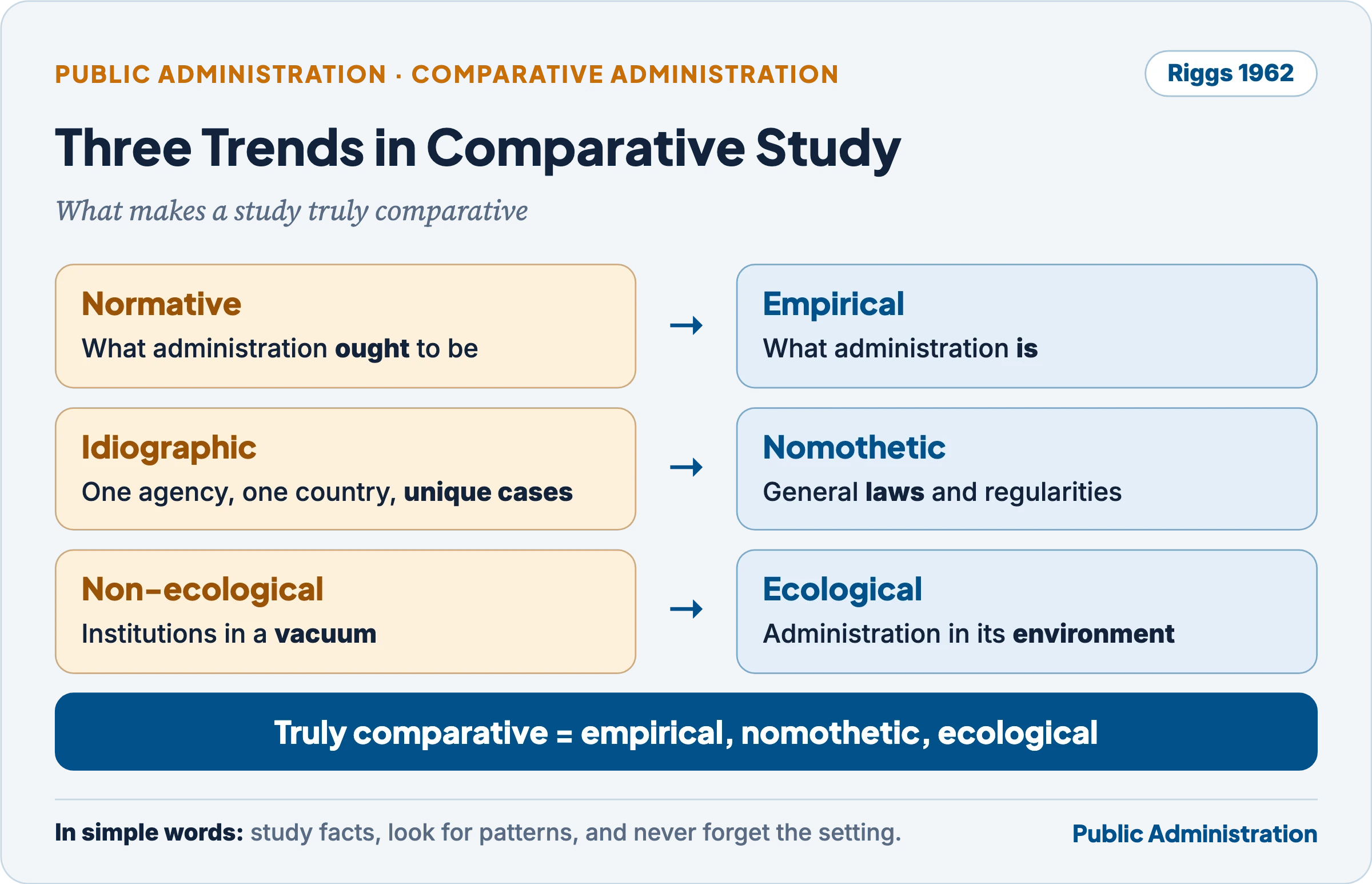
In a widely cited article of 1962, Riggs observed three trends in the comparative study of public administration. They describe the shift from traditional to modern CPA.
| From | To | Meaning |
|---|---|---|
| Normative | Empirical | From “what good administration ought to be” (efficiency, economy, ideal principles) to “what administration actually is” in different settings |
| Idiographic | Nomothetic | From unique cases (one agency, one country, one episode) to law-seeking generalisations about regularities of behaviour |
| Non-ecological | Ecological | From institutions studied in a vacuum to administration studied in interaction with its social, economic, political and cultural environment |
- Riggs’s conclusion: truly comparative studies are empirical, nomothetic and ecological. Put crudely, they are factual and scientific, abstracted and generalisable, and systematic and non-parochial.
- Riggs treated these as degrees of emphasis, not dichotomies: real studies lie between the poles, and he expected old and new emphases to coexist.
- Development administration, with its goal orientation, later produced a synthesis of normative and empirical elements, and the New Public Administration (Minnowbrook, 1968) pulled the field back towards values.
3. Approaches to Comparative Public Administration
In simple words
Scholars disagreed about what to compare and how. Some compared bureaucracies, some compared whole societies, some compared how countries develop. Each lens shows something and hides something.
3.1 Heady’s four foci
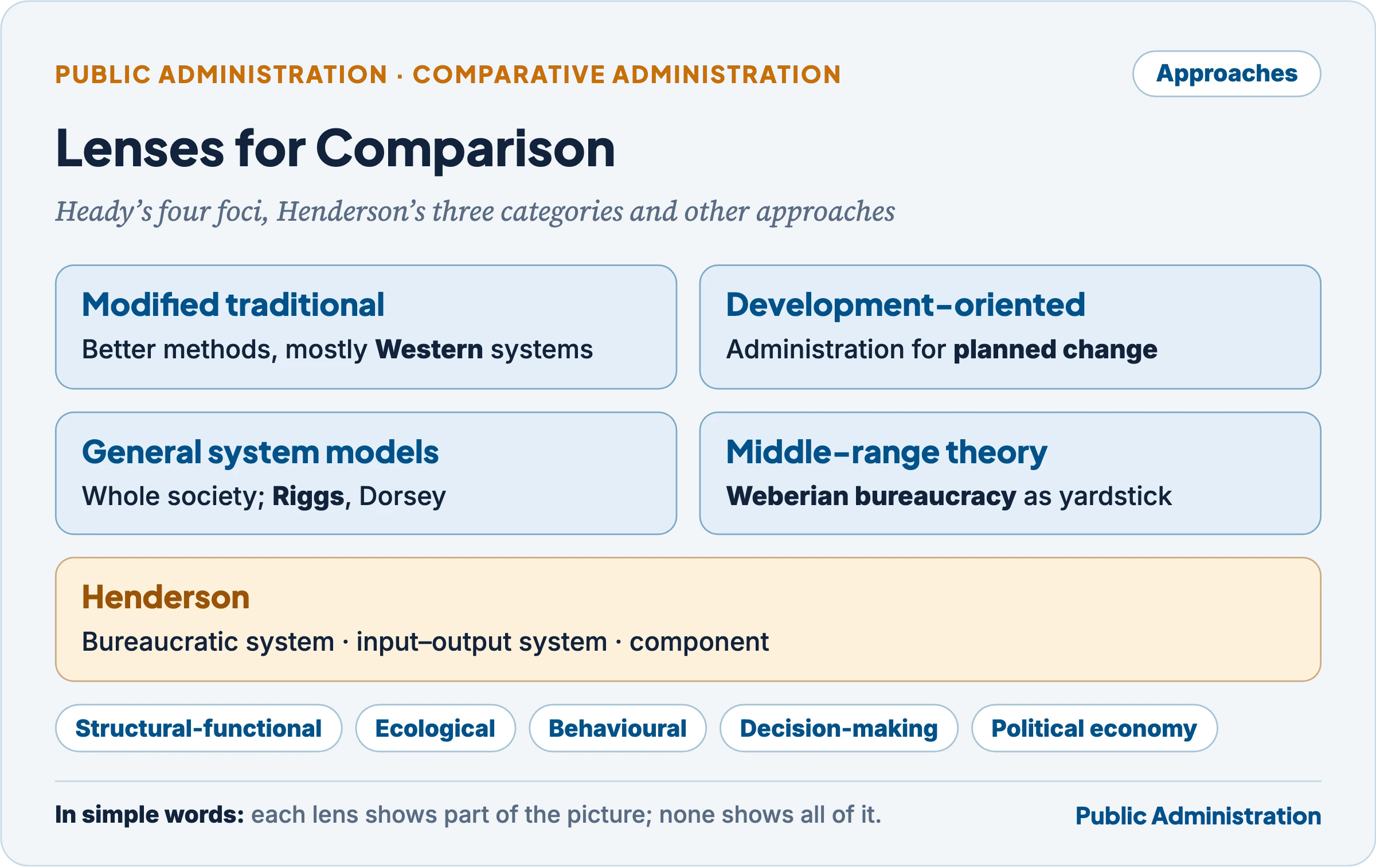
Ferrel Heady classified the CPA literature into four foci in the 1960s. His scheme is the most widely used.
| Focus | What it does | Typical work |
|---|---|---|
| Modified traditional | Continues the older comparative government tradition, with better methods; compares administrative organisation and civil services, mostly of Western countries | Brian Chapman, The Profession of Government (1959); Fritz Morstein Marx; Paul Meyer |
| Development-oriented | Studies how administration can be made capable of directing planned socio-economic change; administrative system as the independent variable, development goals as dependent | Edward Weidner; Riggs’s writings on development administration; Milton Esman |
| General system model-building | Builds models of the whole society with administration as a sub-system; macro, deductive and ecological | Riggs’s agraria–industria and fused–prismatic–diffracted models; John Dorsey’s information–energy model |
| Middle-range theory formulation | Concentrates on a part of the system large enough to matter, especially bureaucracy, using Weber’s ideal type | Morroe Berger (Egypt), Michel Crozier (France), Robert Presthus, Alfred Diamant, Heady himself |
- Why Weber dominates the middle range. Weber’s ideal type (hierarchy, specialisation, rules, merit recruitment, career service, separation of office from person) gave CPA a common yardstick: every bureaucracy could be measured by how far it approached or departed from the type. Waldo called it a paradigm of public administration, set in a framework that spans history and culture. Heady judged the bureaucratic perspective to be the best rooted in the formative period.
- Its limits: it fits legal-rational Western bureaucracies better than administrative systems in traditional or prismatic societies; it ignores informal and irrational behaviour; and it is a model of a settled bureaucracy, not of one directing change.
- Heady himself held that middle-range theory, centred on bureaucracy, was the most promising way forward because grand system models were too abstract to test.
3.2 Henderson’s three categories
Keith Henderson offered a simpler threefold classification:
- Bureaucratic system approach: close to Heady’s middle-range focus.
- Input–output system approach: close to Heady’s general system model-building.
- Component approach: a residual category for partial studies of procedures, control and responsibility, or informal behaviour.
Arora found both schemes broad and overlapping: development concerns appear in system and bureaucratic models alike. Their value is in organising a sprawling literature, not in drawing sharp boundaries.
3.3 Other approaches
- Structural-functional approach. Borrowed from Talcott Parsons, Robert Merton and Marion Levy, and brought into comparative politics by Gabriel Almond. A structure is a pattern of behaviour that has become a standard feature of a social system; a function is its consequence for the system. The key insight for CPA is that the same function may be performed by different structures in different societies, and one structure may perform many functions. Riggs used it to build his typologies; Waldo had suggested its use in public administration in 1955.
- Ecological approach. Studies the two-way interaction between the administrative system and its environment. It is treated in Section 6.
- General systems (input–output) approach. The administrative system receives inputs (demands, resources, support), converts them, and produces outputs, with feedback (David Easton in politics). It explains interdependence but can lean towards equilibrium.
- Behavioural approach. Facts, quantification, testing and interdisciplinarity applied to administrative behaviour across cultures (Crozier’s study of French bureaucracy, The Bureaucratic Phenomenon, 1963; Berger’s Egypt study, 1957). A recurring complaint is that CPA was “too behavioural”: it borrowed methods suited to rich-data Western settings and produced few comparable data elsewhere.
- Development administration approach. Studies goal-oriented, change-oriented administration (Weidner, Riggs, Esman). It distinguishes administration of development from administrative development; see the article on development administration.
- Decision-making approach. Martin Landau argued that developing countries must raise their decision-making capacity rather than “muddle through”; using Simon’s fact and value premises as ideal types, he placed folk societies near the value pole and urban societies near the fact pole.
- Universalist versus ecological theories. Another way of grouping: universalist approaches look for what is common (Weber’s model; Wilson’s idea that practices can be transferred), while ecological approaches stress context (systems and development models). Evidence supports both partly; most scholars now combine them.
3.4 From “institutional” to “political-economy” approaches
The basis of comparison has itself moved over time:
| Phase | Basis of comparison | Typical question |
|---|---|---|
| Institutional-legal (to the 1940s) | Constitutions, ministries, civil service laws | How is the British Treasury organised? |
| Behavioural-ecological (1950s–60s) | Behaviour, culture, environment | Why does merit recruitment coexist with nepotism? |
| Grand system models (1960s) | Whole societies | What kind of society produces what kind of administration? |
| Bureaucratic politics and development (1960s–70s) | Bureaucracy–polity balance | Does a strong bureaucracy help or hurt development? |
| Political economy and public management (1980s onwards) | Markets, state capacity, institutions, performance | Why did NPM spread, and with what results? |
| Governance and policy transfer (1990s onwards) | Networks, indicators, diffusion | How do reforms travel, and why do they mutate? |
Each phase added tools, but none produced a single accepted theory of CPA. The political-economy phase (public choice, new institutional economics, the developmental state literature) explains why states choose reforms, yet it too is contested. The fair verdict is that the approaches have built a large body of middle-range knowledge without achieving the universal theory the CAG hoped for.
4. Historical and Sociological Factors Affecting Administrative Systems
In simple words
A government office is not built on empty ground. It sits on a country’s history, its religion, its caste or class structure, its legal habits and its economy. The same rulebook therefore produces a different office in Paris, Tokyo and Patna.
Every administrative system is the product of its history and society. Riggs put it as: the significance of each administrative pattern lies in its setting. Comparison makes these factors visible because the same formal device (a merit examination, a prefect, a district officer) behaves differently in different settings.
4.1 Historical factors
- Pattern of state formation.
- Where a strong bureaucracy came before democracy (Prussia, France, Japan), the civil service became a prestigious state elite with its own sense of the public interest.
- Where democracy and parties came first (the USA), the bureaucracy was weak, fragmented and long subject to patronage (the spoils system until the Pendleton Act, 1883).
- Britain was in between: a reformed, neutral service (Northcote–Trevelyan Report, 1854) grew under parliamentary supremacy.
- Colonial legacy. Most developing countries inherited a law-and-order, revenue-collecting bureaucracy designed for control, not development.
- India inherited the ICS tradition, the district Collector, the secretariat system and a dense body of procedure; Pakistan inherited the same and Ralph Braibanti found its elite service dominant over weak political institutions.
- French colonies inherited the prefectoral model and a codified administrative law; Latin America inherited Iberian centralism.
- The legacy explains elitism, distance from citizens, centralisation and a habit of rule-bound caution.
- Revolutionary breaks. The French Revolution and Napoleon created the prefect, the Conseil d’État and the grands corps; the Meiji Restoration (1868) gave Japan a modern bureaucracy on European lines; the Chinese revolution of 1949 fused party and state.
- War and crisis. World wars expanded the administrative state everywhere; the New Deal expanded American administration; partition and integration of princely states shaped Indian administration.
- Path dependence. Once established, institutions persist because people invest in them. Historical institutionalism in modern CPA explains why reforms in one country follow a different path from reforms in another even under similar pressures.
4.2 Sociological and cultural factors
- Social stratification.
- Closed stratification (caste) and open class structures shape who becomes an official, how officials see citizens, and whom they favour. Riggs noted the effects of families, sects, social classes and associational groups on administration.
- In India, studies showed the higher civil services drawn largely from urban, educated, upper-middle-class families, producing a cultural gap with rural citizens; reservations under Articles 16(4) and 335 were meant to create a more representative bureaucracy.
- Family and kinship. Strong family obligations make nepotism socially acceptable even when legally condemned; in Nigeria and elsewhere civil servants are expected to support a circle of relatives.
- Religion and values.
- Weber’s The Protestant Ethic and the Spirit of Capitalism (1905) linked religious ethics to rational conduct; Confucian values of hierarchy, education and loyalty underpin the merit tradition and deference to the state in China, Japan and Korea.
- V. Subramaniam argued that some traditional values sit uneasily with Western-style rational decision-making, for example by widening the gap between precept and practice. Such cultural explanations are contested, but they show how values enter administration.
- Political culture. Gabriel Almond and Sidney Verba, The Civic Culture (1963), classified political cultures as parochial, subject and participant. A participant culture expects responsive, accountable administration; a subject culture accepts authority and treats officials as rulers. India mixes all three.
- Administrative culture. The values and habits of the bureaucracy itself: rule-orientation, hierarchy, secrecy, status-consciousness, or, alternatively, results-orientation and service. Civil servants recruited young and trained in isolation can develop an administrative culture different from the surrounding society; the influence of society on administration depends on the relative strength of the two.
- Communication and authority patterns. In hierarchical cultures subordinates hesitate to tell superiors bad news; communication is top-down; benevolent paternalism works better than participative styles.
4.3 Hofstede’s dimensions applied to administration
Geert Hofstede, the Dutch social psychologist, studied IBM employees in over 50 countries and published Culture’s Consequences (1980). His dimensions of national culture are now widely used to explain administrative differences.
| Dimension | High end | Low end | Administrative effect |
|---|---|---|---|
| Power distance | Unequal power is accepted (India, China, France) | Equality expected (Denmark, Austria) | Tall hierarchies, centralised decisions, deference to officers, little delegation |
| Uncertainty avoidance | Rules and certainty preferred (Japan, France, Greece) | Ambiguity tolerated (UK, Singapore, Denmark) | Detailed procedure, codified law, rule-bound caution versus flexibility and discretion |
| Individualism vs collectivism | Individual achievement (USA, UK) | Group loyalty (China, Indonesia) | Individual performance pay and contracts versus loyalty to group, kin or caste |
| Masculinity vs femininity | Competition, achievement | Care, consensus | Target-driven management versus consensual, welfare-oriented administration |
| Long-term orientation (added later) | Persistence, thrift (East Asia) | Short-term results | Long-horizon planning and industrial policy versus electoral-cycle management |
| Indulgence vs restraint (added later) | Gratification allowed | Strict norms | Weaker direct administrative link; affects compliance styles |
- The dimensions help explain why NPM spread easily in low-power-distance, individualist Anglo-Saxon countries and less easily in France, Germany or Japan; and why participative management imported from the USA often stalls in high-power-distance bureaucracies.
- Critique: the data came from one company; national averages hide regional and class variation (India’s diversity); culture changes; and cultural explanation can slide into stereotype or excuse administrative failure as “culture”. Hofstede’s dimensions are a starting hypothesis, not a verdict.
4.4 Economic and legal factors
- Economic development.
- Rich states can pay, train and equip officials; poor states run “poor bureaucracies” (Robert Fried’s phrase) with low pay, which invites petty corruption.
- In developing countries the state is the main change agent, so administration carries heavy economic functions (planning, public enterprise, welfare). Low economic development usually goes with low administrative capability, which is why administrative reform was seen as a precondition of growth.
- The debate is old: one view holds that the main difference between Western and underdeveloped administrations lies in the economic environment, not in socio-cultural heritage; the opposing view says culture and history shape even the economy. The balanced position is that economy and culture interact: Japan and South Korea modernised economically while keeping distinctive administrative cultures, and India’s growth since 1991 has not removed caste or patronage from administration.
- Legal traditions.
| Feature | Common law (UK, USA, India) | Civil law (France, Germany, Japan) |
|---|---|---|
| Source of law | Judge-made precedent plus statute | Codified law (Napoleonic Code, 1804) |
| Courts for administration | Ordinary courts review administrative action (Dicey’s rule of law) | Separate administrative courts (Conseil d’État, droit administratif) |
| Official’s status | Officials are ordinary citizens before ordinary courts | Officials have a distinct public-law status |
| Administrative style | Pragmatic, case-based, discretion checked by courts | Legal-rational, code-based, career jurists in the service |
– India is a hybrid: common-law courts and writs, but also administrative tribunals (Article 323A) that echo the continental idea of specialised adjudication.
Indian Connect — Social and historical factors in Indian administration
- Colonial continuity: the district Collector, the secretariat system, the All India Services (Article 312) and a rule-bound procedural culture all carry the imprint of British rule; the Indian Police Act, 1861 governed policing for over a century and a half, which is why police reform debates (Prakash Singh judgment, 2006) still argue with colonial design.
- Caste and representation: reservations (Articles 15(4), 16(4), 16(4A), 335) were designed to make the bureaucracy representative of a stratified society; the 103rd Amendment (2019) added a 10 per cent quota for economically weaker sections.
- Political culture: patronage, caste mobilisation and frequent transfers of officers reflect a political culture in which officials are expected to serve leaders and communities; the T.S.R. Subramanian v. Union of India (2013) judgment asked for fixed tenure and civil services boards to curb arbitrary transfers.
- Ecology of corruption: the Santhanam Committee (1964) already traced corruption to social and economic causes (delay, discretion, low pay, social acceptance of gifts), not just individual greed. A purely legal view misses these roots; a systemic-ecological view links them.
5. Administration and Politics in Different Countries
In simple words
Every country answers the same questions differently: who becomes a civil servant, how much power the civil service has, and how it gets along with politicians. Lining the answers up side by side is the oldest exercise in comparative administration.
5.1 The United Kingdom
- Model: parliamentary system; civil servants are permanent, politically neutral and anonymous; ministers are answerable to Parliament (individual ministerial responsibility).
- History: the Northcote–Trevelyan Report (1854) recommended open competitive examination and a unified service; the Fulton Committee (1968) attacked the “cult of the amateur” generalist and created the Civil Service Department and the Civil Service College.
- Recruitment: graduate entry through the Civil Service Fast Stream and open competition, overseen by the Civil Service Commission under the Constitutional Reform and Governance Act, 2010, which put the service and its merit principle on a statutory footing for the first time.
- Politics–administration relations:
- The Civil Service Code requires integrity, honesty, objectivity and impartiality; special advisers form a political layer beside the neutral service.
- The Whitehall model of a powerful permanent secretary was satirised as “Yes, Minister” government; Thatcher’s reforms (Next Steps agencies, 1988) separated policy from delivery and were a core NPM export.
- Trend: tension between ministers and senior officials has grown; recent governments speak of reforming and shrinking the civil service and of bringing in outside skills.
5.2 The United States
- Model: presidential system with separation of powers; bureaucracy answers to both the President and Congress, and to courts; it is fragmented across departments, independent agencies and regulatory commissions.
- History: the spoils system (Jacksonian era) gave way to the merit system after the Pendleton Act (1883); the Civil Service Reform Act, 1978 created the Office of Personnel Management, the Merit Systems Protection Board and the Senior Executive Service.
- Recruitment: largely position-based (people are hired into specific jobs, often laterally, not into a lifelong career cadre); several thousand top posts are political appointments.
- Politics–administration relations:
- The politics–administration dichotomy (Wilson, Goodnow) was born here, yet American bureaucrats work in close alliance with interest groups and congressional committees (the “iron triangle”).
- The Hatch Act (1939) restricts partisan activity by federal employees.
- Trend: a renewed contest over political control of the career service: an executive order of January 2025 revived the idea of reclassifying policy-influencing career posts (the former “Schedule F”) so that they can be removed more easily, which critics see as a return towards spoils.
5.3 France
- Model: a strong administrative state; semi-presidential system under the Fifth Republic (1958); a career civil service of very high prestige.
- History: Napoleon’s centralised state created the prefect in each département, the Conseil d’État and the codes. The grands corps (Conseil d’État, Inspection des Finances, Cour des comptes, Corps des mines) form an elite.
- Recruitment: through concours (competitive examinations) and elite schools. The École nationale d’administration (ENA, 1945) trained most senior officials (“énarques”) until it was replaced by the Institut national du service public (INSP) on 1 January 2022, a reform meant to make the elite more diverse.
- Politics–administration relations:
- Civil servants may enter politics and return (pantouflage to business, and movement into ministerial cabinets); many presidents and prime ministers were énarques. The boundary between politics and administration is permeable, unlike Britain’s.
- Ministerial cabinets (personal staffs of ministers) are staffed largely by civil servants.
- Article 23 of the 1958 Constitution makes membership of the government incompatible with a parliamentary mandate, any professional activity and public employment. It does not forbid ministers from leading a party, but a convention discourages it so that ministers appear to govern for all citizens and not for a party machine. In 2004, President Chirac insisted that Nicolas Sarkozy could not be Finance Minister and president of the governing UMP at once; Sarkozy resigned from the government when he took over the party. The convention is political, not legal, and has been bent since.
- Administrative law: separate administrative courts headed by the Conseil d’État; droit administratif is a model studied worldwide.
5.4 Japan
- Model: parliamentary system; a powerful, prestigious career bureaucracy recruited by examination.
- History: the Meiji state (from 1868) built a European-style bureaucracy; after 1945 the US occupation democratised politics but kept the bureaucracy, which became the engine of growth.
- The developmental state: Chalmers Johnson, MITI and the Japanese Miracle (1982), showed how the Ministry of International Trade and Industry guided industrial policy through administrative guidance (informal direction of firms). Japan became the model of a developmental state in which an elite, meritocratic bureaucracy steers the market.
- Recruitment: national public service examinations, a closed career system with lifelong employment and seniority; amakudari (“descent from heaven”), the practice of retiring officials taking posts in firms they once regulated, symbolised the close state–business tie.
- Politics–administration relations: for decades bureaucrats dominated policy while the Liberal Democratic Party ruled; since the 1990s scandals and reforms have shifted power to politicians, culminating in the Cabinet Bureau of Personnel Affairs (2014), which gives the Cabinet control over senior appointments.
5.5 China
- Model: a party-state; the Communist Party of China leads the state, and administration is an instrument of the Party.
- History: imperial China ran the world’s oldest merit examination (from the Sui–Tang period until 1905), a model that later influenced Western civil service reformers. The People’s Republic (1949) fused party and state.
- Recruitment: Civil Servant Law (2005, revised 2018) provides for national and provincial examinations; but promotion of leading cadres runs through the nomenklatura system controlled by the Party’s Organization Department, which since 2018 also absorbed the national civil service administration.
- Politics–administration relations:
- There is no politics–administration dichotomy: cadres are expected to be both “red and expert”. Party committees sit inside ministries, enterprises and universities.
- Performance-based cadre evaluation (targets for growth, stability, and lately environment) drives local officials; scholars describe a form of “meritocratic authoritarianism”, while critics stress weak accountability and the anti-corruption campaign’s political uses.
- Lesson for CPA: China combines Weberian features (examinations, hierarchy, targets) with Leninist party control, a mix no Western model predicts.
5.6 Comparison table
| Feature | UK | USA | France | Japan | China | India |
|---|---|---|---|---|---|---|
| System | Parliamentary | Presidential | Semi-presidential | Parliamentary | Party-state | Parliamentary, federal |
| Bureaucracy’s role | Neutral adviser and implementer | Fragmented; shares power with Congress and interests | Strong state elite | Developmental steering elite (declining) | Party instrument | Steel-frame generalists; development and regulation |
| Recruitment | Open competition, Fast Stream | Position-based; political appointees at top | Concours, ENA then INSP | National exams, closed career | Exams plus Party nomenklatura | UPSC examination; All India Services |
| Career type | Career, now more open | Position (job-based) | Career corps | Career, seniority | Cadre career | Career, cadre-based |
| Politics–administration | Clear line, neutrality | Political-bureaucratic alliances | Permeable; officials move into politics | Bureaucrats dominated, now politicians | Fused | Neutral in law, politicised in practice |
| Administrative law | Ordinary courts | Ordinary courts, APA 1946 | Administrative courts | Mixed | Party discipline plus courts | Courts plus tribunals |
The table shows three broad families. The Anglo-American systems separate a neutral service from politics but differ on career versus position. The continental and East Asian systems trust a strong, elite state bureaucracy. The party-state fuses the two. India sits on the Westminster pattern in law, but its political culture pulls it towards politicisation.
5.7 Developing countries: Heady’s analysis
Heady argued that the newly independent states of Asia, Africa and Latin America, despite their differences, are in transition and share five common administrative features:
- Imitative rather than indigenous pattern: the basic administrative structure is copied from a Western model, usually the colonial one.
- Deficiency of skilled manpower for development programmes, alongside a surplus of staff in routine posts.
- Non-production orientation: bureaucracies serve status, personal security and expediency more than programme goals.
- Discrepancy between form and reality (what Riggs called formalism): laws and organisation charts are not matched by practice.
- Operational autonomy of the bureaucracy: bureaucrats wield more political power than in developed systems because rival political institutions are weak.
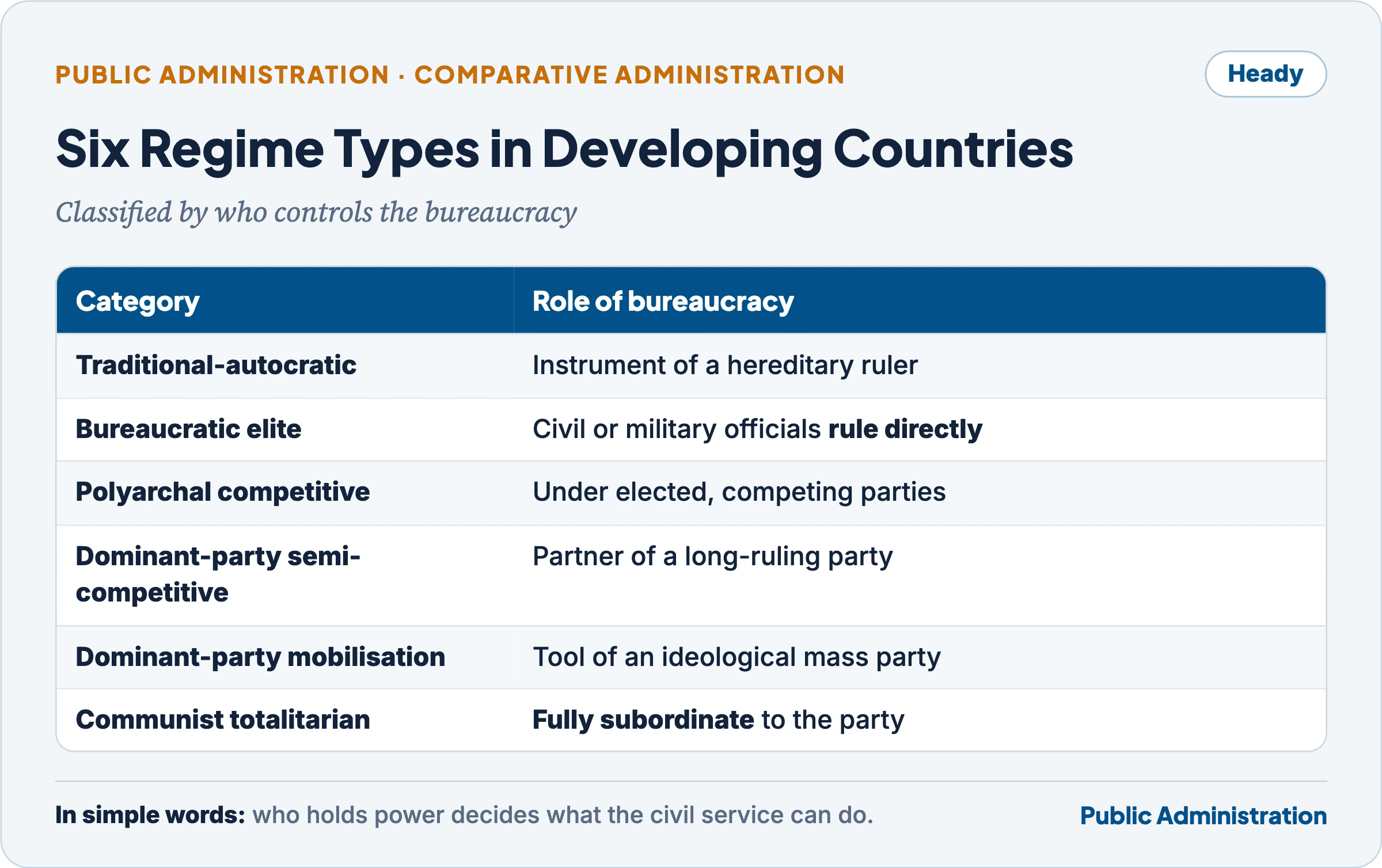
Heady classified political regimes in developing countries into six categories, according to the relationship between the political leadership and the bureaucracy:
| Heady’s category | Who holds power | Role of bureaucracy | Examples (at the time of classification) |
|---|---|---|---|
| Traditional-autocratic | Hereditary ruling elite | Instrument of the monarch | Saudi Arabia, Nepal under the old monarchy |
| Bureaucratic elite (civil and military) | Civil or military bureaucrats themselves | Rules directly, often after a coup | Pakistan and Thailand under military rule, several Latin American juntas |
| Polyarchal competitive | Competing elected parties | Subordinate to elected leaders, but influential | Philippines, Sri Lanka, Costa Rica |
| Dominant-party semi-competitive | One party wins repeatedly though others exist | Close partnership with the ruling party | Mexico under the PRI; India in the Congress era is often cited |
| Dominant-party mobilisation | An ideological mass party | Used to mobilise society | Ghana under Nkrumah, Tanzania, Algeria |
| Communist totalitarian | Communist party | Fully subordinate to the party | China, Cuba, Vietnam, North Korea |
- Riggs’s “unbalanced polity”: in many developing states the bureaucracy outweighs the political institutions meant to control it, so bureaucrats become political actors. Heady accepted this but added that non-Western states often have unbalanced politics, but not necessarily bureaucratic politics: in mobilisation and communist regimes the party dominates the bureaucracy, and in competitive polyarchies elected leaders do.
- Administrative capability: developing states generally lack the capacity to make and implement policy throughout their territory (Riggs called this penetration), so building capability (training, institutions, decentralisation, technology) is itself a development task.
- Looking outward: many Asian countries after independence copied Western models instead of drawing on their own values and requirements; critics argued that development administration encouraged this outward look, and that indigenous traditions (community management of forests, informal dispute resolution) were undervalued.
Indian Connect — India in the comparative frame
- India adopted the Westminster model (parliamentary executive, neutral permanent civil service, UPSC under Article 315) but works in a society Riggs would call prismatic: merit recruitment coexists with transfer politics, and progressive laws coexist with weak enforcement.
- In Heady’s terms India moved from a dominant-party semi-competitive system (Congress dominance until 1967, and nationally until 1977) towards a polyarchal competitive system with coalitions after 1989, and again to a period of single-party majorities after 2014; the civil service’s relations with politics shifted accordingly.
- India also borrows comparatively: lateral entry at Joint Secretary level (since 2018) imitates the American position-based model, though a 2024 advertisement was withdrawn after objections about reservation; Mission Karmayogi (2020) and the Capacity Building Commission draw on competency frameworks from the UK, Singapore and Canada.
6. Ecology and Administration
In simple words
In biology, ecology studies how a plant or animal lives with its surroundings: soil, climate, other species. In administration, ecology studies how a government office lives with its society: its economy, culture, politics and history. The office shapes the society, and the society shapes the office.
6.1 Meaning of ecology
- The term comes from biology, where it means the interdependence of organisms and their environment; sociologists of the 1920s (the Chicago school of human ecology) applied it to human communities in cities.
- Ecology and environment are close but not identical: ecology stresses the relationship and is more deterministic; environment can be manipulated by human action. In administrative study, ecology means the two-way interaction between the administrative system and its political, economic, social and cultural environment.
- The key proposition: public administration is a sub-system of society; it is affected by the other sub-systems and affects them in turn.
6.2 John Gaus: the founder
John M. Gaus, the American political scientist of the Wisconsin and Harvard schools, introduced the ecological approach in Reflections on Public Administration (1947), which carries his essay on “the ecology of government”.
- Gaus said the ecological approach builds quite literally from the ground up: from the elements of a place (soil, climate, location) to the people who live there, their numbers, ages and knowledge, and the physical and social technology by which they get their living.
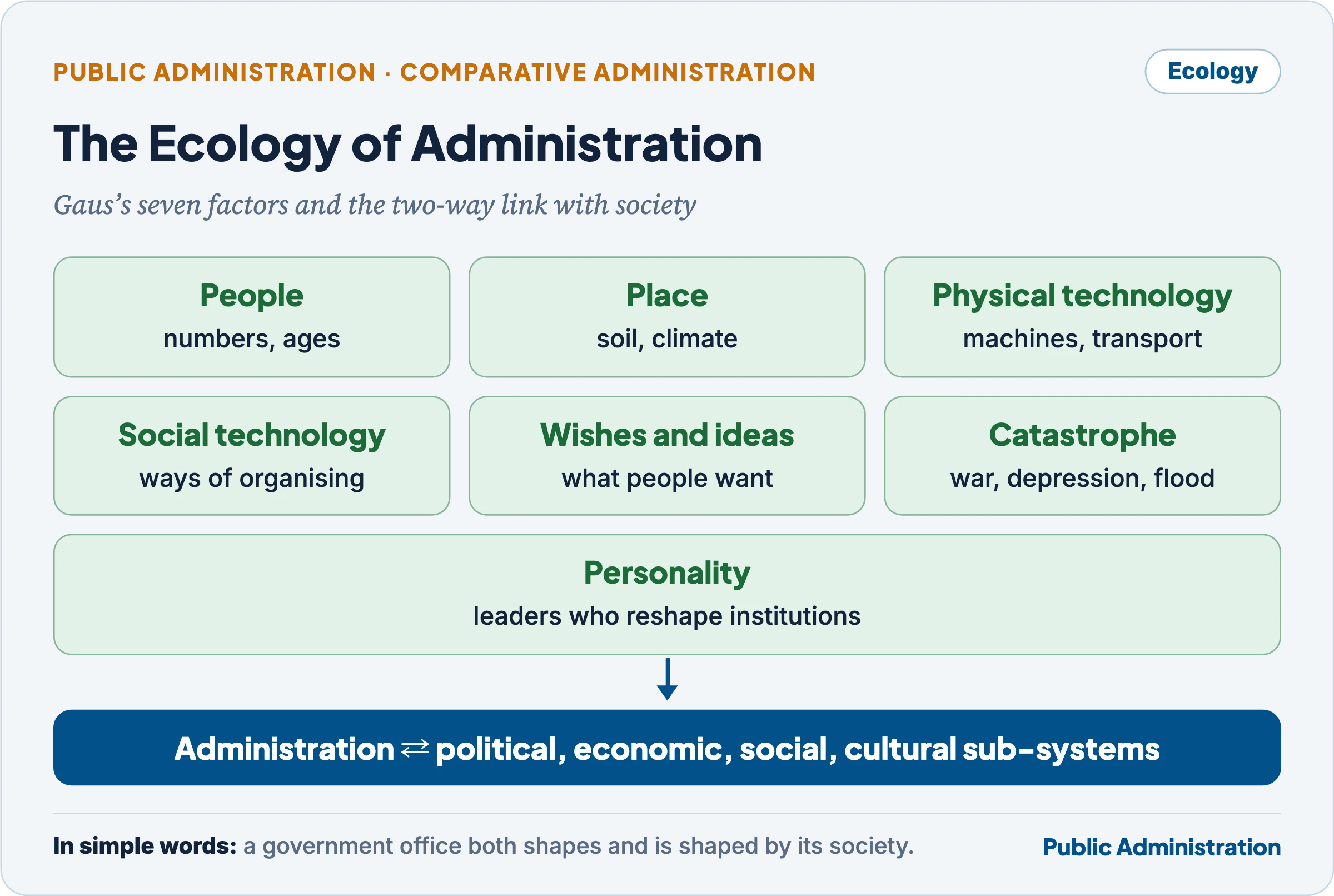
- His seven ecological factors, used to explain American public administration:
| Gaus’s factor | Meaning | Example of administrative effect |
|---|---|---|
| People | Size, age and distribution of the population | Ageing population creates pension and health administration |
| Place | Physical location, terrain, climate, resources | Drought-prone regions need relief and irrigation administration |
| Physical technology | Machines, transport, communication | The automobile created highway and traffic agencies |
| Social technology | Forms of organisation and ways of doing things | Corporations, cooperatives, insurance schemes need regulators |
| Wishes and ideas | What people want and believe | Demand for welfare or environmental protection creates new departments |
| Catastrophe | Wars, depressions, floods, pandemics | The Great Depression produced the New Deal agencies |
| Personality | Leaders who shape institutions | A Roosevelt or a Nehru reshapes administration |
- Gaus wanted to explain why government does what it does: new functions appear when the environment changes. His concern was the American system, not comparison, but the method was ready-made for CPA.
- Robert Dahl (1947) made the same point from the comparative side, and Roscoe Martin (1952) applied ecological thinking to American grass-roots government. Riggs then made ecology the centre of comparative work.
6.3 Riggs: The Ecology of Public Administration (1961)
Fred W. Riggs (1917–2008), the American scholar who spent his career at Indiana and then the University of Hawaii, delivered lectures at the Indian Institute of Public Administration that were published as The Ecology of Public Administration (1961).
- Core premise: the nature of public administration in any country cannot be understood without grasping the social setting in which it operates. Bureaucracy is one of several basic institutions of society, continuously interacting with the political, economic, social and cultural sub-systems, both modifying them and modified by them.
- Method: Riggs combined the ecological approach with structural-functionalism and ideal-type model-building. He identified five functions every society performs (economic, social, communication, symbolic and political) and asked which structures perform them in different societies.
- Comparisons in the book: he illustrated the ecology of administration with the USA, Thailand and the Philippines, showing how economic foundations, social structures, communication networks, symbol systems and political frameworks shape administrative behaviour.
Agraria and Industria. Riggs’s first typology, “Agraria and Industria” (1956–57), contrasted two ideal types:
| Feature | Agraria (model: imperial China) | Industria (model: contemporary USA) |
|---|---|---|
| Social norms | Ascriptive, particularistic, diffuse | Achievement, universalistic, specific |
| Mobility | Stable local groups, little spatial mobility | High mobility |
| Occupations | Simple, stable, hereditary | Complex, differentiated, cut off from family |
| Stratification | Differential, rigid status | Egalitarian, based on occupational achievement |
| Associations | Few; family and caste do everything | Many functionally specific, voluntary associations |
| Administration | Personal, mixed with household and religion | Specialised, rule-based, professional |
- Riggs added an intermediate type, Transitia, for societies moving from Agraria to Industria. The typology echoes Weber’s traditional and legal-rational authority and Parsons’s pattern variables.
- Why he abandoned it: it could not analyse transitional societies, which were his real interest; real industrial societies keep agrarian features; it assumed one-directional movement; it focused on the environment rather than the administrative system; and it was too abstract.
- He replaced it with the fused–prismatic–diffracted model (late 1950s, fully in Administration in Developing Countries: The Theory of Prismatic Society, 1964), built on structural differentiation. That model, the sala, formalism, overlapping, the bazaar-canteen and the critiques are treated in the companion article on Riggsian models and their critique. In brief: fused societies have one structure doing many functions; diffracted societies have a specialised structure for each function; prismatic societies are formally differentiated but still work in fused ways underneath.
6.4 Political, social and economic environment: how ecology works
- Political environment conditions administration. In totalitarian systems a neutral bureaucracy is not tolerated: Carl Beck found that in communist Eastern Europe an independent bureaucracy would threaten the party elite. In Britain conventions define a clear boundary; in the USA bureaucrats ally with interest groups and legislators. In India the British principle of political neutrality was adopted, yet observers such as C.P. Bhambhri argued that the bureaucracy is a powerful social group whose neutrality is a myth.
- Social environment. Caste, family, religion and class enter recruitment, posting and behaviour; Braibanti saw caste, communal and family considerations intruding into Pakistan’s bureaucracy; Crozier showed how French social norms (avoidance of face-to-face conflict, centralised rules) produced the “bureaucratic vicious circle”.
- Economic environment. In industrial societies the civil service is efficient and carries fewer welfare functions; in developing societies administration carries multifarious economic functions. Guy Peters observed that a country’s social and economic systems place boundaries on what government and administration can do, and political culture may virtually mandate some actions and prohibit others.
- Administration shapes environment too. Land reform, Green Revolution extension services, Aadhaar-based payments and digital public infrastructure have changed Indian society. The ecological approach is not one-way determinism.
6.5 Why ecology matters, especially for developing countries
- Explains failure of transplants: a model that works in its native ecology may fail elsewhere; that is why technical assistance often produced formal but not real change.
- Guides reform: reformers must ask which environmental conditions a device needs (literacy for RTI, connectivity for e-governance, trust for e-filing) before importing it.
- Supports theory-building: only by varying environments can one see which features of administration are universal.
- Especially useful for developing countries, where the gap between formal structure and social reality is widest, change is rapid, and administration is both shaped by and responsible for social transformation.
- Limits: ecology can become determinism (administration as a passive product of society); environmental variables are hard to measure; and early ecological work described the environment far more than the internal working of administration.
Common confusion
Is the ecological approach the same as Riggs’s prismatic model? No. The ecological approach is a general way of studying administration in its environment; Gaus founded it (1947) and many scholars use it. Riggs’s prismatic model is one particular application of the ecological approach, combined with structural-functionalism, to explain administration in transitional societies. One can use the ecological approach while rejecting Riggs’s models.
Indian Connect — Ecology of Indian administration
- Federal and linguistic diversity produce very different state administrations under the same constitutional design: Kerala’s decentralised planning and high literacy shaped a participatory administrative style that Bihar’s ecology did not.
- Digital ecology: India’s high mobile penetration and the JAM trinity (Jan Dhan accounts, Aadhaar, mobile) made Direct Benefit Transfer possible; the same scheme would fail where identity and banking ecology are missing.
- Disaster ecology: Odisha’s cyclone administration (after the 1999 super cyclone) built shelters, early warning and community drills; by Cyclone Fani (2019) mass evacuation kept deaths low, an example of administration reshaping its environment.
7. Decline, Critique and Current Status of CPA
In simple words
After a boom in the 1960s, the field lost its money and much of its confidence in the 1970s. It came back in the 1980s and 1990s with smaller, practical questions: which reforms work, which travel, and how to measure governments against each other.
7.1 The decline of the 1970s
- Funding ended: the Ford Foundation did not renew its grant after 1971; the CAG merged into SICA in 1973; the Journal of Comparative Administration stopped in 1974.
- Changing American priorities: the Vietnam War, domestic urban crises and disillusionment with foreign aid turned attention inwards; the New Public Administration (1968) focused on American social equity.
- Disappointment of practitioners: Ford and USAID wanted practical lessons; the CAG produced grand theory.
7.2 Critiques of classical CPA
- Too abstract, too theoretical: Robert Golembiewski argued that CPA’s failure rested substantially on a self-imposed failure experience: it set an unattainable goal by choosing early and persistently to seek a comprehensive theory or model in terms of which to define itself.
- No paradigm: Peter Savage, editor of the Journal of Comparative Administration, wrote that comparative administration started with no paradigm of its own and developed none. There was no agreement on approach, method, concepts or boundaries; the field was “pre-paradigmatic” and the models (Riggs’s, Weber’s) were never tested in a cumulative way.
- Ethnocentric and West-centric: the yardstick of “development” was the American or Western model; prismatic or developing administration was seen as a deviation. Robert Fried criticised a “Manichean” view in which everything in the North was wonderful and everything in the South despicable: it missed the hidden rationalities and humane informal controls of non-Western societies, and ignored irrational bureaucratic behaviour in rich countries. Critics such as Edward Said‘s followers later called this an intellectual by-product of Cold War hegemony.
- Elitist: CPA scholarship came from a small circle of American academics working with ruling elites and foreign-aid agencies; citizens, social movements and local scholars were absent.
- Irrelevant to practice: models such as the prismatic-sala did not tell a district officer what to do; Henderson and Lee Sigelman complained that theories were not framed in testable terms.
- Too behavioural and data-poor: borrowed survey methods needed data that most developing countries could not provide; the “researchable world” was uneven.
- Static and equilibrium-biased: structural-functional models explained how systems maintain themselves better than how they change.
7.3 Why universal theory remains elusive
Robert Fried traced the difficulty to the subject matter and to the knowledge industry:
- National administrative systems are harder to study than legislatures or parties, especially in terms of performance.
- Their boundaries are hard to define (agencies by function, by level, public and private partners).
- Implementation networks vary by function, so variation within a country may be as large as between countries.
- Agencies change constantly.
- The subject combines diversity with complexity, and change with formalism, which can be understood only in total ecological context.
- Countries differ in how researchable they are, and scholars disagree on method.
- Culture itself blocks integration: administrative ideas carry the values of the setting in which they were born (Taylorism, human relations, NPM), so the different streams of thought resist being merged into one universal theory.
The honest conclusion is that CPA produces contextual, middle-range generalisations (for example: merit-based recruitment tends to improve state capacity; reforms imported without local adaptation tend to become formalistic) rather than universal laws.
7.4 Contributions despite decline
Arora listed the CAG’s contributions; others added more:
- it widened the horizons of public administration beyond the American setting;
- it opened the discipline to all kinds of social scientists;
- it made the field more systematic by studying administrative systems in their ecological settings;
- it stimulated interest in development administration;
- it helped remove provincialism, brought politics and administration closer, and encouraged a more scientific outlook.
7.5 The revival: “new” CPA in the 1980s and 1990s
In the early 1980s scholars such as Ferrel Heady, Charles Goodsell, Jong S. Jun, Milton Esman, Gerald and Naomi Caiden and O.P. Dwivedi tried to revive the field. Heady argued that what CPA needed was not a prolonged post-mortem but vigorous pursuit of attractive new opportunities. Goodsell’s “The New Comparative Administration: A Proposal” (1981) asked that CPA cover all studies of administrative phenomena where the comparative method is explicitly used, at supra-national and sub-national levels.
The revival had a new orientation:
| Feature | Classical CPA (about 1955–1975) | New CPA (1980s onwards) |
|---|---|---|
| Driver | US foreign aid, Ford Foundation, Cold War | Fiscal crisis, globalisation, multilateral agencies (World Bank, OECD, UNDP, EU), fall of communism |
| Aim | Grand theory; nation-building | Applied lessons; better policy and management |
| Focus | Whole societies, developing countries | Developed and developing countries alike; specific sectors and reforms |
| Method | Deductive model-building | Empirical, case-based, quantitative indicators |
| Theory base | Structural-functionalism, systems theory | Public choice, new institutional economics, reinvention, good governance, network theory |
| Key themes | Development, bureaucracy and polity | NPM, privatisation, budgeting, performance, accountability, decentralisation, NGOs, citizen charters, human rights |
| Typical body | CAG | SICA, IPMN, OECD-PUMA/GOV, EIPA, NISPAcee |
- Thrust areas of the new CPA: disinvestment and privatisation; citizen’s charters; the role of citizens in promoting or resisting reform; human rights enforcement; debureaucratisation; the role of the private sector, voluntary agencies, self-help groups and community organisations; and international interdependence of bureaucracies.
- Guess and Gabrielyan concluded that a fortuitous set of circumstances now favours comparative work: a changing world order, applied methods and growing international interest in the results of public-sector reform. Some called this a “reinvigorated functionalism” driven by NPM.
7.6 New directions
(a) NPM: convergence or divergence? From the 1980s New Public Management (agencies, contracts, performance targets, markets) spread from New Zealand, the UK and Australia to many countries, often pushed by the World Bank and IMF.
- Convergence thesis: global pressures (fiscal stress, globalisation, ICT, international organisations) push all countries towards a common managerial model.
- Divergence thesis: Christopher Pollitt and Geert Bouckaert, in Public Management Reform: A Comparative Analysis (4th edition, Into the Age of Austerity, 2017), showed that countries fall into distinct groups: core NPM marketisers (UK, New Zealand, Australia), modernisers following a Neo-Weberian State model (Germany, France, the Nordic countries, which modernise the state without abandoning it) and others. They found convergence in talk, less in decisions, still less in practice and least in results.
- Path dependence and ecology explain the divergence: legal tradition (Rechtsstaat versus public interest), administrative culture, state structure and political system filter global ideas.
- The question “administrative ideas must be seen in the context of the environment in which they develop” applies exactly: NPM was born in Anglo-Saxon, low-power-distance, market-friendly ecologies; in developing countries it often became formalistic (agencies on paper, contracts without capacity). ICT, by contrast, has been adopted more widely, yet digital government too varies with infrastructure, literacy and trust.
(b) Policy transfer and diffusion. David Dolowitz and David Marsh (1996, 2000) defined policy transfer as the process by which knowledge about policies or institutions in one setting is used in another; Richard Rose wrote of lesson-drawing. Transfer may be voluntary (copying an ombudsman) or coercive (structural adjustment conditions). It may be copying, emulation, hybridisation or inspiration. Poorly adapted transfer produces “inappropriate transfer”, a modern word for formalism.
(c) Globalisation. International organisations, global value chains and transnational networks make administration interdependent: tax cooperation (the OECD/G20 global minimum tax), climate commitments and pandemic management all require comparable administrative capacity.
(d) Comparative governance indicators. Comparison has become measurement.
| Indicator | Who | What it compares |
|---|---|---|
| Worldwide Governance Indicators (WGI) | World Bank (since 1996) | Six dimensions: voice and accountability, political stability, government effectiveness, regulatory quality, rule of law, control of corruption; over 200 economies; methodology revised in 2025 |
| Government at a Glance | OECD (biennial; latest edition June 2025) | Public finances, employment, institutions, trust, digital government, integrity |
| Corruption Perceptions Index | Transparency International | Perceived public-sector corruption |
| UN E-Government Development Index | UN DESA (biennial survey) | Online services, telecom infrastructure, human capital |
| Quality of Government / V-Dem / Bertelsmann indices | Academic institutes | Impartiality, professionalism of bureaucracy, democracy |
- Uses: benchmarking, donor allocation, reform targets. Comparative performance measurement (CPM) applies the same logic inside countries, comparing municipalities or hospitals on common indicators so that managers can see their everyday work against wider standards and learn from the best performers.
- Critique: perception-based indicators reflect expert opinion and ideology; they rank rather than explain; and they can encourage “gaming” and formal compliance. The World Bank itself describes the WGI as an entry point that needs country-level diagnosis.
(e) The comparative public management turn. Much of today’s CPA is comparative public management: comparing budgeting, personnel systems, regulatory agencies, performance management, e-government and service delivery. Networks such as the International Public Management Network promote it.
(f) Asian administrative traditions. Scholars now study Confucian administrative heritage, the developmental state (Japan, South Korea, Taiwan, Singapore), China’s party-state governance and India’s own traditions (Kautilya’s Arthashastra) as models in their own right, not deviations from the West.
(g) Global South scholarship. A growing literature calls for decolonising comparative administration: building theory from African, Latin American and South Asian experience, studying informal institutions, hybrid governance and non-state actors, and moving beyond the assumption that Western administration is the norm. Jamil Jreisat, the Arab-American scholar, argued in Comparative Public Administration and Policy (2002) and later work that CPA must link administration with policy, overcome its theory–practice gap and recognise globalisation; he treated comparison as essential to the identity of public administration itself.
Criticism — The case against Comparative Public Administration
- It promised a universal science and delivered models that could not be tested; Savage’s “no paradigm” verdict still stands.
- Its yardstick was West-centric, treating developing administration as a failed copy of the West; much of it served Cold War foreign-policy aims.
- It was elitist: produced by American academics for aid agencies, with little voice for citizens or local scholars.
- Its grand models offered little to practitioners, and its behavioural methods needed data that did not exist.
- The new CPA risks a fresh bias: NPM and governance indicators can export market-centred values just as development administration exported modernisation.
Defence — The case for Comparative Public Administration
- Without comparison there is no way to tell the universal from the local; Dahl’s argument remains unanswered.
- CPA destroyed the myth of universal principles and made the ecological view common sense: reformers now ask whether a device suits its setting.
- It created lasting concepts (formalism, bureaucratic politics, development administration, prismatic society) still used to diagnose real problems.
- The new CPA is practical and plural: Pollitt and Bouckaert’s comparative work, governance indicators and policy-transfer studies directly inform reform, including in India.
- Its global turn (Asian traditions, Global South scholarship) is correcting the West-centric bias from within.
7.7 Current status: a summary
- CPA is no longer a separate movement with its own grand theory; it has become a method used across public administration, policy studies and governance.
- Its main forms today are comparative public management, comparative policy analysis, governance measurement and policy-transfer research.
- It is more empirical and nomothetic than ever (large datasets, cross-national regressions), and more ecological in a new sense (historical institutionalism, path dependence, culture).
- It is increasingly plural, with SICA’s 50th-anniversary reflections (2024–25) stressing decolonisation, non-Western traditions and multi-level analysis.
- Riggs’s test of a truly comparative study (empirical, nomothetic, ecological) is therefore better met today than in his own time, though through middle-range rather than grand theory.
7.8 Heady’s reading of the field’s stages, and CPA versus organisation theory
Heady’s stages. Heady, who chronicled the field across six editions of his textbook, read its growth in three broad stages:
- Formative stage (to the late 1950s): comparison of mostly Western systems, a modified traditional focus, and the first technical-assistance experiences that revealed the limits of American doctrine.
- Expansionist or “heyday” stage (1960s): the CAG, Ford funding, ambitious general system models (Riggs) and the rise of development administration, with optimism that a comparative science was near.
- Reassessment stage (from the 1970s): loss of funds and confidence, self-criticism, and a turn to middle-range work centred on bureaucracy and its relation to the political regime, later widened into public management comparison.
Heady rationalised the sequence as normal growth: grand ambition was needed to open the field, and disappointment pushed it towards testable, middle-range questions. That is why he made the bureaucracy–regime relationship the organising variable of his own classification.
CPA and modern organisation theory. The two resemble each other: both arose from dissatisfaction with classical “principles”, both use systems and open-environment thinking, both borrowed from sociology (Weber, Parsons), and both treat organisations as shaped by their environment (contingency theory in organisation theory, ecology in CPA). They differ in unit and purpose: organisation theory studies organisations in general (public and private) and mostly within one culture, looking at internal structure, motivation and decision-making; CPA studies public administrative systems across cultures and nations, and stresses the political regime and the wider society. Organisation theory has a stronger record of empirical testing; CPA has a wider canvas but weaker cumulative evidence.
7.9 Relevance for India
- Diagnosis: concepts such as formalism and overlapping explain the gap between India’s laws and their enforcement (for example, the long gap between the 73rd–74th Amendments’ promise of devolution and actual transfer of funds, functions and functionaries).
- Reform design: the 2nd ARC, NITI Aayog and DARPG routinely compare international practice (UK agencies, Singapore’s civil service, Estonia’s digital state); comparison helps adapt rather than copy.
- Benchmarking within India: NITI Aayog’s indices (SDG India Index, Health Index), the Good Governance Index (DARPG, 2019 and 2021 editions) and state-level rankings apply comparative performance measurement to Indian states, an intra-national form of CPA.
- Exporting lessons: India’s digital public infrastructure (Aadhaar, UPI, DigiLocker) is now itself a subject of comparative study and transfer, discussed at the G20 under India’s presidency (2023), which reverses the old one-way flow from West to South.
- Federal laboratory: with 28 states and 8 Union Territories, India is a natural setting for intra-national comparison, the most feasible kind of comparative research.
Key Terms
| Term | Meaning in simple words |
|---|---|
| Comparative Public Administration | Study of administration across countries, cultures or periods using comparison |
| Cross-cultural analysis | Comparing systems in different political-economic cultures |
| Cross-temporal analysis | Comparing administration at different times |
| Idiographic | Studying unique cases (one agency, one country) |
| Nomothetic | Seeking general laws and regularities |
| Empirical | Based on observed facts, “what is” |
| Normative | Concerned with values, “what ought to be” |
| Ecological approach | Studying the two-way interaction between administration and its environment |
| Structural-functional approach | Analysing which structures perform which functions in a society |
| Middle-range theory | Theory about a part of a system (such as bureaucracy), between grand theory and single cases |
| Modified traditional approach | Improved version of old comparative government, focused on Western systems |
| CAG | Comparative Administration Group of ASPA (1960–1973), chaired by Riggs |
| SICA | Section on International and Comparative Administration of ASPA (from 1973) |
| Agraria / Industria | Riggs’s early ideal types of agricultural and industrial societies |
| Transitia | Riggs’s intermediate type between Agraria and Industria |
| Formalism | Gap between what rules prescribe and what actually happens |
| Unbalanced polity | Bureaucracy stronger than the political institutions that should control it |
| Power distance | Hofstede’s measure of how far unequal power is accepted |
| Political culture | Shared beliefs and attitudes towards the political system |
| Administrative culture | Shared values and habits of the bureaucracy itself |
| Developmental state | State whose elite bureaucracy steers economic growth (Japan, South Korea) |
| Policy transfer | Use of policy knowledge from one setting in another |
| Neo-Weberian State | Modernising the state while keeping its Weberian core |
| Convergence thesis | Claim that global pressures make administrations alike |
| Comparative performance measurement | Comparing organisations on common indicators to learn and improve |
Commissions, Committees and Judgments
| Body or case | Year | Key point |
|---|---|---|
| Northcote–Trevelyan Report (UK) | 1854 | Open competition and a unified, neutral civil service |
| Pendleton Act (USA) | 1883 | Merit system replaces spoils for federal posts |
| Princeton Conference on Comparative Administration | 1952 | Institutional start of CPA; “criteria of relevance” |
| Comparative Administration Group (ASPA) | 1960–1973 | Riggs as chair; Ford grants 1962 and 1966; merged into SICA 1973 |
| Santhanam Committee | 1964 | Traced corruption to administrative and social causes |
| Fulton Committee (UK) | 1968 | Criticised the generalist “amateur” tradition |
| Civil Service Reform Act (USA) | 1978 | OPM, MSPB, Senior Executive Service |
| Second Administrative Reforms Commission | 2005–2009 | Comparative study of international reforms for India |
| T.S.R. Subramanian v. Union of India | 2013 | Fixed tenure and civil services boards against arbitrary transfers |
| Cabinet Bureau of Personnel Affairs (Japan) | 2014 | Cabinet control of senior bureaucratic appointments |
| INSP replaces ENA (France) | 2022 | Elite training school reformed for diversity |
Contemporary Developments
- December 2025: the World Bank released the revised Worldwide Governance Indicators (WGI 2.0), with stricter source screening, an absolute 0–100 scale and recalculated series back to 1996, covering six dimensions for over 200 economies.
- June 2025: the OECD published Government at a Glance 2025, comparing public finances, trust, digital government and integrity across member countries.
- 2024–2025: ASPA’s SICA marked 50 years; reflections published in Public Administration and Development (October 2025) call for decolonising CPA and engaging non-Western administrative traditions.
- January 2025: a US executive order revived the reclassification of policy-influencing career posts (the former “Schedule F”), reopening the comparative debate on merit versus political control of the bureaucracy.
- August 2024: India withdrew a UPSC lateral-entry advertisement for senior posts after objections over reservation, showing how a position-based practice borrowed from abroad is filtered by Indian political ecology.
- 2023: under India’s G20 presidency, digital public infrastructure became a theme of international comparison and transfer, with India as a source rather than a recipient of administrative models.
- 2022: France’s INSP replaced the ENA as the training school of the senior civil service.
Revision Grid
| Thinker or body | Work or report (year) | Key idea |
|---|---|---|
| Woodrow Wilson | “The Study of Administration” (1887) | Borrow foreign techniques without their political spirit |
| Max Weber | Writings on authority and bureaucracy (c. 1905–1920) | Comparative typology of authority; bureaucracy as core concept |
| Robert Dahl | “The Science of Public Administration: Three Problems” (1947) | No science of PA unless comparative |
| John M. Gaus | Reflections on Public Administration (1947) | Ecology of government; seven factors |
| Fred W. Riggs | The Ecology of Public Administration (1961) | Administration interacts with its environment; Agraria–Industria |
| Fred W. Riggs | Article on trends in comparative study (1962) | Normative to empirical, idiographic to nomothetic, non-ecological to ecological |
| Ferrel Heady | Public Administration: A Comparative Perspective (1966) | Four foci; five features of developing administration; six regime types |
| Keith Henderson | Classification of approaches | Bureaucratic, input–output, component |
| Almond and Verba | The Civic Culture (1963) | Parochial, subject, participant political culture |
| Michel Crozier | The Bureaucratic Phenomenon (1963) | French culture shapes bureaucratic behaviour |
| Geert Hofstede | Culture’s Consequences (1980) | National cultural dimensions such as power distance |
| Chalmers Johnson | MITI and the Japanese Miracle (1982) | Developmental state |
| Robert Golembiewski | Critique of CPA (1970s) | Self-imposed failure by seeking a comprehensive theory |
| Peter Savage | Editor, Journal of Comparative Administration | CPA started with no paradigm and developed none |
| Robert Fried | “Comparative Public Administration: The Search for Theories” (1990) | Why universal theory is elusive; Manichean bias |
| Charles Goodsell | “The New Comparative Administration: A Proposal” (1981) | Wider, explicitly comparative scope |
| Jamil Jreisat | Comparative Public Administration and Policy (2002) | Link administration and policy; globalisation |
| Pollitt and Bouckaert | Public Management Reform (4th edn, 2017) | Divergent reform paths; Neo-Weberian State |
| Dolowitz and Marsh | Policy transfer (1996, 2000) | How and why policies travel |
Previous Year Questions
- 2026Critically analyse the differences between Ferrel Heady’s focus on administrative structures and Fred Riggs’s ecological ‘Prismatic’ model. Which one of these frameworks provides a more effective tool for the study of developing nations? Examine.
- 2026The advent of Comparative Public Administration not only widened the knowledge of Public Administration, but also contributed to developing its understanding in a cross-cultural and cross-national framework. Examine.
- 2025The basis of comparative study of Public Administration has evolved from institutional approach to the contemporary political economic process approach. Have all these approaches enabled the development of a theory of Comparative Public Administration? Justify your answer.
- 2024Undoubtedly, social and historical factors play a significant role in shaping administrative system, but side by side, understanding of these influences is essential for designing responsive governance structure. Examine.
- 2024The study of Public Administration must include its ecology. Discuss.
- 2023” The studies in Comparative Public Administration (CPA) got momentum in 1980’s and 1990’s with a new objective and orientation than its previous counterparts.” Critically examine.
- 2023” The Constitution of French Republic does not prohibit ministers from being the leader of political party; it is customary that minister should not occupy such a post to ensure impartiality.” Explain.
- 2022Weber’s construct of bureaucracy has served a great heuristic purpose in furthering research in the field of Comparative Public Administration. Do you agree with the statement ? Give reasons.
- 2021Integration of different streams of administrative thought to propound a universal administrative theory is hindered by the impact of culture. Critically examine.
- 2021The approach to the study of administration in its environmental context is especially more useful for developing countries. Comment.
- 2020“Comparative Public Administration started with no paradigm of its own and developed none.” Comment
- 2020“Administrative ideas must be seen in the context of environment in which they develop.” In the light of the above statement, examine the influence of New Public Management and Information and Communication Technologies on comparative study of Public Administration.
- 2019The failure to discard its elitist character and west-centric orientation has led to the decline of Comparative Public Administration. Explain.
- 2018“Administrative systems across the world can be understood only in their respective historical and social contexts.” Explain the statement giving examples.
- 2016“Riggs observed that three ‘trends’ could be discerned in the comparative study of Public Administration.” Discuss.
- 2015How does Ferrel Heady rationalize the three stages of development in comparative administration?
- 2015“Comparative Performance Measurement (CPM) bridges everyday work experience with the broader horizons of comparativism.” Explain.
- 2013“Comparative Public Administration both resembles and differs from modern organization theory.” Elaborate.
- 2013“….in most cases …. Newly independent states, of the nations of Africa, Asia and Latin America, despite their differences …. Are in transition.” (Ferrel Heady). What common features are indicative of characteristics of their administrative patterns (cultures)?
- 2012Comment on the reasons why universal theory remains elusive in comparative public administration.
- 2009“… non-western states often, if not always, have unbalanced politics, but these may not necessarily be bureaucratic politics.” Discuss.
- 2008“Truly comparative administrative studies are empirical, nomothetic and ecological.” (Riggs) In this perspective, examine the current status of Comparative Public Administration.
- 2008“In the last two decades, almost all countries of the world have experienced transformations in their administrative systems.” Explain this phenomenon with examples from the developed and the developing nations in the context of New Public Management Movement.
- 2007“Not to be comparative is to be naively parochial” (Riggs). Comment.
- 2005“No science of public administration is possible unless…. There is a body of comparative studies from which it may be possible to discover principles and generalities that transcend national boundaries and peculiar historical experiences.” Discuss.
- 2004Explain the meaning, significance and Models of Comparative Public Administration.
- 2002How did F.W. Riggs conceptualise the inter-actions between administrative systems and their environment?
- 2000“Political environment conditions administrative system.” – (F. W. Riggs) Comment.
- 1999“Instead of looking inward in their own values and requirements, the Asian countries looked outward.” Comment.
- 1999Critically comment on the function of administrative capabilities with reference to developing countries.
- 1998“As long as the study of public administration is not comparative, claim for a ‘science of public administration ‘sounds rather hollow” Explain.
- 1995A major problem with comparative public administration is that it has been behavioural. Comment.
- 1994“The main distinction between administration in western countries and in underdeveloped countries does not lie in differences in socio-cultural heritage but rather in the respective economic environments.” Comment.
- 1994“The emphasis in most of the writings on comparative bureaucracy appears to be on the interaction between the administrative subsystem and the political system in which it exists.” Comment.
- 1993“Comparative Public administration as a field of research is not so much comparative, as it is the study of Public administration in foreign countries.” Comment.
- 1993How dose public administration differ in the developed and developing societies? How far can it modernise the traditional political culture of developing countries?
- 1991‘The growth of comparative Public Administration is a continuing process and is of relevance for both operational and academic study of Public Administration.
- 1990Discuss the major conceptual approaches to the study of Comparative Public Administration and explain how Max Weber is considered to be the foremost mentor in the field.
- 1990‘Government has been slow in using modern methods for discovering executive talent.’ Examine the validity of the statement with reference to recruitment to higher civil service in India, USA and France.
- 2026The political culture in India shapes bureaucratic behaviour, professional integrity and civil service conduct. Explain with suitable examples.
- 2015To what extent has political culture influenced the administrative culture of India? Explain.
- 2011Explain with appropriate illustrations the interface between political culture and bureaucratic culture in contemporary India.
- 2002“Culturally sanctioned values and symbols have acted as important influencing catalyst in administration.” – Elaborate.
- 1999“Only a systematic-ecological approach to the study of corruption in India can help us understand its causes and dimensions.” Comment.