

Administrative Behaviour: Process and techniques of decision-making; Communication; Morale; Motivation Theories – content, process and contemporary; Theories of Leadership: Traditional and Modern.
This article: Communication (meaning, process models, its place in organisation theory from Barnard and Simon to Deutsch’s cybernetics, types, networks, informal groups and the grapevine, barriers and remedies, communication in decision-making, strategic and digital government communication, transparency with staff) and Morale (meaning, morale–motivation–job satisfaction, determinants, indicators, measurement, the morale–productivity debate, building morale, the psychological contract, morale in India’s civil services).
Official Syllabus: Paper I · Unit 1-03 Administrative Behaviour
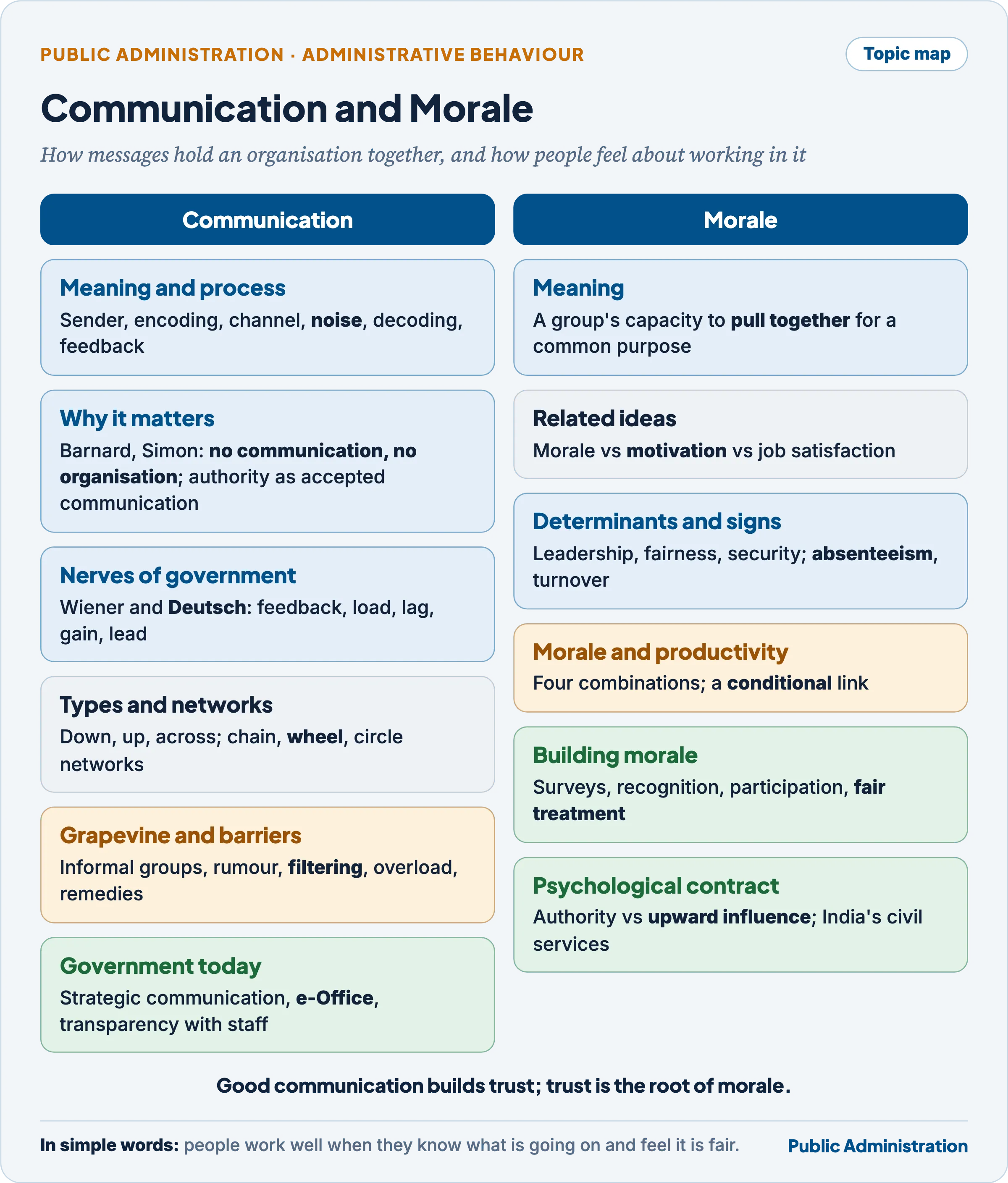
Communication is the process by which information, instructions, ideas and feelings pass between people so that they reach a shared understanding; morale is the collective spirit with which a group works towards a common purpose. The two are tied together. An organisation exists only when people can talk to each other, and it works well only when the people who talk to each other also trust what they hear and want to act on it. That is why the behavioural writers placed communication at the heart of organisation and treated morale as its most sensitive outcome.
- Communication answers the question: does everyone know what is going on, and does the top know what is happening below?
- Morale answers the question: do people feel good enough about the organisation to give their best, together?
- In government both matter more than in business: public goals are vague, staff are many and dispersed, citizens must be persuaded, and civil servants cannot be motivated by profit-sharing.
In simple words
Think of a district during a cyclone warning. The Collector must get the warning from the weather office, pass orders to tehsildars, village officers and police, hear back on who has been evacuated, and keep the public calm through radio and mobile alerts. If messages are late, garbled or not believed, people die. And if the field staff are exhausted, unpaid and blamed for every lapse, even perfect messages will not be acted on with energy. The first problem is communication; the second is morale.
1. Communication: Meaning, Elements and Process
In simple words
Communication is not just sending a letter or an order. It is complete only when the other person understands it the way you meant it, and you know that they have understood. A circular that nobody reads has been sent, but it has not been communicated.
1.1 Meaning and definitions
The word comes from the Latin communis, “common”: to communicate is to make something common between two or more minds.
- Keith Davis, the American organisational-behaviour scholar: communication is the process of passing information and understanding from one person to another.
- Louis A. Allen: it is the sum of all the things one person does to create understanding in the mind of another; a systematic, continuing process of telling, listening and understanding.
- Newman and Summer: an exchange of facts, ideas, opinions or emotions by two or more persons.
- Ordway Tead, the American writer on administration: its underlying aim is the meeting of minds on common issues.
- John D. Millett, in Management in the Public Service (1954): communication is the shared understanding of a shared purpose, and the blood stream of an administrative organisation.
- Peter Drucker: the ability of the various functional groups within an enterprise to understand each other and each other’s functions and concerns.
The common thread: the essence of communication is understanding, not the mere transmission of information. It has three aspects in an organisation:
- Internal: between the organisation and its employees (upward, downward, across).
- External: between the organisation and the public, usually called public relations.
- Interpersonal: among employees as individuals.
1.2 Nature of communication
- Two-way: a message and a reaction to it; one-way “communication” is only half the process.
- Continuous: it never stops while the organisation lives.
- Pervasive: it runs through every function (planning, organising, staffing, directing, coordinating, controlling) and every level.
- Purposive: in an organisation its purpose is to influence action, to change behaviour towards organisational goals.
- Both factual and emotional: it carries attitudes and feelings as well as facts, which is why it shapes morale.
Keith Davis gave it two objectives: to provide the information and understanding needed for group effort, and to provide the attitudes needed for cooperation.
1.3 Elements of a communication system
Classical public-administration writing on communication listed five elements:
| Element | What it means in a government office |
|---|---|
| Communicator | The sender; orders issue in the name of the head, though drafted by staff, which keeps one voice and avoids conflicting instructions |
| Transmission | The procedure and medium: file, post, phone, video, e-Office |
| Form | Order, rule, circular, manual, report, house journal |
| Recipient | Everyone whose behaviour the message must affect, and no one else |
| Desired response | Evidence of compliance: replies, returns, reports flowing back up |
The last element is the most neglected. A head who issues orders without asking for evidence of response does not know whether the order has changed anything.
1.4 Process models
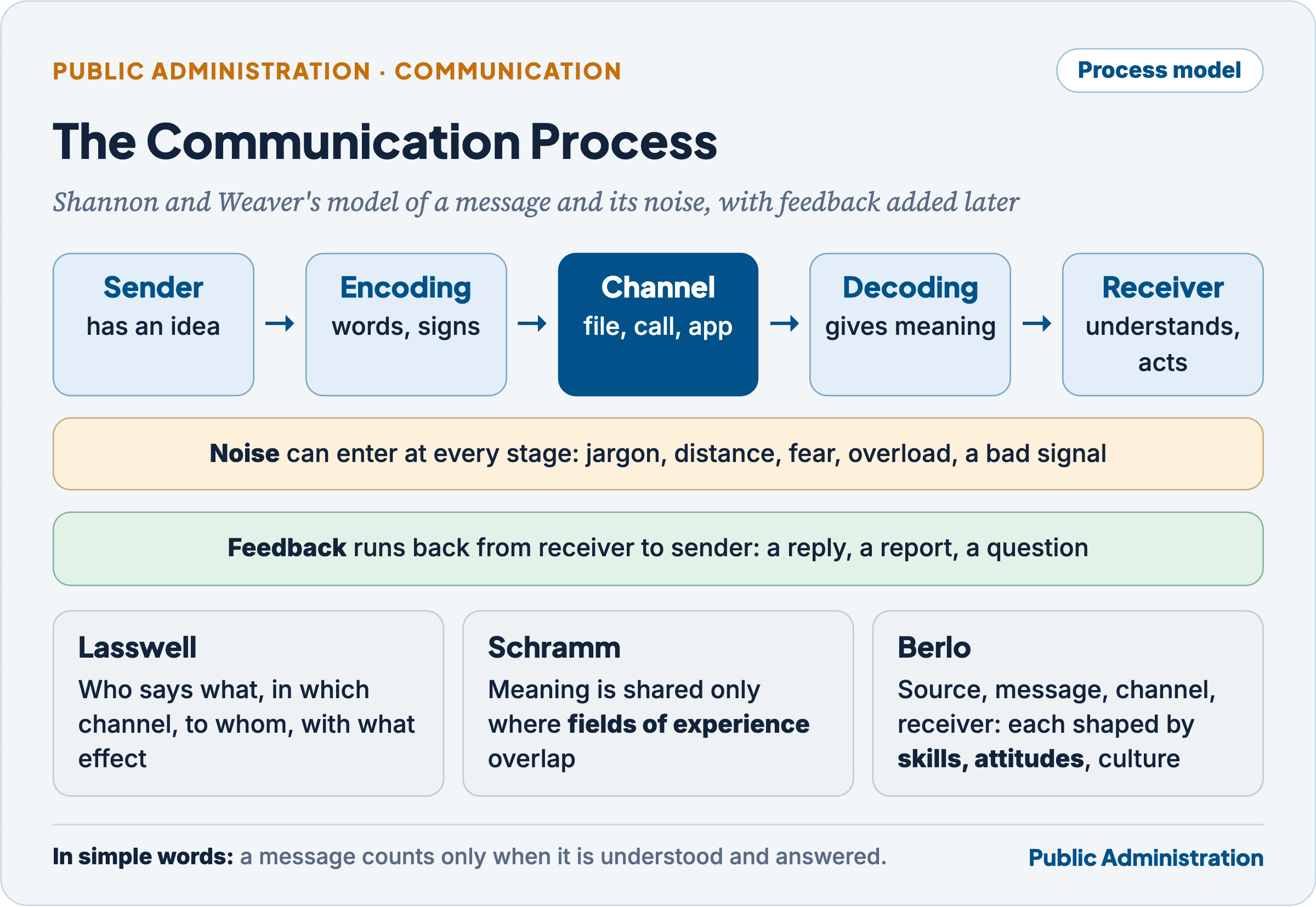
Claude Shannon, the American engineer, published “A Mathematical Theory of Communication” (1948), and with Warren Weaver produced The Mathematical Theory of Communication (1949). Their model is the most widely used picture of the process:
- Source / sender: has an idea, an instruction or a need.
- Encoding: turns the idea into words, numbers, symbols or gestures.
- Message: the actual product (the letter, the speech, the graph).
- Channel: the medium that carries it (file, telephone, meeting, app).
- Decoding: the receiver translates symbols back into meaning, through his own experience.
- Receiver: the person for whom the message is meant.
- Feedback: the receiver’s response, which tells the sender whether the message arrived as intended.
- Noise: anything that distorts the message at any stage: jargon, a bad line, fear, distraction, overload.
Later writers refined the model:
- Harold Lasswell (1948) reduced it to five questions: who says what, in which channel, to whom, with what effect. The last question shifts attention from sending to effect.
- Wilbur Schramm (1954) stressed that meaning is shared only where the fields of experience of sender and receiver overlap. A notification written in legal English for a village audience fails here.
- David Berlo, in The Process of Communication (1960), gave the SMCR model (source, message, channel, receiver), in which each element is shaped by communication skills, attitudes, knowledge, social system and culture.
- Engineering models saw communication as a pipe; behavioural writers see it as a relationship. Feedback was added because the original was largely one-way.
Common confusion
Are communication and information the same thing? No. Information is the content, the “thing” sent; communication is the process by which it becomes shared understanding. Drucker went further and said communication is a matter of the receiver’s perception and expectation: people hear what they are ready to hear. A ministry can publish huge amounts of information (dashboards, gazettes, data portals) and still communicate badly if its audience cannot use or does not trust what is published.
2. Why Communication Matters: From Barnard and Simon to “Communication Is Authority”
In simple words
An organisation is people working together. They cannot work together without knowing what the others are doing and what the boss wants. So communication is not an extra; it is what turns a crowd into an organisation. Barnard went further: even the boss’s authority depends on whether his message is understood and accepted.
2.1 “Without communication there can be no organisation”
- Herbert Simon, the American Nobel-winning theorist of decision-making, in Administrative Behavior (1947), defined communication as any process whereby decisional premises are transmitted from one member of an organisation to another.
- In his words, without communication there can be no organisation, because there is then no way for the group to influence the behaviour of the individual.
- Communication, for Simon, is two-way: information flows to the decision centre (so that decisions are informed) and decisions flow from the centre to the points of action (so that they are carried out).
- The decision-maker can be pictured as an information-processing system: the quality of his decision cannot exceed the quality of the information reaching him.
2.2 Barnard: communication as the first executive function
Chester Barnard, the American telephone executive and theorist, in The Functions of the Executive (1938), made communication one of the three elements of every organisation:
- A formal organisation exists when there are persons able to communicate with each other, who are willing to contribute action, towards a common purpose.
- Communication is the dynamic element: it is what turns a purpose into coordinated action.
- “The first executive function is to develop and maintain a system of communication.” This involves a scheme of organisation (positions), a personnel system (people to fill them) and an informal organisation.
- The techniques of communication shape the form and internal economy of an organisation; without a suitable technique, some purposes cannot be adopted at all.
- Barnard’s later reflection also tied communication to coordination: communication, authority, specialisation and purpose are all aspects of coordination.
2.3 “Communication is authority”: Barnard’s acceptance theory
Classical theory saw authority as a right that flows downward from the top. Barnard reversed the view. He defined authority as the character of a communication (order) in a formal organisation by virtue of which it is accepted by a member as governing the action he contributes.
- Authority lies with the receiver, not the sender. An order has authority only if it is accepted. Hence the statement that, in practice, communication is authority.
- A member accepts a communication as authoritative when four conditions hold together:
- he understands it (a communication that cannot be understood can have no authority);
- he believes it is consistent with the purpose of the organisation;
- he believes it is compatible with his personal interest as a whole;
- he is mentally and physically able to comply.
- Zone of indifference: orders fall into three bands: clearly unacceptable, borderline, and unquestionably acceptable. Orders in the last band are obeyed without thought. The zone widens when inducements are generous and narrows when they are poor.
- Fiction of superior authority: members presume orders from above are authoritative because denying them threatens everyone who benefits from the organisation; group opinion (the informal organisation) keeps the zone stable.
- Objective authority needs a sound communication system. Barnard’s seven features: channels definitely known; a definite formal channel to every member; lines as direct and short as possible; the complete line normally used; competent persons at communication centres; lines not interrupted while the organisation functions; and every communication authenticated.
- Authority of position and authority of leadership: a communication is accepted partly because of the office from which it comes and partly because of the personal competence of the person who sends it.
Simon carried the idea into the zone of acceptance: a subordinate accepts a decision when he sets aside his own critical faculties and lets the communicated premise guide his choice.
Critique.
- Kenneth Andrews felt that Barnard understated objective, positional authority and seemed to give individuals a veto, when in reality organisations coerce and members depend on their jobs.
- In a government office, rules, discipline and the hierarchy limit the subordinate’s freedom to “reject” an order; the theory explains willing cooperation better than compliance.
- The theory is still valuable: it explains why badly drafted, unexplained or impossible orders fail even when they carry an official seal.
Indian Connect — Authority, communication and written orders in India
- In T.S.R. Subramanian v. Union of India (2013), the Supreme Court directed that civil servants should act on written communication; where an oral instruction is received from a superior or political executive, it should be recorded in writing before action, except in emergencies. A record-based channel protects both accountability and the officer’s morale.
- The Central Secretariat Manual of Office Procedure prescribes authentication of every order (issued “by order and in the name of the President”) and defines who may sign for whom: Barnard’s “every communication should be authenticated” in practice.
- The Collector (as the channel between government and the district) and the Chief Secretary (as the communication link between the State and the Union) are offices whose authority rests largely on their command of information flows.
2.4 Other formulations of its importance
| Thinker | Image of communication |
|---|---|
| Millett | The blood stream of an administrative organisation |
| Pfiffner | The heart of management |
| George Terry | The lubricant of the management process |
| Norbert Wiener | The cement that holds an organisation together |
| Fayol | The gangplank: direct horizontal contact to save the delay of the scalar chain |
| Mary Parker Follett | Coordination by direct contact of the people concerned, at an early stage, as a continuing process |
2.5 What communication does for an organisation
- Holds the organisation together: links superiors and subordinates, departments and headquarters with field.
- Serves every management function:
- planning needs information from below and consultation;
- organising needs the communication of tasks, authority and relationships;
- staffing (selection, training, appraisal) is an exchange of information;
- directing and leading depend on persuasion and instruction;
- coordinating is impossible without lateral flow;
- controlling needs feedback on performance against targets.
- Supports goal-setting and goal-getting: goals must be communicated to be shared; progress must be reported to be achieved.
- Builds motivation and morale: people who are told why, consulted and recognised feel valued. Recognition, a Herzberg motivator, is itself an act of communication.
- Connects the organisation to its environment: citizens, media, legislators and other agencies.
- Makes leadership possible: leadership by persuasion places a heavy premium on communication; transformational leaders “communicate a vision” (see the article on Leadership).
Headquarters and field relations show all of this in miniature. Headquarters needs accurate field reports to make realistic policy; the field needs clear, timely and flexible instructions that allow for local conditions. A relationship that runs only on orders down and returns up, without dialogue, breeds unrealistic policy above and resentment below.
3. Cybernetics and the “Nerves of Government”
In simple words
A ship’s helmsman watches the compass, sees that the ship has drifted, and turns the wheel a little. He keeps correcting. Cybernetics says that a government works the same way: it must constantly sense what is happening, compare it with its goals and correct itself. The information channels are its nerves.
3.1 Norbert Wiener and cybernetics
- Norbert Wiener, the American mathematician at MIT, coined cybernetics (from the Greek kybernetes, steersman) and published Cybernetics (1948).
- Every system has a natural tendency towards disorder and breakdown, measured as entropy. Information is the antidote to entropy: by methodical information processing, a system moves towards order (negative entropy).
- Control is possible only through messages and feedback: signals that report deviations from the goal so that the course can be corrected.
- Wiener’s ideas on control by information feedback fed directly into the design of computers and, through them, into management information systems.
3.2 Karl Deutsch’s model
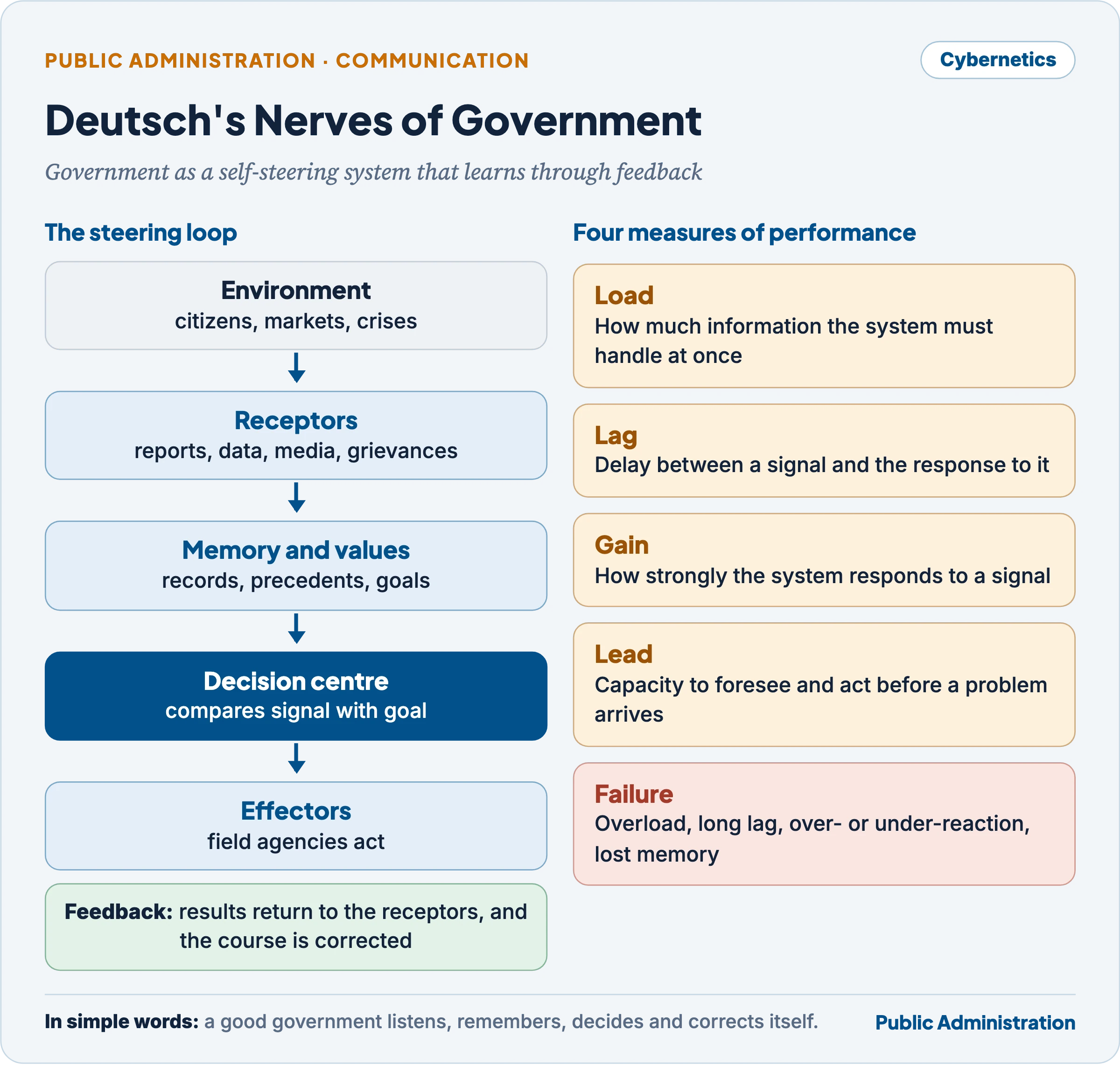
Karl Deutsch, the Czech-born American political scientist, in The Nerves of Government: Models of Political Communication and Control (1963), applied cybernetics to government. He suggested that it is more useful to see government as a problem of steering than of power, and that a political system is best understood through its communication and decision channels.
- The steering loop:
- Receptors take in information from the environment (reports, data, media, grievances, intelligence).
- Memory stores past experience, records, precedents and values (the goals against which information is judged).
- The decision centre compares incoming signals with memory and goals and chooses a response.
- Effectors (field agencies) carry out the decision.
- Feedback carries the results back to the receptors, so that the system can correct itself.
- Four measures of performance:
- Load: the volume and speed of information the system must handle.
- Lag: the delay between receiving information and responding to it.
- Gain: the size of the response to a signal (too little is inertia, too much is over-reaction).
- Lead: the capacity to predict and act before a problem arrives.
- Learning capacity: a good system does not merely correct errors but changes its own goals and structures in the light of experience (“goal-changing feedback”). Its political “will” and “consciousness” are, in Deutsch’s terms, the ways it manages its own information.
- Why systems fail: overload, excessive lag, too much or too little gain, loss of memory, and blocked or distorted channels.
3.3 Making government communication effective, responsive and motivational
Deutsch’s vocabulary gives a ready checklist for reforming a government’s communication system:
- Better receptors: real-time data, grievance portals, social audits, field visits, citizen surveys, so that the government “hears” early and from below.
- Less lag: fewer levels of file movement, delegation of powers, time-bound disposal, digital files.
- Right gain: proportionate responses; avoiding both inaction and panic.
- More lead: forecasting, early-warning systems, foresight units, scenario planning.
- Better memory: institutional records, knowledge management, handing-over notes, so that transfers do not wipe out experience.
- Responsive feedback: citizens’ feedback actually changes the service (closing the loop), not just a complaint number.
- Motivational communication: downward messages that explain the why, recognise good work and invite suggestions; upward channels that are safe to use.
Critique. The cybernetic model is mechanistic: government is not a thermostat. It tends to ignore power, conflict and values, treats politics as information-processing, and can justify a technocratic, surveillance-heavy state. Its strength is diagnostic: it shows where a system is failing (overload, lag, blocked feedback).
Indian Connect — Cybernetic thinking in Indian governance
- PRAGATI (Pro-Active Governance and Timely Implementation), launched on 25 March 2015, is a monthly video review by the Prime Minister with Union secretaries and State chief secretaries: a decision centre receiving direct feedback on stalled projects and grievances, cutting lag across levels.
- Delayering: under the Secretariat Reforms programme, the average number of levels a file passes through in central ministries fell from 7.19 in 2021 to 4.13 by February 2026 (DARPG report released 24 March 2026), a direct cut in lag and filtering.
- CPGRAMS, the central grievance portal, functions as a receptor and feedback channel; DARPG’s 2026 reports put average disposal time in central ministries at about 13 days.
- Early-warning systems: India Meteorological Department forecasts plus the NDMA’s SACHET alert system give the disaster-management machinery lead.
4. Types of Communication
In simple words
Messages can travel down (orders), up (reports and complaints), sideways (between equals) or across (between different levels of different sections). They can be official or informal, spoken or written, and can even be carried by a gesture or a silence. Each kind has its own uses and its own weaknesses.
4.1 Formal and informal
- Formal communication follows channels deliberately established by the organisation: who reports to whom, how often, in what form. It rests on the scalar chain, is recorded and can be authenticated, but is slow and rigid.
- Informal communication flows through social relations: friendships, lunch groups, cadre networks, messaging-app groups. It is fast and flexible but unrecorded and liable to distortion. (See Section 6.)
- As Simon observed, however elaborate the formal system, it is always supplemented by an informal one.
4.2 By direction
Downward communication flows from higher to lower levels.
- Devices: orders, instructions, circulars, office memoranda, manuals, budget sanctions, staff meetings, video conferences.
- Functions: conveying goals, policies, procedures, job instructions, feedback on performance, and the rationale for decisions.
- Problems:
- information is lost or distorted as it passes through many levels; many directives are not read or not understood;
- overload of circulars at the bottom;
- orders framed without upward information are unrealistic and meet resistance;
- it dominates in authoritarian climates, where it becomes command without explanation.
Upward communication flows from subordinates to superiors.
- Devices: reports and returns, statistical and accounting data, requests for guidance, suggestion schemes, grievance and appeal procedures, counselling, open-door policy, staff meetings, attitude surveys, an internal ombudsman.
- Functions: tells the top what is really happening, provides feedback on policy, gives early warning, lets employees participate and lets off steam. Upward channels flourish in participative and democratic climates.
- Drawbacks of upward communication:
- Filtering: each level edits what passes up, especially bad news; the more levels, the more filtering.
- Fear and status distance: subordinates hesitate to contradict superiors or report failures; “yes-men” tell the boss what he wants to hear.
- Self-interest: reports are framed to make the reporting unit look good; targets invite manipulated data.
- Distrust of results: if suggestions are ignored, staff stop making them.
- Distance and size: the top of a large organisation is physically and socially far from the field.
- Overload at the top: too many reports go up for anyone to read them, so the important signal is lost among routine ones.
- Lack of listening: superiors are trained to command, not to hear.
- The result is the familiar paradox of the head who appears blind to what is really happening in his own agency, while every report he receives says that all is well.
- Remedies: fewer levels, direct and anonymous channels, skip-level meetings, independent verification (social audit, third-party monitoring), rewards for honest reporting, a no-blame culture for reporting problems, and visible action on suggestions.
Horizontal (lateral) communication flows among people at the same level: section officers, departments, ministries.
- It is essential for coordination and is carried by meetings, inter-departmental committees and Fayol’s gangplank.
- Its weakness is departmentalism (“silos”): units guard their information.
Diagonal (crosswise) communication flows between people at different levels in different units with no reporting relationship (a district engineer talking directly to a deputy secretary in another department).
- It speeds work in complex organisations but needs safeguards: crosswise contact should be encouraged where appropriate, subordinates should not commit beyond their authority, and they should keep superiors informed.
4.3 By medium
| Medium | Examples | Strengths | Weaknesses |
|---|---|---|---|
| Oral | Meetings, phone, conferences, field visits | Fast, personal, immediate feedback, carries tone | No record; can be denied or misremembered |
| Written | Files, orders, manuals, reports, letters | Precise, permanent, can be authenticated, travels without dilution | Slow, rigid, costly; jargon; often unread |
| Non-verbal | Gesture, posture, silence, punctuality, office layout | Reveals true attitudes | Easily misread; culturally variable |
| Audio-visual and digital | Video conferences, e-Office, dashboards, messaging apps | Speed, reach, searchable records | Overload, digital divide, loss of personal touch |
The conference method. Millett listed its uses: to gain awareness of a problem, help in problem-solving, gain acceptance of decisions, promote a sense of unity, help in appraising personnel, and encourage exchange of information. An early report of the Estimates Committee of Parliament warned that conferences had become too many and too unwieldy, often ending in protracted correspondence over minutes. Meetings help only when prepared, focused and followed up.
Common confusion
What is the “dog law” problem in organisational learning? Jeremy Bentham mocked judge-made law as “dog law”: you wait until your dog does something wrong and then beat it, so it learns the rule only after punishment. Much of what a new entrant learns in an organisation is communicated in the same way: the unwritten rules are discovered by being reprimanded after breaking them. This is a failure of downward communication and induction. The remedy is explicit orientation, mentoring, clear manuals and early feedback, as in the Karmayogi Prarambh online orientation for new central recruits.
5. Communication Networks
In simple words
In any team, some people can talk to everyone and some can talk only to their neighbour. This pattern, the network, decides how fast the team solves a problem, how many mistakes it makes and how happy its members are.
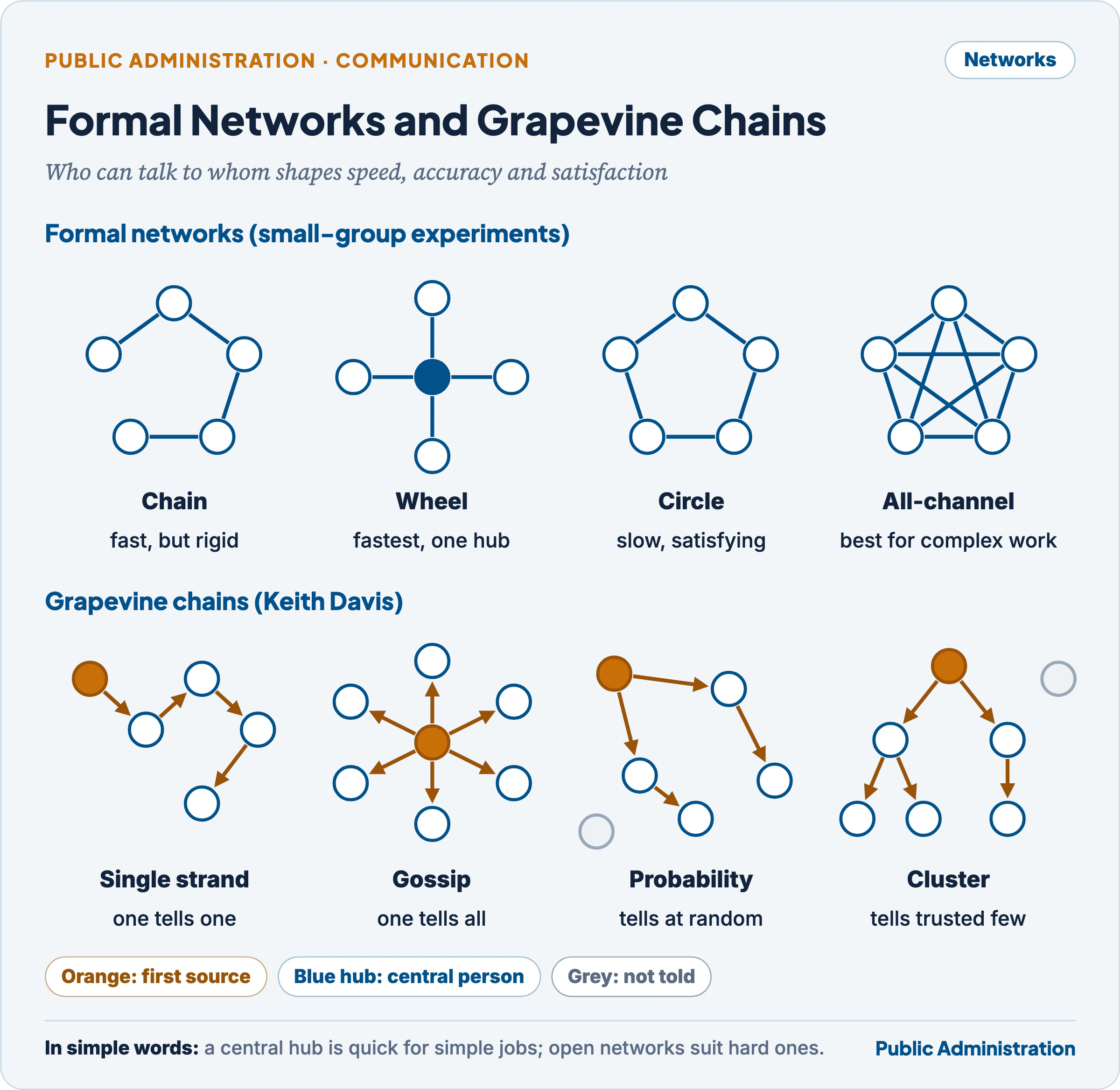
Alex Bavelas at MIT designed the experiments, and Harold Leavitt reported them in 1951: small groups solved a puzzle while allowed to pass messages only along fixed links. The results showed that structure shapes performance.
| Network | Pattern | Speed and accuracy | Satisfaction | Fits |
|---|---|---|---|---|
| Chain | Messages pass up and down a line, as in a hierarchy | Fairly fast, accurate on simple tasks; distortion over many links | Low at the ends | Routine, rule-bound work |
| Wheel (star) | Everyone communicates only through a central person | Fastest and most accurate on simple tasks; clear leader | Lowest, except for the hub | Crisis command, simple coordination |
| Y and inverted V | Variants of the chain with a branch | Intermediate | Intermediate | Small hierarchies with a deputy |
| Circle | Each talks only to two neighbours | Slow, more errors on simple tasks | Highest | Peer groups |
| All-channel | Everyone talks to everyone | Slower on simple tasks, best on complex ones | High | Task forces, committees, innovation |
- Centralised networks (wheel, Y, chain) did best on simple problems; decentralised ones (circle, all-channel) did better on complex problems and gave more satisfaction.
- People at the centre of a network sent the most messages and enjoyed their work most: centrality brings both influence and morale.
- The lesson for administration: no network is best for all purposes. A district control room in a flood works as a wheel; a policy task force on climate adaptation needs an all-channel network.
6. Informal Groups, Informal Communication and the Grapevine
In simple words
Every office has two organisations: the one on the organisation chart, and the one of friendships, tea groups, batchmates and rivals. The second one often knows the news first. The grapevine is the name for the news that travels along these unofficial lines.
6.1 “Formal organisations are made up of informal groups”
The Hawthorne studies (1924–32), reported by Roethlisberger and Dickson in Management and the Worker (1939), discovered that inside every formal organisation there are informal groups with their own leaders, norms and communication lines. Barnard then argued that formal and informal organisation are interdependent aspects of the same phenomenon: informal organisation comes first, makes formal organisation possible, and is in turn created by it.
Why informal groups form (as summarised by Hicks and Gullett and others):
- Social needs: affiliation, friendship and belonging, which formal roles do not satisfy.
- Identity and solidarity: personal comfort, status and recognition among peers.
- Release of tension: a sympathetic hearing for frustrations; informal groups act as release valves.
- Help with the job: colleagues teach shortcuts and unwritten rules.
- Creativity and values: room for initiative and for shared values the formal system ignores.
- Information: formal channels are slow and selective; members want to know what is going on.
What they do for the formal organisation (Barnard):
- carry facts, opinions, suggestions and suspicions that cannot easily pass through formal channels;
- maintain cohesion and the willingness to serve;
- preserve personal integrity and self-respect against the impersonality of the formal system;
- promote self-discipline in the group.
Their dysfunctions:
- Rumour: inaccurate, incomplete and distorted information.
- Resistance to change: groups defend customs and the status quo.
- Conformity and output restriction: in the Bank Wiring Observation Room, a cohesive group fixed its own “fair day’s work” and punished rate-busters, the informal version of Taylor’s “systematic soldiering”.
- Role conflict: a member torn between group norms and official duty.
- Cliques and favouritism: “kitchen cabinets”, caste or batch lobbies that bypass formal accountability.
The statement that formal organisations are made up of informal groups is therefore substantially true: no formal design works unless informal groups accept it, and the art of administration is to align the two rather than suppress the informal side.
6.2 The grapevine
The term is usually traced to the American Civil War, when hastily strung telegraph lines hung loosely from trees like vines and carried garbled messages. In organisations, the grapevine is the informal communication network that carries news and rumour along social lines.
Keith Davis, in “Management Communication and the Grapevine” (Harvard Business Review, 1953), studied it systematically:
- Four chains:
- Single strand: A tells B, who tells C, and so on; the least accurate.
- Gossip: one person tells everyone he meets.
- Probability: information passes at random.
- Cluster: A tells a few trusted people, who each tell a few others; the most common pattern.
- Only a minority of people act as liaison individuals who actively pass information on; most hear but do not pass it on.
- The grapevine is fast, carries information that matters to people, and in normal business situations is largely accurate (Davis reported that roughly 75 to 95 per cent of grapevine information was correct); its errors are dramatic and therefore remembered.
- It cannot be abolished: suppressed in one place, it reappears in another. Wherever people gather in groups, a grapevine develops.
Simon saw a practical use: the grapevine is a barometer of organisational opinion; an administrator who listens to it learns what topics interest members and how they feel about them.
Is the grapevine a necessary evil?
| Why “evil” | Why “necessary” |
|---|---|
| Spreads rumours and half-truths, especially in uncertainty (transfers, restructuring, promotions) | Fills gaps left by slow or secretive formal channels |
| Can damage reputations and morale | Fast, and often accurate on routine matters |
| Leaks confidential information | Acts as a safety valve and builds group feeling |
| Undermines formal authority when relied upon too much | Gives managers feedback on what staff really think |
| Heavy reliance on it signals weak coordination | Can translate official messages into meaningful terms |
The better view is that the grapevine is neither good nor evil but inevitable; it becomes “evil” mainly when formal communication fails. Managing it means:
- feeding it facts: prompt, honest official communication leaves little room for rumour;
- listening to it as an early-warning system;
- using key communicators (liaison individuals) to spread accurate news;
- correcting rumours openly and quickly;
- building trust, so that official statements are believed.
Indian Connect — Informal channels in Indian administration
- Batch, cadre and service networks (IAS batchmates, State service associations, officers’ messaging-app groups) are powerful informal channels; postings and policy changes are often known on them before orders issue.
- Rumour in crises: rumours of child-lifters spread through messaging apps in 2018 led to mob lynchings; COVID-19 brought floods of misinformation. The PIB Fact Check unit (set up in November 2019) is a formal answer to the external grapevine.
- Conduct rules (the CCS (Conduct) Rules, 1964) restrict unauthorised communication of official information and contact with the press, an attempt to keep the internal grapevine from becoming public leaks.
7. Barriers to Communication and How to Remove Them
In simple words
A message can fail because the words are confusing, because the listener is not paying attention, because he distrusts the speaker, because it passed through too many hands, or because it was one of a hundred messages that day. Each of these is a barrier, and each has a fix.
Communication problems are often symptoms of deeper problems: poor planning, unclear structure or vague standards. A wise administrator looks for the cause, not only the symptom. Barriers can arise in the sender, the channel, the receiver or the feedback.
7.1 Semantic and language barriers
- Words mean different things to different people; technical jargon and legal phrasing exclude the reader.
- Official language tends to become over-exact, abstract and impersonal. The American politician Maury Maverick coined the word gobbledygook for it in 1944, and Rudolf Flesch wrote “More about Gobbledygook” (1945) on the curiously legalistic ring of official communications.
- Poorly expressed messages: poor choice of words, omissions, incoherence, awkward structure.
- In India, the gap between the language of the file (often English) and the language of the citizen is a major semantic barrier.
7.2 Psychological and perceptual barriers
- Selective perception: people hear what they expect or want to hear.
- Premature evaluation and poor listening: judging before the speaker has finished.
- Halo effect: two-valued, black-and-white thinking that judges a person or message wholly good or wholly bad (Hicks and Gullett).
- Stereotyping: content is filtered through fixed expectations about the sender.
- Dogmatism: fixed beliefs block new information.
- Distrust, threat and fear: in a climate of fear, people become defensive and distort information; distrust grows from inconsistent behaviour by superiors.
- Unclarified assumptions: sender and receiver assume different things.
- Emotions: anger or anxiety colour how a message is sent and received.
7.3 Organisational barriers
- Filtering: deliberate manipulation of information; its extent depends mainly on the number of levels.
- Status and power differences between sender and receiver.
- Size and distance: large, dispersed organisations stretch every channel.
- Rigid rules and procedures: everything must go “through proper channel”.
- Absence of definite channels, or unclear responsibility for communicating.
- Lack of will to communicate: superiors who hoard information as a source of power.
- Information overload: too much information makes people ignore some of it, make errors, delay, filter arbitrarily, or escape from the task altogether.
- Loss by transmission and poor retention: each relay loses accuracy; people forget.
- Insufficient time for adjustment: changes communicated too suddenly to be absorbed.
7.4 Other barriers
- Ideological and cultural barriers: different backgrounds, education and values produce different social and political views; Pfiffner thought these were probably the greatest handicaps to communication and the hardest to overcome.
- Physical and technical noise: distance, bad connections, poor infrastructure.
- Feedback barriers: no mechanism to confirm understanding.
7.5 Principles and remedies
Millett’s seven principles of effective communication:
| Principle | Meaning |
|---|---|
| Clarity | Clearly and precisely stated |
| Consistency | Consistent with the receiver’s expectations and with earlier messages |
| Adequacy | Sufficient, neither overburdening nor too little |
| Timeliness | Neither too late nor too early |
| Uniformity | The same message for all who must act alike |
| Flexibility | Broad purpose with room for judgement, not rigid detail |
| Acceptability | Framed to win acceptance, for instance by reference to earlier agreements |
George Terry’s eight guidelines for the communicator: inform yourself fully; establish mutual trust; find common ground of experience; use mutually known words; have regard for context; secure and hold attention; use examples and visual aids; practise delaying reactions.
The American Management Association‘s “ten commandments” add: clarify ideas before communicating; examine the true purpose; consider the physical and human setting; consult others in planning; mind the tone as well as the content; convey something of value to the receiver; follow up; communicate for tomorrow as well as today; make actions support words; and seek to understand before seeking to be understood.
A barrier-to-remedy summary:
| Barrier | Remedy |
|---|---|
| Jargon, legalese | Plain language; local languages; simple forms |
| Too many levels, filtering | Delayering; delegation; direct and anonymous channels |
| Fear, distrust | Consistency; no-blame reporting; protection for honest messengers |
| Overload | Prioritise; summarise; dashboards; fewer circulars |
| One-way flow | Built-in feedback; follow-up; surveys |
| Silos | Inter-departmental committees; shared platforms; gangplank-style contact |
| Distance | Video conferencing; field visits; e-Office |
| Rumour | Prompt, honest official communication |
Above all, communication works only in a climate of mutual trust and confidence, treated as a continuing programme, not a one-time campaign.
Indian Connect — Reducing communication barriers in Indian government
- The 2nd Administrative Reforms Commission, in its 13th Report, Organisational Structure of the Government of India (2009), recommended no more than three levels of decision-making below the minister; the 12th Report, Citizen Centric Administration (2009), urged simple language, single-window services and effective grievance redressal.
- The Central Secretariat Manual of Office Procedure (16th edition, 2022) built in delayering, the desk-officer system and e-Office as defaults.
- Under the delayering drive, average file levels fell from 7.19 (2021) to 4.13 (February 2026), directly reducing filtering and lag.
8. Communication and Decision-Making: “Information Is the Life-Blood”
In simple words
A decision is only as good as the information behind it, and it is useless unless it is communicated to those who must carry it out. So communication comes in twice: before the decision, as information, and after it, as instruction and feedback.
- Before the decision: communication supplies the factual premises (data, field reports, expert advice) and the value premises (goals and priorities from the political executive). Simon’s decision-maker is an information-processing system; with bounded rationality, he satisfices on whatever information reaches him (see the article on Decision-Making).
- During the decision: consultation and committees pool knowledge; Millett’s conference method helps gain awareness and acceptance; participation improves both the quality and the acceptance of decisions.
- After the decision: the decision must be communicated clearly and with its reasons to those who implement it; feedback then tells the decision-maker whether it is working, starting the next cycle.
- Management information systems (MIS) apply information technology to this flow: generating, processing and transmitting the information that managers need for problem-solving and planning. Their danger is data without relevance: heaps of figures nobody uses.
- Goal-setting and goal-getting: public servants can pursue goals only if goals are communicated, monitored and revised; poor communication produces “goal displacement”, where officials chase returns and targets instead of results.
- Policy implementation: George C. Edwards III, in Implementing Public Policy (1980), named communication (clear, consistent and accurately transmitted orders) as the first of four factors in implementation, alongside resources, dispositions (the self-interest and attitudes of implementers) and bureaucratic structure. Vague or inconsistent instructions give implementers discretion that they may use against the policy.
- The budget as a communication framework: the budget tells every unit what the organisation’s priorities are and how much it may do; budget sanctions are a downward communication and expenditure returns an upward one.
Why the statement that information is the life-blood of an organisation holds:
- it coordinates separate units towards one purpose;
- it allows rational choice instead of guesswork;
- it gives early warning of problems;
- it makes accountability possible, because performance can be compared with plans;
- it legitimises decisions by explaining them to those affected.
9. Strategic Communication for Government
In simple words
A government does not only need to make good policies; it needs people to understand, trust and act on them: get vaccinated, use toilets, file taxes on time, evacuate before a cyclone. Strategic communication is the planned use of communication to achieve such policy goals, adjusted as the public responds.
9.1 Meaning
- Strategic communication is the purposeful use of communication by an organisation to fulfil its mission (Hallahan and colleagues, 2007). It is goal-driven, audience-centred, evidence-based and evaluated.
- The OECD Report on Public Communication: The Global Context and the Way Forward (December 2021), based on surveys of centres of government and health ministries in 46 countries, argued that public communication should move from a tool of information dissemination to a lever of open, two-way, responsive governance, built on objective-driven strategies, audience insight and evaluation.
- It is distinct from propaganda (one-way persuasion for the government’s image) and from public relations (managing reputation); its core is policy outcomes and citizen trust.
9.2 Why it must be an agile management process
An agile process works in short cycles of plan, act, measure and adapt, instead of a fixed, one-time campaign. Government communication needs this because the information environment changes by the hour, misinformation spreads faster than correction, and public responses are hard to predict.
- Listen first: social listening, surveys, grievance data and behavioural research show what people know, fear and believe.
- Set clear objectives: what should people know, feel or do?
- Segment audiences: farmers, youth, women, migrants and officials need different messages and channels.
- Craft and test messages: simple, consistent, in local languages, with trusted messengers.
- Choose channels: television, radio, print, social media, SMS, community leaders, frontline workers.
- Measure and adapt: track reach, understanding and behaviour change; drop what fails and scale what works.
- Coordinate across government: one voice, so that ministries do not contradict each other.
- Build internal communication: frontline staff must know the message before the public does.
9.3 India’s architecture of government communication
- Press Information Bureau (PIB): the nodal agency for communicating government policies to the media; its Fact Check unit (November 2019) counters false news about the Union government.
- MyGov (launched 26 July 2014): a citizen-engagement platform for discussions, polls, crowd-sourcing and campaigns, a two-way channel.
- Mann Ki Baat (monthly radio address since October 2014): direct, regular communication from the head of government.
- Ministry social-media cells, Doordarshan and All India Radio, the Directorate of Advertising and Visual Publicity (now the Central Bureau of Communication) for campaigns.
- Behaviour-change campaigns: Swachh Bharat (framing sanitation as dignity and a mass movement), Beti Bachao Beti Padhao, and COVID-19 communication (daily health ministry briefings, caller tunes, the MyGov chatbot helpdesk on a messaging app, appeals through frontline ASHA workers).
- Crisis communication: the 2nd ARC’s 3rd Report, Crisis Management (2006), stressed a communication plan as part of disaster preparedness. Odisha’s cyclone evacuations (Phailin 2013, Fani 2019) showed how early, repeated, trusted, multi-channel warnings save lives. NDMA’s SACHET system, built on the Common Alerting Protocol, had issued over 6,899 crore SMS alerts in more than 19 languages by June 2025, when nationwide testing of cell broadcast alerts began.
9.4 Limits and risks
- Credibility gap: communication cannot rescue a bad policy; overselling destroys trust.
- Propaganda risk: publicity money can be used for the ruling party’s image; courts have laid down guidelines on government advertising for this reason.
- Free speech: state fact-checking raises the question of who checks the checker. The Bombay High Court in Kunal Kamra v. Union of India (20 September 2024) struck down the 2023 amendment to the IT Rules that empowered a government fact-check unit to flag “fake” content about the Union government; the Union’s appeal is before the Supreme Court.
- Digital divide: digital-first communication can miss the poor, the elderly and remote areas.
10. Transparency and Keeping Staff in the Loop
In simple words
A transparent office tells its own staff what is happening and why, before they read it in the newspaper or hear it on the grapevine. People who are kept informed feel trusted, rumours have less room, and changes are carried out with less resistance.
A transparent organisation is one in which information about goals, decisions, reasons, performance and changes flows openly to its own members, not only to the public.
How it keeps staff in the loop:
- Sharing plans and reasons: explaining why a policy or restructuring is happening, not just what.
- Consultation before decisions that affect staff (postings policy, working hours, office reorganisation).
- Open performance information: shared targets, dashboards and progress reviews.
- Regular two-way forums: staff meetings, town halls, skip-level meetings, Chintan Shivirs (brainstorming retreats) in ministries.
- Clear, fair HR processes: published transfer and promotion criteria, online tracking of one’s own file or claim.
- Institutional voice: the Joint Consultative Machinery (since 1966) gives central employees a formal channel to raise service matters with the government; grievance cells and staff associations do the same.
- Digital tools: e-Office lets an employee see where a file is; iGOT Karmayogi and internal portals share learning and announcements.
Why it matters:
- Trust and morale: people who are kept informed feel valued; secrecy breeds suspicion.
- Rumour control: accurate information starves the grapevine of speculation.
- Better implementation: staff who understand the why act with judgement, not mechanically.
- Ownership and innovation: staff who see the whole picture suggest improvements.
- Psychological contract: sudden, unexplained changes are felt as breaches of unwritten expectations (Section 17).
Limits:
- Confidentiality: security, cabinet deliberations, ongoing investigations and personal data cannot be shared freely (Official Secrets Act, 1923; Digital Personal Data Protection Act, 2023, which also amended the personal-information exemption in Section 8(1)(j) of the RTI Act).
- Overload: sharing everything is not transparency; relevant information is.
- Cosmetic transparency: meetings that inform but never listen.
External transparency reinforces internal transparency: Section 4 of the Right to Information Act, 2005 requires every public authority to publish its functions, powers, norms, decision-making procedures and budgets suo motu. The 2nd ARC’s 1st Report, Right to Information: Master Key to Good Governance (2006), treated openness as a change of organisational culture, not only a legal duty.
11. E-Office and Digital Communication in Indian Government
In simple words
For decades, government files moved physically from table to table, sometimes for months. Now most central government files are electronic: they can be tracked, they move instantly, and nobody can claim a file is “lost”. This is the biggest change in the internal communication of Indian government since independence.
- e-Office, developed by the National Informatics Centre as a mission-mode project, replaces paper files with electronic files, digital receipts, e-signatures and file tracking.
- Scale: by February 2026, 93.78 per cent of all files created in central ministries were e-files, 95.30 per cent of receipts were e-receipts, and 66 ministries and departments had at least 90 per cent e-file adoption (DARPG Secretariat Reforms report released 24 March 2026).
- Effects on communication:
- Speed and the end of physical file movement;
- transparency of file status and accountability for delay;
- fewer levels (desk-officer system, delayering);
- institutional memory in searchable form;
- easier inter-ministerial movement and remote working.
- Other tools: video conferencing for reviews (PRAGATI), CPGRAMS for grievances, dashboards for schemes, NIC’s government messaging app Sandes, and the iGOT Karmayogi learning platform.
- The 2nd ARC’s 11th Report, Promoting e-Governance: The SMART Way Forward (2008), stressed that technology must come with process re-engineering, not merely digitise old procedures.
- New communication technology has both external and internal faces: it enables public engagement (MyGov, social media, grievance apps) and new forms of internal teamwork (shared files, collaborative documents, video meetings across headquarters and field).
Limits and risks:
- Digitising red tape: the same number of levels, now electronic.
- Loss of face-to-face contact, which carries trust and tacit knowledge.
- Cyber-security and data protection.
- Surveillance and stress: constant tracking can lower morale if used punitively.
- Uneven capacity in States and districts.
12. Morale: Meaning and Nature
In simple words
Morale is the mood of a team about its work. Three workers laying bricks were asked what they were doing. One said, “Laying bricks.” The second said, “Building a wall.” The third said, “Building a cathedral.” All did the same job, but the third had the highest morale: he saw meaning in it and took pride in it.
12.1 Definitions
- Alexander Leighton, the American psychiatrist and social scientist: morale is the capacity of a group of people to pull together persistently and consistently in pursuit of a common purpose. This is the most widely used definition.
- Dale Yoder: a feeling related to esprit de corps, enthusiasm or zeal; for a group, the overall tone, climate or atmosphere of work, perhaps vaguely sensed by the members.
- Edwin Flippo: a mental condition or attitude of individuals and groups that determines their willingness to cooperate. Good morale shows in enthusiasm, voluntary conformity with rules and willingness to cooperate; poor morale in surliness, insubordination and dislike of the job.
- Michael Jucius answered four questions: what it is (an attitude of mind, esprit de corps, a state of well-being, an emotional force); what it does (affects output, quality, costs, cooperation, discipline, initiative); where it resides (in the minds and emotions of individuals and in the reactions of their groups); whom it affects (employees, executives and, ultimately, consumers and the community).
- A public-administration view: morale is an attitude of satisfaction with, desire to continue in, and willingness to strive for the goals of a particular organisation.
12.2 Nature
- Group phenomenon: morale is generated by the group; it is a composite, not an average of individual attitudes. Fayol‘s fourteenth principle, esprit de corps (“union is strength”), is the classical recognition of it.
- Individual and group morale: individual morale rests on self-expression, pride in workmanship and identification with the group’s purpose; group morale rests on cohesion and pride in the group, which the Hawthorne studies found strong even where people disliked the work itself.
- Intangible and indirect: it can be measured only through its expressions.
- Dynamic: it fluctuates daily and also follows longer trends; it responds to pressures and supports.
- Unrelated to morality: morale is about spirit, not about right and wrong.
- Built, not ordered: motivation can be pushed by rewards and penalties; morale can be built only by positive means.
13. Morale, Motivation and Job Satisfaction
In simple words
Motivation is what makes one person want to do a task. Job satisfaction is how that person feels about the job. Morale is how the whole team feels about working together for the organisation. They overlap, but they are not the same.
| Basis | Motivation | Job satisfaction | Morale |
|---|---|---|---|
| Unit | Individual | Individual | Mainly the group |
| Nature | An inner drive or energy towards a goal | A feeling about the job (pay, work, supervision, colleagues) | A collective attitude or spirit towards the organisation |
| Focus | Willingness to do a particular task | Contentment with job conditions | Willingness to cooperate for a common purpose |
| Source | Needs and incentives | Job-related factors | Group relationships, leadership, shared purpose |
| Function | Mobilises energy | Expresses evaluation | Mobilises sentiments |
| How produced | Rewards and penalties | Better job conditions | Positive means only |
- Linkages: high motivation tends to raise morale, and high morale can be strongly motivating; both influence performance. In one formulation, motivation determines what a person will do; morale influences what a person can sustain with others.
- Content theories connect them: communication and recognition meet Maslow’s social and esteem needs; for Herzberg, recognition, responsibility and achievement are motivators, while poor supervision and policies are hygiene factors that lower satisfaction and morale (see the article on Motivation Theories).
Common confusion
If staff have high morale, are they necessarily highly motivated and productive? Not necessarily. A closely knit group can enjoy its work and its company (high morale) while agreeing among themselves to work slowly (low productivity), as the Bank Wiring group did. Conversely, a well-paid individual may be highly motivated to earn bonuses while the group around him is cynical. Morale, motivation and productivity are linked, but each can move without the others.
14. Determinants of Morale
In simple words
Morale rises when people feel secure, fairly treated, respected, well led and proud of their work, and when colleagues are supportive. It falls when they feel insecure, ignored, cheated or bullied.
Four broad sources of morale:
- The organisation: sound personnel policies, fair pay, job security, merit-based promotion, a reward system, a free flow of information, attitude surveys whose findings are shared and acted on. Morale cannot be extracted by an authoritarian attitude; it must be won.
- The nature of the work: meaningful, skilled, challenging work that gives a sense of competence and pride; tedious, routine work depresses morale.
- Supervision and leadership: democratic, fair, impartial supervisors who give recognition, explain the importance of work and use positive discipline. Employees often “leave managers, not organisations”.
- Fellow employees: cooperation, fraternity and help for newcomers raise morale; jealousy and non-cooperation lower it.
Specific factors:
- Job security and economic security;
- feeling valued and recognised;
- realistic, merit-based promotion opportunities;
- fairness in pay, workload, discipline and postings (equity, in Adams’s sense);
- management style: paternalistic or participative styles raise morale; authoritarian styles create a feeling of being neglected;
- organisational culture and its fit with employees’ values;
- self-concept: self-confident employees show higher morale;
- perception of work and reward: interesting work with clear prospects raises morale; boring work with remote rewards lowers it;
- job satisfaction (pay, promotion, working conditions, co-workers, supervision);
- working conditions: safety, comfort, space, facilities;
- the status and social value of the organisation’s work;
- communication: being informed and heard;
- external events: layoffs, cuts in benefits, attacks on the service in public debate, the death of a colleague on duty.
15. Indicators and Effects: How Morale Shows Itself
In simple words
Low morale is like a fever: you see it in people coming late, staying away, quitting, complaining, fighting and doing careless work. High morale shows in team spirit, pride, and people doing more than they are asked.
Morale can drive an organisation forward or produce discontent, poor performance and absenteeism. Its symptoms:
| Low morale | High morale |
|---|---|
| Absenteeism and tardiness | Punctuality, regular attendance |
| High turnover, requests for transfer | Longer stay; loyalty |
| Rising grievances and complaints | Few grievances; problems solved informally |
| Indiscipline, insubordination | Voluntary compliance with rules |
| Poor inter-personal and industrial relations; strikes, sabotage | Team spirit, group cohesion, harmony |
| Lack of pride; careless work; waste and spoilage | Pride in work, quality consciousness |
| Rising accidents | Fewer accidents |
| Resistance to change | Adaptability |
| Need for close supervision | Self-discipline; less supervision needed |
| Cynicism, gossip, rumour | Commitment to organisational goals; organisational citizenship |
Why morale matters for government in particular:
- Public services are labour-intensive and delivered at the frontline (teachers, constables, health workers, patwaris); their mood is the citizen’s experience of the state.
- Low morale shows as citizen-facing problems: absenteeism of teachers and doctors, rude behaviour, delay, corruption (“I am not valued, so why should I care?”).
- High morale enables discretionary effort in crises: elections, disasters, pandemics.
- Morale is contagious: one demoralised supervisor can depress a whole office, and a confident one can lift it.
16. Measuring Morale
In simple words
You cannot measure morale with a ruler. You either ask people how they feel (surveys and interviews) or watch the signs (absence, resignations, complaints, mistakes).
Direct methods:
- Attitude surveys: questionnaires (often anonymous) on pay, work, supervision, colleagues, policies and prospects; the most widely used method. They must be followed by communicating results and acting on them, or they deepen cynicism.
- Morale interviews and counselling interviews: free, frank conversation with employees without fear.
- Exit interviews: why people leave.
- Modern engagement and pulse surveys: short, frequent, digital surveys; 360-degree feedback.
- Spies and informers were once used by employers; they are discredited and themselves destroy morale.
Indirect indices:
- absenteeism, turnover, grievances, output levels, accidents, waste, disciplinary cases, transfer requests, participation in suggestion schemes and voluntary activities.
Cautions:
- Indices are ambiguous: turnover is naturally higher among young staff in unskilled posts; output can be raised by fear, and high-morale groups may produce little for lack of tools or by a deliberate decision to restrict output.
- Surveys suffer from social-desirability bias if staff fear identification.
- Morale should therefore be judged from several measures together, tracked over time.
17. Morale and Productivity: The Great Debate
In simple words
It seems obvious that happy workers work harder. But a happy team may also be happy doing very little, and a frightened team may produce a lot for a while. The real link between morale and productivity is real but weaker, and more conditional, than common sense suggests.
17.1 The four combinations
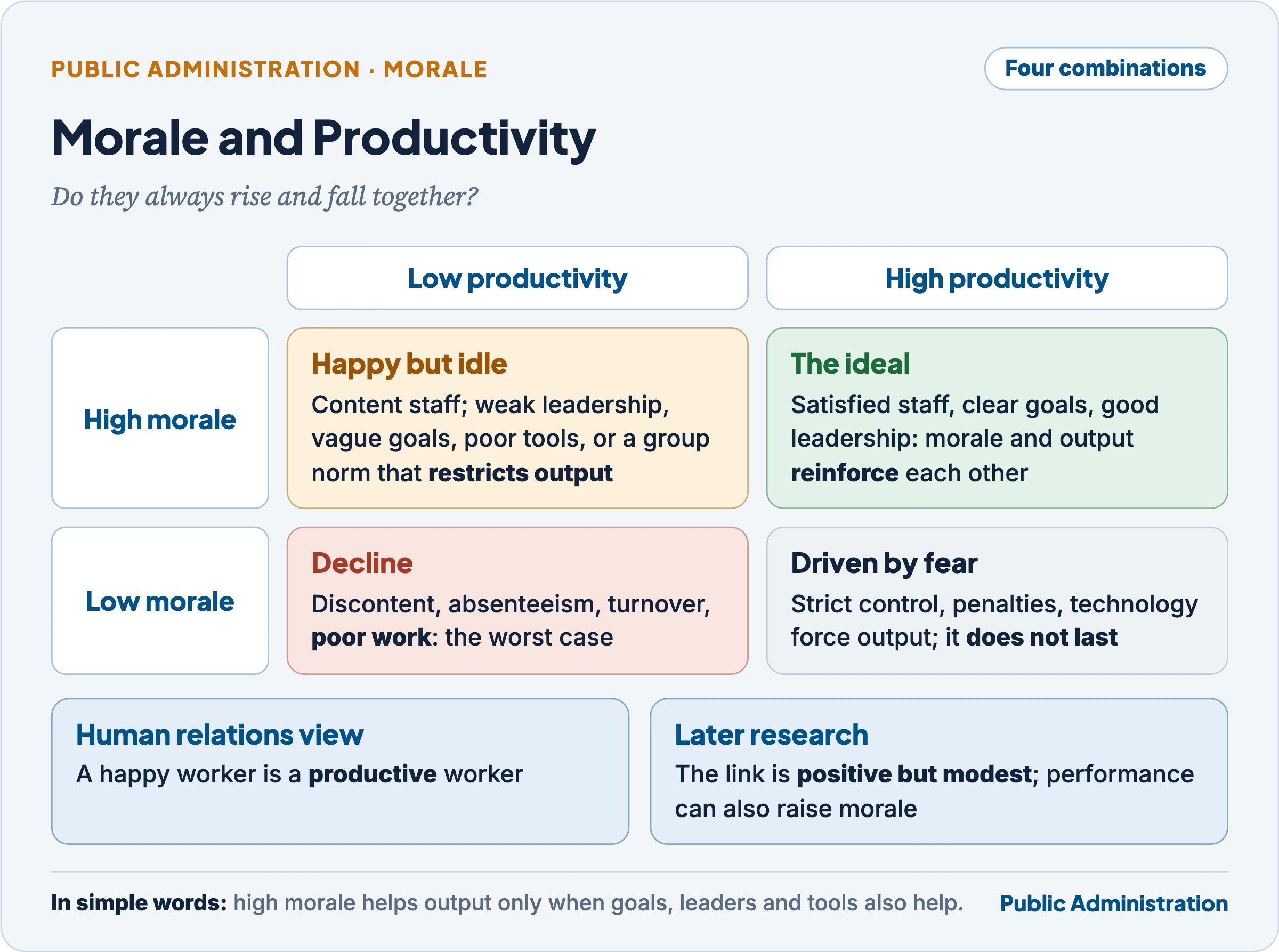
Writers on morale classify the relationship into four combinations:
- High morale, high productivity: satisfied staff with clear goals, good leadership and adequate means; morale and output reinforce each other. The ideal.
- High morale, low productivity: staff are content with their work and colleagues, but incompetent leadership, vague goals, poor facilities or a group norm that restricts output keep productivity low.
- Low morale, high productivity: strict rules, close supervision, fear of punishment and better technology force output up for a while, in the spirit of McGregor’s Theory X. It does not last: turnover, sabotage and burnout follow.
- Low morale, low productivity: discontent, absenteeism and poor work; neither control nor commitment.
17.2 What the evidence says
- Human relations belief: after Hawthorne, it was widely assumed that a happy worker is a productive worker.
- Hawthorne’s own evidence was mixed: the Bank Wiring group showed high cohesion with restricted output.
- Michigan studies: the Prudential Insurance study of the late 1940s (Katz, Maccoby and Morse) found that employee morale and satisfaction did not by themselves distinguish high- from low-producing sections; supervisory style mattered more.
- Brayfield and Crockett (1955), reviewing the research, found minimal or no relationship between employee attitudes and performance.
- Porter and Lawler (1968) reversed the arrow: performance, when fairly rewarded, produces satisfaction, not the other way round (see the article on Motivation Theories).
- Iaffaldano and Muchinsky (1985), in a meta-analysis, found only a weak average correlation; Judge and colleagues (2001), with better methods, estimated a moderate positive relationship (around 0.30).
- Rensis Likert argued that the long run matters: coercive pressure can raise output briefly while eating into the “human assets” of the organisation, whose loss appears later as turnover and decline.
17.3 Assessment
The proposition that morale and productivity go hand in hand is partly true:
- High morale is a necessary but not sufficient condition for sustained high productivity.
- The link is mediated by leadership, goals, skills, tools, incentives and group norms. Morale turns into output when the group’s norms align with organisational goals.
- The relationship is non-proportional: a 20 per cent rise in morale does not mean a 20 per cent rise in output.
- It runs both ways: success raises morale as much as morale raises success.
- In the long run, low morale nearly always reduces productivity through absenteeism, turnover, errors and lost initiative.
Criticism — Doubts about “higher morale, higher productivity”
- Restriction of output: cohesive, happy groups can agree to produce less, as in the Bank Wiring room.
- Weak empirical link: reviews from Brayfield and Crockett (1955) onwards found the correlation modest.
- Reverse causation: performance and fair reward may cause satisfaction, not the other way round.
- Fear works, briefly: strict control can raise output without good morale.
- Other factors dominate: technology, skills, leadership and resources often matter more.
- Vague concept: morale is hard to define and measure, which weakens any claimed relationship.
Defence — Why morale still matters for productivity
- Long-run effects: low morale shows up in absenteeism, turnover, accidents and lost initiative, all of which cut output.
- Discretionary effort: the extra effort that matters in crises and complex public work cannot be ordered; it comes from morale.
- Quality and service: in public services, courtesy, care and honesty depend heavily on morale.
- Modern evidence: better studies show a real, moderate positive relationship.
- Alignment: when group norms support organisational goals, high morale multiplies effort.
- Cost of the alternative: control-based output is expensive to supervise and does not last.
18. Building and Sustaining Morale
In simple words
Morale cannot be ordered into existence. It is built slowly, by treating people fairly, keeping them informed, giving them interesting work, recognising good work and caring for them as human beings, and it can be destroyed quickly by one unfair act.
Morale is significant because it determines the will to cooperate, which no rule can enforce. Methods to foster and sustain it:
- Lead by example: superiors who show the discipline, courtesy and commitment they expect (“walk the talk”).
- Clear and honest communication: share objectives, news and reasons promptly; listen.
- Participation and consultation: consult employees before decisions that affect them; use suggestion schemes, quality circles and staff councils.
- Recognition and appreciation: praise even small successes; awards, letters of appreciation, public acknowledgement.
- Job enrichment: challenging work, responsibility, autonomy and feedback (Herzberg).
- Empowerment and delegation: let people decide how to do their jobs.
- Challenge: set stretch goals with support; capable staff whose energy lies dormant can be roused by a real challenge.
- Fair personnel policies: transparent postings and transfers, merit-based promotion, timely pay and arrears, fair appraisal.
- Positive and fair discipline: consistent, impersonal and immediate, on McGregor’s hot-stove rule (the stove burns everyone who touches it, at once, every time, with warning).
- Training and career development: training, orientation and education raise competence and confidence.
- Care for the whole person: concern for health, family, housing, children’s education and work–life balance; counselling and employee-assistance programmes.
- Healthy, safe and pleasant workplaces: clean offices, safe conditions, rest rooms.
- Respond to problems promptly: unaddressed grievances signal that management does not care.
- Build team spirit: shared goals, celebrations, group rewards.
- Measure morale regularly and act on the findings.
19. The Psychological Contract
In simple words
When you join an organisation you sign a contract about pay and duties. But you also carry an unwritten list of expectations: that you will be treated fairly, promoted if you do well, and not transferred on a whim. The organisation has its own unwritten list: loyalty, extra effort when needed, discretion. This unwritten deal is the psychological contract. When either side breaks it, trust and morale collapse.
19.1 Origin and meaning
- Chris Argyris used the term “psychological work contract” in Understanding Organizational Behavior (1960) for the implicit understanding between foremen and workers: if the organisation respected the group’s norms, the workers would give good output.
- Harry Levinson and colleagues, in Men, Management and Mental Health (1962), described it as a series of mutual expectations, many of them unspoken, which govern the relationship.
- Edgar Schein, the American organisational psychologist, in Organizational Psychology (1965), made it central: the individual has a set of expectations of the organisation, and the organisation has a set of expectations of him. The degree of match determines commitment and performance.
- Denise Rousseau, in work from 1989 onwards, redefined it as the individual’s belief about the terms of a reciprocal exchange; it lies “in the eye of the beholder”, so the two sides may hold different contracts without knowing it.
19.2 Authority and upward influence
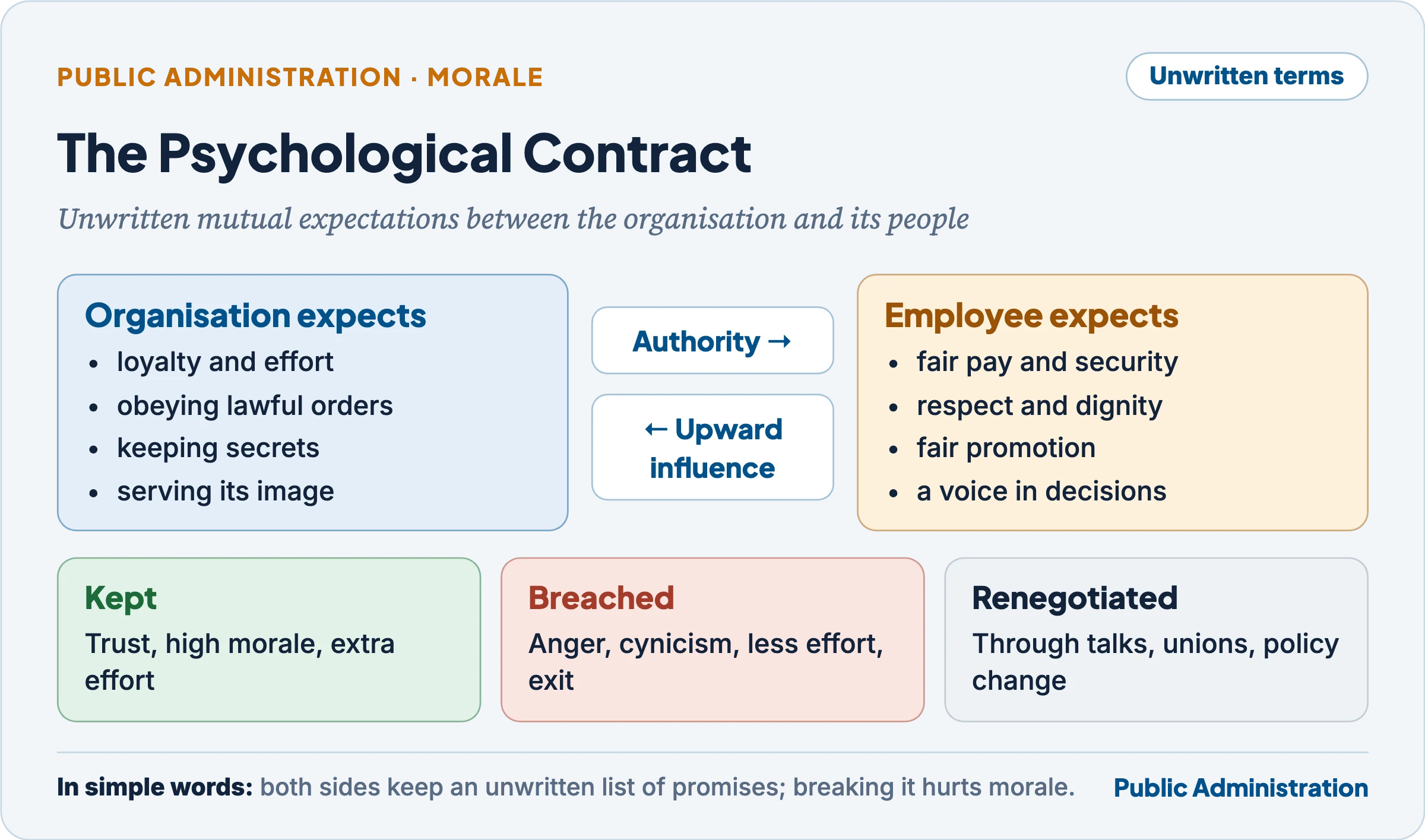
How is this unwritten contract enforced? Schein’s answer, which is the core of the concept:
- The organisation enforces its side through authority: it can issue orders, reward and punish, promote and transfer. Its expectations include loyalty, effort, obedience to legitimate orders, confidentiality and protection of the organisation’s image.
- The employee enforces his side through upward influence: voice (suggestions, grievances, negotiation, union action), participation, and in the last resort exit (resignation) or reduced effort. His expectations include fair pay, security, dignity, fair promotion, interesting work and a voice in decisions that affect him.
- The contract is therefore dynamic and political: it is constantly renegotiated through the interplay of authority from above and influence from below.
- The type of contract depends on the type of organisation: in Amitai Etzioni‘s terms, coercive organisations get alienated compliance, utilitarian ones calculative involvement, and normative ones (such as a mission-driven public service) moral commitment.
19.3 Transactional and relational contracts; breach and violation
| Transactional contract | Relational contract |
|---|---|
| Short-term, specific, mainly economic | Long-term, open-ended, socio-emotional |
| “A fair day’s pay for a fair day’s work” | Loyalty in return for security and career |
| Typical of contract staff, consultants | Typical of permanent civil services |
- Breach is the perception that the other side has failed to deliver a promise; violation is the emotional reaction (anger, betrayal) that follows.
- Consequences of violation: lower trust, commitment, effort and organisational citizenship; more cynicism, absenteeism and exit.
- Link with Barnard and Simon: the psychological contract is the subjective side of the inducements–contributions balance. Members stay and contribute while they feel inducements at least equal contributions; the zone of indifference widens when the contract is felt to be kept.
- Link with morale: morale is, in large part, the group’s verdict on whether the psychological contract is being honoured.
Indian Connect — The psychological contract in India’s civil services
- The traditional relational contract of the civil services (permanent tenure under Article 311, assured career, pension, status) is being reshaped by contractual and outsourced staffing, performance-linked appraisal and pension reform.
- Pensions: the shift from the old defined-benefit pension to the National Pension System in 2004 was widely felt by employees as a breach; the Unified Pension Scheme, effective 1 April 2025, restored an assured pension (50 per cent of average basic pay of the last twelve months for 25 years of service) for those who opt for it, an example of renegotiation through upward influence.
- Lateral entry: the August 2024 advertisement for lateral recruitment to 45 senior posts was withdrawn on 20 August 2024 after objections, including on reservation; career services saw such entry as touching their expectations of promotion.
- Transfers: arbitrary transfers are the most common perceived breach; the Supreme Court’s direction for Civil Services Boards and minimum tenure (2013) addresses it.
20. Morale in India’s Civil Services
In simple words
India’s civil servants hold great power and status, yet many feel demoralised: they are transferred suddenly, pressured by politicians, blamed for honest mistakes, stuck without promotion or buried in work. Reforms over the last two decades try to fix these, through stable tenure, training, recognition and fairer systems.
20.1 What depresses morale
- Frequent and arbitrary transfers: used as reward and punishment; short tenures prevent officers from completing work and disrupt family life.
- Political interference and pressure for illegal or partisan acts; oral instructions without written record.
- Fear of the “3Cs” (investigation, vigilance and audit) after honest decisions, which breeds risk-aversion and defensive file-noting.
- Promotion stagnation in some cadres and services, delays in empanelment, and the generalist–specialist divide.
- Vacancies and workload: shortage of officers at the cutting edge; police and health workers with long hours.
- Pay and parity disputes between services; delayed arrears in States.
- Public distrust and media trials: the honest majority tarred by the corrupt few.
- Poor working conditions at the field level: housing, transport, security, especially in remote and conflict areas.
- Opaque appraisal and grievance systems.
- Police morale: the Supreme Court in Prakash Singh v. Union of India (2006) directed a minimum two-year tenure for key police officers and Police Establishment Boards for postings, to insulate them from arbitrary transfer; implementation by States remains uneven.
20.2 What has been done
- Stable tenure and written orders: T.S.R. Subramanian v. Union of India (2013) directed Civil Services Boards for postings, a minimum tenure, and recording of oral instructions; the Hota Committee (2004) had earlier recommended fixed tenure and boards for postings.
- 2nd ARC, 10th Report, Refurbishing of Personnel Administration (2008): performance management, fair appraisal, mid-career training, and protection of civil servants from arbitrary action.
- Mission Karmayogi (National Programme for Civil Services Capacity Building), approved in September 2020, moving from “rule-based” to “role-based” HR; the Capacity Building Commission; the iGOT Karmayogi platform with over 1.70 crore registered users and more than 5,600 courses in 23 languages (August 2026). From the 2025–26 reporting year, completion of prescribed iGOT courses is captured in the APAR, linking learning with career.
- Recognition: the Prime Minister’s Awards for Excellence in Public Administration and Civil Services Day (21 April) celebrate good work.
- Appraisal reforms: online SPARROW APAR system; multi-source (360-degree) feedback for empanelment.
- Grievance and voice: the Joint Consultative Machinery; online grievance redressal for employees; staff associations.
- Pay and pensions: Central Pay Commissions (the 8th Central Pay Commission, whose terms of reference were approved on 28 October 2025, is chaired by Justice Ranjana Prakash Desai); the Unified Pension Scheme (2025).
- Better office environment: Special Campaigns for cleaner, decongested offices, e-Office reducing drudgery.
20.3 What remains
- Implement tenure protection in States, where most transfer abuse occurs.
- Protect bona fide decisions from harassment (the 2018 amendment to the Prevention of Corruption Act requiring prior approval before investigating decisions taken in official functions is a step).
- Balance performance pressure with support: Karmayogi must not become a box-ticking exercise.
- Improve frontline morale: teachers, health workers, constables and revenue staff, not only the higher services.
- Treat mental health and work–life balance as an organisational responsibility.
Key Terms
| Term | Meaning in simple words |
|---|---|
| Communication | Sharing information so that sender and receiver reach a common understanding |
| Encoding / decoding | Turning an idea into symbols; turning symbols back into meaning |
| Noise | Anything that distorts a message: jargon, fear, overload, bad signal |
| Feedback | The receiver’s response, telling the sender how the message was received |
| Decisional premises | Simon’s facts and values passed through communication to guide choice |
| Acceptance theory of authority | Barnard: an order has authority only if the receiver accepts it |
| Zone of indifference | The range of orders a member accepts without question |
| Cybernetics | Science of control through information and feedback (Wiener) |
| Load, lag, gain, lead | Deutsch’s measures: information volume, delay, size of response, foresight |
| Entropy | A system’s natural drift towards disorder; information counters it |
| Filtering | Deliberate editing of information as it passes up or down |
| Diagonal communication | Contact between different levels of different units |
| Gangplank | Fayol’s direct horizontal contact across chains of command |
| Wheel network | Everyone communicates through one central person |
| All-channel network | Everyone communicates with everyone |
| Grapevine | The informal network that carries news and rumour |
| Cluster chain | Davis’s commonest grapevine pattern: tell a few trusted people |
| Gobbledygook | Pompous, unclear official language |
| Strategic communication | Purposeful, planned, evaluated communication to achieve policy goals |
| e-Office | Electronic file and office-management system of the Government of India |
| Morale | A group’s capacity to pull together persistently for a common purpose |
| Esprit de corps | Team spirit; Fayol’s fourteenth principle |
| Attitude survey | Questionnaire measuring employees’ feelings about their work |
| Psychological contract | Unwritten mutual expectations between organisation and employee |
| Upward influence | The employee’s means of shaping the organisation: voice, participation, exit |
Commissions, Committees and Judgments
| Body / case | Year | Key point |
|---|---|---|
| Joint Consultative Machinery | 1966 | Formal channel between the government and central employees on service matters |
| Hota Committee on Civil Services Reforms | 2004 | Fixed tenure; boards for postings; performance appraisal reform |
| 2nd ARC, 1st Report, Right to Information: Master Key to Good Governance | 2006 | Openness as a change in organisational culture |
| 2nd ARC, 3rd Report, Crisis Management | 2006 | Communication plans as part of disaster preparedness |
| Prakash Singh v. Union of India | 2006 | Minimum tenure and Police Establishment Boards to protect police from arbitrary transfer |
| 2nd ARC, 10th Report, Refurbishing of Personnel Administration | 2008 | Performance management, fair appraisal, protection from arbitrary action |
| 2nd ARC, 11th Report, Promoting e-Governance: The SMART Way Forward | 2008 | Process re-engineering before digitisation |
| 2nd ARC, 12th Report, Citizen Centric Administration | 2009 | Plain language, single window, grievance redressal |
| 2nd ARC, 13th Report, Organisational Structure of the Government of India | 2009 | No more than three levels below the minister |
| T.S.R. Subramanian v. Union of India | 2013 | Civil Services Boards; minimum tenure; oral instructions to be recorded in writing |
| Central Secretariat Manual of Office Procedure, 16th edition | 2022 | Delayering, desk-officer system, e-Office as default |
| Kunal Kamra v. Union of India (Bombay High Court) | 2024 | 2023 IT Rules amendment on a government fact-check unit struck down |
| 8th Central Pay Commission (Justice Ranjana Prakash Desai) | 2025 | Terms of reference approved 28 October 2025 |
Contemporary Developments
- 5 August 2026: the Government told the Lok Sabha that iGOT Karmayogi had over 1.70 crore registered users and 5,600+ courses in 23 languages, and that from the 2025–26 reporting year completion of prescribed courses is recorded in every central and All India Services officer’s APAR.
- 24 March 2026: DARPG’s Secretariat Reforms report for February 2026 showed 93.78 per cent of new central files were e-files and the average file levels had fallen from 7.19 (2021) to 4.13, a measurable cut in hierarchical filtering and delay.
- 2026: DARPG’s monthly CPGRAMS reports put average grievance disposal time in central ministries at about 13 days.
- 28 October 2025: the Union Cabinet approved the terms of reference of the 8th Central Pay Commission under Justice Ranjana Prakash Desai, a major pay-related influence on civil-service morale.
- 30 June 2025: nationwide testing of indigenous cell broadcast emergency alerts began; NDMA’s SACHET system had by then sent over 6,899 crore SMS alerts in 19+ languages during disasters.
- 1 April 2025: the Unified Pension Scheme took effect, restoring an assured pension option for central employees under the NPS.
- 20 September 2024: the Bombay High Court in Kunal Kamra v. Union of India struck down the 2023 IT Rules amendment empowering a government fact-check unit, sharpening the debate on the limits of state “strategic communication”; the appeal is pending in the Supreme Court.
- 20 August 2024: the advertisement for lateral entry to 45 senior posts was withdrawn, illustrating how career-service expectations (the psychological contract) shape personnel policy.
Revision Grid
| Thinker / body | Work or report (year) | Key idea |
|---|---|---|
| Chester Barnard | The Functions of the Executive (1938) | Communication as first executive function; authority as accepted communication; zone of indifference |
| Herbert Simon | Administrative Behavior (1947) | Communication transmits decisional premises; no communication, no organisation; grapevine as barometer |
| Roethlisberger and Dickson | Management and the Worker (1939) | Informal groups and output restriction |
| Harold Lasswell | “The Structure and Function of Communication in Society” (1948) | Who says what, in which channel, to whom, with what effect |
| Norbert Wiener | Cybernetics (1948) | Control by information and feedback; information against entropy |
| Shannon and Weaver | The Mathematical Theory of Communication (1949) | Source, channel, receiver, noise |
| Bavelas and Leavitt | Network experiments (1951) | Centralised networks for simple tasks; decentralised for complex ones and satisfaction |
| Keith Davis | “Management Communication and the Grapevine” (1953) | Four grapevine chains; cluster commonest; largely accurate |
| John D. Millett | Management in the Public Service (1954) | Blood stream; seven principles; conference method |
| Wilbur Schramm | “How Communication Works” (1954) | Overlapping fields of experience |
| Brayfield and Crockett | Review (1955) | Minimal link between attitudes and performance |
| David Berlo | The Process of Communication (1960) | SMCR model |
| Chris Argyris | Understanding Organizational Behavior (1960) | “Psychological work contract” |
| Levinson and colleagues | Men, Management and Mental Health (1962) | Mutual, often unspoken expectations |
| Karl Deutsch | The Nerves of Government (1963) | Government as steering; load, lag, gain, lead |
| Edgar Schein | Organizational Psychology (1965) | Psychological contract enforced by authority and upward influence |
| Porter and Lawler | Managerial Attitudes and Performance (1968) | Performance leads to satisfaction |
| George C. Edwards III | Implementing Public Policy (1980) | Communication, resources, dispositions, structure |
| Iaffaldano and Muchinsky; Judge and colleagues | Meta-analyses (1985; 2001) | Satisfaction–performance link weak to moderate |
| Denise Rousseau | Psychological contract research (1989 onwards) | Individual beliefs; transactional and relational contracts |
| Alexander Leighton | Definition of morale | Capacity of a group to pull together for a common purpose |
| OECD | Report on Public Communication (2021) | Strategic, two-way, evaluated public communication |
| 2nd ARC | 1st, 3rd, 10th–13th Reports (2006–09) | Openness, crisis communication, personnel reform, e-governance, fewer levels |
| Supreme Court | T.S.R. Subramanian (2013); Prakash Singh (2006) | Tenure, boards, written instructions |
Previous Year Questions
- 2026A transparent organisation keeps the staff in the loop. Describe.
- 2026New communication technology has not only enabled more robust public engagement with the government, but also serves as a new means of internal organizational teamwork. Discuss.
- 2024“Formal organisations are made up of informal groups.” Discuss.
- 2024“Grapevine is a necessary evil.” Examine.
- 2024Healthy Headquarters and Field Agencies relationship thrives on effective communication. Comment.
- 2022Strategic communication ought to be an agile management process. Discuss the conceptualization of strategic communication for the government actions.
- 2022Transformational leadership requires high degree of coordination, communication and cooperation. Explain.
- 2018Communication represents the “Nerves of Government” (Karl Deutsch). How can the communication system in the government be made more effective, responsive and motivational?
- 2016“Morale can drive an organization forward or can lead to employees’ discontent, poor job performance and absenteeism.” Examine.
- 2015“Information constitutes the life-blood of the functioning of an organisation. “Explain the utility and significance of communication in decision-making.
- 2013What is the nature of psychological contract pursued by organizational management through authority and the employees through exertion of upward influence?
- 2011An administrator uses the budget as a framework for communication and co-ordination, as well as for exercising administrative discipline throughout the administrative structure. Explain.
- 2007What is meant by morale? There is a belief that “moral and productivity go hand in hand and higher the morale, higher the productivity.” Do you agree? Substantiate.
- 2003What is morale? State its significance and suggest methods to foster and sustain morale in an organization.
- 2001‘The nature and role of communication in administration indicates that “Communication is authority”; Comment.
- 2000….. “a more thorough consideration leads to the understanding that communication, authority, specialisation and purpose are all aspects compre-hended in coordination.”- (Chester I. Barnard) Comment.
- 2000“Information constitutes the life-blood of the functioning of organization.” In the light of this statement, explain the utility and importance of communication in decision-making.
- 1998“Communication holds the organisation together.” Comment.
- 1995Authority has been defined in part as a “character of a communication in a formal organisation.” Comment.
- 1995“Much of what the recruit learns in an organisation is communicated after the fashion of Bentham’s ‘dog law’.” Discuss.
- 1995Explain how factors such as communications, resources, self interests and bureaucratic structures affect implementation of public policies.
- 1994Bring out the importance of communication in administrative organisations. What are the drawbacks in upward communication?
- 1993“A managerial leader should effectively communicate to motivate his team.” How do Maslow and Herzberg see this inter linkage between motivation and communication?
- 1990‘Without communication, there can be no organisation’. Discuss the importance of communication in Public Administration.
- 1987Critically examine the functions of administrative leadership. What role does communication play in improving the quality of administrative decisions in goal setting and goal getting by public servants.
- 1987‘Contributions of Maslow and Herzberg have deepened our understanding about the State of morale and motivation of the public servants.’ Comment.
- 2022“The Chief Secretary is the chief communication link between the state and central government”. Explain.
- 2004“The district officer as a chief agent and representative of state serves as a channel of communication between the Government and the residents of the district.” Explain.