

Administrative Behaviour: Process and techniques of decision-making; Communication; Morale; Motivation Theories – content, process and contemporary; Theories of Leadership: Traditional and Modern.
This article: Process and techniques of decision-making: meaning and types of decisions, the decision process, the behavioural basis of administration, rationality and its limits (Simon), incrementalism, mixed scanning, the optimal model, garbage can and Allison’s models, the decision environment, quantitative and group techniques, groupthink, delegation, evidence and performance-information use, and data- and AI-assisted decisions in Indian government.
Official Syllabus: Paper I · Unit 1-03 Administrative Behaviour
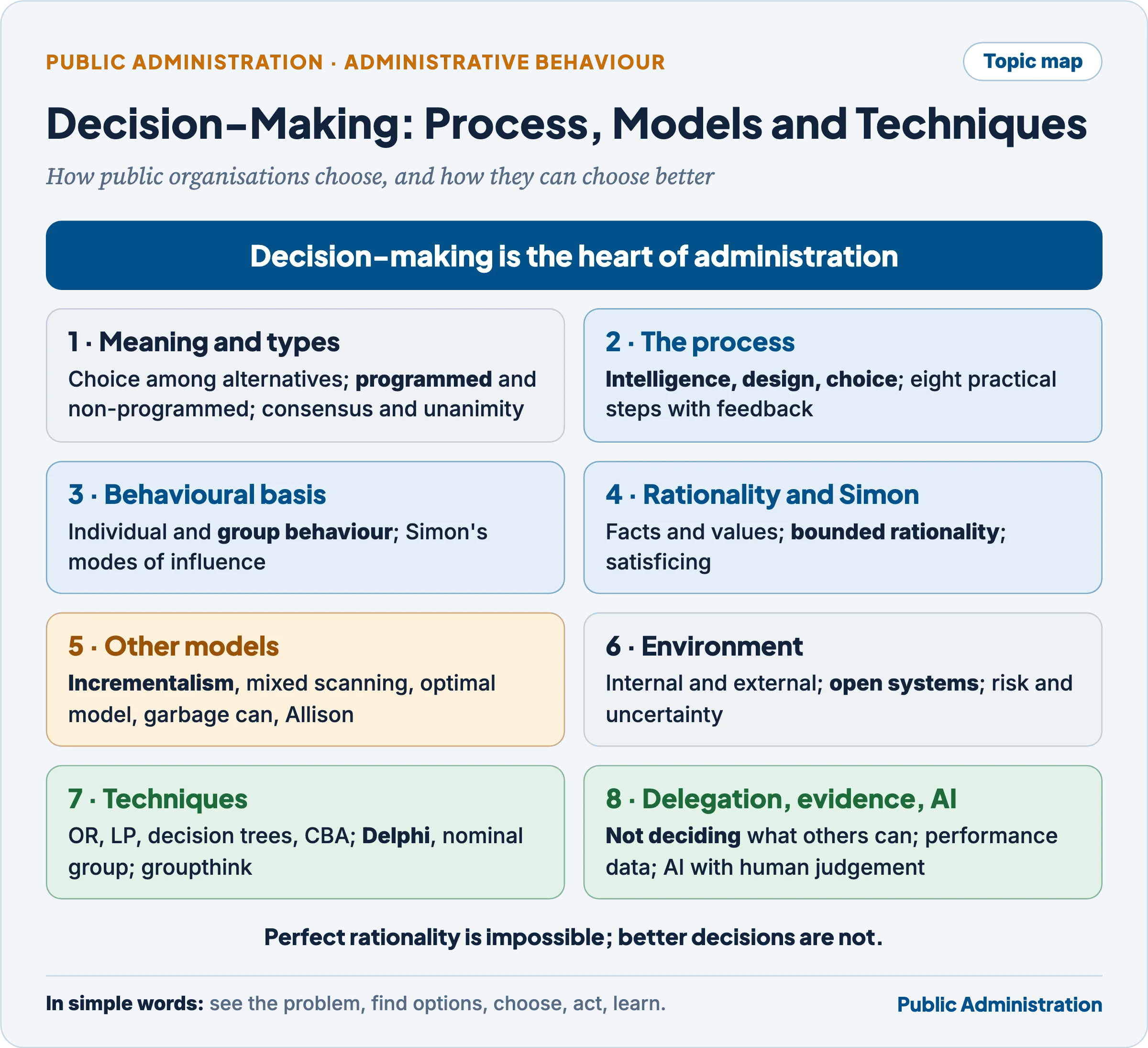
Every act of administration begins as a decision: to sanction a road or not, to declare a drought or wait for one more rainfall report, to transfer an officer, to release an instalment, to prosecute or to compound an offence. Herbert Simon made this the starting point of a whole school of thought: an organisation is best understood as a structure of decision-makers, and “administration” is the process by which choices are made and carried out. The study of decision-making therefore asks three questions that run through this article: how decisions are actually made (process and behaviour), how well they can be made (rationality and its limits), and with what aids they can be improved (techniques, delegation, evidence and data).
In simple words
A District Collector receives a report of rising diarrhoea cases in three villages. She can wait for more data, send a medical team at once, close the suspect well, or ask the Block officer to decide. Whatever she does, including doing nothing, is a decision. How she notices the problem, what options she sees, how much information she can gather in the time she has, whose advice she takes and what she finally chooses is the subject of this article.
1. Meaning and Nature of Decision-Making
In simple words
A decision is simply a choice between alternatives made to reach some goal. In a government office, decisions are rarely one person’s free choice: they are shaped by rules, by superiors, by the information on the file and by the values of the organisation.
1.1 Definitions
- Decision-making is the selection of one course of action from among alternatives in order to move towards a desired state of affairs. A decision is an act of choice in which an executive forms a conclusion about what must be done in a given situation.
- Herbert Simon, the American Nobel-winning theorist of decision-making, in Administrative Behavior (1947), held that decision-making is the heart of administration. Every member of the organisation decides, not only the top: the clerk who chooses which file to put up first, the inspector who chooses which shop to raid. He defined choice as the process by which one of the many possible behaviour alternatives at each moment is selected and carried out; a series of such choices over time is a strategy.
- A fuller behavioural definition: decision-making is a conscious human process, involving both individual and social phenomena, based on factual and value premises, which ends with the choice of one behaviour from among alternatives with the intention of moving towards some desired state of affairs.
- George Terry, an American management writer, separated policy from decision: a policy is broad, affects many problems and is used again and again; a decision applies to a particular problem and is used once. Yet a policy is itself the product of a decision, which is why “all policy-making is decision-making, but all decision-making is not policy-making“.
1.2 Three mental elements in every decision
Psychologists identify three aspects of the mind that enter every choice:
- Cognition: knowing and reasoning (facts, data, analysis).
- Conation: willing, desiring, being averse to something (motive and intention).
- Affection: emotion, feeling, mood and temperament.
A decision is therefore never only an intellectual calculation. This is the root of the behavioural view of decision-making developed in section 4.
1.3 Characteristics of a decision
- It is a process of selection: there must be at least two alternatives, even if one is “do nothing”.
- It is goal-directed: in an organisation, the aim is the organisation’s objectives, not only the decider’s.
- It requires evaluation of alternatives against some criteria.
- It is a mental and human process, so it carries the decider’s knowledge, values and limits.
- It implies commitment of resources and of authority, for the short or the long run.
- It is future-oriented and hence carries uncertainty: no one decides about the past.
- It is a means, not an end: decisions are made and remade as circumstances and ends change.
- Decisions are sequential and hierarchical: a State department decides how much rice to procure; the Collector then decides how much to procure from which block; the block then decides which centres to open. Each higher decision sets the frame for the lower ones.
1.4 Positive and negative decisions
Chester Barnard, the American telephone executive and organisation theorist, in The Functions of the Executive (1938), divided decisions into two classes:
- Positive decisions: to do something, direct action, stop action or prevent action.
- Negative decisions: decisions not to decide. They are often unconscious and “instinctive”, yet they are inescapable, and “it is because of the rejections that the selection is good”.
This idea matters for public administration because much government behaviour consists of not deciding: files kept pending, issues kept off the agenda. Political scientists Peter Bachrach and Morton Baratz (“Two Faces of Power”, 1962; “Decisions and Nondecisions”, 1963) showed that non-decisions, keeping certain issues from ever reaching the agenda, are themselves an exercise of power and part of policy.
1.5 Barnard: personal and organisational decisions
- Organisational decisions are made by a person in an official capacity for the organisation’s purposes. They can be delegated and their logic is impersonal.
- Personal decisions concern whether the individual will contribute to the organisation at all (join, stay, work hard, leave). They cannot be delegated and follow the person’s own motives.
- Barnard’s point: the executive’s task is to make the organisational decision acceptable to the individual, so that personal and organisational decisions point the same way. This is the bridge to motivation and morale (see the articles on Motivation Theories and on Communication and Morale).
1.6 Decision-making in public versus private organisations
| Basis | Public administration | Business |
|---|---|---|
| Goals | Many, vague and often conflicting (equity, efficiency, legality, votes) | Fewer and clearer (profit, market share) |
| Outside influence | Legislature, courts, audit, media, parties and pressure groups all press on the decision | Freer of outside pressure |
| Accountability | Decisions must be recorded, reasoned and defended; they can be reviewed in courts and audited | Accountable mainly to shareholders and the market |
| Speed | Procedures, consultation and file movement slow decisions; delay itself is criticised | Speed is prized; delay is costly |
| Measure of success | Hard to measure (public value, equity, legitimacy) | Measurable in money |
The public decision-maker cannot keep a matter pending forever, yet cannot decide without carrying the people and the system along. Kautilya‘s advice that the king should consult ministers before deciding and decide in time, and Barnard’s warning that decision is “a burdensome task”, both recognise this tension.
2. Types of Decisions
In simple words
Not all decisions are alike. Renewing a driving licence is a routine choice that a rule can settle; deciding how to respond to a new epidemic is a one-off choice that no rule covers. Different kinds of decisions need different people, procedures and techniques.
The main classifications are set out below; each answers a different question about the decision.
| Classification | Type A | Type B | Who usually decides |
|---|---|---|---|
| Structure (Simon) | Programmed: repetitive, routine, settled by a rule or procedure | Non-programmed: novel, unstructured, of high consequence | Lower levels / top levels |
| Time and scope | Strategic (basic): long-term direction, structure, objectives | Tactical and operational: how to implement the strategy | Top / middle and lower |
| Level | Policy decisions: basic policies, long-term impact | Operative decisions: day-to-day functioning | Top / lower |
| Capacity (Barnard) | Organisational: made in official capacity, delegable | Personal: about one’s own participation, not delegable | Any member |
| Number of deciders | Individual: one person, suits routine matters | Group: committee or team, suits complex matters | Officer / committee, board, cabinet |
| Certainty of outcome | Under certainty or risk: outcomes known or with known probabilities | Under uncertainty: probabilities unknown | Analysts / leaders using judgement |
2.1 Programmed and non-programmed decisions
- The terms come from computer language: a programme is a plan for the automatic solution of a problem. Simon developed the distinction in The New Science of Management Decision (1960).
- Programmed decisions are repetitive and routine; definite procedures exist, so each case need not be treated afresh. Examples: sanction of leave, payment of pension, issue of a caste certificate against set documents, award of a tender by the lowest-bid rule.
- Non-programmed decisions are new, unstructured, consequential or elusive; no ready method exists, so the organisation must innovate and improvise. Examples: the first response to COVID-19 in March 2020, a new unemployment allowance, starting dairy or cold-storage activities for the first time, designing the GST rate structure.
- They are two ends of a continuum, not two boxes: most real decisions are partly programmed.
- The key difference: for programmed decisions the organisation supplies the alternatives through routines; for non-programmed decisions it supplies only the parameters for search.
- Common elements in both (Simon): defining the situation, linking means to ends, dividing the problem into parts, choosing by “satisficing” rather than optimising, uncertainty absorption (facts are summarised and their doubts dropped as they travel up the hierarchy) and routinisation.
2.2 Simon’s two-dimensional taxonomy
Simon classified decision-making techniques along two dimensions at once: the type of decision (programmed or non-programmed) and the age of the technique (traditional or modern). The resulting four-cell grid explains which tools fit which decisions.
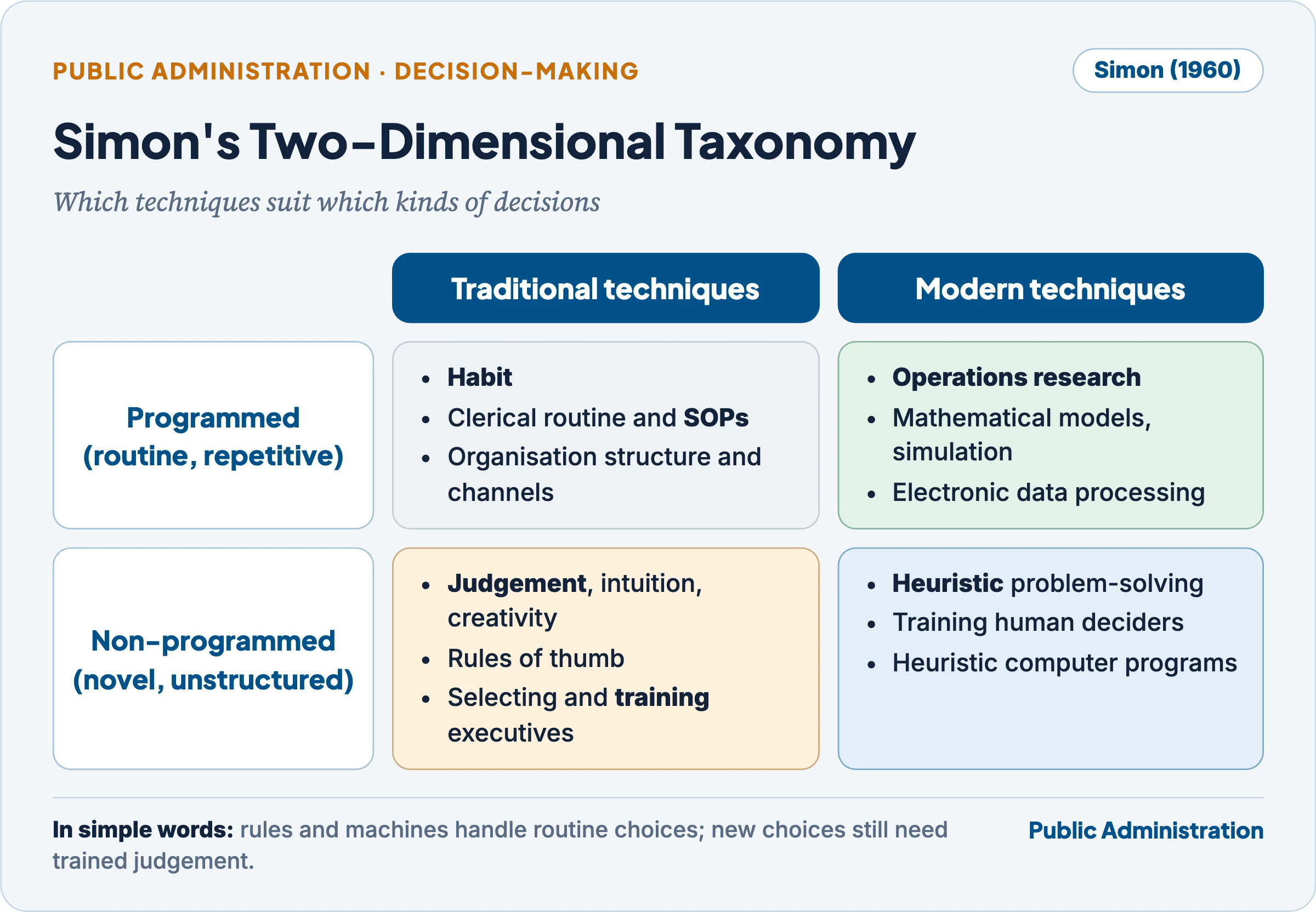
| Type of decision | Traditional techniques | Modern techniques |
|---|---|---|
| Programmed (routine, repetitive) | Habit; clerical routine and standard operating procedures; organisation structure (common expectations, sub-goals, defined channels of information) | Operations research (mathematical analysis, models, computer simulation); electronic data processing |
| Non-programmed (one-shot, ill-structured) | Judgement, intuition and creativity; rules of thumb; selection and training of executives | Heuristic problem-solving applied to training human decision-makers and to building heuristic computer programs |
- What it shows: routine decisions can be handed to rules and, increasingly, to machines; novel decisions still depend on human judgement, which can be trained.
- Simon’s prediction: computers and operations research would let more and more decisions be programmed, reducing the need for middle managers and leading to recentralisation of decision-making. Indian experience with dashboards and real-time monitoring (section 14) shows both the promise and the risk of this.
2.3 Gresham’s law of planning
James March and Herbert Simon, in Organizations (1958), noted a “Gresham’s law” of decision-making: just as bad money drives out good money, programmed (routine) activity tends to drive out non-programmed (planning) activity. An officer flooded with routine files never finds time to think about the long-term problem.
- Example: a District Collector buried in daily review meetings and court cases may never prepare the district’s flood-preparedness plan until the flood arrives.
- Remedy: separate planning units (policy cells, strategy units, NITI Aayog-type bodies) and delegation of routine work, so that someone is protected from the routine.
2.4 Strategic and tactical decisions: the entrepreneur and the manager
- Strategic decisions settle what the organisation should do: its purpose, direction and major commitments. They are taken under uncertainty, have long-term effects and often cannot be reversed.
- Tactical decisions settle how to carry out the strategy with given resources; operational decisions settle day-to-day details.
- The entrepreneur (in government, often the political executive or a reforming leader) makes strategic choices: to launch a scheme, to enter a sector, to restructure an institution. The manager (the career administrator) makes tactical choices: how to deliver the scheme efficiently.
- But the line is not fixed. Managers shape strategy through the options and information they put up; entrepreneurs often decide tactics when they micromanage. In public administration, senior civil servants are expected to advise on strategy as well as manage. A good organisation keeps both roles alive.
2.5 Individual and group decisions
Group decisions bring more knowledge and more acceptance but cost time and blur responsibility. The contrast below underlies the group techniques of section 12.
| Basis | Individual decision | Group decision |
|---|---|---|
| Speed | Fast | Slow |
| Information and ideas | Limited to one mind | Wider pool of knowledge and views |
| Acceptance | Lower; others may resist | Higher; those who decide help implement |
| Responsibility | Clear | Diffused; hard to fix |
| Risks | Personal bias, limited view | Groupthink, domination by one member, compromise on a weak option |
| Best for | Routine, urgent, confidential matters | Complex, new matters needing acceptance |
2.6 Consensus and unanimity as styles of decision
Groups can reach decisions in several styles: by authority (the chair decides after hearing members), by majority vote, by consensus or by unanimity.
- Unanimity: every member positively agrees; any one member can block the decision. It gives each member a veto. Example: decisions of the UN Security Council need the concurring votes of all five permanent members on substantive matters.
- Consensus: the group reaches a general agreement that all can live with, even if some members have reservations; no one presses an objection to the point of blocking. Consensus is about acceptance, not identical opinions.
- Strengths: both styles build ownership and reduce resistance during implementation, which matters in federations, coalitions and committees of equals.
- Weaknesses: unanimity can lead to paralysis or to the lowest common denominator; consensus can hide real disagreements, slow decisions and invite groupthink.
- Japanese ringi system: a proposal circulates bottom-up and each official affixes a seal; decisions are slow to make but fast to implement because everyone has already agreed.
Indian Connect — Consensus and unanimity in Indian decision-making
- The GST Council (Article 279A, inserted by the Constitution (101st Amendment) Act, 2016) decides by a majority of not less than three-fourths of the weighted votes of members present and voting; the Union’s vote counts for one-third and all the States together for two-thirds. Formally, therefore, neither the Union alone nor all the States together can carry a decision; in practice the Council has worked largely by consensus, which reflects the logic of cooperative federalism.
- Cabinet decisions rest on the convention of collective responsibility (Article 75(3)): ministers may disagree inside the Cabinet, but once a decision is taken all must support it in public. This is consensus by convention, not unanimity of opinion.
- Gram Sabhas and many tribal councils traditionally seek consensus rather than votes, which builds acceptance but can let dominant groups silence dissent.
2.7 How much participation? The Vroom–Yetton model
Victor Vroom and Philip Yetton, in Leadership and Decision-Making (1973), argued that the right style depends on the problem. A manager asks seven yes/no questions in sequence: does the decision need high quality, does the leader have enough information, is the problem structured, is subordinates’ acceptance critical, would they accept an autocratic decision, do they share the organisation’s goals, and is conflict likely among them. The answers lead to one of five styles:
- AI: the leader decides alone with the information at hand.
- AII: the leader gets information from subordinates, then decides alone.
- CI: the leader consults subordinates individually, then decides.
- CII: the leader consults them as a group, then decides.
- GII: the group decides together, aiming at consensus; the leader acts as chair.
The model is a contingency theory of decision participation: neither autocracy nor participation is always best. It is developed further in the article on Theories of Leadership.
3. The Decision-Making Process
In simple words
Any careful decision moves through a few steps: noticing that something is wrong, understanding why, thinking of possible answers, comparing them, choosing one, acting, and checking whether it worked. Real decisions rarely follow the steps neatly, but the steps show where a decision can go wrong.
3.1 Simon’s three phases: intelligence, design, choice
In The New Science of Management Decision (1960), Simon divided the process into three phases:
- Intelligence activity: searching the environment for occasions calling for a decision: detecting problems and opportunities. (The word is used in its military sense of gathering information.)
- Design activity: inventing, developing and analysing possible courses of action. This is usually the most time-consuming phase.
- Choice activity: selecting one course of action from those available.
- Simon later added a fourth activity, review: assessing past choices.
- Not a straight line: each phase can contain the others. Designing an alternative may itself require new intelligence; choosing may reveal that the problem was wrongly defined.
3.2 Mintzberg’s three phases
Henry Mintzberg, Duru Raisinghani and André Théorêt, in “The Structure of ‘Unstructured’ Decision Processes” (1976), studied 25 real strategic decisions and found three phases, close to Simon’s but more untidy:
- Identification: recognising the need for a decision and diagnosing it.
- Development: searching for ready-made solutions or designing custom-made ones.
- Selection: screening, evaluating and authorising a choice.
- Real decisions were interrupted, delayed and recycled: new information, political blocks and timing forced decision-makers back to earlier phases again and again.
3.3 The general rational sequence
Combining these approaches, a rational decision passes through the following steps. The diagram below shows them as a cycle with feedback.
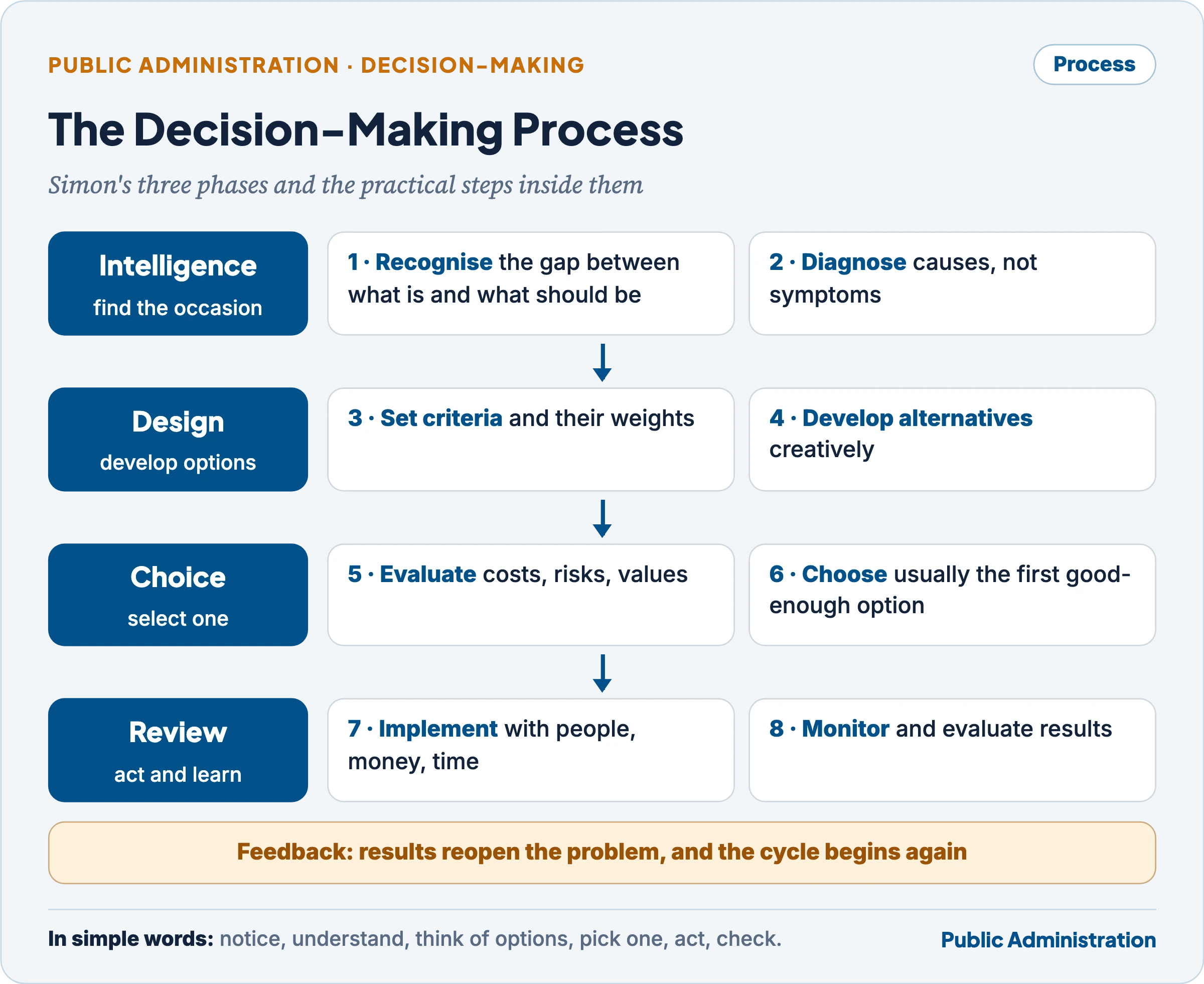
- Recognise the need for a decision. A problem is a gap between what is and what should be: falling immunisation rates, rising complaints, a court order. Whether a gap is seen as a problem depends on the decision-maker’s perception: what one officer sees as a crisis, another sees as normal.
- Diagnose and define the problem. Symptoms must be separated from causes, just as a doctor separates fever from infection. Management may see a clash of personalities when the real problem is poor structure; it may launch a cost-cutting drive when the real problem is poor design. A wrongly defined problem guarantees a wrong decision.
- Set decision criteria and weights. What will count as a good solution: cost, speed, equity, legality, acceptability? Weights are subjective: one person buying a two-wheeler values looks, another price, a third fuel efficiency.
- Develop alternatives. This is a creative step that needs divergent thinking; decision-makers must not be prisoners of past practice. Encouraging dissent helps, since disagreement is a source of alternatives. Group techniques (section 12) are designed for this step.
- Evaluate alternatives. Each alternative is weighed against the criteria, using quantitative factors (cost, time) and qualitative ones (morale, political climate, legal risk), with both desirable and undesirable consequences.
- Choose. The alternative that best meets the criteria is selected. In practice, as Simon showed, the choice is usually the first that is good enough (section 6).
- Implement. The decision is communicated, accepted and converted into action with budget, time and responsibilities fixed. Consulting those affected earlier makes them accept it now.
- Monitor and give feedback. Progress reports and evaluation show whether the decision is working; a poor decision should be corrected rather than defended.
3.4 Criteria for choosing among alternatives
Peter Drucker, the Austrian-American management thinker, in The Practice of Management (1954), offered four criteria for picking the right alternative:
- Risk: weigh the risk of each course of action against the expected gain.
- Economy of effort: prefer the alternative that gives the greatest result with the least disturbance and effort.
- Timing: an emergency calls for dramatic action that tells everyone something important is happening; a long-term change may be better started slowly and allowed to gather momentum.
- Limitation of resources: the most important resource is the people who will carry out the decision; the best decision fails if they lack the skill or motivation. If capable people are not available, it may be wiser to defer the decision and build capacity first.
3.5 Three bases of selection
When selecting among alternatives, decision-makers lean on three bases:
- Experience: the most common and often overrated basis. It gives familiarity and practical wisdom but can make the decider a prisoner of the past, since old lessons may not fit new problems. Experience helps when it is analysed for the reasons behind past success or failure, not copied blindly.
- Experimentation: trying an alternative to see what happens (a pilot project). It is the most expensive method, but sometimes the only reliable one. Pilots of Direct Benefit Transfer in selected districts before national roll-out are an example.
- Research and analysis: breaking the problem into parts and studying its quantitative and qualitative factors, often by building a model that simulates the problem. It is cheaper than experimentation; operations research is its most developed form.
3.6 Non-quantitative and quantitative bases
- Intuition: “gut feeling” built on experience and tacit knowledge. Studies of top executives found that many high performers relied heavily on intuition, especially where data ran out. Barnard called these non-logical processes: judgements that cannot be put into words but are grounded in experience.
- Facts: decisions should rest on adequate facts, but collecting them is costly and facts must still be interpreted and weighed, which brings back subjectivity.
- Considered opinion: a logical argument derived from careful analysis, often used to win acceptance for a decision.
- Quantitative methods: mathematical models that seek the best answer to a well-defined problem (section 12.1).
3.7 Millett’s three factors that shape decisions
John D. Millett, an American scholar of public administration, pointed to three sets of factors:
- Personal differences: some people are decisive and accept the consequences of their choices; others avoid clear-cut choices. Barnard listed the executive’s three failings as being irresponsible, indecisive or unpersuasive.
- The role of knowledge: the accumulation and analysis of facts and the use of general knowledge to predict consequences. For Simon, the two critical limits are the information available and the computational capacity to handle it.
- Institutional and personal factors: the traditions, aspirations and attitudes of the agency, and the personal predilections of administrators, both limit the choices that are actually considered. In a democracy, administration must carry the people along rather than decide from an ivory tower.
4. The Behavioural Basis of Decision-Making
In simple words
Organisations do not decide; people do. To understand why a government office acts as it does, we must understand how its people perceive, think, feel and behave, alone and in groups. This is the behavioural approach to public administration.
4.1 A science built on human behaviour
- Robert Dahl, the American political scientist, in “The Science of Public Administration: Three Problems” (Public Administration Review, 1947), argued that the search for universal “principles” of administration ignored three things: normative values, the individual personality and the social framework. A science of public administration, he said, must rest on an understanding of man’s behaviour in the area marked off by the boundaries of public administration, and must therefore draw on psychology and sociology.
- Simon, in the same years, made the same move from a different side: “decisions are not made by organisations but by human beings behaving as members of organisations“. He replaced the classical “principles” (which he called proverbs) with the study of how individual choices are influenced by the organisation.
- The behavioural approach that followed (Barnard, Simon, March, Argyris, Likert, McGregor) studies observable behaviour, uses empirical methods, and treats the organisation as a social system of people with motives, emotions and limited knowledge.
- Why behaviour is the right base: rules and structures describe what should happen; behaviour explains what does happen. Formalism, red tape, corruption, absenteeism, innovation and morale are all forms of behaviour that structure alone cannot explain.
- The limits of the claim: behaviour alone cannot supply the values (justice, accountability, rights) that public administration must serve, and behavioural science risks ignoring the political, legal and historical context. This was Dahl’s own warning and later the complaint of the New Public Administration (see the article on New Public Administration and Public Choice).
4.2 Socio-psychological bases of individual behaviour
An individual’s behaviour in an organisation flows from a few psychological processes, each of which affects how decisions are made:
- Perception: people act on the world as they see it, not as it is. Two officers reading the same field report may see a crisis or a routine matter. Selective perception leads each department to see a problem through its own lens.
- Attitudes and values: settled ways of feeling about people, work and authority; they decide which alternatives seem acceptable at all.
- Personality: traits such as risk-taking, authoritarianism or dependence shape whether someone decides boldly or avoids deciding. Chris Argyris argued that formal organisations demand passive, dependent behaviour that conflicts with the mature personality.
- Motivation and needs: behaviour is directed at satisfying needs (Maslow, Herzberg; see the article on Motivation Theories).
- Learning and habit: much behaviour is learned and becomes routine; habit is the oldest technique of programmed decision-making.
- Cognitive limits and biases: limited attention, memory and computing capacity (bounded rationality, section 6) and systematic biases (section 12.4).
- Emotions and stress: fear of audit or vigilance inquiry, ambition, loyalty and fatigue all affect the choice.
4.3 Socio-psychological bases of group behaviour
Individuals in an organisation belong to groups, formal and informal, which shape their behaviour powerfully:
- The informal organisation: the Hawthorne studies (1924–1932) showed that workers’ output was set by group norms more than by pay or physical conditions; the Bank Wiring Room group restricted output to an agreed level (see the article on the Human Relations School).
- Norms: shared expectations of how members should behave (how fast to work, whether to report a colleague).
- Roles and status: each member plays a role (leader, expert, joker) and holds a status that decides whose opinion counts in a meeting.
- Cohesiveness: the strength of members’ attachment to the group. High cohesion raises morale and cooperation but can also produce conformity and groupthink.
- Conformity pressure: Solomon Asch‘s experiments (1951) showed that many people will agree with an obviously wrong group answer rather than stand alone.
- Group polarisation (risky shift): groups often take more extreme decisions, riskier or more cautious, than their members would alone.
- Social loafing: individuals put in less effort in groups when their own contribution cannot be identified.
- Intergroup conflict: departments compete for budgets and turf; each defends its own goals (sub-optimisation).
These individual and group processes explain why the rational model’s assumptions (one clear goal, complete information, one calculating mind) rarely hold. They also explain why communication, morale, motivation and leadership (the other parts of this syllabus line) are themselves conditions of good decisions.
4.4 How the organisation shapes individual decisions: Simon’s modes of influence
Simon argued that the organisation cannot dictate every decision, but it can set the premises on which individuals decide. It does so through five modes of influence:
- Authority: the subordinate accepts a superior’s decision as a premise of his own behaviour without examining it, within a zone of acceptance (Simon’s version of Barnard’s zone of indifference). Outside that zone, authority fails.
- Organisational loyalty (identification): members come to identify with the organisation’s goals and judge alternatives by their effect on the organisation. It makes group effort possible but can produce narrow departmental loyalties.
- The criterion of efficiency: “be efficient”: choose the alternative that gives the largest result for given resources. It shapes how the individual handles facts.
- Advice and information: the flow of information up, down and across the organisation supplies the factual premises of decisions.
- Training: supplies facts, a frame of reference and approved values, so that the individual can be trusted with more discretion.
The first three are external influences (decisions reached elsewhere imposed on the individual) and loyalty and training are internal ones (attitudes built into the individual). Together they narrow the alternatives an official actually considers, which is the theme of section 6.4.
Indian Connect — Behaviour behind the rules in Indian administration
- Fear of audit, vigilance and courts makes many officers prefer the safe, rule-bound option or to keep a file moving rather than decide. The Prevention of Corruption (Amendment) Act, 2018 inserted Section 17A, requiring prior approval before any inquiry into a public servant for a decision or recommendation made in the discharge of official duties, precisely to protect honest decision-making from this fear.
- Group norms in offices (the pace of file disposal, attitudes to “speed money”) often matter more than written rules, as the Hawthorne findings predicted.
- Training as a mode of influence: Mission Karmayogi (approved 2 September 2020) shifts civil service training from “rule-based” to “role-based” and places explicit emphasis on behavioural change, an application of Simon’s view that training shapes the premises of decision.
5. Rationality, Facts and Values
In simple words
A rational decision is one where the means chosen actually lead to the goal wanted. But what counts as “rational” depends on whose goals, on how much the decider knows, and on whether the choice is about facts that can be checked or values that cannot.
5.1 The rational-comprehensive model and “economic man”
The rational-comprehensive (or classical) model, inherited from classical economics, assumes an economic man who:
- has one clear goal or a complete and consistent order of preferences;
- knows all possible alternatives;
- can foresee all the consequences of each;
- can compare all consequences without limit on computation;
- and therefore chooses the optimal, value-maximising alternative.
This model is attractive because it is logical and teachable, and it underlies cost-benefit analysis and operations research. It works well when goals are agreed and the problem is technical and small, for example choosing which communication technology a police force should buy.
5.2 Simon’s six kinds of rationality
Simon showed that “rational” is not one thing. A decision may be:
- Objectively rational: it is in fact the correct behaviour for maximising given values in a given situation.
- Subjectively rational: it maximises attainment relative to the decider’s actual knowledge.
- Consciously rational: the adjustment of means to ends is a conscious process.
- Deliberately rational: that adjustment has been deliberately brought about by the individual or organisation.
- Organisationally rational: it is oriented to the organisation’s goals.
- Personally rational: it is oriented to the individual’s own goals.
A decision can be rational in one sense and irrational in another: a clerk who delays a file to avoid risk is personally rational but organisationally irrational.
5.3 The means–ends chain and its three problems
- Rationality is usually judged by the means–ends chain: if appropriate means are chosen to reach a desired end, the decision is rational. But every end is itself a means to a further end: building a school is a means to literacy, literacy a means to employment, employment a means to well-being. Organisations are hierarchies of means and ends: the superior’s decision becomes the value premise of the subordinate’s decision.
- Simon found three problems with the means–ends test:
- Ends are often stated incompletely or wrongly, because the alternative ends that another choice might reach are not considered.
- A complete separation of means from ends is usually impossible: means carry their own value consequences (forced sterilisation in 1975–77 is the classic Indian example of a “means” that destroyed the end of population welfare).
- The means–ends language hides the time element: what is achieved, and when, matters as much as what is chosen.
- Simon also observed that the means–ends hierarchy is seldom an integrated chain: links between activities and final goals are often obscure, incompletely stated or contradictory.
5.4 Facts and values in decision-making
- Simon’s distinction: every decision combines factual premises and value premises.
- A factual proposition is a statement about the observable world that can be tested as true or false (“this dam will irrigate 50,000 hectares”).
- A value proposition expresses a preference about what ought to be and cannot be proved true or false by observation (“irrigation for farmers matters more than the forest the dam submerges”).
- Decisions are more than factual propositions: they select one future state of affairs in preference to another and direct behaviour towards it, so they have an ethical as well as a factual content.
- Fact–value and means–ends: in so far as a decision selects final goals, the value element predominates; in so far as it implements goals, the factual element predominates. There are no purely “value decisions” or “factual decisions”, only decisions with predominant value or factual components.
- Simon’s prescription: a science of administration can deal only with the factual element. Values should be set by the legislature and political executive; the administrator should find the best means to reach them. Hence his fact–value dichotomy, drawn from logical positivism.
5.5 Can government decisions be value-free?
Hardly. Even technical decisions carry values:
- Choosing the problem (urban congestion or rural water?) is a value choice.
- Choosing the criteria (cost, equity, speed) and their weights is a value choice.
- Even “facts” are selected and framed: which data are collected, which consequences are counted, whose losses are ignored.
- Discretion at the front line (the police officer, the patwari, the teacher) constantly applies values in implementation.
- Critics of Simon:
- Norton Long warned that a value-free science would revive the politics–administration dichotomy in new words and wrongly treat bureaucracy as a neutral instrument; bureaucracy is in fact a powerful political actor.
- Philip Selznick argued that the radical separation of fact and value divorces means from ends.
- Dwight Waldo insisted that administrative theory is political theory and cannot avoid values.
- Robert Dahl argued that values must be made explicit, not smuggled in.
- The New Public Administration (Minnowbrook, 1968) put social equity and values at the centre of public administration.
5.6 How can government decisions be made more rational?
Although perfect rationality is impossible, decisions can be made more rational in several ways:
- Better information: reliable statistics, real-time administrative data, management information systems and data governance (section 14).
- Analytical tools: cost-benefit analysis, operations research, simulation and decision trees for structured problems (section 12.1).
- Explicit values: stating goals and trade-offs openly (outcome budgets, Regulatory Impact Assessment, public consultation), so that value choices are made consciously and democratically.
- Organisational design: specialist staff and policy units, clear delegation, fewer levels of decision-making, protection of planning from routine.
- Group techniques that improve the quality of alternatives and guard against groupthink (Delphi, nominal group, devil’s advocate).
- Learning and feedback: monitoring, evaluation and pilots, so that decisions improve over time.
- Accountability: reasoned orders, judicial review and audit force the decider to show that relevant factors were considered and irrelevant ones excluded.
Common confusion
Did Simon say that values do not matter in administration? No. Simon said that decisions always contain both facts and values, and that the two are intertwined in practice. His claim was narrower: that the scientific study of administration can only test the factual element, so values should be set by politically accountable bodies. His critics argue that even this narrower claim fails in practice, because administrators shape values all the time.
6. Simon: Bounded Rationality, Satisficing and the Administrative Man
In simple words
Nobody has the time or brain power to look at every possible option. So people, and officials, look at a few options and pick the first one that is “good enough”. Simon showed that this is not laziness but the only way any real person can decide.
6.1 Bounded rationality
- Simon rejected the economic man’s total rationality as “fundamentally wrong” as a description of real behaviour. Human behaviour is neither totally rational nor totally irrational: it is intendedly rational, but only limitedly so. He called this bounded rationality.
- The bounds on rationality:
- Limited information: data are incomplete, costly and slow to obtain.
- Limited cognitive capacity: the mind can process only a few alternatives and consequences at once.
- Limited time and resources: administration demands action, not endless contemplation.
- Unconscious habits, skills and reflexes that guide action without deliberation.
- Values and loyalties (to department, group or profession) that colour the definition of the problem.
- Uncertainty about the future and about others’ reactions.
- The decider’s simplified world: the decision-maker defines the situation for himself and acts within this simplified model of reality, considering only a few premises at a time.
6.2 Satisficing
- Instead of optimising (searching for the best possible alternative), the decider satisfices: he searches until he finds an alternative that meets a minimum level of acceptability, and then stops. The word combines “satisfy” and “suffice”.
- Simon’s image: an optimiser looks for the sharpest needle in the haystack; a satisficer looks for a needle sharp enough to sew with.
- Example: a District Collector needing a site for a temporary flood shelter does not compare every building in the district; she takes the first school building that is safe, large and reachable.
6.3 Three features of Simon’s original view
Simon’s early account of bounded rationality had three linked features:
- Search for alternatives: alternatives are not given; they must be searched for, at a cost, and are found one after another.
- Satisficing: the search stops when an alternative meets the aspiration level, the decider’s idea of what is good enough.
- Aspiration adaptation: the aspiration level itself changes with experience. If good alternatives are found easily, aspirations rise; if search is long and fruitless, they fall. This keeps search and aspiration in balance over time.
6.4 “Narrowing choices”: how organisations make bounded rationality workable
- Barnard observed that the power of choice is paralysed if the number of equal opportunities is large: a man waking in a boat adrift in fog, free to go in any direction, cannot choose at all. Limitation of possibilities is necessary to choice; finding a reason why something should not be done is a common way of deciding what should be done. Hence, in his words, the processes of decision are largely techniques for narrowing choice.
- How choices are narrowed:
- Purpose: fixing an objective rules out alternatives that do not serve it.
- Strategic factor: Barnard advised concentrating on the limiting (strategic) factor, the one element whose change will produce the desired result, rather than every factor at once.
- Organisational premises: rules, procedures, division of labour, span of control and the authority system fix in advance which decisions each official can take and which alternatives he may consider (Simon’s modes of influence, section 4.4).
- Hierarchy as a means–ends chain: broad policy decisions at the top become the given value premises for decisions lower down, so each level only has to find means to an imposed goal.
- Programmes and standard operating procedures pre-select responses to recurring situations.
- Information channels decide which facts reach the decider at all.
- Assessment: narrowing makes rational choice possible for bounded minds and makes behaviour predictable and coordinated. But it can also exclude good options (tunnel vision), entrench routine and resist innovation; this is why non-programmed decisions need deliberate search and creative techniques.
6.5 Economic man, administrative man, social man
Simon placed his administrative man between two extremes. The table contrasts them.
| Basis | Economic man (classical economics) | Administrative man (Simon) | Social man (human relations) |
|---|---|---|---|
| Rationality | Total | Bounded | Largely non-rational, driven by sentiment |
| Alternatives | Knows all | Searches a few, one after another | Follows group norms |
| Aim | Maximise (optimise) | Satisfice (good enough) | Belong, be accepted |
| View of the world | Complete and accurate | A drastically simplified model, treated as mostly “empty” | As the group sees it |
| Decision method | Calculation | Simple rules of thumb, habit, tricks of the trade | Conformity |
| Realism | Hypothetical, useful for analysis | Describes real managerial behaviour | Partial |
- The administrative man recognises that his world is a simplified model of reality and is content with it; because he satisfices, he can choose without first identifying all alternatives; because he treats the world as largely empty, he can decide with relatively simple rules of thumb that do not make impossible demands on his capacity for thought.
- The difference between maximising and satisficing is relative: under some conditions the two give nearly the same result; under others they are far apart.
6.6 Simon’s contribution and its critics
- Contributions:
- Made decision-making the core unit of analysis and connected public administration to economics, psychology and computer science; Simon received the Nobel Prize in Economics in 1978 for this work.
- Bounded rationality became the building block of behavioural economics, organisation theory and artificial intelligence (Simon was among the founders of AI).
- Gave administrators practical tools: programmed decisions, the case for operations research and computers, and the idea that organisation design sets decision premises.
- His book has been described as a synthesis of classical and behavioural approaches: it keeps hierarchy, authority and efficiency, but explains them through behaviour.
- Criticisms:
- Positivism and the fact–value split (Long, Selznick, Waldo): makes administration appear neutral and instrumental and revives the politics–administration dichotomy. Simon’s identification of decision-making as the core of the field is logically sound, but its positivist underpinning is problematic for a public, value-laden activity.
- Too rational, too abstract: Argyris argued that Simon underplayed intuition, tradition and faith; James McCamy said the individual “disappeared into the organisation” and emotion “vanished in a puff of reason”.
- Barnard’s own comments on the manuscript: inconsistent use of “rational” and “efficient”, too little on uncertainty, too little on communication, not politically neutral.
- Status quo bias: satisficing can rationalise incompetence and discourage bold, innovative choices (Dror).
- Culture-bound: built on American experience; decision behaviour in developing societies differs (Riggs’s prismatic formalism).
- Neglect of politics and power: decisions in government involve bargaining, not only computation (Lindblom, Allison).
- Efficiency as the criterion: efficiency is only one value; Simon himself later limited the efficiency criterion to lower-level decisions, since higher-level decisions cannot be measured and compared.
For Simon’s wider critique of the classical “proverbs” and his theory of organisational equilibrium, see the article on Simon’s Decision-Making Theory.
7. Lindblom’s Incrementalism: “Muddling Through”
In simple words
Most governments do not redesign policy from scratch every year. They take last year’s policy and adjust it a little, see what happens, and adjust again. Lindblom argued that this “muddling through” is not a failure of rationality but the sensible way to decide when goals are disputed and knowledge is limited.
7.1 The argument
- Charles E. Lindblom, the American political economist, in “The Science of ‘Muddling Through'” (Public Administration Review, 1959), contrasted two methods:
- The root (rational-comprehensive) method: start afresh from fundamentals, clarify values first, list all alternatives, analyse all consequences, choose the best.
- The branch method of successive limited comparisons: start from the existing situation and compare only a few alternatives that differ marginally (incrementally) from current policy.
- Features of incrementalism:
- Values and analysis are intertwined: one chooses among policies and values at the same time, rather than fixing values first.
- The test of a good policy is agreement, not proof that it is the best means to an agreed end: people who disagree on values can still agree on a policy.
- Analysis is drastically limited: important outcomes, alternatives and values are deliberately neglected.
- Successive comparison greatly reduces or eliminates reliance on theory; policy is made and remade endlessly, in small steps, correcting errors as they appear.
- Why it is realistic: it fits bounded rationality, reduces the risk of big errors (each step is small and reversible), and suits pluralist democracies where many groups must agree.
- Partisan mutual adjustment: in The Intelligence of Democracy (1965), Lindblom argued that coordination in a democracy emerges from bargaining and mutual adjustment among many partisan actors, without a central coordinator.
- Disjointed incrementalism: with David Braybrooke, in A Strategy of Decision (1963), he described the policy process as remedial, serial and fragmented among many actors.
- “Still Muddling, Not Yet Through” (1979): Lindblom refined the idea, distinguishing simple incremental analysis, disjointed incrementalism and strategic analysis, and conceded that incrementalism needs to be done better, not abandoned.
- Budgeting: Aaron Wildavsky, in The Politics of the Budgetary Process (1964), showed that budgets are made incrementally: this year’s budget is last year’s plus or minus a margin. Reforms such as PPBS and zero-based budgeting tried to escape incrementalism but ended up being applied incrementally themselves (see the article on Budgets).
7.2 Criticisms of incrementalism
- Conservatism: Yehezkel Dror, in “Muddling Through: ‘Science’ or Inertia?” (1964), argued that incrementalism is valid only when present policies are broadly satisfactory, problems are stable and means of action are continuous. Otherwise it reinforces inertia and the status quo.
- Unsuited to developing societies: countries facing deep poverty, inequality and rapid change need big, non-incremental choices (land reform, Green Revolution, liberalisation in 1991).
- Pro-establishment bias: “agreement” among existing partisans excludes those not at the table: the poor, the unorganised and future generations.
- No guide for fundamental decisions: Amitai Etzioni pointed out that incrementalism cannot explain or guide fundamental decisions such as a declaration of war, which in turn set the context for later small steps.
- Can drift: many small steps can add up to a direction nobody chose.
- Defence: incrementalism need not be slow: a rapid sequence of small changes can transform the status quo more safely than one big leap. Lindblom himself argued that incremental steps can be large and fast.
8. Etzioni’s Mixed Scanning
In simple words
A weather department could photograph every square kilometre of sky in high detail (too much data), or watch only the places where storms came before (and miss new ones). Etzioni’s answer: use one broad camera to scan the whole sky roughly, and a second close-up camera to study only the areas that look dangerous.
- Amitai Etzioni, the German-born American sociologist, in “Mixed-Scanning: A ‘Third’ Approach to Decision-Making” (Public Administration Review, 1967), and in The Active Society (1968), proposed a blend of rationalism and incrementalism.
- Two levels of decision:
- Fundamental (contextuating) decisions: made after a broad but not detailed scan of the main alternatives in the light of the actor’s basic goals. They set the direction.
- Incremental (bit) decisions: made within the context set by fundamental decisions, examined in detail.
- Weather-satellite example: a wide-angle camera covers all parts of the sky without great detail; a zoom camera then examines in depth only those areas the first camera flags. Mixed scanning may miss trouble that only a detailed shot would reveal, but it is far less likely than incrementalism to miss obvious trouble in unfamiliar areas, and far cheaper than comprehensive rationality.
- Flexibility: the share of broad versus detailed scanning should vary with the problem: more broad scanning in times of crisis and change, more incremental work in stable times.
- Critique: the boundary between “fundamental” and “incremental” is not clear in practice; the model describes what good decision-makers already do; it says little about whose values govern the fundamental scan.
Indian illustrations of mixed scanning:
- NITI Aayog has replaced Five-Year Plans with broader strategy documents and sectoral and scheme-level reviews, a broad scan of direction combined with detailed attention to selected programmes.
- The Aspirational Districts Programme (launched January 2018, 112 districts) and the Aspirational Blocks Programme (launched 7 January 2023) apply mixed scanning spatially: a national scan of indicators identifies the most backward districts and blocks, which then receive close, detailed monitoring and incremental improvement through monthly ranking.
- Crisis decisions such as the March 2020 national lockdown were fundamental decisions; the hundreds of later guidelines on relaxations were incremental bit decisions within that context.
9. Dror’s Normative-Optimal Model
In simple words
Dror said policy-makers should aim higher than “good enough” but not pretend to be perfect calculating machines. They should use all the analysis they can, add judgement and creativity where analysis runs out, and above all improve the system by which decisions are made.
- Yehezkel Dror, the Israeli policy scientist, in Public Policymaking Reexamined (1968), proposed an optimal model that is both normative (how decisions should be made) and realistic (what is possible with available resources).
- Rational plus extra-rational: the model combines rational elements (data, analysis, explicit goals, cost-benefit comparison) with extra-rational processes: intuition, judgement, creativity, tacit knowledge and vision, which are not irrational but go beyond formal analysis. Good policy-making needs both.
- Meta-policy-making: Dror’s distinctive idea is “policy-making about policy-making“: deciding how decisions will be made, by whom, with what resources and strategy.
- Eighteen phases in three stages, linked by feedback:
- Meta-policy-making (phases 1–7): processing values; processing reality; processing problems; surveying, processing and developing resources; designing, evaluating and redesigning the policy-making system; allocating problems, values and resources; determining policy-making strategy.
- Policy-making (phases 8–14): sub-allocating resources; setting operational goals with priorities; setting other significant values with priorities; preparing major alternatives including some good ones; preparing reliable predictions of benefits and costs; comparing alternatives and identifying the best; evaluating the best and deciding whether it is good.
- Post-policy-making (phases 15–17): motivating the execution of policy; executing the policy; evaluating policy-making after execution.
- Phase 18: communication and feedback channels interconnecting all the phases.
- Against incrementalism: Dror allowed incrementalism where conditions are stable but argued that developing and rapidly changing societies need innovative, “nova-design” policies. He also pleaded for policy sciences as a new interdiscipline (Design for Policy Sciences, 1971).
- Critique: demanding and resource-heavy; “extra-rational” processes are vague and hard to check; the model can become an idealised checklist rather than a description; it gives great weight to elite planners and experts.
10. Beyond Rationality: Garbage Can, Allison and Other Approaches
In simple words
Sometimes decisions do not come from a clear problem looking for a solution. A solution may be waiting for a problem, people come and go from meetings, and what gets decided depends on who happened to be in the room. These models describe that messier reality.
10.1 The garbage can model
- Michael Cohen, James March and Johan Olsen, in “A Garbage Can Model of Organizational Choice” (Administrative Science Quarterly, 1972), described decision-making in organised anarchies such as universities and many public agencies.
- Three features of organised anarchies:
- Problematic preferences: goals are unclear and discovered through action.
- Unclear technology: members do not fully understand how their own processes work; they learn by trial and error.
- Fluid participation: who takes part in a decision changes from time to time.
- Four independent streams: problems, solutions (answers looking for questions), participants and choice opportunities (occasions such as meetings, budget deadlines). A choice opportunity is a garbage can into which problems and solutions are dumped; what comes out depends on the mix in the can and the timing.
- Ways decisions happen: by resolution (the problem is actually worked on), by oversight (a choice is made quickly before problems attach to it) or by flight (problems leave for another arena and the choice is made without them).
- Value and limits: it describes the real untidiness of choice and inspired John Kingdon‘s multiple streams model of agenda-setting (see the article on Public Policy). But it is mainly a backward-looking explanation and offers little help to administrators who must decide in real time from inside the process.
10.2 Allison’s three models
Graham Allison, in Essence of Decision: Explaining the Cuban Missile Crisis (1971), explained the 1962 crisis (when American spy planes found Soviet missile bases in Cuba) through three lenses:
- Model I, rational actor: the government acts as a single rational individual choosing the best option to reach national goals.
- Model II, organisational process: decisions are the outputs of large organisations following their standard operating procedures and routines; leaders choose among the limited options these organisations can deliver.
- Model III, governmental (bureaucratic) politics: decisions are the resultant of bargaining among players in the government, each with different perceptions, motives, positions and power. Allison’s conclusion: what moves the chess pieces is not simply reasons or routines but the power and skill of proponents and opponents. Hence the maxim (Miles’s law) that “where you stand depends on where you sit“.
- Lesson: the same decision looks different through each lens; a full explanation needs all three.
10.3 Bargaining, participative and public choice approaches
- Bargaining approach (Lindblom): decision-making is value-laden and conflict-prone; conflicts cannot be settled by analysis, so partisan mutual adjustment is the best hope. It describes reality well but has a normative problem: not all interests are invited to bargain.
- Participative approach: rests on democracy: those affected by a decision should take part in it. Two questions remain: does participation mean being consulted or sharing power, and who may participate (employees, clients, taxpayers, the whole public)? Indian community development and Panchayati Raj planning rest on this approach.
- Public choice approach: assumes officials, like everyone, are rational self-interested maximisers. Anthony Downs (Inside Bureaucracy, 1967) explained bureaucratic behaviour through officials’ psychological motives (climbers, conservers, zealots, advocates, statesmen); William Niskanen (Bureaucracy and Representative Government, 1971) used neo-classical economics to argue that bureaucrats maximise budgets. Its remedy is competition, contracting out and privatisation. Its critics call the self-interested bureaucrat a caricature that ignores public service motivation (see the article on New Public Administration and Public Choice).
- No single approach suffices: each has its own virtues and its own problems; real decisions draw on all of them.
10.4 The models compared
The models differ mainly in how much rationality they assume and how they treat values and politics. The comparison below runs from the most to the least rational.
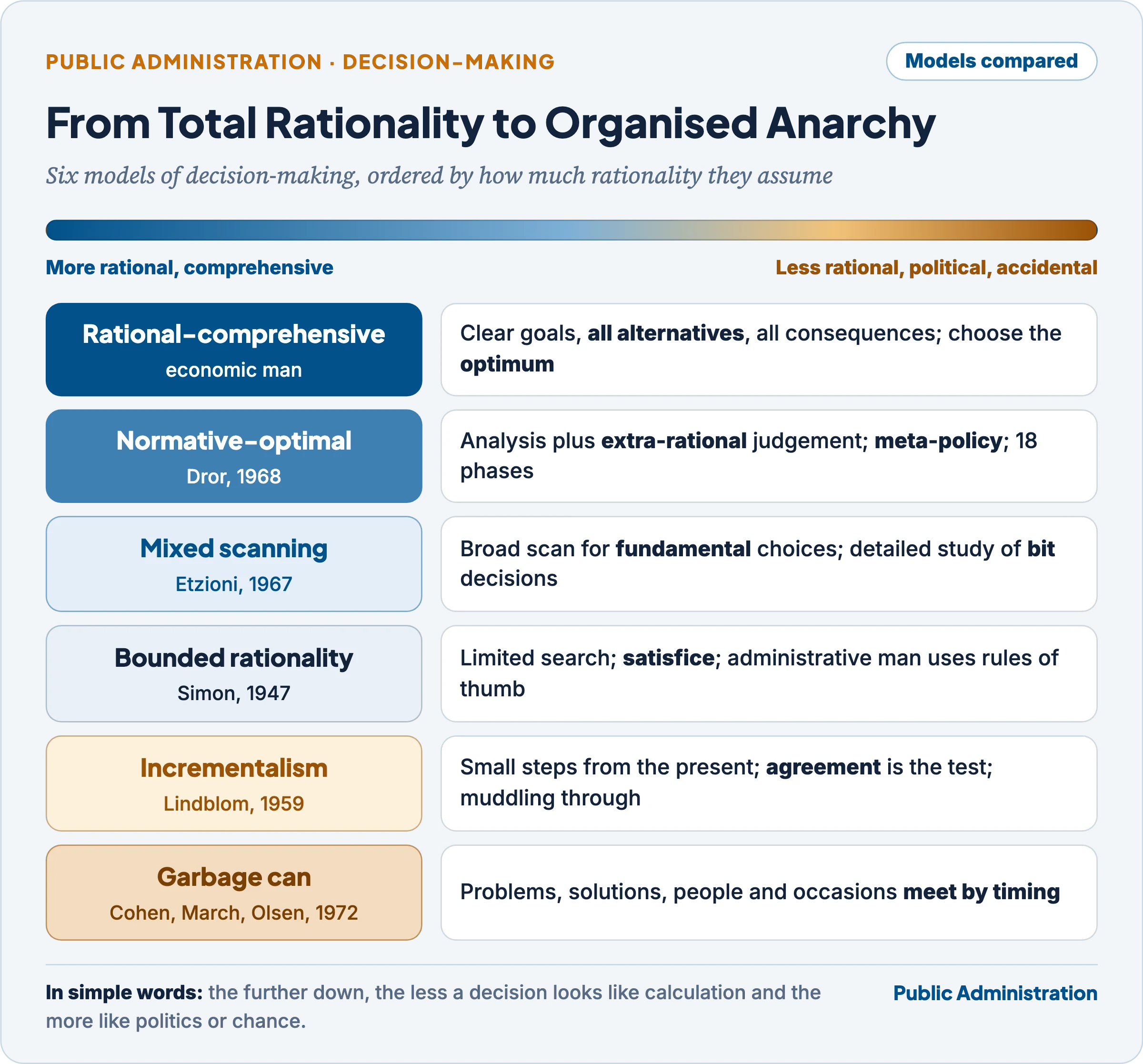
| Model | Thinker and work | View of rationality | Best suited to | Main criticism |
|---|---|---|---|---|
| Rational-comprehensive | Classical economics; early policy analysis | Total; optimise | Small, technical problems with agreed goals | Impossible demands on information and computation |
| Bounded rationality | Simon, Administrative Behavior (1947) | Limited; satisfice | Most real administrative decisions | Status-quo bias; positivist fact–value split |
| Incrementalism | Lindblom, “Muddling Through” (1959) | Limited and political; agreement is the test | Stable pluralist democracies | Conservative; ignores the unrepresented |
| Mixed scanning | Etzioni (1967) | Broad scan plus detailed increments | Mixed situations; crises plus routine | Boundary between levels unclear |
| Normative-optimal | Dror (1968) | Rational plus extra-rational; meta-policy | Major, novel policy problems | Demanding; extra-rational is vague |
| Garbage can | Cohen, March and Olsen (1972) | Largely accidental; timing matters | Organised anarchies | Descriptive, backward-looking |
| Allison’s three models | Allison (1971) | Rational, organisational and political lenses | Explaining crisis and foreign-policy decisions | Model III hard to test |
- Simon versus Lindblom: both reject total rationality, but Simon keeps rational search within bounds, whereas Lindblom replaces analysis with political agreement.
- Lindblom versus Dror: Lindblom accepts small steps as normal and good; Dror wants innovation and better meta-policy, especially for developing countries.
- Etzioni sits between them; garbage can and Allison’s Model III abandon the idea of a single rational decider altogether.
Common confusion
Is “rationalism” simply the opposite of “incrementalism”? Not quite. They differ in method (comprehensive search versus marginal comparison) and in the test of a good decision (best means to agreed ends versus agreement itself). But incrementalism is not irrational: Lindblom saw it as the intelligent response to bounded rationality and value conflict. And the two can be combined, as in Etzioni’s mixed scanning and Dror’s optimal model.
11. The Decision Environment
In simple words
No decision is made in a vacuum. Laws, budgets, politics, technology, public opinion and the organisation’s own rules all limit what can be decided. A manager who treats these surroundings as fixed may be overtaken by them; a wise one watches them and, where possible, shapes them.
11.1 Internal and external environment
- Internal environment:
- Rules, procedures and precedents that standardise decision-making and fix it in advance.
- Division of labour and span of control, which define each official’s decisional space.
- The authority system, which grades decisions by level and acts as a quality control device when lower decisions go up for approval.
- The communication system, which supplies data, the raw material of decisions.
- Socialisation and training, which inject the organisation’s values into new entrants (probation, “understudy”).
- Finance and human resources: some options are rejected simply because they cost too much or assume skills that staff do not have.
- Interpersonal relations: strained relations block communication; hierarchy itself can impede rational decision-making.
- External environment:
- Political: the government of the day, the legislature, parties, elections, coalition partners.
- Legal and constitutional: fundamental rights, statutes, court orders, federal division of powers.
- Economic: growth, fiscal space, markets, international prices.
- Social and cultural: caste, religion, language, public opinion and social norms (Riggs’s ecology of administration).
- Technological: new data and digital tools that change what can be known and done.
- Pressure groups, media and civil society, and increasingly international bodies and agreements.
11.2 Why taking the environment as given is dangerous
- A management that treats its environment as fixed behaves as a closed system: it plans for last year’s conditions and is overtaken by change it never noticed. This was the weakness of classical theory.
- Open-systems thinking (Katz and Kahn, The Social Psychology of Organizations, 1966) treats the organisation as continuously exchanging inputs and outputs with its environment and depending on feedback to survive.
- Turbulent environments: Fred Emery and Eric Trist (“The Causal Texture of Organizational Environments”, 1965) showed that environments range from placid to turbulent fields in which change comes from the environment itself; turbulence demands constant scanning and adaptation.
- Contingency theory: there is no one best way; the right structure and decision style depend on the environment (see the article on Systems and Contingency Theories).
- Two responses:
- Adapt: scan the environment continuously (Simon’s intelligence phase), build forecasting and early-warning systems, plan for contingencies.
- Shape: organisations, especially governments, can change their environment through regulation, incentives, public communication and partnerships. A department that plans against last year’s rainfall, migration or technology is taking its environment as given; one that invests in forecasting, crop insurance and irrigation is shaping it.
11.3 Certainty, risk and uncertainty
- Certainty: the outcome of each alternative is known (rare outside routine matters).
- Risk: outcomes are not known, but their probabilities can be estimated from experience or data (decision trees, expected value, insurance).
- Uncertainty: even probabilities cannot be estimated (a new virus, a war, a technological disruption). Here judgement, scenarios, robustness and flexibility matter more than calculation.
- Ambiguity: the problem itself is unclear and goals conflict, the world of the garbage can.
12. Techniques of Decision-Making
In simple words
Techniques are tools that help people decide better. Some are mathematical and suit well-defined problems such as routing trucks or scheduling a project. Others are ways of organising group discussion so that more ideas come out and fewer bad ideas survive.
12.1 Quantitative techniques
Quantitative techniques grew rapidly from the middle of the twentieth century with better measurement, applied mathematics and the computer. They work best when the objective is clear, the variables are measurable and the problem recurs; they seek to bring maximum rationality to decisions.
- Operations research (OR): the application of scientific method and mathematical models to operational problems, first developed in Britain during the Second World War (radar deployment, convoys). Steps: precise statement of the problem, collection of data, construction of a mathematical model, substitution of data and calculation of results under varying conditions, selection of the optimum course, and follow-up as new data arrive.
- Linear programming (LP): finds the optimal combination of limited resources to maximise or minimise an objective (profit, cost, time), when relationships between variables are linear (if one unit costs ₹9, ten units cost ₹90). Uses: minimising distribution cost, fixing inventory levels, allocating staff. George Dantzig developed the simplex method in 1947.
- Queuing (waiting-line) theory: balances the cost of waiting (idle staff, citizens in lines) against the cost of extra service counters. Uses: number of counters at a passport seva kendra, beds in a hospital, toll lanes.
- Simulation: builds a model of reality and runs it through the same influences it faces in practice, often using random numbers, to see how outcomes vary (“what if” analysis). Spreadsheet models of tax changes are simple simulations.
- Monte Carlo method: a form of simulation that uses probability and repeated random trials to estimate the chance of events (a machine breakdown, a flood exceeding embankment height).
- Game theory: analyses decisions where the outcome depends on the choices of rational opponents (competitors, other countries, other parties). John von Neumann and Oskar Morgenstern founded it in Theory of Games and Economic Behavior (1944). Strategies include minimax (minimise the maximum possible loss) and minimum regret. Uses: spectrum auctions, negotiations, disarmament.
- Decision tree: a diagram of sequential choices and chance events, with probabilities and pay-offs, used to calculate the expected value of each option (worked example below).
- Cost-benefit analysis (CBA): compares the monetised social costs and benefits of a project over time, discounted to present value; a project is worth doing if benefits exceed costs. Cost-effectiveness analysis compares the cost of reaching a fixed, non-monetised goal (cost per child immunised). CBA’s limits: hard to put money values on lives, forests or culture, and the choice of discount rate is itself a value judgement.
- Network analysis (PERT and CPM): PERT (Programme Evaluation and Review Technique, US Navy Polaris project, 1958) and CPM (Critical Path Method, DuPont, 1957) plan and control large projects by identifying the critical path of activities whose delay delays the whole project (see the article on Techniques of Administrative Improvement).
- Management information systems and decision support systems: computerised systems that collect, store and present data for decisions; dashboards and geospatial platforms are their current form (section 15).
A worked decision tree (illustrative figures). A district must choose between two ways to cut maternal deaths in a remote block:
- Option A, build a new community health centre: cost ₹10 crore. If it is staffed (probability 0.6), it averts 40 deaths over five years; if it is not staffed (probability 0.4), it averts 10. Expected deaths averted = 0.6 × 40 + 0.4 × 10 = 28, at ₹35.7 lakh per death averted.
- Option B, fund ambulances plus incentives for referral to the district hospital: cost ₹4 crore. If roads stay open (probability 0.8), it averts 25 deaths; if monsoon cuts the roads (probability 0.2), it averts 8. Expected deaths averted = 0.8 × 25 + 0.2 × 8 = 21.6, at ₹18.5 lakh per death averted.
- What the tree shows: Option A saves more lives in expectation; Option B saves lives more cheaply. The tree does not make the choice: it makes the trade-off explicit (value premise) and shows which probability (staffing) matters most, so the decider knows what to improve.
Indian Connect — Quantitative tools in Indian government
- Anna Chakra (launched 5 December 2024 by the Department of Food and Public Distribution with the World Food Programme and IIT Delhi) uses operations research to optimise the movement of foodgrains to about 4.37 lakh fair price shops and around 6,700 warehouses; route optimisation has been implemented in 30 States/UTs with estimated savings of about ₹250 crore a year, a textbook application of linear programming.
- PM GatiShakti National Master Plan (launched 13 October 2021) is a GIS-based decision support system with hundreds of data layers that ministries use to plan and approve infrastructure alignments.
- Project appraisal by bodies such as the Expenditure Finance Committee and the Public Investment Board relies on financial and economic analysis of costs and benefits before large projects are sanctioned.
Limits of quantitative techniques: they need reliable data, which is often missing; they handle only what can be measured; they can give a false sense of precision; models are only as good as their assumptions; and the computer does not decide, managers do. They are aids to judgement, best suited to programmed decisions.
12.2 Qualitative and group techniques
These techniques improve the design phase (generating alternatives) and the choice phase (evaluating them) in groups, while controlling the faults of group behaviour.
- Brainstorming: developed by the advertising executive Alex Osborn and popularised in Applied Imagination (1953). A group generates as many ideas as possible on a problem; no criticism is allowed during generation; free-wheeling and wild ideas are welcome; ideas may be combined and improved; all ideas are recorded for later evaluation. It is enjoyable, builds participation and reduces dependence on one authority, but it can be costly and time-consuming, its ideas can be superficial, and dominant members still sway the group.
- Nominal group technique: developed by André Delbecq and Andrew Van de Ven (1971). It reduces domination and conformity and ensures that every member contributes. Seven to ten people with varied backgrounds sit together but do not interact freely at first:
- The problem is presented.
- Each member writes ideas silently and independently.
- In round-robin fashion each member presents one idea at a time, recorded on a board, without discussion.
- The group discusses each idea only to clarify and evaluate it.
- Each member ranks the ideas privately in writing.
- The decision is the pooled result of individual votes.
- Delphi technique: developed at the RAND Corporation in the 1950s by Olaf Helmer and Norman Dalkey. A panel of experts, who never meet and stay anonymous to each other, answer a questionnaire; their responses are pooled into a feedback report and sent back with a sharper second questionnaire; members revise their views; the rounds continue until a consensus emerges or enough information is gathered. Anonymity removes the pressure of status and personality; experts can be anywhere. It is slow and depends on the choice of experts and the skill of the coordinator. It is used for forecasting and long-range planning.
- Synectics: developed by William J.J. Gordon (1961), from the Greek for “joining together different and apparently irrelevant elements”. A carefully selected group led by a facilitator uses analogies and metaphors to produce novel solutions. It produces one well-developed solution but is costly and fails if that solution fails.
- Devil’s advocate and dialectical inquiry: one member (or sub-group) is assigned to attack the preferred option, or two groups develop opposing plans and debate them. Both counter premature agreement.
- Consultation and conference: inter-departmental meetings, committees and consultation with stakeholders before a decision (section 12.3 and the Indian box below).
12.3 Groupthink and its remedies
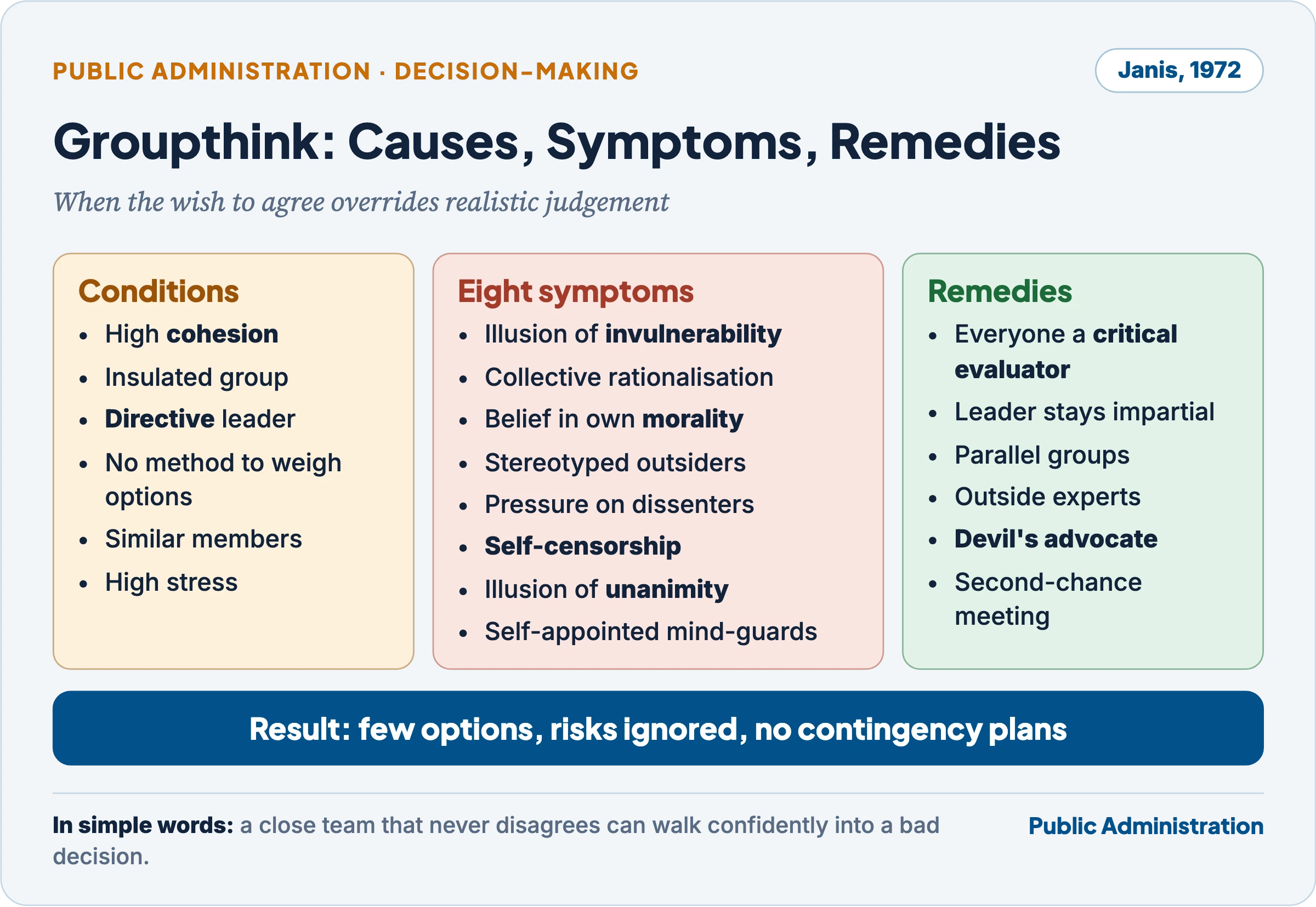
- Irving Janis, the American psychologist, in Victims of Groupthink (1972; revised as Groupthink, 1982), defined groupthink as a mode of thinking in a highly cohesive group where the desire for unanimity overrides the realistic appraisal of alternatives. He studied American foreign-policy fiascos such as the Bay of Pigs invasion (1961), Pearl Harbor and the escalation in Vietnam, and contrasted them with the better-handled Cuban Missile Crisis (1962).
- Conditions: high cohesion, insulation from outsiders, a directive leader who signals his preference, no procedure for searching and evaluating alternatives, homogeneous members, and high stress with low hope of a better solution than the leader’s.
- Eight symptoms:
- an illusion of invulnerability, leading to excessive optimism and risk-taking;
- collective rationalisation that discounts warnings;
- an unquestioned belief in the group’s inherent morality;
- stereotyped views of rivals and outsiders as weak or evil;
- direct pressure on dissenters to conform;
- self-censorship of doubts;
- an illusion of unanimity (silence taken as consent);
- self-appointed mind-guards who shield the group from contrary information.
- Results: incomplete survey of alternatives and objectives, failure to examine risks, poor information search, selective bias, no contingency plans.
- Remedies:
- The leader should assign every member the role of critical evaluator and accept criticism of his own views.
- The leader should stay impartial at first and not state preferences.
- Set up independent groups under different leaders to work on the same problem.
- Divide the group into sub-groups that meet separately, then reconvene.
- Members should discuss the group’s thinking with trusted outsiders and report back.
- Invite outside experts to challenge the group.
- Appoint a devil’s advocate at every meeting.
- Spend time on warning signals and rivals’ likely responses.
- Hold a “second-chance” meeting after a preliminary decision to air remaining doubts.
Indian Connect — Guarding against groupthink in Indian decision-making
- The Pre-Legislative Consultation Policy (2014) asks ministries to place draft legislation in the public domain for comment (normally for at least 30 days) before it goes to the Cabinet, bringing outside views into a closed process.
- Expert committees and Groups of Ministers with members from different ministries and disciplines act as independent groups on the same problem.
- Courts as an outside check: the Supreme Court in Kranti Associates v. Masood Ahmed Khan (2010) held that even administrative authorities must record reasons when decisions affect anyone prejudicially, because reasons restrain arbitrariness, show that relevant factors were considered and extraneous ones excluded, and make judicial review possible. “Rubber-stamp reasons” do not count.
12.4 Biases, heuristics and nudges
- Daniel Kahneman and Amos Tversky, Israeli-American psychologists, extended Simon’s insight in “Judgment under Uncertainty: Heuristics and Biases” (1974) and prospect theory (1979). People use mental short-cuts (heuristics) that cause systematic errors:
- Availability: judging likelihood by how easily examples come to mind (the last disaster).
- Representativeness: judging by resemblance to a stereotype.
- Anchoring: sticking close to an initial number (last year’s budget).
- Loss aversion: losses hurt more than equal gains please, so people resist change.
- Status quo and default bias: people stick to the default option.
- Confirmation bias and overconfidence.
- Nudge: Richard Thaler and Cass Sunstein, in Nudge (2008), argued that governments can design the choice architecture (defaults, reminders, social norms) to steer people towards better choices while preserving freedom of choice.
- Behavioural public administration: a growing field applies these insights to how officials decide and how citizens respond to government, extending Simon and Dahl’s programme.
- Indian application: the Economic Survey 2018–19 devoted a chapter (“Policy for Homo Sapiens, Not Homo Economicus”) to nudges, showing how the Swachh Bharat Mission and Beti Bachao Beti Padhao used social norms and reinforcement, and proposing nudges for tax compliance and the LPG subsidy.
13. Delegation: The Fine Art of Not Deciding
In simple words
A good head of office does not decide everything personally. She decides what only she can decide, and lets others decide what they are closer to and better placed to judge. That frees her time, trains her team and gets decisions made faster.
13.1 Barnard’s fine art of executive decision
Barnard wrote that the fine art of executive decision consists in not deciding questions that are not now pertinent, in not deciding prematurely, in not making decisions that cannot be made effective, and in not making decisions that others should make. Each part has a reason:
- Not deciding questions not now pertinent is uncommon good sense: it avoids wasting authority on hypothetical problems.
- Not deciding prematurely avoids committing attitudes and developing prejudices before the facts are in.
- Not making decisions that cannot be made effective avoids destroying authority: an order that cannot be enforced weakens every later order.
- Not making decisions that others should make preserves morale, develops competence, fixes responsibility and preserves authority.
The last clause is the case for delegation. Barnard repeated it late in life: an executive’s worst difficulty is the belief that he has to tell everybody what to do.
13.2 Delegation: meaning and elements
- Delegation is the entrustment of authority by a superior to a subordinate to perform assigned duties and take decisions within limits. The delegator retains ultimate accountability.
- Three elements:
- Responsibility (duty): the task assigned.
- Authority: the power to decide and act, which must be equal to the responsibility (principle of parity).
- Accountability: the obligation to answer for performance, which cannot be delegated: the superior remains answerable to his own superior (principle of absoluteness of responsibility).
13.3 Why delegate
- Volume of work: no head can personally decide everything as work grows.
- Complexity and specialisation: experts and field officers know more about particular problems.
- Time for policy and planning: delegation frees the top for non-programmed decisions, the remedy for Gresham’s law.
- Speed and responsiveness: decisions are taken nearer the problem and the citizen.
- Development of subordinates: they learn by deciding; future leaders are trained.
- Morale and motivation: responsibility is a motivator (Herzberg); trust raises morale.
- Fixing responsibility: each level knows what it must answer for.
13.4 Hindrances and limits
- Organisational hindrances: absence of clear procedures, poor coordination and communication, unstable non-repetitive work, vaguely defined positions.
- Personal hindrances (as listed by John Pfiffner): the egotism of those who rise in hierarchies; fear that subordinates will decide wrongly; fear that strong subordinates will become rivals; impatience with subordinates’ slowness; political considerations in government; an authoritarian cultural heritage; lack of emotional maturity; not knowing how or how far to delegate.
- Subordinates’ reluctance: fear of criticism, lack of information and resources, lack of confidence, overload.
- Limits: the head cannot delegate all authority (that would make him superfluous), nor accountability, nor matters reserved by law (statutory powers, rule-making, sanction of prosecution where the law names the authority), nor the core functions of policy, coordination and control.
- Making delegation work: select capable subordinates, define responsibilities, train them, lay down general policies, standardise procedures, keep information flowing up, down and across, and set up checks that give early danger signals rather than requiring every decision to come back up.
13.5 Delegation in Indian administration
- Too many levels: files in Indian government often pass through many layers before decision; the 2nd ARC, 13th Report, Organisational Structure of Government of India (2009), recommended that the number of levels of decision-making be cut to no more than three.
- The Central Secretariat Manual of Office Procedure, 2022 adopted delayering, more delegation and the desk-officer system, with e-Office for file movement.
- Delegation of Financial Powers Rules fix the monetary limits up to which each level can sanction expenditure; periodic upward revision of these limits is one of the simplest ways to speed decisions.
- Simon’s modes of influence explain the paradox: delegation works only where training, loyalty and information have already shaped the premises of subordinates’ decisions; without them, superiors fear to let go.
- Recentralisation through technology: dashboards and real-time monitoring let the top watch and decide more, exactly as Simon predicted, which can undo delegation if senior levels use data to micromanage rather than to set goals and check results.
Common confusion
Does delegation mean the superior is no longer responsible? No. The superior delegates authority, not accountability. If a subordinate decides badly under delegated power, the superior still answers to his own superior, to the legislature or to the court. This is why delegation needs clear limits, information flows and controls, and why it is a test of the superior’s judgement, not an escape from it.
14. Evidence, Performance Information and Learning
In simple words
Governments now collect huge amounts of data on schemes: how many toilets built, how many children weighed, how many cases disposed. The question is whether officers actually use this information to decide better, and what makes them use it or ignore it.
14.1 Evidence-based policy and its limits
- Evidence-based policy means using the best available research, evaluation and data to decide what to do, rather than relying only on ideology, habit or anecdote. Its methods include randomised controlled trials, impact evaluations, pilots and systematic reviews.
- Models of research use: in the decision-driven (problem-solving) model, a decision is pending, research is commissioned to fill the knowledge gap, and the findings feed the choice. In practice, research is more often used conceptually (shaping how problems are seen) or politically (to justify decisions already taken), and evidence reaches policy through many indirect routes.
- Limits: evidence is often incomplete or contested; it answers “what works” but not “what is right”; findings from one context may not transfer to another; time and political pressure rarely wait for evaluation.
14.2 Performance information use as organisational behaviour
- Since the 1990s, performance management reforms (New Public Management, outcome budgets, results frameworks) have produced vast amounts of performance information. Governments wagered that this information would be used to improve decisions.
- Donald Moynihan and Sanjay Pandey, in “The Big Question for Performance Management: Why Do Managers Use Performance Information?” (Journal of Public Administration Research and Theory, 2010), argued that using performance information is a form of organisational behaviour: employees have discretion about whether and how far to use it, but are influenced by the social context and formal systems in which they work. They tested four groups of factors in a survey of American local government managers:
- Individual factors: public service motivation was positively associated with use; managers used data out of commitment to public purpose.
- Job factors: perceived links between performance and extrinsic rewards (pay, promotion) did not significantly raise use; leaders in generalist roles used data less than heads of task-specific agencies.
- Organisational factors: information availability, a developmental culture (open, innovative, risk-taking) and administrative flexibility all raised use. Supply of data is necessary, but demand for data depends on culture.
- Environmental factors: professional networks and public participation had positive but weaker effects.
- What follows: performance systems should appeal to public service motivation rather than rely only on contract-like rewards; managers need flexibility to act on what the data show; and organisations need a learning culture, not only dashboards.
- Critical points:
- Use is not always good use: passive use (filling formats), political use (to win arguments) and perverse use (gaming targets) are common.
- Campbell’s law (Donald Campbell): the more any quantitative indicator is used for social decision-making, the more it is subject to corruption pressures and the more it distorts the processes it is meant to monitor. Teaching to the test and reclassifying crimes are examples.
- Self-reported use measured in surveys may overstate real use.
- Context matters: findings from American cities need testing in Indian ministries and districts, where flexibility is lower and accountability more procedural.
14.3 Performance problems, training and the work environment
- A common response to poor performance in government is “more training“. But performance problems are rarely caused simply by lack of knowledge or skill, and training alone rarely fixes them.
- Thomas Gilbert, in Human Competence: Engineering Worthy Performance (1978), proposed the Behaviour Engineering Model, which sorts the causes of performance into six cells:
| Information | Instruments | Motivation | |
|---|---|---|---|
| Environment (the organisation supplies) | Data: clear expectations, guidance, timely feedback | Resources: tools, staff, budget, time, processes | Incentives: rewards, recognition, career consequences |
| Individual (the person brings) | Knowledge and skills: training | Capacity: aptitude, health, fit for the job | Motives: willingness, values |
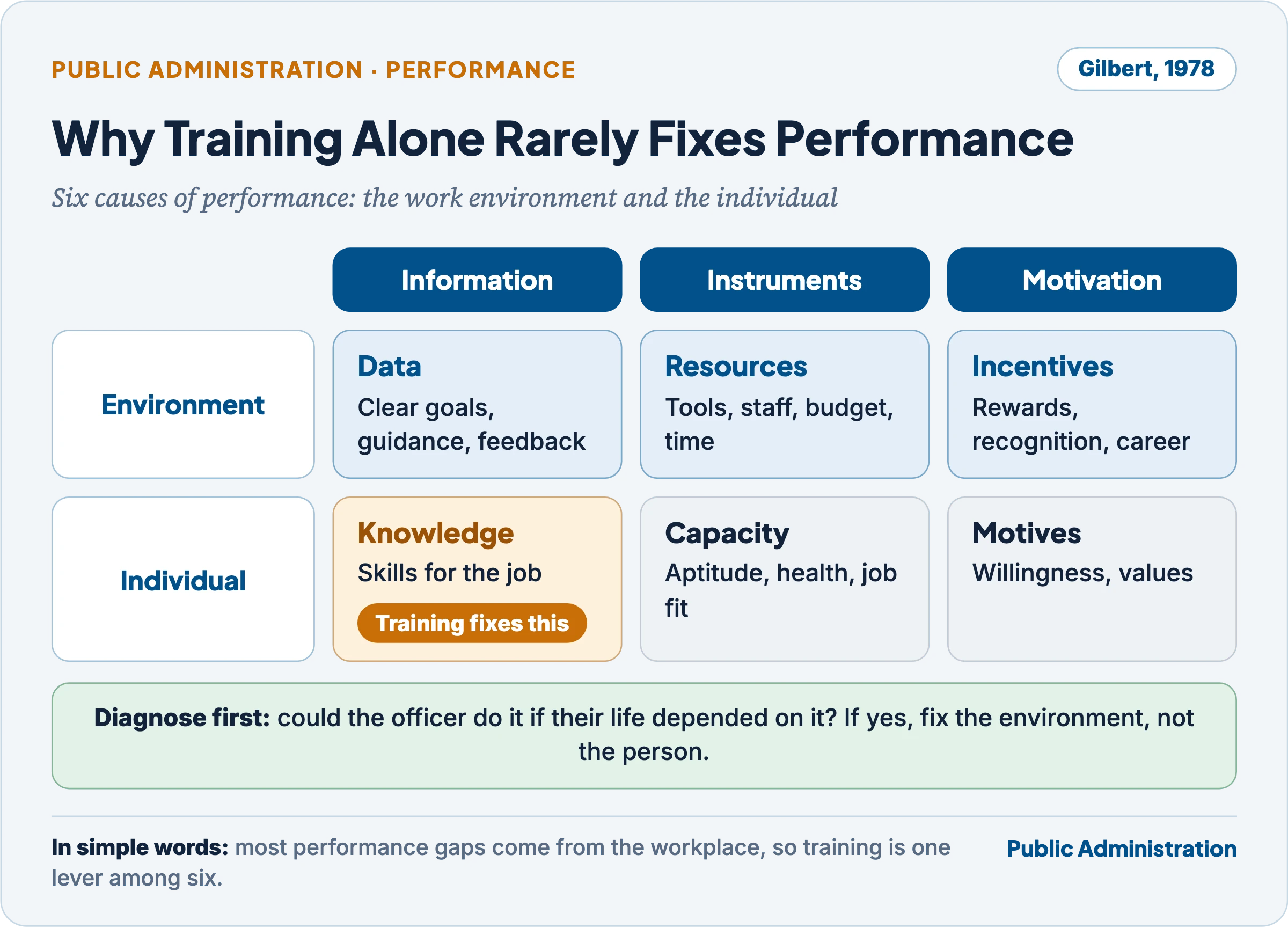
- Gilbert’s argument: the environmental cells (data, resources, incentives) are usually the bigger and cheaper levers; only the knowledge cell is fixed by training. An officer who does not process files on time may lack clear priorities, a working computer, adequate staff or any reward for speed, none of which a training course supplies.
- Robert Mager and Peter Pipe (Analyzing Performance Problems, 1970) asked a simple diagnostic question: could the person do it if their life depended on it? If yes, the problem is not skill but the environment or the consequences; training will not help.
- Why training alone fails:
- Transfer problem: skills learned in a course are not applied if the workplace does not support or reward them.
- Wrong diagnosis: training is used as a symbol of action when the real causes are structural (understaffing, unclear roles, frequent transfers, political interference).
- Motivation and morale: demotivated staff do not use new skills (see the articles on Motivation Theories and on Communication and Morale).
- Where training does matter: when there is a genuine knowledge or skill gap (new law, new technology), and when it is combined with changes in job design, feedback, resources and incentives. Simon himself listed training as a mode of organisational influence because it shapes the premises of decisions; but it works alongside authority, loyalty, information and efficiency criteria, not instead of them.
Indian Connect — Evidence and training in Indian administration
- The Development Monitoring and Evaluation Office (DMEO), created under NITI Aayog in 2015, evaluates Central schemes and runs the Output-Outcome Monitoring Framework, which links scheme spending to measurable outputs and outcomes.
- The Data Governance Quality Index (DGQI), launched by DMEO in 2020 as a self-assessment of ministries’ data systems, has run seven rounds; the eighth (FY 2024–25) covers schemes across 74 ministries and departments. DGQI 3.0 added an emerging-technology pillar and is run through the VEDAM portal. DMEO’s own review found weak attention to fairness, participation and lawfulness in data practice.
- Aspirational Districts and Blocks rank units monthly on key indicators, turning performance information into a tool of competition and learning; the Moynihan–Pandey findings suggest their success depends as much on local flexibility and culture as on the dashboards.
- Mission Karmayogi (2020) aims to link training to roles and competencies (the Framework of Roles, Activities and Competencies) rather than to generic courses, which addresses the “training alone” problem only if postings, resources and incentives also change.
15. Data and AI-Assisted Decision-Making in Indian Government
In simple words
Computers can now sort millions of records, spot patterns and even suggest decisions. Used well, they make government faster and fairer. Used badly, they hide bias inside code and leave citizens with no one to explain why they were refused.
15.1 The shift
- Simon’s prediction (1960) that computers would programme more decisions and recentralise decision-making has largely come true. Indian government now uses:
- Monitoring platforms: PRAGATI (launched 25 March 2015), a multi-modal platform through which the Prime Minister reviews delayed projects, programmes and grievances with Union Secretaries and State Chief Secretaries by video-conference, supported by geospatial data. Up to its 46th meeting (30 April 2025), 370 projects worth about ₹20 lakh crore had been reviewed.
- Spatial decision support: PM GatiShakti (13 October 2021), integrating ministries’ infrastructure data on one GIS platform, with an Empowered Group of Secretaries and a Network Planning Group for decisions.
- Optimisation tools: Anna Chakra for foodgrain logistics (December 2024).
- Dashboards and real-time data for schemes, Aspirational Districts and grievance redressal.
- AI in the judiciary: the Supreme Court’s SUPACE portal (6 April 2021) helps judges with research; Chief Justice S.A. Bobde insisted it would not be allowed to spill over into decision-making.
- National AI capacity: the IndiaAI Mission (approved 7 March 2024, outlay ₹10,371.92 crore) and the India AI Governance Guidelines (November 2025), built on seven principles (trust, people first, innovation over restraint, fairness and equity, accountability, understandable by design, and safety, resilience and sustainability).
15.2 Promise
- Speed and scale: routine (programmed) decisions such as eligibility checks can be made quickly for millions.
- Consistency: rules applied uniformly, reducing petty discretion and rent-seeking.
- Better intelligence: early warning of problems (Simon’s intelligence phase), better targeting and monitoring.
- Coordination: shared platforms reduce inter-ministerial delays.
- Evidence: more data for evaluation and learning.
15.3 Risks
- Algorithmic bias: models trained on biased data reproduce exclusion (for example, wrong deletion of beneficiaries from databases).
- Opacity: citizens and even officials may not know why a system decided as it did, which conflicts with the duty to give reasons (Kranti Associates, 2010) and with natural justice.
- Accountability gap: when a machine recommends and an official “approves”, responsibility is blurred.
- Automation bias: humans tend to over-trust machine outputs and stop exercising judgement.
- Privacy: large data systems raise questions under the Digital Personal Data Protection Act, 2023.
- Recentralisation and micromanagement: dashboards can pull decisions upward and weaken delegation and local discretion.
- Datafication of what is measurable: what cannot be counted (dignity, trust, quality) may be neglected.
15.4 Principles for AI-assisted public decisions
- Human in the loop for decisions that affect rights and entitlements: AI should assist, not replace, judgement, as the SUPACE design recognised.
- Explainability and reasons: every adverse decision should carry an intelligible reason and a route for appeal.
- Auditing and testing of algorithms for bias before and after deployment.
- Data governance: quality, consent and proportionality (the DGQI findings show how much remains to be done).
- Clear accountability: a named official remains answerable.
The underlying lesson is Simon’s: technology moves the boundary between programmed and non-programmed decisions, but the non-programmed, value-laden choices, where facts and values meet, remain the responsibility of accountable human beings.
16. Assessment: Can Government Decisions Be Rational?
In simple words
Perfectly rational government decisions are impossible: no one knows everything, and people disagree about what is good. But decisions can be made more rational, more informed and more accountable. The debate is about how far, and by what means.
- What the theories agree on: total rationality is unattainable; information, cognition, time and politics limit every decision; organisations must narrow choices to make them manageable; values cannot be removed from public decisions.
- Where they differ: whether to push rationality as far as possible (Dror, operations research, evidence-based policy), to accept limited rationality and improve its procedures (Simon), to rely on political agreement and small steps (Lindblom), to combine these (Etzioni), or to recognise that decisions are often accidental and political (garbage can, Allison).
- The public dimension: government decisions must be not only efficient but legal, fair, participatory and accountable. A decision can be technically optimal and still illegitimate if it ignores those affected or cannot be explained.
Criticism — The case against rational decision-making in government
- Impossible demands: no decision-maker has complete information, unlimited computation or agreed goals (Simon, Lindblom).
- Values are contested: in a plural democracy there is no single objective function to maximise; agreement, not optimality, is the realistic test (Lindblom).
- Power, not analysis, decides: bargaining among players and organisational routines shape outcomes (Allison’s Models II and III).
- Analysis can mislead: quantitative tools give false precision, measure only the measurable and can be gamed (Campbell’s law).
- Technocracy risk: a push for “rational” decisions can concentrate power in experts and dashboards and exclude citizens.
Defence — The case for making decisions more rational
- Bounded is not absent: within its limits, careful search, explicit criteria and evidence clearly improve outcomes (Simon, Dror).
- Incrementalism has costs: it protects the status quo and fails societies that need structural change (Dror, Etzioni).
- Tools work where problems are structured: operations research, cost-benefit analysis and decision trees have saved money and lives (Anna Chakra, project appraisal).
- Explicit values are more democratic: stating goals, trade-offs and reasons openly allows scrutiny by legislatures, courts and citizens (Kranti Associates).
- Learning systems: monitoring, evaluation and feedback let organisations correct errors, combining incremental adjustment with rational review.
A decision is good not because it is perfect, but because its facts were sought, its values were stated and its reasons can be given.
Key Terms
| Term | Meaning in simple words |
|---|---|
| Decision-making | Choosing one course of action from among alternatives to reach a goal |
| Programmed decision | A routine, repetitive decision settled by a rule or procedure |
| Non-programmed decision | A new, unstructured decision for which no ready rule exists |
| Strategic decision | A long-term decision about direction and major commitments |
| Tactical decision | A decision about how to carry out a strategy |
| Negative decision | A decision not to decide (Barnard) |
| Non-decision | Keeping an issue off the agenda altogether (Bachrach and Baratz) |
| Intelligence, design, choice | Simon’s three phases: find the problem, develop options, select one |
| Factual premise | A statement that can be tested as true or false |
| Value premise | A statement of preference that cannot be proved true or false |
| Means–ends chain | Each end is a means to a further end; hierarchy links them |
| Bounded rationality | Rationality limited by information, mental capacity and time |
| Satisficing | Choosing the first option that is good enough rather than the best |
| Aspiration level | The standard of “good enough”, which rises or falls with experience |
| Administrative man | Simon’s realistic decider who satisfices using simple rules of thumb |
| Zone of acceptance | The range within which a subordinate accepts orders without question |
| Uncertainty absorption | Doubts are dropped as information is summarised up the hierarchy |
| Gresham’s law of planning | Routine work drives out planning work (March and Simon) |
| Incrementalism | Deciding by small changes from existing policy (“muddling through”) |
| Partisan mutual adjustment | Coordination through bargaining among many actors (Lindblom) |
| Mixed scanning | A broad scan for fundamental choices plus detailed incremental ones (Etzioni) |
| Meta-policy-making | Policy-making about how policy should be made (Dror) |
| Extra-rational | Intuition, judgement and creativity beyond formal analysis (Dror) |
| Organised anarchy | An organisation with unclear goals, unclear technology and fluid participation |
| Groupthink | A cohesive group’s drive for agreement overriding realistic judgement (Janis) |
| Delphi technique | Anonymous rounds of expert questionnaires leading to consensus |
| Nominal group technique | Silent idea writing, round-robin sharing and private ranking |
| Consensus | General agreement all can accept; no one blocks |
| Unanimity | Every member positively agrees; each has a veto |
| Delegation | Entrusting authority to a subordinate while keeping accountability |
| Performance information use | Managers actually using performance data in decisions |
| Nudge | Changing the choice setting (defaults, reminders) to steer behaviour |
Commissions, Committees and Judgments
| Body / case | Year | Key point |
|---|---|---|
| 2nd ARC, 13th Report, Organisational Structure of Government of India | 2009 | Cut the number of levels of decision-making to no more than three; delegate routine work |
| Kranti Associates v. Masood Ahmed Khan (Supreme Court) | 2010 | Reasons must be recorded even in administrative decisions that affect anyone prejudicially; reasons restrain arbitrariness and enable judicial review |
| Pre-Legislative Consultation Policy | 2014 | Draft laws to be placed in public domain for comment before Cabinet decision |
| Constitution (101st Amendment) Act | 2016 | Article 279A: GST Council decides by three-fourths of weighted votes; Union one-third, States two-thirds |
| Prevention of Corruption (Amendment) Act | 2018 | Section 17A: prior approval before inquiry into a public servant’s official decisions or recommendations |
| Economic Survey 2018–19, Chapter 2 | 2019 | Behavioural economics and nudges in public policy |
| Mission Karmayogi (NPCSCB) | 2020 | From rule-based to role-based training; behavioural change |
| Central Secretariat Manual of Office Procedure | 2022 | Delayering, delegation, desk officers, e-Office |
| India AI Governance Guidelines | 2025 | Seven principles for safe, accountable AI, including human-centred and explainable systems |
Contemporary Developments
- 2 September 2020: the Union Cabinet approved Mission Karmayogi, shifting civil service training from rule-based to role-based, with a Capacity Building Commission and the iGOT platform.
- 6 April 2021: the Supreme Court launched SUPACE, an AI research assistant for judges, with an explicit commitment that AI would not make decisions.
- 7 January 2023: the Aspirational Blocks Programme was launched for 500 blocks (now 513) in 27 States and 4 UTs, extending indicator-based ranking and monitoring below the district level.
- 7 March 2024: the Cabinet approved the IndiaAI Mission with an outlay of ₹10,371.92 crore over five years, including a Safe and Trusted AI pillar.
- 5 December 2024: the Anna Chakra PDS supply-chain optimisation tool was launched; route optimisation is now in place in 30 States/UTs, with estimated savings of about ₹250 crore a year.
- 30 April 2025: the 46th PRAGATI meeting brought the number of projects reviewed under the platform to 370, worth about ₹20 lakh crore.
- November 2025: MeitY released the India AI Governance Guidelines, setting seven principles and an institutional framework (AI Governance Group, AI Safety Institute) for responsible AI, including in government.
- 2026: DMEO reported that the Data Governance Quality Index had completed seven rounds, with the eighth (FY 2024–25) covering 74 ministries and departments, and flagged gaps in fairness, participation and lawfulness in government data practice.
Revision Grid
| Thinker / body | Work or report (year) | Key idea |
|---|---|---|
| Chester Barnard | The Functions of the Executive (1938) | Positive and negative decisions; decisions as techniques for narrowing choice; fine art of not deciding |
| Herbert Simon | Administrative Behavior (1947) | Decision-making the heart of administration; fact and value premises; bounded rationality; satisficing |
| Robert Dahl | “The Science of Public Administration: Three Problems” (1947) | Science of administration must rest on understanding human behaviour; values, personality, social setting |
| Peter Drucker | The Practice of Management (1954) | Risk, economy of effort, timing, limitation of resources |
| March and Simon | Organizations (1958) | Gresham’s law of planning; uncertainty absorption |
| Charles Lindblom | “The Science of ‘Muddling Through'” (1959); “Still Muddling, Not Yet Through” (1979) | Incrementalism; successive limited comparisons; partisan mutual adjustment |
| Herbert Simon | The New Science of Management Decision (1960) | Intelligence, design, choice; programmed and non-programmed; two-dimensional taxonomy |
| Bachrach and Baratz | “Two Faces of Power” (1962) | Non-decisions as exercise of power |
| Yehezkel Dror | “Muddling Through: ‘Science’ or Inertia?” (1964); Public Policymaking Reexamined (1968) | Critique of incrementalism; normative-optimal model; 18 phases; extra-rationality |
| Amitai Etzioni | “Mixed-Scanning” (1967) | Fundamental plus incremental decisions |
| Cohen, March and Olsen | “A Garbage Can Model of Organizational Choice” (1972) | Organised anarchies; four streams |
| Graham Allison | Essence of Decision (1971) | Rational actor, organisational process, governmental politics |
| Irving Janis | Victims of Groupthink (1972) | Eight symptoms; remedies |
| Vroom and Yetton | Leadership and Decision-Making (1973) | Five decision styles AI to GII |
| Kahneman and Tversky | “Judgment under Uncertainty” (1974); prospect theory (1979) | Heuristics, biases, loss aversion |
| Mintzberg, Raisinghani and Théorêt | “The Structure of ‘Unstructured’ Decision Processes” (1976) | Identification, development, selection; interrupted processes |
| Thomas Gilbert | Human Competence (1978) | Six causes of performance; environment before training |
| Thaler and Sunstein | Nudge (2008) | Choice architecture |
| Moynihan and Pandey | “The Big Question for Performance Management” (2010) | Performance information use as organisational behaviour |
| 2nd ARC | 13th Report (2009) | No more than three levels of decision-making |
Previous Year Questions
- 2026Rationality in policy-making is a challenge, and its absence is a predicament for the policy process. Examine.
- 2025The fine art of decision-making is not making decisions that others can make. Comment.
- 2023“The process of decisions ……… is largely a technique of narrowing choices.” Explain.
- 2022Performance problems are rarely caused simply by lack of training and rarely can performance be improved by training alone. Critically analyse the statement.
- 2022‘Lindblom regarded rational decision-making as an unattainable goal.’ In the light of the statement, suggest measures to avoid policy failures.
- 2021Two-dimensional taxonomy was used by Herbert Simon to describe the degree to which decisions are programmed or non-programmed.” Explain.
- 2021Zero-based budgeting was intended to get away from incrementalism, but ended up being the most incremental of any budgetary approach. Discuss.
- 2020“‘Performance information use’ is a form of organizational behaviour that is influenced by individual, job, organizational and environmental factors.” Critically analyze.
- 2019“If there is ever to be a science of Public Administration it must derive from an understanding of man’s behaviour.” Explain.
- 2018“Herbert Simon’s book Administrative Behavior presents a synthesis of the classical and behavioural approaches to the study of Public Administration.” Explain.
- 2016“In Public Policy Making, ‘Rationalism’ is the opposite of ‘Incrementalism’.” Examine.
- 2015“Information constitutes the life-blood of the functioning of an organisation. “Explain the utility and significance of communication in decision-making.
- 2013“Decisions are not made by ‘organizations’, but by ‘human beings’ behaving as members of organizations.” How do Bernard and Simon conceptualize the relation between the decisions of the individual employee and the organizational authority?
- 2013“The policy process was not structured in the way required by bureaucratic planning. “Arguably, incrementalism now stands most in contrast to neo-liberal nationality that impose markets against both gradual change and democratic liberalism.” Analyse these two statements.
- 2012‘Three features characterize Simon’s original view of bounded rationality: search for alternatives, satisficing, and aspiration adaptation.’ Elucidate.
- 2012Would you agree with Bachrach and Baratz that along with decisions, non-decisions are also part of policy? Give reasons for your answer.
- 2011Whereas Downs’ model is largely dependent on a theory of psychological motivation, Niskanen’s model is framed by neo-classical thinking. In the light if the above, discuss the public choice approach to decision-making.
- 2011Critically examine the following statements in the field of Policy Sciences: (i)The incrementalist paradigm posits a conservative tendency in public policy making. (ii)Dror’s Optimal Model is a fusion of the economically rational model with the extra-rational model.
- 2010“Simon’s identifying decision-making as the core field of public administration appears logically acceptable but his positivist underpinning is problematic.” Critically examine the statement.
- 2008Examine the respective roles of facts and values in the decision-making process. Is it possible to make value-free decisions in government system? How can government decisions be made more rational?
- 2006“Simon’s work has had major implications for the study of public administration and the practice of public administration professionalism.” Comment.
- 2004Policy is a decision driven model of research use. Explain.
- 2001The ‘decision-making scheme’ and ‘satisfying model’ of Herbert A Simon is the major component of administrative theory. Comment.
- 2000“Administrative efficiency is enhanced by keeping at a minimum the number of organizational levels through which a matter must pass before it is acted upon.” –(Herbert A. Simon) Comment.
- 2000“Information constitutes the life-blood of the functioning of organization.” In the light of this statement, explain the utility and importance of communication in decision-making.
- 1998“’Consensus’ and ‘Unanimity’ are used as styles in decision-making.” Comment.
- 1998“All policy-making is decision-making, but all decision-making is not policy-making.” Elaborate. How does a policy emanate and what course does policy-making in government follow?
- 1995“The study of decision-making is proceeding in so many directions that we can lose sight of the basic administrative processes that Barnard and Simon were trying to describe and that so many men have been trying to improve.” Elucidate.
- 1994“As March and Simon point out, there seems to exist a ‘Gresham’s Law’ of decision-making.” Explain.
- 1993“While the entrepreneur makes strategic decisions, the manager makes tactical ones.” Elucidate.
- 1992‘Simon explains that decision-making basically involves choice between alternative plans of action and choice in turn, involves facts and values.’ Comment.
- 1990‘A management which takes its environment as given…… is pursuing a dangerous course.’ Comment on the environment of decision-making.
- 1989Argue for and against the Simonian perspective that the “decisional science envelopes decisional structure, decisions and their feedback not in an integrated manner but anything other than that.”
- 1988Elucidate the socio-psychological bases of individual and group behaviour in a complex organization.
- 1988Discuss the Simonian concept of ‘satisfying’ as a bridge between rational and non-rational perspectives on organizations.
- 1988“Incrementalism in administration is not, in principle, a slow- moving tactic of conservatism, instead, it is a fast moving sequence of small changes that after the status que” Examine, in the light of this statement, the desire of development administration, for incrementalist policy-making.
- 1987‘The first stage (in administrative decision-making) is what I call “Intelligence”, the second represents “Designin” and the last stage is “Choice”. Critically examine the Simonian Model of Rational Decision-Making in administration.
- 1987Critically examine the functions of administrative leadership. What role does communication play in improving the quality of administrative decisions in goal setting and goal getting by public servants.
- 2021The Prime Minister’s Office has become a powerful institution in itself by virtue of its role in decision-making on strategic issues of utmost importance. Examine the statement.
- 2020Even if all the States combine together, they cannot have their way in the decision-making in the GST Council, unless the Union agrees to it. Analyze this in the perspective of federalism in India.
- 2015“Most Civil Servants in India are competent administrators, but they pay little attention to encourage people’s participation in decision-making.” Comment on the statement.