

Anthropology Optional › Paper II › Unit 09: Tribal Administration and Development
9.3 Contributions of anthropology to the understanding of regionalism, communalism, and ethnic and political movements.
Official Syllabus: Paper II, Unit 9.3
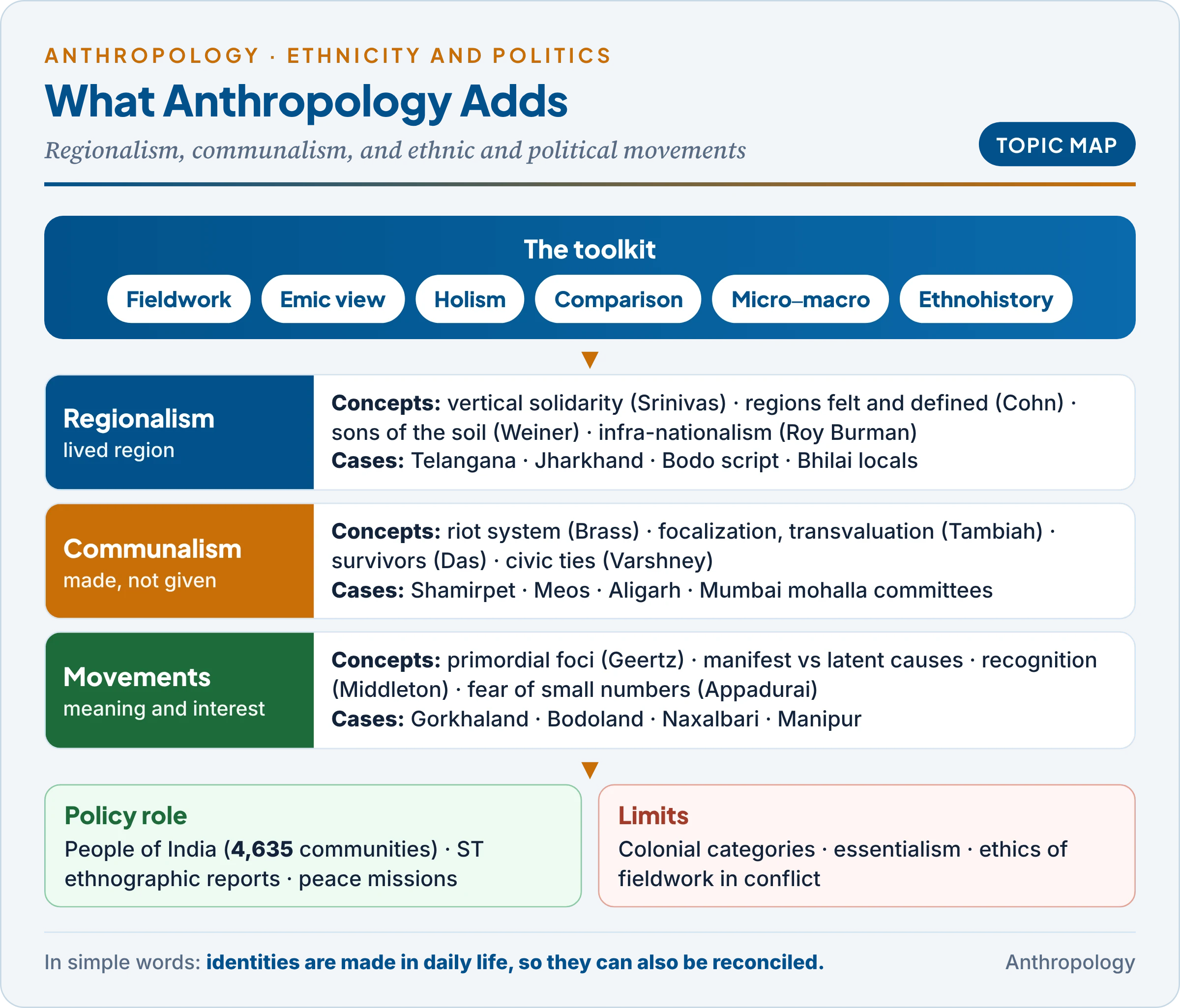
This article asks what anthropology adds to the study of regionalism, communalism and ethnic and political movements. The theories of ethnicity, the causes of ethnic conflict and tribal unrest, the autonomy movements and national integration are taught in 7.3a; the history and typologies of tribal movements (Santal hul, Birsa Munda, Tana Bhagat, Jharkhand) in 7.4; the status of religious and linguistic minorities in 5.2; and anthropology’s role in development in 9.2.
1. What Anthropology Brings to the Study of Conflict and Mobilisation
In simple words
Newspapers and politicians usually explain riots and regional movements from the top: leaders, parties and laws. Anthropologists go and live with ordinary people in a village or a town quarter and ask how they themselves see their neighbours, their region and their faith. This shows that hatred is not natural or eternal: it is made, used and sometimes unmade in daily life.
Example first: one village, two pictures. In the early 1950s the Indian anthropologist S.C. Dube studied Shamirpet, a multi-caste village near Hyderabad (Indian Village, 1955). Hindus treated their Muslim neighbours almost as another jati (caste group) within the village order, and both joined the same rites against evil spirits, ghosts and epidemics. Yet cities such as Aligarh, Ahmedabad and Hyderabad saw repeated riots. Long fieldwork in both settings showed that hostility is produced by particular conditions (urban politics, segregated housing, organised networks), not carried in religion itself.
1.1 The anthropological toolkit
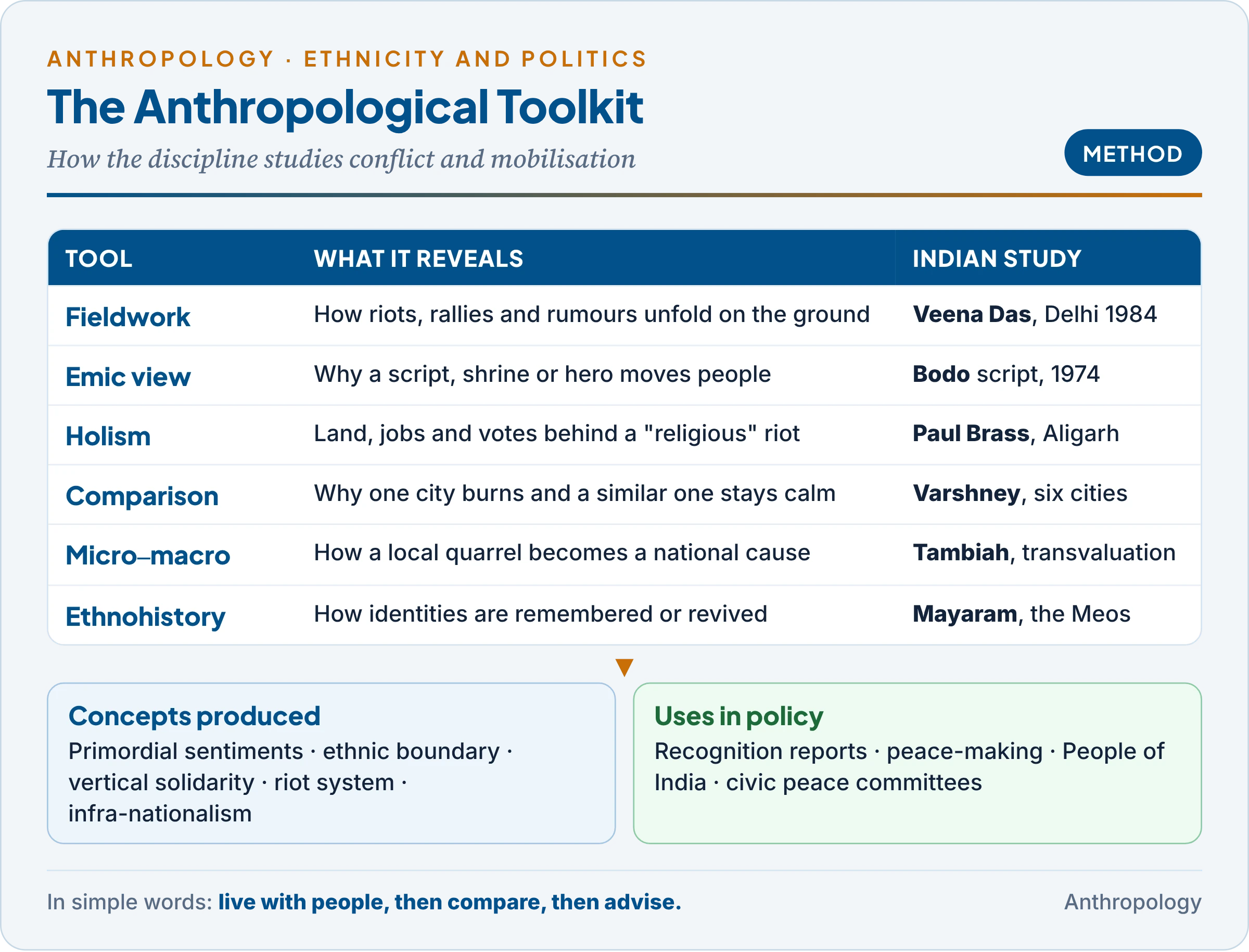
Anthropology contributes a way of knowing more than a single theory. The table lists its tools and what each reveals.
| Tool | What it means | What it reveals | Indian illustration |
|---|---|---|---|
| Fieldwork (participant observation) | Living with people for months and taking part in daily life | How riots, rallies and rumours actually unfold on the ground | Veena Das among survivors in Delhi after 1984 |
| Emic view | The insider’s own categories and meanings | Why a symbol (a script, a shrine, a drum) moves people | Bodo script agitation of 1974 |
| Holism | Linking economy, kinship, religion and politics | That a “religious” riot often has land, jobs and votes behind it | Paul Brass in Aligarh |
| Comparison | Setting cases side by side | Why one city burns and a similar one stays calm | Ashutosh Varshney‘s six cities |
| Micro–macro link | Tracing local events to state and national forces | How a village quarrel becomes a national cause | Stanley Tambiah‘s “transvaluation” |
| Ethnohistory | People’s own memory and myth of the past | How identities are remembered, revived or invented | Meo memory (Shail Mayaram) |
The emic view (the insider’s) explains why people feel as they do; the etic view (the observer’s comparative categories) lets cases be compared. Together they denaturalise conflict: identities such as “Hindu”, “Bodo” or “Telangana person” are shown to be made and remade, and so can also be reconciled.
1.2 Concepts anthropology has given to the field
- Primordial sentiments (Clifford Geertz, the American anthropologist, “The Integrative Revolution”, 1963): attachments felt as “given” by birth (blood, race, language, region, religion, custom) that compete with loyalty to the new state (§4.1).
- Ethnic boundary (Fredrik Barth, Ethnic Groups and Boundaries, 1969): what keeps a group distinct is the line it draws against others, not the cultural content inside it.
- Vertical solidarity (M.N. Srinivas, the Indian sociologist-anthropologist): a region binds castes and classes of one area together “vertically”, so regional loyalty can cut across caste.
- Bridge and buffer communities, infra-nationalism and proto-nationalism (B.K. Roy Burman, the Indian anthropologist who headed the Census’s social studies unit): groups that link or separate larger blocs, and loyalties that sit below or before the nation and need not oppose it.
- Institutionalised riot system (Paul Brass) and focalization and transvaluation (Stanley Tambiah): the social machinery and the symbolic process that turn local incidents into “communal” riots (§3.3).
1.3 The three lenses, in brief
Primordialists (Edward Shils, Geertz) see identity as a deep, felt attachment; instrumentalists (Abner Cohen, Paul Brass) as a resource leaders use; constructivists (Barth, Benedict Anderson’s “imagined communities”) as a boundary built through interaction (7.3a §1.3). Fieldwork combines them: identities are built, then felt as natural, then used.
Common confusion
Is anthropology’s contribution simply to describe conflicts that political science explains? No. Political science usually starts from parties, elections and the state. Anthropology starts from meanings and relationships in everyday life and asks how people come to see a quarrel as “communal” or a grievance as “regional”. Many key findings (the riot system, civic ties across communities, recognition politics) came from fieldwork-based studies, whatever the author’s department.
2. Regionalism: The Anthropological Understanding
In simple words
Regionalism is a strong attachment to one’s own region, with the demand that the region get a fair share of power, jobs and development. Anthropologists show that a region is not only a line on a map: it is a lived world of language, food, festivals, memories and grievances. When people feel that outsiders take their jobs, water or minerals, this lived world turns into a political demand.
Example first: Telangana. The Telugu-speaking districts of the old Hyderabad State were joined to Andhra in 1956, with promised safeguards for local jobs (the mulki rules, preference for local residents). People in Telangana came to feel that settlers from coastal Andhra held the better jobs and that river water and funds flowed elsewhere. A first agitation in 1969 (“Jai Telangana”) was followed by a long second phase, summed up in the slogan neellu, nidhulu, niyamakalu (water, funds, jobs). Telangana became a separate state on 2 June 2014 under the Andhra Pradesh Reorganisation Act, 2014. The case shows what anthropologists stress: both sides spoke Telugu, so the movement rested not on language but on memory of a separate history, dialect and cultural pride, and a sense of being outnumbered at home.
2.1 The region as an anthropological unit
- Culture areas and regions: Irawati Karve (Kinship Organization in India, 1953) divided India into kinship zones (northern, central, southern, eastern) that broadly follow language regions.
- Unity in diversity: N.K. Bose (Peasant Life in India: A Study in Indian Unity and Diversity, 1961) mapped house types, oil presses, ploughs and food across India and found regional patterns within an all-India continuity.
- Regions subjective and objective: the American anthropologist-historian Bernard Cohn (1967) distinguished regions defined by outside criteria (geography, language, administration) from regions felt by the people themselves through sacred myths, history and symbols (for example Bundelkhand). A political movement needs the second kind.
- Vertical solidarity: for Srinivas, a region binds different castes together; its boundaries are flexible and depend on a population sharing language and culture.
Regionalism is cultural before it is political: food, dialect, saints and festivals give a region emotional reality; grievances give it a political edge.
2.2 The roots of regionalism
The table groups the factors that fieldwork has traced.
| Root | How it works | Indian case |
|---|---|---|
| Human diversity | Caste, tribe, religion and language group people into ready-made blocs | Bodo, Gorkha and Meitei identities |
| Language and culture | Language marks identity; fear of a dominant language or culture | Anti-Hindi agitation in Tamil Nadu (1965); Bodo script |
| Uneven development | A region feels its wealth leaves while it stays poor | Jharkhand‘s minerals; Telangana‘s water |
| Sons of the soil | Natives educated but jobless resent migrants who hold jobs | Shiv Sena in Bombay; the Assam movement |
| History and memory | A separate past (a kingdom, a princely state, a colonial “excluded area”) | Hyderabad State; the Naga hills |
| Geography | Hills, forests and borders isolate and preserve identities | The North-East; Ladakh |
| Politics and administration | Leaders mobilise identity; delayed or partial concessions | Regional parties; repeated Bodo accords |
- Uneven development and internal colonialism: the American sociologist Michael Hechter (Internal Colonialism, 1975) argued, from Britain’s “Celtic fringe”, that when a core region controls the wealth of a periphery and jobs are divided along cultural lines, the periphery’s culture becomes the badge of its grievance. Jharkhand and Telangana movements spoke in exactly these terms.
- Sons of the soil: the American political scientist Myron Weiner (Sons of the Soil: Migration and Ethnic Conflict in India, 1978) showed that such movements arise when a native middle class becomes educated and finds migrants already in the jobs it wants (Assam, Bombay, Hyderabad). His argument is explained in 7.3a §2.2.
- Why language is so powerful: it is both a practical asset (schools, exams, jobs) and a symbol of dignity, so script disputes stir passions beyond their practical cost.
2.3 From tribe to region: how ethnicity becomes regionalism
The Indian anthropologist Vinay Kumar Srivastava described a recurring passage from “isolated folk” to “ethnic group” to “region”: exploitation by outsiders, in a group large enough and with leaders, produces political consciousness, and a separate region becomes its demand. The image traces the steps.
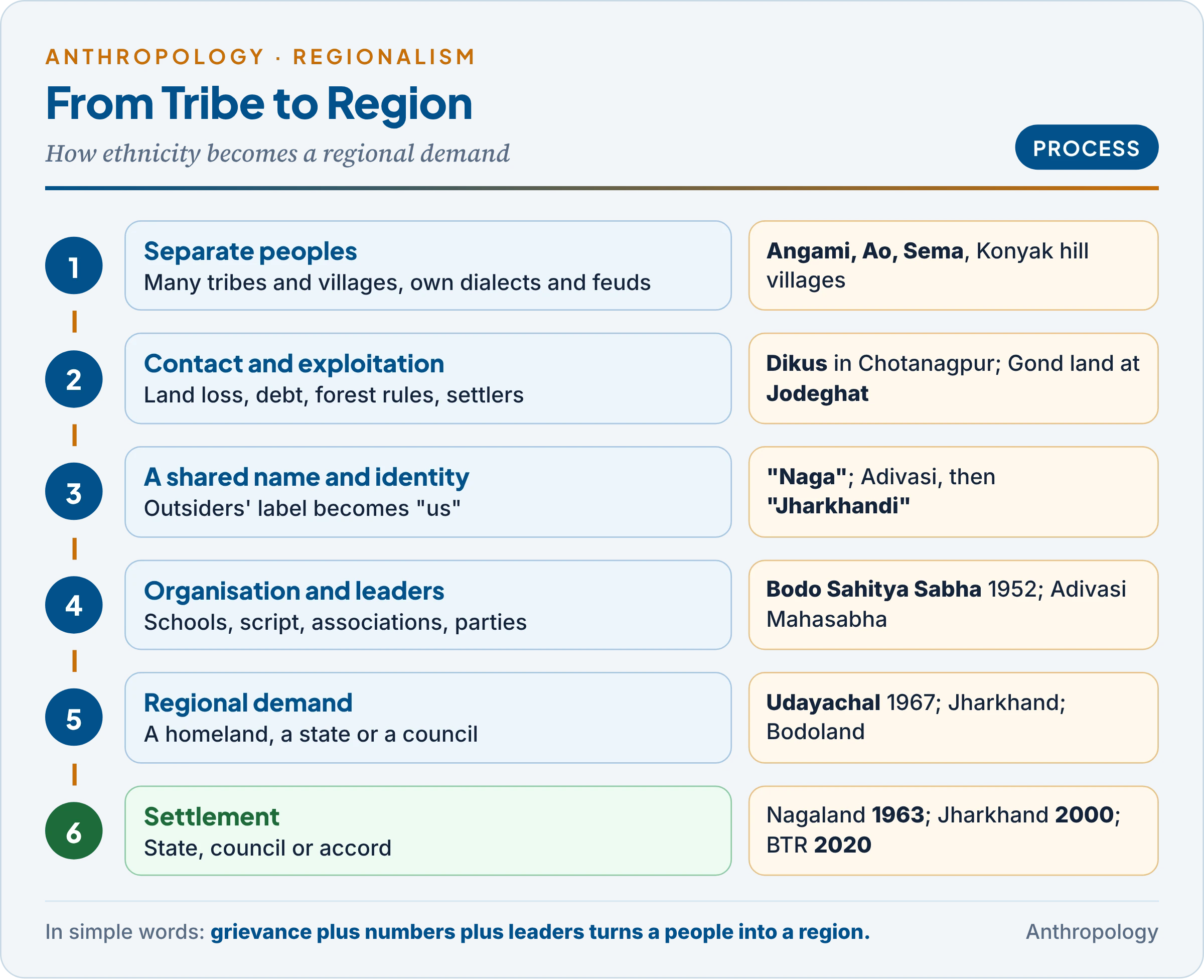
- Nagas: a name becomes a nation. Many endogamous, mutually hostile hill tribes (Angami, Ao, Sema, Konyak) were lumped together as “Naga” by the plains people and the British; mission schools, the Roman script and the pidgin Nagamese linked them; under outside rule the label became a shared identity and then a demand for a homeland (7.3a §1).
- Gonds of Adilabad: grievance, martyrdom, region. Komaram Bheem led the Gonds of the Jodeghat area against forest officials and the Nizam’s revenue system with the call Jal, Jangal, Zameen (water, forest, land); he was killed by the Nizam’s police at Jodeghat in 1940. The Nizam’s government then asked the Austrian anthropologist Christoph von Fürer-Haimendorf to study the Gonds; his work fed into the Hyderabad Tribal Areas Regulation of 1946. The Indravelli firing (20 April 1981) later cemented Gond identity (7.3a §3).
- Bodos: language first, then land. The Bodo Sahitya Sabha (1952) began with literature and schooling in Bodo. The Plains Tribals Council of Assam (1967) demanded a plains-tribal territory, Udayachal. In 1974 the Sabha’s campaign for the Roman script led to police firing in which about 15 agitators died; in April 1975 it accepted Devanagari. Language and script grievances fed into the later Bodoland demand (7.3a §4.4).
- Jharkhand: from tribal to regional identity. The movement began among educated Christian Munda and Oraon (Chhotanagpur Unnati Samaj, 1915), grew under Jaipal Singh‘s Adivasi Mahasabha and Jharkhand Party, and won statehood (15 November 2000) only after it widened into a “Jharkhandi” identity that included non-tribal peasants and workers. The Indian administrator-anthropologist K.S. Singh (Tribal Movements in India, 2 vols, 1982–83) read this as the classic passage from ethnicity to regionalism (7.4 §4.8).
2.4 What ethnography adds to the study of regionalism
- Regionalism is lived in everyday competition. In the steel town of Bhilai (Chhattisgarh), the British anthropologist Jonathan Parry found local Chhattisgarhi labourers working under contractors who were mostly outsiders; the local–outsider tension shaped unions and politics. This was part of a London School of Economics project, “Regionalism, nationalism and globalisation in India”, comparing four states.
- Region and nation are layered. In the same project Véronique Bénéï showed schools and Marathi cinema making Shivaji a regional hero with a Hindu tint, while Peggy Froerer found Chhattisgarh’s schools stressing Indian (or Hindu) nationalism over Chhattisgarhi regionalism.
- The politics of “sons of the soil”. The American political scientist Mary Fainsod Katzenstein (Ethnicity and Equality, 1979) and the Danish anthropologist Thomas Blom Hansen (Wages of Violence, 2001) showed the Shiv Sena turning the Marathi “son of the soil” against South Indian and later Muslim “outsiders”: regionalism sliding into communalism.
- Loyalties below the nation need not oppose it. Roy Burman‘s idea of infra-nationalism treats regional and tribal loyalties as building blocks of the nation when they are respected. He used it in peace missions between Nagas and Kukis in Manipur.
2.5 Anthropological suggestions for handling regionalism
- Natural regions: Srinivas proposed that administrative regions be drawn on scientific criteria (ecology, economy, culture), with help from geographers and ethnographers, rather than on language alone, each with a council responsible for its development.
- Jobs: in Nation-Building in Independent India (1976) Srinivas suggested giving local people preference in semi-skilled and unskilled jobs, with training to prepare them, while filling specialised posts on all-India merit.
- Language with respect: recognition of scripts and languages (Ol Chiki for Santali, devised by Raghunath Murmu in 1925; Santali and Bodo in the Eighth Schedule by the 92nd Amendment, 2003) honours identity and reduces the pull of separatism (7.3a §5.3).
- Balanced development: fieldwork repeatedly found that when the benefits of development reach a region, its demand for separation weakens
3. Communalism: The Anthropological Understanding
In simple words
Communalism is the belief that people of one religion share common worldly interests that are different from, and opposed to, those of people of another religion. Anthropologists show that this belief is not built into religion. In many villages and shrines people of different faiths have shared rituals for centuries; communal hatred is produced by particular political, economic and organisational conditions, and it can be prevented.
Example first: the Meos between two faiths. The Meos of Mewat (Rajasthan–Haryana border) became Muslims over several centuries but kept Hindu-style clan (gotra) exogamy, epics and festivals. The Indian political anthropologist Shail Mayaram (Resisting Regimes: Myth, Memory and the Shaping of a Muslim Identity, 1997) showed, from their oral epics and memories, that Meo identity was long fluid and “liminal” (in between). It was pushed towards a sharp “Muslim” identity by princely-state politics, Hindu and Islamic reform movements such as the Tablighi Jama’at, and the violence of 1947. A community that was once a living bridge was made communal by history and organisation.
3.1 What communalism is
- Three stages (Bipan Chandra): the Indian historian Bipan Chandra (Communalism in Modern India, 1984) traced communalism from the belief that followers of a religion share common secular interests, to the belief that these interests differ from those of other religions, to the belief that they are mutually hostile. The definition and the factors behind communalism are given in 5.2 §3.5.
- “Communal living” versus communalism: Vinay Kumar Srivastava noted that living as a community is normal; communalism begins when it isolates communities and strikes at a composite culture. An individual may denounce communalism, yet act as a “communal actor” when the situation defines him as a member of a religious group.
- A modern product: historians such as Gyanendra Pandey (The Construction of Communalism in Colonial North India, 1990) and anthropologists such as Bernard Cohn (his essay on the census and “objectification”, reprinted in An Anthropologist among the Historians, 1987) showed that colonial census categories, separate electorates and printed religious publics turned fuzzy, overlapping identities into counted, bounded blocs.
3.2 Anthropological explanations
- Functionalism’s double edge: following Durkheim, religion creates solidarity within a moral community; for the same reason it can divide communities. When that solidarity becomes open hostility, religion turns dysfunctional for the wider society.
- Geertz in Java: in The Religion of Java (1960), Geertz described three religious streams in the town he called Modjokuto: the abangan (village animist-syncretic), the santri (orthodox Muslim) and the priyayi (Hindu-Buddhist-influenced elite). Conflict between them was sharpened by ideological dislike, changing stratification that forced formerly separate groups into contact, competition for power after colonial rule, and the search for scapegoats in a fast-changing society,, and moderated by shared village life.
- Congregational and non-congregational religions: Srivastava contrasted congregational, monotheistic faiths with one text and sharp boundaries, which mobilise easily, with plural traditions such as Hinduism, harder to unite except by deliberate political effort.
- Syncretism and its erosion: Sufi shrines, pir cults and mixed communities like the Meos show a composite culture at the local level. The American anthropologist Robert Hayden (“Antagonistic Tolerance”, 2002) warned that shared shrines can turn into contested ones when the balance of power shifts (3.4 §8.1).
3.3 The anthropology of riots
Fieldwork in riot-affected towns has changed how communal violence is understood. Four findings stand out; the image combines them.
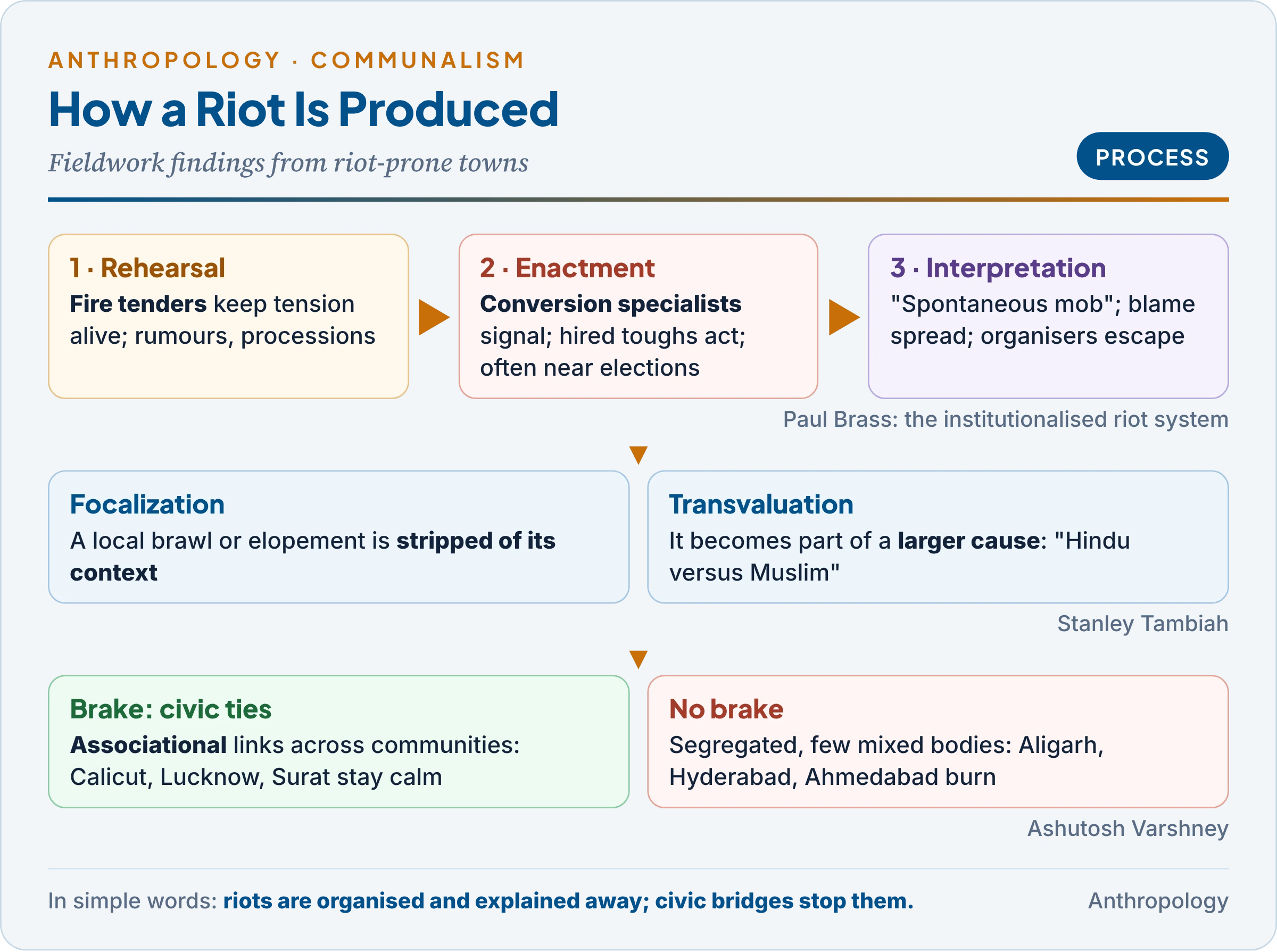
- Riots are produced (Paul Brass). From four decades of work in Aligarh, Brass (Theft of an Idol, 1997; The Production of Hindu–Muslim Violence in Contemporary India, 2003) found “institutionalised riot systems” in riot-prone towns: networks of known people with specific roles. “Fire tenders” keep tension alive; “conversion specialists” lead crowds and signal when violence should start; hired toughs do the violence; politicians and the vernacular press then explain it away. Riot production runs in three phases: preparation or rehearsal, activation or enactment (often near elections), and explanation or interpretation, when blame is spread so widely (“the mob”, “ancient hatred”) that the organisers escape.
- Local quarrels become national causes (Stanley Tambiah). The Sri Lankan-born anthropologist Stanley Tambiah (Leveling Crowds, 1996, developing a 1990 essay) called “focalization” the stripping of a local incident (a brawl, an elopement, a cricket match) of its particular context, and “transvaluation” its absorption into a larger, enduring cause such as “Hindu versus Muslim”. He also showed how riots become routinised and ritualised, following known scripts.
- The voice of survivors (Veena Das). The Indian anthropologist Veena Das edited Mirrors of Violence: Communities, Riots and Survivors in South Asia (1990) and worked among Sikh widows in Sultanpuri, Delhi, after the killings of 1984. In Critical Events (1995) she showed how events such as Partition and 1984 reshape the categories people live by, and in Life and Words (2007) how survivors rebuild everyday life. Her work brought gender, grief and the state’s denial into the study of riots.
- Civic ties as a brake (Ashutosh Varshney). Comparing Aligarh with Calicut, Hyderabad with Lucknow and Ahmedabad with Surat (Ethnic Conflict and Civic Life, 2002), Varshney found that associational links across communities (business bodies, unions, professional and festival associations) are sturdier than everyday neighbourly contact in preventing riots, especially in large cities (summary in 7.3a §2.5).
Common confusion
Is a communal riot a spontaneous outburst of mass hatred? Fieldwork says mostly no. Riots are usually partly organised and partly spontaneous: emotions are real, but the spark is turned into a fire by networks, rumours, political timing and police inaction. Calling riots “spontaneous” is itself part of the third phase Brass describes, because it hides who organised them.
3.4 Village and city, conversion and communal politics
- Village evidence: Dube’s Shamirpet and many other village studies (5.1) found Hindus and Muslims within one ritual and economic order; Varshney too found everyday ties enough to keep peace in villages. Communal violence has been mainly an urban phenomenon, tied to segregated neighbourhoods, electoral competition and rumour.
- Segregation feeds itself: each riot makes people move to areas where their own community is a majority; segregation then weakens everyday contact and makes the next riot easier.
- Conversion as politics: the American anthropologist O.M. Lynch (The Politics of Untouchability, 1969) showed Jatavs of Agra using Buddhism and alliances with other groups to claim dignity and political power. The conversion of about 180 Dalit (Pallar) families to Islam at Meenakshipuram (Tamil Nadu) on 19 February 1981 became a national communal issue, though the converts spoke mainly of escaping caste humiliation (3.4 §7).
3.5 Remedies informed by fieldwork
- Build civic bridges: inter-community business, trade and professional associations; joint festival and peace committees. Police officers set up mohalla (neighbourhood) committees in Bhiwandi in the 1980s and in Mumbai after the riots of 1992–93, bringing police and residents of all communities together to stop rumours before they spread.
- Neutral, timely policing and prosecution of riot organisers, which breaks the impunity on which riot systems depend.
- Schools and media that teach shared histories and avoid stereotypes.
- Rethinking secularism: the Indian anthropologist T.N. Madan (“Secularism in Its Place”, 1987) and the psychologist-critic Ashis Nandy argued that a privatised, Western-style secularism cannot take root where most people are deeply religious; tolerance must be drawn from within religious traditions themselves. Others reply that a neutral state remains essential. The debate is explained in 3.4 §8.2.
4. Ethnic and Political Movements: Anthropological Interpretations
In simple words
An ethnic movement is collective action by people who share a sense of common origin and culture, to win recognition, land, jobs or self-rule. A political movement seeks change in who holds power or how it is used. Anthropologists study what such movements mean to the people in them: their symbols, memories and hopes, and how the state’s own categories shape what they demand.
Example first: Darjeeling’s search for “tribal” status. In July 2006 a team of government anthropologists from West Bengal’s Cultural Research Institute came to Darjeeling to carry out an “Ethnographic Survey” of Nepali-speaking groups that had applied for Scheduled Tribe status. The American anthropologist Townsend Middleton (The Demands of Recognition: State Anthropology and Ethnopolitics in Darjeeling, 2015) followed both sides. Communities staged sacrifices, shamanic rites, bows and arrows to prove they were “primitive” enough; officials struggled to judge “authentic” culture. Middleton showed that anthropology itself has become a resource in ethnic politics: people now remake their cultures to fit the state’s ethnological categories, and the Gorkhaland movement swung between a Gorkha identity and a tribal one.
4.1 Geertz’s foci of primordial attachment
Geertz listed the bases around which “primordial” discontent tends to crystallise in new states. The table gives each with an Indian case.
| Focus | Meaning | Indian case |
|---|---|---|
| Assumed blood ties | Belief in common descent, real or imagined | Naga, Munda and Santal clan-based identities |
| Race | Visible physical features taken as markers | Racial abuse of North-Eastern people in Indian cities (Bezbaruah Committee, 2014) |
| Language | Mother tongue as identity and opportunity | Linguistic states (1956); Bodo script |
| Region | Attachment to a homeland | Telangana, Gorkhaland, Ladakh |
| Religion | Shared faith as a political bond | Partition of 1947; the Punjab crisis of the 1980s |
| Custom | Distinct ways of life and law | Tribal customary law protected by Article 371A (Nagaland) |
Geertz’s point was that these loyalties are not relics that modernisation will remove. The new state, by creating jobs, elections and a national stage, gives them new things to compete for. His solution was neither suppression nor surrender but the “integrative revolution”: building civil institutions within which primordial groups can bargain peacefully.
4.2 Manifest causes and latent causes
- Manifest cause: what a movement says it is about (language, religion, region, tribe).
- Latent cause: what anthropologists often find beneath it: competition over land, jobs, resources and power.
- Evidence: groups that share a culture can split when interests diverge, and groups that differ can unite when interests converge. Many Muslim settlers of East Bengal origin in Assam (Na-Asamiya) returned Assamese as their mother tongue in the censuses after 1951, aligning with the Assamese for security on the land rather than with Bengali speakers of their own culture.
- Why it matters: if the latent cause is land, jobs and power, then cultural concessions alone will not settle a movement; development and power-sharing must accompany recognition.
4.3 Interpretive approaches
Different schools read the same movement in different ways. The table summarises them; 7.4 §6.6 applies several to tribal movements.
| Approach | Core idea | Key scholar | Indian reading |
|---|---|---|---|
| Relative deprivation | People rise when the gap between what they expect and what they get widens | David Aberle (1962) | Telangana’s “water, funds, jobs” |
| Revitalization | A stressed society remakes its culture through a prophet | Anthony Wallace (1956) | Birsa Munda; Heraka |
| Agrarian and subaltern | Peasant insurgency has its own consciousness | Ranajit Guha (Elementary Aspects of Peasant Insurgency, 1983) | Santal hul; Naxalbari |
| Internal colonialism | A periphery’s resources are drained by a core | Michael Hechter (1975) | Jharkhand, Telangana |
| Politics of recognition | Groups seek equal respect for their identity | Charles Taylor (1992); Middleton (2015) | Gorkha ST demand; Sarna code |
| Constructivist | Identities are built through contact, print and mobilisation | Barth; Anderson | Naga and Jharkhandi identities |
No single approach is enough. Deprivation explains why people are angry, recognition explains what they ask for, political economy explains whom they oppose, and constructivism explains how a “people” is formed. Anthropology’s strength is to hold all four together through one case studied in depth.
4.4 Readings of major movements
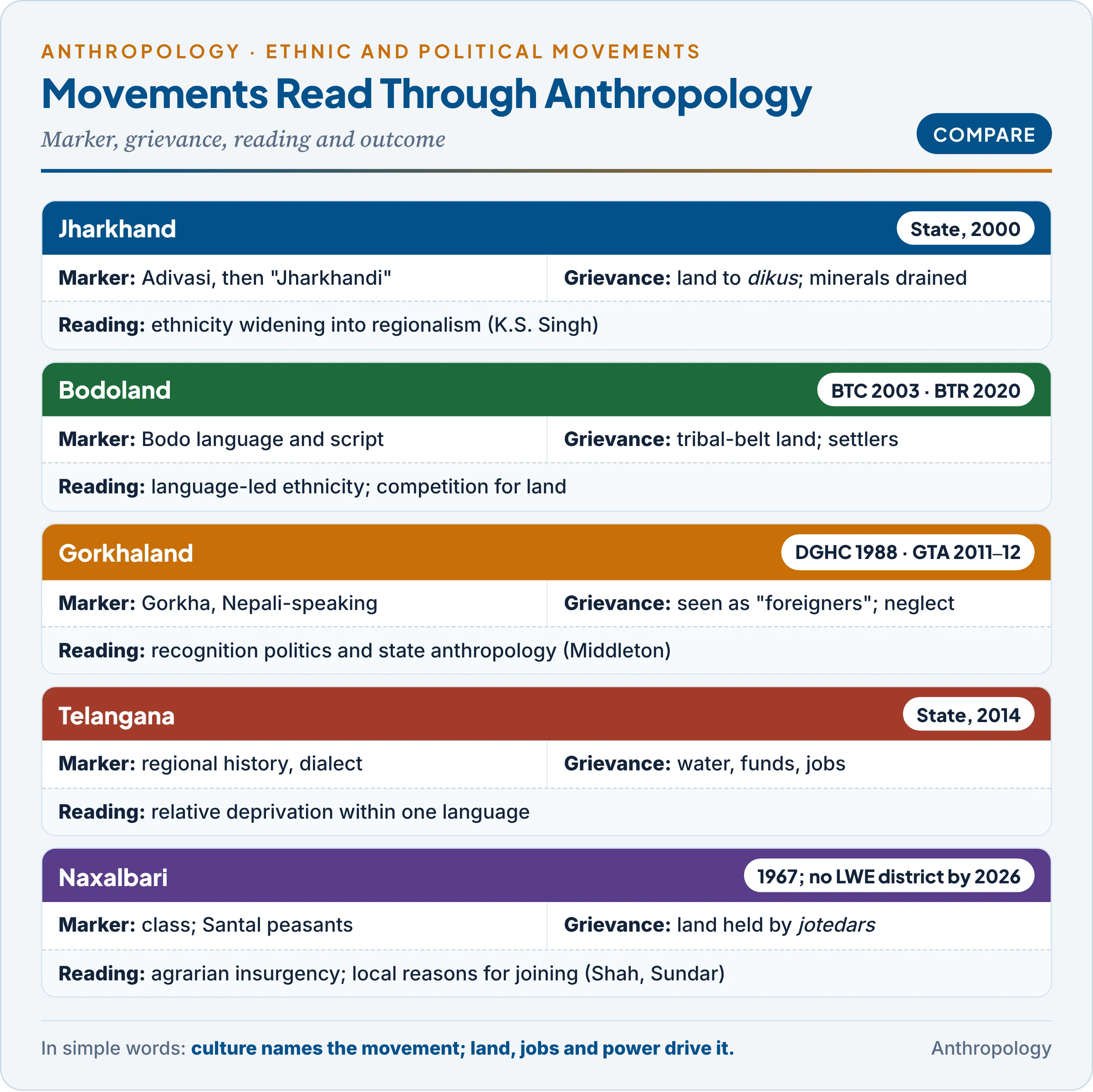
The table sets five movements side by side, with what anthropological study has added; the image compares them.
| Movement | Identity marker | Core grievance | Anthropological reading | Outcome so far |
|---|---|---|---|---|
| Jharkhand | Adivasi, then “Jharkhandi” | Land loss to dikus; mineral wealth leaving the region | K.S. Singh: ethnicity widening into regionalism | State, 15 November 2000 |
| Bodoland | Bodo language and script | Land in tribal belts; settler growth | Language-led ethnicity; competition with settlers | BTC 2003; BTR 2020 |
| Gorkhaland | Gorkha (Nepali-speaking) | Being treated as “foreigners”; hill neglect | Middleton: recognition politics and state anthropology | DGHC 1988; GTA 2011–12 |
| Telangana | Regional history and dialect | “Water, funds, jobs”; mulki safeguards | Relative deprivation within one language | State, 2 June 2014 |
| Naxalbari | Class, with Santal and other poor peasants | Land held by jotedars (big landholders) | Agrarian insurgency; later forest-tribal base | Spread, then shrank; no LWE district by April 2026 |
- Naxalbari: on 25 May 1967 police fired on a gathering of peasants, mainly women, near Naxalbari in north Bengal; the rising was led on the ground by Kanu Sanyal and the Santal leader Jangal Santhal, with Charu Majumdar as ideologue. Its later strongholds were the forested tribal belt. The British anthropologist Alpa Shah (In the Shadows of the State, 2010; Nightmarch, 2018) and Nandini Sundar (Subalterns and Sovereigns, 1997) showed, from fieldwork in Jharkhand and Bastar, that Adivasis joined or tolerated the Maoists for local reasons (protection from forest officials, fair tendu leaf rates, kinship and friendship), not mainly for ideology, and were caught between insurgents and the state (7.3a §3.3).
- Kashmir and Nagaland (2020 question): in Kashmir, a regional identity (Kashmiriyat, a shared culture of Hindus and Muslims of the valley) was overlaid by religious and national contests; Article 370 was made inoperative and the state reorganised into two Union Territories in 2019. In Nagaland, a many-tribe Naga identity built in the twentieth century still sustains talks on a final settlement (7.3a §4.4). In both, the anthropological lesson is the same: a shared regional culture can be pulled apart or welded together by politics.
4.5 The resurgence of ethno-nationalism
- Meaning: the claim that an ethnic group is a nation entitled to its own territory or state; it has revived worldwide since the 1990s.
- Appadurai’s explanation: the Indian-born anthropologist Arjun Appadurai (Fear of Small Numbers: An Essay on the Geography of Anger, 2006) argued that every modern nation carries an idea of a “national ethnos”. Majorities can develop an “anxiety of incompleteness”: the presence of even a small minority reminds them that the pure national whole is not achieved, and this can turn identities “predatory”, seeking to remove the other.
- Nation-state and indigenous peoples (2025 question): the nation-state’s demand for one law, one language of rule and one model of development presses hardest on indigenous societies, whose land and custom it often treats as obstacles; the comparison with other countries is in 8.2.
- Indian expressions: majoritarian movements in religion and language; small groups’ assertions for homelands (Kuki-Zo demand for a separate administration in Manipur since 2023); and counter-mobilisations by groups that fear becoming minorities at home.
4.6 Rising ethnic conflicts: what anthropology suggests
- Listen before acting: study each group’s fears (land, numbers, dignity) before redrawing boundaries or extending reservations.
- Recognition without exclusion: respect languages and customary law while protecting minorities within each claimed homeland.
- Power-sharing: councils, special provisions and mixed cabinets, as in Manipur in 2026.
- Civic ties and early warning: mixed associations, peace committees, quick action on rumours.
- Development with consent: through gram sabhas and the Forest Rights Act (2006), since the latent cause is usually land and livelihood.
5. Anthropology, Policy and the Limits of Expertise
In simple words
Anthropologists do not only study movements; they have also advised governments, written the reports that decide who is a “tribe”, and tried to make peace between warring groups. This gives the discipline influence, but also responsibility, because the categories it creates can be used to include or exclude people.
5.1 Contributions to policy
- Mapping diversity: the People of India project of the Anthropological Survey of India, launched on 2 October 1985 under K.S. Singh, studied 4,635 communities and was published in 43 state-wise volumes. It documented both diversity and linkages between communities, a resource for understanding identity claims.
- Deciding recognition: applications for ST status are judged partly on ethnographic reports from state tribal research institutes and the Registrar General; anthropologists thus stand at the centre of recognition politics (§4, Middleton).
- Advising after unrest: Haimendorf‘s study of the Gonds after 1940 led to protective regulation in Hyderabad (§2.3); Verrier Elwin, as adviser for tribal affairs in NEFA, shaped a policy of developing tribes “along the lines of their own genius” (9.1a).
- Peace-making: Roy Burman walked through conflict areas of the North-East and spoke with both armed groups and governments; credibility built through fieldwork made him an accepted go-between.
- Livelihood and health (2017 and 2024 questions): ethnography links the loss of livelihood to mining, dams, forest laws and market change (6.3a, 6.3b), and shows during crises such as COVID-19 that health care works for marginal groups only when it fits their own ideas of illness, trust and community (9.2).
- Policy-making in general (2012 question): anthropological findings have informed PESA (1996), the Forest Rights Act (2006) and tribal development plans; anthropology’s wider role in development, livelihoods and health is treated in 9.2.
5.2 Critiques and limits
- Colonial roots: colonial ethnography and the census classified and fixed castes, tribes and religions (Cohn; Nicholas Dirks, Castes of Mind, 2001), and these categories later became the basis of political competition.
- Essentialism: describing a group as having one “true” culture can freeze change and exclude members who do not fit; recognition procedures can reward performances of primitiveness (Middleton).
- Ethics: fieldwork in conflict zones raises consent, safety and neutrality; the researcher may be seen as a spy or partisan.
- Marginal influence: Indian anthropology is often consulted late; the call is for a relevant, problem-solving anthropology that informs policy without serving it.
Key Terms
| Term | Meaning in simple words |
|---|---|
| Regionalism | Strong loyalty to one’s region and the demand that its interests be served |
| Vertical solidarity | Regional loyalty that binds different castes and classes of one area together |
| Sons of the soil | The belief that natives of a region have first claim to its jobs and land |
| Internal colonialism | A rich core region draining a poorer periphery inside the same country |
| Communalism | The belief that people of one religion share worldly interests opposed to those of another |
| Communal actor | A person who behaves as a member of a religious bloc in a given situation |
| Composite culture | Shared practices and shrines of different faiths at the local level |
| Institutionalised riot system | A standing network of people who prepare, start and explain riots |
| Focalization | Stripping a local incident of its particular context |
| Transvaluation | Turning a local incident into part of a larger, lasting cause |
| Associational engagement | Organised links across communities (unions, business and professional bodies) |
| Primordial sentiments | Loyalties felt as given by birth: blood, race, language, region, religion, custom |
| Ethno-nationalism | The claim that an ethnic group is a nation entitled to its own territory or state |
| Anxiety of incompleteness | A majority’s fear that a minority’s presence spoils the national whole |
| Infra-nationalism | Loyalty to a group below the nation that need not oppose the nation |
| Politics of recognition | Struggle for equal respect for a group’s identity and status |
| Emic and etic | The insider’s own view and the observer’s comparative view |
Contemporary Developments
- Manipur (2026): President’s Rule, imposed on 13 February 2025, was revoked on 4 February 2026; Y. Khemchand Singh became Chief Minister with a Kuki and a Naga legislator as deputy chief ministers, an attempt at ethnic power-sharing after the Meitei–Kuki-Zo conflict that began in May 2023.
- Bodoland (2025): in elections to the Bodoland Territorial Council held on 22 September 2025, the Bodoland People’s Front won 28 of 40 seats, returning Hagrama Mohilary to power.
- Census with caste (2025–27): the Cabinet Committee on Political Affairs decided on 30 April 2025 to include caste enumeration in the next Census, the first since 1931; the reference date is 1 March 2027 (1 October 2026 for Ladakh and snow-bound areas). Counted categories will shape future identity claims.
- Ladakh (2026): after an in-principle understanding on 22 May 2026 on Article 371-type safeguards and a legislature for the Union Territory, the Leh Apex Body and the Kargil Democratic Alliance rejected the Centre’s 32-page draft of 15 October 2026, and talks stalled.
- Left-wing extremism (2026): as on 8 April 2026, the Ministry of Home Affairs classed no district as affected by left-wing extremism; 37 districts were “Legacy and Thrust” and one a “District of Concern”, where development and security support continue.
Diagrams to Master
- Topic map: label the toolkit (fieldwork, emic view, holism, comparison) and the three fields (regionalism, communalism, movements) with two scholars each.
- The anthropological toolkit: label each tool, what it reveals and one Indian study.
- From tribe to region: draw the chain (separate tribes → contact and exploitation → shared name → organisation → regional demand → state, council or accord) and attach Naga, Gond, Bodo and Jharkhand.
- How a riot is produced: label Brass’s three phases and roles, Tambiah’s focalization and transvaluation, and Varshney’s civic-ties brake.
- Movements read through anthropology: a five-row grid of marker, grievance, reading and outcome.
Revision Grid
| Scholar | Work (year) | Key idea |
|---|---|---|
| S.C. Dube | Indian Village (1955) | Hindus and Muslims share one village order in Shamirpet |
| Irawati Karve | Kinship Organization in India (1953) | Kinship zones follow linguistic regions |
| N.K. Bose | Peasant Life in India (1961) | Regional patterns within all-India unity |
| Clifford Geertz | “The Integrative Revolution” (1963); The Religion of Java (1960) | Primordial sentiments; abangan, santri, priyayi |
| Bernard Cohn | “Regions Subjective and Objective” (1967) | Regions felt by people versus regions defined from outside |
| M.N. Srinivas | Nation-Building in Independent India (1976) | Vertical solidarity; natural regions; local job preference |
| Myron Weiner | Sons of the Soil (1978) | Native middle class versus migrants |
| Mary F. Katzenstein | Ethnicity and Equality (1979) | Shiv Sena and preferential policies |
| Michael Hechter | Internal Colonialism (1975) | Core drains periphery; culture marks grievance |
| K.S. Singh | Tribal Movements in India (1982–83); People of India | Ethnicity widening into regionalism; 4,635 communities |
| B.K. Roy Burman | Essays on tribes and the North-East | Infra-nationalism; bridge and buffer communities |
| Bipan Chandra | Communalism in Modern India (1984) | Three stages of communal ideology |
| Gyanendra Pandey | The Construction of Communalism in Colonial North India (1990) | Communalism as a colonial-modern product |
| Veena Das | Mirrors of Violence (1990); Critical Events (1995); Life and Words (2007) | Survivors, gender and critical events |
| Stanley Tambiah | Leveling Crowds (1996) | Focalization and transvaluation |
| Paul Brass | The Production of Hindu–Muslim Violence (2003) | Institutionalised riot system; three phases |
| Ashutosh Varshney | Ethnic Conflict and Civic Life (2002) | Associational ties prevent riots |
| Shail Mayaram | Resisting Regimes (1997) | Liminal Meo identity made communal |
| T.N. Madan | “Secularism in Its Place” (1987) | Tolerance from within religious traditions |
| Arjun Appadurai | Fear of Small Numbers (2006) | Anxiety of incompleteness; predatory identities |
| Townsend Middleton | The Demands of Recognition (2015) | State anthropology and recognition politics in Darjeeling |
| Alpa Shah | In the Shadows of the State (2010); Nightmarch (2018) | Why Adivasis joined or tolerated Maoists |
Previous Year Questions
Contributions of anthropology to the understanding of regionalism, communalism, and ethnic and political movements
- 2025Discuss the rising ethnic conflicts in India and propose their possible remedial measures.
- 2025Critically evaluate the concept of Nation-State and describe its impact on indigenous societies.
- 2024Elucidate the resurgence of ethno-nationalism from an anthropological lens.
- 2024Critically examine existing paradigms of holistic health for the marginalised sections of society drawing inferences from COVID-19 pandemic.
- 2020Discuss the regionalism and demand for autonomy in India from Anthropological perspective with respect to Kashmir/Nagaland/Bodoland/Gorkhaland agitation.
- 2019Write a note in 150 words on Anthropological understanding of communalism.
- 2017Discuss the contribution of anthropology in understanding the loss of livelihood of tribal communities due to economic and ecological factors.
- 2016Write a note in 150 words on Anthropological interpretation of ethnic and political movements.
- 2012Using examples, comment on how anthropology can be utilized in policy making.
- 2009In what ways has anthropology contributed to the understanding of ethnic & political movements in India?
- 1995To what extent, ethnicity is responsible for the tribal movements in India? Elaborate with suitable examples.
Related questions from other units
- 2026Unit 4: Write notes on: Kumar Suresh Singh’s contribution in studying tribal movements.
- 2025Unit 7.3: Write notes on: Regionalism and Autonomy.
- 2023Unit 7.3: Distinguishing between ethnic identity and ethnicity, discuss the factors responsible for ethnic conflict in tribal areas.
- 2022Unit 7.3: Write notes on: Regionalism as an opportunity and threat to national integration.
- 2015Unit 5.2: Critically examine the concept of communalism and its relevance for multi-religious and multiethnic polity of India.
- 2014Unit 7.3: Discuss the rise of ethno-nationalism among Indian tribes with specific example.
- 2013Unit 7.4: Write a note in 150 words on Ethnic movements in India.
- 2011Unit 5.2: Write a note in 150 words on Factors contributing to communalism.
- 2003Unit 7.3: What is regionalism ? Evaluate how regionalism has stimulated political movements in India.
- 1997Unit 7.3: Discuss the significance of the regionalism and communalism in Indian context and its role in ethno-political movements in the present political system.
More from Tribal Administration and Development: all notes of this unit · every PYQ of this unit · Anthropology Optional hub