

Anthropology Optional › Paper II › Unit 08: Religions, Tribes and the Nation-State
8.1 Impact of Hinduism, Buddhism, Christianity Islam and other religions on tribal societies.
Official Syllabus: Paper II, Unit 8.1
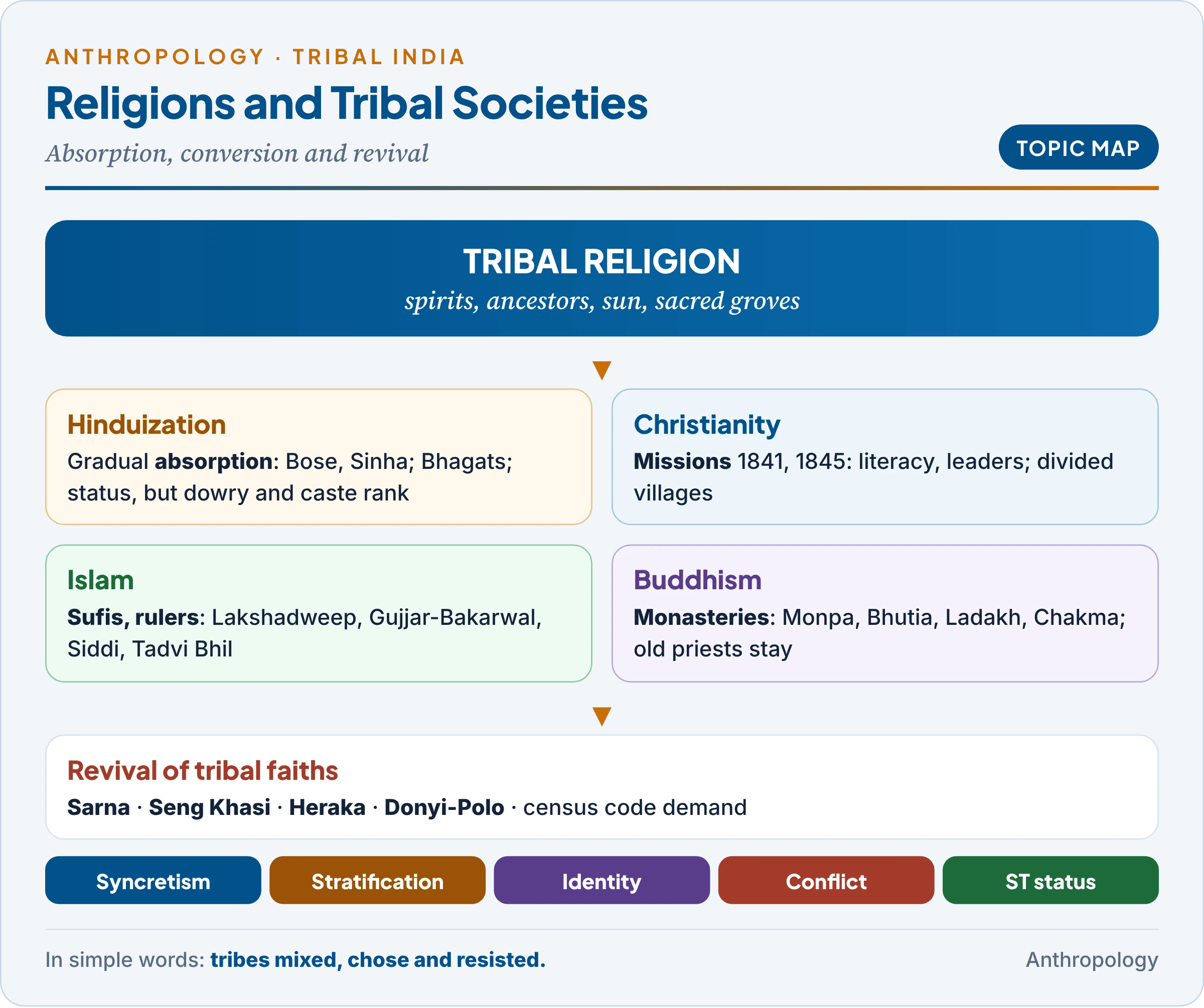
This article covers what world religions have done to tribal societies, and how tribes responded. The impact of the same religions on Indian society in general is in 3.4; Sanskritization and the tribe-caste continuum in 3.2b and 5.3a; the nature-man-spirit complex and sacred groves in 3.3; and the Bhagat, Heraka and Seng Khasi movements as social movements in 7.4.
1. Tribal Religion and the Meeting of Faiths
In simple words
Tribes had their own religions long before Hinduism, Christianity, Islam or Buddhism reached them: worship of spirits, ancestors, the sun, hills and sacred groves. Contact with world religions changed these beliefs, but rarely erased them. Most tribes today mix the old and the new, and some are reviving their old faiths as a mark of identity.
Example first: Oraon villages with three faiths. In many villages of Gumla district, Jharkhand, one finds Sarna households who worship at the sacred grove under the village priest (pahan), Christian households who attend a Lutheran or Catholic church, and Hindu or Bhagat households who keep vegetarian rules and worship Hindu gods. All three remain Oraon: they share clans, language and the Karam and Sarhul festivals, yet they marry, vote and argue along religious lines. The Census of 2011 recorded Jharkhand’s tribal population as about 46% “other religions” (mostly Sarna), 38% Hindu and 15% Christian.
1.1 Bases of tribal religion
What is religion? Anthropologists define it in three classic ways. E.B. Tylor, the British founder of the anthropology of religion, gave a minimal definition: “belief in spiritual beings“. Émile Durkheim, the French sociologist, defined it by its social function: a unified system of beliefs and practices relative to sacred things that unites its followers into one moral community (1912). Clifford Geertz, the American interpretive anthropologist, called it a cultural system of symbols that gives people a sense of order and meaning (1966). Tribal religion fits all three: spirits, a moral community of clan and village, and symbols tied to land.
Tribal religions share some common building blocks. The table gives the main ones, with the scholar who named them and an Indian case.
| Element | Meaning | Scholar or case |
|---|---|---|
| Animism | Belief in souls and spirits in persons and nature | E.B. Tylor, Primitive Culture (1871) |
| Animatism / mana | An impersonal sacred power in things | R.R. Marett (1909) |
| Bongaism | Belief in bonga, a diffuse spirit-power | D.N. Majumdar on the Ho |
| Naturism | Worship of sun, earth, hills and rivers | Singbonga (sun) of the Munda; Dharmes of the Oraon |
| Ancestor cult | Dead kin as guardians of the house and clan | Munda memorial stones (sasandiri) |
| Totemism | Clans linked to animals or plants, with taboos | Oraon and Munda clan names |
| Magic and shamanism | Specialists who heal, divine and fight witches | ojha or deonra (shaman) |
| Sacred geography | Groves and hills as abodes of deities | Sarna grove; jaher of the Santal; Niyamgiri |
The Indian anthropologist L.P. Vidyarthi summed up these links as a nature-man-spirit complex among the Maler (3.3). These religions are this-worldly, tied to land and community, and have no written scripture, no church and no conversion: this is why world religions could enter them so easily, and why religious change so often became a question of land and identity.
Common confusion
Are animism and animatism the same? No. Animism (Tylor) is belief in individual spirits or souls, which can be named, fed and feared, like the Munda ancestor spirits. Animatism (Marett) is belief in an impersonal power, like the Melanesian mana, present in objects and persons without being a person itself. Many tribal religions combine both: personal spirits and a diffuse sacred force.
1.2 Religious composition of Scheduled Tribes
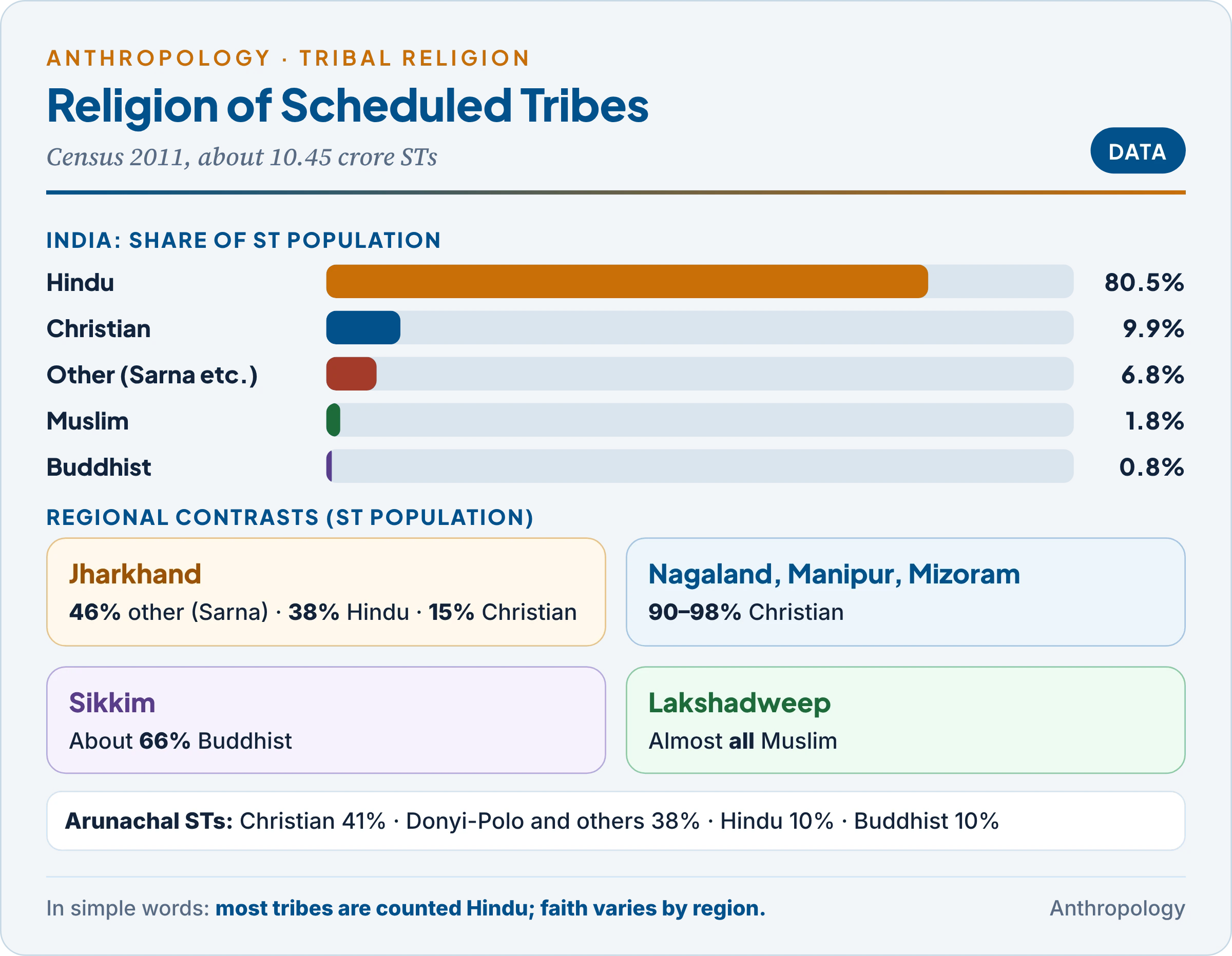
The table shows how the Scheduled Tribes of India were distributed by religion in Census 2011 (total about 10.45 crore).
| Religion | ST population | Share | Where concentrated |
|---|---|---|---|
| Hindu | 8.42 crore | 80.5% | Western, central and southern India |
| Christian | 1.03 crore | 9.9% | North-East, Jharkhand, Odisha, Chhattisgarh |
| Other religions (Sarna and others) | 71 lakh | 6.8% | Jharkhand, Odisha, Bengal, Meghalaya, Arunachal |
| Muslim | 18.6 lakh | 1.8% | Jammu and Kashmir, Lakshadweep |
| Buddhist | 8.7 lakh | 0.8% | Bengal hills, Sikkim, Tripura, Ladakh, Arunachal, Mizoram |
Three points stand out. Most tribes are counted as Hindu, though many practise their own religion and the census category is contested. Christianity is concentrated: STs in Manipur, Nagaland, Mizoram and Meghalaya are 84–98% Christian, and the number of Christian STs rose by about 63% between 2001 and 2011. The “other religions” column, about 89% of whose members are tribal, includes Sarna (about 49 lakh), Gondi (10 lakh), Sari Dharam of the Santals (5 lakh), Donyi-Polo (3.3 lakh) and Khasi (1.4 lakh).
1.3 How religious change happens
Religious change among tribes has followed four broad processes.
- Absorption (Hinduization): gradual, without a single act of conversion; tribes adopt Hindu gods, priests and customs while keeping much of their own.
- Conversion: a decisive change of affiliation, by individuals or by whole kin groups and villages (the “mass movements” described by the missionary-sociologist J. Waskom Pickett in 1933).
- Syncretism: old and new beliefs combined, as when Buddhist Monpas keep their pre-Buddhist priests.
- Revitalization: reform or revival of the tribal religion itself, often in reaction to the others (Sarna, Seng Khasi, Heraka, Donyi-Polo).
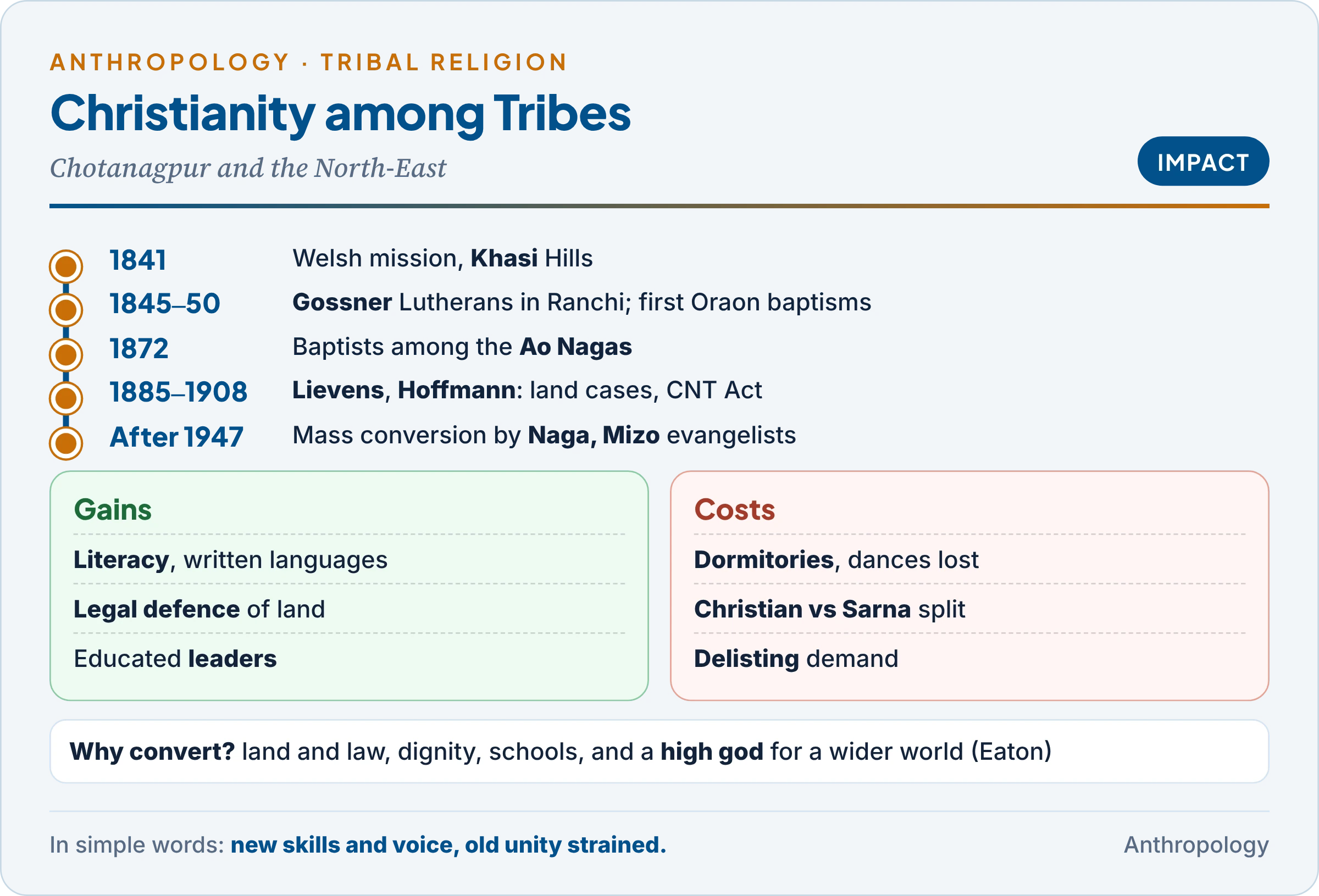
Why convert? An anthropological explanation. The American historian Richard Eaton (“Conversion to Christianity among the Nagas, 1876–1971”, 1984) found that most Naga conversion happened after 1947, when foreign missionaries had left, and among groups least exposed to them. Following the anthropologist Robin Horton‘s work on African religions, he argued that tribal religions had two tiers: many local spirits and a distant high god. When colonial rule, war and schooling widened people’s world, attention shifted to the high god who ruled the larger world, and the Christian God was identified with him. Conversion was thus less a surrender to missionaries than a reorganisation of tribal cosmology.
Common confusion
Is Hinduization the same as Sanskritization? Not quite. Hinduization is the broad process by which tribes come to worship Hindu deities, observe Hindu festivals and use Brahmin priests. Sanskritization (M.N. Srinivas) is narrower: a group copies the customs of higher castes (vegetarianism, teetotalism, sacred thread, restrictions on women) to claim a higher rank. A tribe may be Hinduized at the level of worship without Sanskritizing its way of life.
2. Impact of Hinduism
In simple words
Hinduism spread among tribes slowly, through neighbours, kings, priests and holy men, not through missions. Tribes took Hindu gods, festivals and ideas of purity while keeping much of their own culture. This brought new status for some, but also caste ranking, dowry and restrictions on women.
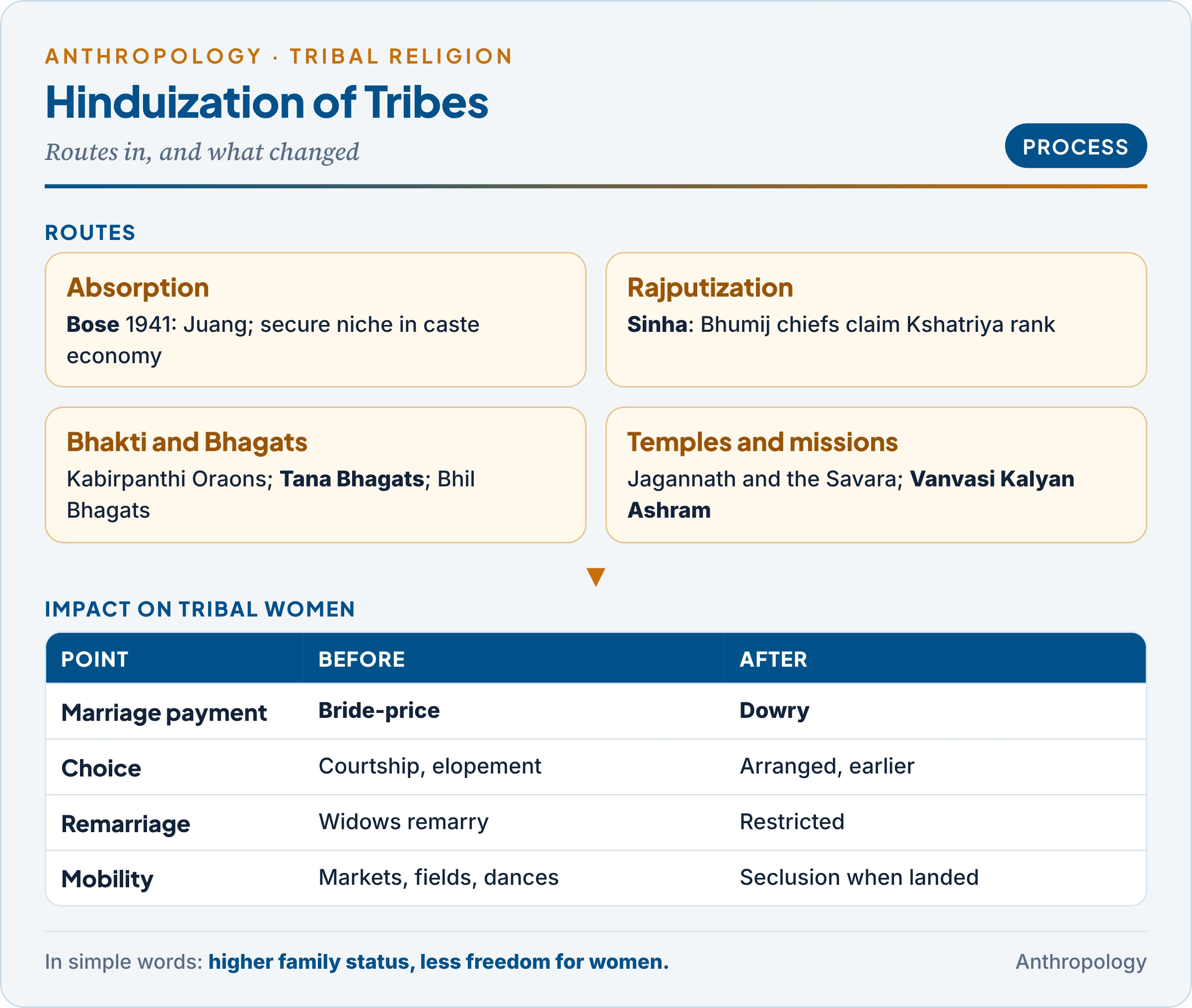
Example first: the Juang and the Bhumij. The Indian anthropologist Nirmal Kumar Bose, in “The Hindu Method of Tribal Absorption” (1941), described how the Juang of Odisha moved toward caste society: they took Brahmin priests for some rites and Hindu deities, while keeping their own customs, because caste offered a secure place in a wider economy. Surajit Sinha showed the Bhumij of Manbhum chiefs claiming Rajput descent through Brahmin-written genealogies, while commoners stayed closer to tribal life (3.2b).
2.1 Routes of Hinduization
- Absorption through economy: Bose’s point that caste gave a hereditary occupational niche and security, so absorption was gradual and non-coercive, though tribes entered low in the hierarchy.
- State formation and Rajputization: tribal chiefs became Kshatriyas (Bhumij, Raj Gond, Chero), building temples and employing Brahmins (Sinha).
- Bhakti sects and reform movements: Kabirpanthis among the Oraons; Bhagat movements among Oraons (Tana Bhagats) and Bhils (Govind Guru) with vegetarianism and abstinence (7.4); the Gandhian movement of Rajmohini Devi, a tribal woman of Surguja (from the early 1950s), against liquor, sacrifice and superstition; Vaishnavism among the Noctes and Akas of Arunachal.
- Temple and pilgrimage: tribal deities taken into Hindu shrines, as in the Savara origin story of Jagannath at Puri (1.1c); tribal pilgrims at regional temples.
- Organised work after 1950: the Akhil Bharatiya Vanvasi Kalyan Ashram (Jashpur, 1952) runs schools, hostels and health work and promotes the view that tribes are part of Hindu society; ghar wapsi (“homecoming”) campaigns seek to reconvert Christian tribals.
Scholars disagree about what this means. G.S. Ghurye, the Indian sociologist, called tribes “backward Hindus“; Verrier Elwin and later Virginius Xaxa insisted that tribes have distinct religions and that classifying them as Hindu is a colonial and census construction. The current Sarna and Bhil assertions (“we are not Hindus”) show that the debate is still alive (§6). Field studies show the process as partial and plural: Sachchidananda (Culture Change in Tribal Bihar, 1964) found Hinduised sections of Munda and Oraon villages, with Hindu festivals and purity rules, living beside Christian and traditional sections of the same tribe.
2.2 Impact on tribal society
| Area | Change through Hinduization |
|---|---|
| Religion and ritual | Hindu gods beside tribal ones; Brahmin priests for marriage and death rites; costlier, more complex rituals |
| Food and conduct | Vegetarianism and abstinence among Bhagats; decline of animal sacrifice |
| Social organisation | Clan names turned into gotras while clan exogamy and totemic ideas persist; ranking of sections, as among the Bhumij and Gonds |
| Status | Upward claims (Kshatriya) for chiefs; a low caste rank for many commoners; some disabilities copied from caste society |
| Marriage | Bride-price giving way to dowry; earlier marriage; less freedom of choice |
| Youth and festivals | Decline of youth dormitories and mixed dancing, seen as immoral by Hindu neighbours |
| Economy | Peasantization: plough agriculture learnt from Hindu peasant neighbours |
The table shows a trade-off. Hinduization offered status and integration in regional society, but often at the cost of egalitarian features of tribal life, especially for women.
2.3 Impact on the status of tribal women in Central India
Tribal women in central India traditionally enjoyed more freedom than upper-caste Hindu women, though they were excluded from priesthood and, in many tribes, from inheriting land. Hinduization changed this balance.
| Point | Traditional tribal practice | After Hinduization |
|---|---|---|
| Marriage payment | Bride-price: the groom’s side compensates the bride’s family | Dowry: the bride’s family pays, lowering her value |
| Choice of spouse | Courtship, elopement, dormitory friendships (Muria ghotul) | Arranged, earlier marriage |
| Divorce and remarriage | Relatively easy; widow remarriage accepted | Restrictions modelled on high castes |
| Mobility | Women in markets, fields and dances | Seclusion among Sanskritized, landed households |
| Ritual | Women in festivals, though barred from priesthood | Ideas of pollution around menstruation and childbirth strengthened |
| Economy | Major role in farming and forest gathering | Withdrawal from field work as a status symbol among the better-off |
Hinduization thus tended to reduce women’s autonomy even as it raised the family’s status. The effect was strongest among upwardly mobile, landed sections and weakest among poor households, where women’s labour remained essential.
3. Impact of Christianity
In simple words
Christian missions came to tribal areas in the nineteenth century and offered schools, hospitals, legal help and a new religion. Many tribes, especially in the North-East and Chotanagpur, converted. Christianity brought literacy, confidence and political leadership, but also divisions within tribes and conflict with those who kept the old faith.
Example first: four Oraons in Ranchi. Four German Lutheran missionaries sent by Johannes Gossner of Berlin arrived in Ranchi on 2 November 1845. For five years nobody converted. On 9 June 1850, four Oraon seekers, earlier followers of the Kabir sect, were baptised. Within decades the Gossner Evangelical Lutheran Church had spread among the Oraon, Munda and Kharia, and Christian tribals became the region’s first educated leaders.
3.1 Christianity in Jharkhand
- Missions: Gossner Lutherans (1845); an Anglican mission formed after a split in the late 1860s; Belgian Jesuits from Chaibasa (1869), whose growth came after Constant Lievens (from 1885), remembered as the “Apostle of Chotanagpur“.
- Land and law: Lievens defended Munda and Oraon tenants in court against landlords, which drew thousands into the Catholic Church in the 1880s. The Jesuit John-Baptist Hoffmann helped draft the Chotanagpur Tenancy Act, 1908, which protects khuntkatti land, and founded a Catholic cooperative credit society to free tribals from moneylenders.
- Language and scholarship: Hoffmann’s Encyclopaedia Mundarica (with Arthur van Emelen, 15 volumes) and the Norwegian missionary P.O. Bodding‘s work on Santali produced the first grammars, dictionaries and printed literatures in tribal languages.
- Education and health: mission schools, colleges and hospitals made Christian tribals the most literate tribal section and produced teachers, nurses, clerks and officers.
- Politics: educated Christians founded the Chota Nagpur Unnati Samaj (1915) and the Catholic Sabha; Jaipal Singh Munda, schooled at St. Paul’s, Ranchi, led the Adivasi Mahasabha and the Jharkhand Party (7.4).
- Scale: in 2011 Christians were 4.3% of Jharkhand’s population and about 15.5% of its STs, concentrated in Gumla, Simdega, Khunti and Ranchi.
Why tribes in Jharkhand converted:
- Land and law: the failure of the Sardari larai petitions and the missions’ readiness to fight cases made the church an ally against dikus.
- Dignity: converts escaped begar and the contempt of landlords; a Christian identity carried self-respect.
- Services: schools, hospitals, famine relief and credit reached villages where the state did not.
- Faith and community: the first converts were religious seekers, and later conversions came by kin groups and villages, so that social life continued inside the new faith.
Effects on tribal society in Jharkhand:
- Empowerment: schooling, salaried jobs and legal knowledge gave converts the means to resist dikus; the Oraon and Munda middle class is largely Christian. Joseph Bara, a historian of the region, argues that Mundas and Oraons took Western and Christian elements selectively to strengthen themselves.
- Change in institutions: early missions discouraged the dhumkuria (youth dormitory), dancing, rice-beer and sacrifices; Christians stopped village sacrifices to spirits, weakening the pahan‘s ritual role.
- Division: villages split into Christian and Sarna sections, and Christians into denominations. Sarna leaders object that Christians marry within the clan and have abandoned the parha (inter-village council). In 2008, an Oraon Bible translation (Nemha Bible) that used the word “sarna” led to protests and burning of copies.
- Inculturation: churches now use tribal music, dress and drums, and some celebrate Karam and Sarhul; Sarna groups have objected even to this, as an appropriation.
- Status and politics: the demand to delist converted tribals from the ST list, first raised by Kartik Oraon, has been revived by the Janjati Suraksha Manch; the state passed a Freedom of Religion Act (2017) against conversion by force or inducement.
3.2 Christianity in North-East India
The North-East is where Christianity transformed tribal society most completely. A short summary is in 3.4; the anthropological picture is fuller.
- Missions: Welsh Presbyterians in the Khasi Hills (Thomas Jones, 1841), American Baptists among the Ao Nagas (E.W. Clark, 1872), Welsh and English missionaries among the Mizo (from 1894).
- Growth after 1947: most conversion came after Independence, carried by Naga, Mizo and Khasi evangelists, not foreigners; Eaton’s “high god” explanation (§1.3) fits this pattern. In Arunachal Pradesh, Christians rose from about 14% of STs in 1991 to 41% in 2011.
- Why so complete: no Brahmanical caste order to hold the hills; missions as the only schools and clinics in Excluded Areas; and a written, modern religion that distinguished hill peoples from the Hindu and Muslim plains.
- Social impacts: high literacy and written languages in Roman script; the end of head-hunting and village warfare; decline of the Naga morung and Garo nokpante (bachelors’ dormitories) and of many festivals; the church as civil society (the Young Mizo Association, 1935); prohibition of liquor in Nagaland (1989).
- Continuity: Khasi Christians kept matrilineal descent and inheritance; Mizo churches developed their own hymns, revivals and drums, an indigenous Christianity.
- Identity and politics: Christianity became part of Naga and Mizo nationhood; churches mediated in insurgencies (the Naga peace mission of the 1960s) and accords.
- Reaction: Seng Khasi (1899), Heraka (1920s–30s) and Donyi-Polo revival; in Arunachal, rules under the Freedom of Religion Act, 1978 are being framed after a Gauhati High Court direction (2024), with a committee set up in 2025.
3.3 Processes of conversion: ethnographic examples
The table brings together cases that show how conversion happened, not only why.
| People and place | Process | What it shows |
|---|---|---|
| Oraon, Munda (Chotanagpur) | Kin-group conversion in the 1880s through Jesuit legal help | Conversion as an agrarian strategy as well as faith |
| Nagas (Eaton, 1984) | Mass conversion after 1947 by Naga evangelists | High-god identification; literacy and war widened the world |
| Adi, Nyishi (Arunachal) | Rapid growth from the 1990s; healing prayer, schools | Answered by the Donyi-Polo revival and the 1978 Act |
| Juang, Bhumij (Odisha, Manbhum) | Gradual Hinduization without a single act of conversion | Bose’s absorption; Sinha’s Rajputization |
| Tadvi Bhils (Khandesh) | Islam under medieval rulers | Conversion through the state, with syncretic practice |
| Monpa (Tawang) | Whole community, through Tibetan monastic influence | Communal adoption that kept old priests |
The table shows that conversion runs along a range: from individual decisions to collective moves by clans and villages, and from sudden baptism to centuries-long absorption. The type of religion shapes the process: missionary religions convert, non-missionary traditions absorb.
3.4 Assessment: converted and non-converted tribes
The table weighs the main effects of Christianity on tribal culture and identity.
| Gains | Losses and tensions |
|---|---|
| Literacy, health care, written languages | Loss of festivals, songs, dances and dormitories |
| Legal defence of land; cooperatives against moneylenders | Weakening of village priests and councils |
| A confident educated elite; political leadership | Stratification between Christian and non-Christian sections |
| Decline of witch-hunting, feuds and costly sacrifices | Denominational rivalries |
| A pan-tribal identity (Jharkhandi, Naga, Mizo) | Conflict with Hindu and Sarna organisations; delisting demands |
The Jesuit scholar Joseph Marianus Kujur describes tribal Christians as holding a double identity, tribal and Christian, which is the source both of their confidence and of the suspicion they face.
Non-converted tribes have been affected too: they have organised to defend their religion (Sarna, Seng Khasi, Heraka), borrowed church-like forms (prayer halls, written creeds, Sunday worship in Donyi-Polo), and competed with Christians for jobs and reservation. The Patna High Court captured the continuity when it held, in a 1960s election case, that Christian Oraons were “Oraons first and Christians next“, since they kept their clans and customs.
4. Impact of Islam
In simple words
Islam reached only a few tribes, mainly in Lakshadweep, Jammu and Kashmir and western India, usually through traders, rulers and Sufi saints rather than missions. Where tribes became Muslim, they adopted Islamic prayer and law but kept much of their old kinship and custom.
Example first: Lakshadweep. Almost all of the islands’ Scheduled Tribes (about 61,000 in 2011) are Muslim. The anthropologist Leela Dube (Matriliny and Islam, 1969) showed that these devout Muslims still live in matrilineal households, where ancestral property passes through women while Islamic law governs self-acquired property (3.4). Island society kept a ranking of Koya (landowners), Malmi (sailors) and Melacheri (tree-climbers), a hierarchy that Islam’s egalitarian creed did not dissolve.
4.1 Muslim tribes
- Gujjars and Bakarwals (Jammu and Kashmir): pastoral, transhumant Muslims with strong Sufi devotion; granted ST status in 1991; in 2024 they protested the addition of the Paharis to the ST list, fearing dilution of their reservation.
- Siddis (Gujarat, Karnataka): people of African descent; in Gujarat they are Sufi Muslims devoted to the saint Bava Gor (Ratanpur), whose shrine mixes Sufi, Hindu and Bhil elements; Karnataka Siddis are Hindu, Muslim and Christian.
- Tadvi Bhils (Khandesh, Maharashtra–Gujarat–Madhya Pradesh): a section of Bhils who became Muslim under medieval sultanates; they offer namaz but keep Bhil dress, language and many Hindu customs.
- Others: small Muslim sections among tribes of Bengal, Assam and Tripura.
4.2 Impact
- Belief: monotheism, prayer and fasting displace spirit worship and sacrifice to spirits, though saint shrines often absorb older ideas of power and healing.
- Law and kinship: Islamic law of marriage, divorce and inheritance meets tribal custom; some groups shift toward patrilineal norms and cousin marriage, but matriliny persisted in Lakshadweep.
- Women: greater seclusion and modest dress in some groups, though pastoral women among the Bakarwals remain active in herding and migration.
- Reform: purist movements (such as the Tablighi Jamaat) push converts to drop “Hindu” and tribal practices, a process the sociologist Yogendra Singh called Islamization; syncretic practice survives among Tadvi Bhils and Siddis.
- Why limited: Islam spread through rulers, traders and Sufis, not through organised missions in tribal areas, and its legal code demands a larger break with custom than Hindu absorption did.
5. Impact of Buddhism
In simple words
Buddhism is the faith of several Himalayan and north-eastern tribes, from Ladakh to Sikkim and Arunachal and the Chakmas of Tripura and Mizoram. It brought monasteries, scriptures, art and learning, but tribes kept their older spirits and priests alongside the lamas.
Example first: the Monpa of Tawang. The Monpa of western Arunachal follow Tibetan Mahayana Buddhism centred on the Tawang monastery, the largest in India. Every Monpa village has a gompa and a lama, families traditionally sent a son to the monastery, and festivals such as Losar and the masked dances of Torgya are Buddhist. Yet the Austrian anthropologist Christoph von Fürer-Haimendorf found that Monpas and Sherdukpens still honour pre-Buddhist deities through their own priests, distinct from the lamas: Buddhism was added to tribal religion rather than replacing it.
5.1 Buddhist tribes of India
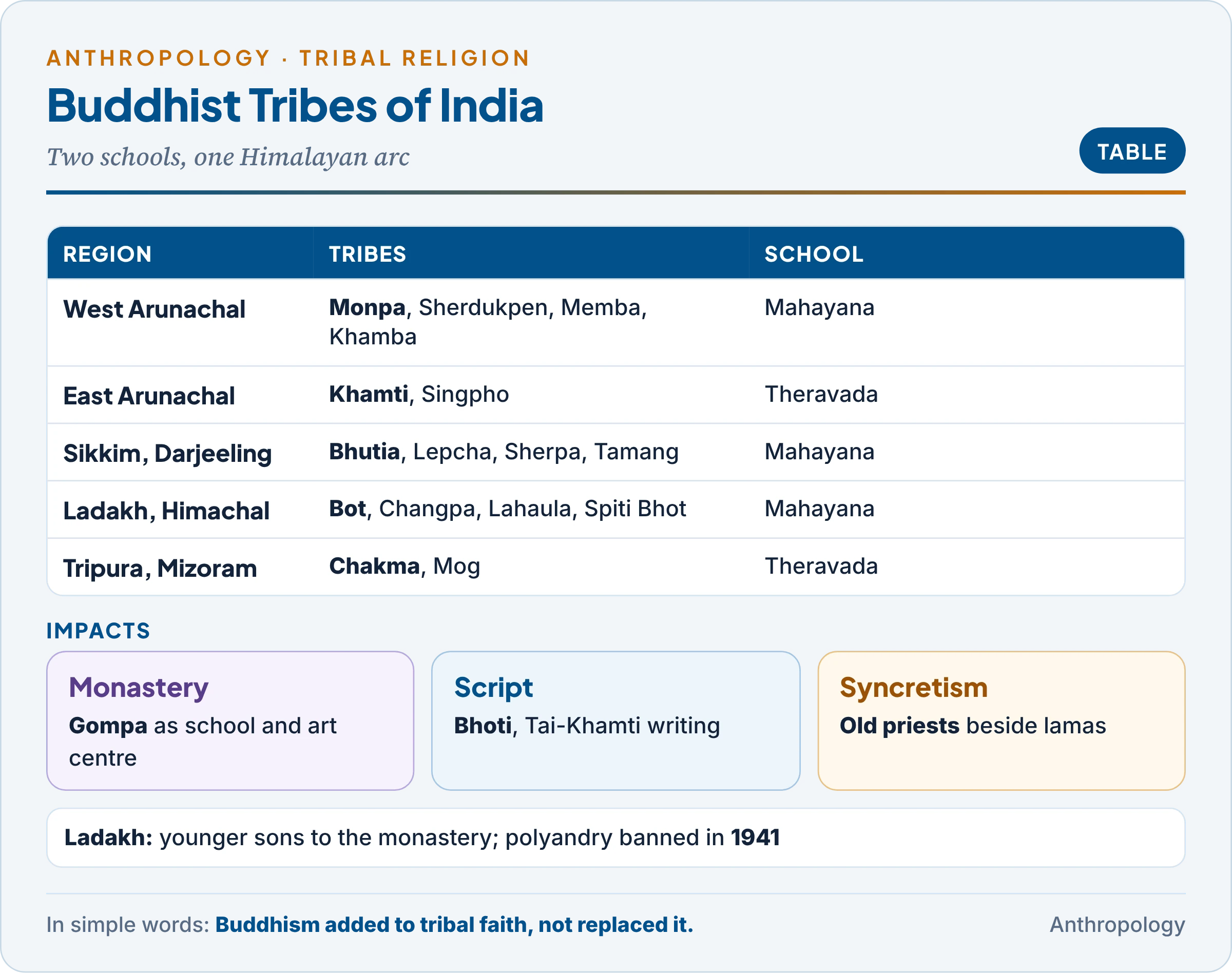
The table lists the main Buddhist tribes by region and school.
| Region | Tribes | School |
|---|---|---|
| Arunachal Pradesh (west) | Monpa, Sherdukpen, Memba, Khamba | Tibetan Mahayana |
| Arunachal Pradesh (east) | Khamti, many Singpho, Tikhak Tangsa | Theravada (Tai-Shan tradition) |
| Sikkim and Darjeeling hills | Bhutia, Lepcha (partly), Sherpa, Tamang | Tibetan Mahayana |
| Ladakh | Bot (Boto), Changpa, Mon, Buddhist Brokpa | Tibetan Mahayana |
| Himachal Pradesh | Lahaula, Spiti Bhot, part of the Kinnaura | Tibetan Mahayana |
| Tripura and Mizoram | Chakma, Mog (Marma) | Theravada |
In 2011, Buddhist STs numbered about 8.7 lakh, largest in West Bengal (Darjeeling hills), Sikkim, Tripura, Ladakh, Arunachal and Mizoram. The Arunachal Freedom of Religion Act, 1978 itself names Buddhism “as practised among the Monpas, Membas, Sherdukpens, Khambas, Khamptis and Singphos” as an indigenous faith of the state.
5.2 Impact
- Monastery as institution: the gompa became the centre of learning, art and ritual; sending a son to the monastery was a duty and a form of status.
- Literacy and script: Tibetan (Bhoti) script in the Himalaya and the Tai-Khamti script in the east gave written traditions to otherwise oral societies.
- Art and festival: thangka painting, masked cham dances, prayer flags and stupas; Losar and Torgya are tribal and Buddhist at once.
- Family and land: in Ladakh, fraternal polyandry and the sending of younger sons to monasteries kept land holdings undivided; the Buddhists’ Polyandrous Marriages Prohibition Act, 1941 of Jammu and Kashmir, pressed for by Ladakhi Buddhist reformers themselves, banned it, and the practice has largely disappeared.
- Ethics: Buddhist teaching reduced animal sacrifice and encouraged non-violence, though sacrifice survives in some non-Buddhist rites.
- Syncretism: Bon and shamanic elements coexist with Buddhism among Monpas and Lepchas (the Lepcha bongthing and mun priests).
- Identity and politics: Buddhism underpins Ladakhi and Chakma identity (the Chakma Autonomous District Council in Mizoram dates from 1972); Chakmas displaced in the 1960s by the Kaptai dam in East Pakistan were resettled in Arunachal, where their citizenship and rights remain contested.
Buddhism’s impact thus differs from Christianity’s: it rarely divided a tribe, because whole communities adopted it centuries ago and it allowed older rites to continue.
6. Other Religions and the Revival of Indigenous Faiths
In simple words
Faced with Hinduism and Christianity, many tribes have revived and organised their own religions, giving them names, festivals, prayer houses and leaders. The demand for a separate census code for these faiths, such as Sarna, has become a major identity movement.
- Sikhism and Jainism: almost no tribal followers (about 13,500 and 12,400 STs in 2011).
- Sarna (Jharkhand, Odisha, Bengal, Chhattisgarh): worship of the supreme being (Dharmes, Singbonga) and village spirits at the sarna grove; Sarhul and Karam as central festivals; organised by the Kendriya Sarna Samiti and others.
- Sari Dharam of the Santals, Gondi Punem of the Gonds, Songsarek of the Garos and Bathou of the Bodos.
- Seng Khasi (from 1899): protects Niam Khasi, matrilineal custom and festivals.
- Heraka (Zeliangrong Nagas): reformed faith of Jadonang and Gaidinliu (7.4).
- Donyi-Polo (Adi, Galo and other Tani groups of Arunachal): worship of the sun (Donyi) and moon (Polo); a revival begun at a 1968 meeting at Along and led by Talom Rukbo, whose Donyi-Polo Yelam Kebang (founded 31 December 1986) printed prayers, gave the deities icons and built prayer halls (gangging).
The Sarna code demand. Colonial censuses counted tribal religions under separate labels such as “Animist” (1891–1911) and “Tribal Religion” (1921); after Independence the separate category disappeared, so tribals had to choose a listed religion or write their faith under “others”. Tribal organisations want a separate religion column for Sarna and other tribal faiths in the Census, instead of being listed under “Hindu” or “other”. The Jharkhand Assembly unanimously passed a resolution for a Sarna Adivasi Dharma Code on 11 November 2020. In March 2026 the Union Home Ministry told Parliament that in Census 2027 enumerators will record religion as stated by the respondent, without a separate printed code.
The revival movements are not simple returns to the past. They systematise tribal religion on the model of the world religions (a creed, a calendar, a priesthood, prayer halls), so that it can stand beside them in census, law and politics.
7. Consequences of Contact and Overall Assessment
In simple words
Contact with world religions has changed tribal beliefs, families, leadership and identity. It has brought education and new status, but also divisions, conflicts and legal disputes over who counts as a tribe.
7.1 Social and religious consequences of tribal and non-tribal contact
| Consequence | Example |
|---|---|
| Syncretism | Monpa Buddhism with Bon priests; Siddi worship of Bava Gor |
| Stratification within tribes | Bhumij chiefs vs commoners; Christian vs Sarna Oraons |
| New status claims | Kshatriya genealogies; Christian educated elite |
| Revival and reform | Seng Khasi, Heraka, Donyi-Polo, Sarna |
| Communal conflict | Attacks on Christians in the Dangs (1998) and Kandhamal (2008); killing of the missionary Graham Staines (Odisha, 1999) |
| Law and the state | Anti-conversion laws (Odisha 1967, Madhya Pradesh 1968, Arunachal 1978, Jharkhand 2017); census categories; ST status |
The table shows that religious change in tribal India is never only spiritual: it is tied to land, schooling, status and political power.
7.2 Religion and Scheduled Tribe status
- The law: the Constitution (Scheduled Tribes) Order, 1950 has no religion clause, unlike the Scheduled Castes Order, which limits SC status to Hindus, Sikhs and Buddhists.
- Chinthada Anand v. State of Andhra Pradesh (24 March 2026): the Supreme Court held that conversion alone does not end ST status; what matters is whether the person keeps the attributes of tribal identity (custom, social organisation, community life) and is accepted by the tribe. ST status is lost only where conversion leads to a complete break with tribal life (3.2b, 7.1).
- Delisting debate: the Joint Parliamentary Committee on the 1967 amendment Bill recommended (1969) excluding Christian and Muslim converts from ST lists; Parliament never adopted it. The Janjati Suraksha Manch revived the demand, with a rally in New Delhi on 24 May 2026, while Sarna and Christian Adivasi groups held counter-rallies.
7.3 The four religions compared
| Point | Hinduism | Christianity | Islam | Buddhism |
|---|---|---|---|---|
| Mode | Gradual absorption | Missions, schools, conversion | Rulers, traders, Sufis | Monasteries, whole communities |
| Area | West, centre, south | North-East, Chotanagpur, Odisha | J&K, Lakshadweep, Khandesh | Himalaya, Arunachal, Tripura |
| Break with old faith | Small | Large | Large in law, small in practice | Small |
| Main gains | Status, integration | Literacy, leadership | New community, Sufi devotion | Learning, art |
| Main costs | Caste rank, dowry | Divided villages | Loss of custom | Few |
The comparison shows why Hinduism spread widely but shallowly, Christianity deeply but unevenly, and Islam and Buddhism only in particular regions. It also explains the different reactions: Christianity provoked organised revival and opposition, while Hinduization provoked assertion of distinctness only recently.
7.4 Anthropological perspectives
- Absorption (N.K. Bose, Surajit Sinha): tribes entered Hindu society through economy and state formation, gradually.
- Isolation, assimilation, integration (Elwin, Ghurye, Nehru’s Panchsheel): the policy debate over whether tribes should be protected from world religions (7.2).
- Identification (Eaton, after Horton): conversion as a shift within tribal cosmology toward a high god.
- Selective acculturation (Joseph Bara): tribes took what empowered them from missions.
- Indigeneity (Xaxa): religion as a key marker of tribal identity, distinct from caste Hindu society.
Read together, these views show that tribes were not passive recipients of world religions. They chose, mixed and resisted according to their needs for land, dignity and identity.
7.5 The way ahead
- Freedom of conscience: Article 25 protects the right to profess and propagate religion; laws against forced or induced conversion must not become tools to harass believers.
- Tribal identity before religion: ST status should turn on tribal attributes and community acceptance, as Chinthada Anand holds, not on church or temple membership.
- Protect institutions, not only beliefs: support village councils, dormitories, languages and sacred groves, which all faiths have weakened.
- Dialogue and inculturation: churches, Hindu organisations and Sarna bodies working on shared ground (land, schooling, health) reduce conflict.
- Nehru’s Panchsheel: let tribes develop “along the lines of their own genius”, including in religion (7.2).
Key Terms
| Term | Meaning in simple words |
|---|---|
| Animism | Belief that spirits live in people and nature |
| Bonga | Spirit-power in Munda and Ho belief |
| Sarna | Sacred grove; also the name of the Jharkhand tribal faith |
| Hinduization | Tribes adopting Hindu gods, priests and customs |
| Hindu method of absorption | Bose’s idea of tribes entering caste society through economic security |
| Rajputization | Tribal chiefs claiming Rajput (Kshatriya) descent |
| Mass movement | Conversion of whole kin groups or villages together |
| Inculturation | Expressing Christianity through local culture |
| Islamization | Converts moving toward stricter Islamic practice |
| Gompa | Buddhist monastery or temple |
| Syncretism | Mixing of beliefs from different religions |
| Revitalization | Reform and revival of a tribe’s own religion |
| Donyi-Polo | Sun-moon faith of the Tani tribes of Arunachal |
| Delisting | Demand to remove converts from the ST list |
| Ghar wapsi | Campaigns to reconvert tribals to Hinduism |
Contemporary Developments
- Chinthada Anand (24 March 2026): conversion alone does not end ST status; tribal attributes and community acceptance decide.
- Census 2027: religion to be recorded as stated by the respondent (MHA, March 2026); the Sarna code demand continues.
- Delisting rally: Janjati Suraksha Manch rally in New Delhi (24 May 2026) and Sarna–Christian counter-rally in Jashpur.
- Arunachal: a high-powered committee (November 2025) is reviewing draft rules under the Freedom of Religion Act, 1978; the High Court extended the deadline in February 2026.
- Jammu and Kashmir: the Pahari ethnic group and others were added to the ST list (February 2024) amid Gujjar–Bakarwal protests.
Diagrams to Master
- Topic map: tribal religion → Hinduization, Christianity, Islam, Buddhism → revival → consequences.
- Census composition: India 80.5 / 9.9 / 6.8 / 1.8 / 0.8; Jharkhand STs 46 / 38 / 15.
- Christianity’s impact: missions (1841, 1845) → reasons → gains → costs → reactions.
- Buddhist tribes: Mahayana west and north, Theravada east; monastery, script, art, syncretism.
- Comparison table: mode, area, break with old faith, gains and costs for the four religions.
Revision Grid
| Scholar | Work (year) | Key idea |
|---|---|---|
| E.B. Tylor | Primitive Culture (1871) | Animism |
| D.N. Majumdar | Studies of the Ho | Bongaism |
| L.P. Vidyarthi | The Maler (1963) | Nature-man-spirit complex |
| N.K. Bose | “The Hindu Method of Tribal Absorption” (1941) | Absorption through economic security |
| Surajit Sinha | Bhumij studies (1960s) | Rajputization, state formation |
| J. Waskom Pickett | Christian Mass Movements in India (1933) | Group conversion |
| Richard Eaton | “Conversion to Christianity among the Nagas” (1984) | High-god identification |
| Leela Dube | Matriliny and Islam (1969) | Islam and matriliny coexist |
| C. von Fürer-Haimendorf | Arunachal studies | Buddhism beside tribal priests |
| Yogendra Singh | Modernization of Indian Tradition (1973) | Islamization |
| Virginius Xaxa | “Tribes as Indigenous People of India” (1999) | Tribes distinct from caste Hindus |
Previous Year Questions
8.1 Impact of Hinduism, Buddhism, Christianity Islam and other religions on tribal societies.
- 2026Discuss the impact of Christianity on the tribal population of Jharkhand.
- 2026Write notes on: Buddhist tribes of India.
- 2025Evaluate the impact of Christianity on Scheduled Tribe societies of North-East India.
- 2022Explain the social and religious consequences of contact between tribal and non-tribal populations.
- 2021Critically assess the impact of Christianity on tribal culture and identity.
- 2020Explain the impact of Hinduism on Tribal people of India.
- 2019Describe the impact of Buddhism on the tribal populations of India.
- 2017Write a note in 150 words on Impact of Christianity on Indian tribes.
- 2016Discuss the impact of Islam on scheduled tribes of India.
- 2015Discuss the impact of Hinduism on the status of tribal women in Central India.
- 2014Write a note in 150 words on Impact of Christianity on tribes.
- 2012Using ethnographic examples, highlight the processes of religious conversions in Tribal India.
- 2011Discuss the impact of Hindu Society on tribal population in India.
- 2009Analyse the impact of Christianity on tribal communities with special reference to North East India.
- 2002Write a note on Bases of tribal religion.
- 2000Write a note on Impact of Christianity on tribal societies.
- 1996Define religion in anthropological perspective. Bring out the impact of Christianity on the converted and non-converted tribal groups of India.
- 1995Write a note on Hindu mode of tribal absorption.
Related questions from other units
- 2026Unit 7.4: Write notes on: Tana Bhagat movement.
- 2026Unit 3.2: Does caste as a social category exist among the non-Hindu communities in India? Illustrate your answer with suitable examples.
- 2023Unit 3.2: “Tribes are backward Hindus.” Critically comment with reference to the contributions of G. S. Ghurye.
- 2022Unit 3.4: Critically examine ‘Indigenisation of Christianity’ in India.
- 2019Unit 5.3: Discuss how the elements of Little and Great Traditions combine in the emergence of social/political/religious movements, giving any one example to illustrate the issue.
- 2016Unit 9.1: Critically examine the role of NGOs and missionaries in transformation of scheduled tribes in Central India.
- 2016Unit 3.2: How is process of tribe-caste continuum different from Sanskritization? Comment.
- 2015Unit 3.4: Write a note in 150 words on Islam and Matriliny.
- 2008Unit 3.2: Is Tribe-Caste Continuum a reality or myth ? Discuss.
- 2003Unit 3.4: Evaluate the impact of Buddhism, Jainism, Islam and Christianity on Indian society and culture in anthropological terms.
More from Religions, Tribes and the Nation-State: all notes of this unit · every PYQ of this unit · Anthropology Optional hub