

Anthropology Optional › Paper II › Unit 07: Scheduled Castes, Scheduled Tribes and OBCs
7.3 The concept of ethnicity; Ethnic conflicts and political developments; Unrest among tribal communities; Regionalism and demand for autonomy; Pseudo-tribalism; Social change among the tribes during colonial and post-independent India; National integration
Official Syllabus: Paper II, Unit 7.3
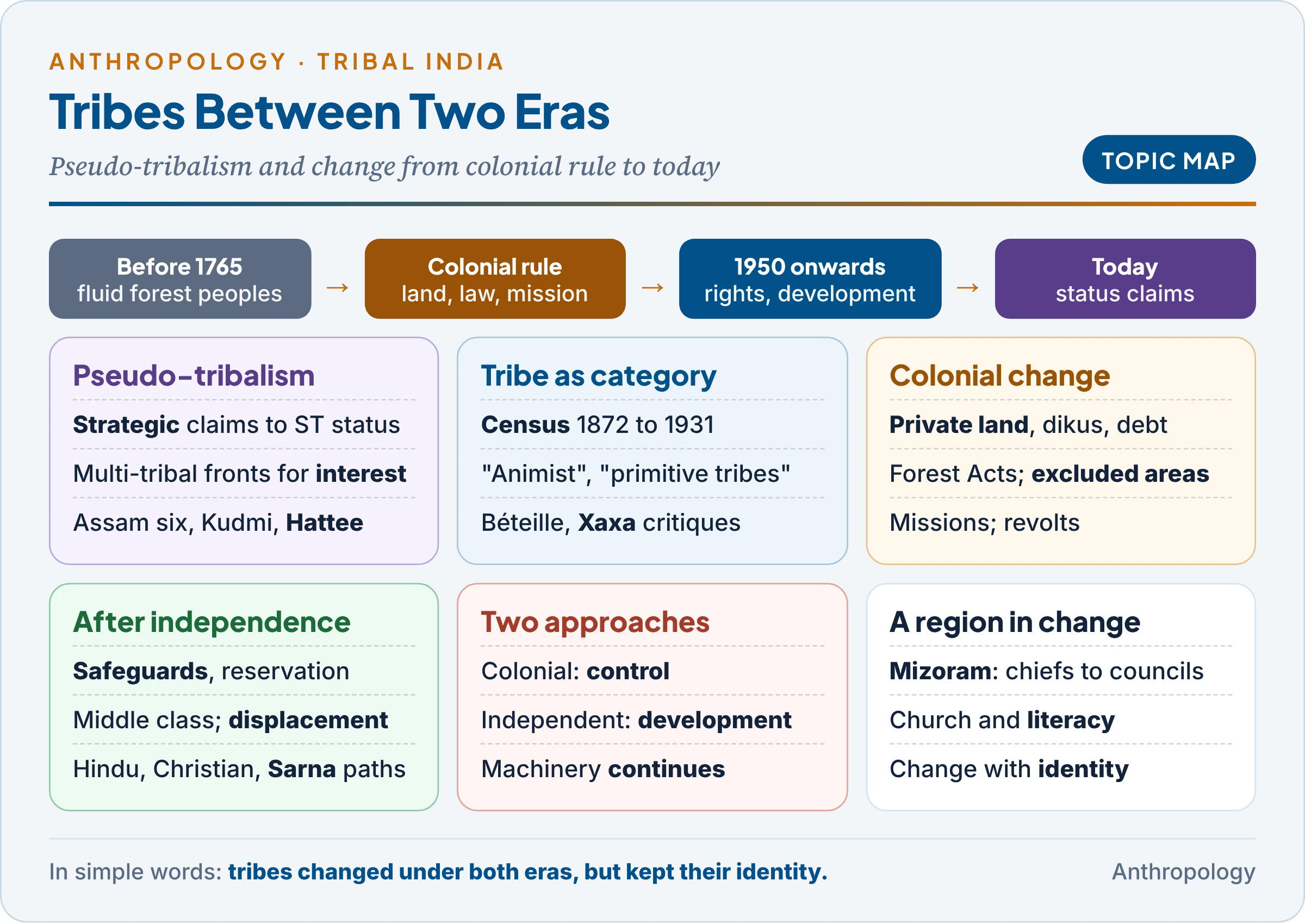
This article covers pseudo-tribalism and the long arc of social change among tribes from colonial rule to the present. Ethnicity, regionalism, autonomy and national integration are in 7.3a; the impact of democratic institutions, development programmes and welfare (including Nehru’s Panchsheel and the isolation–assimilation–integration debate) is in 7.2; colonial ethnographers as scholars are in 4a; colonial forest law is in 6.3b; tribal revolts and movements are in 7.4.
1. Tribalism and Pseudo-Tribalism
In simple words
Tribalism is a strong loyalty to one’s own tribe, its people, customs and land. Pseudo-tribalism means a “false” or strategic tribalism: a group that is not, or is no longer, tribal in its way of life claims tribal identity, usually because Scheduled Tribe status brings real benefits. The term is contested, because every claim has to be judged on evidence, not suspicion.
Example first: Assam’s six communities. The Tai Ahom, Chutia, Moran, Matak, Koch-Rajbongshi and the tea tribes (Adivasis brought from Chotanagpur to the tea gardens) together form about 27% of Assam’s people and are listed as Other Backward Classes. They have long demanded Scheduled Tribe (ST) status. In November 2025 a state Group of Ministers recommended it, proposing a new “ST (Valley)” category so that existing quotas stay protected, and the proposal reached the Centre in January 2026. The Coordination Committee of Tribal Organisations of Assam, speaking for 14 existing tribes, rejected it, pointing out that the Lokur Committee (1965) had not treated these groups as tribes. The dispute shows the core of pseudo-tribalism debates: a valuable legal category, competing claims to it, and the question of who decides what a tribe is.
1.1 Tribalism
- Meaning: a strong in-group identity that separates members of one tribe from others, resting on kinship, territory, shared myths, language and customary institutions. It draws on ethnocentrism, the universal habit of judging others by one’s own standards (7.3a).
- Positive side: it sustains mutual aid, customary law, language and collective claims to land and autonomy; it binds people under pressure.
- Negative side: it can become exclusive, setting tribe against tribe (Kuki–Naga clashes in Manipur) or against all outsiders.
- Modern tribalism is not a survival of the past: it is often renewed by contact and competition, as Barth’s boundary theory predicts (7.3a).
1.2 Pseudo-tribalism: two senses
The term is used in Indian anthropology in two related senses. No single originator can be securely credited, so the note presents the concept, not an author.
| Point | Sense 1: strategic claims to tribal status | Sense 2: manufactured tribal solidarity |
|---|---|---|
| What happens | A group that does not meet the accepted criteria of a tribe claims tribal identity or ST status | Several tribes suspend old differences and act as one bloc for a political or economic goal |
| Driving force | Reservation in jobs, education and legislatures; land protection; welfare | Elections, statehood, bargaining with the state |
| Signs | Revival or adoption of “tribal” markers, new origin stories, lobbying for listing, false certificates | Multi-tribal fronts whose glue is a common agenda, not common culture |
| Example | ST demands by OBC or caste groups; fake ST certificates | The multi-tribal and multi-caste Jharkhand movement |
Why both are called “pseudo”: in each, tribal identity is used for interest rather than lived as culture. The first sense dominates current debates because the stakes (quotas, reserved seats, land) are high. A third, related use describes the capture of ST benefits by advanced sections of large tribes while small and vulnerable tribes (PVTGs) are left behind, a tribal version of the “creamy layer” problem.
Tribalism and pseudo-tribalism side by side. The two are often confused because both use the language of tribe. The table separates them.
| Point | Tribalism | Pseudo-tribalism |
|---|---|---|
| Source | Lived kinship, territory, custom and shared history | Interest: quotas, seats, land protection, votes |
| Direction | From inside the community | Often from leaders or lobbies, sometimes from outside |
| Form | Everyday solidarity, customary law, language | Claims, campaigns, certificates, temporary fronts |
| Effect on other tribes | Can be exclusive, but defends a real community | Can dilute the share of genuinely vulnerable tribes |
| Test | Continuity of institutions and self-identity | Ethnographic evidence examined case by case |
The line between them is not always sharp: a real community may also act strategically, and a strategic claim may grow into a real identity over time. That is why anthropologists insist on evidence rather than labels.
Common confusion
Is pseudo-tribalism the same as Sanskritization or de-tribalization? No. Sanskritization is a group moving towards higher-caste Hindu customs to claim higher status. De-tribalization is a tribe losing its distinct way of life through contact, migration or conversion. Pseudo-tribalism runs the other way: a group moving towards a tribal label, because the tribal category now carries more legal benefit. Some groups have done both in turn: the Kudmi-Mahatos of the Jharkhand–Bengal border once sought to be counted as a caste, and since the 1970s have sought ST status.
1.3 Why it arises
- ST status is a resourced category. It brings reserved posts and seats (Articles 15(4), 16(4), 330, 332), protection of land under tenancy laws and the Fifth Schedule, and scheme benefits. Where these are worth more than OBC or general status, claims follow.
- Lists are state-wise. A community can be ST in one state and not in the next: the Lambada (Banjara, Sugali) are ST in Andhra Pradesh and Telangana but not in Karnataka or Maharashtra. Members who migrate, or claim across borders, create disputes.
- Similar names. The Halba are an ST of Maharashtra; the Halba-Koshti weavers claimed to be the same. In State of Maharashtra v. Milind (2000) the Supreme Court held that Halba-Koshti could not be read into “Halba” and that courts cannot add to the ST list.
- Changing criteria. The Lokur Committee (1965) listed five marks of a tribe: primitive traits, distinctive culture, geographical isolation, shyness of contact and backwardness. Critics call these colonial and outdated; claimants argue that if the criteria are weak, exclusion is arbitrary too.
1.4 Indian cases
| Case | Claim and response |
|---|---|
| Assam’s six communities | ST claim backed by the state (2025), opposed by existing STs; pending with the Centre (2026) |
| Meitei of Manipur | ST claim; a 2023 court direction sparked violence (7.3a); the direction was deleted in 2024 |
| Kudmi-Mahato (Jharkhand, West Bengal, Odisha) | Claim to have been listed among “aboriginal tribes” in 1913 and dropped in 1950; rail blockades in 2022 and 2023; opposed by existing tribes; the Lokur Committee and the Jharkhand Tribal Research Institute (2004) did not recommend inclusion |
| Gujjar (Rajasthan) | ST agitation (2007–08) opposed by the Meena; settled with a separate backward-class quota (2019) |
| Hattee (Himachal Pradesh) | Added to the ST list by Parliament in 2023 after the Centre had refused in 1995, 2006 and 2017 (“Hattee” being a blanket term for all residents of the area, priestly and dominant castes included); the High Court stayed it in January 2024 on petitions by the area’s Gujjars (an existing ST) and Scheduled Castes |
| Pahari (Jammu and Kashmir) | Added to the ST list in 2024, with the Gujjar-Bakarwal protesting dilution of their share |
Fake certificates are the crudest form. In Kumari Madhuri Patil v. Additional Commissioner, Tribal Development (1994) the Supreme Court ordered scrutiny committees to verify caste and tribe certificates; in Chairman and Managing Director, FCI v. Jagdish Balaram Bahira (2017) it held that benefits obtained through a false claim must be withdrawn.
1.5 An anthropological caution
- “Pseudo” is an allegation, not a finding. Identity changes over time (Barth’s boundaries move); a group that has taken up farming, Hinduism or Christianity does not cease to be a tribe for that reason.
- Separate three questions: the community’s history and identity, the merits of its claim to listing (examined by the state, the Registrar General of India and the National Commission for Scheduled Tribes before Parliament amends the list), and the truth of an individual’s certificate.
- The real harm of false claims falls on the smallest and poorest tribes, who lose quotas and land protection to larger, better-organised groups. That is why the ethnographic evidence behind each claim matters.
2. “Tribe” as a Colonial Construct
In simple words
Before British rule, Indian languages had words for forest peoples and for communities, but no sharp line between “tribe” and “caste”. The colonial census and administration drew that line, made lists and fixed groups in them. The idea of “tribe” in India is therefore partly a product of colonial classification.
- Before colonial rule: Sanskrit texts spoke of jana (a people), jati and atavika (forest dwellers); the Ashokan edicts warn the atavika peoples. Forest and hill communities traded, fought and intermarried with kingdoms and castes; boundaries were fluid (the tribe–caste continuum in 3.2b).
- The census made the category. From the 1872 and 1881 censuses, officials sorted Indians by caste, religion and “race”. H.H. Risley, Census Commissioner for 1901, used body measurements to rank groups; tribes were recorded under the religious heading “Animist”. J.H. Hutton’s 1931 Census listed “primitive tribes”, and the Government of India Act, 1935 spoke of “backward tribes”. The Constitution (Scheduled Tribes) Order, 1950 inherited these lists.
- What the label did: it froze moving groups into fixed boxes, treated tribes as isolated and timeless, and justified separate administration.
- Scholars’ critique: André Béteille, the Indian sociologist (“The Concept of Tribe with Special Reference to India”, 1986), argued that no clear criterion separates tribe from caste in India and that the category is largely administrative. Virginius Xaxa, an Oraon sociologist, has shown that tribes today are better understood as indigenous peoples with distinct identities than as a stage of evolution. The historian Sumit Guha (Environment and Ethnicity in India, 1200–1991, 1999) traced how forest peoples were bound up with states for centuries before the British.
- Tribe or indigenous people? Internationally, the preferred term is indigenous peoples. India voted for the United Nations Declaration on the Rights of Indigenous Peoples (2007) but holds that all its citizens are indigenous, so it speaks of Scheduled Tribes, not indigenous peoples. Tribal activists use adivasi (“original inhabitant”) to make the indigenous claim.
- Was “tribe” only a construct? Not entirely. The colonial label fixed and simplified real differences, but forest and hill communities did have distinct institutions: clan-based land, village councils, youth dormitories, their own deities and languages. F.G. Bailey found the difference in access to land (direct through clan membership in tribes, dependent through rank in caste), and Surajit Sinha in ecological and social isolation. The construct argument is best read as a warning against treating tribes as timeless and isolated, not as a denial that they exist.
- Colonial ethnography: the encyclopaedic surveys (E.T. Dalton, Descriptive Ethnology of Bengal, 1872; Risley, The Tribes and Castes of Bengal, 1891; Edgar Thurston, Castes and Tribes of Southern India, 1909; R.V. Russell and Hira Lal, The Tribes and Castes of the Central Provinces, 1916) and the monographs of the early twentieth century (S.C. Roy, The Mundas and Their Country, 1912; J.H. Hutton, The Angami Nagas, 1921; J.P. Mills, The Lhota Nagas, 1922; Verrier Elwin, The Baiga, 1939) are still the base of Indian tribal studies, but were written to know and govern. Their scholars and the “handmaiden of colonialism” debate are treated in 4a.
3. Social Change during the Colonial Period
In simple words
British rule ended the relative isolation of tribal areas. It brought new land laws, courts, police, forest rules, money, markets, missionaries and schools. Tribes lost much land and freedom, some gained education and new religions, and many rose in revolt. By 1947 tribal society had changed deeply.
Example first: Chotanagpur. Among the Munda of the Chotanagpur plateau, the descendants of the clan that first cleared a village held it as khuntkatti (communal land of the founding lineage), with their own headman and priest and a parha (inter-village council). After the East India Company took the diwani of Bengal, Bihar and Orissa (1765), revenue farmers (thikadars), traders and moneylenders from the plains moved in, backed by courts the Mundas did not understand. Communal holdings became rent-paying tenancies, and debt turned owners into labourers. The Kol insurrection of 1831–32 followed; the British answered with a separate South-West Frontier Agency (1834). German Lutheran missionaries of the Gossner mission arrived in Ranchi in 1845, and Christian converts later fought for the return of lost land. The Chota Nagpur Tenancy Act of 1908, passed after Birsa Munda’s rising (7.4), finally restricted the transfer of tribal land and recognised khuntkatti rights. In one region the whole colonial chain is visible: land law, outsiders, debt, revolt, mission and protective law.
3.1 Administration: from conquest to “excluded areas”
The British first treated tribal tracts like other districts, then, after repeated revolts, carved them out for special rule. The timeline traces the steps.
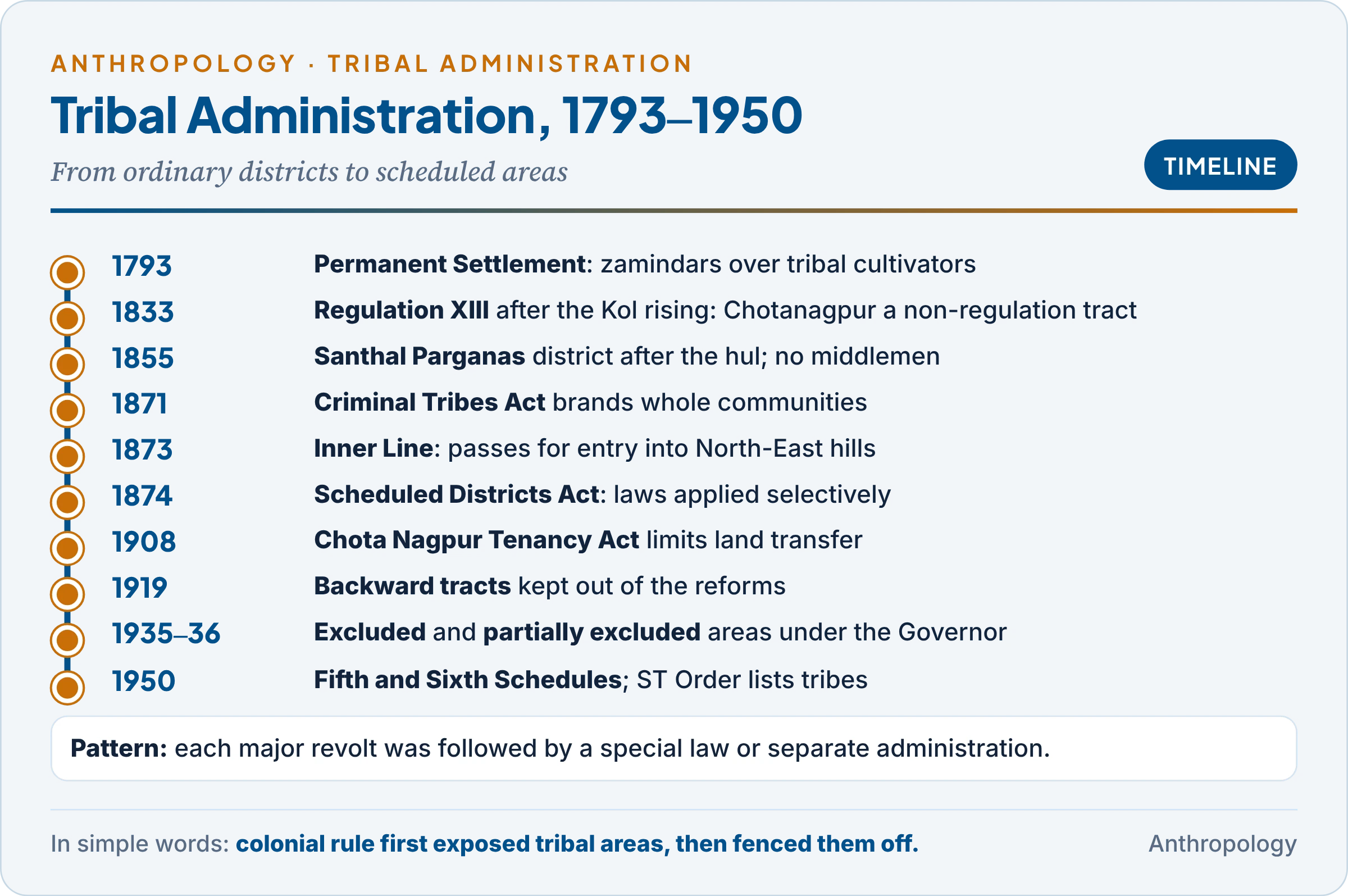
- 1793, Permanent Settlement: zamindars became owners of land revenue rights in Bengal and Bihar; tribal cultivators became their tenants.
- 1833, Regulation XIII: after the Kol rising, Chotanagpur was made a non-regulation area (ordinary laws did not apply automatically) under an agent of the Governor-General.
- 1855, Santhal Parganas: after the Santhal hul, a separate district was formed with simplified rule through Santhal headmen and no intermediaries.
- 1873, Inner Line: the Bengal Eastern Frontier Regulation barred outsiders from entering hill tracts of the North-East without a pass, a rule still used in parts of the region.
- 1874, Scheduled Districts Act: the government could decide which laws applied in listed backward districts.
- 1919, “backward tracts”: the Government of India Act kept such tracts outside the reformed provincial legislatures.
- 1935–36, Excluded and Partially Excluded Areas: the Government of India Act (sections 91 and 92) and the Order of 1936 placed tribal areas under the Governor’s direct or special control.
- Effects: protection from some exploitation, but also isolation, little development and, in the nationalists’ eyes, a divide-and-rule device. These arrangements became the base of the Fifth and Sixth Schedules (details in 7.1).
3.2 Land, forest and the money economy
- From communal to private land: surveys and settlements recorded land as individual property that could be sold, mortgaged and taken for debt, replacing clan and village rights.
- Outsiders as intermediaries: zamindars, revenue farmers and moneylenders became the dikus of tribal memory. Debt led to bonded labour; in the Santhal country it was called kamiauti.
- Forests became state property: the Indian Forest Acts of 1865, 1878 and 1927 reserved forests, restricted shifting cultivation, grazing and collection, and made forest dwellers into trespassers (detail in 6.3b).
- Labour migration: tea gardens in Assam and north Bengal recruited labour from Chotanagpur and central India from the mid-nineteenth century; their descendants are Assam’s tea tribes. Mines, railways and plantations drew others.
- Criminalisation: the Criminal Tribes Act, 1871 branded whole nomadic and forest communities as born criminals (repealed in 1952; the denotified tribes are discussed in 7.1).
- Result: tribal economies were pulled into markets and money, land passed to outsiders, and many tribals became tenants, labourers and migrants.
3.3 Missionaries, schools and new religions
- Who came: the Gossner Lutherans in Ranchi (1845), Jesuit missions in Chotanagpur (from the 1880s, known for help in land cases), Welsh Presbyterians among the Khasi (from 1841), American Baptists among the Ao Nagas (from 1872) and Welsh and Baptist missionaries among the Mizo (from 1894).
- What changed: schools, hospitals and a Roman script for many tribal languages; an educated tribal elite that later led political movements (the Chhotanagpur Unnati Samaj, 1915; 7.3a); new ideas of individual worth.
- Costs and tensions: decline of youth dormitories, feasts, dances and old priests in some groups; division between Christian and non-Christian members of the same tribe. The full impact of Christianity on tribes is the subject of 8.1.
- The Christianised North-East: Christians formed about 88% of the population of Nagaland and 87% of Mizoram in Census 2011, most of it the result of conversion since the late nineteenth century.
3.4 A different pattern in the North-East
Colonial rule touched the hill tribes of the North-East very differently from those of Central India. The contrast explains much of the region’s later politics (7.3a).
- Late and light rule: the hills were annexed late in the nineteenth century, mainly to protect the tea gardens of the Brahmaputra valley and the frontier. The British ruled through chiefs and village councils (indirect rule) and kept revenue light.
- Closed to outsiders: the Inner Line (1873) kept out plains traders, moneylenders and settlers. Land therefore stayed largely in tribal hands, unlike in Chotanagpur.
- Missions instead of markets: with plains people kept out, missionaries became the main agents of change, so the hills gained literacy and Christianity without mass land loss.
- Result: a literate, Christian, landholding tribal society with little contact with the Indian national movement, which partly explains why some hill peoples questioned their place in India after 1947.
3.5 Hinduization and reform from within
- Sanskritization among tribes: tribal chiefs and landed families claimed Kshatriya or Rajput descent, employed Brahmin priests and adopted the sacred thread. Surajit Sinha showed this “Rajputization” among the Bhumij chiefs of Manbhum; N.K. Bose described the Juang and others drawn into caste society for economic security (both in 3.2b and 5.3a).
- Reform movements: under colonial stress, movements urged tribals to give up liquor, meat and spirit worship and to adopt Hindu-style purity: the Tana Bhagat movement among the Oraon (from 1914), and the Bhagat movements among the Bhil led by Govind Guru. K.S. Singh noted that Sanskritization, once a slow change of single families, took the shape of mass movements under colonial rule (details in 7.4).
3.6 Resistance and the national movement
- Revolts: the colonial period saw more frequent tribal risings than among any other group: Pahariya, Kol (1831–32), Santhal (1855–56), Munda (1899–1900), Bhil, Koya, Naga and many others (7.4).
- Joining the freedom struggle: tribals were not only rebels against local oppression but part of the national movement.
- Tana Bhagats joined Gandhi’s Non-Cooperation and later campaigns, refusing rent and wearing khadi.
- Alluri Sitarama Raju led the Koya and other hill people in the Rampa rebellion (1922–24) in the Godavari agency.
- Rani Gaidinliu, a Rongmei (Zeliangrong) Naga leader of the Heraka movement, was arrested in 1932 and released only in 1947; Nehru called her “Rani”.
- Komaram Bheem led Gonds against the Nizam’s forest and revenue officials, with the slogan jal, jangal, zameen (water, forest, land); he was killed at Jodeghat in 1940.
- Laxman Naik of Koraput led tribal protest during the Quit India movement and was hanged in 1943.
- Recognition: since 2021, 15 November (Birsa Munda’s birth anniversary) is observed as Janjatiya Gaurav Divas to mark tribal contributions to the freedom struggle.
3.7 The colonial balance sheet
The image sums up how colonial forces turned into social outcomes.
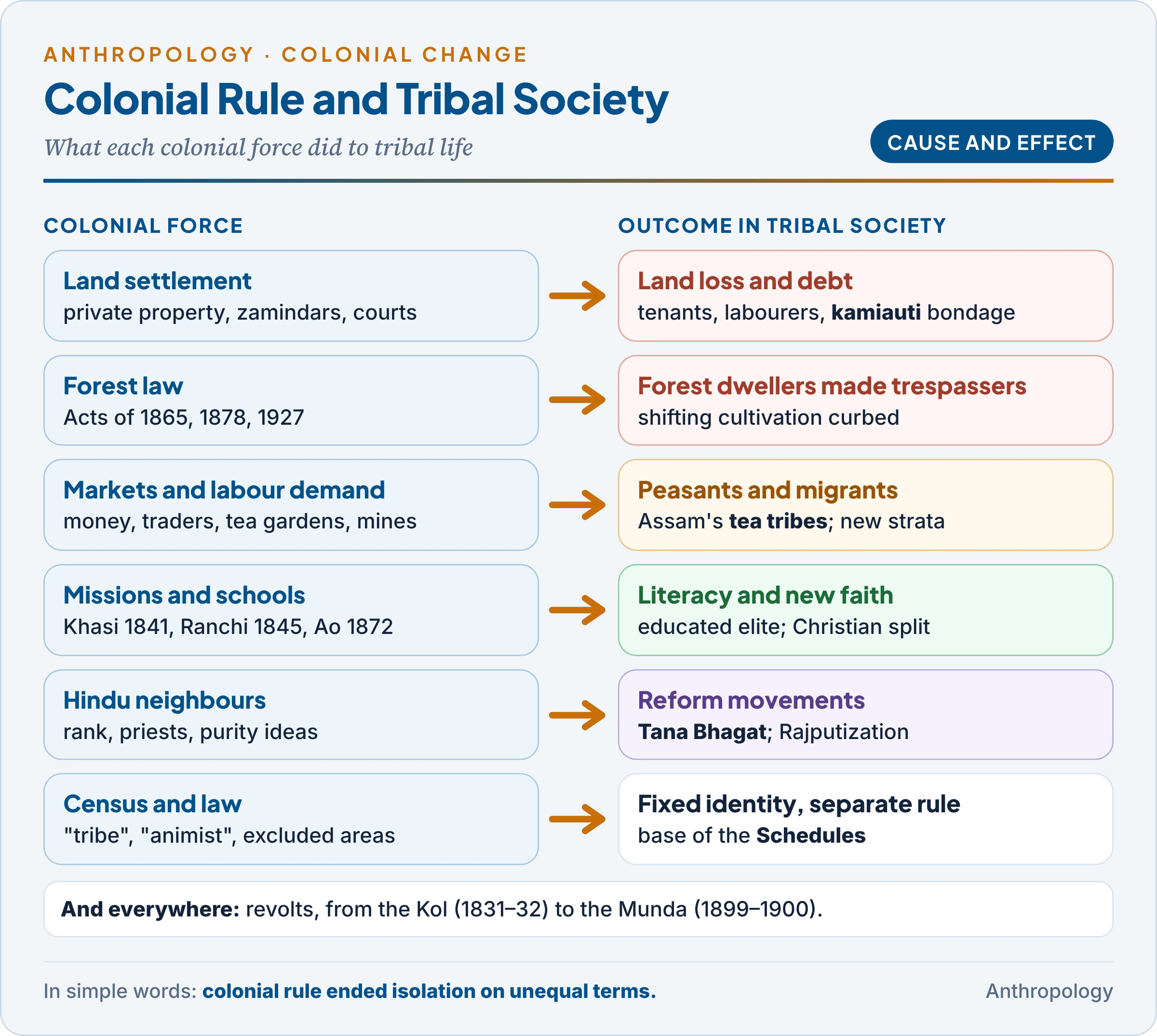
- End of isolation: the colonial system ended the relative isolation of tribal society (K.S. Singh) through roads, police, revenue, courts, traders and teachers.
- Peasantization and stratification: by the late nineteenth century most large tribes were becoming communities of peasants; colonial rule also created internal divisions, though kinship and ethnicity kept them from turning into open class conflict.
- New identities: the label “tribe”, Christian and Hindu reform identities, and the opposition of adivasi and diku all took shape in this period.
- The paradox: colonial rule both exposed tribes to exploitation and protected some of them through special laws, which is why the Fifth and Sixth Schedules are said to rest on colonial foundations.
4. Social Change after Independence
In simple words
After 1947 the Indian state promised tribes protection and development. Constitutional safeguards, reservation, schools, roads and projects brought deep change: more education, a tribal middle class, new political power and new religions, but also displacement, land loss and widening inequality within tribes.
Example first: the Sarna code. In Jharkhand, many Oraon, Munda and Ho people who follow their own religion of sacred groves (sarna) are recorded in the census as “Other religions” or as Hindus. Educated tribal leaders have campaigned for a separate Sarna religion code, and on 11 November 2020 the Jharkhand Assembly passed a resolution asking the Centre for one. The demand shows several post-independence changes together: education produced a leadership, Christianity and Hinduism pulled members in different directions, and identity politics turned religion into a claim for recognition.
4.1 The policy frame
- Constitution: STs notified under Article 342; reserved seats (Articles 330, 332) and posts (Article 16(4)); the Fifth and Sixth Schedules (Article 244); the duty to promote their educational and economic interests (Article 46) (7.1).
- Development: community development blocks, Special Multipurpose Tribal Blocks (1954), Tribal Development Blocks, the Tribal Sub-Plan (1974–75), and later laws such as PESA (1996) and the Forest Rights Act (2006) (details and appraisal in 7.2 and 9.1).
- Philosophy: Nehru’s Panchsheel (1959) chose integration without assimilation (7.2).
4.2 Economic change
- From forest to field and wage: shifting cultivation and gathering declined; most tribals became settled cultivators and, increasingly, agricultural labourers. In Census 2011, about 44% of ST workers were agricultural labourers and 35% cultivators.
- Migration and cities: seasonal migration to brick kilns, construction and plantations, and permanent movement to towns; an urban tribal population grew (6.3b).
- Displacement: dams, mines and industrial projects displaced tribals far beyond their share of the population (6.3a).
- Continuing land alienation despite protective laws, through debt, fraud and acquisition (6.2).
- New middle class: reservation and education created tribal teachers, officers, engineers and politicians. Xaxa and others note growing class differentiation within tribes, and the concentration of benefits among the larger and more advanced groups.
4.3 Religious and cultural change
The changes run in several directions at once. The image maps the main routes.
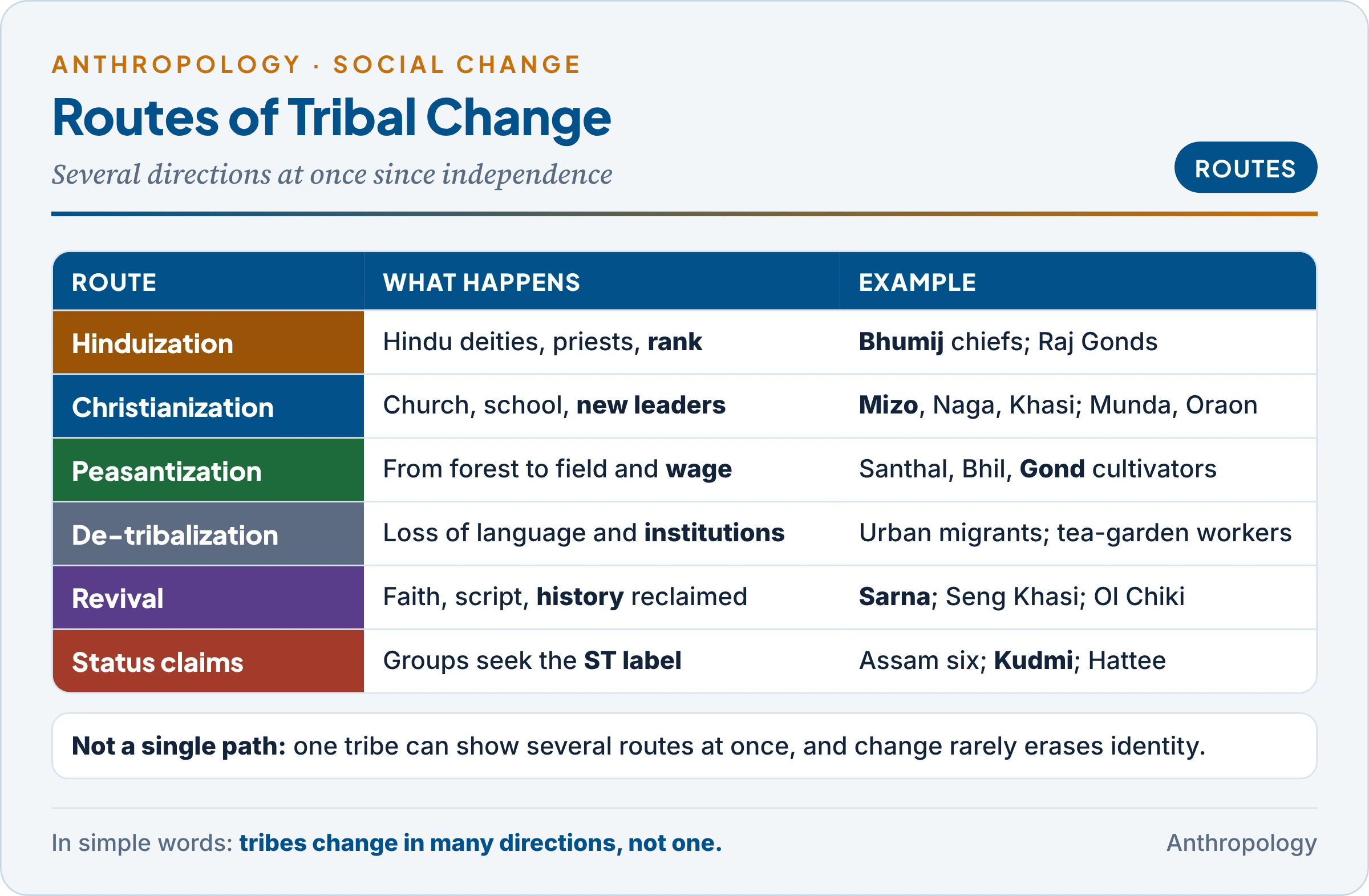
- Hinduization: tribes near Hindu peasants adopted Hindu deities, festivals and priests, and in some cases caste-like rank; Bose’s “Hindu method of tribal absorption” continued (3.2b).
- Christianization: conversion spread, especially in the North-East and Chotanagpur, bringing literacy and new leadership but also internal division (8.1).
- De-tribalization: loss of language, dress, institutions and customary law among migrants and the urban educated, sometimes called cultural erosion.
- Revival and re-tribalization: reassertion of tribal identity through religion (Sarna in Jharkhand; Seng Khasi, founded 1899, among the Khasi; Donyi-Polo revival in Arunachal Pradesh), script and language (Ol Chiki for Santali; Santali in the Eighth Schedule, 2003), festivals and history.
- Commodification of culture: tribal art, dance and craft have entered markets and tourism (7.2).
Common confusion
Is de-tribalization the end of a tribe? No. A tribe that farms, goes to school or adopts a new religion may still keep its kinship, territory, language and sense of self, and educated members are often the strongest assertors of tribal identity. Change and continuity go together; the Santhal, Munda and Khasi are both modern and distinctly tribal.
4.4 Political change
- Representation and power: reserved seats, panchayats and autonomous councils gave tribals political voice; tribal parties and leaders became significant in several states.
- New states: Jharkhand and Chhattisgarh (2000), and earlier Nagaland, Meghalaya and Mizoram, gave tribal majorities or large minorities state power (7.3a).
- Assertion: movements over land, forest, identity and autonomy (7.3a, 7.4).
4.5 A region in change: Mizoram
The change within a single region shows how the colonial and post-independence forces combine. Mizoram is a clear case.
- Chiefdom to democracy: the Mizo villages were once ruled by hereditary chiefs. A commoners’ movement after independence led to the abolition of chieftainship in 1954, when the chiefs’ rights were acquired by law, and elected village councils took over.
- Church and civil society: Christianity, arriving from 1894, became the centre of social life; the Young Mizo Association (founded 1935) grew into the main civil body for village welfare, funerals and social discipline.
- Literacy: mission schooling made the Mizo among India’s most literate peoples (91.3% in Census 2011).
- Crisis and settlement: the 1959 bamboo-flowering famine and poor relief led to the 1966 Mizo National Front rising; the 1986 Mizo Accord brought statehood (1987) (7.3a).
- Lesson: a society can change radically (religion, polity, literacy) and yet keep a strong ethnic identity; change and identity are not opposites.
5. Colonial and Post-Independence Approaches Compared
In simple words
The colonial state mostly wanted to control tribal areas and keep them quiet, while letting outsiders exploit them. The independent Indian state promised protection, development and a share in power. Some colonial tools survived, and the results of independence have been mixed.
Three approaches in brief. Policy towards tribes has swung between isolation (keep them apart to protect them: the colonial excluded areas and Elwin’s early “national park” idea), assimilation (absorb them into the majority: G.S. Ghurye called them “backward Hindus” in 1943) and integration (join national life while keeping identity: Nehru’s Panchsheel). The debate and its present relevance are in 7.2.
The table compares the two periods on the points that changed most. The image summarises the same contrast.
| Point | Colonial period | After independence |
|---|---|---|
| Aim | Control, revenue, order on the frontier | Welfare, development and integration |
| Administration | Non-regulation tracts, Scheduled Districts, excluded areas | Fifth and Sixth Schedules, Tribes Advisory Councils, PESA |
| Land | Private property, zamindars, debt; protective acts only after revolts | Tenancy laws, land-transfer bans, but acquisition for projects |
| Forest | Forests taken by the state | State control, then Forest Rights Act (2006) |
| Culture and religion | Missions encouraged; census fixed tribal identity | Panchsheel: respect for culture; recognition of languages |
| Education | Mission schools, small elite | Mass schooling, reservation, residential schools |
| Voice | Little; a few nominated members | Reserved seats, councils, tribal-majority states |
| Outcome | Isolation and exploitation together; frequent revolts | Real gains, but displacement, inequality and continuing unrest |
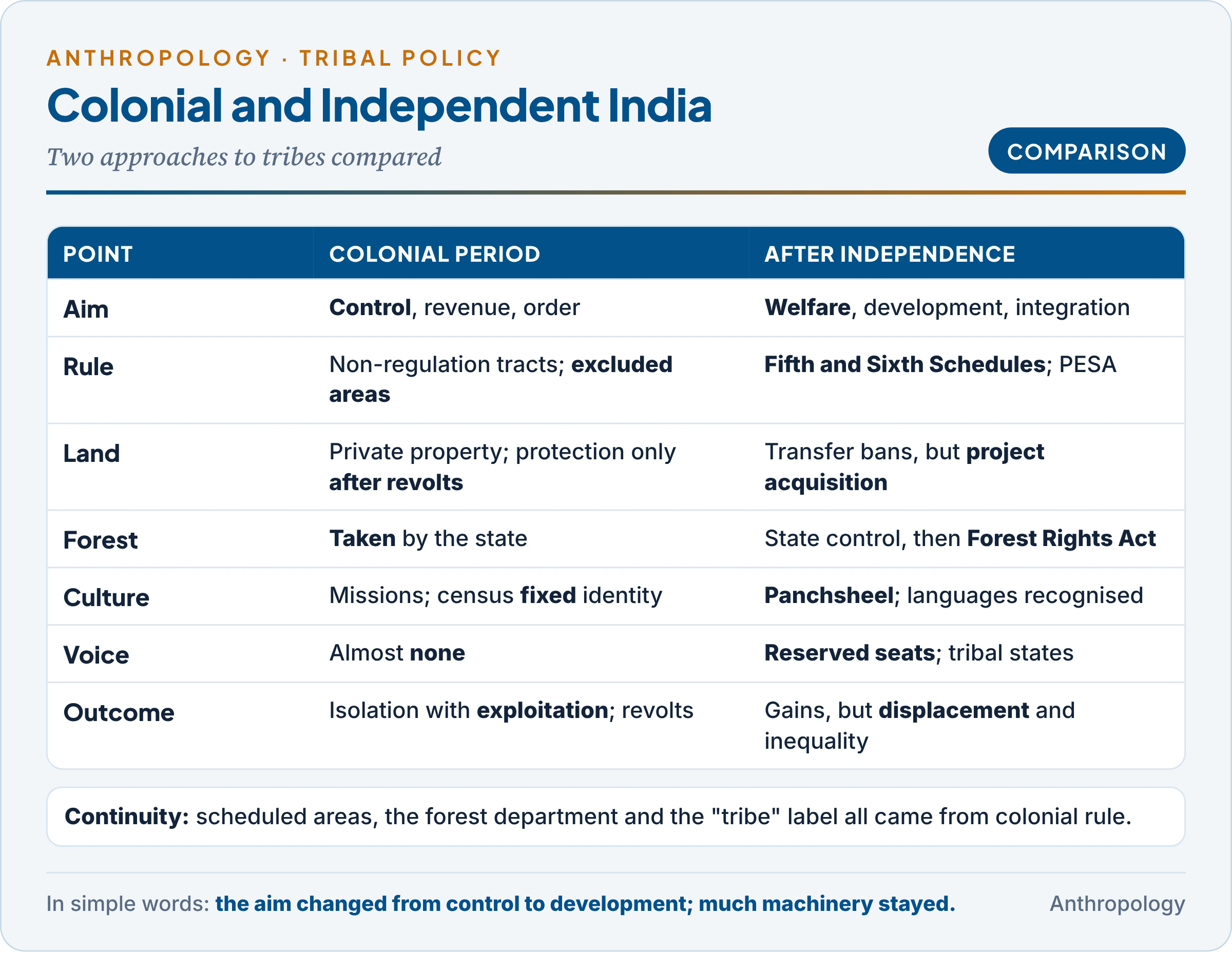
Change and continuity. The independent state reversed the colonial aim, from control to development, but kept much of the colonial machinery: Scheduled Areas, the forest department, protective tenancy laws and the very category of “Scheduled Tribe”. The biggest new cost was development-induced displacement, which colonial rule had caused on a much smaller scale.
5.1 How tribals have responded to government measures
| Positive responses | Negative responses |
|---|---|
| Use of education and reservation to enter jobs and politics | Dependence on schemes; benefits captured by elites |
| Participation in elections, panchayats and councils | Distrust of officials after displacement and forest evictions |
| Adoption of new crops, credit and markets | Resistance to projects (Niyamgiri, Pathalgadi; 7.3a) |
| Revival of language and culture through state recognition | Cultural loss where development ignored customs |
Why the response is mixed: where measures were made with tribal consent and through customary institutions, they were welcomed; where they were imposed from above, they were resisted. The lesson anthropologists draw from both periods is the same: change succeeds when it builds on tribal institutions and secures land and forest rights.
5.2 How scholars assess the two periods
- Continuity of extraction: many anthropologists argue that the resource frontier survived independence: forests, minerals and rivers in tribal areas were still taken for the wider economy, now in the name of national development. Nandini Sundar’s history of Bastar traces this continuity from the colonial forest state to the modern security state.
- A real break in rights: others stress what changed: citizenship, the vote, reservation, and laws such as PESA and the Forest Rights Act that colonial rule never offered. Tribal leaders now sit in Parliament and run states.
- Uneven gains: Xaxa shows that benefits went mostly to the larger and more advanced tribes and to an educated minority within each, so inequality within tribal society has grown.
- Balanced view: the colonial period opened tribal society to the outside world on unequal terms; the post-independence period gave tribes tools to bargain, but the outcome depends on whether those tools are used with their consent and control.
Key Terms
| Term | Meaning in simple words |
|---|---|
| Tribalism | Strong loyalty to one’s own tribe, its people, customs and land |
| Pseudo-tribalism | Strategic or “false” tribalism: claims to tribal status, or tribal unity built for interest |
| Lokur criteria | Five marks of a tribe used since 1965: primitive traits, distinct culture, isolation, shyness of contact, backwardness |
| Scrutiny committee | A body that checks whether a caste or tribe certificate is genuine |
| Colonial construct | A category created or fixed by colonial administration |
| Khuntkatti | Munda communal land held by the founding lineage of a village |
| Non-regulation area | A colonial tract where ordinary laws did not apply automatically |
| Inner Line | The 1873 rule barring outsiders from North-East hill tracts without a pass |
| Excluded areas | Tribal areas under the Governor’s direct control (1935) |
| Kamiauti | Debt bondage in the Santhal country |
| Tea tribes | Descendants of central Indian tribes taken to Assam’s tea gardens |
| Rajputization | Tribal chiefs claiming Rajput descent and Hindu rank |
| De-tribalization | Loss of a tribe’s distinct way of life through contact or migration |
| Re-tribalization | Revival and assertion of tribal identity |
| Janjatiya Gaurav Divas | 15 November, marking tribal contributions to the freedom struggle (since 2021) |
Contemporary Developments
- Assam (2025–26): a state Group of Ministers recommended ST status for six communities with a new “ST (Valley)” category (November 2025); existing tribes rejected it, and the proposal was pending with the Centre in 2026.
- Kudmi-Mahato demand: rail blockades in 2022 and 2023 pressed the ST claim in Jharkhand, West Bengal and Odisha; existing tribal bodies oppose it.
- Additions to the ST list: the Hattee of Himachal Pradesh (2023; implementation stayed by the High Court since January 2024) and the Pahari of Jammu and Kashmir (2024) were added after long campaigns, each contested by existing tribes.
- Sarna code: Jharkhand’s 2020 resolution for a separate religion code remains a live demand ahead of the next census.
- Janjatiya Gaurav Divas: observed every 15 November since 2021.
Diagrams to Master
- Topic map: pseudo-tribalism, tribe as colonial construct, colonial change, post-independence change, comparison.
- Administration timeline: 1793, 1833, 1855, 1873, 1874, 1919, 1935–36, 1950.
- Colonial impact: six colonial forces on one side, their outcomes on the other.
- Routes of change: Hinduization, Christianization, peasantization, revival, status claims, each with one example.
- Colonial versus post-independence: aim, administration, land, forest, culture, education, voice, outcome.
Revision Grid
| Scholar | Work (year) | Key idea |
|---|---|---|
| E.T. Dalton | Descriptive Ethnology of Bengal (1872) | Early survey of Chotanagpur tribes |
| H.H. Risley | The Tribes and Castes of Bengal (1891) | Census classification; tribes as “animist” |
| S.C. Roy | The Mundas and Their Country (1912) | First Indian tribal monograph; Munda land and revolt |
| J.H. Hutton | The Angami Nagas (1921); Census 1931 | Naga ethnography; “primitive tribes” |
| Verrier Elwin | The Baiga (1939); A Philosophy for NEFA (1957, 1959) | Protection of tribal culture; basis of Panchsheel |
| N.K. Bose | “The Hindu Method of Tribal Absorption” (1941) | Tribes drawn into caste society |
| Surajit Sinha | Bhumij studies (1962) | Rajputization of tribal chiefs |
| Lokur Committee | Report (1965) | Five criteria for scheduling tribes |
| K.S. Singh | Tribal Society in India (1985) | Colonial rule ended isolation; Sanskritization became movements |
| André Béteille | “The Concept of Tribe with Special Reference to India” (1986) | No clear line between tribe and caste |
| Sumit Guha | Environment and Ethnicity in India, 1200–1991 (1999) | Forest peoples long tied to states |
| Virginius Xaxa | Writings on tribal transformation (1999 onwards) | Tribes as indigenous peoples; class formation within tribes |
Previous Year Questions
7.3 Pseudo-tribalism; Social change among the tribes during colonial and post-independent India
- 2019What has been the contribution of tribal people to the Indian Independence movement ?
- 2016Write a note in 150 words on Tribe as a colonial construct.
- 2014Describe the history of tribal administration in the colonial period.
- 2013Assess the contributions of early 20th century ethnographic tradition to Indian anthropology.
- 2012Write a note in 150 words on Colonial Ethnography.
- 2011Compare the approach adopted towards tribal communities during Colonial and post independence periods.
- 2010Discuss and compare the approaches towards the tribes during colonial and post independent India.
- 2010Do you find any significant change in the approaches ? Assess.
- 2005Elucidate the nature of changes in administration of tribal areas from colonial period to Post-Independence era in India.
- 2000Outline the historical background of tribal administration during the colonial period. Evaluate post-Independence administrative policies with special reference to states under either the Fifth Schedule or Sixth Schedule of the Constitution of India.
- 1994Write a note on Positive and negative response of the tribals to Governmental measures.
- 1983Taking the example of any region, describe the radical changes that are taking place in tribal societies and assess their future outcome.
Related questions from other units
- 2026Unit 9.1: Write an account on the contribution of Verrier Elwin in developing policies for the tribal populations in post-independent India.
- 2026Unit 4: Assess the contribution of colonial scholars in studying the tribal populations of North-East India.
- 2025Unit 6.1: Write notes on: Tribalism and Pseudotribalism.
- 2023Unit 9.1: Elucidate the shifting terrains of India’s tribal policies in colonial and post-colonial periods.
- 2022Unit 9.1: Discuss the views of G. S. Ghurye and Verrier Elwin on the approach towards tribal populations. What are the policies of the Government of India towards Indian tribal populations?
- 2016Unit 3.2: How is process of tribe-caste continuum different from Sanskritization? Comment.
- 2015Unit 4: Write a note in 150 words on Elwin Ghurye Debate on Tribes.
- 2013Unit 7.1: Fifth Schedule and Sixth Schedule of the Constitution are built on the foundations laid by the colonial Government. Discuss. (250 words).
- 2004Unit 6.3: Write a note on Detribalization.
- 2001Unit 6.3: Write a note on Detribalization.
More from Scheduled Castes, Scheduled Tribes and OBCs: all notes of this unit · every PYQ of this unit · Anthropology Optional hub