

Anthropology Optional › Paper II › Unit 06: Tribal Situation in India
6.1 Tribal situation in India – bio-genetic variability, linguistic and socio-economic characteristics of the tribal populations and their distribution.
Official Syllabus: Paper II, Unit 6.1
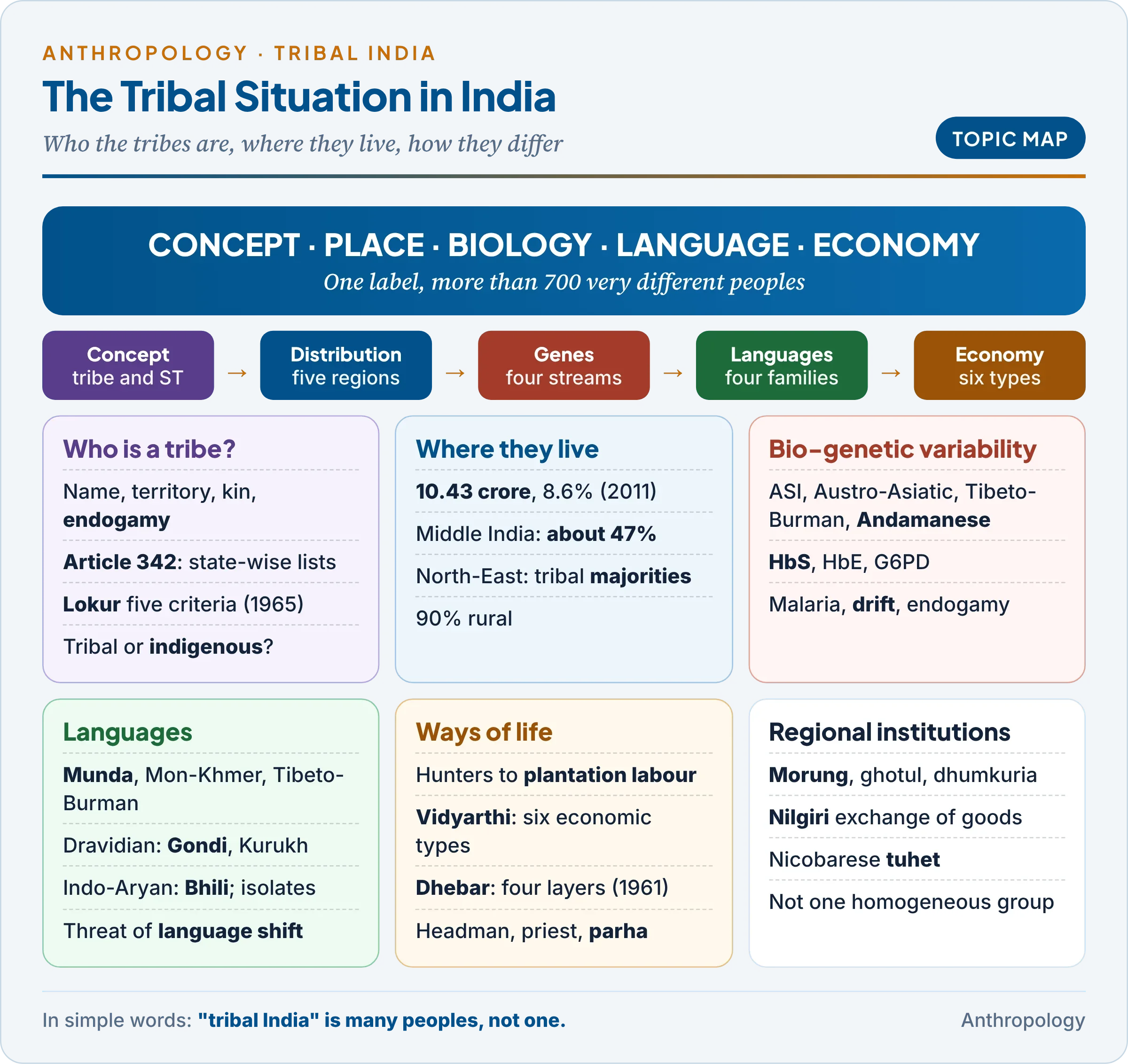
This article describes India’s tribal peoples as they are: who they are, where they live, how they differ in biology, language and way of life. The racial classifications and genetic ancestry of all Indians are taught in 2a; tribal demography in 2b (§7); the problems of tribal communities in 6.2; constitutional safeguards in 7.1; pseudo-tribalism in 7.3; and PVTGs in 9.1b.
1. Who Is a Tribe? Concept, Census and the Scheduled Tribe
In simple words
A tribe is a community that sees itself as one people, with its own name, territory, language and customs, and that lived largely outside the caste order. In India the word also has a legal meaning: a “Scheduled Tribe” is a group named in an official list, which gives its members special protection. The two meanings overlap but are not the same.
Example first: the Hattee of Himachal Pradesh. In August 2023 Parliament added the “Hattee of Trans Giri area of Sirmour district” to Himachal Pradesh’s list of Scheduled Tribes. The Registrar General of India (RGI, the census authority that vets such proposals) had rejected the proposal as recently as 2017, noting that “Hattee” was a name for the inhabitants of a region that included Rajput and Brahmin castes as well as Scheduled Castes; it reversed its view after a new state ethnographic report. Months after the Act, the state was still asking the Union who exactly the Hattees were. “Tribe” in India is decided partly by anthropology, partly by administration and politics.
1.1 Anthropological definitions
- Imperial Gazetteer of India: a tribe is “a collection of families bearing a common name, speaking a common dialect, occupying or professing to occupy a common territory and is not usually endogamous, though originally it might have been so”.
- D.N. Majumdar, the Indian anthropologist who founded anthropology at Lucknow: “a social group with territorial affiliation, endogamous, with no specialization of functions, ruled by tribal officers hereditary or otherwise, united in language or dialect, recognizing social distance with other tribes or castes”.
- G.S. Ghurye, the Bombay sociologist, called tribes “backward Hindus”, stressing their long contact with Hinduism; Verrier Elwin, the missionary-turned-ethnographer, stressed their distinct culture (the Ghurye-Elwin debate is in 4b).
- André Béteille, the Delhi sociologist, argued that in India “tribe” is defined less by what a group is than by its position outside the state and the caste civilization, and that most Indian tribes had long ceased to be isolated.
- F.G. Bailey (a British anthropologist of Odisha) and Surajit Sinha (an Indian anthropologist of the Bhumij) treated tribe and caste as two ends of a continuum: a tribe holds land by kinship and political rights, a caste by dependence on others (detail in 3.2b).
The definitions share territory, a common name and language, kinship-based organisation, endogamy and relative autonomy. Each fails at the edges, because large groups such as the Bhil or Gond are internally stratified and live beside castes in the same villages.
1.2 From colonial census to “Scheduled Tribe”
The colonial census created the category before anthropology defined it. The table shows how the label changed with the administrator’s idea of what made a tribe different.
| Census or law | Label used | What it stressed |
|---|---|---|
| 1891 (J.A. Baines) | “Forest tribes” under agricultural and pastoral castes | Habitat |
| 1901 (H.H. Risley) | “Animists” | Religion |
| 1911 (E.A. Gait) | “Tribal animists” | Religion |
| 1921 | “Hill and forest tribes” | Habitat |
| 1931 (J.H. Hutton) | “Primitive tribes” | Stage of development |
| Government of India Act, 1935 | “Backward tribes” | Administration |
| 1941 | “Tribes” (about 2.47 crore) | Community |
| Constitution, 1950 | “Scheduled Tribes” | A legal list |
The shift from religion to habitat to backwardness to a legal list shows why the category has always been contested: each label sorted the same people by a different test.
1.3 The constitutional category
- Article 366(25) defines Scheduled Tribes as communities deemed to be so under Article 342. The President, after consulting the Governor, notifies the first list for each state; later changes need an Act of Parliament.
- State-specific lists: a community is an ST only in the state where it is listed; a Santal who moves from Jharkhand to Delhi is not an ST there. No ST is notified in Punjab, Haryana, Delhi, Chandigarh and Puducherry.
- Lokur Committee (1965) criteria: primitive traits, distinctive culture, geographical isolation, shyness of contact with the community at large, and backwardness. These are not in the Constitution but guide the RGI.
- Criticism: words such as “primitive” and “shyness” are evolutionist and condescending; isolation no longer describes most tribes; and the tests cannot separate a tribe from a poor caste. A government task force chaired by Hrusikesh Panda (2014) called for revised criteria, and the RGI’s continued use of them was criticised in 2023. Meanwhile, inclusions such as the Pahari Ethnic Group, Paddari Tribe, Koli and Gadda Brahmin in Jammu and Kashmir (February 2024) show that political pressure often decides.
Common confusion
Is every tribe a Scheduled Tribe, and every Scheduled Tribe a tribe? No. “Tribe” is an anthropological description; “Scheduled Tribe” is a legal status. Some communities with clear tribal features are not listed, or are listed in one state but not the next; some listed groups, like the Hattee entry, include caste groups. The 705 individual groups notified at the 2011 Census are a list, not a scientific classification.
1.4 Tribe, Adivasi and indigenous people
- Adivasi (adi, first; vasi, dweller) is the self-name most tribal movements prefer. Jaipal Singh Munda urged it in the Constituent Assembly; B.R. Ambedkar preferred “Scheduled Tribes” because a list has a fixed legal meaning.
- International law: India ratified ILO Convention 107 (1957) on 29 September 1958 but has not ratified ILO Convention 169 (1989). At the UN General Assembly on 13 September 2007 India voted for the Declaration on the Rights of Indigenous Peoples (143 for, 4 against, 11 abstentions), while stating that the concept, tied to colonial settlement, does not single out any group in India: in the official view all Indians are indigenous.
- The debate: Virginius Xaxa, the tribal sociologist, argues that India’s tribes fit the international idea of indigenous peoples because they are non-dominant, territorially rooted and culturally distinct; the state replies that, unlike the Americas or Australia, India had no settler majority that displaced a native population.
2. Distribution: Where Tribes Live
In simple words
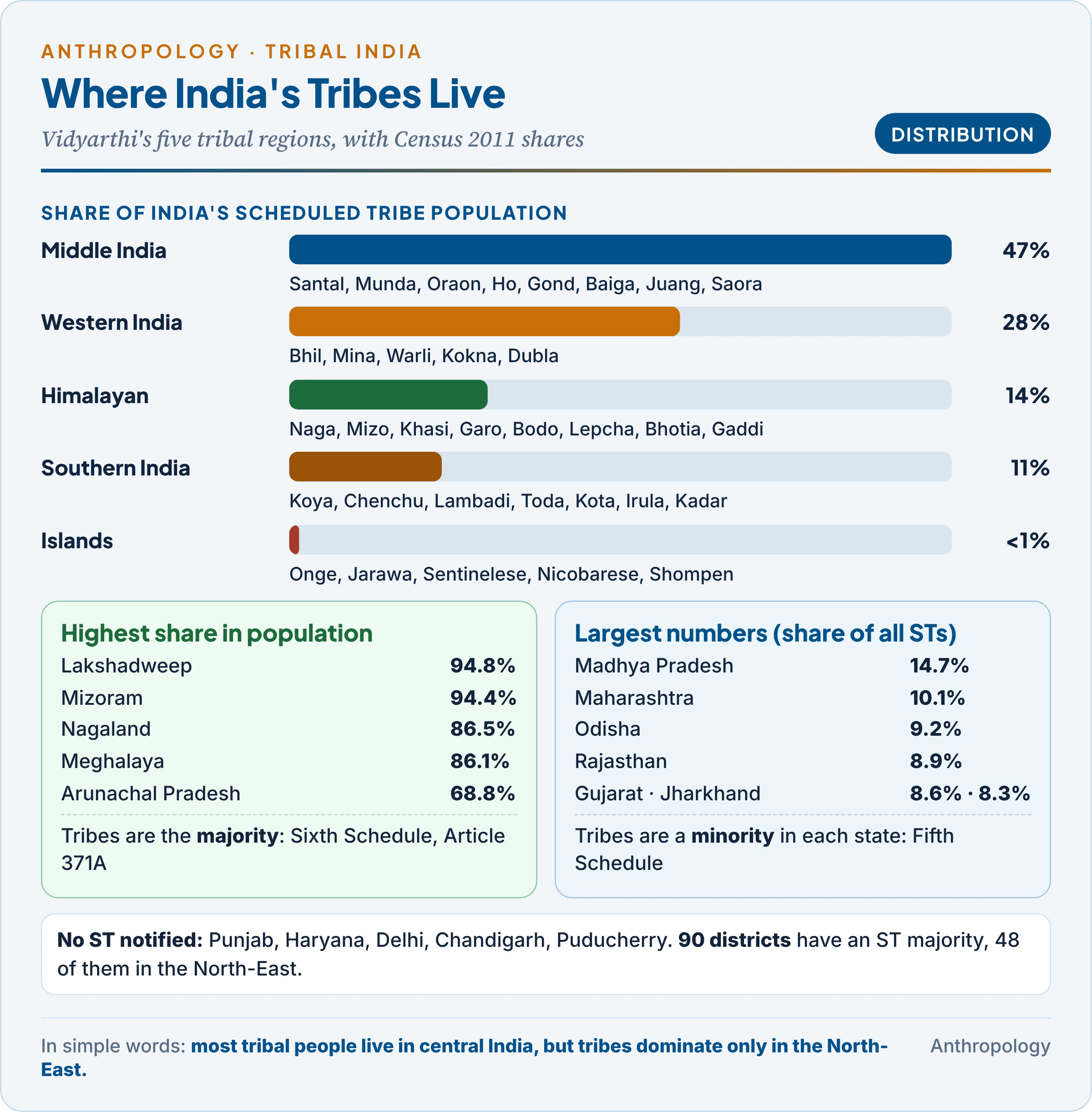
About one Indian in twelve belongs to a Scheduled Tribe. Most live in two belts: the hills and forests of central India, and the North-East. In the central belt tribes are a minority of each state’s population; in the North-East they are often the majority.
Census 2011 counted 10.43 crore Scheduled Tribe people, 8.6% of India’s population, in 705 notified groups. Read the table as two contrasts: absolute numbers are largest in central India, shares are highest in the North-East.
| Indicator (Census 2011) | Figure |
|---|---|
| ST population; share of India | 10.43 crore; 8.6% |
| Rural share | 89.97% |
| Decadal growth 2001–11 | 23.7% (all India 17.7%) |
| Sex ratio; child sex ratio | 990; 957 |
| Literacy | 59.0% (male 68.5%, female 49.4%) |
| Largest ST population | Madhya Pradesh (1.53 crore; 14.7% of all STs) |
| Highest share in population | Lakshadweep (94.8%), Mizoram (94.4%), Nagaland (86.5%), Meghalaya (86.1%) |
| Districts with ST majority | 90, of which 48 are in the North-East |
More than two-thirds of all STs live in seven states: Madhya Pradesh, Maharashtra, Odisha, Rajasthan, Gujarat, Jharkhand and Chhattisgarh. The Bhil, Gond and Santal are the three largest tribes; at the other end, the Great Andamanese numbered 44 in 2011.
2.1 Zonal classifications
- B.S. Guha’s three zones: (i) North and North-Eastern, in the Himalayan valleys and eastern frontier; (ii) Central or Middle, the old hills and plateaus between the Gangetic plains and the peninsula, the largest zone; (iii) Southern, the peninsula and its islands.
- L.P. Vidyarthi, the Ranchi anthropologist, refined this into five regions using geographical, ecological, economic, administrative and ethnic factors. The shares below are worked out from Census 2011 state totals.
| Region (Vidyarthi) | States | Share of India’s STs (2011, approx.) | Example tribes |
|---|---|---|---|
| Himalayan (North-East, Central and North-Western sub-regions) | North-East, Sikkim, J&K, Himachal, Uttarakhand | about 14% | Naga, Mizo, Khasi, Garo, Bodo, Lepcha, Bhotia, Gaddi, Gujjar, Tharu |
| Middle India | Jharkhand, Odisha, Chhattisgarh, Madhya Pradesh, West Bengal, Bihar, south Uttar Pradesh | about 47% | Santal, Munda, Oraon, Ho, Gond, Baiga, Juang, Saora |
| Western India | Rajasthan, Gujarat, Maharashtra, Goa, Dadra-Daman | about 28% | Bhil, Mina, Warli, Kokna, Dubla |
| Southern India | Andhra Pradesh, Telangana, Karnataka, Kerala, Tamil Nadu | about 11% | Gond and Koya (Telangana), Chenchu, Lambadi, Toda, Kota, Irula, Kadar, Paniya |
| Islands | Andaman and Nicobar, Lakshadweep | under 1% | Great Andamanese, Onge, Jarawa, Sentinelese, Nicobarese, Shompen |
Middle India holds nearly half of India’s STs but they are a minority within each state (21% in Madhya Pradesh, 26% in Jharkhand, 31% in Chhattisgarh); the Himalayan North-East holds fewer people but tribes are the majority. This difference explains why the Fifth Schedule (protection inside a non-tribal state) operates in the middle belt and the Sixth Schedule (tribal self-government) in the North-East.
3. Bio-genetic Variability
In simple words
India’s tribes differ in body build, skin colour, blood and genes as much as they differ in language and custom. The differences come from very old ancestry, from long isolation in small groups, and from adaptation to local disease and climate, especially malaria. Genes show that tribes are not “pure races” but varied mixtures.
Example first: three tribal populations. An Onge of Little Andaman is short, dark and frizzy-haired, and carries maternal lineages found nowhere else on earth. A Santal of Jharkhand speaks an Austroasiatic language and carries a Y-chromosome lineage that came from Southeast Asia. A Naga of Nagaland has the straight hair and eyelid fold of East Asian populations. All three are “tribal”, yet biologically they come from different branches of humanity. This is what the syllabus means by bio-genetic variability.
3.1 The older racial view, in brief
- B.S. Guha (Census 1931) placed India’s tribes in three strains: Proto-Australoid (Munda, Oraon, Gond, Bhil, Santal, Chenchu), Mongoloid (Himalayan and North-Eastern tribes) and Negrito (Andamanese, and a contested strain among the Kadar and Irula of the southern hills).
- Why the schemes failed: traits vary gradually (clines), different traits do not vary together, bodies respond to environment, and most variation lies within groups. The full comparison and critique are in 2a (§§2–4).
Bio-morphological variation in the North-East. “Mongoloid” covers great variety. Guha distinguished Palaeo-Mongoloids, long-headed (Sema Naga) and broad-headed (Lepcha, Chakma), from Tibeto-Mongoloids (Bhotia of Sikkim), who are taller with broad, massive heads. A.C. Haddon, the British anthropologist, recorded several head-and-nose combinations among Assam’s hill peoples. The Khasi look East Asian yet speak an Austroasiatic language, a reminder that body and language travel separately.
3.2 What genetics now shows
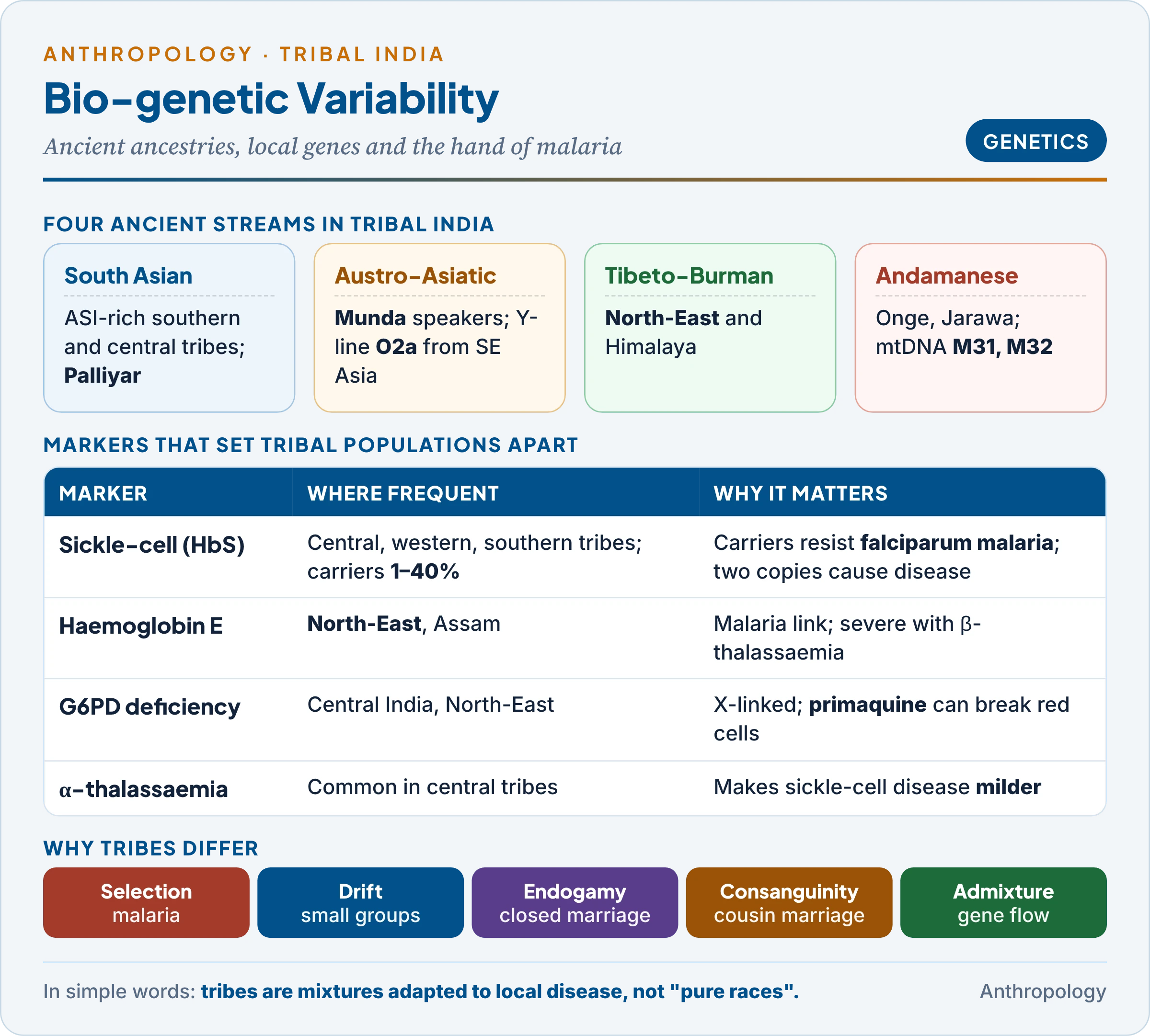
- Mainland ancestry: most Indians are mixtures of Ancestral North Indians (ANI) and Ancestral South Indians (ASI); tribal groups, especially in the south, carry more ASI ancestry, and some southern tribes such as the Palliyar are close to its direct descendants.
- Five components: a study by Analabha Basu, Partha Majumder and colleagues (2016) added Ancestral Austro-Asiatic (highest among Munda speakers), Ancestral Tibeto-Burman (North-East) and a distinct Andamanese component.
- Andamanese: maternal lineages M31 and M32 point to an early coastal dispersal out of Africa (K. Thangaraj and colleagues, 2005).
- Munda speakers: about two-thirds of their Y chromosomes belong to O2a, of Southeast Asian origin, while their maternal lineages are local (G. Chaubey and colleagues, 2011): migrating men married local women.
The genetic picture confirms what linguists suspected: tribal India contains at least four ancient streams, and language often marks ancestry better than physique.
3.3 Genetic markers that distinguish tribal populations
Tribal groups differ from caste populations, and from each other, in the frequency of a few inherited blood traits. The table lists the ones that matter for health and for evolutionary explanation.
| Marker | Where it is frequent | Why it matters |
|---|---|---|
| Sickle-cell gene (HbS) | Tribes of central, western and southern India; carriers vary from 1 to 40% across tribes | First reported among southern tribes by H. Lehmann and M. Cutbush (1952); carriers resist falciparum malaria |
| Haemoglobin E (HbE) | North-East, especially Assam’s plains and hill tribes | Also linked to malaria; with β-thalassaemia it causes severe anaemia |
| G6PD deficiency | Many tribes of central India and the North-East | X-linked enzyme defect; protects against malaria but antimalarial drugs such as primaquine can break red cells |
| α-thalassaemia | Very common among central Indian tribes | Makes sickle-cell disease milder in many tribal patients |
| Blood group B | High across India, including tribes | Shows regional, not “racial”, patterning |
How such variation arises.
- Natural selection by malaria: forests and hills were hyper-endemic for malaria, so genes that gave carriers some protection spread, even though two copies cause disease. This is a textbook case of balanced polymorphism (Paper I, 9.3 and 9.6).
- Genetic drift and founder effect: small, endogamous groups such as the Toda or the Andamanese change by chance, and rare genes can become common.
- Consanguinity: cross-cousin and uncle-niece marriage in many southern tribes raises the share of homozygotes (two copies of the same gene), and with it recessive disorders.
- Admixture: gene flow from neighbouring castes and tribes blurs boundaries; Kadar blood-marker studies found only slender evidence of any African admixture and much local mixing.
Common confusion
Are tribes genetically “pure” or “primitive” populations? No. Every tribal group studied is a mixture of ancestral streams, and tribes differ from one another more than they differ from neighbouring castes. Features such as the sickle-cell gene are recent adaptations to malaria, not signs of an older or simpler biology.
4. Linguistic Variability
In simple words
Tribal people speak languages from all four of India’s language families, and a few speak languages unrelated to any other. Many tribal languages are spoken by a few thousand people, have no traditional script and are losing speakers to the regional language of school and market.
Example first: the Chotanagpur plateau. In a single district of Jharkhand one can hear Santali, Mundari and Ho (Austroasiatic), Kurukh of the Oraon (Dravidian), and Sadri or Nagpuri, an Indo-Aryan lingua franca (a shared second language for trade and contact) used between them. Neighbours who look alike and share festivals speak languages from three families. Linguistic diversity among the tribes of Chotanagpur is therefore greater than across most of north India.
4.1 The four families and the isolates
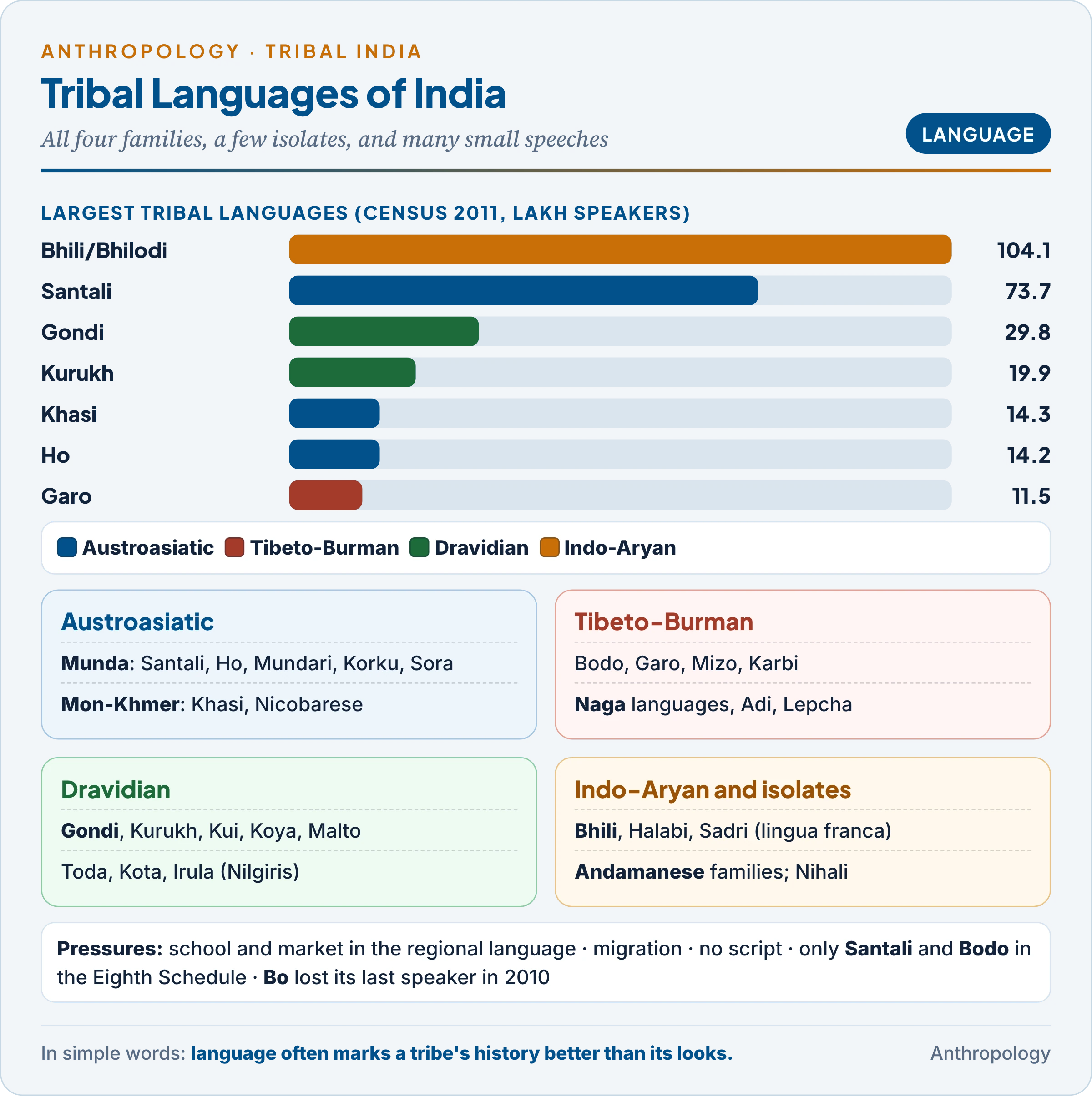
George Grierson’s Linguistic Survey of India (1903–28) first mapped these speeches; older Indian writers named the families after ancient peoples: Nishada (Austric), Kirata (Sino-Tibetan), Dravida and Arya. The table places India’s main tribal languages in their families, with Census 2011 speaker numbers where the census gives them separately.
| Family | Main tribal languages (Census 2011 speakers) | Region |
|---|---|---|
| Austroasiatic: Munda branch | Santali (73.7 lakh), Ho (14.2 lakh), Mundari (11.3 lakh), Kharia, Korku, Juang, Savara (Sora), Gadaba, Birhor, Asuri | Chotanagpur, Odisha hills, Satpura (Korku) |
| Austroasiatic: Mon-Khmer branch | Khasi (14.3 lakh), Nicobarese | Meghalaya; Nicobar Islands |
| Tibeto-Burman | Bodo, Garo (11.5 lakh), Karbi, Mizo, the Naga languages (Ao, Angami, Konyak and others), Adi, Lepcha, Bhotia | Himalaya and North-East |
| Dravidian | Gondi (29.8 lakh), Kurukh (19.9 lakh), Kui of the Kondh (9.4 lakh), Koya, Kolami, Malto, Parji, Toda, Kota, Irula | Central India, Odisha, Nilgiris |
| Indo-Aryan | Bhili/Bhilodi (1.04 crore, the largest non-scheduled language), Halabi, Sadri, Lambadi | Western and central India |
| Isolates and small families | Great Andamanese and Ongan (Onge, Jarawa); Nihali of the Tapti valley | Andamans; Madhya Pradesh–Maharashtra |
- The Munda branch is the oldest attested tribal family of central India; Santali alone has more than half of all Austroasiatic speakers in India.
- Dravidian tribal languages (Gondi, Kurukh, Malto) show that Dravidian once extended far north of its present southern home.
- The largest tribe, the Bhil, speaks an Indo-Aryan language: tribes have often shifted language to that of their neighbours while keeping their identity.
4.2 Language, territory and kinship in the North-East
- Knife-edged boundaries: in Arunachal and Nagaland language boundaries are sharp; often each tribe, and sometimes each cluster of villages, has its own speech, mutually unintelligible with the next valley’s.
- Language as ethnic marker: among the Naga and Mizo-Kuki peoples, language, clan territory and the village coincide. A clan holds land, its members speak the village dialect, and marriage alliances run along the same lines, so language reinforces kinship and territorial claims.
- Political use: the same coincidence underlies demands for autonomous councils and statehood (7.3).
4.3 Threats to tribal languages
- Shift: schooling, migration and markets in the regional language push children away from their mother tongue; the Bo language of the Great Andamanese lost its last speaker in 2010.
- Recognition: only Santali and Bodo, added by the 92nd Amendment (2003), are among the 22 scheduled languages; most tribal languages are invisible in official use.
- Scripts as identity: Ol Chiki, devised by Pandit Raghunath Murmu for Santali, became a rallying symbol of Santal identity.
- Education: children taught in an unfamiliar language fall behind and drop out (6.2, §5); the National Education Policy 2020 recommends the mother tongue as the medium at least up to Grade 5 wherever possible.
5. Socio-economic Characteristics
In simple words
Most tribes share a few broad features: small communities held together by kinship, land owned or used in common, simple technology, leaders who are also elders or priests, and a religion centred on nature and ancestors. But they range from hunters who move with the seasons to farmers, artisans and factory workers.
5.1 Common features
The features below recur in most definitions; each also has important exceptions.
| Feature | Meaning | Exception or change |
|---|---|---|
| Common territory and name | A tribe identifies with its homeland and clan lands | Migrant tribals in Assam’s tea gardens and Indian cities |
| Kinship-based organisation | Clans, lineages and phratries regulate marriage, land and ritual | Leaders now also come from parties and panchayats |
| Endogamy with clan exogamy | Marry inside the tribe, outside one’s own clan | Inter-tribal marriage in towns |
| Relative equality | No hereditary priestly or untouchable ranks inside the tribe | Large tribes (Bhil, Mina, Gond) have internal ranks and elites |
| Subsistence economy | Production for use, little saving, barter and reciprocity | Cash crops, wage labour, salaried jobs |
| Collective ownership | Clan or village control over land, forest and water | Individual titles introduced by colonial and state law |
| Nature- and ancestor-centred religion | Spirits of hill, forest and lineage; sacred groves | Conversion to Christianity, Hinduization |
5.2 Social organisation
- Units: from the bottom, family, lineage, clan, phratry (a cluster of clans), moiety (one of two halves of a tribe) and the tribe. T.C. Das, an Indian anthropologist, showed that tribes combine these units in several patterns, from “family–local group–tribe” among small foraging bands to “family–clan–phratry–moiety–tribe”.
- Family: most tribes are patrilineal, patrilocal and monogamous with nuclear households (Santal, Munda, Oraon, Ho, Gond, Bhil).
- Matriliny: among the Khasi and Garo of Meghalaya descent runs through women; among the Khasi the youngest daughter (khatduh) keeps the ancestral house.
- Parallel descent: among the Dimasa Kachari of Assam sons belong to the father’s clan and daughters to the mother’s.
- Polyandry: the Toda of the Nilgiris practised fraternal polyandry, with social fatherhood fixed by the bow-and-arrow ceremony (pursütpimi) recorded by W.H.R. Rivers (The Todas, 1906); the Khasa of Jaunsar-Bawar (Uttarakhand) are another example.
5.3 Economic types
L.P. Vidyarthi‘s economic typology sorts tribes by their main way of making a living. It is the most widely used Indian classification.
| Type | Tribes | Key feature |
|---|---|---|
| Hunting and gathering | Birhor (Jharkhand), Chenchu (Nallamala), Kadar (Anaimalai), Raji, Onge, Jarawa | Band organisation; mobility; sharing |
| Shifting cultivation | Juang, Saora, Baiga, Hill Maria, most North-Eastern tribes | Slash-and-burn on hill slopes: jhum (North-East), podu (Andhra-Odisha), bewar or dahiya (Madhya Pradesh) |
| Pastoralism | Toda (buffalo), Gaddi and Bakarwal (sheep, goats), Bhotia (yak, sheep), Gujjar | Seasonal migration; exchange of dairy produce |
| Settled agriculture | Santal, Munda, Oraon, Gond, Bhil, Mina; Apatani wet-rice terraces | Plough farming, often supplemented by forest produce |
| Simple artisans | Asur, Agaria (iron), Mahli (bamboo), Kota (smithy, pottery), Birhor (rope) | Crafts traded or exchanged with neighbours |
| Industrial and plantation labour | Santal, Ho and Oraon in mines and steel towns; “tea tribes” of Assam | Wage work, migration |
The U.N. Dhebar Commission (1960–61) saw four layers among tribes: an acculturated top (such as the Mina), settled agriculturists, highland shifting cultivators, and at the base isolated groups at a pre-agricultural stage. This lowest layer became the Primitive (now Particularly Vulnerable) Tribal Groups (9.1b).
Characteristics of tribal economies. The Indian anthropologist D.P. Sinha described traditional tribal exchange as barter by volume rather than weight, small-scale, of consumer goods rather than trade goods, with prices fixed by custom rather than supply and demand. The family is the unit of production; hunting and paddy transplanting are done communally; and reciprocity binds kin and neighbours. Among the Munda, Oraon and Gond, kin help each other at transplanting and are repaid with food and drink, an instance of generalised reciprocity (Paper I, 3b).
Shifting cultivators form a distinct socio-economic type: land is held by clan or village and reallocated each cycle; the village council fixes the plots; labour is exchanged between households; fallows of 10 years or more once restored fertility, but rising population and forest laws have shortened them to a few years, cutting yields and pushing families into wage work.
5.4 Political and religious organisation
- Village leaders: most tribes separate a secular headman from a priest: among the Munda the munda (headman) and pahan (priest); among the Santal the manjhi (headman) with assistants. Small bands such as the Birhor have one leader for both.
- Federations: groups of villages form the Munda parha under a manki, the Santal pargana and the Oraon parha, which settle disputes beyond the village.
- Chiefs: hereditary chiefs ruled among the Konyak Naga (ang), the Mizo (lal) and the Khasi (syiem).
- Justice: oath and ordeal, fines paid as a communal feast, and punishment of witchcraft, adultery and theft.
- Religion: beliefs in spirits of hills, forests and ancestors (the Munda bonga), sacred groves (the sarna of Chotanagpur), totemic clans and the shaman (ojha) who diagnoses illness. The nature-man-spirit complex is taught in 3.3.
5.5 Gender relations among Central Indian tribes
- Traditional strengths: bride-price rather than dowry, divorce and widow remarriage permitted, women’s large role in farming, forest collection and markets, and a sex ratio close to parity.
- Traditional limits: women may not plough among the Munda, Oraon and Santal, are excluded from land inheritance under customary law, and have been the targets of witch-hunting, against which Bihar (1999) and Jharkhand (2001) passed special laws.
- Change: schooling and wage work have raised women’s mobility, but dowry has spread with Sanskritization; the Hindu Succession Act does not apply to STs (section 2(2)), and in Kamla Neti v. Special Land Acquisition Officer (2022) the Supreme Court urged the Union to consider giving tribal daughters equal inheritance.
6. Regional Profiles and Distinct Institutions
In simple words
Each tribal region has its own typical institutions. The North-East has chiefs, clan lands and youth dormitories; central India has village councils and federations; the Nilgiri hills had a set of tribes who traded goods and services with each other; and the islands have hunter-gatherers and coconut-growing villagers.
6.1 The Himalaya and the North-East
- No caste, strong clan: society is built on clans and villages, without untouchability; land is held by the clan or village and worked by jhum.
- Institutions: chieftainship (Konyak, Mizo, Khasi), village councils, feasts of merit (Naga) and the morung dormitory.
- Agriculture: the Apatani of the Ziro valley (Arunachal) grow wet rice with fish in irrigated terraces, a complex system described by Christoph von Fürer-Haimendorf (The Apa Tanis and Their Neighbours, 1962).
- Religion and literacy: most Naga, Mizo and Khasi are Christian; ST literacy is 91.5% in Mizoram (2011).
- Political form: the Sixth Schedule (Assam, Meghalaya, Tripura, Mizoram) and Article 371A (Nagaland) protect customary law and land.
6.2 Middle and Western India
- Chotanagpur: the Munda, Ho, Santal and Oraon keep village councils and federations, sacred groves and dormitories; their land was protected after revolts by the Chotanagpur Tenancy Act (1908) and Santhal Parganas Tenancy Act (1949) (6.2).
- Bastar and the Gond belt: the Muria ghotul, the Maria and Bison-horn Maria, the Baiga of Mandla with their bewar farming.
- Western India: the Bhil (archers and peasants), Mina (an educated, landowning tribe), Warli (known for wall painting) and Dubla (former bonded labourers in south Gujarat).
- Artisan tribes of Jharkhand: the Asur (traditional iron smelters, now a PVTG), Lohra and Karmali (blacksmiths), Mahli (bamboo baskets), Chik Baraik (weavers) and Birhor (rope-makers). Their crafts fed the weekly market and the village economy; factory iron and plastic have undercut them.
6.3 South India: the Nilgiri interdependence
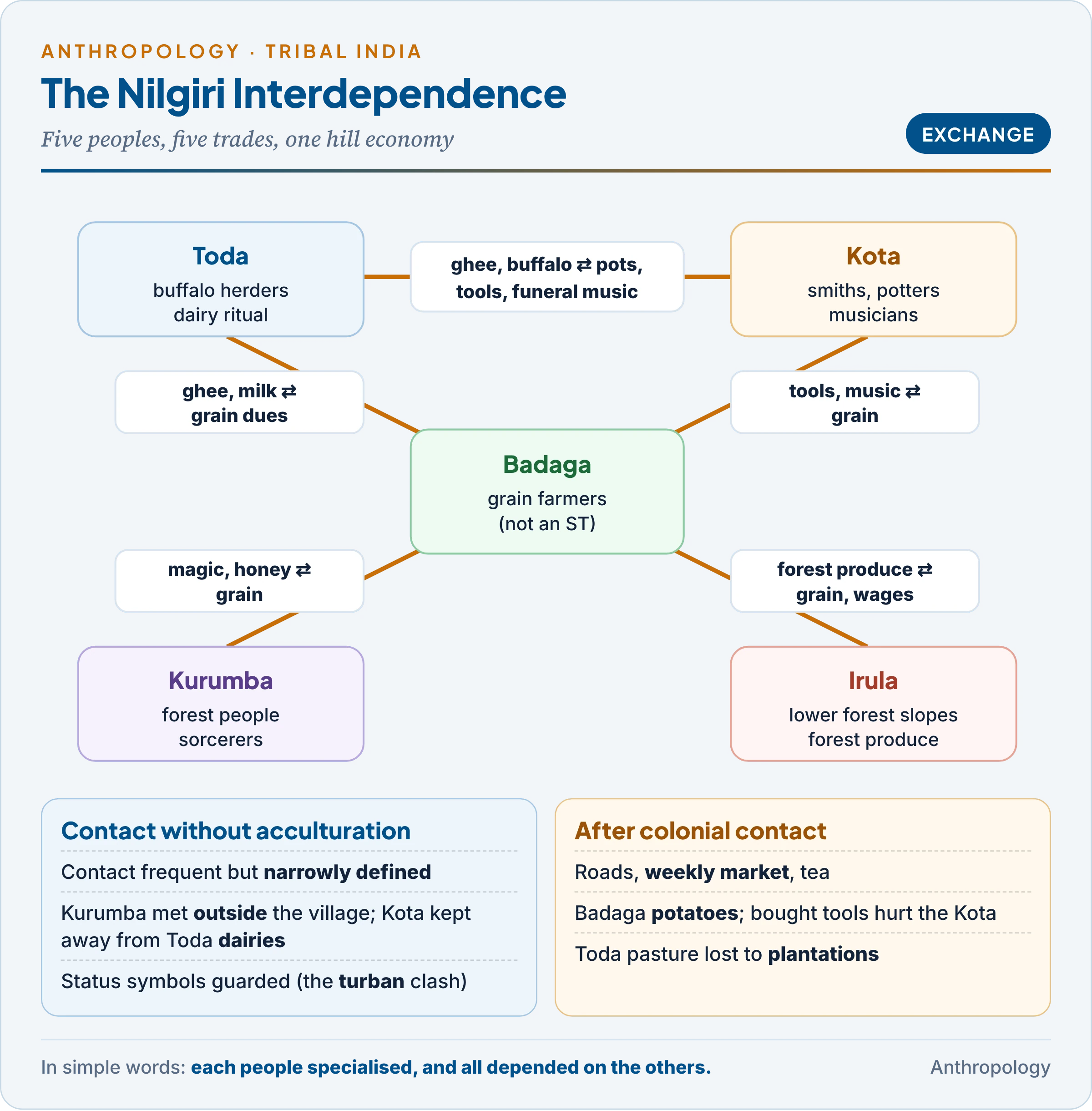
Example first. On the Nilgiri plateau of Tamil Nadu, villages of four peoples stood within a short walk of each other, yet each lived from a different trade. The American anthropologist David Mandelbaum (“Culture Change among the Nilgiri Tribes”, American Anthropologist, 1941) described them as living in economic and social symbiosis: the Toda were pastoralists, the Badaga agriculturists, the Kota artisans, the Kurumba food gatherers and sorcerers. The Irula, on the lower forested slopes, gathered forest produce and later worked on plantations.
| People | Gave | Received |
|---|---|---|
| Toda (buffalo herders) | Ghee, milk, buffalo for Kota funerals | Grain from Badaga; pots, tools and music from Kota |
| Kota (smiths, potters, musicians) | Iron tools, pottery, music at Toda and Badaga ceremonies | Grain, ghee, carcasses of sacrificed buffalo |
| Badaga (farmers, not an ST) | Grain as customary dues | Tools, music, dairy goods, magical protection |
| Kurumba (forest people) | Magical protection, honey, forest produce | Grain and payments |
| Irula (lower-slope forest people) | Forest produce | Grain, wages |
Why the cultures stayed distinct. Mandelbaum’s key finding is contact without acculturation. Contact was frequent but narrowly defined: Kurumbas were met outside the village, Kota musicians could not come near a Toda dairy (it would be polluted), and any borrowing of another tribe’s status symbols was resisted (Badagas beat Kotas who began wearing turbans). Each culture also had a different focus: Toda life centred on the buffalo cult, Kota on the smithy, Badaga on the crop.
Change. British settlement of the hills from the nineteenth century brought roads, a weekly market, tea and potatoes. Badagas replaced millet with potatoes as a cash crop and bought imported tools, undermining the Kota economy; a faction among the Badagas, moving towards caste Hindu practice, tried to drop Kota music from rituals; Toda pasture shrank under plantations. Later scholars such as Nurit Bird-David (1994) criticised the classic “Nilgiri system” as seen from the plateau, arguing that forest peoples such as the Nayaka were less dependent on it. Today the Toda, Kota, Kurumba and Irula are PVTGs in Tamil Nadu, while the Badaga seek ST status.
Other southern tribes. The Chenchu of the Nallamala hills (food gatherers studied by Haimendorf, 1943), the Kadar of the Anaimalai (honey collectors), and the Paniya of Wayanad, long tied to landlords as bonded agricultural labourers, show that southern tribes range from foragers to a rural proletariat.
6.4 The islands
- Andamanese: the Great Andamanese, Onge, Jarawa and Sentinelese were hunter-gatherers and fishers with bows, canoes and clay pots, living in bands; contact since 1858 brought epidemics and collapse (Census 2011: Great Andamanese 44, Onge 101, Jarawa 380, Sentinelese an estimated 15). A.R. Radcliffe-Brown’s The Andaman Islanders (1922) made them a classic of functionalism.
- Nicobarese: horticulturists and pig-keepers in large permanent villages, with land, coconut groves and pigs owned by the tuhet (a large joint family); coconuts once served as currency in trade with passing ships.
- Shompen: a small forest people of Great Nicobar (229 in 2011), hunter-horticulturists of the interior.
6.5 Youth dormitories
Youth dormitories are houses where the unmarried young of a village sleep, work and learn together. They are one of the most distinctive tribal institutions of India.
| Dormitory | Tribe and region | Ethnographer or note |
|---|---|---|
| Ghotul | Muria, Bastar (Chhattisgarh) | Verrier Elwin, The Muria and Their Ghotul (1947) |
| Dhumkuria | Oraon, Chotanagpur | S.C. Roy, The Oraons of Chota Nagpur (1915) |
| Giti-ora | Munda, Ho | Separate houses for boys and girls |
| Morung | Naga (e.g., Ao, Konyak) | Also a guardhouse and council hall |
| Zawlbuk | Mizo | Young men only; village defence |
| Nokpante | Garo | Bachelors’ house |
| Dhangarbasa | Bhuiyan, Odisha | Separate for boys and girls |
- Functions: education in work, song, dance, myth and discipline; labour for community tasks such as house-building and festivals; social control, since elders and office-bearers punish breaches; courtship and preparation for marriage; and among the Naga and Mizo, village defence.
- The ghotul: all unmarried boys (chelik) and girls (motiari) belonged, under elected leaders; Elwin distinguished an older type, in which couples paired until marriage, from a newer type in which partners had to change, to prevent attachment.
- Decline: missionary and reformist disapproval of mixed dormitories, formal schooling, and the end of warfare have closed most dormitories; some survive as cultural centres (Paper I, 4b, §7.3).
7. Tribes Are Not Homogeneous: Diversity, Stratification and Change
In simple words
“Tribal India” is not one society. Tribes differ in size from a few dozen people to millions, in wealth from foragers to officers and ministers, and in how far they have joined the wider economy. These differences grow as some members prosper and others lose land.
- Scale: from the Great Andamanese (44) to the Bhil, the largest tribe.
- Internal stratification: large tribes have landlords, educated elites and labourers. The Mina of Rajasthan have taken a large share of reserved posts; within the Bhil and Gond, chiefly lineages once claimed Rajput status (7.3, 3.2b).
- Tribe and peasant: many settled tribes are peasants in all but name. Surajit Sinha described a tribe-peasant continuum: tribes moving from isolated, egalitarian, kin-based communities towards peasant villages linked to markets, states and Hindu civilization (3.2b).
- Migration as mobility: seasonal and permanent migration to brick kilns, plantations, mines and cities brings cash and new ideas, but also exploitation (6.2). Earlier migrants became the “tea tribes” of Assam, who are not STs in Assam though they are in their home states.
- Plural traditions: tribal deities, arts and ecological knowledge entered Hindu and regional cultures (Jagannath of Puri began as a Savara deity; 1.1c), while tribes absorbed Hindu, Christian and modern elements: a two-way flow behind India’s multiculturalism.
- Tribalism and pseudo-tribalism: tribalism is the assertion of tribal identity and interests; pseudo-tribalism describes non-tribal or better-off groups claiming tribal status for its benefits, as critics argued in the Hattee case (detail in 7.3).
Key Terms
| Term | Meaning in simple words |
|---|---|
| Tribe | A community with its own name, territory, language and customs, organised mainly by kinship |
| Scheduled Tribe | A community listed under Article 342 in a state’s ST order |
| Adivasi | “First dwellers”: the self-name preferred by many tribal movements |
| Lokur criteria | The five tests used since 1965 to recognise an ST |
| Indigenous peoples | In international law, descendants of a land’s inhabitants before conquest or colonisation |
| Bio-genetic variability | Differences between populations in body form, blood and genes |
| Balanced polymorphism | Two forms of a gene kept in a population because carriers have an advantage |
| HbS / HbE | Abnormal haemoglobins frequent in central/southern and North-Eastern tribes |
| Genetic drift | Chance change in gene frequencies, strongest in small groups |
| Lingua franca | A shared second language used between speakers of different languages |
| Language shift | A community giving up its language for another |
| Jhum | Shifting (slash-and-burn) cultivation in the North-East |
| Phratry | A group of related clans |
| Moiety | One of two halves into which a tribe is divided |
| Parha / pargana | Federations of villages among the Oraon and Munda, and the Santal |
| Khatduh | The youngest Khasi daughter, who inherits the ancestral house |
| Tuhet | The Nicobarese joint family that owns land, coconuts and pigs |
| Youth dormitory | A house where the village’s unmarried young live and learn together |
| Contact without acculturation | Mandelbaum’s term for the Nilgiri tribes’ close but bounded relations |
| Pseudo-tribalism | Claiming tribal status mainly for its benefits |
Contemporary Developments
- ST list changes: Hattee of Trans Giri added in Himachal Pradesh (Act of 4 August 2023); Pahari Ethnic Group, Paddari Tribe, Koli and Gadda Brahmin added in Jammu and Kashmir (Act of 12 February 2024). Both were opposed by existing STs and SCs who feared dilution of their share.
- Census 2027: the first census since 2011 will again count Scheduled Tribes, giving the first new tribe-wise figures in sixteen years.
- Sickle-cell gene: the National Sickle Cell Anaemia Elimination Mission (launched 1 July 2023) had conducted more than 7.25 crore screenings in 17 tribal-majority states by July 2026, identifying about 2.5 lakh people with the disease and about 20 lakh carriers (6.2, §6).
- Language: Santali (written in Ol Chiki) and Bodo remain the only tribal languages in the Eighth Schedule; the NEP 2020 promotes mother-tongue teaching in early grades.
- Saturation schemes: the Dharti Aaba Janjatiya Gram Utkarsh Abhiyan (launched 2 October 2024) targets 63,843 tribal-majority villages in 549 districts (6.2).
Diagrams to Master
- Topic map: concept and ST → distribution → bio-genetic variability → languages → socio-economic types → regional institutions.
- Distribution panel: Vidyarthi’s five regions with Census 2011 shares, highest-share states and example tribes.
- Genetic markers panel: four ancestral streams; HbS, HbE, G6PD, α-thalassaemia; malaria, drift, endogamy and consanguinity as causes.
- Language families panel: Munda and Mon-Khmer, Tibeto-Burman, Dravidian, Indo-Aryan and isolates, with speaker numbers.
- Nilgiri interdependence: five peoples, the goods and services exchanged, and the changes after colonial contact.
Revision Grid
| Scholar or body | Work (year) | Key idea |
|---|---|---|
| W.H.R. Rivers | The Todas (1906) | Toda polyandry, dairy ritual, genealogical method |
| S.C. Roy | The Oraons of Chota Nagpur (1915) | Oraon dhumkuria and village organisation |
| A.R. Radcliffe-Brown | The Andaman Islanders (1922) | Function of Andamanese ritual and exchange |
| B.S. Guha | Census of India (1931) | Three tribal racial strains; three tribal zones |
| David Mandelbaum | “Culture Change among the Nilgiri Tribes” (1941) | Interdependence; contact without acculturation |
| C. von Fürer-Haimendorf | The Chenchus (1943); The Apa Tanis and Their Neighbours (1962) | Foragers; wet-rice hill farming |
| Verrier Elwin | The Muria and Their Ghotul (1947) | The ghotul and its two forms |
| H. Lehmann and M. Cutbush | British Medical Journal (1952) | Sickle-cell trait in southern Indian tribes |
| U.N. Dhebar Commission | Report (1961) | Four layers of tribal society |
| Lokur Committee | Report (1965) | Five criteria for ST status |
| Surajit Sinha | Tribe-caste and tribe-peasant continua (1960s) | Tribes as part of Indian civilization |
| L.P. Vidyarthi | Tribal regions and economic types | Five regions; six economic types |
| André Béteille | “The Concept of Tribe with Special Reference to India” (1986) | Tribe defined by position outside state and caste |
| Nurit Bird-David | “The Nilgiri Tribal Systems: A View from Below” (1994) | Critique of the plateau-centred Nilgiri model |
| Basu, Majumder and colleagues | Genome study (2016) | Five ancestral components including Austro-Asiatic and Tibeto-Burman |
Previous Year Questions
6.1 Tribal situation in India – bio-genetic variability, linguistic and socio-economic characteristics of the tribal populations and their distribution.
- 2025Critically examine the concept of Scheduled Tribe (ST) and mention the limitations of administrator’s criteria.
- 2025Write notes on: Tribalism and Pseudotribalism.
- 2025Describe the nature of traditional socioeconomic interdependence among the Toda, Kota, Kurumba and Irula tribes of Nilgiri Hills. Highlight the changes occurring in these interrelationships.
- 2024Write notes on: Artisan tribes of Jharkhand.
- 2023Discuss the distribution of tribes in different geographical regions of India. Identify the distinct institutional features of tribal societies of these regions.
- 2021Write short notes on “Cultural diversity and multiculturalism” in about 150 words.
- 2021Write short notes on “Concept of tribe and Indian census” in about 150 words.
- 2020Elucidate the linguistic classification of Indian tribes.
- 2018Write a note in 150 words on Distinctive cultural features of tribes of Andaman islands.
- 2018Write a note in 150 words on Youth Dormitory as an institution.
- 2016Discuss how cultural diversity of Indian tribes has enriched its plural traditions.
- 2016Write a note in 150 words on Biogenetic variability of Indian tribes.
- 2015Write a note in 150 words on Socioeconomic characteristics of shifting cultivators.
- 2014Write a note in 150 words on Biogenetic variations of Indian tribes.
- 2014Write a note in 150 words on Social and economic marginalization of tribal people.
- 2013Write a note in 150 words on Threat to tribal languages in India.
- 2013Write a note in 150 words on Linguistic classification of Indian tribes.
- 2012Write a note in 150 words on Youth Dormitory.
- 2012Discuss the concept of ‘indigenous people’ as per the relevant UN convention. Are tribals of India indigenous people ? Comment.
- 2012Using ethnographic examples, point out how gender relations have changed over time among Central Indian tribes.
- 2012Discuss the linkages between language, territoriality and kinship among the tribes of North-East India.
- 2011Discuss the distinctive features of tribal in North-east India.
- 2011“Tribes in India are not homogeneous group.” Discuss.
- 2009Write a brief note on the linguistic diversity among Indian tribes.
- 2008Write a note on Tribes as Indigenous Cultures.
- 2007Do you think that Indian tribes have rich biogenetic variability ? Discuss.
- 2006Write a note on Key characteristics of the Scheduled Tribes in India.
- 2006Discuss bio-morphological variation among the tribals of Northeastern India.
- 2005Write a note on Genetic diversity among Indian tribes.
- 2003Write a note on Tribe and peasant similarities and differences.
- 2003Write a note on Biogenetic variability in tribal population.
- 2002Write a note on Linguistic diversity among the tribes of Chhota Nagpur.
- 2001Write a note on Scheduled Area.
- 1992Give in detail the ethnographic profile of polyandrous tribe in India.
- 1989Write a note on Tribal Youth Dormitories.
- 1988Write a note on Migration as a means of socio-economic mobility in tribal society.
- 1987Briefly describe the linguistic and socioeconomic characteristics of the tribal peoples either (a) of Central India including the Chota Nagpur plateau or (b) of North East India.
- 1986Write a note on Languages spoken by the scheduled tribes.
- 1985Describe the racial, linguistic and socioeconomic characteristics of a tribe either of Central India or of South India.
- 1985Write a note on Role of dormitory in tribal life.
- 1984Write a note in 200 words : Racial affinity of Indian tribes.
- 1984Write an ethnographic profile in detail about any one Indian tribe you are aware of.
- 1981Write a note on Youth dormitory in a Central Indian tribe. (200 words).
Related questions from other units
- 2026Unit 2: Write notes on: Dravidian language family and its tribal speakers.
- 2026Unit 9.1: Write notes on: Particularly Vulnerable Tribal Group (PVTG) of the islands.
- 2024Unit 8.2: Write notes on: Describe ILO’s Convention No. 169 on Indigenous and Tribal people. Is India a signatory to it?
- 2022Unit 2: Write notes on: Austroasiatic languages.
- 2019Unit 2: Write a note in 150 words on Distribution of Tibeto-Burman group of languages in India.
- 2018Unit 2: Write a note in 150 words on Endangered languages.
- 2018Unit 3.2: Explain the significance of tribe-caste continuum in the present context.
- 2017Unit 8.2: Critically evaluate the term ‘tribe’ (as used in India) as compared to the term ‘indigenous’ in some other countries.
- 2017Unit 2: Write a note in 150 words on Austro-asiatic linguistic groups in India.
More from Tribal Situation in India: all notes of this unit · every PYQ of this unit · Anthropology Optional hub