

Anthropology Optional › Paper II › Unit 03: Indian Social System and Caste
3.2 Caste system in India- structure and characteristics, Varna and caste, Theories of origin of caste system, Dominant caste, Caste mobility, Future of caste system, Jajmani system, Tribe caste continuum.
Official Syllabus: Paper II, Unit 3.2
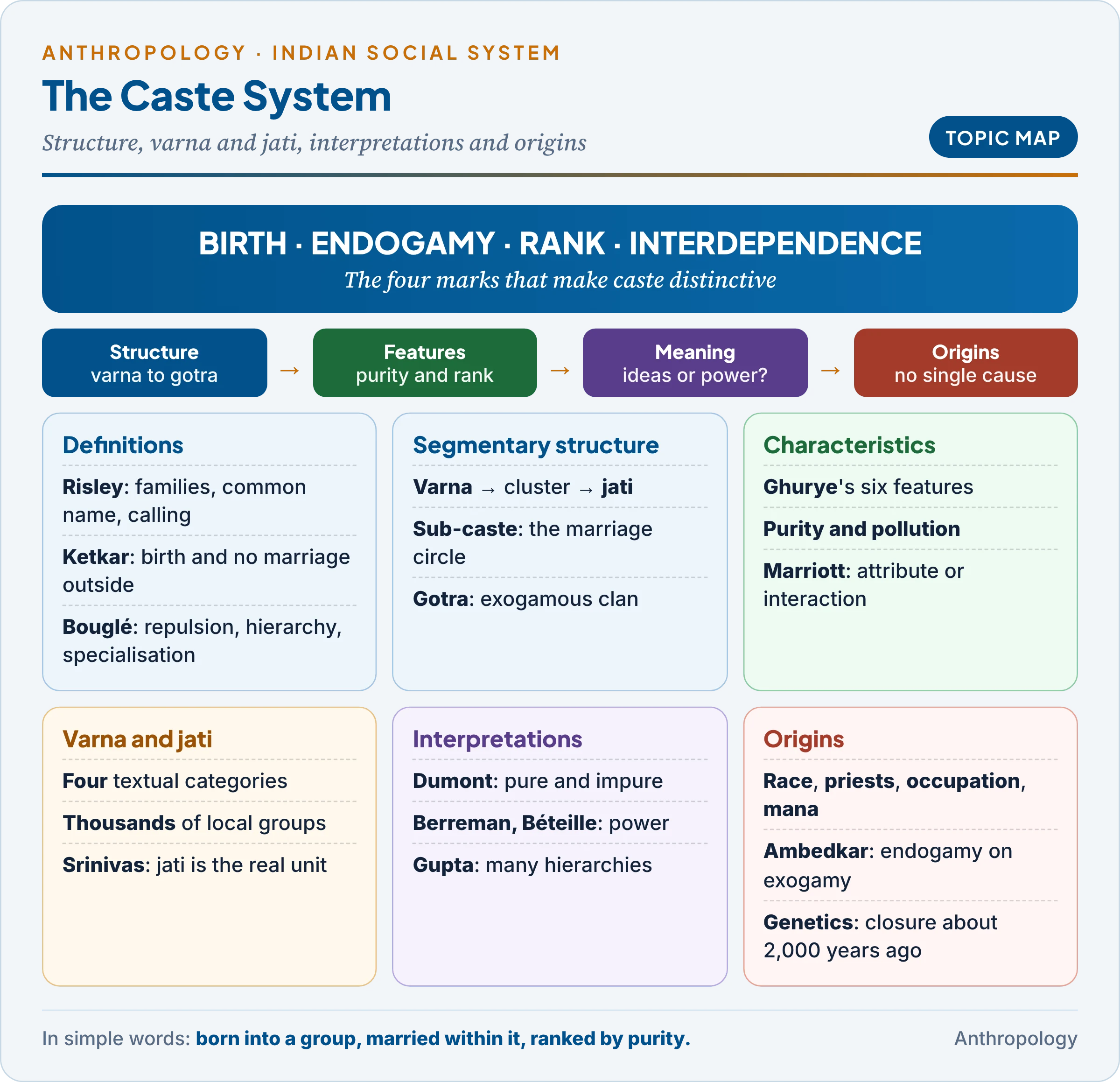
This article covers what caste is, its structure, its relation to varna, how scholars interpret it and the theories of its origin. Dominant caste, mobility, the future of caste, jajmani and the tribe-caste continuum are in 3.2b; varna as an ideal scheme of duties (with ashrama, purushartha, karma and rina) is in 3.1.
1. What Caste Is
In simple words
A caste is a group you are born into and cannot leave. You usually marry inside it, it once fixed your work, and it is ranked above or below other such groups. India has thousands of these groups, and they are linked to one another in each village and region.
1.1 A village to begin with
The British anthropologist Kathleen Gough studied Kumbapettai, a village in the Tanjore (Thanjavur) district of Tamil Nadu (“Caste in a Tanjore village”, 1960). At the top were Brahmin landlords who owned most of the land and lived in a separate street. Below them were non-Brahmin tenants, artisans and service castes such as barbers and washermen. At the bottom were Pallar and Paraiyar labourers who lived in separate hamlets, could not draw water from the Brahmin well and could not enter the Brahmin street. Each group married within itself, ate only certain foods from certain others, and did work its birth assigned to it.
This village shows the four marks of caste: birth-based membership, marriage within the group, a ranked order justified by purity, and interdependence of groups.
1.2 The word and its definitions
- Casta: “caste” comes from the Portuguese casta (breed, lineage), used by sixteenth-century Portuguese traders. Indians say jati (from jan, to be born), stressing birth.
- Megasthenes, Greek envoy to the Mauryan court (about 300 BC), noted that no one could marry outside his group or change occupation.
- H.H. Risley, the British civil servant who led the 1901 Census (The People of India, 1908): a caste is “a collection of families or groups of families bearing a common name”, claiming common descent from a mythical ancestor, following the same hereditary calling, and regarded as one homogeneous community.
- S.V. Ketkar, an Indian scholar (History of Caste in India, 1909): a caste has two marks: membership by birth and an inexorable rule against marrying outside.
- A.L. Kroeber, an American anthropologist (1930): a caste is “an endogamous and hereditary subdivision of an ethnic unit” occupying a position of superior or inferior rank compared with other such subdivisions.
- Célestin Bouglé, a French sociologist (Essais sur le régime des castes, 1908), defined a caste system by three tendencies: hereditary specialisation, hierarchy and repulsion (groups keep apart).
Risley and Kroeber describe a single group; Bouglé describes a system. G.S. Ghurye, the founder of Indian sociology at Bombay (Caste and Race in India, 1932), held that caste is best understood through its features (§3).
1.3 The scale of caste
- The People of India project of the Anthropological Survey of India, led by K.S. Singh from 1985, identified 4,635 communities, most of them castes, each with its own name, territory and marriage circle.
- The real units are local: most jatis live within one linguistic region, and the same caste can stand at different heights in neighbouring villages.
2. The Structure of Caste: From Varna to Sub-caste
In simple words
Caste is not one ladder of four steps. It is a set of nested groups: a broad varna label at the top, then clusters of related castes, then the castes themselves, then smaller sub-castes and clans. The group that really decides whom you marry is usually the smallest one.
2.1 The levels
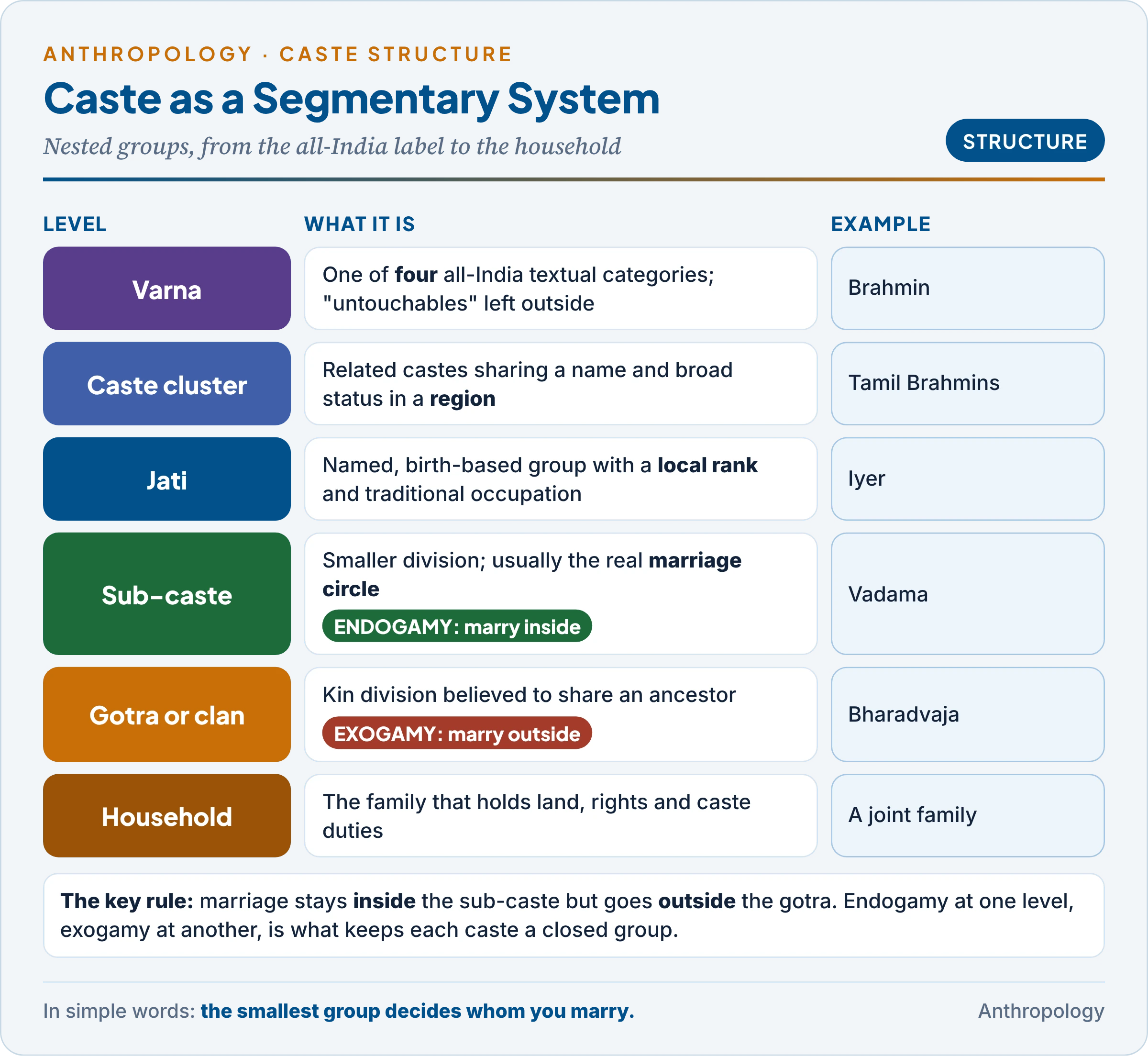
Caste is a segmentary system: larger units split into smaller ones, and each level matters for a different purpose. The levels from broadest to narrowest are set out below.
| Level | What it is | Example |
|---|---|---|
| Varna | One of four all-India categories (Brahmin, Kshatriya, Vaishya, Shudra), with “untouchables” outside | Brahmin |
| Caste cluster | A group of castes sharing a name and broad status in a region (Irawati Karve’s term) | Tamil Brahmins |
| Jati (caste) | A named, endogamous, usually occupational group with a local rank | Iyer |
| Sub-caste | A smaller endogamous division of a jati, often the real marriage circle | Vadama |
| Gotra or clan | An exogamous kin division within the sub-caste (one marries outside it) | Bharadvaja |
| Lineage and household | The family that holds land, rights and caste duties | A joint family |
The table shows a key rule: the marriage circle is set by the sub-caste (endogamy), while marriage is forbidden within the gotra (exogamy). Caste thus combines endogamy at one level with exogamy at another, which is exactly the combination B.R. Ambedkar took as the core of caste (§6.6).
2.2 The two dimensions
- Vertical (hierarchy): castes are ranked above and below one another in each region. The ranking is clear at the top (Brahmins) and the bottom (castes once treated as untouchable) but vague in the middle, where castes dispute precedence. M.N. Srinivas, the Indian anthropologist who studied Rampura in Mysore, stressed this vagueness of the middle ranks.
- Horizontal (segmentation): each caste divides into sub-castes, often mutually exclusive for marriage. Irawati Karve, an Indian anthropologist (Hindu Society: An Interpretation, 1961), saw a caste as an extended kin group: its members are, or believe they are, related by blood and marriage.
2.3 Caste as a local system
- Caste councils (jati panchayats) judged breaches of marriage, food and occupation rules and could outcaste an offender.
- Village interdependence: castes are tied by service exchange (jajmani, 3.2b) and ritual roles: barber and washerman remove pollution at births and deaths.
- Regional divisions: parts of south India grouped castes into right-hand (valangai) and left-hand (idangai) divisions that competed for honours, a sign that rank was always contested.
3. Characteristics of the Caste System
In simple words
Scholars have tried to list what makes caste different from other forms of inequality. The common answer is: you are born into it, you marry inside it, it is ranked by purity, it limits eating and touching, it ties groups to occupations, and it gives some groups privileges and others disabilities.
3.1 Ghurye’s six features (1932)
Ghurye’s list is the most widely used description of the traditional caste system.
- Segmental division of society: society is split into groups whose membership is fixed by birth; each caste has its own council and is “a small and complete social world”.
- Hierarchy: a definite scheme of social precedence, with the Brahmin at the top in most regions.
- Restrictions on feeding and social intercourse: minute rules on which food may be accepted from whom. Kachcha food (cooked in water) was accepted only from one’s own or a higher caste; pakka food (fried in ghee) could pass more widely.
- Civil and religious disabilities and privileges: segregation of lower castes in separate hamlets, denial of wells, temples, schools and roads; privileges for the higher castes.
- Lack of unrestricted choice of occupation: each caste had a hereditary calling; leaving it, especially for a “lower” one, was condemned.
- Restrictions on marriage: endogamy within the caste or sub-caste, with hypergamy (women marrying into higher sub-groups) as a regional exception.
Distance pollution shows how far these rules could go. Ghurye recorded that in Tamil Nadu a Shanar (toddy-tapper) polluted a Brahmin within 24 paces, while in Kerala a Nayar could approach but not touch a Nambudiri Brahmin, a Tiyan had to keep 36 steps away and a Pulayan 96 paces.
3.2 Other formulations
- Bouglé (1908): repulsion, hierarchy and hereditary specialisation together make the “spirit of caste”.
- Gerald Berreman, an American anthropologist who worked in the Himalayan village of Sirkanda, defined caste as a system of birth-ascribed ranked groups that are exhaustive (everyone belongs to one), exclusive and discrete, held together less by agreement than by the power of those on top. The lower castes conform in action but not necessarily in belief.
- Louis Dumont, a French anthropologist (Homo Hierarchicus, 1966; English 1970), reduced Bouglé’s three features (separation, division of labour, hierarchy) to one principle: the opposition of pure and impure (§5).
3.3 Purity and pollution: how the mechanism works
Ritual purity is a state of religious fitness; pollution is its loss through contact with organic life and death: blood, birth, death, excreta, hair, leather and dead animals.
- Temporary pollution affects everyone (after a birth or death in the family) and is removed by bathing and rites.
- Permanent pollution was ascribed to whole castes whose hereditary work handled impure matter: washermen (soiled cloth), barbers (hair, nails), leather workers (dead cattle), sweepers (excreta). Because their work absorbs the pollution of others, these castes were indispensable yet ranked low.
- Transmission: pollution was believed to pass through touch, food, water and in places even sight or shadow, so caste rules regulate exactly these channels.
The mechanism explains why the Brahmin ranks highest and castes with impure tasks lowest, regardless of wealth; it does not explain why a wealthy landowning caste often ranks high despite meat-eating or other “impure” practices (§5.3).
3.4 How ranks are decided: attribute or interaction?
McKim Marriott, an American anthropologist who studied Kishan Garhi in Uttar Pradesh, distinguished two theories of caste ranking (1959):
- Attributional: a caste’s rank follows from its attributes: diet (vegetarian or meat-eating), occupation, rites.
- Interactional: a caste’s rank follows from transactions: who accepts food, water and services from whom. A caste that gives food to many and takes from few ranks high. Marriott later mapped these transactions as a matrix (1968).
The interactional view explains why the same caste can rank differently in neighbouring villages.
Common confusion
Is untouchability the same as caste? No. Caste is the whole system of birth-ranked groups. Untouchability was its most extreme expression: the treatment of certain castes as permanently polluting, denied wells, temples and contact. Article 17 of the Constitution abolished untouchability and made its practice an offence; caste as a social group continues.
4. Varna and Caste
In simple words
Varna is a simple four-part scheme found in the old texts. Caste (jati) is the thousands of real groups people actually belong to. Varna is a map; jati is the territory. People use the map to place real castes, but the map does not show everything.
4.1 What varna is
- Meaning: varna literally means colour (also understood as “kind” or “choice”). In the Rig Veda the word marks the contrast between the arya varna and the dasa varna; it is not used there for Brahmin, Kshatriya and so on as classes (Ghurye).
- The fourfold scheme appears in the Purusha Sukta (Rig Veda 10.90), a late hymn: from the cosmic being came the Brahmin (mouth), Kshatriya (arms), Vaishya (thighs) and Shudra (feet). The first three are dvija (twice-born), entitled to the sacred thread at upanayana.
- Outside the scheme: the Chandala, Nishada and Paulkasa of Vedic texts; later texts called such groups avarna or panchama.
- Flexible origins: the Bhagavad Gita (4.13) links varna to guna (qualities) and karma (action), not birth alone, a verse reformers often cite. The Manusmriti (early first millennium AD) treats varna as hereditary and explains the many jatis as products of mixed unions between varnas (varnasamkara), anuloma (hypergamous) and pratiloma (hypogamous).
4.2 Srinivas on varna and caste (1962)
Srinivas’s essay “Varna and Caste” (Caste in Modern India, 1962) is the standard anthropological view.
- The real unit is the jati: a small endogamous group with a traditional occupation and a local rank. Varna is at most a set of broad categories.
- Distortion: varna pictures caste as four fixed all-India blocks, hiding regional variety, mobility and the untouchables.
- Usefulness: varna supplies a common, all-India language: an ordinary villager can place an unfamiliar caste from another region by asking “which varna?”. It also gives the idiom of mobility: a caste rising in rank claims Kshatriya or Vaishya status (Sanskritization, 5.3).
The French Indologist Émile Senart (Les Castes dans l’Inde, 1896) had already argued that varna and jati were independent in origin and fused later. Dumont read them as two expressions of the same hierarchical principle: varna ranks by function, jati by purity, and the two meet because both place the priest above the king.
4.3 The two compared
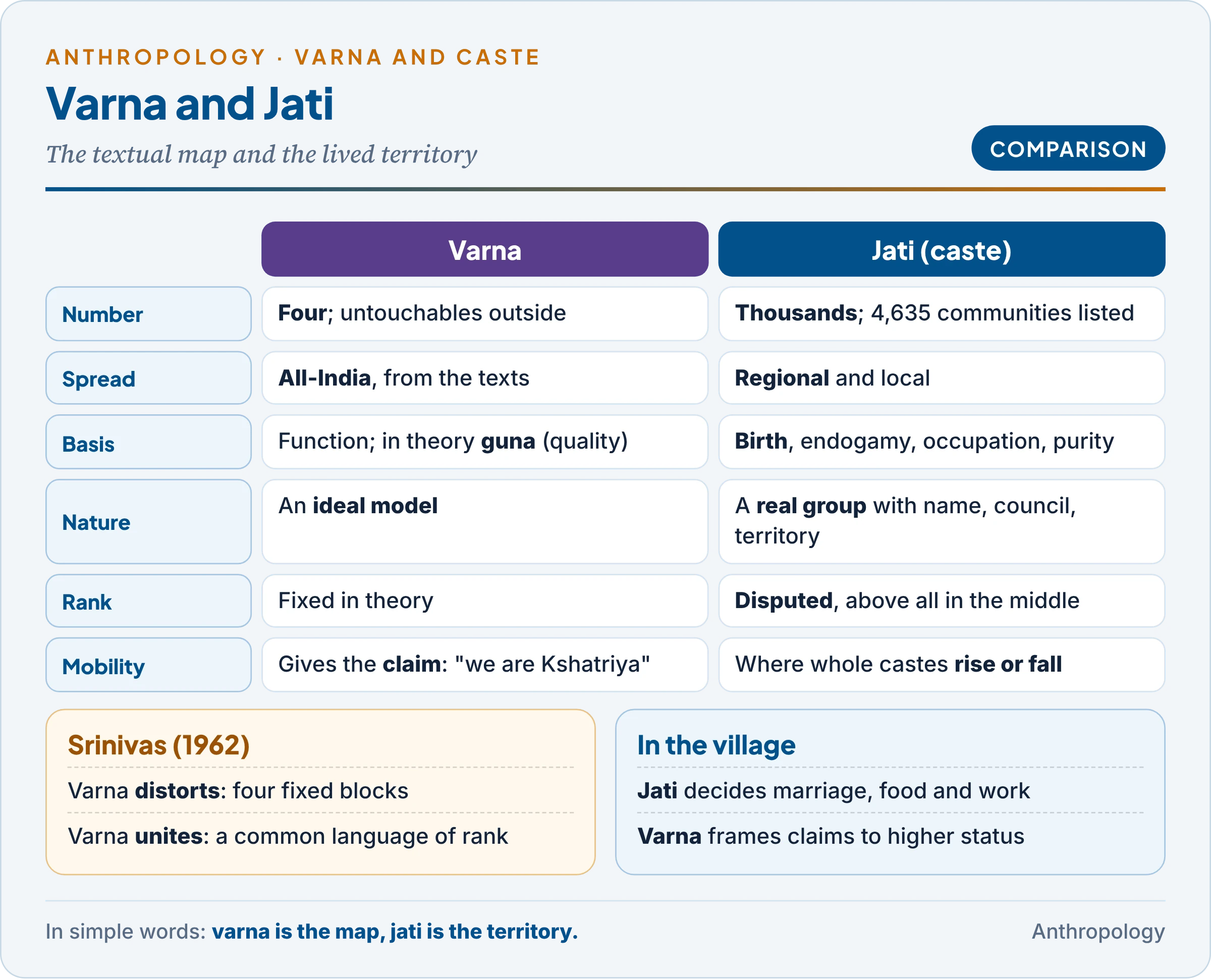
The table compares the two concepts on the points most often confused.
| Varna | Jati (caste) | |
|---|---|---|
| Number | Four (untouchables outside) | Thousands (4,635 communities in the People of India project) |
| Spread | All-India, textual | Regional and local |
| Basis | Function and, in theory, quality (guna) | Birth, endogamy, occupation, purity |
| Nature | An ideal model or category | A concrete group with a name, council and territory |
| Rank | Fixed in theory | Disputed, especially in the middle |
| Mobility | Supplies the claim (to be Kshatriya, Vaishya) | Where mobility happens (whole castes rise or fall) |
| Untouchables | Excluded | Present as named jatis |
The comparison answers an old question: in village India the jati matters more than the varna, because it decides marriage, food, work and local rank. But varna is not irrelevant: it frames mobility claims and lets people across regions place one another.
Common confusion
Are varna and caste the same thing? No. Varna is a fourfold textual model of society by function; caste (jati) is a real, birth-based, endogamous group, of which there are thousands. A single varna label such as “Kshatriya” covers many unrelated jatis in different regions, and many jatis have no agreed varna at all.
5. How Anthropologists Have Interpreted Caste
In simple words
Some scholars see caste mainly as a set of religious ideas about purity that Indians share. Others see it mainly as a system of power and inequality, like class or race elsewhere. The debate is about whether caste is unique to India or one example of a general human pattern.
5.1 The two broad approaches
Interpretations fall into two families, and the 2016 question asks for exactly this contrast.
| Cultural or ideological view | Structural or stratification view | |
|---|---|---|
| Core claim | Caste is a system of ideas and values (purity, hierarchy) unique to Hindu India | Caste is a form of ranked, birth-based inequality found in many societies |
| Main scholars | Bouglé, A.M. Hocart, Dumont, Marriott and Ronald Inden | Berreman, F.G. Bailey, André Béteille, Dipankar Gupta |
| What explains rank | Religious values: purity, sacrifice, dharma | Power: land, wealth, force, politics |
| Comparison | Caste is not comparable to class or race | Caste is comparable (American race relations, South African apartheid) |
The cultural view explains why rank is expressed in purity; the structural view explains why rank follows land and power and why lower castes resist it. Most anthropologists now combine the two.
5.2 Dumont’s Homo Hierarchicus
Example first. In many villages a Brahmin family is poorer than the landowning caste around it. Yet the landowner will accept cooked food from the Brahmin’s kitchen, while the Brahmin will not accept cooked food from the landowner’s. Wealth does not buy purity.
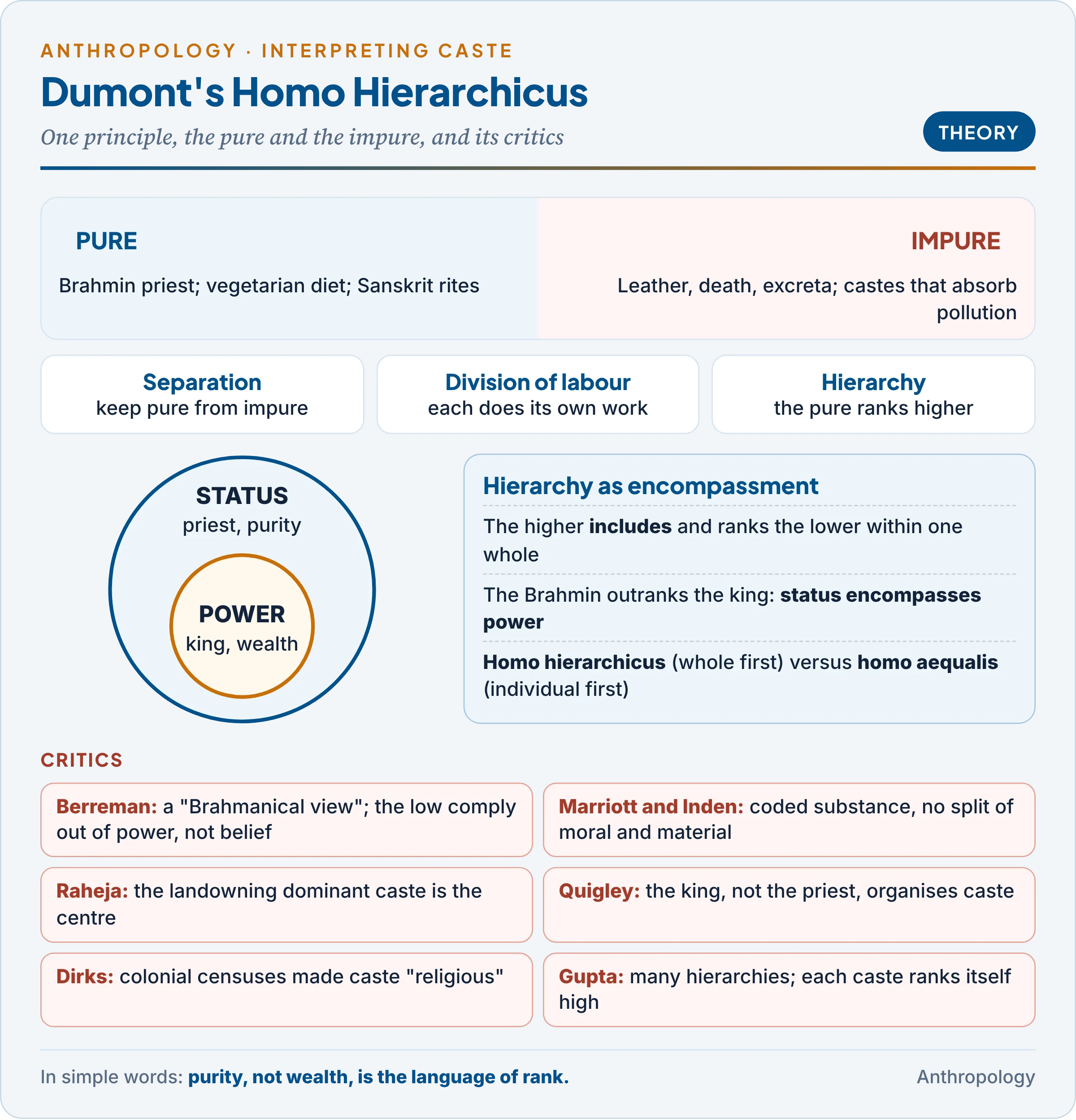
- One principle: the whole caste system rests on the opposition of pure and impure. The pure must be kept separate from the impure (separation), each must perform its own work (division of labour), and the pure is superior (hierarchy).
- Hierarchy as encompassment: hierarchy is not a ladder of more and less; it is the encompassing of the contrary. The pure includes and ranks the impure as a part of the whole, as the right hand encompasses the left.
- Status and power separated: the Brahmin (status, purity) is superior to the king (power, artha), even though the king is richer and stronger. The king’s power is encompassed by the priest’s status. In the West, Dumont argued, status follows power and wealth.
- Homo hierarchicus and homo aequalis: traditional India values the whole over the individual (holism and hierarchy); the modern West values the individual and equality. Caste is therefore not “stratification”, which assumes equal individuals unequally rewarded, but hierarchy, which assumes the whole comes first. This is the basis of the 2018 question.
Criticisms of Dumont
- Berreman called it a “Brahmanical view” of caste (1971): it takes the higher castes’ ideology as everyone’s. Lower castes, he found, do not accept their impurity; they comply because of power.
- Marriott and Inden (1977) argued that Indians do not separate the moral from the material: castes differ in coded substance exchanged through food and touch (“ethnosociology”).
- Gloria Goodwin Raheja (The Poison in the Gift, 1988), working among Gujar landowners of Pahansu (Uttar Pradesh), showed that the dominant landowning caste, not the Brahmin, stood at the centre of ritual exchange, passing inauspiciousness to others through gifts.
- Declan Quigley (The Interpretation of Caste, 1993) argued that the king, not the priest, is the organising centre.
- Nicholas Dirks (Castes of Mind, 2001) argued that caste as one all-India religious system was partly shaped by colonial censuses; before that, kingship mattered more.
Dumont’s lasting contribution is to show why purity, not wealth, is the idiom of rank; his weakness is that he treated an ideology as a description.
5.3 The structural view: caste as stratification
- Berreman (“Caste in India and the United States”, 1960) compared caste with the Black-white colour line in the American South: in both, rank is ascribed by birth, groups are endogamous, contact is regulated and the lower group resents its position. Caste is thus one case of a general type: birth-ascribed stratification.
- F.G. Bailey, a British anthropologist who studied Bisipara in Odisha, called caste “closed social stratification” (1963) and showed that rank in the village followed land and political control.
- André Béteille, an Indian sociologist (Caste, Class and Power, 1965), studied Sripuram in Thanjavur and found that in the past caste, class and power coincided (Brahmins held ritual rank, land and office), but that they were separating: non-Brahmins gained power through party politics and land came onto the market.
- Edmund Leach, a British anthropologist (“What should we mean by caste?”, 1960), took a middle position: caste is structural but specific to India. Castes are interdependent and do not compete; a caste that competes for economic or political goals “acts in defiance of caste tradition”, like a faction.
5.4 Gupta: difference, not one hierarchy
Dipankar Gupta, an Indian sociologist (Interrogating Caste, 2000), argued that there is no single agreed hierarchy. Each caste has origin tales that give it an exalted past; each ranks itself higher than others place it. Castes are discrete groups separated by difference, and the “hierarchy” one sees is the version of whoever holds economic and political power. Gupta’s view explains why castes of the same rank still refuse to intermarry, and why caste identities grow stronger in democratic politics even as the old system of ranked interdependence collapses.
5.5 Caste, class, race and estate
The 2024 question asks to differentiate caste, class and race. The table compares them with the European estate.
| Caste | Class | Race | Estate | |
|---|---|---|---|---|
| Basis | Birth into a named group; purity | Economic position (Marx: relation to the means of production) | Supposed biological descent and appearance | Legal rank (clergy, nobility, commons) |
| Mobility | Individual mobility nearly closed; group mobility possible | Open in principle | Closed by appearance and law where codified | Limited; by law and ennoblement |
| Marriage | Endogamy a rule | No rule | Banned across lines in some societies (United States, apartheid South Africa) | Mostly within the estate |
| Legitimation | Religious (dharma, karma, purity) | Secular; market | Pseudo-scientific “race science” | Law and custom |
| Example | Jatis of a Tanjore village | Workers and owners in a factory town | The colour line of the American South | Pre-revolutionary France |
The table shows why the comparison is debated. Caste resembles race (birth, endogamy, segregation; Berreman) and resembles class where it follows land and power (Béteille), but it differs from both in being legitimated by religion and in dividing society into many small groups, not two or three large strata. Max Weber, the German sociologist, called castes closed status groups, in which ethnic separation had been turned into ritual separation.
6. Theories of the Origin of Caste
In simple words
No one knows exactly how caste began. Different scholars have blamed race, priests, occupations, religious beliefs, tribes or marriage rules. Each explains part of the story, but none explains all of it, and caste probably grew out of many causes over a long time.
The theories fall into families. The table gives the families before each is explained.
| Family | Main scholars | Core idea |
|---|---|---|
| Traditional | Purusha Sukta, Manu | Divine creation of four varnas; jatis from mixed unions |
| Racial | Risley, Ghurye (in part), N.K. Dutt | Conquest by fair Indo-Aryans, colour prejudice, hypergamy |
| Political (Brahmanical) | Abbé Dubois, Ghurye | A device of Brahmins to keep power |
| Occupational | J.C. Nesfield, Denzil Ibbetson, Joseph Dahlmann | Hereditary occupations and guilds |
| Religious and ritual | Senart, Hocart | Family cults, sacrifice and kingship |
| Mana and taboo | J.H. Hutton | Pre-Aryan tribal fear of others’ magical power |
| Tribal and kin | Karve, D.D. Kosambi | Pre-existing tribes absorbed as endogamous jatis |
| Endogamy | B.R. Ambedkar | Endogamy superimposed on exogamy |
| Multiple factor | Hutton, most modern scholars | Many causes over a long period |
6.1 The traditional theory
- Claim: the four varnas were created by Brahma from different parts of the cosmic being (Purusha Sukta); jatis arose from mixed unions (varnasamkara), as the Manusmriti explains. Birth in a caste is the result of karma in a past life, and following its duties is dharma (3.1).
- Criticism: a religious justification, not an explanation; it confuses varna with jati and cannot explain thousands of regional jatis.
6.2 The racial theory
- Risley (The People of India, 1908) held that caste began when fair-skinned Indo-Aryan invaders met dark-skinned natives. Invaders took native women but did not give their daughters, so hypergamy and colour prejudice hardened into endogamous castes. He claimed the nasal index fell as caste rank rose (detail in 2a).
- Ghurye accepted a racial element: caste was “the Brahmanic child of the Indo-Aryan culture, cradled in the land of the Ganges and the Jumna”, and spread outward. N.K. Dutt (Origin and Growth of Caste in India, 1931) and D.N. Majumdar also gave race and colour a central place.
- Criticism: conquest and colour prejudice exist in many societies without producing caste; physical anthropology found no racial line between castes (Bhupendranath Datta’s reworking of Risley’s figures; Karve and Malhotra, 1968); and genetics shows nearly all Indian groups are mixtures of the same ancestral populations (2a).
6.3 The political or Brahmanical theory
- Abbé J.A. Dubois, a French missionary in south India (Hindu Manners, Customs and Ceremonies, English 1816), saw caste as an ingenious device of the Brahmins to secure their own supremacy. Ghurye too stressed that Brahmins excluded the Shudras and aboriginals from their religious and social life to protect their purity.
- Criticism: Hutton objected that so deep an institution could not be imposed by decree by priests who rarely held political power. Priestly ideology sanctified caste; it did not create it.
6.4 The occupational and guild theories
- J.C. Nesfield (Brief View of the Caste System of the North-Western Provinces and Oudh, 1885) held that function alone created caste: castes ranked by the stage of industry their work represented, so metal-workers stood above basket-makers.
- Denzil Ibbetson, a British civil servant (Punjab Census Report of 1881), combined tribal origins, occupational guilds and the Brahmin’s religious monopoly.
- Joseph Dahlmann, a German Jesuit scholar (Das altindische Volkstum, 1899), traced castes to professional guilds that became hereditary corporations.
- Criticism: occupation does not explain endogamy or untouchability; the same occupation ranks differently by region; and guilds elsewhere never became castes.
6.5 Religious, ritual and mana theories
- Senart (1896) linked caste to the family cults and rules of purity of descent of the ancient Aryans, comparing jatis to the Roman gens and Greek phratry.
- A.M. Hocart, a British anthropologist (Les Castes, 1938; English Caste, 1950), saw castes as hereditary ritual offices around the king, the chief sacrificer: castes are “families to whom various offices in the ritual are assigned by heredity”. The barber and washerman are ritual specialists who remove pollution at royal and family rites.
- J.H. Hutton, a British administrator-anthropologist and Census Commissioner for 1931 (Caste in India, 1946), drew on his work among the Naga of north-east India, where each village was an independent unit and occupations were distributed by village (potters in one, weavers in another). He argued that pre-Aryan India believed in mana, an impersonal supernatural power passed through food, touch and marriage; fear of others’ mana produced taboos on eating and marrying with them, and the Indo-Aryans later placed themselves at the top.
- Criticism: mana and taboo exist across the Pacific without caste; Hutton himself added many factors: isolation, hereditary occupation, pollution ideas, Brahmin manipulation and the clash of peoples.
6.6 Ambedkar: endogamy superimposed on exogamy
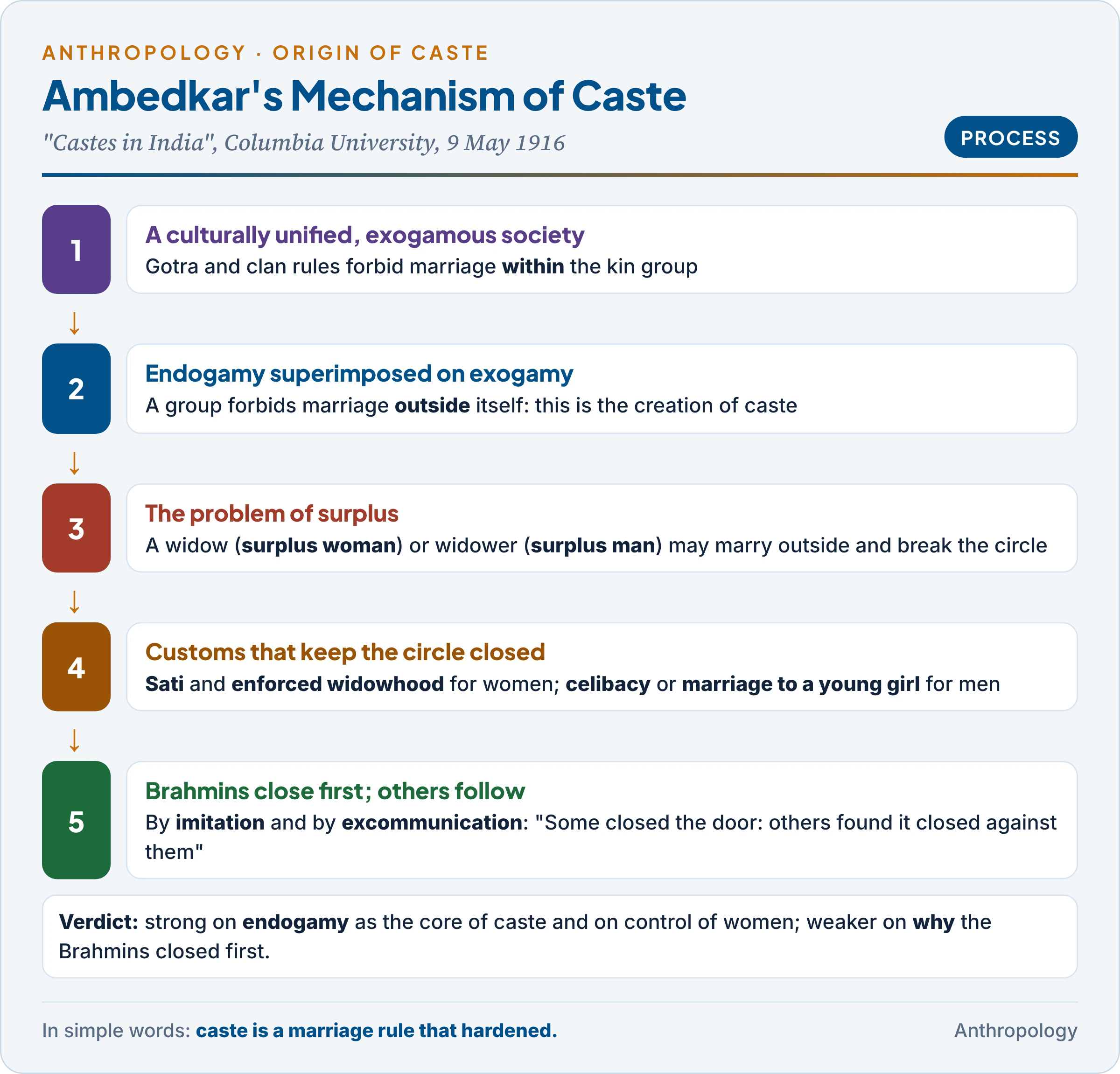
B.R. Ambedkar, the Indian jurist, economist and leader of the Dalit movement, presented “Castes in India: Their Mechanism, Genesis and Development” at Alexander Goldenweiser‘s anthropology seminar at Columbia University on 9 May 1916 (printed in the Indian Antiquary, 1917). It is the most original Indian theory of caste origin.
The argument, step by step
- Cultural unity first: India’s peoples were already culturally unified; caste is not the meeting of separate races but the parcelling of a homogeneous society. Ambedkar therefore rejected the racial theory.
- The defining feature: Ketkar’s two marks (birth and no marriage outside) are one thing: endogamy. Indian society was originally exogamous (gotra and clan rules forbade marrying within), and “the superposition of endogamy on exogamy means the creation of caste”.
- The problem of surplus: a closed endogamous group must keep its numbers of marriageable men and women equal. A surplus woman (a widow) threatens the group because she may marry outside; a surplus man (a widower) may do the same.
- The solutions: the surplus woman was disposed of by sati (burning with the dead husband) or enforced widowhood; the surplus man by celibacy or, more often, by marriage to a girl not yet of age, which produced child marriage. These customs, in Ambedkar’s view, are the mechanism that maintains endogamy.
- Genesis: the Brahmins were the first to enclose themselves as an endogamous class and adopted these customs.
- Spread: other groups copied them through imitation (the “infection of imitation”) and some were forced into closure by excommunication: “Some closed the door: Others found it closed against them.”
Later works extended the argument: Annihilation of Caste (1936) called caste “not merely a division of labour” but “a division of labourers” arranged in graded inequality; Who Were the Shudras? (1946) made the Shudras degraded Kshatriyas; and The Untouchables (1948) traced untouchability to “Broken Men“, scattered tribal remnants who continued to eat beef after the Brahmins gave it up.
Evaluation
- Strengths: Ambedkar identified endogamy as the single feature without which caste cannot exist, a point modern genetics supports (§6.8); he explained the link between caste and the control of women’s sexuality, later developed by feminist scholars such as Uma Chakravarti; and he rejected racial explanations a generation before physical anthropology did.
- Weaknesses: it explains how endogamy is maintained better than why Brahmins closed first; it rests on textual customs (sati, child marriage) never universal among lower castes; and the Broken Men thesis has thin historical evidence.
6.7 Tribal and historical theories
- Karve (1961) argued that many jatis were once separate tribes or kin groups that kept their endogamy when absorbed into a wider agrarian society; this explains why jatis behave like extended kin groups and differ biologically from one another.
- D.D. Kosambi, the Indian mathematician and historian, described caste formation as the absorption of tribal groups into a class society, each entering as a jati. The tribe-caste continuum (3.2b) shows the same process in recent centuries.
6.8 What genetics adds
- Priya Moorjani and colleagues (2013) found that mixing between the two ancestral populations of India (ANI and ASI) was widespread from about 4,200 to 1,900 years ago, after which gene flow almost stopped: groups began to marry only within themselves.
- Analabha Basu and colleagues (2016) dated the onset of strict endogamy among upper castes to about 70 generations ago, which they linked to the Gupta period.
- Genetics thus supports Ambedkar and Karve in one respect: caste is, at its core, a system of endogamous breeding groups that closed at a historical moment; it does not support a racial division between castes (2a).
6.9 Evaluation
- No single cause: each theory explains one feature (race explains colour prejudice, the Brahmanical theory explains the sanctity of rank, occupation explains specialisation, mana explains taboos, Ambedkar explains endogamy) but not the whole.
- Process, not event: caste formed over more than a thousand years, through tribal absorption, agrarian kingdoms, Brahmanical codification and, later, colonial classification.
- Why only India: endogamy, a religious ideology of purity and a political economy tying groups to land and service came together here; elsewhere they appear only separately.
7. Caste beyond Hinduism
In simple words
Islam, Christianity, Sikhism and Buddhism preach equality, yet caste-like groups exist among their followers in India. Most converts kept their old caste ties, and neighbours kept treating them by their caste of origin.
The 2026 question asks whether caste exists among non-Hindu communities. The evidence says it does, in weaker but real forms.
- Muslims: Ghaus Ansari (Muslim Caste in Uttar Pradesh, 1960) grouped north Indian Muslims into Ashraf (claimed foreign descent: Sayyid, Shaikh, Mughal, Pathan), Ajlaf (clean occupational groups: Julaha weavers, Darzi tailors, Qassab butchers) and Arzal (groups treated as polluting, such as sweepers). Imtiaz Ahmad edited Caste and Social Stratification among the Muslims (1973). Groups are largely endogamous and ranked. Rising groups adopt Arabic-origin names: Julahas became Ansari or Momin, butchers Qureshi, barbers Salmani, a process parallel to Sanskritization. The Pasmanda (backward) movement now mobilises the Ajlaf and Arzal against Ashraf leadership.
- Christians: Kerala’s Syrian Christians claim high-caste ancestry and keep apart from Dalit Christians, who in places report separate seating and burial spaces.
- Sikhs: despite the Gurus’ rejection of caste, Jat landowners, Khatri traders and Dalit Sikhs (Mazhabi, Ramdasia, Ravidasia) remain largely endogamous; some Dalit Sikhs built separate gurdwaras.
- Buddhists: Ambedkar’s conversion at Nagpur (14 October 1956) brought mainly Mahars into Buddhism; neighbours still often identify neo-Buddhists by former caste.
- Beyond India: Fredrik Barth found caste-like groups among the Muslim Pathans of Swat (1960); Nepal’s Muluki Ain (1854) codified a caste hierarchy.
Why caste persists after conversion
- Carried in: converts came mostly as whole groups and kept their endogamy, occupations and kin networks. J.H. Hutton remarked that when Islam and Christianity came, “caste was in the air”, and their followers caught it.
- Imposed from outside: neighbours kept ranking converts by caste of origin.
- Law: clause 3 of the Constitution (Scheduled Castes) Order, 1950 recognises Scheduled Castes only among Hindus, with Sikhs added in 1956 and Buddhists in 1990. Dalit Christians and Muslims are therefore not Scheduled Castes, though the Mandal Commission (1980) listed many converts as OBCs.
Among non-Hindus, ranked labels and endogamy persist strongly, while the ritual system of purity is weaker.
Key Terms
| Term | Meaning in simple words |
|---|---|
| Jati | A caste: a named, birth-based, endogamous group with a local rank |
| Varna | One of four textual categories of society (Brahmin, Kshatriya, Vaishya, Shudra) |
| Avarna | Groups outside the four varnas, later treated as untouchable |
| Endogamy | Marriage only within one’s own group |
| Hypergamy | A woman marrying into a higher group or sub-group (anuloma) |
| Commensality | Rules about who may eat with whom and accept food from whom |
| Kachcha and pakka food | Food cooked in water (restricted) and food fried in ghee (more widely accepted) |
| Purity and pollution | Religious states of fitness and defilement that ranked castes |
| Segmentary system | Larger groups divided into smaller ones, each level with its own role |
| Caste cluster | Related castes sharing a name and broad status in a region |
| Encompassment | Dumont’s idea that the higher includes and ranks the lower within one whole |
| Status and power | Ritual rank (priest) and political-economic force (king), separated by Dumont |
| Closed stratification | Ranked groups into which one is born and which one cannot leave |
| Mana | An impersonal supernatural power; Hutton linked fear of it to caste taboos |
| Ashraf, Ajlaf, Arzal | Higher, middle and lowest ranked groups among north Indian Muslims |
Contemporary Developments
- Caste in Census 2027: on 14 August 2026 the Registrar General notified the 40 questions of the population-enumeration phase; question 10, “Scheduled Caste / Scheduled Tribe / Caste“, is an open field recording the caste exactly as declared. It is the first enumeration of all castes since 1931; enumeration began in snow-bound areas in August 2026 and runs elsewhere in February 2027 (reference date 1 March 2027).
- Caste in prisons: in Sukanya Shantha v. Union of India (3 October 2024) a Supreme Court bench led by Chief Justice D.Y. Chandrachud held that prison rules allotting work by caste (cleaning to “scavenger” castes, cooking to “suitable” castes), segregating barracks by caste and branding denotified tribes as “habitual offenders” violated Articles 14, 15, 17, 21 and 23. It ordered deletion of the caste column in prison registers. The Union Home Ministry amended the Model Prison Manual, 2016 and added section 55A to the Model Prisons and Correctional Services Act, 2023 (December 2024) to prohibit caste-based classification and work allotment.
- Converts and SC status: in Chinthada Anand v. State of Andhra Pradesh (24 March 2026) the Supreme Court held that clause 3 of the 1950 Order is “categorical and absolute”: a person born in the Madiga caste who became a Christian pastor lost Scheduled Caste status from the moment of conversion and could not invoke the SC/ST (Prevention of Atrocities) Act. Scheduled Tribe status, by contrast, is not lost by conversion alone. A commission under former Chief Justice K.G. Balakrishnan (2022) is examining SC status for Dalit converts.
- Heterogeneity within the Scheduled Castes: in State of Punjab v. Davinder Singh (1 August 2024) a seven-judge bench held by 6:1 that states may sub-classify Scheduled Castes, because the SCs are not a homogeneous class, a legal recognition of the segmentary structure of caste (detail in 3.2b).
Diagrams to Master
- Topic map: the seven themes of the article.
- Segmentary structure: varna → caste cluster → jati → sub-caste → gotra → household; mark endogamy at the sub-caste and exogamy at the gotra.
- Varna and jati compared: four textual categories against thousands of local groups; varna as idiom of claims, jati as unit of life.
- Dumont’s model: the pure-impure axis, its three expressions (separation, division of labour, hierarchy), status encompassing power, and the six critiques.
- Ambedkar’s mechanism: exogamy + endogamy superimposed → surplus woman and man → sati, enforced widowhood, girl marriage → Brahmins close first → imitation and excommunication.
Revision Grid
| Scholar | Work (year) | Key idea |
|---|---|---|
| Émile Senart | Les Castes dans l’Inde (1896) | Varna and jati independent; family cults and purity of descent |
| J.C. Nesfield | Brief View of the Caste System (1885) | Occupation alone created caste |
| H.H. Risley | The People of India (1908) | Race, colour prejudice and hypergamy |
| Célestin Bouglé | Essais sur le régime des castes (1908) | Repulsion, hierarchy, hereditary specialisation |
| B.R. Ambedkar | “Castes in India” (1916; 1917) | Endogamy superimposed on exogamy; imitation |
| G.S. Ghurye | Caste and Race in India (1932) | Six features; “Brahmanic child” of Indo-Aryan culture |
| A.M. Hocart | Les Castes (1938) | Castes as hereditary ritual offices around the king |
| J.H. Hutton | Caste in India (1946) | Mana and taboo; many factors |
| Berreman | “Caste in India and the United States” (1960) | Caste as birth-ascribed stratification |
| E.R. Leach | “What should we mean by caste?” (1960) | Structural, India-specific; castes do not compete |
| Irawati Karve | Hindu Society: An Interpretation (1961) | Jati as extended kin group; caste clusters |
| M.N. Srinivas | “Varna and Caste” (1962) | Jati is the real unit; varna a common idiom |
| André Béteille | Caste, Class and Power (1965) | Caste, class and power separating in Sripuram |
| Louis Dumont | Homo Hierarchicus (1966) | Pure and impure; status encompasses power |
| Dipankar Gupta | Interrogating Caste (2000) | Discrete castes, multiple hierarchies |
Previous Year Questions
Caste system: structure and characteristics, varna and caste, theories of origin
- 2026Does caste as a social category exist among the non-Hindu communities in India? Illustrate your answer with suitable examples.
- 2024Discuss the theories on origin of caste system and its criticism in India. Differentiate between caste, class and race.
- 2022Critically describe Dr. B. R. Ambedkar’s argument on the origin of Indian caste system.
- 2020Discuss the characteristics of caste system in India.
- 2018Discuss the view that caste is not social stratification, but a system of hierarchy.
- 2016Examine the structural and cultural theories of caste system in India.
- 2013Write a note in 150 words on : Discuss how Louis Dumont explained caste system.
- 2011Critically examine the theories of Origin of Castes.
- 2003Write a note on Caste as a pattern of social stratification.
- 1995Write a note on; Distinguish between varna and caste.
- 1991Write a note on Concept of caste as a hierarchical system based on the opposition between ‘pure’ and ‘impure’
- 1990Discuss the essential features of the caste system in India. Critically examine its role in the changing social context in contemporary times.
- 1989Discuss the concept of social signification and comment on caste as a stratified system of interaction.
- 1988Write a note on Concept of purity and the caste system.
- 1986Write a note on Varna model of caste.
- 1983Write a note in 200 words : Inter-caste hierarchy in any region of India.
- 1981Discuss the inter-related concepts of Varna and Jati Caste. Do you agree with the view that in the context of existing realities in village India, it is the Caste that is important and not the Varna ?
Related questions from other units
- 2026How is the theory of structuralism helpful in understanding the concepts of caste and gender?
- 2024Examine critically the concept of social stratification as a basis for sustaining social inequality.
- 2019Unit 3.1: Write a note in 150 words on Use of doctrine of Karma and rebirth in justifying the Varna system.
- 2019Unit 3.4: What has been the impact of non-Hindu religions on the emancipation of Schedule Castes in India ?
- 2019Unit 4: Give an account of the contributions of Iravati Karve and B.S. Guha to the analysis of race and caste in India.
- 2012Unit 5.2: Critically examine the prevalence of caste ideology among religious minorities in the Indian context.
- 2000Unit 3.1: Write a note on Concept of Karma in relation to caste.
- 1998Now we live more in a class than a caste. Discuss foe role of kinship in this changed situation.
- 1997Unit 3.1: Write a note on Significance of Varna and Caste.
More from Indian Social System and Caste: all notes of this unit · every PYQ of this unit · Anthropology Optional hub