

Anthropology Optional › Paper II › Unit 03: Indian Social System and Caste
3.1 The structure and nature of traditional Indian social system – Varnashram, Purushartha, Karma, Rina and Rebirth
Official Syllabus: Paper II, Unit 3.1
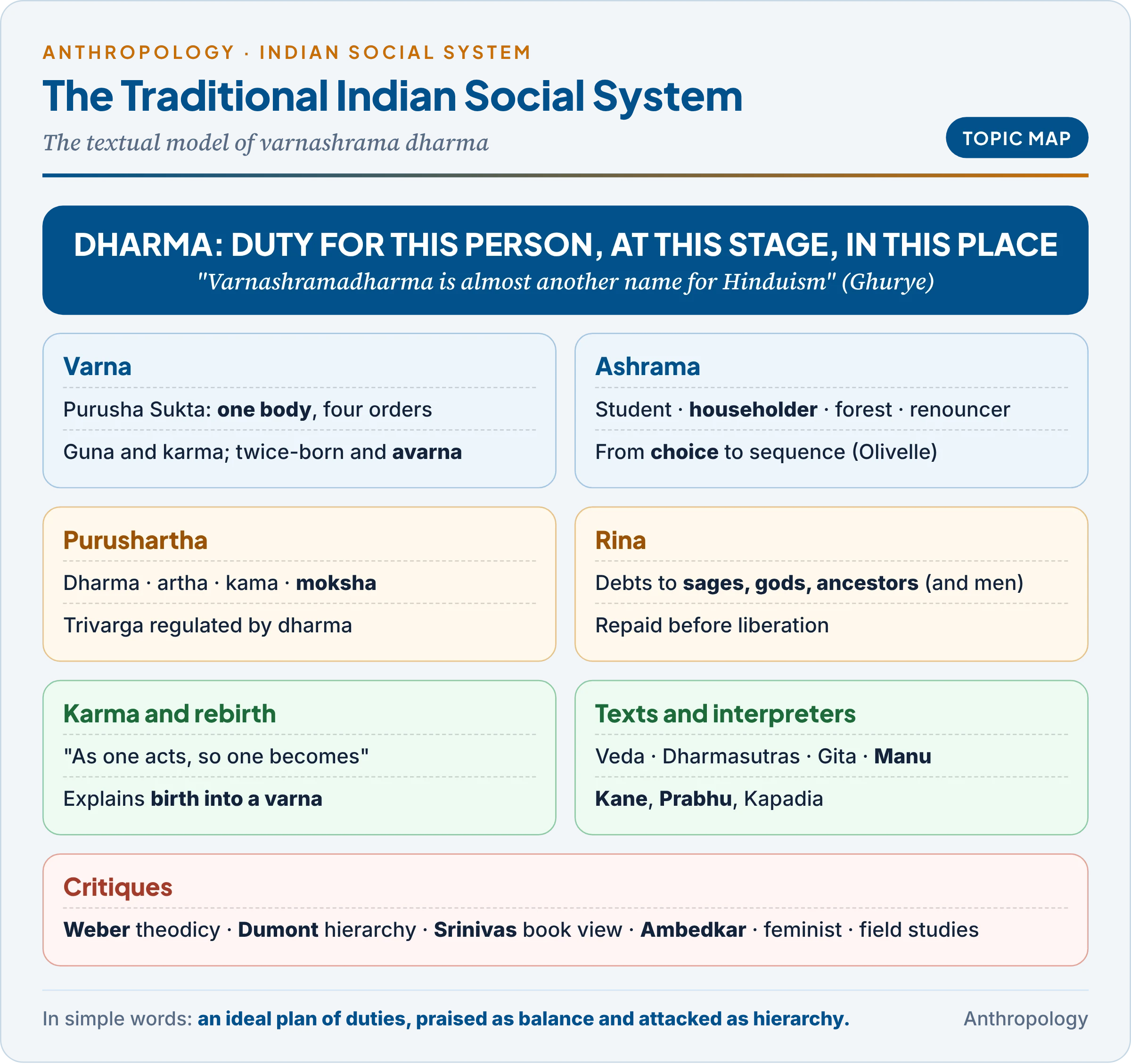
This article covers the classical Hindu model of society, the scheme set out in Sanskrit texts. How caste (jati) actually works, the difference between varna and caste in practice, and the theories of the origin of caste are in 3.2a. The impact of Buddhism, Jainism, Islam and Christianity is in 3.4; Buddhism appears here only for its challenge to varna.
1. The Textual Model: Dharma, Sources and Approach
In simple words
Ancient Sanskrit texts describe an ideal Hindu society. In it, everyone has a place in one of four orders (varna), passes through four stages of life (ashrama), pursues four aims (purushartha), carries three debts (rina), and is reborn according to his deeds (karma). The thread that holds it together is dharma, the right duty for each person in each situation.
1.1 A model, not a description
- The Indian sociologist G.S. Ghurye observed that “varnashramadharma, duties of castes and ashramas, is almost another name for Hinduism” (1964). It is the normative model (a picture of how society ought to be) produced by Brahmin authors.
- The anthropologist M.N. Srinivas distinguished the “book view” of Indian society, drawn from these texts, from the “field view” found in villages. The book view tells us about values and legitimations; it does not tell us how people actually lived.
- Why study it? Ideas shape practice. The model has justified hierarchy, guided rituals (initiation, marriage, funeral rites), shaped law until the twentieth century, and still frames debate about caste, gender and duty.
1.2 The texts
The scheme was built up over about a thousand years; the table gives the main texts in rough order.
| Text | Approximate period | What it adds |
|---|---|---|
| Rig Veda, Purusha Sukta (10.90) | Late Rigvedic | Four orders born from the cosmic person |
| Brahmanas (Taittiriya Samhita, Shatapatha Brahmana) | Later Vedic | The debts (rina); four varnas named |
| Upanishads (Brihadaranyaka, Chandogya, Jabala) | From about the 7th century BCE | Karma and rebirth; moksha; early ashrama ideas |
| Dharmasutras (Apastamba, Gautama, Baudhayana, Vasishtha) | Last centuries BCE | First rules on varna and ashrama |
| Bhagavad Gita | Around the turn of the Common Era | Varna by guna and karma; selfless action |
| Manusmriti | About the 2nd century CE | The classical synthesis of varna, ashrama, rina |
| Arthashastra, Kamasutra, Mahabharata | Early centuries BCE–CE | Artha and kama as legitimate aims; debates on dharma |
Two modern Indian scholars systematised this material for social science. P.V. Kane, a Sanskritist and lawyer, compiled the five-volume History of Dharmasastra (1930–62). P.H. Prabhu, a psychologist, wrote Hindu Social Organization (1954; first published as Hindu Social Institutions, 1940), which read the scheme as a psychology of personality: man’s conduct is shaped by desa (place), kala (time), srama (effort or training) and guna (inborn traits). The ashrama scheme deals with nurture (srama) and the varna scheme with nature (guna).
1.3 Dharma, the binding idea
- Meaning: dharma comes from the root dhri, “to hold, support, sustain”. The Mahabharata explains that it is called dharma because it upholds creatures. It means duty, law, right conduct and the order of the world at once.
- Kinds of dharma:
- Sadharana dharma, duties common to all: the Mahabharata (Shanti Parva) lists nine, including truthfulness, forgiveness, freedom from anger, purity, justice and maintaining dependants.
- Varnashrama dharma or svadharma: duties by varna and ashrama. The Gita (3.35) says one’s own dharma, though imperfect, is better than another’s well performed.
- Apad dharma, rules for distress: when a man cannot live by his own calling he may take up another’s (Manu 10.116 lists ten means of livelihood open to all in distress).
- Kula, jati and desa dharma: the custom of family, caste and region, which the texts accept as valid.
- Contextual ethics: dharma is not one rule for all but the right act for this person, at this stage, in this place. This is why the poet and folklorist A.K. Ramanujan (“Is There an Indian Way of Thinking?”, 1989) called Indian rules context-sensitive rather than universal.
Common confusion
Is dharma the same as religion? No. Religion, as the French sociologist Émile Durkheim defined it, is a system of beliefs and practices about sacred things that unites a community of believers. Dharma is wider and more practical: it covers duty, law, morality, custom and the cosmic order, including matters such as trade, punishment and family property that are not “religious” at all. A Hindu could hold different beliefs about God and still be judged by his conduct according to dharma. Hence the term sanatana dharma is closer to “an eternal order of duties” than to “a creed”.
2. Varna: The Fourfold Order
In simple words
Varna divides society into four orders: priests and teachers, rulers and warriors, traders and farmers, and servants. The texts say each order has its own duties and that together they form one body. Critics reply that this “division of work” was really a hierarchy by birth that kept some people low and others high.
2.1 Origin in the texts
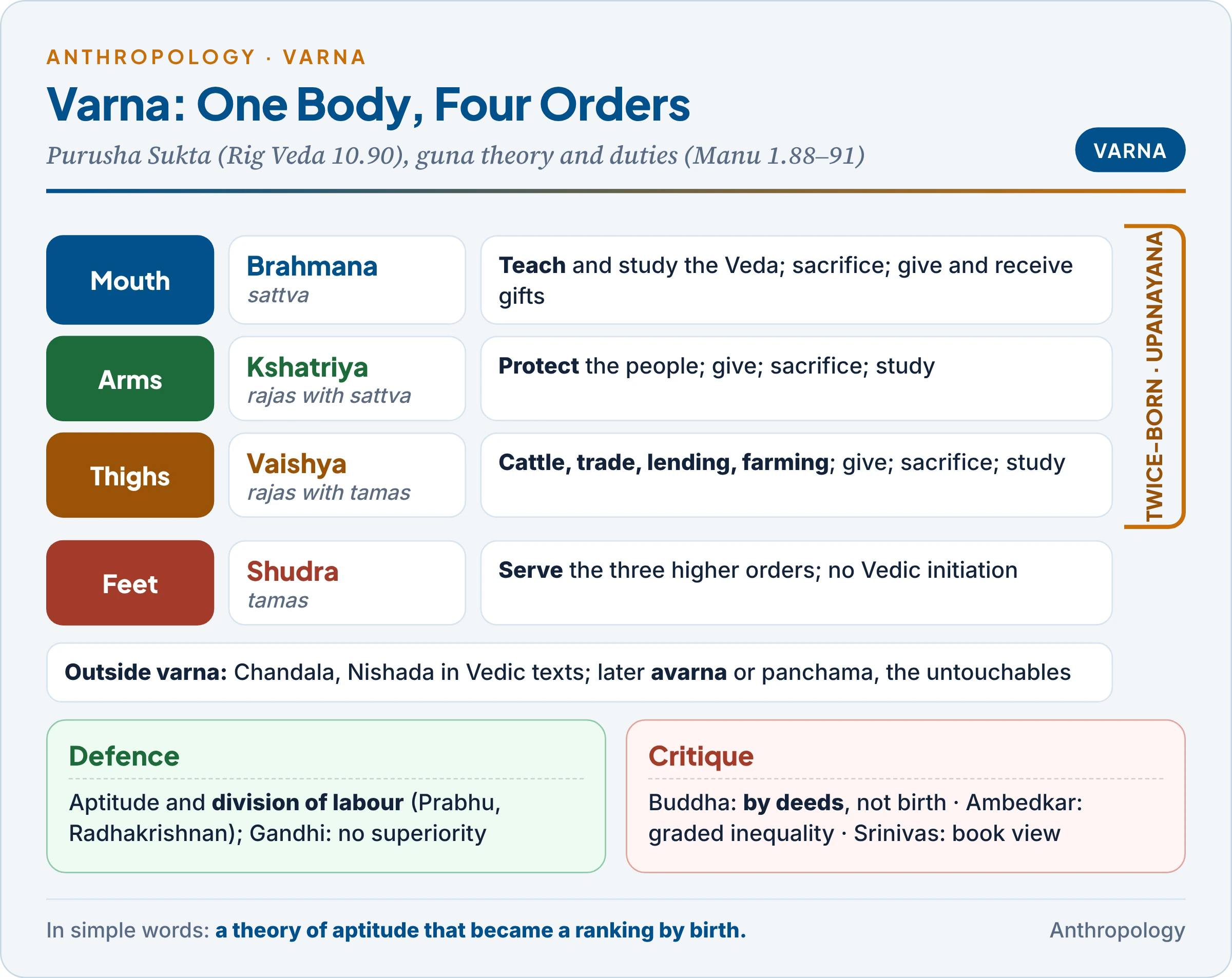
Example first. The Purusha Sukta (Rig Veda 10.90) describes the gods sacrificing a cosmic person, Purusha: “His mouth became the Brahmana; his arms were made the Rajanya (Kshatriya); his thighs the Vaishya; from his feet the Shudra was born.” The image makes society one body whose parts differ in purity and function, with the mouth (speech, sacrifice) at the top and the feet (service) at the bottom.
- Meaning of the word: varna means colour, and also class or kind. Ghurye (Caste and Race in India, 1932) noted that the early Rig Veda uses varna for the contrast between the Arya and the Dasa, not for the four classes; it names three orders (brahman, kshatra, vish). The Purusha Sukta is a late hymn, and the four orders are first regularly called varnas in the Brahmanas.
- Textual theories of origin:
- Divine origin: from the body of the creator (Purusha Sukta; Manu 1.31).
- Guna and karma: in the Gita (4.13) Krishna says “the fourfold order was created by me according to the division of guna (quality) and karma (work)”.
- Fall from one class: in the Mahabharata the sage Bhrigu tells Bharadvaja that all men were at first Brahmins and became divided by their acts, each order acquiring its colour (white, red, yellow, black).
- Indo-Iranian parallel: the Avesta of ancient Iran also names four classes (priests, chariot-warriors, herder-farmers, artisans), which suggests a shared older tripartite scheme; the French scholar Georges Dumézil saw priestly, warrior and productive “functions” across Indo-European myth.
2.2 Guna and varna
The guna theory links varna to three qualities of nature: sattva (purity, light), rajas (energy, passion) and tamas (inertia, darkness). The table shows the conventional mapping.
| Varna | Dominant guna | Duties in the texts (Manu 1.88–91; Gita 18.41–44) |
|---|---|---|
| Brahmana | Sattva | Studying and teaching the Veda, sacrificing and officiating, giving and receiving gifts |
| Kshatriya | Rajas with sattva | Protecting the people, giving, sacrificing, studying |
| Vaishya | Rajas with tamas | Cattle, trade, lending, agriculture, giving, sacrificing, studying |
| Shudra | Tamas | Serving the three higher varnas “without resentment” |
The table shows why defenders call varna a theory of aptitude while critics call it a theory of rank: duties are matched to qualities, but the qualities themselves are ranked, and the lowest order is defined only by service.
- Twice-born (dvija): the first three varnas undergo upanayana, the initiation that gives a “second birth” into Vedic learning; Shudras do not. A well-known later verse says “by birth everyone is a Shudra; by sacraments one becomes twice-born”.
- Graded rules: Manu fines a Shudra eight times the value of a theft, a Vaishya sixteen, a Kshatriya thirty-two and a Brahmin sixty-four, or even a hundred or 128 (Manu 8.337–338): greater knowledge, greater guilt. Yet the same text exempts Brahmins from capital punishment and prescribes harsh penalties for a Shudra who insults a twice-born. The code is both graded responsibility and graded privilege.
- Outside varna: groups such as the Chandala and Nishada appear in Vedic texts outside the four orders; later writers called the untouchables avarna (without varna) or panchama (the fifth).
2.3 The functional defence
- Division of labour: Prabhu and the philosopher S. Radhakrishnan (The Hindu View of Life, 1927) read varna as a functional order matching aptitude to work and giving each group a recognised place.
- Separation of powers: some interpreters argue that varna divided knowledge (Brahmana), force (Kshatriya), wealth (Vaishya) and labour (Shudra), so no one group held all forms of power.
- Gandhi defended varna in his 1936 reply to Ambedkar as a law of hereditary occupation without superiority: every calling, the scavenger’s included, of equal worth.
- Flexibility in early periods: the Vedic orders were not yet closed; inter-varna marriages and changes of calling are recorded, and apad dharma allowed a change of livelihood in distress.
2.4 Critiques of varna
- Ambedkar. The jurist and Dalit leader B.R. Ambedkar publicly burned the Manusmriti at Mahad on 25 December 1927. In Annihilation of Caste (1936) he argued that chaturvarnya (the fourfold order) could never be a neutral division of labour: it fixed occupation by birth, denied education and arms to the lower orders, and was enforced by religious sanction, so it could only be abolished, not reformed. In Who Were the Shudras? (1946) he argued that the Shudras were originally a Kshatriya community degraded by Brahmins.
- Buddhism and varna. The Buddha rejected birth as the measure of worth: “not by birth is one an outcast, not by birth is one a Brahmin; by deeds one becomes an outcast, by deeds one becomes a Brahmin” (Vasala Sutta). The Assalayana Sutta mocks the claim that Brahmins are born from Brahma’s mouth (they are born of women like everyone else), and the Agganna Sutta explains social classes as human arrangements, with the ruler chosen by agreement. Buddhist texts list the Kshatriya before the Brahmin, and the monastic order admitted all; Upali, a barber, became a leading monk. In 1956 Ambedkar led a mass conversion to Buddhism as an exit from varna.
- Srinivas argued in “Varna and Caste” (1962) that the varna model has distorted the understanding of caste: the real units are thousands of local jatis, whose middle ranks are fluid and contested, while varna offers only an all-India frame into which they are fitted (details in 3.2a).
- Dumont. The French anthropologist Louis Dumont (Homo Hierarchicus, 1966) read the varna scheme as showing the separation of status from power: the Brahmin ranks above the king in purity though the king holds force. For Dumont this proves that hierarchy, not equality, is the organising value of Indian society; critics reply that he took the Brahmin’s view as the whole society’s.
3. Ashrama: The Stages of Life
In simple words
The ashrama scheme divides the life of a twice-born man into four stages: student, householder, forest-dweller and wandering renouncer. Each stage has its own duties and prepares him for the next, ending in liberation. Historians have shown that the stages began as four alternative ways of life and were only later arranged in a sequence.
Example first. Manu (6.2) tells the householder when to move on: “When a householder sees his skin wrinkled and his hair white, and the sons of his sons, then he may resort to the forest.” The rule ties the stages of life to the life cycle of the family: a man leaves the household only when the next two generations are in place to run it.
3.1 Meaning
- Ashrama comes from srama, “exertion”. An ashrama is both a place of effort and a halting place on the journey to liberation; the Mahabharata calls the four stages the rungs of a ladder.
- Purpose (Prabhu): a school of life that trains the individual for his social duties stage by stage. In the first stage the group looks after the individual; in the second the individual is the trustee of family and society; in the last he is free of social ties.
3.2 The four stages
The table sets out each stage with its entry rite and the duty that defines it.
| Ashrama | Entry | Defining duties |
|---|---|---|
| Brahmacharya (celibate student) | Upanayana (Brahmana in the 8th year, Kshatriya 11th, Vaishya 12th; latest 16, 22, 24: Manu 2.36–38) | Live with the guru, study the Veda, beg alms for the teacher, celibacy, simple food and dress; ends with the ritual bath (samavartana) |
| Grihastha (householder) | Vivaha (marriage) | Earn and spend by dharma, beget sons, perform the five great sacrifices, feed guests and dependants |
| Vanaprastha (forest-dweller) | Grey hair and grandsons (Manu 6.2); wife may go along (6.3) | Austerity, forest food, study, continued sacrifices; gradual detachment |
| Sannyasa (renouncer) | Renounce home, property and the sacred fires; perform one’s own funeral rites | Wander alone, beg once a day, no possessions, equanimity, meditation on the self |
- Five great sacrifices (pancha mahayajna, Manu 3.70) of the householder: to the sages (teaching and study of the Veda), to the ancestors (offerings of water and food, shraddha), to the gods (fire offerings), to all beings (bali, food for animals and spirits) and to men (hospitality to guests). They atone for the harm a household causes daily at its “five slaughter-houses”: hearth, grinding stone, broom, mortar and pestle, and water-pot (Manu 3.68–69).
- Supremacy of the householder: “As all creatures live by depending on air, so the other orders subsist by depending on the householder” (Manu 3.77), and as rivers rest in the ocean, so all orders rest in the householder (6.90). Only the householder pursues dharma, artha and kama together and supports the other three stages.
3.3 From choice to sequence
The common picture of four 25-year stages is a late simplification; the texts tell a more complex story.
- Early texts: the Chandogya Upanishad (2.23.1) speaks of three “branches of dharma”: the householder’s sacrifice, study and giving; austerity; and the student living for life in the teacher’s house. These were parallel ways of life, not stages.
- Original system: the Sanskritist Patrick Olivelle (The Asrama System, 1993) showed that in the early Dharmasutras the ashramas were four alternative, lifelong vocations, one of which a young man could choose after his studies.
- Opposition: Gautama and Baudhayana rejected the choice and held that there is really one ashrama, the householder’s, because only it is commanded by the Veda.
- Classical system: in Manu the ashramas become obligatory stages passed through in order, with the ascetic modes moved to old age. The Jabala Upanishad gives the sequence but still allows a man to renounce “on the very day he becomes detached”, from any stage.
- Why it matters: the sequence was a compromise between two rival ideals, the married householder of Vedic ritual and the celibate renouncer of the new ascetic movements, including Buddhism and Jainism. By placing renunciation at the end of life, Brahmanism absorbed the ascetic challenge without threatening family and lineage.
3.4 Interpretations and critique
- Dumont’s renouncer. In “World Renunciation in Indian Religions” (1960) Dumont argued that Indian society holds two kinds of person: the man-in-the-world, defined by caste and relationships, and the individual-outside-the-world, the renouncer, who alone is a true individual. Much of Indian religious creativity (sects, bhakti, Buddhism) came from renouncers; the ashrama scheme brought the renouncer back inside the social order.
- For twice-born men only. Shudras had no upanayana and so no student stage, and women were outside the scheme: Manu (2.67) declares that for a woman marriage takes the place of initiation, serving her husband the place of living with a teacher, and housework the place of the sacred fire.
- Ideal more than practice: few men ever became forest-dwellers; renunciation became the path of a minority of ascetics organised in orders.
- Contemporary relevance: the scheme survives as a life-course ideal: education before marriage, active householding, a stepping back in old age and the hope of spiritual concerns at the end. It is invoked in debates on ageing and retirement, where the vanaprastha ideal of withdrawal now meets weaker family support and laws such as the Maintenance and Welfare of Parents and Senior Citizens Act (2007).
4. Purushartha: The Aims of Life
In simple words
The purusharthas are the four legitimate aims of human life: right conduct, wealth, pleasure and liberation. The idea is that a good life uses all of them in balance, with right conduct guiding wealth and pleasure, and liberation as the final goal.
Example first. Ancient authors disagreed about which aim comes first. Kautilya wrote that “artha alone is primary, for dharma and kama depend on it” (Arthashastra 1.7). Vatsyayana‘s Kamasutra (1.2) gave a place to each aim in a different period of life: artha (learning) in youth, kama in the prime of life, dharma and moksha in old age, though one may pursue them “as opportunity offers, since life is uncertain”. Manu (2.224) settled the dispute: some say the good is dharma and artha, some kama and artha, some dharma alone, some artha alone, “but the correct view is that it is the aggregate of the three“.
4.1 The four aims
| Aim | Meaning | Text | Place in the scheme |
|---|---|---|---|
| Dharma | Duty, right conduct, moral law | Dharmasutras, Manusmriti | The regulator of the other aims |
| Artha | Wealth, power, livelihood, statecraft | Arthashastra | Legitimate means of life and of dharma |
| Kama | Desire and pleasure: sexual, emotional, aesthetic | Kamasutra | Legitimate when governed by dharma |
| Moksha | Liberation from rebirth; union of self (atman) and the absolute (brahman) | Upanishads, Gita | The ultimate aim, beyond the other three |
- Trivarga to chaturvarga: the older texts speak of the three aims (trivarga: dharma, artha, kama). Moksha was added later, after the Upanishads made liberation the highest good, giving the four (chaturvarga).
- Prabhu called dharma, artha and kama the moral, material and mental (emotional) resources of man. K.M. Kapadia, a sociologist of the Hindu family (Marriage and Family in India, 1955), argued that by accepting artha and kama the sages recognised that spirituality unfolds only when life is not economically starved or emotionally stunted.
- Kama is not only sex: it covers emotional and aesthetic life (music, art, love). Unchecked desire, however, is the first of the six inner enemies (arishadvarga: desire, anger, greed, delusion, pride, envy).
4.2 The interface with ashrama
Each stage of life is the training ground for particular aims, and each discharges particular debts (§6). This interface is what makes varnashrama a system rather than a list.
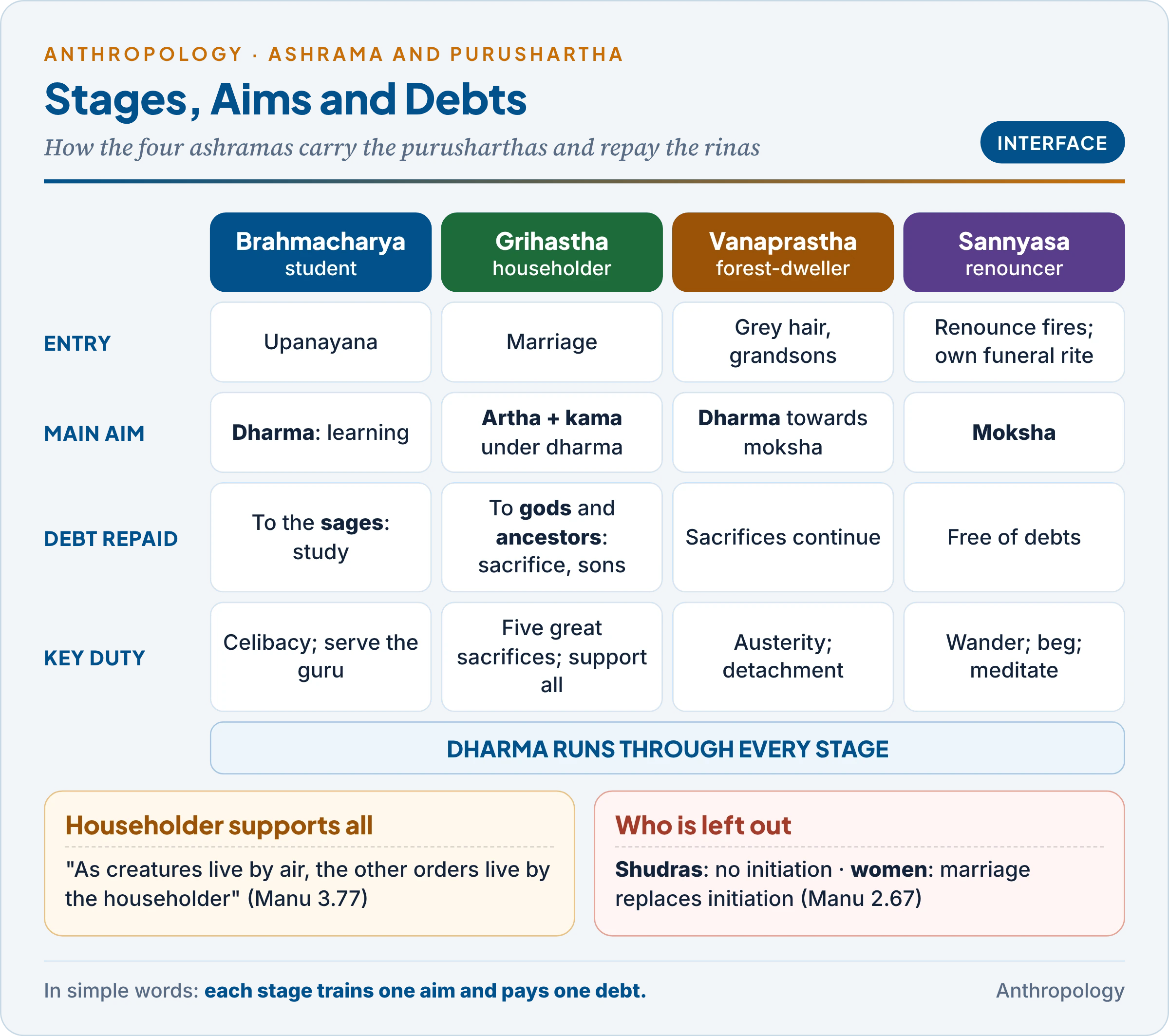
- Brahmacharya: learning dharma; repays the debt to the sages.
- Grihastha: artha and kama pursued under dharma; repays the debts to the ancestors (sons) and the gods (sacrifice).
- Vanaprastha: dharma turning towards moksha.
- Sannyasa: moksha alone.
4.3 The philosophy behind the purusharthas
- Integration: the scheme rejects both unrestrained worldliness and world-rejection. Unlike early Buddhist and Jain monasticism, it treats wealth and pleasure as legitimate, but only within dharma and only as stages towards liberation.
- Hierarchy of values: moksha above dharma, dharma above artha, artha above kama. The order expresses a theory of personality in which the material and emotional self is disciplined, not denied.
- A householder’s ethic: the aims are most fully balanced in the grihastha stage, which explains why the householder is the hero of the texts.
- Criticism: the aims were framed for the twice-born male (purusha); women’s “aims” were reduced to stridharma, duty as wife and mother, and the Shudra’s to service. Liberation through knowledge and renunciation was open in practice to few; the bhakti movements later offered it to all through devotion.
- Purushartha and righteous living today: the scheme still offers a vocabulary for ethical economic life (wealth earned and used within dharma), balance between work, family and personal life, the legitimacy of pleasure and art, and a place for inner goals amid consumerism. Its modern use is selective: the hierarchy of varna that once framed it is now rejected by the Constitution.
5. Karma and Rebirth
In simple words
Karma means that every action has consequences for the person who acts, in this life or in later lives. Rebirth means that the self is born again and again, carrying these consequences, until it is freed. Together they explain why people are born unequal and urge them to act well, but critics say they also taught low castes to accept their position.
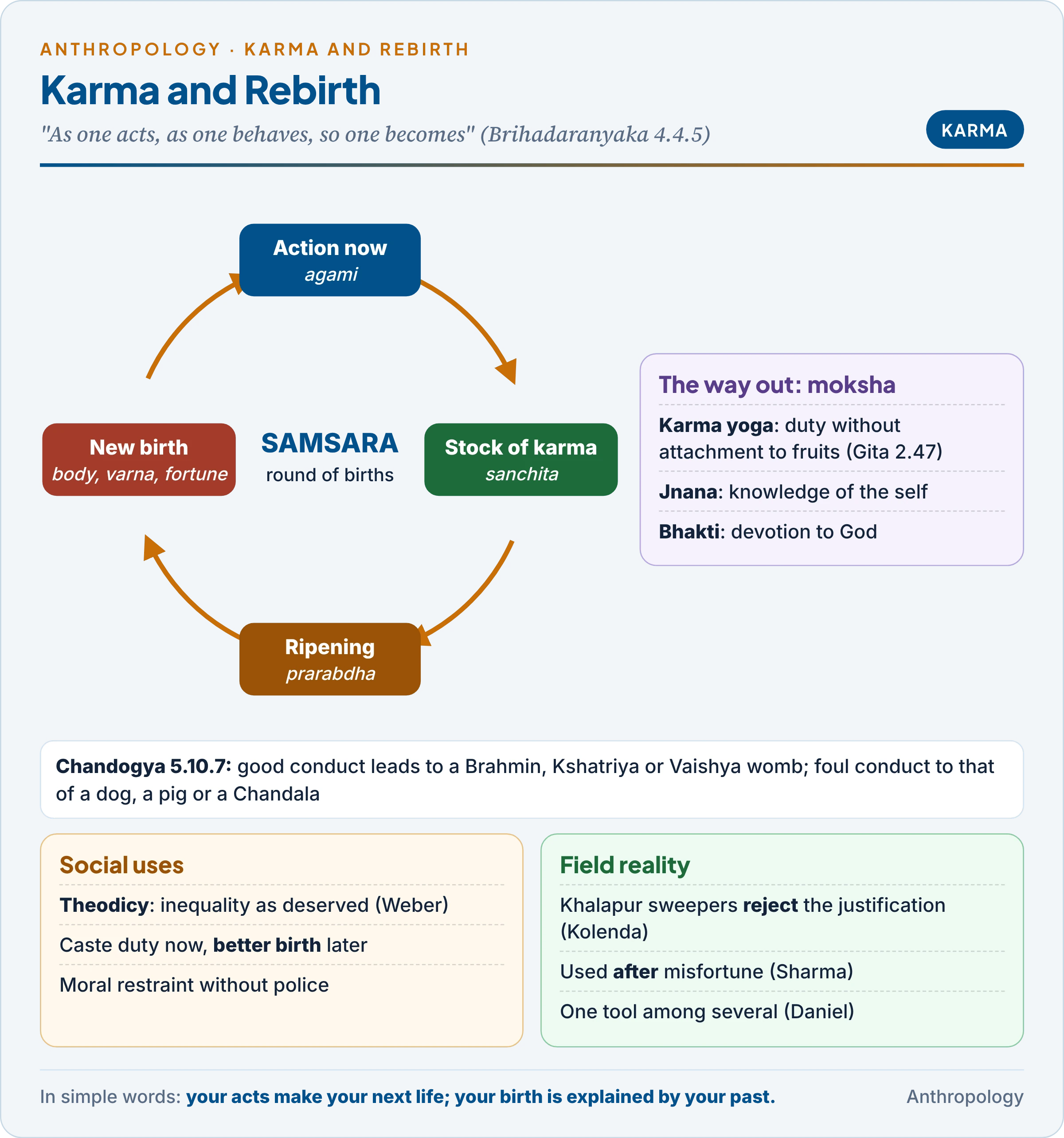
Example first. The Chandogya Upanishad (5.10.7) states the doctrine in social terms from the start: “Those whose conduct here has been pleasant will quickly enter a pleasant womb, the womb of a Brahmin, a Kshatriya or a Vaishya; but those whose conduct has been foul will enter a foul womb, the womb of a dog, a pig or a Chandala.” From its first statement, the theory of rebirth explained birth into a varna as the result of past conduct.
5.1 The doctrine
- Karma (from kri, “to do”) means action and its fruit (karmaphala). “As one acts, as one behaves, so one becomes” (Brihadaranyaka Upanishad 4.4.5). Good acts produce merit (punya), bad acts demerit (papa), which ripen as happiness or suffering.
- Rebirth (punarjanma): the self (atman) is not destroyed at death but takes a new body; the round of births is samsara, and release from it is moksha.
- Origin: the doctrine appears first in the early Upanishads. In both the Brihadaranyaka (6.2) and the Chandogya (5.3–10) the teaching of rebirth is given to a Brahmin by a Kshatriya king, Pravahana Jaivali, which suggests it arose outside the older sacrificial priesthood.
- Shared and contested: Buddhism and Jainism accepted karma and rebirth but rejected the Vedic sacrifice and the authority of Brahmins; Buddhism also denied a permanent self.
- Three stores of karma (Vedanta): sanchita (the whole accumulated stock), prarabdha (the part already ripening, which has shaped this birth) and agami or kriyamana (karma being made now, which shapes the future).
- Three paths to release (Gita): the path of action (karma yoga), of knowledge (jnana) and of devotion (bhakti). The Gita’s nishkama karma, action without attachment to its fruit (“your right is to action alone, never to its fruits”, 2.47), makes duty itself the path, so that acting in one’s station need not bind.
5.2 Social functions
- Theodicy (an explanation of why suffering exists in a just world). The German sociologist Max Weber (The Religion of India, 1916–17) called karma “the most consistent theodicy ever produced by history“: inequality at birth is deserved, so no one is to blame but the sufferer’s own past.
- Use of karma to justify varna. Combined with svadharma, karma tells the low-born that faithful performance of their caste duty brings a better birth next time, and warns the high-born that neglect will bring a lower one. Weber saw this as the reason why the lowest castes had the strongest interest in caste duty, and why caste was so stable.
- Social control and morality: fear of future consequences and hope of reward support honesty, charity and restraint without police.
- Motivation: defenders reply that karma makes each person “the maker of his own destiny“, since present action shapes the future.
5.3 What villagers actually believe
Anthropologists tested Weber’s claim in the field, and the results qualify it.
- Pauline Kolenda (“Religious Anxiety and Hindu Fate”, 1964) worked among the sweepers (Chuhras) of Khalapur, Uttar Pradesh, and found that they did not accept that their low birth was a just reward for past sins; they spoke more of fate and of spirits. The doctrine appealed more to those it placed high.
- Ursula Sharma (“Theodicy and the Doctrine of Karma”, 1973), in a village of Himachal Pradesh, found karma used retrospectively, to explain misfortune only after other causes (gods, witchcraft, planets) failed, not as a guide for action.
- Charles Keyes and E. Valentine Daniel (eds., Karma: An Anthropological Inquiry, 1983) showed that karma is one explanation among several: Sheryl Daniel found Tamil villagers using a “tool box” of karma, fate written on the forehead (talai-yezhuttu), divine will and others as the situation required.
- Conclusion: karma is a powerful ideology, but people use it selectively; acceptance of the caste order was never as complete as the textual model implies.
Common confusion
Is karma the same as fate? No. Fate (bhagya, niyati) is a fixed destiny imposed from outside, often by a god or “written on the forehead”. Karma is self-made: the present is the result of one’s own past acts, and present acts change the future. Popular belief often blends the two, which is why outsiders called Hindus “fatalistic”, but the doctrine itself is a theory of moral causation, not of predestination.
6. Rina: The Debts of Life
In simple words
Rina means debt. The texts say every person is born owing debts to the sages who gave knowledge, to the gods who sustain the world and to the ancestors who gave life. A good life repays them through study, worship and having children, and only then can one seek liberation.
Example first. The Taittiriya Samhita (6.3.10.5) states: “A Brahmin is born with three debts: of studentship to the sages, of sacrifice to the gods, of offspring to the ancestors.” The Shatapatha Brahmana (1.7.2.1–5) adds a fourth, the debt to men, repaid by hospitality.
The table links each debt to its creditor, the way it is repaid and the stage of life in which this happens.
| Debt | Owed to | Repaid by | Stage |
|---|---|---|---|
| Rishi rina | Sages and teachers | Study of the Veda; passing knowledge on | Brahmacharya |
| Deva rina | Gods | Sacrifice and worship | Grihastha |
| Pitri rina | Ancestors and parents | Begetting sons; ancestral offerings (shraddha) | Grihastha |
| Manushya rina | Fellow humans | Hospitality and charity | Grihastha |
- Debt before liberation: “When he has paid the three debts, let him set his mind on liberation; he who seeks it without paying them sinks downwards” (Manu 6.35). The debts tie the individual’s spiritual goal to his social obligations.
- A duty-based view of the person: the individual is born a debtor, not a bearer of rights. Life is a series of obligations to the past (ancestors), the present (guests, the gods who sustain the world) and the future (children, knowledge passed on).
- Five sacrifices as repayment: the householder’s daily pancha mahayajna (§3.2) is the routine discharge of these debts, extended to all beings. Some modern writers read the scheme as an ecological ethic of reciprocity with nature; that is a modern interpretation, not the texts’ own aim.
- Critique: the debt to the ancestors is paid by sons, who alone could offer the shraddha rites; this religious rule is one root of son preference (Unit 2b). Like the ashramas, the debts were framed for twice-born men.
7. The System as a Whole: Integration, Critique and Change
In simple words
The parts fit together: varna fixes a person’s place in society, ashrama sets the stages of his life, purushartha gives the aims, rina the obligations, and karma and rebirth explain and justify it all across many lives. Scholars have praised this as a balanced plan for life and attacked it as a religious defence of inequality. Modern law has removed its legal force, but parts of it live on in ritual and ideals.
7.1 How the parts fit
- Varna places the group; ashrama guides the individual through time; purushartha gives the goals; rina gives the obligations; karma and rebirth connect lives and justify the whole; dharma binds them.
- Unifying features of traditional Hindu society that follow from the model:
- Hierarchy as a value (Dumont), with ranked orders and ranked aims.
- Duty before right: persons are defined by obligations.
- Holism: the individual exists within family, caste and cosmos; only the renouncer stands outside.
- Fusion of sacred and secular: law, economy and family are all matters of dharma.
- Family and lineage at the centre, through the householder, sons and ancestral rites.
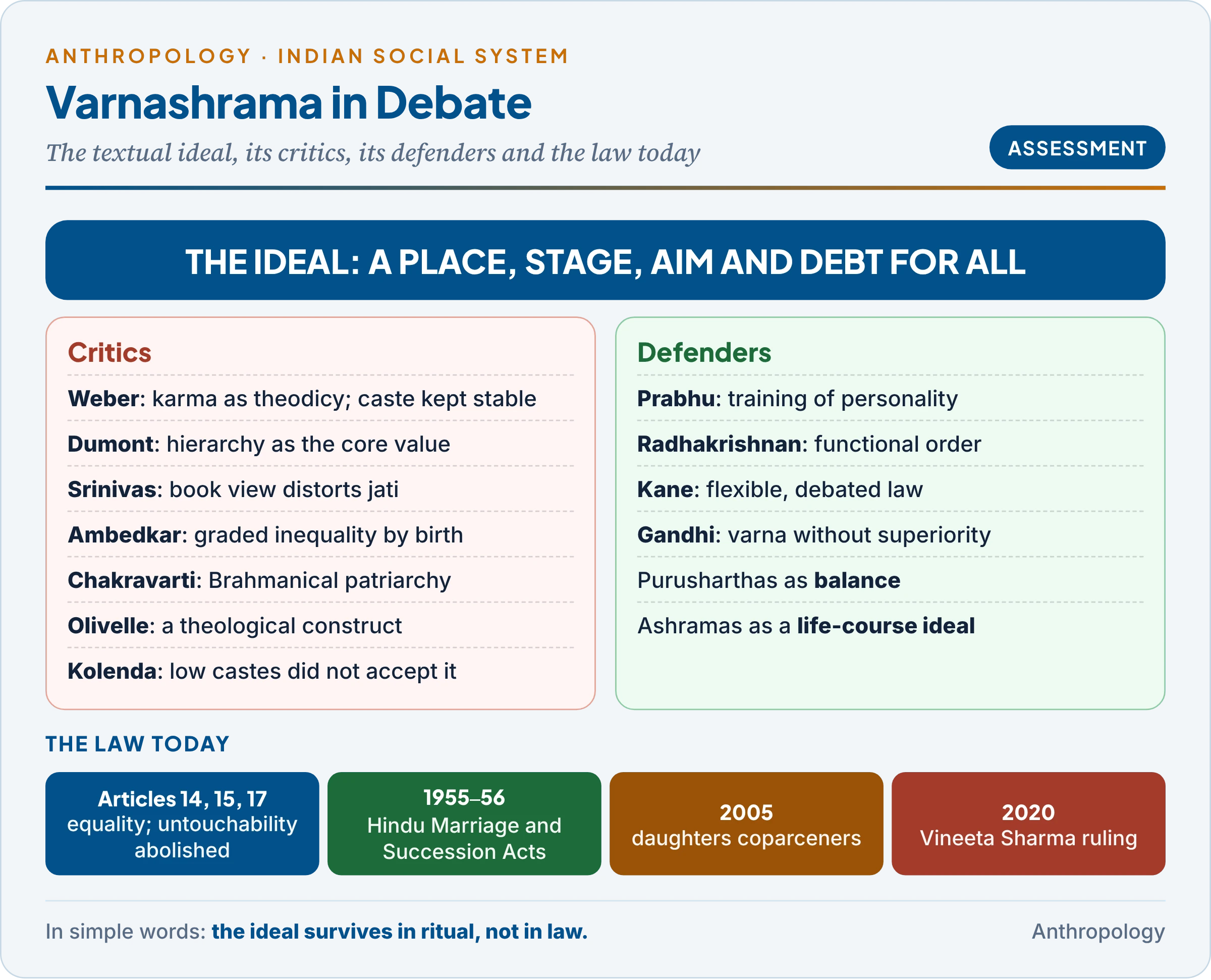
7.2 Assessment
The two views below are each strongest on different ground; read them side by side.
Criticism
- Ambedkar: a religious charter of graded inequality, denying learning, property and arms to the lower orders and women.
- Weber: karma made the caste order the most consistent theodicy and blocked change.
- Feminist scholars: Uma Chakravarti (“Conceptualising Brahmanical Patriarchy in Early India”, 1993) showed how control of women’s sexuality and marriage was built into maintaining caste purity; Manu (9.3) holds that a woman is guarded by father, husband and sons and is “never fit for independence”.
- Srinivas: a book view that distorts the fluid world of jatis.
- Olivelle: much of the scheme is a theological construct, never practised as described.
- Ethnography: low castes did not simply accept the karma justification (Kolenda).
Defence
- Prabhu, Radhakrishnan: an integrated plan for personality and society, balancing material and spiritual needs.
- Kane: a historical legal tradition with internal debate, flexibility (apad dharma) and regional custom.
- Gandhi: varna as division of labour without superiority.
- Purusharthas: legitimate worldly aims under ethical control; a model of balance.
- Ashramas: a life-course ideal with value for education, family duty and ageing.
7.3 Change today
- Constitution: equality before law (Article 14), no discrimination by caste or sex (Article 15), abolition of untouchability (Article 17). Varna has no legal standing.
- Hindu Code: the Hindu Marriage Act (1955) allowed divorce and inter-caste marriage, turning a sacrament partly into a contract; the Hindu Succession Act (1956), amended in 2005, made daughters coparceners (joint heirs to family property by birth), confirmed by the Supreme Court in Vineeta Sharma v. Rakesh Sharma (2020). These changes cut into the son-centred logic of pitri rina.
- Persistence: samskaras (initiation, marriage, funeral and shraddha) remain widely practised; renouncer orders flourish; karma remains a common explanation of fortune; ashrama ideals shape talk of retirement.
- Contested legacy: the Manusmriti remains politically charged. In July 2024 Delhi University rejected a proposal to add readings on it to its law syllabus after objections that it is hostile to women and marginalised groups.
Key Terms
| Term | Meaning in simple words |
|---|---|
| Varnashrama dharma | Duties according to one’s varna and stage of life |
| Dharma | Duty, right conduct, law and the order that upholds the world |
| Svadharma | One’s own duty, set by varna and ashrama |
| Apad dharma | Rules allowing other livelihoods in times of distress |
| Varna | One of the four orders: Brahmana, Kshatriya, Vaishya, Shudra |
| Dvija | “Twice-born”: the first three varnas, initiated by upanayana |
| Guna | Inborn quality: sattva (purity), rajas (energy), tamas (inertia) |
| Avarna | Groups outside the four varnas; later the untouchables |
| Ashrama | A stage of life: student, householder, forest-dweller, renouncer |
| Upanayana | Initiation into Vedic study; the “second birth” |
| Pancha mahayajna | The householder’s five daily sacrifices to sages, ancestors, gods, beings and men |
| Purushartha | One of the four aims of life: dharma, artha, kama, moksha |
| Trivarga | The three worldly aims: dharma, artha, kama |
| Moksha | Liberation from the cycle of rebirth |
| Karma | Action and its moral consequences for the actor |
| Samsara | The cycle of birth, death and rebirth |
| Prarabdha karma | Past karma already ripening, which shaped the present life |
| Nishkama karma | Action performed without attachment to its results |
| Rina | A debt owed from birth to sages, gods and ancestors (and men) |
| Theodicy | An explanation of why suffering exists in a just world |
Contemporary Developments
- Manusmriti and the university (July 2024): Delhi University rejected a proposal to include readings on the Manusmriti in its LLB jurisprudence course after teachers objected that the text is regressive towards women and marginalised communities.
- Daughters as coparceners: Vineeta Sharma v. Rakesh Sharma (Supreme Court, 11 August 2020) held that daughters are coparceners by birth under the 2005 amendment, regardless of when the father died, weakening the son-only logic of inheritance and ancestral rites.
- Census 2027 will enumerate castes for the first time since 1931, renewing debate on how far the varna frame still shapes how Indians classify themselves (3.2a).
- Scholarship: Patrick Olivelle’s critical edition and translation, Manu’s Code of Law (2005), established a more reliable text and a date around the second century CE, correcting older readings based on interpolated manuscripts.
Diagrams to Master
- Topic map: dharma at the centre linking varna, ashrama, purushartha, rina and karma–rebirth; texts on one side, interpreters and critics on the other.
- Varna model: the Purusha Sukta body (mouth, arms, thighs, feet), the guna mapping, twice-born line, avarna outside; one line each for the Buddhist and Ambedkarite critiques.
- Ashrama–purushartha–rina matrix: four stages across; the aim and the debt under each; dharma running through all.
- Karma–rebirth cycle: sanchita, prarabdha, agami; samsara; the three paths to moksha; theodicy and social control.
- Assessment chart: textual ideal against critiques and defences, with the constitutional changes.
Revision Grid
| Scholar | Work (year) | Key idea |
|---|---|---|
| Max Weber | The Religion of India (1916–17) | Karma as the most consistent theodicy; stability of caste |
| S. Radhakrishnan | The Hindu View of Life (1927) | Varna as functional order; balance of aims |
| G.S. Ghurye | Caste and Race in India (1932) | Varna first meant Arya versus Dasa; varnashramadharma as Hinduism |
| P.V. Kane | History of Dharmasastra (1930–62) | The textual history of varna, ashrama, samskara and law |
| B.R. Ambedkar | Annihilation of Caste (1936); Who Were the Shudras? (1946) | Chaturvarnya as religiously sanctioned graded inequality |
| P.H. Prabhu | Hindu Social Organization (1954) | Desa, kala, srama, guna; ashrama as nurture, varna as nature |
| K.M. Kapadia | Marriage and Family in India (1955) | Artha and kama as conditions of spiritual growth |
| Louis Dumont | “World Renunciation in Indian Religions” (1960); Homo Hierarchicus (1966) | Renouncer as the individual; status above power |
| M.N. Srinivas | “Varna and Caste” (1962) | Book view versus field view; varna distorts caste |
| Pauline Kolenda | “Religious Anxiety and Hindu Fate” (1964) | Khalapur sweepers did not accept karma’s justification |
| Ursula Sharma | “Theodicy and the Doctrine of Karma” (1973) | Karma used retrospectively, among other explanations |
| Charles Keyes and E. Valentine Daniel | Karma: An Anthropological Inquiry (1983) | Popular karma beliefs; Sheryl Daniel’s “tool box” |
| Patrick Olivelle | The Asrama System (1993) | Ashramas began as alternative vocations, later stages |
| Uma Chakravarti | “Conceptualising Brahmanical Patriarchy in Early India” (1993) | Gender control as the basis of caste purity |
Previous Year Questions
3.1 The structure and nature of traditional Indian social system – Varnashram, Purushartha, Karma, Rina and Rebirth
- 2025Write notes on: Varnashrama and its contemporary relevance.
- 2023Write notes on: Interface between Purushartha and Ashrama.
- 2023Write notes on: Karma and Rebirth.
- 2022Write notes on: Varna and Buddhism.
- 2022Write notes on: Dharma versus Religion.
- 2021Write short notes on “Purushartha and righteous living today” in about 150 words.
- 2019Write a note in 150 words on Use of doctrine of Karma and rebirth in justifying the Varna system.
- 2018Write a note in 150 words on Philosophy behind Purusharthas.
- 2017Write notes on: Varnashram and the concept of Rina.
- 2011Write a note in 150 words on Philosophy behind Purushartha.
- 2007Write a note on Purushartha.
- 2006Write a note on Karma.
- 2005Write a note on Varnashram.
- 2004Trace the broad unifying features of the traditional Hindu society in the anthropological perspective.
- 2003Write a note on Significance of Purushartha.
- 2002Write a note on Concept of Rina Rebirth.
- 2000Write a note on Concept of Karma in relation to caste.
- 1998Discuss the basic of Indian Social System. Do you find any change today ?
- 1997Write a note on Concept of rebirth in Hindu Social System.
- 1997Write a note on Significance of Varna and Caste.
- 1996Write a note on Importance of Karma in Hindu social system.
- 1995Explain the concept of “Rina” according to the Hindu Scriptures. What were the mechanisms suggested by the scholars to reply the “Rinas” ?
- 1994Write a note on Social Significance of Grihastha-ashram.
- 1994Describe the major purusharthas according to Hindu scriptures and discuss the social significance of Harmonious management of ‘Trivarga’
- 1987Write a note on Purushartha chatushtam.
- 1984Write a note in 200 words : Significance of Varna and Ashram as regulators of social life.
- 1982Write a note on Varnashram dharma in 200 words.
Related questions from other units
- 2024Unit 3.4: Elucidate the difference between secularism, religiosity, religious fundamentalism, and spiritualism from an anthropological perspective.
- 2018Unit 3.4: Explain the impact of Buddhism and Jainism on Indian society.
- 1998Unit 3.4: Account for the emergence of new religions in India in the 6th century B.C.
- 1995Unit 3.2: Write a note on; Distinguish between varna and caste.
- 1986Unit 3.2: Write a note on Varna model of caste.
- 1981Unit 3.2: Discuss the inter-related concepts of Varna and Jati Caste. Do you agree with the view that in the context of existing realities in village India, it is the Caste that is important and not the Varna ?
More from Indian Social System and Caste: all notes of this unit · every PYQ of this unit · Anthropology Optional hub