

6 Anthropological theories: (j) Post-modernism in anthropology.
Official Syllabus: Paper I, Unit 6 (post-modernism in anthropology)
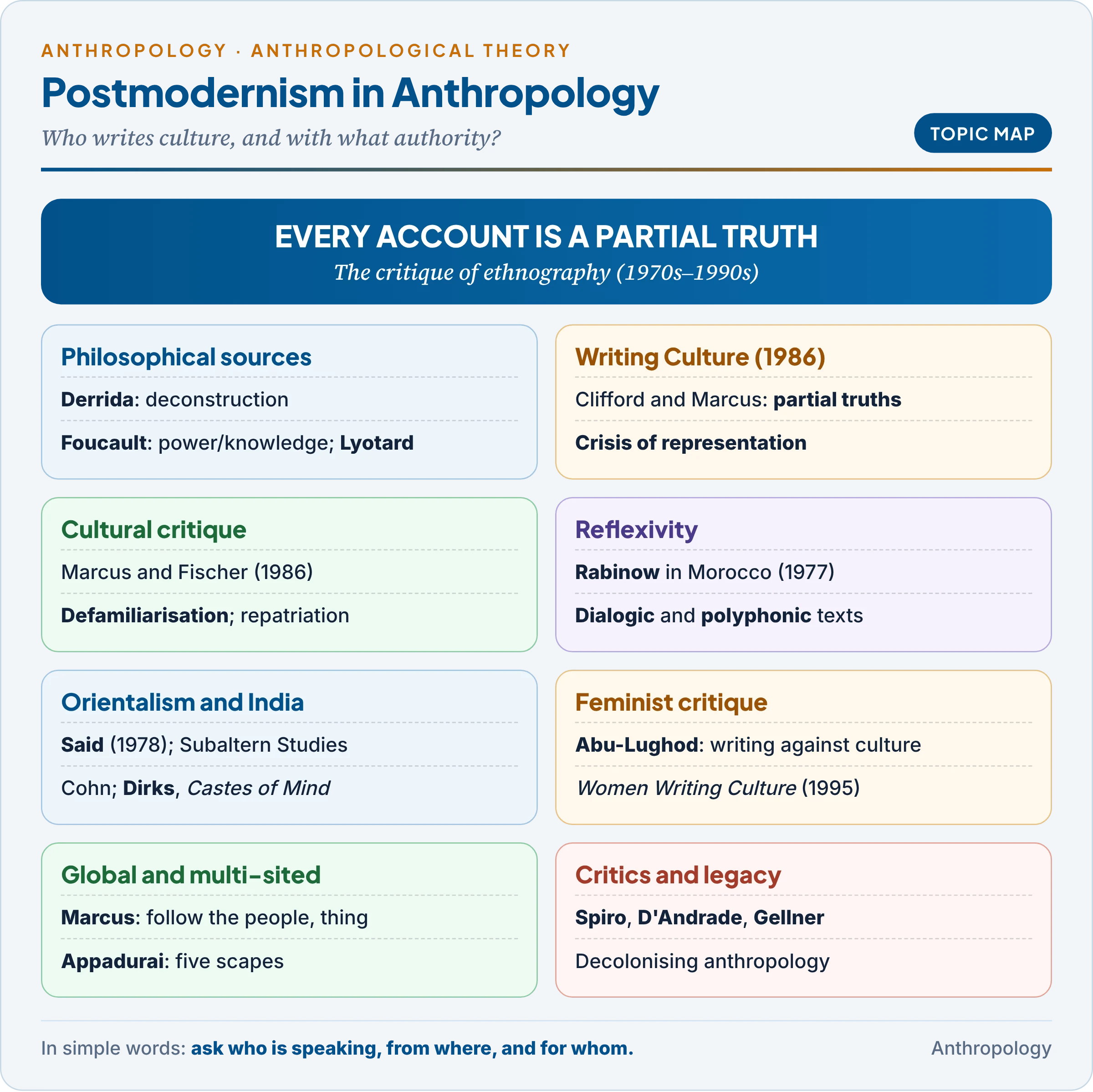
1. What Postmodernism Is
In simple words
Postmodernism doubts that anyone can describe another culture from a neutral, all-seeing position. Every account is written by a particular person, from a particular place, with particular power, so it is always partial. Postmodern anthropologists therefore look closely at how ethnographies are written and whose voices they include or leave out.
Example first. In 1926–27 the American anthropologist Robert Redfield described Tepoztlán, a Mexican village, as a harmonious, well-integrated folk community. In 1943 Oscar Lewis studied the same village and found envy, conflict and poverty. Which account was true? For the postmodernists the question itself was wrong: each was a partial truth, shaped by the observer’s questions, values and position. Such clashes, with the Mead–Freeman controversy (Unit 6g), shook confidence in ethnography as objective science.
1.1 Modern and postmodern
- Modernity, rooted in the Enlightenment, trusted reason, science and progress, and believed that a trained observer could discover objective truth.
- Postmodernism, a late twentieth-century movement that began in architecture, art and literary theory, is marked by scepticism. The French philosopher Jean-François Lyotard defined it as “incredulity toward metanarratives” (The Postmodern Condition, 1979): distrust of grand stories, such as progress, evolution or Marxist history, that claim to explain everything.
- Core ideas:
- No neutral standpoint: all knowledge is shaped by the knower’s culture, gender, class and position.
- Radical pluralism: there are many partial truths, not one objective reality.
- Knowledge and power are entangled: who gets to describe others is a question of power.
- Representation is construction: texts do not mirror reality; they make it.
- Agency: renewed attention to individuals as active makers of culture rather than bearers of a system.
- Two camps. The political scientist Pauline Rosenau (1992) distinguished sceptical postmodernists, who reject theory and truth altogether, from affirmative ones, who want theory transformed, not abolished, and who ally with movements for the marginalised. In place of scientific method they rely on deconstruction and intuitive interpretation, an introspective understanding built by listening to and talking with others.
1.2 Philosophical sources
Postmodern anthropology borrowed its tools from French philosophy and literary theory. The table shows what each thinker gave it.
| Thinker | Key work | Idea taken up by anthropology |
|---|---|---|
| Jacques Derrida | Of Grammatology (1967) | Deconstruction: exposing the hidden hierarchies in a text |
| Michel Foucault | Discipline and Punish (1975) | Discourse and power/knowledge: what counts as truth is produced by power |
| Jean-François Lyotard | The Postmodern Condition (1979) | Suspicion of metanarratives |
| Jean Baudrillard | Simulacra and Simulation (1981) | A world of images and simulations in place of reality |
| Mikhail Bakhtin | Essays on the novel (1930s, translated 1981) | Dialogism and polyphony: many voices in one text |
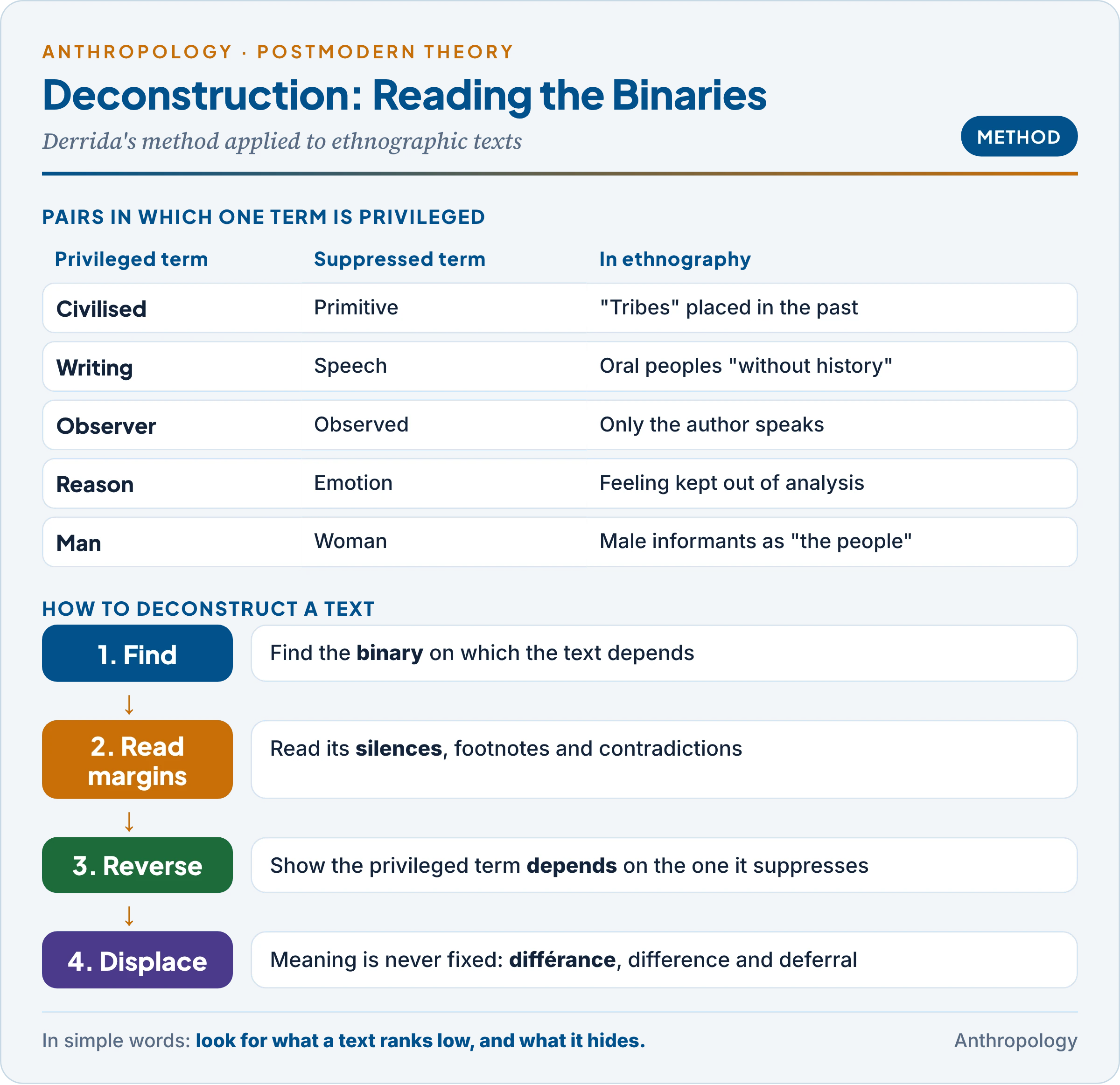
- Deconstruction (Derrida). Western thought organises meaning through binary oppositions (speech/writing, reason/emotion, civilised/primitive, man/woman) in which one term is privileged over the other. Derrida showed that meaning is never fixed in a sign; it is produced by its difference from other signs and endlessly deferred (his term différance). To deconstruct a text is to read its margins, silences and contradictions to show how the privileged term depends on the one it suppresses. “There is nothing outside the text” means that we never reach reality except through language. Applied to ethnography, deconstruction asks how a text constructs “the primitive”, “the native” or “the tribal” as the inferior half of a binary.
- Discourse (Foucault). A discourse is a system of statements that defines what can be said and known about a subject (madness, sexuality, crime). Knowledge does not stand outside power; it creates the objects it governs. Colonial anthropology can be read as one such discourse.
Common confusion
Are postmodernism and post-structuralism the same? They overlap but differ. Post-structuralism is a set of French philosophical ideas (Derrida, Foucault, later Barthes) that rejected structuralism’s fixed, universal structures of meaning. Postmodernism is the wider cultural and intellectual mood of scepticism towards grand narratives and objective truth. In anthropology the post-structuralist tools were used to build the postmodern critique of ethnography.
1.3 Roots inside anthropology
- Geertz. Interpretive anthropology already treated culture as a text and ethnography as interpretation; Works and Lives (1988) studied how classic anthropologists wrote their authority (Unit 6j).
- Malinowski’s diary (published 1967) revealed the master fieldworker’s loneliness and contempt for his hosts, cracking the image of the detached scientist (Unit 6d).
- The colonial critique. Dell Hymes (ed., Reinventing Anthropology, 1972) and Talal Asad (ed., Anthropology and the Colonial Encounter, 1973) showed how anthropology had grown inside colonial power. Johannes Fabian (Time and the Other, 1983) argued that ethnographies placed living people in a primitive past, a “denial of coevalness“.
- Decolonisation, the women’s movement and the civil rights movement brought people who had been described into the academy, and they began to answer back.
2. Writing Culture and the Crisis of Representation
In simple words
In the 1980s a group of anthropologists studied ethnographies the way literary critics study novels. They showed that ethnographers use stories, styles and rhetorical tricks to make readers believe them. This raised a crisis: if ethnographies are written constructions, how can anyone claim to represent another culture truly?
Example first. The Nuer (1940), by the British anthropologist E.E. Evans-Pritchard, is a model of scientific ethnography. Yet its introduction mentions that he arrived soon after government forces had raided Nuer country, that the Nuer refused to cooperate, and that he suffered from “Nuerosis“. The book’s calm, timeless description leaves the colonial violence out of the analysis. The American anthropologist Renato Rosaldo examined this gap in Writing Culture (1986): the text’s authority depends on what it leaves out.
2.1 The book
- Writing Culture: The Poetics and Politics of Ethnography (1986), edited by James Clifford, a historian of anthropology, and George E. Marcus, an American anthropologist, came out of a seminar at the School of American Research, Santa Fe, in April 1984.
- Contributors: Mary Louise Pratt, Vincent Crapanzano, Renato Rosaldo, James Clifford, Stephen Tyler, Talal Asad, George Marcus, Michael Fischer and Paul Rabinow.
- Thesis. Ethnography is a form of writing, not a transparent window. It uses rhetoric, allegory and narrative conventions, and it is shaped by power. “Western writers no longer portray non-Western peoples with unchallenged authority.”
- “Partial Truths” (Clifford’s introduction). Ethnographic writing is determined contextually, rhetorically, institutionally, generically, politically and historically. Ethnographies are “fictions” in the root sense of fingere, something made, not something false. “Ethnographic truths are thus inherently partial, committed and incomplete.”
2.2 Key essays
| Author | Essay | Argument |
|---|---|---|
| Pratt | “Fieldwork in Common Places” | Ethnographies join a personal arrival story to impersonal description, borrowing from travel writing |
| Crapanzano | “Hermes’ Dilemma” | The ethnographer, like Hermes, promises not to lie but never tells the whole truth; Geertz’s cockfight speaks for “the Balinese” without letting any speak |
| Rosaldo | “From the Door of His Tent” | Evans-Pritchard’s authority rests on silences about colonial power |
| Clifford | “On Ethnographic Allegory” | Ethnographies tell deeper moral stories, such as the salvage of vanishing cultures |
| Asad | “Cultural Translation” | Translation runs between unequal languages; the stronger language rewrites the weaker |
| Tyler | “Post-Modern Ethnography” | Ethnography should evoke, not represent |
| Rabinow | “Representations Are Social Facts” | The textual critics ignore the power of the academy that rewards their own writing |
2.3 The crisis of representation
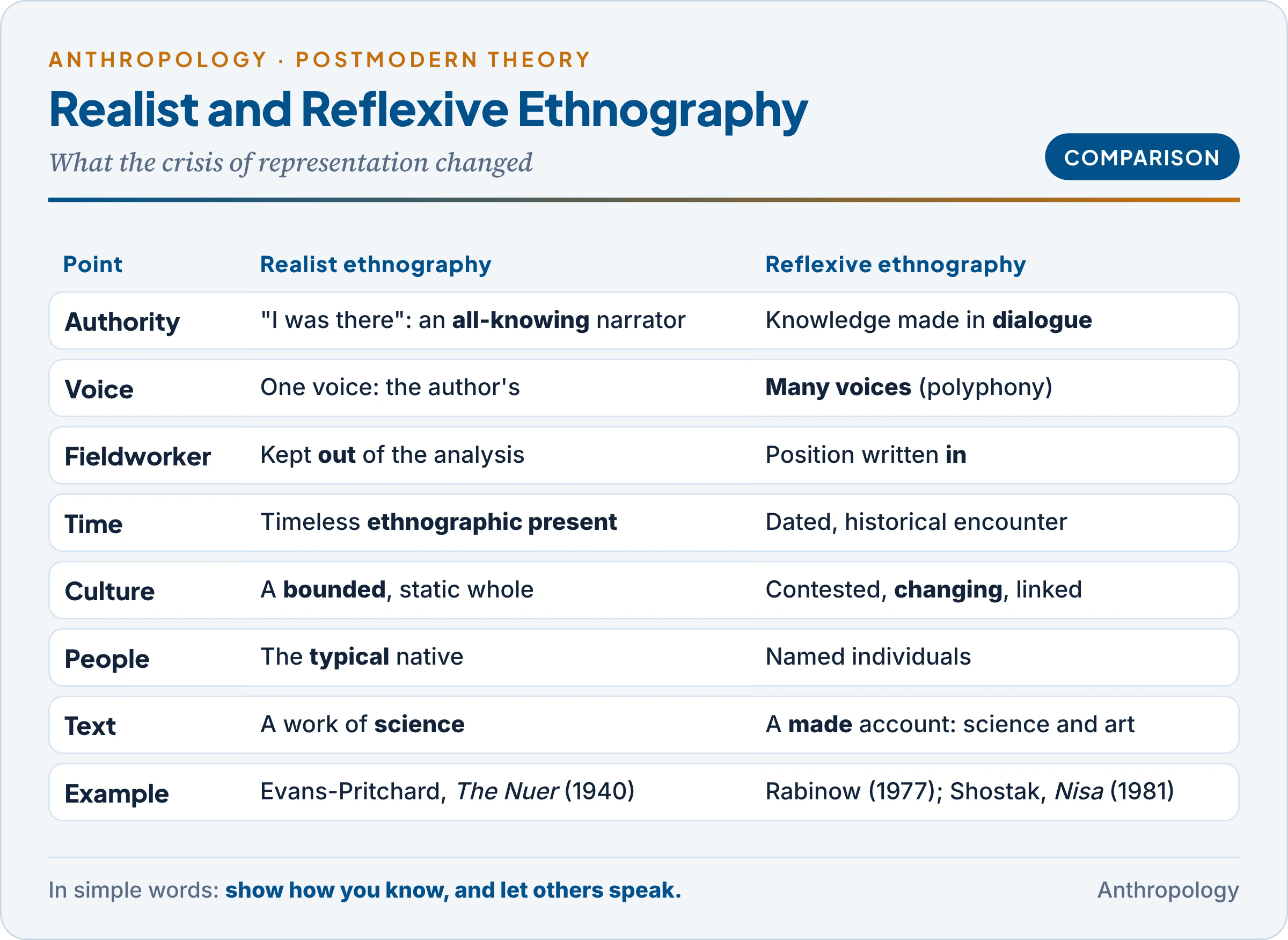
- Realist conventions questioned. Classic ethnographic realism used an invisible, all-knowing narrator; the ethnographic present (a timeless “the Nuer do…”); the typical native with no name; and the removal of the fieldworker’s experience from the analysis.
- Ethnographic authority. In “On Ethnographic Authority” (1983) Clifford traced four modes by which ethnographers claim to know: experiential (“I was there”), interpretive (I read their culture), dialogic (knowledge made in conversation) and polyphonic (many voices, not one).
- Marcus and Fischer. In Anthropology as Cultural Critique: An Experimental Moment in the Human Sciences (1986) George Marcus and Michael Fischer named a “crisis of representation“: uncertainty about adequate means of describing social reality across the human sciences, as grand paradigms lost their hold. Their response:
- an experimental moment of new ethnographic forms, some exploring person, self and emotion, others placing local life in the world political economy;
- repatriation: using ethnography of others as cultural critique of the anthropologist’s own society;
- two techniques of defamiliarisation (making the familiar strange): epistemological critique (showing that one’s own categories are constructions too) and cross-cultural juxtaposition (as Mead set Samoan adolescence against American).
3. Reflexivity and Experimental Ethnography
In simple words
Reflexivity means the anthropologist turns the camera around and looks at himself or herself too. Who am I, how did people see me, and how did that shape what I learnt? Experimental ethnographies write this openly into the text and let local people speak in their own words.
Example first. On 24 April 1970 arsonists set fire to the Center for Advanced Study in the Behavioral Sciences at Stanford, and M.N. Srinivas lost all three copies of his processed field notes on Rampura, a Karnataka village he had studied since 1948. Encouraged by the anthropologist Sol Tax, he wrote The Remembered Village (1976) from memory. The book is personal, reflective and openly shaped by his own position as a Brahmin outsider-insider: an early example of the reflexive mode.
3.1 Reflexivity
- Meaning. The ethnographer’s self-conscious examination of how identity, presence and relationships shape the knowledge produced. Fieldwork is an encounter, not an extraction of data.
- Positionality. Gender, nationality, caste, class, age and institutional power all affect access and interpretation.
- Why it matters. Making the conditions of knowledge visible lets readers judge an account; it treats people as interlocutors, not specimens; and it guards against the hidden bias of the “view from nowhere”.
3.2 Rabinow in Morocco
- The book. Reflections on Fieldwork in Morocco (1977), by the American anthropologist Paul Rabinow, a student of Geertz, recounts his fieldwork of 1968–69 near Sefrou.
- Aim. Borrowing from the French philosopher Paul Ricoeur, he defined interpretation as “the comprehension of the self by the detour of the comprehension of the other“.
- The informants as people. Each chapter is an encounter: with Ibrahim, his Arabic teacher, who expected Rabinow to pay his lodging on a trip to Marrakech (“my first direct experience with Otherness”); with Ali, “an insider’s outsider”, a marginal villager whose distance from his own society made him reflective about it; and with Malik, a villager of Sidi Lahcen with whom understanding grew slowly.
- Argument. Facts are made in the dialogue between fieldworker and informant; both are culturally mediated and historically situated selves. The informant is changed by being asked to explain his world, and so is the anthropologist.
3.3 Dialogic and polyphonic ethnography
- Dialogic ethnography presents knowledge as a conversation. Kevin Dwyer‘s Moroccan Dialogues (1982) prints his interviews with a farmer, Faqir Muhammad, including the farmer’s questions about the anthropologist’s purpose. Vincent Crapanzano‘s Tuhami: Portrait of a Moroccan (1980) presents a tilemaker’s life story and dreams through their dialogue.
- Polyphonic ethnography includes many voices that the author does not resolve into one. Marjorie Shostak‘s Nisa: The Life and Words of a !Kung Woman (1981) interweaves Nisa’s own narrative with the anthropologist’s commentary. The idea comes from Bakhtin’s reading of the novel.
- Poetic or evocative ethnography (Tyler) uses literary forms to evoke experience rather than claim to represent it.
- Emotion as knowledge. In “Grief and a Headhunter’s Rage” (1984) Rosaldo explained that he understood the Ilongot (Luzon, Philippines) link between bereavement and headhunting only after his wife, the anthropologist Michelle Rosaldo, died in a fall during their fieldwork in 1981. The ethnographer’s own experience became a source of insight (Culture and Truth, 1989).
3.4 Native and insider anthropology in India
- Reflexive accounts. André Béteille and T.N. Madan edited Encounter and Experience: Personal Accounts of Fieldwork (1975), in which Indian anthropologists described their own fieldwork relationships.
- The insider question. The Indian-American anthropologist Kirin Narayan, in “How Native Is a ‘Native’ Anthropologist?” (1993), argued that every anthropologist is partly insider and partly outsider; the useful question is the quality of relations with the people studied, not birth.
- Who theorises? The Indian political scientist Gopal Guru (Economic and Political Weekly, 2002) described “a pernicious divide between theoretical brahmins and empirical shudras” in Indian social science, in which Dalit and Adivasi lives supply data for upper-caste theorists. He and Sundar Sarukkai developed the argument in The Cracked Mirror (2012). This is the postmodern question of voice in an Indian setting.
4. Orientalism, Feminism and the Politics of Representation
In simple words
These critics asked who has the power to describe whom. The West had described the East as timeless, irrational and in need of rule, and men had described women’s lives while leaving women’s own writing out. Their work showed that ways of describing people can become ways of controlling them.
Example first. British administrators and many scholars described India as a land of unchanging self-sufficient villages and of a rigid caste system rooted in ancient texts. That picture justified colonial rule and shaped the census, the gazetteers and the law. Later scholars asked how far this India was found and how far it was made by the describers.
4.1 Said’s Orientalism (1978)
- The author. Edward Said, a Palestinian-American literary scholar, drew on Foucault’s idea of discourse.
- Thesis. “Orientalism” was not a neutral study of the East but a Western style of thought and an institution for dealing with the Orient: describing it, teaching it, ruling it. It produced an Orient that was passive, irrational, sensual, despotic and unchanging, the opposite of a rational, active West. Knowledge of the Orient was bound up with power over it.
- Influence on anthropology. It made anthropologists ask how their own discipline had represented the colonised, and it helped found postcolonial studies.
- Criticisms: it treats “the West” as a single block, gives the colonised little agency, and draws mainly on literary texts.
4.2 India: the making of colonial knowledge
- Subaltern Studies. From 1982 the Indian historian Ranajit Guha and his colleagues wrote history from below, recovering the agency of peasants and tribal rebels erased in colonial and nationalist accounts.
- The census. Bernard Cohn, an American anthropologist-historian, showed in “The Census, Social Structure and Objectification in South Asia” and Colonialism and Its Forms of Knowledge (1996) how the census objectified caste into fixed, ranked, countable units.
- Castes of Mind (2001). Nicholas Dirks argued that caste as we know it is “a modern phenomenon“, the product of the encounter with British rule. He did not claim the British invented caste, but under the “ethnographic state” (rule through anthropological knowledge, census and classification, as in Herbert Risley’s 1901 Census) caste became the single term that named and subsumed India’s diverse social identities.
- Imagining India. Ronald Inden (Imagining India, 1990) and Arjun Appadurai (“Putting Hierarchy in Its Place”, 1988) argued that Western scholarship made hierarchy India’s essence, as in Dumont’s Homo Hierarchicus.
- Critics. Susan Bayly (Caste, Society and Politics in India, 1999) and the historian Sumit Guha replied that pre-colonial states already classified and ranked groups; colonial rule hardened caste rather than created it.
4.3 The feminist critique
- Exclusion. In his introduction to Writing Culture Clifford explained the absence of feminist anthropologists by saying that feminist ethnography had not produced textually innovative forms. Feminists replied that women had long written experimental ethnography, often dismissed as “unscientific”.
- Cautions. Frances Mascia-Lees, Patricia Sharpe and Colleen Cohen (“The Postmodernist Turn in Anthropology: Cautions from a Feminist Perspective”, 1989) warned that postmodernism dissolves the subject just when women were claiming a voice, and that its “experiments” repeated what feminists had done. The British anthropologist Marilyn Strathern (1987) called feminism and anthropology an “awkward relationship“.
- “Writing Against Culture” (1991). The Palestinian-American anthropologist Lila Abu-Lughod argued that the very concept of “culture” freezes difference and creates “others”. She proposed “ethnographies of the particular“: accounts of real individuals and their arguments, as in her study of the poetry of Awlad ‘Ali Bedouin women in Egypt (Veiled Sentiments, 1986).
- Women Writing Culture (1995). Edited by Ruth Behar and Deborah Gordon, its 23 essays recovered women ethnographers such as Elsie Clews Parsons, Ella Deloria, Ruth Landes and Zora Neale Hurston, and experimented with autobiography, drama and fiction. Feminist ethnography, they showed, had long been reflexive.
Common confusion
Is reflexivity the same as writing about oneself? No. Reflexivity is not autobiography for its own sake. It brings the researcher’s position into view to explain how the knowledge was produced. Critics called the worst examples “navel-gazing”, but good reflexive work, like Rosaldo’s or Srinivas’s, uses the self to understand others better.
5. Multi-Sited Ethnography and the Global
In simple words
Many lives today stretch across villages, cities and countries. A single village study cannot capture a migrant’s world or a global industry. Multi-sited ethnography follows people, things and ideas as they move, and studies the connections between places.
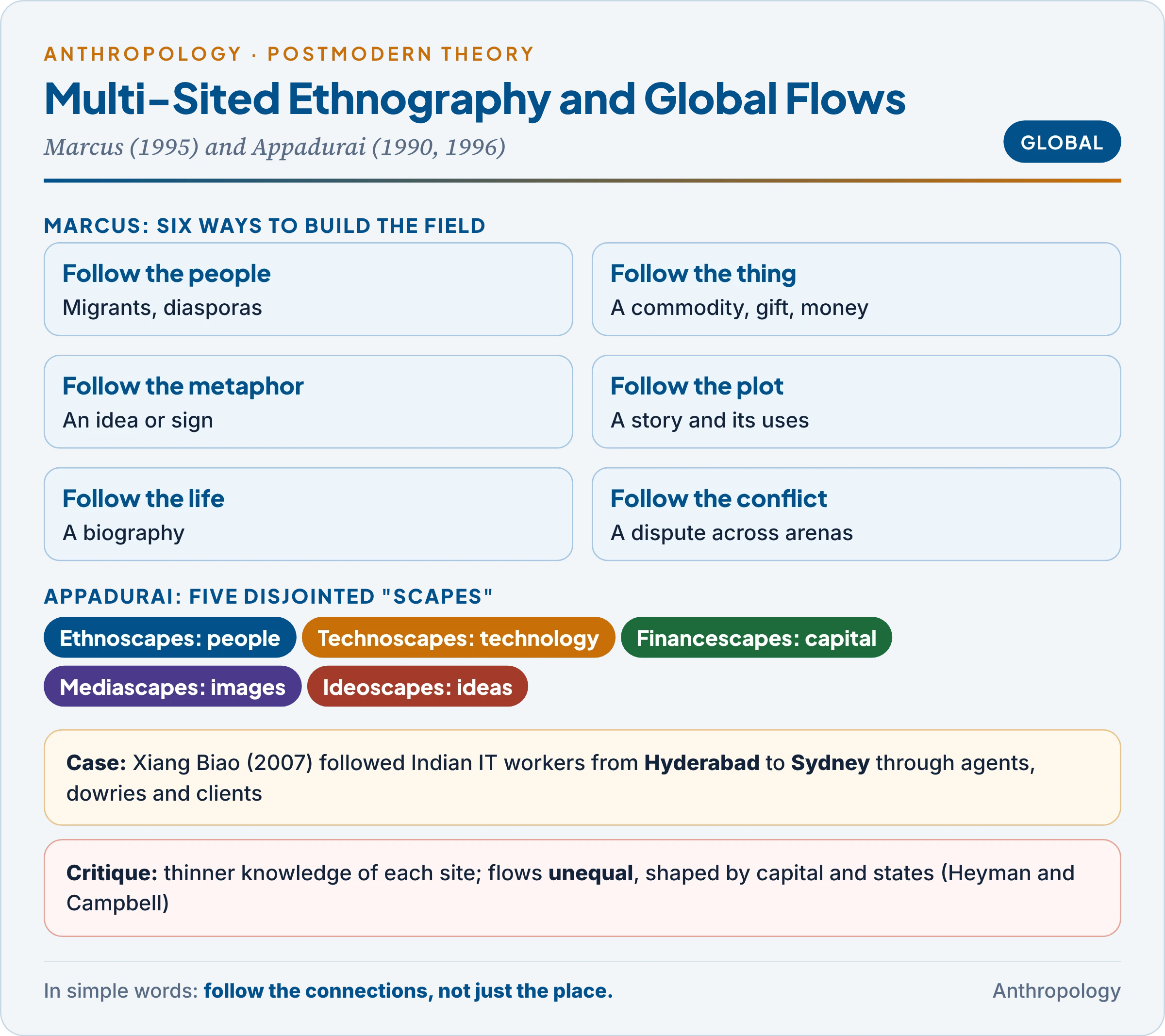
Example first. In the early 2000s the anthropologist Xiang Biao studied “body shopping”: agencies that recruit Indian IT workers, mostly from Andhra Pradesh, and hire them out to firms abroad. He did fieldwork in Hyderabad and in Sydney, following workers, dowry negotiations, agents and corporate clients (Global “Body Shopping”, 2007). Neither the Andhra village nor the Sydney office alone would explain the system; only following its chains could.
5.1 Marcus’s multi-sited ethnography (1995)
- The article. “Ethnography in/of the World System: The Emergence of Multi-Sited Ethnography” (Annual Review of Anthropology, 1995). Ethnography moves from a single site, set against an abstract “world system”, to several sites linked by flows, cutting across the local and the global.
- Six ways to construct the field:
- Follow the people (migrants, diasporas).
- Follow the thing (a commodity, a gift, money).
- Follow the metaphor (an idea or sign as it travels).
- Follow the plot, story or allegory (a narrative and its uses).
- Follow the life or biography.
- Follow the conflict (a dispute across arenas).
- Concerns. Marcus himself noted the risks: thinner knowledge of each site, the attenuation of fieldwork, and the danger of losing the subaltern’s view.
5.2 Appadurai’s global cultural economy
- The work. Arjun Appadurai, the Indian-born American anthropologist, in “Disjuncture and Difference in the Global Cultural Economy” (1990) and Modernity at Large (1996), argued that globalisation is not simply homogenisation (Americanisation) but a set of disjointed flows.
- Five “scapes”:
- Ethnoscapes: moving people: tourists, migrants, refugees, guest workers.
- Technoscapes: technology moving across borders.
- Financescapes: flows of global capital.
- Mediascapes: images and information through media.
- Ideoscapes: political ideas such as democracy, rights and sovereignty.
- Disjuncture. The flows move at different speeds and in different directions, so they do not fit a simple centre-periphery model. The suffix “-scape” signals that each looks different from each actor’s position.
- Imagination as social practice. People now live in “imagined worlds“: “men and women from villages in India think not just of moving to Poona or Madras but of moving to Dubai and Houston”.
- Criticisms. Josiah Heyman and Howard Campbell (2009) argued that Appadurai overstates disjuncture, treating all flows as equal causes while underestimating the power of capital and of states, and wrongly treats places as the opposite of flows when flows in fact make and remake places; the result hides global inequality and borders. Anna Tsing (Friction, 2005) showed that global connections work through friction, not free flow.
6. Critique, Legacy and Relevance
In simple words
Critics said postmodernism went too far: if every account is just one story, anthropology cannot tell truth from falsehood. Supporters replied that admitting partiality makes research more honest, not less. Its lasting gift is care about voice, power and ethics.
6.1 The critics
- Melford Spiro (“Postmodernist Anthropology, Subjectivity, and Science: A Modernist Critique”, 1996). The postmodern case has two arguments, both based on subjectivity: an epistemological one (because the human object and the observer are subjective, anthropology cannot be a science) and an ideological one (since objectivity is an illusion, science subverts oppressed groups, women and Third World peoples). Spiro rejected both: insight and empathy are needed, but intellectual responsibility requires objective methods; without them, ethnography becomes empirically dubious.
- Roy D’Andrade (“Moral Models in Anthropology”, 1995). Moral models (what is good) must be kept apart from objective models (how the world works), or both suffer. “Science works not because it produces unbiased accounts but because its accounts are objective enough to be proved or disproved no matter what anyone wants to be true.“
- Ernest Gellner (Postmodernism, Reason and Religion, 1992), the British philosopher-anthropologist, mocked “subjectivity and navel-gazing“: postmodernists agonise so much about knowing the Other that they stop trying. Relativism, he argued, is self-defeating and leads to cognitive paralysis, while trans-cultural knowledge is “the central fact” of modern life.
- Marvin Harris (Theories of Culture in Postmodern Times, 1999) called it obscurantism that abandons the search for causes (Unit 6i).
- Political economy critics. Nicole Polier and William Roseberry (1989) argued that the preoccupation with genres of writing distracted from the real social and political contexts of fieldwork.
- Irony. The movement put Western academics and their texts back at the centre, again speaking about others.
The two sides can be set against each other.
Criticism
- Relativism: if all accounts are partial, none can be judged better.
- Loss of science: interpretations cannot be tested.
- Self-absorption: the anthropologist becomes the subject.
- Neglect of material life: texts over power and economy.
Defence
- Partial is not false: some accounts are better grounded than others.
- Rigour through reflexivity: conditions of knowledge are made visible.
- Ethics: people studied become partners and authors.
- Power examined: colonial and academic power are exposed.
Most anthropologists today accept the critique of naive realism but not radical relativism. The common ground is “critical realism“: there is a world to know, but our knowledge of it is always situated.
6.2 Legacy: decolonising anthropology
- Routine reflexivity. Most ethnographies now discuss the fieldworker’s position, consent and relationships; ethics codes require informed consent and attention to harm.
- Collaborative and participatory research: communities as co-authors and owners of knowledge.
- Ethics first. The American anthropologist Nancy Scheper-Hughes (“The Primacy of the Ethical”, 1995) called for a “militant” anthropology that bears witness and takes sides, as in her study of infant death in north-east Brazil, Death without Weeping (1992).
- Decolonising anthropology. Faye Harrison (ed., Decolonizing Anthropology, 1991) called for an anthropology serving liberation; the Maori scholar Linda Tuhiwai Smith (Decolonizing Methodologies, 1999) showed how research had served colonisation and set out indigenous research priorities.
- Science and humanism. In 2010 the American Anthropological Association removed “science” from its long-range plan, then reaffirmed that anthropology draws on both the sciences and the humanities: the postmodern debate in a single episode.
6.3 Relevance for social justice
- Voice. By asking who speaks for whom, postmodernism supports the right of Dalit, Adivasi and women’s voices to represent themselves, through autobiography, testimony and community research.
- Deconstructing labels. The British Criminal Tribes Act (1871) branded whole communities as hereditary criminals; they were “denotified” in 1952, yet stigma persists. Deconstruction shows how such categories were constructed by colonial knowledge, and so can be unmade.
- Plural knowledge. Recognising indigenous knowledge as knowledge, not superstition, strengthens claims over land, forests and heritage.
- Limits. If every truth is partial, the facts of injustice can be dismissed too. Effective advocacy needs reliable evidence alongside voice, which is why most activist anthropologists are affirmative, not sceptical, postmodernists.
6.4 Indian relevance at a glance
The table gathers the Indian applications discussed above.
| Theme | Indian work | Point |
|---|---|---|
| Reflexive fieldwork | Srinivas, Remembered Village (1976); Béteille and Madan (1975) | Knowledge shaped by the fieldworker’s memory and position |
| Colonial knowledge | Cohn (1996); Dirks, Castes of Mind (2001) | Census and the “ethnographic state” fixed caste |
| History from below | Subaltern Studies (from 1982) | Recovering suppressed voices |
| Who theorises | Guru (2002); Guru and Sarukkai (2012) | “Theoretical brahmins and empirical shudras” |
| Multi-sited | Xiang Biao (2007) | Indian IT labour between Hyderabad and Sydney |
| Global imagination | Appadurai (1990, 1996) | Villagers imagining Dubai and Houston |
The critique has particular force in India because so much of the classic picture of caste, village and tribe was produced under colonial rule. It also asks who now writes about Indian communities, and with what authority.
Key Concepts
| Concept | Scholar | Meaning |
|---|---|---|
| Metanarrative | Lyotard | A grand story claiming to explain everything |
| Deconstruction | Derrida | Exposing hidden hierarchies in a text’s binaries |
| Discourse, power/knowledge | Foucault | Knowledge produced by and producing power |
| Crisis of representation | Marcus and Fischer | Doubt that any account can describe reality adequately |
| Partial truths | Clifford | Ethnographies as committed, incomplete constructions |
| Ethnographic authority | Clifford | How an ethnographer claims to know |
| Reflexivity | Rabinow and others | Examining how the self shapes knowledge |
| Dialogic, polyphonic | Dwyer, Shostak | Knowledge as conversation; many voices |
| Orientalism | Said | Western discourse constructing the East as inferior |
| Writing against culture | Abu-Lughod | Ethnographies of the particular |
| Multi-sited ethnography | Marcus | Following connections across sites |
| Scapes | Appadurai | Disjointed global flows |
Major Works
| Scholar | Work | Year | Significance |
|---|---|---|---|
| Rabinow | Reflections on Fieldwork in Morocco | 1977 | Reflexive classic |
| Said | Orientalism | 1978 | Knowledge and power over the East |
| Lyotard | The Postmodern Condition | 1979 | Incredulity toward metanarratives |
| Clifford and Marcus (eds) | Writing Culture | 1986 | Ethnography as writing |
| Marcus and Fischer | Anthropology as Cultural Critique | 1986 | Crisis of representation; repatriation |
| Clifford | The Predicament of Culture | 1988 | Ethnographic authority, collecting |
| Rosaldo | Culture and Truth | 1989 | Emotion and the positioned observer |
| Abu-Lughod | “Writing Against Culture” | 1991 | Against the culture concept |
| Gellner | Postmodernism, Reason and Religion | 1992 | Rationalist critique |
| Behar and Gordon (eds) | Women Writing Culture | 1995 | Feminist response |
| Marcus | “Ethnography in/of the World System” | 1995 | Multi-sited ethnography |
| Spiro | “Postmodernist Anthropology, Subjectivity, and Science” | 1996 | Modernist critique |
| Dirks | Castes of Mind | 2001 | Caste and the ethnographic state |
Key Terms
| Term | Meaning in simple words |
|---|---|
| Postmodernism | A mood of doubt about grand theories and objective truth |
| Post-structuralism | French ideas rejecting fixed structures of meaning |
| Relativism | The view that truth depends on one’s culture or standpoint |
| Representation | The way a people is described or portrayed |
| Ethnographic present | Describing a people in a timeless present tense |
| Reflexivity | Looking critically at one’s own role in research |
| Positionality | A researcher’s social position: gender, caste, nationality |
| Polyphony | Many voices in one text |
| Discourse | A system of ideas that shapes what can be said and known |
| Binary opposition | A pair of opposites, one ranked above the other |
| Subaltern | A person or group pushed to the margins of power |
| Defamiliarisation | Making the familiar look strange in order to question it |
| Decolonising | Removing colonial assumptions and power from knowledge |
Contemporary Developments
- Writing Culture at 25. A 25th anniversary edition (2010) and Writing Culture and the Life of Anthropology (ed. Orin Starn, 2015) assessed the book’s legacy: reflexivity became routine while the hope for radically new textual forms faded.
- The science debate. The American Anthropological Association’s 2010 removal of “science” from its long-range plan, and its quick reaffirmation of a discipline drawing on sciences and humanities, showed the divide is still alive.
- The ontological turn. Since the 2000s some anthropologists (Eduardo Viveiros de Castro, Martin Holbraad, Morten Pedersen) treat other peoples’ concepts as different worlds, not different views of one world, carrying the postmodern challenge further.
- Decolonising the discipline. Calls to decolonise syllabi, citation and authorship and to centre indigenous and Global South scholars continue the critique of who writes whom.
Diagrams to Master
- Topic map of the article.
- Deconstruction (§1.2): binary pairs, the privileged term, reading the margins, reversal and displacement.
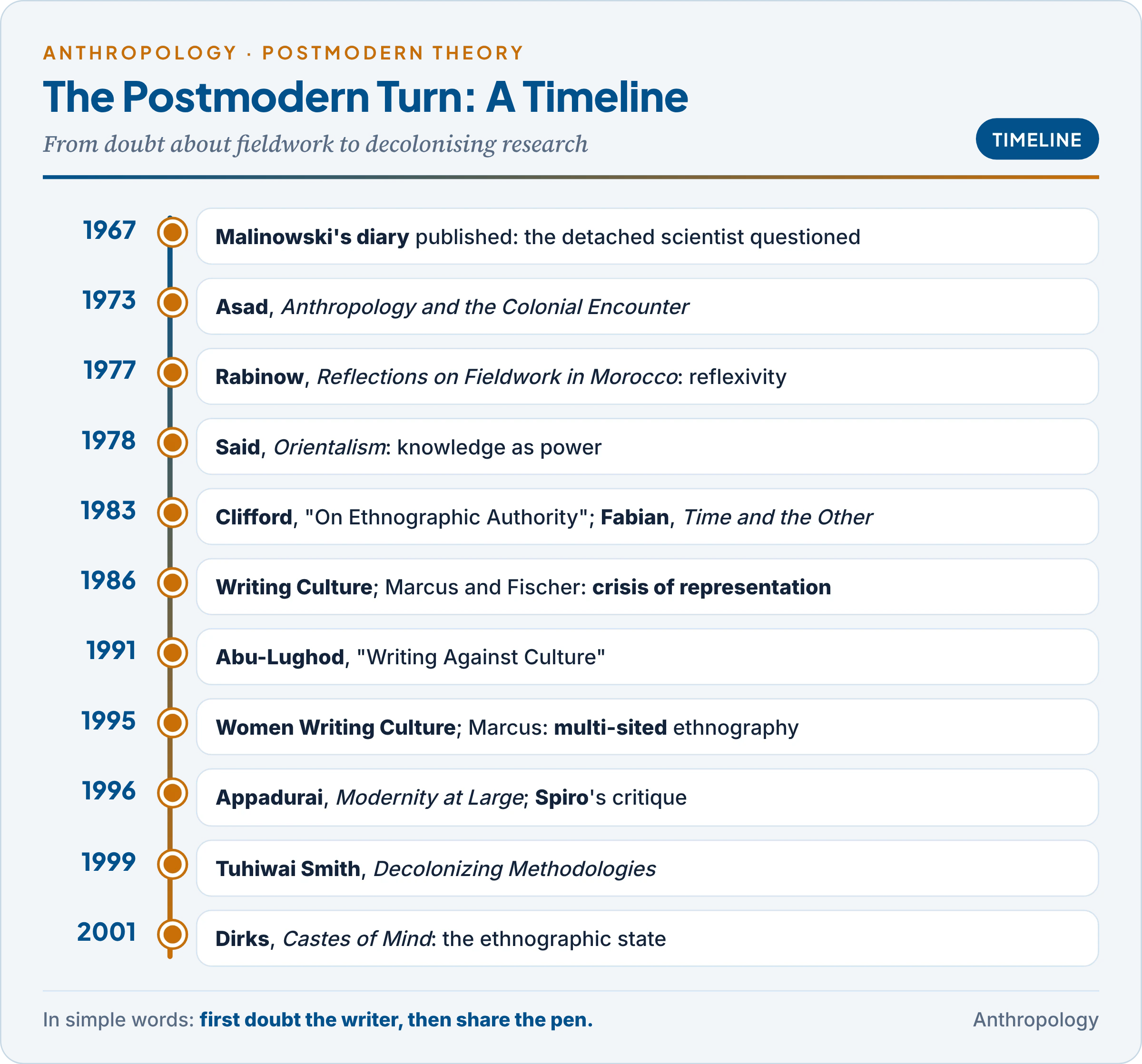
- Timeline of the postmodern turn (§1.3): 1967 to 2001, with author and idea for each step.
- Realist versus reflexive ethnography (§2.3): authority, voice, fieldworker, time, status of the text.
- Multi-sited ethnography and scapes (§5): Marcus’s six “follows”; Appadurai’s five scapes; Xiang Biao’s case.
Revision Grid
| Scholar | Work (year) | Key idea |
|---|---|---|
| Asad (ed.) | Anthropology and the Colonial Encounter (1973) | Anthropology and colonialism |
| Rabinow | Reflections on Fieldwork in Morocco (1977) | Self through the other |
| Said | Orientalism (1978) | Discourse of the East |
| Fabian | Time and the Other (1983) | Denial of coevalness |
| Clifford | “On Ethnographic Authority” (1983) | Four modes of authority |
| Clifford and Marcus | Writing Culture (1986) | Partial truths |
| Marcus and Fischer | Cultural Critique (1986) | Crisis of representation |
| Abu-Lughod | “Writing Against Culture” (1991) | Ethnographies of the particular |
| Marcus | Multi-sited ethnography (1995) | Follow people, things, metaphors |
| Appadurai | Modernity at Large (1996) | Five scapes |
| Spiro; D’Andrade; Gellner | 1996; 1995; 1992 | Defence of science and reason |
| Dirks | Castes of Mind (2001) | Ethnographic state |
Previous Year Questions
Unit 6: Post modernism in anthropology
- 2025How the theories of postmodernism are relevant in promoting social justice and empowerment of marginalised communities?
- 2024Critically explain the notion of ‘deconstruction’ in the light of the postmodern works of Jacques Derrida.
- 2023Critically examine Arjun Appadurai’s conceptualization of global cultural economy.
- 2015Explain the basic features of ‘Postmodernism’ in Anthropology.
- 2012Write a note in 150 words on Post -modernism in Anthropology.
Related questions from other units
- 2026Unit 8: Write notes on: Ethics in anthropological fieldwork.
- 2025Unit 8: Write notes on: Multispecies, Multi-sited and Critical Ethnography.
- 2025Unit 2.1: Critically examine the drawbacks in assuming culture as an ‘integrated-closed system’ in understanding of contemporary society.
- 2024Unit 8: Discuss the contemporary challenges in fieldwork method in anthropological research.
- 2023Unit 8: Critically discuss the controversies related to fieldwork of Bronislaw Malinowski and Margaret Mead.
- 2020Unit 8: How have interpretation and presentation of data changed from classical to contemporary writings in anthropological texts?
- 2020Unit 8: Write notes on the Experiential Ethnography in about 150 words.
- 2007Unit 8: Critically examine the contribution of Positivistic and Non-Positivistic approaches in Social Science Research.
- 2006Unit 8: Critically examine the role of subjectivity in Anthropological Research.
- 1997Unit 2.2: Critically assess the role of ethnography in the development of anthropological theories.