

6 Anthropological theories: (b) Diffusionism (British, German and American).
Official Syllabus: Paper I, Unit 6 (diffusionism)
1. What Diffusionism Was
In simple words
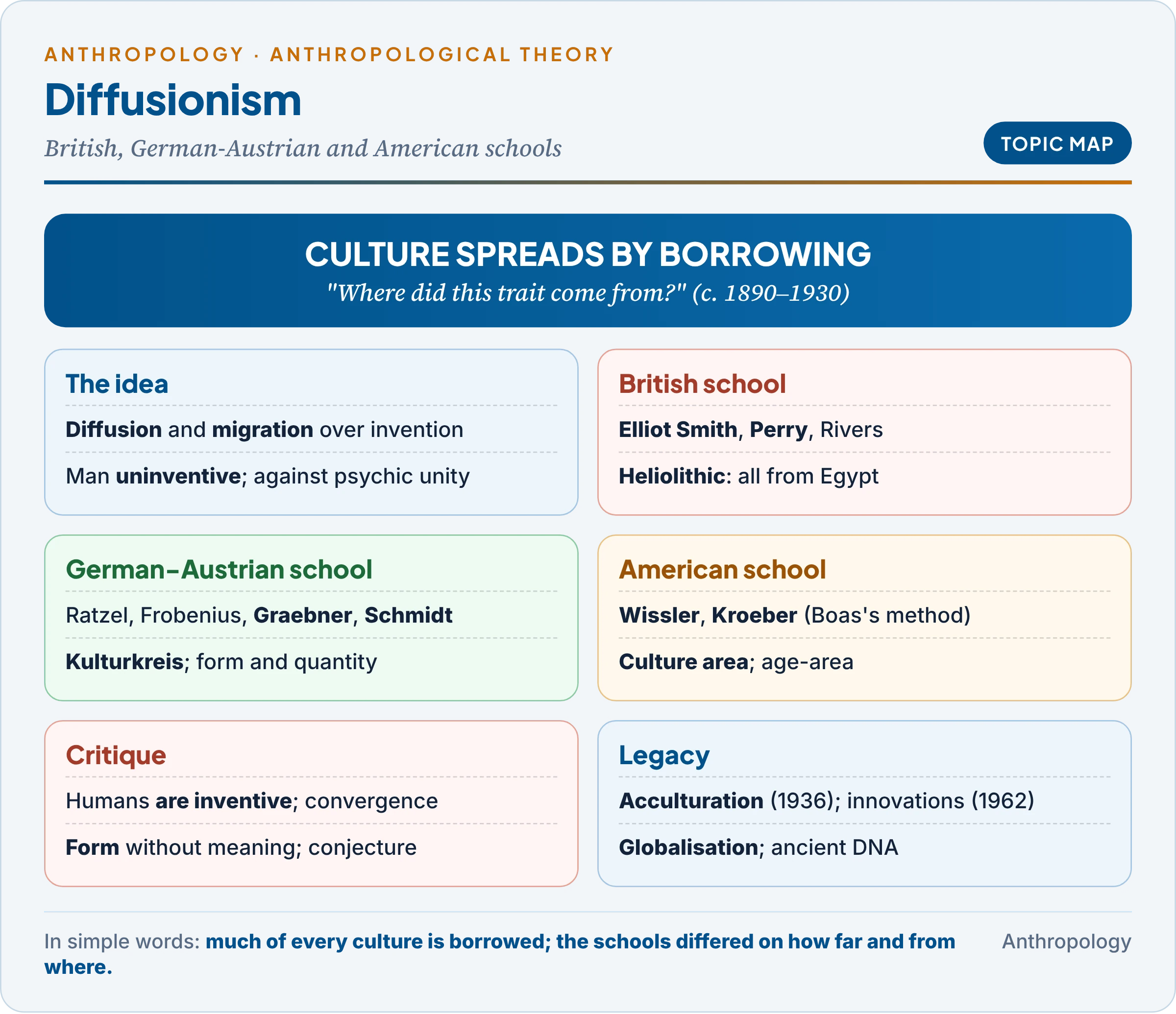
Diffusionism is the view that cultures grow mainly by borrowing from one another, not by inventing everything themselves. Its followers explained similar customs in distant places by tracing how those customs spread from a few places where they were first invented.
Example first. In 1937 the American anthropologist Ralph Linton wrote a sketch, “One Hundred Per Cent American”, of an ordinary American’s morning. He wakes in a bed of a type first made in the Near East, wears pyjamas from India, uses soap invented by the ancient Gauls, drinks coffee from Abyssinia, and reads a newspaper printed in letters invented by ancient Semites on paper invented in China. At the end he thanks God, in an Indo-European language, that he is “one hundred per cent American”. The joke makes the diffusionist point: most of any culture is borrowed.
1.1 Diffusion, migration and diffusionism
- Diffusion is the spread of a culture trait (a tool, idea, custom or word) from the society where it began to other societies, through trade, war, intermarriage, travel or imitation.
- Migration is the movement of the people themselves, who carry their culture with them and adapt it to the new setting. Diffusion moves traits; migration moves their carriers.
- Diffusionism is the theory that diffusion and migration, not independent invention, explain most cultural similarities and change. It flourished from about 1890 to 1930.
- The core premise: humans are basically uninventive. Important inventions were made once, or a few times, at particular places and then spread. This directly denies the evolutionists’ psychic unity of mankind.
1.2 Diffusionism against evolutionism
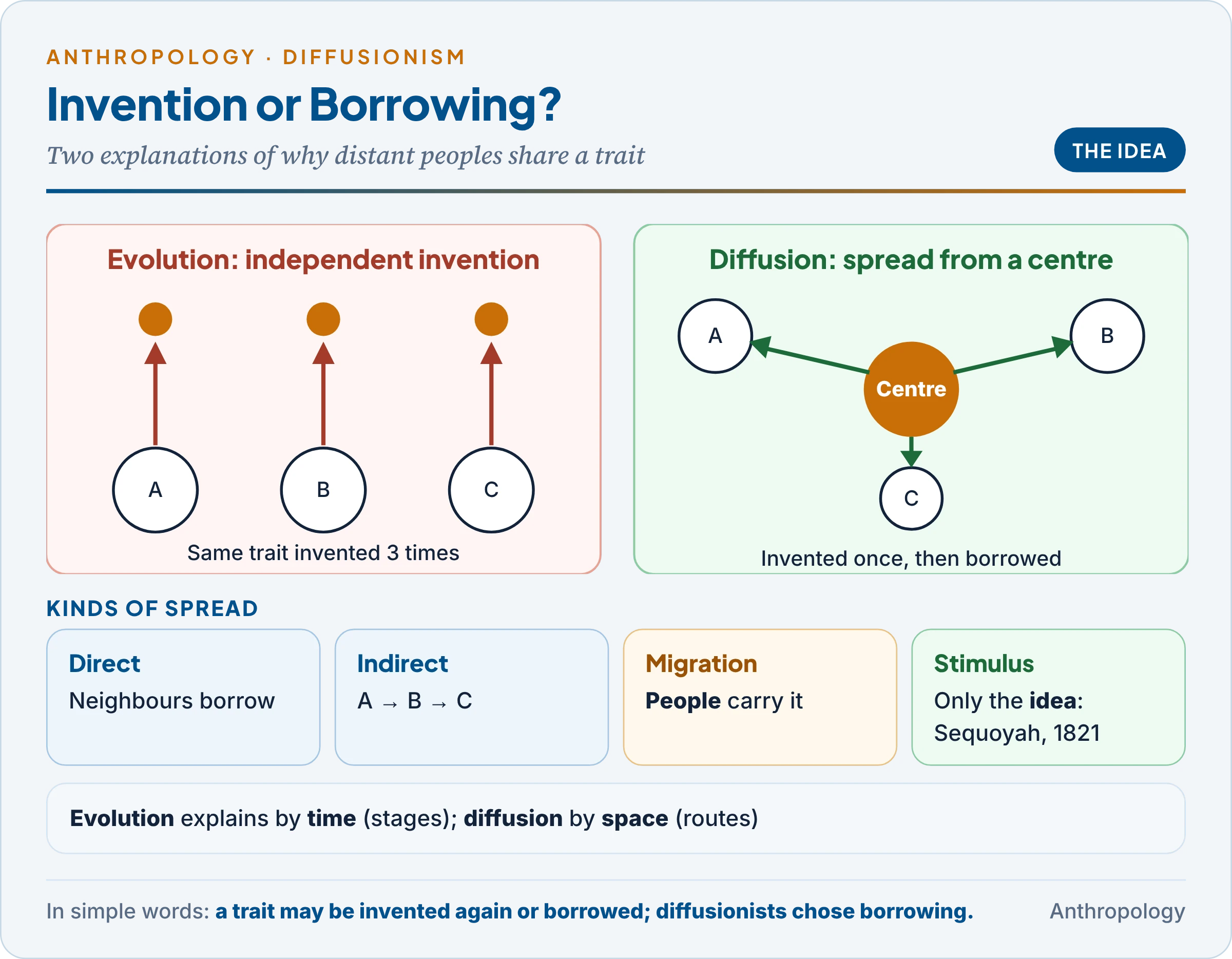
The classical evolutionists (Tylor, Morgan, Frazer; Unit 6a) held that all societies pass through the same stages because all human minds work alike, so similar customs arise independently. They knew that borrowing happened, but treated it as secondary. Diffusionism reversed the emphasis. The table compares the two as explanations of culture change.
| Basis | Evolutionism | Diffusionism |
|---|---|---|
| Source of similarity | Independent invention by similar minds | Borrowing or migration from a common centre |
| View of human mind | Inventive; psychic unity | Uninventive; imitative |
| Direction of explanation | Time: stages from simple to complex | Space: routes from centres to peripheries |
| Key question | “Which stage does this trait show?” | “Where did this trait come from?” |
| Pattern of change | Gradual, internal, one ladder | Sudden, external, by contact |
| Method | World-wide comparison of customs | Mapping distributions of traits |
| Weakness | Ignores contact and history | Ignores invention and why traits are accepted |
The two are mirror images: evolutionism explains culture by time (stages), diffusionism by space (routes). Neither asks how a culture works now, which is why functionalism (Units 6d, 6e) rejected both.
1.3 How diffusion works
The diffusionist literature summarised several conditions of diffusion:
- A trait is adopted only if it is meaningful and useful to the receiving group, economically or socially.
- A trait is modified as it spreads, to fit new environments and customs.
- Diffusion brings culture change in the receiving group, sometimes slight, sometimes far-reaching.
- Barriers slow it: distance, isolation, poor communication and ethnocentrism (the belief that one’s own ways are best).
- The older texts claim that diffusion always runs from “higher” to “lower” cultures. This is not true: maize, potato, tobacco and rubber spread from the indigenous Americas to Europe, and the Hindu-Arabic numerals reached Europe from India through the Arab world.
Kinds of diffusion.
- Direct (neighbours borrow through daily contact), indirect (through intermediate peoples) and forced (imposed by conquest or colonial rule) diffusion.
- Stimulus diffusion (A.L. Kroeber, 1940): not the trait but the idea of it spreads, and the receivers invent their own version. The classic case is Sequoyah, a Cherokee who, knowing only that English speakers could write, invented a Cherokee syllabary (about 1821) unlike the English alphabet.
2. The British School: Pan-Egyptian or Heliolithic Diffusionism
In simple words
The British diffusionists claimed that almost all civilization was invented once, in ancient Egypt, and carried from there across the world by sea-going travellers. Pyramids, mummies, sun-worship and stone monuments everywhere were, for them, copies of Egyptian originals.
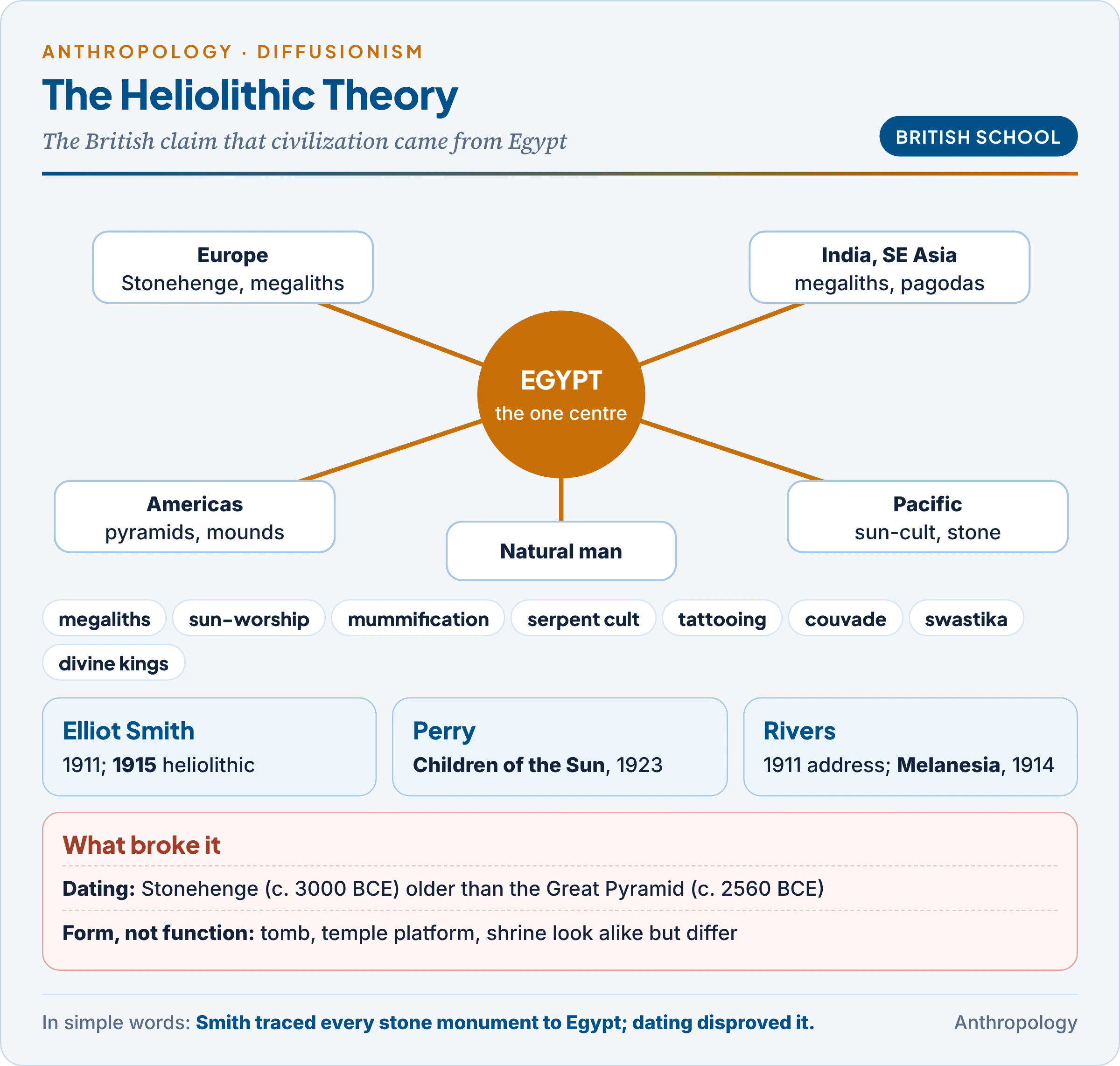
Example first. Grafton Elliot Smith, an Australian-born anatomist, spent 1900–1909 as professor of anatomy in Cairo, studying mummies. He was struck by the likeness between Egyptian stone monuments and the megaliths (large standing stones and stone tombs) of Britain, the pyramids of Mexico, the pagodas of Asia and the mounds of North America, and concluded that the “rude” builders of Britain must have copied Egypt. From this grew the most extreme theory in the history of anthropology.
2.1 Grafton Elliot Smith (1871–1937)
- Works: The Ancient Egyptians and the Origin of Civilization (1911); The Migrations of Early Culture (1915); Human History (1930); The Diffusion of Culture (1933).
- The heliolithic culture. Smith used the term heliolithic (Greek helios, sun, and lithos, stone), borrowed from a colleague, for a culture complex that combined megalith-building and sun-worship with mummification, serpent-worship, tattooing, ear-piercing, circumcision, the couvade (the father’s ritual lying-in at childbirth), massage, the swastika symbol and divine kingship.
- The argument. In 1915 he wrote that this complex had come together in Egypt “nearly thirty centuries ago” and spread along coastlines across the world. Because the traits were found together along one route, he held that they must have travelled together.
- Natural man and the premise. Peoples untouched by Egypt lived as “natural man”, without agriculture, religion or the state. Man is essentially uninventive; civilization arose once, under the special conditions of the Nile, where irrigation led to the plough, writing, the state and sun-worship.
2.2 W.J. Perry (1887–1949)
- Works: The Megalithic Culture of Indonesia (1918); The Children of the Sun (1923); The Growth of Civilization (1924).
- Perry, a schoolmaster who became a lecturer at Manchester and later at University College London, gave Smith’s theory its motive. The “Children of the Sun”, rulers claiming descent from the sun-god, sailed out from Egypt in search of “givers of life”: gold, pearls, precious stones and amber believed to prolong life. Wherever they found these, they set up colonies, built megaliths and taught agriculture.
- Perry mapped megaliths and sources of gold and pearls across Indonesia and the Pacific and claimed that they coincided.
2.3 W.H.R. Rivers (1864–1922)
William Halse Rivers Rivers, a British physician and psychologist, came to diffusion from fieldwork, which makes him the most serious of the three.
- Before diffusion: member of the Torres Strait Expedition (1898); author of the genealogical method (1900), a technique of collecting kinship data through family trees; and of The Todas (1906), a study of the polyandrous Toda of the Nilgiri Hills.
- Conversion: in his presidential address to the anthropology section of the British Association at Portsmouth (1911), “The Ethnological Analysis of Culture“, Rivers announced that his Melanesian data could not be explained by independent evolution; they showed mixture of cultures brought by migrants.
- The History of Melanesian Society (1914): Melanesian culture was a blend of an older population and successive waves of immigrants. Small groups of immigrant men married local women, learned their wives’ language, yet kept certain customs, especially funeral rites. Rivers used this to explain why peoples alike in most respects differ in their burial customs.
- “The Disappearance of Useful Arts” (1912): some Melanesian islanders lacked canoes, pottery or the bow, although their ancestors must have arrived by canoe. Useful arts can be lost, so culture does not only progress. This challenged the evolutionist ladder from another side.
- Late phase: he moved close to Smith’s Egyptian scheme before his death in 1922.
2.4 Why the British school collapsed
- Form without function. Smith treated any vague likeness of form as proof of contact and ignored function and meaning: Egyptian pyramids were royal tombs, Mesoamerican pyramids were temple platforms, Asian pagodas are shrines, the Ohio mounds were burial mounds.
- Chronology. Radiocarbon dating destroyed the time sequence. The archaeologist Colin Renfrew, in Before Civilization (1973), showed that the megalithic tombs of western Europe are older than the Egyptian pyramids; the first phase of Stonehenge (about 3000 BCE) precedes the Great Pyramid (about 2560 BCE). Most South Indian megaliths date to the Iron Age (first millennium BCE), long after the pyramids, and served a local tradition of burial. Copies cannot be older than their supposed model.
- One centre only. The school ignored Mesopotamia, the Indus, China and Mesoamerica, independent centres of agriculture and cities.
- No fieldwork behind most claims, and contradictions: civilization began now in the search for the elixir of life, now in the lessons of the Nile flood.
- A racist echo. The idea that “natives” could not have built their own monuments survives in today’s pseudo-archaeology (§7.4).
The British school is often called the “last to appear and the first to disappear”: by the 1930s almost no professional anthropologist accepted it.
3. The German-Austrian School: Kulturkreis (Culture Circle)
In simple words
The German and Austrian diffusionists did not trace everything to Egypt. They believed culture arose in several original centres, each with its own bundle of traits, and that these bundles spread out in waves and overlapped. By studying which traits were found together and where, they tried to rebuild the order of these waves.
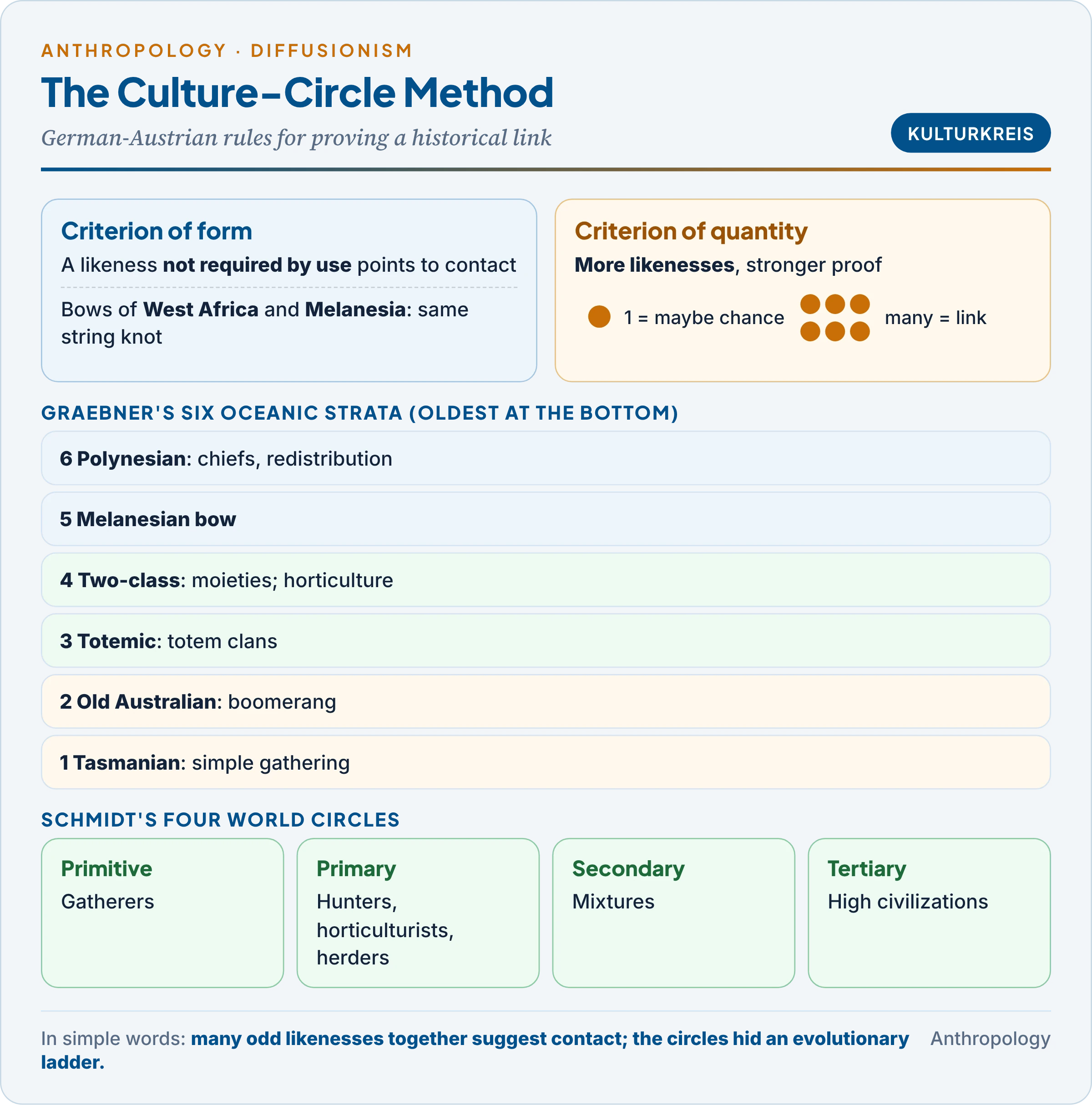
Example first. In the 1890s the German geographer Friedrich Ratzel examined bows from West Africa and from Melanesia and New Guinea. The two regions are thousands of kilometres apart, yet the bows shared details that the purpose of a bow does not require: a similar flat cross-section of the shaft, the same way of fastening the string, the same feathering of the arrows. A bow needs a string; it does not need that particular knot. Ratzel concluded that such non-functional resemblances must come from a historical connection. This reasoning became the criterion of form, the foundation of the German-Austrian school.
3.1 The scholars
| Scholar | Dates | Main works | Contribution |
|---|---|---|---|
| Friedrich Ratzel | 1844–1904 | Anthropogeographie (1882–91); Völkerkunde (1885–88), trans. The History of Mankind (1896–98) | Founder of anthropogeography; humans more imitative than inventive; criterion of form (Formgedanke) from the African bow (1891) |
| Leo Frobenius | 1873–1938 | “Der westafrikanische Kulturkreis” (1897–98); Paideuma (1921) | Coined Kulturkreis (culture circle); whole complexes travel, not single traits; a West African–Melanesian circle (masks, shields, drums, house forms); counted shared traits (“geographical statistics”); studied myth too |
| Fritz Graebner | 1877–1934 | “Kulturkreise und Kulturschichten in Ozeanien” (Berlin lecture 1904, published 1905); Methode der Ethnologie (1911) | Systematised the method; criteria of form and quantity; six culture strata in Oceania |
| Wilhelm Schmidt | 1868–1954 | Founded Anthropos (1906); Der Ursprung der Gottesidee (12 vols, 1912–55); Handbuch der Methode der kulturhistorischen Ethnologie (1937) | Catholic priest (Society of the Divine Word); led the Vienna school; four world circles; primitive monotheism |
Against Adolf Bastian‘s “elementary ideas” (Unit 6a), Ratzel held that people are shaped more by one another than by climate or terrain, so the first task is to find where a trait came from and where it went. Frobenius widened the unit from single traits to whole complexes, and Graebner, with Bernhard Ankermann (who treated Africa), turned the idea into a world scheme.
3.2 The criteria of form and quantity
Graebner and Schmidt set out rules for deciding when two similar traits prove a historical connection. The two primary criteria are the heart of the school.
| Criterion | Statement | Example |
|---|---|---|
| Form (quality) | A likeness that does not arise from the nature, material or purpose of the object points to a common origin, whatever the distance | The same string-fastening on West African and Melanesian bows |
| Quantity | The probability of a connection rises with the number of independent likenesses | Bows plus masks, shields, drums and house forms shared by the same two regions |
| Continuity (supporting) | A connection is stronger if the trait is found in intervening regions too | A chain of bow-types across the Indian Ocean coasts |
| Degree of relationship (supporting) | The closer the likeness, the closer the connection | Identical versus loosely similar designs |
The logic is that of a detective. One shared clue may be chance; a dozen shared, non-functional clues are hard to explain without contact. The criterion of form screens out likenesses that any maker would arrive at (a bow must bend), and the criterion of quantity guards against coincidence. Schmidt’s Handbuch (1937) presented the two supporting criteria.
3.3 Graebner’s strata and Schmidt’s circles
Graebner’s six Oceanic strata, from oldest to youngest:
- Tasmanian: simple food-gathering, the oldest layer.
- Old Australian (boomerang): hunting with the boomerang.
- Totemic: clans linked to animal and plant totems.
- Two-class (moiety): society in two halves regulating marriage; horticulture.
- Melanesian bow: the bow and related traits.
- Polynesian: chiefs, gift-giving and redistribution, patrilineal descent.
Each layer was a Kulturkreis that had spread and settled over the earlier ones, like geological strata. Graebner also spoke of primary spread from a centre and secondary spread from the regions it first reached.
Schmidt’s four world circles (Kulturkreise):
- Primitive (Urkulturen): food-gatherers such as the Central African forest peoples (then called Pygmies), the Fuegians of Tierra del Fuego and south-east Australians.
- Primary: three independent developments: higher hunters (patrilineal, totemic), horticulturists (matrilineal) and pastoral nomads (patriarchal).
- Secondary: mixtures of the primary circles.
- Tertiary: the high civilizations of Asia, Europe and America.
Schmidt’s scheme looks like diffusion but reads as evolution: gatherers, then hunters, horticulturists and herders, then mixed societies, then civilizations, the familiar ladder in new clothes. In Der Ursprung der Gottesidee he argued that the oldest peoples believed in a single high god, so that primitive monotheism came first and later religions were degenerations. This reversed Tylor’s sequence of animism to monotheism (Unit 5a) and fitted Schmidt’s Catholic theology, which made critics suspicious of its neutrality.
3.4 The Vienna school and India
- Wilhelm Koppers, Schmidt’s student and head of the Vienna Institute of Ethnology, carried out fieldwork among the Bhil of Jhabua (central India) from October 1938 to December 1939, published as Die Bhil in Zentralindien (1948). Using language evidence, he argued that the Bhil descended mainly from a pre-Aryan hunting people who later adopted an Indo-Aryan language: a typical culture-historical reconstruction.
- Christoph von Fürer-Haimendorf, later the leading ethnographer of the Nagas, Konyaks, Reddis and Gonds, trained in Vienna under the culture-historical school. He chose the Naga Hills for his first fieldwork (1936–37) partly because the Vienna archaeologist Robert Heine-Geldern had linked their megaliths to South-East Asian culture complexes.
3.5 Assessment of the German-Austrian school
- Strengths. More cautious than the British school (several centres, not one); explicit criteria of proof; invention as well as diffusion; some fieldwork (Koppers, Gusinde, Haimendorf).
- Weaknesses.
- No culture circle was ever established empirically; the circles were constructed from scattered traits.
- Tracing world culture to four or five early bands and their migrations is speculation.
- Similarity, even non-functional, does not always prove contact; independent convergence remains possible.
- Museum methodology: traits classified out of context, as Boas complained in his 1911 review of Graebner’s Methode, where he called the procedure mechanical.
- It described what spread and where, never why a trait was accepted, rejected or changed.
- Its strata hid an evolutionary sequence and, in Schmidt, a theological aim.
4. The American School: Culture Areas and Age-Areas
In simple words
The American diffusionists worked on a smaller scale. They grouped Native American peoples into culture areas whose members shared many traits, and they used the spread of each trait within an area to estimate its age. They did not look for a single world history, only for the history of particular regions.
Example first. On the Great Plains of North America in the nineteenth century, peoples as different in language as the Lakota, Cheyenne, Comanche and Crow shared a whole way of life: horse-mounted bison hunting, the portable tipi, the Sun Dance, military societies and painted hide robes. They spoke unrelated languages, so they had not inherited this way of life from one ancestor; they had borrowed it from one another within a region. The horse itself had arrived only after Spanish colonisation, yet spread across the Plains within a few generations. A culture area is the name for such a region.
4.1 From museum device to theory
- Otis T. Mason, curator at the US National Museum, grouped Native American peoples by “ethnic environments” in the 1890s to arrange museum displays.
- W.H. Holmes (1914) replaced “ethnic environment” with “culture area”: a region with an ethnic boundary, whose most typical tribes lie at its centre.
- Clark Wissler, curator at the American Museum of Natural History, in The American Indian (1917) mapped fifteen culture areas: ten in North America (including Mexico), four in South America and one in the Caribbean. He linked them to food areas: the bison area to the Plains, salmon to the North Pacific Coast, caribou to the sub-Arctic, maize to the agricultural Southwest and East, manioc to the Amazon.
- A.L. Kroeber, in Cultural and Natural Areas of Native North America (1939), regrouped North America into six grand areas with 84 sub-areas and matched them to natural regions.
4.2 The structure of a culture area
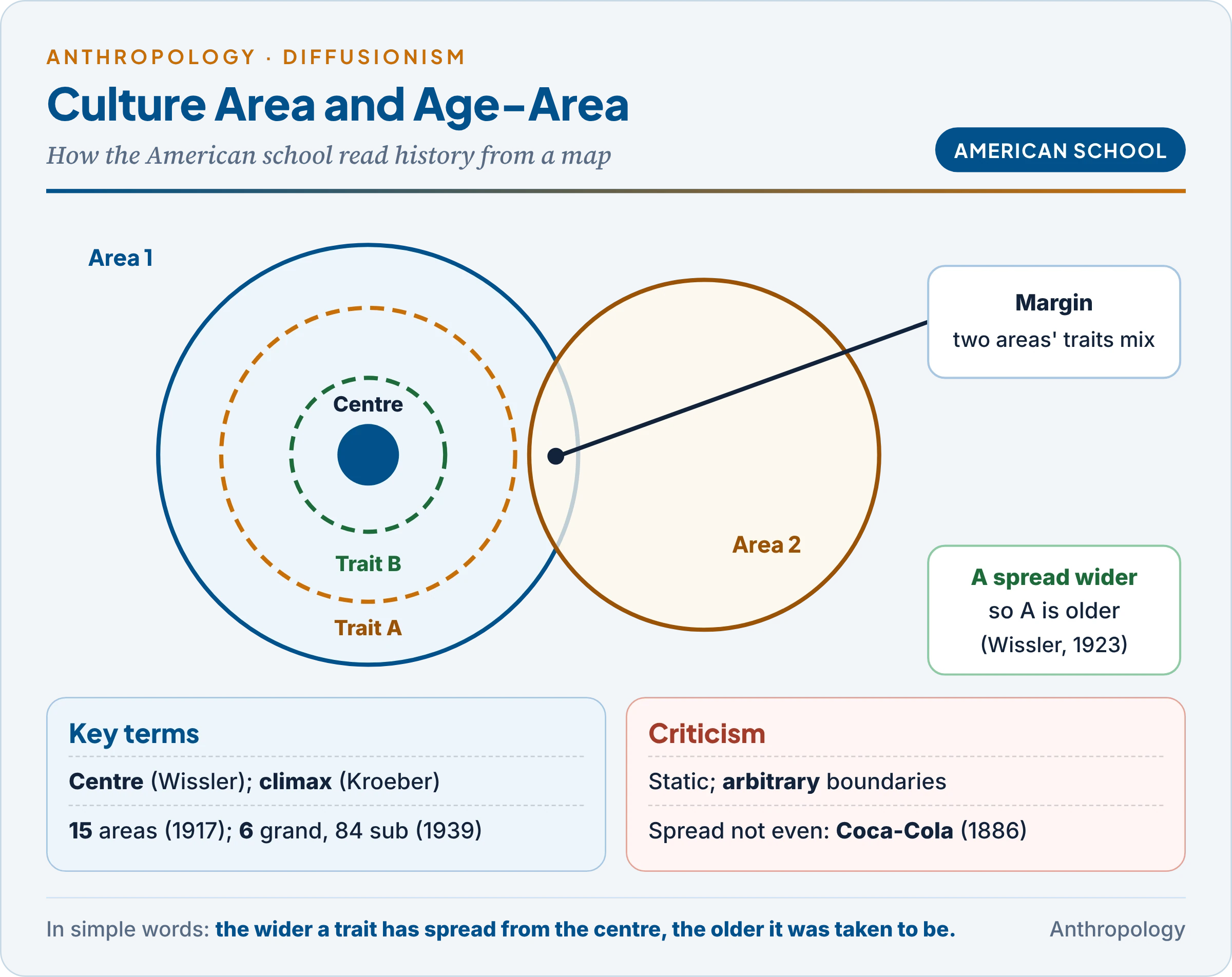
- Culture centre (Wissler): the zone where the traits typical of the area are most concentrated and most elaborated. Wissler held that it was also the oldest.
- Culture margin: the border zone, where traits of two or more areas mix.
- Culture climax (Kroeber): Kroeber preferred this term for the zone of richest development and greatest intensity, without assuming it was the point of origin.
- Age-area principle (Wissler, Man and Culture, 1923): traits spread outward from a centre in all directions, so a trait found over a wider area is older than one found over a smaller area. Of two traits, the one reaching the margins left the centre earlier. Edward Sapir‘s “Time Perspective in Aboriginal American Culture” (1916) set out similar rules for inferring time from distribution.
- Beyond America. Boas’s student Melville Herskovits identified an East African cattle area (1926), where cattle served as wealth, bride-price and ritual objects rather than mainly as food.
4.3 Criticism of the culture-area approach
- Static. The map shows a moment, usually the time of first European contact, not change.
- Boundaries are arbitrary; different traits give different boundaries.
- Material bias: areas were drawn mostly from food, tools and dwellings, less from belief and social organisation.
- The age-area principle is unreliable. Traits do not spread evenly in all directions or at a constant speed; mountains, seas and politics deflect them. A recent trait can spread faster and wider than an old one: Coca-Cola, invented in 1886, now covers far more of the world than many ancient crafts.
- Complex societies. The approach fits small tribal societies in contiguous regions but not stratified or urban societies, where traits spread by class and network rather than by territory.
- No “why”. Like the German school, it maps spread but does not explain why a trait is accepted, rejected or modified.
4.4 Boas and the American school
Franz Boas (Unit 6b) is often named as its leader because his historical method traced trait distributions in limited areas (the Tsimshian tales). Unlike the European schools, he required diffusion to be proved case by case, and stressed that receivers reinterpret what they borrow; hence the school’s other name, distributionist.
4.5 Culture areas in India
Indian anthropologists adapted the regional idea to Indian diversity:
- B.S. Guha, first Director of the Anthropological Survey of India, grouped tribes into north and north-eastern, central (middle) and southern zones.
- L.P. Vidyarthi divided tribal India into five regions: Himalayan, Middle India, Western India, South India and the Islands.
- Irawati Karve (Kinship Organisation in India, 1953) identified northern, central, southern and eastern kinship zones, each with its own marriage rules and kin terms (Unit 2.5b).
These are culture areas in method: regions of shared traits produced by shared history and contact.
5. The Three Schools Compared
In simple words
The three schools agreed that borrowing explains much of culture, but they disagreed on how many centres there were, how far traits travelled and how carefully the spread had to be proved.
The table sets the three schools side by side on the points on which they are usually compared.
| Basis | British | German-Austrian | American |
|---|---|---|---|
| Other names | Pan-Egyptian, heliolithic, heliocentric | Kulturkreis, culture-historical, Vienna | Culture-area, distributionist, historical |
| Leaders | Elliot Smith, Perry, Rivers | Ratzel, Frobenius, Graebner, Schmidt | Wissler, Kroeber (Boas as method) |
| Number of centres | One (Egypt) | Several original circles | Many regional centres |
| Scale | World | World | Region (culture area) |
| Unit that spreads | A whole civilization complex | Culture complexes in waves | Single traits and complexes |
| Human inventiveness | Almost none | Limited; invention allowed | Ordinary; diffusion and invention both |
| Evolution | Rejected | Hidden in the strata | Rejected as unilinear |
| Method | Comparison of forms | Criteria of form and quantity | Mapping distributions; age-area |
| Fieldwork | Little (except Rivers) | Some (Koppers, Gusinde) | Extensive |
| Fate | Abandoned by the 1930s | Faded after 1950 | Absorbed into acculturation studies |
The trend runs from the extreme to the moderate: one world centre, then a few circles, then as many regional centres as the evidence showed. The more modest the claim, the better its evidence and the longer it survived; the culture area still organises regional ethnography, while the heliolithic theory survives only in pseudo-archaeology.
Common confusion
Is a culture area the same as a culture circle? No. A culture area (American) is a continuous geographical region whose peoples share traits now, mapped from the ground. A culture circle (German-Austrian) is a bundle of traits believed to have formed once and then spread, often to non-adjacent places across the world, reconstructed from scattered similarities. The first is a map of the present; the second is a hypothesis about the deep past.
6. Critique of Diffusionism
In simple words
Later anthropologists accepted that borrowing is real and important, but they rejected the idea that people are uninventive and that a few centres made all of culture. They also asked a question the diffusionists had skipped: why do people accept some borrowed things and reject others?
- Humans are inventive. Agriculture, pottery, writing, cities and states arose independently in several regions (the Near East, China, Mesoamerica, the Andes). The premise of uninventiveness is false.
- Convergence and limited possibilities. Similar needs and materials can produce similar results without contact (Goldenweiser‘s principle of limited possibilities, 1913; Unit 6b).
- Form without meaning. Traits were compared as objects, stripped of their function and meaning in their own culture. A borrowed trait often changes its meaning: cricket, brought to the Trobriand Islands by missionaries, became a ritual contest between villages with war-dances and magic.
- No explanation of acceptance. Diffusion is selective. People borrow what fits their needs, values and structure, as the functionalists (Malinowski, Radcliffe-Brown) stressed; mapping routes does not explain this choice.
- Conjectural history. Most reconstructions were untestable inferences from distributions; Radcliffe-Brown dismissed them as “conjectural history”.
- Ethnocentric overtones and bad chronology. The claim that some peoples could only imitate echoed colonial ideas of “advanced” and “backward” races, and dating showed supposed copies to be older than their models (§2.4).
Was diffusionism an extremist view? The British school was: one centre, uninventive humanity, form taken as proof. The German-Austrian school was extreme in scale but disciplined in method; the American school was moderate. The lasting lesson is Boas’s middle position: cultures change by both invention and borrowing, and the weight of each must be shown case by case.
7. Legacy: Acculturation, Modern Diffusion and Globalisation
In simple words
Diffusionism as a grand theory died, but its central fact, that cultures borrow from one another, lived on. Anthropologists turned it into the study of what happens when whole cultures meet, how new ideas spread, and how globalisation mixes cultures today.
7.1 Acculturation
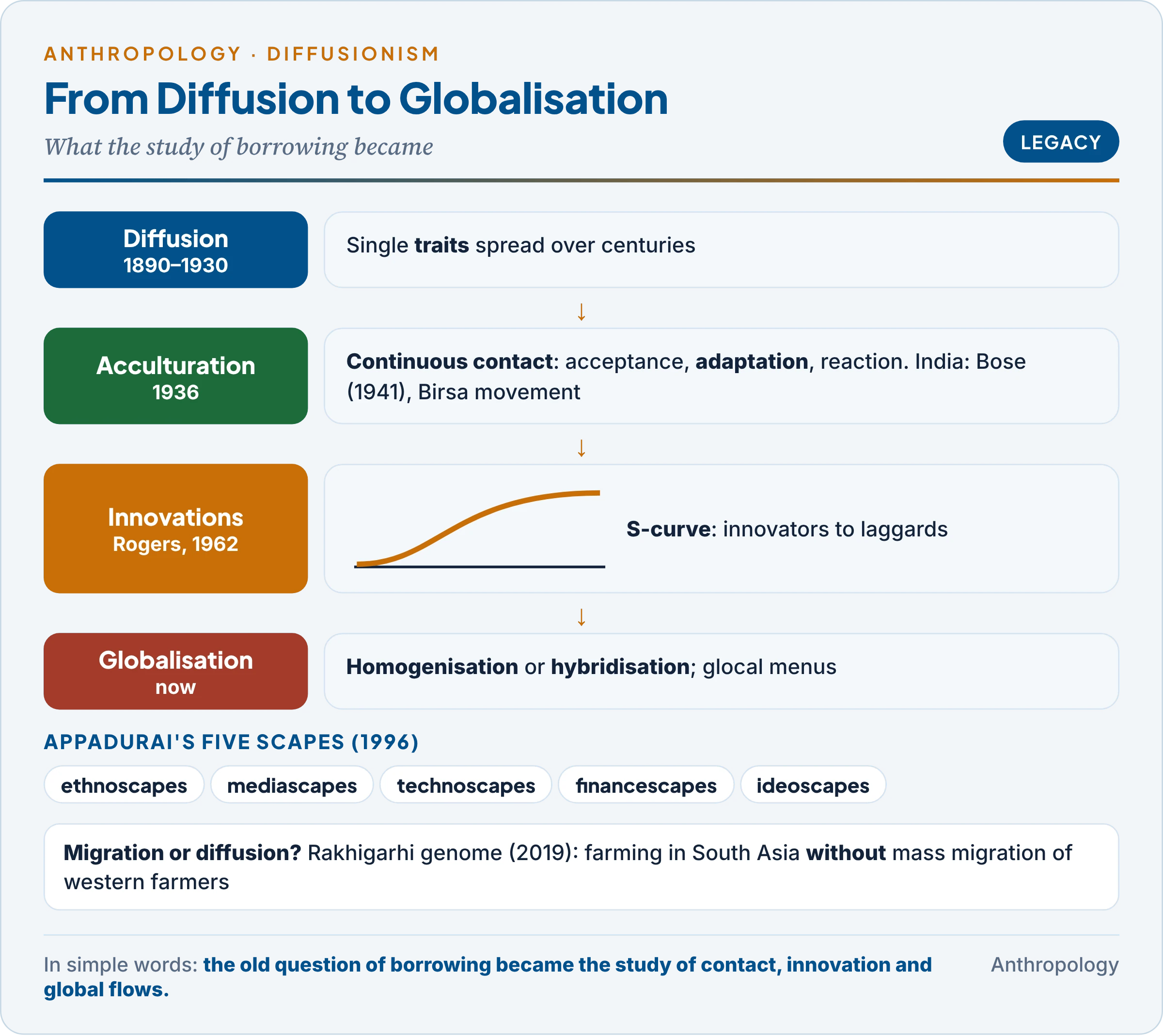
From the 1930s, American anthropologists shifted from traits spreading over centuries to cultures meeting now. Robert Redfield, Ralph Linton and Melville Herskovits, in their 1936 memorandum for the Social Science Research Council, defined it:
“Acculturation comprehends those phenomena which result when groups of individuals having different cultures come into continuous first-hand contact, with subsequent changes in the original culture patterns of either or both groups.”
The table separates the related terms.
| Term | What spreads or changes | Contact | Example |
|---|---|---|---|
| Diffusion | Single traits | Direct or indirect; may be intermittent | Tobacco spreading from the Americas |
| Acculturation | Whole culture patterns of one or both groups | Continuous, first-hand | Tribal communities adopting market farming, schooling and a regional language |
| Assimilation | Minority absorbed into the dominant group | Prolonged, unequal | Loss of a separate language and identity |
| Enculturation | Culture learned by a child within its own society | Within the group | A child learning kinship etiquette |
Kroeber connected the first two: diffusion concerns the elements of a culture, acculturation the whole culture; acculturation always involves diffusion. The memorandum named three outcomes: acceptance (traits replace older ones), adaptation (old and new blend into a new whole, which Herskovits called syncretism) and reaction (rejection).
- Contra-acculturation and nativism. When contact is forced, groups may reassert their old ways. Linton’s “Nativistic Movements” (1943) classified such efforts to revive or perpetuate selected traits. In India, the Birsa Munda movement (1895–1900) among the Munda combined religious reform with resistance to land loss and colonial rule.
- India. D.N. Majumdar‘s A Tribe in Transition (1937) studied contact among the Ho of Singhbhum; N.K. Bose‘s “The Hindu Method of Tribal Absorption” (1941) showed tribes entering the caste order. Srinivas‘s Sanskritization (1952) and Marriott‘s universalization and parochialization (Kishan Garhi, 1955) trace the two-way flow between great and little traditions: diffusion inside one civilization.
7.2 Diffusion of innovations
The sociologist Everett Rogers, in Diffusion of Innovations (1962), made diffusion measurable. Adoption follows an S-shaped curve: innovators (about 2.5 per cent) and early adopters (13.5) lead, the early and late majority (34 each) follow, laggards (16) come last. Adoption depends on advantage, compatibility with existing values, simplicity, trialability and visibility; compatibility restates the old rule that a trait spreads only if it is meaningful and useful to the receivers. The model guided agricultural extension and health programmes, including in India.
7.3 Globalisation
Globalisation is diffusion at unprecedented speed and scale, carried by trade, migration and media. Anthropologists describe three possible outcomes:
- Homogenisation: one culture (often American) spreads and erases others, as in talk of “McDonaldization”.
- Hybridisation (creolisation): borrowed elements mix with local ones into new forms (Ulf Hannerz). The anthropologist James Watson‘s Golden Arches East (1997) showed East Asian customers turning McDonald’s into a local social space. McDonald’s in India serves no beef and built its menu around local tastes such as the McAloo Tikki: glocalisation (the sociologist Roland Robertson‘s term for global forms adapted to local settings).
- Disjunctive flows: Arjun Appadurai (Modernity at Large, 1996) described five overlapping “scapes”: ethnoscapes (people), mediascapes (images), technoscapes (technology), financescapes (capital) and ideoscapes (ideas). They move independently, so cultures are reshaped unevenly rather than simply copied.
For tribal India, globalisation brings markets, mining and migration into indigenous economies (Unit 3b), a modern form of culture contact.
7.4 Migration or diffusion? The question returns
- Ancient DNA now tests what diffusionists could only guess: whether a trait spread by moving people (demic diffusion) or by moving ideas (cultural diffusion). The Rakhigarhi genome (Vasant Shinde and colleagues, Cell, 2019) from the Indus Civilization showed no Steppe-pastoralist ancestry and an Iranian-related ancestry that split off before farming began in Iran. The authors concluded that farming in South Asia did not require a large migration of western farmers: local hunter-gatherers took up farming, a case of diffusion of ideas, or independent development, rather than migration.
- Hyperdiffusionism today. The Society for American Archaeology wrote to Netflix on 30 November 2022 about the series Ancient Apocalypse, which attributed ancient monuments to a lost advanced civilisation; the letter said such theories rob Indigenous peoples of credit for their own heritage, the same flaw as Elliot Smith’s “natural man”.
Key Concepts
| Concept | Scholar | Meaning |
|---|---|---|
| Diffusion | All schools | Spread of traits from one society to another |
| Heliolithic culture | Elliot Smith | Egyptian complex of megaliths, sun-worship, mummification |
| Kulturkreis | Frobenius, Graebner, Schmidt | Culture circle: a bundle of traits that spread together |
| Criterion of form | Ratzel, Graebner | Non-functional likeness proves connection |
| Criterion of quantity | Frobenius, Graebner | More likenesses, stronger proof |
| Primitive monotheism | Schmidt | Belief in a high god as the oldest religion |
| Culture area | Mason, Holmes, Wissler, Kroeber | Region of peoples sharing traits |
| Culture centre, climax, margin | Wissler; Kroeber | Core, richest zone and border of an area |
| Age-area principle | Wissler | Wider distribution means greater age |
| Stimulus diffusion | Kroeber | Spread of an idea, not the trait itself |
| Acculturation | Redfield, Linton, Herskovits | Change from continuous first-hand contact |
Major Works
| Scholar | Work | Year | Significance |
|---|---|---|---|
| Ratzel | Die afrikanischen Bögen | 1891 | Bow comparison; criterion of form |
| Frobenius | “Der westafrikanische Kulturkreis” | 1897–98 | Term Kulturkreis |
| Graebner | “Kulturkreise und Kulturschichten in Ozeanien” | 1905 | Six Oceanic strata |
| Graebner | Methode der Ethnologie | 1911 | Criteria of form and quantity |
| Rivers | The History of Melanesian Society | 1914 | Waves of immigrants in Melanesia |
| Elliot Smith | The Migrations of Early Culture | 1915 | Heliolithic culture |
| Wissler | The American Indian | 1917 | Fifteen culture areas |
| Perry | The Children of the Sun | 1923 | Search for “givers of life” |
| Schmidt | Der Ursprung der Gottesidee | 1912–55 | Primitive monotheism |
| Redfield, Linton, Herskovits | “Memorandum for the Study of Acculturation” | 1936 | Definition of acculturation |
| Kroeber | Cultural and Natural Areas of Native North America | 1939 | Six grand areas, 84 sub-areas |
| Koppers | Die Bhil in Zentralindien | 1948 | Culture-historical study in India |
Key Terms
| Term | Meaning in simple words |
|---|---|
| Diffusion | Spread of a cultural item from one society to another |
| Diffusionism | Theory that borrowing explains most of culture |
| Culture trait | Smallest unit of culture, such as a tool or a custom |
| Culture complex | A cluster of related traits that go together |
| Heliolithic | “Sun and stone”: Smith’s Egyptian culture complex |
| Kulturkreis | Culture circle: traits that formed and spread together |
| Criterion of form | Proof of contact from likeness not required by use |
| Criterion of quantity | Proof of contact from many likenesses together |
| Culture area | Region whose peoples share many traits |
| Age-area | The idea that widely spread traits are older |
| Stimulus diffusion | Borrowing an idea and inventing one’s own version |
| Acculturation | Culture change from continuous contact between groups |
| Nativism | Attempt to revive or keep old traits against outside influence |
| Glocalisation | Global products adapted to local cultures |
Contemporary Developments
- Ancient DNA and the Indus Civilization (2019): the Rakhigarhi genome showed that farming in South Asia did not need a large migration of western farmers, turning the old “migration or diffusion” debate into a testable question.
- Pushback against hyperdiffusion (2022): the Society for American Archaeology‘s letter of 30 November 2022 to Netflix criticised Ancient Apocalypse for denying Indigenous peoples credit for their monuments.
- Repatriation and the end of the trait museum: new US NAGPRA regulations (2024) require consultation before displaying Native American cultural items, completing the move away from the trait-by-type museum displays from which culture-area studies grew.
- Glocalisation in India: global food and media brands adapt to local diets, languages and festivals: acceptance, adaptation and reaction in present-day contact.
Diagrams to Master
- Topic map of the article.
- Evolution versus diffusion (§1): invention against spread; kinds of diffusion, with Sequoyah.
- Heliolithic theory (§2): Egypt, routes, traits, and the dating that broke it.
- Kulturkreis criteria (§3): form and quantity (bow); six strata; four circles.
- Culture area and age-area (§4): centre, margin, rings A and B; mark the older trait.
- Legacy (§7): acculturation outcomes, S-curve, Appadurai’s scapes.
Revision Grid
| Scholar | Work (year) | Key idea |
|---|---|---|
| Ratzel | Anthropogeographie (1882–91) | Imitation over invention; criterion of form |
| Graebner | Methode der Ethnologie (1911) | Form and quantity; Oceanic strata |
| Rivers | “Ethnological Analysis of Culture” (1911) | Culture mixture by migrants |
| Elliot Smith | Migrations of Early Culture (1915) | Heliolithic culture from Egypt |
| Wissler | The American Indian (1917); Man and Culture (1923) | Culture areas; age-area |
| Perry | The Children of the Sun (1923) | “Givers of life” |
| Redfield, Linton, Herskovits | Memorandum (1936) | Acculturation defined |
| Schmidt | Handbuch (1937) | Four world circles; primitive monotheism |
| Kroeber | Cultural and Natural Areas (1939); “Stimulus Diffusion” (1940) | Culture climax; idea diffusion |
| Rogers | Diffusion of Innovations (1962) | S-curve of adoption |
| Renfrew | Before Civilization (1973) | Megaliths older than pyramids |
| Appadurai | Modernity at Large (1996) | Five scapes of global flows |
Previous Year Questions
Unit 6: Diffusionism (British, German and American)
- 2015How do diffusionism and evolutionism differ as explanations of Culture Change?
- 1998Define ‘culture area’. How did it help the American diffusionists to understand diffusion of culture ?
- 1996What is meant by cultural diffusionism ? Give an account of Fritz Graebner’s contributions to the theory of cultural diffusionism.
- 1993Bring out the merits and demerits in the British Diffusion Studies and the American Distribution Studies.
- 1992Write a note on Diffusion and Diffusionism.
- 1984Distinguish between : British school of diffusion and Austro-German school of diffusion.
- 1983Diffusionism is an extremist view.Exemplify.
Related questions from other units
- 2023Unit 6: Critically examine Arjun Appadurai’s conceptualization of global cultural economy.
- 2023Unit 3: Discuss the impact of globalization on the economic systems of indigenous communities.
- 2019Unit 3: Discuss how indigenous people encounter globalization.
- 2013Unit 3: Discuss the impact of globalization on tribal economy. (350 words).
- 2000Unit 2.1: Write a note on Culture Area & Age Area.
- 1999Unit 2.1: Write a note on Culture trait and Culture complex.
- 1997Unit 2.1: Write a note on Acculturation and contra-acculturation.
- 1997Unit 2.1: Elucidate the various concepts of social and cultural changes indicating the specific problems involved in the change process.
- 1995Unit 2.1: What is cultural change ? How did the Austro-German school put up the scheme of cultural change ?
- 1982Unit 1.3: Discuss the comparative method of cultural evolutionists, diffusionists and modern social anthropologists.