

6 Anthropological theories: (b) Historical particularism (Boas).
Official Syllabus: Paper I, Unit 6 (historical particularism)
1. From the Evolutionist Ladder to Particular Histories
In simple words
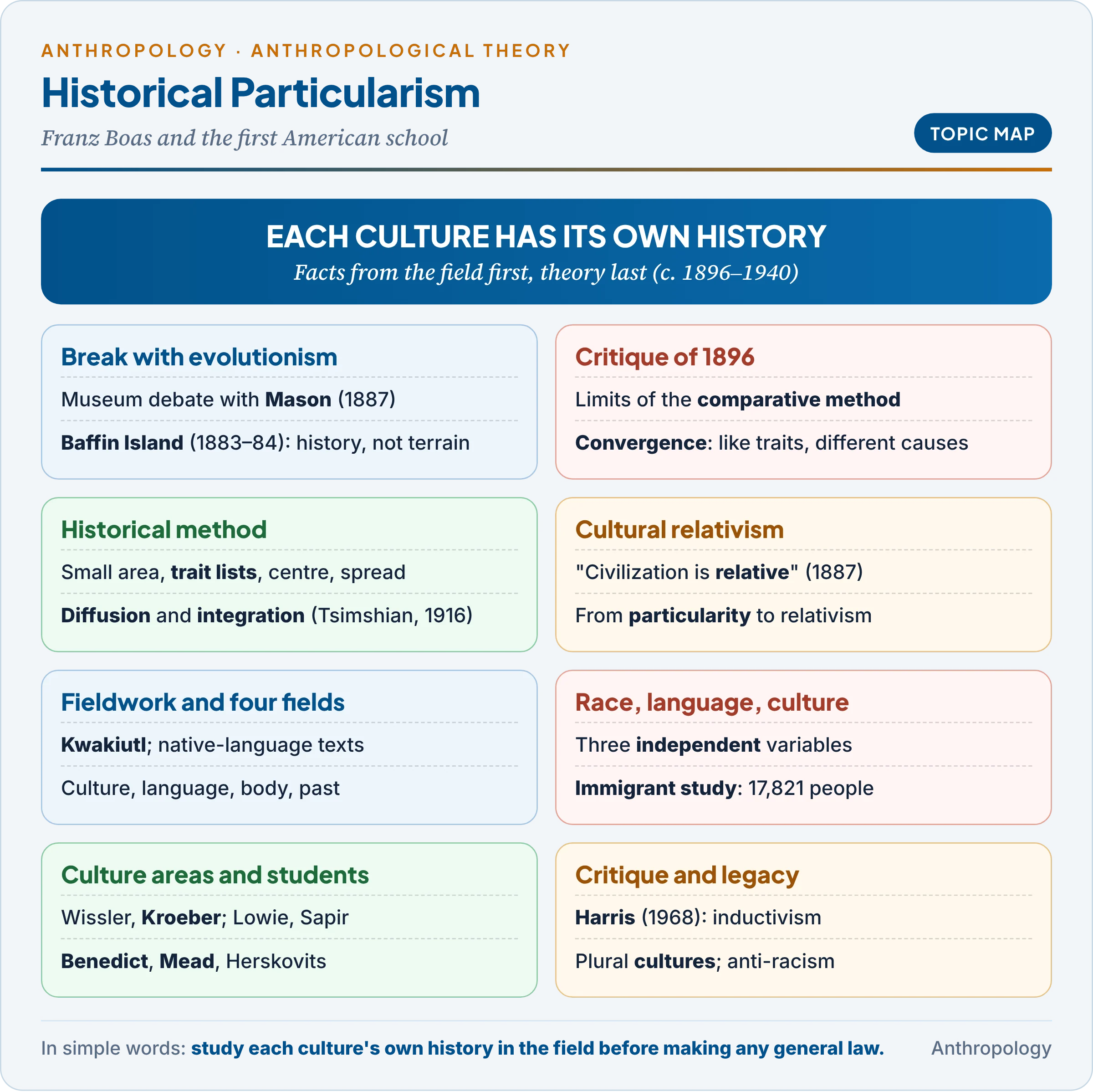
Historical particularism is the idea that every culture is the product of its own unique history. Instead of placing all peoples on one ladder of progress, it asks how each particular culture came to be what it is, and it insists on collecting facts in the field before building any theory.
Example first. In 1887 the US National Museum in Washington arranged its North American objects the way the evolutionists liked: all rattles together, all pipes together, all masks together, each row running from “simple” to “advanced”. Franz Boas, a young German-born scholar, objected in the journal Science. A Kwakiutl rattle, he argued, means nothing when placed beside a rattle from Africa; it makes sense only beside the masks, songs and ceremonies of the Kwakiutl themselves. He asked for a “tribal arrangement” of collections and concluded that “civilization is not something absolute, but … is relative, and … our ideas and conceptions are true only so far as our civilization goes”. The curator Otis T. Mason defended the arrangement by type. This museum quarrel already held the whole programme: context before classification, the particular culture before the general law.
- Who Boas was. Franz Boas (1858–1942), born in Minden, Germany, trained in physics and geography (PhD, Kiel, 1881), settled in the United States in 1887 and taught at Columbia University from 1896 (professor from 1899). He is called the “father of American anthropology”.
- The turning point. On Baffin Island (1883–84), where he went to study how Inuit (“Eskimo”) movement depended on ice and terrain, he found that environment limited but did not decide how people lived. Neighbouring Arctic peoples in similar environments lived differently because they had different traditions and histories. Geography, he concluded, plays a limiting rather than a creative role (The Central Eskimo, 1888).
- His philosophy of science. In “The Study of Geography” (1887), Boas separated the physicist, who seeks general laws, from the cosmographer, who wants to understand a phenomenon for its own sake, in all its detail. Historical particularism grew from this second attitude: a culture is worth understanding as a whole and in its own history, not only as a case of a law.
- What he opposed. Boas attacked the classical evolutionism of Tylor, Morgan and Frazer (Unit 6a): their belief that all societies climb one ladder from savagery through barbarism to civilization, that psychic unity (all minds work alike) makes peoples invent the same things in the same order, and that the comparative method can rebuild that ladder by arranging customs from all over the world. He also rejected the extreme diffusionism of the British and German schools (Unit 6c), which traced most of culture to one or a few centres.
- The name. Boas spoke of the “historical method”. The label historical particularism was coined by the American anthropologist Marvin Harris in The Rise of Anthropological Theory (1968), largely as a criticism (§8); it now names the first American school of anthropological thought.
2. The Critique of the Comparative Method (1896)
In simple words
The evolutionists believed that if two peoples had the same custom, they must have reached the same stage of progress. Boas showed that the same custom can arise in very different ways. So before comparing customs across the world, one must first find out how each custom actually developed in its own place.
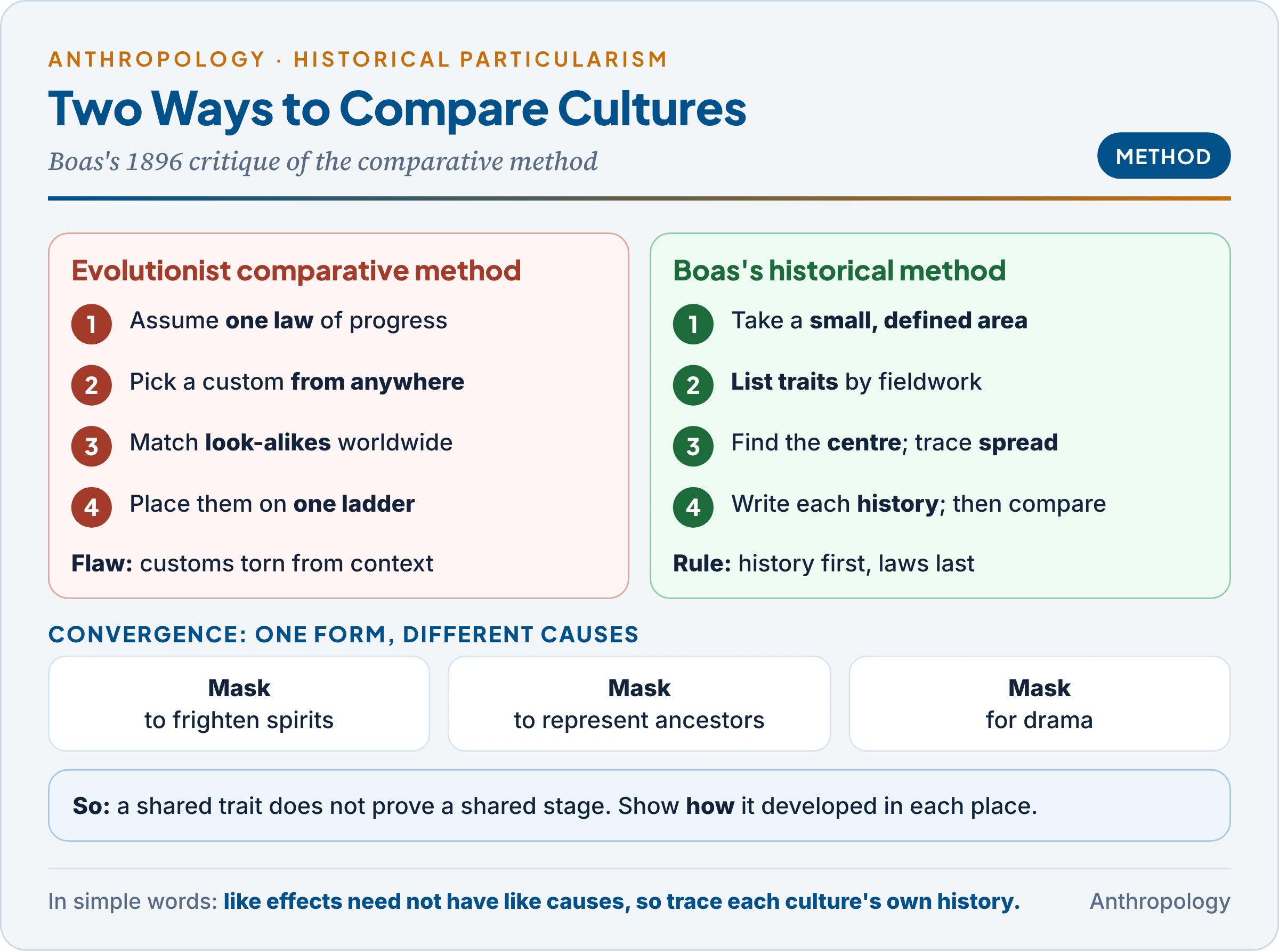
Boas’s most cited paper, “The Limitations of the Comparative Method of Anthropology” (Science, 1896), did not reject comparison. It rejected careless comparison: lifting a custom out of its setting, matching it with a look-alike elsewhere, and treating the match as proof of a universal stage. The table sets the evolutionist method beside Boas’s alternative, step by step.
| Question | Evolutionist comparative method | Boas’s historical method |
|---|---|---|
| Starting point | A general law of progress, assumed in advance | Detailed facts about one culture |
| Unit of study | A custom torn from its context | The whole culture of a limited area |
| Similar traits mean | The same stage reached by the same mind | Possibly different origins (convergence) or borrowing |
| Data | Reports of travellers and missionaries | Fieldwork, native texts, the people’s own language |
| Order of work | Theory first, examples fitted to it | History first, generalisation last |
| Aim | Rebuild the history of mankind | Rebuild the history of each culture, then compare histories |
The heart of the critique is the word convergence. Boas pointed out that similar results can come from different causes: masks may be worn to frighten spirits, to represent ancestors, or for drama, so a mask among two peoples does not prove the same belief or the same stage. Geometric designs may grow out of realistic pictures in one place and turn into realistic pictures in another. Because like effects need not have like causes, a world-wide comparison of look-alikes proves nothing until the history of each case is known.
- The positive programme. Boas asked that each culture be studied in a small, well-defined area, that the distribution of its traits be mapped, and that borrowing (diffusion) and independent invention be weighed case by case. Only after many such histories were known could laws of cultural growth be sought.
- Not anti-comparison. Boas wrote that the historical and comparative methods should check each other. His target was the unilinear use of comparison, not comparison as such.
- A supporting idea. His student Alexander Goldenweiser stated the principle of limited possibilities (1913): since there are only a few ways to make a boat or organise descent, unrelated peoples may arrive at similar solutions. This explains similarity without either a single ladder or borrowing.
The paper changed the burden of proof. Before 1896 a look-alike custom was taken as evidence of a universal stage; after it, the scholar had to show how the custom developed. That shift is why the 1896 paper is treated as the founding text of historical particularism (Unit 6a, §7.1, lists it among the critics of evolutionism).
3. Historical Particularism: Core Ideas and Method
In simple words
Every culture is like a person with a life story: it has met its own neighbours, borrowed some ideas, invented others and reshaped them all to fit together. To understand it, one has to reconstruct that story from careful fieldwork.
3.1 Core ideas
- Each culture has a unique history. A culture is the product of particular events: migrations, contacts, inventions and borrowings. It is intelligible only through that history, not through a universal scheme.
- Three kinds of causes. In “The Methods of Ethnology” (1920), Boas named environmental conditions, psychological factors (the general workings of the human mind) and historical connections as the forces shaping a custom. Historical connections were the most important for him, which is why the label “historical” fits.
- Diffusion and integration. A culture’s inventory is cumulative: much of it is borrowed. But borrowed elements do not sit loosely; each people reinterprets them to fit its own pattern. Boas saw culture change as the joint work of diffusion (spread of traits by contact) and integration (the reshaping of borrowed traits into the local whole).
- Induction. Theories must grow out of data. Boas thought general laws might eventually be found, but late in life grew sceptical because cultural phenomena are too complex for simple laws.
- No ranking. Since each culture is a unique historical product, there is no single scale on which to call one “savage” and another “civilized”. This leads directly to cultural relativism (§4).
3.2 The method in steps
The textbooks reduce Boas’s procedure to four steps. They are a teaching summary of what he practised, not a recipe he published.
- Trait listing. Record, through fieldwork, the traits of the cultures in a small region where similar cultures exist. A culture trait is the smallest identifiable unit of culture: a tool, a myth motif, a ritual act.
- Locating the centre. Find the place where the traits characteristic of the area are most concentrated.
- Tracing spread. Use the continuous distribution of traits to establish their common origin and the paths along which they spread. Continuity of distribution is the main proof of a historical connection.
- Writing the history. Reconstruct the history of each culture and then link the histories of the whole area.
The Tsimshian case. In Tsimshian Mythology (1916), Boas compared the tales of the Tsimshian of the North Pacific Coast (British Columbia) with the versions told by their neighbours. He broke each tale into separate incidents and mapped where each incident occurred. Three conclusions followed:
- Similar tales among neighbours came from diffusion, not from independent invention.
- Tales did not travel as wholes: each incident had its own history of spread.
- Each people retold the borrowed incidents as one coherent story, reshaped to fit its own values. Borrowed parts, unified by local reinterpretation, made a new whole.
The Tsimshian work shows the method at its best: a limited area, massive detail and a conclusion that is historical (how these tales spread), not evolutionary (what stage of mind they show). It also shows the cost: years of work yield a history of one region’s folklore, not a general theory.
4. Cultural Relativism and Cultural Particularity
In simple words
If every culture has grown along its own path, then it has its own standards of right, beautiful and true. Cultural relativism is the rule that we should understand a custom by the standards of the people who practise it, before judging it by our own.
Example first. In “On Alternating Sounds” (1889), Boas answered linguists who said that some Native American languages were “primitive” because speakers seemed to pronounce the same word in different ways. Boas showed that the hearers, not the speakers, were at fault: the listeners heard the sounds through the categories of their own language and so missed the regular pattern of the other. What looked like disorder was a different order. The lesson extends to every custom: an observer’s perception is shaped by his own culture, so judgment must begin from the other culture’s own categories.
4.1 From particularity to relativism
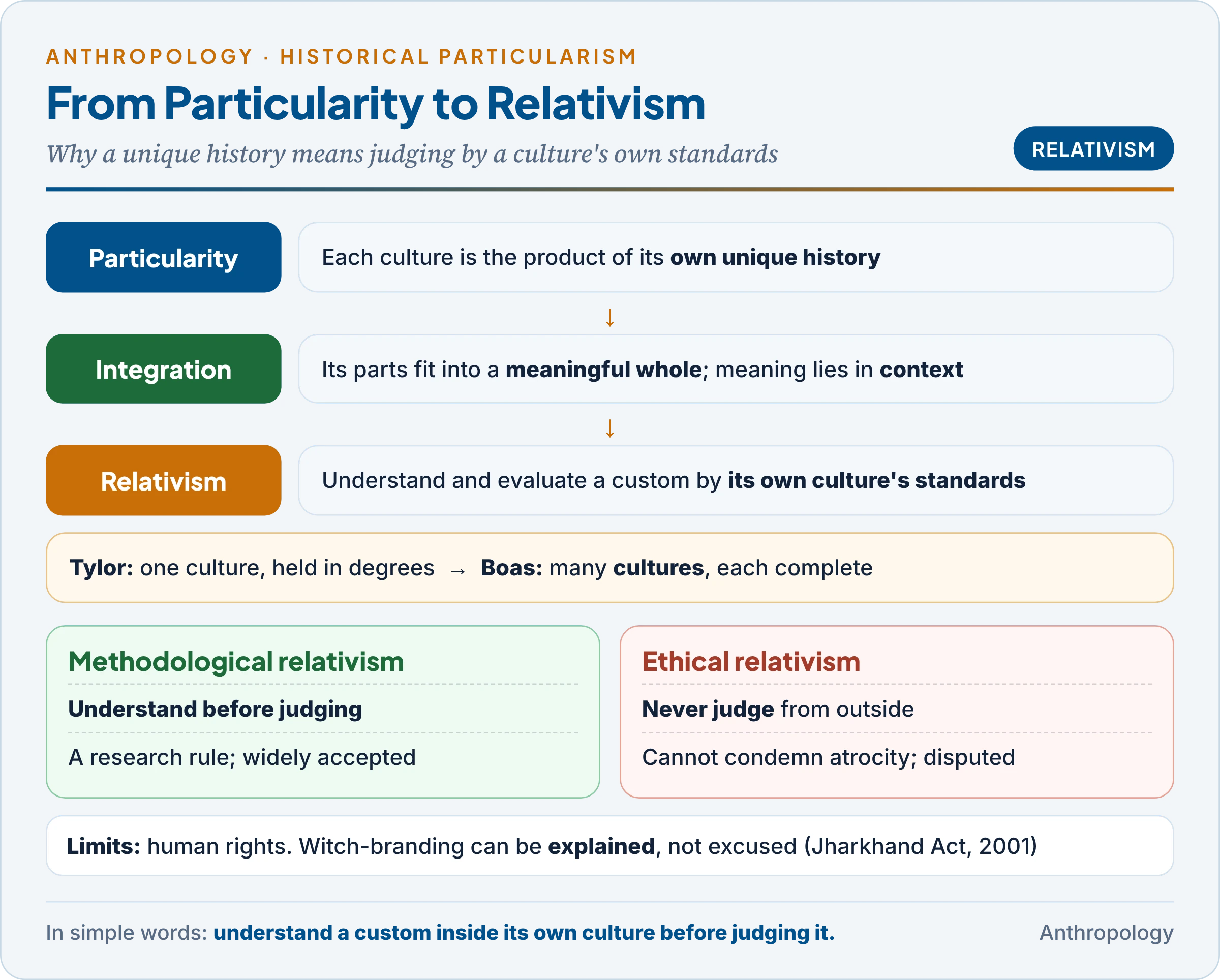
The two ideas are linked as a chain of reasoning, which the image below also draws.
- Particularity (a fact about history): each culture is a unique product of its own past.
- Integration (a fact about structure): each culture fits its parts into a meaningful whole, so a custom’s meaning lies in its context.
- Relativism (a rule of method): therefore a custom must be understood and evaluated in terms of that whole, not by an outside yardstick.
- Plural “cultures”: the historian George Stocking showed that Boas changed the meaning of “culture” itself. For Tylor there was one culture, possessed in greater or lesser degree; after Boas anthropologists spoke of cultures, plural, each equally a culture.
- The term. Boas never used the phrase. The first recorded use of “cultural relativism” is by the philosopher Alain Locke in 1924, describing the “extreme cultural relativism” of Boas’s student Robert Lowie. The concept was developed most fully by Melville Herskovits (Man and His Works, 1948), and the term became common only after Boas’s death.
- Why it mattered then. It was a weapon against ethnocentrism (judging others by one’s own culture as the standard) and against the racial ranking of peoples current in the early twentieth century (§6).
4.2 Two kinds of relativism
Relativism is debated because it can mean two different things. The table separates them.
| Basis | Methodological relativism | Ethical (moral) relativism |
|---|---|---|
| Claim | Understand a custom in its own context before judging | No custom can ever be judged from outside |
| Status | A research rule; nearly all anthropologists accept it | A philosophical position; widely disputed |
| Example | Explaining why a community practises bride-price | Saying witch-hunting is beyond criticism because it is local |
| Problem | Few | Cannot condemn genocide, slavery or caste atrocity |
Boas’s own position was methodological: he condemned racism and war in the strongest terms, which an ethical relativist could not do. The danger of ethical relativism appeared in 1947, when the American Anthropological Association, in a statement drafted by Herskovits, warned the UN that a universal declaration of human rights might impose Western values; the statement was later criticised for leaving no ground to oppose oppression. Today most anthropologists hold relativism as a method of understanding and accept human rights as its limits.
Common confusion
Does cultural relativism mean that “anything goes”? No. Relativism asks us to understand before we judge, and to judge with knowledge of context. It does not forbid judgment. India shows the balance: the Jharkhand Prevention of Witch (Daain) Practices Act, 2001 outlaws witch-branding, which an anthropologist can explain (fear of illness, land disputes, attacks on widows) without excusing it.
4.3 Relativism in Indian tribal policy
- Verrier Elwin, the British-born anthropologist of the tribes of central India and later adviser for NEFA (now Arunachal Pradesh), argued that tribal ways had value of their own and should not be swept aside by forced “civilising”. His folklore collections recorded myths and songs in the people’s own words, a practice associated with Boas and Tylor.
- Nehru’s Tribal Panchsheel, set out in his foreword to Elwin’s A Philosophy for NEFA (2nd ed., 1959), began with the principle that tribal people should develop “along the lines of their own genius” and that nothing should be imposed on them. This is relativism turned into policy: respect for each community’s path, within a framework of rights.
5. Fieldwork and the Four Fields
In simple words
Boas made anthropology a field science. He lived among the people he studied, learned their languages, wrote down their own words, and used all four branches of anthropology (culture, language, the body and the past) to understand one people as a whole.
5.1 The Boasian style of fieldwork
- Long, repeated fieldwork on the North Pacific Coast, above all among the Kwakiutl (now Kwakwaka’wakw) of British Columbia, from 1886 onward.
- Native-language texts. Boas recorded myths, recipes and ceremonies in the native language, with translations, because a people’s categories live in its words. His Kwakiutl collaborator George Hunt, of Tlingit and English parentage and raised among the Kwakiutl, wrote down thousands of pages for him (Kwakiutl Texts, 1902–05).
- Key informants. Boas relied on a few knowledgeable people, believing their accounts could reveal the cultural pattern.
- Salvage ethnography. He worked urgently to record cultures being destroyed by colonisation and disease. The potlatch (the Northwest Coast feast of giving away wealth to claim rank) was banned in Canada from 1885 to 1951, yet Boas documented it in detail.
- Large organised research. He directed the Jesup North Pacific Expedition (1897–1902) for the American Museum of Natural History, which studied peoples on both sides of the Bering Strait to test historical links between Asia and America.
Boas and the Polish-British Bronislaw Malinowski (Unit 6d) both made fieldwork the core of anthropology, but they asked different questions of it. The comparison is frequently set side by side.
| Basis | Boas (American) | Malinowski (British) |
|---|---|---|
| Main question | How did this culture come to be? (history) | How does this culture work now? (function) |
| Data | Texts, myths, measurements, distribution of traits | Daily life through participant observation |
| Informants | A few key informants; texts in the native language | The whole community observed in action |
| Time | Repeated short visits over decades | Long continuous stay (Trobriands, 1915–18) |
| Attitude to history | Central, reconstructed from evidence | Dismissed reconstruction as “conjectural history” |
| Unit | Culture and its history | Institutions meeting needs |
Both rejected the armchair. The difference is one of direction: Boas looked backward to explain a culture by its past, Malinowski looked around to explain it by its present working. The British charge that American reconstructions were hypothetical (§8) grows from this difference.
5.2 The four fields
Boas insisted that anthropology study culture, language, human biology and the past together. This four-field approach (socio-cultural, linguistic, biological and archaeological anthropology) became the structure of American anthropology departments.
- Why four fields? Each field checks the others. To trace a people’s history one needs its language (old contacts), its physical type (ancestry and change), its archaeology (time depth) and its culture.
- Why it mattered politically. The four fields allowed Boas to show, with evidence from each, that race, language and culture vary independently (§6), the core scientific argument against racism.
- In India. Indian anthropology kept a similar breadth: the University of Calcutta opened India’s first anthropology department in 1920, and the Anthropological Survey of India (1945) combined physical and cultural anthropology. The UPSC syllabus itself, with its biological, archaeological and socio-cultural units, follows this holistic tradition (Unit 1.3).
6. Race, Language and Culture
In simple words
In Boas’s time many scholars believed that “races” differed in intelligence and that a people’s race decided its language and culture. Boas proved, with measurements and fieldwork, that body, language and culture change independently of one another, so race cannot explain culture.
6.1 The independence thesis
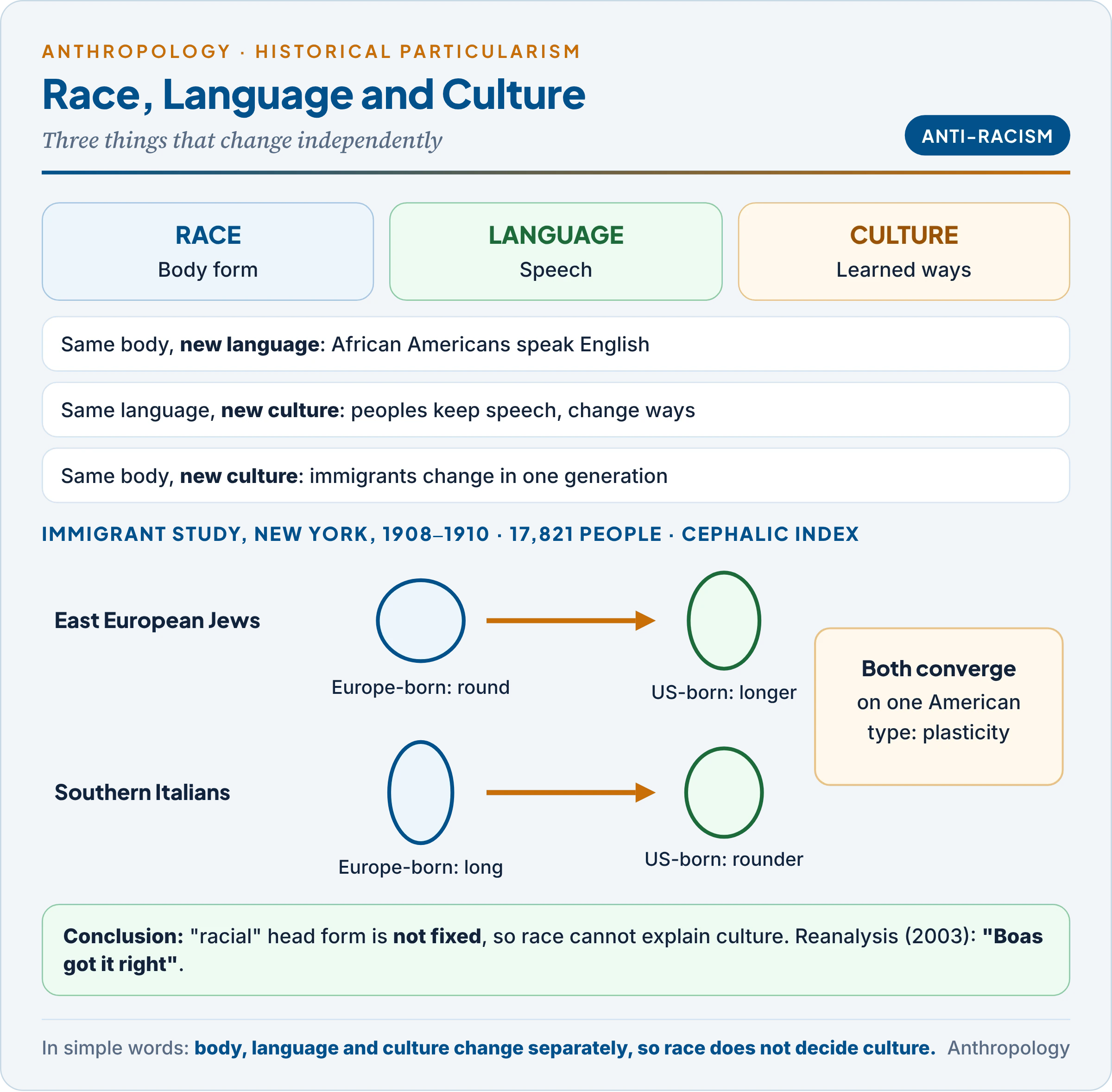
Boas’s central scientific claim, set out in his introduction to the Handbook of American Indian Languages (1911) and gathered in Race, Language and Culture (1940), was that race, language and culture are independent variables:
- A people can keep its physical type and change its language: African Americans speak English.
- A people can keep its language and change its culture: Hungarian speakers adopted much of European culture while keeping a non-Indo-European language.
- A people can change its culture without changing its body: immigrant groups in America changed their way of life in one generation.
If the three vary separately, then classifications of mankind by race, by language and by culture do not coincide, and race cannot be the cause of cultural difference. In The Mind of Primitive Man (1911), Boas concluded that differences between peoples come from history and environment, not from inborn mental capacity. The Nazis later burned the book.
6.2 The immigrant study (1908–1910)
Example first. For the US Immigration Commission, Boas and a team of 13 assistants measured 17,821 immigrants and their children in New York City between 1908 and 1910. The key measure was the cephalic index (head breadth as a percentage of head length), then treated as the most stable racial trait.
- Finding. Children born in America differed from their European-born siblings. East European Jews, who in Europe had round heads, had American-born children with longer heads; southern Italians, who had long heads, had children with rounder heads. Both moved towards a common American type, and the change was larger the longer the mother had lived in America before the birth.
- Why it mattered. If head form, the supposed “permanent” mark of race, changes in one generation under a new environment, then racial types are not fixed. This demonstrated human plasticity (the capacity of the body to change with environment).
- Reports. Boas reported to the Commission in 1910 and 1911, and published the full analysis as Changes in Bodily Form of Descendants of Immigrants (1912).
- Re-examination. In 2002 the physical anthropologists Corey Sparks and Richard Jantz (PNAS) argued that the effect was small. In 2003 Clarence Gravlee, H. Russell Bernard and William Leonard (American Anthropologist) reanalysed the raw data with modern statistics and concluded that “Boas got it right”: cranial form did respond to the environment.
6.3 Language and thought
- Boas showed that every language classifies experience in its own way and that speakers use these categories unconsciously. Languages of so-called primitive peoples are as regular and complex as European ones.
- This idea passed to Edward Sapir and his student Benjamin Lee Whorf, whose Sapir–Whorf hypothesis (that language shapes thought) is treated in Unit 7.
- Boas founded the International Journal of American Linguistics (1917), making the study of native languages a discipline in itself.
The three lines of work (bodies, languages, cultures) converge on one conclusion: human differences are historical, not hereditary. This made the Boasian school the scientific core of the twentieth-century case against racism, a theme carried forward in Unit 9.5.
7. Culture Areas and the Boasian Students
In simple words
To trace history without written records, Boas’s circle grouped neighbouring peoples with similar cultures into “culture areas” and studied how traits spread within them. Boas also trained a generation of students who carried his ideas into almost every branch of American anthropology.
7.1 Culture areas (in brief)
A culture area is a geographical region whose peoples share many culture traits because of common history and contact, such as the Plains of North America with the horse, the tipi and bison hunting. The idea began as a way to arrange museum collections (the curator Otis T. Mason spoke of “ethnic environments” in the 1890s) and was developed by Clark Wissler, Boas’s colleague at the American Museum of Natural History, in The American Indian (1917, fifteen areas), and by A.L. Kroeber in Cultural and Natural Areas of Native North America (1939). Wissler added the culture centre and the age-area principle (the more widely a trait is spread, the older it is).
For historical particularism the culture area was the practical unit of research: the “small, well-defined area” of the 1896 programme. Its full treatment (centre, margin, age-area, culture climax and the criticisms) belongs to the American school of diffusion in Unit 6c.
7.2 The students
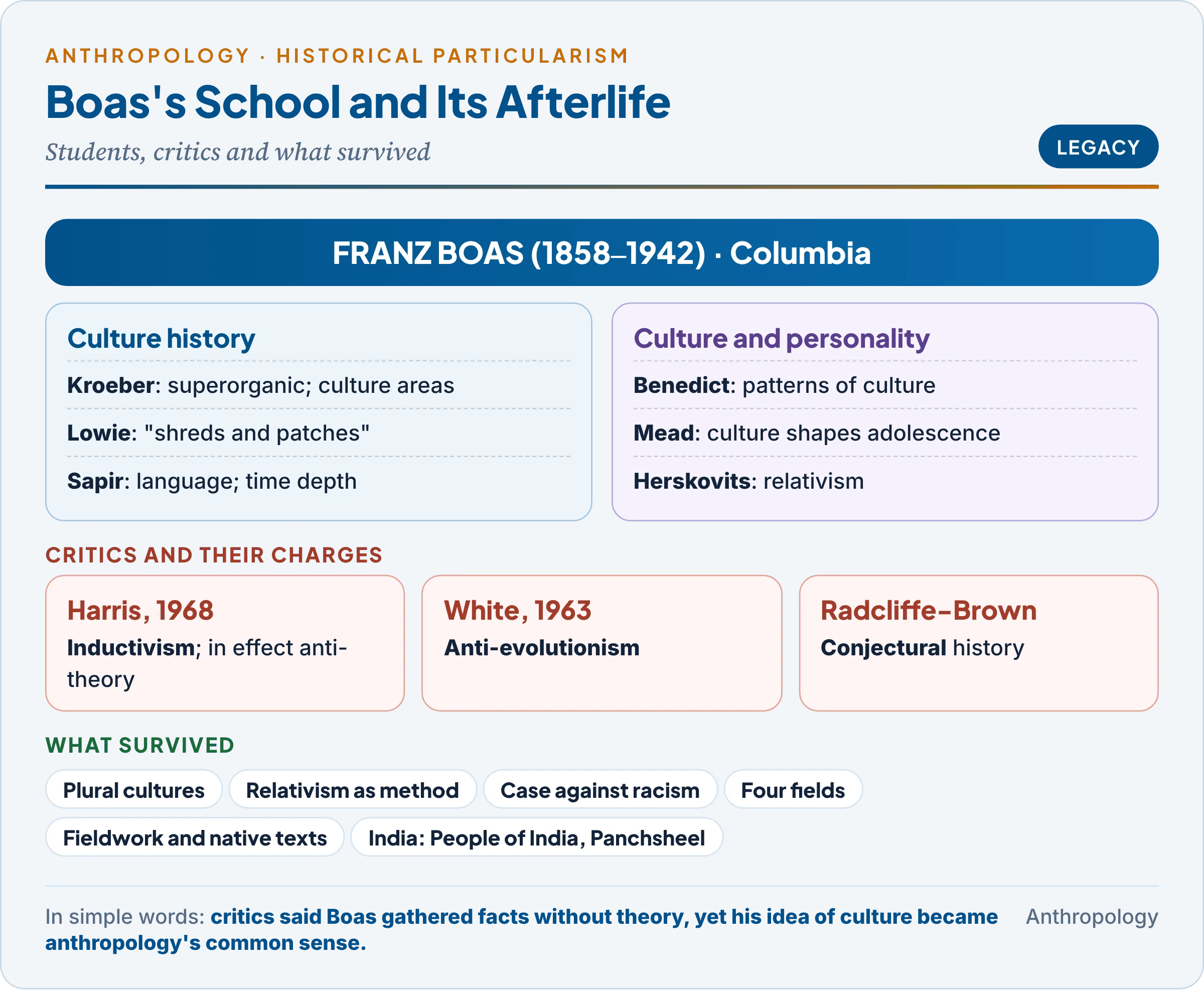
Boas supervised the first generation of American PhDs in anthropology. Each student took one strand of his work further, as the table shows.
| Student | Main work (year) | What they carried forward |
|---|---|---|
| A.L. Kroeber | “The Superorganic” (1917); Cultural and Natural Areas (1939) | Culture as a level above the individual; culture areas; first Columbia PhD in anthropology (1901) |
| Robert Lowie | Primitive Society (1920) | Attack on evolutionism: civilization a “planless hodge-podge”, a thing of “shreds and patches” |
| Edward Sapir | Language (1921); “Time Perspective in Aboriginal American Culture” (1916) | Linguistics; methods for inferring time depth from distributions |
| Ruth Benedict | Patterns of Culture (1934) | Integration: each culture as a coherent pattern (Zuni, Kwakiutl, Dobu) |
| Margaret Mead | Coming of Age in Samoa (1928) | Culture, not biology, shapes adolescence and gender |
| Melville Herskovits | Man and His Works (1948) | Cultural relativism systematised; African and African-American studies |
| Paul Radin | Primitive Man as Philosopher (1927) | The individual and native thought |
| Alexander Goldenweiser | “The Principle of Limited Possibilities” (1913) | Critique of evolutionism and of easy diffusionism |
| Zora Neale Hurston; Ella Deloria | Mules and Men (1935); Dakota Texts (1932) | Insider ethnography of African-American and Dakota life |
| Ashley Montagu | Man’s Most Dangerous Myth (1942) | The case against the race concept |
Two lines run from Boas through these students. One, through Kroeber, Lowie and Sapir, continued culture history: distributions, culture areas and language. The other, through Benedict and Mead, turned to culture and personality (Unit 6g): how each culture’s integrated pattern shapes the individual. Both rest on Boas’s idea of culture as learned, historical and plural.
Common confusion
Was Boas a diffusionist? He is often listed with the American school of diffusion because his method traced the spread of traits. But he rejected the extreme British claim (Egypt as the source of civilization) and the world-wide German culture circles. For Boas, diffusion was one historical process among several, to be proved case by case in a limited area, never a master key (Unit 6c).
8. Critique and Legacy
In simple words
Critics said that Boas collected mountains of facts but refused to build theories, so his school explained little. Yet his ideas about culture, race, relativism and fieldwork became the common sense of modern anthropology.
8.1 The critics
Each critic attacked a different weakness. The table names the critic, the charge and why it holds.
| Critic | Work (year) | Charge | Why the charge has force |
|---|---|---|---|
| Marvin Harris | The Rise of Anthropological Theory (1968) | Inductivism: facts were expected to “speak for themselves”; in effect an anti-theory programme | Facts never select themselves; without hypotheses, data piled up without explanation |
| Leslie White | “The Ethnography and Ethnology of Franz Boas” (1963) | Anti-evolutionism that blocked the study of cultural evolution for decades | General trends (foraging to farming to states) are real and can be studied without ranking |
| A.R. Radcliffe-Brown | Writings on method (1929 onwards) | Historical reconstruction without records is conjectural history | Many Boasian histories were inferences from distribution, not documented events |
| A.L. Kroeber | “History and Science in Anthropology” (1935) | Boas was not truly historical: he analysed processes but wrote few narrative histories | Even his student found the method fell between history and science |
| British social anthropologists | 1930s–50s | Stress on culture neglected social structure and institutions | Kinship and politics were often listed as traits, not analysed as systems |
| Later critics | 20th century | Salvage bias froze cultures in an imagined past; key informants gave a partial picture | Living, changing communities appeared as remnants |
The charge of inductivism is the deepest. Harris, the founder of cultural materialism (Unit 6i), argued that because Boas would not generalise until all the facts were in, and the facts are never all in, his programme postponed theory indefinitely. Defenders reply that Boas did produce strong general claims: the independence of race, language and culture; the plasticity of human form; the historical and integrated nature of culture. What he refused were unilinear laws built on poor data, and the evidence justified that refusal.
8.2 Ethics: the “Scientists as Spies” letter
In 1919 Boas wrote in The Nation that some anthropologists had used research as cover for spying in Central America during the First World War. The American Anthropological Association censured him; the censure was rescinded in 2005. The episode is an early statement of a basic rule of fieldwork ethics (Unit 8): research must never deceive the people studied.
8.3 What survived
- The plural, learned concept of culture, separated from race and from any scale of progress.
- Cultural relativism as the basic method of understanding another way of life.
- The scientific case against racism: plasticity, the independence of race, language and culture.
- Fieldwork and native-language texts: archives that communities today use to revive languages and ceremonies.
- The four-field structure of anthropology.
- A generation of students who founded culture-and-personality studies, American linguistics and modern culture history.
8.4 Historical particularism and India
- Documenting each community. The People of India project of the Anthropological Survey of India (launched 1985 under K.S. Singh) profiled 4,635 communities, each in its own terms. It is particularist in spirit: it records the distinct history and practices of every group rather than ranking them on a scale.
- Relativism in tribal policy. Elwin’s views and Nehru’s Panchsheel (§4.3) put the respect for each culture’s own path into the administration of the North-East.
- Against racial ranking. Colonial ethnography, notably H.H. Risley (The People of India, 1908), ranked castes partly by nasal and cranial indices. The Boasian demonstration that head form changes with environment undercut the scientific basis of such ranking (Unit 9.5).
Key Concepts
| Concept | Scholar | Meaning |
|---|---|---|
| Historical particularism | Boas (label by Harris, 1968) | Each culture is the product of its unique history |
| Historical method | Boas | Study a limited area in detail; compare histories, not look-alike traits |
| Convergence | Boas | Similar traits arising from different causes |
| Limited possibilities | Goldenweiser | Few possible solutions make unrelated peoples converge |
| Diffusion and integration | Boas | Borrowing of traits and their reshaping into the local whole |
| Cultural relativism | Boas; Herskovits | Judge a custom by its own cultural context |
| Cultures (plural) | Boas (per Stocking) | Many cultures, each complete, not one culture in degrees |
| Independence of race, language and culture | Boas | The three vary separately, so race does not cause culture |
| Plasticity | Boas | Body form changes with environment |
| Four fields | Boas | Cultural, linguistic, biological and archaeological anthropology together |
| Culture area | Wissler, Kroeber | Region of peoples sharing traits through history |
| Superorganic | Kroeber | Culture as a level above the individual |
| Shreds and patches | Lowie | Civilization built by borrowing, without a plan |
Major Works
| Scholar | Work | Year | Significance |
|---|---|---|---|
| Boas | Museum debate with Mason, Science | 1887 | Tribal arrangement; civilization is relative |
| Boas | The Central Eskimo | 1888 | First major ethnography |
| Boas | “On Alternating Sounds” | 1889 | Perception shaped by one’s own language |
| Boas | “The Limitations of the Comparative Method of Anthropology” | 1896 | Founding critique of evolutionism |
| Boas | Kwakiutl Texts (with George Hunt) | 1902–05 | Native-language texts |
| Boas | The Mind of Primitive Man | 1911 | No inborn mental difference between races |
| Boas | Handbook of American Indian Languages | 1911 | Language classifies experience |
| Boas | Changes in Bodily Form of Descendants of Immigrants | 1910–12 | Plasticity of head form |
| Boas | Tsimshian Mythology | 1916 | Diffusion and reintegration of tale incidents |
| Boas | “The Methods of Ethnology” | 1920 | Environment, psychology and history as causes |
| Boas | Primitive Art | 1927 | Art as historical and technical, not stage-bound |
| Boas | Anthropology and Modern Life | 1928 | Anthropology applied to race, eugenics and nationalism |
| Boas | Race, Language and Culture | 1940 | Collected essays; independence thesis |
Key Terms
| Term | Meaning in simple words |
|---|---|
| Historical particularism | Explaining each culture through its own unique history |
| Comparative method | Arranging customs from many peoples into stages of progress |
| Convergence | Similar customs arising from different causes |
| Culture trait | The smallest identifiable unit of culture, such as a tool or a myth motif |
| Diffusion | Spread of a trait from one people to another |
| Integration | Reshaping borrowed traits to fit the local culture |
| Induction | Building conclusions from collected facts rather than from a prior theory |
| Cultural relativism | Understanding a custom by its own culture’s standards |
| Ethnocentrism | Judging other cultures by one’s own as the standard |
| Four-field approach | Studying culture, language, biology and the past together |
| Cephalic index | Head breadth as a percentage of head length |
| Plasticity | The body’s capacity to change with the environment |
| Key informant | A knowledgeable member of a community who explains its culture |
| Salvage ethnography | Recording cultures thought to be disappearing |
| Culture area | Region whose peoples share many traits |
| Conjectural history | Reconstruction of the past without documentary evidence |
Contemporary Developments
- Boas’s hall, reimagined (2022): the Northwest Coast Hall of the American Museum of Natural History, which Boas laid out in 1899 with each people in its own section, reopened on 13 May 2022 after a five-year renovation co-curated with consulting curators from ten Northwest Coast Nations. It keeps Boas’s tribe-by-tribe plan but tells the story in Indigenous voices.
- Repatriation rules (2024): new US regulations under the Native American Graves Protection and Repatriation Act (NAGPRA) led the same museum to close its Eastern Woodlands and Great Plains halls in January 2024, extending the shift from outsiders’ collections to community consent.
- The immigrant data debate: the 2002 PNAS reanalysis (Sparks and Jantz) and the 2003 American Anthropologist reanalysis (Gravlee, Bernard and Leonard) reopened Boas’s plasticity finding; the latter, using his published raw data, supported his conclusion.
- Renewed interest in the Boas circle: the historian Charles King‘s Gods of the Upper Air (2019) presented Boas, Benedict, Mead, Deloria and Hurston as the founders of modern ideas of cultural diversity and anti-racism.
Diagrams to Master
- Topic map of the article.
- Comparative versus historical method (§2): the evolutionist ladder of look-alike traits beside Boas’s four steps; label convergence with the masks example.
- Particularity to relativism (§4): unique history, integration and context leading to relativism; separate methodological from ethical relativism.
- Race, language and culture (§6): three independent variables, with the immigrant study numbers (17,821; New York; 1908–10) and the two directions of change.
- Boas’s school (§7–8): students and their strands, the critics and their charges, and the legacy.
Revision Grid
| Scholar | Work (year) | Key idea |
|---|---|---|
| Boas | Museum debate (1887) | Tribal arrangement; civilization is relative |
| Boas | “Limitations of the Comparative Method” (1896) | Convergence; study one area’s history first |
| Boas | Mind of Primitive Man (1911) | No racial difference in mental capacity |
| Boas | Immigrant study (1908–12) | Head form changes in one generation |
| Goldenweiser | “Limited Possibilities” (1913) | Similar solutions from few options |
| Boas | Tsimshian Mythology (1916) | Incidents diffuse separately and are reintegrated |
| Kroeber | “The Superorganic” (1917) | Culture above the individual |
| Wissler | The American Indian (1917) | Fifteen culture areas |
| Lowie | Primitive Society (1920) | “Shreds and patches” |
| Mead | Coming of Age in Samoa (1928) | Culture shapes adolescence |
| Benedict | Patterns of Culture (1934) | Culture as an integrated pattern |
| Kroeber | Cultural and Natural Areas (1939) | Culture areas and climax |
| Herskovits | Man and His Works (1948) | Relativism systematised |
| White | 1963 | Boas as anti-evolutionist |
| Harris | The Rise of Anthropological Theory (1968) | Coined “historical particularism”; inductivism |
Previous Year Questions
Unit 6: Historical particularism (Boas)
- 2024Discuss historical particularism as a critical development to the classical evolutionism.
- 2021Write notes on Historical Particularism and Franz Boas, (in about 150 words).
- 2015Write a note in 150 words on Historical Particularism.
- 1997Critically examine the Historical Particularistic approach of Franz Boas to the study of culture.
- 1995What was Boas approach of studying primitive cultures ? Delineate the role of field work and history in anthropological study.
- 1991Write a note on Franz Boas.
- 1988Write a note on Franz Boas.
Related questions from other units
- 2023Unit 2.5: Critically discuss A. L. Kroeber’s contribution to kinship studies.
- 2022Unit 2.1: Discuss the historical and cultural contexts that led to superseding ethnocentrism with cultural relativism in anthropology.
- 2022Unit 8: Write the historical development of fieldwork tradition in anthropology till recent times.
- 2020Unit 2.1: Write notes on Human rights and Cultural relativism in about 150 words.
- 2020Unit 7: Write notes on Sapir-Whorf hypothesis in about 150 words.
- 2016Unit 8: Describe the evolution of fieldwork tradition in Anthropology.
- 2013Unit 2.1: Why has the concept of Cultural Relativism been so dear to anthropologists ? (250 words).
- 1997Unit 2.1: What do you understand by cultural relativistic approach and ethnocentric approach in the study of culture ? Discuss the logical premises of cultural relativist approach.
- 1984Unit 2.1: What is cultural relativism ? Evaluate its importance for the development of comparative method in social anthropology.
- 1983Unit 1.1: Analyse the comparative method of the nineteenth century anthropology and its limitations as to the nature and purpose of social-cultural anthropology.