

6 Anthropological theories: (a) Classical evolutionism (Tylor, Morgan and Frazer).
Official Syllabus: Paper I, Unit 6 (classical evolutionism)
1. What Classical Evolutionism Was
In simple words
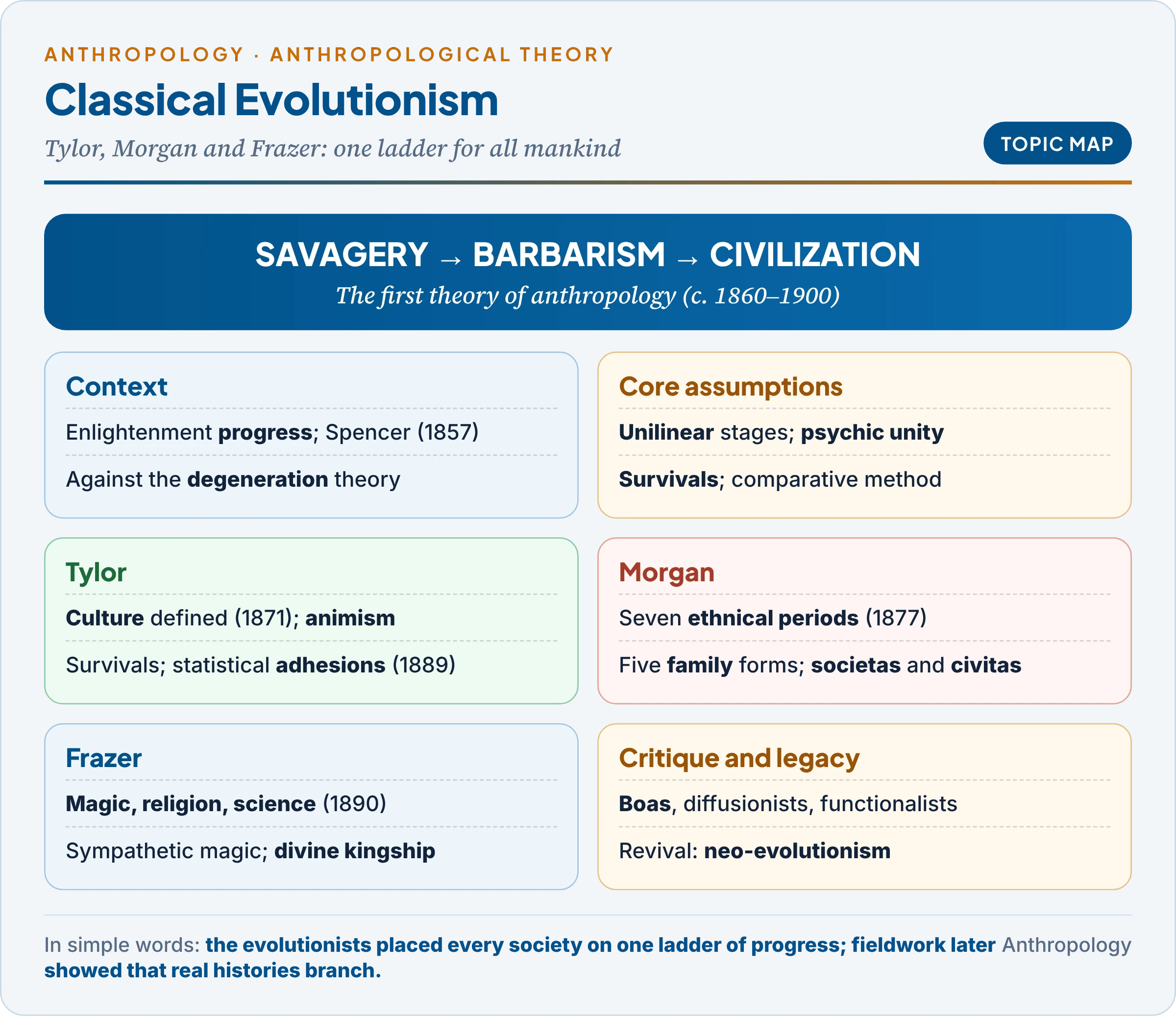
Classical evolutionism was anthropology’s first big theory. Its founders believed that all human societies climb the same ladder, from “savagery” through “barbarism” to “civilization”, and that living tribal peoples show us the lower rungs that Europeans had climbed long ago.
Example first. In the 1870s and 1880s, the British collector Augustus Pitt Rivers arranged weapons, boats and tools from all over the world not by region but by type, from the “simplest” to the “most advanced”: a throwing stick, then a boomerang, then a spear-thrower, then a bow. An Australian club and an English rifle stood in one sequence. His collection went to Oxford in 1884, the same year E.B. Tylor became Britain’s first university teacher of anthropology there. The display put the whole theory into a single room: one line of progress, with peoples placed at different points on it.
- Where it came from.
- Enlightenment ideas of progress: the French philosopher Montesquieu and the Scottish thinkers of the 18th century had already divided history into stages such as hunting, herding and civilization.
- Herbert Spencer, the English philosopher, wrote of social evolution (“Progress: Its Law and Cause”, 1857) before Darwin’s Origin of Species (1859). He defined evolution as change from “indefinite, incoherent homogeneity” to “definite, coherent heterogeneity”.
- Prehistoric archaeology: the discovery of stone tools with extinct animals, and John Lubbock‘s terms Palaeolithic and Neolithic (Pre-historic Times, 1865), made a long human past visible.
- Colonial expansion supplied masses of reports from travellers, traders and missionaries about peoples very different from Europeans, which needed explaining.
- What it opposed. The degeneration theory of Archbishop Richard Whately and others held that “savages” had fallen from an original civilised state. The evolutionists replied that the evidence (stone tools beneath metal ones, survivals of older customs) showed rise, not fall. This is why Tylor said that the “savage” is the ancestor, not the fallen descendant, of the civilised.
- Darwin’s place. Classical evolutionism was not simply Darwinism applied to society. Spencer, Tylor and Morgan built mainly on older ideas of progress; Darwin’s natural selection works through variation and chance, whereas their schemes were directional and predetermined.
The pioneers came from several countries and each traced the evolution of a different institution. The table groups them before the three named in the syllabus are taken up one by one.
| Scholar | Country | Work (year) | Evolutionary claim |
|---|---|---|---|
| Henry Maine | Britain | Ancient Law (1861) | Law moves “from Status to Contract” |
| J.J. Bachofen | Switzerland | Das Mutterrecht (1861) | Mother-right before father-right |
| J.F. McLennan | Scotland | Primitive Marriage (1865) | Marriage by capture; coined exogamy and endogamy |
| John Lubbock | Britain | The Origin of Civilisation (1870) | Religion from atheism to monotheism |
| Adolf Bastian | Germany | Der Mensch in der Geschichte (1860) | Elementary ideas common to all minds |
| E.B. Tylor | Britain | Primitive Culture (1871) | Culture and religion evolve; survivals |
| L.H. Morgan | USA | Ancient Society (1877) | Seven ethnical periods; family and property evolve |
| J.G. Frazer | Scotland | The Golden Bough (1890) | Magic, religion, science |
What unites them is the question they asked, “how did institution X begin and through which stages did it pass?”, and the method by which they answered it: arranging customs from all over the world in a sequence. What divides them is the institution each chose (law, marriage, family, religion), which is why their stage-sequences did not always agree.
2. Core Assumptions and Method
In simple words
The evolutionists made a few big assumptions. All human minds work alike, so all societies invent the same things in the same order. Societies move along one line, at different speeds. Customs that no longer make sense are leftovers from older stages, and by comparing living peoples one can rebuild the whole history of mankind.
The table lists the assumptions; the paragraph after it explains how they fitted together into one argument.
| Assumption | Meaning | Example | Weakness |
|---|---|---|---|
| Unilinear evolution | All societies pass through the same stages in the same order | Savagery, barbarism, civilization | Real histories branch and skip |
| Psychic unity of mankind | All human minds are basically alike | Similar myths and tools in unconnected places | Explains similarity, not difference |
| Progress | Change is upward: simple to complex, homogeneous to heterogeneous | Stone, then bronze, then iron | “Higher” judged by Victorian standards |
| Different rates | Societies move at different speeds along the one line | Europe “ahead”, Australia “behind” | Turns contemporaries into ancestors |
| Independent invention | Similar traits arise separately from similar minds | Agriculture in several centres | Underrates diffusion (borrowing) |
| Survivals | Customs that outlive their purpose reveal earlier stages | Blessing a sneeze | Present use is ignored |
| Comparative method | Living “primitives” stand for past stages; customs are compared across the world | Australians as “early man” | Data torn from context |
The assumptions form a chain. Psychic unity guarantees that all peoples will meet the same problems with the same solutions, so evolution must be unilinear. Since some peoples are slower, living foragers can stand for the past of civilised peoples. Survivals then confirm the order: a custom that is meaningless now must have made sense at an earlier stage. The comparative method assembles customs from everywhere into one ladder. If any link fails (if minds are alike but environments differ, or if customs spread by borrowing), the whole chain weakens.
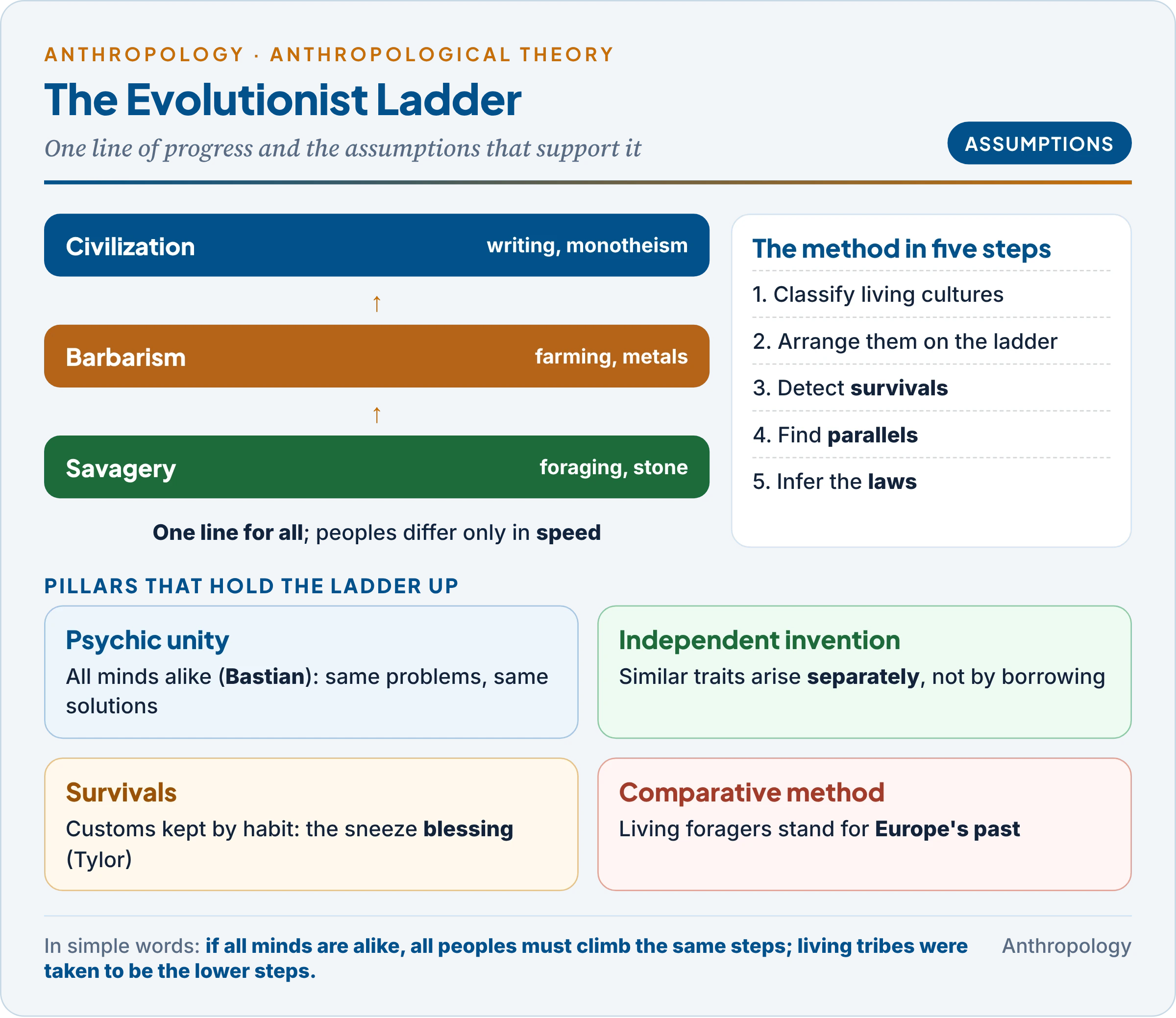
- Psychic unity. The German ethnologist Adolf Bastian separated Elementargedanken (elementary ideas common to all humanity) from Völkergedanken (folk ideas, their local forms). The idea had a progressive side: it denied that “races” differed in mental capacity, and so separated culture from race.
- Survivals. Tylor coined the term: processes, customs and opinions carried by force of habit into a new state of society, where they remain as proofs and examples of an older condition. He compared the anthropologist to a geologist reading strata.
- Tylor’s examples include saying a blessing when someone sneezes, once a protection against spirits; archery surviving as sport after the bow had lost its use in war; and children’s games that preserve old rites.
- Morgan read kinship terms as survivals of earlier marriage forms (§4).
- The comparative method. Its steps were: classify living cultures; arrange them on the ladder; detect survivals; identify parallels (proof of psychic unity); and infer the laws of evolution. The method, its five steps and the critiques of Boas and later comparativists are treated in full in Unit 1.1; here it matters as the engine of evolutionist reasoning.
- Skipping stages and causes of change. The evolutionists allowed that a people could skip a stage by borrowing from a more advanced neighbour, which quietly admitted diffusion. They named internal causes (inventions, ideas, great individuals) and external ones (war, contact, borrowing). The claim, often listed among their tenets, that simpler societies have greater “evolutionary potential” is not theirs: it is the law of evolutionary potential of Sahlins and Service (1960; Unit 6h).
Common confusion
Did the classical evolutionists deny diffusion? Not entirely. Tylor accepted that culture spreads by borrowing as well as by invention, and his 1889 statistical study was attacked precisely because borrowing could make cases non-independent (Galton’s problem, Unit 1.1). Morgan gave far more weight to independent invention from psychic unity. What all of them shared was the belief that, whichever way a trait arrived, societies still passed through the same sequence of stages.
3. Edward Burnett Tylor (1832–1917)
In simple words
Tylor was the English scholar who made culture the subject of anthropology. He defined culture, traced religion back to belief in souls, and showed how old customs survive as clues to the past.
Example first. In 1856, a young English Quaker from a family of brass-founders travelled to Mexico with the archaeologist Henry Christy and saw ancient Aztec ruins beside living villages. His book Anahuac (1861) began a lifelong question: how did the cultures of mankind grow? That young man was Tylor, later called the “father of anthropology”. He became Reader in Anthropology at Oxford (1884), the first such post in Britain, and its first Professor (1896).
- Major works. Researches into the Early History of Mankind (1865); Primitive Culture (1871); Anthropology (1881), the first general textbook; “On a Method of Investigating the Development of Institutions” (1889).
- The definition of culture. “Culture or Civilization, taken in its wide ethnographic sense, is that complex whole which includes knowledge, belief, art, morals, law, custom, and any other capabilities and habits acquired by man as a member of society.”
- The word “acquired” separates culture from biological inheritance: culture is learned, so it can be studied as a natural science of its own.
- “Complex whole” treats every custom as part of one interrelated body, an early statement of holism.
- The definition uses culture and civilization as synonyms, because for Tylor all peoples had culture in different degrees: a single scale, not separate cultures.
- The science of culture. Tylor held that culture follows laws as nature does: “the uniformity which so largely pervades civilization may be ascribed, in great measure, to the uniform action of uniform causes“. He called anthropology “essentially a reformer’s science“, because it could expose superstitions as survivals and so clear them away.
- Three stages. Savagery (hunting and gathering, stone tools; animism), barbarism (domestication, metals, villages; polytheism) and civilization (beginning with writing; monotheism). Unlike Morgan, Tylor did not force named peoples into fine sub-stages.
- Animism. Religion began as belief in spiritual beings, inferred from dreams and death, and developed into polytheism and monotheism (Unit 5a §2 and Unit 5b §2).
- Statistical comparison (1889). Tylor tabulated customs across about 350 peoples to find “adhesions” (customs that regularly occur together), such as avoidance between a man and his wife’s parents where the husband lives with the wife’s family. This was the first statistical cross-cultural test (Unit 1.1).
Assessment.
- Lasting: the concept of culture; separation of culture from race; animism and survivals as analytical tools; the first statistical comparison; anthropology as a university discipline.
- Criticised: an armchair scholar relying on others’ reports; intellectualist (he pictured early people as reasoning philosophers and neglected emotion and society); a single scale on which Victorian England stood highest; survivals ignore what a custom does now.
4. Lewis Henry Morgan (1818–1881)
In simple words
Morgan was an American lawyer who studied the Iroquois and then compared kinship terms from all over the world. He argued that human history passed through seven periods, each marked by an invention, and that family, government and property changed in step with technology.
Example first. In the 1840s Morgan, a lawyer in Rochester, New York, befriended the Seneca (an Iroquois nation) and their interpreter Ely S. Parker, and was adopted into the Hawk clan (1847). He noticed that a Seneca calls his father’s brother “father” and his mother’s sister “mother”, unlike English usage. Puzzled, he sent questionnaires across the world through missionaries and officials. Schedules from Tamil and Telugu speakers in South India came back showing the same pattern as the Seneca. A shared mind, not a shared history, seemed the only explanation for such distant parallels, and this led him to a universal theory of social evolution.
- Major works. League of the Ho-dé-no-sau-nee, or Iroquois (1851), an early ethnography; Systems of Consanguinity and Affinity of the Human Family (1871), which founded kinship studies; Ancient Society (1877), subtitled Researches in the Lines of Human Progress from Savagery through Barbarism to Civilization.
- Psychic unity and “germs of thought”. Morgan held that “the experience of mankind has run in nearly uniform channels“. All later institutions grew from a few germs of thought present in the mind from the earliest times, so peoples who never met developed alike.
- Four lines of progress. Ancient Society traces the growth of inventions and discoveries, of the idea of government, of the idea of the family and of the idea of property. Morgan’s distinctive claim is that these move together: a change in technology and subsistence brings changes in family, government and property.
4.1 The seven ethnical periods
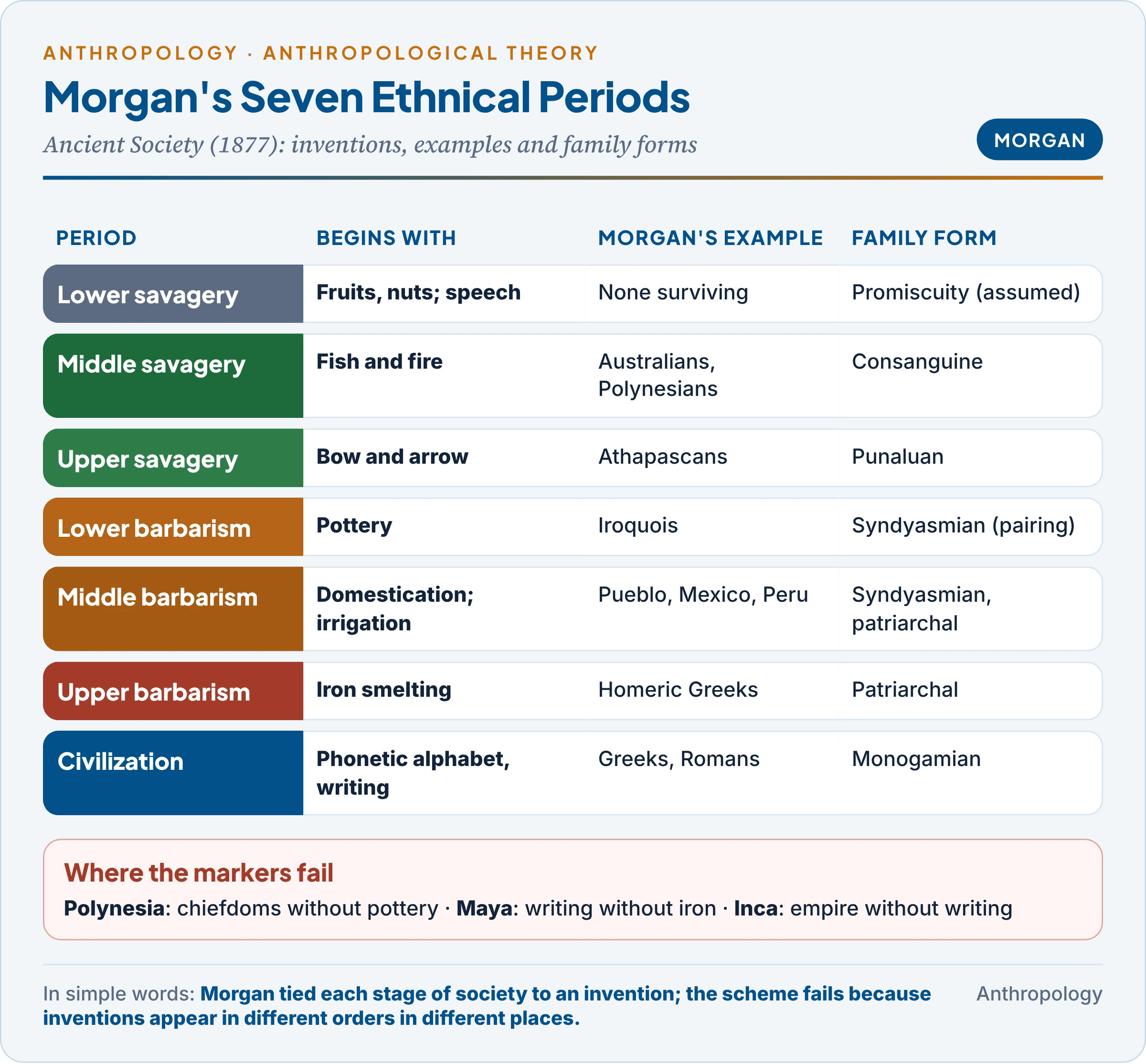
Morgan divided savagery and barbarism into lower, middle and upper periods, each opened by a technological marker. The table gives his scheme with the peoples he placed in each period.
| Ethnical period | Begins with | Morgan’s example |
|---|---|---|
| Lower savagery | Infancy of mankind; fruits and nuts; speech | None surviving |
| Middle savagery | Fish subsistence and fire | Australians, Polynesians |
| Upper savagery | Bow and arrow | Athapascans of Hudson’s Bay |
| Lower barbarism | Pottery | Iroquois and tribes east of the Missouri |
| Middle barbarism | Domestication (Old World); irrigation, adobe and stone (New World) | Village Indians of New Mexico, Mexico, Peru |
| Upper barbarism | Iron smelting | Homeric Greeks, Germans of Caesar’s time |
| Civilization | Phonetic alphabet and writing | Greeks, Romans, modern Europe |
The scheme’s strength is its materialism: it ties social stages to subsistence and technology, which later evolutionists (§7) found useful. Its weakness is that the markers do not travel. Polynesians built large chiefdoms without pottery; the Maya had writing and cities without iron; the Inca ran an empire without writing. A single invention cannot define a stage for all humanity.
4.2 Evolution of the family
Morgan read kinship terminologies as fossils of earlier marriage forms: terms change slowly, so a term that groups many relatives together must record a time when those relatives really were equivalent. On this reasoning he proposed five forms of family.
- Consanguine family: group marriage of brothers and sisters within one generation. Evidence: the Hawaiian (Malayan) terminology, which calls all men of the parents’ generation “father”.
- Punaluan family: group marriage of several brothers with each other’s wives, or sisters with each other’s husbands, but brothers and sisters excluded (from Hawaiian punalua, “intimate companion”). Here began the incest taboo and the gens (clan). Evidence: Turanian-Ganowanian (Iroquois and Tamil-type) terms.
- Syndyasmian (pairing) family: a man and woman pair, but the bond is easily dissolved.
- Patriarchal family: a man rules several wives and dependants, as among Hebrew pastoral herders.
- Monogamian family: one man and one woman with exclusive cohabitation, tied to private property and inheritance by known heirs.
Before these, Morgan assumed a stage of primitive promiscuity. The sequence links family to property: the accumulation of property and the wish to pass it to one’s own children pushed society toward paternity certainty, and so toward monogamy.
- Criticism.
- No society practising promiscuity or consanguine group marriage has ever been found. The Finnish anthropologist Edward Westermarck (The History of Human Marriage, 1891) argued that pair-bonding is ancient and the family primeval.
- Malinowski (The Family among the Australian Aborigines, 1913) showed that the “lowest” Australians lived in individual families.
- The Hawaiian usage is classificatory: calling an uncle “father” marks a category of relatives, not group paternity. A.L. Kroeber (“Classificatory Systems of Relationship”, 1909) argued that terms reflect linguistic and psychological principles, not past marriage forms.
- Morgan’s six-type labels for terminologies (Hawaiian, Eskimo, Iroquois, Crow, Omaha, Sudanese) are not his: they come from G.P. Murdock (Social Structure, 1949). Morgan’s own division was descriptive versus classificatory (Unit 2.5b).
4.3 Government and property
- Government. The idea of government grew through gens (clan), phratry (group of gentes), tribe and confederacy of tribes, as in the League of the Iroquois. All these rest on personal relations of kinship, which Morgan called societas. The Greek and Roman state, by contrast, rests on territory and property (civitas). The shift from kinship to territory as the basis of political order is his most durable insight in political anthropology (Unit 4a).
- Property. Property passed by three successive rules of inheritance: first to the gentiles (members of the whole clan), then to agnatic kin (relatives through males), and finally to the owner’s children. Morgan saw early society as communistic in household life and property.
- Marx and Engels. Karl Marx made notes on Ancient Society, and Friedrich Engels built on them in The Origin of the Family, Private Property and the State (1884): monogamy, private property and the state arose together, and the subjection of women was linked to private property. Through Engels, Morgan became a founding figure of Marxist anthropology.
Assessment.
- Lasting: kinship as a field of study; the descriptive-classificatory distinction; the link between technology, economy and social organisation; the shift from kin to territory in the rise of the state; field research among the Iroquois; the first world survey by questionnaire.
- Criticised: stages imposed on data; named peoples treated as living fossils; family stages unsupported; terms misread as survivals; ethnocentric labels “savage” and “barbarian”.
5. James George Frazer (1854–1941)
In simple words
Frazer was a Scottish classical scholar who collected customs from every part of the world into a huge book, The Golden Bough. He argued that human thought passed from magic to religion to science, and his vivid writing made anthropology famous far beyond the universities.
Example first. At Nemi, near Rome, an ancient rule said that the priest of Diana’s grove, the “King of the Wood“, held office only until a runaway slave broke a bough from a sacred tree and killed him, becoming priest in his turn. Frazer set out to explain this strange rule. His answer took him through divine kings whose health was thought to sustain the land (and who were therefore killed before they weakened), corn spirits, scapegoats and dying-and-rising gods such as Adonis, Attis and Osiris. The explanation grew into The Golden Bough: two volumes in 1890, three in 1900, twelve in the third edition (1906–1915), and a one-volume abridgement in 1922.
- Other works. Totemism and Exogamy (1910); Psyche’s Task (1909), arguing that superstition once supported useful institutions such as government, property, marriage and respect for life; The Belief in Immortality (1913–24); Folk-Lore in the Old Testament (1918).
- Method. Frazer was the purest armchair anthropologist. He gathered material from classical texts, folklore, missionaries and administrators, and drafted a questionnaire (“Questions on the Manners, Customs, Religion, Superstitions, &c. of Uncivilized or Semi-civilized Peoples”, 1887) for people in the field. He held the first chair of social anthropology, at Liverpool (1908), but did no fieldwork.
- Magic, religion, science.
- Magic. Early people believed that nature obeys fixed laws they could control, through the laws of similarity and contact (Unit 5b §7). Magic is thus a false science: “the bastard sister of science“.
- Religion. The shrewder minds noticed that magic failed. Concluding that nature is ruled by powerful beings, people turned to propitiating them: religion is “a propitiation or conciliation of powers superior to man”.
- Science. Careful observation revealed the true laws of nature, and science returned to magic’s view of a law-governed world, with correct laws. Frazer expected science to displace religion in turn.
- Magician to priest and king. Successful magicians gained prestige and authority, became priests and priest-kings; Frazer thus linked the evolution of thought to the origin of political power.
Assessment.
- Lasting: Frazer’s laws of sympathetic magic remain the standard classification; his collection gave the young discipline a vast store of comparative material; and his book inspired Malinowski, who said that reading The Golden Bough drew him to anthropology, as well as writers such as T.S. Eliot, whose notes to The Waste Land (1922) cite it.
- Criticised:
- Stages not found: magic, religion and science coexist in every society; Malinowski’s Trobrianders combined garden magic with sound farming knowledge (Unit 5b §8).
- Intellectualism: like Tylor, Frazer explained rites by mistaken reasoning, ignoring their expressive and social meaning. The philosopher Ludwig Wittgenstein (“Remarks on Frazer’s Golden Bough“, written 1931) objected that a rite is not a bad hypothesis but an expression of feeling, and remarked that Frazer was “much more savage than most of his savages”.
- Context lost: customs were torn from their societies and strung together by resemblance.
5.1 Frazer and the place of religion in modernity
Frazer’s sequence implied a prediction: as science advances, religion will fade. The German sociologist Max Weber (“Science as a Vocation”, 1917) described a similar “disenchantment of the world”. Yet religion has not disappeared. The American sociologist Peter Berger, once a leading theorist of secularisation, edited The Desecularization of the World (1999), conceding that most of the world remained “furiously religious“. In India, mass pilgrimages such as the Maha Kumbh (2025), the political weight of religious identity, and tribal campaigns for a Sarna religion code (Unit 5a) show religion adapting to modernity rather than vanishing. Science answered Frazer’s “how” questions; religion continues to answer questions of meaning, identity and community that science does not address.
6. Tylor, Morgan and Frazer Compared
In simple words
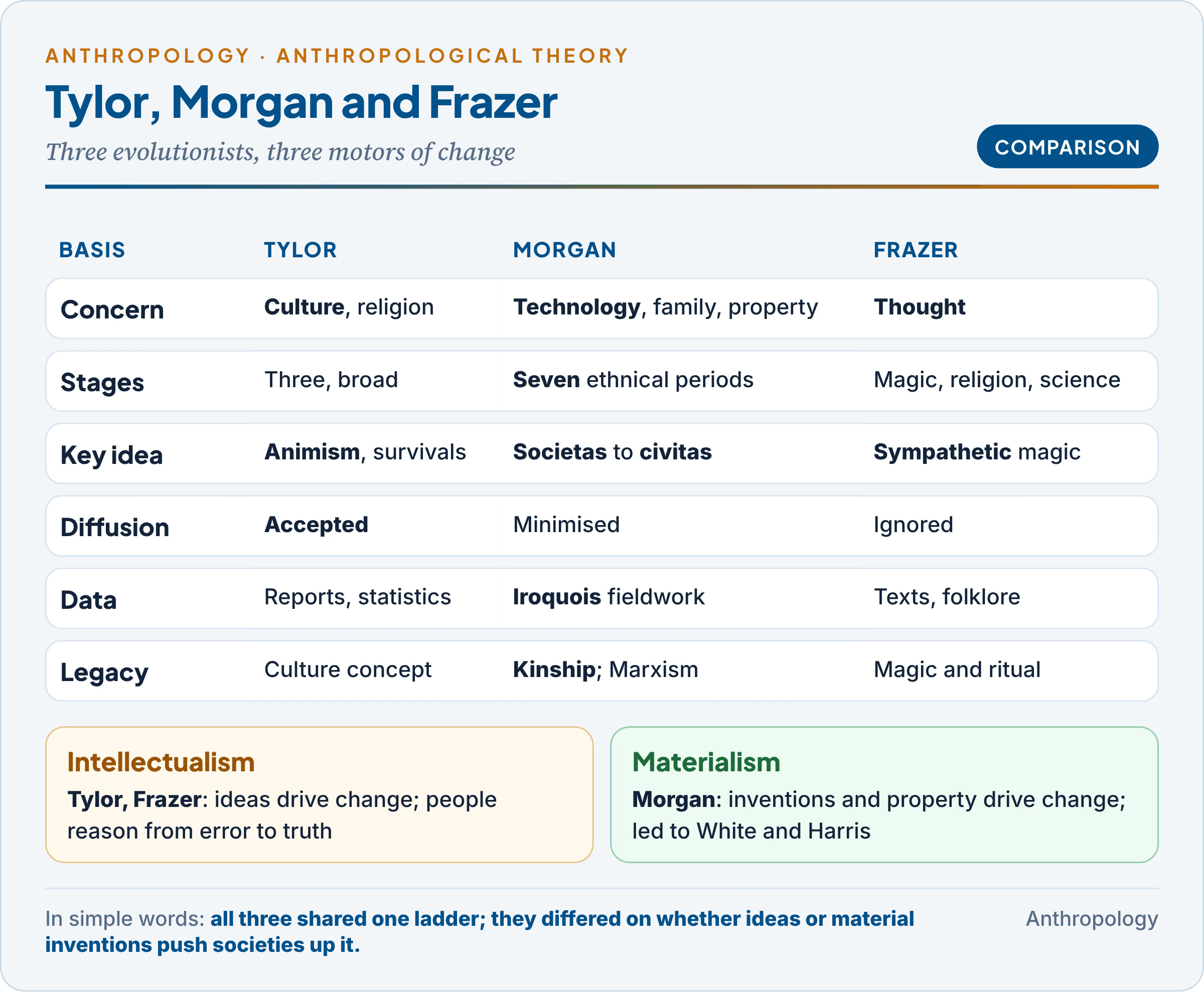
The three shared one big idea, that humanity climbs a single ladder, but each traced a different part of the climb: Tylor followed culture and religion, Morgan followed technology, family and property, and Frazer followed ways of thinking.
The table compares the three on the points most often asked. Read across each row to see where they agreed and where they parted.
| Basis | Tylor | Morgan | Frazer |
|---|---|---|---|
| Main concern | Culture, religion | Technology, family, government, property | Thought: magic, religion, science |
| Stages | Savagery, barbarism, civilization (broad) | Seven ethnical periods | Magic, religion, science |
| Stage criterion | Technology and religion | Inventions: fire, bow, pottery, iron, writing | Mode of thought |
| Key concepts | Culture, animism, survivals, adhesions | Germs of thought, societas and civitas, family stages | Sympathetic magic, divine kingship |
| Diffusion | Accepted alongside invention | Minimised; independent invention | Little attention |
| Data | Travel in Mexico; reports; statistics | Iroquois fieldwork; world questionnaire | Texts, folklore, questionnaire |
| Later influence | Cultural anthropology; cross-cultural method | Kinship studies; Marxist anthropology; neo-evolutionism | Study of magic and ritual; literature |
The deepest difference lies between Morgan’s materialism and the intellectualism of Tylor and Frazer. Morgan made technology and property the motor of change; Tylor and Frazer made ideas the motor, with people reasoning their way from error toward truth. This split runs through later theory: neo-evolutionists and cultural materialists followed Morgan (Units 6h, 6i), while the study of religion and symbolism followed the line from Tylor and Frazer, though in reaction against their intellectualism (Units 5a, 6j).
7. Critique and Legacy
In simple words
In the early twentieth century, anthropologists who did fieldwork found that real societies did not fit the ladder. Different schools attacked it for different reasons. Yet the evolutionists left lasting tools, and a reformed evolutionism returned in the mid-twentieth century.
7.1 The critics
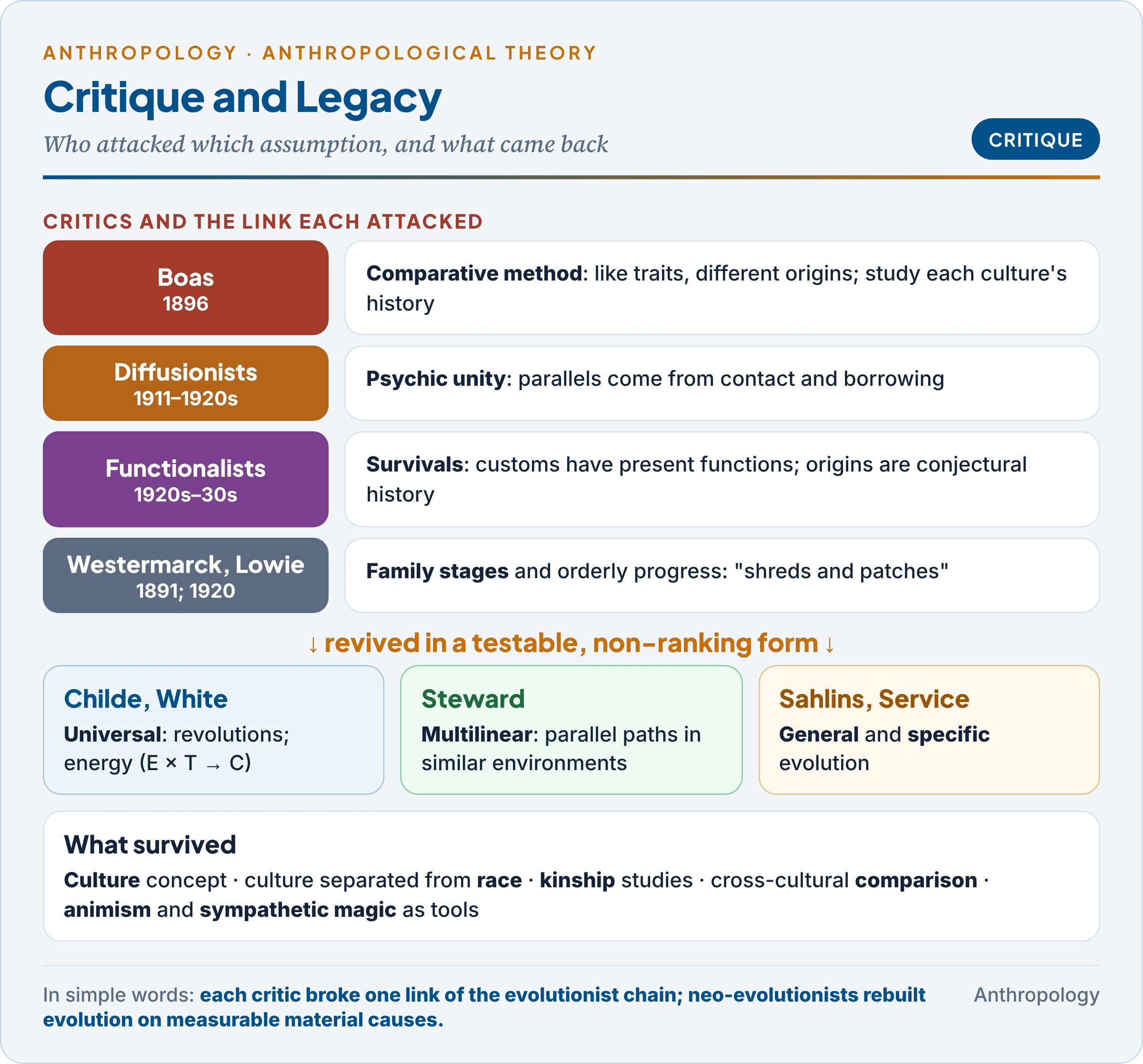
Each later school attacked a different link in the evolutionist chain (§2). The table matches the critic to the assumption attacked.
| Critic | Work (year) | Assumption attacked | Objection |
|---|---|---|---|
| Franz Boas (historical particularism) | “The Limitations of the Comparative Method of Anthropology” (1896) | Comparative method; independent invention | Similar traits may have different origins (convergence); each culture has its own history, to be studied in the field before any law is proposed |
| R.H. Lowie | Primitive Society (1920) | Orderly stages | Civilization is “that planless hodge-podge, that thing of shreds and patches“, built by borrowing |
| Diffusionists: Elliot Smith, Perry (Britain); Graebner, Schmidt (Germany-Austria); Wissler (USA) | 1911–1920s | Psychic unity, independent invention | Humans are uninventive; parallels show contact and borrowing from a few centres |
| Functionalists: Malinowski, Radcliffe-Brown | 1920s–1930s | Survivals; history of origins | A living custom has a present function, not a fossil meaning; origin stories are “conjectural history” |
| Westermarck; Malinowski | 1891; 1913 | Morgan’s family stages | The family is primeval; no promiscuity or group marriage found |
| Later critics | 20th century | Progress and ranking | Ethnocentric and tied to colonial rule; “savage” and “barbarian” are value judgments |
The critiques fall into two kinds. Empirical critiques (Boas, Westermarck, Malinowski) showed that the facts did not fit: stages were missing, skipped or reversed. Theoretical critiques (diffusionists, functionalists) replaced the question itself: diffusionists asked “where did a trait come from?”, functionalists “what does it do now?”. Together they ended evolutionism’s dominance by about 1920.
Common confusion
Was Boas against evolution? Boas did not deny that cultures change or that biological evolution occurred. He rejected unilinear schemes built from the armchair and the comparative method that supported them. His alternative was to reconstruct the particular history of each culture from detailed fieldwork, and only then to generalise (Unit 6b).
7.2 What survived
- The concept of culture (Tylor) and its separation from race through psychic unity.
- Anthropology as a discipline: university posts, museums, a general textbook.
- Kinship studies (Morgan), the descriptive-classificatory distinction and the world survey.
- Cross-cultural comparison: Tylor’s statistics led to G.P. Murdock‘s Human Relations Area Files (Unit 1.1).
- Analytical tools: animism, survivals, sympathetic magic, societas and civitas.
- A broad sequence that archaeology broadly confirms in outline: foraging before farming, villages before cities, writing appearing with early states, though without a single path or fixed rate.
7.3 Revival: neo-evolutionism
From the 1940s, American and British scholars revived evolution in a testable, non-ranking form (in full in Unit 6h).
- V. Gordon Childe, the Australian-born British archaeologist (Man Makes Himself, 1936), described the Neolithic Revolution (the shift to food production) and the Urban Revolution as turning points. The Neolithic is called a “revolution” because food production transformed population, settlement, property and social organisation as deeply as the Industrial Revolution later did.
- Leslie White, the American anthropologist who championed Morgan, measured cultural evolution by energy harnessed per person (E × T → C: energy times technology yields culture).
- Julian Steward (Theory of Culture Change, 1955) proposed multilinear evolution: parallel sequences in similar environments, not one universal path.
- Marshall Sahlins and Elman Service (Evolution and Culture, 1960) separated general evolution (increase in complexity across humanity) from specific evolution (adaptation of particular cultures).
The table sets out how the two kinds of evolutionism differ.
| Basis | Classical evolutionism | Neo-evolutionism |
|---|---|---|
| Path | Unilinear, one ladder | Universal (White, Childe) or multilinear (Steward) |
| Motor | Mind and ideas (Tylor, Frazer); inventions (Morgan) | Energy, technology, environment |
| Evidence | Armchair comparison of reports | Archaeology, fieldwork, cultural ecology |
| Ranking | Savage, barbarian, civilized | Complexity without moral ranking |
| Diffusion | Largely ignored | Accepted |
The shift is from stages of mind to stages of adaptation. Neo-evolutionists kept the idea that societies grow more complex, but explained it by material causes that can be measured, and accepted that different environments produce different paths.
7.4 Evolutionism and India
- Colonial ethnography carried evolutionist assumptions. H.H. Risley (The People of India, 1908) ranked castes partly by physical measurements, and census categories placed “animist” and “primitive” tribes at the bottom of a scale of civilisation.
- Indian data in evolutionist theory: Morgan’s Tamil and Telugu kinship schedules supported his “Turanian” family; the Toda and Nayar were cited as survivals of early marriage forms.
- Administrative legacy: the Dhebar Commission (1960–61) recommended special treatment for the least developed tribes, which led to the category of Primitive Tribal Groups (1975), renamed Particularly Vulnerable Tribal Groups in 2006. The criteria (pre-agricultural technology, low literacy, stagnant population) echo the old idea of technological stages, now used for targeted protection rather than ranking.
Key Concepts
| Concept | Scholar | Meaning |
|---|---|---|
| Unilinear evolution | All three | One sequence of stages for all societies |
| Psychic unity of mankind | Bastian, Tylor, Morgan | All human minds are basically alike |
| Elementary and folk ideas | Bastian | Universal ideas and their local forms |
| Comparative method | All three | Living peoples placed on the ladder as past stages |
| Survivals | Tylor | Customs outliving their purpose, clues to earlier stages |
| Culture as a complex whole | Tylor | Learned capabilities and habits of members of society |
| Animism | Tylor | Belief in spiritual beings; first religion |
| Adhesions | Tylor | Customs that regularly occur together |
| Ethnical periods | Morgan | Seven stages marked by inventions |
| Germs of thought | Morgan | Original ideas from which institutions grew |
| Consanguine to monogamian family | Morgan | Five-stage evolution of the family |
| Societas and civitas | Morgan | Kin-based versus territorial government |
| Sympathetic magic | Frazer | Magic by similarity and by contact |
| Magic, religion, science | Frazer | Three stages of thought |
| Divine kingship | Frazer | A king whose vigour sustains the land |
Major Works
| Scholar | Work | Year | Significance |
|---|---|---|---|
| Maine | Ancient Law | 1861 | Status to contract |
| Tylor | Researches into the Early History of Mankind | 1865 | Early comparative study |
| Tylor | Primitive Culture | 1871 | Culture defined; animism; survivals |
| Morgan | League of the Iroquois | 1851 | Early field ethnography |
| Morgan | Systems of Consanguinity and Affinity | 1871 | Founding work of kinship studies |
| Morgan | Ancient Society | 1877 | Ethnical periods; family, government, property |
| Tylor | Anthropology | 1881 | First general textbook |
| Engels | The Origin of the Family, Private Property and the State | 1884 | Morgan in Marxist theory |
| Tylor | “On a Method of Investigating the Development of Institutions” | 1889 | Statistical adhesions |
| Frazer | The Golden Bough | 1890; 3rd ed. 1906–15 | Magic, religion, science; divine kingship |
| Frazer | Totemism and Exogamy | 1910 | World survey of totemism |
Key Terms
| Term | Meaning in simple words |
|---|---|
| Evolutionism | The view that societies develop through ordered stages |
| Unilinear | Following a single line or path |
| Savagery, barbarism, civilization | The three main stages in the evolutionists’ scheme |
| Psychic unity | The idea that all human minds work alike |
| Survival | A custom kept by habit after its purpose has gone |
| Comparative method | Arranging customs from many peoples into a sequence |
| Degeneration theory | The view that “savages” had fallen from civilisation |
| Independent invention | The same trait arising separately in different places |
| Diffusion | Spread of a trait from one people to another |
| Ethnical period | One of Morgan’s seven stages |
| Classificatory terms | Kin terms that group several relatives under one word |
| Punaluan | Morgan’s group-marriage stage, after Hawaiian punalua |
| Societas | Society organised by kinship |
| Civitas | Society organised by territory and property |
| Intellectualism | Explaining customs as products of reasoning |
| Conjectural history | Guesswork about origins without evidence |
| Neo-evolutionism | Twentieth-century revival of evolution based on energy, technology and environment |
Contemporary Developments
- The Dawn of Everything (2021): the anthropologist David Graeber and archaeologist David Wengrow argued that archaeology shows early humans experimenting with many political forms, including seasonal shifts between hierarchy and equality, and attacked the stage sequence inherited from the evolutionists.
- Seshat databank (2018): a team led by Peter Turchin coded hundreds of past societies and reported (in PNAS) that measures of social complexity tend to rise together along one main dimension, a quantitative return to comparative evolution without moral ranking.
- Museums rethinking evolutionist displays: the Pitt Rivers Museum, Oxford, removed human remains, including the Amazonian tsantsa (shrunken heads), from display in 2020, acknowledging that its typological layout had presented peoples as “primitive” stages.
- PVTG programme: PM-JANMAN, launched on 15 November 2023, targets housing, roads, water, health and education for the 75 PVTGs, the category that descends from the “primitive tribe” label of the colonial and early post-colonial era.
Diagrams to Master
- Topic map of the article.
- Evolutionist ladder (§2): one line of stages held up by psychic unity, independent invention, survivals and the comparative method.
- Morgan’s ethnical periods (§4.1): seven rows with the marker, an example people and the family form; mark the Polynesia, Maya and Inca exceptions.
- Tylor, Morgan and Frazer (§6): a three-column comparison; label Morgan’s materialism against the intellectualism of the other two.
- Critique and legacy (§7): each critic against the assumption attacked, then the line to Childe, White, Steward, Sahlins and Service.
Revision Grid
| Scholar | Work (year) | Key idea |
|---|---|---|
| Spencer | “Progress: Its Law and Cause” (1857) | Homogeneity to heterogeneity |
| Bastian | Der Mensch in der Geschichte (1860) | Elementary and folk ideas |
| Maine | Ancient Law (1861) | Status to contract |
| Bachofen | Das Mutterrecht (1861) | Mother-right first |
| McLennan | Primitive Marriage (1865) | Exogamy; marriage by capture |
| Tylor | Primitive Culture (1871); 1889 | Culture; animism; survivals; adhesions |
| Morgan | Systems (1871); Ancient Society (1877) | Ethnical periods; family stages; societas and civitas |
| Engels | Origin of the Family (1884) | Monogamy, property, state together |
| Frazer | The Golden Bough (1890) | Magic, religion, science |
| Westermarck | History of Human Marriage (1891) | Family is primeval |
| Boas | “Limitations of the Comparative Method” (1896) | Convergence; history of each culture |
| Kroeber | “Classificatory Systems of Relationship” (1909) | Kin terms are not survivals |
| Lowie | Primitive Society (1920) | “Shreds and patches” |
| Childe | Man Makes Himself (1936) | Neolithic and Urban Revolutions |
| Murdock | Social Structure (1949) | Six terminology types |
| Steward | Theory of Culture Change (1955) | Multilinear evolution |
| Sahlins and Service | Evolution and Culture (1960) | General and specific evolution |
Previous Year Questions
Unit 6: Classical evolutionism (Tylor, Morgan and Frazer)
- 2025Critically examine James Frazer’s theory of evolutionism. Elucidate the place of religion in modernity.
- 2021Critically evaluate Lewis Morgan’s classification of family.
- 2015How did Morgan explain the evolution of marriage, family and Socio-Political organization and how did other evolutionists disagree with his explanation ?
- 2010Point out the differences in the concepts of classical evolutionism and neo- evolutionism in socio-cultural anthropology. Which stage of prehistoric culture is known as cultural revolution and why ?
- 1996Write a note on Classical evolutionism.
- 1988Write a note on 19th century evolutionism.
- 1985Write a note on Contributions of Morgan and Tylor in the history of anthropological thought.
- 1981Discuss the basic assumptions of 19th century evolutionism. Are these valid today?
Related questions from other units
- 2024Unit 6: Discuss historical particularism as a critical development to the classical evolutionism.
- 2015Unit 6: How do diffusionism and evolutionism differ as explanations of Culture Change?
- 2002Unit 1.8: Write a note on Universal Cultural Evolution.
- 1993Unit 6: How do the approach of the 19th Century Evolutionists differ from those of the Neo-Evolutionists ? Discuss.
- 1991Unit 1.4: Write a note on Social-cultural evolution.
- 1987Unit 5: Distinguish between religion and magic. Critically examine the different theories of religion and comment on their relevance today.
- 1984Unit 2.1: What is cultural relativism ? Evaluate its importance for the development of comparative method in social anthropology.
- 1983Unit 1.1: Analyse the comparative method of the nineteenth century anthropology and its limitations as to the nature and purpose of social-cultural anthropology.
- 1983Unit 1.4: Sociocultural evolution is not parallel to biological evolution in man. Substantiate.
- 1982Unit 1.3: Discuss the comparative method of cultural evolutionists, diffusionists and modern social anthropologists.