

1.8 Principles of Pre-historic: Archaeology, Chronology, Relative and Absolute Datings Methods; Cultural Evolution – Broad Outlines of Prehistoric cultures: Paleolithic, Mesolithic, Neolithic, Chalcolithic, Copper-Bronze Age and Iron Age
Official Syllabus: Paper I, Unit 1.8
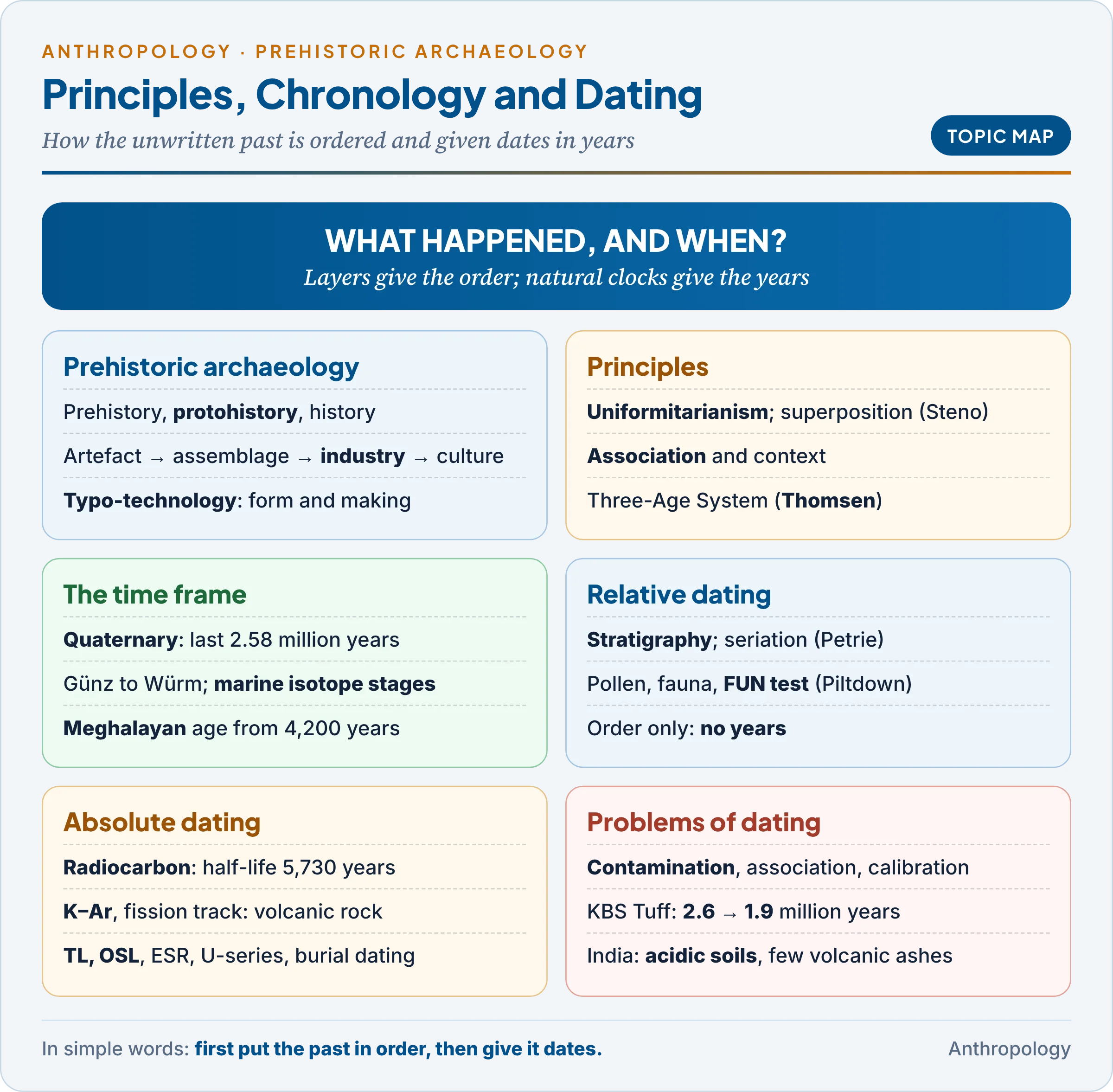
This article covers the principles of prehistoric archaeology, chronology and the relative and absolute dating methods. The cultures follow in Unit 1.8b (Palaeolithic) and Unit 1.8c (Mesolithic to Iron Age). The branch itself was introduced in Unit 1.3: in brief, archaeological anthropology reconstructs past ways of life from artefacts (objects people made or used), ecofacts (natural remains such as seeds and bones that reveal human activity) and features (hearths, pits and walls), through survey, excavation, recording and laboratory analysis.
1. Prehistoric Archaeology: Meaning and Basic Units
In simple words
Prehistoric archaeology studies the long human past before writing, using only what people left in the ground. Because no one wrote anything down, the archaeologist must work out both what happened and when it happened from stones, bones, soil and charcoal. Over 99% of the human story belongs to this unwritten past.
Example first. At Attirampakkam, near Chennai, hand-axes lie in clay beneath metres of later sediment. Nobody recorded who made them. Yet by reading the layers, the tools and the minerals in the clay, archaeologists showed that people made hand-axes there about 1.5 million years ago and that a lighter, flake-based technology replaced them about 385,000 years ago. That is prehistoric archaeology at work: a story of people, and a date for it, rebuilt from silent remains.
- Prehistory is the period before written records. The French archaeologist Paul Tournal used pré-historique for his cave finds in southern France around 1830, and the Scottish-Canadian scholar Daniel Wilson brought “prehistoric” into English in 1851.
- Indian archaeology uses a three-fold division: prehistory (no writing), protohistory (writing that cannot be read, as with the Harappans, or a people known only from outsiders’ accounts) and history (readable records).
- Aims of prehistoric archaeology: to build a time sequence (chronology), to reconstruct past ways of life (economy, settlement, technology, belief) and to explain how and why cultures changed.
- Why it is interdisciplinary: a single layer is dated by physicists, its pollen read by botanists and its bones identified by zoologists.
Prehistorians group remains into a ladder of units. The table gives each rung; notice that every higher unit is built by comparing many lower ones.
| Unit | Meaning in simple words | Example |
|---|---|---|
| Artefact | Any object made, modified or used by people | A hand-axe from Isampur |
| Assemblage | All the artefacts found together in one layer | Tools of one level at Singi Talav |
| Industry | Assemblages sharing the same types and techniques | The Acheulian |
| Culture | Recurring sets of tools, pottery, houses and burials reflecting a shared way of life | The Harappan culture |
| Tradition / horizon | Traits persisting over a long time / spreading fast over a wide area | Acheulian hand-axes / microliths |
An archaeological culture is a pattern in objects, from which the people behind it are inferred. The Australian-born prehistorian V. Gordon Childe, who systematised the idea, warned that a pot style does not automatically equal an ethnic group, a caution that matters whenever a tool type is tied to a “people”.
- Typo-technology is the standard way to study stone tools: typology classifies them by form and presumed function; technology reconstructs how they were made, the sequence of steps called the chaîne opératoire (French, “operational chain”).
- Why both are needed: two look-alike scrapers may be made by different methods, and the method reveals the makers’ planning and skill.
2. Principles of Prehistoric Archaeology
In simple words
Archaeology rests on a few rules of reasoning. The present helps us understand the past; lower layers are usually older; objects found together were usually used together; and tool styles change over time in a pattern. Each rule has exceptions, so archaeologists check one against another.
2.1 The founding principles
Example first. In 1859 the British geologist Joseph Prestwich and the archaeologist John Evans visited the gravel pits of Abbeville in France, where Jacques Boucher de Perthes had found hand-axes beside the bones of extinct elephants and rhinoceroses. Their verdict that people had lived alongside extinct animals established the antiquity of humans. In 1863 the British geologist Robert Bruce Foote found a hand-axe at Pallavaram, near Chennai, and founded Indian prehistory. Behind both conclusions lay a handful of principles.
- Uniformitarianism (“the present is the key to the past”): the processes that lay down gravel, silt and ash today worked the same way in the past (James Hutton, 1785; Charles Lyell, Principles of Geology, 1830–33). Why it matters: if a metre of river silt takes centuries to settle today, deep deposits imply great age; this gave prehistory its long time scale.
- Superposition: in an undisturbed deposit, lower layers are older than those above (the Danish scientist Nicolaus Steno, or Niels Stensen, 1669).
- Association and context: objects found together in a sealed layer were in use at about the same time. A find lies in primary context (undisturbed) or secondary context (moved by water, animals, ploughing or later digging). Why it matters: a hand-axe rolled by a river may be far older than its gravel; much of the Indian Lower Palaeolithic lies in river gravels, so many dates are only minimum ages.
- Faunal succession: species appear and vanish in a fixed order, so layers with the same fossils are of about the same age (the English surveyor William Smith, 1815).
- Typology: artefacts change in style and design in a traceable way (the Swedish archaeologist Oscar Montelius; the British soldier-archaeologist Augustus Pitt-Rivers).
- The Three-Age System: the Danish curator Christian Jürgensen Thomsen arranged the National Museum’s collection into Stone, Bronze and Iron Ages (1816–19; published 1836), and Jens Worsaae proved the order by excavation. John Lubbock split the Stone Age into Palaeolithic and Neolithic (Prehistoric Times, 1865); Hodder Westropp added Mesolithic (1866).
- Analogy with living peoples: present hunter-gatherers, potters and herders help explain how remains were made and left; ethnoarchaeology tests these analogies (Unit 1.3; Paper II).
- Formation processes: a site is shaped by cultural (discard, reuse) and natural (water, decay, burrowing) processes that must be “subtracted” before behaviour is read (the American archaeologist Michael Schiffer, 1976).
These principles work as checks on one another. Superposition gives order, association ties objects to it, faunal succession links distant sites, and typology fills gaps where layers are missing. When one fails (a burial pit cutting into older layers), the others expose the error.
Common confusion
Is ethnoarchaeology the same as classical archaeology? No. Ethnoarchaeology studies living people (how Yanadi fishermen of Andhra Pradesh use stone net-sinkers, for instance) to understand how prehistoric remains formed. Classical archaeology studies the literate civilisations of ancient Greece and Rome, where inscriptions and texts guide the digging. The first works from the present back to the past; the second works with written evidence beside the objects.
2.2 Form, space and time, and what people leave behind
The American archaeologist Albert Spaulding (1960) defined archaeology as the study of the interrelation of form, space and time in artefacts. Form is what the object is; space is where it lies in relation to other finds (a cluster of chips marks a workshop, hearths with charred bones mark cooking); time is the task of dating. A hand-axe without its layer and date is a curiosity; with them it becomes evidence.
Prehistoric remains are of three kinds, and each answers different questions.
| Kind of remains | Examples | What they reveal |
|---|---|---|
| The environment | Animal bones, pollen, phytoliths (silica bodies from plant cells), sediments | Climate, vegetation and the resources a group used (its cultural ecology) |
| Behaviour | Tools, waste flakes, hearths, ornaments, art, burials | Technology, trade, use of space, ritual |
| The people | Skeletons and teeth | Age, sex, health, injury, diet, care |
The three are read together. At Shanidar Cave, Iraq, the American archaeologist Ralph Solecki found a Neanderthal man with a withered arm and a blinded eye who had survived for years: the bones prove disability, his survival proves that others cared for him (Unit 1.6c). Every find is preserved, cleaned and catalogued with its exact location, treated (in Douglas Leechman‘s words) “as though it were the only one of its kind in the world”.
3. Chronology: Meaning, Importance and the Time Frame
In simple words
Chronology means putting past events in the right order and, where possible, giving them dates in years. Without it, archaeologists cannot say which culture came first, how fast things changed, or whether two sites were in use at the same time. Prehistoric chronology is set against the Earth’s geological history, especially the Ice Ages.
3.1 Why chronology matters
Example first. For decades the Soan pebble-tool industry of the Siwalik hills was thought an older, separate tradition from the Acheulian hand-axes of peninsular India. Once sites were dated, the Acheulian at Attirampakkam (about 1.5 million years) proved older than most Soan-type assemblages, and the two-tradition scheme had to be rethought (Unit 1.8b). A single reliable date changed the story.
- Sequence: which culture preceded which, so that change can be traced.
- Rate of change: the Acheulian lasted about 1.5 million years with little change, while Upper Palaeolithic traditions in Europe changed every few thousand years; only dates reveal this acceleration of cultural evolution.
- Contemporaneity: whether two sites or two human species coexisted (Neanderthals and modern humans in Europe about 45,000–40,000 years ago).
- Cause and effect: to link a cultural change to a climatic event, both must be dated. Tools at Jwalapuram, Andhra Pradesh, lie below and above the ash of the Toba super-eruption of about 74,000 years ago, showing that people survived it.
- Comparison across regions: whether Indian Levallois technology (about 385,000 years) arose locally or came with migrants can be asked only with dates.
Writing dates. BP means years before 1950 CE; cal BP is a calibrated radiocarbon age; ka and Ma are thousand and million years; ± gives one standard deviation (a 68% chance).
3.2 The geological time scale and the Quaternary
Geological time, about 4.6 billion years, is divided into eons, eras, periods and epochs, built on superposition and faunal succession and fixed in years by dating volcanic rocks.
- Eras: Palaeozoic (about 539–252 Ma; fishes, the first amphibians and reptiles), Mesozoic (252–66 Ma; dinosaurs, the first mammals and birds) and Cenozoic (66 Ma to now; the “Age of Mammals“, including the primates).
- Cenozoic epochs: Palaeocene, Eocene, Oligocene, Miocene (apes widespread), Pliocene (5.3–2.58 Ma; early hominins), Pleistocene and Holocene; the old Tertiary spans the first five, the Quaternary the last two.
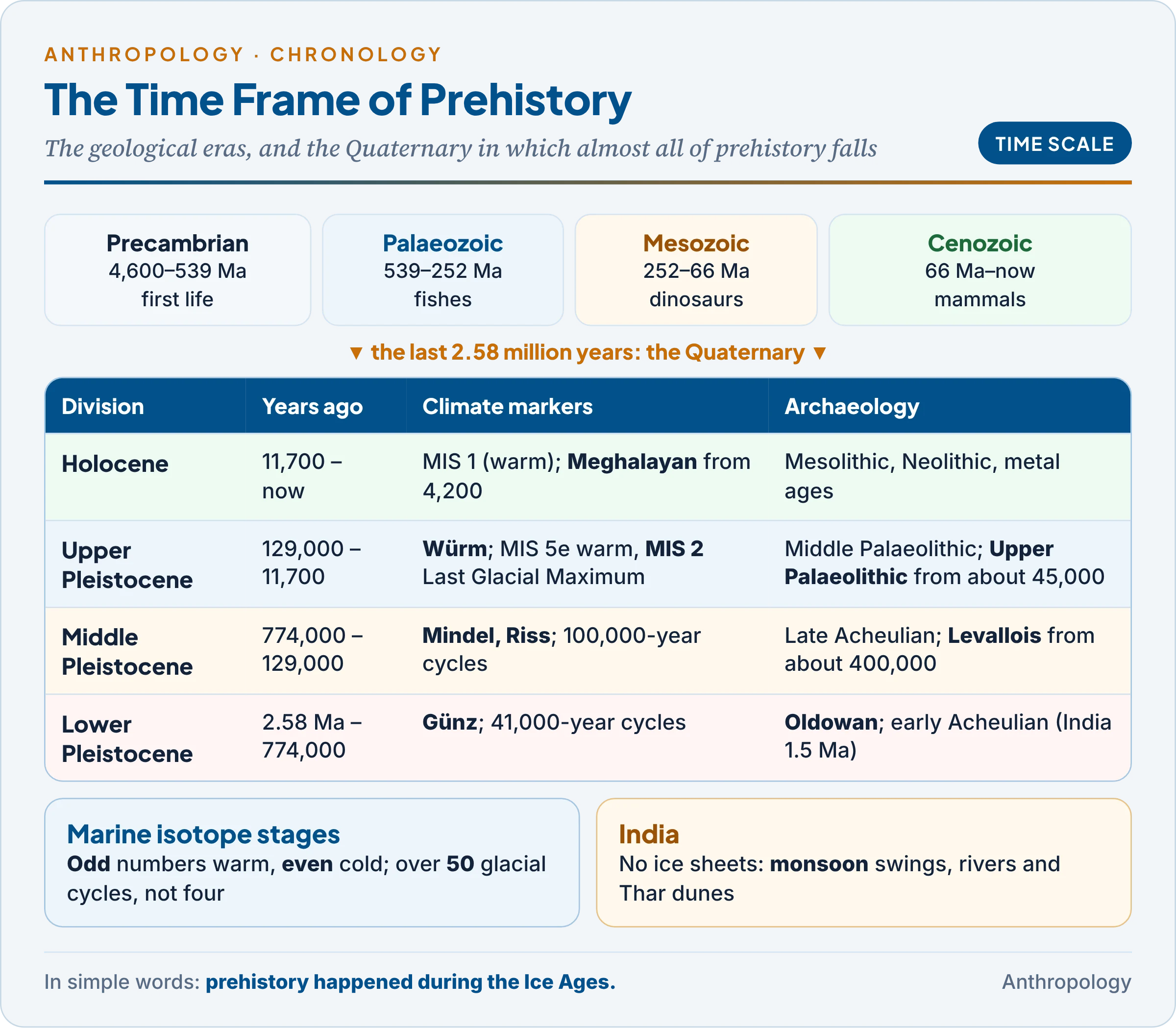
Almost all of prehistory falls in the Quaternary, the last 2.58 million years, a time of repeated glacials (ice ages) and warm interglacials.
- Pleistocene divisions: Lower (2.58 Ma–774,000 years), Middle (774,000–129,000 years; the Chibanian, named in 2020) and Upper (129,000–11,700 years).
- Holocene divisions (2018): Greenlandian, Northgrippian and Meghalayan (from 4,200 years), defined by a stalagmite from Mawmluh Cave, Meghalaya, that records a severe drought; it is the only geological age named after an Indian place.
- The Alpine scheme: Albrecht Penck and Eduard Brückner (1909) named four glaciations from Alpine terraces: Günz, Mindel, Riss and Würm, still used in older texts and many PYQs.
- The ocean record: Cesare Emiliani (1955) read oxygen isotopes in the shells of foraminifera (tiny sea creatures) from ocean cores; ice sheets lock up light oxygen, so the shells record global ice volume. This gives numbered Marine Isotope Stages (MIS): odd numbers warm, even numbers cold. MIS 2 is the Last Glacial Maximum (about 26,000–19,000 years ago); MIS 5e is the last interglacial (about 125,000 years).
- Why the ocean record replaced the Alpine one: continuous ocean cores show over 50 glacial cycles, not four pieced together from patchy land deposits.
- Consequences for humans: in glacials sea level fell about 120 metres, exposing land bridges (Beringia; Britain to Europe; western Indonesia to Asia), and cold selected for fire, shelter, clothing and better tools.
- India had ice only in the high Himalaya; its Pleistocene was marked by swings of the monsoon, with active rivers and lakes in wet phases and spreading dunes in the Thar in dry ones. Attempts to match Indian river terraces to Himalayan glaciations (the Yale–Cambridge expedition of Helmut de Terra and T.T. Paterson, 1935) or to “pluvial” (rainy) phases are now abandoned, because terraces form for many reasons besides climate.
4. Relative Dating Methods
In simple words
Relative dating tells us which of two things is older, without giving an age in years. It is like knowing that a grandmother is older than her grandson without knowing either birthday. Most relative methods depend on layers, on changing styles, or on slow chemical changes in buried bones.
Relative dating places remains in order: what came first and what came next. It cannot say “how long ago”. The British archaeologist Mortimer Wheeler described relative chronology as arranging the products of non-literate societies into a sequence that may have no dates attached.
4.1 Stratigraphy
Example first. In the Bhimbetka rock shelter excavated by the Indian prehistorian V.N. Misra in the 1970s, Acheulian tools lay at the base, Middle Palaeolithic flakes above them, Upper Palaeolithic blades above those and microliths near the top. Before any date in years, the layers proved the order of the cultures.
- Principle: the law of superposition. Stratigraphy (the study of layers) reconstructs the history of deposition at a site.
- Exceptions to detect:
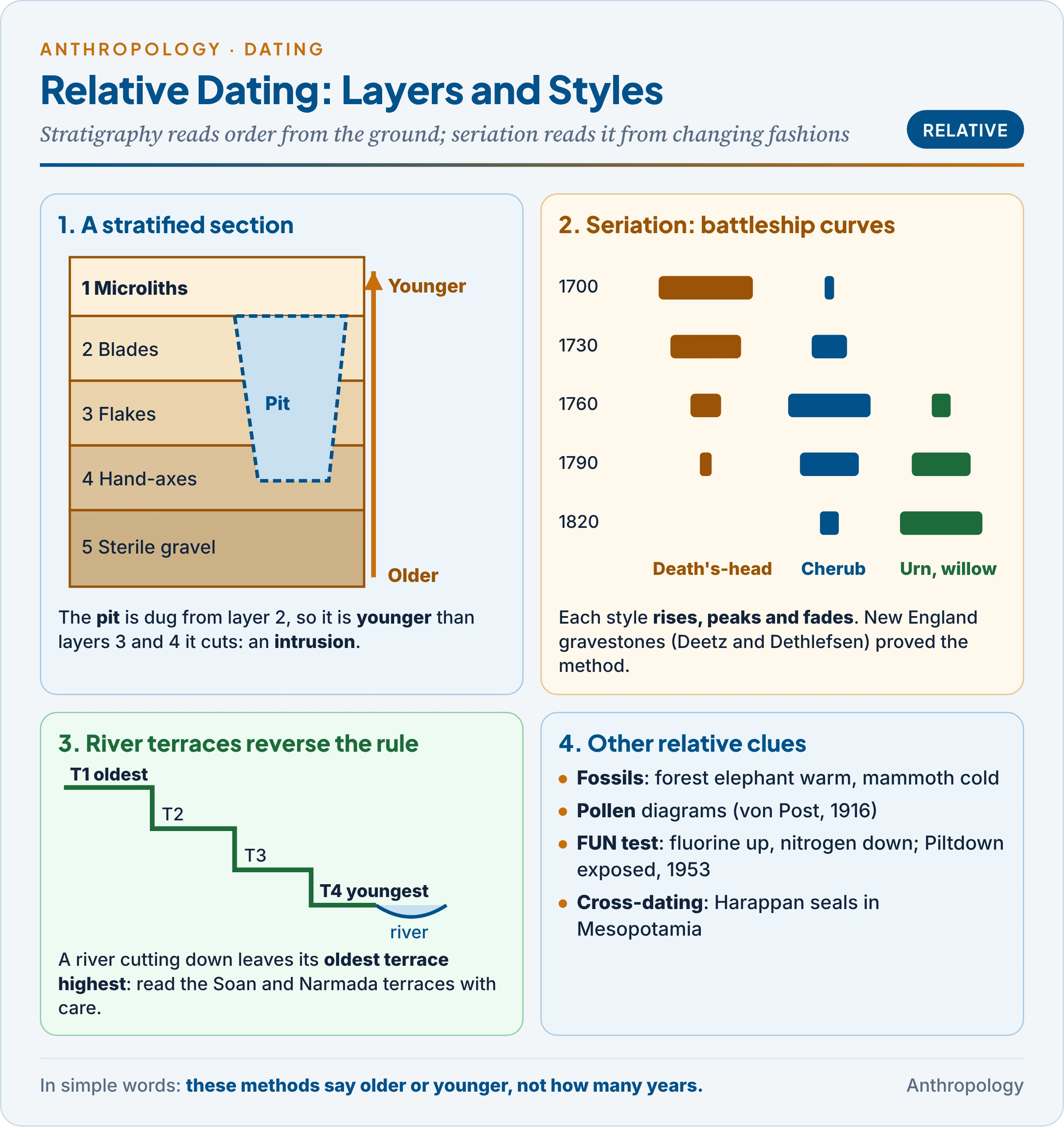
- Intrusion: a later pit or burial cut into older layers. The Galley Hill skeleton from Kent, once claimed as very ancient, was shown by fluorine testing (1949) to be a later burial dug into older gravels.
- Inversion and mixing by landslides, erosion or burrowing animals.
- River terraces reverse the rule: a river that cuts down leaves its oldest terraces highest on the valley side, so the terraces of the Soan or the Narmada must be read with care.
- Recording: sections are drawn and summarised in a Harris matrix (a diagram of which layer lies over which; Edward Harris, 1973).
- Strength and limit: stratigraphy is the foundation of all dating, since even absolute dates mean little unless tied to a layer; but it works only within a site or between sites whose layers can be traced.
4.2 Typology, seriation and cross-dating
Example first. The British Egyptologist Flinders Petrie excavated hundreds of predynastic graves at Diospolis Parva, Egypt, that had no layering. He noticed that the handles of one pottery type changed step by step from working lugs to mere painted lines. Ordering the graves by this change gave “sequence dates” (1899) that later excavations confirmed.
- Seriation orders assemblages by the principle that a style appears, rises to a peak of popularity and then declines; plotted as bars, each style makes a lens-shaped “battleship curve“. Frequency seriation uses the changing proportions of types; contextual seriation uses which types occur together (Petrie’s method).
- A classic test: James Deetz and Edwin Dethlefsen (1960s) seriated dated gravestones in New England, where the death’s-head gave way to the cherub and then to the urn and willow, each in a battleship curve. Because the stones carried dates, the study proved that seriation works and linked the changes to shifting religious beliefs.
- Limits: seriation gives an order but not its direction (style may move from simple to complex or the reverse), so it must be anchored by stratigraphy or a date; and it holds only for a local area, since styles change at different rates elsewhere.
- Cross-dating carries dates from a dated region to an undated one through shared objects: Harappan seals in Mesopotamian levels of known age dated the Harappan civilisation before radiocarbon.
- Seriation is the reverse of stratigraphy: stratigraphy reads the sequence from the layers; seriation proposes one from the objects and must test it against layers or dates.
4.3 Biological and environmental methods
- Palaeontology: extinct or evolving species act as time markers. The forest elephant (Elephas antiquus) marks warm phases and the woolly mammoth (Mammuthus primigenius) cold tundra; mammoth molars changed in a known direction through the Pleistocene. Limits: site bones are those hunters brought back, not a random sample; many species tolerate several climates; and some survived longer in refuges.
- Palynology (pollen analysis): tough pollen walls survive for hundreds of thousands of years, and each plant genus has a distinctive grain. The Swedish geologist Lennart von Post introduced the method in 1916. Counting grains level by level gives a pollen diagram of changing vegetation that can be matched to a dated regional sequence.
- Best preserved in waterlogged peat bogs, lake beds and acidic soils; poorly in dry or alkaline sediments.
- India: cores from the salt lakes of Rajasthan, such as Didwana and Sambhar, record the Late Quaternary swings of the monsoon against which Thar Desert sites are read.
- Rate of accumulation: age from the thickness of deposits. At Modoc Rock Shelter, Illinois, Melvin Fowler found the rate changed several times, since population, dumping and site growth all alter it; Wheeler thought the method “only of academic interest”.
- Patination and geomorphology: the weathering skin (patina) on stone thickens with exposure, and terraces, dunes, moraines (glacial debris) and loess (wind-blown dust) can be ordered into regional sequences; patina depends so much on rock and climate that it is the weakest method.
4.4 Chemical methods: the FUN test
Example first. In 1912 “Piltdown man” from Sussex, England, was hailed as an ancient human with a large brain and an ape-like jaw. In 1949 the British geologist Kenneth Oakley measured its fluorine, and in 1953 Oakley, the anatomist Wilfrid Le Gros Clark and the physical anthropologist Joseph Weiner proved it a forgery: a recent human skull and an orangutan jaw, stained and filed to look old.
- Fluorine and uranium from groundwater accumulate in buried bone (fluorine turns bone mineral into stable fluorapatite), so older bones hold more; nitrogen declines as the protein collagen decays (fresh bone has about 4%).
- How it is used: bones from the same deposit should give similar values; a bone with far less fluorine than its neighbours is intrusive (Galley Hill) or fake (Piltdown).
- Limits: groundwater, temperature and soil differ from place to place, so the test compares bones only within one site and gives relative, never absolute, ages.
4.5 Methods between relative and absolute
Some methods measure a slow, steady process whose rate must be calibrated locally.
- Obsidian hydration (Irving Friedman and Robert Smith, 1960): a freshly flaked surface of obsidian (volcanic glass) absorbs water and forms a hydration rind that thickens with time. The rate depends on temperature and glass chemistry, so it must be fixed for each region.
- Amino acid racemisation: after death, amino acids slowly flip from the “left-handed” (L) to the “right-handed” (D) form, so the D/L ratio rises with time at a temperature-dependent rate. In 2025 amino acid dating of fossils from the spear layer at Schöningen, Germany, placed the oldest complete wooden spears at about 200,000 years, not 300,000–400,000.
5. Absolute (Chronometric) Dating Methods
In simple words
Absolute dating gives an age in years, with a margin of error. Most methods use a natural clock: radioactive atoms that break down at a fixed rate, damage that builds up in crystals, or yearly layers in trees and lakes. Each clock suits a certain material and a certain span of time.
5.1 The principle of radioactive decay
To date a specimen absolutely is to connect it to a universal time scale, a process that runs at the same rate everywhere. Radioactive decay is the best such clock: unstable parent atoms turn into daughter atoms at a fixed rate, unaffected by heat or chemistry.
- The half-life (t½) is the time in which half the parent decays: after one half-life ½ remains, after two ¼, after three ⅛.
- Age equation: t = (t½ ÷ 0.693) × ln(N₀ ÷ N), where N₀ is the starting amount, N the amount left and 0.693 = ln 2.
- Why each method has a range: after about 9–10 half-lives too little parent remains to measure, while in a very young sample too little daughter has formed.
| Isotope | Half-life | Main use |
|---|---|---|
| Carbon-14 → nitrogen-14 | 5,730 years | Organic remains up to about 50,000 years |
| Potassium-40 → argon-40 | 1.25 billion years | Volcanic rocks, from about 100,000 years |
| Uranium-234 → thorium-230 | Thorium-230: about 75,000 years | Cave carbonates and corals, to about 500,000 years |
| Aluminium-26, beryllium-10 | 0.71 and 1.39 million years | Burial dating of quartz, to about 5 million years |
5.2 Radiocarbon (C-14) dating
Example first. At Patne, Maharashtra, the Indian archaeologist S.A. Sali found pieces of ostrich eggshell engraved with cross-hatched lines in an Upper Palaeolithic layer. Eggshell holds carbon taken in by the living bird, and radiocarbon gave about 25,000 ± 200 BP, making these among the earliest dated art objects in India (Unit 1.8b).
- Discovery: the American chemist Willard Libby, with James Arnold, published the method in 1949; Libby won the Nobel Prize in Chemistry in 1960.
- How the clock works:
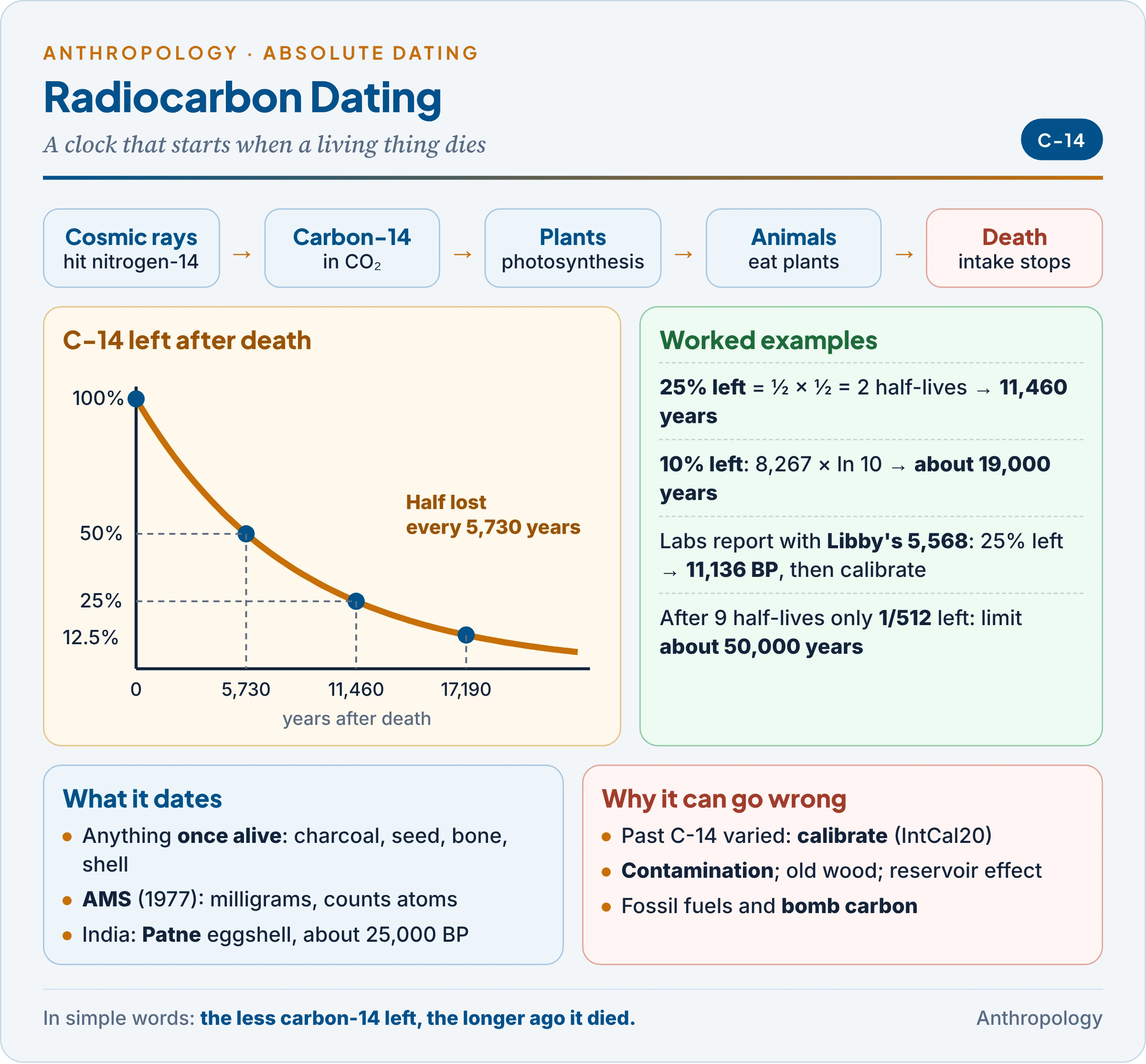
- Cosmic rays in the upper atmosphere produce neutrons that convert nitrogen-14 into carbon-14.
- C-14 forms carbon dioxide, which enters plants by photosynthesis and animals through food. Living things keep the atmospheric C-14 : C-12 ratio, about 1.2 parts per trillion.
- At death intake stops; C-14 decays back to nitrogen-14 (beta decay) with a half-life of 5,730 years, while stable C-12 remains.
- The less C-14 remains, the longer ago the organism died.
- Materials: anything once alive: charcoal, wood, seeds, bone collagen, shell, hair, textiles.
- Measurement: conventional counting of beta particles from grams of carbon, or accelerator mass spectrometry (AMS), from 1977, which counts the C-14 atoms themselves in milligrams (a single seed), faster and more precisely.
- Range: about 300 to 50,000 years. After nine half-lives (51,570 years) only 1/512 of the C-14 remains, and a trace of modern contamination can then double the apparent amount.
Worked example 1. Charcoal retains 25% of the C-14 of living wood. 25% = ¼ = (½)², so two half-lives have passed: 2 × 5,730 = 11,460 years.
Worked example 2. Charcoal retains 10%. Age = (5,730 ÷ 0.693) × ln(100 ÷ 10) = 8,267 × 2.303 = about 19,000 years.
Worked example 3. By convention, laboratories still report the “conventional radiocarbon age” with Libby’s original half-life of 5,568 years (the more accurate 5,730, the “Cambridge half-life”, was fixed in 1962). The charcoal of Example 1 is reported as 8,033 × ln 4 = 11,136 radiocarbon years BP, and this figure is then calibrated to calendar years.
- Why calibration is needed: Libby assumed atmospheric C-14 had always been constant, but it varies with the Earth’s magnetic field, solar activity and the carbon cycle. Radiocarbon ages are converted with a calibration curve built from tree rings, corals, cave formations and lake sediments; the current curve, IntCal20 (2020), reaches 55,000 cal BP. Uncalibrated ages of 10,000–30,000 years can be too young by over a thousand years.
- Other sources of error: contamination by younger or older carbon; the reservoir effect (sea and lake creatures take in “old” dissolved carbon and look centuries too old); the old-wood problem (heartwood charcoal dates the tree, not the fire); and the Suess effect and bomb carbon (fossil fuels diluted atmospheric C-14, nuclear tests nearly doubled it).
- India: dating began at TIFR, Mumbai, under D.P. Agrawal in the 1960s; today PRL (Ahmedabad), BSIP (Lucknow) and the Inter-University Accelerator Centre (New Delhi, AMS) do the work.
5.3 Potassium–argon (K–Ar) and argon–argon (Ar–Ar)
Example first. In 1959 Mary Leakey found the robust skull “Zinjanthropus” (now Paranthropus boisei, OH 5) in Bed I of Olduvai Gorge, Tanzania. In 1961 Jack Evernden and Garniss Curtis dated the volcanic layers of Bed I by potassium–argon to about 1.75 million years. Most scholars had thought the human story spanned well under a million years; overnight, its time scale doubled.
- The clock: potassium-40 in volcanic minerals decays with a half-life of 1.25 billion years; about 11% becomes the gas argon-40.
- Why volcanic rock: eruption heat drives out all argon, resetting the clock; as the rock cools, argon-40 from decay is trapped. The Ar-40 : K-40 ratio gives the time since eruption.
- What it dates: the volcanic layer, not the fossil. A fossil is dated by being sandwiched between dated ash beds, which is why East Africa’s Rift Valley holds the best-dated early hominins.
- Assumptions and range: no argon at formation and no gain or loss since; useful from about 100,000 years upwards, so unsuitable for recent sites.
- Ar–Ar: reactor irradiation turns potassium-39 into argon-39, so a single crystal can be dated, exposing grains contaminated by older rock.
Worked example 4. For ages far below the half-life, argon-40 builds up by about 58 atoms per million atoms of potassium-40 every million years (decay constant to argon, 5.81 × 10⁻¹¹ per year). A tuff with an Ar-40 : K-40 ratio of 0.000102 is about 0.000102 ÷ 0.0000581 = 1.75 million years old, the age of Olduvai Bed I.
- A lesson in caution: the KBS Tuff at Koobi Fora, Kenya, just above the skull KNM-ER 1470, was first dated by potassium–argon to about 2.6 million years (1970). Pig fossils and fission-track dates disagreed, and new argon work settled on about 1.88 million years: altered, contaminated grains had made the first date far too old. Independent methods exposed the error.
5.4 Fission-track dating
- The clock: uranium-238 occasionally splits in two (spontaneous fission); the fragments tear microscopic tracks through crystals and glass, which build up at a constant rate.
- Measurement: tracks on an acid-etched surface are counted; uranium content is found by inducing fresh fission in a reactor.
- The reasoning: more tracks for the same uranium means more time. Two samples with equal uranium, one with twice the track density, differ in age by a factor of two.
- Resetting: heating erases old tracks, so the clock starts when a volcanic rock cools or when glass, glaze or obsidian is heated.
- Materials and range: zircon, apatite, volcanic glass, obsidian, man-made glass; from a few thousand years (uranium-rich glass) to billions.
- Applications: an independent check on argon dates for Olduvai Bed I (about 2 million years, 1965) and the KBS Tuff (zircon, about 1.87 million years, 1980); dating and correlating volcanic ash beds (tephra); dating heated obsidian and ancient glass.
Common confusion
Does fission-track dating count alpha particles? No. The tracks come from spontaneous fission: a uranium-238 nucleus splitting into two heavy fragments that tear through the crystal. Alpha particles from ordinary decay are far too light to leave tracks that can be etched and counted. Some reference notes confuse the two.
5.5 Luminescence dating: TL, OSL and IRSL
Example first. At Jebel Irhoud, Morocco, flint tools had been burnt in ancient fires, which reset their luminescence clock. Thermoluminescence dating gave about 315,000 years (Daniel Richter and colleagues, 2017), making the human fossils from those layers the oldest known Homo sapiens.
- The clock: quartz and feldspar are bombarded by weak natural radiation from uranium, thorium and potassium in the soil. Freed electrons are trapped in crystal defects and build up steadily, like a battery charging.
- Resetting to zero: heat (firing pottery, burning flint, baking a hearth) empties the traps; this is used in thermoluminescence (TL). Sunlight empties the traps of grains carried by wind or water, and burial starts the clock; this is used in optically stimulated luminescence (OSL), and with feldspar in infrared-stimulated luminescence (IRSL).
- Measurement: in the laboratory the sample is heated (TL) or lit (OSL); trapped electrons escape and emit light. The glow gives the radiation absorbed since resetting, the equivalent dose (in grays, Gy); the dose rate is measured from the surrounding soil.
- Age = equivalent dose ÷ annual dose rate.
Worked example 5. A potsherd has an equivalent dose of 6 Gy, and its surroundings deliver 0.003 Gy a year: age = 6 ÷ 0.003 = 2,000 years. A buried sand with an equivalent dose of 231 Gy and a dose rate of 3 Gy per thousand years was last exposed to sunlight 77,000 years ago.
- History: Farrington Daniels proposed TL dating (1953), George Kennedy and L. Knopff applied it to pottery (1960), and David Huntley and colleagues introduced OSL (1985).
- Range: a few decades to about 200,000–300,000 years for quartz, and up to about 500,000 with newer feldspar signals, beyond which the traps fill (saturation).
- Why it matters: it dates inorganic materials (sediments, pottery, burnt stone) and covers the gap beyond radiocarbon, exactly the Middle Palaeolithic; it also exposes fakes, which have almost no stored dose.
- Indian applications:
- Attirampakkam, Middle Palaeolithic: 385,000–172,000 years (Kumar Akhilesh and colleagues, 2018)
- Jwalapuram: tools below and above the Toba ash, about 77,000 years (Michael Petraglia and colleagues, 2007)
- Dhaba, Son valley: an unchanging industry from 79,600 to 65,200 years, spanning Toba (Chris Clarkson and colleagues, 2020)
- Singi Talav, Rajasthan: occupation between 248,000 and 65,000 years (James Blinkhorn and colleagues, 2021)
- Limits: grains not fully bleached give ages too old; past soil moisture must be estimated; some feldspars leak electrons (anomalous fading).
5.6 Other trapped-charge, isotopic and magnetic methods
- Electron spin resonance (ESR): measures trapped electrons directly in tooth enamel, shell or coral, up to about 2 million years. At Isampur, Karnataka, ESR on fossil teeth dated the Acheulian quarry-workshop to about 1.27 ± 0.17 million years (K. Paddayya and colleagues, 2002).
- Uranium-series: uranium dissolves in water but thorium does not, so a fresh cave formation (a speleothem: stalagmite or flowstone) contains uranium and no thorium-230, which then grows in at a known rate; the Th/U ratio gives the age, up to about 500,000 years. Thin calcite crusts over cave paintings give a minimum age for the art: a painting at Leang Karampuang, Sulawesi, is at least 51,200 years old (Adhi Agus Oktaviana and colleagues, 2024).
- Cosmogenic nuclide burial dating: cosmic rays hitting surface quartz make aluminium-26 and beryllium-10 in a fixed ratio (about 6.8 : 1). Once the quartz is buried, production stops, and aluminium-26 decays faster, so the ratio falls with burial time.
- Worked example 6: the ratio halves about every 1.43 million years, so gravel whose ratio has fallen from 6.8 to 3.4 was buried about 1.4 million years ago.
- Attirampakkam: burial dating with palaeomagnetism placed the Acheulian at 1.51 ± 0.07 million years (Shanti Pappu and colleagues, 2011), the oldest dated Acheulian in India.
- Palaeomagnetism: iron minerals in sediments record the polarity of the Earth’s field, which has reversed many times; since the last reversal (Brunhes–Matuyama) was about 773,000 years ago, a reversed-polarity Acheulian layer must be older than that.
- Archaeomagnetism: heated clay records the field’s direction as it cools; because the magnetic pole wanders, an undisturbed kiln or hearth can be dated against a regional curve of the pole’s path.
5.7 Annual-layer methods: tree rings and varves
- Dendrochronology: a tree adds one ring a year, wide in good years and narrow in bad ones.
- The American astronomer A.E. Douglass founded the science in Arizona; in 1929 he closed the gap in his sequence and dated dozens of Pueblo ruins exactly.
- Cross-dating: overlapping ring patterns from living trees, beams and buried logs build a master chronology; an undated beam is matched to it to the year. European oak and pine chronologies exceed 12,000 years and anchor radiocarbon calibration.
- Limits: needs clear annual rings (rare in the humid tropics) and a regional sequence; missing outer rings blur the felling date, and a reused beam dates earlier than the building.
- Varves: a varve is the pair of layers laid down in one year in a glacial lake: a thick, coarse, light layer in summer (fast meltwater) and a thin, fine, dark layer in winter (still water under ice).
- The Swedish geologist Gerard De Geer published a Swedish varve chronology of about 12,000 years in 1910. Limits: varves form only near ice sheets, some years leave none or two, and finds are rare in varved clay.
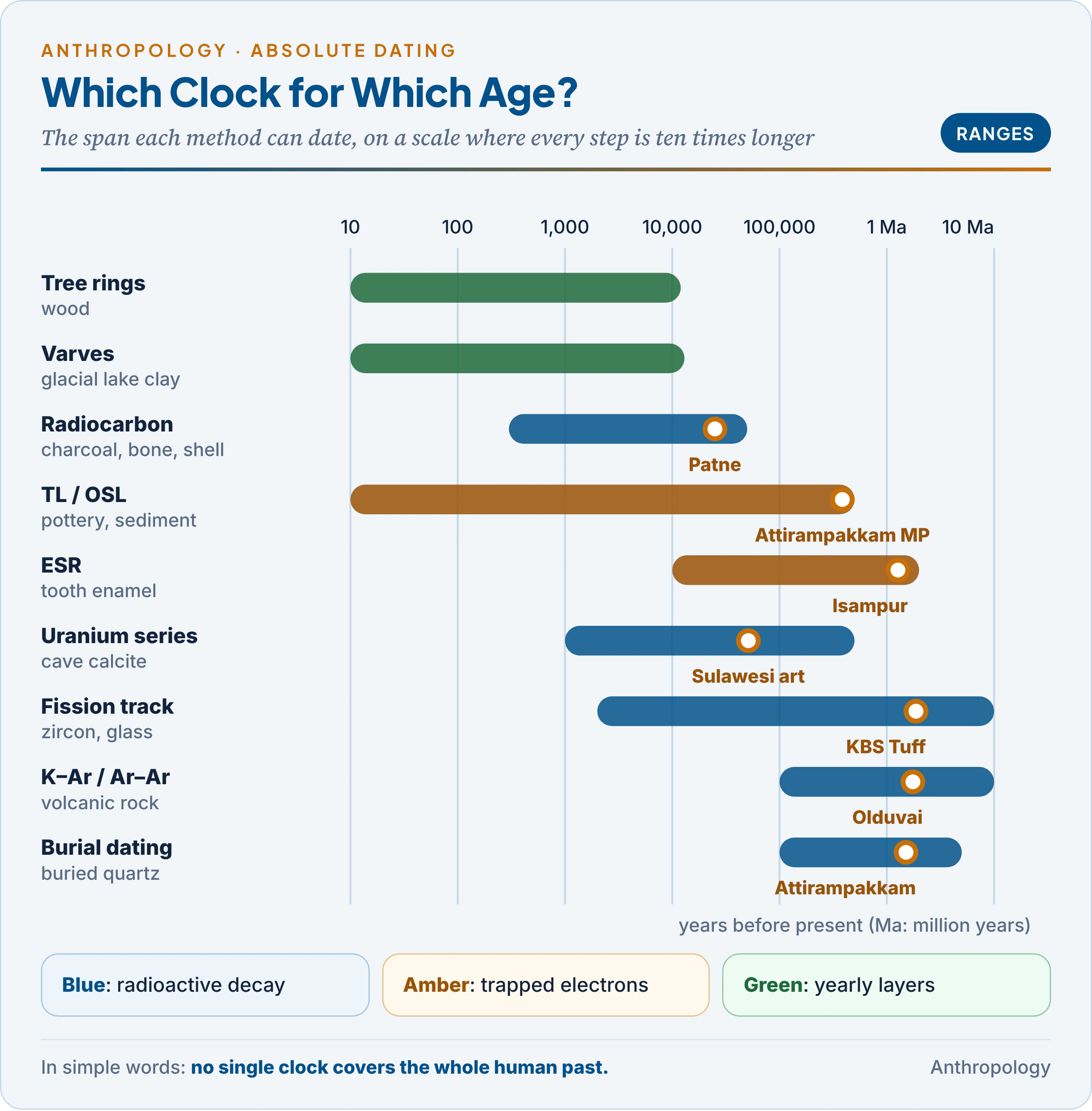
The table brings the absolute methods together. Read it by material first: the material at a site decides which clock can be used, and the expected age decides whether that clock reaches far enough.
| Method | What it measures | Material | Range | Key example |
|---|---|---|---|---|
| Radiocarbon (AMS) | C-14 decay since death | Charcoal, bone, shell, seeds | 300–50,000 years | Patne eggshell, 25,000 BP |
| K–Ar / Ar–Ar | Argon built up since eruption | Volcanic rock, ash | 100,000 years upwards | Olduvai Bed I, 1.75 Ma |
| Fission track | Tracks of U-238 fission | Zircon, glass, obsidian | Thousands to billions | KBS Tuff, 1.87 Ma |
| TL | Trapped charge since heating | Pottery, burnt flint | To about 500,000 years | Jebel Irhoud, 315,000 years |
| OSL / IRSL | Trapped charge since burial | Quartz, feldspar sediment | To about 500,000 years | Attirampakkam, 385,000 years |
| ESR | Trapped charge (direct) | Tooth enamel | To about 2 Ma | Isampur, 1.27 Ma |
| Uranium series | Growth of thorium-230 | Cave calcite, coral | To about 500,000 years | Sulawesi art, 51,200 years |
| Cosmogenic burial | Al-26/Be-10 after burial | Buried quartz | To about 5 Ma | Attirampakkam, 1.51 Ma |
| Dendrochronology | Annual rings | Wood | To about 12,000 years | Pueblo ruins, to the year |
The table shows that no single method covers the whole human past: radiocarbon rules the last 50,000 years, trapped-charge and uranium-series methods bridge the Middle and Upper Pleistocene, and argon, fission-track and burial dating reach further back. Hence one site is often dated by several methods, each checking the others.
6. Problems of Dating and How They Are Tackled
In simple words
Every dating method rests on assumptions, and each can go wrong. A date may belong to the wrong object, the sample may be contaminated, or the clock may not have been fully reset. Archaeologists guard against this by tying dates to layers, using several methods and laboratories, and treating a single date with caution.
The problems fall into a few groups, each with a standard remedy.
| Problem | Example | Remedy |
|---|---|---|
| Association: the sample may not belong to the event | Charcoal washed into a layer; a reused beam | Date short-lived material found in place |
| Contamination | Roots in old charcoal; groundwater in bone | Chemical cleaning; AMS on purified fractions |
| Unmet assumptions | Old argon in grains (KBS Tuff); poor bleaching (OSL) | Single-crystal Ar–Ar; single-grain OSL |
| Changing rates | Atmospheric C-14 not constant; fluorine varies by soil | Calibration; compare only within a site |
| Gaps in range | Radiocarbon stops at 50,000 years; argon needs volcanoes | Luminescence, ESR, uranium-series, burial dating |
| No datable material | Surface scatters of quartzite tools | Typological comparison with dated sites |
- Precision is not accuracy: a narrow ± range may still be wrong if the sample was contaminated; a date is a probability range.
- Bayesian modelling (programs such as OxCal) combines dates with the order of layers: a date from a lower layer must be older than one above, which narrows each range.
- Special problems in India:
- Acidic soils destroy bone, so collagen for radiocarbon and hominin fossils are scarce (the Narmada skull is the main exception).
- Volcanic ash for argon dating is rare; the Toba ash of about 74,000 years is a valuable time line across the subcontinent.
- Many Palaeolithic sites are surface finds or lie in river gravels, so they are placed by typology rather than dates.
- Luminescence, ESR and burial dates since 2000 have overturned the old picture of a “late” and derivative Indian Palaeolithic.
A date is therefore a hypothesis to be tested. The best chronologies come where stratigraphy, several methods and typology agree, as at Attirampakkam.
Fossils and Prehistory: Landmark Dated Sites
The table lists sites where a date changed the understanding of prehistory. Read the date and method together: each date is only as good as the clock behind it.
| Specimen / Culture | Site | Date (method) | Traits | Significance |
|---|---|---|---|---|
| Zinjanthropus (OH 5), Oldowan tools | Olduvai Bed I, Tanzania | 1.75 Ma (K–Ar, 1961) | Robust skull; choppers, flakes | Doubled the time scale of human evolution |
| Early Acheulian | Attirampakkam, Tamil Nadu | 1.51 ± 0.07 Ma (burial dating, palaeomagnetism) | Hand-axes, cleavers | Oldest dated Acheulian in India |
| Acheulian workshop | Isampur, Karnataka | 1.27 ± 0.17 Ma (ESR) | Limestone bifaces | Early Acheulian in the Deccan |
| Earliest Homo sapiens | Jebel Irhoud, Morocco | About 315,000 years (TL on burnt flint) | Modern face, archaic braincase | Older origin of our species |
| Middle Palaeolithic | Attirampakkam | 385,000–172,000 years (luminescence) | Levallois flakes | Indian MP as old as Africa’s |
| Engraved ostrich eggshell | Patne, Maharashtra | About 25,000 BP (radiocarbon) | Cross-hatched lines | Early Indian art object |
| Piltdown “man” | Sussex, England | Recent (fluorine, 1949–53) | Human skull, orangutan jaw | Exposed as a forgery |
Key Terms
| Term | Meaning in simple words |
|---|---|
| Prehistory / protohistory | Before writing / writing exists but cannot be read |
| Typo-technology | Studying tools by shape and by how they were made |
| Primary / secondary context | A find left undisturbed / moved after it was left |
| Superposition | Lower layers are older, unless disturbed |
| Seriation | Ordering finds by the rise and fall of styles |
| FUN test | Comparing fluorine, uranium and nitrogen in bones from one site |
| Half-life | Time for half of a radioactive substance to decay |
| BP / cal BP | Years before 1950 / radiocarbon years converted to calendar years |
| Calibration | Correcting radiocarbon ages with tree rings and other records |
| AMS | Counting C-14 atoms directly in milligram samples |
| Equivalent dose | Radiation absorbed since a luminescence clock was reset |
| Marine Isotope Stage | A numbered warm (odd) or cold (even) stage from ocean cores |
Contemporary Developments
- Iron at Sivagalai (January 2025): Tamil Nadu’s report Antiquity of Iron (K. Rajan and R. Sivanantham) dated charcoal from iron-bearing urn burials at Sivagalai, Thoothukudi, to as early as 3345 BCE by AMS radiocarbon, while OSL on pottery from the same grave at BSIP Lucknow and PRL Ahmedabad gave mid-3rd millennium BCE ages; the claim remains debated.
- Keeladi chronology dispute (2025–26): the excavator K. Amarnath Ramakrishna dated Keeladi, near Madurai, from the 8th century BCE to the 3rd century CE using AMS dates on 23 samples; the ASI asked him to revise it, and in February 2026 he refused, saying his dates rest on stratigraphy and material culture.
- Vadnagar pushed back (January 2026): AMS dating at PRL Ahmedabad of borehole samples about 25 metres deep placed the first occupation of Vadnagar, Gujarat, at about 2,750 years BP, some 500 years earlier than the excavated levels suggested.
- Mammoth Site redated (August 2026): at Hot Springs, South Dakota, IRSL dating of feldspar put the mammoth bone bed at about 232,000–160,000 years, against radiocarbon ages of 42,000–23,000 years on bone apatite: contaminated bone mineral had made the radiocarbon ages far too young (Quaternary Research).
- Oldest dated painting (July 2024): laser-ablation uranium-series dating of calcite over a painting at Leang Karampuang, Sulawesi, gave a minimum of 51,200 years, the oldest known figurative art.
Diagrams to Master
- Topic map: principles → chronology → relative dating → absolute dating → problems.
- Quaternary chart: 2.58 Ma, 774 ka, 129 ka, 11.7 ka, 4.2 ka; odd MIS warm, even cold; Günz to Würm; Palaeolithic stages alongside.
- Relative dating: layers with an intrusive pit; a terrace staircase (oldest highest); three battleship curves.
- Radiocarbon: N-14 → C-14 → CO₂ → plants → animals → death; decay curve at 5,730, 11,460, 17,190 years.
- Range chart: C-14, luminescence, U-series, ESR, K–Ar, fission track and burial dating, with Patne, Attirampakkam, Isampur and Olduvai marked.
Revision Grid
| Scholar | Work (year) | Key idea |
|---|---|---|
| Steno | 1669 | Law of superposition |
| Thomsen; Worsaae | 1816–19, published 1836 | Three-Age System |
| Prestwich and Evans | Abbeville, 1859 | Antiquity of humans |
| Robert Bruce Foote | Pallavaram, 1863 | Beginning of Indian prehistory |
| Lubbock; Westropp | Prehistoric Times (1865); 1866 | Palaeolithic, Neolithic; Mesolithic |
| Flinders Petrie | 1899 | Sequence dating |
| De Geer; von Post | 1910; 1916 | Varves; pollen analysis |
| Douglass | 1929 | Dendrochronology |
| Libby (and Arnold) | 1949; Nobel Prize 1960 | Radiocarbon dating |
| Oakley; Weiner; Le Gros Clark | 1949; 1953 | Fluorine test; Piltdown exposed |
| Emiliani | 1955 | Marine isotope stages |
| Evernden and Curtis | 1961 | K–Ar date of Olduvai Bed I |
Previous Year Questions
Unit 1.8: Principles of prehistoric archaeology, chronology and dating methods
- 2026Write notes on: Ethnoarchaeology and classical archaeology.
- 2026Write notes on: Thermoluminescence dating method.
- 2025Write notes on: Fission track dating method and its applications.
- 2024Write notes on: Chronometric dating.
- 2021Write notes on Thermoluminescence (TL) dating in about 150 words.
- 2019Write a note in 150 words on Relative Dating Methods.
- 2018Describe the principles of radiocarbon dating. Mention its limitations.
- 2017What are dating methods? Discuss one absolute method and one relative method in detail.
- 2014Describe the absolute dating methods in Archaeology, highlighting the importance of each method.
- 2013Write a note in 150 words on Carbon -14 method of dating.
- 2012Write a note in 150 words on Relative dating methods.
- 2010Write a note in 150 words .on Importance of chronology in prehistory.
- 1999Write a note on Carbon dating method.
- 1997Write a note on Problems of dating in Prehistoric Archaeology.
- 1996Write a note on Radiometric methods of dating fossils.
- 1995Write a note on Chronometric dating methods.
Related questions from other units and Paper II
- 2023Unit 1.1: Write notes on: Material culture and archaeology.
- 2023Unit 1.8: Discuss the Paleolithic environment in light of available evidences with special reference to India.
- 2018Unit 1.3: Give an account of- the field methods used in the study of Archaeological Anthropology.
- 2015Unit 1.3: Write a note in 150 words on Archaeological Anthropology.
- 2009Unit 1.3: Write a note on New Archaeology.
- 2008Unit 1.3: Write a note on Concept of Ethnoarchaeology.
- 1997Unit 1.1: Write a note on Dating methods in Prehistory.
- 1992Unit 1.3: Write a note on Archaeological Anthropology.
- 1987Unit 1.2: Write a note on Prehistoric anthropology and its relation to other science.