

1.6 Phylogenetic status, characteristics and geographical distribution of the following: (A) Prepleistocence fossil primates- Oreopithecus. (B) South and East African hominids-Plesianthropus/Australopithecus Africau Paranthropus, Australopithecus. (C) Paranthropus, Australopithecus. .Paranthropus-Homo erectus-Homo erectus javanicus, Homo erectus pekinensis. (D) Homo Heidelbergensis. (E) Neanderthal man-La-chapelle-aus-saints (Classical type), Mt.Carmelites types (Progressive type). (F) Rhodesian man. (G) Homo sapiens-Cromognon, Grimaldi, Chancelede.
Official Syllabus: Paper I, Unit 1.6
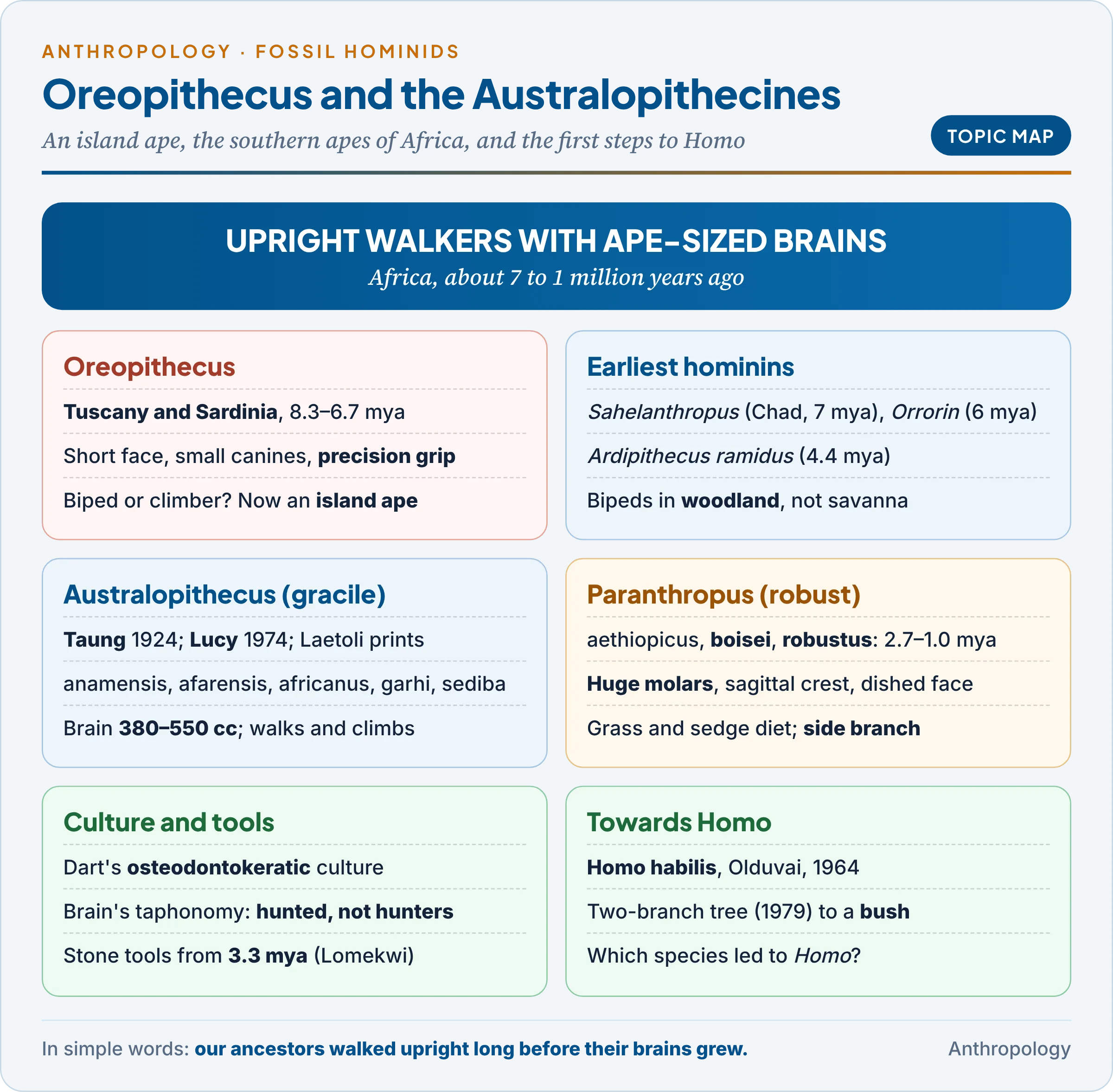
This article covers Oreopithecus, the South and East African hominids (Australopithecus and Paranthropus), their culture, the first Homo, and their phylogenetic status. Homo erectus and H. heidelbergensis follow in Unit 1.6b, and Neanderthals, Rhodesian man and early H. sapiens in Unit 1.6c. The Miocene apes are in Unit 1.5b: in brief, apes spread across Africa, Europe and Asia 23–7 million years ago, and Ramapithecus of the Siwaliks, once called the first hominid, proved to be an ape on the orangutan line.
1. Reading the Hominid Fossil Record
In simple words
What we know of our early ancestors comes from bones and teeth turned to stone and from the rocks around them. To use a fossil we must know how it was preserved, how old it is, and how its shape compares with apes and humans. “Phylogenetic status, characteristics and distribution” simply mean: its place in the family tree, what it looked like, and where it lived.
1.1 Fossils and fossilisation
- A fossil is any trace of past life preserved in rock: body fossils (bones, teeth, shells), trace fossils (footprints, burrows, coprolites or fossil dung) and chemical fossils (surviving organic molecules). Mineral growths that merely look like fossils, such as fern-shaped manganese dendrites, are pseudofossils.
- How bone becomes stone. If a skeleton is buried quickly, ground water deposits minerals in the pores of the bone (permineralisation) or replaces the bone molecule by molecule with calcite or silica (replacement). If the bone dissolves away, it leaves a mould, which may fill to form a cast; the Taung child’s brain survived as a natural endocast (a stone filling of the braincase). Rarer routes are freezing, drying in caves, amber, tar pits and carbonisation.
- Why hominid fossils are rare. Only hard parts of animals that died near water or in caves, and were buried before scavengers scattered them, survive. The study of what happens to remains between death and discovery is taphonomy (Greek taphos, burial), a term coined by the Soviet palaeontologist Ivan Efremov (1940). It overturned Dart’s “killer ape” reading of Makapansgat (§7).
1.2 Two kinds of site, two kinds of dating
The South and East African records differ because of their geology, and this explains why East African dates are precise and South African dates long were not.
| Feature | South African caves | East African Rift Valley |
|---|---|---|
| Setting | Dolomite limestone caves (Sterkfontein, Swartkrans, Taung) | Lake and river sediments in the Rift Valley (Olduvai, Hadar, Turkana) |
| How bones got in | Fell or were dragged into cave shafts by leopards, hyenas, eagles | Buried by floods and lake mud near water |
| Matrix | Hard breccia (cemented rubble); fossils freed by drilling or acid | Soft silts interleaved with volcanic ash (tuffs) |
| Dating | Fauna, palaeomagnetism, uranium–lead on flowstone, cosmogenic nuclides | Potassium–argon and argon–argon on the ash beds |
Volcanic ash contains potassium, which decays to argon at a known rate, so each ash layer is a clock (Unit 1.8a), and a fossil between two dated ash beds is bracketed in age. That is why the first hominid dated radiometrically, Zinjanthropus (1.75 million years, 1961), came from East Africa; South African caves lack ash, so their fossils were long dated only by the animals found with them (biostratigraphy).
1.3 The vocabulary of status
- Hominoid (superfamily Hominoidea): apes and humans.
- Hominid and hominin: see the box below.
- Phylogenetic status means a fossil’s place in the family tree: is it a direct ancestor of later forms, a side branch that left no descendants, or a sister group (a close cousin sharing a common ancestor)?
- Primitive and derived traits. A primitive trait is inherited from a distant ancestor (large canines); a derived trait is new to one line (habitual bipedalism). Cladistics (classification by shared derived traits) uses only derived traits: two fossils that both walk upright are close kin, two that both have large canines may not be.
- Lumpers place variable fossils in few species; splitters create many. Much of the australopithecine debate is a quarrel between the two habits.
Common confusion
Hominid or hominin: which word means “our line”? In older books, including the syllabus, hominid (family Hominidae) means humans and all their bipedal ancestors, while the great apes sat in a separate family, Pongidae. DNA showed that chimpanzees are closer to humans than to gorillas, so today the family Hominidae includes all great apes and humans, and our line after the split from chimpanzees is the tribe Hominini, whose members are hominins. “Australopithecines are hominids” (old usage) and “australopithecines are hominins” (new usage) mean the same thing.
2. Oreopithecus: The Island Ape of Tuscany
In simple words
Oreopithecus was an ape that lived on an island in what is now Italy, about 8 to 7 million years ago. Some of its features, such as a short face, small canines and a hand able to pinch, looked human, so it was once called the earliest hominid. It is now seen as an unusual ape whose island life produced human-like traits by coincidence.
2.1 Discovery and distribution
- Named Oreopithecus bambolii (“hill ape of Monte Bamboli”) by the French palaeontologist Paul Gervais (1872), from jaws in the lignite (brown coal) of Monte Bamboli, Tuscany.
- The 1958 skeleton: the Swiss palaeontologist Johannes Hürzeler, who had argued from the teeth since 1954 that it was a hominid, found a nearly complete, crushed skeleton (“Sandrone”) in the Baccinello lignite mine near Grosseto on 2 August 1958.
- Range and date: dozens of individuals from Tuscany and Sardinia, then an island chain (the Tusco-Sardinian province) cut off from mainland Europe, about 8.3–6.7 million years ago (fossil fauna and magnetic stratigraphy): a pre-Pleistocene primate living while the human and chimpanzee lines were separating in Africa.
2.2 Characteristics
Read each trait against its explanation: almost every human-like feature has an ape-like reason.
| Region | Trait | Reading |
|---|---|---|
| Skull and teeth | Short face, small canines, no gap (diastema) in the lower tooth row, small brain | Human-like at first sight; small canines also occur in other apes |
| Molars | Tall cusps with shearing crests | A leaf-eater (folivore), not a human-like diet |
| Arms and trunk | Long arms (high intermembral index), very mobile joints, broad chest, short trunk | Climbing and hanging, like orangutans |
| Hand | Long thumb and a joint allowing a pad-to-pad precision grip (Salvador Moyà-Solà and colleagues, 1999) | A convergent human-like grip for picking food |
| Pelvis and spine | Short ilium; lower back claimed to curve forward | Basis of the bipedal claim, now disputed |
| Foot | Big toe set at about 100° to the other toes, making a tripod | Stable standing and slow shuffling, not striding |
The pattern is that of a suspensory, leaf-eating ape; the human-like traits sit in the face, hand and hip, the parts most easily reshaped by diet and posture.
2.3 Phylogenetic status: the bipedalism debate
- Hürzeler (1960) read the short pelvis and small canines as proof of a bipedal hominid; other specialists found the skeleton fundamentally ape-like.
- Meike Köhler and Salvador Moyà-Solà (Spanish palaeontologists, 1997) revived a slow, peculiar bipedalism, explained by island ecology: with no large predators and scarce food, selection favoured cheap, energy-saving movement over speed.
- Marcia Russo and Liza Shapiro (American anthropologists, 2013) found no adaptations for a forward-curved, bipedal lower back. Most specialists now see a climbing ape that could stand and shuffle but did not walk like a hominin.
- Placement: a hominoid ape in its own subfamily or family (Oreopithecidae), near the European dryopithecines or older African apes; not a human ancestor.
- Extinction: about 6.5 million years ago a land bridge joined the island to the mainland; sabre-toothed cats and new competitors crossed, and Oreopithecus, the last ape of Europe, vanished.
Significance. Oreopithecus is a lesson in convergence (similar traits evolving independently, Unit 1.4b): small canines, a short face, a precision grip and an upright trunk can all arise in an ape. A fossil becomes a hominin only when the whole pattern, above all bipedal walking, is shown.
3. The Earliest Hominins before Australopithecus
In simple words
Before the australopithecines, between about 7 and 4.4 million years ago, Africa held a few apes that had begun to walk upright. They are known from fewer bones, and scientists still argue whether all of them belong to our line. They show that upright walking began in wooded country, not on open grassland.
The four candidates below are arranged by age; note how few bones each rests on.
| Species | Site | Date (method) | Key traits | Significance |
|---|---|---|---|---|
| Sahelanthropus tchadensis (“Toumaï”) | Djurab Desert, Chad; Michel Brunet, 2002 | About 7 million years (fauna; cosmogenic beryllium) | Brain about 360 cc; small, worn canines; foramen magnum under the skull (disputed) | Oldest claimed hominin; far west of the Rift |
| Orrorin tugenensis | Tugen Hills, Kenya; Brigitte Senut and Martin Pickford, 2001 | About 6 million years (argon dating) | Thigh bone with a long neck, like a biped | Upright walking by 6 million years |
| Ardipithecus kadabba | Middle Awash, Ethiopia; Yohannes Haile-Selassie | 5.8–5.2 million years (argon dating) | Teeth and toe bone | Close to the split |
| Ardipithecus ramidus (“Ardi”) | Aramis, Middle Awash; Tim White, Gen Suwa, Berhane Asfaw (named 1994; skeleton published 2009) | 4.4 million years (argon dating) | About 50 kg, 120 cm; brain 300–350 cc; grasping big toe; upright on the ground | A biped that still climbed, living in woodland |
- Ar. ramidus was first named Australopithecus ramidus (1994), then given its own genus; it is the oldest, not the youngest, of the forms once grouped with the australopithecines.
- Why they matter: the hominin line began with woodland bipeds with small canines, so the old “savanna hypothesis” (upright walking began on open grassland) does not fit.
- The French palaeontologist Yves Coppens proposed the “East Side Story” (1994): the Rift Valley split an ape population, leaving apes in the humid west and hominins in the drying east. Finds in Chad, about 2,500 km west of the Rift, weakened it.
4. South and East African Hominids: Discovery and Distribution
In simple words
The australopithecines are the “southern apes” of Africa, the Plio-Pleistocene hominids (Pliocene and early Pleistocene), living between about 4.2 and 1 million years ago. They walked on two legs but had brains the size of a chimpanzee’s. They were found first in South African limestone caves, from 1924, and then in much larger numbers along the East African Rift Valley, from 1959.
4.1 The Taung child and the South African caves
In 1924 quarrymen at the Buxton Limeworks at Taung (now in North West Province, South Africa) blasted out a small skull filled with stone and sent it to Raymond Dart, an Australian-born anatomist at the University of the Witwatersrand, Johannesburg. Dart chipped away the rock and found the face, lower jaw and a natural endocast of a child. He named it Australopithecus africanus, “southern ape of Africa”, in Nature on 7 February 1925. Its features are summarised below.
| Aspect | The Taung child |
|---|---|
| Age at death | About 3 years (first permanent molars erupting) |
| Date | About 2.8 million years (fossil fauna of the deposit; not precisely dated) |
| Brain | About 400 cc; adult size estimated at about 440 cc, like a chimpanzee’s |
| Hominin traits | Foramen magnum set forward under the skull (upright posture); small milk canines; no diastema; a less projecting face; a parabolic tooth row |
| Cause of death | Eagle predation: Lee Berger and Ron Clarke (1995) compared the bone assemblage with crowned-eagle nests; Berger (2006) found talon punctures in the eye sockets |
Significance of the Taung child
- Bipedalism before brains: the first fossil to show upright posture with an ape-sized brain.
- Africa as the cradle: Darwin had predicted (1871) an African origin, since our closest relatives live there; the establishment then looked to Asia and Europe.
- Rejected for two decades: Arthur Keith, Grafton Elliot Smith and Arthur Smith Woodward (leading British anatomists) called it a young ape, because they expected the human line to have enlarged the brain first, as the fraudulent Piltdown skull (1912) seemed to show.
- Vindicated by Broom’s adult skulls (from 1936), the endorsement of the British anatomist Wilfrid Le Gros Clark (1947) and the exposure of Piltdown (1953).
Robert Broom, a Scottish-born doctor and palaeontologist, then explored the dolomite caves now in the Cradle of Humankind World Heritage Site (1999; extended to Taung and Makapansgat in 2005):
- Sterkfontein: the first adult (1936), named Plesianthropus transvaalensis (“near-man of the Transvaal”), now A. africanus: the “Plesianthropus” of the syllabus. In 1947 Broom and John Robinson found Sts 5 (“Mrs Ples“) and Sts 14, a partial skeleton with a human-like pelvis.
- Kromdraai (1938): a heavy-jawed skull (TM 1517) that Broom named Paranthropus robustus, the first robust form.
- Swartkrans (from 1948): hundreds of robust specimens and, in 1949, an early Homo jaw (Telanthropus, now Homo erectus). Robust forms and Homo lived side by side, which is why older schemes, and the syllabus line, list Paranthropus beside Homo erectus in Africa.
- Makapansgat (1947): Dart’s A. prometheus, named for fire it never used (§7), now A. africanus.
- Later: Drimolen, Malapa (A. sediba, 2008), Rising Star (Homo naledi, a small-brained Homo about 335,000–236,000 years old) and “Little Foot” (StW 573), a nearly complete skeleton freed from Sterkfontein rock by Ron Clarke, about 3.67 million years old by cosmogenic dating (2015, disputed).
4.2 East Africa: the Rift Valley record
From 1959 discovery moved to the East African Rift, where erosion exposes thick, datable sediments.
| Site | Key find | Date |
|---|---|---|
| Olduvai Gorge, Tanzania | OH 5, found by Mary Leakey on 17 July 1959 and named Zinjanthropus boisei (“Nutcracker Man”) by Louis Leakey; H. habilis (§8) | 1.75 mya |
| Laetoli, Tanzania | Type jaw of A. afarensis; footprint trails (Mary Leakey, 1978) | 3.66 mya |
| Hadar, Ethiopia | Lucy (AL 288-1), about 40 per cent of a skeleton, found by Donald Johanson on 24 November 1974; the “First Family” (1975) | 3.2 mya |
| Dikika, Ethiopia | Selam, a three-year-old A. afarensis girl with an ape-like shoulder blade but walking legs (published 2006) | 3.3 mya |
| Omo and West Turkana | Omo 18 jaw (1967); the “Black Skull” (KNM-WT 17000, Alan Walker, 1985) | 2.7–2.3 mya |
| Koobi Fora, Kenya | Richard Leakey‘s team from 1968: robust skulls (KNM-ER 406) and early Homo (ER 1470) | 2.0–1.4 mya |
| Kanapoi, Woranso-Mille | A. anamensis (Meave Leakey, 1995); the MRD cranium (2019); the Burtele foot | 4.2–3.4 mya |
| Bouri, Middle Awash | A. garhi (1999), with cut-marked bones nearby | 2.5 mya |
| Koro Toro, Chad | “Abel” (A. bahrelghazali), found by Michel Brunet in 1995, far west of the Rift | 3.5 mya |
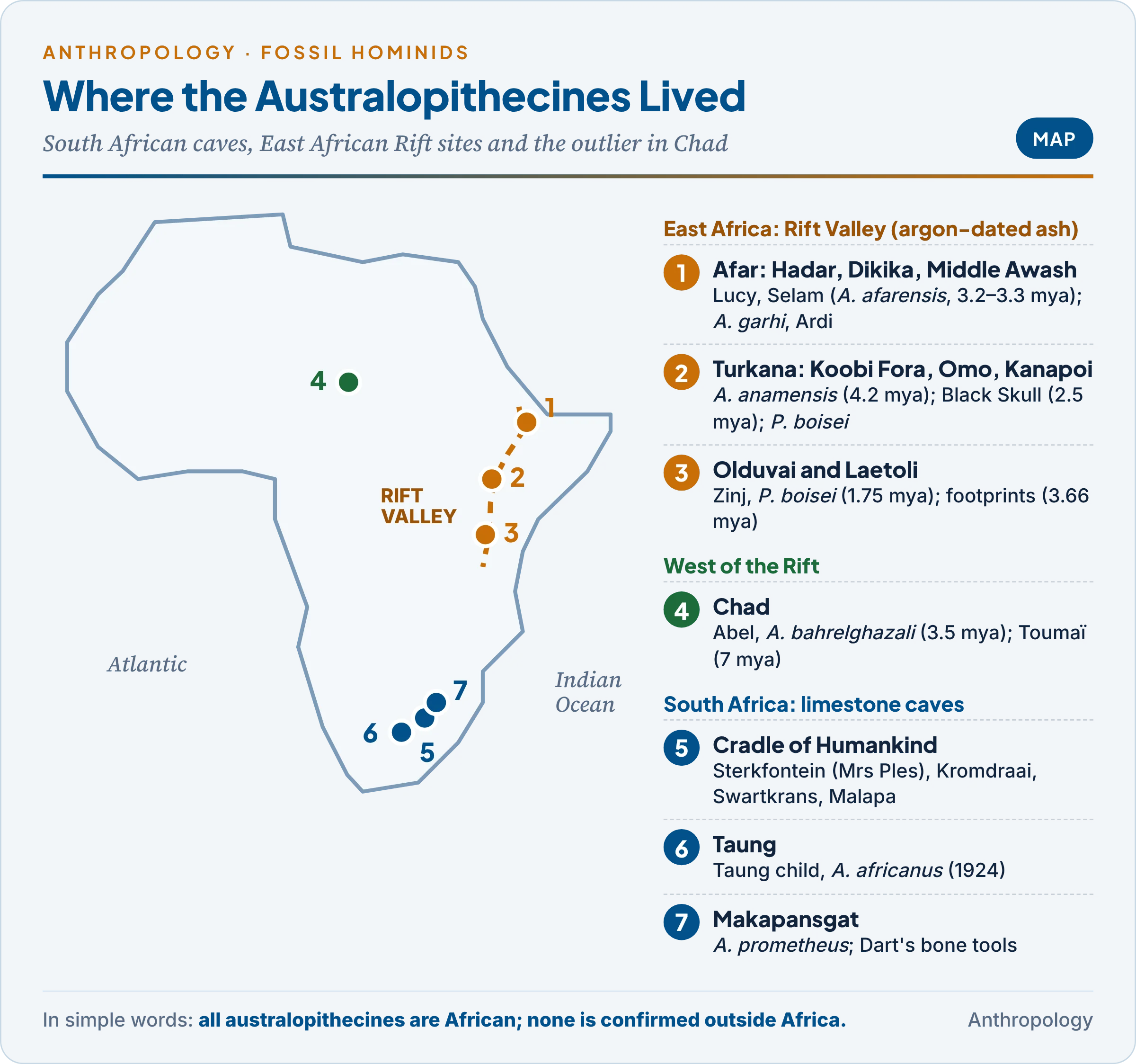
Distribution in sum: australopithecines are confined to Africa, from the Cape to Ethiopia and west to Chad. Claims of Asian forms, such as the massive Java jaws called Meganthropus (first found by Ralph von Koenigswald in 1941), have not stood up; they are now treated as Homo erectus or an ape.
5. Genus Australopithecus: Species and Characteristics
In simple words
Australopithecus is the “gracile” or lighter-jawed group of australopithecines. They stood about 1 to 1.5 metres tall, walked upright on the ground but could still climb, and had brains of 400 to 550 cc. Several species lived one after another, and sometimes side by side, between 4.2 and 2 million years ago.
5.1 The species
The table below arranges the main species by age; read the “Significance” column for what each adds to the story.
| Species and specimen | Site | Date (method) | Traits | Significance |
|---|---|---|---|---|
| A. anamensis: KNM-KP 29281; MRD-VP-1/1 | Kanapoi, Kenya; Woranso-Mille, Ethiopia | 4.2–3.8 mya (argon dating of tuffs) | Bipedal tibia; large canines; narrow, ape-like jaw | Earliest Australopithecus |
| A. afarensis: Lucy AL 288-1; LH 4; Selam | Hadar, Laetoli, Dikika | 3.85–2.95 mya (argon dating) | Brain 380–550 cc; projecting face; small diastema; valgus knee; curved fingers; strong sexual dimorphism | Best-known early biped; likely ancestor of later forms |
| A. deyiremeda | Burtele, Woranso-Mille | 3.5–3.3 mya (argon dating) | Small jaws; (2025) foot with a grasping big toe | Two hominin species at one time and place |
| A. africanus: Taung, Sts 5, Sts 14 | Taung, Sterkfontein, Makapansgat | About 3.0–2.1 mya (fauna, palaeomagnetism, uranium–lead) | Brain 420–500 cc; rounder vault; no diastema; parabolic arch | First australopith found; South African gracile form |
| A. garhi | Bouri, Ethiopia | 2.5 mya (argon dating) | Large teeth; brain about 450 cc | Near cut-marked bones: a candidate ancestor of Homo |
| A. sediba: MH1, MH2 | Malapa, South Africa | 1.98 mya (uranium–lead, palaeomagnetism) | Brain about 420 cc; human-like hand and pelvis; ape-like foot | A late mosaic; claimed, but too young, as Homo‘s ancestor |
Two more forms belong to this time: A. bahrelghazali (“Abel”, Chad, about 3.5 mya) and the flat-faced Kenyanthropus platyops (Lomekwi, Kenya, about 3.5 mya). Read down the date column and the old single chain breaks: between 3.5 and 3.3 million years ago at least three hominins lived in East Africa. The traits column shows mosaic evolution (Unit 1.4b): legs became modern early, arms, brain and face later.
5.2 Characteristics of the genus
- Body: about 1.0–1.5 m and 25–50 kg; in most estimates males were much larger than females (sexual dimorphism), suggesting competition among males for mates.
- Skull: brain 380–550 cc; no true forehead and moderate brow ridges; prognathism (projecting jaws), strongest in A. afarensis; the foramen magnum further forward than in apes, so the head balanced on an upright spine; usually no sagittal crest (a bony ridge for chewing muscles).
- Teeth: reduced, blunt canines, a small diastema (gap) in afarensis, none in africanus; large molars with thick enamel for tough and hard foods; the tooth row changing from U-shaped towards parabolic.
- Walking: a short, broad ilium (upper hip bone) that brought the gluteal muscles to the side to balance the body on one leg; a valgus knee (thigh angled inward); an arched foot with the big toe in line.
- Climbing retained: long arms, curved fingers and toes, an upward-facing shoulder. Australopiths walked on the ground but still slept and fed in trees, so selection kept both abilities.
- Diet: fruit, leaves, seeds, tubers, insects and some meat; enamel isotopes show A. africanus ate many C4 foods (tropical grasses, sedges and animals that ate them), which forest apes do not.
5.3 Australopithecines compared with apes and humans
The comparison below shows why the australopithecines are placed on the human side of the split, even though their brains are ape-sized.
| Feature | Chimpanzee | Australopithecine | Modern human |
|---|---|---|---|
| Canines | Large, projecting; big sex difference | Smaller, non-projecting; moderate sex difference | Small; minimal sex difference |
| Enamel | Thin | Thick | Thick |
| Tooth row | U-shaped, diastema | Intermediate to parabolic | Parabolic, no diastema |
| Brain | About 400 cc | About 400–550 cc | About 1,350 cc |
| Foramen magnum | Towards the back | Between back and base | Under the skull |
| Pelvis | Tall, narrow ilium | Short, broad ilium | Short, broad, bowl-shaped |
| Big toe | Opposable | In line (except some species) | In line |
| Arms and fingers | Long arms, curved fingers | Fairly long; curved fingers | Short arms, straight fingers |
The decisive column is the middle one: in the teeth and the walking skeleton the australopithecines already resemble humans, while in the brain and arms they remain close to apes. Bones show which way a lineage was heading; the brain, which made humans distinctive, came last.
6. Genus Paranthropus: The Robust Australopithecines
In simple words
Paranthropus (“beside man”) are the “robust” australopithecines, which had enormous back teeth, powerful jaws and often a bony crest on top of the skull. They lived in East and South Africa between about 2.7 and 1 million years ago, ate tough plant foods, and died out without leaving descendants. They show that early human history had side branches, not a single line.
6.1 The three species
The robust species, oldest first, show the chewing apparatus growing more extreme in East Africa.
| Species and specimen | Site | Date (method) | Traits | Significance |
|---|---|---|---|---|
| P. aethiopicus: Omo 18 (1967); Black Skull KNM-WT 17000 (1985) | Omo, Ethiopia; West Turkana, Kenya | 2.7–2.3 mya (argon dating) | Brain about 410 cc; largest sagittal crest; very projecting face; flat skull base like afarensis | Oldest robust form; primitive ancestor of later robusts |
| P. boisei: OH 5 “Zinj” (1959); KNM-ER 406; Konso | Olduvai, Koobi Fora, Peninj, Konso | 2.3–1.4 mya (argon dating) | Brain 500–550 cc; biggest molars of any hominin; broad, dished face; huge cheekbones | “Hyper-robust” East African form |
| P. robustus: TM 1517 (1938); SK 48; DNH 7 | Kromdraai, Swartkrans, Drimolen | About 2.0–1.0 mya (fauna, uranium–lead, ESR) | Brain about 530 cc; less extreme than boisei | South African robust form; lived beside early Homo |
P. boisei, the last East African robust, is also the most extreme, which once suggested steady growth in robustness; the early, already crested Black Skull showed that robustness appeared quickly.
6.2 Characteristics
Robust refers to the chewing apparatus, not to body size; Paranthropus bodies were about the size of gracile australopithecines (about 1.0–1.4 m and roughly 32–55 kg, males larger).
- Megadontia (very large cheek teeth): molars and molar-like premolars with very thick enamel, set behind small incisors and canines. The front teeth shrank because food was not bitten off and torn but crushed and ground for long periods.
- Sagittal crest (mainly in males) and flaring zygomatic arches (cheekbones): the crest anchored a huge temporalis muscle, and the wide arches gave it room to pass to the jaw.
- Dished face: forward-jutting cheeks, where the masseter muscle attached far forward for maximum grinding force; a deep, thick jaw, a low forehead and strong brow ridges.
- Foramen magnum placed forward, and the legs and feet of an efficient biped.
- Hand: Swartkrans hand bones (studied by Randall Susman, 1988) and a 2025 P. boisei hand from Koobi Fora show a long thumb able to make a precision grip, combined with powerful, gorilla-like gripping for processing plant food.
6.3 Diet: nutcracker or grass-eater?
- Robinson’s dietary hypothesis: John Robinson, Broom’s colleague, argued (1950s) that robust forms were vegetarian specialists and gracile forms omnivores, so the two could coexist by eating different foods, as Gause’s rule predicts (Unit 1.4b).
- Clifford Jolly’s “seed-eaters” model (Man, 1970). The British anthropologist Clifford Jolly took the gelada baboon of the Ethiopian highlands as an analogy: geladas sit upright on grassland and pick small, hard objects (seeds, grass blades, roots) one by one with nimble fingers. Small-object feeding, he argued, explains the early hominid package: large, flat molars and thick enamel for grinding, small incisors and canines (nothing to tear), an upright trunk from sitting while feeding, and precise hands; tools and hunting came later.
- Strength: it explains the teeth and jaws without hunting, and robust C4 diets fit it.
- Weakness: it explains upright sitting, not walking (geladas are quadrupeds), and the earliest hominins lived in woodland.
- Microwear (microscopic scratches and pits on teeth): Peter Ungar and colleagues (2008) found that P. boisei molars lack the deep pits of nut-cracking, so “Nutcracker Man” ate tough, fibrous food.
- Isotopes: Thure Cerling and colleagues (2011) found a C4 signal of about three-quarters in P. boisei enamel: it lived mainly on grasses and sedges. P. robustus ate a more mixed diet.
The result is a modern version of Robinson’s idea: Paranthropus was a specialist in abundant, low-quality plant food; early Homo a generalist that added meat with tools.
6.4 Lifeways and extinction
- Habitat: wooded grassland near lakes and rivers.
- Tools: at Nyayanga, Kenya, Oldowan tools 3.03–2.58 million years old lie with Paranthropus teeth and butchered hippopotamus bones (2023). At Swartkrans, polished bone tools for digging into termite mounds (Lucinda Backwell and Francesco d’Errico, 2001) and burnt bones about 1–1.5 million years old (C.K. Brain and Andrew Sillen, 1988) lie with P. robustus, though Homo erectus was there too.
- Social life: large sex differences and the male crest suggest male competition, perhaps one male with several females, as in gorillas.
- Predation: the juvenile skull SK 54 has two holes matching a leopard’s lower canines (§7).
- Extinction about 1 million years ago: a narrow diet is a strength while that food is common but a trap when climate turns drier and more variable, and Homo, a tool-using generalist, competed for some resources.
6.5 Phylogenetic status of Paranthropus
- A side branch, not our ancestor: Paranthropus left no descendants. When P. boisei (KNM-ER 406) and Homo erectus (KNM-ER 3733) turned up in the same 1.7–1.8 million-year-old levels at Koobi Fora (Richard Leakey and Alan Walker, 1976), the “single-species hypothesis” of Loring Brace and Milford Wolpoff (that culture allowed only one hominin species at a time) collapsed.
- One genus or two lines? Specialists disagree on whether the robust forms are one natural group:
| View | Reasoning | Taxonomy |
|---|---|---|
| Monophyly (one robust lineage) | P. aethiopicus (2.5 mya) gave rise to P. boisei in East Africa and P. robustus in the south; robust traits evolved once | Genus Paranthropus |
| Parallel evolution (two lineages) | East African robusts descend from aethiopicus; P. robustus descends from A. africanus; similar diets produced similar skulls twice | Australopithecus robustus and A. boisei |
The Black Skull is the key: its primitive skull base and projecting face, combined with robust teeth, link the robusts to A. afarensis rather than to A. africanus. Most specialists today use Paranthropus, which assumes one robust lineage, but the parallel model shows how convergence can mislead classification.
Common confusion
Were the robust australopithecines bigger animals than the gracile ones? No. “Robust” and “gracile” describe the skull, jaws and teeth. Paranthropus had huge molars, a sagittal crest and a heavy jaw, but its body was about as small as that of Australopithecus africanus. Older estimates of a much heavier robust body were not borne out by later skeletons.
6.6 Australopithecus and Paranthropus compared
This table answers the classic “distinguish the two categories” question.
| Trait | Australopithecus (gracile) | Paranthropus (robust) |
|---|---|---|
| Brain | 380–550 cc | 410–550 cc |
| Vault and forehead | Higher, rounder vault | Low and flat |
| Sagittal crest | Absent (small in some afarensis males) | Present, mostly in males |
| Face | Projecting, but not dished | Broad, dished; flaring cheekbones |
| Incisors and canines | Moderate | Small |
| Premolars and molars | Large | Very large (megadontia); molar-like premolars |
| Jaw | Large | Massive |
| Diet | Generalist omnivore | Specialist in tough plant food |
| Time | 4.2–2.0 mya | 2.7–1.0 mya |
| Fate | One line probably gave rise to Homo | Extinct side branch |
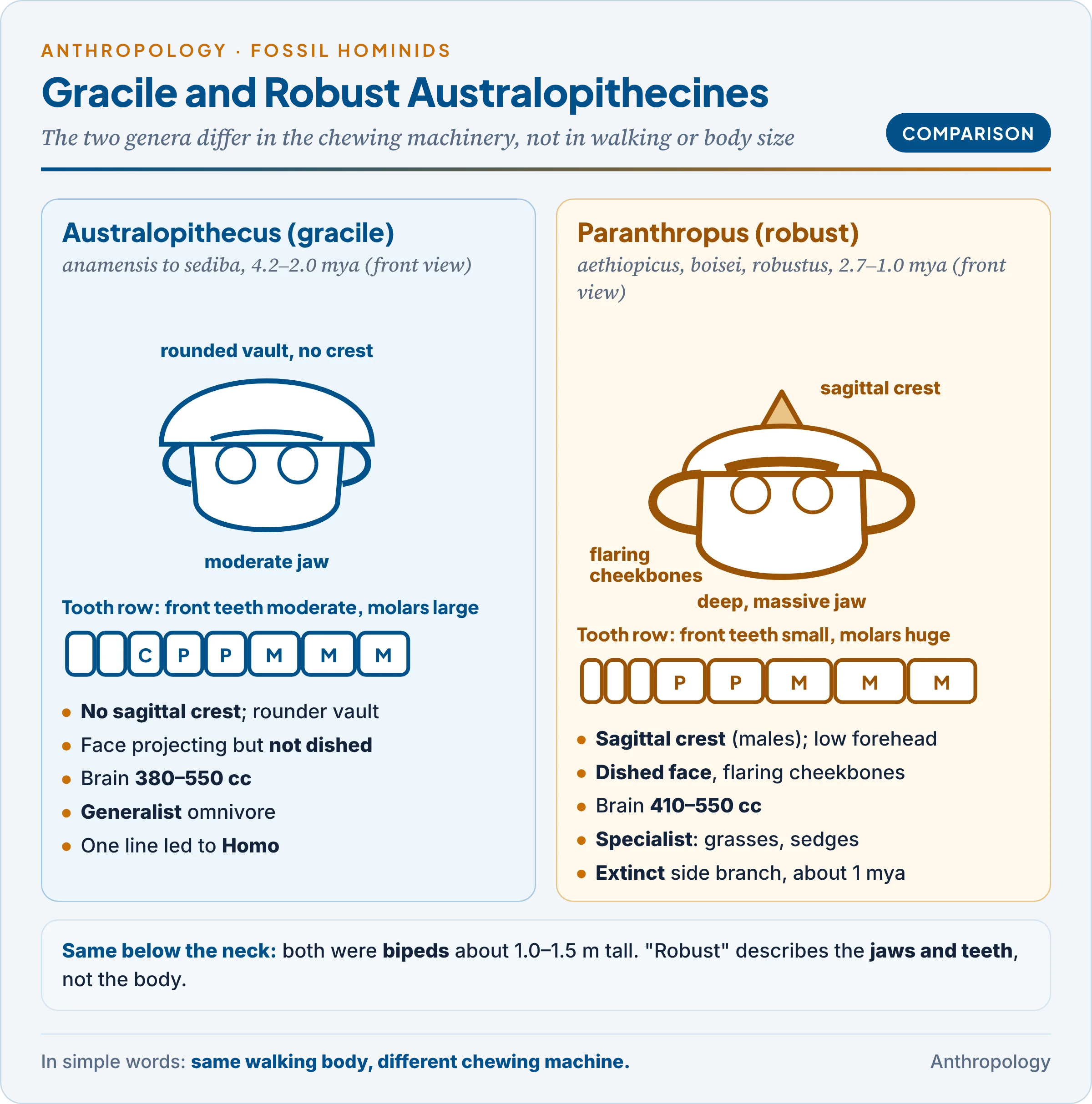
The table shows that the two genera differ almost entirely in the feeding machinery, the part of the body most sensitive to diet. Their walking skeletons are much alike, which is why both count as hominins.
7. Culture and Lifeways: Osteodontokeratic Culture and the First Tools
In simple words
Did the australopithecines make tools? Raymond Dart thought they used bones, teeth and horns as weapons, and called this the “osteodontokeratic culture”. Later research showed that most of those bones had been collected by leopards and hyenas, so the australopithecines were often the hunted, not the hunters. Stone tools, however, do go back to australopithecine times.
7.1 Dart’s osteodontokeratic culture
- The evidence. In the cave breccia of the Makapansgat Limeworks (Limpopo Province), Dart collected thousands of animal bones with A. africanus (“A. prometheus“). Some parts were over-represented: antelope lower humeri (upper arm bones), jaws and horn cores, while vertebrae were rare.
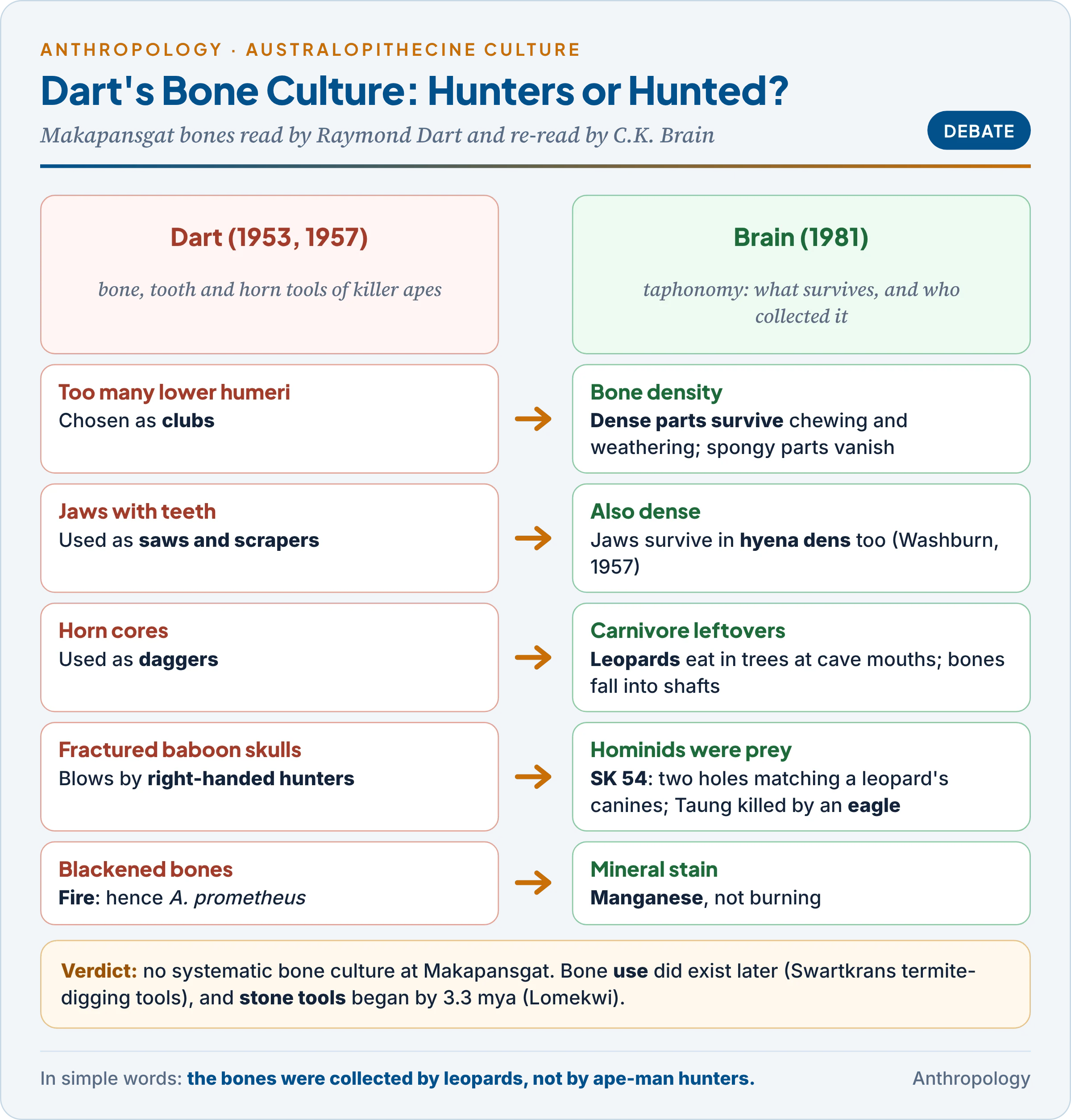
- The theory (1957). Dart named an osteodontokeratic culture (Greek osteon, bone; odous, tooth; keras, horn): australopithecines selected these parts as tools, humeri as clubs, toothed jaws as saws and scrapers, horns as daggers. Depressed fractures on baboon skulls were blows from right-handed attackers, and blackened bones meant fire.
- The “killer ape”. In “The predatory transition from ape to man” (1953) Dart portrayed australopithecines as carnivorous killers; the American writer Robert Ardrey popularised the idea in African Genesis (1961), feeding the “Man the Hunter” view of human origins.
7.2 The taphonomic critique
- Sherwood Washburn (American physical anthropologist, 1957) noted that hyena dens hold similarly selective bone collections.
- C.K. Brain (South African taphonomist), The Hunters or the Hunted? (1981):
- Bone density explains the pattern. Watching dogs chew goat bones in Namibian villages, he showed that dense parts (lower humerus, jaws, horn cores) survive gnawing and weathering while spongy parts are destroyed. Over-representation reflects survival, not selection.
- Carnivores filled the caves: leopards feed in trees at cave mouths and the bones fall into the shafts; hyenas and porcupines add more.
- Hominids were prey: the Swartkrans skull SK 54 has two holes spaced exactly like a leopard’s lower canines; an eagle killed the Taung child.
- No fire: the blackening is manganese staining.
- Result: most specialists reject a systematic osteodontokeratic culture. Bone use was possible (Swartkrans digging tools), but Makapansgat is mainly a carnivore accumulation. The debate made taphonomy a core method and replaced “Man the Hunter” with early hominins as vulnerable prey.
7.3 The earliest stone tools
Stone tools were long thought to define Homo (“Man the Tool-maker“, Kenneth Oakley, 1949). Finds since the 1990s show that australopithecines, or species close to them, also worked stone.
| Site | Date | Evidence | Makers |
|---|---|---|---|
| Dikika, Ethiopia (Shannon McPherron, 2010) | 3.39 mya | Cut-marked animal bones | A. afarensis; the marks are disputed |
| Lomekwi 3, Kenya (Sonia Harmand, 2015) | 3.3 mya | Large cores and flakes: the “Lomekwian“ | Before any known Homo: Kenyanthropus or A. afarensis |
| Nyayanga, Kenya (Thomas Plummer, 2023) | 3.03–2.58 mya | Oldowan tools; hippo butchery | Found with Paranthropus teeth |
| Gona, Ethiopia (Sileshi Semaw, 1997) | 2.6 mya | Oldowan flakes and cores | Early Homo or A. garhi |
| Bouri, Ethiopia (1999) | 2.5 mya | Cut and percussion marks on antelope bones | A. garhi |
The lesson is that tool use preceded the large brain, as bipedalism did: knocking a sharp flake off a stone needs good hands and planning, not a human-sized brain. Once begun, culture fed back into biological evolution (Unit 1.4a, the biocultural feedback loop).
Growth and development: growth lines in enamel show a fast, ape-like schedule. The Taung child’s first permanent molar was erupting at about 3 years, which in a modern child happens at about 6. A long childhood, allowing long learning, came only with Homo (Unit 1.6b).
8. Homo habilis and the Threshold of Homo
In simple words
Homo habilis, the “handy man”, lived in East Africa about 2.3 to 1.4 million years ago. It had a somewhat larger brain than the australopithecines and was linked with the first widespread stone tools. Scientists still argue whether it belongs in our genus or is really an advanced australopithecine.
8.1 Discovery and characteristics
- Olduvai (1960): Jonathan Leakey found OH 7 (jaw, skull bones, hand bones). In 1964 Louis Leakey, the South African anatomist Phillip Tobias and the British anatomist John Napier named Homo habilis (“handy man”) in Nature. Other specimens: OH 24, OH 62 (a small body with long arms), KNM-ER 1813.
- Date: about 2.3–1.4 million years ago (argon dating of tuffs).
- Characteristics: brain about 510–800 cc, larger for body size than in australopithecines; rounder vault, less projecting face, narrower cheek teeth; a hand capable of a precision grip (Napier); an arched foot (OH 8); but a small body (about 1.0–1.35 m) with long arms, still partly arboreal.
- Culture: the Oldowan industry (Mary Leakey’s classification): choppers, polyhedrons, discoids, scrapers, hammerstones and sharp flakes, for cutting meat, cracking marrow bones and working wood. At FLK Zinj (Olduvai Bed I) tools and broken bones lie together; the American archaeologist Glynn Isaac read such sites as home bases for food sharing, while Lewis Binford argued hominins were mostly scavenging carnivore kills.
- Homo rudolfensis: KNM-ER 1470 (Koobi Fora, 1972), about 1.9 million years, brain about 750 cc but a broad, flat face and large teeth. The oldest Homo is the LD 350-1 jaw from Ledi-Geraru, Ethiopia (2.8 million years, Brian Villmoare, 2015).
8.2 Homo or Australopithecus?
- The brain criterion. The British anatomist Arthur Keith had set a “cerebral Rubicon” of about 750 cc for Homo. H. habilis fell below it, so Leakey, Tobias and Napier redefined Homo around about 600 cc plus toolmaking, a precision grip and bipedalism.
- The critics. Le Gros Clark thought the fossils fitted A. africanus. Bernard Wood and Mark Collard (Science, 1999) found australopith-like body proportions, teeth and growth and moved H. habilis and H. rudolfensis to Australopithecus, starting true Homo with H. erectus.
- Relationship to H. erectus. At Ileret, Kenya, Fred Spoor and colleagues (2007) found a H. habilis jaw about 1.44 million years old and a H. erectus skull about 1.55 million years old: the two coexisted for about half a million years. H. habilis may be a sister of H. erectus, or H. erectus may have budded off one population (cladogenesis, a lineage splitting, rather than gradual change of the whole species).
The period 2–1.5 million years ago, when Paranthropus, H. habilis, H. rudolfensis and H. erectus shared the same basins, has been called the crucial humanising period.
8.3 Olduvai Gorge
- Where: a ravine about 48 km long and up to 90 m deep on the edge of the Serengeti, northern Tanzania, in the Ngorongoro Conservation Area (World Heritage Site, 1979).
- History: found by the German entomologist Wilhelm Kattwinkel (1911); explored by Hans Reck (1913) and Louis and Mary Leakey from 1931.
- Sequence: Beds I–IV and later layers, about 2.0 million to 15,000 years ago, with datable volcanic tuffs.
- Finds: OH 5 (P. boisei), OH 7 (H. habilis), OH 9 (H. erectus), OH 62; a continuous record from the Oldowan (Bed I) to the Acheulian hand-axe industry (from Bed II) (Unit 1.8b).
- Significance: the first radiometric date for a hominid (1.75 million years, 1961), which roughly doubled the accepted length of the Pleistocene, and proof that robust australopithecines and early Homo lived together.
9. Phylogenetic Status of the Australopithecines
In simple words
The australopithecines sit between the last common ancestor of chimpanzees and humans and the genus Homo. Everyone agrees that some australopithecine gave rise to Homo and that the robust forms were a side branch. The debate is over which species was our ancestor, and over how many species lived at once.
9.1 Points of agreement
- Hominins, not apes: small canines and habitual bipedalism are derived traits shared with Homo; the ape-like small brain and long arms are primitive traits and do not count against hominin status.
- African, as Darwin predicted; mosaic, with bipedalism (by 4.2 million years) two million years before brain expansion.
- Paranthropus is a side branch; Homo descends from a gracile australopithecine.
9.2 Models of the family tree
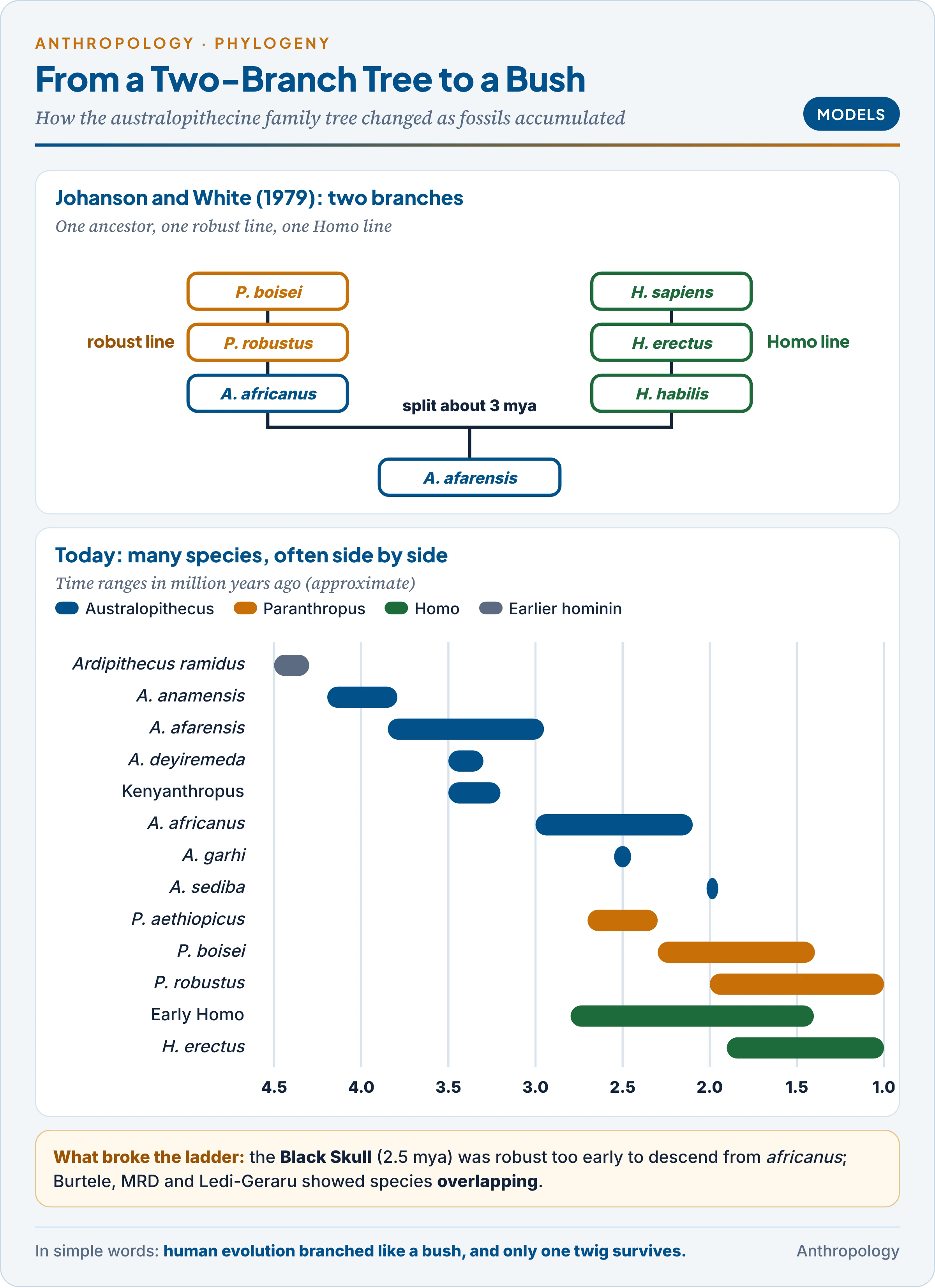
The models below show the tree growing more branched as fossils accumulated: a ladder became a bush.
| Model | Proposed by | Structure | What changed it |
|---|---|---|---|
| A. africanus as common ancestor | Phillip Tobias and others (1970s) | A. africanus → robust line and → Homo | A. afarensis proved older and more primitive |
| Two branches | Donald Johanson and Tim White (Science, 1979) | A. afarensis splits about 3 mya: (a) A. africanus → P. robustus → P. boisei; (b) H. habilis → H. erectus → H. sapiens | The Black Skull (1985): a robust form at 2.5 mya, too early to descend from africanus |
| Three branches | After Walker and Leakey (1986) | A. afarensis → (a) P. aethiopicus → P. boisei; (b) A. africanus → P. robustus; (c) Homo | New species between 3.5 and 2.5 mya |
| Bushy tree (current) | Many authors | A. anamensis → A. afarensis; several species side by side; Homo from an afarensis-like form about 2.8 mya; A. africanus and A. sediba as southern side branches | Coexisting species (Burtele, MRD, Ledi-Geraru) |
9.3 The live questions
- A. anamensis to A. afarensis: long seen as gradual change in one lineage (anagenesis), but the MRD cranium shows the two overlapped by at least 100,000 years, so afarensis may have budded off one population.
- Who was Homo‘s ancestor? A. afarensis (the Ledi-Geraru jaw keeps some of its traits), A. garhi (age and tools fit) or A. sediba (human-like hand and pelvis, but at 1.98 million years younger than the oldest Homo). A. africanus is now usually a side branch.
- Is Ardipithecus an ancestor? Its describers say yes; critics see an ape with independently evolved hominin-like traits.
- How many species? Splitters count four hominins at 3.5–3.3 million years; lumpers credit much of the variety to sexual dimorphism within A. afarensis.
Evaluation. The australopithecines are the ancestral stock of Homo, but no single species can yet be named the ancestor. Human evolution was an adaptive radiation: a bipedal ape split into species with different diets and habitats, and one line of toolmaking generalists led to Homo.
Key Terms
| Term | Meaning in simple words |
|---|---|
| Hominin | A member of the human line after it split from the chimpanzee line |
| Australopithecine | The “southern apes” of Africa: Australopithecus and Paranthropus |
| Gracile / robust | Light-jawed / heavy-jawed australopithecines (the words describe chewing anatomy, not body size) |
| Phylogenetic status | A fossil’s place in the family tree: ancestor, side branch or sister group |
| Taphonomy | The study of what happens to remains between death and discovery |
| Tuff | A layer of volcanic ash, datable by potassium–argon or argon–argon |
| Megadontia | Very large cheek teeth relative to body size |
| Sagittal crest | A bony ridge along the top of the skull for large chewing muscles |
| Dished face | A face with forward-jutting cheeks that looks concave in profile |
| C4 foods | Tropical grasses and sedges (and their consumers), traced by carbon isotopes |
| Osteodontokeratic | Dart’s supposed bone, tooth and horn tool culture |
| Oldowan | The earliest widespread stone-tool industry: choppers and sharp flakes |
| Mosaic evolution | Different body parts evolving at different times and rates |
| Anagenesis / cladogenesis | Change within one lineage / the splitting of a lineage into two |
| Cerebral Rubicon | Arthur Keith’s brain-size threshold (about 750 cc) for the genus Homo |
Contemporary Developments
- Two neighbours at 3.4 million years (November 2025): the Burtele foot, with its grasping big toe, was assigned to A. deyiremeda, a climber living beside A. afarensis (Yohannes Haile-Selassie and colleagues, Nature).
- The hand of Paranthropus (October 2025): a P. boisei skeleton (KNM-ER 101000, Koobi Fora, about 1.5 million years) shows a long, human-like thumb for precision grips, gorilla-like power gripping and a stiff, bipedal foot (Carrie Mongle and colleagues, Nature).
- Early Homo and a new Australopithecus side by side (August 2025): 13 teeth from Ledi-Geraru, Ethiopia, show early Homo at 2.78 and 2.59 million years and an unnamed Australopithecus species at 2.63 million years (Brian Villmoare and colleagues, Nature).
- Proteins from Paranthropus teeth (2025): enamel proteins from four P. robustus individuals from Swartkrans, about 2 million years old, identified males and females and showed one individual to be genetically distinct (Palesa Madupe and colleagues, Science).
- Oldowan tools with Paranthropus (February 2023): Nyayanga, Kenya (3.03–2.58 million years), yielded Oldowan tools used to butcher hippopotamus and pound plants, with Paranthropus teeth, extending the early Oldowan by over 1,300 km (Thomas Plummer and colleagues, Science).
Diagrams to Master
- Topic map: the six blocks of the article, from Oreopithecus to phylogeny.
- Site map: South African caves (Taung, Sterkfontein, Kromdraai, Swartkrans, Makapansgat, Malapa), East African sites (Olduvai, Laetoli, Koobi Fora, Hadar, Omo) and Chad, with species and dates.
- Gracile and robust skulls: label sagittal crest, zygomatic arch, dished face, molars, small front teeth, foramen magnum.
- Dart against Brain: bone club, jaw saw and horn dagger against bone density, the leopard holes in SK 54 and the eagle.
- Phylogeny: a time axis (4.4–1 mya) with the 1979 two-branch model and the current bush; Paranthropus as a side branch.
Revision Grid
| Scholar | Work (year) | Key idea |
|---|---|---|
| Dart | Nature (1925) | Australopithecus africanus from Taung |
| Broom | 1936–49 | Plesianthropus, Paranthropus; adult australopithecines from the Cradle of Humankind |
| Dart | 1953; 1957 | “Predatory transition”; osteodontokeratic culture |
| Hürzeler | 1958–60 | Oreopithecus skeleton; claimed a hominid biped |
| Mary and Louis Leakey | 1959 | Zinjanthropus boisei (OH 5), Olduvai |
| Leakey, Tobias and Napier | Nature (1964) | Homo habilis |
| Jolly | Man (1970) | Seed-eaters model (gelada analogy) |
| Leakey and Walker | 1976 | P. boisei and H. erectus coexisted: end of the single-species hypothesis |
| Johanson and White | Science (1979) | A. afarensis; two-branch phylogeny |
| C.K. Brain | The Hunters or the Hunted? (1981) | Taphonomy: hominids as prey |
| Walker and Leakey | 1985–86 | Black Skull (P. aethiopicus); three-branch model |
| Wood and Collard | Science (1999) | H. habilis closer to Australopithecus |
| Cerling and colleagues | 2011 | P. boisei a C4 grass and sedge eater |
| Harmand and colleagues | 2015 | Lomekwi stone tools, 3.3 mya |
Previous Year Questions
Unit 1.6: Australopithecines, Paranthropus and Homo habilis
- 2026Discuss the phylogenetic status, characteristic features, geographical distribution and lifeways of Paranthropus.
- 2025Write notes on: Osteodontokeratik culture and its makers.
- 2023Discuss major species of Australopithecus discovered from South and East Africa. Describe the discovery, physical features and significance of Taung baby.
- 2019Write a note in 150 words on Olduvai Gorge.
- 2012Comment briefly on the phylogenetic position of Austrolopithecines.
- 2009Write a note on Homo habilis.
- 2009Distinguish between major categories of Australopithecines. How are Australopithecines different from Apes?
- 2005Write a note on Australopithecus.
- 1999Write a note on Australopithecus.
- 1997Write a note on Homo habilis.
- 1990Discuss the origin of Australopethecines. Describe their spatial distribution and growth and development.
- 1987Discuss the spatial distribution, physical features, cultural status or origin of Australopithecines.
Related questions from other units and Paper II
- 2026Unit 1.2: Write notes on: Seed Eaters Model of hominid differentiation.
- 2010Unit 1.4: What are the major craniofacial changes that occurred during Hominid evolution ? Discuss.
- 1996Unit 1.4: Discuss the geographic distribution and taxonomic issues concerning early hominids. Elucidate evidence in support of alternative positions.
- 1988Unit 1.6: Discuss the different types of evidence of the Pithecanthropines, and give a critical appraisal of their place in human evolution in the light of latest discoveries in Africa.