

1.5 Characteristics of Primates; Evolutionary trend and primate Taxonomy; Primate Adaptations (Arboreal and Terrestrial) Primate Taxonomy; Primate Behaviour; Tertiary and Quaternary fossil primates; Living Major Primates; Comparative Anatomy of Man and Apes; Skeletal changes due to erect posture and its implications
Official Syllabus: Paper I, Unit 1.5
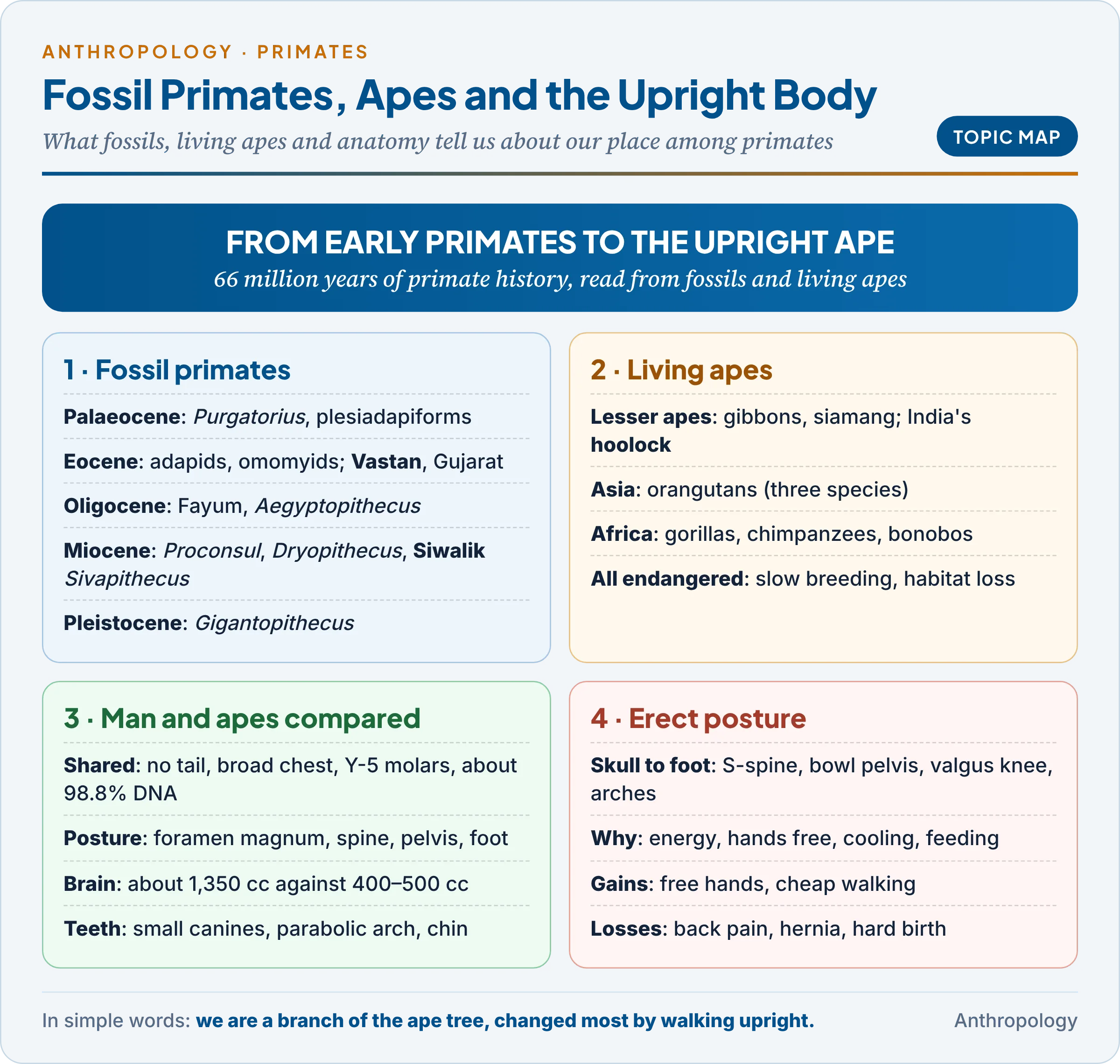
This article covers Tertiary and Quaternary fossil primates, the living major primates, the comparative anatomy of man and apes and the skeletal changes due to erect posture. Primate characteristics, taxonomy, adaptations and behaviour are in Unit 1.5a: in brief, primates are defined by trends towards grasping hands, forward-facing eyes, reduced smell, larger brains and slow growth, and they are classified into strepsirhines (lemurs, lorises) and haplorhines (tarsiers, monkeys, apes, humans).
1. Tertiary and Quaternary Fossil Primates
In simple words
Fossil primates are the remains of primates that lived millions of years ago. They show that primates first appeared about 66 million years ago, that lemur-like and tarsier-like forms spread in a warm early world, that monkeys and apes arose in Africa, and that apes became varied and widespread across Africa, Europe and Asia before the human line split off. India’s Siwalik Hills hold some of the most important of these fossils.
In 1932, in the Siwalik Hills at Haritalyangar (Himachal Pradesh), the American geologist G. Edward Lewis found an ape upper jaw with small front teeth and named it Ramapithecus (1934). In the 1960s the American palaeontologists Elwyn Simons and David Pilbeam argued that its short face, small canines and thick enamel made it the earliest hominid, about 14 million years old, and textbooks placed India near the root of the human line. Then in 1980, on the Potwar Plateau of Pakistan, Pilbeam’s team found a partial face of Sivapithecus (specimen GSP 15000, about 8 million years old) that looked strikingly like an orangutan. Ramapithecus turned out to be the smaller (probably female) form of Sivapithecus, an ape on the orangutan line. One fossil face moved the human split from about 14 million to about 6–7 million years ago. The case shows why fossil primates matter: they test every claim about where we came from.
1.1 The time frame
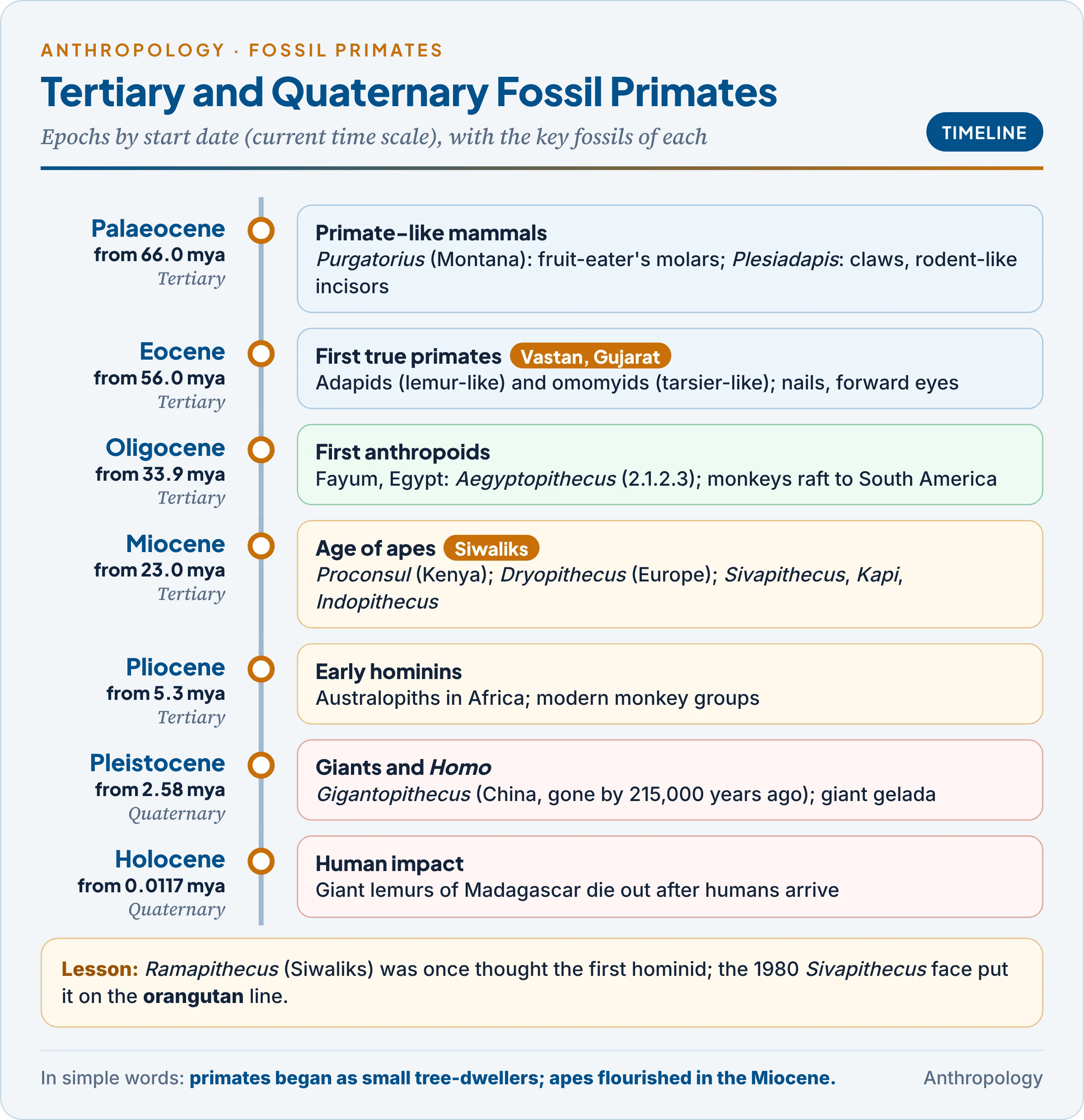
The Tertiary period (Palaeocene to Pliocene, now divided into the Palaeogene and Neogene) and the Quaternary (Pleistocene and Holocene) together make up the Cenozoic era, the “Age of Mammals”. The dates below follow the current international time scale; older textbooks give rounder or earlier figures.
| Period | Epoch | Began (million years ago) | Primate event |
|---|---|---|---|
| Tertiary (Palaeogene) | Palaeocene | 66.0 | Primate-like mammals (plesiadapiforms) |
| Eocene | 56.0 | First true primates: adapids and omomyids | |
| Oligocene | 33.9 | First anthropoids (Fayum); monkeys reach South America | |
| Tertiary (Neogene) | Miocene | 23.0 | “Planet of the apes“: hominoid radiation |
| Pliocene | 5.3 | Early hominins; modern monkey groups | |
| Quaternary | Pleistocene | 2.58 | Homo; giant apes and monkeys; ice ages |
| Holocene | 0.0117 | Modern primates; extinctions caused by humans |
Older books give Palaeocene 65, Eocene 53, Oligocene 37, Miocene 22.5 and Pleistocene 1.8 million years; the Pleistocene base moved to 2.58 million years in 2009.
Why geography matters. The old supercontinent had split into Laurasia (north) and Gondwanaland (south) in the Mesozoic. Until about 45 million years ago North America and Europe were linked through Greenland, so the same early primates occur on both. Africa was an island continent until about 16 million years ago, when the Arabian plate joined it to Eurasia and African apes spread into Europe and Asia. Cooling and drying through the Cenozoic shrank the forests and opened woodland and savanna.
1.2 Palaeocene: primate-like mammals
- Purgatorius (about 66 million years ago, at the very end of the Cretaceous, Montana, USA) is known from teeth and ankle bones. Its molars had the rounded cusps of a fruit- and insect-eater, and its ankle allowed the rotation used in climbing. It still had the primitive dental formula 3.1.4.3.
- Plesiadapiforms, such as Plesiadapis of North America and Europe, were squirrel-sized to cat-sized. They had claws, no postorbital bar, eyes facing partly sideways, and large rodent-like front teeth with a gap behind them.
- Status: most experts treat them as archaic relatives of primates rather than true primates, because their front teeth are too specialised to be ancestral. Carpolestes (about 56 million years ago), with a grasping big toe bearing a nail but sideways eyes, shows that grasping evolved before stereoscopic vision (Unit 1.5a §4.1).
1.3 Eocene: the first true primates
The Eocene was the warmest epoch of the Cenozoic, with forests reaching the poles, and it was the heyday of the prosimians: almost four times as many genera are known from the Eocene as live today. True primates (euprimates) with nails, forward eyes and a postorbital bar appear suddenly at its start. They fall into two families.
| Family | Like which living primates | Traits | Examples and sites |
|---|---|---|---|
| Adapidae (adapoids) | Lemurs | Larger, active by day, leaf- and fruit-eaters, long snout | Notharctus, Smilodectes (North America); Adapis (France, described by Cuvier in 1821); Cantius |
| Omomyidae (omomyids) | Tarsiers | Small, large eye sockets (night-active), insect-eaters, leaping | Teilhardina (Asia, Europe, North America); Necrolemur (Europe) |
Both families occur in India: the Vastan lignite mine near Surat, Gujarat, at least 53 million years old, has yielded early adapoids (Marcgodinotius, Asiadapis) and an omomyid (Vastanomys), described in 2005–09. They are among Asia’s oldest primates and link India’s fauna with Europe’s as India drifted towards Asia.
- Which family led to the anthropoids? Adapids were once favoured; most experts now prefer an Asian, tarsier-like source. Eosimias (China, about 45 million years ago) and Archicebus (China, about 55 million years ago, a tiny animal near the split between tarsiers and anthropoids) point to Asia as the cradle of the anthropoids, which later reached Africa.
- The “Ida” episode: in 2009 a 47-million-year-old skeleton from Messel, Germany (Darwinius) was promoted as a “missing link” to monkeys; it proved to be an adapid, closer to lemurs.
- Lemurs reach Madagascar: the island was already separated from Africa, so lemur ancestors probably rafted across on floating vegetation, then radiated without monkey competitors (Unit 1.5a §4.6).
1.4 Oligocene: the Fayum and the first anthropoids
Almost all early Old World anthropoids come from the Fayum depression, south-west of Cairo, Egypt, now desert but tropical swamp forest by the sea about 37–30 million years ago; Elwyn Simons led its excavation from the 1960s.
- Parapithecids (Apidium, Parapithecus): squirrel-sized leapers with three premolars (2.1.3.3), like New World monkeys, near the base of the anthropoids.
- Propliopithecids (Propliopithecus, Aegyptopithecus): with the catarrhine formula 2.1.2.3.
- Aegyptopithecus zeuxis (about 30–29 million years ago) is the best known. It weighed about 6–8 kg, had full postorbital closure, a small brain with an enlarged visual area and reduced smell bulbs, and the limbs of a slow, arboreal quadruped. Its canines varied greatly between individuals, implying sexual dimorphism and probably male competition for females.
- Significance: Aegyptopithecus is primitive enough to be close to the common ancestor of Old World monkeys and apes, bridging the Eocene prosimians and the Miocene apes.
- Other finds: Saadanius (about 29–28 million years ago, Saudi Arabia, 2010) is a catarrhine from just before the ape–monkey split. Rukwapithecus (about 25 million years ago, Tanzania, 2013), the oldest known ape, and its contemporary Nsungwepithecus, the oldest known Old World monkey, show the two lines had separated by the late Oligocene, as molecular dates predict.
How did monkeys reach South America? South America was an island continent, and the Atlantic was then much narrower (about 1,500–2,000 km). The oldest South American anthropoids, from Santa Rosa in the Peruvian Amazon, include Ucayalipithecus (2020), a parapithecid, a group otherwise known only from Afro-Arabia. Its ancestors probably rafted from Africa between about 35 and 32 million years ago, when sea levels dropped. The New World monkeys thus came from African stock, which explains why platyrrhines and catarrhines share anthropoid traits but have evolved separately ever since.
1.5 Miocene: the age of apes
If the Eocene was the age of prosimians, the Miocene (23–5.3 million years ago) was the age of apes: more than 500 individuals are known from Europe, Asia and Africa, many with no living descendants. Naming was long a muddle, with nearly 30 genera, two of them for the upper and lower jaws of one animal. In the 1960s Simons and Pilbeam “lumped” almost all into Dryopithecus and Ramapithecus; finds since the 1980s showed this went too far.
Early Miocene Africa (23–14 million years ago)
- Proconsul (about 20–17 million years ago, Rusinga Island and Koru, Kenya): named in 1933; the British archaeologist Mary Leakey found a nearly complete skull on Rusinga in 1948.
- Ape-like: no tail, Y-5 molars, a fairly large brain.
- Monkey-like: a flexible back and limbs of equal length, so it walked on top of branches.
- It is a “dental ape“: an ape in its head and teeth, a monkey in its body. Most experts place it near or before the split of the small and large apes. The Rusinga species have since been renamed Ekembo.
- Morotopithecus (about 20 million years ago, Uganda): short, stiff lower back vertebrae and a mobile shoulder like living apes, showing an early upright-trunk (orthograde) body.
- Masripithecus (about 18–17 million years ago, northern Egypt, 2026): the first early-Miocene ape from North Africa (see Contemporary Developments).
Middle and late Miocene Europe (16–7 million years ago)
- Dryopithecus (first found at Saint-Gaudens, France, 1856, about 12–11 million years ago): thin-enamelled molars with the Y-5 pattern, a fruit-eater of forests. Its teeth gave the Y-5 its other name, the “Dryopithecus pattern“. It shows apes had spread into Europe, but it is not a direct human ancestor.
- Pierolapithecus (about 12 million years ago, Spain, 2004): broad chest and stiff lower back, the orthograde great-ape body plan.
- Danuvius (11.6 million years ago, Bavaria, Germany, 2019): complete limb bones show long arms for hanging and extended hips and knees, which its describers called “extended limb clambering“, a possible model for the common ancestor of great apes and humans. The claim of partial bipedalism is disputed.
- Ouranopithecus (about 9.5–8.7 million years ago, Greece): thick enamel; possibly near the African ape–human line.
- Oreopithecus (about 8–7 million years ago, Tuscany and Sardinia, Italy): an island ape with a short face and an unusual pelvis; treated in Unit 1.6a.
Middle and late Miocene Asia (16–7 million years ago)
- Sivapithecus (about 12.7–8.5 million years ago, Siwaliks of India and Pakistan; also Turkey): named by the British geologist Guy Pilgrim in 1910. It weighed about 30–70 kg, had thick-enamelled, flat-wearing molars and robust jaws. The 1980 face shows a concave profile, tall oval eye sockets set close together and projecting incisors, all orangutan features. Its arm bones, however, are unlike an orangutan’s, so it was probably not a suspensory specialist. This mismatch is still debated.
- Ramapithecus: now merged with Sivapithecus (above).
- Giant apes: Indopithecus (about 8.6 million years ago, Haritalyangar), a giant jaw first described as Gigantopithecus bilaspurensis (1969) by Simons and the Indian anthropologist S.R.K. Chopra of Panjab University; its Pleistocene relative Gigantopithecus is covered in §1.7.
- Kapi ramnagarensis (about 13 million years ago, Ramnagar, Jammu and Kashmir; Christopher Gilbert and colleagues, 2020): a single molar that is the oldest known gibbon fossil, about 5 million years older than the previous record. It shows that gibbons reached Asia at about the same time as the great apes.
Late Miocene Africa (10–6 million years ago): fossils are few, though this is where gorillas, chimpanzees and humans diverged; Chororapithecus (about 8 million years ago, Ethiopia, gorilla-like teeth) begins to fill the gap, and the first hominins, Sahelanthropus (Chad) and Orrorin (Kenya), appear at its end (Unit 1.6).
The table summarises the key fossils with their dates and significance.
| Fossil | Site | Date (dating method) | Key traits | Significance |
|---|---|---|---|---|
| Purgatorius | Montana, USA | about 66 mya (ash beds, argon dating) | Fruit-eater’s molars; climbing ankle | Earliest primate-like mammal |
| Adapids / omomyids | N. America, Europe, Asia; Vastan, Gujarat | 56–34 mya (marine microfossils at Vastan) | Nails, forward eyes, postorbital bar | First true primates |
| Aegyptopithecus | Fayum, Egypt | about 30–29 mya (argon dating of basalt; magnetic stratigraphy) | 2.1.2.3; postorbital closure; small brain | Near the monkey–ape common ancestor |
| Proconsul | Rusinga, Kenya | 20–17 mya (potassium–argon) | No tail; monkey-like body | Early “dental ape” |
| Dryopithecus | France, Spain, Hungary | 12–9 mya (fossil fauna) | Thin enamel; Y-5 molars | Apes spread into Europe |
| Kapi | Ramnagar, J&K | 13.8–12.5 mya (fossil fauna, magnetic stratigraphy) | Gibbon-like molar | Oldest gibbon |
| Sivapithecus | Siwaliks, India–Pakistan | 12.7–8.5 mya (magnetic stratigraphy) | Thick enamel; orangutan-like face | Orangutan line; absorbed Ramapithecus |
| Danuvius | Bavaria, Germany | 11.6 mya (magnetic stratigraphy) | Long arms, extended hips and knees | Model for the great ape–human ancestor |
| Gigantopithecus blacki | South China caves | 2.3 mya – 295,000–215,000 years ago (luminescence, uranium-series, ESR) | Largest primate; huge flat molars | Quaternary giant ape; orangutan relative |
Two patterns emerge: primates began as small arboreal fruit- and insect-eaters and diversified as the world cooled; and the record is poorest in Africa exactly when the human line began.
1.6 The Ramapithecus–Sivapithecus debate
The debate is examined in Paper II (Siwaliks and Narmada basin), but its logic belongs here. The table sets the two readings side by side.
| Basis | Ramapithecus as a hominid (1960s–70s) | Ramapithecus as Sivapithecus (from about 1980) |
|---|---|---|
| Evidence | Fragmentary jaws; dental arcade reconstructed as parabolic (human-like) | More complete jaws and the 1980 face |
| Key traits | Small canines, thick enamel, short face | Same traits occur in female Sivapithecus; face orangutan-like |
| Human split | About 14 million years ago | About 6–7 million years ago |
| Supporting science | Fossil morphology alone | Fossils plus the molecular clock (Vincent Sarich and Allan Wilson, 1967) |
The molecular clock (estimating the time since two species split from the number of differences in their proteins or DNA) had already suggested in 1967 that humans and African apes separated only about 5 million years ago. Palaeontologists at first rejected this; the 1980 face reconciled the two. The lesson is that thick enamel and small canines evolved more than once (convergence, Unit 1.4b §6.4) and cannot alone identify a hominin.
1.7 Quaternary fossil primates
The Quaternary (from 2.58 million years ago) adds the hominins of Unit 1.6 and several remarkable non-human primates.
- Gigantopithecus blacki (South China): the largest primate ever, known from four jaws and over a thousand teeth. It was discovered in 1935 by the German-Dutch palaeontologist Ralph von Koenigswald in Hong Kong drugstores, where its teeth were sold as “dragon teeth“. Estimates suggest up to about 3 m tall and 200–300 kg. Proteins from its enamel (2019) show it was a relative of the orangutan. It lived from about 2 million years ago until it became extinct between 295,000 and 215,000 years ago, when seasonal climates thinned its forests and it failed to adapt its diet (Contemporary Developments).
- Theropithecus oswaldi: a giant gelada baboon of Pleistocene Africa, nearly gorilla-sized, a grass-eater like the living gelada. Its bones in butchery sites suggest that early Homo hunted it.
- Giant lemurs of Madagascar: Archaeoindris (gorilla-sized), Megaladapis and Palaeopropithecus survived until the last 2,000 years, then died out after humans arrived, a Holocene extinction caused by hunting and forest clearance.
1.8 Fossil primates and human origins: an evaluation
- “India as the cradle of mankind”: Siwalik finds led Pilgrim (1915) and others to place the human line’s origin in India, and Ramapithecus revived the idea. But every early hominin is African, and the Siwalik apes lie on the orangutan line. India’s contribution is different:
- Vastan holds some of the oldest primates of Asia;
- the Siwaliks hold one of the world’s richest Miocene ape records (Sivapithecus, Indopithecus, Kapi);
- the Narmada basin (Paper II) and Attirampakkam (Unit 1.4a) record later hominins and their tools.
India was a crossroads of primate evolution, not its cradle.
- “Dryopithecus holds the clue for human origin”: in the sense that dryopithecines show apes had the Y-5 teeth and the upright-trunk body from which both great apes and humans evolved, yes; as a direct ancestor, no.
- Gradualism versus punctuation: the American palaeontologist Philip Gingerich (1976) traced the Palaeocene–Eocene lineage of Plesiadapis through successive layers and found gradual size change, a primate example for gradualism; the long stasis of Homo erectus is the usual example for punctuated equilibrium (Unit 1.4b §5.3). Primate history fits both tempos at different times.
2. Living Major Primates
In simple words
The living major primates are the apes: the small gibbons of Asia, the orangutans of Borneo and Sumatra, and the gorillas, chimpanzees and bonobos of Africa. They are our closest relatives, and every one of them is now endangered.
In the Hollongapar Gibbon Sanctuary in Jorhat, Assam, family groups of western hoolock gibbons sing loud duets at dawn to mark their territories. The hoolock is India’s only ape, living in the forests south and east of the Brahmaputra and in the north-eastern states. Its long arms, which almost touch the ground when it stands, and its swinging travel through the canopy are the features of all gibbons.
2.1 Lesser apes: gibbons and siamang (family Hylobatidae)
- Range: South-East Asia, southern China, north-east India, Bangladesh and Myanmar, south to Sumatra, Java and Borneo.
- Kinds: about 20 species in four genera: Hylobates, Hoolock (India’s western and eastern hoolocks), Nomascus and Symphalangus, the siamang of Sumatra and Malaysia, which is the largest and has a throat sac that amplifies its call.
- Body: about 5–8 kg (siamang up to 12), little sexual dimorphism, arms far longer than legs, hook-like hands with a short thumb, ischial callosities, brain about 100 cc.
- Locomotion: fast ricochetal brachiation (swinging with a flight phase); bipedal walking on branches and ground, arms raised.
- Society: pair-living, territories announced by duets, with some extra-pair mating.
2.2 Great apes
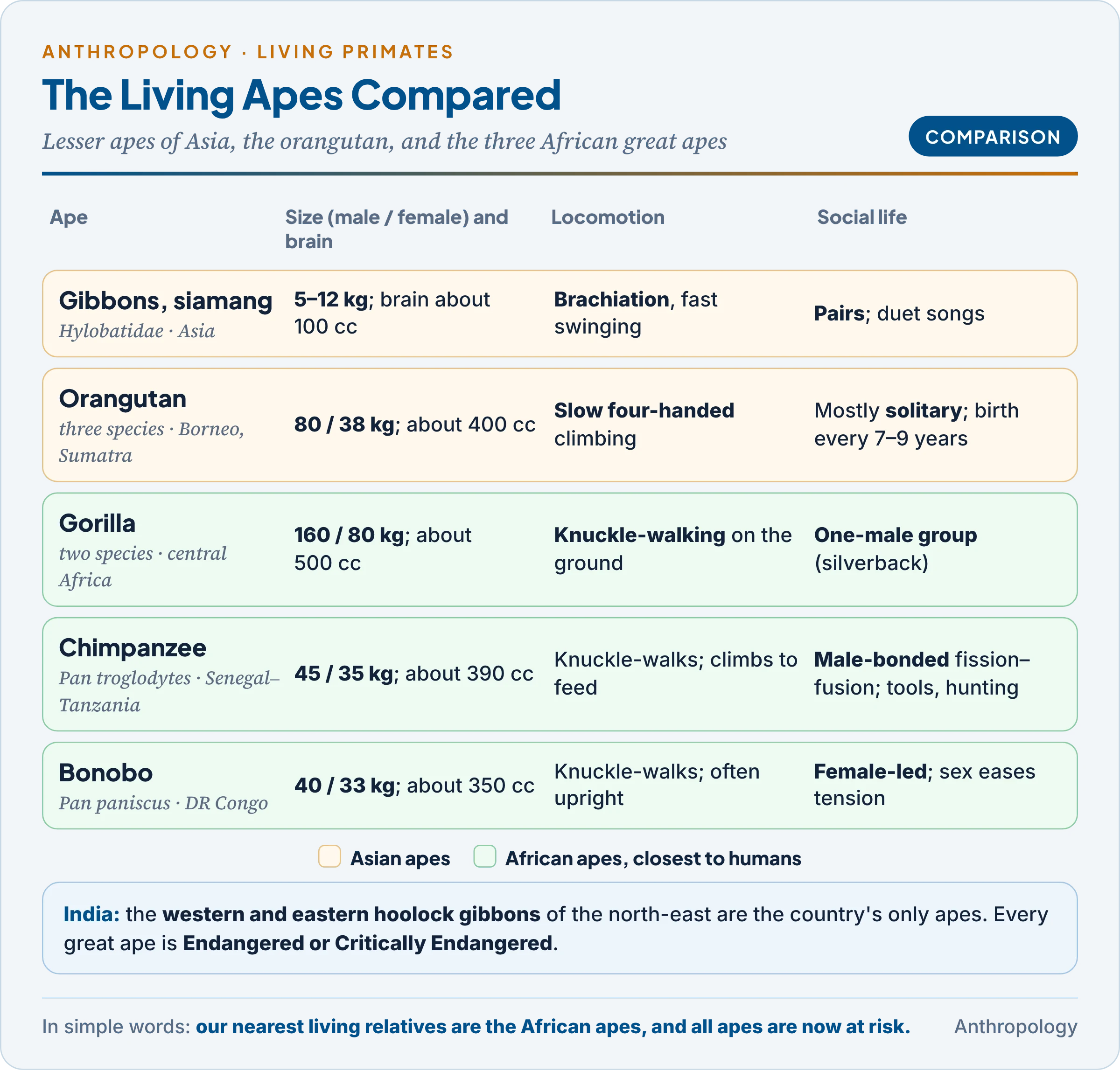
The table compares the four great apes; the text after it draws out what the contrasts mean.
| Trait | Orangutan | Gorilla | Chimpanzee | Bonobo |
|---|---|---|---|---|
| Range | Borneo and Sumatra (Asia) | Equatorial central Africa | Equatorial Africa, Senegal to Tanzania | DR Congo, south of the Congo River |
| Species | Three: Bornean, Sumatran, Tapanuli (2017) | Two: western (lowland) and eastern (incl. mountain) | Pan troglodytes (four subspecies) | Pan paniscus |
| Male / female weight | about 80 / 38 kg | about 160 / 80 kg | about 45 / 35 kg | about 40 / 33 kg |
| Brain | about 400 cc | about 500 cc | about 390 cc | about 350 cc |
| Locomotion | Slow four-handed climbing (quadrumanous); fist-walking on the ground | Knuckle-walking; mainly on the ground | Knuckle-walking; climbs to feed | Knuckle-walking; more often bipedal |
| Social life | Largely solitary | One-male group led by a silverback | Male-bonded fission–fusion community | Female-led fission–fusion community |
| Diet | Fruit, especially figs | Leaves and stems (mountain); fruit (lowland) | Fruit; hunts monkeys | Fruit; little hunting |
| Status (IUCN) | All three Critically Endangered | Both Critically Endangered; mountain subspecies Endangered | Endangered | Endangered |
- Asian versus African apes: the orangutan is the only great ape of Asia and the most arboreal; its separate lineage goes back about 13–16 million years, matching the Sivapithecus fossils (§1.5). The African apes are more terrestrial and knuckle-walk, and are closer to humans.
- Size and sex: gorillas and orangutans show the strongest sexual dimorphism (males about twice female weight); mature male gorillas grow silver back hair, hence “silverback”.
- Slow breeding: an orangutan mother gives birth only every 7–9 years, the longest interval of any mammal. Combined with habitat loss, this is why every great ape is endangered: a population cannot replace losses quickly.
- Chimpanzee and bonobo: the two Pan species are equally related to humans, yet they differ socially: chimpanzees are male-dominated, territorial and capable of lethal raids; bonobos are female-led and resolve tension through sex and play (Unit 1.5a §5.7). The difference is often linked to richer, more reliable food south of the Congo River, which lets bonobo females forage together and form alliances.
- Mountain gorillas (Virunga volcanoes and Bwindi): protection building on Fossey’s work raised them above 1,000, and they were moved from Critically Endangered to Endangered in 2018.
2.3 Living monkeys in brief
The major living monkeys are described with taxonomy in Unit 1.5a §3: in brief, the New World monkeys (marmosets, capuchins, spider and howler monkeys) are arboreal and often have prehensile tails; the Old World monkeys divide into the omnivorous, often terrestrial cercopithecines (macaques, baboons, guenons) and the leaf-eating colobines (langurs, colobus). India’s macaques and langurs belong to the Old World group.
3. Comparative Anatomy of Man and Apes
In simple words
Humans and apes have the same basic body: no tail, a broad chest, arms that can swing above the head, and similar teeth and blood. The differences cluster in three areas: humans walk upright, have much bigger brains, and have smaller jaws and teeth. Comparing the two shows exactly what changed on the human line.
The frontispiece of Huxley’s 1863 book drew five skeletons side by side: gibbon, orangutan, chimpanzee, gorilla and man. The drawing makes the point at a glance: the same bones in the same arrangement, differing in proportion. Huxley concluded that “the structural differences which separate Man from the Gorilla and the Chimpanzee are not so great as those which separate the Gorilla from the lower apes.” Comparative anatomy measures those differences of proportion.
3.1 Similarities
Humans share with the apes all the hominoid features (Unit 1.5a §3.4):
- No tail; a broad, shallow chest; shoulder blades on the back; a mobile shoulder that lets the arm rotate above the head (we can hang from a bar and throw overarm because of this ancestry).
- Y-5 molars and the dental formula 2.1.2.3; an appendix; a large, folded brain; and the same slow life history with long infancy and single births.
- Physiology: similar blood groups (chimpanzees A and O, gorillas B), menstrual cycles and shared diseases.
- Genes: human and chimpanzee DNA differ at about 1.2 per cent of letters (about 4 per cent counting insertions and deletions). Humans have 46 chromosomes and great apes 48, because two ancestral ape chromosomes fused end to end to form human chromosome 2. Gene differences date the human–chimpanzee split to about 6–7 million years ago.
Which ape is closest? Each ape resembles humans in different features, which long confused the question:
- gorilla: the hands, feet and pelvis are most human-like among apes;
- chimpanzee: the skull and body pigmentation;
- orangutan: the high forehead and 12 pairs of ribs, as in humans (chimpanzees and gorillas have 13);
- gibbon: relatively long legs and frequent upright walking.
DNA settled it: Charles Sibley and Jon Ahlquist (American molecular biologists, 1984) and later genomes showed that chimpanzees and bonobos are closest, then gorillas, then orangutans. Single resemblances mislead; overall genetic distance does not.
Common confusion
Did man descend from apes or monkeys? No living ape or monkey is our ancestor. Humans and chimpanzees share a common ancestor that lived about 6–7 million years ago and was neither a chimpanzee nor a human; since then both lines have evolved, chimpanzees as much as we have. Living apes are therefore our cousins, not our grandparents, and monkeys are more distant cousins still, sharing an ancestor with us about 25–30 million years ago.
3.2 The skull: gorilla and man
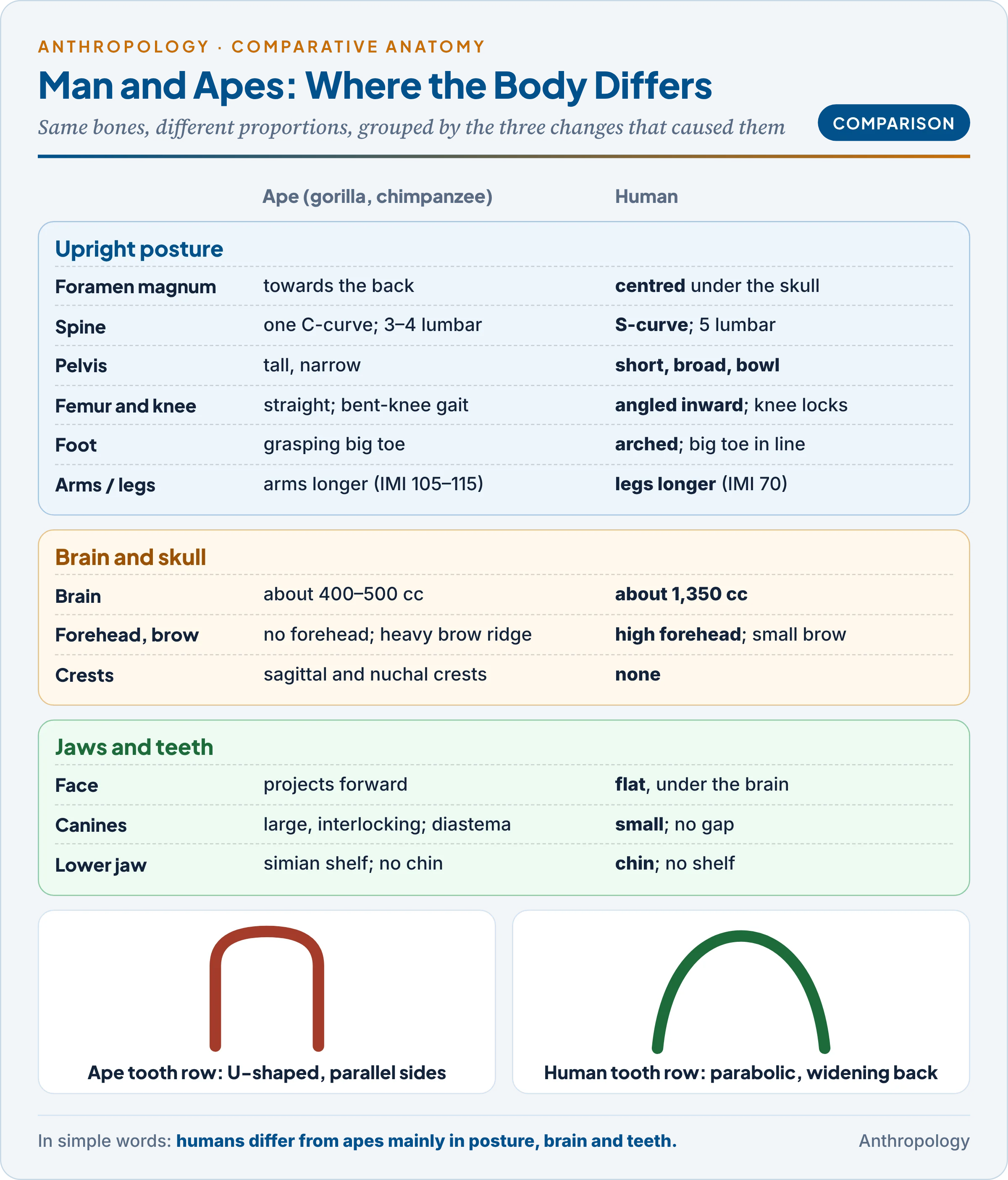
The gorilla skull shows the ape pattern in its most extreme form, so it is the standard comparison. The table lists the differences from the top of the head to the chin.
| Feature | Gorilla | Man |
|---|---|---|
| Braincase and face | Face larger than braincase | Braincase larger than face |
| Brain size | about 500 cc | about 1,350 cc |
| Forehead | Absent; skull slopes back | High, vertical forehead |
| Brow ridge | Massive, continuous (supraorbital torus) | Small or absent |
| Crests | Sagittal crest on top (males) and nuchal crest at back, for huge chewing and neck muscles | No crests; smooth skull |
| Foramen magnum (opening for the spinal cord) | Towards the back; head hangs forward | Central, under the skull; head balanced |
| Mastoid process (bump behind the ear) | Small | Large (for neck muscles that balance the head) |
| Face | Prognathous (jaws project forward) | Orthognathous (face flat, under the brain) |
| Nose | Flat, broad nostrils, little bridge | Projecting nasal bones, prominent nose |
| Lower jaw | Massive; simian shelf (a bony ledge inside the chin); no chin | Light; chin present; no shelf |
| Dental arcade (shape of the tooth row) | U-shaped, parallel rows | Parabolic, diverging towards the back |
| Canines and diastema | Large, interlocking canines; diastema gap | Small canines, level with other teeth; no gap |
| Chewing | Mainly up and down (canines lock the jaws) | Side-to-side grinding (rotary) |
| Enamel | Thin | Thick |
The skull differences have three causes, and knowing them makes the table easy to recall:
- Upright posture moved the foramen magnum forward and removed the need for heavy neck muscles and the nuchal crest.
- Brain expansion produced the high forehead and vaulted braincase.
- Smaller teeth and jaws, as tools and cooking took over cutting and softening food (Unit 1.4a §2), removed the sagittal crest, the brow ridge, the simian shelf and the interlocking canines; freed from canine locking, the jaw could grind from side to side.
3.3 The skeleton and body: chimpanzee and man
The postcranial skeleton (all of it below the head) differs mainly because of bipedalism, treated in §4. The table summarises.
| Feature | Chimpanzee | Man |
|---|---|---|
| Spine | One C-shaped curve; 3–4 lumbar vertebrae | S-shaped, four curves; 5 lumbar vertebrae |
| Chest | Funnel-shaped (narrow at top) | Barrel-shaped |
| Pelvis | Tall, narrow blades facing backwards | Short, broad, bowl-shaped, blades curving round the sides |
| Limb proportions | Arms longer than legs (IMI about 105) | Legs longer than arms (IMI about 70) |
| Femur | Straight down from the hip; no angle at the knee | Slopes inward to the knee (valgus angle, about 8–11°) |
| Knee | Cannot lock straight; walks bent-hip, bent-knee | Locks straight; large joint surfaces |
| Foot | Grasping, opposable big toe; flat | Non-opposable big toe in line; arched; large heel |
| Hand | Long fingers, short thumb; knuckle-walking | Long, strong thumb; precision grip |
| Body hair | Dense coat | Sparse hair; many sweat glands |
- Chimpanzee and man (1993 PYQ pattern): add to these the skull differences of §3.2 (milder in the chimpanzee than in the gorilla: smaller brow ridge, no sagittal crest in most) and the similarities of §3.1.
- Australopiths in between: fossil australopiths (Unit 1.6) sit between chimpanzee and human in canine size (smaller, non-projecting), enamel thickness (thicker), brain size (about 400–550 cc) and foramen magnum position (between rear and base), but already have a human-like knee and pelvis. Their teeth and hips modernised early, their brains late.
3.4 Evolutionary significance
- The differences are a map of hominization. They cluster in locomotion, brain and teeth, the three main trends of human evolution (Unit 1.4a §1.1). Each human trait can be traced to one of these changes.
- They appeared at different times. Fossils show the pelvis and knee changed first (by 4 million years ago), the teeth next, the brain last: mosaic evolution (Unit 1.4b §6.6). So no single feature makes a fossil human.
- Differences are mostly of degree. Huxley’s point stands: almost every human structure has an ape counterpart, enlarged, reduced or reshaped. What is new is the combination, plus the culture it made possible.
- The similarities have practical value. Shared anatomy and genes make apes models for medicine and for reconstructing early hominin behaviour, and they underline the ethical case for their conservation.
4. Skeletal Changes due to Erect Posture and Its Implications
In simple words
When our ancestors began to walk upright on two legs, almost every part of the skeleton changed, from the skull to the toes, to carry the body’s weight over two feet and keep it balanced. This freed the hands but brought new problems, such as back pain and difficult childbirth.
Low back pain affected an estimated 619 million people in 2020 and is the world’s leading cause of disability (Global Burden of Disease study, 2023). It is not only modern: spinal arthritis appears in prehistoric hunter-gatherer skeletons. It is a price of standing on two legs with a skeleton remodelled from a tree-climbing ape. Unit 1.4a §2.1 summarised the changes; here they are taken region by region.
Common confusion
Are erect posture and bipedalism the same thing? Not quite. Erect (orthograde) posture means holding the trunk upright, which apes (and fossils such as Morotopithecus) do when they hang, climb or sit. Bipedalism means walking on two legs as the normal way of travel. Humans are the only primates with both as a habit; the skeletal changes of the legs and feet are due to bipedal walking, those of the spine and skull to keeping the upright trunk balanced over them.
4.1 From head to foot
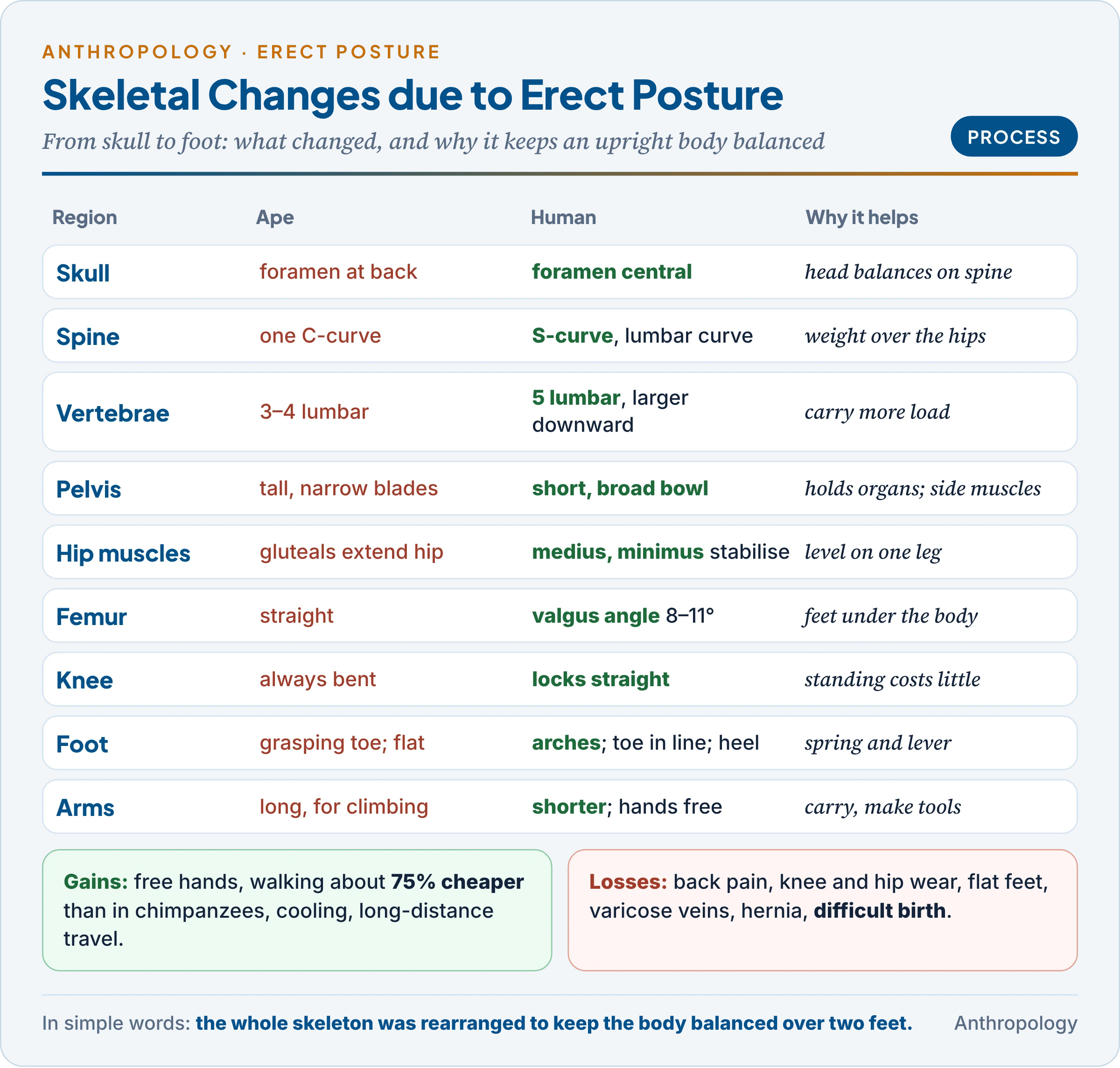
The table moves from the skull down. For each region it shows what changed and why the change helps an upright walker.
| Region | Ape condition | Human condition | How it helps |
|---|---|---|---|
| Skull | Foramen magnum towards the back; strong neck muscles and crests | Foramen magnum central, under the skull; small neck muscles | The head balances on top of the spine with little muscle effort |
| Spine | One C-shaped curve | S-shaped: forward curves in the neck and lower back (lordosis), backward in the chest and sacrum | Places the head and trunk directly over the hips and feet; absorbs shocks like a spring |
| Vertebrae | Similar size down the column; 3–4 lumbar | Bodies grow larger downwards; 5 lumbar, wedge-shaped | Lower vertebrae carry more weight; wedging forms the lumbar curve |
| Sacrum | Long, narrow | Short and broad | Firm, wide link between spine and pelvis |
| Pelvis | Tall, narrow, blades at the back | Short, broad, bowl-shaped; blades (ilium) curve to the sides | Supports the abdominal organs from below; lowers the centre of gravity |
| Hip muscles | Gluteals mainly extend the hip | Gluteus medius and minimus at the side stop the pelvis tilting at each step; gluteus maximus enlarged | Keeps the body level on one leg while the other swings |
| Femur | Short, straight; no valgus angle | Long; slopes inward to the knee; larger head; strong linea aspera (muscle ridge at the back) | Brings the knees and feet under the body; long stride |
| Knee | Bent in walking; small joint | Locks fully straight; large condyles | Standing needs little muscle work |
| Foot | Grasping; opposable big toe; flat | Big toe in line; two arches (lengthwise and across); big heel bone | A rigid lever to push off and a spring to absorb impact |
| Upper limb | Long arms for climbing and knuckle-walking | Shorter arms; freed hand with long thumb | Hands free to carry and make tools |
Two points tie the table together. The centre of gravity must sit over a tiny base, the two feet, so the spine curves, the femur angles inward and the knees lock to keep it there. And the foot changed most: from a grasping organ to a platform, with weight passing from the heel along the outer edge, across the ball, and off the big toe.
The curves form in every child: a newborn’s spine is one C-shaped curve, like an ape’s; the neck curve appears when the baby holds up its head (about 3–4 months) and the lower-back curve when it walks (about 12 months).
4.2 Why did bipedalism evolve?
Unit 1.4a §2.1 lists the main hypotheses; here they are set out with their evidence and weaknesses. They are not mutually exclusive.
| Hypothesis | Proposed by | Core idea | Evaluation |
|---|---|---|---|
| Freeing the hands | Charles Darwin (The Descent of Man, 1871) | Hands freed for tools, weapons and carrying | Bipedalism appears about 4 million years before the first stone tools, so tools cannot be the first cause |
| Energy efficiency | Peter Rodman and Henry McHenry (1980) | Walking upright costs less energy than knuckle-walking when food patches are far apart | Strongly supported: human walking costs about 75 per cent less than chimpanzee walking (Michael Sockol and colleagues, 2007) |
| Keeping cool | Peter Wheeler (British physiologist, 1991) | Upright body exposes less skin to midday sun and catches cooler breezes | Mainly useful in open, hot country, but early hominins lived in woodland |
| Provisioning and pair-bonding | C. Owen Lovejoy (1981) | Males walked upright to carry food to mates and young | Assumes monogamy, which human societies do not universally show |
| Seed-eating and postural feeding | Clifford Jolly (1970); Kevin Hunt (1994) | Standing to pick seeds or fruit from low branches; bipedal walking grew from bipedal standing | Chimpanzees do stand to feed; fits a woodland setting |
| Arboreal origin | Susannah Thorpe and colleagues (2007) | Upright walking began in the trees, on flexible branches, as orangutans do | Supported by Danuvius (2019) and by the climbing features of early hominins |
| Endurance running | Dennis Bramble and Daniel Lieberman (2004) | Long-distance running for persistence hunting | Explains later features of Homo erectus, not the origin |
The evidence now favours a two-stage view: bipedalism began as a way to move efficiently between scattered woodland foods, perhaps growing out of upright postures used in the trees and for feeding; carrying, tools, cooling and running became important later, as hominins moved into open country.
4.3 Gains and losses of erect posture
The new posture brought advantages and costs. The table balances them; the paragraph after it explains why the costs were never removed.
| Gains | Losses |
|---|---|
| Hands freed for carrying food, infants and, later, tools | Slower sprinting than four-legged predators |
| Cheap walking over long distances | Loss of the grasping foot and of agile climbing |
| Less heat absorbed; easier cooling | Low back pain, slipped discs and stress fractures of the lower vertebrae |
| Wider view over tall grass; threat display | Knee and hip arthritis; flat feet and bunions |
| Endurance running (in Homo) | Varicose veins and haemorrhoids: blood must climb against gravity |
| A balanced head that could later carry a larger brain | Hernias, as abdominal organs press down on the groin |
| Difficult childbirth (the obstetrical dilemma) |
The costs persist because evolution modifies existing structures; it cannot start again. A quadruped’s spine is a horizontal bridge; ours is a vertical column whose lowest discs bear the whole upper body. The pelvis must be narrow for walking but wide for a large-headed baby, so the infant must rotate through the birth canal: Sherwood Washburn’s obstetrical dilemma (1960). The American anthropologist Holly Dunsworth and colleagues (2012) argued that birth timing is set rather by the mother’s energy limit (the “EGG” hypothesis). Either way, human birth became slow and risky, and assisted birth a cultural universal.
4.4 Implications for reading fossils and for human evolution
- Reading bipedalism from bones: because the changes run from skull to foot, a single bone can show bipedalism.
- The forward foramen magnum of the Taung child (1925) was the first clue that australopiths walked upright.
- The valgus knee of Australopithecus afarensis (about 3.2 million years ago) shows the femur already angled inward.
- The Laetoli footprints (about 3.66 million years ago) show an arched foot with the big toe in line.
- A femur of Sahelanthropus (about 7 million years ago), described in 2022, was read as bipedal, but its forearm bones show climbing, and many experts dispute the femur.
- Bipedalism came first: “feet before brains“, which overturned the old belief, behind the Piltdown forgery, that the brain led (Unit 1.4a).
- Early bipeds were mixed. Ardipithecus (about 4.4 million years ago) walked upright on the ground but still had a grasping big toe for climbing; australopiths had human-like hips with curved fingers. Habitual bipedalism with a fully human foot came only with Homo erectus (Unit 1.6b).
- Bipedalism made culture possible: free hands could carry and make tools, and the obstetrical dilemma produced helpless infants and cooperative care, the setting in which culture is learned.
Key Terms
| Term | Meaning in simple words |
|---|---|
| Tertiary / Quaternary | The periods from 66 to 2.58 million years ago, and from 2.58 million years ago to now |
| Adapids / omomyids | Eocene lemur-like / tarsier-like primates |
| Dental ape | A fossil with ape teeth but a monkey-like body, such as Proconsul |
| Siwaliks | Himalayan foothill deposits rich in Miocene ape fossils |
| Molecular clock | Dating a split between species from the number of genetic differences |
| Brachiation | Swinging hand over hand beneath branches |
| Sagittal crest | A bony ridge on top of the skull for large chewing muscles |
| Simian shelf | A bony ledge inside the front of an ape’s lower jaw |
| Diastema | A gap in the tooth row that receives the opposite canine |
| Foramen magnum | The opening in the skull base through which the spinal cord passes |
| Lumbar lordosis | The forward curve of the lower back |
| Valgus (bicondylar) angle | The inward slope of the femur to the knee |
| Orthograde | Holding the trunk upright |
| Obstetrical dilemma | The conflict between a narrow walking pelvis and a large-headed baby |
Contemporary Developments
- An early ape from Egypt (March 2026): jaws about 17–18 million years old from Wadi Moghra were named Masripithecus, the first early-Miocene ape of North Africa; its describers place it closer to living apes than any East African ape of its age and suggest the living apes arose in north-east Afro-Arabia (Shorouq Al-Ashqar and colleagues, Science), a claim others call premature.
- Complete ape genomes (April 2025): the chimpanzee, bonobo, gorilla, two orangutan and siamang genomes were sequenced end to end (telomere to telomere), allowing exact comparison with the human genome (DongAhn Yoo and colleagues, Nature).
- Why the giant ape died out (January 2024): Gigantopithecus blacki became extinct 295,000–215,000 years ago, as seasonal climates opened its forests and it failed to change its diet (Yingqi Zhang and colleagues, Nature).
- Bipedalism at 7 million years? (August 2022): a femur and two forearm bones of Sahelanthropus from Chad were described as showing habitual bipedalism combined with climbing (Guillaume Daver and colleagues, Nature); the reading of the femur remains disputed.
- India’s oldest gibbon (2020): a molar from Ramnagar, Jammu and Kashmir, about 13 million years old, was named Kapi ramnagarensis, the earliest known gibbon, extending the fossil record of the lesser apes by about 5 million years.
Diagrams to Master
- Topic map: fossil primates, living apes, man–ape anatomy and erect posture.
- Fossil timeline: epochs with start dates (66, 56, 33.9, 23, 5.3, 2.58 million years ago) and key fossils; mark Vastan, the Siwaliks and the Fayum.
- Living apes: gibbon, orangutan, gorilla, chimpanzee, bonobo by range, weight, brain, locomotion and society.
- Skull comparison: gorilla and human in profile; label sagittal crest, brow ridge, foramen magnum, prognathism, canines, chin, and the U-shaped versus parabolic tooth row.
- Erect posture: ape and human skeletons with foramen magnum, S-curve, bowl pelvis, valgus femur, locked knee, arched foot and the line of gravity through the feet.
Revision Grid
| Scholar | Work (year) | Key idea |
|---|---|---|
| Huxley | Evidence as to Man’s Place in Nature (1863) | Man and great apes differ less than great apes and monkeys |
| Darwin | The Descent of Man (1871) | Bipedalism freed the hands |
| Pilgrim | 1910 | Named Sivapithecus |
| Lewis | 1934 | Named Ramapithecus (Haritalyangar) |
| Mary Leakey | 1948 | Proconsul skull, Rusinga |
| Washburn | 1960 | Obstetrical dilemma |
| Simons and Pilbeam | 1965 | Ramapithecus as a hominid; lumping of Miocene apes |
| Sarich and Wilson | 1967 | Molecular clock: human–ape split about 5 million years ago |
| Simons and Chopra | 1969 | Gigantopithecus bilaspurensis (Indopithecus), Haritalyangar |
| Rodman and McHenry | 1980 | Energy efficiency of bipedalism |
| Lovejoy | 1981 | Provisioning hypothesis |
| Pilbeam | 1982 | Sivapithecus face linked to orangutan |
| Sibley and Ahlquist | 1984 | Chimpanzees closest to humans by DNA |
| Wheeler | 1991 | Thermoregulation hypothesis |
| Bramble and Lieberman | 2004 | Endurance running |
| Sockol and colleagues | 2007 | Human walking about 75 per cent cheaper |
| Dunsworth and colleagues | 2012 | Energetic limit on gestation (EGG) |
Previous Year Questions
Unit 1.5: Fossil primates, living primates, comparative anatomy and erect posture
- 2025Discuss the Miocene hominoid remains and their significance in evolution.
- 2021Write notes on: The losses and gains of erect posture.
- 2019Discuss the evolutionary significance of bipedalism and erect posture.
- 2017Bring out the comparative anatomical features of man and apes. Discuss their evolutionary significance.
- 2016Explain the skeletal changes due to erect posture and their implications.
- 2014Elucidate the skeletal differences between humans and chimpanzees.
- 2012Compare and contrast the skull of Gorilla and Man.
- 2009List the major skeletal modifications in humans due to assumption of erect posture·.
- 1999Write a note on Fossil men.
- 1998‘Man can stand erect while anthropoid apes cannot.’ Discuss the anatomical changes that occurred in Man due to erect posture.
- 1997Discuss the gradualist view of evolutionary change vis-a-vis the punctuationalist view giving an example from primate evolution that supports one view or the other.
- 1993Discuss similarities and difference between Chimpanzee and Man in salient physical and anatomical Characteristics.
- 1992Write a note on Anthropoid apes.
- 1987Write a note on Anthropoid apes.
- 1986What are different fossil primates of the Palaeocene and Eocene times ?
- 1986Discuss critically the contribution of these primates to human origin.
- 1985Give a brief account of the distribution and physical features of the Asiatic Anthropoid apes.
- 1983Discuss the claim of India to be the cradleland of man kind with references to fossil evidences.
- 1983Living anthropoid apes are our distant cousins. Discuss.
- 1982Man has not descended from monkeys. Justify.
Related questions from other units and Paper II
- 2025Unit 1.2: Discuss the palaeoanthropological significance of Siwaliks of India giving its subdivisions, fossil primate fauna and major primate fossil localities.
- 2025Unit 1.2: Write notes on: Taxonomic status of Ramapithecus in the light of Ramapithecus-Sivapithecus controversy.
- 2023Unit 1.2: Write notes on: Ramapithecus-Sivapithecus debate.
- 2023Unit 1.2: “Siwalik deposits show a variety of Neogene fossil primates.” Critically examine.
- 2018Unit 1.2: Describe the salient features of Sivapithecus.
- 2009Unit 1.6: Distinguish between major categories of Australopithecines. How are Australopithecines different from Apes?
- 2001Unit 1.6: Write a note on Erect Postrute.
- 1991Unit 1.6: Write a note on Ramapithecus.
- 1982Unit 1.6: Dryopithecus holds the clue for human origin. Discuss.