

1.5 Characteristics of Primates; Evolutionary trend and primate Taxonomy; Primate Adaptations (Arboreal and Terrestrial) Primate Taxonomy; Primate Behaviour; Tertiary and Quaternary fossil primates; Living Major Primates; Comparative Anatomy of Man and Apes; Skeletal changes due to erect posture and its implications
Official Syllabus: Paper I, Unit 1.5
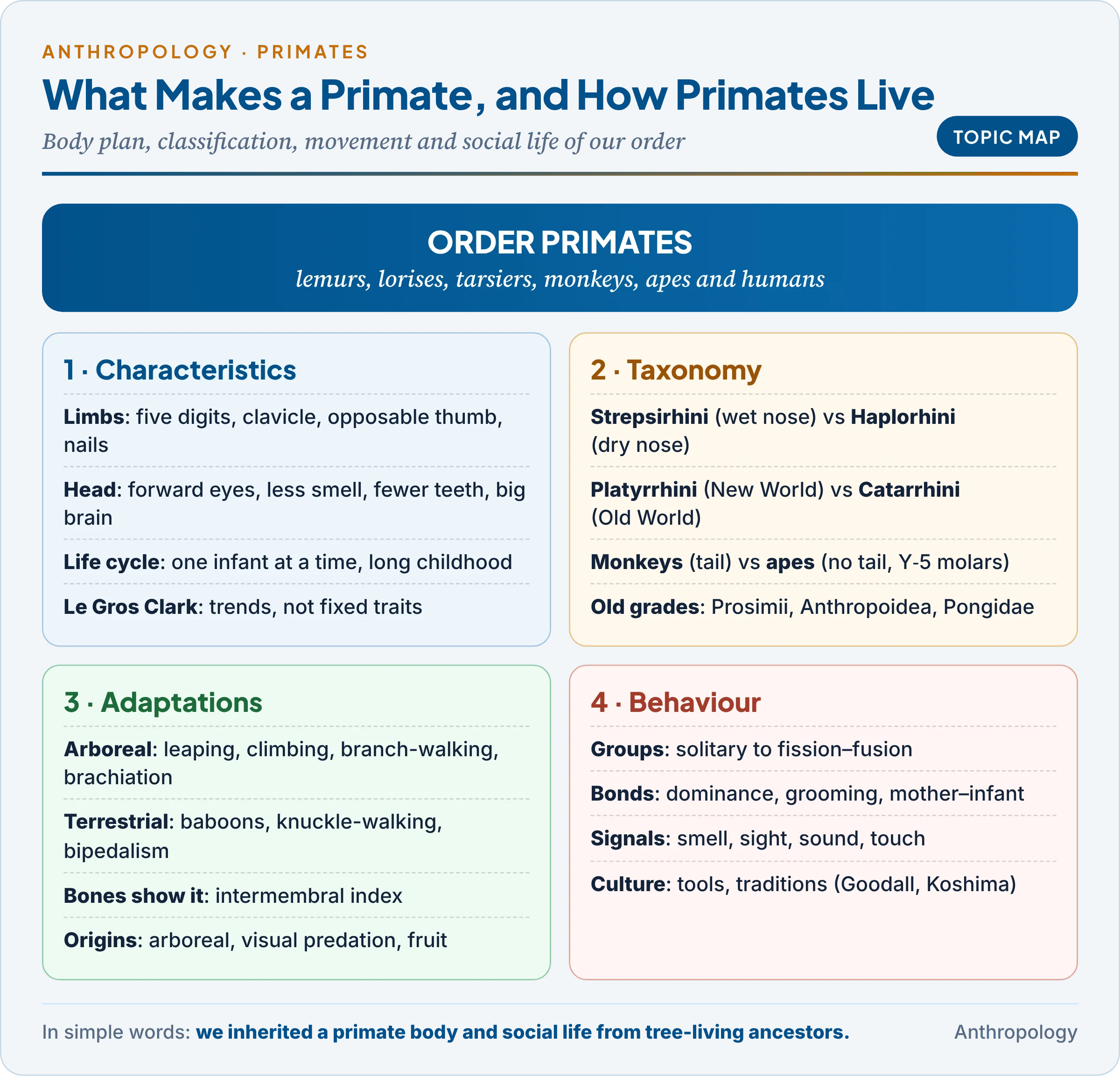
This article covers the characteristics and evolutionary trends of primates, primate taxonomy, arboreal and terrestrial adaptations and primate behaviour. The fossil primates, the living apes, the comparative anatomy of man and apes and the skeletal changes of erect posture are in Unit 1.5b.
1. Man’s Place in Nature: Primates as Mammals
In simple words
Humans are animals, and among animals we belong to the mammals, and among mammals to the group called primates, together with lemurs, monkeys and apes. Looking at the features we share with them, and the few we do not, tells us where our body and behaviour came from.
In 1758 the Swedish naturalist Carl Linnaeus, founder of modern classification, placed Homo sapiens in the order Primates beside monkeys and apes (Systema Naturae, 10th edition), a century before Darwin and purely on anatomy. In 1863 the British biologist Thomas Henry Huxley (Evidence as to Man’s Place in Nature) compared ape and human skeletons and concluded that man differs from the great apes less than they differ from monkeys. Genetics later confirmed both.
1.1 The classification ladder
Each step down the ladder adds traits that humans share with a smaller group of animals.
| Level | Name | Defining trait shared with humans |
|---|---|---|
| Kingdom | Animalia | Many cells; ingests food; moves |
| Phylum | Chordata | A notochord (a stiff rod along the back) at some stage |
| Subphylum | Vertebrata | Backbone protecting a spinal cord with a brain at its head |
| Class | Mammalia | Hair, milk glands, constant body temperature, four kinds of teeth |
| Order | Primates | Grasping hands, forward eyes, large brain, slow life history |
| Suborder | Haplorhini | Dry nose, no reflecting layer in the eye, closed eye socket |
| Superfamily | Hominoidea | No tail, broad chest, swinging arms |
| Tribe | Hominini | Habitual bipedalism (humans and their fossil relatives) |
| Genus, species | Homo sapiens | Large brain, chin, symbolic culture |
Most of what makes us “human” was inherited in layers: warm blood and milk are mammalian; hands, eyes and long childhood are primate; the tailless, broad-chested body is hominoid. Only the bottom rows are uniquely human.
1.2 Primates as mammals
- Mammals are endothermic (they keep a constant body temperature from inside), have hair, suckle their young and have heterodont teeth (teeth of different shapes: incisors cut, canines grip, molars grind).
- Of the three subclasses, egg-laying monotremes (platypus) and pouched marsupials (kangaroo), primates belong to the placental mammals (Eutheria), whose foetus grows long inside the womb.
- Why this matters: suckling and long dependence create a lasting mother–infant bond, the setting in which young primates learn most of their behaviour, the root of culture.
1.3 Man is a primate
The claim “man is a primate” rests on three kinds of evidence.
- Anatomy: nails, an opposable thumb, a clavicle, forward eyes with colour vision, a large brain, single births and a long childhood (§2).
- Genetics: humans and chimpanzees differ at only about 1.2 per cent of DNA letters, and humans have 46 chromosomes because two ape chromosomes fused into our chromosome 2 (Unit 1.5b §3).
- Behaviour: group living, grooming, dominance, mother–infant bonding, tool use and learned traditions all have primate roots (§5).
Humans differ mostly in degree, with a few true novelties: habitual bipedalism, a brain about three times a chimpanzee’s, articulate language and cumulative culture. Man is a “unique primate” because the combination is unique, not each part.
2. Characteristics and Evolutionary Trends of Primates
In simple words
Primates cannot be defined by one special body part, the way a bird is defined by feathers. Instead, they share a set of tendencies that developed over time: better grasping, better eyesight, a weaker sense of smell, bigger brains and slower growth. These tendencies are strongest in monkeys, apes and humans, and weaker in lemurs and lorises.
Look at your own hand. It has five fingers, a thumb that can touch each fingertip, flat nails instead of claws, and ridged skin (fingerprints) on the fingertips. A squirrel climbs a tree by digging its claws into the bark; a monkey climbs by wrapping its hand round a branch. That single contrast (gripping versus clawing) explains much of primate anatomy.
2.1 Le Gros Clark’s evolutionary trends
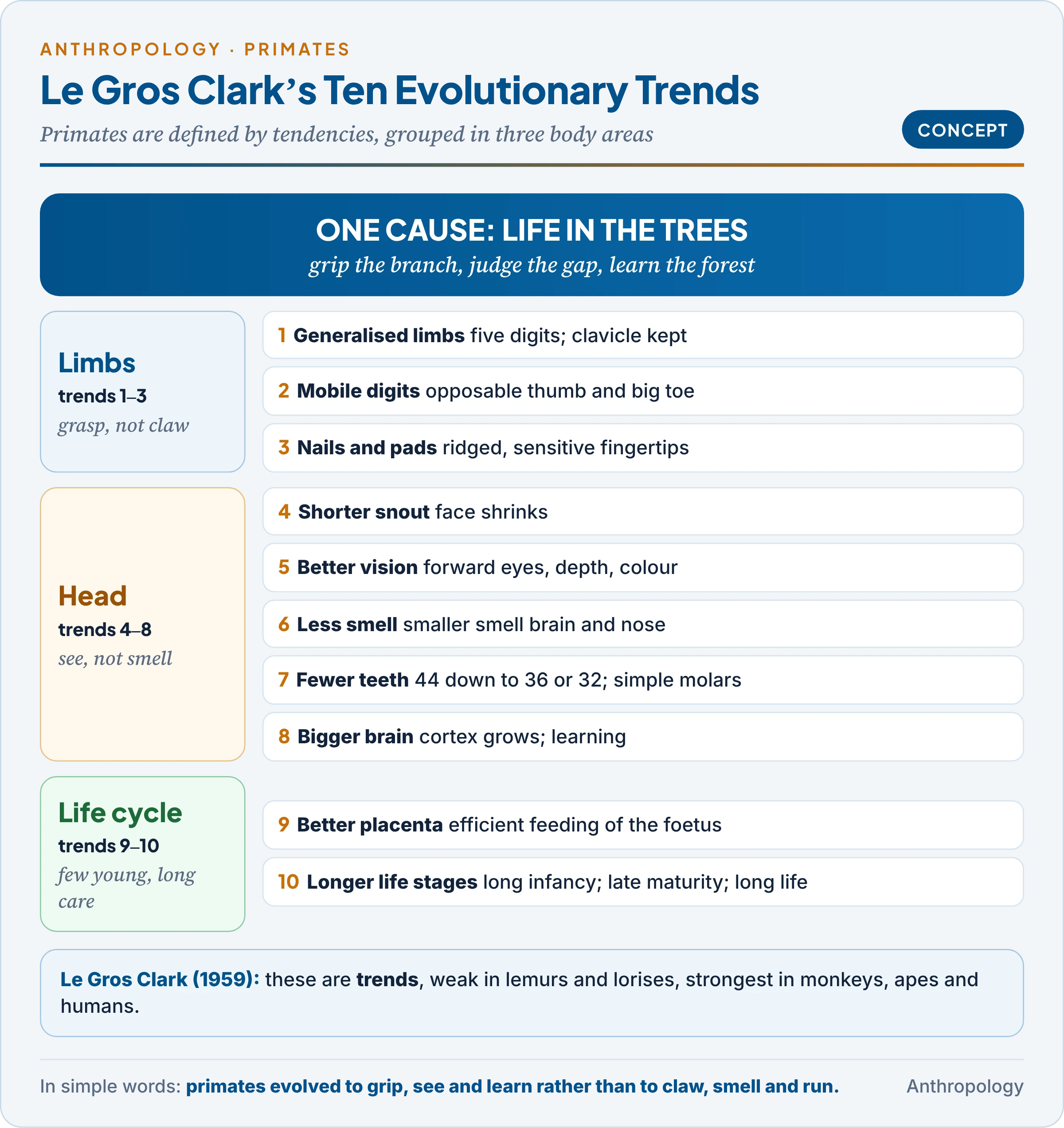
The British anatomist Wilfrid Le Gros Clark (The Antecedents of Man, 1959) noticed that primates are anatomically generalised, lacking the specialisations of other orders (hooves, flippers, horns). So he defined the order by evolutionary trends: tendencies developed to different degrees in different members, rather than fixed traits.
| Group | Trend | What it means |
|---|---|---|
| Limbs | 1. Generalised limbs, pentadactyly (five digits), clavicle kept | Limbs stay flexible for climbing; the collarbone holds the arm out to the side |
| 2. Mobile digits, opposable thumb and big toe | Digits move separately; thumb tip can meet the other fingertips | |
| 3. Nails replace claws; tactile pads | Sensitive, ridged fingertips grip and feel | |
| Head | 4. Shorter snout | Face shrinks as smell matters less |
| 5. Better vision, binocular and stereoscopic | Eyes face forward; fields overlap; depth is judged | |
| 6. Reduced smell apparatus | Smaller smell areas of the brain and nose | |
| 7. Fewer teeth, simple molar cusps | Primitive 44 teeth reduced to 36 or 32 | |
| 8. Larger, more complex brain, especially the cerebral cortex | More learning, memory and coordination | |
| Life cycle | 9. More efficient nourishment of the foetus | Better placenta, longer pregnancy |
| 10. Longer life stages | Long infancy, late maturity, long life |
The trends concern three areas: the limbs (1–3), the head (4–8) and the life cycle (9–10). They are trends, not characteristics, weak in lemurs and lorises and strongest in monkeys, apes and humans; and they are interrelated, all linked to life in the trees.
2.2 Limbs and hands: grasping, not clawing
- Generalised limbs (trend 1): primates keep the ancient mammal plan of one bone in the upper limb and two in the lower (radius and ulna, tibia and fibula). Two forearm bones let the hand rotate palm up and down; the clavicle braces the shoulder so the arm can reach in every direction. Hoofed mammals, which only run, have lost it.
- Prehension (trend 2): prehension means grasping. The opposable thumb can rotate so its tip faces the other fingertips. It is absent in tree shrews, incomplete in lemurs and lorises and full in Old World monkeys, apes and humans. Humans lost it in the big toe, which became part of a weight-bearing platform (Unit 1.5b §4).
- Nails and pads (trend 3): flat nails back tactile pads carrying dermatoglyphics (friction ridges, as in fingerprints) and many nerve endings, so the hand grips without slipping and feels. Marmosets keep claws for clinging to trunks while eating gum, and lemurs and lorises a grooming claw on the second toe.
- Why it matters: a hand that grips and feels could later make tools; culture borrowed a climbing organ.
2.3 Eyes, nose and brain: seeing replaces smelling
- Stereoscopic vision (trend 5): the eyes moved to the front of the face, so their fields overlap and the brain compares two slightly different images to judge depth. For a leaping animal, a misjudged distance can be fatal.
- Bony eye protection: lemurs and lorises have a postorbital bar (a ring of bone at the side of the eye socket); monkeys, apes and humans have postorbital closure (a full bony cup behind the eye).
- Colour vision: Old World monkeys, apes and humans all have three-colour (trichromatic) vision; in most New World monkeys only some females do. Colour picks out ripe fruit and young red leaves against green.
- Reduced smell (trends 4 and 6): the snout shortened and the smell areas of the brain shrank; the moist nose tip (rhinarium) of a lemur is lost in monkeys and apes. Smell is reduced, not lost (§5.4).
- Brain (trend 8): the cerebral cortex expanded and folded, especially its visual and association areas (which link senses, memory and movement). The result is behavioural flexibility: primates solve problems by learning rather than by bodily specialisation, a trend carried furthest in man.
2.4 Teeth: fewer, simpler, more general
Primates eat a mixed diet, so their teeth stay generalised. A dental formula counts the teeth in one quarter of the mouth (incisors–canines–premolars–molars); the total is four times that.
| Group | Dental formula | Total teeth |
|---|---|---|
| Primitive placental mammal | 3.1.4.3 | 44 |
| Lemurs and lorises | 2.1.3.3 | 36 |
| Tarsiers | 2.1.3.3 upper / 1.1.3.3 lower | 34 |
| New World monkeys (most) | 2.1.3.3 | 36 |
| Marmosets and tamarins | 2.1.3.2 | 32 |
| Old World monkeys, apes, humans | 2.1.2.3 | 32 |
Every primate has lost at least one incisor and one premolar from the primitive 44, and the catarrhines share 2.1.2.3. Since teeth are the commonest fossils, the formula is a first clue for placing a fossil (Unit 1.5b §1).
- Molar patterns: Old World monkeys have bilophodont molars (four cusps in two cross-ridges, which keep working when worn by leaves); apes and humans have the Y-5 pattern (five cusps separated by Y-shaped grooves), a sign of close relationship.
- Canines: monkeys and apes have large projecting canines; a gap (diastema) in the opposite jaw receives them, and a blade-like (sectorial) lower premolar hones the upper canine. Canines serve display and defence as much as feeding.
- Dental comb: lemurs and lorises groom with a tooth comb of forward-slanting lower incisors and canines.
2.5 Life cycle: few young, long childhood
- Single births: most primates bear one infant at a time, which an arboreal mother can carry (marmosets bear twins).
- Placenta: monkeys, apes and humans have a haemochorial placenta (the mother’s blood bathes the foetal tissues directly); lemurs and lorises a simpler epitheliochorial one, with more layers between the bloodstreams.
- Slow life history: primates grow more slowly than other mammals of their size.
| Species | Pregnancy | Sexual maturity | Growth complete |
|---|---|---|---|
| Rhesus macaque | about 5½ months | about 3–4 years | about 7 years |
| Chimpanzee | about 8 months | about 10–13 years | about 15 years |
| Human | 9 months | about 12–15 years | about 20 years |
Each step from monkey to ape to human lengthens every stage: the K-strategy of few, heavily invested offspring. The long childhood is when a young primate learns, linking reproduction to intelligence and culture; the cost is a low birth rate that leaves apes vulnerable today (Unit 1.5b §2).
Common confusion
Is a primate defined by one unique feature? No. Some primates keep claws, humans have lost the grasping big toe, and many other mammals climb trees. Primates are defined by a set of trends present to different degrees, and a fossil is judged by their overall pattern, not one feature.
2.6 How well do the trends hold?
- The trends are not universal. The aye-aye has claws and rodent-like incisors; humans have lost the grasping foot. Trends describe the overall direction, not every species.
- Old and new together: primates combine old features (five digits, clavicle) with new ones (big brain, forward eyes), an example of mosaic evolution (Unit 1.4b).
- Ladder bias: older textbooks lined up tree shrew, lemur, monkey, ape and man as steps towards man. Each living primate is fully adapted to its own niche, as the British primatologists John and Prue Napier (A Handbook of Living Primates, 1967) stressed.
3. Primate Taxonomy
In simple words
Taxonomy is the science of naming and grouping living things. Primates were first grouped by how “advanced” they looked; today they are grouped by who descended from whom. The two systems mostly agree, but they disagree about one small animal, the tarsier.
The tarsier of the Philippines, Borneo and Sulawesi is a palm-sized, night-hunting primate with huge eyes and long leaping legs. It looks like a lemur and was long classed with lemurs and lorises as a “prosimian” (meaning “before the monkeys”). Yet it has a dry nose, a free upper lip, no reflecting layer in its eyes and a placenta like a monkey’s, and DNA places it closer to monkeys, apes and humans. The tarsier is the case on which the two systems of primate classification divide.
3.1 Two ways of classifying
- Phenetics groups animals by overall similarity.
- Cladistics (the German entomologist Willi Hennig, 1950) groups them only by shared derived traits (new features inherited from a common ancestor), so each group holds an ancestor and all its descendants.
- Evolutionary taxonomy (the American palaeontologist George Gaylord Simpson, 1945) adds the degree of adaptive change, so it accepts grades (levels of organisation) as groups.
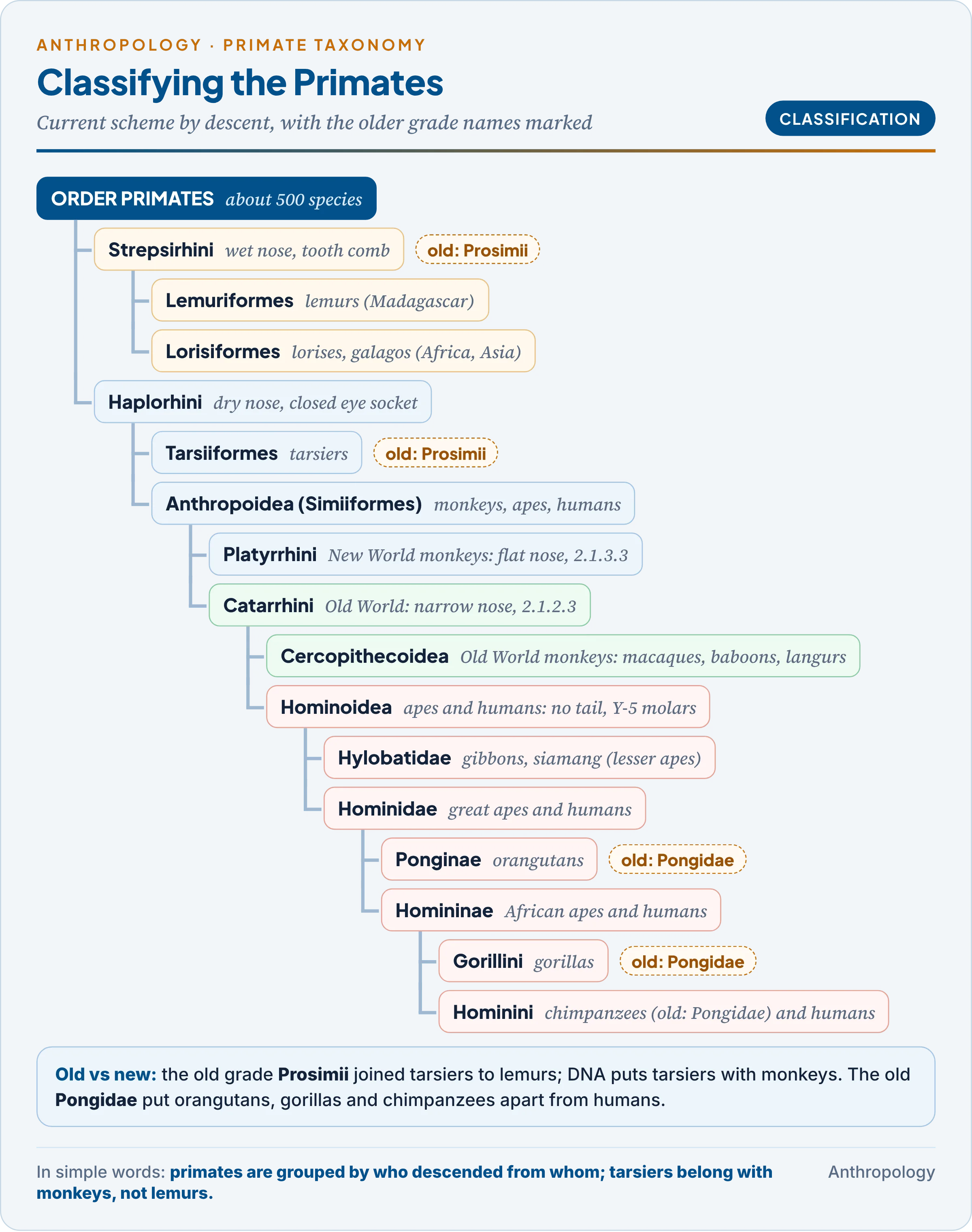
Two schemes follow. In the table, notice that only the tarsier and the naming of the great apes differ.
| Basis | Older (gradistic) scheme | Current (cladistic) scheme |
|---|---|---|
| Suborders | Prosimii (lemurs, lorises, tarsiers) and Anthropoidea (monkeys, apes, humans) | Strepsirhini (lemurs, lorises) and Haplorhini (tarsiers plus anthropoids) |
| Basis | Grade: “primitive” versus “advanced” | Clade: common descent |
| Tarsier | A prosimian | A haplorhine, sister to anthropoids |
| Great apes | Pongidae (orangutan, gorilla, chimpanzee) apart from Hominidae (humans) | All in Hominidae; humans in tribe Hominini |
The cladistic scheme is standard because it reflects descent, which DNA can test; the gradistic terms survive in older books and past questions. Strepsirhine (“twisted nose”, moist and comma-shaped) and haplorhine (“simple nose”) were revived by the British zoologist Reginald Pocock (1918). As Unit 1.4a explains, “hominid” once meant only humans and their upright ancestors; the human line is now “hominin“.
3.2 Strepsirhini and Haplorhini
The strepsirhines are the lemurs, lorises and galagos. The table lists the traits that separate them from the haplorhines (tarsiers, monkeys, apes and humans).
| Trait | Strepsirhini | Haplorhini |
|---|---|---|
| Nose | Moist rhinarium; upper lip tied to the gum | Dry nose; free, mobile upper lip for facial expression |
| Eye socket | Postorbital bar only | Postorbital closure (partial in tarsiers) |
| Night vision | Tapetum lucidum (reflecting layer that makes eyes shine at night) | No tapetum; a fovea (spot of sharpest vision) instead |
| Teeth | Tooth comb for grooming | No tooth comb |
| Grooming claw | On the second toe | Absent (tarsiers have claws on the second and third toes) |
| Lower jaw | Two halves unfused at the chin | Fused in anthropoids |
| Placenta | Epitheliochorial | Haemochorial |
The pattern is consistent: strepsirhines keep the ancestral toolkit for smell and night activity; haplorhines invest in daylight vision and facial expression, which the free upper lip makes possible.
Geographical distribution of the strepsirhines:
- Lemurs: only Madagascar (and the nearby Comoros), where over a hundred species evolved without monkey competitors, from mouse lemurs (the smallest primates) to the indri.
- Galagos (bushbabies) and pottos: sub-Saharan Africa.
- Lorises: South and South-East Asia; India has the slender loris of the Western and Eastern Ghats and the Bengal slow loris of the north-east.
3.3 Platyrrhini and Catarrhini
Within the anthropoids, the monkeys of the Americas and those of Africa and Asia have been separated for over 30 million years. The table compares them.
| Trait | Platyrrhini (New World monkeys) | Catarrhini (Old World monkeys, apes, humans) |
|---|---|---|
| Region | Central and South America | Africa and Asia |
| Nose | Flat, nostrils wide apart, facing sideways | Narrow, nostrils close, facing downward |
| Teeth | 2.1.3.3 (36); marmosets 2.1.3.2 | 2.1.2.3 (32) |
| Tail | Often prehensile (grasping) in the atelids | Never prehensile; absent in apes and humans |
| Ear | Bony ring, no bony ear tube | Bony ear tube (tubular ectotympanic) |
| Rump pads | None | Ischial callosities in Old World monkeys and gibbons |
| Colour vision | Usually only some females trichromatic (howlers excepted) | All trichromatic |
New World monkeys form the families Callitrichidae (marmosets, tamarins), Cebidae (capuchins, squirrel monkeys), Atelidae (spider, howler, woolly monkeys) and the titis, sakis and owl monkeys. The spider monkey’s prehensile tail is a fifth hand with a ridged pad at its tip; no Old World primate evolved one. Ischial callosities (hard rump pads) let Old World monkeys sleep sitting on branches. How monkeys reached South America, probably by rafting from Africa, is in Unit 1.5b §1.4.
3.4 Old World monkeys and apes
The catarrhines divide into the Cercopithecoidea (Old World monkeys) and the Hominoidea (apes and humans).
| Trait | Cercopithecoidea | Hominoidea |
|---|---|---|
| Tail | Usually present | Absent |
| Chest | Narrow and deep, like a dog’s | Broad and shallow |
| Shoulder blade | On the sides of the chest | On the back |
| Arm movement | Mainly forward and back | Full rotation above the head |
| Molars | Bilophodont | Y-5 |
| Lumbar spine | Long and flexible | Short and stiff |
| Brain | Smaller for body size | Larger and more folded |
The hominoid body is built for hanging and reaching overhead: the broad chest and back-placed shoulder blades let the arms swing above the head, and the short lower back keeps the trunk upright. This orthograde (upright-trunk) plan is the starting point for human erect posture (Unit 1.5b §4). Old World monkeys form two subfamilies:
- Cercopithecinae: cheek pouches; omnivorous; many terrestrial: macaques, baboons, guenons.
- Colobinae: multi-chambered stomachs in which bacteria ferment leaves, as in cattle: langurs (Asia), colobus (Africa).
3.5 Primates of India
India has about 25 species of non-human primates: two lorises, about ten macaques, about ten langurs and two gibbons.
- Common: the rhesus and bonnet macaques and the Hanuman langurs, which live alongside people in towns and temples.
- Threatened forest species: the lion-tailed macaque (Western Ghats), the golden langur (Assam–Bhutan), the Nilgiri and capped langurs, and the hoolock gibbons of the north-east, India’s only apes.
- New species: the Arunachal macaque (2004) and the Sela macaque (2022) show that primate taxonomy is still being written.
4. Primate Adaptations: Arboreal and Terrestrial
In simple words
Most primates live in trees, and their bodies are built for climbing, leaping, swinging and gripping. A few monkeys, and humans, came down to the ground and changed again. How an animal moves is written in the length of its arms and legs, the shape of its hands and the build of its back.
Watch two primates in an Assamese forest. A hoolock gibbon crosses the canopy by swinging under the branches on very long arms, covering several metres a swing. Below, a troop of rhesus macaques walks on all fours along the forest floor and into a nearby village. Their bodies show the difference: the gibbon’s arms are far longer than its legs; the macaque’s arms and legs are about equal.
4.1 Why primates became what they are: three hypotheses
Three explanations compete for why the primate package (grasping hands, forward eyes, reduced smell) evolved.
| Hypothesis | Proposed by | Core idea | Weakness |
|---|---|---|---|
| Arboreal hypothesis | Grafton Elliot Smith (British anatomist, 1912); Frederic Wood Jones (Arboreal Man, 1916) | Life in the trees selected grasping hands, depth vision and reduced smell | Squirrels live in trees with claws and side-facing eyes |
| Visual predation hypothesis | Matt Cartmill (American anthropologist, 1974) | Forward eyes and grasping hands evolved to stalk and seize insects on thin branches, as in owls and cats | Many early primates ate fruit, and some hunters (squirrel-like insect eaters) lack these traits |
| Angiosperm (fruit) hypothesis | Robert Sussman (American anthropologist, 1991) | Primates evolved alongside flowering, fruiting trees; grasping hands reach fruit at branch tips; vision picks it out | Explains grasping better than forward eyes |
The fossil Carpolestes (about 56 million years ago, Wyoming; Jonathan Bloch and Doug Boyer, 2002) had a grasping big toe with a nail but sideways eyes: grasping came before stereoscopic vision, favouring the fruit view for the first step. Most primatologists combine the three: early primates exploited the fine terminal branches of fruiting trees for fruit, flowers and insects.
4.2 Modes of locomotion
The British primatologists John Napier and Alan Walker (1967) defined vertical clinging and leaping and helped build the standard classification of primate movement; each mode marks the skeleton.
| Mode | How the animal moves | Body adaptations | Examples |
|---|---|---|---|
| Vertical clinging and leaping | Clings upright to trunks; leaps with hind legs | Long hind limbs, upright trunk | Tarsiers, galagos, indri, sifakas |
| Slow climbing | Moves slowly with a vice-like grip | Reduced index finger, wide-angled thumb and big toe | Lorises, pottos |
| Arboreal quadrupedalism | Walks and runs on top of branches | Limbs about equal; tail for balance | Most monkeys, macaques in trees |
| Semibrachiation | Arm-swinging plus leaping and climbing | Long arms; prehensile tail (New World) or reduced thumb (colobines) | Spider and howler monkeys; langurs, colobus |
| Terrestrial quadrupedalism | Walks on the ground on palms and soles, or on fingers | Equal limbs, short fingers, longer thumb | Baboons, patas monkeys, rhesus macaques |
| Knuckle-walking | Walks on the backs of bent fingers | Long arms, long fingers, locking wrist | Chimpanzees, bonobos, gorillas |
| Brachiation | Swings hand over hand under branches | Very long arms, hook-like hands, short thumb | Gibbons, siamangs (true); orangutans (modified, slow, four-handed climbing) |
| Bipedalism | Walks upright on two legs | Long legs, bowl-shaped pelvis, arched foot | Humans only (habitually) |
Read the “Body adaptations” column: structure follows function. Brachiators need hooks, so their thumbs are reduced (spider monkey, colobus) or tucked away; leapers need springs, so their legs are long. A gibbon hangs from one hand at a branch tip and pulls fruit in with the other, so brachiation is above all a feeding adaptation.
Two cautions. Structure and behaviour do not always match: chimpanzees and gorillas have the long arms and short thumbs of brachiators but mainly knuckle-walk, probably because they became too heavy to swing. And every primate uses several modes; a classification names the most typical.
4.3 Reading locomotion from bones: the intermembral index
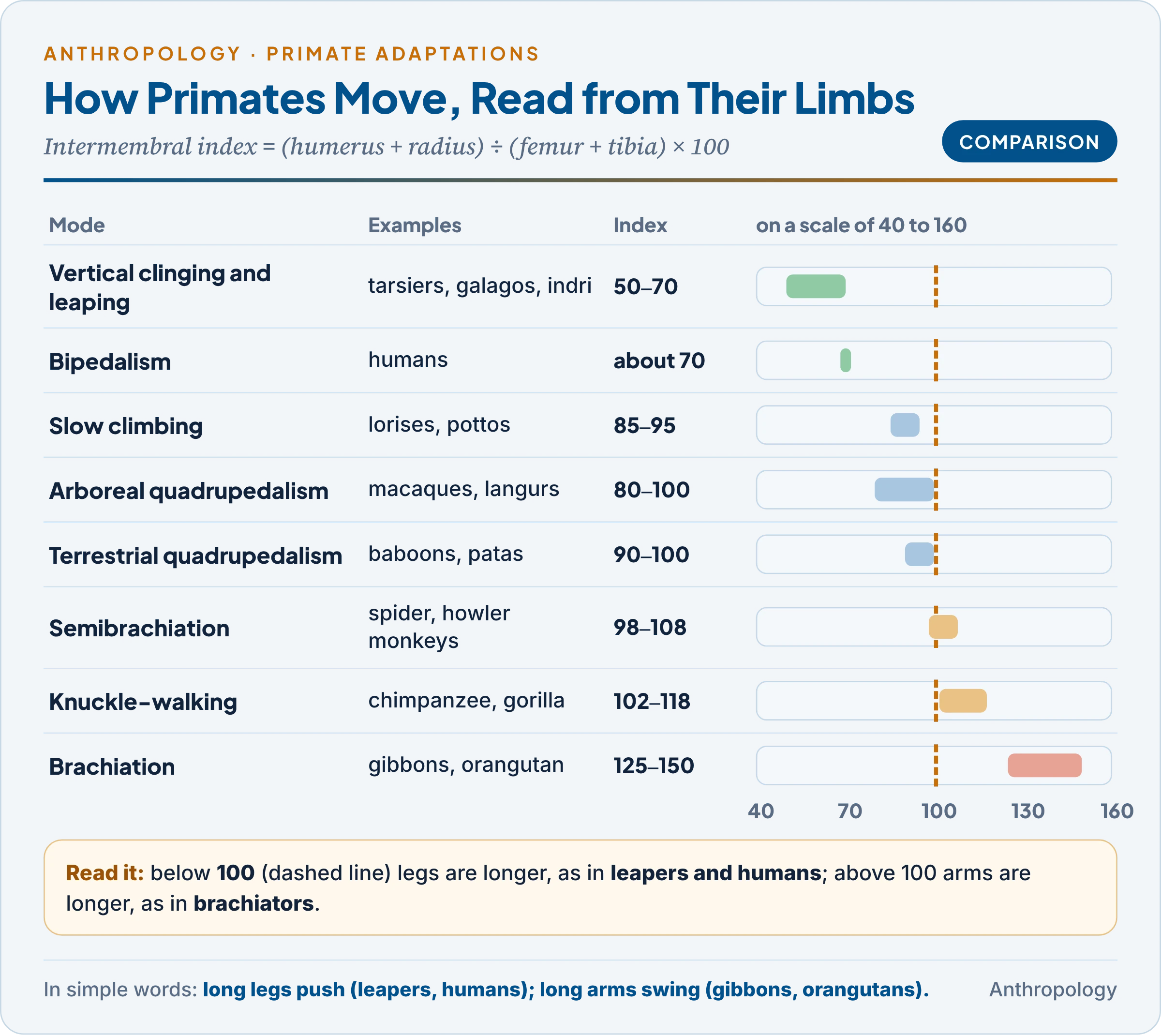
The intermembral index (IMI) measures arm length against leg length:
IMI = (humerus + radius) ÷ (femur + tibia) × 100
An index below 100 means longer legs; above 100 means longer arms.
| Locomotion | Typical IMI | Examples |
|---|---|---|
| Vertical clinging and leaping | about 50–70 | Tarsiers, galagos |
| Bipedalism | about 70 | Humans |
| Quadrupedalism | about 80–100 | Macaques, baboons, langurs |
| Knuckle-walking | about 100–120 | Chimpanzee about 105, gorilla about 115 |
| Brachiation | about 125–150 | Gibbons; orangutan about 140 |
Worked example: humerus 30 cm, radius 25 cm, femur 32 cm, tibia 28 cm gives (30 + 25) ÷ (32 + 28) × 100 = 55 ÷ 60 × 100 ≈ 92, a quadruped. So a few long bones show how an extinct primate moved. Humans and leapers both score low because both push with the legs.
4.4 The primate hand
Napier also ranked hands by how the thumb works: non-opposable (tree shrews; digits move together), pseudo-opposable (lemurs, lorises, New World monkeys; the thumb converges but does not rotate) and truly opposable (Old World monkeys, apes, humans; the thumb rotates to meet the fingertips, giving separate power and precision grips). Ground-living baboons have long thumbs and short fingers for picking up seeds. Humans refine the precision grip furthest (Unit 1.4a §2.2).
4.5 Terrestrial adaptations
The ground brought predators, open country and scattered food. Savanna baboons and macaques show a consistent set of answers.
- Body: arms and legs about equal, short fingers, a digitigrade stance (walking on the fingers and toes, heel raised) in baboons, and tough ischial callosities.
- Defence: marked sexual dimorphism (size difference between the sexes): male baboons weigh about twice as much as females, with long canines and a mane for threat displays; tree monkeys, which simply flee, show little.
- Society: troops of 10 to 100 with clear dominance hierarchies that reduce fighting and organise defence.
- Diet: wider: grass, roots, seeds, insects, some meat; the Ethiopian gelada lives mainly on grass.
- Humans alone are fully terrestrial; gorillas and chimpanzees still sleep in tree nests.
4.6 Adaptive radiation and the adaptive tradition of primates
Adaptive radiation (one ancestral group branching rapidly into many forms suited to different ways of life; Unit 1.4b §6.5) describes primate history well. From small insect- and fruit-eaters of about 56 million years ago, primates radiated into:
- night-active insect-hunters (tarsiers, lorises, galagos);
- gum-eaters with claws (marmosets);
- leaf-eaters with fermenting stomachs (colobines) or long guts (howlers, gorillas);
- fruit-eaters with colour vision (most monkeys and apes);
- ground-living omnivores (baboons, macaques, humans).
The vivid case is Madagascar, where lemurs, isolated from monkeys, radiated into over a hundred species. An adaptive tradition is the lasting adaptive pattern a lineage keeps while it diversifies: for primates, the arboreal tradition of grasping, seeing and learning, inherited even by ground-living species.
5. Primate Behaviour
In simple words
Primates are highly social: most live in groups, groom each other, rank themselves, communicate with calls, faces and smells, and learn skills from their elders. Studying how monkeys and apes live helps us understand where human social life came from, and which parts of it are truly new.
In 1960, at Gombe Stream, Tanzania, the young English researcher Jane Goodall watched a chimpanzee she called David Greybeard strip a twig, poke it into a termite mound and pull it out covered in termites. Tool-making had been the mark of humanity. Her mentor, the Kenyan-British palaeoanthropologist Louis Leakey, replied: “Now we must redefine tool, redefine Man, or accept chimpanzees as humans.” One observation changed how anthropology defines culture.
5.1 Primatology and anthropology
Primatology (the study of non-human primates) belongs to biological anthropology (Unit 1.3) for four reasons:
- Models of the past: fossils preserve bones, not behaviour; living apes and ground monkeys suggest how early hominins foraged and grouped.
- Roots of culture: ape tools, learning and bonds show which human behaviours are old and which are new.
- Biocultural approach: primate studies show how ecology shapes society, anthropology’s question for human groups too.
- Applied value: conservation, zoonotic disease (HIV came from chimpanzee and sooty mangabey viruses) and human–monkey conflict in Indian towns.
Pioneers of field primatology. The table lists the studies that built the field, including several conducted in India.
| Primatologist | Species and site | Key finding |
|---|---|---|
| C.R. Carpenter (American, 1934) | Howler monkeys, Barro Colorado Island, Panama | First systematic field study of a wild primate group |
| Kinji Imanishi (Japanese, from 1948) | Japanese macaques, Koshima | Founded Japanese primatology; individual identification; learned traditions |
| Sherwood Washburn and Irven DeVore (Americans, about 1960) | Savanna baboons, Kenya | Baboons as a model for early hominins in open country |
| Phyllis Jay (Dolhinow) (American, late 1950s) | Hanuman langurs, north India | Relaxed hierarchy, shared infant care |
| Yukimaru Sugiyama (Japanese, 1960s) | Hanuman langurs, Dharwar, Karnataka | First report of infanticide after male takeover |
| Jane Goodall (British, from 1960) | Chimpanzees, Gombe, Tanzania | Tool-making, hunting, warfare |
| Dian Fossey (American, from 1967) | Mountain gorillas, Karisoke, Rwanda | Gentle family groups; poaching threat (Gorillas in the Mist, 1983) |
| Sarah Blaffer Hrdy (American, 1970s) | Hanuman langurs, Mount Abu, Rajasthan | Infanticide as a male reproductive strategy (The Langurs of Abu, 1977) |
Goodall, Fossey and Biruté Galdikas (orangutans, Borneo, from 1971) were all sent by Louis Leakey, who believed long-term ape studies would illuminate human origins. India was an early centre of the field; Indian primatologists such as Mewa Singh (lion-tailed and bonnet macaques) now lead much of the work.
5.2 Forms of social organisation
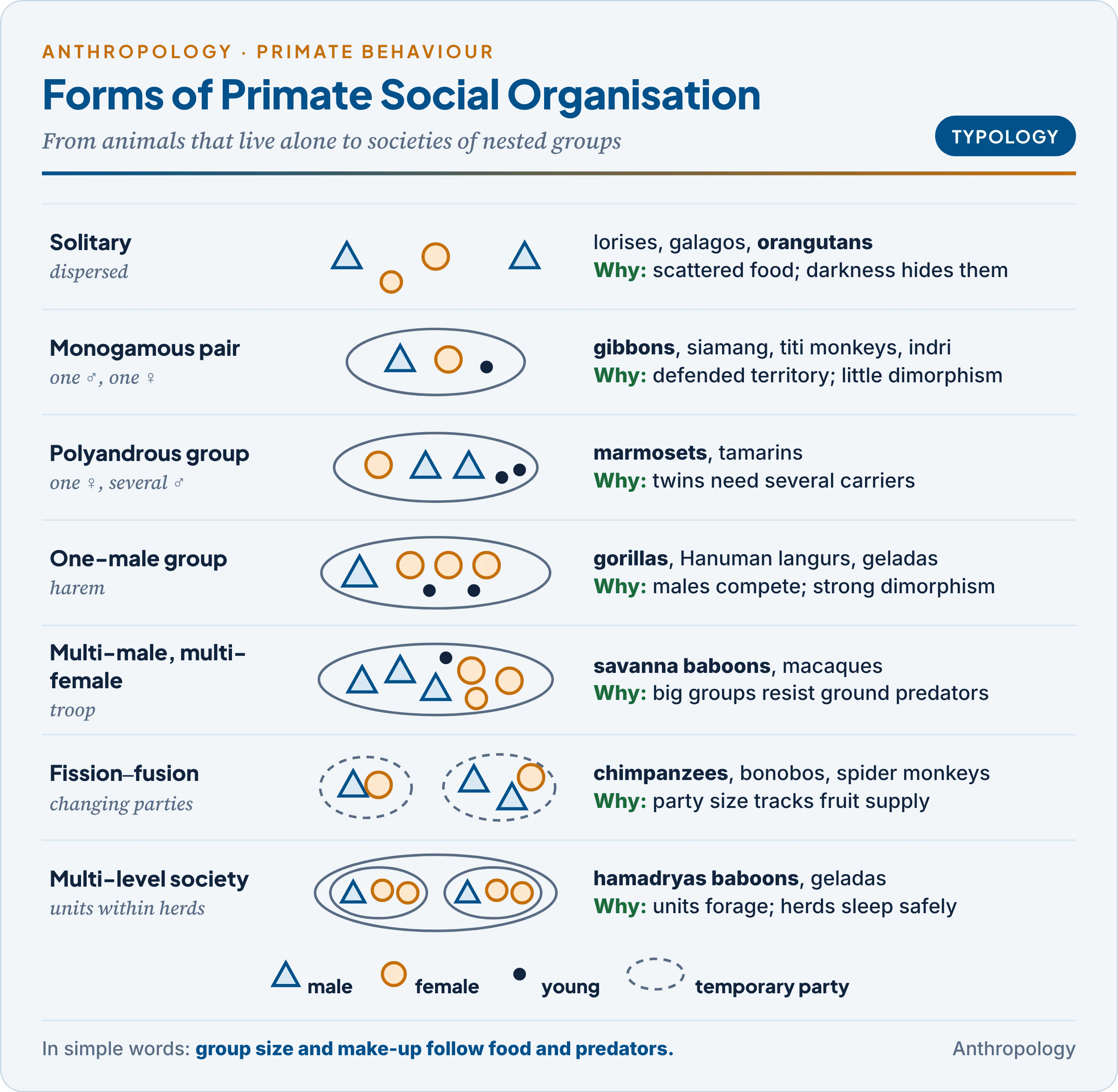
The social organisation of a species is the size, sex make-up and stability of its groups. Primates show every major form found in mammals.
| Form | Group make-up | Examples | Ecological logic |
|---|---|---|---|
| Solitary (dispersed) | Adults forage alone; ranges overlap | Lorises, galagos, aye-aye; orangutans | Scattered food; darkness hides them |
| Monogamous pair | One male, one female and young | Gibbons, siamangs, titi and owl monkeys, indri | Defended territory; little dimorphism |
| Polyandrous group | One breeding female, two or more males | Marmosets, tamarins | Twins need several carriers |
| One-male group (harem) | One male, several females and young | Gorillas (silverback), Hanuman langurs, geladas | Males compete for females; strong dimorphism |
| Multi-male, multi-female | Several adults of both sexes | Savanna baboons, macaques, ring-tailed lemurs | Large group defends against ground predators |
| Fission–fusion community | Large community splits into changing parties | Chimpanzees, bonobos, spider monkeys | Party size tracks fruit supply |
| Multi-level society | One-male units nested in bands and herds | Hamadryas baboons, geladas | Units forage; herds sleep safely |
Two factors explain most of this variety. Predation pushes animals into larger groups, especially on the ground; food distribution limits group size, so scattered fruit favours small or fluid parties. John Crook and Stephen Gartlan (1966) first linked social systems to ecology; Richard Wrangham (1980) added that where females must jointly defend food, groups form round related females (female-bonded groups, as in macaques).
- Who leaves home: in most monkeys males leave at maturity and females stay, forming matrilines; in chimpanzees males stay (male philopatry) and, being related, defend territory together. Dispersal by one sex prevents inbreeding, a parallel to exogamy (Unit 2.3).
5.3 Dominance and grooming
- Dominance hierarchy: a ranking that sets priority of access to food and mates, based on size, age, confidence and allies. It reduces fighting, because each animal knows whom to avoid. It is rigid in savanna baboons, relaxed in Hanuman langurs, and political in chimpanzees, where high rank depends on alliances, as the Dutch primatologist Frans de Waal showed (Chimpanzee Politics, 1982).
- Social grooming (allogrooming): cleaning another’s fur is hygiene but mainly social cement: it calms, repairs relationships and builds alliances.
- Grooming and language: the British anthropologist Robin Dunbar (Grooming, Gossip and the Evolution of Language, 1996) argued that when human groups grew too large to groom everyone, talk took over as the way to bond.
- Reconciliation: chimpanzees kiss and embrace opponents soon after a fight (de Waal): peace-making is primate, not only human.
5.4 Communication and the role of smell
Primates send signals in four modes, which differ in strength and reach.
| Mode | Examples | Strength and range |
|---|---|---|
| Olfactory (smell) | Scent-marking, urine-washing, gland rubbing | Long-lasting; works in the dark and in absence |
| Visual | Stares, bared canines, eyebrow flashes, sexual swellings | Immediate, close range |
| Auditory | Alarm calls, gibbon songs, chimpanzee pant-hoots | Long range; many receivers at once |
| Tactile | Grooming, embracing, hitting, biting | Strongest and most intimate |
Smell as a signal. Reduced smell in monkeys and apes is a trend, not an absence; in strepsirhines smell remains a main channel.
- What smell does: a scent mark stays after the sender has gone, carrying identity, sex, rank and reproductive state, which suits nocturnal and solitary animals that rarely meet.
- Ring-tailed lemurs rub secretions from wrist and shoulder glands on their tails and wave them at rivals in “stink fights“; in the breeding season males release a fruity, floral scent that attracts females (Japanese researchers, 2020).
- Others: lorises and galagos urine-wash their hands and feet, leaving a trail; many New World monkeys scent-mark; the vomeronasal organ (a nose organ for chemical signals) is well developed in strepsirhines, reduced in catarrhines.
- Old World monkeys and apes shifted to vision: a chimpanzee’s sexual swelling advertises fertility where a lemur would use scent. Smell still matters, as when a mother recognises her infant.
Do monkeys have words? Vervet monkeys give different alarm calls for leopards, eagles and snakes. Played from hidden speakers (Robert Seyfarth, Dorothy Cheney and Peter Marler, 1980), the calls made vervets run up trees, look up or search the ground respectively: they carry specific meaning.
Common confusion
Is a primate call system a language? No, though it shares some features. Primate calls form a closed system: a fixed set of signals, each tied to a situation. Human language is open: a few dozen sounds combine by grammar into an endless number of new sentences, about things absent, past or imagined (displacement), and the words are arbitrary and learned. Apes in laboratories can learn symbols, but they have not shown full grammar (Unit 7).
Ape language studies. Because apes cannot shape human speech sounds, researchers tried other channels.
| Study | Ape and method | Result |
|---|---|---|
| Keith and Cathy Hayes (1940s–50s) | Chimpanzee Viki, spoken words | Only about four words; the ape vocal tract cannot form speech |
| Allen and Beatrix Gardner (from 1966); Francine Patterson (from 1972) | Chimpanzee Washoe; gorilla Koko; American Sign Language | About 130 signs (Washoe); several hundred (Koko); some combined |
| Sue Savage-Rumbaugh (1980s) | Bonobo Kanzi, lexigrams (keyboard symbols) | Learned symbols by watching his mother’s lessons; understood spoken English sentences |
| Herbert Terrace (1979) | Chimpanzee Nim Chimpsky, sign language | Critic: Nim mostly imitated trainers’ cues (the “Clever Hans” effect), with no grammar |
Terrace’s videos showed that apparent sentences were often unconscious prompting by trainers (Clever Hans was a horse that seemed to count but read its owner’s cues). Apes can learn symbols and simple combinations, best when young and by observation (Kanzi), but not grammar.
5.5 Sexual behaviour, infant care and infanticide
- Mating systems vary: gibbons pair; baboons form short consortships; chimpanzees mate promiscuously; bonobos use sex to reduce tension.
- Oestrus and concealed ovulation: most female primates are receptive only around ovulation (oestrus), often advertised by sexual swellings; human females have concealed ovulation. The American anthropologist C. Owen Lovejoy (1981) linked this to pair-bonding and male food provisioning. Critics led by Adrienne Zihlman replied that human monogamy is not universal, that women in foraging societies supply much of the food, and that bonobos mate outside oestrus without pair-bonds: the model projected modern family ideals onto the past.
- Mother–infant bond: the American psychologist Harry Harlow (1958) gave infant rhesus monkeys a wire “mother” with milk and a soft cloth one without; they clung to the cloth mother. Contact comfort, not only food, builds attachment, and isolated monkeys grew up unable to mate or mother normally.
- Infanticide: a male taking over a Hanuman langur troop may kill unweaned infants. Sugiyama first reported it at Dharwar; Hrdy, at Mount Abu, explained it as a male strategy: a female who loses her infant returns to oestrus sooner and bears the new male’s young. Behaviour is shaped by individual reproductive interests, not the good of the group, which is why langur females sometimes jointly drive off invading males.
5.6 Tool use and culture
- Chimpanzee tools: termite fishing with prepared twigs (Gombe), leaf sponges, stone hammers and anvils for cracking nuts (Christophe and Hedwige Boesch, Taï Forest, Côte d’Ivoire) and sharpened sticks to stab bushbabies (Fongoli, Senegal, 2007). Young chimpanzees take years to master nut-cracking by watching their mothers.
- Traditions: on Koshima in 1953 a young macaque, Imo, began washing sweet potatoes; the habit spread to her playmates and mother, then down the generations. Andrew Whiten and colleagues (Nature, 1999) found 39 chimpanzee behaviours that vary between communities for no ecological reason, that is, culture as learned group tradition.
- Hunting and sharing: Gombe chimpanzees hunt colobus monkeys in groups and share the meat, mostly with allies.
How far is this “culture”? Ape culture is real but limited. Human culture is cumulative: each generation builds on the last, so techniques ratchet up in complexity. Ape traditions rarely accumulate, are seldom deliberately taught and are not symbolic. Primates show the foundations of culture; humans added symbol, language and accumulation (Unit 2.1).
5.7 Aggression and conflict
- Display before violence: most aggression is ritualised: baboons stare, flash pale eyelids, slap the ground and yawn to show their canines, and the hierarchy settles most disputes.
- Lethal intergroup conflict: in the Gombe “Four-Year War” (1974–78), males of one chimpanzee community killed every male of a group that had split away and took its territory. Such raids, now recorded at several sites, raise the question of whether warfare has primate roots.
- The bonobo contrast: bonobos have female-led societies, rarely kill, and ease tension through sex and play. Two sister species thus warn against treating any one ape as “the” model of early humans.
Key Terms
| Term | Meaning in simple words |
|---|---|
| Primates | The mammal order of lemurs, lorises, tarsiers, monkeys, apes and humans |
| Evolutionary trend | A tendency that runs through a group to different degrees, not a fixed trait |
| Opposable thumb | A thumb that can rotate to meet the other fingertips |
| Stereoscopic vision | Depth perception from two overlapping fields of view |
| Dental formula | Count of incisors, canines, premolars and molars in one quarter of the jaw |
| Y-5 molar | A five-cusped molar with Y-shaped grooves, found in apes and humans |
| Strepsirhini | Wet-nosed primates: lemurs, lorises and galagos |
| Haplorhini | Dry-nosed primates: tarsiers, monkeys, apes and humans |
| Platyrrhine / catarrhine | Flat-nosed New World monkeys / narrow-nosed Old World monkeys, apes and humans |
| Brachiation | Swinging hand over hand beneath branches |
| Intermembral index | Arm length divided by leg length, times 100 |
| Dominance hierarchy | A ranking that sets priority of access to food and mates |
| Philopatry | Staying in the group of one’s birth |
Contemporary Developments
- Death of Jane Goodall (1 October 2025): the primatologist who showed chimpanzee tool-making, hunting and warfare at Gombe from 1960 died aged 91.
- Grammar-like calls in bonobos (April 2025): bonobo call combinations were found to combine meanings like compositional human phrases (Mélissa Berthet and colleagues, Science), narrowing, not closing, the gap with language.
- An orangutan treats its own wound (May 2024): the wild Sumatran orangutan Rakus applied chewed leaves of the medicinal liana Fibraurea tinctoria to a facial wound, the first recorded wound treatment with a known medicinal plant by a wild animal (Isabelle Laumer and colleagues, Scientific Reports).
- A new Indian primate (May 2022): the Zoological Survey of India described the Sela macaque (Macaca selai) of Arunachal Pradesh, cut off from the Arunachal macaque by the Sela Pass about two million years ago.
- Primates in crisis (2017): about 60 per cent of the world’s primate species are threatened with extinction and about 75 per cent have declining populations, mainly through farming, logging and hunting (Alejandro Estrada and colleagues, Science Advances).
Diagrams to Master
- Topic map: characteristics, taxonomy, adaptation and behaviour.
- Evolutionary trends: three boxes, limbs (1–3), head (4–8), life cycle (9–10), all linked to arboreal life.
- Classification tree: Strepsirhini and Haplorhini → tarsiers and anthropoids → platyrrhines and catarrhines → Old World monkeys and hominoids; mark the prosimian grade and the old Pongidae.
- Locomotion spectrum: eight modes with an example and the intermembral index for each.
- Social organisation: small group diagrams (△ male, ○ female) from solitary to multi-level, one example each.
Revision Grid
| Scholar | Work (year) | Key idea |
|---|---|---|
| Linnaeus | Systema Naturae, 10th edition (1758) | Placed humans in the order Primates |
| Huxley | Evidence as to Man’s Place in Nature (1863) | Man closer to great apes than these are to monkeys |
| Elliot Smith; Wood Jones | 1912; Arboreal Man (1916) | Arboreal hypothesis |
| Simpson | 1945 | Gradistic primate classification |
| Le Gros Clark | The Antecedents of Man (1959) | Ten evolutionary trends |
| Goodall | Gombe, from 1960 | Chimpanzee tool-making |
| Crook and Gartlan | 1966 | Social organisation follows ecology |
| Napier and Walker | 1967 | Vertical clinging and leaping; locomotor categories |
| Cartmill | 1974 | Visual predation hypothesis |
| Hrdy | The Langurs of Abu (1977) | Infanticide as male strategy |
| Lovejoy; Zihlman | 1981; 1970s–80s | Pair-bond model; its critique |
| de Waal | Chimpanzee Politics (1982) | Alliances, reconciliation |
| Sussman | 1991 | Angiosperm hypothesis |
| Dunbar | Grooming, Gossip and the Evolution of Language (1996) | Language replaced grooming |
Previous Year Questions
Unit 1.5: Primate characteristics, taxonomy, adaptations and behaviour
- 2026What are Strepsirhini Primates? Describe their geographical distribution and mention the characteristics that distinguish them from Haplorhini Primates.
- 2025Write notes on: Smell as a signal among non-human primates.
- 2022Discuss different forms of primate social organisation.
- 2020Write notes on Jane Goodall’s contributions in studying primate behaviour in about 150 words.
- 2020Illustrate with examples the various types of locomotion patterns among the non-human primates.
- 2019Write a note in 150 words on Adaptive primate radiation.
- 2013Write a note in 150 words on Role of primatology in Anthropological studies.
- 2011‘Man is a primate.’ Discuss.
- 2000Describe the range of locomotive behavior of contemporary non-human primates and state how does it help in understanding the structural-functional correlations of their limb structure.
- 1996Discuss primate locomotion with special reference to adaptations to arboreal life.
- 1995Write a note on Adaptive tradition in primates.
- 1994Write a note on Primate.
- 1994Narrate with reasons man’s place in Primate order.
- 1992What are the characteristic physical features of the Primate ? Show the position of Man among the other Primates in a tabular form.
- 1991Why is Man a primate ? Describe the place of Man in the animal kingdom.
- 1988Write a note on Characters of primates.
- 1986Discuss the evolution of primates with special reference to dentition.
- 1981Discuss how man is unique primate.
Related questions from Unit 1.5b and other units
- 2017Unit 1.5: Bring out the comparative anatomical features of man and apes. Discuss their evolutionary significance.
- 2012Unit 1.4: Write a note in 150 words on Adaptive tradition in context of evolution.
- 1993Unit 1.5: Discuss similarities and difference between Chimpanzee and Man in salient physical and anatomical Characteristics.
- 1983Unit 1.5: Living anthropoid apes are our distant cousins. Discuss.