

Religious Pluralism: Religious Pluralism and the Problem of Absolute Truth.
Official Syllabus: Paper II, Section B, Unit 9
In the nineteenth century the old Indian ideas of “one Reality, many names” met a new challenge: missionary Christianity, which often declared Indian religions false, and a colonial state that classified Indians by religion. Out of this encounter came the most influential modern Indian answers to the problem of religious pluralism and absolute truth. Sri Ramakrishna tested the idea in his own life by practising several religions and declaring “as many faiths, so many paths“. Swami Vivekananda carried it to the Parliament of Religions at Chicago in 1893 as the ideal of a universal religion that accepts rather than merely tolerates. Radhakrishnan grounded it in religious experience. Mahatma Gandhi turned it into an ethic of equal respect for all religions (sarva dharma samabhāva) and moved from “God is Truth” to “Truth is God“. This article explains each view, distinguishes samanvaya, samabhāva and sadbhāva, examines the critics, and closes the unit with a synthesis: how can one hold to absolute truth without exclusivism?
In simple words
Imagine many rivers — the Ganga, the Narmada, the Kaveri, the Brahmaputra. One runs straight, another winds through hills; they have different names, colours and banks. Yet all reach the same ocean, and once there, they are simply sea water. Ramakrishna and Vivekananda used exactly this picture for the religions. Gandhi added a moral warning: no river is perfectly clean on its way, so each must clean its own water — and never sneer at the others.
Context & Problem
The Nineteenth-Century Encounter
- The missionary challenge. Many missionaries presented Christianity as the only true religion and Indian traditions as idolatry — an exclusivist stance (see the article on exclusivism and inclusivism).
- Reform movements answered in different ways.
- Brahmo Samaj — Raja Ram Mohan Roy (1828) taught a rational monotheism drawn from the Upaniṣads and admired the ethics of Jesus; Keshab Chandra Sen later founded the New Dispensation (Nava Vidhān, 1880), which tried to harmonise the scriptures and saints of all religions.
- Arya Samaj — Swami Dayananda Saraswati (1875) held the Vedas alone to be infallible and, in the Satyārth Prakāś, criticised other faiths sharply — an Indian exclusivism.
- Ramakrishna–Vivekananda — a Vedāntic answer: all religions are true paths, rooted in realisation rather than in doctrine.
- The Parliament of the World’s Religions (Chicago, September 1893) gave this third answer a world stage.
- The national question. In the twentieth century, Gandhi and the framers of the Constitution had to make religious plurality the basis of a common citizenship.
The Problem Restated
- If many religions claim absolute truth, must they fight?
- Can one remain fully committed to one’s own faith while accepting others as true?
- Is “all religions are true” a metaphysical claim, an ethical attitude, or both?
- How should a plural society and a state practise pluralism?
Core Doctrine
1. Sri Ramakrishna: Realising the One through Many Paths
A life as an experiment
- Priest of Kālī at the Dakshineswar temple near Calcutta, devoted to the Divine Mother.
- Many disciplines, one realisation. He practised Tantra under a woman teacher, the Bhairavī Brāhmaṇī; the Vaiṣṇava devotional moods towards Rāma and Kṛṣṇa; Advaita under the monk Totāpurī (1865), reaching the formless absorption of nirvikalpa samādhi; Islam (about 1866), under the Sufi Govinda Roy, living and praying as a Muslim; and Christianity (about 1874), meditating on Christ until he had a vision of Jesus.
- The conclusion: “Joto mot, toto poth” — “As many faiths, so many paths.” Each path, followed sincerely, led him to the same God-realisation.
His parables
- Water at the lake. At a lake with many landing places (ghāṭs), Hindus draw jal, Muslims draw pānī, Christians draw water — one substance, many names. To say “only jal is real water” is foolish.
- The chameleon. One man says the chameleon on the tree is red, another green, another blue, and they quarrel. The man who lives under the tree says: it is all of these, and sometimes it has no colour at all. God has many forms, and is also formless.
- The roof. One can reach a roof by stairs, ladder, rope or bamboo pole; so one can reach God by many paths.
- The mother’s cooking. A mother cooks the same fish differently for each child — curry for one, soup for the weak stomach of another. God gives each people the religion it can digest.
- Form and formless. God with form is like ice formed by the cold of devotion; God without form is like water; in the sun of knowledge the ice melts. Both are the same substance.
His warning against dogmatism. Ramakrishna criticised matuyā buddhi — the attitude “my religion alone is right“. Each person thinks his own watch keeps the correct time, but the watches all differ; one must check them against the sun.
What is distinctive
- Verification by practice. Ramakrishna did not argue his way to pluralism; he claimed to have tested the paths. No major religious figure before him had deliberately practised several religions in this way.
- Commitment without exclusiveness. He advised each person to stay sincerely on his own path — sincerity, not syncretism, is the key.
2. Swami Vivekananda: The Ideal of a Universal Religion
At the Parliament of Religions, Chicago (1893)
- Welcome reply (11 September). “I am proud to belong to a religion which has taught the world both tolerance and universal acceptance. We believe not only in universal toleration, but we accept all religions as true.” He quoted the Śiva-mahimna-stotra — different streams, from different sources, all mingle their water in the sea — and the Gītā’s “whosoever comes to Me, through whatsoever form, I reach him“. He condemned sectarianism, bigotry and its horrible descendant, fanaticism, which had “filled the earth with violence” and drenched it “with human blood”.
- The frog in the well (15 September). A frog living all his life in a well cannot believe that the ocean is bigger than his well. “I am a Hindu. I am sitting in my own little well and thinking that the whole world is my little well.” Each sect is such a frog; the Parliament was an attempt to break down the walls.
- The Paper on Hinduism (19 September). Key ideas:
- “To the Hindu, man is not travelling from error to truth, but from truth to truth, from lower to higher truth.”
- All religions, “from the lowest fetishism to the highest absolutism”, are attempts of the human soul to grasp and realise the Infinite, each determined by the conditions of its birth.
- If there is ever to be a universal religion, it must have no location in place or time; it must be infinite like the God it preaches; its sun must shine on the followers of Kṛṣṇa and of Christ, on saints and sinners alike; it must be not Brahminic or Buddhistic, Christian or Mohammedan, but the sum total of all these, with infinite room for development.
- Final address (27 September). “The Christian is not to become a Hindu or a Buddhist, nor a Hindu or a Buddhist to become a Christian. But each must assimilate the spirit of the others and yet preserve his individuality and grow according to his own law of growth.” Like a seed that takes in earth, air and water but grows into its own plant. Anyone who hopes for unity through the triumph of one religion and the destruction of the others holds “an impossible hope“. On the banner of every religion should be written: “Help and not Fight, Assimilation and not Destruction, Harmony and Peace and not Dissension.”
In simple words
A seed of mango planted in the soil takes in water, air and minerals — but it does not become water or air; it grows into a mango tree. Vivekananda asked each religion to do the same: absorb the best of the others and yet grow into a better version of itself, not into a copy of someone else.
The ideal of a universal religion (later lectures)
- Not one creed for all. A universal religion is not a single book, prophet or ritual imposed on everyone; uniformity would be the death of religion. “Unity in variety” is the plan of nature.
- Three parts of every religion. Each religion has philosophy (its ideas), mythology (its stories and personal forms) and ritual (its forms of worship). Religions differ most in mythology and ritual, less in their deepest philosophy.
- Room for every temperament. A universal religion must satisfy four types of mind, and the ideal person combines all four:
- the active worker — karma-yoga, the path of selfless work;
- the emotional lover — bhakti-yoga, the path of devotion;
- the mystic — rāja-yoga, the path of meditation and mind-control;
- the philosopher — jñāna-yoga, the path of knowledge.
- Each religion has a soul. Each great religion stands for a central idea — for example, Islam for the brotherhood and equality of believers, Christianity for love and purity, Hinduism for spirituality. They are complementary, not rivals.
- Practical Vedānta. In a letter of 1898 to a Muslim friend he wrote that the hope of India lay in the junction of the two systems — a “Vedāntic brain and Islamic body” — and that mankind must be led to a place beyond the Vedas, the Bible and the Qurʾān, yet by harmonising the Vedas, the Bible and the Qurʾān.
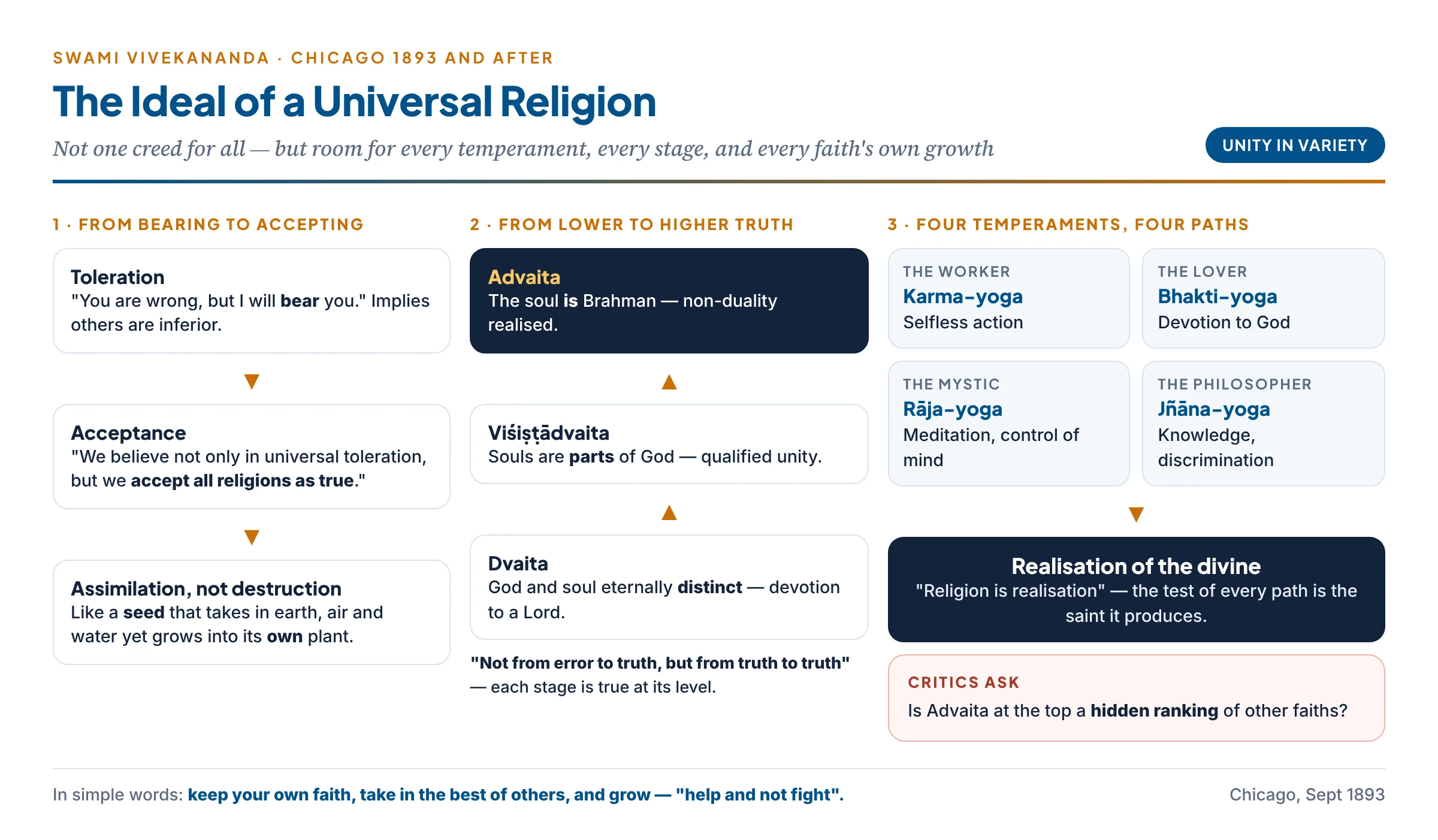
3. How the Vedāntic View Addresses Conflicting Truth Claims
Different religions say contradictory things: God is personal or impersonal; the soul is eternal or there is no soul; salvation comes through Christ, the Qurʾān, knowledge or nirvāṇa. Vivekananda’s Vedānta answers in six steps:
- Essentials and non-essentials. The contradictions lie mostly in mythology and ritual (names, histories, ceremonies). Underneath lies one aim — the realisation of the divine in human life.
- Lower and higher truths, not truth and error. Dualism (dvaita: God and soul eternally distinct), qualified non-dualism (viśiṣṭādvaita: souls as parts of God) and non-dualism (advaita: the soul is Brahman) are three stages of one ascent. A dualist statement is not false; it is true at its stage. Contradiction dissolves into progression.
- One Reality, many approaches. Ekaṃ sad viprā bahudhā vadanti: the personal God of the theist and the impersonal Absolute of the non-dualist are the same Reality seen from different standpoints — “God with form and without form” (Ramakrishna).
- Fitness and the chosen ideal. People differ in temperament (adhikāra); each needs the path and the chosen deity (iṣṭa) that suits him. Differences in religions are fitted to differences in people.
- Realisation as the test. “Religion is realisation“, not talk or belief. The truth of a path is shown by its power to make saints — a practical, experiential test rather than a doctrinal one.
- Acceptance, not mere toleration. Toleration implies “you are wrong, but I will bear you”. Acceptance means “your path is true for you, as mine is for me“.
Evaluation of the Vedāntic answer
- Strengths: it keeps commitment and openness together; it gives a reason for respect (each path really leads to God); it offers a practical test; it rejects both conversion by force and bland syncretism.
- Weaknesses:
- Advaita at the summit — dualists, Christians and Muslims are placed on lower rungs; this is inclusivism, not equality.
- Minimising doctrine — believers do not regard the Incarnation, the finality of the Qurʾān or the denial of a soul as mere “mythology”; calling them non-essential changes the religions.
- Who decides the essence? The “common core” is defined in Vedāntic terms.
- Experience is interpreted — Ramakrishna’s experiences of Christ or Allah were understood through his Vedāntic framework; mystics of different traditions may have different experiences (see the article on Hick).
Common confusion
Did Vivekananda want all religions to merge into one new religion? No. He explicitly rejected the hope that unity would come through “the triumph of any one of the religions” or through a mixture. The “universal religion” is not a new creed but the recognition that the existing religions are many paths to one goal, each growing “according to its own law of growth”. He opposed syncretism (blending religions into one) as much as exclusivism.
4. Radhakrishnan: Experience over Dogma, Fellowship of Faiths
- The Hindu View of Life (Upton Lectures, Oxford, 1926) is his classic statement. Its key claims:
- Religion is experience, not dogma. The intellect is subordinated to intuition, creed to realisation (anubhava).
- Because experience is primary and its expressions secondary, Hinduism has no fixed creed; it is a fellowship of all who accept the law of right and earnestly seek for the truth.
- Hence Hinduism’s attitude to other faiths is one of positive fellowship, not grudging tolerance; it has historically absorbed and adapted rather than persecuted.
- A hierarchy of worship. Radhakrishnan also quoted a traditional ranking: the worshippers of the Absolute are highest; then worshippers of the personal God; then of the incarnations such as Rāma, Kṛṣṇa and the Buddha; below them worshippers of ancestors, deities and sages; lowest, worshippers of petty forces and spirits. All are accepted, but ranked.
- Later works — Eastern Religions and Western Thought (1939) and his lectures on the fellowship of the spirit — called for a world community of religions, each contributing to a common spiritual life.
- Evaluation: his account gives a strong basis for dialogue (shared experience), but critics note the same inclusivist hierarchy found in Vivekananda — the Absolute of Advaita at the top.
5. Mahatma Gandhi: Truth Is God and Equal Respect for All Religions
Influences
- The Gītā (his “spiritual dictionary”), the Sermon on the Mount, Tolstoy, readings of the Qurʾān, and his Jaina friend Raychandbhai, whose many-sided outlook echoes anekāntavāda.
- His ashram prayers included verses from several scriptures; his favourite hymn sang “Īśvara Allāh tero nām” — Īśvara and Allāh are Your names.
From “God is Truth” to “Truth is God”
- The earlier formula. Gandhi first said “God is Truth”: of all the attributes given to God, truth was the most essential.
- The shift. Around 1929 he went “a step further” and said “Truth is God”. He explained the change at a meeting in Lausanne in December 1931.
- His reasons:
- God has a thousand names, and none is exhaustive; but Truth names the essence. The Sanskrit sat means being — “nothing is or exists in reality except Truth”. So Sat or Satya is the fullest name of God.
- Love might also describe God, but the word has a double meaning (it can mean degrading passion), whereas truth has no such ambiguity.
- Even atheists do not deny truth. “In their passion for discovering truth, the atheists have not hesitated to deny the very existence of God — from their own point of view, rightly.” “Truth is God” includes the sincere atheist as a seeker.
- Means and end. The way to Truth is love, that is non-violence (ahiṃsā); since means and ends are convertible, he could still say “God is Love”.
- Absolute and relative truth. “Absolute Truth is God“; for us truth is relative. Each must hold to the truth as he sees it, while staying open to correction. Hearing the “inner voice” requires discipline and humility: “If you would swim on the bosom of the ocean of Truth you must reduce yourself to a zero.”
- Truth in life. In later writing he said that truth is not one quality among many but the living embodiment of God; service of all that exists is service of Truth.
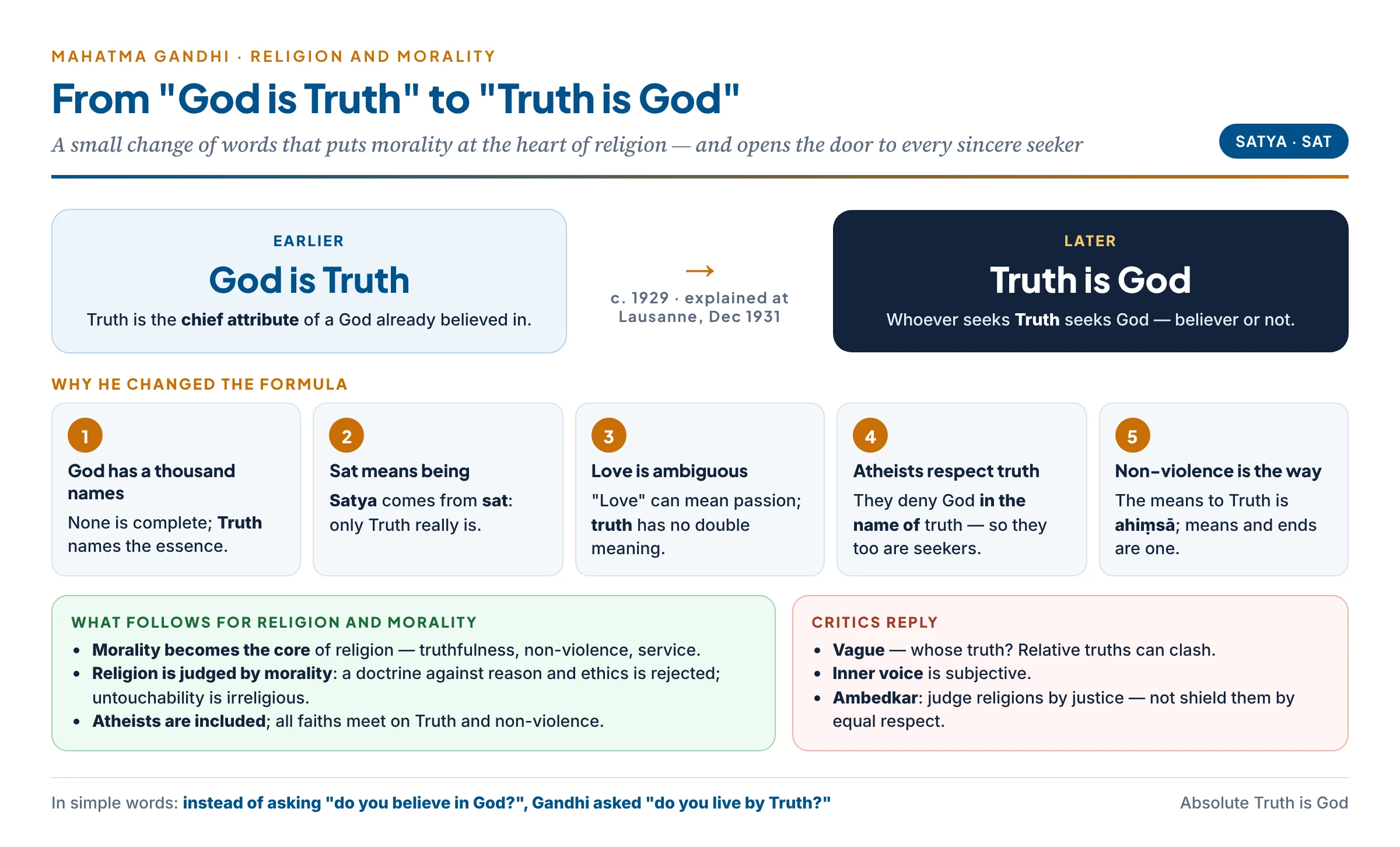
The shift in the context of religion and morality
- Morality becomes the core of religion. If Truth (a moral value) is God, then truthfulness, non-violence and service are not merely commands of religion; they are religion in its essence. Gandhi wrote that God is “ethics and morality“, “conscience“, even “the atheism of the atheist”.
- Religion judged by morality. Gandhi held that he would reject any religious doctrine that does not appeal to reason and is in conflict with morality. A practice like untouchability, however old, is irreligious because it is untruthful and violent.
- Atheists within the moral fold. A truthful atheist serves the same Truth as a devout believer; religious labels matter less than moral seeking.
- A bridge between religions. All religions can meet on Truth and non-violence, which they share, rather than on doctrines, which divide them.
- Comparison. Like Kant, Gandhi makes morality the heart of religion; unlike Kant, he does not reduce God to a postulate of practical reason — Truth is living Being (sat) to be realised.
Evaluation of the shift
- Strengths: universal and inclusive (atheists, all faiths); grounds religion in ethical practice; resists religious violence and caste injustice; joins personal search and public action (satyāgraha, “holding fast to truth”).
- Criticisms:
- Vagueness — “Truth” is abstract; whose truth? If truths are relative to each seeker, conflicting “truths” can each claim to be God.
- The inner voice — appeal to conscience is subjective and unverifiable, as Gandhi himself admitted when he demanded discipline before claiming it.
- Theistic objection — a believer worships a personal God who loves and forgives; equating God with an abstract principle seems to lose the personal relationship (though Gandhi himself prayed to Rāma).
- Ambedkar’s critique — Gandhi’s insistence that all religions, including Hinduism, are true and must be reformed from within left the varṇa framework standing. B.R. Ambedkar judged religions by morality — liberty, equality, fraternity — and found Hinduism wanting, converting to Buddhism in 1956. Ironically, Ambedkar applied Gandhi’s own principle (religion must answer to morality) more critically than Gandhi did.
Sarva Dharma Samabhāva: equal regard for all religions
- Against the word “tolerance”. In From Yeravda Mandir (written in prison, 1930) Gandhi wrote: “I do not like the word tolerance, but could not think of a better one. Tolerance may imply a gratuitous assumption of the inferiority of other faiths to one’s own, whereas ahimsa teaches us to entertain the same respect for the religious faiths of others as we accord to our own.”
- The equal eye. Since we are imperfect seekers, religion as we conceive it is also imperfect: “All faiths constitute a revelation of Truth, but all are imperfect and liable to error.” So comparison of merit does not arise; we should look at all religions with an equal eye and blend into our faith every acceptable feature of other faiths.
- The tree. “Even as a tree has a single trunk, but many branches and leaves, so is there one true and perfect Religion, but it becomes many, as it passes through the human medium.” The one Religion is beyond speech; imperfect people put it into words, interpreted by others equally imperfect.
- Everybody right — and possibly wrong. “Everybody is right from his own standpoint, but it is not impossible that everybody is wrong.” Hence tolerance — which “does not mean indifference towards one’s own faith, but a more intelligent and purer love for it”.
- Limits. “Tolerance obviously does not disturb the distinction between right and wrong, or good and evil.” Equal respect is not moral relativism.
- Three conclusions (1928). At a meeting of an interfaith fellowship he said: “After long study and experience, I have come to the conclusion that (1) all religions are true; (2) all religions have some error in them; (3) all religions are almost as dear to me as my own Hinduism.” Hence no thought of conversion; the aim is to help “a Hindu to become a better Hindu, a Mussalman to become a better Mussalman, and a Christian a better Christian“.
- How to study other faiths. Read each religion through its devoted followers, not through hostile critics — a principle of charitable understanding.
In simple words
Think of your own family. You know your parents are not perfect, and you still love them more than anyone’s opinion of them. You also know that your neighbour loves his parents the same way. Gandhi’s equal respect is like that: love your own faith with open eyes about its faults, and give your neighbour’s faith the same respect you want for yours.
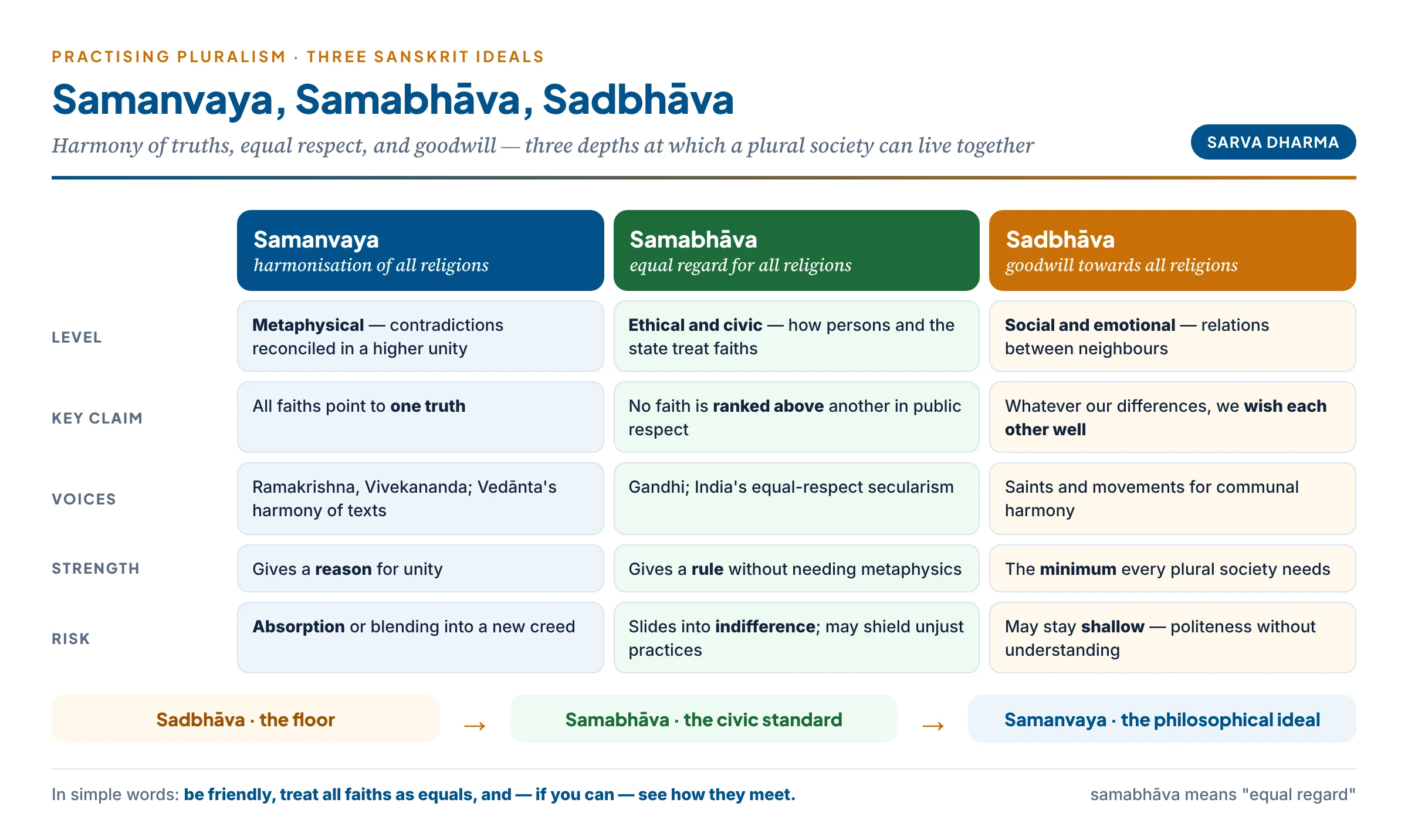
6. Samanvaya, Samabhāva and Sadbhāva: Three Ways of Practising Pluralism
| Sarva-dharma-samanvaya | Sarva-dharma-samabhāva | Sarva-dharma-sadbhāva | |
|---|---|---|---|
| Literal meaning | Harmonisation or synthesis of all religions | Equal regard (equal attitude) towards all religions | Goodwill or friendly feeling towards all religions |
| Level | Metaphysical — shows that differences are reconciled in a higher unity | Ethical and political — treat all faiths with equal respect | Social and emotional — cordial relations between communities |
| Key claim | All religions point to one truth; their contradictions can be reconciled | No religion is to be ranked above another in public respect | Whatever our differences, we wish each other well |
| Associated with | Ramakrishna, Vivekananda; Vedānta’s harmonising of texts | Gandhi; Indian secularism | Saints and civic movements for communal harmony |
| Strength | Gives a reason for unity | Gives a rule for conduct, without needing metaphysics | The minimum any plural society needs |
| Risk | Absorption or syncretism (Dīn-i-Ilāhī, the New Dispensation) | Can slide into indifference, or shield harmful practices from criticism | May be shallow — politeness without understanding |
- Samanvaya comes from Vedānta: the Brahma Sūtra’s principle that all Upaniṣadic texts are harmonised (samanvaya) in Brahman. Applied to religions, it says all faiths harmonise in one Reality.
- Samabhāva is sama (equal) + bhāva (attitude, regard). It is the Gandhian and constitutional ideal: the state keeps equal respect and principled distance; citizens extend to others the respect they want for their own faith.
- Sadbhāva is sat (good) + bhāva (feeling) — goodwill. It does not require a theory of truth, only friendship.
- They form a ladder of depth: sadbhāva (goodwill) is the floor; samabhāva (equal respect) is the civic standard; samanvaya (harmony of truths) is the philosophical ideal.
Common confusion
Is it “sarva dharma samabhāva” or “sambhāva” — and does it mean tolerance? The correct form is samabhāva — sama (equal) + bhāva (regard): equal respect for all religions. The spelling “sambhāva” is a common slip in popular usage, and it should not be confused with sambhava (“birth, possibility”). Some study notes even say that Gandhi rejected the word “tolerance (sambhava)” — that is a confusion. Gandhi rejected the English word tolerance because it can imply that others are inferior; the ideal he put in its place was samabhāva, equal regard.
7. How Can Religious Pluralism Be Practised in a Pluralistic Society?
At the level of the individual
- Humility about one’s own grasp of truth (Gandhi’s “imperfect seekers”; the Jaina “in some respect”).
- Study other faiths through their devotees, not through their enemies.
- Firm faith, open heart — be “a better Hindu, a better Muslim, a better Christian”, not a convert-hunter.
At the level of communities
- Dialogue — interfaith councils, shared festivals, visits to one another’s shrines; the Ramakrishna Mission’s celebration of the birthdays of many prophets is one example.
- Restraint in speech — Aśoka’s vacaguti: do not praise your own faith by disparaging another’s.
- Internal reform — each community must cleanse its own unjust practices (untouchability, gender discrimination), because pluralism does not protect injustice.
At the level of the state
- Freedom of religion — Articles 25–28 guarantee conscience, practice and propagation, subject to public order, morality and health, and allow social reform laws.
- Equality and non-discrimination — Articles 14–15; protection of minorities’ culture and institutions — Articles 29–30.
- Equal respect and principled distance — the state neither establishes a religion nor ignores religion; it can intervene for reform (temple entry, abolition of untouchability) while respecting faith.
- Fraternity — the Preamble’s fraternity and Article 51A(e) ask citizens to transcend religious diversity in a spirit of common brotherhood.
- Secularism as basic structure — affirmed in S.R. Bommai (1994).
At the level of education
- Value education that teaches about all religions, the habit of reading the other charitably, and the constitutional values of liberty, equality and fraternity.
Is secularism necessarily related to religious pluralism?
- The link: where several religions live together, a state that favours one cannot treat all citizens as equals; pluralism therefore calls for secularism. In India, secularism is built on the old ethic of equal respect.
- But not necessarily: secularism also arose in Europe from wars between Christian sects and from the demand for individual liberty, and a secular state could exist even in a religiously uniform society. Conversely, a society can be plural yet have an established religion (as in some European democracies). So the relation is strong but not logically necessary. (The Indian secularism articles of the Socio-Political section treat this in detail.)
Critical Evaluation
Objections to Modern Indian Pluralism
- Hierarchy in disguise. Vivekananda’s ladder (dvaita → viśiṣṭādvaita → advaita) and Radhakrishnan’s ranking of worshippers place Advaita at the top. Others are accepted only as lower stages — Hindu inclusivism.
- Essentialism. “All religions are essentially the same” ignores real differences — creation and rebirth, soul and no-soul, grace and self-effort — and so does not take religions seriously as truth claims.
- Unverifiable experience. Ramakrishna’s realisations were interpreted through Vedāntic ideas; experiences in other traditions may be different in kind, not the same experience under different names.
- Majoritarian misuse. “All religions are one” can be used to absorb minorities, deny their distinctness, or oppose their right to propagate their faith.
- Ambedkar’s challenge. Equal respect for all religions can shield unjust practices; religions must be judged by liberty, equality and fraternity, not simply respected.
- Exclusivists’ reply. Christians and Muslims who hold their revelation to be final see “acceptance” as a polite denial of what they believe.
- Truth made vague. Gandhi’s “Truth is God” may make religious truth so broad that it loses content.
Replies
- Acceptance with individuality. Vivekananda explicitly says each religion should keep its individuality; Gandhi forbids any thought of conversion — neither demands that others become Vedāntins.
- Humility rather than hierarchy. Gandhi’s version drops the ladder: every religion, including Hinduism, is imperfect and liable to error. This avoids inclusivism.
- An ethic, not only a metaphysics. Samabhāva does not require proving that all doctrines are equally true; it requires equal respect for persons and their faiths — something both exclusivists and pluralists can accept.
- Ethical limits. Gandhi: tolerance “does not disturb the distinction between right and wrong”. Equal respect for religions is not respect for every practice.
- Practical success. The ideas shaped India’s constitutional secularism, inspired interfaith movements worldwide, and offered a non-violent answer to communal hatred.
Critics and Defenders
Criticism — Against neo-Vedāntic and Gandhian pluralism
- Inclusivist hierarchy — Advaita is the summit; other faiths are lower rungs.
- Essentialism — real doctrinal differences are dismissed as “mythology”.
- Interpreted experience — Ramakrishna’s realisations prove only what his framework allowed him to see.
- Majoritarian absorption — “all religions are one” can deny minorities their distinctness.
- Moral shield — equal respect can protect caste and other unjust practices (Ambedkar).
- Vague truth — “Truth is God” says too little to guide belief.
Defence — For neo-Vedāntic and Gandhian pluralism
- Individuality kept — “each must grow according to its own law of growth”; no conversion, no merger.
- Humility for all — every religion, one’s own included, is imperfect (Gandhi).
- Ethics over doctrine — samabhāva asks for equal respect, not metaphysical agreement.
- Right and wrong preserved — tolerance never covers injustice; untouchability is condemned as irreligious.
- Inclusive of atheists — “Truth is God” welcomes every sincere seeker.
- Proven in public life — a foundation of India’s equal-respect secularism and of worldwide interfaith dialogue.
Cross-Tradition Comparison
Vivekananda, Gandhi and Hick
| Point | Vivekananda | Gandhi | John Hick |
|---|---|---|---|
| Basis | Vedāntic realisation; one Reality | Truth as God; human imperfection | Kantian Real an sich vs Real as experienced |
| Other religions | True paths — stages from lower to higher truth | True but imperfect, liable to error | Equally valid culturally shaped responses |
| Hierarchy? | Yes — Advaita as summit | No — all imperfect alike | No — parity, judged by moral fruits |
| Test of a path | Power to produce realisation and saints | Truth and non-violence in life | Transformation from self-centredness to Reality-centredness |
| Conversion | Unnecessary; assimilate, don’t destroy | Rejected | Not needed for salvation |
| Main weakness | Inclusivism | Vagueness of “Truth” | The unknowable Real may be empty |
Unit Synthesis: The Positions on Religious Pluralism and Absolute Truth
| Model / thinker | View of other faiths | Basis | Status of absolute truth |
|---|---|---|---|
| Exclusivism (Barth) | False, human “unbelief”; no saving power | Unique revelation in Christ | Possessed only by one revelation |
| Inclusivism (Rahner) | Partly true; grace works “anonymously” | God’s universal will to save, centred in Christ | Fullness in one tradition; seeds in others |
| Pluralism (Hick) | Equally valid responses to the Real | Kant’s noumenon–phenomenon distinction | Beyond all human descriptions |
| Jainism (anekāntavāda) | Partial standpoints (naya); error only in one-sidedness | Many-sided reality | Known whole only to the kevalin; finite claims are “in some respect” |
| Vedānta (Vivekananda) | True stages on one ascent | One Reality, levels of truth, realisation | Brahman, realised in experience |
| Gandhi | True but imperfect branches of one tree | Truth is God; human fallibility | Absolute Truth is God; all creeds relative glimpses |

Indian Connect — Indian takeaways
- Ramakrishna gave pluralism an experiential basis; Vivekananda gave it a philosophy and a world platform; Gandhi gave it an ethic and a politics.
- The weak point of the Vedāntic version is hierarchy; Gandhi’s insistence that every faith is imperfect is the strongest correction.
- India’s constitutional equal respect is the civic form of samabhāva — but it must be joined to Ambedkar’s demand that religion answer to justice.
Synthesis (Siddhānta): Absolute Truth without Exclusivism
- Holding truth is not possessing it. The deepest lesson of the Indian tradition — from neti, neti to the Jaina syāt to Gandhi’s “imperfect seekers” — is that one can be committed to absolute truth while admitting that one’s grasp of it is partial. Exclusivism confuses holding the truth with owning it.
- Humility, not scepticism. The pluralist does not say “there is no truth” (relativism) or “we can know nothing” (scepticism); he says “Truth is greater than my creed“. This keeps both conviction and openness.
- Ethics as the meeting ground. Where doctrines conflict, religions can still meet on truthfulness, non-violence and compassion — Gandhi’s Truth, the Buddha’s test of welfare, Hick’s moral fruits. This also guards pluralism against moral relativism.
- Respect for difference. Real pluralism lets each tradition define itself — Vivekananda’s “own law of growth” — instead of absorbing it into a larger scheme.
- From metaphysics to institutions. Equal respect must be embodied in constitutional rights, restraint in speech, dialogue and education, or it remains a pious hope.
- A final formula. Absolute Truth is one; human religions are many, partial and improvable; therefore conviction must walk with humility, and faith with equal respect.
“Even as a tree has a single trunk, but many branches and leaves, so is there one true and perfect Religion, but it becomes many, as it passes through the human medium.” — Gandhi
Previous Year Questions
- 2026Critically evaluate the shift in Gandhi’s view from ‘God is Truth‘ to ‘Truth is God‘, in the context of interrelation between religion and morality.
- 2025How does the Vedantic view of Religious Pluralism address the conflicting truth claims of different faiths? Answer with reference to Swami Vivekananda’s view of Universal Religion.
- 2025Is the idea of secularism necessarily related to the idea of religious pluralism? Discuss.
- 2008In a pluralistic society, how can religious pluralism be practiced? Point out distinction among – (a) sarvadharmasamanvaya (b) sarvadharmasambhava (c) sarvadharmasadbhava