

Religious Pluralism: Religious Pluralism and the Problem of Absolute Truth.
Official Syllabus: Paper II, Section B, Unit 9
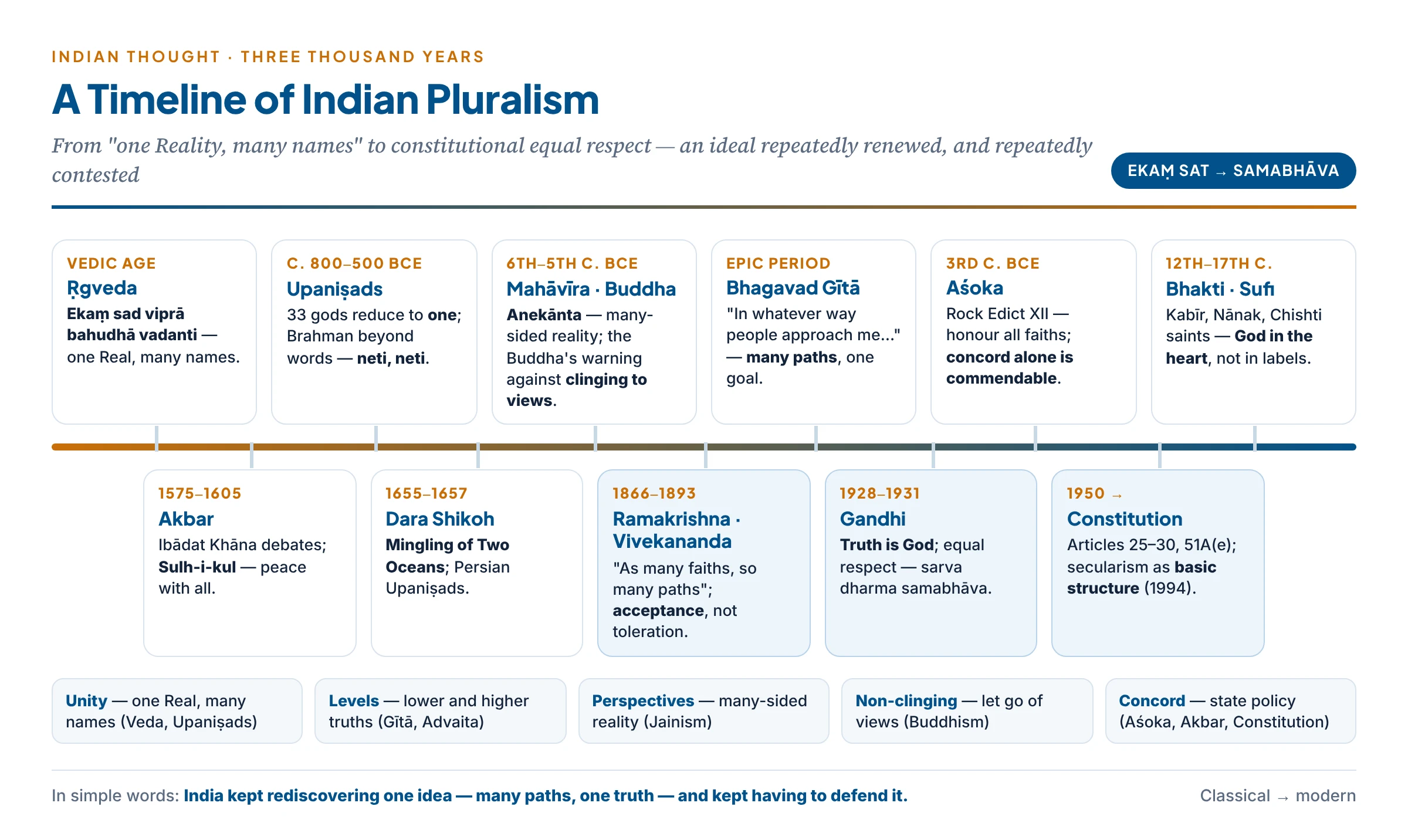
Long before Western theology began debating exclusivism, inclusivism and pluralism, Indian thought had to live with many schools under one sky. Vedic ritualists, Upaniṣadic monists, theists, materialists, Jainas and Buddhists argued with one another for centuries, usually by debate rather than by the sword. Out of this experience came several distinct answers to the problem of religious plurality and absolute truth: the Vedic idea that one Reality is spoken of in many ways (ekaṃ sad viprā bahudhā vadanti), the Gītā’s many paths to one goal, Advaita’s levels of truth, the Jaina doctrine that reality itself is many-sided (anekāntavāda), the Buddhist warning against clinging to views, Aśoka’s state policy of concord (samavāya), the Bhakti–Sufi saints’ religion of the heart, and the Mughal experiments of Akbar and Dara Shikoh. This article explains each answer, tests it against its critics, and asks what the old dictum “Truth is one, yet people perceive it differently” means in present-day India.
In simple words
Think of one woman. Her child calls her “Mummy”, her students call her “Ma’am”, her husband calls her by her name, and the bank calls her “the account holder”. Four names, four relationships, one person. Nobody is lying, yet nobody’s name tells the whole story. The Vedic sages said the same of the Ultimate: one Reality, many names. The Jainas added a further point: even the person’s nature has many sides — she is strict in class and gentle at home — so every description is true in some respect, and false only when it claims to be the whole truth.
Context & Problem
Why India Is Called a Laboratory of Pluralism
- Many systems, no central church. India had no single institution with the power to declare one creed true for all. The orthodox schools (āstika — those that accept the authority of the Veda) and the heterodox schools (nāstika — Cārvāka, Buddhism, Jainism) all flourished side by side.
- Debate as a method. Indian philosophy grew through public debate (śāstrārtha). Every school had to state the rival’s view fairly (pūrvapakṣa) before refuting it and stating its own conclusion (siddhānta). This built a habit of taking other views seriously.
- Atheists inside the tradition. Schools that rejected a creator God (Mīmāṃsā, classical Sāṃkhya, Jainism, Buddhism) were still counted as paths to liberation. Disagreement about God did not automatically mean exclusion.
- Not a golden age without conflict. Indian history also knows sectarian rivalry, royal patronage shifting from one sect to another, and periods of persecution and temple destruction. The pluralist ideals discussed below were achievements won against such tendencies, not a description of a perfect past.
The Questions Indian Thought Had to Answer
- Is the Ultimate one, though described in many ways? (the Vedic and Vedāntic question)
- Can contradictory descriptions both be true? (the Jaina question)
- Does clinging to any description lead to liberation at all? (the Buddhist question)
- How should a ruler or a society treat rival faiths? (the question of Aśoka and Akbar)
- Where is God actually found — in creeds, or in the heart? (the question of the Bhakti and Sufi saints)
Five Indian Models of Pluralism
| Model | Key idea | Main source | Nearest Western position |
|---|---|---|---|
| Unity model | One Reality, many names | Ṛgveda, Upaniṣads, Gītā | Hick’s one Real, many responses |
| Levels model | Lower and higher truths | Advaita Vedānta | Inclusivism (a ladder) |
| Perspective model | Reality is many-sided; each view partial | Jainism | Aspectual pluralism |
| Therapeutic model | Clinging to views causes conflict; test by results | Buddhism | Pragmatism; Hick’s ethical test |
| Civic model | Concord, restraint in speech, impartial state | Aśoka, Akbar | Locke’s toleration; secularism |
Core Doctrine
1. The Vedic Root: Ekaṃ Sad Viprā Bahudhā Vadanti
The verse. The best-known statement of Indian pluralism comes from the “riddle hymn” of the sage Dīrghatamas in the first book of the Ṛgveda:
“They call it Indra, Mitra, Varuṇa, Agni, and it is the heavenly, beautiful-winged Garutmān. The Real is one; the wise speak of it in many ways — they call it Agni, Yama, Mātariśvan.” — Ṛgveda
- Ekaṃ sat — “the Real (being, truth) is one“. Sat means both what is and what is true.
- Viprāḥ — the inspired sages, the seers who have glimpsed it.
- Bahudhā vadanti — “speak of it in many ways”. The plurality lies in speech (names, images, concepts), not in the Real itself.
- A parallel verse in the tenth book says that the wise poets, by their words, shape the One into many forms (ekaṃ santaṃ bahudhā kalpayanti). The many forms are made by language; the One is given.
- Yāska’s explanation. The early etymologist Yāska explained that because the deity is so great, “the one Self is praised in many ways”: the different gods are limbs or aspects of one Self.
- Henotheism. In many Vedic hymns, each god in turn is praised as supreme — Indra in one hymn, Varuṇa in another. Max Müller called this henotheism (“one god at a time”). The ekaṃ sat verse goes a step further: the gods are names of one Real.
- Humility at the root. The Nāsadīya hymn (the hymn of creation) ends by asking whether even the overseer in the highest heaven knows how creation arose — “perhaps he knows, or perhaps he does not know.” Doubt is built into the oldest scripture.
What the dictum teaches
- Ontological unity — there is one Ultimate, so this is not relativism (relativism says there is no single truth at all).
- Linguistic plurality — every human name is partial, so no one name may claim to be the whole.
- Respect for the wise of every kind — the many names come from sages, not from fools; diversity is a sign of depth, not of error.
- A test, not a blank cheque — the verse praises the speech of the vipra (the seer). It does not say every utterance about the divine is equally wise.
Three ways of reading it
| Reading | What “one Real” means | Who reads it so |
|---|---|---|
| Monist | Impersonal Brahman beyond all names | Advaita, Vivekananda |
| Theist | One supreme Lord with many names | Vaiṣṇava and Śaiva theists |
| Pluralist | The one ultimate behind all world religions | Radhakrishnan, Gandhi, modern interfaith thought |
Common confusion
Was ekaṃ sad viprā bahudhā vadanti originally a statement about world religions? No. In the Ṛgveda it is about the Vedic gods — Indra, Agni, Varuṇa, Yama — being names of one Real. The extension of the verse to Christianity, Islam, Buddhism and the rest is a modern reading, made especially by Vivekananda, Radhakrishnan and Gandhi. The extension is natural and powerful, but a careful student should say “the verse was later applied to world religions”, not “the Ṛgveda taught interreligious pluralism”.
2. The Upaniṣads: Many Names, Beyond All Names
- How many gods? In the Bṛhadāraṇyaka Upaniṣad a questioner asks the sage Yājñavalkya how many gods there are. He answers 3,306; pressed again, 33; then 6, 3, 2, one and a half, and finally one — the breath of life, which is Brahman. The dialogue is a lesson in reduction: the many gods are powers of one Reality.
- Neti, neti — “not this, not this”. Brahman cannot be captured by any description. Every positive name (“father”, “light”, “king”) must be negated, because the Ultimate is beyond all predicates.
- Beyond speech. The Taittirīya Upaniṣad speaks of that “from which words turn back, together with the mind, not reaching it”; the Kena Upaniṣad of that which speech cannot express, but by which speech itself is expressed.
- One without a second. The Chāndogya Upaniṣad declares that in the beginning there was Being alone, one only, without a second (ekam evādvitīyam).
- The theistic voice. The Śvetāśvatara Upaniṣad praises one God hidden in all beings, the inner Self of all, under the names Rudra and Īśa.
Why this matters for pluralism
- If the Ultimate exceeds all descriptions, then every religious description is partial. No creed can be the final, complete statement.
- But if the Ultimate is one without a second, then the many paths are not paths to different goals. Unity and humility arrive together.
In simple words
A map of India is useful, but it is not India. A political map, a railway map and a rainfall map all look different, and each is correct for its purpose. The Upaniṣads treat religious descriptions like maps: helpful, partial, and never to be mistaken for the land itself — neti, neti.
3. The Bhagavad Gītā: Many Paths, One Destination — with an Inclusivist Accent
The key verses
- Fourth chapter: “In whatever way people approach me, in that very way I receive them; on every side, O Pārtha, people follow my path.” (ye yathā māṃ prapadyante tāṃs tathaiva bhajāmy aham). All approaches lead to Kṛṣṇa.
- Seventh chapter: whatever form a devotee wishes to worship with faith (śraddhā), Kṛṣṇa makes that faith steady; the devotee receives what he seeks — but in truth from Kṛṣṇa alone.
- Ninth chapter: even those who devotedly worship other gods worship Kṛṣṇa, though “not according to the proper rule” (avidhi-pūrvakam).
- Paths for temperaments. The Gītā offers several disciplines — knowledge (jñāna-yoga), devotion (bhakti-yoga), selfless action (karma-yoga) and meditation (dhyāna-yoga) — suited to different natures.
The inclusivist accent
- The Gītā is generous: no sincere worship is wasted.
- But it is also hierarchical: worship of other gods reaches Kṛṣṇa indirectly, “not by the proper rule”, and the Gītā adds that worshippers of the gods go to the gods, while Kṛṣṇa’s devotees come to him. One path is fuller than the others.
- So the Gītā is closer to inclusivism (one tradition holds the fullness; others share in it partially) than to Hick’s parity of all traditions. This is why critics speak of Hindu inclusivism.
The rivers and the ocean. A hymn to Śiva, the Śiva-mahimna-stotra of Puṣpadanta, gives the classic image:
“Because of the variety of their tastes, people follow different paths, straight or crooked; yet You alone are the goal of all, as the ocean is of all rivers.” — Śiva-mahimna-stotra
This verse later became the centre of Vivekananda’s Chicago address (see the next article).
4. Advaita Vedānta: Levels of Truth and Paths for Every Seeker
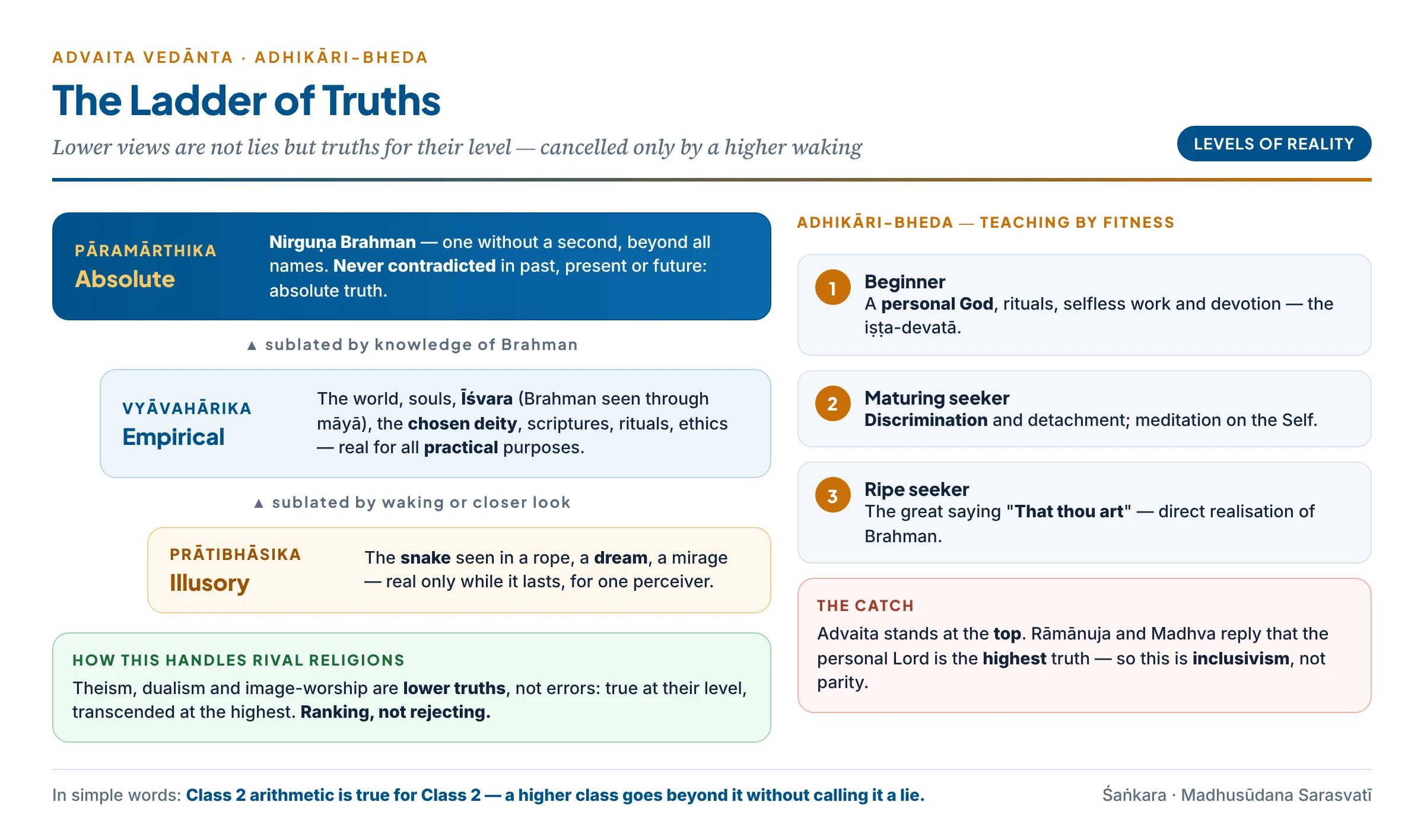
Three levels of reality and truth
- Pāramārthika — the absolute level: Brahman alone, one without a second. Its mark is that it is never contradicted in past, present or future (trikālābādhita). This is absolute truth in the strict sense.
- Vyāvahārika — the empirical or practical level: the world, individual souls, Īśvara (God as creator and ruler), scriptures, rituals, ethics. Real for all practical purposes, but sublated (cancelled) by the knowledge of Brahman.
- Prātibhāsika — the illusory level: the snake seen in a rope, a dream, a mirage. Real only while it lasts, for one perceiver.
Brahman and Īśvara
- Nirguṇa Brahman — Brahman without attributes, beyond thought.
- Saguṇa Brahman / Īśvara — the same Brahman seen through māyā, as the personal Lord with qualities, worthy of worship.
- They are not two realities but one Reality viewed from two standpoints — the absolute and the empirical. The personal gods of the religions are true at the empirical level and transcended at the absolute level.
How Advaita handles conflicting religious claims
- Ranking instead of rejecting. Dualist worship, theism and image-worship are not called false; they are lower truths suited to the seeker’s stage. They become “untrue” only for one who has realised Brahman — as a dream becomes untrue only on waking.
- Fitness of the seeker (adhikāri-bheda). Teaching is given according to capacity (adhikāra). A beginner needs a personal God, rituals and devotion; an advanced seeker needs discrimination and renunciation; the most advanced needs only the great sayings such as “That thou art“.
- The chosen deity (iṣṭa-devatā). Each person may worship the form of the divine that best draws his heart — Rāma, Kṛṣṇa, Śiva, Devī — without denying the others.
- Madhusūdana Sarasvatī’s map of systems. The sixteenth-century Advaitin Madhusūdana Sarasvatī, in his short treatise Prasthānabheda (“the difference of paths”), surveyed the Vedic sciences and philosophical schools and argued that the founders of the systems were wise sages who all aimed at the one Supreme; their differences arise from adapting teaching to people of different capacities, and the final goal of all is the non-dual Brahman.
In simple words
Think of a school. Class 2 learns that you cannot subtract 5 from 3; Class 7 learns negative numbers and finds that you can. The Class 2 teacher was not lying — she taught the truth suitable for that level. Advaita treats the religions in the same way: dualist and theist teachings are true for their level, and a higher level does not call them lies but goes beyond them.
Its limits
- Advaita stays at the top of the ladder. Every other view is placed below non-dualism. Theists such as Rāmānuja and Madhva reject this: for them the personal Lord is the highest reality, not a lower appearance, and difference (bheda) is real.
- Inclusivism, not parity. Advaita’s “pluralism” is generous but hierarchical. It accepts others on its own terms — the same charge brought against Rahner’s “anonymous Christian”.
5. Jainism: Anekāntavāda — Reality Has Many Sides
Jaina philosophy built the most systematic theory of pluralism in world thought. Where the Vedic sages said the Real is one but named in many ways, the Jainas said the Real is itself many-sided, so that many true descriptions of it are possible.
Anekāntavāda: the doctrine of non-one-sidedness
- The word. An-eka-anta — “not one-sided“. Its opposite is ekāntavāda, one-sidedness or dogmatism.
- Every thing has infinite characters. The Jainas define a real thing as “possessing infinite characters” (ananta-dharmātmakaṃ vastu). Some characters are positive (what it is), many are negative (what it is not, and how it differs from everything else).
- Being includes change and permanence. Reality is defined as “what possesses origination, decay and permanence” (utpāda-vyaya-dhrauvya-yuktaṃ sat). A gold bangle melted into a necklace: the bangle perishes, the necklace arises, the gold remains. The substance (dravya) is permanent; its modes (paryāya) change.
- Why rival schools err. The Vedāntin sees only permanence (Brahman unchanging); the Buddhist sees only change (everything momentary). Each has seized one side and denied the other. The Jaina says both are partly right and both are wrong in their denials.
Pramāṇa and naya: whole knowledge and partial standpoint
- Pramāṇa — valid knowledge that grasps a thing as a whole.
- Naya — a standpoint or partial view that grasps one aspect (ekadeśa) of a thing while leaving others aside.
- Durnaya — a wrong standpoint: a partial view that claims to be the whole and denies all others. A naya is innocent; a naya that absolutises itself becomes dogma.
- The rule. Every naya becomes valid only when it is qualified — when it admits that it speaks “in some respect”.
The seven standpoints (naya)
- Four standpoints about objects (artha-naya):
- Naigama — the common-sense or purposive standpoint, which mixes the general and the particular (a man carrying firewood says “I am cooking”).
- Saṅgraha — the collective standpoint, which sees only the universal (“all is being”). Pushed to the extreme, it becomes Advaita.
- Vyavahāra — the practical standpoint, which sees particular things and distinctions.
- Ṛjusūtra — the momentary standpoint, which sees only the present state. Pushed to the extreme, it becomes the Buddhist doctrine of momentariness.
- Three standpoints about words (śabda-naya):
- Śabda — words with different tense or gender can refer differently.
- Samabhirūḍha — synonyms are distinguished by their root meanings.
- Evambhūta — a word applies only while its meaning is actually being fulfilled (Indra is “Purandara”, the destroyer of cities, only while he is destroying cities).
- Two broad standpoints. All seven reduce to the substance standpoint (dravyārthika), which sees permanence, and the mode standpoint (paryāyārthika), which sees change.
In simple words
A glass of water is “big” next to a teaspoon and “small” next to a bucket. Ask “Is the glass big?” and the honest answer is “in one respect yes, in another no“. Nothing contradictory has been said, because the two answers speak of different comparisons. Syādvāda simply insists that we mention the respect — and stop shouting “big!” or “small!” as if one answer were the whole truth.
Syādvāda: the doctrine of “in some respect”
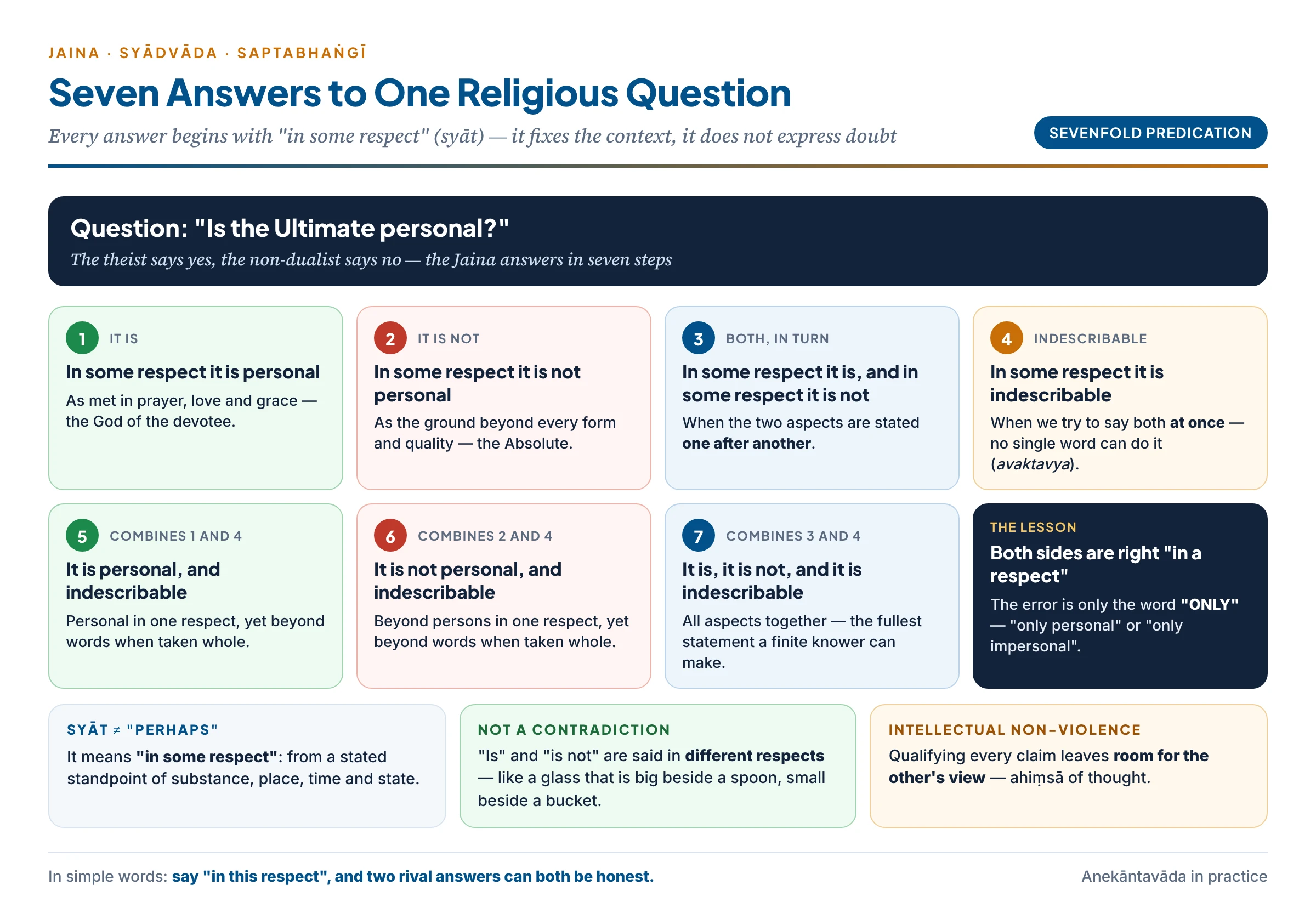
- Syāt means “in some respect“, “from a certain standpoint” — not “perhaps”. It does not express doubt; it fixes the context in which a statement is true.
- The four conditions. A thing exists in respect of its own substance, place, time and state (dravya, kṣetra, kāla, bhāva). A clay pot exists as clay, here, now, in this shape; it does not exist as gold, in another city, last year, or as a broken heap.
- The sevenfold way of predication (saptabhaṅgī). Every question admits seven answers, each qualified by “in some respect”. Applied to a religious claim — “the Ultimate is personal” — it runs:
- In some respect it is personal — as met in prayer, love and grace.
- In some respect it is not personal — as the ground beyond all forms and qualities.
- In some respect it is personal and in some respect not — when we state both aspects one after another.
- In some respect it is indescribable — when we try to state both aspects at once; no single word can do it (avaktavya).
- In some respect it is personal and indescribable.
- In some respect it is not personal and indescribable.
- In some respect it is personal, not personal, and indescribable.
- The lesson. The theist who says “personal” and the non-dualist who says “impersonal” are both right in a respect; they are wrong only when each says “only this”.
The blind men and the elephant (andha-gaja-nyāya)
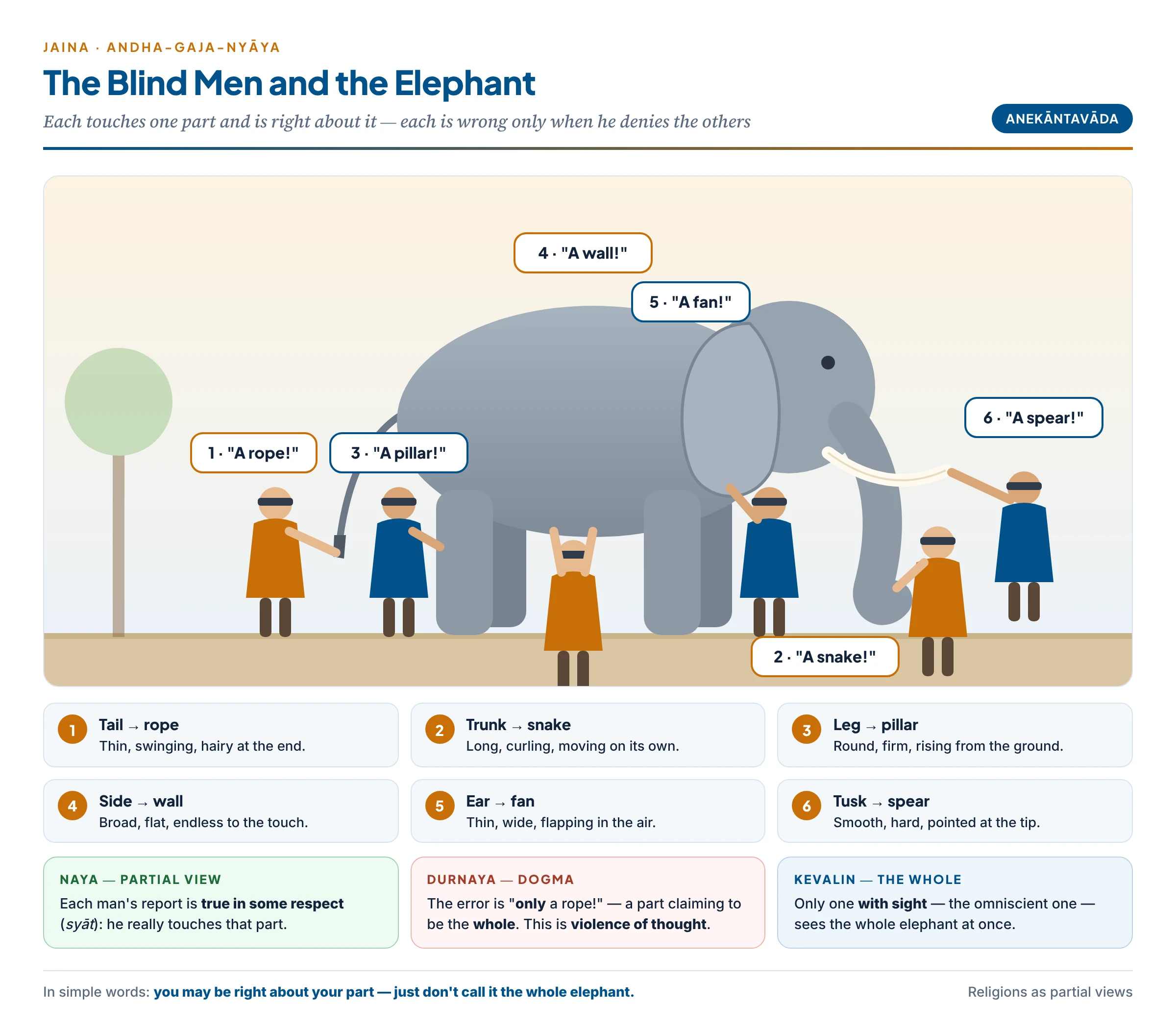
- The parable. Six blind men touch an elephant. The one at the trunk says it is a snake; at the ear, a fan; at the leg, a pillar; at the side, a wall; at the tail, a rope; at the tusk, a spear. Each is right about what he touches and wrong in denying what the others touch.
- Who sees the whole? Only one with sight — in Jainism the omniscient one (kevalin), whose perfect knowledge (kevala-jñāna) grasps all aspects together.
- Applied to religions. The monotheist grasps the personal grace of the Ultimate; the Advaitin its non-dual unity; the Buddhist the flux and emptiness of all things. Each touches a genuine side of an infinitely rich reality. Fanaticism begins when one partial standpoint proclaims itself the whole — when a naya becomes a durnaya.
Jaina voices of fairness
- Haribhadra (eighth century), who wrote a fair-minded compendium of six systems, declared: “I have no partiality for Mahāvīra, nor hatred for Kapila and the others; whoever’s word is reasonable should be accepted.”
- Siddhasena Divākara taught that the standpoints taken one by one are false, but taken together they give the right view — like separate jewels that become a necklace only when strung on one thread.
- Anekānta applied to itself. Later Jaina logicians said that even anekānta is anekānta: from the standpoint of complete knowledge (pramāṇa) reality is many-sided; from a single standpoint (naya) a one-sided statement is allowed. So the doctrine does not refute itself.
Intellectual non-violence
- Ahiṃsā in three places — in action (do not harm living beings), in speech (do not wound with words), and in thought (do not do violence to another’s view by dismissing it).
- Anekāntavāda is ahiṃsā of the intellect. To say “only my view is true” is a violence of the mind that prepares the ground for violence of the hand.
- Influence. Gandhi said his Jaina friend Raychandbhai (Śrīmad Rājacandra) deeply shaped his religious thinking; his later remark that “everybody is right from his own standpoint” echoes anekānta (see the next article).
6. Buddhism: The Danger of Clinging to Views
The Buddha’s elephant. The Buddhist Udāna tells the oldest surviving version of the parable. Wandering teachers of many sects in Sāvatthī were quarrelling, each saying “this alone is true, everything else is false”, and wounding one another with words. The Buddha told this story:
- A king had all the men born blind in the city brought before an elephant, and each touched one part.
- The man at the head said the elephant was like a water-pot; at the ear, a winnowing basket; at the tusk, a ploughshare; at the trunk, a plough-pole; at the body, a granary; at the foot, a pillar; at the back, a mortar; at the tail, a pestle; at the tuft of the tail, a broom.
- They began to fight with their fists, shouting “the elephant is like this, not like that!” — and the king was amused.
- The Buddha’s moral: some recluses and brahmins are attached to their views; seeing only one side, they wrangle and quarrel.
What the Buddhist lesson adds
- The Jaina moral is “each is partly right“. The Buddhist moral is sharper: clinging to any view (diṭṭhi) is itself the problem. Views become a thicket, a fetter, a source of conflict.
- The raft. The Buddha compared his own teaching to a raft for crossing a river — useful for crossing, to be left behind on the far shore, not carried on one’s head. Even the true teaching must not become an object of clinging.
- The unanswered questions (avyākata). Asked whether the world is eternal, whether soul and body are the same, or whether the Buddha exists after death, he kept silent. In the parable of the poisoned arrow, a wounded man who refuses treatment until he knows the archer’s caste and name will die first. Metaphysical disputes that do not lead to liberation are set aside.
- The Kālāma test. To the Kālāma people, confused by teachers who each praised their own doctrine and condemned the rest, the Buddha said: do not accept a teaching merely because of tradition, scripture, logic alone, or the teacher’s prestige; accept it when you yourself know that it leads to welfare and happiness and away from greed, hatred and delusion. This is a practical, experiential test of religious claims — close to Hick’s later test of fruits.
- Nāgārjuna’s emptiness. The Madhyamaka philosopher Nāgārjuna argued that all views are empty of independent truth and said he himself “had no thesis”. Emptiness (śūnyatā) is the relinquishing of all views — and those who turn emptiness itself into a view are called incurable. This is a radical cure for dogmatism, though critics ask whether it leaves any positive truth standing.
Aśoka’s Twelfth Rock Edict: the first state policy of religious concord. The Maurya emperor Aśoka (third century BCE), though a Buddhist, honoured all sects — Buddhist monks, Brahmins, Ājīvikas (to whom he gifted rock-cut caves) and Nirgranthas (Jainas). His Twelfth Rock Edict says:
“The faiths of others all deserve to be honoured for one reason or another. By honouring them, one exalts one’s own faith and at the same time performs a service to the faith of others… If a man extols his own faith and disparages another because of devotion to his own, he seriously injures his own faith. Therefore concord alone is commendable.” — Aśoka, Rock Edict XII
- Restraint in speech (vacaguti) — do not praise your own faith and disparage another’s without reason.
- Growth in essentials (sāra-vṛddhi) — the king values the growth of the essential qualities of religion in all sects more than gifts or honours.
- Concord (samavāya) — men of all faiths should meet, listen and learn one another’s doctrines.
- Officers of dharma (dharma-mahāmātras) were appointed to look after the welfare of all sects.
Indian Connect — Aśoka in today’s India
The Twelfth Edict reads like a commentary on the Indian Constitution. Article 25 guarantees freedom of conscience and the right to profess, practise and propagate religion; Article 51A(e) asks every citizen “to promote harmony and the spirit of common brotherhood amongst all the people of India transcending religious … diversities”. Aśoka’s “restraint in speech” is today’s concern with hate speech; his “concord” is today’s interfaith dialogue.
7. Bhakti and Sufi Saints: A Pluralism of the Heart
From roughly the twelfth to the seventeenth centuries, saint-poets in many Indian languages taught that God is found in love and inner truth, not in the outward marks that divide communities.
- Kabīr (fifteenth century), a weaver of Banaras, mocked both the pandit and the mullah. In a famous verse he says that the Hindu calls Rām dear, the Turk calls Rahīm dear; both fight and die, and neither knows the secret. God is not in the temple or the mosque but within — “the One who is near”.
- Guru Nānak (1469–1539), after his spiritual experience at Sultanpur Lodhi, proclaimed “Na ko Hindū, na Musalmān” — “there is no Hindu, there is no Muslim” — meaning that before God the labels do not matter; what matters is truthful living. The Guru Granth Sahib itself includes hymns of Kabīr, Ravidās, Nāmdev and the Sufi Bābā Farīd — a scripture that is plural by design.
- The Sufis. Chishti saints such as Moinuddin Chishti of Ajmer and Nizamuddin Auliya of Delhi welcomed Hindus and Muslims alike; their shrines are still visited by all communities. The Sufi doctrine of the unity of being (waḥdat al-wujūd, associated with Ibn ʿArabī) saw the one Real behind all forms. Ibn ʿArabī wrote that his heart had become capable of every form — a pasture for gazelles, a convent for monks, a temple for idols, the pilgrim’s Kaʿba, the tablets of the Torah and the book of the Qurʾān — because his religion was the religion of love.
- Rūmī’s elephant in the dark. The Persian poet Rūmī told the elephant parable with a new twist: people touch an elephant in a dark room; one feels the trunk and says “a water-pipe”, another the ear and says “a fan”. “If each of them had held a candle, their differences would have vanished.” The cure for religious disagreement is light — direct spiritual vision — not more argument.
- Other voices. Lal Ded (Lalla) of Kashmir, revered by Hindus and Muslims alike; Bulleh Shah of Punjab; the Marathi saints Nāmdev and Tukārām, who declared that devotion, not birth or ritual, makes one dear to God.
What the saints add
- Experience over creed. Truth is realised in the heart, not won in disputation.
- Critique of externals. Ritual, pilgrimage, dress and dietary rules are the things that divide; love is what unites.
- Social edge. Many saints came from artisan and low-caste backgrounds; their pluralism also challenged caste pride and priestly monopoly.
8. Akbar and Dara Shikoh: Pluralism as Policy and as Scholarship
Akbar (ruled 1556–1605)
- Ibādat Khāna (House of Worship), built in 1575 at Fatehpur Sikri. At first only Muslim scholars debated there; later Akbar invited Shia and Sunni theologians, Hindu pandits, Jaina monks (notably Hīravijaya Sūri), Zoroastrian priests, Jesuit fathers from Goa (from 1580) and even sceptics and materialists.
- Sulh-i-kul — “peace with all” or universal concord. The state would not take sides between religions; subjects of every faith were to be treated alike.
- Concrete measures. Abolition of the pilgrim tax (1563) and of the jizya (the poll-tax on non-Muslims, 1564); appointment of Hindus to high office; translation of the Mahābhārata and Rāmāyaṇa into Persian.
- Dīn-i-Ilāhī (from 1582) — a small, voluntary order of discipleship around the emperor, drawing on several traditions. It gained only a handful of followers and died with Akbar — an example of syncretism (blending religions into a new one) rather than pluralism (respecting religions as they are).
- Interfaith dialogue. The Ibādat Khāna is often cited as an early model of inter-religious dialogue — though the debates sometimes grew so heated, especially among the Muslim theologians themselves, that Akbar eventually closed them.
What the Ibādat Khāna teaches about dialogue
- Meaning of interfaith dialogue. Conversation between members of different religions with two aims: reducing conflict and reaching mutually desirable goals — understanding, cooperation, shared action for the common good. It is not debate to defeat the other, nor a bargaining of doctrines.
- Particularism vs universalism. Dialogue is difficult when partners adopt particularism — caring only about the concerns of their own group. It is favoured by universalism — taking the concerns of others as one’s own. Akbar’s move from a Sunni-only hall to a hall open to all is a move from particularism to universalism.
- Inclusivism eases dialogue. Dialogue is easier when believers hold some form of inclusivism — the belief that people of other religions may also find a way to salvation, even if the fullness lies in one’s own. Such believers can listen without fear.
- Exclusivism tends to proselytise. Believers with an exclusivist mindset tend to try to convert the other rather than enter an open-ended conversation; for them dialogue is at best a prelude to mission. This is why some Ibādat Khāna sessions turned into polemics.
- Conditions for dialogue to work.
- Freedom of religion — every faith must be free to practise and speak; without it, dialogue is only a show.
- Absence of fundamentalism — literal readings of scripture highlight differences and hide commonalities; dialogue needs readers who look for the spirit as well as the letter.
- Equal standing — no partner may be treated as a mere object of conversion (the lesson of Sulh-i-kul).
- Willingness to learn — Aśoka’s ideal that people of all faiths should know one another’s doctrines.
- Indian continuity. From Aśoka’s “concord” (samavāya) to Akbar’s House of Worship, Dara Shikoh’s “mingling of oceans” and the modern interfaith movements, Indian pluralism has repeatedly turned ideas into institutions of conversation.
Dara Shikoh (1615–1659)
- The eldest son of Shah Jahan, a Sufi of the Qādirī order and a student of Vedānta.
- Majmaʿ-ul-Baḥrain (“The Mingling of the Two Oceans”, 1655) — argued that Sufism and Vedānta differ only in words; the truths of the two traditions meet like two oceans.
- Sirr-i-Akbar (“The Great Secret”, 1657) — a Persian translation of some fifty Upaniṣads, made with Banaras pandits. Through a Latin rendering of this Persian text, the Upaniṣads reached Europe and moved thinkers such as Schopenhauer.
- His fate. Defeated by his brother Aurangzeb, he was executed in 1659, condemned as an apostate — a reminder that pluralism in India has always been contested, not automatic.
“Truth Is One, Yet People Perceive Differently” — The Present Indian Context
What the Dictum Claims
- One truth — there is something real to be known; this is not relativism.
- Many perceptions — because human knowers are finite and shaped by language, culture and temperament, they see differently.
- An ethic follows — if my perception is partial, I owe humility to myself and respect to others.
Where Present-day India Lives the Dictum
- Constitutional equal respect. India’s secularism is not a wall between religion and state but equal respect and principled distance: Articles 14, 15, 25–28 and 29–30 protect individuals and minorities; Article 51A(e) asks citizens to transcend religious diversities in a spirit of brotherhood; the Supreme Court in S.R. Bommai v. Union of India (1994) held secularism to be part of the basic structure.
- Shared sacred spaces. Sufi shrines such as Ajmer Sharif, festivals celebrated across communities, and saints honoured by more than one faith.
- Public opinion. A large Pew Research Center survey (about 30,000 adults, 2019–20) found that 84% of Indians say respecting all religions is very important to being “truly Indian“, and 80% say respecting other religions is a very important part of being a member of their own religion.
Where It Is Strained
- Living together separately. The same survey found that most Indians’ close friends come from their own religion, that roughly two-thirds of Hindus and about four-fifths of Muslims consider it very important to stop interreligious marriage in their community, and that 36% of Hindus would not accept a Muslim neighbour. Respect is high; mixing is low.
- Communal violence and hate speech — riots, mob lynching and inflammatory speech show that “different perceptions” can harden into hostile identities.
- The conversion debate. Several states have anti-conversion laws; the Supreme Court in Rev. Stainislaus v. State of Madhya Pradesh (1977) held that the right to propagate religion does not include a right to convert another person. Critics see these laws as protecting the vulnerable from inducement; others see them as restricting freedom of conscience.
- Absorption instead of respect. “Truth is one” can be used to say “your path is really part of mine“. Minorities may hear this as inclusivism — being swallowed into a majority framework — rather than respect for their own self-understanding.
- Political use of identity. When religion becomes a marker of political identity, differences in perception turn into boundaries of belonging.
Critical Evaluation of the Dictum Today
- Its strength: it gives India a native language of pluralism, older than Western secularism, rooted in scripture and saints, and able to speak to believers in their own idiom.
- Its weakness: by itself it is a metaphysical attitude, not a legal guarantee; it needs constitutional morality, impartial institutions and civic education to work.
- Its condition: it must be read in the Jaina-Aśokan way — “I see only a part, so I must listen” — not in the absorptive way — “I already see the whole, so you are a part of me”.
Critical Evaluation
Objections to the Classical Indian Models
- Inclusivism in disguise. The Gītā’s “not by the proper rule”, Advaita’s ladder with non-dualism at the top, and Madhusūdana’s map that ends in Advaita all rank other paths below one’s own. This is generous inclusivism, not pluralism of equals.
- Śaṅkara’s critique of anekānta. In his commentary on the Brahma Sūtra, Śaṅkara argued that contradictory attributes cannot belong to one thing at the same time, just as heat and cold cannot; a doctrine that says a thing “is and is not” leaves the hearer unable to act, and makes the Jaina’s own teaching uncertain.
- Self-reference. If every judgment is true only “in some respect”, is anekāntavāda itself only true in some respect? If yes, it is weakened; if no, there is at least one absolute truth, and the doctrine is not universal.
- The sighted observer. The blind-men parable needs a king or a kevalin who sees the whole elephant. Whoever tells the story claims that privileged sight — the same objection raised against Hick’s “Real an sich” (see the article on Hick).
- Slide into relativism. If every view is partly true, it becomes hard to call any view false — even one that justifies cruelty.
- An idealised history. Indian history also contains sectarian persecution and religious violence; pluralist texts should not be read as a description of how things always were.
- Anachronism. The Vedic verse concerns Vedic gods, not world religions; the Gītā speaks to Hindu sects. Using them as charters of global pluralism stretches them.
Replies
- Respects remove the contradiction. Syādvāda does not deny the law of non-contradiction: the pot exists as clay and does not exist as gold. Contradiction would arise only if both were asserted in the same respect, which the doctrine forbids. Śaṅkara’s heat-and-cold example ignores the qualifying syāt.
- Jainism is not sceptical. It accepts valid knowledge (pramāṇa) and the perfect knowledge of the kevalin. Anekānta describes the limits of finite knowers, not the absence of truth. And anekānta applies to itself consistently: absolute from the standpoint of complete knowledge, partial from any single standpoint.
- Not anything goes. The Jainas name false standpoints (durnaya); the Buddha gives the Kālāma test of welfare and harm; Gandhi later insists that tolerance “does not disturb the distinction between right and wrong”. Indian pluralism keeps ethical limits.
- Ranking is not rejecting. Advaita calls lower views lower truths, never lies, and the Gītā guarantees that no sincere worship is wasted. Inclusivism of this kind still forbids persecution.
- Practice confirms theory. Aśoka’s edicts and Akbar’s Sulh-i-kul show that these ideas could be turned into state policy, not only poetry.
Critics and Defenders
Criticism — Against classical Indian pluralism
- Hidden hierarchy — the Gītā and Advaita place their own view at the summit; other faiths are welcome only as lower steps.
- Contradiction — Śaṅkara: one thing cannot both be and not be; syādvāda leaves us unable to know or act.
- Self-refutation — “all truth is relative” is either itself relative or an exception to itself.
- Privileged viewer — the elephant story assumes someone who sees the whole, which no pluralist can claim.
- Relativism — if every view is partly right, no view can be condemned.
- Rosy history — sectarian conflict and persecution are left out of the story.
Defence — For classical Indian pluralism
- Respects, not contradictions — “in some respect” keeps logic intact while honouring complexity.
- Truth is kept — pramāṇa and kevala-jñāna show that Jainism defends real truth with humble knowers.
- Ethical limits — durnaya, the Kālāma test and Aśoka’s restraint in speech set boundaries to tolerance.
- Lower truths, not lies — Advaita and the Gītā never call sincere worship false.
- Proven in practice — Aśoka’s edicts, the saints’ poetry, Akbar’s policy and India’s constitutional equal respect.
- Intellectual non-violence — dogmatism in thought is recognised as a seed of violence in action.
Cross-Tradition Comparison
The Elephant Parable across Traditions
| Teller | Who touches | What sees the whole | Lesson |
|---|---|---|---|
| Jaina | Six blind men | The omniscient kevalin | Each view is partly true; error is the claim to wholeness |
| Buddha (Udāna) | All the men born blind | The king who arranged it | Clinging to views causes quarrels |
| Rūmī | People in a dark room | A candle — inner light | Spiritual vision dissolves disputes |
| John Hick | The world’s religions | No one fully — the Real an sich is beyond all | Religions are culturally shaped responses to one Real |
Indian Models and Western Positions
| Indian idea | Western parallel | Key difference |
|---|---|---|
| Ekaṃ sad viprā bahudhā vadanti | Hick’s one Real, many personae and impersonae | Hick says the Real is unknowable in itself; the Vedic seers claim to have glimpsed it |
| Advaita’s levels of truth | Kant‘s phenomena and noumena; Rahner‘s inclusivism | For Kant the noumenon can never be known; for Śaṅkara Brahman is realised in liberation |
| Jaina anekāntavāda | Aspectual pluralism (the Real shows different aspects); perspectivism | Jainism is realist: the aspects really belong to the object |
| Buddhist critique of views | Wittgenstein’s therapy of philosophy; pragmatism | The Buddhist aim is liberation, not only clarity |
| Aśoka’s concord | Locke‘s Letter Concerning Toleration | Aśoka honours other faiths; Locke mainly argues the state cannot compel belief |
| Gītā’s “all paths lead to me” | Rahner‘s anonymous Christians | Both include others within their own framework |
Indian Connect — Indian takeaways
- India offers not one but five models of pluralism — unity, levels, perspectives, non-attachment and civic concord.
- The Jaina model is the most philosophically precise: it keeps truth and humility together.
- The Vedāntic model is the most influential but tends towards inclusivism.
- The Aśokan model shows that pluralism needs institutions and restraint in speech, not only metaphysics.
Common confusion
Is syādvāda a form of scepticism or relativism? Neither. Scepticism says we cannot know the truth; Jainism says we can, through valid knowledge, and that perfect knowledge is attainable. Relativism says truth changes from person to person; Jainism says truth depends on the respect in which a thing is considered — and that respect is objective (the pot really is clay, not gold). Syāt means “in some respect“, not “maybe“. Syādvāda is better called conditional realism: the object is rich, and our statements are true under stated conditions.
Common confusion
Is the blind-men parable a Jaina story only? No. It appears in Jaina works, in the Buddhist Udāna, in Hindu retellings, and in the poetry of Rūmī and other Sufis; a nineteenth-century English poem made it famous in the West. Each teller draws a different moral — partial truth (Jaina), the danger of clinging (Buddhist), the need for inner light (Rūmī) — so a careful answer should say whose version it is using.
Synthesis (Siddhānta)
- One Reality, many names. The Vedic seers and the Upaniṣads give Indian pluralism its foundation: the Ultimate is one, and every name is partial — neti, neti.
- Many paths, unequal maps. The Gītā and Advaita make room for every sincere seeker, but by ranking paths they lean towards inclusivism.
- Many sides, honest statements. Jainism offers the most rigorous answer to the problem of absolute truth: there is truth, reality is many-sided, and every finite statement must carry its “in some respect“. Dogmatism is a violence of thought.
- Let go of views. The Buddha reminds every pluralist that even a correct view can become a fetter, and that teachings are tested by their fruits in welfare and freedom from greed, hatred and delusion.
- Concord as policy. Aśoka and Akbar show that pluralism must become restraint in speech, equal treatment and dialogue if it is to protect people.
- Contemporary relevance. India today celebrates religious tolerance in principle yet often lives together separately. The classical traditions suggest the remedy: not merely to say “truth is one”, but to listen as a blind man who knows he holds only the trunk — and to build institutions that let every community speak for itself.
“I have no partiality for Mahāvīra, nor hatred for Kapila and the others; whoever’s word is reasonable should be accepted.” — Haribhadra
Previous Year Questions
- 2018“Truth is one, yet people perceive differently.” Critically evaluate by considering the present Indian context.
- 2012Critically evaluate Jaina doctrine of relative pluralism or Anekantvada?
- 2011Explain the notion of truth as “Ekam Sat Viprah Bahudha Vadanti” (Truth is one, the learned interpret it differently.)