

Religious Pluralism: Religious Pluralism and the Problem of Absolute Truth.
Official Syllabus: Paper II, Section B, Unit 9
The fact of religious diversity raises two kinds of problems. One is theoretical: if religions make conflicting claims, is there any objective truth in religion at all, or is religious truth relative to each culture — and if so, is morality relative too? The other is practical: if people hold rival absolute truths, will they fight — and how can believers who disagree about the deepest questions live together in peace and freedom? This article takes up both. It explains religious relativism and its difficulties; asks whether pluralism leads to moral relativism and to inter-religious conflict; examines whether the history of religions is a history of conflicts; weighs William James’s and Whitehead’s answers to the clash of creeds; sets out criteria for judging religious systems; and analyses tolerance and religious freedom — from Locke and Quinn to the Indian Constitution.
In simple words
Think of a joint family living in one big house. The brothers disagree about politics, food and how to raise children. Three things can happen. They can fight until one wins (conflict). They can each say “whatever I think is true for me” and stop talking (relativism). Or they can keep their own views, argue honestly, agree on basic house rules — no violence, respect for elders, sharing the kitchen — and live together (tolerance with a shared moral core). This article asks which of these is right for the world’s religions.
Context & Problem
Three Responses to Conflicting Religious Truth Claims
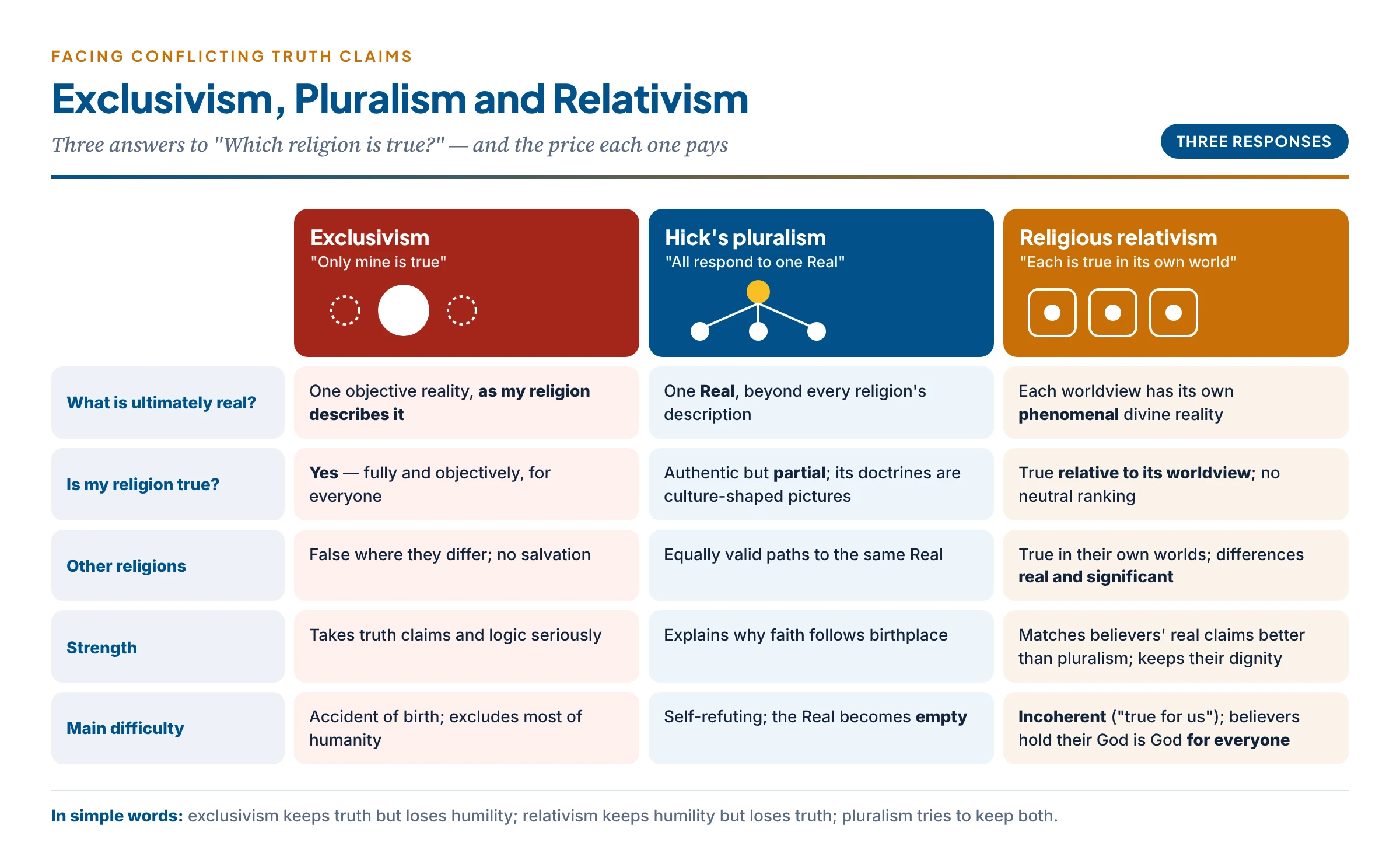
Religions make claims about reality, and some of them contradict each other. Philosophers have answered in three broad ways that bear on this article:
- Objectivism (shared by exclusivism, inclusivism and Hick’s pluralism): there is one objective reality to which religious claims point; the question is how much of it each religion grasps.
- Religious relativism: each religion is “true” within its own worldview, but there is no tradition-transcending sense in which one religion is more true than another.
- Scepticism: since the claims cancel each other out, none is likely to be true (Hume).
Two Practical Worries
- Moral worry — if all religions are “equally valid”, must we accept all their moral practices, including cruel ones? Does pluralism make right and wrong relative?
- Political worry — does belief in one absolute truth make conflict inevitable? Or does pluralism itself breed conflict, by weakening every faith’s confidence and treating serious believers as naïve?
Core Doctrine
1. Religious Relativism
What it says
- Religious relativism tries to remain committed to the truth of one’s own religion while agreeing with some central concerns of pluralism.
- It grants that different religions are made up of different experiences and mutually incompatible sets of truth claims, rooted in distinct worldviews that may contradict one another.
- But it explains these differences by a plurality of phenomenal divine realities experienced by different communities.
- A worldview — “the total cognitive web of our interrelated concepts, beliefs, and processes of rational thought” — determines how one understands and experiences Ultimate Reality.
- Corresponding to different worldviews there are mutually incompatible, yet individually adequate, sets of conceptual-scheme-relative truths. The truth of a religion is its adequacy in fitting the worldview of which it is a part.
Its link with Wittgenstein
- Later Wittgenstein‘s idea of language-games and forms of life gives relativism support: religious words get their meaning from their use within a community’s way of life. Judging “God created the world” as if it were a hypothesis in physics, or judging one religion by the rules of another, is a category mistake. On this reading, there is no neutral standpoint outside all language-games from which to rank religions.
Three advantages over Hick’s pluralism
- It gives a better account of what believers actually believe: it accepts that each religion makes real, fundamental claims, not mere myths.
- It keeps the dignity of the religions by treating their differences as real and significant.
- It does not reduce the Real to a mere “image” (as pluralism unintentionally does); the Real remains the direct object of faith within each tradition.
Two objections
- Relativism is incoherent. It seems impossible to hold consistently that truth is relative to individuals — “what is true for me may be false for you” makes truth mean nothing more than belief.
- Reply: this objection fits subjectivism (truth relative to each person’s private view). Religious relativism makes truth relative to the worldview of a culture, not of each individual, so it escapes the charge. (Critics add that cultures are not sealed boxes, and the claim “all truth is relative to culture” is itself offered as true for every culture — so the incoherence returns at one remove.)
- It misdescribes actual religious belief. Muslims have never held that Allah is the true God only relative to the Islamic worldview. For Muslims the God of the Qur’an is unequivocally and objectively true — the one God for everyone, whatever their worldview. The same holds for the other faiths. Historically, believers have been exclusivists, not relativists. So relativism, though closer to believers than pluralism, still falls short of what they actually believe.
In simple words
Relativism treats religions like languages. “Water”, “pāni” and “jal” are all correct — in their own language. Nobody asks which language is “truer”. But religions are not just different words for one thing; they make claims — “there is a self”, “there is no self”. Those are more like two witnesses giving different accounts of an event than two languages naming it.
2. Does the Idea of Religious Pluralism Necessarily Entail Moral Relativism?
Two kinds of relativism
- Descriptive moral relativism — a plain fact: different cultures and religions do hold different moral codes (on diet, marriage, divorce, caste, the status of women).
- Normative moral relativism — a theory: what is right depends on one’s culture or religion, so no code can be criticised from outside.
- Religious pluralism accepts the fact of diversity. The question is whether it must accept the theory.
Why some think it does
- If all major religions are “equally valid” paths, and their moral codes are part of those paths, then it seems we cannot call any religion’s moral teaching wrong.
- Religious diversity involves conflicting moral practices, not just beliefs — for example, caste hierarchy versus egalitarian brotherhood, the subordination of women versus gender equality. A pluralism that endorsed all of them would violate universal human rights.
- Some ancient religions included human sacrifice (as in the Maya religion). If every religion were equally valid, such practices would be beyond criticism — which is absurd.
Why it does not necessarily do so
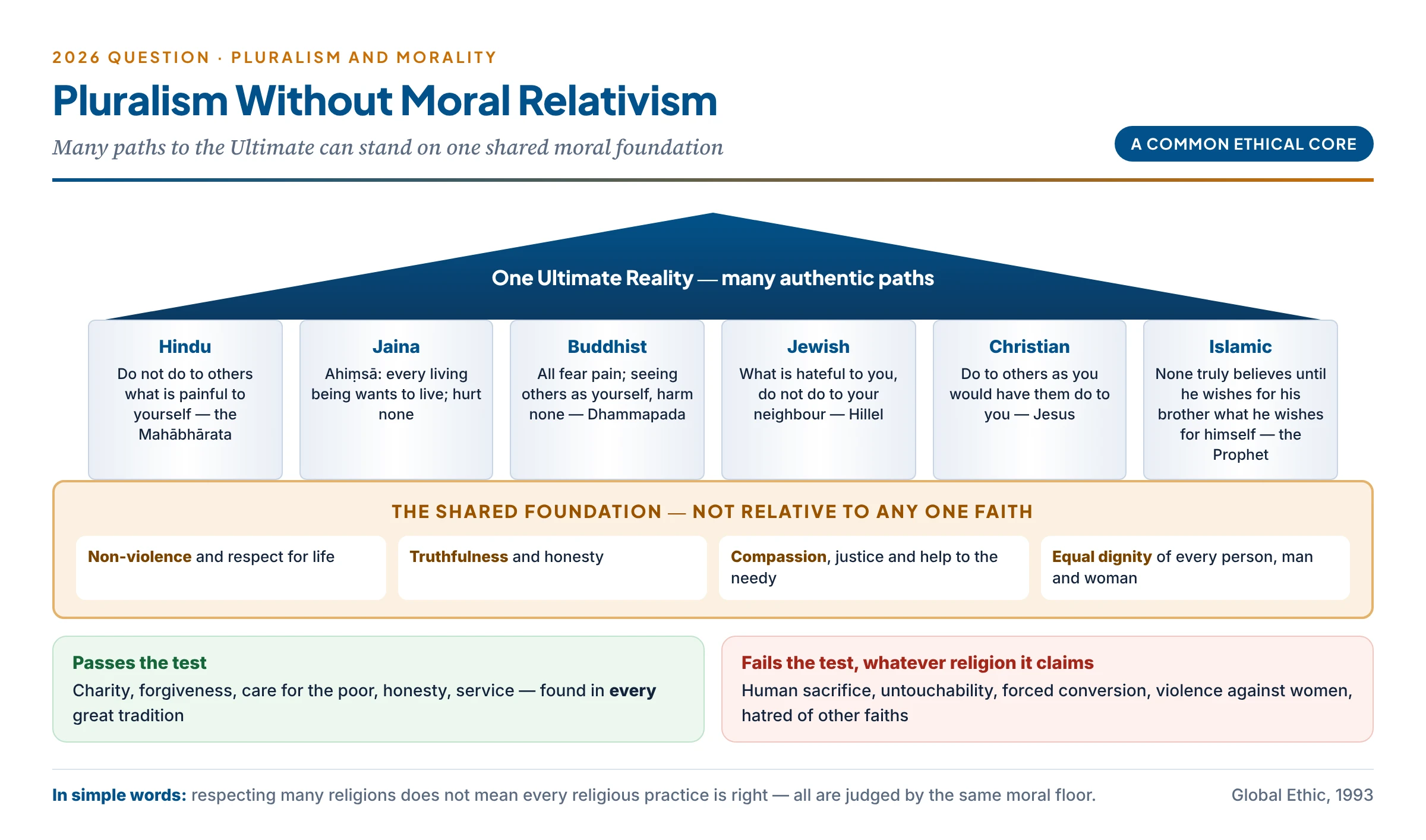
- Pluralism needs a moral yardstick. Hick’s own test of an authentic religion is ethical: does it turn people from self-centredness to love, compassion and justice? This test presupposes a non-relative standard of goodness. So Hick’s pluralism, far from implying moral relativism, depends on moral objectivity. It is precisely this test that lets the pluralist reject human sacrifice, hatred and fraud.
- Pluralism concerns paths to the Ultimate, not every practice. The pluralist says the great traditions are equally valid responses to the Real; he does not say every rule a religion has ever held is right. Religions themselves distinguish their eternal core from time-bound customs — Hindu thought distinguishes sanātana dharma from changing ācāra; the Supreme Court separates essential from non-essential religious practices.
- There is a shared ethical core. The golden rule — treat others as you would want to be treated — appears in almost every tradition (the Mahābhārata, the Analects of Confucius, Hillel in Judaism, Jesus in the Gospels, the Prophet’s sayings in Islam, the Buddhist Dhammapada, Jaina ahiṃsā). The Declaration Toward a Global Ethic (Parliament of the World’s Religions, Chicago, 1993), drafted mainly by Hans Küng, listed shared commitments: non-violence and respect for life, solidarity and a just economic order, tolerance and truthfulness, and equal rights and partnership of men and women.
- Morality has an independent basis. A liberal, pluralistic society needs a core public morality that binds everyone, whatever their religion. You can opt out of religion, but you cannot opt out of morality. Many believers therefore accept that morality has a ground — reason, human dignity, the Constitution — that does not depend on any one religion. Kant’s moral autonomy works the same way.
- Gandhi’s view. Gandhi, the great Indian pluralist, insisted: “Tolerance obviously does not disturb the distinction between right and wrong, or good and evil.” Equal respect for faiths is fully compatible with criticising untouchability, which he fought all his life.
Conclusion: pluralism entails moral relativism only in a crude form that says “every religious practice is equally valid”. Philosophical pluralism is about the object and salvific power of the great traditions, and it uses a moral criterion to judge them. Hence religious pluralism does not necessarily entail moral relativism; properly understood, it requires a shared, non-relative ethical core.
Common confusion
Does accepting many religions mean accepting every religious practice?
No. Religious pluralism is a view about the truth and saving power of the great traditions; moral relativism is a view about right and wrong. A pluralist can hold that Hinduism, Islam and Christianity are equally authentic paths and still condemn sati, untouchability, forced conversion or honour killing. Pluralism uses a moral test (does it make people less selfish and more loving?), so it cannot treat all practices as equally good.
3. Does Religious Pluralism Invite Inter-Religious Conflict and Destroy the Truth of Religion?
The worry
- Conflict. Some fear that pluralism weakens each community’s sense of identity, provokes a defensive backlash from the orthodox (“our faith is being diluted”), and creates competition for followers in an open religious market.
- Truth. If every religion is “one valid path among many”, then no religion is true in the full sense its followers believe. The unique claims — final revelation, only Saviour, eternal Veda — are quietly cancelled. Pluralism could be a disguised scepticism.
Analysis
- Plurality vs pluralism. Conflict usually comes from plurality (many groups living side by side) combined with exclusivism, politics and economic rivalry — not from pluralism as an attitude of respect. Pluralism as an attitude is a response to conflict, not its cause.
- Exclusivism, not pluralism, has the worse record. Persecutions, inquisitions and wars of religion were waged by groups convinced they alone possessed the truth. Exclusivist believers tend to proselytise; believers with an inclusive or pluralist attitude find dialogue easier.
- Truth is not destroyed but relocated. Pluralism keeps one Absolute Truth — the Real — and denies only that any human creed possesses it completely. That is a claim about human limits, not about the non-existence of truth. The religions themselves say the Ultimate surpasses all words (neti neti).
- The genuine risk. A shallow pluralism (“it doesn’t matter what you believe”) can indeed hollow out faith, and believers who feel their faith belittled may react with hostility. So pluralism must be respectful of difference, not dismissive of it.
Verdict: pluralism does not by its nature invite conflict; exclusivism plus political manipulation does. Nor does it destroy religious truth; it changes how that truth is held — with conviction and humility together.
4. Is the History of Religions the History of Conflicts?
Evidence that suggests “yes”
- The Crusades (11th–13th centuries) between Christians and Muslims; the Inquisition; the European Wars of Religion after the Reformation, culminating in the Thirty Years’ War (1618–48) between Catholics and Protestants.
- Persecution of heretics and minorities in many lands; the Partition of India in 1947 with its massive communal violence; modern terrorism in the name of religion; sectarian conflict (Shia–Sunni, Catholic–Protestant in Northern Ireland, Buddhist-majority violence against the Rohingya in Myanmar).
Evidence that suggests “no”
- Coexistence has been more common than war. Most people of different faiths have, most of the time, lived as neighbours, traded, shared festivals and borrowed customs.
- Religion as peacemaker. Aśoka‘s Twelfth Rock Edict urged honour for all sects and declared that “concord alone is commendable“; Akbar‘s Ibādat Khāna (1575) brought Hindus, Muslims, Christians, Zoroastrians, Jains and even atheists into debate; the Bhakti and Sufi saints (Kabīr, Nānak) preached the unity of the divine; Gandhi, Martin Luther King Jr., Desmond Tutu and the Dalai Lama drew their non-violence from religion.
- Conflicts are often political. Many “religious” wars were struggles over land, power, identity and resources, in which religion was a banner rather than the cause. The Document on Human Fraternity signed at Abu Dhabi on 4 February 2019 by Pope Francis and the Grand Imam of Al-Azhar, Ahmad al-Tayyeb, said that violence in the name of God results from “a deviation from religious teachings” and “a political manipulation of religions“.
- Tolerance was born from religious conflict. John Locke‘s A Letter Concerning Toleration (1689) and Pierre Bayle‘s Philosophical Commentary (1686) were written precisely to end the religious wars. The history of conflict is also a history of learning to live together.
Conclusion: the history of religions includes conflicts, but it is not merely a history of conflicts. It is equally a history of compassion, art, law, charity and reconciliation. Conflicts arise mainly when absolutist interpretations are joined to political power.
5. Does the Notion of Absolute Truth Itself Cause Conflict?
- A distinction. Believing that there is an Absolute Truth is different from believing that my group alone possesses it and may impose it. The first is a metaphysical belief; the second is dogmatism.
- The Jaina, Advaita and Gandhian traditions all hold that the Absolute exists yet is grasped by humans only partially — and draw from this humility and tolerance, not war.
6. William James: Are Religious Disputes Like Conflicts in Aesthetic Appreciation?
James’s view
- In The Varieties of Religious Experience (1902), James asked: “Is the existence of so many religious types and sects and creeds regrettable?” He answered “No” emphatically.
- Why: human beings are in different positions with different powers and temperaments; “No two of us have identical difficulties, nor should we be expected to work out identical solutions.”
- “If an Emerson were forced to be a Wesley, or a Moody forced to be a Whitman, the total human consciousness of the divine would suffer.” The divine “can mean no single quality, it must mean a group of qualities”; “Each attitude being a syllable in human nature’s total message, it takes the whole of us to spell the meaning out completely.“
- So a “god of battles” may be the god for one kind of person, and a god of peace and home for another. The sick soul needs a religion of deliverance; the healthy-minded need not dwell on it. “For each man to stay in his own experience … and for others to tolerate him there, is surely best.”
- James also found a common nucleus beneath the warring creeds: (1) an uneasiness — a sense that “there is something wrong about us as we naturally stand”; and (2) its solution — a sense that we are saved from the wrongness by making proper connection with the higher powers.
The aesthetic analogy
- On this view, religious differences are like differences in taste in art or music: one person is moved by Bach, another by Tyāgarāja. We do not say one listener is wrong; each responds to a real beauty in his own way. Disputes are about temperament and fit, not about who has the facts.
Evaluation
- Strengths: it explains why diversity is natural and fruitful; it encourages tolerance; it rightly sees that religion is lived through experience and temperament, not only through doctrines.
- Weaknesses:
- Religions make truth claims; tastes do not. “There is a God who raised Jesus” or “there is no permanent self” are claims about what exists. Two people who like different music do not contradict each other; a Buddhist and a Christian may.
- It risks subjectivism. If religion is like taste, it loses its claim to knowledge — which most believers would reject.
- Some disputes are moral. Disagreements over caste, human sacrifice or the treatment of women cannot be treated as matters of taste.
- Balanced verdict: James is right about the psychological side of religion and the value of variety; he is wrong if he means that all religious disagreement is like aesthetic preference. James himself kept the question of truth open — he called his own view a “piecemeal supernaturalism” and held that religious hypotheses may be tested by their fruits.
In simple words
Two people at a concert — one loves the sitar, the other the violin. Neither is wrong; they simply have different ears. James says religions are somewhat like this. But if one says, “The concert is in Hall A“, and the other says, “No, it’s in Hall B“, one of them is wrong. Many religious claims are of this second kind — and there the music analogy breaks down.
7. “There Are No Whole Truths; All Truths Are Half-Truths”
- The source. Alfred North Whitehead, in Dialogues of Alfred North Whitehead (1954, recorded by Lucien Price): “There are no whole truths; all truths are half-truths. It is trying to treat them as whole truths that plays the devil.“
- Meaning. Every human formulation captures reality from a perspective and leaves something out. The mischief — “the devil” — begins when a partial truth is absolutised and used to deny or crush others. This is a warning against dogmatism, not a denial of truth.
- Indian parallels. It is almost a summary of Jaina thought: a naya (standpoint) is valid as a partial view; when it claims to be the whole truth, it becomes durnaya (a false view). Gandhi said the same: “Everybody is right from his own standpoint, but it is not impossible that everybody is wrong.“
- Critique. Taken literally, the sentence refutes itself: is “all truths are half-truths” itself only a half-truth? If so, some truths may be whole. The best reading is practical and ethical — a rule of humility about human claims — rather than a precise theory of truth.
- Application to religion. Each religion’s doctrines may be “half-truths” about the Infinite; the devil of fanaticism enters when one community treats its half-truth as the whole and makes it a weapon.
8. How Can Religious Conflicts About Truth Be Resolved?
(a) Rational criteria for evaluating religious systems Philosophers have proposed tests that any religious worldview can be put to, without assuming one religion’s scripture:
- Logical consistency — the defining beliefs of the system must be consistent with one another and not self-defeating.
- Coherence of the overall system — the beliefs must hang together to give a unified understanding of the world and one’s place in it.
- Consistency with knowledge in other fields — the system should not contradict well-established knowledge in science, history, psychology and archaeology.
- Reasonable answers to fundamental human questions — it should account for and explain the big questions: Who am I? Why is there suffering? How should I live? What happens at death?
- Existential plausibility — it must be livable on its own beliefs, without borrowing contrary beliefs from another system.
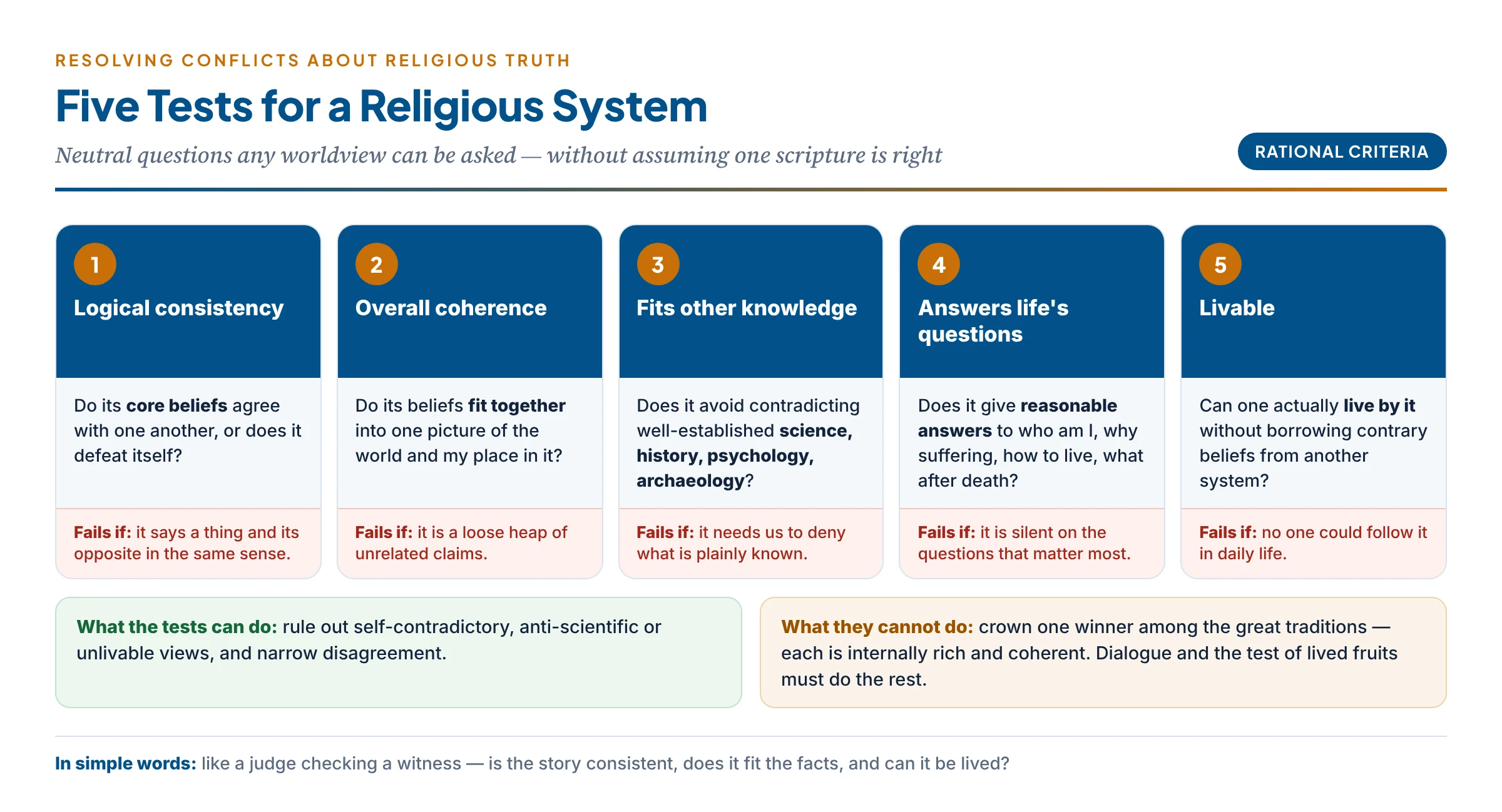
- Limits. These tests can eliminate some views (those that are self-contradictory or clearly against science) but are unlikely to pick one winner among the great traditions, all of which are internally sophisticated.
(b) Dialogue
- Inter-faith dialogue is conversation between members of different religions aimed at reducing conflict and reaching mutually desirable goals.
- It is hard if partners adopt particularism (caring only for their own group’s concerns) and easier under universalism (caring also for the concerns of others).
- Hans Küng: “No peace among the nations without peace among the religions. No peace among the religions without dialogue between the religions.“
- Dialogue does not require giving up one’s faith. Its aims are to understand, to correct caricatures, to learn and to find common ground for action.
(c) The test of life and of the future
- Hick’s soteriological test: judge traditions by their fruits — their power to transform people.
- Hick also proposed eschatological verification: some disputed claims (survival of death, the nature of the Real) may be settled only by experience after death, as a traveller on a road learns at the end whether it led to the Celestial City.
(d) Practical co-operation
- Even where doctrines remain in conflict, religions can work together on shared moral concerns — poverty, disaster relief, environment, peace. Shared action often softens doctrinal conflict.
(e) Separating doctrine from politics
- Many “religious” conflicts are resolved not by settling theology but by a just political order — equal citizenship, impartial law and protection of minorities.
9. Tolerance: Arguments and Their Limits
Locke’s argument (1689)
- The magistrate’s power consists only in outward force; but true and saving religion consists in the inward persuasion of the mind. “Confiscation of estate, imprisonment, torments” cannot make anyone change his inward judgment, because belief is not under the will.
- So persecution aimed at bringing citizens into the true religion is instrumentally irrational — it cannot succeed. The state can force lip service, never genuine faith.
In simple words
A policeman can make you stand up when the anthem plays; he cannot make you feel patriotic. Locke says religion is like the feeling, not the standing: force can produce outward conformity, never inward conviction — so forcing faith is pointless.
Two objections to Locke
- Belief can be influenced indirectly. Force can control what books people read, what preachers they hear and what schools they attend. Over a generation, censorship and coercion do change beliefs. So persecution is not always futile.
- Locke tolerates for the wrong reason. His argument says persecution is ineffective, not that it is wrong. What is missing is concern for the victims: persecution should be condemned because it violates persons, not merely because it does not work.
Bayle’s argument
- Bayle attacked the literal reading of the Gospel saying “compel them to come in“. Any interpretation of scripture that commands cruelty contradicts the natural light of reason and morality, so it must be a false interpretation. This grounds tolerance in morality, not just in futility.
Rawls’s political liberalism
- John Rawls argued that in a free society reasonable people will always disagree about religion and the meaning of life (“the fact of reasonable pluralism”). The state should therefore rest on principles that all can accept from within their own doctrines — an overlapping consensus — and should not enforce any one religion.
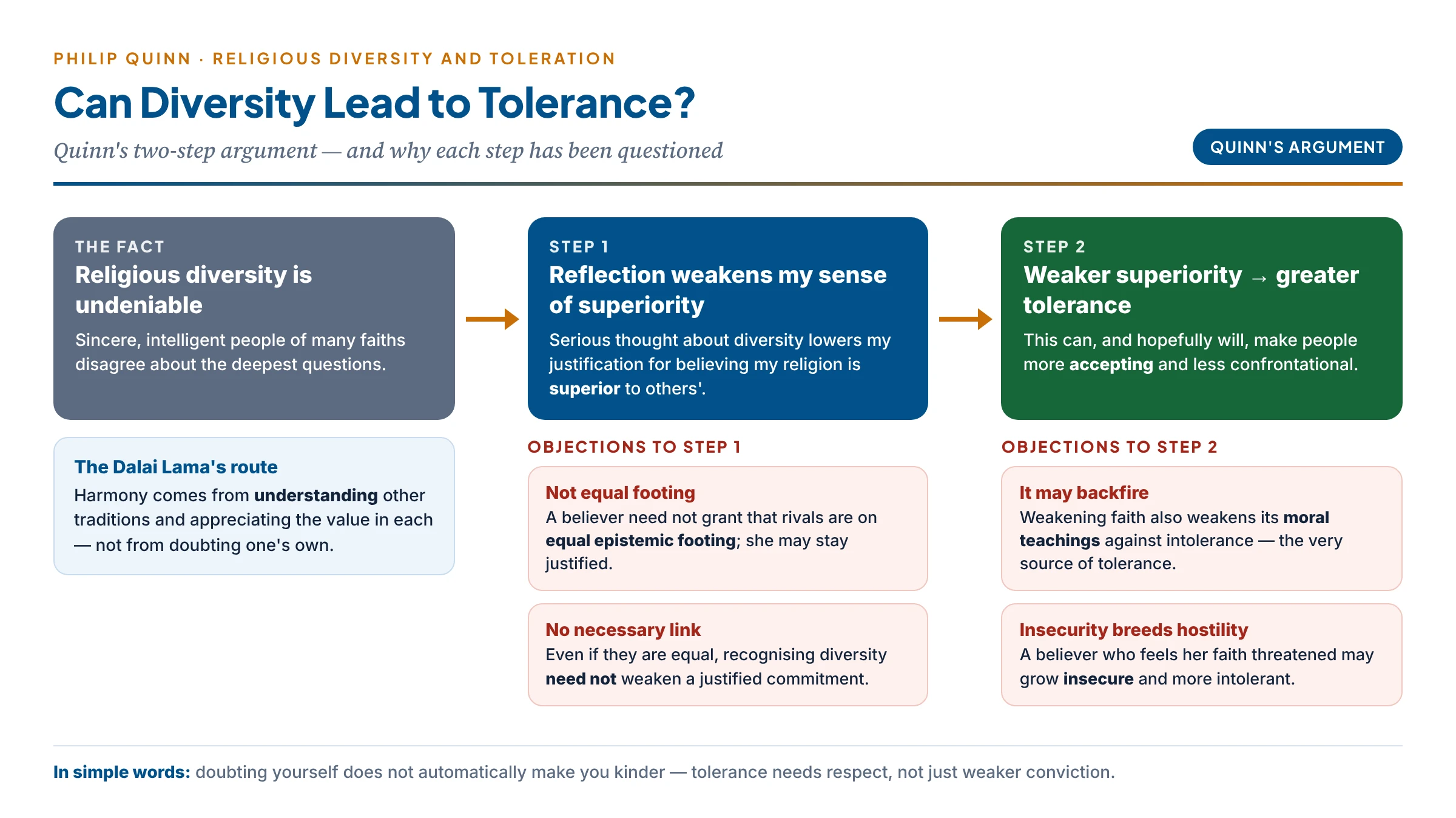
Philip Quinn: from diversity to tolerance Quinn argued:
- Serious reflection on the undeniable fact of religious diversity will weaken a person’s justification for believing that her religious view is superior to others’.
- This weakened justification can, and hopefully will, lead to greater tolerance — a more accepting, less confrontational attitude.
Both steps have been challenged:
- Against step 1:
- A believer need not grant that her rivals are on equal epistemic footing; she may remain justified in thinking her view superior without further reflection.
- Even if rivals are on equal footing, and reflection sometimes lowers confidence, there is no necessary connection between acknowledging diversity and weakening one’s justified commitment.
- Against step 2:
- Weakening a person’s confidence in her religion’s teachings — including its moral teachings that forbid intolerance — may make intolerant behaviour more likely, since it deflates the very convictions needed to inspire tolerance.
- A believer who feels her faith’s superiority being undermined may feel threatened and insecure, and respond with more intolerance.
The Dalai Lama
- As encounters with religious “others” become commonplace, conflicts over doctrine, culture and practice will increase. The Dalai Lama (in Toward a True Kinship of Faiths, 2010) proposes inter-religious harmony based on understanding other traditions and appreciating the value inherent in each — not on pretending that they are identical.
What does “tolerance” mean?
- If “tolerance” means affirming that all traditions are equally true, and “intolerance” means denying it, then any evaluation of religions would be intolerant — an absurd result.
- If “tolerance” means recognising and respecting the beliefs and practices of others, then evaluation and tolerance are compatible. We can disagree and respect.
- The ideal is not an “everyone’s right” attitude (which ends serious thought) but an “everyone’s significant” attitude — learning what others believe, why and how they practise it, and striving to understand.
Common confusion
Does tolerance mean believing that all religions are equally true?
No. Tolerance is an attitude towards people, not a verdict on doctrines. A Christian may believe the Buddhist is mistaken about God and still defend the Buddhist’s right to worship, refuse to insult him, and learn from him. Gandhi went further, preferring equal respect (samabhāva) to mere tolerance, because “tolerance” can hide a sense of superiority. But neither tolerance nor equal respect requires the relativist claim that all creeds are equally true.
10. Is Religious Freedom Possible in a Multi-Religious Society?
Conditions for genuine religious pluralism
- Freedom of religion — all religions have the right to practise, preach and propagate. Healthy dialogue is possible only where there is freedom.
- Absence of fundamentalism — literal, rigid interpretations of religion tend to highlight differences and neglect commonalities. Societies need an attitude that stresses the fundamental oneness of religions rather than fixating on outward differences.
The Indian constitutional framework
- Article 25 — freedom of conscience and the right freely to profess, practise and propagate religion, subject to public order, morality and health; the state may regulate secular activities connected with religion and provide for social reform (including opening Hindu temples to all classes).
- Article 26 — freedom of religious denominations to manage their own affairs.
- Article 27 — no compulsory taxes for promoting any particular religion.
- Article 28 — no religious instruction in wholly state-funded educational institutions.
- Articles 29–30 — cultural and educational rights of minorities.
- Rev. Stainislaus v. State of Madhya Pradesh (1977) — the right to propagate does not include a right to convert another person, since that would interfere with the other’s equal freedom of conscience; state laws against conversion by force, fraud or inducement were upheld.
- S. R. Bommai v. Union of India (1994) — secularism is part of the basic structure of the Constitution.
- The conversion debate. Several states have laws regulating conversion. Supporters say they prevent coercion and inducement; critics say they burden free choice and are used against minorities and inter-faith couples. The debate shows the tension between group protection and individual freedom.
What surveys show
- A large Pew Research Center survey of India (nearly 30,000 adults, 2019–20, published 2021) found that 84% of Indians say respecting all religions is very important to being “truly Indian“, and most people of every faith say they are very free to practise their religion.
- Yet the same survey found strong preference for separation: most people’s close friends are from their own religion, and large majorities want to stop inter-religious marriage. Indians, the report concluded, “live together separately” — tolerance without much mixing, more like a patchwork than a melting pot.
Answer: religious freedom is possible in a multi-religious society — India, with all its problems, shows it — but it is fragile. It requires a neutral or equally respectful state, constitutional rights enforced by courts, freedom from coercion in both directions (by the majority and by proselytising groups), and a culture of mutual respect. Freedom must include the freedom to dissent within one’s own community.
11. Why Religious Tolerance Matters in a Multicultural, Pluralistic Society
- Peace and security — without tolerance, religious difference turns into violence, as communal riots show.
- Human dignity — conscience is the core of a person; forcing or humiliating it violates dignity.
- Democracy — a democracy of equal citizens cannot rank citizens by religion; tolerance is the condition of equal citizenship.
- Truth-seeking — no one has the whole truth (Whitehead, the Jainas, Gandhi); we learn from others. Gandhi: “Cultivation of tolerance for other faiths will impart to us a truer understanding of our own.“
- Development and social cohesion — trust across communities supports trade, cooperation and stable institutions.
- International commitments — UNESCO’s Declaration of Principles on Tolerance (16 November 1995; 16 November is the International Day for Tolerance) defines tolerance as “respect, acceptance and appreciation of the rich diversity of our world’s cultures”; the UN marks 4 February as the International Day of Human Fraternity, after the Abu Dhabi Document.
- Limits — tolerance does not extend to practices that harm others (violence, untouchability, coercion). A tolerant society must be intolerant of intolerance that threatens the freedom of others.
Critical Evaluation
Objections
- To relativism: it is self-undermining and does not match how believers understand their own claims.
- To moral objectivism within pluralism: whose “shared ethical core”? Lists like the Global Ethic may smuggle in liberal Western values and override communities’ own understandings.
- To James: religious claims are factual claims, not matters of taste.
- To Locke: belief can be manipulated; futility is the wrong reason for tolerance.
- To Quinn: reflection on diversity need not weaken conviction, and weakened conviction need not produce tolerance.
- To the “criteria” approach: rational tests cannot settle disputes between sophisticated religions; and religious faith may not be the kind of thing that should be judged by such tests (fideism).
- To tolerance itself: “tolerating” someone can imply a condescending superiority; mere tolerance may keep communities segregated, as the Pew survey suggests.
Replies
- Relativism’s insight survives: meaning and practice are embedded in forms of life; outsiders should understand before they judge.
- The shared ethical core is not merely Western: the golden rule and non-violence are found in Indian, Chinese, Semitic and African traditions; the Global Ethic was drafted with representatives of many faiths.
- James’s aesthetic analogy works for the experiential and temperamental side of religion, even if not for its truth claims.
- Moral grounds for tolerance (Bayle, Rawls, Gandhi’s ahiṃsā) remain even if Locke’s futility argument fails.
- Tolerance can grow into respect: Gandhi’s samabhāva and the Dalai Lama’s “kinship of faiths” move beyond bare tolerance to appreciation.
Critics and Defenders
Criticism — The sceptic’s case
- Relativism makes religious truth mean “true for us” and empties faith of objective claims.
- Pluralism seems to make every religious morality equally valid, including cruel practices.
- Absolute truths breed fanaticism; history shows wars, crusades and riots.
- James’s aesthetic model turns faith into taste.
- Quinn’s route to tolerance may backfire by making believers insecure.
- Tolerance often means “living together separately” rather than real respect.
Defence — The balanced reply
- Objective truth with humility: one Absolute Truth can be held without claiming to possess it completely (Jaina naya, Whitehead, Gandhi).
- Pluralism is not moral relativism: Hick’s own test is ethical; a shared moral core (golden rule, Global Ethic) judges all practices.
- Conflict comes from exclusivism plus politics, not from pluralism; religions also built peace (Aśoka, Akbar, Gandhi, the Abu Dhabi Document).
- Rational criteria and dialogue can narrow disagreements even if they do not end them.
- Moral arguments for tolerance (Bayle, Rawls, ahiṃsā) survive the failure of Locke’s futility argument.
- Constitutional freedom, as in Articles 25–28, makes religious freedom workable in practice.
Cross-Tradition Comparison
| Issue | Western thinkers | Indian thinkers |
|---|---|---|
| Partial truth | Whitehead: “all truths are half-truths” | Jaina naya and syādvāda; Gandhi: “everybody is right from his own standpoint” |
| Why diversity is natural | James: different temperaments need different religions | Gītā: people approach the divine by different paths; iṣṭa-devatā — each chooses his own form of God |
| Ground of tolerance | Locke: belief cannot be forced; Bayle: cruelty contradicts reason; Rawls: reasonable pluralism | Aśoka: honouring others’ faiths honours one’s own; Gandhi: ahiṃsā and the imperfection of all human religion |
| Beyond tolerance | Dalai Lama: kinship of faiths; Küng: dialogue for peace | Gandhi’s sarva-dharma-samabhāva (equal respect); Vivekananda: “acceptance, not mere toleration” |
| Limits of tolerance | No toleration of practices that harm others | “Tolerance does not disturb the distinction between right and wrong” (Gandhi) |
| State’s role | Separation of church and state (Locke, US First Amendment) | Principled distance and equal respect; reform of practices like untouchability (Articles 17, 25) |
Indian Connect — Indian takeaways
- Indian thought rarely treated religious diversity as a scandal; texts from the Ṛgveda (“Truth is one, the wise call it by many names”) to Aśoka’s edicts see it as natural and even valuable.
- The Jaina naya theory gives a logical basis for what Whitehead said as an aphorism: partial truths become evil only when they claim to be the whole.
- Gandhi bridges the two halves of this article: he held one Absolute Truth (“Truth is God”) and equal respect for all faiths, while firmly rejecting practices like untouchability — showing that pluralism need not be moral relativism.
- India’s constitutional model combines freedom of religion with state power to reform harmful practices — tolerance with a moral floor.
Synthesis (Siddhānta)
- On truth: religious relativism is attractive because it respects difference, but it fails to describe what believers actually believe and undermines itself. The more defensible position is objectivism with humility: there is one truth, but each tradition sees it partially.
- On morality: religious pluralism does not necessarily entail moral relativism. Its best form depends on a shared, non-relative ethical core — compassion, non-violence, truthfulness, human dignity — by which every religious practice, including one’s own, can be judged.
- On conflict: neither belief in absolute truth nor pluralism as such causes conflict. Conflict arises when a partial truth is absolutised and joined to power. History shows religion both as a cause of war and as a source of peace.
- On tolerance and freedom: Locke’s futility argument is weak, but moral arguments for tolerance are strong. The goal is to move from mere tolerance to respect and understanding, within a constitutional order that protects freedom of conscience and forbids coercion and harm.
- Contemporary relevance: in India and the world, where religious identity is often mobilised for politics, the philosophical lesson is clear: hold your faith with conviction, others’ faith with respect, and every practice to the test of human dignity.
“There are no whole truths; all truths are half-truths. It is trying to treat them as whole truths that plays the devil.” — Alfred North Whitehead
Previous Year Questions
- 2026Does the idea of Religious Pluralism necessarily entail moral relativism? Critically discuss.
- 2023Does religious pluralism invite inter-religious conflicts and destroy the truth of religion? Discuss.
- 2021Is religious freedom possible in a multi-religious society? Explain.
- 2020Is it acceptable that the History of Religions is the History of Conflicts? Discuss.
- 2020What is the importance of religious tolerance in a multicultural pluralistic society? Justify your answer.
- 2011How can religious conflicts about truth be resolved? Discuss.
- 2011Is William James right in holding that religious disputes are like conflicts in aesthetic appreciation? Discuss.
- 2009“There are no whole truths, all truths are half-truths. It is trying to treat them as whole truth that plays the devil.” Discuss.