

Religious Pluralism: Religious Pluralism and the Problem of Absolute Truth.
Official Syllabus: Paper II, Section B, Unit 9
When a believer learns that billions of sincere, good people follow other faiths, two questions press at once: Are their beliefs true? and Can they be saved? The two oldest answers are exclusivism — only one religion is true and saving, all others are mistaken — and inclusivism — one religion has the fullness of truth, but God’s grace also works, hidden and incomplete, in the others. This article explains both positions, the thinkers behind them (Karl Barth, Hendrik Kraemer, Alvin Plantinga, Karl Rahner and the Second Vatican Council), the classic objections (the myth of neutrality, the justice objection, the accident of birth) and the replies, and then takes up the questions UPSC repeatedly asks: does belief in one Absolute Truth inevitably lead to exclusivism, intolerance and conflict — and what exactly divides the exclusivist from the pluralist?
In simple words
Think of a city with one well-known hospital and many small clinics. The exclusivist says: “Only the hospital can cure; the clinics give false medicine.” The inclusivist says: “The hospital has the full cure, but the clinics are secretly using the hospital’s medicine — patients there can recover too, even if they do not know where the medicine came from.” The pluralist (next article) says: “The hospital and the clinics are all good hospitals, each following a different but genuine system of medicine.”
Context & Problem
Race’s Threefold Typology
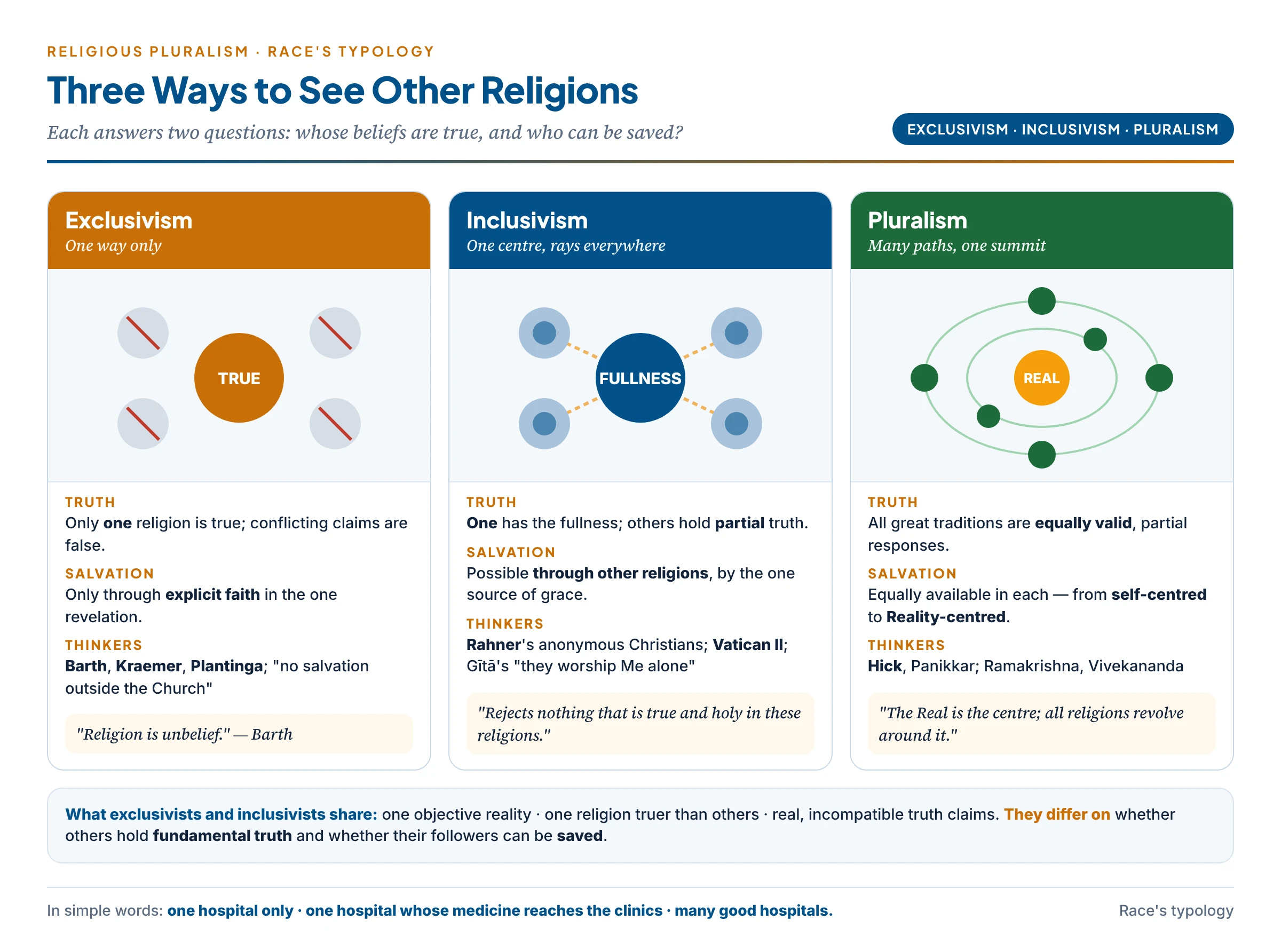
- In 1983 the theologian Alan Race sorted Christian responses to other religions into three types, later developed by Gavin D’Costa and widely used by John Hick and others:
- Exclusivism — only one tradition is true and saving;
- Inclusivism — one tradition has the fullness of truth, but others contain partial truth and saving grace;
- Pluralism — the major traditions are equally valid responses to the same ultimate reality.
- Though framed in Christian terms, the typology applies to every religion: there are exclusivist and inclusivist strands in Islam, Hinduism, Buddhism and Jainism too.
- Each position answers two separate questions — the question of truth (whose beliefs are true?) and the question of salvation (who can be saved or liberated?). A position can be exclusivist about truth but inclusivist about salvation, which is exactly what Rahner’s view is.
What Exclusivists and Inclusivists Share
Exclusivists and inclusivists agree on three things, and these three points also separate them from pluralists and relativists:
- There is one objective reality to which religious truth claims point or correspond.
- One religion’s conceptions are truer than the others — closer to the truth about God (or the Ultimate) and about salvation or liberation.
- The different religions contain genuinely incompatible truth claims; the differences are real, not merely verbal.
Where they part company
- They disagree on whether religions outside one’s own also contain fundamental truths, and on whether their adherents can obtain salvation or liberation.
- Exclusivists: fundamental truth is found in only one religion, and salvation is exclusive to it. Religious differences are real and intractable.
- Inclusivists: only one religion is privileged, but other religions also contain important truths, and true seekers from every tradition can find salvation.
Core Doctrine
1. Religious Exclusivism
The core tenets
- Sole mediatorship: divine revelation has occurred definitively at one historical point — for orthodox Christianity, in Jesus Christ; for Islam, in the Qur’an revealed to the Prophet.
- Epistemic monopoly: genuine theological truth is found only in that revelation; other traditions are in error or are, at best, human projections.
- Soteriological monopoly: salvation is available only through conscious, explicit faith in that unique revelation.
- “Outside the Church there is no salvation” (Extra Ecclesiam nulla salus): the formula goes back to Cyprian of Carthage in the third century. The Council of Florence (1442) declared that pagans, Jews, heretics and schismatics cannot share eternal life unless they join the Church before death.
- Scriptural roots often cited: “I am the way, and the truth, and the life; no one comes to the Father except through me” (Gospel of John); “there is salvation in no one else” (Acts of the Apostles). In Islam, the Qur’anic verse that a religion other than Islam “will never be accepted” from one who seeks it is read in an exclusivist way — though other verses (on the “People of the Book”) are read inclusively.
- Historically the most widely held view: most adherents of the great religions have, through most of history, been exclusivists about their own faith.
Karl Barth (1886–1968): revelation against religion
- Barth’s dialectical theology (also called crisis theology) stresses the infinite gap between God and humanity. God can be known only where God reveals himself — and he has done so in Jesus Christ alone.
- In his Church Dogmatics he describes “the revelation of God as the abolition of religion“. “Religion is unbelief“: it is the human attempt to justify and sanctify oneself before an image of God of one’s own choosing — a work of human pride.
- Revelation comes vertically from above, as God’s sovereign break-in and judgment (Krise) on all human religiousness. By this standard the world’s religions are forms of idolatry.
- Important nuance: Barth applies this judgment to Christianity as a religion too. Christianity is the “true religion” only in the way a sinner is “justified” — by grace, not by its own merits.
Hendrik Kraemer (1888–1965): religions as indivisible wholes
- In The Christian Message in a Non-Christian World (1938), written for the world missionary conference at Tambaram (Madras), Kraemer argued that each religion is an indivisible totality (a gestalt, a whole whose parts get their meaning from the whole).
- So one cannot detach the ethics or mysticism of a religion from its dogmatic core and praise them separately. The “love” of Buddhism and the “love” of the Gospel are not the same thing, because they belong to different wholes.
- Between the Gospel and the religions there is radical discontinuity; non-Christian religions are separate spiritual universes with no saving efficacy.
Exclusivism in other traditions
- Islam: the Qur’an as God’s final and complete revelation, the Prophet as the “seal of the prophets“.
- Hindu sectarian thought: Madhva divided souls into those fit for liberation (mukti-yogya), those eternally bound to rebirth (nitya-saṃsārin) and those destined for darkness (tamo-yogya) — a rare exclusivist streak in Indian thought. Mīmāṃsā held that only the Veda is a source of knowledge of dharma.
- Buddhism: early texts insist that only the path taught by the Buddha leads to nirvāṇa; other teachers are “wrong views” (micchā-diṭṭhi).
Alvin Plantinga’s philosophical defence of exclusivism (1995)
- Plantinga is the leading contemporary philosopher who defends exclusivism as rationally and morally permissible. The exclusivist believes certain things (for example, that God has created the world and that salvation comes through Christ) and believes that propositions incompatible with them are false.
- Charge 1 — moral: exclusivism is arrogant, egotistical and imperialistic.
- Reply: the pluralist also holds beliefs that others (the exclusivists) reject; if holding a belief that others reject is arrogant, the pluralist is equally arrogant. The charge is self-referentially inconsistent.
- Reply: even withholding belief (agnosticism) is a position that others reject. There is no neutral escape; every option is open to the same complaint.
- Charge 2 — epistemic: exclusivism is irrational or unjustified, because others who are equally intelligent, sincere and well-informed (epistemic parity) believe otherwise.
- Reply: we often rightly hold beliefs that equally intelligent people deny — for instance, the moral conviction that racial discrimination is wrong. Disagreement alone does not oblige us to give up a belief that seems clearly true to us.
- Reply: the exclusivist may have inner evidence or insight that others lack or have not attended to.
- Reply: awareness of diversity may reduce confidence somewhat, but it need not defeat a belief that is warranted (for Plantinga, religious belief can be properly basic — rational without being inferred from other beliefs).
In simple words
Plantinga’s point about “arrogance” works like this. Suppose Ravi says, “It is arrogant of you to think your religion is right when others disagree.” But Ravi himself thinks his view — that all religions are equal — is right, though millions disagree with it. If holding a disputed view is arrogant, Ravi is arrogant too. The charge cannot be used by anyone, because everyone holds some disputed view.
The exclusivist’s positive argument
- Logic: there can be only one Absolute. Even if many religions are paths to it, one path must be superior to the others.
- Not all belief systems are equal: the great world religions can be clearly distinguished from some primitive cults; practices such as the human sacrifice of the ancient Maya cannot count as a legitimate path to the Absolute. So some ranking of religions is unavoidable — and once ranking is allowed, the question is only where to draw the line.
- Seriousness about truth: exclusivism takes the believers’ own claims at face value — it respects the law of non-contradiction and refuses to dissolve doctrines into vague metaphors.
2. Objections to Exclusivism
- The myth of neutrality
- There are no religiously neutral or objective criteria by which to show that one religion is true and others false, or that one has more truth than another. So claiming that one religion is true, or the only way of salvation, is inappropriate and perhaps morally offensive.
- Fideist reply: it does not matter that there are no neutral criteria, because religious beliefs are not the kind of thing that should be subject to rational assessment; demanding such assessment may show a lack of faith (fideism, from fides, faith).
- Rejoinder: if faith needs no reasons, every rival faith can say the same, and there is no reason left to prefer one over another. And the objection cuts both ways: the pluralist has no neutral criteria for declaring all religions equal either.
- The justice objection
- Billions of people, now and in history, have been completely unaware of religions other than their own. For the exclusivist they are nevertheless held morally and epistemically responsible for not affirming truths they never heard.
- This bites hardest on monotheisms with a final judgment: how could a just God condemn people to eternal perdition simply for lack of knowledge? And there are good, sincere, devoted people in all the major religions.
- This is not a problem for inclusivists, who allow salvation to those who never met the one true religion in this life.
- The argument from geographical and historical arbitrariness
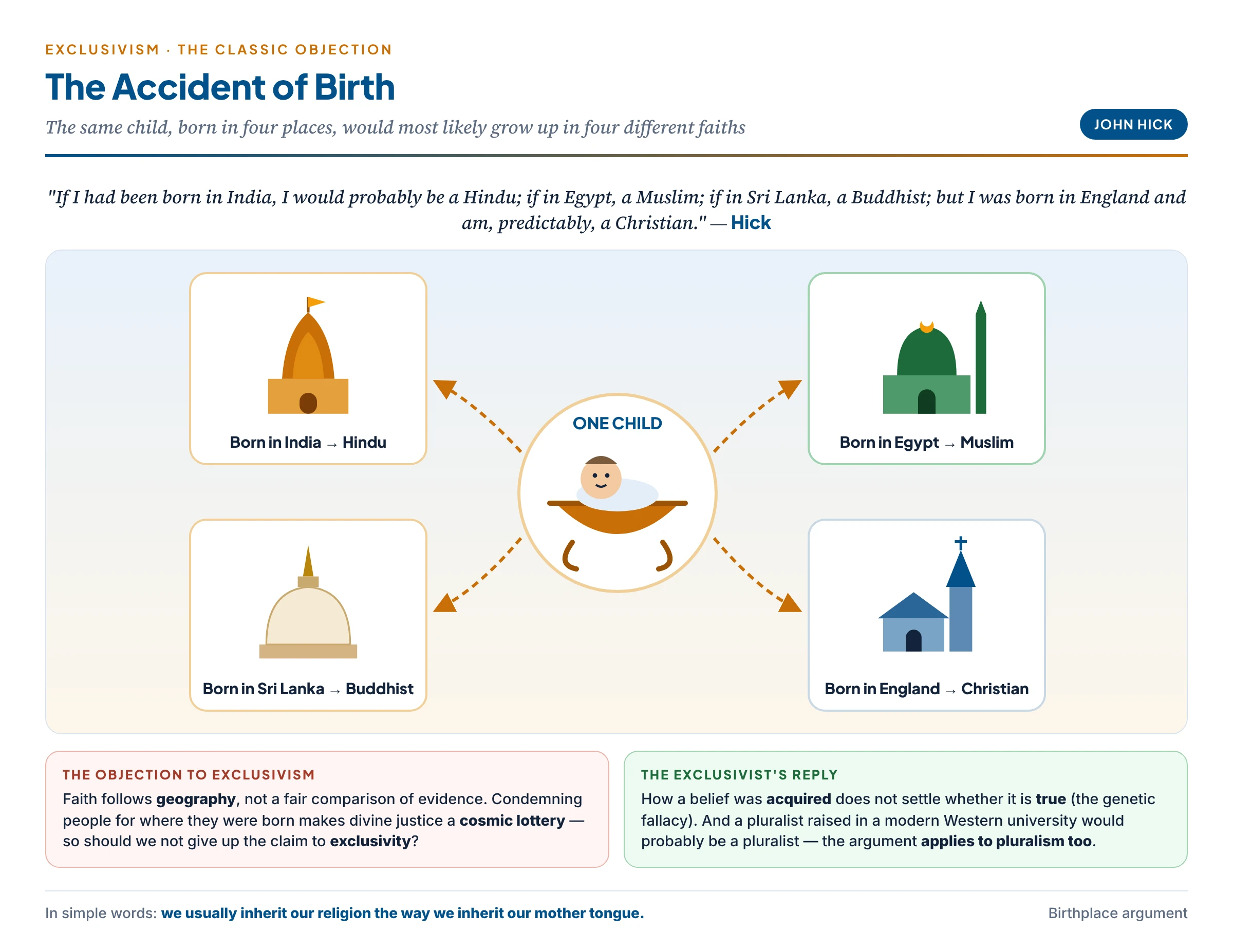
- A person’s faith is overwhelmingly fixed by the place, culture and family of birth — Hick’s “born in India, Egypt, Sri Lanka, England” argument.
- Condemning someone because they were born in a non-Christian (or non-Muslim) culture makes divine justice depend on a cosmic lottery.
- The pluralist presses: if we recognise the accidental character of our religious preference, should we not give up the claim to exclusivity?
- The argument from divine love (omnibenevolence)
- If God is infinitely loving, omnipotent and just, how could he create billions of human beings across millennia without ever giving them the historical possibility of hearing the “true” message? Most humans have lived before Christ or outside Christendom.
- Hick calls this the glaring paradox: infinite love has supposedly ordained that human beings can be saved only in a way that in fact excludes the large majority of them.
- Epistemological solipsism
- Exclusivism declares its own scripture uniquely authoritative without offering independent criteria that a rival exclusivist could not equally claim. Every exclusivist sits inside a closed circle of his own revelation.
- Historical and practical consequences
- Exclusivism has often accompanied intolerance, forced conversion, missionary imperialism, crusades and the European wars of religion.
In simple words
If your mother tongue is Tamil, it is because you were born to Tamil-speaking parents — not because you compared all the world’s languages and chose the best one. The birthplace argument says religion is usually acquired the same way. That does not prove any religion false, but it makes the claim “mine alone is right, and everyone else is lost” look like an accident dressed up as a conclusion.
Exclusivist replies to these objections
- The genetic fallacy: how a belief was acquired (by birth) does not settle whether it is true. Many true beliefs are learnt from parents.
- The objection is self-applying: a pluralist born in a modern Western university would probably have been a pluralist — so the same arbitrariness applies to pluralism itself.
- Inclusivist softening: many exclusivists about truth become inclusivists about salvation, which answers the justice objection.
3. Religious Inclusivism
Core tenet
- The definitive, normative fullness of divine truth lies in one tradition, but God’s saving grace is genuinely and mysteriously at work in and through the other traditions.
- Theistic inclusivists hold that God is present and working in all religions, though most clearly in one. They grant that other theistic religions are right that there is a personal God (unlike, say, Buddhists), while disagreeing on other matters such as the means of salvation.
- Non-theistic inclusivists hold that Ultimate Reality is found by truth-seekers in all religions, but is most clearly understood in one privileged tradition.
Karl Rahner (1904–1984): “anonymous Christians” Rahner, a German Jesuit philosopher-theologian, set out his view in a 1961 lecture, “Christianity and the Non-Christian Religions“, later published in his Theological Investigations. His argument runs in steps:
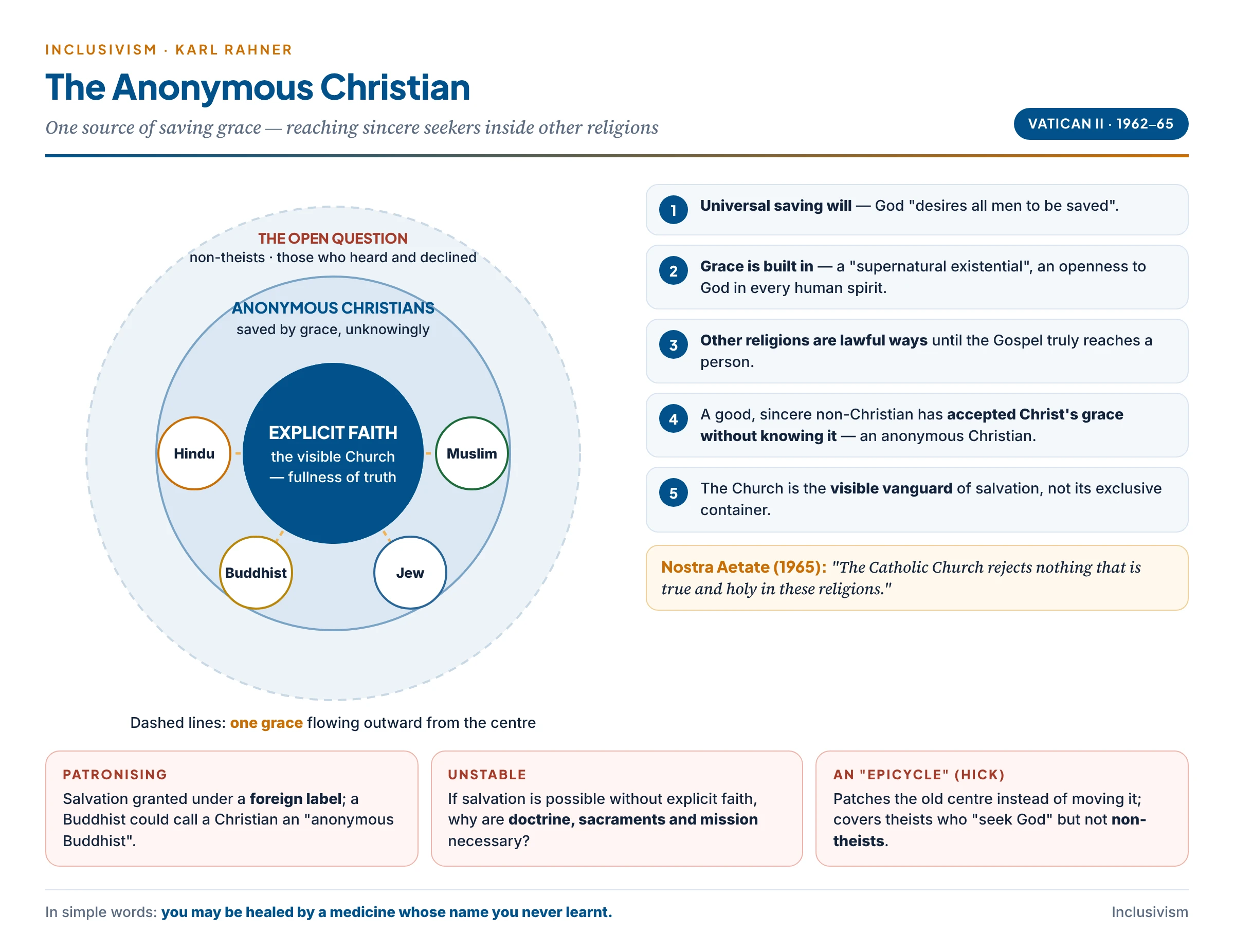
- God’s universal saving will: God “desires all men to be saved” (First Letter to Timothy). A loving God cannot have left most of humanity without any real chance of salvation.
- Grace is everywhere: grace is not a rare extra given to a few. It is built into the very structure of human consciousness as a supernatural existential — an orientation towards God present in every person’s openness to truth, goodness and love (the transcendental horizon of the human spirit).
- Other religions are lawful ways: until the Christian gospel genuinely reaches a person’s historical situation, his own religion can contain elements of grace and be a legitimate path by which God’s grace reaches him.
- The anonymous Christian: a Hindu, Buddhist or Muslim who lives with moral integrity, self-giving love and fidelity to conscience has, in the depth of his being, accepted the saving grace of God in Christ — without knowing it. Such a person is an “anonymous Christian“.
- The Church’s role: the Church is not the exclusive community of salvation but its historically visible vanguard — the explicit expression of what is hidden elsewhere.
In simple words
A child in a village may be kept alive by a vaccine that came from a distant laboratory, without ever hearing the laboratory’s name. Rahner thinks of grace like that: a sincere Hindu or Muslim may be healed by the grace of Christ without knowing its source. The critic replies: the villager would rightly be annoyed to be told that she is “really” a member of the laboratory staff.
The Second Vatican Council (1962–1965)
- Lumen Gentium (1964): “Those who through no fault of their own are still ignorant of the Gospel of Christ and of his Church yet sincerely seek God and, with the help of divine grace, strive to do his will as known to them through the voice of their conscience, those men can attain to eternal salvation.“
- Nostra Aetate (1965): “The Catholic Church rejects nothing that is true and holy in these religions“; their teachings “often reflect a ray of that Truth which enlightens all men.” It speaks with respect of Hinduism, Buddhism, Islam and Judaism.
- This was a historic shift from the Council of Florence’s “no salvation outside the Church” — yet it remains inclusivist: Christ is still the one source of all saving grace.
Inclusivism in other traditions
- The Bhagavad Gītā: “Even those devotees who, endowed with faith, worship other gods, worship Me alone, O son of Kuntī — though not according to the proper rule” (avidhi-pūrvakam). Another verse says that whatever form a devotee worships with faith, Kṛṣṇa makes that faith steady. Other worship is valid but indirect.
- The Vedāntic ladder: many modern Vedāntins treat other faiths as lower rungs of a single ladder — dualism, qualified non-dualism and non-dualism as stages, with Advaita at the top. Other religions are not false but less complete. Critics call this Hindu inclusivism: generous, but on Vedānta’s own terms.
- Mahāyāna Buddhism: the doctrine of skilful means (upāya) — in the Lotus Sūtra‘s parable of the burning house, a father lures his children out with promises of different carts and then gives them all the one great vehicle. Other paths are provisional teachings.
- Islam: Jews and Christians are “People of the Book“, recipients of genuine earlier revelation; one Qur’anic verse promises reward to Jews, Christians and Sabians who believe in God and the Last Day and do good — though the final revelation remains the Qur’an.
- Jainism: other philosophies are partial standpoints (nayas) — true in some respect, false only when they claim to be the whole truth.
Hick’s critique: inclusivism as an “epicycle”
- Hick compares inclusivism to the epicycles that astronomers added to the earth-centred (Ptolemaic) model of the universe to save it from awkward observations: a real movement in response to a real problem, but one that complicates the old system instead of going to the heart of the problem.
- Vatican II’s formula covers those who “sincerely seek God” — but what of non-theistic Buddhists and Hindus? And what of those Muslims, Jews, Buddhists, Hindus, Jains and Parsis who have heard the Christian gospel and have chosen to stay in the faith of their fathers?
Other criticisms of inclusivism
- Patronising crypto-imperialism: telling a devout Buddhist or Muslim that he is “really” an unconscious Christian is condescending; it refuses to take his worldview on its own terms and grants him salvation only under a foreign label. A Buddhist could equally call a saintly Christian an “anonymous Buddhist” — and the Christian would not feel honoured.
- Doctrinal instability: if salvation is possible without explicit faith, sacraments and dogma, why are they necessary? Why mission at all? The uniqueness of the one revelation is quietly undermined.
- It still ranks: inclusivism keeps a hierarchy of religions with one’s own at the top; the others are affirmed only as partial versions of it.
- It leaves the truth question unsolved: inclusivism softens the question of salvation but leaves conflicting truth claims where they were.
Defence of inclusivism
- It holds together commitment (one’s own faith is true) and charity (God’s grace is not confined to one community).
- It answers the justice objection without giving up the law of non-contradiction.
- It eases dialogue: inter-faith dialogue is easier when believers think others may also be on a way to salvation, whereas exclusivists tend to proselytise rather than seek open-ended dialogue.
- A chastened inclusivism — one that grounds respect in humility about one’s own grasp of truth rather than in scepticism about truth — is, for many philosophers, the most defensible of the three positions.
Common confusion
Does inclusivism mean that all religions are equal? No. Inclusivism holds that one religion has the fullness of truth, while others share in it partially and can still be paths of salvation. “All religions are equally valid” is pluralism. Rahner’s “anonymous Christian” and the Gītā’s “they worship Me alone, though not by the proper rule” are inclusivist precisely because they keep one centre.
Common confusion
Did Barth condemn only non-Christian religions? Many notes present Barth as saying “Christianity is true; other religions are idolatry.” Barth’s actual claim is more radical: all religion, including Christianity as a human religion, is unbelief under God’s judgment. Christianity is “true religion” only by grace, as a sinner is justified — not because it is better than others in itself. His exclusivism is about revelation in Christ, not about the superiority of the Christian religion as a human institution.
4. Does an Unquestionable Acceptance of One Absolute Truth Inevitably Result in Exclusivism?
Why it seems to
- Logical step: if my creed’s statements are the literal, complete and unalterable revelation of the Absolute, then any statement contradicting them must be false — heresy or unbelief (the law of non-contradiction applied dogmatically).
- Salvation step: if salvation requires explicit assent to these statements, other paths must be invalid.
- Historical step: such a stance has repeatedly produced intolerance, missionary imperialism, heresy trials and sectarian wars, from medieval Europe to modern sectarian violence.
In simple words
“There is one correct answer to this sum” does not lead to quarrels in a maths class. “My notebook has the one correct answer, and anyone whose working differs is a cheat” does. The trouble begins not with believing that there is one answer, but with locking it inside one notebook.
Why it need not
- The key word is “unquestionable“. The problem is not belief in one Absolute Truth but the claim to possess it completely and beyond question.
- Absolute Truth can be held without exclusivism when it is understood to transcend all human formulations:
- The Ṛgveda: “Truth is one; the wise call it by many names” (ekaṃ sad viprā bahudhā vadanti) — one Absolute, many legitimate descriptions.
- Hick: the Real in itself is beyond every creed; the creeds are culturally shaped responses to it.
- Jainism: only the omniscient (kevalin) knows the whole truth; claiming that a partial standpoint is the whole is intellectual violence — dogmatic error (durnaya).
- Gandhi: “Truth is God“, but we are only seekers; therefore all religions, including our own, are imperfect.
- The mystics of every tradition hold most firmly to one Absolute — and are usually the least exclusivist, because they know the Absolute exceeds every name.
Conclusion
- Exclusivism follows from absolute truth + complete possession + literal finality of one formulation. Remove the claim of complete possession, and the same belief in one Absolute Truth becomes the ground of humility and pluralism. So the result is not inevitable; it depends on how the Absolute is held.
5. Is Religious Absolutism a Threat to Religious Pluralism?
What religious absolutism means
- Religious absolutism is the stance that one’s own doctrines and practices are absolutely, literally and completely true and binding for everyone, closed to interpretation or revision. It is close to fundamentalism — literal reading of scripture that stresses differences and neglects commonalities.
Why it threatens pluralism
- It denies equal standing to other faiths and can justify coercion, conversion pressure, blasphemy laws and theocracy.
- Religious pluralism in a society needs at least two conditions:
- Freedom of religion — every religion may practise, preach and propagate; healthy dialogue exists only where this freedom exists;
- Absence of fundamentalism — an attitude that emphasises the fundamental oneness of religions rather than fixating on differences in their outward expressions.
- Absolutism attacks both conditions.
Why the answer is not simply “yes”
- Pluralism itself needs some absolute commitments: to human dignity, non-violence, freedom of conscience and equal respect. A pluralism with no firm values would collapse into indifference.
- So it is absolutism of creed — “my formulation alone is final” — that threatens pluralism; absolutism of ethical values supports it.
6. If God Is Regarded as “One”, Will It Give Rise to Religious Conflicts?
The case that it may
- Monotheism draws a sharp line between the one true God and false gods; worship of other gods becomes idolatry, a sin rather than a difference of opinion.
- When “one God” is joined to “one correct description of him” and “one community that owns him”, rivals appear as enemies of God. The crusades, wars between Christian denominations, and violence in the name of “the one true faith” are often cited.
The case that it need not
- If God is one, all human beings are the children of one Father — a ground for universal brotherhood, not division. The Qur’an says God made humanity into “nations and tribes, that you may know one another“.
- Guru Nanak began from the oneness of God (Ik Oṅkār) and concluded “there is no Hindu, there is no Musalman” — oneness of God as a reason for unity.
- The Ṛgveda‘s “one Truth, many names” draws tolerance, not conflict, from oneness.
- Polytheistic societies have also fought religious wars; conflict is not peculiar to monotheism.
- Conclusion: conflict arises when the oneness of God is confused with the oneness of one’s own idea of God, and when religion is fused with political power and group identity. Belief in one God, rightly understood, unites.
7. Does the Notion of Absolute Truth Give Rise to Intolerance and Religious Conflicts?
- Yes, when absolute truth is joined with: (1) the claim to possess it fully; (2) the belief that error must be suppressed; and (3) access to state power. This combination produced the Inquisition, the wars of religion and modern religious extremism.
- No, in itself:
- Causes of conflict are many — political, economic, ethnic and territorial. Religious leaders themselves (for example, in the joint Abu Dhabi Document on Human Fraternity, 2019) describe religious violence as the result of the political manipulation of religions, not of their teachings.
- Belief cannot be compelled: John Locke argued that true religion consists in the inward persuasion of the mind, which outward force can never produce — so even a believer in absolute truth has reason to be tolerant.
- Absolute truth can ground humility: if Truth is greater than all of us, none of us owns it (Gandhi).
- Balanced view: the notion of absolute truth is not the cause of intolerance; dogmatic possession of it is. Relativism is no cure — a relativist has no ground to say intolerance is wrong.
8. The Central Problem Between Religious Pluralists and Religious Exclusivists
The central problem
- How can a believer hold that his own faith is true (and, given the law of non-contradiction, that conflicting claims are false) while recognising that equally sincere, intelligent and morally admirable people of other faiths believe otherwise — and while believing that God is just and loving to all?
- It has four layers:
- Truth (alethic): can more than one religion be true about the Ultimate?
- Salvation (soteriological): can people be saved or liberated through other religions?
- Justification (epistemic): is it rational to hold one’s faith when epistemic peers disagree?
- Morality: is it arrogant or unjust to claim exclusive truth?
| Issue | Exclusivist argument | Pluralist argument |
|---|---|---|
| Truth | Contradictory claims cannot both be true; one Absolute, one truth | The Real is beyond all formulations; each grasps it partially |
| Salvation | Only through the unique revelation | Equally available through every great tradition (saints everywhere) |
| Justification | Disagreement does not defeat warranted belief (Plantinga) | Belief tracks birthplace, not evidence; no neutral criteria |
| Morality | Pluralism is itself an exclusive claim — “exclusivist about exclusivism” | Exclusivism is arrogant and makes God unjust |
| Respect for believers | Takes their claims seriously, at face value | Takes their sincerity and goodness seriously |
- The deepest disagreement: the exclusivist reads religious doctrines as literal descriptions of reality; the pluralist reads them as culturally shaped responses to a reality beyond description. Almost every other dispute follows from this one.
Critical Evaluation
Assessing Exclusivism
- Strengths: logical clarity; respect for the law of non-contradiction; takes believers’ claims at face value; Plantinga shows it is not irrational merely because others disagree.
- Weaknesses: the justice and birthplace objections; tension with divine love; no neutral criteria; a history of intolerance.
Assessing Inclusivism
- Strengths: combines commitment and charity; answers the justice objection; accepted by major traditions (Vatican II, the Gītā, much Vedānta).
- Weaknesses: patronising; leaves non-theists out; undermines the necessity of its own revelation; does not solve conflicting truth claims.
Critics and Defenders
Criticism — Against exclusivism and inclusivism
- Hick: the birthplace argument; exclusivism makes infinite love exclude most of humanity; inclusivism is an “epicycle”.
- The justice objection: condemning people for never hearing the message is unjust.
- The myth of neutrality: no neutral criteria exist to crown one religion.
- Non-Christian critics: “anonymous Christian” is condescending crypto-imperialism.
- Historians: exclusivist claims have fuelled crusades, forced conversion and wars of religion.
Defence — For exclusivism and inclusivism
- Plantinga: the arrogance charge is self-refuting; disagreement does not defeat warranted belief; even withholding is a stance.
- Logic: contradictory claims cannot all be true; there is one Absolute.
- Not all religions are equal: practices like human sacrifice show that ranking is unavoidable.
- Rahner and Vatican II: God’s universal saving will reaches all sincere seekers.
- Chastened inclusivism: firm commitment joined to humility is more coherent than pluralism.
Cross-Tradition Comparison
| Tradition | Exclusivist strand | Inclusivist strand |
|---|---|---|
| Christianity | Cyprian; Council of Florence; Barth; Kraemer | Rahner’s anonymous Christians; Vatican II |
| Islam | Qur’an as final revelation; “seal of the prophets” | “People of the Book”; reward for Jews, Christians and Sabians who do good |
| Hinduism | Madhva’s souls destined for darkness; Mīmāṃsā’s Veda alone | Gītā: those who worship other gods “worship Me alone”; Vedāntic ladder |
| Buddhism | Only the Buddha’s path ends suffering; other views “wrong” | Skilful means (upāya); the one great vehicle |
| Jainism | Rejects one-sided dogmatism (ekāntavāda) as false | Other systems as partial standpoints (nayas) |
Indian Connect — Indian takeaways
- Indian traditions are predominantly inclusivist: the Gītā, Vedānta and Jaina nayavāda all place other views inside a larger whole rather than outside the truth.
- The same inclusivism invites the Western criticism of patronage: Vedānta often affirms other faiths as lower stages of its own summit.
- Gandhi’s equal respect (sarva dharma samabhāva) moves beyond inclusivism by admitting that one’s own religion is also imperfect.
Synthesis (Siddhānta)
- Exclusivism takes truth seriously but struggles with justice, love and the accident of birth; Plantinga shows it is not irrational, but not that it is correct.
- Inclusivism answers the question of salvation generously while keeping one religion at the centre; its weakness is condescension and an unsolved problem of truth.
- Belief in one Absolute Truth does not by itself lead to exclusivism, intolerance or conflict. What does is the claim to possess that truth completely, literally and beyond question, especially when joined to political power.
- The central problem between pluralists and exclusivists is whether doctrines are literal descriptions of the Ultimate or culturally conditioned responses to it — the question taken up in the next article on John Hick.
- Contemporary relevance: inter-faith declarations such as Nostra Aetate and the Abu Dhabi Document on Human Fraternity — which says that “the pluralism and the diversity of religions… are willed by God in His wisdom” — show traditions moving from exclusivism towards inclusivism and beyond, while keeping their own convictions. In a plural society, the practical lesson is firm conviction without monopoly.
Previous Year Questions
- 2022“An unquestionable acceptance of only one Absolute Truth will inevitably result in religious exclusivism.” Discuss.
- 2019Expound and explain the central problem in the discussion between religious pluralists and religious exclusivists.
- 2018Distinguish between Exclusivism, Inclusivism and Pluralism with regard to the conflicting truth-claims of different religions.
- 2016Is Religious absolutism a threat to Religious pluralism? Discuss.
- 2014If God is regarded as ‘one’, will it give rise to religious conflicts?
- 2011Does the notion of absolute truth give rise to intolerance and religious conflicts? Discuss.