

Religious Pluralism: Religious Pluralism and the Problem of Absolute Truth.
Official Syllabus: Paper II, Section B, Unit 9
The world has many religions, and they do not merely worship in different languages — they say different things. One teaches a personal Creator who will judge each soul after one life; another teaches an impersonal, non-dual Brahman and a long cycle of rebirths; a third denies both a creator and a permanent soul. Each tradition also claims to possess, or to point towards, the Absolute Truth — the final, unconditioned truth about reality and salvation. The philosophical problem of this unit is how these two facts fit together: if truth is one, how can there be so many religions, each claiming it? This article sets out the problem itself — what religious plurality is, what “a religion” is, where exactly the religions conflict, what “absolute truth” means, whether it can be rationally defended, and how the God of religion relates to the Absolute of philosophy — and then maps the six responses that the rest of the unit examines.
In simple words
Imagine five travellers who have each climbed a different side of a great mountain in thick fog. Each comes down with a confident report: “The summit is a rocky peak,” says one; “It is a snowfield,” says another; “There is no summit at all, only an endless ridge,” says a third. Three questions now arise. Is there one summit? (the question of absolute truth). Can all the reports be right? (the question of conflicting claims). And how should the travellers treat each other while the fog lasts? (the question of tolerance). Religious pluralism asks exactly these three questions about the world’s faiths.
Context & Problem
Religious Plurality Is a Fact; Religious Pluralism Is a Theory
- Religious plurality (or religious diversity) is simply a fact: there are many religious traditions, differing deeply in their doctrines, practices, institutions, scriptures, experiences and hopes. Nobody disputes it.
- Religious pluralism is one interpretation of that fact — a philosophical theory about what the fact means. Its best-known form holds that the great religions are equally valid responses to one ultimate reality.
- So one can accept plurality and still reject pluralism: an exclusivist, an inclusivist, a relativist and an atheist all accept that there are many religions; they disagree about what follows from it.
- In ordinary usage, religious pluralism is an attitude or policy towards the many belief systems that co-exist in a society. It can mean any of four things:
- One’s own religion is not the sole and exclusive source of truth — at least some truths and true values exist in other religions;
- Two or more religions with mutually exclusive truth claims are equally valid — which may be read either as toleration (an idea that arose from Europe’s wars of religion) or as moral and religious relativism;
- The exclusive claims of different religions turn out, on closer study, to be variations of universal truths taught since time immemorial;
- The promotion of unity, co-operation and better understanding between religions, or between denominations of one religion.
- Pluralists in the strong sense hold that all the major religions are different paths to the same God or Ultimate Reality: “many paths lead to God and to salvation or liberation.” Exclusivists hold the opposite — there is only one way.
Common confusion
Is religious plurality the same as religious pluralism? No. Plurality is the observable fact that many religions exist. Pluralism is a contested theory (or an attitude) about that fact — for example, that all the great religions are equally valid. Saying “India is religiously plural” describes society; saying “all religions are equally true” takes a philosophical position that must be argued for.
What Counts as “a Religion”?
Before asking which religion is true, we must ask what a religion is — and the definitions themselves show how diversity complicates philosophy.
- Kant: religion is “the recognition of all our duties as divine commands.” But Theravāda Buddhism is clearly a religion and has no personal God who commands — so this cannot be a necessary condition. Kant simply knew less about the world’s religions than we do.
- Clifford Geertz (anthropologist): a religion is a system of symbols that creates powerful, long-lasting moods and motivations by formulating a picture of a general order of existence and clothing it with an aura of factuality. The objection: it is too broad — the symbol-system of Nazism fits it, yet Nazism is a political ideology, not a religion.
- Melford Spiro: a religion is “an institution consisting of culturally patterned interaction with culturally postulated superhuman beings.” The objection: it is too narrow — pure Theravāda Buddhism and Jainism again fall outside.
- Lesson: there is no neat definition that covers every religion and excludes everything else. The world’s religions are not one kind of thing with one kind of claim.
- Wilfred Cantwell Smith’s critique of “a religion”: the idea of “a religion” — a bounded system of doctrines that can be labelled “Christianity” or “Buddhism” and then called true or false — is a modern Western invention (most such names were coined in the eighteenth century; “Islam” is the main exception). Before that, people did not think of themselves as belonging to one of a set of competing belief systems. Smith calls it “a surprisingly modern aberration” to ask whether Christianity or Islam is true. Treating living streams of faith as rival “-isms” is an illicit reification — turning good adjectives (religious, faithful) into bad nouns.
- Consequence: if religions are better seen as religio-cultural streams — like civilisations — then it is no more appropriate to call a whole religion “true” or “false” than to call a civilisation true or false. This softens, though it does not remove, the problem of conflicting claims.
How the Problem Became Urgent
- The Axial Age (a term of the philosopher Karl Jaspers). Between roughly 800 and 300 BCE a series of great religious breakthroughs occurred independently: the Hebrew prophets (Amos, Hosea, Isaiah, Jeremiah), Zoroaster in Persia, Pythagoras, Socrates, Plato and Aristotle in Greece, Confucius and the Taoist scriptures in China, and in India the Upaniṣads, the Buddha, Mahāvīra and, towards the end, the Bhagavad Gītā. Christianity and Islam grew later from the Hebrew root.
- Separate worlds: because communication was limited, these revelations developed inside separate cultures, each forming its own language, institutions and self-understanding. Religious plurality was historically inevitable.
- Contact without dialogue: the great expansions — Buddhism into Asia, Christianity into the Roman Empire, Islam into the Middle East, Europe and India, the nineteenth-century Christian missions — produced conflicts rather than dialogues.
- Today: scholarly study of world religions (roughly the last century), migration and globalisation have made almost everyone aware of other faiths. Along with this awareness, conflict in the name of religion — from wars to verbal abuse — remains widespread. The Dalai Lama has suggested that harmony can be achieved by understanding other traditions and appreciating the value inherent in each of them.
Religions Make Claims
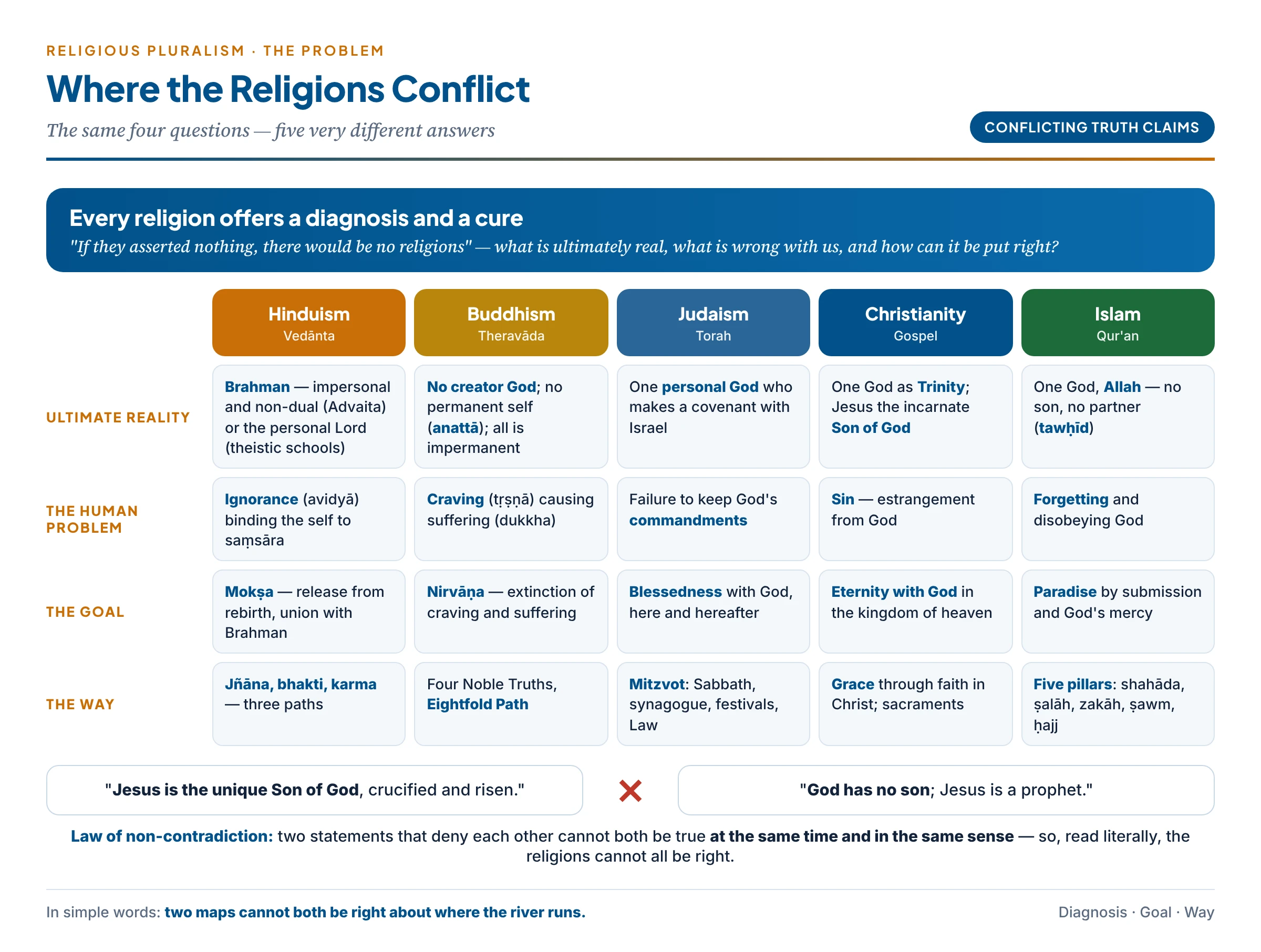
- Religions are not only rituals and feelings; they assert things. As Keith Yandell puts it: “Of course religions make claims — if they asserted nothing, there would be no religions… It is in the very nature of a religion to offer an account of our situation, our problem, and its solution.”
- Some of these claims are similar or identical across traditions (the importance of compassion, the reality of something beyond the visible world). Others directly contradict each other — and it is the contradictions that cause the most difficulty and most of the conflict.
Core Doctrine
1. Where Exactly the Religions Conflict
Metaphysical conflicts — about Ultimate Reality
- Theism (Judaism, Christianity, Islam, Vaiṣṇava and Śaiva theism): Ultimate Reality is a personal, loving Creator with sovereign will, distinct from creation.
- Advaita Vedānta: the personal God (Īśvara) belongs to the lower, empirical level of reality (vyāvahārika); the ultimate truth is impersonal, attributeless, non-dual consciousness (Nirguṇa Brahman), and the world is only an apparent transformation (vivarta) produced by māyā.
- Theravāda Buddhism: there is no creator God, no permanent self (anattā) and everything is impermanent (anicca); Mahāyāna speaks of emptiness (śūnyatā) and denies any metaphysical substance (nairātmyavāda).
- Jainism: an atheistic pluralism — innumerable eternal souls (jīvas) and non-living substances (ajīva), with no creator.
Historical conflicts — about events and revelations
- Christianity says salvation comes uniquely through the crucifixion and resurrection of Jesus Christ, the incarnate Son of God.
- Islam says the final and complete revelation was given word for word to the Prophet Muhammad in the Qur’an — and the Qur’an says God has no son and that Jesus was not crucified as Christians believe.
- Traditional Hinduism says the Vedas are beginningless and authorless (apauruṣeya).
Soteriological conflicts — about salvation and the way to it Soteriology (from Greek sōtēria, salvation) is the doctrine of what salvation is and how to reach it.
| Religion | The goal | The way |
|---|---|---|
| Hinduism | Mokṣa — release from the cycle of birth and death (saṃsāra) and union with Brahman | Three paths (mārgas): knowledge (jñāna), devotion (bhakti), action (karma) |
| Buddhism | Nirvāṇa — liberation from saṃsāra, extinction of craving and suffering | The Four Noble Truths — all existence is suffering (dukkha), suffering is caused by craving (tṛṣṇā), suffering can end, the way is the Noble Eightfold Path (aṣṭāṅgika mārga: right view, resolve, speech, conduct, livelihood, effort, mindfulness, concentration) |
| Judaism | Blessedness with God, here and perhaps hereafter | Fulfilling the divine commandments (mitzvot): Sabbath, synagogue, the annual festivals, strict obedience to the Law (Torah) |
| Christianity | Spiritual transformation and eternity with God in the kingdom of heaven | God’s grace (charis) through Christ’s atonement (hilastērion) for sin (hamartia); receiving grace through faith (pistis) and the sacraments; following God’s law (nomos) out of gratitude |
| Islam | Blessedness in paradise by submission to Allah and by His mercy | The five pillars: profession of faith (shahāda), five daily prayers (ṣalāh), almsgiving (zakāh), fasting (ṣawm), pilgrimage to Mecca (ḥajj) |
The questions that divide them (in John Hick’s list)
- Is the divine nature personal or non-personal?
- Does the deity become incarnate in the world?
- Are human beings reborn again and again on earth?
- Is the empirical self the real self, destined for eternal life with God, or only a temporary appearance of an eternal higher self?
- Is the Bible, the Qur’an or the Bhagavad Gītā the Word of God?
The logical heart of the problem: the law of non-contradiction
- Classical logic (from Aristotle) holds that two contradictory statements cannot both be true at the same time and in the same sense. “It is raining here now” and “it is not raining here now” cannot both be true.
- Apply it to religion: “Jesus is the unique incarnate Son of God” and “God has no son” cannot both be literally true. “Each person lives once and is then judged” and “each person is reborn many times” cannot both be literally true.
- So, if religious statements are literal claims about reality, the religions cannot all be true. This is the problem of conflicting truth claims.
In simple words
Two maps of the same city cannot both be right if one shows the river north of the market and the other shows it south. You may say both maps are “useful” or “beautiful”, but if they are maps — if they claim to describe the city — at least one is wrong about the river. The religions face the same difficulty whenever their teachings are read as descriptions of reality.
2. The Sceptical Thrust: Hick’s Birthplace Argument and Hume’s Cancelling Miracles
- The birthplace argument. John Hick put the problem concretely: “If I had been born in India, I would probably be a Hindu; if in Egypt, probably a Muslim; if in Sri Lanka, probably a Buddhist; but I was born in England and am, predictably, a Christian.” The religion a person holds depends overwhelmingly on the accident of birth, not on a fair comparison of evidence.
- Hume’s principle. David Hume argued that “in matters of religion, whatever is different is contrary“, so the religions of ancient Rome, of Turkey, of Siam and of China cannot all rest on a solid foundation.
- Contrary miracles. Every religion cites miracles as evidence of its truth. A miracle that supports religion A supports A’s teaching against B; a miracle that supports B does the reverse. The testimonies therefore cancel each other out — like two witnesses who contradict each other.
- The sceptical conclusion. Any ground for believing one religion is indirectly a ground for believing every other one false. So for any particular religion there is more reason to think it false than true — and it is a short step from “they cannot all be true” to “probably none of them is true.”
- Replies to Hume.
- The miracles of different religions need not be contrary facts — if there were many gods, each might work wonders for his worshippers; or the true God might work a miracle for a mixed religion to steer its followers away from something worse (for instance, a cult of human sacrifice).
- A miracle may support a religion’s general claim (that God acts in the world) without supporting every doctrine attached to it.
- The same problem for religious experience. William Alston argued that it is rational to trust a socially established practice of forming beliefs from mystical experience (for example, Christian mystical practice) unless it is shown to be unreliable. But Hindu, Buddhist and Muslim mystical practices produce different and incompatible beliefs. Religious diversity therefore weakens the confidence each practice can claim — a problem Alston admitted was the most serious one facing his view.
3. The Problem of Absolute Truth Stated
The problem has a simple shape:
- People all over the world hold different foundational beliefs.
- On these foundations they build systems of religious belief and morality, which they consider to be “truth“.
- Because their foundations differ, their conclusions about truth differ too.
Yet every major religion believes in a transcendent reality beneath the natural world — something unconditioned and uncaused by anything else, often thought of as a perfect, self-existent, eternal Being, the source of all that exists, and itself beyond full conceptualisation or definition. The philosophy of religion asks whether the one Absolute can be reconciled with the many accounts of it.
4. What Does “Absolute Truth” Mean?
“Absolute” (Latin absolutus, “loosened from”, “unconditioned”) means free from conditions or limits. In the religious context the phrase “absolute truth” carries at least four senses, and much confusion comes from mixing them.
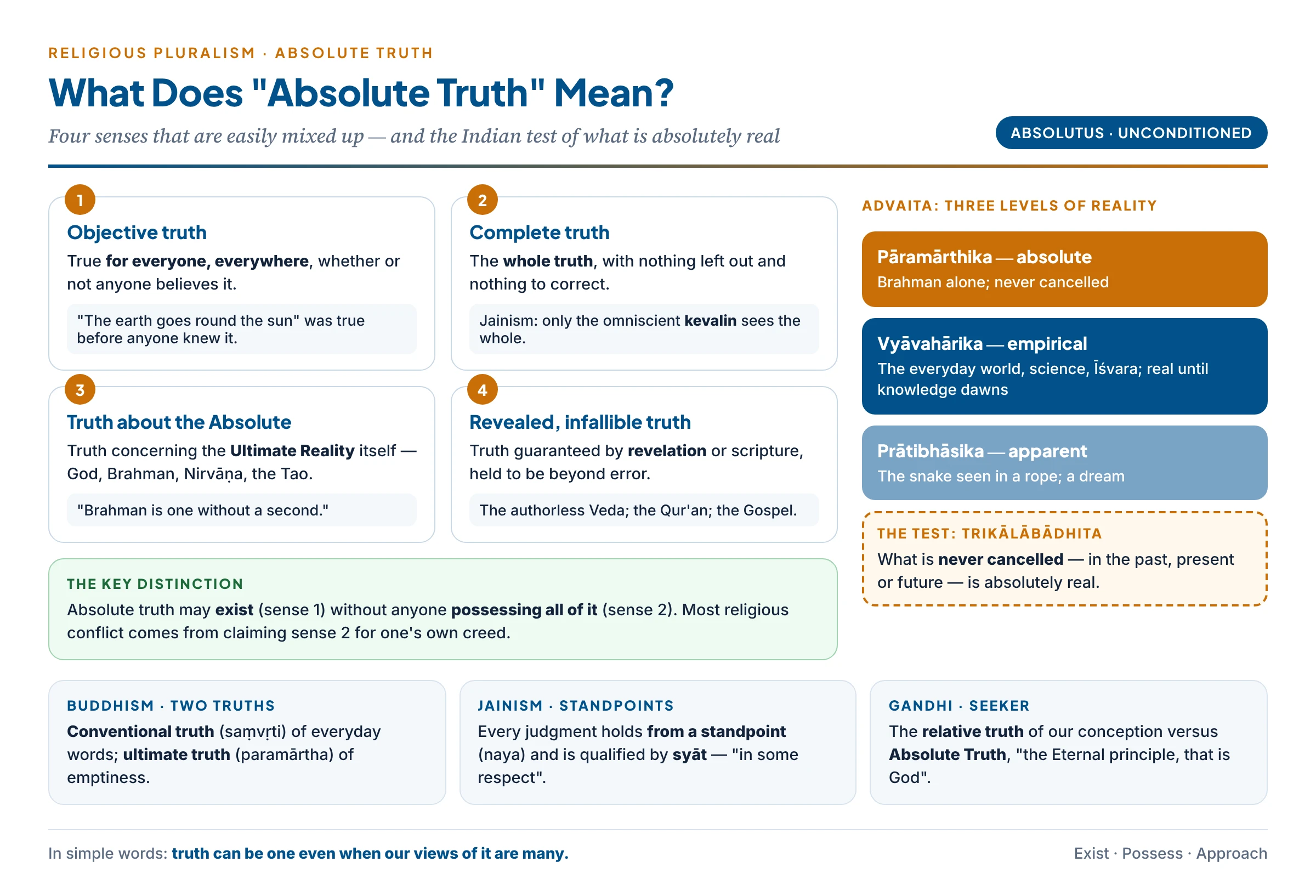
- Objective (unconditional) truth — a statement that is true for everyone, everywhere, whether or not anyone believes it. “The earth goes round the sun” was true before anyone knew it. In this sense even “God exists” or “God does not exist” is absolutely true or false.
- Final or complete truth — the whole truth, with nothing left out and nothing to be corrected. No human statement seems to reach this; the Jaina says only the omniscient (kevalin) has it.
- Truth about the Absolute — truth concerning the Ultimate Reality itself (God, Brahman, Nirvāṇa, the Tao), as opposed to truths about the world.
- Revealed, infallible truth — truth guaranteed by a revelation or scripture and therefore held to be beyond error and beyond revision.
Indian standards of absolute truth
- Advaita Vedānta distinguishes three levels of reality and truth:
- Prātibhāsika — the apparent or illusory (the snake seen in a rope, a dream);
- Vyāvahārika — the empirical, practical reality of everyday life and science, real until knowledge of Brahman dawns;
- Pāramārthika — the absolute reality, Brahman alone.
- The test of the absolute in Advaita is non-contradiction in all three times (trikālābādhita): what is never cancelled — in the past, present or future — is absolutely real. The rope-snake is cancelled when the rope is seen; the empirical world is cancelled by the knowledge of Brahman; Brahman is never cancelled.
- Buddhism (Nāgārjuna) speaks of two truths: conventional truth (saṃvṛti-satya), the truth of everyday language and concepts, and ultimate truth (paramārtha-satya), the emptiness of all things. The ultimate cannot be taught except through the conventional.
- Jainism holds that reality has infinite aspects; every human judgment is true only from a standpoint (naya) and must be qualified by “in some respect” (syāt). Only the kevalin, the omniscient liberated soul, knows the whole.
- Gandhi distinguished “the relative truth of our conception” from “the Absolute Truth, the Eternal principle, that is God“. We live by relative truth while searching for the Absolute.
Truth theories applied to religion
- Correspondence: a religious statement is true if it matches reality (“God exists” is true if God exists). This makes conflicts real and sharp.
- Coherence: a statement is true if it fits consistently within a whole system of beliefs. Each religion may be internally coherent — which explains why each feels true from inside.
- Pragmatic: a statement is true if believing it works — if it transforms life. Here many religions could be “true” together, and the conflict softens (this is close to William James and, in part, to John Hick).
5. Can Absolute Truth Be Justified on Rational Grounds?
Arguments for
- The self-refutation argument. “There is no absolute truth” is itself offered as a statement true for everyone, always — that is, as an absolute truth. So the denial defeats itself. At least some absolute truths (including truths of logic) must exist.
- Logic presupposes it. All reasoning assumes the law of non-contradiction. A person who denies it cannot even state his denial, since “the law is false” would then be no different from “the law is true.”
- The demand for an unconditioned ground. Every conditioned thing points beyond itself to its conditions. The cosmological arguments of Aquinas and the Nyāya and Vedāntic arguments reason that the chain of conditions must end in something unconditioned — an Absolute.
- The undeniable self. Śaṅkara argues that the witness-consciousness (sākṣin) cannot be denied, because the one who denies it is that very consciousness. Here at least one truth is absolutely certain.
- Hegel: “The true is the whole.” Partial truths are moments of a single, all-inclusive rational whole — the Absolute — which reason can come to know.
Arguments against
- Kant: human reason knows things only as they appear (phenomena), shaped by the forms of space and time and the categories of the understanding. When reason tries to know the thing-in-itself (noumenon) — God, the soul, the world as a whole — it falls into contradictions (the antinomies). So knowledge of the Absolute lies beyond reason.
- Finitude: a finite mind cannot contain the infinite. Even if absolute truth exists, we may not be able to possess it. As Aquinas himself said, “the thing known is in the knower according to the mode of the knower.”
- Cultural conditioning: every concept we use is shaped by language, history and culture — the point Hick develops into his pluralism.
- Perspectivism: Nietzsche argued, in effect, that there are no bare facts, only interpretations made from some perspective.
- Logical positivism: statements about the Absolute cannot be verified by sense experience, so they are not even meaningful candidates for truth.
A balanced answer
- Reason can show that absolute truth exists — that some things are true unconditionally, and that the idea of an unconditioned ground is not absurd.
- Reason cannot show that any finite person or tradition possesses the whole of it.
- Absolute truth is therefore best defended as a formal or regulative ideal — the goal that keeps inquiry honest — rather than as a doctrine that anyone can hold in complete form. This distinction between truth existing and truth being possessed is the key to the whole unit.
In simple words
A good judge believes there is one true answer to “who committed the crime?” — otherwise trials would be pointless. But a good judge also knows that her own view of the answer can be mistaken, which is why she hears both sides. Believing in absolute truth and being humble about our grasp of it go together.
6. Does Religion Guarantee the Absolute Truth?
The case that it does
- Religions claim a source higher than human reason: revelation (the Torah, the Gospel, the Qur’an), an authorless Veda that, for Mīmāṃsā, is self-valid (svataḥ-prāmāṇya), or the direct experience (anubhava) of the enlightened — the Buddha’s awakening, the ṛṣi’s vision.
- These sources claim certainty and finality: God cannot deceive; the authorless Veda has no human defects; realisation is self-luminous.
The case that it does not
- Rival guarantees cancel: every religion offers its own guarantee, and they conflict (Hume’s point). A guarantee that every rival can also issue guarantees nothing.
- The human medium: revelation is received, written, translated and interpreted by fallible human beings. Gandhi put it vividly — there is one true religion, but it “becomes many, as it passes through the human medium.”
- Doctrines change: Hick notes the immense changes in Christian theology after Darwin, Einstein and Freud. What changes cannot have been the final, absolute form of truth.
- Faith is not proof: religious certainty is a certainty of commitment, not a demonstration that compels every rational mind.
Conclusion
- Religion does not guarantee absolute truth in the sense of a public, logical proof. It offers a path towards the Absolute, a trust in it and, for the mystic, an experience of it.
- Where a religion claims to possess the absolute truth in a complete and exclusive form, it moves towards exclusivism and conflict (examined in the next article). Where it claims to point towards the absolute truth that exceeds all formulations, it leaves room for other paths.
7. The God of Religion and the Absolute of Philosophy
Two pictures of the Ultimate
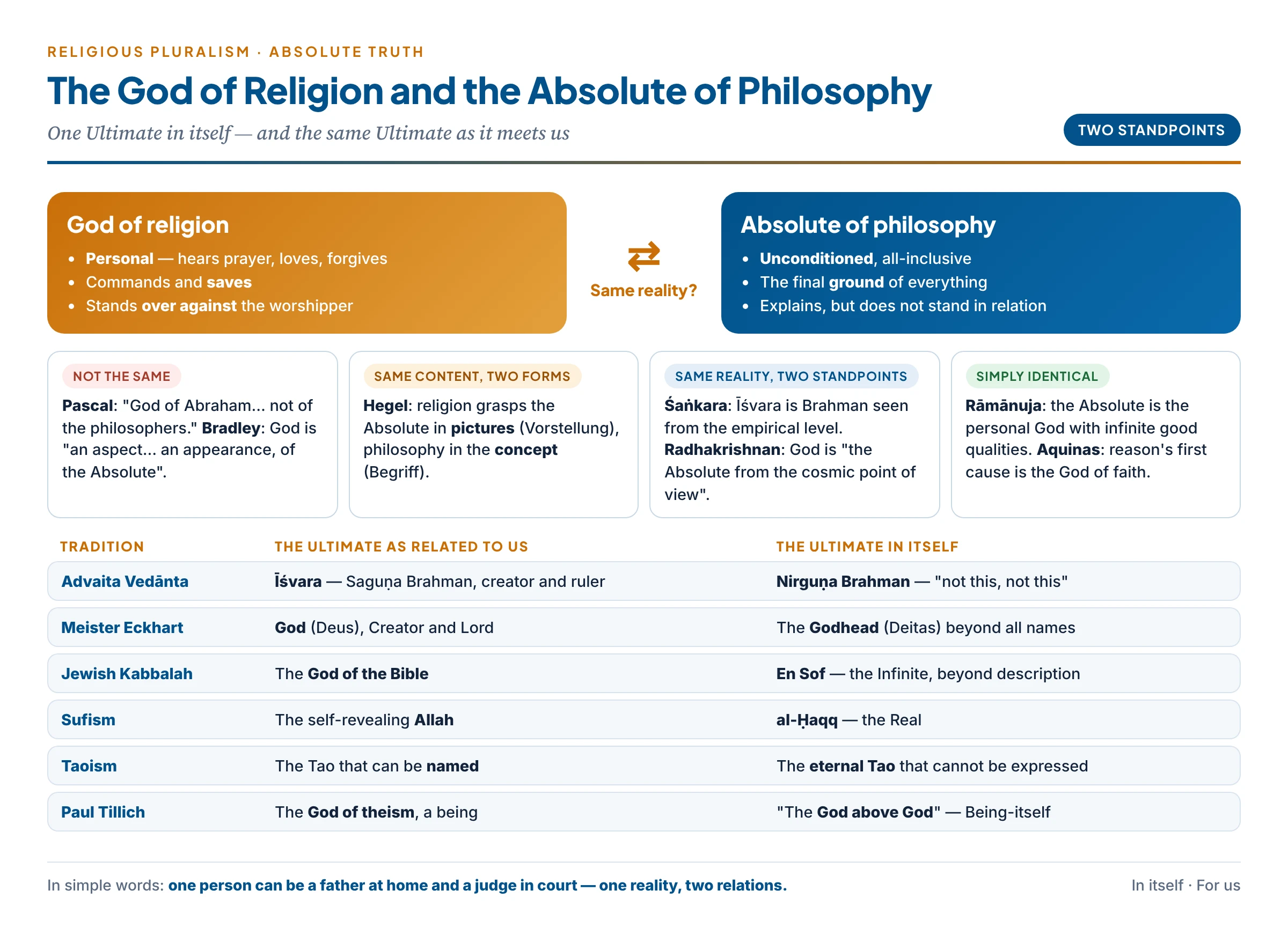
- The God of religion is personal: he hears prayer, loves, commands, forgives, saves; he stands over against the worshipper as an object of devotion.
- The Absolute of philosophy is the ultimate principle of explanation: unconditioned, all-inclusive, complete, the ground of everything — Plato’s Good, Aristotle’s Unmoved Mover, Spinoza’s Substance, Hegel’s Absolute Spirit, Bradley’s Absolute, Śaṅkara’s Brahman.
- The question is whether these are one and the same reality.
“Not the same” — Pascal and Bradley
- Pascal, in his Memorial of 1654 (sewn into his coat and found after his death), wrote: “God of Abraham, God of Isaac, God of Jacob — not of the philosophers and the scholars.” The living God met in faith is not the conclusion of an argument.
- F. H. Bradley argued that religion needs a God who stands in relation to the worshipper — someone to whom I pray, who is other than me. But whatever stands in relation to something else is finite, a part and not the whole. The Absolute includes everything and so cannot stand over against anything. Bradley states the dilemma sharply: “If you identify the Absolute with God, that is not the God of religion. If again you separate them, God becomes a finite factor in the Whole.” Religion strives to end the gap between man and God, yet it needs that gap in order to exist — “a God which is all in all is not the God of religion.” Hence: “God is but an aspect, and that must mean but an appearance, of the Absolute.“
- Kierkegaard and much existentialist faith agree in spirit: the God of faith is met in passionate decision, not in a system.
“The same, seen differently” — Hegel, Aquinas, Radhakrishnan
- Hegel: religion and philosophy have the same content — the Absolute Spirit — but religion grasps it in picture-thinking (Vorstellung: images, stories, the Father and the Son), while philosophy grasps it in the concept (Begriff). The God of religion is the Absolute in pictorial form.
- Aquinas: the God reached by natural reason (first cause, necessary being) is the same God whom revelation reveals more fully as Trinity and saviour.
- Radhakrishnan: “The Absolute is the pre-cosmic nature of God, and God is the Absolute from the cosmic point of view.“
The same distinction inside the religions themselves Many traditions — especially in their mystical strands — distinguish the Ultimate in itself from the Ultimate as related to us:
- Advaita: Nirguṇa Brahman (without attributes) and Saguṇa Brahman experienced as Īśvara, the personal creator and ruler;
- Meister Eckhart: the Godhead (Deitas) beyond all names and God (Deus) as Creator and Lord;
- Jewish Kabbalah: En Sof (“the Infinite”), beyond all description, and the God of the Bible;
- Sufism: al-Ḥaqq (“the Real”), the abyss of Godhead beneath the self-revealing Allah;
- Taoism: “The Tao that can be expressed is not the eternal Tao” (the opening of the Tao Te Ching);
- Paul Tillich: “the God above the God of theism” — God as Being-itself, not a being;
- Gordon Kaufman: the “real God” and the “available God“.
Assessment
- They can be identified if the God of religion is understood as the Absolute in relation to finite beings — one reality, two standpoints.
- They cannot be simply identified if the Absolute is so empty of qualities that it cannot love, hear or save, or if the God of religion is so finite that he is one being among others. Then either religion loses its object of worship, or philosophy loses its Absolute.
- This same pattern — one Ultimate, many ways of meeting it — is the root from which John Hick’s pluralism later grows.
8. Do Īśvara and Brahman Signify the Same Reality in Advaita Vedānta?
What each term means
- Brahman in its highest sense is Nirguṇa — pure existence, consciousness and bliss (sat-cit-ānanda), without attributes, without distinctions, beyond speech and thought (“not this, not this“, neti neti).
- Īśvara is Saguṇa Brahman — Brahman associated with māyā (its limiting adjunct, upādhi), and so seen as the omniscient, omnipotent creator, sustainer and dissolver of the world, the giver of the fruits of karma (karma-phala-dātā), and the object of worship.
Śaṅkara’s answer: the same reality, two standpoints
- There are not two realities. Īśvara is Brahman itself, viewed from the empirical standpoint (vyāvahārika dṛṣṭi), in relation to a world. Brahman is the same reality viewed from the absolute standpoint (pāramārthika dṛṣṭi), where there is no world to be related to.
- Īśvara is real as long as the world is real — he is not an illusion for the worshipper. Devotion to Īśvara purifies the mind and prepares it for knowledge.
- But Īśvara’s status as creator and ruler belongs to the empirical order. When the world is cancelled in the knowledge of Brahman, Īśvara-hood — not Brahman — is transcended. So they signify the same reality, but not with the same status.
In simple words
One man is a father at home, a judge in court and a friend at the club. These are not three men; they are one man in three relations. Remove the court, and he is no longer a judge — but he has not vanished. Īśvara is Brahman in relation to the world; when the world-relation drops away in liberation, the “judge” disappears and the man remains.
The theistic Vedāntic contrast
- Rāmānuja (Viśiṣṭādvaita) rejects the two-level view. Brahman is the personal God (Nārāyaṇa), possessed of infinite auspicious qualities; “nirguṇa” only means free from bad qualities. There is no higher, impersonal Absolute above the God of devotion.
- Madhva (Dvaita) is even firmer: God (Viṣṇu) is supreme and eternally distinct from souls and matter.
- So, across Vedānta, the answer to “are the God of religion and the Absolute of philosophy the same?” ranges from “the same reality at two levels” (Śaṅkara) to “simply identical — the Absolute is the personal God” (Rāmānuja, Madhva).
9. Six Responses to Religious Diversity
Philosophers have answered the conflicting truth claims of the religions in six main ways:
- Atheism — all religions are false; no religion’s central claims are true. Diversity is evidence that religion is a human projection.
- Agnosticism — there is no way to determine which, if any, religion is true, so the best response is to suspend judgment.
- Religious relativism — each religion is “true” and “effective” for its own adherents, within its own worldview; there is no tradition-transcending sense in which one can speak of religious truth.
- Religious pluralism — ultimately all the major religions are correct, each offering a different path and a partial perspective on the one Ultimate Reality (John Hick; in India, Ramakrishna and Vivekananda).
- Religious inclusivism — only one religion is fully correct, but other religions participate in or partially reveal its truth, and salvation (or nirvāṇa, or mokṣa) is possible through them (Karl Rahner).
- Religious exclusivism — one religion is correct and all others are mistaken; salvation is found only through it (Karl Barth; Alvin Plantinga defends it philosophically). Historically this has been the most widely held view among believers.
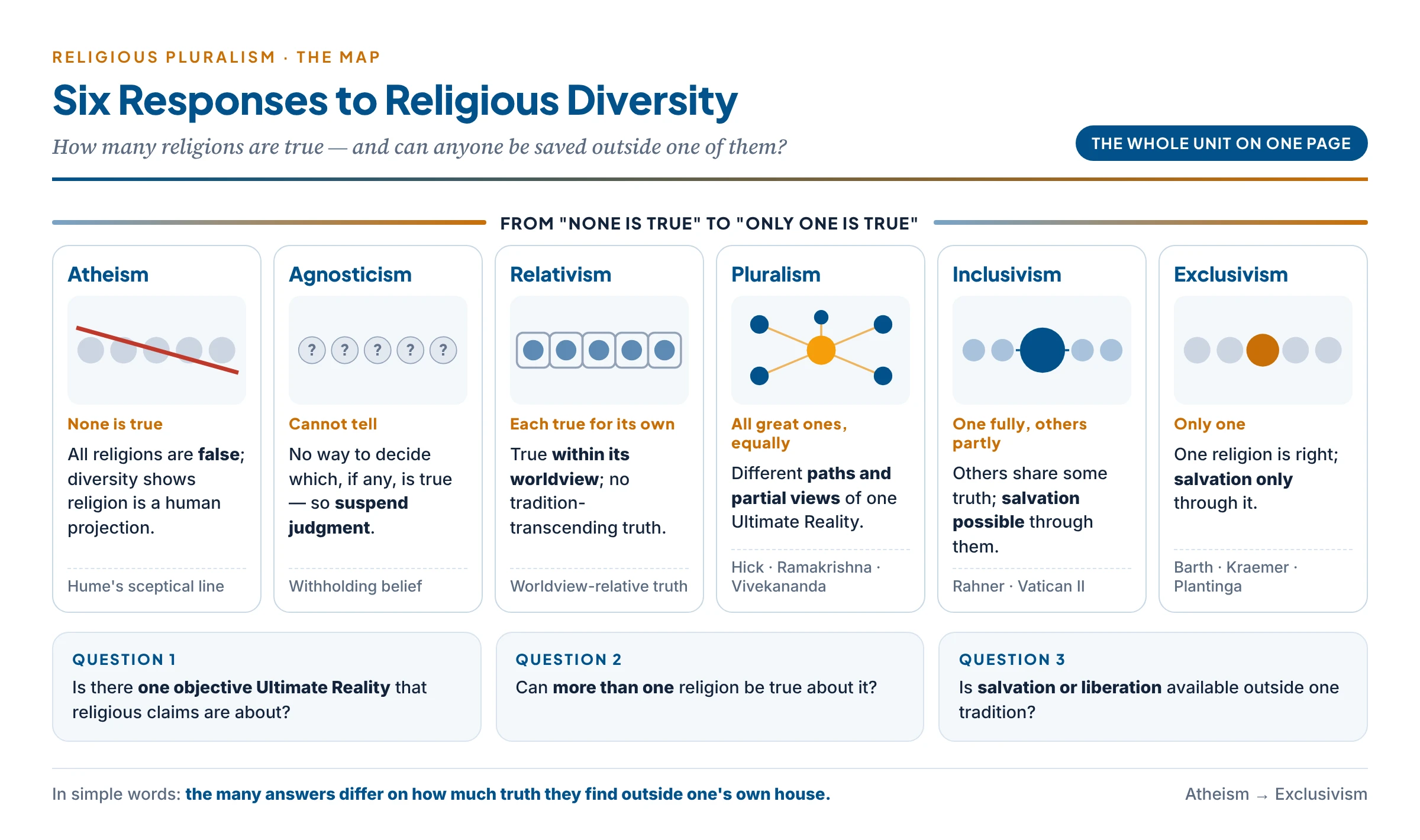
- The deciding questions: Is there one objective Ultimate Reality? Can more than one religion be true about it? Is salvation available outside one tradition? Each response answers these differently.
- Exclusivism and inclusivism are examined in the next article, Hick’s pluralism in the third, and relativism, conflict and tolerance in the fourth; the Indian responses follow in the last two.
Critical Evaluation
Is the Problem Overstated?
- Many “religions” are streams, not systems (Cantwell Smith): conflicts between rigid “-isms” may be partly an artefact of modern classification.
- Experience and doctrine differ: Hick separates religious experience from the theories built on it. Experience provides the ground of belief; belief shapes experience in turn — like the hen and the egg. Many conflicts are at the level of theory, which changes over time.
- Personal and non-personal may be complementary: if the Ultimate is infinite, it may be both personal Lord and non-personal Ground of Being. Sri Aurobindo spoke of a “logic of the infinite“, in which attributes that exclude each other in finite things need not do so in the Infinite.
- Shared core: every major tradition teaches the transformation from self-centredness to something greater, and produces saints of comparable goodness.
Is the Problem Understated?
- Core doctrines really conflict: rebirth versus one life and judgment; no permanent self (anattā) versus an eternal soul (ātman); the Trinity versus the strict oneness of God (tawḥīd). These are not peripheral; believers regard them as essential.
- Truth cannot be traded for usefulness: to say both maps of the city are “useful” does not settle where the river is (Yandell‘s line of objection to pluralism).
- The definitions of religion themselves resist unity: no single concept of “the religious” covers Theravāda Buddhism and Islam alike.
Objections to the Very Idea of Absolute Truth — and Replies
- Objection: absolute truth breeds dogmatism and violence. Reply: what breeds violence is the claim to possess absolute truth completely and exclusively, combined with power — not the belief that truth exists. Gandhi held to absolute Truth and practised non-violence because he knew he did not possess it fully.
- Objection: all truth is relative to culture. Reply: the statement “all truth is relative” claims to be true for every culture, and so refutes itself; moreover, cultures criticise and correct themselves, which assumes a truth beyond them.
- Objection: talk of the Absolute is meaningless (positivism). Reply: the verification principle cannot itself be verified by the senses; and religious language may be meaningful in other ways (examined in the unit on religious language).
Critics and Defenders
Criticism — Doubts about absolute truth in religion
- Kant: reason cannot know the thing-in-itself; claims about the Absolute end in antinomies.
- Hume: in religion “whatever is different is contrary”; rival miracles and rival guarantees cancel each other.
- The birthplace argument: belief follows geography, not evidence.
- Nietzsche and relativists: there are only interpretations from perspectives.
- Logical positivists: statements about the Absolute are unverifiable and so meaningless.
- Pascal and Bradley: the God of religion is not the Absolute of philosophy, so religion cannot simply claim the philosopher’s Absolute.
Defence — Defences of absolute truth
- Self-refutation: “there is no absolute truth” is itself an absolute claim.
- Non-contradiction is presupposed by every argument, including the sceptic’s.
- Śaṅkara: the witness-self cannot be denied; Brahman is what is never cancelled (trikālābādhita).
- Regulative ideal: absolute truth guides inquiry even when no one possesses it fully.
- Hegel, Aquinas, Radhakrishnan: the God of religion is the Absolute grasped in relation, in picture or in faith.
- Gandhi: the relative truths of our conception are steps towards the Absolute Truth, which is God.
Cross-Tradition Comparison
| Issue | Western thinkers | Indian thinkers | Common insight |
|---|---|---|---|
| Levels of truth | Kant: phenomena vs noumena | Advaita: vyāvahārika vs pāramārthika; Buddhism: conventional vs ultimate truth | Our knowledge is real at its level but does not exhaust reality |
| Is the God of religion the Absolute? | Bradley: an aspect or appearance of the Absolute; Hegel: same content, different form | Śaṅkara: Īśvara is Brahman from the empirical standpoint; Rāmānuja: the Absolute is the personal God | The answer depends on whether personality is a limit or a perfection |
| The Ultimate beyond names | Eckhart’s Godhead; Tillich’s God above God; Kabbalah’s En Sof | Neti neti; Nirguṇa Brahman; Buddhist emptiness | Every tradition knows an Ultimate beyond its own words |
| Test of absolute truth | Correspondence; non-contradiction | Trikālābādhita — never cancelled in past, present, future | Truth is what survives every correction |
| Partial grasp | Aquinas: known in the mode of the knower | Jaina naya and syāt; only the kevalin knows the whole | Finite knowers see from standpoints |
Indian Connect — Indian takeaways
- Indian thought rarely set absolute truth against plurality: the Ṛgveda’s “Truth is one; the wise call it by many names” holds both together.
- The two-level structure (empirical and absolute) allows a personal God to be fully real for worship while the Absolute remains beyond all forms — a resource the West reached late, through Kant and Hick.
- Jaina syādvāda gives a logic for holding a truth firmly but conditionally — the attitude this unit keeps returning to.
Synthesis (Siddhānta)
- The fact of religious plurality is undeniable; pluralism is one contested theory about it, alongside atheism, agnosticism, relativism, inclusivism and exclusivism.
- The conflict is real wherever religious statements are read as literal descriptions — about God’s nature, historical events, the self and salvation — because of the law of non-contradiction.
- Absolute truth is not refuted by diversity. Its existence can be defended rationally (the self-refutation of relativism, the presupposition of logic, the idea of an unconditioned ground). What diversity refutes is the claim of any finite tradition to possess it completely.
- Religion does not guarantee absolute truth as a public proof; it offers orientation, trust and experience directed towards it.
- The God of religion and the Absolute of philosophy can be the same reality approached from two standpoints — the Absolute in itself and the Absolute in relation to us. Śaṅkara’s Īśvara and Brahman, Eckhart’s God and Godhead, and Tillich’s God above God all express this.
- Contemporary relevance: in plural societies, the distinction between truth existing and truth being possessed is the philosophical ground of tolerance — firm conviction without the claim of a monopoly. Gandhi’s life is the best illustration: an absolute commitment to Truth joined to the humility of a “seeker”.
Previous Year Questions
- 2024Write a note on the notion of absolute truth in the context of religion.
- 2021Discuss the possibility of Absolute Truth in the context of religious pluralism.
- 2017Does religion guarantee the absolute truth? Discuss in the context of religious pluralism.
- 2012Can the notion of absolute truth be justified on rational grounds?
- 2012Do the concept of Ishvara and Brahman signify the same reality in Advaita Vedanta?
- 2009Can the God of religion be identified with the absolute of philosophy?
- 2000Religious pluralism and the claim of absolute truth (short note).