

Religion and Morality: Religion and Morality.
Official Syllabus: Paper II, Section B, Unit 8
The oldest and simplest answer to the question “how are religion and morality related?” is that morality depends on religion: what is right is right because God commands it, and what is wrong is wrong because God forbids it. This is the Divine Command Theory (DCT). It has deep roots in Judaism, Christianity and Islam, and it gives morality something many people want — objectivity, authority and a powerful motive. But more than two thousand years ago Socrates asked a question that has haunted it ever since: is something good because God commands it, or does God command it because it is good? This article explains the theory, the arguments for it, the Euthyphro dilemma, the main theistic replies (Aquinas’s natural law, Adams’s modified theory, the appeal to God’s nature), the question whether moral obligation needs a divine lawgiver, and the standard criticisms of making morality depend on religion.
In simple words
A child asks, “Why must I be home by eight?” One parent says, “Because I said so.” Another says, “Because the streets are unsafe after dark, and I love you.” In the first case the rule is right only because of the parent’s will; in the second, the parent commands it because it is already good for the child. The Euthyphro dilemma asks which kind of parent God is — and shows that each answer has a price.
Context & Problem
The Dialogue Behind the Dilemma
- In Plato’s dialogue Euthyphro (set in 399 BCE), Socrates is on his way to court to face the charge of impiety. He meets Euthyphro, a priest who is prosecuting his own father for causing the death of a labourer — and who is sure this is the pious thing to do.
- Socrates asks him what piety (the holy, the god-pleasing) is. Euthyphro answers: piety is what the gods love.
- Socrates then asks the famous question: “Is the pious loved by the gods because it is pious, or is it pious because it is loved by the gods?“
- In modern form: “Is an action morally right because God commands it, or does God command it because it is morally right?“
Who Held the Divine Command View?
- William of Ockham (14th century): God’s will is absolutely free; what God commands is right simply because He commands it. Ockham even held that if God commanded a person to hate God, doing so would be meritorious.
- Duns Scotus: the commandments concerning God (the “first table”) are necessary, but those concerning our neighbour (the “second table”) depend on God’s free will — God could dispense with them.
- Descartes: God’s will creates even the eternal truths; nothing is good prior to God’s choosing it.
- Locke and William Paley: God’s law is the criterion of ethics. Paley defined virtue as “doing good to mankind, in obedience to the will of God, for the sake of everlasting happiness”.
- Kierkegaard: “Duty is quite simply the expression of the will of God” (Article 2).
- Islamic theology produced the same debate: the Ash’arites held that good is whatever God commands and reason cannot know good apart from revelation; the Mu’tazilites held that reason can know good and evil, and God commands what is already good.
Core Doctrine
1. The Divine Command Theory Stated
- Thesis: moral values, duties and obligations have no independent existence; they are produced by the will and command of God.
- A common modern form:
- an act is morally required just in case God commands it;
- an act is morally wrong just in case God forbids it;
- an act is permissible just in case God neither commands nor forbids it.
- The Decalogue–Sharia paradigm: murder and theft are wrong because and only because God has prohibited them; charity and worship are good because and only because God has commanded them.
- Not a mere dictionary claim. If “right” simply meant “commanded by God”, then “it is right because God commands it” would say only “God commands it because God commands it” — empty. If rightness and God’s command merely happened to coincide, God’s will would explain nothing. So the theory claims something in between: God’s command is what makes right acts right — just as being made of hydrogen and oxygen is what makes water water, a fact people drank water for centuries without knowing, yet a necessary one.
- The supporters’ picture (as presented in Indian textbooks of philosophy of religion):
- “God does not want anything because it is good; what God wants becomes good.” Nothing in the universe is good in itself; goodness is relative to God.
- God creates ethics by His own will and is not bound by any ethical law. We know His mandates through saints and sacred books.
- A fundamental postulate of ethics is the moral order of the universe; God is the treasure house of ethical qualities who orders good and rejects evil. Neither religion nor ethics could survive if God were unethical or indifferent to morality.
- Religion satisfies the emotional side of man and ethics the volitional side; for all-round development the two must be complementary.
2. Arguments for Making Morality Depend on God
- Objectivity. If God is the source of morality, moral principles are objective — not mere preferences, conventions or evolutionary accidents. This avoids moral relativism.
- Motivation. Religion provides the strongest incentive to be moral: salvation, heaven or liberation for the good; hell or bondage for the wicked.
- A command needs a commander. Many theists argue that it is impossible to think of a command without a commander: either moral claims are self-explaining modes of impersonal existence, or they are explained by a personal God.
- Conscience points to God. John Henry Newman: “If, as is the case, we feel responsibility, are ashamed, are frightened, at transgressing the voice of conscience, this implies that there is One to whom we are responsible, before whom we are ashamed, whose claim upon us we fear.”
- Obligation as awareness of God. Illtyd Trethowan went further: we are not merely led to God by argument; in moral experience we are directly confronted by absolute obligation and absolute value, so that “an awareness of obligation is an awareness of God“. People have value because they receive it from a source of value.
- Objective law needs a mind. Hastings Rashdall and C.S. Lewis: an objective moral law, binding on all, can only exist in a mind — the mind of God. (These are forms of the moral argument for God — see Unit 02.)
3. Two Versions of “Morality Included in Religion”
An example makes the difference clear. Fred joins an organisation whose leader issues orders. The leader says, “You ought to do this,” and everyone agrees. Fred replies: “Yes, I ought to do it — but not because the leader says so. He is right, but his saying it does not make it right.“
- Weak version (Fred’s view). God always wills what is morally obligatory, but His willing it does not make it obligatory. From “God wills it” we may infer that it is right — God is a perfectly reliable guide — but the rightness has another source.
- Strong version (true DCT). An act is obligatory by virtue of being willed by God. There is no standard against which God’s will can be judged; God’s will creates moral standards. Anyone who thinks there are moral reasons to refuse God’s will “has not understood what morality is”.
4. The Euthyphro Dilemma
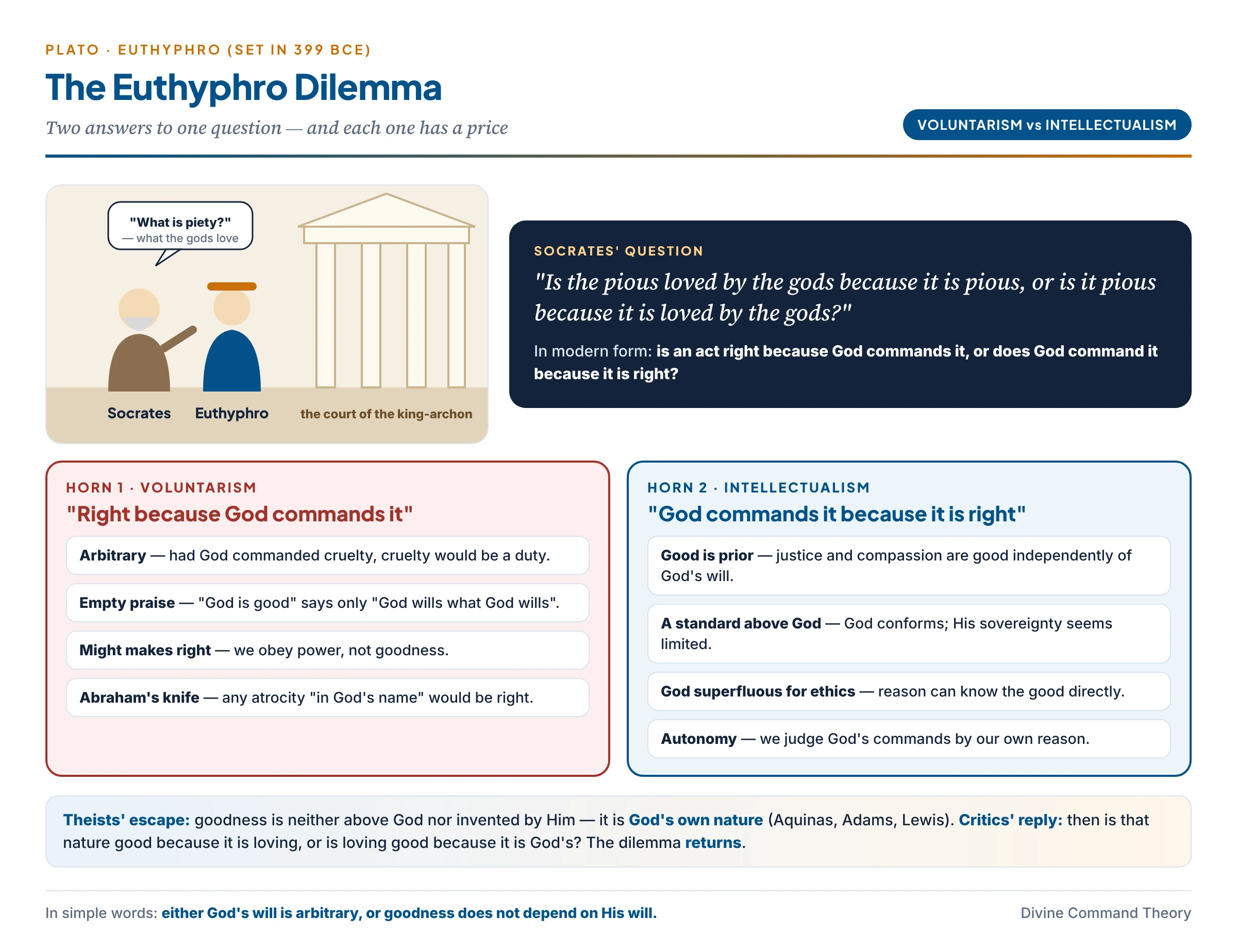
Horn 1 — Voluntarism: “X is right because God commands it.”
- Arbitrariness. Morality becomes hostage to divine whim. If God commanded cruelty, rape or the torture of infants, these would at once become duties. This is contrary to our sense that some acts are wrong essentially.
- The vacuity of praise. “God is good” becomes an empty tautology — “God does whatever God wills”. We could no longer praise God for being good, since there is no standard of goodness He meets.
- Might makes right. Morality is reduced to raw power — cosmic coercion. We obey because God is strong, not because what He commands is good.
- The example of Abraham. If God commanded Abraham to kill his son, was that therefore right? Many atrocities — judged by ordinary conscience — have been committed in the name of religion. If God really commanded them, does that make them right?
Horn 2 — Intellectualism: “God commands X because X is right.”
- Autonomy of the good. Justice, compassion and truth are good independently of God’s will; morality is prior to God.
- A standard above God. God Himself must conform to an external standard; He is not the sovereign author of morality, which seems to limit His sovereignty and omnipotence.
- God becomes superfluous for ethics. If moral principles exist independently, human reason can discover them directly — by ethical inquiry — without scripture, priests or revelation. We assess God’s commands by our own reason, which is the autonomy of morality.
In simple words
Imagine a judge in a cricket match. If “out” simply means “whatever the umpire says”, then the umpire can never be wrong — and saying “he is a good umpire” means nothing. If the umpire gives a batsman out because the ball hit the stumps, then the rules of cricket are above the umpire, and anyone who knows the rules can check his decisions. The Euthyphro dilemma asks whether God is the first kind of umpire or the second.
5. The Theistic Replies
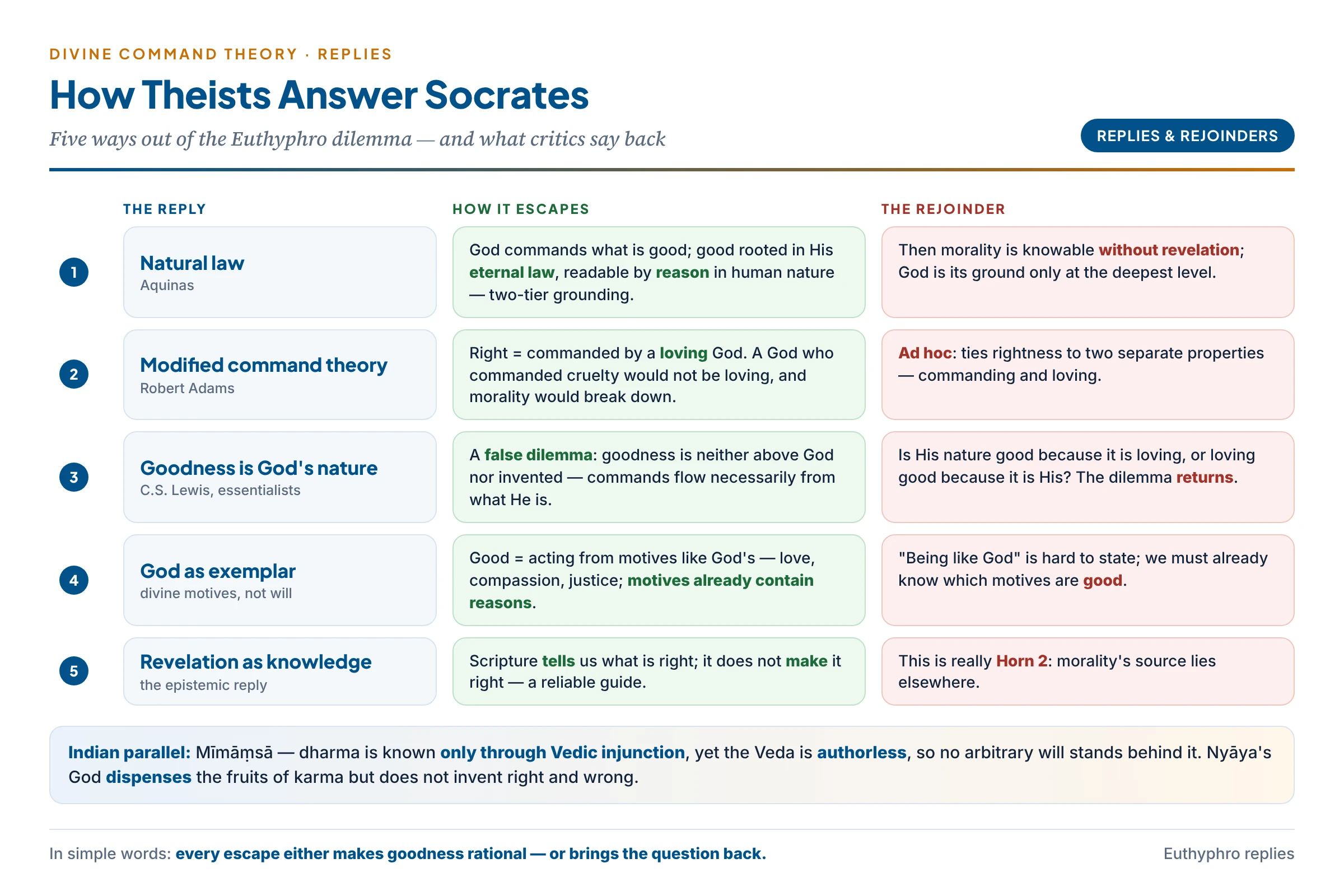
(a) Natural law — Aquinas’s middle way
- Thomas Aquinas took the second horn in a modified form. God commands what is good, and good is grounded not in an arbitrary will but in God’s eternal law — the ordering wisdom of God’s own nature.
- Two-tier grounding. The natural law is that part of the eternal law which human beings grasp by reason: the basic precepts of morality are rooted in human nature (preserve life, seek truth, live in society) and are knowable by all, believers or not. So morality is common to all humans, and yet ultimately depends on God.
- This allows morality to be objective, rational and universal without being arbitrary, while keeping God as its deepest source.
In simple words
A good architect designs a house according to the laws of physics; he does not invent those laws, yet they are not “above” him in any insulting way — they express the very nature of building. For Aquinas, God’s commands are like the architect’s plans: they follow the wisdom in God’s own nature, which our reason can partly read in the nature of things. That is why a non-believer can still see that murder is wrong.
(b) Adams’s modified Divine Command Theory
- Robert Adams defines rightness as being commanded by a loving God. God could command cruelty for its own sake — but then He would not be loving, and if that were so, morality would break down; our moral concepts presuppose a loving God.
- Morality thus depends on divine commands, but on the commands of a deity with a particular nature. Since God’s love is essential, His commands are not arbitrary.
(c) The essentialist reply — goodness is God’s nature
- C.S. Lewis and many theists: the dilemma is a false dilemma. Goodness is neither above God nor made up by Him; it is identical with God’s nature, which is essentially loving, just and rational. God’s commands flow necessarily from that nature; He cannot command cruelty, not because a law outside Him forbids it, but because cruelty is contrary to what He is.
- A related view makes God not a lawgiver but a moral exemplar: what is good for us is to act from motives like God’s — love, compassion, justice — as Christians imitate Christ, Buddhists the arahant and Jews the righteous man (tzaddik). Since motives already contain reasons, the charge of arbitrariness does not arise.
(d) The epistemic reply — revelation tells, it does not make
- Revelation tells us what is right; it does not make it right. God’s commands are a reliable source of knowledge about morality, not the ground of morality — Fred’s “weak version”.
(e) The logical reply — an extra premise
- It is invalid to argue from “God wills that I do X” to “I ought to do X” — a fact about God’s will does not by itself yield a duty. But the believer can add a premise:
- God wills that I do X.
- One is morally obliged to do what God wills.
- Therefore I am morally obliged to do X.
- This argument is valid. The critic must then deny that God exists or that His will can be known, or deny premise 2. Denying premise 2 is not easy: it is a fundamental moral starting point, and the critic’s own counter-premise (“one must never kill the innocent, even if God wills it”) is equally fundamental. At this level the dispute becomes a clash of basic moral commitments.
Why the dilemma returns
- At the level of God’s nature. Is God’s nature good because it has certain qualities (love, justice) that are good in themselves? Then goodness is again independent of God. Or are love and justice good only because they belong to God? Then “goodness” is again arbitrary.
- Ad hoc. Tying rightness to the commands of a loving God uses two different properties of God — commanding and loving — without explaining why they go together.
- Our knowledge of God’s goodness. To call God’s nature “good” we must already know what goodness is — which suggests that our moral concepts are prior to our idea of God.
- Kant’s objection remains: even if God’s commands are perfectly good, a person who does right because it is commanded acts heteronomously, not from respect for the moral law itself (Article 4).
Common confusion
Does the Euthyphro dilemma disprove the existence of God? No. It is aimed at one theory about God and morality — that God’s will creates moral values. A theist can accept the second horn (God commands what is good), or locate goodness in God’s nature, and still believe in God. What the dilemma shows is that a theist cannot comfortably hold both that God is the sole author of morality and that calling God “good” says something substantive.
6. If Morality Follows from Religion, Can It Be Rationally Justified?
- The problem. If an act is right only because God commands it, then the final answer to “why should I do this?” is “because God says so“. That is an appeal to authority, not to reason. The believer cannot give reasons that a non-believer could accept.
- The is–ought gap. “God wills X” is a statement of fact; “I ought to do X” is a statement of value. Many philosophers hold that no value follows from facts alone (Article 5). So even revealed commands need a bridge premise to yield obligations.
- When justification is possible. If God commands things because they are good (Horn 2, natural law), reasons are available: murder is wrong because it destroys a person, and God forbids it for that reason. Morality then follows from religion in the sense of being taught and sanctioned by it, but it is rationally justifiable in its own terms.
- Conclusion. Only the voluntarist form of dependence cuts morality off from rational justification. The intellectualist, natural-law and essentialist forms allow religious morality to be reasonable — at the cost of admitting that its reasons are open to everyone.
7. Does Obligation Need Reference to God?
The 2025 question asks whether normative principles (principles of what one ought to do) must refer to God in order to produce a feeling of obligation in a moral agent.
Arguments that obligation needs God:
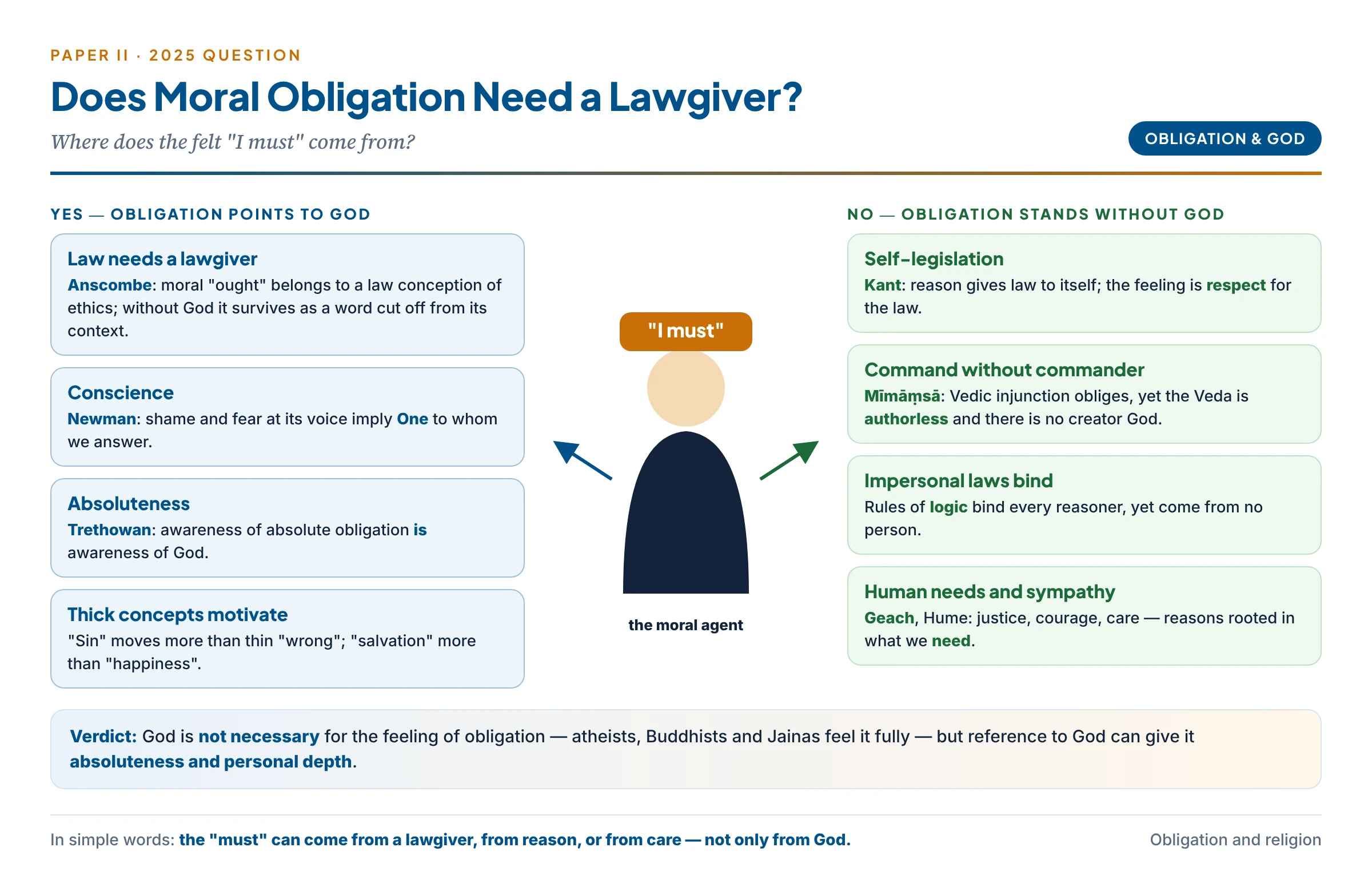
- Law needs a lawgiver. Elizabeth Anscombe (Modern Moral Philosophy, 1958) argued that the idea of a moral law — of what one is “morally obliged” to do — makes sense only within a law conception of ethics, and a law needs a lawgiver. In the Judaeo-Christian tradition that lawgiver was God. Modern philosophers kept the word “ought” in its special moral sense after giving up belief in the lawgiver, so the word survives “like a word cut off from the context that gave it sense”. Attempts to make society or the self the lawgiver fail, because neither has the right authority.
- Conscience. Newman: the shame and fear we feel at violating conscience point to a Person to whom we are answerable.
- Absoluteness. The absoluteness of moral obligation is “so far from being self-explanatory” that, without a theistic setting, one would be tempted to hand it over to anthropologists and psychologists (Trethowan).
- Thick religious concepts motivate. “Sin” adds to “moral wrong” the idea of offending God; “salvation” adds to “happiness” the idea of union with God, identity with Brahman or realising one’s Buddha-nature. When these thick concepts are thinned into secular “wrong” and “happiness”, they become usable by all — but lose much of their power to motivate.
Arguments that it does not:
- Self-legislation. For Kant, obligation arises from reason giving law to itself; the feeling of obligation is respect (Achtung) for the moral law, which needs no reference to God. (Kant treats duties as divine commands only after they are known to be duties.)
- Commands without a commander — Mīmāṃsā. The Pūrva Mīmāṃsā holds that dharma is known through the Vedic injunction (codanā, vidhi), which produces in the agent a sense of “this ought to be done” — yet the Veda is authorless (apauruṣeya) and Mīmāṃsā denies a creator God. Obligation here is real, binding and religious — but without God.
- Impersonal laws can bind. The rules of logic bind anyone who reasons, yet even most theists do not think logical truths come from a person. Moral demands, too, may bind without a personal source.
- Human needs. Philosophers such as Peter Geach argue that the relevant answer to “why shouldn’t I?” appeals to what the person needs and cannot get otherwise — justice for life in society, courage and temperance for any ordinary life. Such reasons are objective yet do not presuppose God.
- Experience. Atheists, Buddhists and Jainas feel obligation as keenly as theists; the feeling evidently does not depend on belief in God.
In simple words
Think of traffic rules. A driver may stop at a red light because a policeman is watching (fear of an outside authority), because she understands that the rule saves lives (reason), or because she cares about the children crossing (sympathy). All three produce a real sense of “I must stop”. The question of the 2025 paper is whether the moral “must” always needs the policeman — God — or whether understanding and care are enough.
Verdict. God is not necessary to produce a feeling of obligation — reason, conscience, sympathy and social life all produce it. But reference to God can deepen obligation, giving it absoluteness and personal depth. Whether the ultimate ground of obligation is God remains an open metaphysical question.
Indian Connect — A Euthyphro question in Indian dress
- The Indian version of the dilemma would be: is dharma dharma because the Veda enjoins it, or does the Veda enjoin it because it is dharma? The Mīmāṃsā answer is subtle: the Veda is the only means of knowing dharma (codanā-lakṣaṇo’rtho dharmaḥ — “dharma is that good which is marked by injunction”), but since the Veda is eternal and authorless, no arbitrary will stands behind it. This escapes the voluntarist horn without placing a standard above a God.
- Nyāya accepts God, but as the dispenser of the fruits of karma (karmādhyakṣa), not the creator of right and wrong — He cannot arbitrarily save a sinner or punish the innocent. Indian theism thus generally takes the second horn: God upholds a moral order He does not invent.
8. Criticisms of Making Morality Depend on Religion
- Morality without God is possible. Many people perform moral deeds without accepting God — humanists, Sartre, Nietzsche (in his own way), and the non-theistic religions Jainism and Buddhism.
- Doubtful foundation. If God is the ground of morality, but God’s existence is itself doubtful, then morality too becomes doubtful.
- Fear and greed are not moral motives. An action done from greed for reward or fear of punishment cannot be called moral in the true sense; this also creates problems for freedom of the will.
- Dogmatism. What is considered moral in a religious sense may go against modern ideas of gender equality and social justice — e.g. women’s rights, caste, untouchability, slavery.
- Frozen values. When moral values become fixed by revelation, they fail to evolve with changing circumstances.
- External imposition. It constrains human freedom through an externally imposed value system.
- Religious conflict. When notions of morality differ in each religion, making morality depend on religion can lead to religious conflicts — whose God’s commands should a plural society follow?
- The epistemic problem. Even if God’s will is the standard, which commands are God’s? Different scriptures, sects and interpreters disagree, so believers must still use reason and conscience to decide.
Common confusion
Many notes say that Divine Command Theory is the same as the moral argument for God. Is it? No. The moral argument (Kant, Newman, Rashdall) argues from morality to God: the moral law or the highest good points to God’s existence. Divine Command Theory is a theory of what makes acts right: God’s command. One can accept the moral argument while rejecting DCT — Kant did exactly that, holding that duties are known by reason first and only then regarded as divine commands.
Critical Evaluation
Critics and Defenders
Criticism — Critics of Divine Command Theory
- Socrates / Plato: the Euthyphro dilemma — arbitrariness or a standard above God.
- Kant: obedience to command is heteronomy; moral worth needs autonomy.
- Rachels: total obedience is incompatible with being an autonomous agent (Article 4).
- Mu’tazilites: reason knows good and evil apart from revelation.
- Secular moralists: morality must be shareable by people of all faiths and none.
Defence — Defenders and reformers of the theory
- Aquinas: natural law — rational, universal, yet rooted in God’s eternal law.
- Adams: right is what a loving God commands; arbitrariness excluded.
- C.S. Lewis, essentialists: goodness is God’s nature; the dilemma is false.
- Anscombe, Newman: moral “ought” and conscience point to a lawgiver.
- Logical reply: “one ought to do what God wills” is as basic as any rival moral premise.
Cross-Tradition Comparison
| Issue | Western theism | Islamic theology | Indian thought |
|---|---|---|---|
| Is right right because commanded? | Ockham, Descartes: yes; Aquinas: no | Ash’arites: yes; Mu’tazilites: no | Mīmāṃsā: dharma known only through injunction, but no commanding God |
| Role of God | Lawgiver | Lawgiver | Nyāya: dispenser of karma’s fruits; Mīmāṃsā, Buddhism, Jainism: none |
| Can reason know morality? | Natural law: yes | Mu’tazila: yes | Buddhism, Jainism: yes, by insight; Mīmāṃsā: dharma only via Veda |
| Answer to Euthyphro | Ground goodness in God’s nature | Ash’arite voluntarism or rationalism | Dharma as eternal order that even gods uphold (Ṛta) |
Indian Connect — Takeaways
- Indian thought largely avoids the voluntarist horn: the moral order (Ṛta, dharma, karma) is eternal and impersonal; God, where accepted, is its guardian or administrator, not its arbitrary creator.
- Yet Indian thought is not purely rationalist either: in Mīmāṃsā, dharma is beyond perception and inference and is known only through scripture — showing that scriptural authority and non-arbitrariness can go together.
Synthesis (Siddhānta)
- Pure voluntarism fails. If right were right only because God commands it, morality would be arbitrary and “God is good” would be empty. Almost no serious theist today holds the theory in this form.
- Modified theories survive. Grounding goodness in God’s nature or eternal law (Aquinas, Adams, Lewis) makes morality objective and non-arbitrary — but concedes that its content is rational and can be known without revelation. Morality then depends on God at the deepest metaphysical level only, not for its knowledge or justification.
- Obligation does not need God to be felt, but reference to God can give it depth and absoluteness. The Mīmāṃsā example shows that even a strongly religious, scripture-based ethics can be godless — dependence on religion is not the same as dependence on God.
- Contemporary relevance. In plural democracies, laws cannot rest on “God commands it”, since citizens disagree about God. Public morality needs reasons all can share — while religious citizens remain free to see those same duties, as Kant advised, as divine commands.
“Is the pious loved by the gods because it is pious, or is it pious because it is loved by the gods?” — Socrates, in Plato’s Euthyphro
Previous Year Questions
- 2026How does the issue of moral autonomy conflict with conception of religion as a source of morality? Critically discuss.
- 2025Is it necessary for the normative principles to bear reference to God in order to produce a feeling of obligation in a moral agent? Critically discuss.
- 2015Is morality necessarily based on religion? Discuss.
- 2011Examine the view that the foundation of morality is possible only in a religious framework.
- 2010If morality has to follow from religion, can there be a rational justification for moral actions? Discuss.
- 2001There are two incompatible views regarding the relationship between religion and morality. According to one view, morality requires some divine transcendental source in order that it is binding and objective. The second view argues in favour of purely secular morality, based entirely on human reason. Which one of these two views is correct in your opinion and why? Discuss.