

Religion without God.
Official Syllabus: Paper II, Section B, Unit 7
In nineteenth-century Europe, science, historical criticism and revolution shook belief in the Christian God. Thinkers responded in two ways. Some explained religion as a human product: for Ludwig Feuerbach, God is the projection of the human essence; for Émile Durkheim, God is society worshipping itself; for Karl Marx, religion is the “opium of the people“. Others tried to replace the old religion with a new one: Auguste Comte founded a “Religion of Humanity“, complete with priests, sacraments, a calendar of saints and temples — a religion explicitly without God. Twentieth-century humanism and even Marxism came to function, for many, as secular faiths. This article studies these Western, sociological and humanist “religions without God”, the sacred–profane distinction at their heart, the role of evil and the profane in founding religion, and the question whether humanism can be a substitute for religion — especially in India.
In simple words
A child sees a huge, kind giant in the clouds — and later realises the “giant” was the shape of her own father, reflected in her memory and magnified. She has two choices. She can say, “So there is nothing up there,” and feel empty. Or she can say, “What I loved in the giant — care, strength, justice — was real; it was human; let me now love it in human beings.” Feuerbach and Comte chose the second path: they turned the worship of God into the worship of humanity.
Context & Problem
From Explaining God to Replacing God
- The crisis. The Enlightenment, the French Revolution (1789) and the rise of natural science made traditional belief in a personal God difficult for many educated Europeans. Nietzsche would later call this “the death of God” (Article 2).
- But religion did not simply disappear. It still bound communities, gave meaning, consoled the suffering and motivated morality. If God was gone, could these functions remain?
- Two strategies.
- Naturalistic explanation — show that religion is a human creation: the projection of human nature (Feuerbach), of society (Durkheim), of class interest (Marx), of the wish for a father (Freud). These theories make a religion without God conceivable by showing that what was really worshipped all along was something human.
- Constructive replacement — build a new religion around the real object: Humanity (Comte), Society (Durkheim’s civil religion), the classless future (Marxism as a secular faith), human values (humanism).
- The question for this unit. Do these show that religion can exist without God — or only that something else has been put in God’s place?
Core Doctrine
1. Ludwig Feuerbach: Theology Is Anthropology
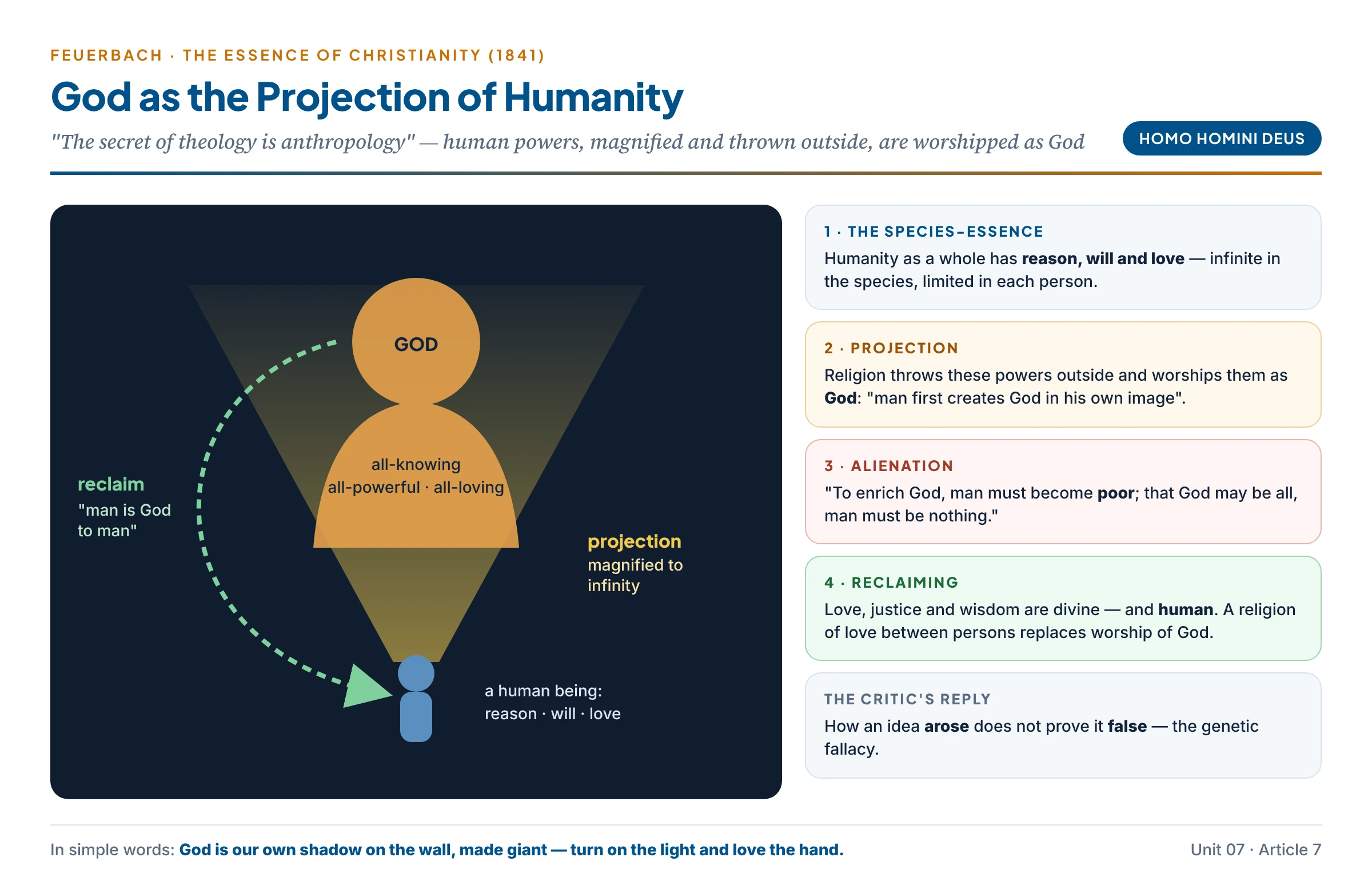
- The book. In The Essence of Christianity (1841), Ludwig Feuerbach (1804–1872) argued that “the secret of theology is anthropology” — what people say about God is really a statement about human nature.
- The projection.
- Human beings are conscious of their species-essence — the powers of humanity as such: reason, will and love.
- These powers are infinite in the species, though limited in each individual.
- Religion projects these infinite human powers outside, onto an imaginary being — God, who is all-knowing (infinite reason), all-powerful (infinite will) and all-loving (infinite love).
- “Man first unconsciously and involuntarily creates God in his own image, and after this God consciously and voluntarily creates man in his own image.” Religion is “the dream of the human mind“.
- Religion as alienation. In projecting his best qualities onto God, man impoverishes himself: “To enrich God, man must become poor; that God may be all, man must be nothing.” He worships as divine what he despises in himself as human.
- The remedy — a religion of humanity. Reclaim the projected attributes. The highest principle is “Man is God to man” (Homo homini deus). Love, justice and wisdom are divine — and they are human. The religion of the future is a religion of love between persons.
- Influence. Feuerbach’s critique deeply influenced Marx and Engels, and later Freud; his projection theory is the ancestor of every “religion is a human creation” view.
In simple words
Shine a torch on your hand in a dark room and a giant shadow appears on the wall. Feuerbach says God is that shadow: the shape comes from us — our reason, will and love — only magnified and thrown outside. Worshipping the shadow, we forget that the hand is our own. Turn on the light, he says, and love the hand.
2. Auguste Comte: The Religion of Humanity
(a) The Law of Three Stages
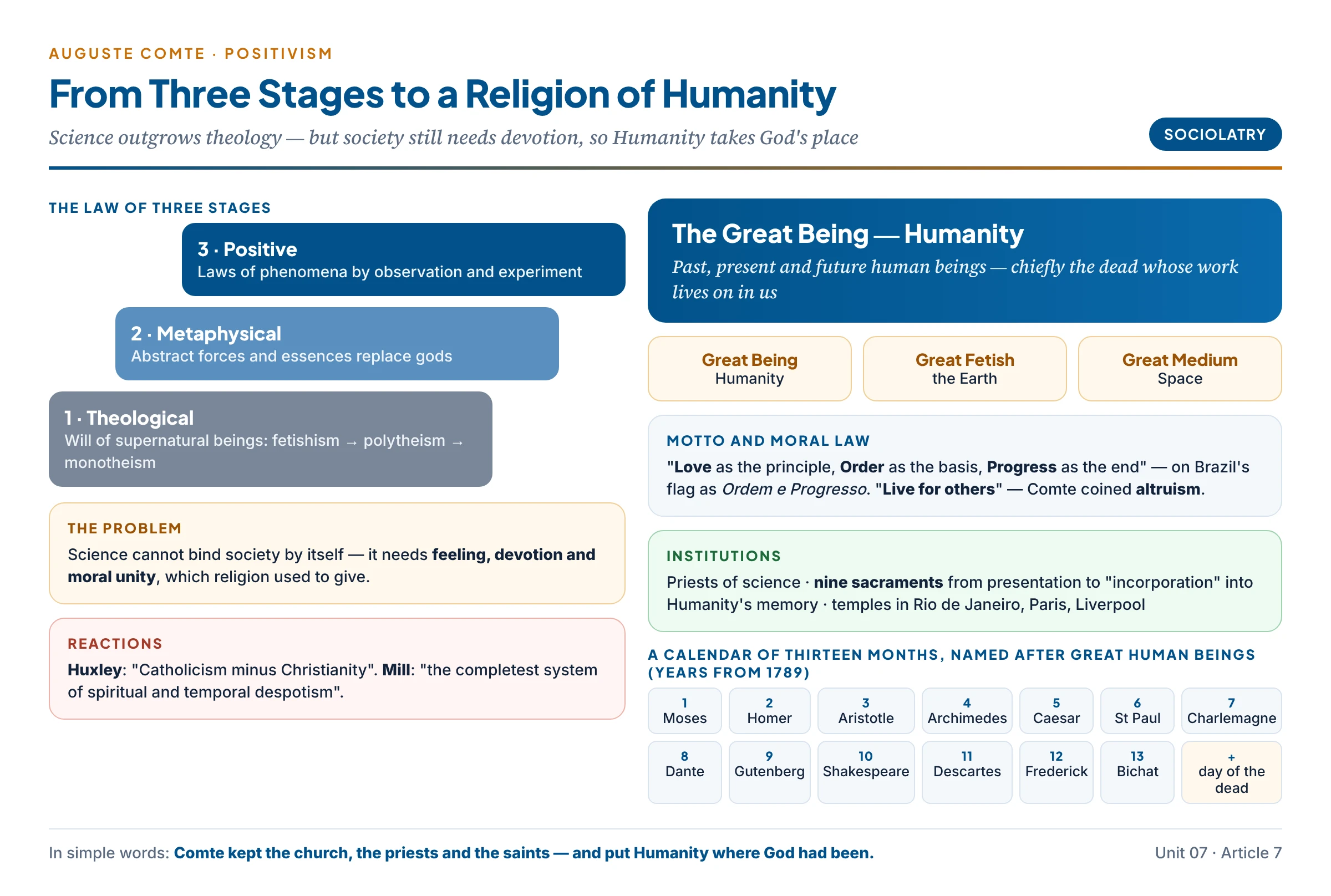
- Auguste Comte (1798–1857), founder of positivism and coiner of the word “sociology“, held that every branch of human knowledge — and humanity as a whole — passes through three stages:
- The theological stage — events are explained by the will of supernatural beings: first fetishism (spirits in things), then polytheism (many gods), then monotheism (one God).
- The metaphysical stage — supernatural beings are replaced by abstract forces and essences (“Nature”, “vital force”, “the essence of things”).
- The positive (scientific) stage — the mind gives up asking for ultimate causes and studies the laws of phenomena by observation and experiment.
- The consequence. In the positive age humanity outgrows theology and metaphysics. But Comte saw that society cannot hold together on science alone: it needs feeling, devotion and moral unity — the things religion used to supply.
(b) The Religion of Humanity
- The object of worship. In his System of Positive Polity (1851–54) and Catechism of Positive Religion (1852), Comte proposed a new religion whose supreme object is Humanity — the Great Being (Grand Être). Humanity here means the continuous whole of human beings, past, present and future, and especially the dead whose work lives on in us: “the living are always, and more and more, governed by the dead”.
- The positivist trinity. Later he added the Great Fetish (the Earth, which supports us) and the Great Medium (Space), forming a trinity with the Great Being.
- The motto. “Love as the principle, Order as the basis, Progress as the end.” Its short form, “Order and Progress” (Ordem e Progresso), stands on the national flag of Brazil, where positivism was influential.
- The moral law. “Live for others” (vivre pour autrui). Comte coined the word “altruism” (from Latin alter, “other”) for the selfless devotion that the new religion would cultivate.
- The institutions.
- A priesthood of scientist-philosophers who would teach, advise and arbitrate, but hold no political power.
- Nine social sacraments marking life’s stages — presentation (of the infant), initiation, admission, destination (choice of career), marriage, maturity, retirement, transformation (at death) and incorporation (the solemn admission of a worthy life into the memory of Humanity, some years after death).
- A positivist calendar of thirteen months, each named after a great figure of human history — Moses, Homer, Aristotle, Archimedes, Caesar, St Paul, Charlemagne, Dante, Gutenberg, Shakespeare, Descartes, Frederick and Bichat — with every day dedicated to a lesser benefactor; years counted from 1789.
- Prayer and commemoration — private and public “worship” of Humanity, and veneration of the great dead; Comte’s own devotion to Clotilde de Vaux, whom he idealised after her early death, shaped this cult.
- Temples — “Temples” or “Churches of Humanity” were built, the best known in Rio de Janeiro, with others in Paris and Liverpool.
- Sociolatry. Comte’s religion has been called sociolatry — the worship of human society.
(c) Reactions
- Thomas Huxley called it “Catholicism minus Christianity” — all the machinery of the Church without its God.
- John Stuart Mill, an early admirer of Comte’s science, called the later system “the completest system of spiritual and temporal despotism” ever devised, and joked that some passages “could have been written by no man who had ever laughed“.
- Yet Comte’s religion was the first deliberate attempt to build a complete religion — doctrine, worship and moral regime — without God, and its ideals of altruism, service and reverence for human achievement influenced organised humanism.
3. Émile Durkheim: The Sacred, the Profane and Society
(a) Defining religion without gods
- In The Elementary Forms of the Religious Life (1912), Émile Durkheim (1858–1917) asked what religion essentially is. He rejected two common definitions:
- Religion as the supernatural or mysterious — the sense of the “supernatural” is a late idea, impossible before people had a notion of natural law.
- Religion as belief in gods or spiritual beings (Tylor) — because “there are great religions from which the idea of gods and spirits is absent“. His chief examples were Buddhism and Jainism, and Vedic ritual in which the rite works by its own power.
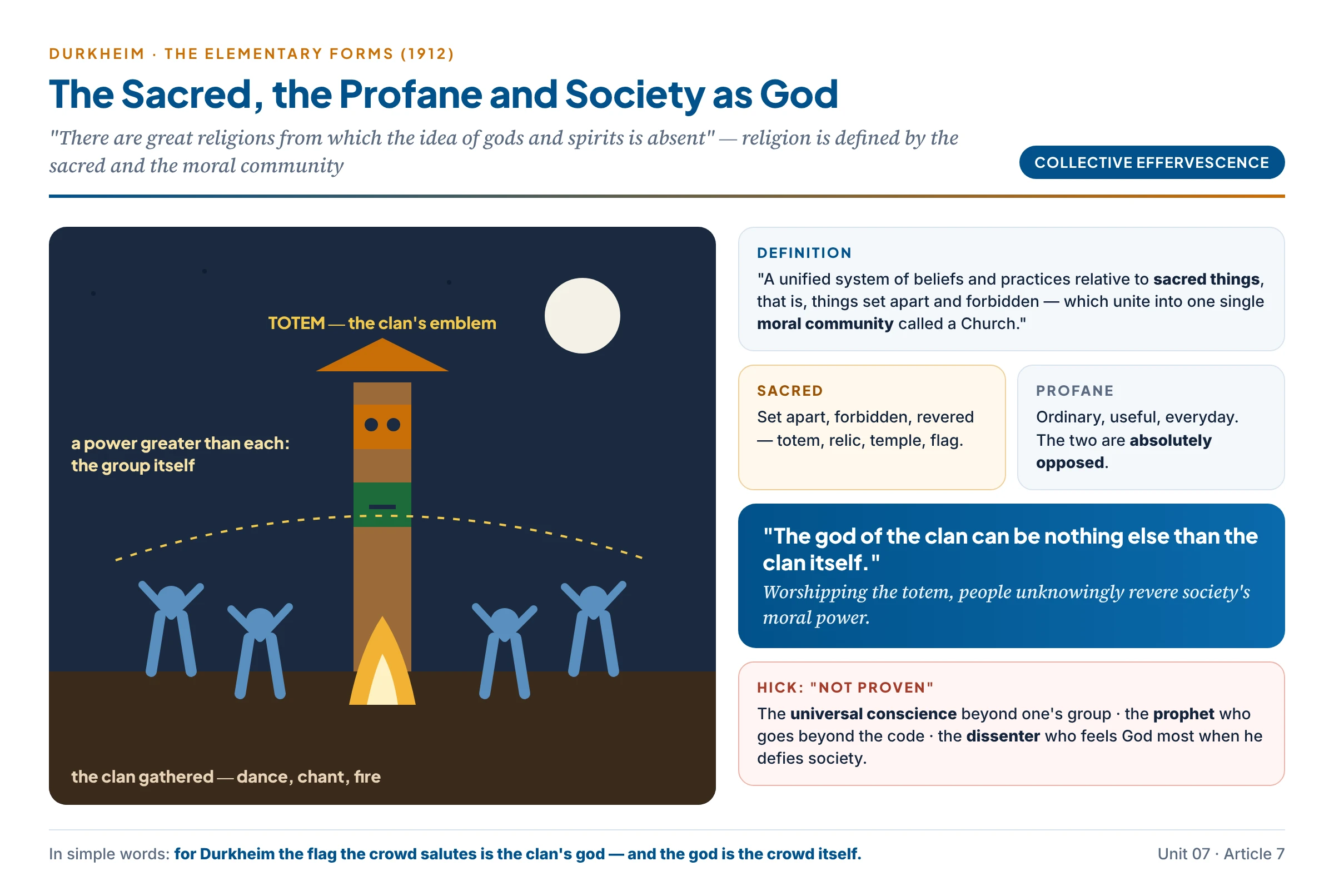
- His definition. “A religion is a unified system of beliefs and practices relative to sacred things, that is to say, things set apart and forbidden — beliefs and practices which unite into one single moral community called a Church, all those who adhere to them.“
- Two elements. (1) the sacred and (2) the moral community (Church). God is not part of the definition.
(b) The sacred and the profane
- The basic division. All religions divide the world into two radically different domains:
- The sacred — things set apart, protected by prohibitions, approached with reverence: a totem, a relic, a temple, a scripture, a flag.
- The profane — the ordinary, everyday, useful world of work and private interest.
- Absolute heterogeneity. The two are not higher and lower degrees of the same thing; they are opposed. The sacred must be protected from contact with the profane by taboos and rites, and the profane must be purified before approaching the sacred.
- Contagion. Sacredness spreads by contact — whatever touches a sacred object may itself become sacred, or dangerous.
(c) Totemism and society as God
- The Australian evidence. Durkheim studied totemism among Aboriginal Australian clans (especially the Arunta). Each clan has a totem — an animal or plant — whose emblem is sacred.
- What the totem symbolises. The totem is the flag of the clan. It represents both the sacred power (the “totemic principle”) and the clan itself. Hence Durkheim’s famous conclusion: “The god of the clan, the totemic principle, can therefore be nothing else than the clan itself, personified and represented to the imagination under the visible form of the animal or plant which serves as totem.”
- Collective effervescence. At periodic gatherings, the assembled clan dances and chants until each person feels lifted out of himself by a power greater than himself. That power is real — it is the force of the group. People interpret it as a sacred or divine force, and the totem becomes its symbol.
- Society worshipping itself. When believers worship God or sacred totems, they are unconsciously worshipping the moral authority of society — the collective conscience that commands, protects, sustains and outlasts them.
- “Something eternal in religion.” Because every society needs to reaffirm its collective ideals periodically, Durkheim held that religion — in some form — will never wholly disappear. Even secular societies create sacred objects and rites: the French Revolution’s festivals of Reason and the Supreme Being, the national flag, memorials to the war dead.
(d) Hick’s three criticisms of the sociological theory
- The universal conscience. The great monotheistic teachers summon us to care for all human beings as brothers and sisters. But the human race as a whole is not a society in Durkheim’s sense; how can “society’s voice” command loyalty to outsiders?
- The prophetic mind. Moral prophets go beyond the established code of their group and call for new and wider obligations. If moral authority is only the group’s pressure for its own preservation, how can the innovator arise? The theory fits a static “closed society”, not moral progress.
- The socially detaching conscience. Individuals such as Amos, or those who resisted apartheid in South Africa, stood against their own society — and felt God’s support most strongly at that moment. If God were society in disguise, the sense of divine support should vanish when one opposes society; in fact it is often strongest then.
- Hick’s verdict: “not proven” — the sociological theory has not established a purely natural explanation of religion.
In simple words
At a cricket World Cup final, a stadium of 100,000 people sings the anthem together; strangers hug, people weep, the flag suddenly seems holy, and everyone feels lifted by a power far greater than themselves. Durkheim would say: that power is real — it is the crowd, the nation. The flag is its totem. Religion, for him, is this experience made permanent — and its “God” is the group itself.
4. Evil, the Profane and the Foundations of Religion
- The profane as a foundation. For Durkheim the sacred can exist only by contrast with the profane. Without an ordinary world to set things apart from, nothing could be holy. Religion is built on this boundary — it tells people what is set apart, what is forbidden, and how to pass from one domain to the other (by purification, initiation, sacrifice).
- Mircea Eliade (The Sacred and the Profane, 1957) developed this: the sacred manifests itself (a “hierophany”) in a stone, a tree, a mountain, a temple, and so orients the whole of human space and time. Religious man lives in a world centred on the sacred; modern profane man lives in a homogeneous, meaningless space.
- Evil as a foundation. Religion arises equally from the experience of evil — suffering, death, guilt, injustice:
- Every great religion begins with a diagnosis of evil: sin (Christianity), suffering (duḥkha, Buddhism), bondage by karma (Jainism), ignorance (avidyā, Vedānta). Without something radically wrong, there would be nothing to be saved or liberated from.
- Hick: the great religions share a soteriological structure — a passage from a radically unsatisfactory state to a limitlessly better one (Article 1).
- Max Weber saw the need to explain undeserved suffering — the “problem of theodicy” — as one of the deepest drivers of religious thought; karma and rebirth were, for him, the most consistent theodicy ever produced.
- Impurity and pollution (the ritually “evil”) mark the boundary of the sacred in many religions — the taboo is both holy and dangerous.
- Significance for religion without God. Neither the sacred–profane boundary nor the response to evil requires a God. Buddhism is founded on the analysis of suffering; Jainism on the bondage of the soul; Durkheim’s totemism on a sacred clan-power. The foundations of religion are experiential and social, and God is one way — not the only way — of answering them.
5. Marxism as a Secular Religion
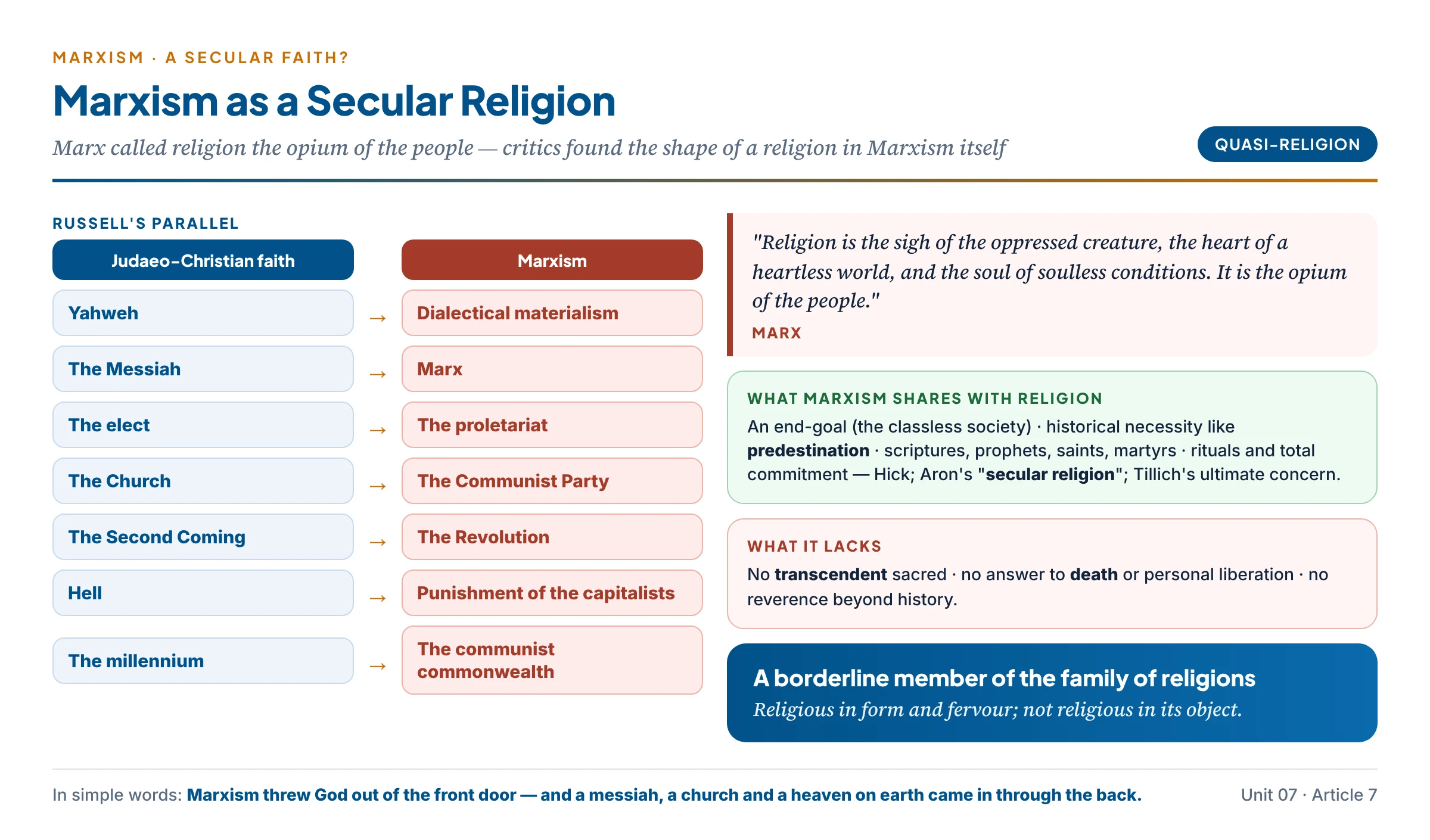
- Marx on religion. “Religion is the sigh of the oppressed creature, the heart of a heartless world, and the soul of soulless conditions. It is the opium of the people.” Religion is both a protest against real suffering and a drug that dulls it. “The abolition of religion as the illusory happiness of the people is the demand for their real happiness.” For Marx, religion would wither away once class exploitation ended.
- Marxism itself as a faith. Critics and sympathisers alike have noted that Marxism took on the form of a religion:
- Hick: Marxism has “its eschatological ideal of the ultimate classless society, its doctrine of predestination through historical necessity, its scriptures, prophets, saints and martyrs” — sharing several features of the family of religions while lacking other, probably more central, ones (Article 1).
- Bertrand Russell drew a famous parallel in his History of Western Philosophy: Yahweh becomes dialectical materialism; the Messiah, Marx; the elect, the proletariat; the Church, the Communist Party; the Second Coming, the Revolution; hell, the punishment of the capitalists; the millennium, the communist commonwealth.
- Raymond Aron called communism a “secular religion” and Marxism “the opium of the intellectuals” (1955).
- Tillich: as communists treat the classless society as ultimate, those who deny religion become religious in their own way — the party and its goal are their ultimate concern.
- Is Marxism a religion? It has faith (in history), hope (the classless society), community, rituals, sacred texts and total commitment. But it lacks a transcendent sacred, any concern with death and personal liberation, and any reverence beyond history. On the family-resemblance view, it is a borderline case — a quasi-religion.
Common confusion
Did Marx say religion is simply a drug invented by rulers to fool the people? Not quite. Marx called religion the “opium of the people” — something the suffering take to dull real pain, and also “the sigh of the oppressed creature” and “the heart of a heartless world”. It is at once a protest against misery and a consolation that keeps people from changing their conditions. His target was the conditions that make such consolation necessary, more than the believers themselves.
6. Can Humanism Be a Substitute for Religion?
(a) What humanism offers
- Humanism as a religion by definition. If religion is defined as total commitment to an object of devotion, then communism, scientism (devotion to science as the only path to truth) and humanism all count as religions — the communist treats the classless society as ultimate, the humanist treats humanity itself as God, and a scientist who consecrates his life to the search for truth is “no less religious” (Tillich’s ultimate concern; Article 3).
- Humanism places human beings — their dignity, reason, welfare and creativity — at the centre of value, without dependence on supernatural authority.
- Religious humanism. Some humanists consciously offered humanism as a religion:
- Comte‘s Religion of Humanity (above).
- Ethical Culture (founded by Felix Adler, New York, 1876) — “deed, not creed“: congregations, Sunday meetings and moral education without theology.
- The Humanist Manifesto (1933), signed by John Dewey among others, spoke of “religious humanism“: “religion consists of those actions, purposes and experiences which are humanly significant”.
- Julian Huxley‘s evolutionary humanism (Article 8).
- Indian humanisms. M.N. Roy‘s radical humanism; Tagore‘s The Religion of Man (1931), a spiritual humanism centred on the divine in humanity; Vivekananda‘s call to serve daridra-nārāyaṇa (God in the poor) — serving human beings as worshipping God; Gandhi‘s “Truth is God”; Ambedkar‘s Navayāna (Article 4); Periyar‘s rationalism; Gora‘s positive atheism.
(b) The case that humanism can substitute for religion
- Morality — humanism provides a full ethic: dignity, rights, compassion, justice, without divine command.
- Meaning — devotion to human welfare, knowledge and beauty gives life purpose.
- Community — humanist associations, service organisations and civil society provide fellowship.
- Freedom from religion’s dangers — no sectarian wars, no persecution of heretics, no caste sanctioned by scripture.
- Harmony with science — no conflict between faith and reason.
(c) The case that it cannot
- No transcendence. Humanism offers no answer to death, cosmic meaning or ultimate mystery; it cannot console the dying or the bereaved as religion does.
- No sacred. Without something set apart and revered, humanism tends to become mere ethics or politics — and the history of Comte’s cult shows how artificial a manufactured sacred can feel.
- Humanity is ambiguous. Humanity produces the Buddha and Gandhi but also war and genocide; worshipping “Humanity” risks worshipping the bad with the good.
- Thin community and ritual. Humanist rites rarely match the depth of religious festivals, pilgrimages and rites of passage.
In simple words
Humanism is like a well-built house with strong walls, bright rooms and fair rules for everyone — but no window looking at the sky. Many people live happily in it. Others feel something missing at night, when they think of death and the stars. Religion, at its best, is the window; humanism, at its best, keeps the house just.
(d) In the context of present Indian society
- India is deeply religious: religion shapes identity, festivals, family life and morality for the vast majority. A humanism that attacks religion would be neither accepted nor wise.
- But India also needs humanism: to fight caste, communalism, superstition and gender discrimination — evils that have often been defended in religion’s name.
- The Constitution’s answer. Article 51A(h) makes it a fundamental duty of every citizen “to develop the scientific temper, humanism and the spirit of inquiry and reform” — while Articles 25–28 protect religious freedom. The Constitution thus asks for humanism alongside religion, not instead of it.
- The Indian tradition’s own humanism — Buddhist compassion, Jaina non-violence, Bhakti saints’ equality, Vivekananda’s service, Gandhi’s sarvodaya, Ambedkar’s fraternity — shows that the best substitute is not humanism against religion but a humanised religion and a religiously serious humanism.
- Verdict. Humanism can replace some functions of religion — morality, social reform, meaning in service — but not all; in India it works best as a corrective and complement to religion rather than a substitute for it.
Indian Connect — Humanism and religion in India
- Vivekananda taught that serving human beings is worshipping God (śiva-jñāne jīva-sevā, serving the living being as God) — a humanism expressed in religious language.
- Tagore’s Religion of Man and Gandhi’s “Truth is God” bring religion close to humanism; Ambedkar and Gora show humanism without God.
- The Constitution’s call for “scientific temper, humanism and the spirit of inquiry and reform” (Article 51A(h)) sits beside its protection of religious freedom (Articles 25–28) — a characteristically Indian synthesis.
Critical Evaluation
The Projection and Sociological Theories
- Strengths.
- They explain why religions take the forms they do — human-like gods, tribal gods, class-serving religions.
- They show that the functions of religion — cohesion, meaning, morality, consolation — can be identified independently of God, and so make religion without God intelligible.
- Durkheim’s definition by the sacred fits Buddhism and Jainism far better than Tylor’s.
- Weaknesses.
- The genetic fallacy. Showing how a belief arose does not show it is false: that God-images resemble fathers or kings does not prove there is no God (Hick: “not proven”).
- Reductionism. They explain religion as “nothing but” projection, society or ideology — ignoring what believers experience as an encounter with a reality beyond themselves.
- Narrow evidence. Durkheim generalised from a few Australian clans; later anthropologists questioned both his data and the universality of a strict sacred–profane split.
- Self-undermining. If all ideals are projections of society or class, so are the ideals of the theorists themselves.
The Constructive “Religions of Humanity”
- Strengths — they keep altruism, commemoration, community and reverence for human achievement; Comte’s “live for others” is a genuine moral ideal.
- Weaknesses — artificial ritual, the danger of idolising society or the state (twentieth-century totalitarian cults of nation and party), and the absence of a transcendent standard by which society itself can be judged — the very point of Hick’s prophetic criticism.
Critics and Defenders
Criticism — Critics of the religions of humanity and society
- Hick: the universal conscience, the prophet and the dissenter show that God is not society in disguise — “not proven”.
- Mill and Huxley: Comte’s cult is despotic — Catholicism minus Christianity.
- The genetic fallacy: how a belief arose does not settle whether it is true.
- History: worship of society and party fed totalitarian cults.
- Believers: humanity is too flawed to be worshipped; humanism cannot face death.
Defence — Defenders and their strengths
- Feuerbach: God’s attributes are human ideals; reclaiming them ends alienation.
- Comte: “live for others” — altruism as the moral law of a godless religion.
- Durkheim: religion is defined by the sacred and the moral community, not by gods.
- Humanists: dignity, reason and compassion need no supernatural sanction.
- The Indian Constitution: scientific temper and humanism are duties of every citizen.
Cross-Tradition Comparison
Four Western Thinkers on Religion without God
| Thinker | What religion really is | What should replace God | Key phrase |
|---|---|---|---|
| Feuerbach | Projection of the human species-essence | Love of humanity | “Man is God to man” |
| Comte | A stage of thought to be outgrown — but a social need | The Great Being — Humanity | “Live for others” |
| Durkheim | Society worshipping itself through sacred symbols | Civil and moral ideals of society | “The god of the clan is the clan itself” |
| Marx | Opium of the people; protest against suffering | A just, classless society | “The heart of a heartless world” |
Western Humanism and Indian Humanism
| Point | Western secular humanism | Indian humanist strands |
|---|---|---|
| Relation to religion | Usually separate from or opposed to it | Often within religion (Vivekananda, Tagore, Gandhi) or reforming it (Ambedkar) |
| Main concern | Reason, rights, science | Social equality, compassion, service, spiritual growth |
| Attitude to God | Atheist or agnostic | Varies — theist (Vivekananda), Truth as God (Gandhi), non-theist (Ambedkar, Roy, Gora) |
| Typical form | Ethical societies, manifestos | Movements of service and reform, constitutional values |
Indian Connect — Takeaways
- Durkheim’s best evidence that religion does not need gods came from India — Buddhism and Jainism.
- India’s humanisms are mostly religious or reforming, not anti-religious; the Constitution pairs humanism with religious freedom.
Synthesis (Siddhānta)
- Feuerbach, Comte, Durkheim and Marx made religion without God thinkable in the modern West: Feuerbach by showing God’s attributes to be human ideals; Durkheim by defining religion through the sacred and the community, citing Buddhism and Jainism; Marx by tracing religion to suffering and society; Comte by actually building a religion whose object is Humanity.
- Their lasting insight is that religion’s functions — binding a community, marking the sacred, responding to evil, giving moral direction — do not depend on belief in a personal God. The sacred–profane boundary and the response to evil are the deeper foundations of religion.
- Their weakness is reductionism: by explaining religion as “nothing but” projection or society, they cannot explain the prophet who defies society, the universal conscience, or the believer’s sense of a reality beyond the human. And their constructed religions — Comte’s cult, the secular faiths of party and nation — proved either artificial or dangerous.
- Humanism can take over many of religion’s moral and social tasks but not its encounter with death, mystery and the transcendent; in India it works best as a partner of religion — a humanised religion and a reverent humanism.
- Contemporary relevance.
- Civil religion — flags, anthems, memorials and national festivals — shows Durkheim’s “something eternal in religion” in secular states.
- Humanist movements and the “spiritual but not religious” continue Comte’s and Feuerbach’s project.
- India’s constitutional duty to cultivate scientific temper and humanism alongside religious freedom is a living experiment in the relation between religion and humanism.
“The god of the clan, the totemic principle, can therefore be nothing else than the clan itself, personified and represented to the imagination under the visible form of the animal or plant which serves as totem.” — Émile Durkheim
Previous Year Questions
- 2021Can humanism be a substitute for religion? Explain and evaluate in the context of the present Indian society.
- 2019What role do the concepts of evil and profane play to provide a firm foundation to religion?
- 2016“World-religion is a spiritualistic and humanistic composite.” Evaluate.
- 2005Can atheism be a religion? Discuss.