

Religion without God.
Official Syllabus: Paper II, Section B, Unit 7
Buddhism is the clearest test case for religion without God. It has no creator of the world, no eternal soul (anattā), no saviour who forgives sins and no sacrifice that pleases a deity — and yet for two and a half thousand years it has given hundreds of millions of people a sacred goal (nirvāṇa), a path (the Noble Eightfold Path), a refuge (the Buddha, the Dhamma and the Saṅgha), scriptures, monasteries, rituals, pilgrimage and devotion. This article states and evaluates Buddhism as a religion without God: the Buddha’s silence on speculative questions, his stories of the deluded creator-god Brahmā, the arguments of Buddhist thinkers against a creator, the self-governing moral law of karma, the challenge of anattā to religion, the devotional turn of Mahāyāna, and Ambedkar‘s modern Navayāna.
In simple words
A doctor does not need to know who built the hospital to cure a patient. The Buddha described himself as a physician: he found the disease (suffering), its cause (craving), its cure (nirvāṇa) and the medicine (the Eightfold Path). Whether there is a builder of the world was, for him, a question that does not heal. His religion is a hospital without a founder’s portrait — and it has been treating patients for 2,500 years.
Context & Problem
The Religious World of the Buddha
- Two currents. In the Buddha’s India (5th century BCE) there were two religious currents:
- The Brahmanical (Vedic) current — sacrifices to gods (Indra, Agni, Varuṇa) and, in the later Vedic period, Brahmā or Prajāpati as the creator of beings.
- The śramaṇa (wandering ascetic) current — Jainas, Ājīvikas, materialists, sceptics — who rejected Vedic authority and sought liberation by effort and austerity.
- The Buddha’s position. The Buddha belonged to the śramaṇa current. He rejected the authority of the Veda, the efficacy of animal sacrifice, the caste privileges claimed through it, and the idea that a creator-god governs human destiny.
- His one concern. “I teach only suffering and the end of suffering.” All his teaching is directed to the removal of suffering in the form of nirvāṇa, and he gives no place to God in its attainment.
- The question. Without God, soul or sacrifice, is Buddhism a religion — or, as many Western scholars said, an ethical philosophy or a psychology?
Core Doctrine
1. The Buddha’s Attitude: Practical Silence, Not Dogmatic Denial
- The unanswered questions (avyākata). The Buddha set aside ten speculative questions — whether the world is eternal, whether it is finite, whether the soul is the same as the body, whether the Tathāgata exists after death — because they “do not lead to disenchantment, to calm, to direct knowledge, to awakening, to nirvāṇa” (Article 2, the parable of the poisoned arrow).
- The question of a creator is of the same kind. The Buddha did not build his teaching on a proof that God does not exist. He showed instead that liberation is possible without a creator, and that belief in a creator can obstruct liberation by making people passive and dependent.
- Gods without God. It is important to be precise:
- Buddhist cosmology does contain gods (devas) — Indra (Sakka), Brahmā and countless others — living in heavenly realms.
- But they are beings within saṃsāra: born, long-lived, yet mortal, subject to karma and in need of liberation themselves.
- The Buddha is called “teacher of gods and humans” (satthā deva-manussānaṃ) — the gods come to him to learn.
- So Buddhism denies a creator God (an eternal, all-powerful maker and ruler of the world), not the existence of any superhuman beings.
Common confusion
Does Buddhism deny the existence of all gods? No. Early Buddhist texts are full of devas, including Brahmā and Sakka (Indra), who visit the Buddha and praise his teaching. What Buddhism denies is a creator God — an eternal, almighty being who made and governs the world and on whom liberation depends. The devas are impermanent beings, bound by karma, who must themselves attain nirvāṇa. So Buddhism is non-theistic (no creator), not “anti-supernatural”.
2. The Deluded Creator: Stories of Brahmā
The Buddha attacked the creator idea less by syllogism than by stories that show how such a belief arises and why it is mistaken.
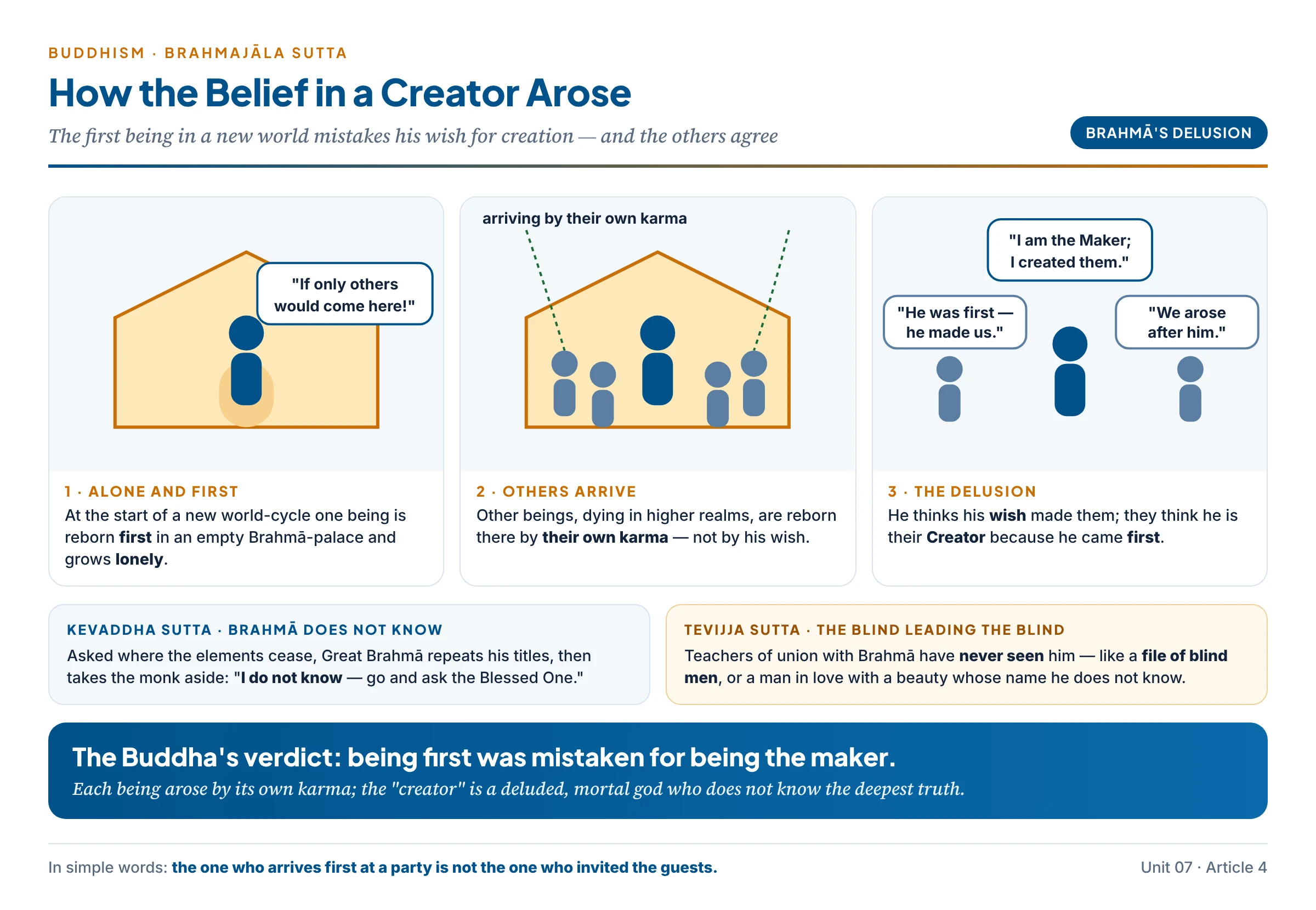
- Mahā-Brahmā’s delusion (Brahmajāla Sutta).
- At the beginning of a new world-cycle, a being dies in a higher realm and is reborn first in an empty palace of the Brahmā world. He lives there long, alone, and grows lonely: “Oh, if only other beings would come here!“
- Just then, by their own karma, other beings also die in higher realms and are reborn in that world as his companions.
- He thinks: “I am Brahmā, the Great Brahmā, the Conqueror … the Maker, the Creator, the Ruler … These beings were created by me. Why? Because I wished, ‘Oh, if only other beings would come here!’ — and on my wishing, they came.”
- The other beings think: “This is the Great Brahmā, the Creator. We were created by him, for we see that he was here first and we arose after him.”
- The lesson: belief in a creator arises from mistaking sequence for causation — “he was here first, so he made us”. In truth each being arose by its own karma.
- Brahmā does not know (Kevaddha Sutta). A monk with a question — “where do the four great elements cease without remainder?” — climbs the heavens until he reaches the Great Brahmā himself. Brahmā answers three times only with his titles: “I am Brahmā, the Great Brahmā, the Maker, the Creator…”. Then he takes the monk aside and confesses: “These gods believe there is nothing Brahmā does not know; so I did not answer in front of them. But I do not know … Go back to the Blessed One and ask him.” The “creator” is ignorant of the deepest truth; the Buddha, a human teacher, knows it.
- The blind leading the blind (Tevijja Sutta). Brahmins who teach the path to union with Brahmā have never seen Brahmā — nor have their teachers, nor their teachers’ teachers. They are like a file of blind men, each holding the one in front: the first does not see, the middle does not see, the last does not see. They are like a man who says he loves the most beautiful woman in the land but cannot say her name, her family, her height or her colour.
In simple words
You arrive first at a party in an empty hall and wish, “I hope others come.” Soon the guests arrive — each invited by their own friends. You think, “My wish brought them!” The guests, seeing you there first, think, “He must be the host.” Both are wrong. That, says the Buddha, is how the belief in a creator began: the one who came first was mistaken for the one who made the rest.
3. Doctrinal Grounds: Why Buddhist Metaphysics Leaves No Room for a Creator
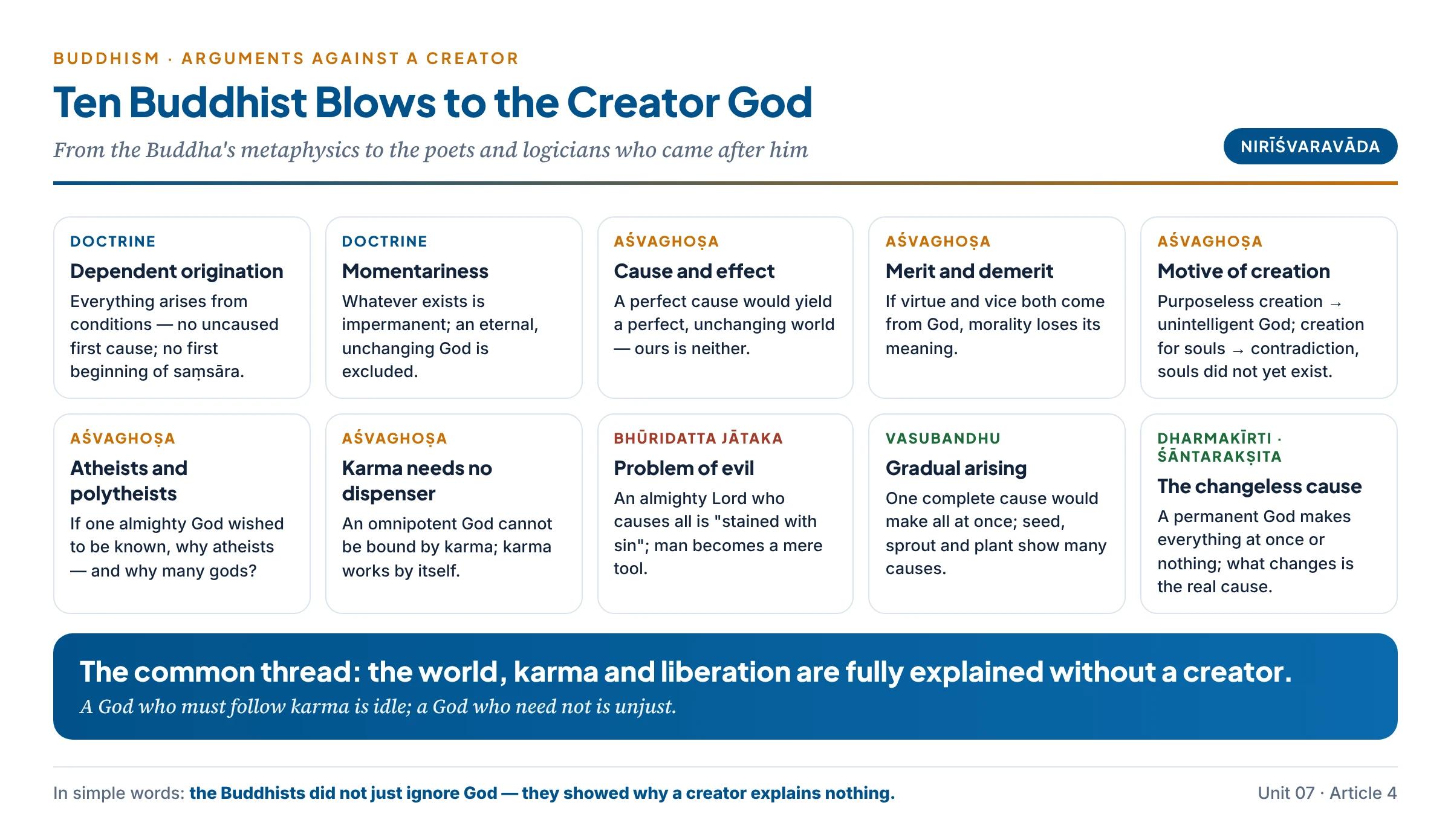
- Dependent origination (pratītyasamutpāda). “When this is, that is; from the arising of this, that arises; when this is not, that is not; from the ceasing of this, that ceases.” Everything arises dependent on conditions. There is no need of God to guide the causal process — and the doctrine itself rules out an uncaused first cause. An uncaused God would be an exception the doctrine cannot allow.
- Momentariness (kṣaṇikavāda). Whatever exists is impermanent and, in later Buddhist philosophy, momentary. An eternal, unchanging God is excluded: nothing permanent can be real, and nothing unchanging can act.
- No first beginning. “Inconceivable is the beginning of this saṃsāra; a first point is not discerned of beings roaming and wandering on, hindered by ignorance and fettered by craving.” With no first beginning, no first maker is needed.
- Karma is intention. “Intention (cetanā), monks, is what I call karma.” The variety of worlds, bodies and experiences arises from the intentional actions of beings themselves.
- No-self (anattā). If there is no permanent self in man, there is no reason to posit a permanent Self of the universe either.
- The refutation of proofs. Buddhist logicians examined and refuted the Nyāya proofs for God’s existence (Unit 02).
4. Arguments of Buddhist Thinkers against a Creator
(a) Aśvaghoṣa (1st–2nd century; poet of the Buddhacarita)
- Cause and effect. If God is the cause and the world the effect, the effect should share the nature of its cause. A perfect, unchanging, conscious God would produce a perfect, unchanging, conscious world — but the world is imperfect, changing and largely unconscious.
- Merit and demerit. If both virtue and vice originate from God, there is no real distinction between merit and demerit, and so no possibility of morality as such: the sinner only does what God made him do.
- The motive of creation. A perfect God can have no motive of his own. If creation is purposeless, God is unintelligent. If God created for the well-being of souls, this is self-contradictory, because the souls themselves are said to be the result of creation — there was no one to benefit before he created.
- Atheists and polytheists. If God is the omnipotent creator, why are there atheists? And if God is one, why are there polytheists? An almighty God who wished to be known would not leave so much ignorance and disagreement about himself.
- The moral argument rejected. Theists say God is needed to dispense the fruits of karma. But an omnipotent God cannot be bound by the law of karma; and in fact there is no need of God, because karma functions autonomously through dependent origination.
(b) The problem of evil: the Bhūridatta Jātaka
- “If there exists some Lord all-powerful to fulfil in every creature bliss or woe, and action good or ill, that Lord is stained with sin; man does but work his will.“
- The argument: if God causes everything, God causes every evil; then God is guilty, and human beings are mere instruments with no responsibility. The Jātaka stories cite the problem of evil as a major reason for rejecting a personal God. This is the Buddhist form of the dilemma later made famous in the West by Epicurus and Hume: if God cannot prevent evil, he is not all-powerful; if he will not, he is not all-good.
(c) Vasubandhu (4th–5th century)
- If the world came from God alone, the cause being complete, the whole world would have arisen all at once. But things arise gradually — seed, sprout, plant — showing they depend on many changing causes, not one.
- If God needs other causes to help him, he is not the sole cause; and God’s own joy in creating would itself need a cause.
(d) Dharmakīrti (7th century) and Śāntarakṣita (8th century)
- A changeless cause makes no difference. A cause is what makes a difference: when it is present the effect arises, when absent it does not. A permanent God is always present; so he would produce everything at once — or nothing at all. If effects come one after another, what changed — not God — is the real cause.
- Śāntarakṣita‘s Tattvasaṅgraha devotes a whole chapter to the examination of God (Īśvara-parīkṣā) and presses the same point: succession in nature shows changing causes, not one changeless God.
5. A Self-governing Moral Order: Dhamma and Karma
- The Dhamma as natural law. The Buddha discovered the Dhamma; he did not make it: “Whether Tathāgatas arise or not, this remains a fact, an established principle, a fixed law: all conditioned things are impermanent … all conditioned things are suffering … all things are not-self. A Tathāgata fully awakens to this and then teaches it.” The moral and spiritual order of the universe is impersonal and eternal — it does for Buddhism what God’s law does for theism.
- Karma without a judge. Good actions bring happiness, bad actions bring suffering, as surely as a seed produces its own kind of plant. The cosmic law of karma operates automatically; Buddhism needs no divine judge to enforce justice.
- So the moral order is objective. Buddhism is not moral relativism: right and wrong are rooted in the nature of things (craving produces suffering; compassion produces peace), not in anyone’s command.
6. Self-reliance: “Be a Lamp unto Yourselves”
- The last teaching. Near his death, in the Mahāparinibbāna Sutta, the Buddha told Ānanda: “Be a lamp (or island) unto yourselves, be a refuge unto yourselves, seek no external refuge” (attadīpā viharatha attasaraṇā anaññasaraṇā).
- The Buddha only shows the way. “You yourselves must strive; the Tathāgatas only point the way.” (Dhammapada)
- No one can purify another. “By oneself is evil done; by oneself is one defiled … purity and impurity depend on oneself; no one can purify another.” (Dhammapada)
- The threefold training. Liberation is achieved not through prayer or divine grace but through:
- Śīla — ethical discipline (right speech, action, livelihood);
- Samādhi — mental cultivation and concentration (right effort, mindfulness, concentration);
- Prajñā — liberating wisdom (right view, right intention).
- The religious meaning of self-reliance. This is not pride but responsibility: the Buddhist cannot blame God or fate for his condition, nor wait for a saviour. Self-reliance is itself the Buddhist form of religious seriousness.
7. Why Buddhism Is a Religion
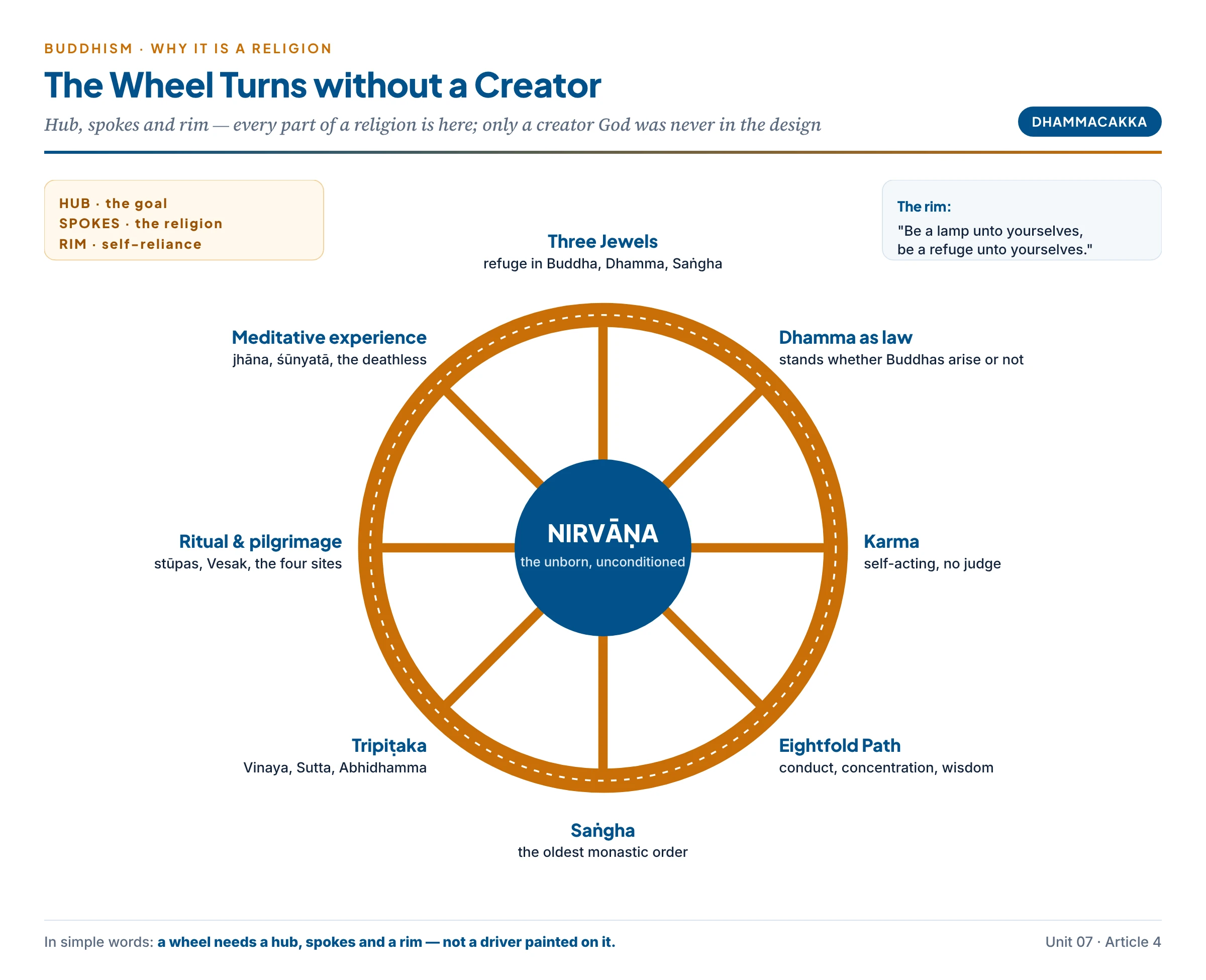
Buddhism has every mark of a religion except a creator God:
- A sacred, ultimate goal — nirvāṇa. “There is, monks, an unborn, unbecome, unmade, unconditioned. If there were not, no escape would be discerned from the born, become, made and conditioned.” Nirvāṇa is transcendent — beyond the conditioned world — and is the supreme object of aspiration.
- Refuge and reverence. The Three Jewels — Buddha, Dhamma, Saṅgha — are the objects of refuge, recited daily by Buddhists everywhere: “I go to the Buddha for refuge…”.
- An absolute moral order — the Dhamma and karma.
- A path — the Noble Eightfold Path and the threefold training.
- A community — the Saṅgha of monks and nuns, supported by lay followers; the oldest continuous monastic order in the world.
- Scriptures — the Tripiṭaka (Vinaya, Sutta, Abhidhamma) and the vast Mahāyāna sūtras.
- Ritual and worship — offerings of flowers, lamps and incense before the Buddha image; veneration of relics in stūpas; recollection of the Buddha (Buddhānussati); the fortnightly uposatha observance; festivals such as Vesak (Buddha Pūrṇimā).
- Pilgrimage — to the four sites the Buddha himself named: Lumbinī (birth), Bodh Gayā (awakening), Sārnāth (first teaching) and Kuśinagara (final nirvāṇa).
- Sacred and profane — monastery and world, the robe and ordinary dress, the relic and ordinary objects.
- Religious experience — the jhānas (meditative absorptions), insight into emptiness (śūnyatā), the “deathless” peace of nirvāṇa. Even a non-theist — even an atheist — can have a mystical experience: nature mysticism, the Buddhist experience of śūnya, and Zen enlightenment are classic examples; charismatic and regenerative experiences are also reported in non-theistic traditions such as Buddhism and Jainism.
- The verdict of the observers. William James counted Buddhism a religion that “does not positively assume a God”; Durkheim made Buddhism his chief evidence that “there are great religions from which the idea of gods and spirits is absent”; the Supreme Court of India (Shirur Mutt, 1954) named Buddhism and Jainism as religions that “do not believe in God or in any Intelligent First Cause” (Article 1).
In simple words
A wheel needs a hub, spokes and a rim — not a driver painted on it. Buddhism’s hub is nirvāṇa, its spokes are the refuges, the path, the community, the scriptures and the rites, and its rim is self-reliance. Nothing is missing that makes a wheel turn; only the driver — a creator God — was never part of the design.
8. Anattā and Religion: Can a Religion Deny the Soul?
- The objection. Most religions promise salvation to the soul. If Buddhism denies a permanent self (anattā), who is bound, who is reborn, who is liberated? Without a soul, surely there is no religion — only a psychology of mental states.
- The Buddhist replies.
- Anattā denies a permanent substance, not the person. The person is a stream (santāna) of the five aggregates — body, feeling, perception, mental formations, consciousness — causally continuous though never the same. Nāgasena‘s chariot analogy (in the Milindapañha): “chariot” is a name for wheels, axle, pole and frame in a certain arrangement; there is no extra chariot-substance — yet the chariot carries the king.
- Rebirth without a soul. What passes from life to life is not a soul but the karmic force of the stream — as a flame lit from one lamp to another, or an echo, or the impression of a seal on wax. Nothing travels, yet the second is conditioned by the first.
- Liberation is the end of craving, not of a substance. Nirvāṇa is the “blowing out” of the fires of greed, hatred and delusion. The Buddha rejected annihilationism (ucchedavāda) as firmly as eternalism (śāśvatavāda) — the middle way.
- Anattā is itself a religious ideal. The dismantling of ego — the root of selfishness, fear and cruelty — is the goal of every mystical tradition. In this sense anattā makes Buddhism more, not less, religious: its whole path is the self-transcendence that other religions seek through surrender to God.
- The verdict. Buddhism can be regarded as a religion despite anattā — perhaps because of it — since religion requires a transformation of the person towards the sacred, not a permanent soul to be saved (Unit 04).
In simple words
A river keeps its name for centuries, though not a single drop of today’s water was there last year. There is no permanent “river-substance” — only a flowing continuity. Buddhism says a person is like that river: no fixed soul, yet a real stream of life that carries its karma forward — and can finally reach the ocean of nirvāṇa.
9. Mahāyāna: Devotion Returns, the Creator Does Not
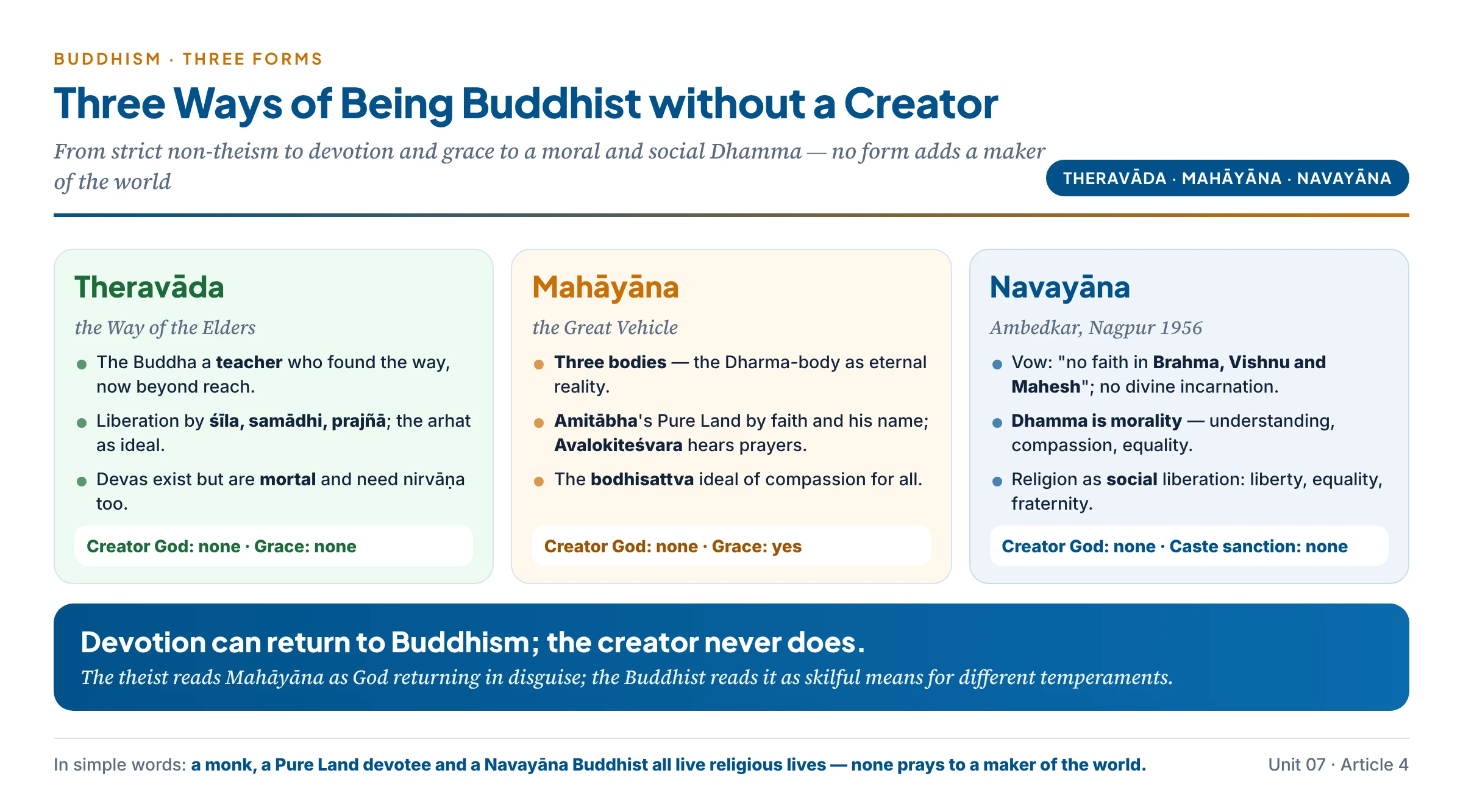
- The devotional turn. Within a few centuries of the Buddha, Mahāyāna developed forms of religion that look strongly theistic:
- The three bodies (trikāya). The Dharma-body — the Buddha as eternal ultimate reality; the enjoyment-body — glorious Buddhas in heavenly “Buddha-fields”; the transformation-body — the historical Buddha who appeared on earth.
- The eternal Buddha of the Lotus Sūtra, who only appeared to be born and to die, out of compassion.
- Amitābha (Amida), whose Pure Land is reached by faith and the recitation of his name — a religion of grace remarkably like Christian or Vaiṣṇava devotion.
- Bodhisattvas such as Avalokiteśvara (the compassionate one) who hear the cries of beings and answer prayers.
- Vajrayāna (Tibetan) Buddhism with its many deities of meditation and, in some schools, a primordial Buddha (Ādi-Buddha).
- Is Mahāyāna theistic?
- The theist says yes: here is grace, prayer, a saviour, an eternal Buddha — the religious heart has put God back under another name. This is evidence that religion needs something like God.
- The Buddhist says no: even the most devotional Mahāyāna has no creator of the world; the Buddhas and Bodhisattvas are enlightened beings who were once ordinary beings; the Dharma-body is the nature of reality (emptiness), not a personal ruler; devotion is an upāya (skilful means) suited to beings of different capacity.
- A balanced view: Mahāyāna shows that Buddhism can include devotion and grace without becoming creator-theism. It occupies a middle position between strict non-theism and full theism.
10. Ambedkar’s Navayāna: A Religion of Morality without God
- The conversion. On 14 October 1956, at Nagpur, Dr B.R. Ambedkar embraced Buddhism with hundreds of thousands of followers. The twenty-two vows he prescribed begin: “I shall have no faith in Brahma, Vishnu and Mahesh, nor shall I worship them“; another vow rejects the belief that God has ever taken incarnation.
- His reading of Buddhism (The Buddha and His Dhamma, published 1957):
- Religion must be rational — it must agree with reason and science.
- Dhamma is morality. In place of God, the centre of religion is morality — understanding (prajñā), compassion (karuṇā) and equality, lived as fellowship (maitrī) with all.
- Religion is social. The Dhamma aims at the reconstruction of the world — liberty, equality and fraternity — not merely private salvation. The Buddha, for Ambedkar, was a social reformer as well as a spiritual teacher.
- Against caste. A religion that sanctifies inequality through divine authority cannot be true religion; Buddhism, with no God to sanction caste, offers equal dignity to all.
- Significance. Ambedkar shows that religion without God can be a living, mass religion of the oppressed — not only a philosophy of monks — and that removing God from religion can be an act of social liberation (Socio-Political Unit 10).
Indian Connect — Buddhism in India today
- Ambedkar’s movement made Buddhism a living Indian religion again; the 2011 Census counted about 84 lakh Buddhists in India, the great majority in Maharashtra.
- The Supreme Court has repeatedly cited Buddhism as proof that religion in India is “not necessarily theistic“.
Critical Evaluation
Objections to Buddhism as a Religion without God
- From theism.
- Karma needs a dispenser. An unconscious law cannot match each deed to its exact fruit over many lives; only an all-knowing God can (Nyāya, Śaṅkara).
- No grace, no prayer. A religion of pure self-effort offers little to the weak and suffering; the rise of Mahāyāna devotion shows that ordinary believers need a saving person.
- Re-deification. In popular practice the Buddha is worshipped as God — images, offerings, prayers for help.
- From Western scholarship. Early Western observers called Buddhism an ethical philosophy, a psychology, or even “atheism“, not a religion, because it lacks a God and a soul.
- Internal tensions.
- Anattā and rebirth. If there is no self, what is reborn, and who is responsible? (Answered by the stream theory — but critics find it strained.)
- Momentariness and responsibility. If everything is momentary, how can the doer of a deed be the one who reaps its fruit?
- A beginningless world may only postpone the question why there is any world at all.
Replies and Strengths
- Karma as natural law needs no more a judge than gravity needs a policeman; and a God who must follow karma is idle, while one who need not is unjust.
- Self-reliance is not cruelty: Buddhism has the Saṅgha, the teacher, the refuges, and, in Mahāyāna, compassionate Bodhisattvas — help without a creator.
- Worship of the Buddha is reverence and recollection, not belief that he created or rules the world.
- Buddhism meets every functional and family-resemblance criterion of religion (Articles 1 and 3).
- It avoids the problem of evil entirely — it never claimed that an all-good, all-powerful being made this suffering world.
- It anticipates modern thought — naturalistic causation, psychological insight into the self, and ethics grounded in the consequences of action.
Critics and Defenders
Criticism — Critics of Buddhism as a godless religion
- Nyāya and Śaṅkara: unconscious karma cannot dispense fruits; a conscious Lord is needed.
- Theists: without grace and prayer, religion is too hard for ordinary people.
- Popular practice: the Buddha is worshipped as a god; Mahāyāna restores a saviour.
- Western scholars: Buddhism is an ethical philosophy, not a religion.
- Critics of anattā: no self means no one to be liberated.
Defence — Defenders and Buddhist replies
- The Buddha: whether Tathāgatas arise or not, the Dhamma stands — an impersonal law needs no ruler.
- Aśvaghoṣa, Dharmakīrti: a creator would be unjust, unintelligent or idle; a changeless cause can do nothing.
- Bhūridatta Jātaka: an almighty Lord would be stained with every sin.
- James, Durkheim, the Supreme Court: Buddhism is a religion without God.
- Ambedkar: a moral and social Dhamma without God liberates the oppressed.
Cross-Tradition Comparison
Buddhist and Western Arguments against a Creator
| Buddhist argument | Point | Western parallel |
|---|---|---|
| Brahmajāla — Brahmā’s delusion | Being first is mistaken for being creator | Hume — order and sequence do not prove a designer |
| Bhūridatta Jātaka | An almighty Lord is responsible for all evil | Epicurus, Hume — the problem of evil; Mackie |
| Aśvaghoṣa on motive | A perfect God has no reason to create | Debates on why a self-sufficient God would create |
| Dharmakīrti | A changeless cause cannot produce successive effects | The puzzle of how a timeless God acts in time |
| Pratītyasamutpāda | Everything arises from conditions; no uncaused cause | Naturalism — nature explains itself; Laplace |
| Self-reliance | Liberation by one’s own effort | Nietzsche, Sartre — man must create his own meaning |
Buddhism and Christianity as Religions
| Point | Buddhism | Christianity |
|---|---|---|
| Ultimate | Nirvāṇa — unconditioned, impersonal | God — personal creator and redeemer |
| Human problem | Suffering from craving and ignorance | Sin and separation from God |
| Saviour | No saviour; the Buddha shows the way | Christ saves by grace |
| Means | Śīla, samādhi, prajñā | Faith, grace, sacraments, love |
| Self | Anattā — no permanent self | An immortal soul |
| Common ground | Compassion, community, scripture, worship, a transcendent goal | Love, church, scripture, worship, a transcendent goal |
Indian Connect — Takeaways
- Buddhism denies a creator, not the sacred: nirvāṇa, the Dhamma and the Three Jewels are its sacred realities.
- Its arguments against a creator — from dependent origination, evil, motive and changelessness — are among the most powerful in world philosophy.
- From the Theravāda monk to the Mahāyāna devotee to Ambedkar’s Navayāna, Buddhism shows three ways of being religious without a creator God.
Synthesis (Siddhānta)
- Stated. Buddhism is a religion without God in a precise sense: it rejects a creator and ruler of the world, holds that the moral law of karma and the truth of the Dhamma are impersonal and self-acting, and teaches liberation by one’s own effort through ethics, meditation and wisdom.
- Its case against a creator rests on its metaphysics (dependent origination, impermanence, a beginningless saṃsāra, no-self), on its stories (Brahmā’s delusion and ignorance), and on the arguments of Aśvaghoṣa, the Jātaka, Vasubandhu, Dharmakīrti and Śāntarakṣita.
- Evaluated. As a religion, Buddhism is beyond doubt: it has a transcendent goal, refuges, a sacred community, scriptures, rituals, pilgrimage and profound religious experience. The theist’s objections show what it lacks — a personal giver of grace — and the Mahāyāna history shows the pull of devotion; but they do not show that it is not a religion.
- The deepest lesson. Buddhism separates two things that Western theism joined: the sacred and the personal creator. It keeps the first and drops the second — and so proves that religion without God is not only conceivable but historically real.
- Contemporary relevance.
- Mindfulness and Buddhist meditation are practised worldwide by people of every faith and none — a non-theistic spiritual discipline in modern dress.
- Engaged Buddhism (Ambedkar in India, Thich Nhat Hanh in Vietnam) applies non-theistic ethics to social justice and peace.
- In inter-religious dialogue, Buddhism reminds theists that compassion, wisdom and liberation can be pursued without agreement about God.
“Be a lamp unto yourselves, be a refuge unto yourselves; seek no external refuge.” — The Buddha
Previous Year Questions
- 2024State and evaluate Buddhism as a religion without God.
- 2018Critically evaluate the Buddhistic arguments against the existence of God as the creator of the world.
- 2016Buddhism disbelieves in the immortality of soul, but accepts the phenomenon of rebirth. Examine.
- 2011Can Buddhism, because of its doctrine of ‘anatta’, be regarded as a religion or not? Discuss.