

Religion without God.
Official Syllabus: Paper II, Section B, Unit 7
Is God necessary for religion? This is the central question of the unit, and UPSC has asked it in almost every form: Is God indispensable for religion? Is God’s existence necessary for religion’s survival? Is a religious life possible without belief in God? How would a religious person deny the possibility of a religion without God? On this question thinkers divide into two camps. For one, God and religion are inseparably related — a religion without God is like a marriage without a spouse. For the other, the relation is only contingent (true in most cases, but not necessary) — God is one way, the most common way, of filling the place of the sacred, but not the only way. This article sets out the theist’s case in full, then the non-theist’s reply, then two related ideas from Indian thought — Gandhi’s “Truth is God” and the debate over a personal versus impersonal God in devotion — and ends with a balanced verdict.
In simple words
Can there be a school without a principal? A traditionalist says no: someone must make the rules, judge the students and award the prizes. A reformer says yes: if the rules are fixed and fair, the exams mark themselves and the senior students guide the juniors, the school can run perfectly well. The traditionalist is the theist; the reformer is the non-theist. The debate is whether religion is a school that needs a principal, or one that only often has one.
Context & Problem
Two Views on the Relation between Religion and God
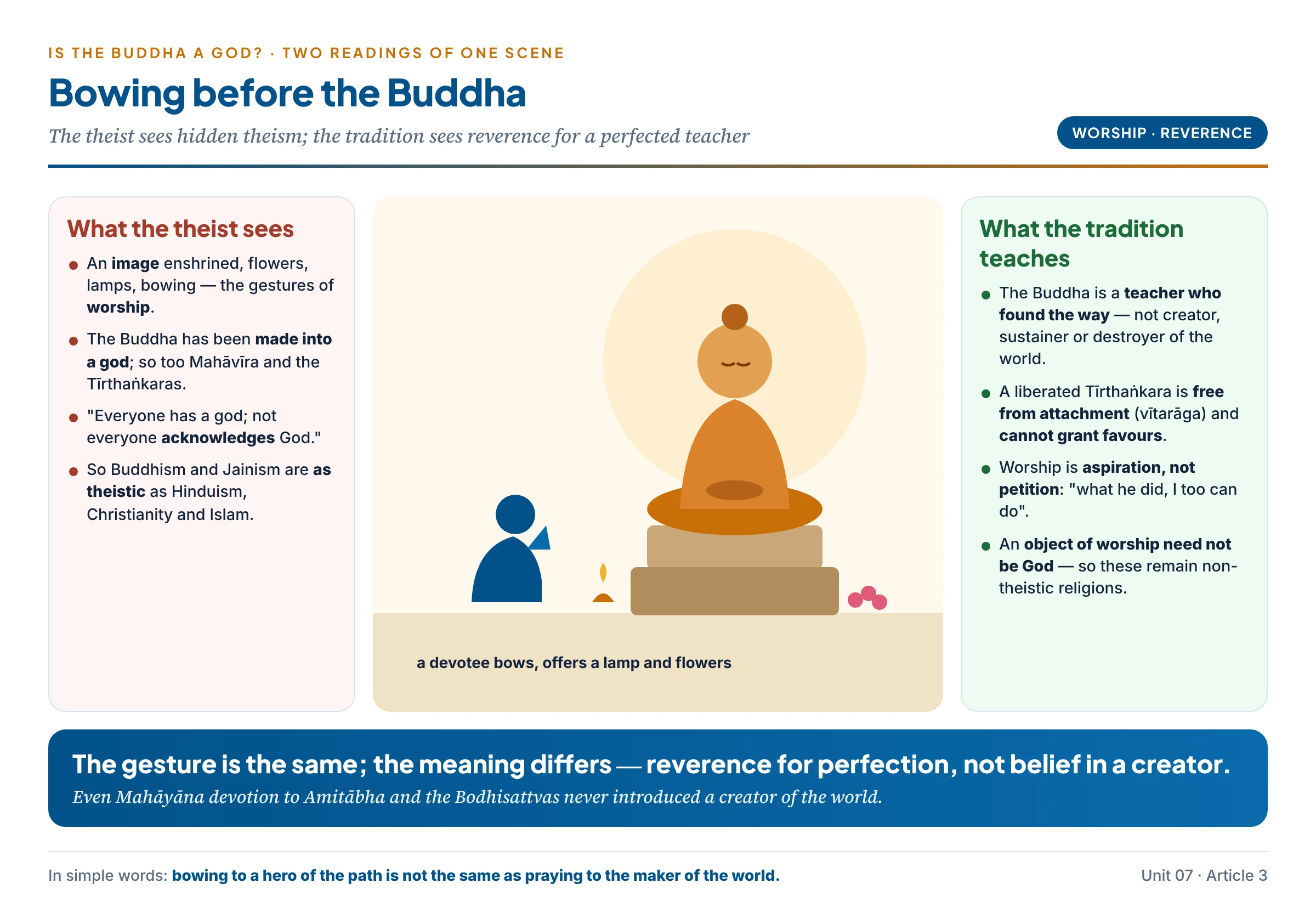
- The necessary-relation view. The majority of thinkers, Western and Indian, hold that there is a necessary relation between religion and God: no religion without God. Many add that the so-called non-theistic religions are really theistic in disguise — Jainism has made the Tīrthaṅkaras, especially Mahāvīra, into gods, and Buddhism has made the Buddha into a god, since their images are enshrined and worshipped in temples. On this view Jainism and Buddhism are as theistic as Hinduism, Christianity and Islam.
- The contingent-relation view. Others hold that the relation is contingent — or that there is no essential relation at all. Jainism and Buddhism do not treat the Tīrthaṅkaras and the Buddha as gods in the theistic sense: they are not creators, sustainers or destroyers of the world. They are revered as perfected beings, and an object of worship need not be God. Since these traditions fulfil the necessary requirements of religion, they are non-theistic religions — and there are many more such religions.
- What is at stake. If the first view is right, a large part of the world’s religious history must be reclassified as “ethics” or “philosophy”. If the second is right, the Western equation of religion with theism is a local habit mistaken for a universal truth.
Core Doctrine
1. The Theist’s Case: How a Religious Person Denies Religion without God
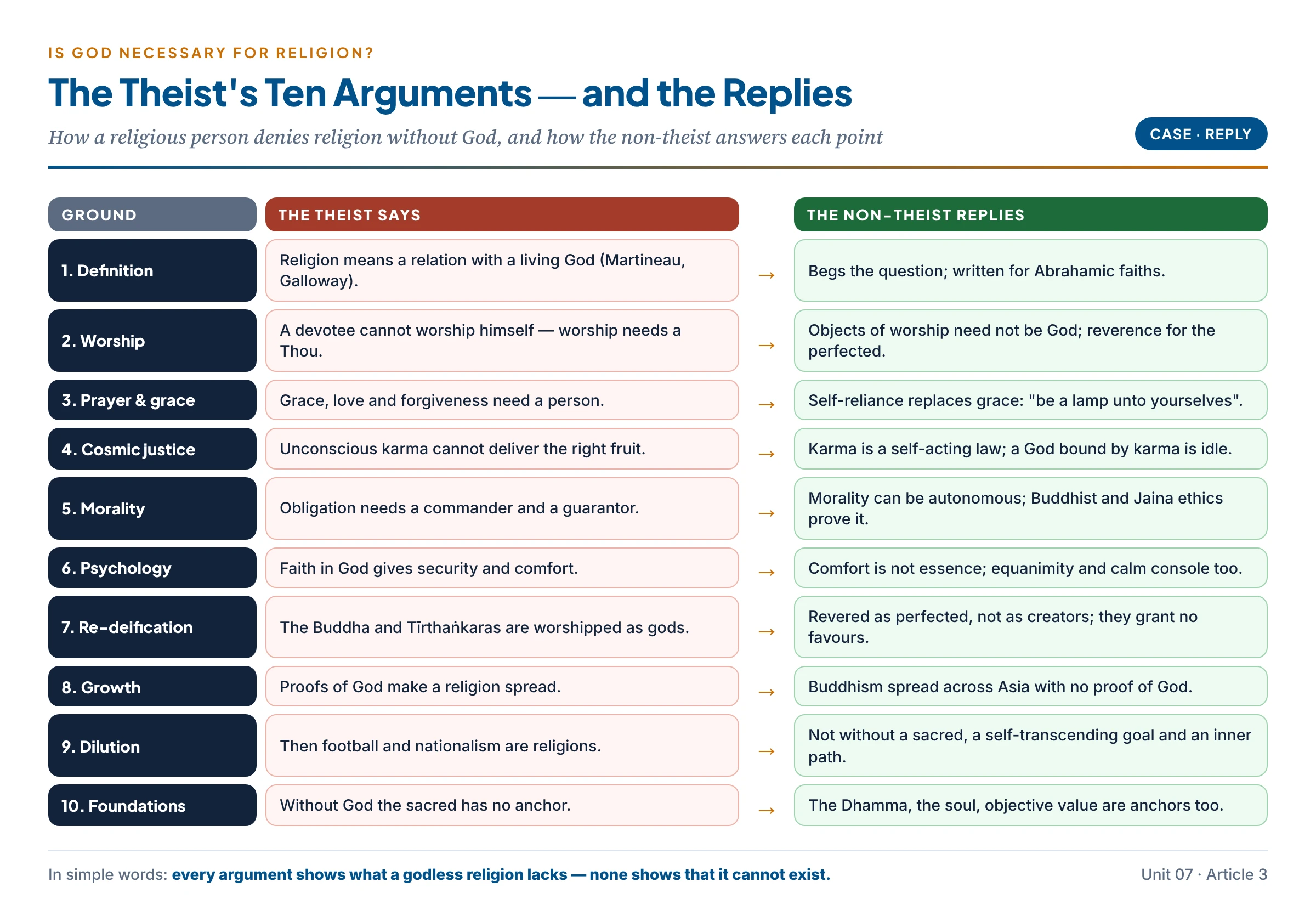
A thoughtful believer can argue against religion without God on ten grounds:
- The argument from definition. Religion means a relation with God: “a belief in an ever-living God … holding moral relations with mankind” (Martineau); “man’s faith in a power beyond himself” (Galloway). Even the word religare — “binding” — implies someone to be bound to. Take away the other party and there is no relation left.
- The argument from worship. Worship requires a distinction between the worshipper and the object of worship. “The devotee cannot be the object of his own devotion.” If the highest reality is my own perfected self (Jainism) or an impersonal state (nirvāṇa), what am I bowing to? Worship, says the theist, is essentially an I–Thou relation (Martin Buber) — a meeting with a Thou who responds.
- The argument from prayer, grace and love.
- Prayer is speaking to someone who hears.
- Grace (kṛpā, prasāda) is a gift from someone who gives — undeserved help that the soul cannot produce by itself. In Rāmānuja‘s self-surrender (prapatti) and in Christian salvation, liberation is impossible without grace.
- Love and forgiveness are relations between persons — one cannot really love a law or be forgiven by a process. Without a personal God these central religious acts become empty gestures or self-talk.
- The argument from cosmic justice. The law of karma promises that every deed bears its due fruit, perhaps many lives later. But karma (or the Mīmāṃsā apūrva, the Nyāya adṛṣṭa) is unconscious. How can an unconscious force remember, weigh and deliver exactly the right result to the right soul at the right time? An all-knowing dispenser of the fruits of action (karmaphala-dātā) is needed. The Nyāya philosophers and Śaṅkara argued in this way: an unconscious potency cannot by itself bestow fruits; the fruit comes from the Lord.
- The argument from morality. Morality needs a ground and a guarantee.
- Ground — moral commands need a commander; without God, obligation shrinks into human preference or convention.
- Guarantee — virtue and happiness do not coincide in this life; only God can unite them in the highest good (Kant‘s moral postulate).
- Motivation — without a benevolent God as moral governor, many people find little incentive to lead an ethical life.
- The argument from human psychology. Belief in God gives security and stability in the face of the helplessness caused by the dark workings of nature — the point Freud made (as a critic) in The Future of an Illusion and Civilization and Its Discontents. Faith in a loving God relieves the insecurities and anxieties of life and satisfies deep emotional needs. A religion without God cannot offer this comfort to ordinary people.
- The argument from history: re-deification.
- In practice the non-theistic religions put something in God’s place. Mahāyāna Buddhism developed an almost divine Buddha — the eternal Dharma-body, the saving grace of Amitābha in the Pure Land, compassionate Bodhisattvas who answer prayers. Jainism offers daily pūjā to the images of the Tīrthaṅkaras.
- Those religions that do not accept God have assumed some powerful entity or highest ideal in God’s place — the Bodhisattvas of Buddhism and the Tīrthaṅkaras of Jainism have a divine status.
- A saying often quoted in this debate puts it sharply: “Everyone has a God or gods; not everyone acknowledges God.” Luther said much the same: “whatever your heart clings to and relies upon, that is properly your god.” So a “religion without God” is really a religion with an unacknowledged god.
- Hence, the theist concludes, non-theistic religion is parasitic on theistic feeling — it survives by borrowing the attitudes of worship.
- The argument from the growth of religion. For a religion to spread beyond a small circle of monks and philosophers, it needs a God who can be proved, preached and loved. Proofs of God’s existence give a religion rational confidence, defend it against sceptics and give it a universal appeal; the largest religions of the world are theistic.
- The argument from dilution. If religion does not need God, anything pursued with total commitment — nationalism, Marxism, devotion to science, even devotion to a football club — becomes a “religion”. The word loses its meaning.
- The argument from foundations. Without God, the “sacred” has no ontological anchor (nothing in reality that makes it sacred). It becomes only what we happen to revere. Objective moral obligation then collapses into subjective human preferences. Religion without God is sentiment without a foundation.
In simple words
A violin needs a violinist — without one, it stays silent. The theist thinks religion is like a violin: without God to play it, prayer, worship and grace make no music. The non-theist thinks religion is more like a garden path: it was laid down once, its direction is fixed, and anyone who walks it reaches the same lake — whether or not the gardener is still around.
2. The Non-theist’s Reply
The non-theist answers the theist point by point:
- To the argument from definition. It begs the question (Article 1). The definitions of Martineau and Galloway were written with Abrahamic religion in mind; using them to exclude Buddhism and Jainism proves nothing. Even religare can mean binding to an ideal and to a community.
- To the argument from worship.
- The necessary requirement of religion is belief in something supernatural or sacred, not necessarily in a personal God. Jainism, Buddhism and Sāṃkhya reject God but accept nirvāṇa, kaivalya, the Tīrthaṅkaras, the law of karma, Prakṛti and Puruṣa. These may well be objects of reverence and the basis of religious life.
- But these are not God, because they lack God’s personal qualities — they do not create, command, judge or forgive. An object of worship need not be God.
- And the worshipper–worshipped distinction is present: the Jaina devotee is not yet a Tīrthaṅkara; he bows to one who has reached the goal he has not. Worship here is reverence and aspiration, not petition.
- To the argument from prayer and grace. Non-theistic religions replace grace by effort. “Be a lamp unto yourselves; be a refuge to yourselves” (the Buddha); “the soul is its own friend and its own enemy” (Jaina teaching). This is not a lack but a different religious ideal — self-reliance instead of dependence. And “prayer” in these traditions becomes meditation, recollection and vow-taking, which transform the person who performs them.
- To the argument from cosmic justice. Karma is a law, not a person — like the law of gravity, it needs no judge to work. In Jainism karma is fine matter that clings to the soul and falls away of itself; in Buddhism karma is intention (cetanā) whose results follow by dependent origination; in Mīmāṃsā the ritual act itself generates the apūrva that brings its fruit. And if God must follow karma in giving fruits, God is idle; if God does not follow it, God is unjust (Article 6; Unit 02).
- To the argument from morality. Morality can be autonomous: grounded in reason (Kant’s own idea that a moral law imposed from outside is heteronomy), in compassion, and in the consequences of action. Buddhist and Jaina ethics are among the most demanding in the world — non-violence to the smallest creature — without a divine commander. An atheist may be a better man than a religious person bereft of moral values (Unit 08).
- To the argument from psychology. That belief in God comforts does not show that religion requires God. The non-theistic religions offer their own consolation — equanimity, the end of craving, the calm of the arhat — and a mature religion may be one that does not depend on a father figure (Freud’s own point).
- To the argument from re-deification.
- Popular devotion shows something about human psychology, not about the essence of these religions. Their teachers expressly deny that the Buddha or the Tīrthaṅkaras create or rule the world, and Jaina doctrine holds that a liberated soul, being free from attachment (vītarāga), cannot grant favours.
- Even Mahāyāna, with all its devotion, never introduced a creator.
- “Everyone has a god” stretches the word “god” until it means anything one values most — a verbal victory, not a real one.
- To the argument from growth. Buddhism spread across Asia — to Sri Lanka, China, Japan, Tibet — without any proof of God; Jainism has survived for 2,500 years. Most believers in every religion never study the proofs at all; religions grow through teachers, community, practice and experience, not through syllogisms. The proofs themselves are widely judged to fail (Unit 02) — yet the religions go on.
- To the argument from dilution. Not every commitment is religion. A religion needs: something treated as sacred and ultimate, a self-transcending goal (liberation, not just success), a path of inner transformation, a moral code, a community with rites. Football fandom and nationalism usually lack the self-transcending goal and the inner path; where they acquire them, they really do become quasi-religions, and it is honest to say so.
- To the argument from foundations. Non-theistic religions have foundations: the Dhamma as an objective law of reality; the Jaina soul with its infinite knowledge; and, in Western forms, the objective reality of value itself (Dworkin, Article 8). Indeed, the theist too must hold that goodness is real before he can call God good.
3. Seven Marks That Make Jainism and Buddhism Religions
Traditional Western philosophers called Jainism and Buddhism “ethical systems“. But they cannot be accepted as mere ethical systems, for they show every mark of a religion:
- Spiritual goal. Like the Semitic religions, they accept a spiritual goal as the real end of life and all its activities — kaivalya in Jainism, nirvāṇa in Buddhism.
- Incentive for good acts. Both accept the law of karma, which encourages good thoughts and actions and discourages bad ones; virtue is rewarded with happiness and vice with sorrow, as in theistic religions.
- Human welfare. Like other religions, both try to remove suffering from human life; all their activities are directed to the welfare of beings.
- Path to liberation. The path to kaivalya or nirvāṇa is an ethical-spiritual discipline very similar to the paths taught in theistic traditions.
- Scriptures. Islam has the Qur’ān, Christianity the Bible; Jainism has its Āgamas (the Aṅgas and Upāṅgas), Buddhism the Tripiṭaka.
- Commitment. Both demand a commitment to a life of spiritual culture, issuing in an all-pervasive pattern of behaviour — not a part-time philosophy.
- Places of worship and the sacred. Both have places of congregation — temples, stūpas, monasteries — like temple, synagogue, church and mosque; the distinction of sacred and profane is clear in both; their festivals, priests and ceremonies, and the rituals associated with them, create a sense of fraternity, just as in theistic religions.
- So the one thing Jainism and Buddhism lack — a creator God — is far outweighed by the seven things they share with every great religion.
In simple words
A young cricketer keeps a photograph of a great batsman above his bed and touches it before every match. Is he praying to the batsman, expecting him to send runs from heaven? No — he is reminding himself what is possible and how to get there. The Jaina bowing before a Tīrthaṅkara, or a Buddhist before the Buddha, is closer to this than to a petition to a creator: “what he did, I too can do“.
4. Gandhi: From “God Is Truth” to “Truth Is God”
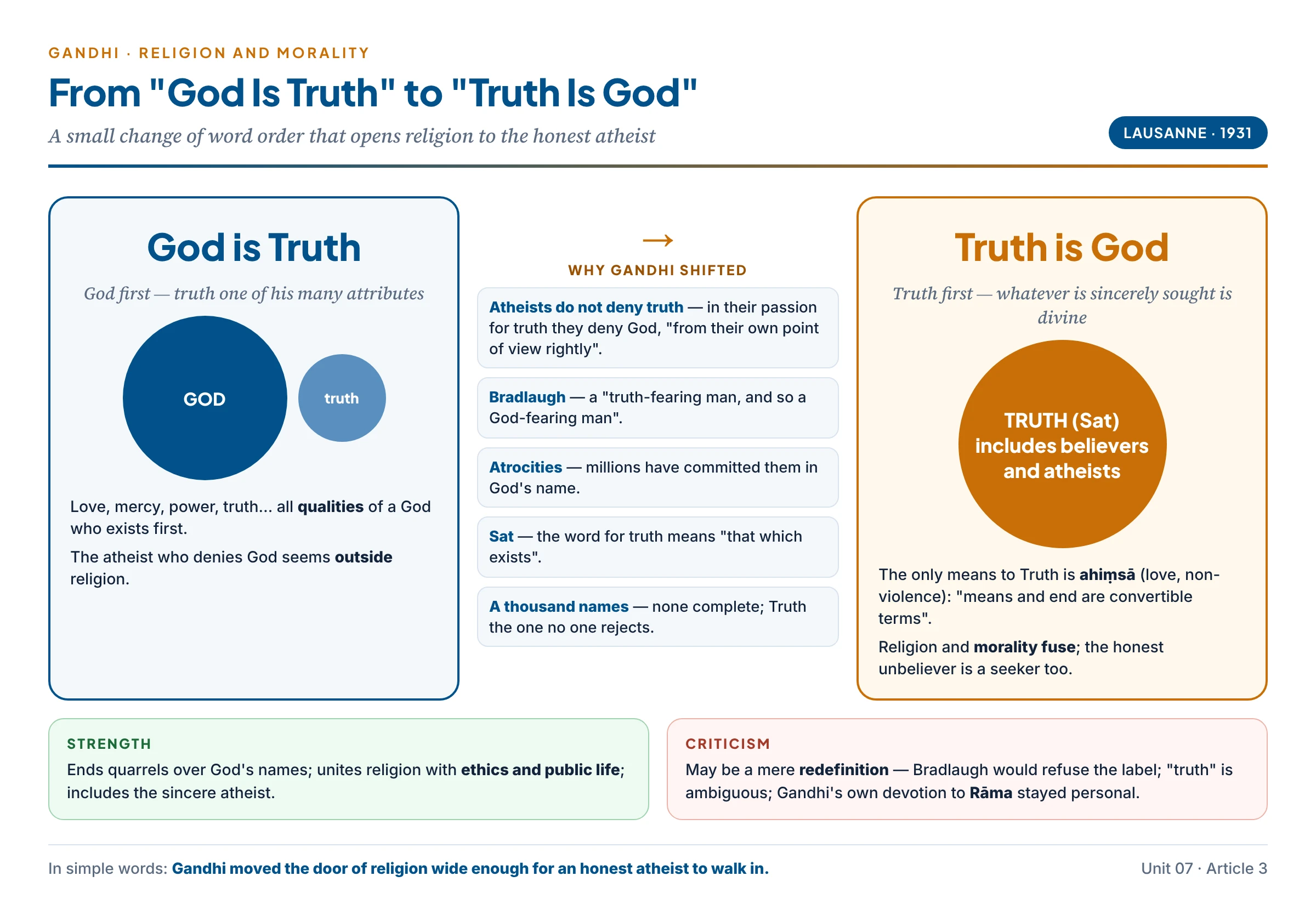
- The shift. Gandhi said in a speech at Lausanne (1931): “I would say with those who say God is Love, God is Love. But deep down in me I used to say that though God may be Love, God is Truth above all. … But two years ago I went a step further and said that Truth is God. You will see the fine distinction between the two statements.”
- Gandhi’s reasons.
- Atheists do not deny truth. “I never found a double meaning in connection with truth, and even atheists had not demurred to the necessity or power of truth. But in their passion for discovering truth, the atheists have not hesitated to deny the very existence of God — from their own point of view rightly. And it was because of this reasoning that I saw that rather than say that God is Truth I should say that Truth is God.”
- Bradlaugh. He recalled Charles Bradlaugh, the English atheist: “I would never regard him as an atheist. I would call him a God-fearing man … a truth-fearing man, and so a God-fearing man.”
- Atrocities in God’s name. “Millions have taken the name of God and in His name committed nameless atrocities.” Truth cannot be so misused.
- Sat. The Sanskrit word for truth, Sat, literally means “that which exists“. Only Truth truly is; so Truth is the most exact name for the ultimate.
- Many names, no exhaustion. God has a thousand names and none is complete; “Truth” is the one name that no sincere person rejects.
- What it means for religion without God.
- “God is Truth” makes God the subject: first there is a God, and truth is one of his attributes. “Truth is God” makes Truth the subject: whatever is true and is sincerely sought is divine. The second formula is wide enough to include atheists — a seeker of truth who denies God is, in Gandhi’s sense, still religious.
- It fuses religion and morality: the religious quest is the moral quest for truth, and its only means is ahiṃsā (love, non-violence) — “means and end are convertible terms”.
- It shows that even a deeply theistic thinker could see the essence of religion in something impersonal — truth — rather than in a personal deity.
- Evaluation.
- Strength — it removes sectarian quarrels over God’s name and attributes, unites religion with ethics and public life (satyāgraha), and includes the honest unbeliever.
- Criticisms — it may be only a redefinition: an atheist like Bradlaugh would reject being called “God-fearing”. “Truth” is ambiguous (factual truth, moral truthfulness, ultimate Reality). And Gandhi’s own devotion remained intensely personal — he prayed to Rāma, and “Rāmanāma” was on his lips at death.
- Balance — “Truth is God” is best read as Gandhi’s way of showing that the core of religion — sincerity, truthfulness, non-violence, self-purification — is accessible to all, whether or not they use the word “God”.
Common confusion
Did “Truth is God” mean that Gandhi stopped believing in a personal God? No. “Truth is God” widened the definition so that sincere atheists could be included in the religious quest; it did not abandon Gandhi’s own faith. He continued to pray, to rely on the inner voice, and to repeat Rāmanāma. The shift is about the best way to describe God — as Truth that everyone can seek — not a conversion to atheism.
Indian Connect — Gandhi and the religion of truth
- “Truth is God” places the ultimate in an impersonal reality (Sat) that everyone can seek — close to Advaita’s Brahman and to the Jaina and Buddhist emphasis on truthfulness and non-violence.
- It answers the theist’s “religion needs God” by widening God until God includes the atheist’s honest search — and thus makes room, within a theistic idiom, for a religion without a personal God.
5. Personal and Impersonal God in the Context of Devotion
- Personalistic notion. God is a person — conscious, loving, responsive, with qualities (saguṇa): the God of Christianity, Islam, Rāmānuja, Madhva and the bhakti saints.
- Impersonalistic notion. The ultimate is impersonal — without qualities (nirguṇa), beyond relations: Advaita’s Brahman, Spinoza’s Substance, Gandhi’s Truth.
- Which suits devotion?
- Devotion (bhakti) needs a person. Love, surrender, prayer and grace all require a Thou who can respond. The great theistic traditions hold that divine grace and surrender to the Supreme God are indispensable for liberation, and that a benevolent God gives the strongest incentive to live ethically.
- The impersonal ultimate suits knowledge (jñāna). It is free from the conflicts that arise from rival names and attributes of God; even an atheist can hardly deny “Truth”; and the idea of a singularity at the origin of the universe fits an impersonal source better than a personal designer.
- But the impersonal is “not conducive to religious activities” — few can love an abstraction. So most religions that speak of an impersonal ultimate also keep a personal face of it for worship.
- The Advaita reconciliation. In Advaita, the impersonal Brahman is the supreme reality from the transcendental standpoint, but from the empirical standpoint it is Īśvara, the personal God. Though Śaṅkara taught the path of knowledge for liberation, he gave due place to bhakti as a means of inner purification, and composed hymns of devotion. So devotion has a place within monism.
- Relevance to religion without God. The non-theistic religions lie at the impersonal end: their ultimate (nirvāṇa, kaivalya) is not a person. And, just as Advaita brings back Īśvara for devotion, popular Buddhism and Jainism bring back devotion to the Buddha and the Tīrthaṅkaras — not as creators, but as personal faces of an impersonal goal. This supports the theist’s point that the heart seeks a person — and the non-theist’s point that this person need not be a creator.
In simple words
A child can love a photograph of the sun, but it is the sun’s warmth that grows the crops. Devotion often needs a personal face to love (the photograph); knowledge seeks the source itself (the warmth). Advaita lets the devotee love the face while knowing that the warmth is beyond every face.
6. Is Religious Life Possible without Belief in God?
- Yes — the evidence of history.
- Buddhist and Jaina monks and nuns live lives of prayer-like recitation, meditation, renunciation, compassion and community — a religious life in every sense — without belief in a creator.
- Sāṃkhya and Mīmāṃsā practitioners pursued liberation and ritual duty without Īśvara.
- In the West, humanists, Quakers of a non-theistic kind and followers of religious naturalism practise silence, ethics, community and reverence (Articles 7–8).
- What a religious life requires. Not a creed about God, but: reverence for something sacred, a discipline of self-transformation, a moral commitment, a community and a goal beyond self-interest. All of these are found in non-theistic traditions.
- The theist’s reservation. Some forms of religious life — prayer of petition, thanksgiving to a giver, trust in providence, the experience of forgiveness — are possible only for a theist. A non-theistic religious life is real but different in texture: more self-reliant, more contemplative, less relational.
7. Is God’s Existence Necessary for the Survival of Religion?
- The historical answer is no. Non-theistic religions have survived for millennia — Jainism and Buddhism for some 2,500 years — and Buddhism has become a world religion.
- But survival may involve adaptation. Buddhism survived partly by developing devotional forms; Jainism by its lay pūjā culture. The theist reads this as proof that religion needs something like God to last among the masses; the non-theist reads it as proof that a religion can include devotion without requiring a creator.
- In the modern world. Religions that emphasise ethics, meditation and inner experience — including non-theistic Buddhist practices of mindfulness — are spreading among people who doubt or deny God. The survival of religion seems to depend more on its power to give meaning, discipline and community than on any single doctrine about God.
8. Why Do Religions Seek Proofs of God?
- The theist’s reasons (the 2011 question asks why proof is “necessary for the growth of a religion”):
- To give rational confidence to believers and defend faith against sceptics.
- To make a religion universal — reasons can be shared across cultures, whereas revelation belongs to one tradition.
- To bring thinkers and elites into the fold; medieval Christianity, Islam and the Nyāya school all built rational theologies as their religions spread.
- The limits.
- Faith precedes proof: believers do not believe because of the proofs; the proofs articulate a faith already held.
- The proofs are contested (Unit 02); if growth depended on them, theism would have stopped growing long ago.
- Non-theistic religions grew without proofs of God — by teaching, example and practice.
- So proofs help a theistic religion grow among the educated, but they are not necessary for the growth of religion as such.
Critical Evaluation
Where the Theist Is Right
- Some religious acts need a person. Prayer of petition, thanksgiving, trust in grace, the joy of being forgiven — these are specifically theistic goods. A religion without God cannot offer them in the same way.
- The pull towards personal devotion is real. The history of Mahāyāna Buddhism, Jaina pūjā and Advaita’s Īśvara shows that the human heart tends to seek a personal face of the ultimate.
- The dilution danger is real. Without a disciplined definition, “religion” can be stretched to cover every enthusiasm.
- Foundations matter. A religion of pure sentiment, with nothing real to which the sentiment answers, would be fragile.
Where the Non-theist Is Right
- Definitions cannot settle facts. Buddhism and Jainism are in fact practised as religions by millions; a definition that denies this is wrong.
- The sacred is wider than God. Nirvāṇa, the perfected soul, the moral law and the Holy are sacred without being personal creators.
- Self-reliance is a religious virtue. The non-theistic paths show that effort, discipline and wisdom can be as religious as surrender and grace.
- The theist’s own tradition agrees in part. Advaita’s impersonal Brahman, the mystics’ God beyond attributes, and Gandhi’s “Truth is God” all locate the ultimate beyond a personal deity.
Critics and Defenders
Criticism — Religion needs God (the theist)
- Definition: religion is a relation with a living God (Martineau, Galloway).
- Worship and grace: devotion needs a responsive Thou; liberation needs grace.
- Karma and morality: an unconscious law needs a conscious dispenser; morality needs a moral governor.
- History: Buddhists and Jainas deify the Buddha and the Tīrthaṅkaras; everyone has some god.
- Dilution and foundations: without God, anything is a religion and the sacred has no anchor.
Defence — Religion without God is possible (the non-theist)
- Definitions beg the question; Buddhism and Jainism are religions in fact.
- Objects of worship need not be God: perfected beings and impersonal goals can be sacred.
- Karma is a self-acting law; morality can be autonomous and compassionate.
- Seven marks: goal, karma, welfare, path, scripture, commitment, worship — all present.
- Gandhi: Truth is God — even the honest atheist seeks the divine.
Cross-Tradition Comparison
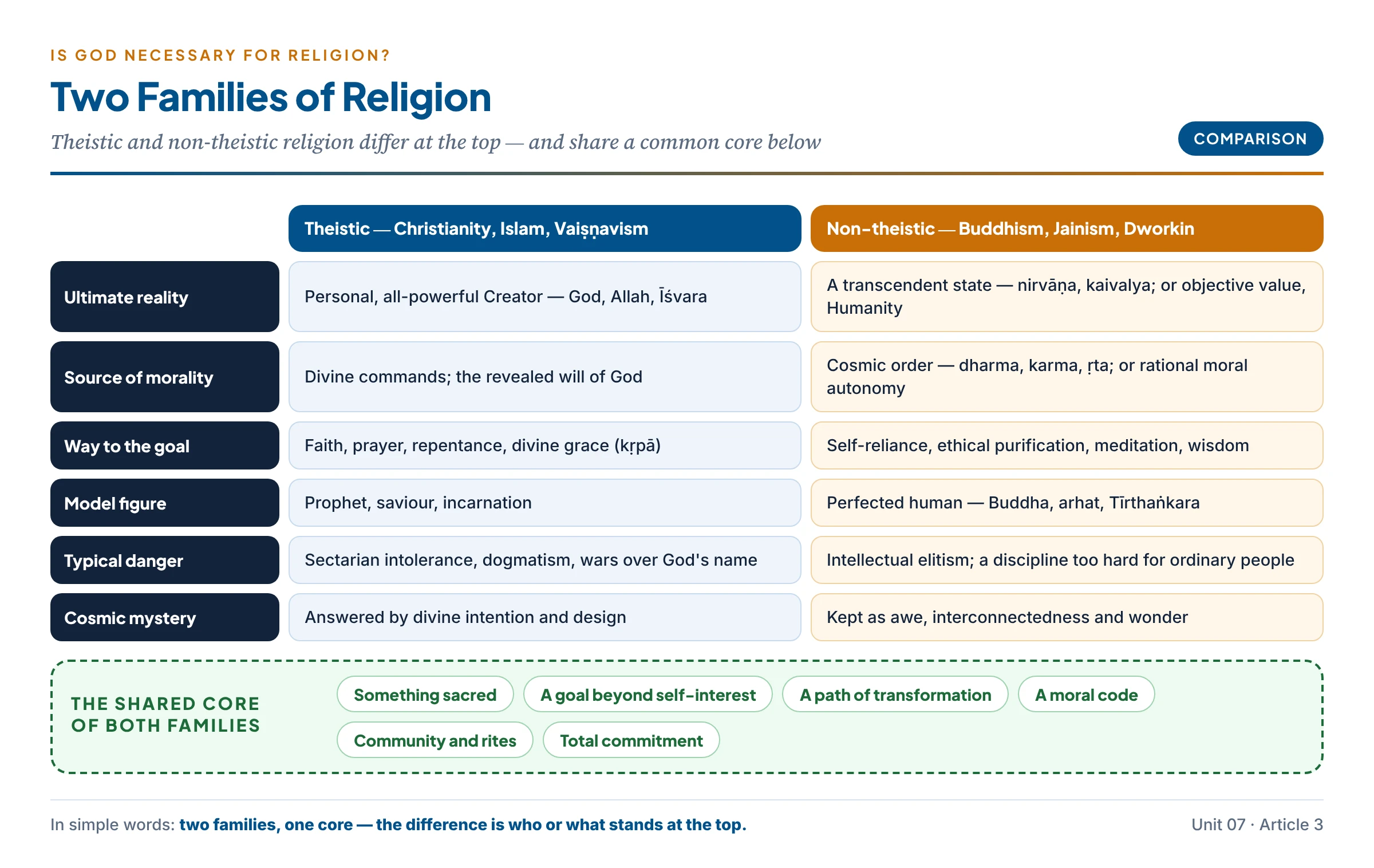
Theistic and Non-theistic Religion Compared
| Feature | Theistic religion (Christianity, Islam, Vaiṣṇavism) | Non-theistic religion (Buddhism, Jainism, Dworkin) |
|---|---|---|
| Ultimate reality | Personal, omnipotent, transcendent Creator (God, Allah, Īśvara) | A transcendent state (nirvāṇa, kaivalya), or objective value, or Humanity |
| Source of morality | Divine commands, the revealed will of God | Cosmic order (dharma, karma, ṛta) or rational moral autonomy |
| Way to the goal | Faith, prayer, repentance and divine grace (kṛpā) | Self-reliance, ethical purification, meditation and wisdom |
| Typical danger | Sectarian intolerance, dogmatism, wars over God’s name | Intellectual elitism; a discipline too demanding for ordinary people |
| Cosmic mystery | Answered by divine intention and design | Kept as awe, interconnectedness and wonder |
| Model figure | Prophet, saviour, incarnation | Perfected human — Buddha, arhat, Tīrthaṅkara |
Two Views of the Religion–God Relation
| Point | Necessary relation | Contingent relation |
|---|---|---|
| Claim | No religion without God | God is common in religion, not essential |
| Reading of Buddhism and Jainism | Theistic in disguise — Buddha and Tīrthaṅkaras deified | Non-theistic — Buddha and Tīrthaṅkaras are not creators |
| Object of worship | Must be God | Need not be God |
| Main support | Western definitions; psychology of devotion | Indian history; broad definitions; the seven marks |
Indian Connect — Takeaways
- India settled this question in practice long ago: theistic and non-theistic paths lived side by side within one religious culture.
- Advaita shows a middle way — an impersonal ultimate with a personal God for devotion; Gandhi shows a theistic language wide enough to include atheists.
- The deification of the Buddha and the Tīrthaṅkaras is reverence for perfection, not belief in a creator.
Synthesis (Siddhānta)
- God is important to religion, but not essential to it. Faith in God satisfies deep emotional needs, gives stability, supports devotion and grace, and offers a strong ground for morality. That is why most religions are theistic. But the essence of religion lies deeper — in the response to what is sacred and ultimate, in a self-transcending goal, and in a path of transformation.
- Any belief or practice that evokes an all-pervasive attitude leading to a culture of the soul should be regarded as religion. Its highest aim is not the worship of God in the literal sense but human welfare and liberation. The object of devotion need not be a public or personal object: it may be an ideal, self-culture, one’s country or profession, or the pursuit of science and art — or it may be God. Such a definition includes both the theistic type and the nirvāṇist type of religion.
- So the answer depends on the definition: on a narrow definition, religions without God are excluded; on a broad or holistic one, religion without God is possible — and, in Buddhism, Jainism, Sāṃkhya and Mīmāṃsā, actual.
- But the theist’s case is not empty. It identifies what non-theistic religion lacks — personal grace, prayer to a hearer, a conscious guarantor of justice — and why devotion keeps returning. The best view keeps both insights: religion can exist without God, but it then becomes a religion of self-reliance, law and perfected example, rather than of grace, relationship and providence.
- Gandhi’s “Truth is God” offers a bridge: the honest seeker of truth, believer or atheist, is engaged in the same religious quest.
- Contemporary relevance.
- Religious freedom in Indian law protects non-theistic faiths and conscience equally (Article 25; the Shirur Mutt case).
- Interfaith dialogue is easier when theists see non-theists not as “unbelievers” but as fellow seekers of the sacred.
- Secular spirituality — meditation, ethics, service — tests the claim that religion can thrive without God.
“Even atheists had not demurred to the necessity or power of truth … rather than say that God is Truth I should say that Truth is God.” — Mahatma Gandhi
Previous Year Questions
- 2026Critically evaluate the shift in Gandhi’s view from ‘God is Truth’ to ‘Truth is God’, in the context of interrelation between religion and morality.
- 2026Discuss the difference between personalistic and impersonalistic notions of God in the context of devotion.
- 2021Is religious life possible without the belief in God? Discuss.
- 2020Critically examine the concept of God as prerequisite for a religion.
- 2019How would a religious person deny the possibility of a religion without God? Discuss.
- 2018Can you justify religion without God? Support your answer.
- 2017Is God necessary for religion? Justify your answer.
- 2015Is existence of God a necessary condition for the survival of religion? Explain.
- 2013Is God indispensable for religion?
- 2011Why is proof for the existence of God necessary for the growth of a religion? Discuss.
- 2002Religion without God. Critical notes.