

Religious Experience: Nature and Object (Indian and Western).
Official Syllabus: Paper II, Section B, Unit 6
In the Indian tradition, religion has always been understood less as a set of beliefs and more as seeing (darśana) and realising (anubhava, sākṣātkāra). The Upaniṣadic sages claimed to have seen the Self; Śaṅkara held that knowledge of Brahman culminates in direct experience; Rāmānuja and Madhva described the highest state as a loving vision of the Lord; and in the twentieth century Radhakrishnan presented Hinduism to the world as a religion of experience rather than dogma. This article explains the nature and object of religious experience in the Vedāntic tradition — from the seers of the Veda to Advaita, Viśiṣṭādvaita, Dvaita, the modern Vedāntins and Radhakrishnan’s The Hindu View of Life — and his idea of a world religion that is both spiritual and humanistic.
In simple words
You can read every book about swimming — strokes, breathing, the physics of floating — and still not know how to swim. Knowing about water is not the same as being in the water. Vedānta says the same about God or Brahman: scripture and reasoning tell you about it, but religion is complete only when you realise it directly. That direct realisation is what Indian thinkers mean by anubhava.
Context & Problem
Why Experience Is Central in Indian Religion
- Philosophy as “seeing”. The Indian word for a philosophical school, darśana, comes from dṛś, “to see”. Its goal is not only to think correctly but to see reality and be freed by that seeing (mokṣa).
- Three stages of Vedānta.
- Creative stage — the Upaniṣads (śruti), in which the basic ideas take shape as the poetic visions and mystic intuitions of enlightened seers.
- Systematic stage — the Brahma Sūtra of Bādarāyaṇa, which gathers and justifies those ideas.
- Commentary stage — Śaṅkara, Rāmānuja, Madhva and others, who cast the ideas into philosophical form and defend them by independent reasoning.
- East and West. In the West, “religious experience” became a central topic only in the nineteenth century, partly as a defence against rationalism (Schleiermacher, then William James). In India, experience was the starting point from the beginning: the Veda itself was understood as the record of what the seers saw.
- Two strands within Vedānta. Classical Vedānta grounds knowledge of Brahman in scripture (śruti) and treats experience as its fruit; modern Vedānta (Vivekananda, Radhakrishnan) speaks of experience as the foundation of all religion. Both strands are part of the “Vedāntic view” and need to be understood together.
The Problems This Article Answers
- What is the nature of religious experience in Vedānta — is it a feeling, a vision, a state, or knowledge?
- What is its object — a personal Lord, an impersonal Absolute, or the Self itself, which can never be an object?
- Is experience a source of knowledge (pramāṇa) or the result of knowledge given by scripture?
- How do the schools differ — identity (Advaita), loving vision (Viśiṣṭādvaita), eternal service (Dvaita)?
- What did Radhakrishnan add, and is his picture fair to other religions?
Core Doctrine
1. Śruti as the Recorded Experience of the Seers
- The seers. The Vedic ṛṣis are called mantra-draṣṭā — “seers of the mantra”. They did not compose the hymns by reasoning; they saw them. The Veda is śruti, “that which was heard”.
- Two ways of seeing śruti.
- Mīmāṃsā — the Veda is authorless (apauruṣeya) and eternal; its authority is intrinsic (svataḥ-prāmāṇya), not borrowed from anyone’s experience.
- Vedānta and modern thinkers — the Upaniṣads embody the experiences of the sages. Radhakrishnan: the Vedas “register the intuitions of the perfected souls… They are not so much dogmatic dicta as transcripts from life.”
- Why scripture is needed at all. Śaṅkara argues that Brahman is supersensuous: it has no form, so it cannot be perceived, and no characteristic mark, so it cannot be inferred. Only śruti can point to it. Without scripture, a person’s longing for the higher remains “a blind groping in the dark”.
- Reason has a place. Śaṅkara condemns dry, quarrelsome reasoning (kutarka, śuṣka-tarka) — “what one clever reasoner proves, a cleverer one overturns” (tarka-apratiṣṭhāna). But sound reasoning (sutarka) that follows scripture (śrutyanugṛhīta tarka) is necessary to understand it. He even says that if a hundred scriptures declared fire to be cold, we would not accept it — scripture cannot contradict experience in its own sphere.
- Experience as the culmination. Śaṅkara states that knowledge of Brahman culminates in experience (anubhavāvasānatvāt brahma-vijñānasya): unlike knowledge of duty (dharma), which concerns something to be done in the future, knowledge of Brahman concerns an already existing reality and ends in its direct realisation.
- The three steps. Śravaṇa (hearing the Upaniṣadic teaching from a teacher), manana (reflecting on it to remove doubts) and nididhyāsana (deep, continuous contemplation) lead to sākṣātkāra — direct realisation.
2. Upaniṣadic Anubhava — the Self Beyond the Three States
- The great sayings (mahāvākyas) express the content of the seers’ experience:
- “Consciousness is Brahman” (prajñānaṃ brahma) — Aitareya Upaniṣad;
- “I am Brahman” (ahaṃ brahmāsmi) — Bṛhadāraṇyaka;
- “That thou art” (tat tvam asi) — Chāndogya;
- “This Self is Brahman” (ayam ātmā brahma) — Māṇḍūkya.
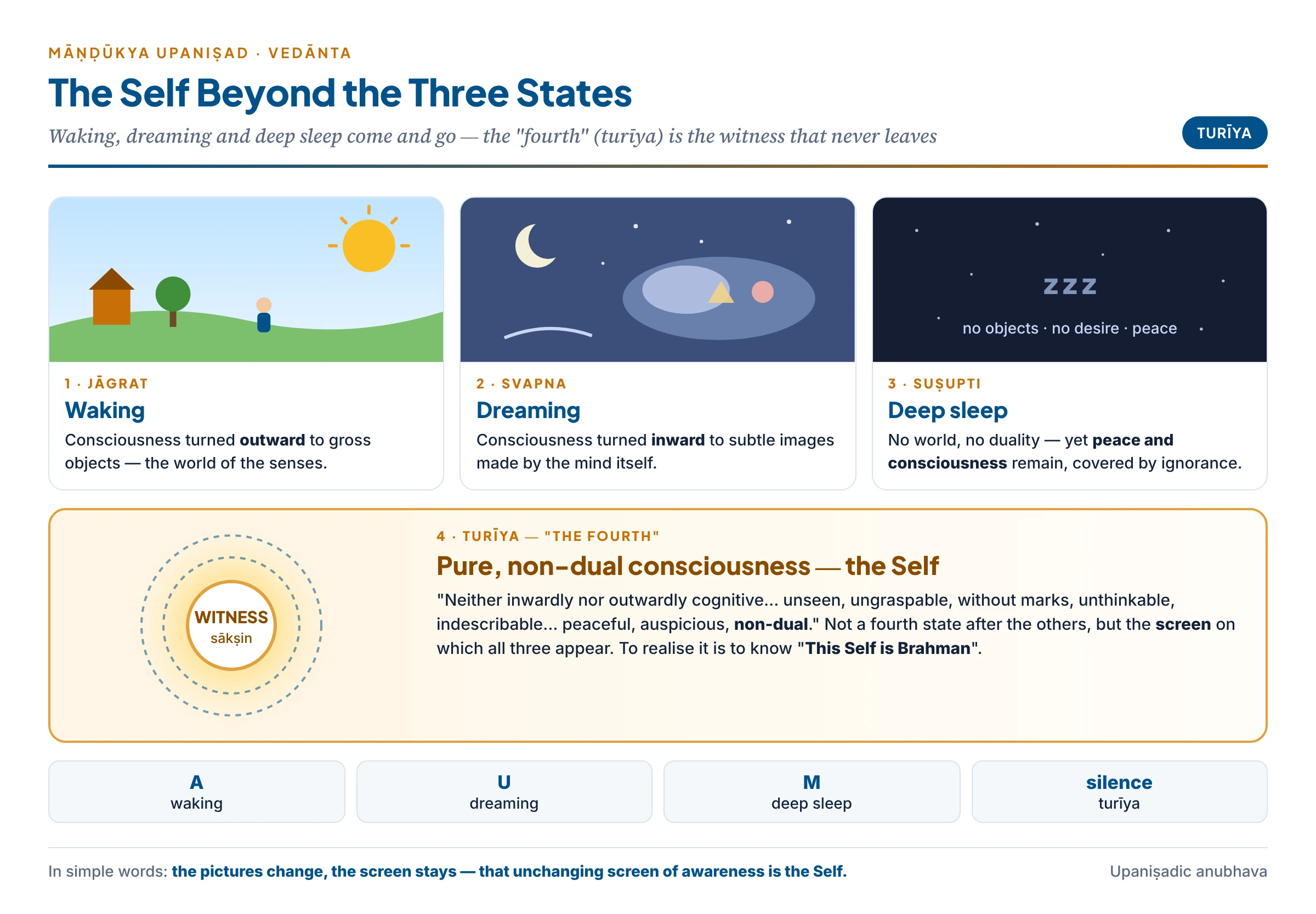
- The four states (Māṇḍūkya Upaniṣad). The Upaniṣad analyses all experience into:
- Waking (jāgrat) — consciousness turned outward to gross objects (Vaiśvānara);
- Dreaming (svapna) — consciousness turned inward to subtle images (Taijasa);
- Deep sleep (suṣupti) — no objects, no desire, a mass of consciousness and bliss, yet still covered by ignorance (Prājña);
- Turīya (“the fourth”) — “neither inwardly nor outwardly cognitive… unseen, ungraspable, without marks, unthinkable, indescribable… the cessation of the world, peaceful, auspicious, non-dual.” This is the Self (ātman) itself.
- The sacred syllable. The three sounds of Om — A, U, M — stand for waking, dream and deep sleep; the silence after them stands for turīya.
- Deep sleep as a clue. On waking we say, “I slept happily; I knew nothing.” There was no world and no duality — yet consciousness and peace were present. Vedānta uses this everyday fact to show that consciousness does not need objects to exist.
- Knower cannot be known as an object. Yājñavalkya asks: “Where everything has become the Self, then by what and whom should one see?… By what should one know the knower?” The Self is the eternal subject; it can be realised but never turned into an object.
- Beyond words. “From which words turn back, together with the mind, not having reached it” (Taittirīya); “There the eye goes not, speech goes not, nor the mind” (Kena). The Self is described by negation — “not this, not this” (neti neti).
- Fruits of the experience.
- “One who knows Brahman becomes Brahman” (brahmavid brahmaiva bhavati).
- “The knot of the heart is cut, all doubts are dispelled, and his karmas perish, when He is seen” (Muṇḍaka).
- “One who knows the bliss of Brahman fears nothing” (Taittirīya) — fearlessness (abhaya).
In simple words
A student called Bāṣkali asked the sage Bāhva to explain Brahman. Bāhva said nothing. Asked a second time, and a third, he still kept silent. At last he said: “I am teaching you, but you do not understand — this Self is silence” (śānto’yam ātmā). The story makes a simple point: the highest experience is not a piece of information that can be handed over in words. Silence is the most accurate description.
Common confusion
Is turīya a fourth state, one more after deep sleep? No. Turīya means “the fourth” only for counting. It is not a state that comes and goes like the other three; it is the witness-consciousness present in all of them, the screen on which waking, dream and sleep appear like pictures. Waking, dream and sleep are states; turīya is the Self that has these states. That is why Advaita says liberation is not entering a new condition but recognising what was always there.
3. Advaita Vedānta: Main Features of Religious Experience
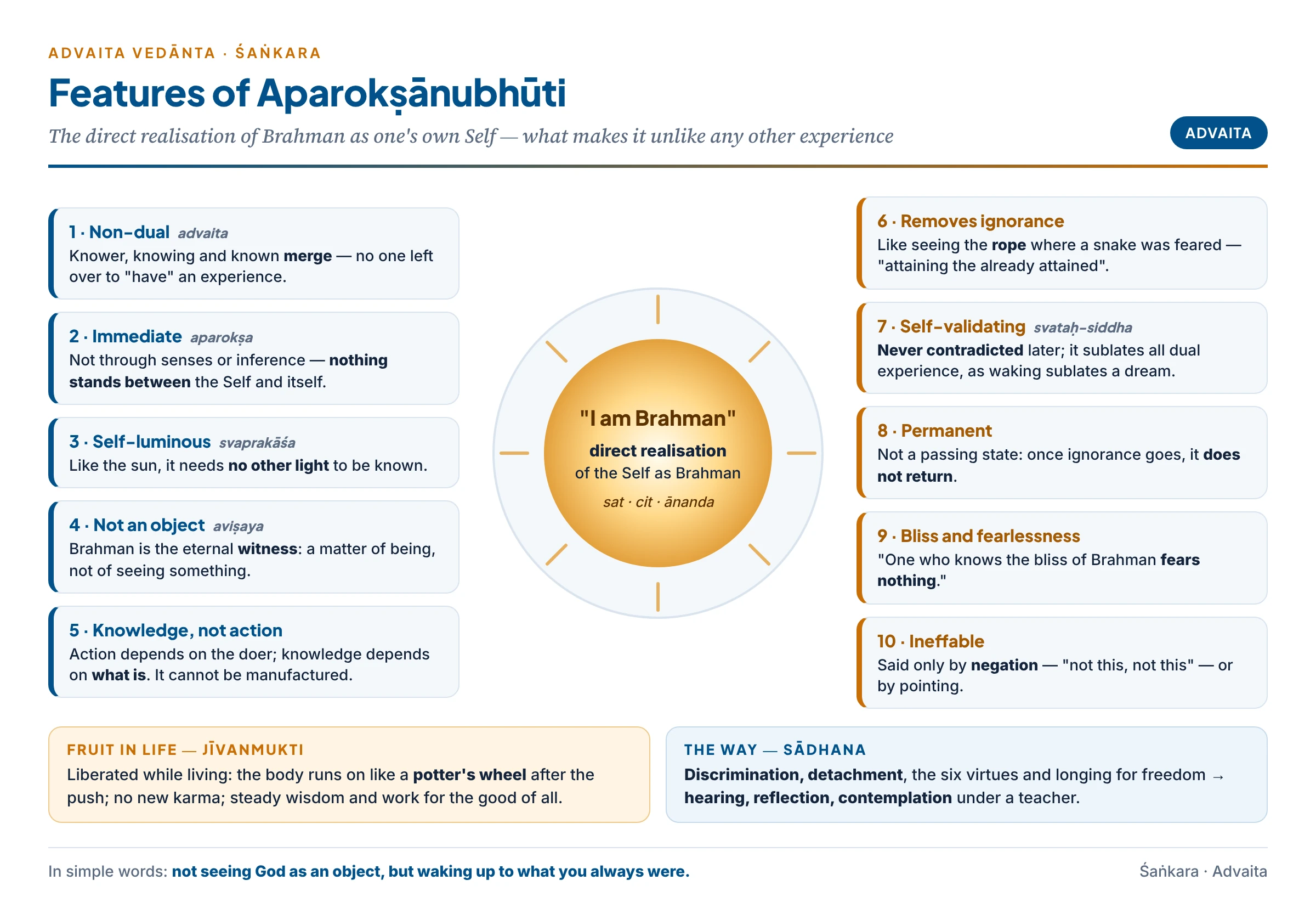
For Śaṅkara the highest religious experience is aparokṣānubhūti — immediate, direct realisation of Brahman as one’s own Self. Its main features are:
- Non-dual (advaita). It is not an experience of Brahman by a separate person; the difference between knower, knowing and known (tripuṭī) disappears. “There is no knower and no known; both become one.”
- Immediate (aparokṣa). It is not mediated by the senses or by inference. The Upaniṣad speaks of “the Brahman that is immediate and direct“. It is more direct than sense perception, because nothing stands between the Self and itself.
- Self-luminous (svaprakāśa). Consciousness reveals itself and everything else, as the sun needs no lamp to be seen. It does not need a second consciousness to know it.
- Not an object (aviṣaya). Brahman is the eternal witness (sākṣin). The experience is a matter of being, not of seeing something.
- Knowledge, not action. Action depends on the doer — one may do it, not do it, or do it differently (kartṛ-tantra). Knowledge depends on the object — one cannot choose to see a rope as a pot (vastu-tantra). Liberation is knowledge, so it cannot be produced by any ritual or effort; effort only removes obstacles.
- Removal of ignorance, not creation of something new. Like seeing that the “snake” was a rope, realisation only removes a mistake (avidyā). It is “attaining the already attained” (prāptasya prāpti) — like a woman searching for the necklace that was round her neck all along.
- Self-validating (svataḥ-siddha). It needs no further proof and cannot be contradicted (abādhita) by any later experience, whereas it sublates (bādha) all dual experience — as waking sublates a dream.
- Permanent, not transient. Unlike the passing mystical “states” described by William James, realisation does not fade, because the Self was never absent; only ignorance is removed, and ignorance once removed does not return.
- Bliss and peace (ānanda, śānti). Brahman is sat–cit–ānanda — being, consciousness, bliss; the realised person is free from fear and desire.
- Ineffable. It is expressed by negation (neti neti) and by implication (lakṣaṇā): in “That thou art”, “that” and “thou” are understood by dropping their limiting features, as in “This is that Devadatta” we identify the man while dropping the different times and places.
- Transforms life — jīvanmukti. The knower is liberated while living. The body continues for a while, like a potter’s wheel that goes on turning after the push stops, or an arrow already shot; no new karma accumulates. Such a person is the sthitaprajña of the Gītā — of steady wisdom — and acts for the welfare of the world (loka-saṃgraha).
- Prepared by discipline. The fourfold qualification (sādhana-catuṣṭaya) — discrimination between eternal and non-eternal, detachment, the six virtues beginning with calm and self-control, and desire for liberation — followed by hearing, reflection and meditation under a teacher (guru).
In simple words
Ramakrishna compared the last step to removing a thorn. If a thorn is stuck in your foot, you take another thorn to pull it out — and then you throw both away. Scripture and the final thought “I am Brahman” are the second thorn: they remove ignorance and then fall away themselves. What remains is not a new thought but simply the Self.
Common confusion
Does Śaṅkara base everything on private mystical experience? Many notes say so, but it is only half right. For Śaṅkara the means of knowledge (pramāṇa) for Brahman is śruti — the Upaniṣadic sentences, especially “That thou art”. Anubhava is where that knowledge culminates, not an independent private proof that could overrule scripture. The strong language of “experience as the foundation of religion” belongs mainly to modern Vedāntins — Vivekananda and Radhakrishnan — who were also answering Western debates about religious experience. Both are genuinely “Vedāntic”; the difference is one of emphasis.
4. Reason, Intuition and Experience in Śaṅkara
- Discursive intellect cannot grasp Brahman, because thought always works with distinctions — subject and object, this and that.
- Intuition is not anti-rational. At the highest level, intuition is pure reason that has dropped its relational form; “what appears to be the suicide of the intellect is in fact its consecration“.
- The ultimate criterion. Scripture, reasoning and experience support one another, but the ultimate criterion of truth is immediate spiritual realisation (svānubhava) — the point at which the knower becomes one with pure consciousness.
- Reason in the world. In the everyday world (vyavahāra), reason is sovereign; even the statement “the intellect is limited” has to be made by the intellect.
5. Viśiṣṭādvaita: Experience as the Loving Vision of the Lord (Rāmānuja)
- The object is a Person. For Rāmānuja, Brahman is the personal Lord Nārāyaṇa, full of auspicious qualities (saviśeṣa). Souls and matter are His body (śarīra), inseparable from Him (apṛthaksiddhi) yet distinct.
- No pure, objectless consciousness. Rāmānuja argues that all consciousness is of something and belongs to someone; an “undifferentiated” experience is never found. Even deep sleep is not knowledge of an attributeless Brahman.
- Bhakti that becomes vision. True devotion is steady remembrance of God (dhruvā smṛti), unbroken like a flow of oil (taila-dhārā), which becomes as vivid as perception (darśana-samānākāra). By the grace of God, constant meditation matures into immediate intuition of God.
- Individuality is kept. The liberated soul does not merge; it enjoys Brahman’s bliss (brahmānubhava) in eternal service. Because karma persists while the body lasts, Rāmānuja does not accept liberation while living — release comes after death.
- Surrender for all. Prapatti — total self-surrender to the Lord — is open to all, including those barred from Vedic study; contemplative bhakti (upāsanā) was traditionally reserved for the three upper classes.
- Grace. Later the school divided over grace: the “monkey” view (the baby monkey must cling to its mother — some effort is needed) and the “cat” view (the mother cat carries the kitten — grace alone saves).
6. Dvaita and Bhedābheda: Experience That Keeps the Difference
- Madhva (Dvaita). Reality has five eternal differences (pañca-bheda) — between God and soul, God and matter, soul and soul, soul and matter, matter and matter. The highest experience is direct vision of Hari (aparokṣa-jñāna), granted by His grace after devotion. The soul remains for ever His servant; even the bliss of the liberated differs according to each soul’s capacity (ānanda-tāratamya).
- The witness (sākṣin). Madhva gives a special faculty, the witness, that directly and infallibly knows the self, its states and the validity of knowledge — a kind of built-in religious and epistemic certainty.
- Bhedābheda schools. Nimbārka (difference-and-non-difference), Vallabha (pure non-dualism and the path of grace, puṣṭi-mārga) and Caitanya (inconceivable difference-and-non-difference, acintya-bhedābheda) describe the highest experience as ecstatic love (prema) of Kṛṣṇa — a relation that is sweeter because lover and Beloved are not simply one.
In simple words
A famous verse puts all three Vedānta views in Hanumān’s mouth, speaking to Rāma: “When I think of myself as the body, I am Your servant; when I think of myself as a soul, I am a part of You; when I know myself as the Self, I am You.” Servant — Dvaita; part — Viśiṣṭādvaita; identity — Advaita. The verse suggests that the three schools may describe different depths of one religious experience rather than simple contradictions.

| Point | Advaita (Śaṅkara) | Viśiṣṭādvaita (Rāmānuja) | Dvaita (Madhva) |
|---|---|---|---|
| Object | Brahman without attributes = the Self | Personal Lord Nārāyaṇa with qualities | Viṣṇu (Hari), wholly independent |
| Nature | Non-dual realisation; knowledge | Loving vision; bhakti as intuition | Direct vision by grace; service |
| Self and God | Identity | Inseparable part (body–soul) | Eternal difference |
| Means | Hearing, reflection, contemplation | Bhakti, prapatti, grace | Bhakti, study, grace |
| Jīvanmukti | Yes | No — release after death | No — release after death |
| Feeling-tone | Peace, fearlessness, bliss | Love, joy of service | Adoration, graded bliss |
7. The Modern Vedāntins: Ramakrishna, Vivekananda, Aurobindo and Ramana
- Ramakrishna (1836–1886). He realised God as the Divine Mother (Kālī), attained nirvikalpa samādhi — formless absorption — under an Advaita teacher, and also followed Islamic and Christian disciplines. When young Narendranath (later Vivekananda) asked, “Sir, have you seen God?“, he answered: “Yes, I see Him just as I see you here, only in a much intenser sense.” He taught “as many faiths, so many paths” and “serve beings as God” (Śiva-jñāne jīva-sevā).
- Vivekananda (1863–1902). “Religion is realisation; not talk, nor doctrine, nor theories, however beautiful they may be. It is being and becoming.” In Raja Yoga he presented religion as a science of the inner life: its claims can be tested by anyone who follows the method of concentration. “Each soul is potentially divine“; the goal is to manifest this divinity through work, worship, psychic control or philosophy — the four yogas.
- Sri Aurobindo (1872–1950). Earlier sages had genuine glimpses of the Supreme, but their intuitions were “coated over with mental stuff”, and their realisation led mainly to individual release. “Mind cannot possess the Infinite, it can only suffer or be possessed by it.” True spiritual experience must rise to the Supermind and transform life on earth, not only escape it.
- Ramana Maharshi (1879–1950). Self-enquiry — “Who am I?” — traces the I-thought to its source; the natural, effortless abiding in the Self (sahaja samādhi) is lived in the midst of ordinary life.
8. Radhakrishnan’s The Hindu View of Life — the Nature of Religious Experience
- The book. Radhakrishnan’s Upton Lectures at Manchester College, Oxford, 1926, published in 1927. The first lecture is titled “Religious Experience: Its Nature and Content“.
- The starting point: “While fixed intellectual beliefs mark off one religion from another, Hinduism sets itself no such limits. Intellect is subordinated to intuition, dogma to experience, outer expression to inward realisation.“
Nature of religious experience — Radhakrishnan’s main points:
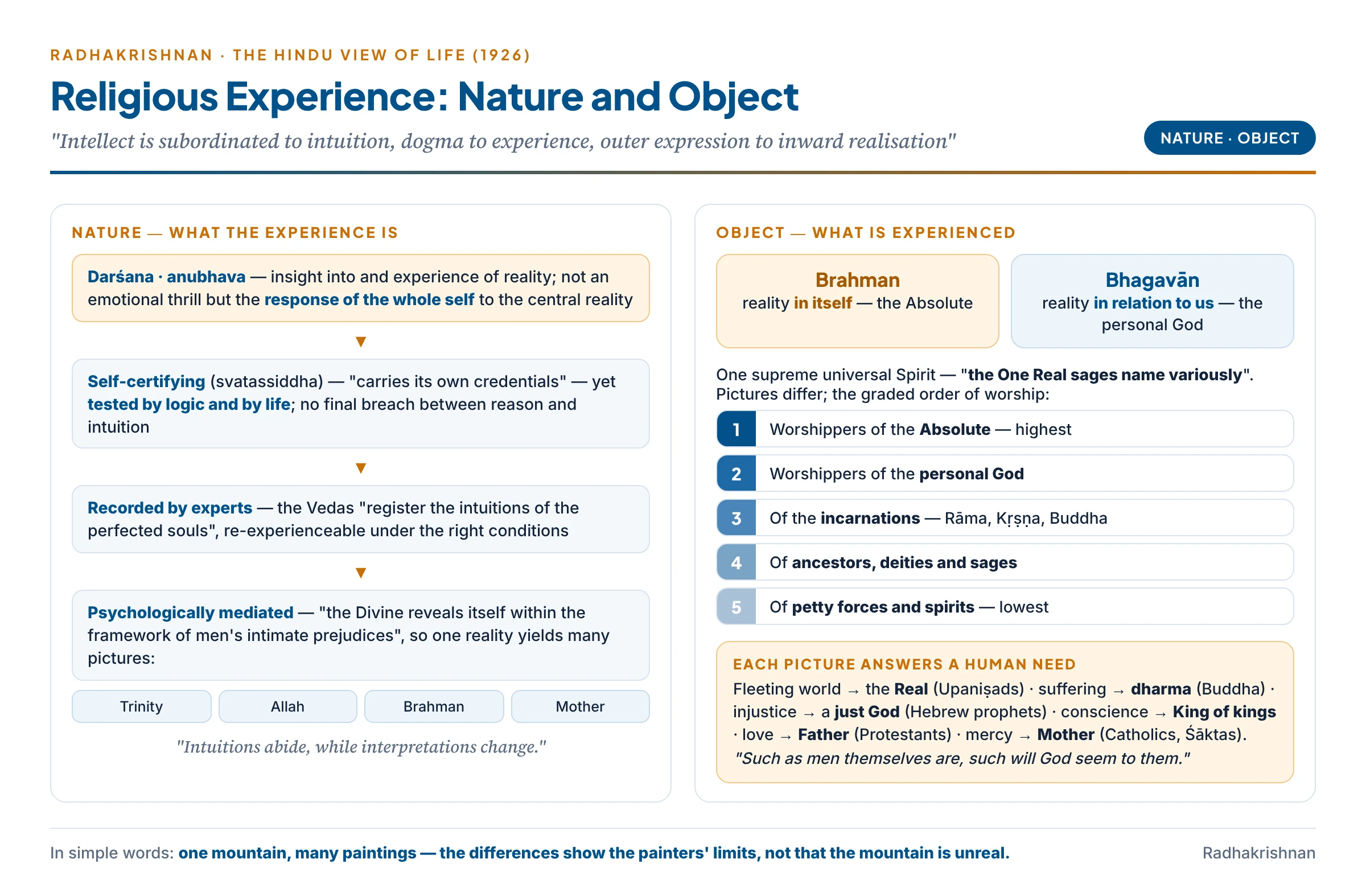
- Religion is a kind of life or experience. It is “not the acceptance of academic abstractions or the celebration of ceremonies”; it is “insight into the nature of reality (darśana), or experience of reality (anubhava)”.
- The response of the whole person. “This experience is not an emotional thrill, or a subjective fancy, but is the response of the whole personality, the integrated self, to the central reality.” It is “a specific attitude of the self, itself and no other” — not reducible to thought (Hegel), feeling (Schleiermacher) or morality (Kant), though mixed up with all three.
- Self-certifying. “Religious experience is of a self-certifying character. It is svatassiddha. It carries its own credentials.”
- But open to rational testing. The seer must “justify his inmost convictions in a way that satisfies the thought of the age”. Spiritual perception, like all perception, “is liable to error and requires the testing processes of logical thought“. To turn “religious certitude into logical certainty” we need an intellectual account. “There can be no final breach between the two powers of the human mind, reason and intuition.”
- True faith versus blind belief. “The mechanical faith which depends on authority” differs from “the religious faith which has its roots in experience”. He quotes Wesley: faith is “the vision of the soul, that power by which spiritual things are apprehended, just as material things are apprehended by the physical senses.”
- Scriptures as records of expert experience. The Vedas “record the spiritual experiences of souls strongly endowed with the sense for reality… experts in the field of religion“. Their truths “are capable of being re-experienced on compliance with ascertained conditions”. We discriminate the genuine from the spurious “not only by means of logic but also through life“.
- Trust tempered by criticism. The Hindu attitude to the Veda is “trust tempered by criticism“; “God has never finished the revelation of His wisdom and love”; interpretation of religious experience “must be in conformity with the findings of science“.
- An experimental basis as wide as human nature. “The Hindu philosophy of religion starts from and returns to an experimental basis.” Other religions start from one particular datum — Christian theology, for example, from the self-certifying authority of Jesus — and tend to dismiss other experiences; “the Hindu thinker readily admits other points of view”.
- Psychologically mediated. “Religious experience is not the pure unvarnished presentment of the real in itself, but is the presentment of the real already influenced by the ideas and prepossessions of the perceiving mind.” “The Divine reveals itself to men within the framework of their intimate prejudices.” The Śvetāśvatara Upaniṣad says God is “fashioned by the heart, the understanding and the will”.
- Conflicting descriptions do not cancel the reality. That descriptions of God conflict “only shows that our notions are not true“. A crude picture of God as “a sultan in the sky” and a refined picture of God as holy love “all intend the same reality”. If the “personal equation” does not destroy objectivity in science, it need not destroy it in religion.
- Silence and negation. “When asked to define the nature of God, the seer of the Upaniṣad sat silent.” Yājñavalkya’s neti is compared with the “I know not” of St Bernard, Ruysbroeck’s “dim silence”, and the negative theology of Dionysius, Eckhart and Boehme.
- Yet images are needed. “Man is a talking animal.” The mind cannot rest in pure negation; it uses imagination. The highest category we have is self-conscious personality: God is the supreme Person (uttama-puruṣa); Brahmā, Viṣṇu and Śiva are God as knower, lover and will — three sides of one personality, not three gods.
In simple words
Think of one mountain painted by many artists. One paints it at dawn, one in storm, one from the north face, one as a child would draw it. The paintings look different, some are crude, some are beautiful — but nobody concludes that there is no mountain. For Radhakrishnan, the many religions are such paintings: the differences show the limits of the painters, not the unreality of the mountain.
9. Radhakrishnan on the Object of Religious Experience
- The question. “If religion is experience, what is it that is experienced?” Christian mystics see the Trinity; Muslim mystics deny it. The Hindu thinker did not conclude that religious experience merely projects “subjective suggestions”.
- The object is the one supreme universal Spirit. “The Hindu never doubted the reality of the one supreme universal spirit, however much the descriptions of it may fall short of its nature.”
- Absolute and personal God — two aspects of one Reality. “When we emphasise the nature of reality in itself we get the absolute Brahman; when we emphasise its relation to us we get the personal Bhagavān.” Rational logic and mystical contemplation favour the Absolute; ethical theism favours the personal God. Hinduism keeps both.
- Different pictures answer different human needs.
- The Upaniṣadic seers, struck by the fleeting world, sought the abiding Real (sat);
- the Buddha, pierced by suffering, found escape in the eternal dharma;
- the Hebrew prophets, troubled by moral injustice, found a just and omnipotent God;
- the prophets and Muhammad, gripped by the authority of conscience, saw God as King of kings;
- Protestant Christians stress God as loving Father;
- Catholics and Śāktas see God as Mother, whose love is like the cow’s for its calf (vātsalya).
“Such as men themselves are, such will God Himself seem to them to be” (John Smith, the Cambridge Platonist). “Not one of them gives the whole truth, though each of them is partially true.”
- What God is to us, not in Himself. These pictures tell us “what he is to us“, not “what God is in himself“. Tukārām even teases God: “because we exist, Godhead has been conferred on you.”
- “The One Real sages name variously” (ekaṃ sad viprā bahudhā vadanti, Ṛg Veda). To admit many descriptions is not polytheism: Yājñavalkya began with 3,306 gods and reduced them all to one Brahman.
- A graded order of worship. Hinduism “accepts all religious notions as facts and arranges them in the order of their more or less intrinsic significance”:
- highest — worshippers of the Absolute;
- then worshippers of the personal God;
- then of the incarnations — Rāma, Kṛṣṇa, Buddha;
- then of ancestors, deities and sages;
- lowest — worshippers of petty forces and spirits.
“The sage finds his God in his deeper self“; “the yogins see Śiva in the Self, not in images.”
- Honest self-criticism. Radhakrishnan admits that in practice “the crowd still stands gazing at the heavens”: in the name of tolerance Hindus have protected superstitious rites, and there has been no serious effort to raise the people’s conception of God. He wanted temples to become “seats of learning and schools of thought“.
- Later formulations. In An Idealist View of Life he called the highest experience integral intuition — the ground and synthesis of all experience — and summed up his position: “Intuitions abide, while interpretations change.” There is “no such thing as pure experience, raw and undigested”; it is always mixed with interpretation, which must therefore be held tentatively.
10. Evaluating Radhakrishnan’s Account
Strengths:
- Undogmatic and open — religion rests on experience that can be re-tested, not on blind authority; reason and intuition are partners.
- Explains diversity without scepticism — conflicting pictures of God are partial, not false; this anticipates John Hick‘s later distinction between the Real in itself and its different human images.
- Balanced on experience and interpretation — he admits experience is psychologically mediated while denying that this makes it unreal, just as the personal equation does not destroy science.
- Ethical and social — he judges religion “through life”, criticises superstition, and links spiritual experience with tolerance and social reform.
Criticisms:
- Advaita bias. His ladder places worshippers of the Absolute at the top and of a personal God second; theists — Rāmānuja, Madhva, Christians, Muslims — would reject this ranking. Critics say he “Hinduises” all religions, treating them as imperfect versions of Vedānta: this is inclusivism, not equal respect.
- Tension in his account. If experience is self-certifying, why must it be tested by logic and life? If it is psychologically mediated, how can it carry its own credentials?
- Experts disagree. If scriptures are the testimony of “experts”, what happens when experts — Advaitins and Dvaitins, Buddhists and Jainas — contradict one another?
- “Experimental” is a loose word. Spiritual “experiments” cannot be repeated under controlled, public conditions; the conditions (“compliance with ascertained conditions”) include belief and discipline, which shape the result.
- Neglect of history. For religions of historical revelation — the Exodus, the Cross, the Qur’ān — a timeless inner intuition cannot replace particular historical events.
- The constructivist challenge. If, as Steven Katz argues, there are no unmediated experiences, there may be no single common core behind the religions at all (Article 7).
11. A World Religion — a Spiritual and Humanistic Composite?
- The idea. Several modern Indian thinkers looked for a universal religion that would combine spirituality — inner realisation of the divine — with humanism — the dignity, freedom and welfare of every human being.
- Vivekananda (Chicago, 1893): a universal religion must have “no place for persecution or intolerance in its polity”, must “recognise divinity in every man and woman“, and its whole aim must be “centred in aiding humanity to realise its own true, divine nature”. Spiritual (divinity of the soul) and humanistic (service of humanity) at once.
- Radhakrishnan. He hoped not for a single new creed but for a fellowship of religions grounded in the spiritual experience they share — “the Vedānta is not a religion, but religion itself in its most universal and deepest significance”. Different religions would remain, each correcting its narrowness through contact with others.
- Tagore — The Religion of Man (1930): the divine is realised in the “Surplus in Man”, his creative and moral reach beyond mere survival — a humanistic spirituality.
- Gandhi — “Truth is God“: a religion of truth and non-violence, judged by service to the poorest.
- Aurobindo — a “religion of humanity” made spiritual: human unity will last only if founded on an inner, spiritual oneness.
Evaluation:
- For: a purely spiritual religion can become other-worldly and indifferent to suffering; a purely humanistic creed (secular humanism) can lack depth and a source of meaning beyond the self. The composite keeps the vertical (God, Spirit) and the horizontal (humanity) together — “serve beings as God”.
- Against:
- a composite risks becoming a lowest common denominator, vague and without the concrete practices that keep religions alive;
- exclusivist believers reject it as dissolving revealed truth;
- secular humanists reject its spiritual element as unnecessary;
- it is often modelled on Vedānta, which other religions may not accept as their common core.
- Balanced view. As an ideal of shared values — reverence, compassion, tolerance, service — it is attractive and has shaped interfaith dialogue and India’s constitutional secularism of equal respect. As a replacement for particular religions, it is neither likely nor necessary.
Critical Evaluation
Objections to the Vedāntic Account of Religious Experience
- Circularity. Scripture tells the seeker what to expect; the experience then “confirms” scripture. Advaitins experience non-duality, Dvaitins experience eternal difference — each finds what his tradition taught.
- Conflict within Vedānta itself. Identity (Śaṅkara) and eternal difference (Madhva) cannot both be the literal truth about the same experience.
- Rāmānuja’s objection to Advaita. There is no consciousness without an object and a subject; a “pure, undifferentiated” experience is either impossible or simply a lack of awareness, as in deep sleep.
- Buddhist objection. The “self-luminous permanent Self” is an illusion produced by craving; careful introspection finds only changing states (anattā).
- Empiricist and Cārvāka objection. What cannot be perceived publicly or inferred from perception is not knowledge.
- Kant. Human beings have no intellectual intuition; we know only what is given through the senses and shaped by our concepts.
- Hegel’s jibe. An undifferentiated Absolute is “the night in which all cows are black” — empty, not full.
- World-negation. Critics such as Albert Schweitzer argued that Indian mysticism leads to “world and life negation”, withdrawal from ethical action.
- Social exclusion. Classical texts restricted Vedic study and contemplative bhakti by caste and gender.
Replies and Strengths
- Fruits in life. The lives of jīvanmuktas and saints — Ramakrishna, Ramana, the Ālvārs — show freedom from fear and ego, and boundless compassion.
- Method, not mere claim. The experience is reached by a repeatable discipline; Vedānta invites the seeker to test it.
- Reason has a role. Reflection (manana) and sound reasoning (sutarka) are required; Śaṅkara refuses any scripture that contradicts experience in its own field.
- Plenitude, not emptiness. Radhakrishnan replies to the “empty Absolute” charge: intuition is the fullness of experience, not a blank.
- Practical Vedānta. Vivekananda and Gandhi turned the vision of one Self into service; Rāmānuja’s prapatti and the bhakti movement opened religious experience to all castes.
Critics and Defenders
Criticism — Critics
- Rāmānuja: pure objectless consciousness is impossible; Advaita misreads deep sleep.
- Madhva: the experience of difference is basic and never sublated.
- Buddhists: the permanent Self is a construction.
- Kant and empiricists: no intellectual intuition; no public checking.
- Constructivists (Katz): each school’s experience is shaped by its doctrine.
- Schweitzer: Indian mysticism leads to world-negation.
Defence — Defenders and strengths
- Śaṅkara: realisation is self-validating and never contradicted; it sublates all dual experience.
- Radhakrishnan: experience is mediated but real; differences show our limits, not God’s unreality.
- Vivekananda: religion is realisation — test it by practice.
- Hanumān’s verse: the schools describe different depths of one experience.
- Fruits: fearlessness, compassion and social service in the lives of the realised.
Cross-Tradition Comparison
Vedānta and Western Accounts of Religious Experience
| Point | Advaita / Radhakrishnan | Western parallels | Key difference |
|---|---|---|---|
| Highest experience | Non-dual realisation of the Self | Eckhart’s “ground of the soul”; Plotinus’ “flight of the alone to the alone” | Advaita calls it knowledge that never fades; Plotinus’ union came only a few times in life |
| Theistic vision | Rāmānuja’s bhakti as vivid vision | Teresa’s spiritual marriage; Bernard’s union of love | Both keep the soul distinct; Rāmānuja makes the world God’s body |
| Experience and dogma | “Intellect subordinated to intuition, dogma to experience” | Schleiermacher’s feeling; James’s “personal religion” | Radhakrishnan adds rational testing and scripture as expert record |
| Transiency | Realisation is permanent | James: mystical states are transient | Advaita distinguishes passing states from lasting knowledge |
| Diversity of religions | One Spirit, many partial pictures; graded order | Hick: one Real, many personae and impersonae | Radhakrishnan ranks the pictures; Hick claims equal validity |
| Reason | Sutarka and manana needed; no final breach | Aquinas: faith above but not against reason | Indian view makes experience, not argument, the final test |
Indian Connect — Takeaways for the Vedāntic view
- The object of religious experience in Vedānta is not “a being among beings” but the ground of all being, which is also one’s own Self — hence it can be realised but never observed.
- Vedānta holds together scripture (śruti), reason (manana, sutarka) and experience (anubhava): scripture points, reason clears doubt, experience confirms.
- The three schools may be read as stages of one experience (Hanumān’s verse) or as genuinely rival accounts; both readings have defenders.
- Radhakrishnan made the Vedāntic view of experience the basis of Indian tolerance and of a hoped-for fellowship of religions.
Synthesis (Siddhānta)
- Nature. In the Vedāntic tradition, religious experience is direct realisation (anubhava, aparokṣānubhūti) — immediate, self-luminous, self-validating and transforming. In Advaita it is non-dual knowledge of the Self as Brahman; in Viśiṣṭādvaita and Dvaita it is a loving, grace-given vision of the Lord.
- Object. Its object is the one Reality — Brahman in itself, Bhagavān in relation to us — which can never be an object like a tree or a star. Radhakrishnan adds that every description of it is psychologically mediated and therefore partial.
- Validity. Vedānta does not rest the experience on private feeling alone: it is guided by scripture, tested by reason, and judged by life — by fearlessness, compassion and freedom from ego.
- A balanced verdict. The Vedāntic view is strongest as a disciplined path whose fruits can be seen; it is weakest where it claims that one school’s experience is the hidden core of all religions. Read with humility, it supports dialogue rather than ranking.
- Contemporary relevance. The global spread of yoga and meditation, Vivekananda’s ideal of service, interfaith dialogue, and India’s secularism of equal respect (sarva-dharma-samabhāva) all draw on this vision of one Reality reached by many paths.
Previous Year Questions
- 2025Evaluate the nature and object of Religious Experience as explained by Radhakrishnan in ‘The Hindu View of Life’.
- 2024Discuss the main features of religious experience according to Advaita Vedanta.
- 2021Explain the concept of religious experience in the light of Vedantic tradition.
- 2016“World-religion is a spiritualistic and humanistic composite.” Evaluate.