

Religious Experience: Nature and Object (Indian and Western).
Official Syllabus: Paper II, Section B, Unit 6
Mystical experience is found in every major religion, but it always speaks the language of its tradition. A Christian mystic speaks of union with the Trinity, a Sufi of passing away in Allah, an Upaniṣadic sage of the Self that is Brahman, a Buddhist of emptiness and the end of craving, a Jaina of the soul’s omniscience. This article surveys the great mystical traditions — Christian, Jewish, Islamic, Hindu, Buddhist and Jaina — compares mysticism in Hinduism and Islam, and examines how Buddhism and Jainism, two non-theistic religions of liberation, report religious experiences that conflict with each other.
In simple words
Imagine people from different countries climbing the same mountain by different paths and then writing home about the summit. One says, “I met the King who lives there.” Another says, “There was no one — only endless sky.” A third says, “I discovered I was the mountain.” Are they describing the same summit in different words, or did they reach different summits? That is the puzzle of mysticism across the traditions.
Context & Problem
Mysticism Inside the Traditions
- Theistic religions with monistic streams. The three Western (Abrahamic) religions — Judaism, Christianity and Islam — are broadly theistic: God is a person, distinct from the soul. Yet each developed monistic streams that speak of oneness with God: the Zohar in Judaism, Meister Eckhart and St John of the Cross in Christianity, and the Sufi school of Ibn ʿArabī in Islam. In mysticism the monism of some Eastern religions is also experienced within Western theism.
- Tension with orthodoxy. In the theistic religions, God is transcendent; no mortal may claim to be God. Mystics who seemed to claim identity were punished: al-Ḥallāj was executed, and Eckhart’s teachings were condemned. In India, by contrast, the realisation “I am Brahman” became the very goal of a central school (Advaita).
- Non-theistic mysticism. Buddhism and Jainism reject a creator God, yet place mystical-meditative experience — nirvāṇa and kevala-jñāna — at the centre of religion. They show that mysticism need not be theistic at all.
Core Doctrine
1. Christian Mysticism
- Dionysius the Areopagite (c. 500) — Mystical Theology: God is known best by unknowing, in the “divine darkness” beyond all affirmation and negation — the root of negative (apophatic) theology.
- Meister Eckhart (c. 1260–1328) — distinguished the Godhead (Gottheit), the silent, attributeless “desert” beyond all distinctions, from God as Creator and Trinity; spoke of the “ground of the soul” where God and the soul are one, of detachment (Gelassenheit) and of the birth of God in the soul. Some of his statements were condemned by the Pope in 1329.
- St Teresa of Avila (1515–1582) — The Interior Castle: the soul passes through seven mansions of prayer to the spiritual marriage, permanent union with God; she combined deep mystical life with energetic reform of her order.
- St John of the Cross (1542–1591) — the “dark night of the senses” and the “dark night of the soul“, in which God seems absent while the soul is being purified; the way of nada — “nothing” — detachment from every created thing.
- Others: Bernard of Clairvaux (union as mutual love), Julian of Norwich (“all shall be well”), Ruysbroeck, Suso, the anonymous Cloud of Unknowing (“by love may He be gotten and holden; but by thought never”).
- Character. Theistic, Christ-centred, stressing love, grace and the cross; union is usually understood as union of wills in love, not loss of the creature in the Creator.
2. Jewish Mysticism
- Kabbalah — the medieval Zohar describes Ein Sof (“without end”), the infinite, unknowable God, who manifests through ten sefirot (divine attributes).
- Devekut — “cleaving” to God in constant remembrance, the goal of Jewish mystical life.
- Hasidism (18th century, the Baal Shem Tov) — joyful devotion, God’s presence in everything; Shneur Zalman of Liadi spoke of the person as a drop in the ocean of the Infinite. Isaac of Acre described the soul absorbed into God “as a jug of water into a running well”.
3. Islamic Mysticism — Sufism
- Name and origin. Sufism (taṣawwuf), probably from ṣūf, the coarse wool worn by early ascetics. It began in early Islam as ascetic piety (Ḥasan al-Baṣrī) and grew into a tradition of love and inner knowledge (maʿrifa).
- Love. Rābiʿa al-ʿAdawiyya (8th century) taught pure love of God — not from fear of hell or hope of paradise, but for God alone.
- The path (ṭarīqa), under a shaykh (master; pīr or murshid) guiding a murīd (disciple):
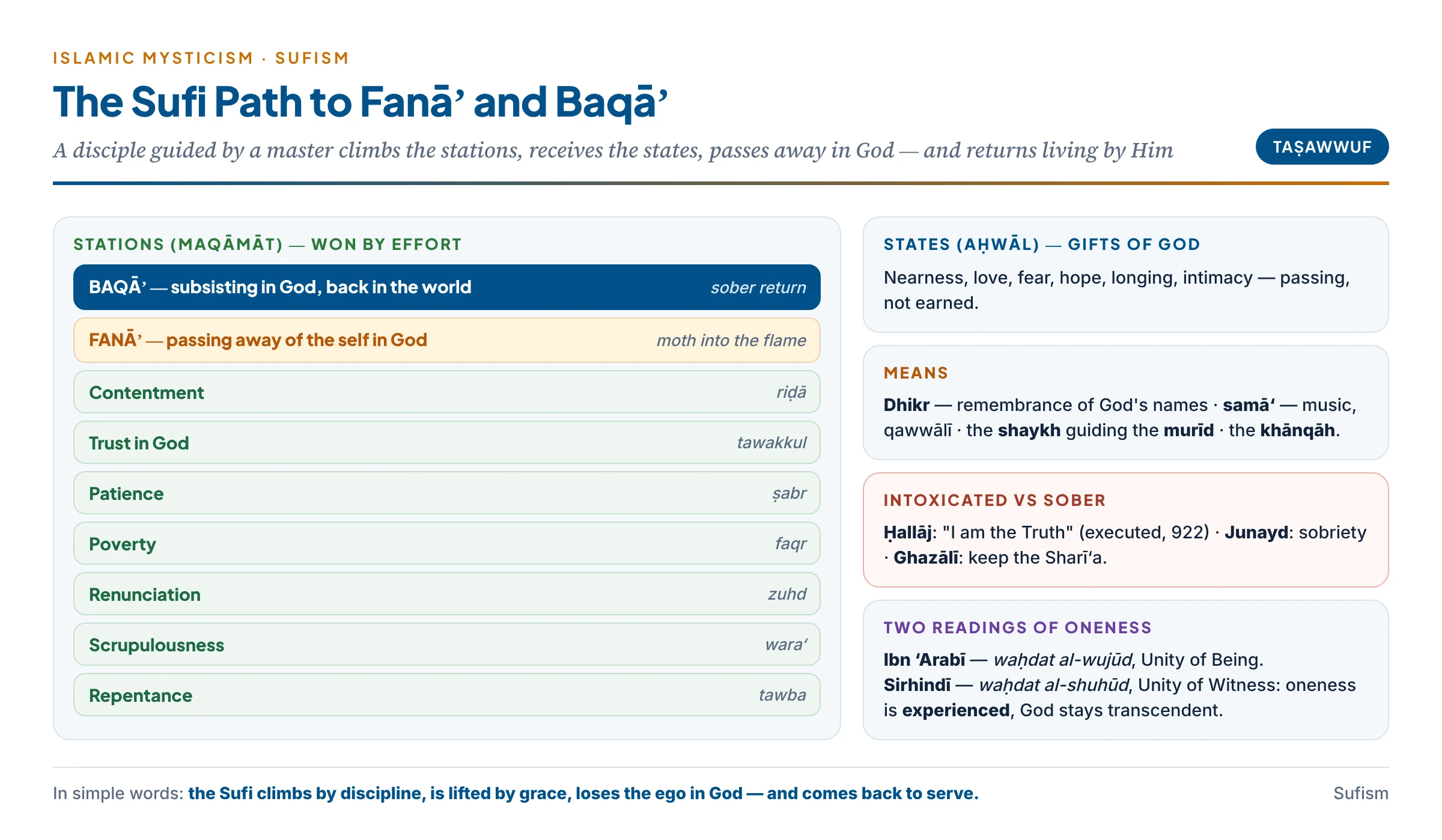
- Stations (maqāmāt) — stable stages won by effort: repentance (tawba), scrupulousness, renunciation (zuhd), poverty (faqr), patience (ṣabr), trust in God (tawakkul), contentment (riḍā).
- States (aḥwāl) — passing gifts of God: nearness, love, fear, hope, longing, intimacy.
- Remembrance (dhikr) — rhythmic repetition of God’s names; samāʿ — listening to music and poetry.
- Fanāʾ and baqāʾ. The goal is fanāʾ — “passing away” of the self, its desires and even its awareness of itself, in God — followed by baqāʾ — “subsisting” in God, returning to the world transformed.
- Intoxicated and sober Sufism. Bāyazīd Bisṭāmī (“Glory be to me!”) and al-Ḥallāj (“I am the Truth” — anā al-Ḥaqq) spoke from mystical “intoxication” (sukr). Al-Ḥallāj was executed in Baghdad in 922 for such utterances. al-Junayd taught “sobriety” (ṣaḥw): the mystic must return to sober awareness of the distinction between God and creature.
- Reconciliation with orthodoxy. al-Ghazālī (d. 1111) made Sufism respectable within Sunni Islam: Sufi knowledge comes by “taste” (dhawq) — as knowing the definition of drunkenness differs from being drunk — and the mystic must keep the Sharīʿa.
- Unity of Being and Unity of Witness.
- Ibn ʿArabī (1165–1240) — waḥdat al-wujūd, the “Unity of Being“: only God truly exists; creatures are His self-manifestations; the “Perfect Man” mirrors all the divine names.
- Shaykh Aḥmad Sirhindī (1564–1624), in Mughal India — waḥdat al-shuhūd, “Unity of Witness“: the experience of oneness is real as experience, but it is a subjective vision; in reality God remains transcendent and distinct from creation. This was a corrective, keeping Sufism within theism.
- Rūmī (1207–1273) — the Masnavī opens with the reed flute lamenting its separation from the reed-bed: the soul’s longing to return to its source; the Mevlevi “whirling” dervishes.
- Sufism in India. Orders (silsilas) such as the Chishtī (Muʿīn al-Dīn Chishtī of Ajmer, Niẓām al-Dīn Awliyāʾ of Delhi), Suhrawardī, Qādirī and Naqshbandī; the khānqāh (hospice) open to all; samāʿ and qawwālī music. Sufis and Bhakti saints shared a language of love, the divine name and the critique of formalism. Prince Dārā Shikōh compared Sufism and Vedānta in Majmaʿ al-Baḥrayn (“The Mingling of the Two Oceans“, 1655) and had the Upaniṣads translated into Persian.
In simple words
Sufi poets tell of the moth and the candle. Moths that only hear about the flame know nothing; the moth that sees it from afar knows a little more; but only the moth that flies into the flame and is consumed truly knows fire — and it can no longer report back. That is fanāʾ: the self passing away in God. Baqāʾ is the Sufi’s addition: in the masters, the self returns to the world, now living by God rather than by its own ego.
4. Hindu Mysticism
- The seers. The Vedic ṛṣis are “seers” (mantra-draṣṭā) who saw the hymns; scripture is thought of as the record of their vision.
- Upaniṣadic mysticism (jñāna). The Self (ātman) is Brahman — “That thou art” (tat tvam asi), “I am Brahman” (ahaṃ brahmāsmi). Brahman is reached not by sight or speech but by meditation on the Self “without parts“; it is described by negation — “not this, not this” (neti neti). The Māṇḍūkya describes four states — waking, dreaming, deep sleep, and turīya, “the fourth”, pure non-dual consciousness. “One who knows Brahman becomes Brahman.” There is no knower and no known.
- Yogic mysticism. Patañjali’s Yoga Sūtra: stilling the movements of the mind (citta-vṛtti-nirodha) through the eight limbs to samādhi and kaivalya — the isolation of the pure self (puruṣa).
- Devotional mysticism (bhakti). The Ālvārs and Nāyanārs of Tamil country, Caitanya‘s ecstatic love of Kṛṣṇa, Mīrābāī‘s bridal longing (mādhurya bhāva), Tulsīdās, Tukārām: union with a personal Lord in love, often keeping a sweet distinction — “I want to taste sugar, not become sugar” (Ramakrishna’s image).
- Sant and Tantric mysticism. Kabīr (15th century), weaver-poet who drew on both bhakti and Sufism, sang of the formless Lord within: “the Lord is in me, the Lord is in you”, mocking temple and mosque ritual. Tantra seeks union through the awakening of inner energy (kuṇḍalinī).
- Modern mystics. Sri Ramakrishna (1836–1886), who reported realising God through Hindu, Islamic and Christian paths and concluded “as many faiths, so many paths“; Ramana Maharshi and his self-enquiry (“Who am I?”); Sri Aurobindo‘s integral yoga.
In simple words
Ramakrishna told of a doll made of salt that went to measure the depth of the ocean. As soon as it stepped in, it began to dissolve — and by the time it reached the bottom there was no doll left to come back and report the depth. So too, he said, the one who realises Brahman merges in it and cannot describe it. The bhakta prefers to remain a little apart — like one who wants to taste sugar rather than become sugar.
5. Mysticism in Hinduism and Islam Compared
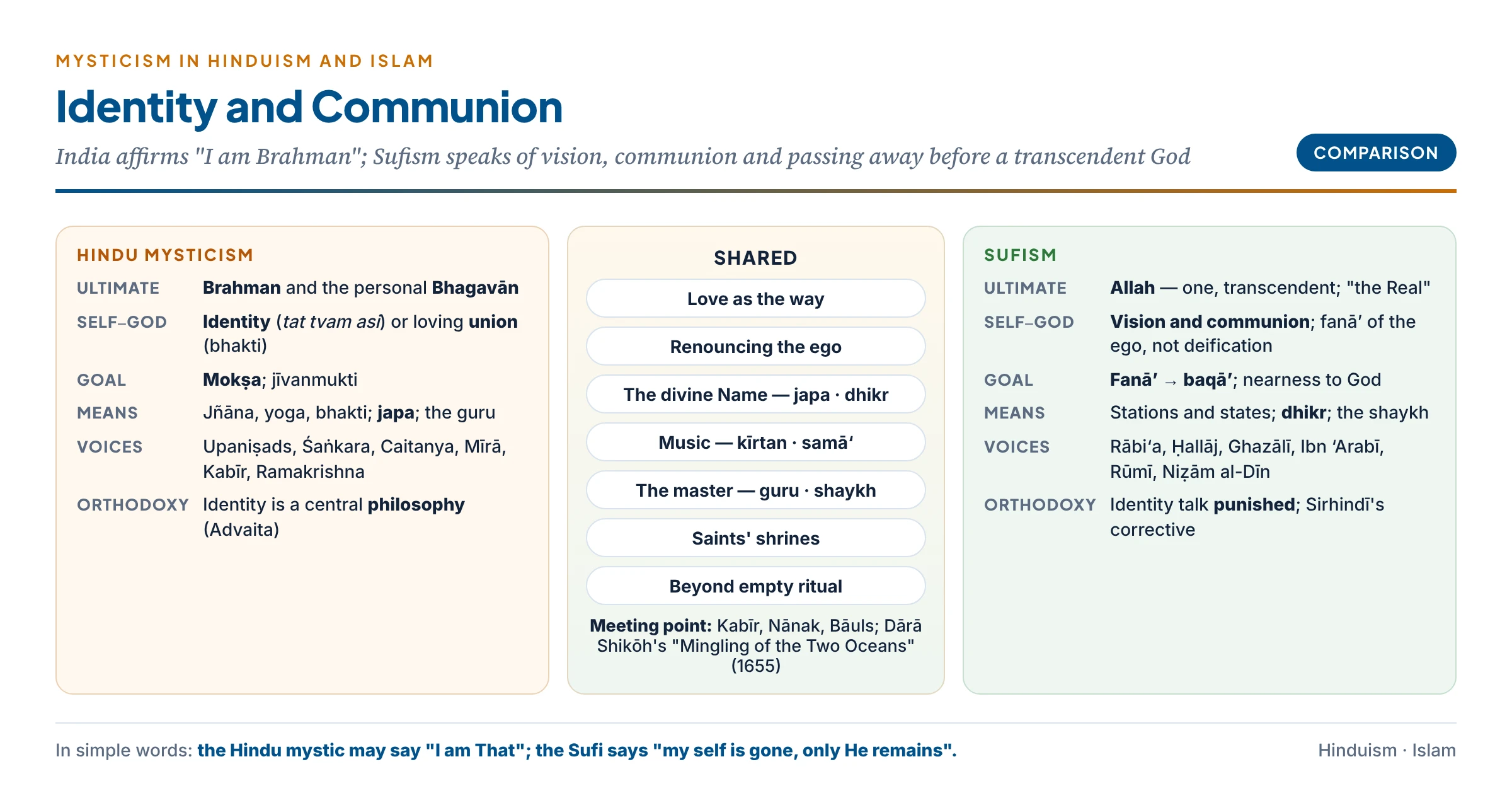
| Point | Hindu mysticism | Islamic mysticism (Sufism) |
|---|---|---|
| Ultimate | Brahman (impersonal) and Īśvara/Bhagavān (personal) | Allah — one, personal, transcendent; Ibn ʿArabī’s “Being” |
| Self and God | Identity (Advaita: ātman = Brahman) or union in love (bhakti, Rāmānuja) | Communion and vision; identity claims (Ḥallāj) suspect; fanāʾ of the ego, not deification |
| Goal | Mokṣa — liberation from rebirth; jīvanmukti | Fanāʾ and baqāʾ; nearness to God; paradise and vision of God |
| Means | Jñāna, yoga, bhakti, karma; japa of mantra; guru | Stations and states; dhikr of divine names; shaykh |
| Relation to law | Mystic may transcend ritual and caste (Kabīr, Advaita’s sannyāsin) | Sharīʿa to be kept (al-Ghazālī); antinomian streams rare |
| Language | Neti neti; tat tvam asi; poetry of longing | Anā al-Ḥaqq; poetry of wine, beloved and reed-flute |
| Music | Kīrtan, bhajan | Samāʿ, qawwālī |
| Orthodoxy’s response | Identity is a central philosophy (Advaita) | Identity talk led to persecution; Sirhindī’s corrective |
- Shared features. Love as the way; renunciation of ego and worldliness; repetition of the divine name; breath and posture disciplines; the authority of a spiritual master; saints’ shrines; contempt for empty ritual; and the experience of the self’s melting into the divine.
- The key difference. Mysticism is found in its most undiluted form in India — the seeker identifies himself completely with ultimate reality like Brahman. Sufis, though mystics, do not speak so much of identification with God as of vision and communion: for Muslims God is transcendent, and no mortal may dare to identify himself with God. (Jews hold similar views.) This is why claims of identity with God were treated as blasphemy — Jesus was crucified on the charge of making himself equal to God, and al-Ḥallāj was executed.
- Meeting points in India. Sufi khānqāhs and bhakti circles influenced each other: Kabīr, Guru Nānak, Dādū, the Bāuls of Bengal; Dārā Shikōh’s “Mingling of the Two Oceans” argued that Sufism and Vedānta differ only in words.
Common confusion
Was al-Ḥallāj stoned to death for saying “I am God”? Many notes say so, but al-Ḥallāj was imprisoned for years and then executed in Baghdad in 922 (flogged, mutilated and put to death) after a long political and religious trial. His cry was “anā al-Ḥaqq” — “I am the Truth“, al-Ḥaqq being one of God’s names. Later Sufis often defended him by saying that it was God speaking through a self that had passed away (fanāʾ), not a man claiming to be God.
6. Buddhist Mysticism
- No God, no soul. Buddhism denies a creator God and a permanent self (anattā). Its mystical experience is therefore not of a Being but an insight into the nature of reality.
- Theravāda — insight (vipassanā). The goal of meditation is to “see things as they are“:
- as unsatisfactory (dukkha), impermanent (anicca) and not-self (anattā);
- as sequences of momentary events, each dependent on what went before — “this being, that arises” (pratītyasamutpāda, dependent origination);
- there are no abiding substances and no eternal souls; the last delusion to go is that one is a self.
Seeing reality this way extinguishes the fires of craving and frees the meditator from rebirth: nirvāṇa. The jhānas (meditative absorptions) lead to this insight. The object is “an insight into the fundamental reality of the world — that it is momentary, impermanent, always becoming“.
- Mahāyāna — emptiness. In Mādhyamika (Nāgārjuna), enlightenment is the direct realisation of śūnyatā — that all things are empty of independent existence — as a basic fact about reality. Yogācāra speaks of pure, non-dual consciousness.
- Zen. Satori or kenshō — sudden awakening to one’s true nature, often triggered by a koan (“What is the sound of one hand clapping?”).
- Is it “mystical”? Many count the experiences of śūnyatā and Zen enlightenment as mystical: ineffable, noetic, transforming. But the Buddhist does not ultimately seek knowledge about a reality; he seeks the extinction of the self and its craving — liberation, not cognition.
7. Jaina Mysticism
- A real, eternal soul. Jainism holds that every soul (jīva) is eternal and by nature possesses infinite knowledge, infinite perception, infinite bliss and infinite energy (ananta-catuṣṭaya), obscured by subtle karmic matter clinging to it.
- Kevala-jñāna. When all karma is destroyed through the three jewels — right faith, right knowledge, right conduct — and through austerity and meditation (dharma-dhyāna and śukla-dhyāna), the soul attains kevala-jñāna: omniscience. Texts say of Mahāvīra that after twelve years of meditation and fasting, “with knees high and head low, in deep meditation”, he reached “the highest knowledge and intuition called Kevala, which is infinite, supreme, unobstructed, complete and full”; he “knew and saw all conditions of the world, of gods, men and demons… the thoughts of their minds”.
- Kaivalya. The kevalin (omniscient one) at death attains siddha status — eternal, blissful, omniscient existence at the summit of the universe.
8. The Conflicting Nature of Religious Experience — Buddhism and Jainism
- Striking agreements. Both are śramaṇa traditions of the same time and region (Magadha, 6th–5th century BCE); both reject the authority of the Veda and a creator God; both teach karma, rebirth, renunciation and ahiṃsā; both place meditative experience at the summit of the religious life; both are religions without God.
- But their supreme experiences contradict each other.
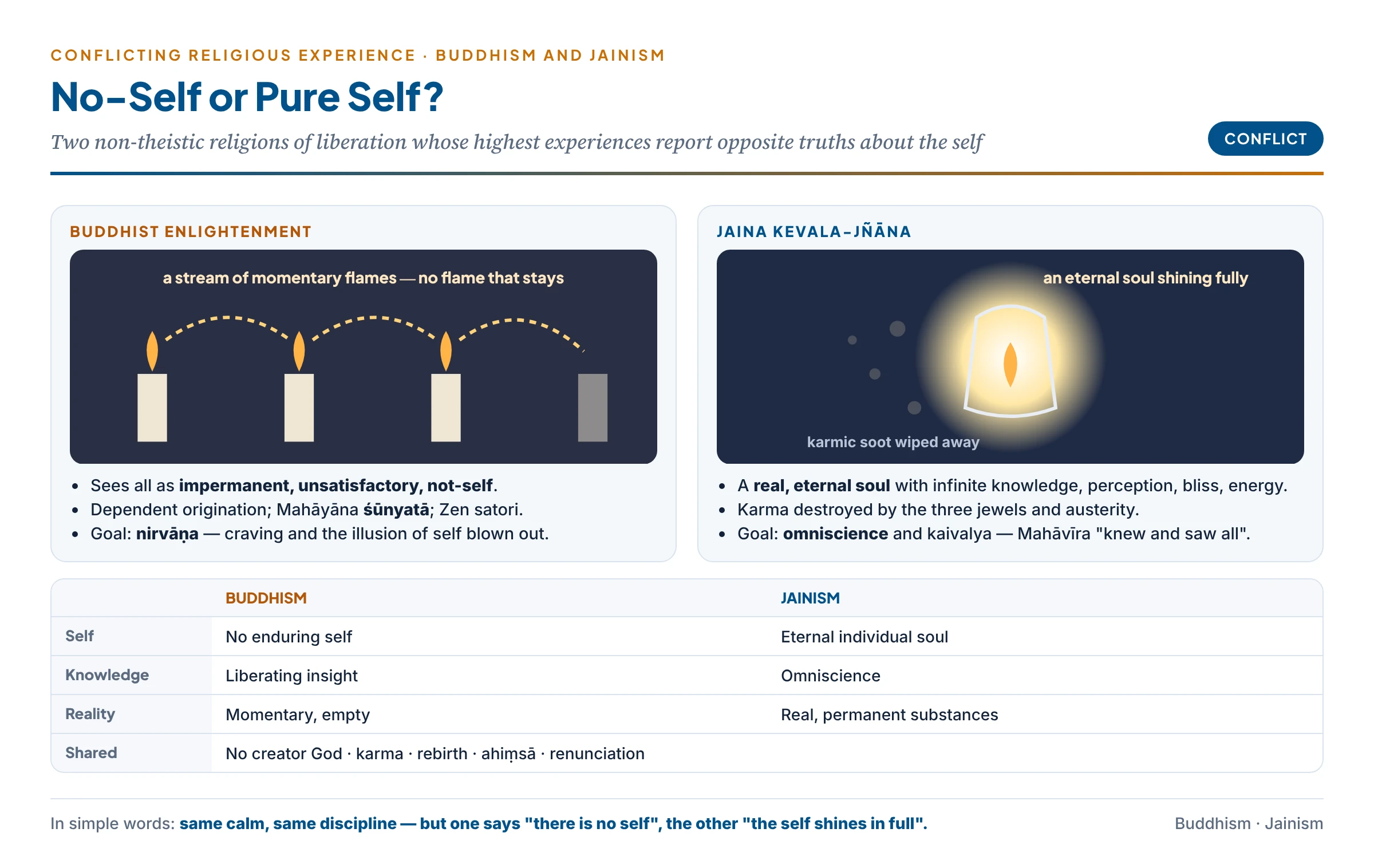
- Self. The Buddhist enlightenment experience reveals no self — only a stream of momentary events. The Jaina kevala experience reveals a real, eternal, individual soul in its pure state.
- Knowledge. The Jaina kevalin claims omniscience — knowledge of all things, past, present and future. The Buddhist insight is a liberating understanding of impermanence and not-self; the Buddha discouraged speculation on unanswerable questions and, in some texts, denied claiming to know all things at every moment.
- Reality. Buddhism (especially Mādhyamika) sees all things as empty of fixed essence; Jainism sees reality as many-sided but composed of real, permanent substances (souls, matter, space, time, motion, rest).
- Liberation. Nirvāṇa is the blowing-out of craving and of the illusion of self; Jaina kaivalya is the full flowering of an eternal self’s knowledge and bliss.
- Mutual criticism. Jainas argued that if everything is momentary, the doer of an action perishes before its fruit — “the action done is lost” (kṛta-praṇāśa) and “fruit comes without action” (akṛtābhyāgama). Buddhists replied that a causal stream suffices for moral continuity, and criticised Jaina extreme austerity as the path of self-torture rejected in the Middle Way.
- Why this matters. If religious experiences are veridical (true to their object), then both the Buddhist experience (there is no enduring self) and the Jaina experience (there is an enduring omniscient self) cannot be true. This is the conflicting claims objection to religious experience as evidence (Article 8) — and it arises not between theism and atheism but within non-theistic religion itself.
- Possible responses.
- Only one is veridical — the other is a misinterpretation shaped by doctrine.
- Experience is interpreted by doctrine — Yandell‘s point: the Buddhist’s peace and freedom from craving count as “enlightenment” only through doctrines that link such states to nirvāṇa; the evidence is indirect and only as good as the doctrine.
- Stace’s common core — both are the same introvertive experience of pure consciousness, interpreted as “no-self” by one and “pure soul” by the other.
- Hick’s pluralism — both are culturally shaped awarenesses of the same Real, experienced as different impersonae (Article 7).
- Jaina anekāntavāda — the Jaina doctrine of many-sidedness would treat each view as partially true from its own standpoint (naya).
In simple words
Two monks sit by a lamp in the same room. The first, a Buddhist, watches the flame and says: “There is no fixed flame here — only a stream of burning moments, each lighting the next. So too with me.” The second, a Jaina, says: “When the soot is wiped off the glass, the light inside shines out fully — that light is my soul, eternal and all-knowing.” They have the same calm, the same discipline, the same freedom from desire — yet their reports of what they saw contradict each other.
Indian Connect — Indian ways of handling conflicting experiences
- Jaina anekāntavāda and syādvāda: every claim is true “in some respect” (syāt); the blind men and the elephant.
- Ramakrishna: “As many faiths, so many paths” — the same reality realised by different routes.
- Radhakrishnan: religious experience is “psychologically mediated” — “the Divine reveals itself to men within the framework of their intimate prejudices”; conflicting descriptions show our notions are imperfect, not that the reality is unreal.
- Vivekananda at the World’s Parliament of Religions (Chicago, 1893): “as the different streams having their sources in different places all mingle their water in the sea, so, O Lord, the different paths which men take… all lead to Thee.”
9. Mystical Traditions at a Glance
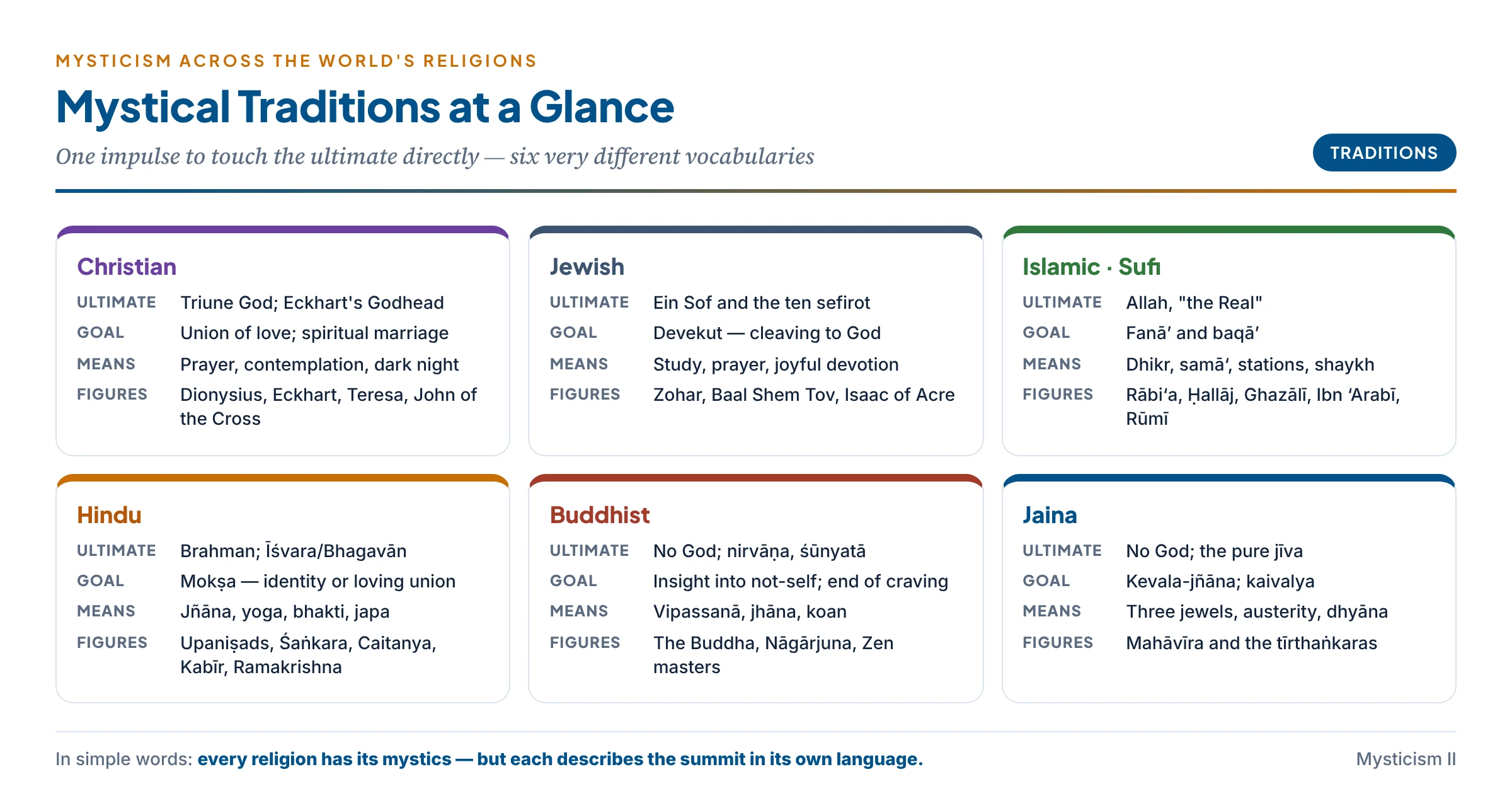
| Tradition | Ultimate | Goal / key experience | Characteristic means | Key figures |
|---|---|---|---|---|
| Christian | Triune God; Eckhart’s Godhead | Union of love; spiritual marriage | Prayer, contemplation, the dark night | Dionysius, Eckhart, Teresa, John of the Cross |
| Jewish | Ein Sof and the sefirot | Devekut (cleaving) | Study, prayer, joyful devotion | Zohar, Baal Shem Tov, Isaac of Acre |
| Islamic (Sufi) | Allah; the Real (al-Ḥaqq) | Fanāʾ and baqāʾ | Dhikr, samāʿ, stations and states | Rābiʿa, Ḥallāj, Ghazālī, Ibn ʿArabī, Rūmī |
| Hindu | Brahman; Īśvara/Bhagavān | Mokṣa; identity or loving union | Jñāna, yoga, bhakti, japa | Upaniṣads, Śaṅkara, Caitanya, Kabīr, Ramakrishna |
| Buddhist | No God; nirvāṇa, śūnyatā | Insight into not-self, emptiness | Vipassanā, jhāna, koan | Buddha, Nāgārjuna, Zen masters |
| Jaina | No God; the pure jīva | Kevala-jñāna, kaivalya | Three jewels, austerity, dhyāna | Mahāvīra, the tīrthaṅkaras |
Critical Evaluation
Do the Traditions Describe One Experience or Many?
- One experience, many interpretations (perennialism). James heard “the same recurring note” in all mystical classics; Stace found a common core; Aldous Huxley spoke of a “perennial philosophy“; Indian thinkers like Ramakrishna, Vivekananda and Radhakrishnan saw different paths to one summit.
- Many experiences (constructivism and pluralism of types). Zaehner argued that theistic, monistic and nature mysticism are different experiences; Steven Katz argued that mystics’ experiences are shaped from the start by their tradition’s concepts, so a Sufi and a Buddhist do not have the same experience (Article 7).
- Evidence for difference. The Buddhist–Jaina conflict, the theistic distinction between God and soul vs the Advaitic identity, and Sirhindī’s correction of Ibn ʿArabī show that mystics themselves disagree about what they experienced.
- Evidence for similarity. Common features — unity, ineffability, peace, loss of ego, love — and the mutual recognition between Sufis and bhaktas, or between Eckhart and Advaita (noticed by Otto), suggest deep kinship.
Critics and Defenders
Criticism — Critics
- Constructivists (Katz): each tradition produces its own experience; there is no common core.
- Zaehner: monistic and theistic mysticism are different experiences, not one experience differently named.
- Orthodox theists: identity mysticism is blasphemy (Ḥallāj’s trial; Eckhart’s condemnation).
- Sceptics: contradictory reports (Buddhist no-self vs Jaina eternal self) show mystical experience is not a reliable guide to reality.
- Mīmāṃsakas and Cārvākas: omniscience and suprasensible insight are impossible claims.
Defence — Defenders and strengths
- James and Stace: a recurring note across all traditions — unity, ineffability, peace.
- Ramakrishna and Vivekananda: many paths, one goal — experienced, not merely argued.
- Hick: different traditions are different human responses to one Real.
- Jaina anekāntavāda: conflicting views can be partial truths from different standpoints.
- Moral fruits: Sufi hospitality, bhakti equality, Buddhist compassion, Jaina ahiṃsā.
Cross-Tradition Comparison
Theistic and Non-theistic Mysticism
| Point | Theistic mysticism (Christian, Sufi, bhakti) | Non-theistic mysticism (Buddhist, Jaina, Advaita/Sāṃkhya) |
|---|---|---|
| Object | A personal God | Nirvāṇa, śūnyatā, the pure soul, Brahman |
| Self | Soul remains distinct, united in love | No-self (Buddhism), pure soul (Jainism), identity with Brahman (Advaita) |
| Grace or effort | Grace of God decisive | Self-effort and insight decisive |
| Feeling | Love, longing, bridal imagery | Peace, cessation, clarity |
| Danger seen by critics | Blasphemous identity claims | Indifference to the world, quietism |
Indian Connect — Takeaways
- India is unique in containing every type of mysticism: theistic (bhakti), monistic (Advaita), dualistic-isolationist (Sāṃkhya–Yoga), no-self (Buddhism) and pure-soul (Jainism).
- The Bhakti–Sufi meeting in medieval India produced a shared mystical culture — Kabīr, Nānak, the Bāuls — that crossed religious boundaries.
Synthesis (Siddhānta)
- One impulse, many forms. Every tradition has a mystical stream seeking direct contact with the ultimate. In the theistic religions it seeks union in love with a transcendent God; in India it reaches to identity with Brahman or the realisation of a pure self; in Buddhism it becomes insight into not-self and emptiness.
- Hinduism and Islam. Hindu mysticism freely affirms identity and holds many paths; Sufism affirms communion, passing away and subsistence within the bounds of God’s transcendence. They meet in love, the divine name, renunciation and the master — and met historically in medieval India.
- Buddhism and Jainism. Their experiences of liberation conflict on the deepest question — whether there is a self — which shows both the power of religious experience and the need to interpret it critically (Articles 7–8).
- Contemporary relevance. Interfaith dialogue, the global spread of meditation, and the continuing popularity of Sufi music and bhakti poetry keep these traditions alive; India’s composite culture (Gaṅgā-Jamunī tehzīb) owes much to the shared mysticism of saints and Sufis.
Previous Year Questions
- 2015Explain the nature of mysticism in Hinduism and Islam.
- 2014Discuss the conflicting nature of religious experience with special reference to Buddhism and Jainism.