

Soul: Immortality; Rebirth and Liberation.
Official Syllabus: Paper II, Section B, Unit 4
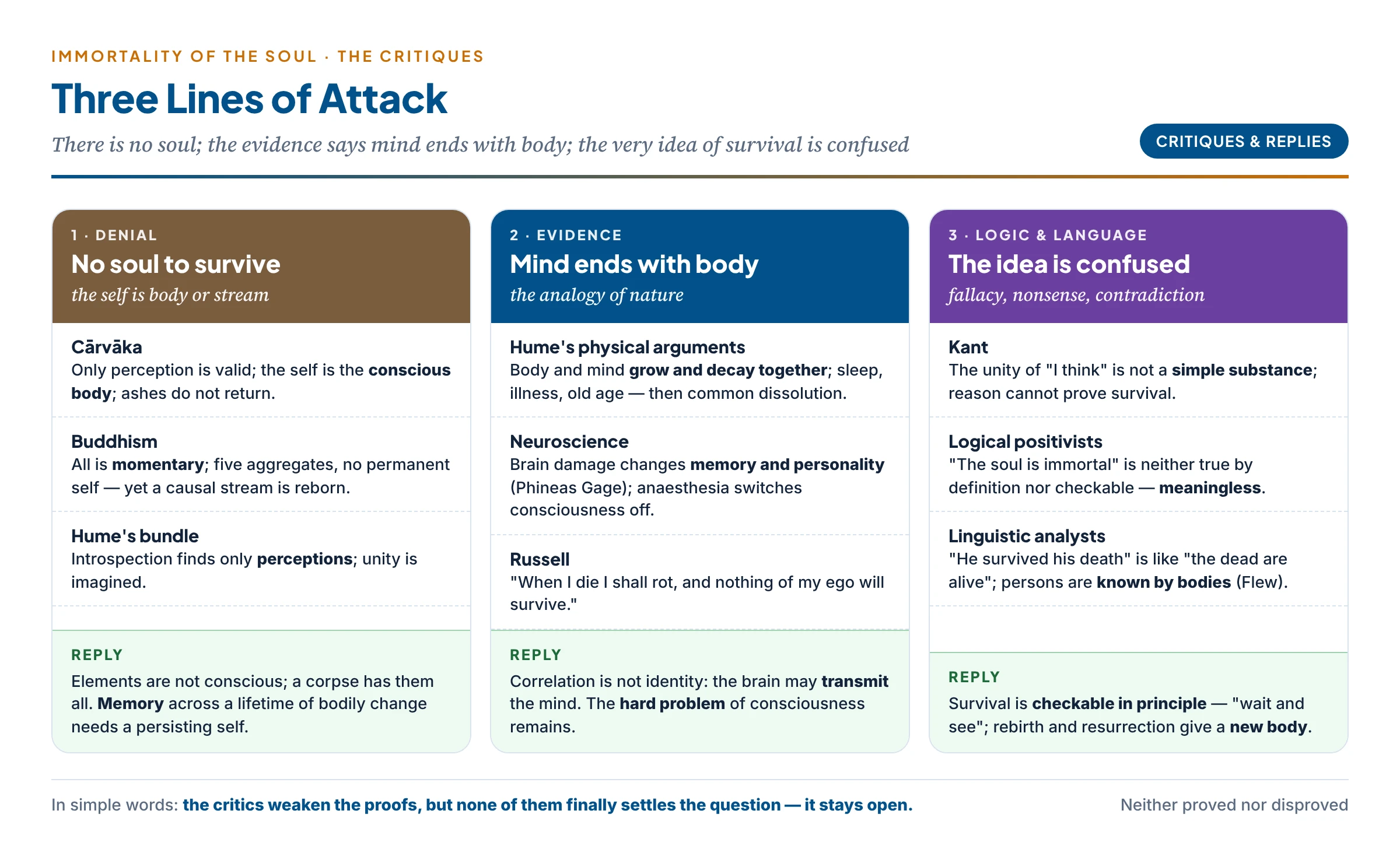
After the arguments for immortality (Articles 2–3) come the arguments against. Some critics deny that there is any soul to survive (Cārvāka, Buddhism, materialism); some point to the evidence that mind depends on body (Hume, modern neuroscience); some say that talk of survival is meaningless or self-contradictory (logical positivists, linguistic analysts). This article sets out these critiques with the replies made to them, and then takes up the great evaluative questions UPSC asks again and again: Why does man desire immortality? Is the idea utopian or realisable? Can immortality be rationally understood? And is it a necessary presupposition of religion?
In simple words
A child asks: “Where does the flame go when you blow out the candle?” One adult says: “Nowhere — the flame was just the burning wax and wick.” Another says: “It has gone back to the fire in the universe.” A third says: “Your question is badly put — a flame is not a thing that ‘goes’ anywhere.” These are the three kinds of critic of immortality: the materialist, the sceptic who finds no evidence, and the philosopher of language who thinks the question itself is confused.
Context & Problem
Three Kinds of Criticism
- Denial of the soul: there is no permanent, immaterial self — so nothing to be immortal (Cārvāka, Buddhism, materialism, Hume’s bundle theory).
- Empirical objection: everything we observe shows that the mind rises, weakens and fails with the body — so it must end with the body (Hume’s physical arguments, neuroscience).
- Logical and linguistic objection: statements about the soul’s survival are unverifiable and so meaningless (logical positivism), or self-contradictory (linguistic analysis), or rest on a fallacy (Kant’s paralogisms).
Why the Critiques Matter
- They decide whether immortality can be a matter of knowledge, of rational hope, or only of faith.
- They also force religion to ask whether its core really depends on personal survival — or on something else, such as eternal values or liberation.
Core Doctrine
1. The Cārvāka Critique
- Perception alone is valid knowledge (pratyakṣam evaikaṃ pramāṇam). The soul is never perceived, so it cannot be known to exist as a separate substance — still less to be immortal.
- The self is the conscious living body (dehātmavāda): consciousness arises from the four elements in a certain combination, as intoxicating power arises from fermented ingredients or red colour from chewing betel leaf, nut and lime. When the body disintegrates, consciousness vanishes.
- Ordinary speech supports this: “I am fat“, “I am lean“, “I am going” — we identify ourselves with the body.
- No evidence of departure: no one has ever seen a soul leave a body or enter another.
- No return: if a soul could go to another world, why does it not come back out of love for the relatives it left weeping?
- No memory: if the soul existed in earlier lives, why do we not remember them?
- Conclusion: “Once the body is reduced to ashes, how can it ever return?” Death itself is liberation (maraṇam eva apavargaḥ); so “while life is yours, live joyously”.
Replies by the other Indian schools
- If consciousness were a property of the elements, it would be found in each element — but no element is conscious; and a dead body has all the elements but no consciousness.
- The red colour of betel is present in its parts; consciousness is not present in any part of the body.
- Memory across a lifetime in which every particle of the body is replaced shows a persisting self: “I who was a child am now old.”
- Perception itself needs a perceiver; to deny the self is to presuppose it.
- “I am fat” is a figurative use; we also say “my body“, which implies an owner distinct from the body.
2. The Buddhist Critique
- Everything is momentary (kṣaṇikavāda) and conditioned (pratītyasamutpāda); the soul is no exception. There is no permanent, unchanging, eternal substance — so no immortal soul.
- The self is the five aggregates, constantly changing; belief in a permanent self (satkāyadṛṣṭi) is itself the root of craving and suffering.
- Yet Buddhism accepts rebirth: what continues is a causal stream, not a soul (Article 6).
- The unanswered questions: when asked whether the enlightened one (Tathāgata) exists after death, does not exist, both, or neither, the Buddha remained silent (avyākata). Such questions “do not lead to peace” — like asking who shot the arrow before letting the surgeon remove it.
- Nirvāṇa is not the immortality of a soul but the “deathless” state (amata) in which craving and the cycle of birth and death end.
3. Hume — the Strongest Empirical Critique
The bundle theory
- When I look into “myself”, I always stumble on some particular perception — heat or cold, love or hatred, pain or pleasure — and never catch myself without a perception. The self is “a bundle or collection of different perceptions“, and its unity is an illusion produced by the imagination.
- A bundle has nothing permanent to be immortal.
“Of the Immortality of the Soul” (published after his death, 1777)
- Opening: “By the mere light of reason it seems difficult to prove the immortality of the soul.” Arguments for it are metaphysical, moral or physical. Hume answers the first two (Articles 2–3) and turns the third against immortality.
- The physical arguments “from the analogy of nature are strong for the mortality of the soul” — and these “are really the only philosophical arguments which ought to be admitted with regard to this question, or indeed any question of fact”.
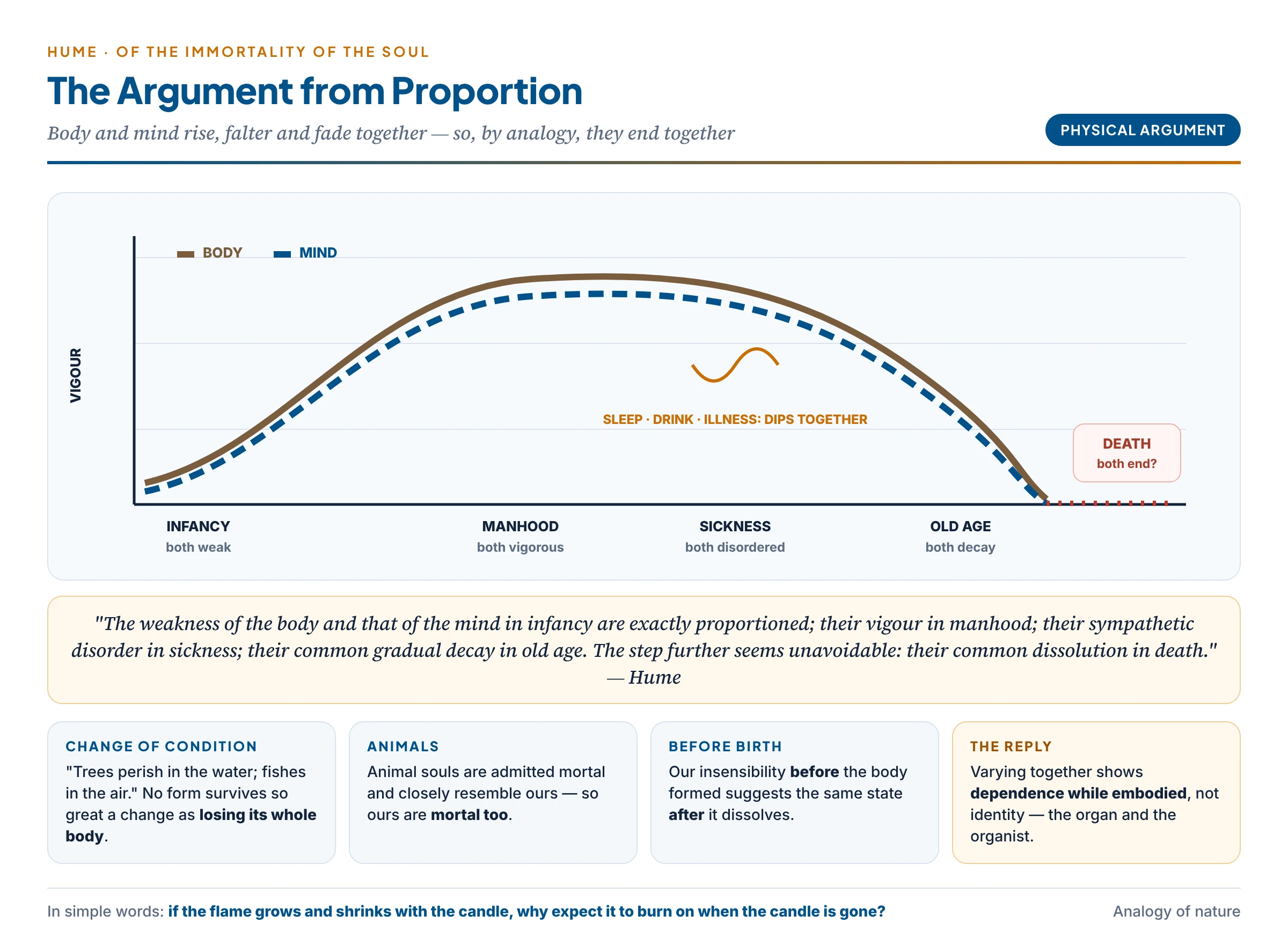
- Proportion: where two things are so connected that every change in one brings a proportionate change in the other, a total dissolution of the first should bring a total dissolution of the second.
- Sleep, a very small effect on the body, brings a temporary extinction (or great confusion) of the soul.
- Life-course: “The weakness of the body and that of the mind in infancy are exactly proportioned; their vigour in manhood; their sympathetic disorder in sickness; their common gradual decay in old age. The step further seems unavoidable: their common dissolution in death.“
- The last symptoms of the mind — disorder, weakness, insensibility, stupidity — are “the forerunners of its annihilation“.
- Change of condition: no form survives transfer to a very different condition — “Trees perish in the water; fishes in the air; animals in the earth.” How could the soul survive the immense change of losing its body and all its organs?
- Everything is in common between soul and body; “the organs of the one are all of them the organs of the other”.
- Animals: their souls are admitted to be mortal and closely resemble ours; so “metempsychosis is the only system of this kind that philosophy can so much as hearken to”.
- Nothing is perpetual: “Every being, however seemingly firm, is in continual flux and change” — how contrary to analogy that “one single form, seemingly the frailest of any”, should be immortal.
- Where to put them all? An infinite number of posthumous existences would require a new universe every generation.
- Before birth: “Our insensibility before the composition of the body seems to natural reason a proof of a like state after its dissolution.”
- The horror of annihilation: if this were an original passion, it would rather prove mortality — nature gives us a horror only of an unavoidable event, so that we may keep it at a distance.
- Suspect motives: “All doctrines are to be suspected which are favoured by our passions.” The hopes and fears behind this doctrine are obvious.
- Conclusion: “By what arguments or analogies can we prove any state of existence which no one ever saw, and which no way resembles any that ever was seen?” Only revelation — “the gospel, and the gospel alone” — could establish immortality (many read this as irony).
In simple words
A candle and its flame grow brighter as the wax is good, flicker when a wind blows, and shrink as the candle burns low. When the candle is finished, no one expects the flame to carry on by itself somewhere. Hume says mind and body behave exactly like flame and candle — so why should the mind be the one flame that outlives its candle?
Replies to Hume
- Correlation is not identity: mind and body vary together, but that shows dependence while embodied, not that mind is body — the organ and the organist (Article 3).
- Counter-examples: in some people mental and moral powers grow as the body declines; and the unity of consciousness and subjective experience remain unexplained by physical change.
- Hume’s own scepticism undermines confident denial: if we know nothing of substance, we cannot know that thought cannot exist without a brain.
4. Kant
- The metaphysical proofs commit the paralogisms — they mistake the logical unity of “I think” for a simple substance (Article 2).
- Theoretical reason can therefore neither prove nor disprove immortality.
- But Kant is not a denier: immortality returns as a postulate of practical reason (Article 3). So Kant’s critique limits knowledge to make room for faith.
5. Logical Positivism — “Meaningless”
- A statement is meaningful only if it is analytic (true by definition) or empirically verifiable.
- “The soul is immortal” and “the soul is mortal” are neither: no sense-experience could verify either. So it is meaningless to say that the soul is either mortal or immortal. Ayer: talk of an immortal, non-empirical soul is metaphysical and so literally nonsensical.
- Replies:
- Schlick, a founder of the movement, held that survival is verifiable in principle: “I can wait until I die.”
- Hick’s eschatological verification: if there is life after death, the believer’s claims will be verified then; if there is not, they will never be falsified — but one-sided verifiability is enough for meaning.
- The verification principle is itself neither analytic nor verifiable — it fails its own test.
6. Linguistic Analysis — “Self-contradictory”
- The argument: words like “person”, “I” and “survive” are learned and used for living bodily beings. To say “he survived his death” is like saying “the dead are alive” — a contradiction.
- Handout version: we say the soul exists within the body; how can one then claim that it exists when the body dies?
- Flew: persons are identified and individuated by their bodies; a disembodied “person” would have no principle of identity — how would we tell one bodiless soul from another, or know it was the same one? “I shall watch my own funeral” is not a possibility but nonsense.
- Wittgenstein: “Death is not an event in life: we do not live to experience death.“
- Ryle: the soul is a ghost in the machine — a category mistake, like asking where “the university” is after being shown the colleges.
- Replies:
- Language can be extended: Hick’s replica stories show how “same person” might reasonably be applied to a person who dies and reappears (Article 5).
- Rebirth and resurrection doctrines claim survival in a new body, not as a bodiless “person” — Flew’s objection bites mainly on disembodied survival.
- “Dead” in “survived death” means the body’s death, not the person’s — so there is no strict contradiction unless one already assumes that a person is his body.
7. Materialism and Modern Neuroscience
- Mind–brain identity theory: mental states are brain states.
- Evidence: damage to particular brain regions abolishes particular abilities — speech, memory, recognition of faces, moral restraint. Phineas Gage (1848), a railway foreman, survived an iron rod through his frontal lobe but became a different personality. Alzheimer’s disease erases memory and character; anaesthesia switches consciousness off; split-brain surgery seems to divide one consciousness into two.
- Conclusion drawn: the hypothesis of a disembodied soul “floating away” from a dead brain is biologically untenable.
- Russell: “I believe that when I die I shall rot, and nothing of my ego will survive.“
- Replies:
- The hard problem: no physical account explains why brain processes are felt — subjectivity cannot simply be reduced to matter.
- Transmission theory: dependence fits a brain that transmits as well as one that produces consciousness.
- Near-death and veridical out-of-body reports (contested) are offered as evidence of mind beyond brain.
8. The Problem of Personal Identity
- For disembodied survival, memory would be the only evidence of identity — but memory can be mistaken, and as Butler noted against Locke, memory presupposes identity and cannot by itself constitute it.
- Much of what we mean by “person” — seeing, acting, speaking — is tied to bodies; it is hard to say what a bodiless human person would be.
- For resurrection by re-creation, the problem becomes: is the re-created person me or a copy? (Article 5).
- So the decisive question is often not whether survival is possible but whether anything after death would be the same person.
9. Epicurus and Lucretius — Death Is Nothing to Us
- Epicurus: “Death is nothing to us: when we are, death is not; when death is, we are not.” A dead person feels no harm, so death should not be feared.
- Lucretius’s symmetry argument: we do not grieve over the endless time before our birth; the time after death is its mirror image — why fear it? (Hume makes the same point.)
- These thinkers do not merely deny immortality; they try to show that we do not need it for a good life.
In simple words
Before you were born, the world went on for billions of years without you — and it did not hurt at all. Epicurus and Lucretius say: after death will be just like before birth. The believer replies: but I exist now, I love people now, and I have unfinished hopes — the “before” did not take anything away from me, the “after” seems to.
Is Immortality Even Desirable?
- Unamuno (Spanish thinker): “I do not want to die — no; I neither want to die nor do I want to want to die; I want to live for ever and ever and ever.” Even as a child, nothing seemed so horrible to him as nothingness.
- Bernard Williams (the “Makropulos case”, after a play in which a woman lives for over three hundred years): an endless life of the same person would eventually become unbearably boring — the projects that give life meaning would be exhausted.
- Bleak disembodiment: a bodiless existence of dream-like images or “thoughts alone” seems a thin and impoverished life, hardly worth wanting.
- Indian view: endless continuation in the cycle of birth and death is not a hope but bondage; the goal is release from it.
Why Does Man Desire Immortality?
- Instinct of self-preservation and the fear of death: every living being clings to life; human beings, aware of their death in advance, dread annihilation.
- Love and the hope of reunion: we cannot accept that those we love are simply gone; immortality promises reunion.
- Unfinished purposes: no human life completes its projects — “a Newton, a Kant, a Gandhi” still had more to do (Article 3).
- The demand for justice: the good suffer and the wicked prosper; we long for a world where justice is finally done.
- The sense of the infinite: human beings can think of the eternal and long for it — “there is no happiness in the small; the infinite alone is happiness” (Chāndogya Upaniṣad).
- Self-transcendence: in moral and spiritual experience we feel ourselves to be more than the body — something “that pertains not to this wild death-element of Time”, as Carlyle put it.
- Religious teaching and social conditioning: belief is taught and reinforced; Hume adds that “unaccountable terrors” about the future would vanish if not “artificially fostered” by those who gain power from them.
- Wish-fulfilment: Freud held that “in the unconscious every one of us is convinced of his own immortality“, and that religious belief is an illusion born of wishes. Modern psychology speaks of the “denial of death” and of beliefs that protect us from the terror of mortality.
- Symbolic immortality: people seek to live on through children (biological), works (creative), faith (religious), nature and moments of transcendence — even those who reject personal survival.
- The oldest literature: the Epic of Gilgamesh, one of humanity’s first written works, is the story of a king’s failed quest for immortality; in the Kaṭha Upaniṣad, Naciketas asks Death himself what lies beyond.
- Two critical readings of the desire:
- Hume: the desire is no evidence; doctrines favoured by our passions are suspect.
- The Buddha: the craving for continued existence (bhava-taṇhā) is one of the three cravings that cause suffering (the Second Noble Truth). The desire for immortality is not a clue to the truth but part of the problem to be overcome.
- A positive reading: the desire may point to something real in human nature — our openness to the eternal — even if it does not prove endless survival.
Is the Idea of Immortality Utopian or Realisable?
Why it may seem utopian
- It has no logical proof (Kant) and no agreed empirical evidence; the strongest empirical considerations point the other way (Hume, neuroscience).
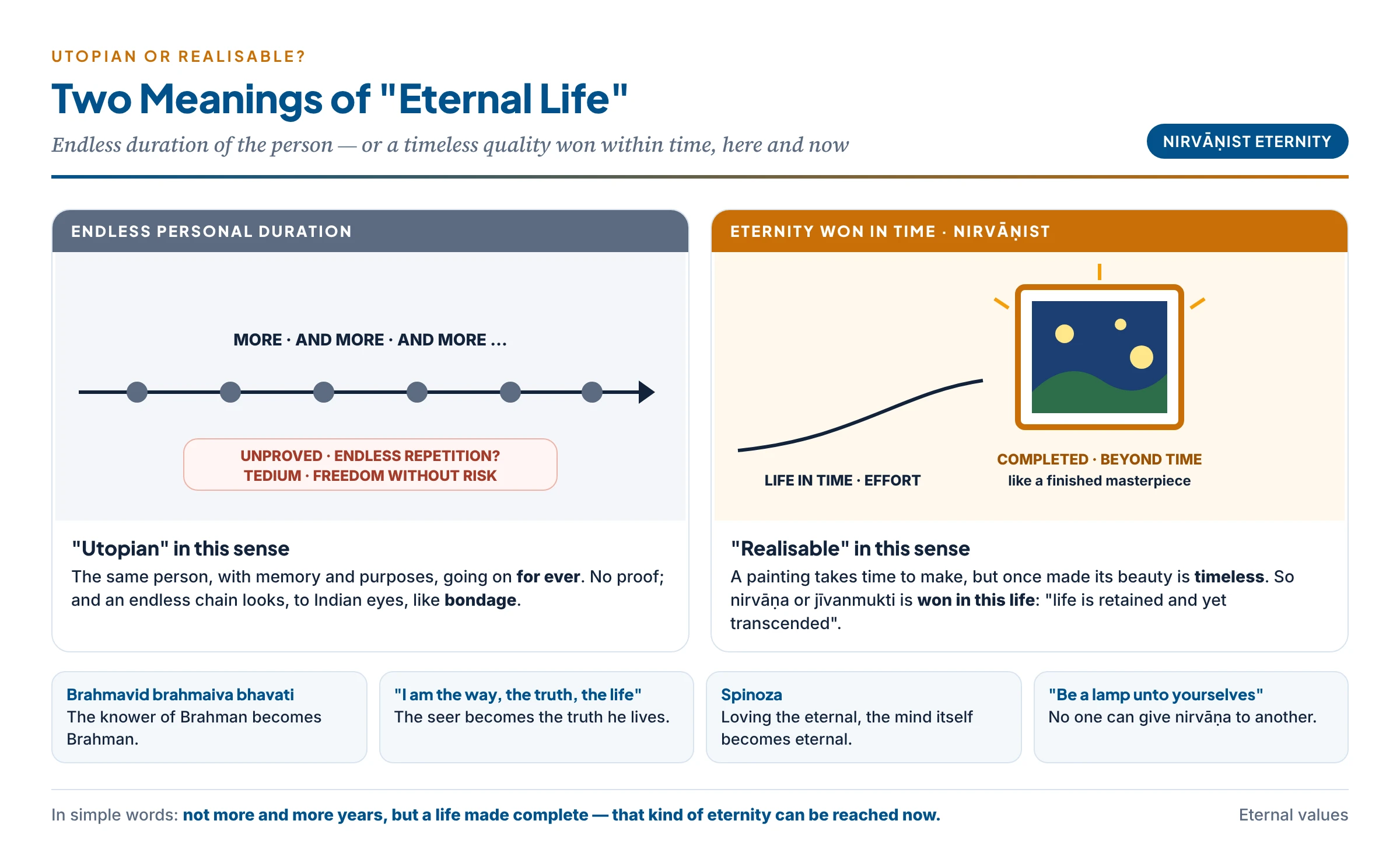
- Endless personal duration raises the problems of endless repetition, boredom and, in paradise, meaningless freedom without risk (Article 3).
- It may be a projection of wishes.
Why it may be realisable — the Nirvāṇist conception
- Eternal values: philosophical argument has been advanced more for the eternal life of values than for personal survival. When Socrates said that the difficulty is “not to avoid death but to avoid unrighteousness“, immortality was joined to a qualitative meaning.
- Pringle-Pattison held that “eternal life” in the New Testament is not a state that follows physical death but an “all-absorbing state of experiencing the love of God” here and now — a view the Vedāntins and the Nirvāṇists would fully endorse.
- Two eternities: the non-Nirvāṇist eternity is timeless, above all change (Plato). The Nirvāṇist eternity is realised in time by “an adventure of creation thrust into open possibilities”.
- Nirvāṇa is attained in this earthly frame; once attained, the person is secure from the endless chain of births and deaths. Timelessness is won through time: life is retained and yet transcended.
- The work of art: the Madonna, a great Passion music, the Starry Night — each took time to create, but once created it is “a thing of beauty”, beyond the accidents of time. So too a person can make himself a thing of value, a co-creator of value with God.
- Discoverers: what made Newton, Einstein, Gandhi, Śaṅkara immortal was their discovery and realisation, not the fact that they lived at a certain time and place.
- The seer becomes the truth: “He who knows Brahman becomes Brahman” (brahmavid brahmaiva bhavati); Christ said “I am the way, the truth and the life“. In spiritual adventure the seeker himself becomes timelessly true.
- Spinoza: by loving what is changeless and eternal (the intellectual love of God, amor intellectualis Dei), the mind is freed from the disturbances of passion and becomes itself eternal.
- A string of pearls: religion is not finding a ready-made string of pearls but becoming a shining string — a thing of value — by following the righteous path in full earnestness. Religious truths are made true.
- By one’s own effort: no one can confer nirvāṇa on another. The Buddha’s last words: “Be a lamp unto yourselves” (appo dīpo bhava). Such nirvāṇa is “neither selfish nor unselfish but selfless“.
In simple words
Think of the Taj Mahal. It took twenty years to build, with stones, labour and money spent in time. But what it achieved — its beauty — is not “lasting for a long time” in the way the stones are; it is simply there, complete, for anyone who sees it. The Nirvāṇist says a human life can be like that: not an endless queue of years, but a work completed — and in that sense eternal.
Verdict: as endless personal survival, immortality is unproved — closer to a hope than a demonstrated fact. As a qualitative eternal life — liberation, jīvanmukti, the life of eternal values — it is realisable here and now, and has been realised by saints, sages and seers.
Is a Rational Understanding of Immortality and Liberation Possible?
- Limits of reason: theoretical reason cannot prove immortality (Kant) and, by Hume’s standard, no experience reaches beyond death.
- What reason can do:
- Clarify concepts — the kinds of immortality, the meanings of liberation, the criteria of identity.
- Test arguments and expose fallacies (the paralogisms, the opposites argument).
- Show coherence or incoherence (disembodied persons, replicas, rebirth without a soul).
- Show what morality rationally requires us to hope (Kant).
- Indian approach: reasoning (manana) is a stage on the path — after hearing the teaching (śravaṇa) and before meditation (nididhyāsana); the final certainty is direct experience (anubhava). The Buddha invited people to “come and see” (ehipassiko) for themselves.
- Liberation is more open to reason than personal immortality: freedom from craving, ignorance and suffering can be understood and partly tested in this life — the jīvanmukta and the arhat are living evidence.
- Conclusion: a partial rational understanding is possible — reason can make immortality and liberation intelligible and defensible, but final assurance comes from faith or realisation.
Importance of the Idea of Immortality
Ethical and moral aspects
- Social argument: belief in a future life supports social order and moral restraint.
- Kant’s summum bonum: moral perfection and justice need a horizon beyond death.
- It helps people perform deeds without fear or favour.
- It gives the theory of karma its field of application.
Religious aspects
- It validates the theory of karma — “as you sow, so shall you reap“.
- It explains rebirth (in the Indian context) and resurrection (in the Semitic context).
- It explains the moral order of the universe.
- It is pivotal for liberation — escape from the cycle of birth and death presupposes a self that passes through it.
Is Immortality a Necessary Presupposition of Religion?
The case for “yes”
- Theism: if God is good and loving, he will not let persons perish — so belief in God and in immortality stand or fall together; those who find no reason for immortality may disbelieve in God.
- Theodicy: no answer to the problem of evil seems complete without an eschatological good that outweighs suffering.
- Christianity: Paul argued that if the dead are not raised, faith is futile — “let us eat and drink, for tomorrow we die”. A modern philosopher adds: “apart from the possibility of resurrection, it seems a mere illusion to have any hope for life after death“.
- Indian religions: karma, rebirth and mokṣa all presuppose a self (or stream) that continues beyond one life.
- Meaning: religion offers ultimate meaning; if death ends everything, it is argued, ultimate meaning collapses.
The case for “no”
- Early Judaism focused on God’s covenant with the nation; the dead went to a shadowy Sheol, and the priestly Sadducees denied resurrection — yet theirs was fully a religion.
- Buddhism denies a permanent soul and refuses to answer whether the enlightened one exists after death — yet it is one of the great religions.
- Confucius: “We do not yet know life; how can we know death?” — religion as reverence and right living.
- Spinoza, Tillich and the “eternal life” view: what matters is a quality of life now, not endless duration.
- Non-cognitive views (Braithwaite): religious language expresses commitment to a way of life, not predictions about the afterlife.
- Religions of humanity (Comte, Feuerbach) and much modern spirituality do without personal survival.
- Religion’s core may be the sense of the sacred, ultimate concern (Tillich), liberation from egoism, or devotion — none of which strictly requires endless survival.
Common confusion
“Without immortality, religion has no meaning” — is the statement simply true? Only if “immortality” is taken broadly. Personal, endless survival is not necessary — Buddhism, early Judaism and Confucianism show this. But some conception of transcending death and finitude — eternal values, the deathless state of nirvāṇa, union with the eternal, the “eternal life” of love — is found in almost every religion. A good answer separates these two senses.
Verdict
- Personal immortality is central to theistic religions and to Indian schemes of karma and liberation, but it is not essential to religion as such.
- What religion does seem to need is some relation to the eternal — a value, reality or state that death cannot touch.
Critical Evaluation
Assessing the Critiques
- Cārvāka and materialism rest on a narrow theory of knowledge (perception or science alone); they explain correlation but not subjectivity.
- Buddhism denies the soul but not survival in the form of a causal stream — its critique is of a substance, not of continuity.
- Hume’s physical arguments are the most serious: the analogy of nature strongly suggests mortality. But analogy yields probability, not proof, and Hume admits we know little about substance.
- Positivism fails by its own principle; linguistic analysis shows the difficulty of disembodied survival but not of embodied forms (resurrection, rebirth).
- Neuroscience shows the dependence of mind on brain in this life; whether that dependence is production or transmission remains a philosophical question.
The Final Conclusion of the Debate
- Immortality of the soul is neither proved nor disproved.
- Everyone argues from his own perspective — scientific, moral, religious, mystical.
- It is the natural craving of human beings that keeps the question alive — and that same craving, the Buddha warned, may be the very thing to be overcome.
Critics and Defenders
Criticism — The critics of immortality
- Cārvāka: no perception of a soul; the self is the conscious body; ashes do not return.
- Buddhism: no permanent self; craving for existence causes suffering.
- Hume: mind and body grow and decay together; their “common dissolution in death” follows.
- Positivists and analysts: survival talk is meaningless or self-contradictory; persons are bodies.
- Neuroscience and Russell: damage the brain and the self changes; “when I die I shall rot”.
Defence — The defenders of immortality
- Nyāya, Jaina, Vedānta: elements are not conscious; memory across bodily change proves a persisting self.
- Lodge and James: the brain may transmit the mind; correlation is not identity.
- Schlick and Hick: survival is verifiable in principle — wait and see.
- Kant: theoretical reason cannot disprove it; morality postulates it.
- Nirvāṇist view: eternal life is a quality realised here and now — open to no materialist refutation.
Cross-Tradition Comparison
| Critique | Western | Indian | Shared point |
|---|---|---|---|
| No soul-substance | Hume‘s bundle | Buddhist pañcaskandha | The “self” is a changing collection |
| Mind depends on body | Hume, Russell, neuroscience | Cārvāka dehātmavāda | Consciousness ends with the body |
| Limits of reason | Kant‘s paralogisms | Buddha’s unanswered questions; Advaita: self known by realisation, not proof | Reason cannot settle the afterlife |
| Don’t fear death | Epicurus, Lucretius | Cārvāka: “while life is yours, live joyously” | Live well without the afterlife |
| Eternal life now | Spinoza, Tillich, Pringle-Pattison | Jīvanmukti, nirvāṇa | Eternity as quality, not duration |
Indian Connect — Indian Connect — the deathless is not the endless
- Indian thought reverses the Western hope. An endless series of lives is saṃsāra — “repeated death”.
- What is sought is the deathless (amṛta in the Upaniṣads, amata in Buddhism): a state outside the chain of births and deaths.
- So the Indian answer to “Is immortality necessary for religion?” is: endless survival is the problem; deathlessness is the goal.
Synthesis (Siddhānta)
- The critiques come from three directions: denial of the soul (Cārvāka, Buddhism, materialism), empirical analogy (Hume, neuroscience) and logical-linguistic analysis (Kant, positivists, analysts). Each damages the metaphysical proofs, but none conclusively disproves survival — the debate ends in agnosticism about personal immortality.
- The desire for immortality is rooted in self-preservation, love, unfinished purposes, the demand for justice and the sense of the infinite; it is no proof (Hume), and for the Buddha it is a form of craving to be overcome.
- Immortality as endless personal duration is unproved and perhaps undesirable; as qualitative eternal life — the Nirvāṇist conception, jīvanmukti, Spinoza’s eternal mind — it is realisable here and now.
- Rational understanding of immortality and liberation is partial: reason clarifies and tests, but final assurance comes from faith or realisation.
- Religion needs not personal survival as such but some relation to what death cannot touch.
- Contemporary relevance: brain science, palliative care, debates on digital immortality and the psychology of death anxiety keep these old questions practical.
“Death is nothing to us: when we are, death is not; when death is, we are not.” — Epicurus
Previous Year Questions
- 2020The concept of ‘Immortality’ is a basic presupposition of religion. Elaborate your answer.
- 2017Discuss whether the doctrine of immortality of soul is indispensable for a religion.
- 2012Is the idea of immortality of soul utopian or it is realizable? Discuss.
- 2011Is a belief in the immortality of the soul a necessary precondition for religion? Discuss.
- 2009Explain why man has a desire for immortality.
- 2008Possibility of rational understanding of immortality and liberation. Critical notes.
- 2007Without some conception of immortality, religion has no meaning. Critically examine.
- 2006Without some conception of immortality, religion has no meaning. Critically examine.
- 2005Without some conception of immortality, religion has no meaning. Critically examine.